I’ve launched seven different online businesses over the past decade. Three of them failed within six months. Two limped along for a year before I pulled the plug. Only two became profitable enough to quit my day job.
The difference between success and failure wasn’t execution quality or marketing tactics. I wasted months on the failures because I didn’t know how to spot the warning signs early. It was recognizing the red flags that your business idea is not viable before wasting months of weekends and thousands of dollars. This article shows you what to look for so you can make a confident go or no-go decision before you commit.

- •What Is a Non-Viable Business Idea?
- •1. Nobody's Searching for Your Solution
- •2. You Can't Get Anyone to Pre-pay (Even at 50% Off)
- •3. Your Unit Economics Make No Sense at Small Scale
- •4. You're Trying to Educate a Market That Doesn't Exist yet
- •5. Your Idea Requires Skills You'd Need Years to Learn
- •6. The Competition Has Resources You'll Never Match
- •7. You've Lost Enthusiasm After Three Months
- 8. You're Only Continuing Because You've Already Invested
- •9. AI Will Automate Your Model Within 12 Months
- •What Most "Validation" Advice Gets Dangerously Wrong
- How to Test Your Idea in 90 Days (without Quitting Your Job)
- •Frequently Asked Questions
- •What Next?
What Is a Non-Viable Business Idea?
A non-viable business idea is one that cannot generate profit exceeding costs with the resources you have available. This definition matters because viability isn’t absolute.
It’s relative to your constraints. For solopreneurs juggling a day job, viability means something specific. Your business must be sustainable with 10-15 hours of weekly effort. It needs to reach profitability without venture capital or a team. Research shows 90% of startups fail, and most of these failures are predictable during the validation phase.
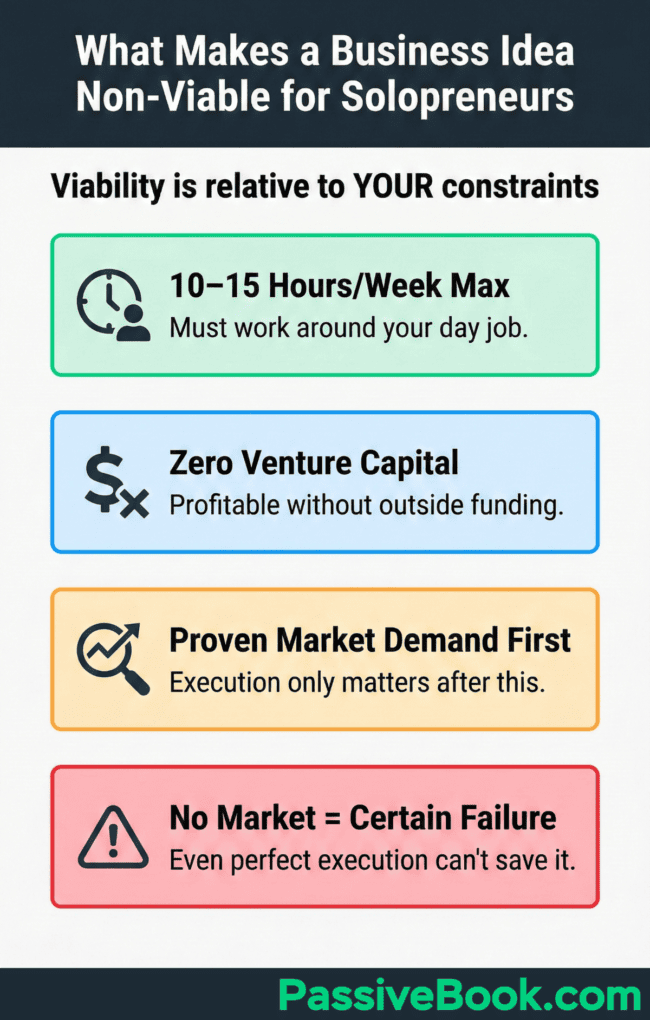
The critical distinction here is that a non-viable idea isn’t just a good idea with poor execution. Execution matters, but only after you’ve confirmed market demand exists. If nobody wants what you’re selling, even perfect execution leads to failure.
Viability requires proven market demand first, then execution capability second. Many aspiring entrepreneurs confuse these concepts. They assume their failed business idea just needed better marketing or a different pricing strategy. Sometimes that’s true, but the core problem was pursuing an idea the market didn’t want badly enough to pay for.
1. Nobody’s Searching for Your Solution
Zero monthly search volume means you’ll spend all your limited resources educating the market instead of converting ready buyers. When nobody is looking for what you’re selling, every customer requires convincing from scratch.
Failory’s startup database documents 42 companies that failed because of no market need. Most of these founders discovered the problem only after launch, when they’d already exhausted their savings and energy. The pattern is consistent: they ignored the red flags and built something nobody was searching for.
I learned this the hard way with a productivity app idea I was convinced would blow up. Spent three weeks researching features and pricing strategies. Never once checked if people were searching for “habit tracking for remote workers.” They weren’t. Wasted effort I’ll never get back.
Before you commit a single weekend to building your product, verify that people are seeking your solution right now. Use free tools like Google Keyword Planner or Ubersuggest to check monthly search volume for problems your business solves.
For solopreneur-scale businesses, look for these minimum benchmarks: At least 500 monthly searches for your primary solution keywords, or 1,000+ monthly searches for the problem you’re solving. Lower than this and you’re facing an audience that’s too small to support even a modest income. Higher search volume is better, but you’ll face more competition from established players.
Here’s what to look for: Are people typing questions about this problem into Google? Are they asking for recommendations in Reddit forums or Facebook Groups? If the answer is no, you’re facing an uphill battle that’s nearly impossible to win with 10-15 hours per week.
The harsh reality is that creating demand from nothing requires massive advertising budgets. That’s why venture-backed companies can afford to educate markets, but bootstrapped solopreneurs cannot. You need people already looking for solutions so you can focus on conversion rather than awareness.
2. You Can’t Get Anyone to Pre-pay (Even at 50% Off)
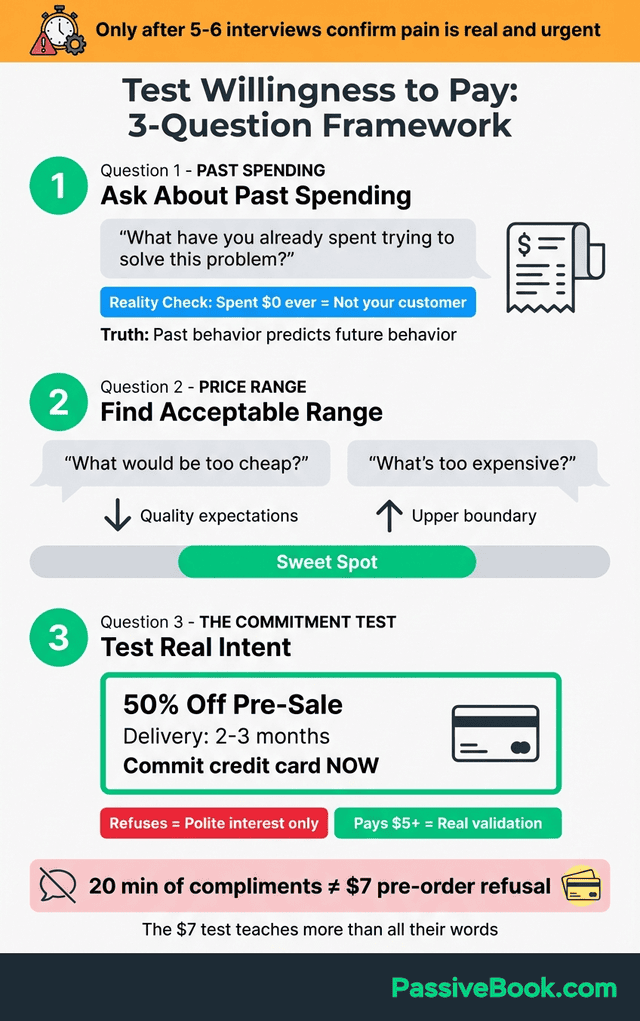
Customer enthusiasm means nothing without a credit card in hand. People will tell you all day long they’d “definitely buy that” or “this is exactly what I need.” These words are worthless until backed by payment.
Nathan Barry pre-sold ConvertKit to his blog audience before writing a single line of code. He secured $5,000 in monthly commitments from 23 early customers within the first month, validating that email marketing software designed for creators was something his audience would pay for. This pre-sale approach gave him the confidence and runway to build the product knowing demand was real.
Try this test: offer your product or service to 100 potential customers at a 50% discount in exchange for early access. If you can’t get even five people to prepay at half price, you don’t have proven demand.
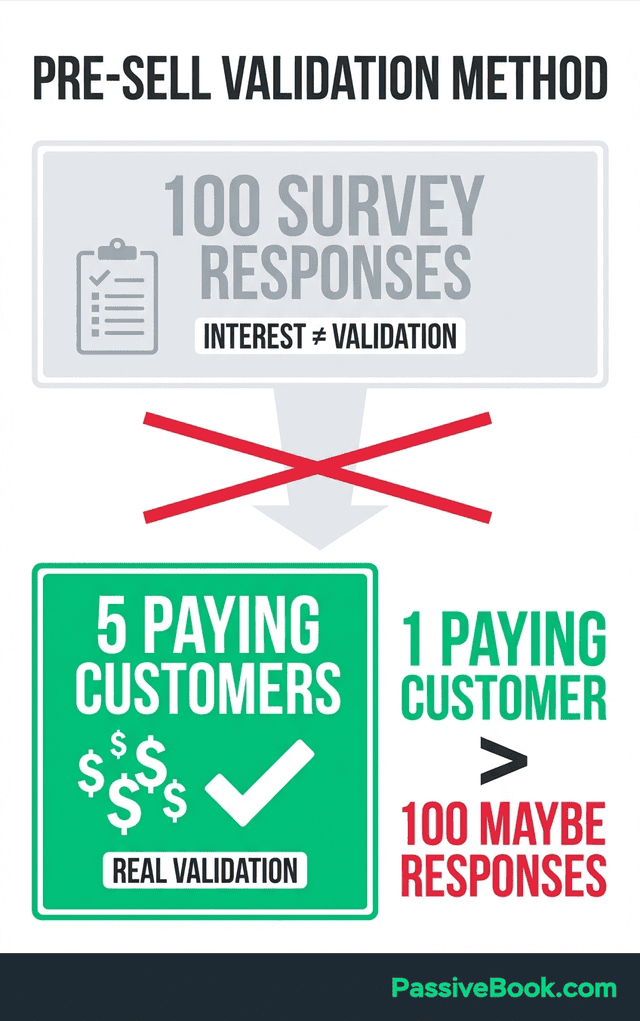
You have polite interest, which evaporates the moment you ask for money. Pre-selling validates the most important business question: will people exchange money for your solution? This matters infinitely more than survey responses or interview feedback. Payment is the only behavior that predicts market viability.
Pre-selling proves you have a viable product before you invest months building it. When you’re bootstrapping with limited capital, you cannot afford to build something nobody will buy. You collect revenue before spending time or money on development. If nobody prepays, you’ve lost a few hours of outreach instead of months building the wrong thing.
3. Your Unit Economics Make No Sense at Small Scale
Here’s the math that kills most solopreneur dreams: Calculate whether a single product service sale covers your customer acquisition cost plus an hourly rate equivalent to what you’re worth. If the math doesn’t work at small scale, it won’t magically improve with volume when you’re bootstrapping.
Research shows the average customer acquisition cost is $86 across industries, but ecommerce typically runs $45-$75 depending on your product and marketing channel. These numbers matter because they determine whether your business model can survive.
Here’s a concrete example: You’re selling $30 print-on-demand t-shirts. Production costs are $12 per shirt. You spend $25 in Facebook ads to generate each sale.
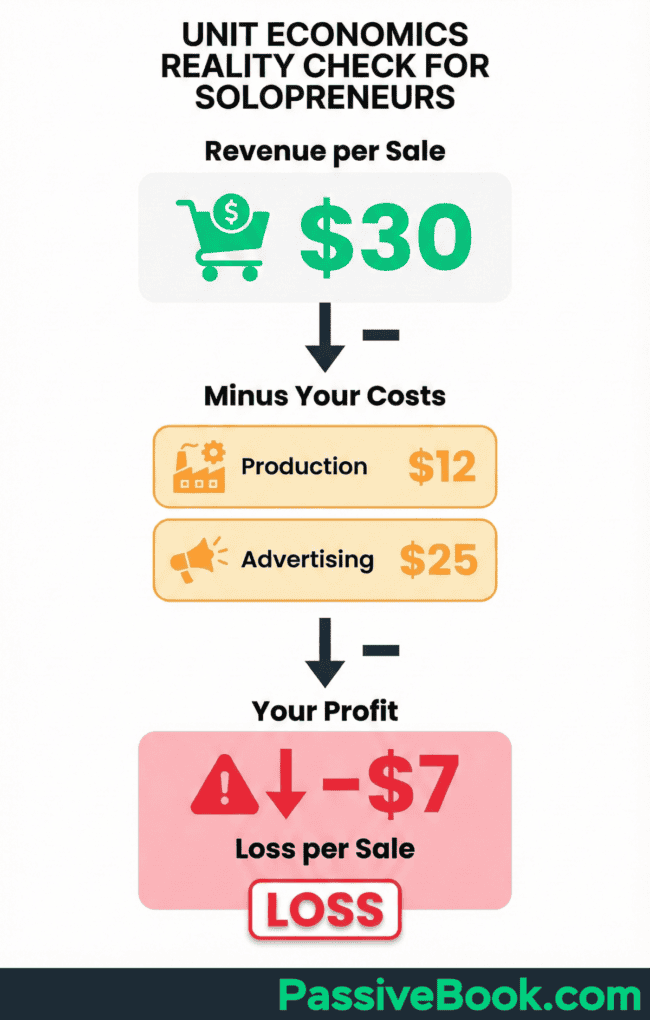
Your math looks like this: $30 revenue minus $12 production minus $25 advertising equals a $7 loss per transaction.
That’s a death spiral, not a business model.
I made exactly this mistake with a print-on-demand store. Got excited about $30 shirt prices, conveniently ignored that Facebook ads were costing me $28 per sale. Convinced myself “scale would fix it.” It didn’t. Math doesn’t lie, even when you want it to.
No amount of scale fixes this. You’re losing money on every sale. Unless you can dramatically reduce acquisition costs or increase prices, this business model is fundamentally broken. Yet many aspiring entrepreneurs convince themselves that higher volume will somehow solve the problem.
Cash flow problems kill businesses more than lack of demand does. About 82% of failed businesses cite cash flow issues as a primary cause. Most of these cash flow problems stem from unit economics that never made sense in the first place.
Before launching, map out the full cost structure of acquiring and serving one customer. Include advertising, payment processing fees, platform commissions, and your time valued at a reasonable hourly rate. If you can’t reach profitability at small volumes, you’re building a non-viable business for long-term business growth.
4. You’re Trying to Educate a Market That Doesn’t Exist yet
If your potential customers don’t even recognize they have a problem to solve, you’re too early for bootstrap budgets. Market education requires resources that solopreneurs simply don’t have.
Juicero raised $120 million from investors to create a WiFi-connected juicer for the home. The company failed when consumers discovered they could squeeze the juice packets by hand. The $400 device solved a problem that wasn’t significant enough to warrant the price or complexity.
This differs from validation methodology mistakes where you interview the wrong people. Market education issues mean even the right audience doesn’t recognize they have a problem worth solving. They’re not searching for solutions because they don’t know a better way exists.
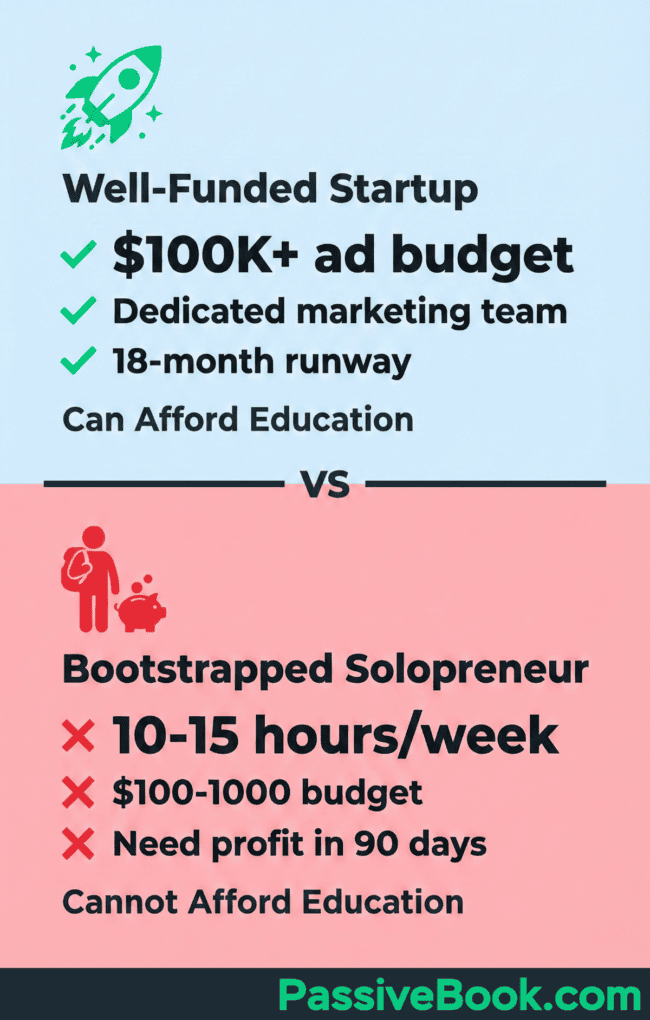
Content creators and online course builders succeed when audiences already know they have a problem to solve and are searching for guidance. Someone searching “how to start a podcast” knows they want to podcast and just needs guidance. But if you’re trying to convince people they should start podcasting in the first place, you’ve taken on a much harder challenge.
The test is simple: Can you find existing communities, forums, or search volume around the problem you’re solving? If people aren’t already discussing this pain point, you’ll burn through your limited time creating awareness instead of converting ready buyers. That’s a recipe for failure when you only have 10-15 hours per week to invest.
5. Your Idea Requires Skills You’d Need Years to Learn
Can you deliver what you’re planning to sell? With only 10-15 hours available each week, steep learning curves eat up all your launch time before you make a single dollar.
Founder-market fit matters enormously for bootstrapped entrepreneurs. You need to use existing expertise rather than starting from scratch in a completely new field. The time required to achieve professional-level competency in most technical domains spans years, not months.
Research demonstrates significant gaps exist between how people assess their own skills and their actual proficiency across professional domains.
This overconfidence causes aspiring entrepreneurs to underestimate learning timelines and launch products they’re not qualified to deliver.
I thought I could learn video editing “well enough” in a month to launch a YouTube channel. Six months later, I was still watching tutorials instead of publishing content. The gap between “functional” and “competitive” is massive in technical fields.
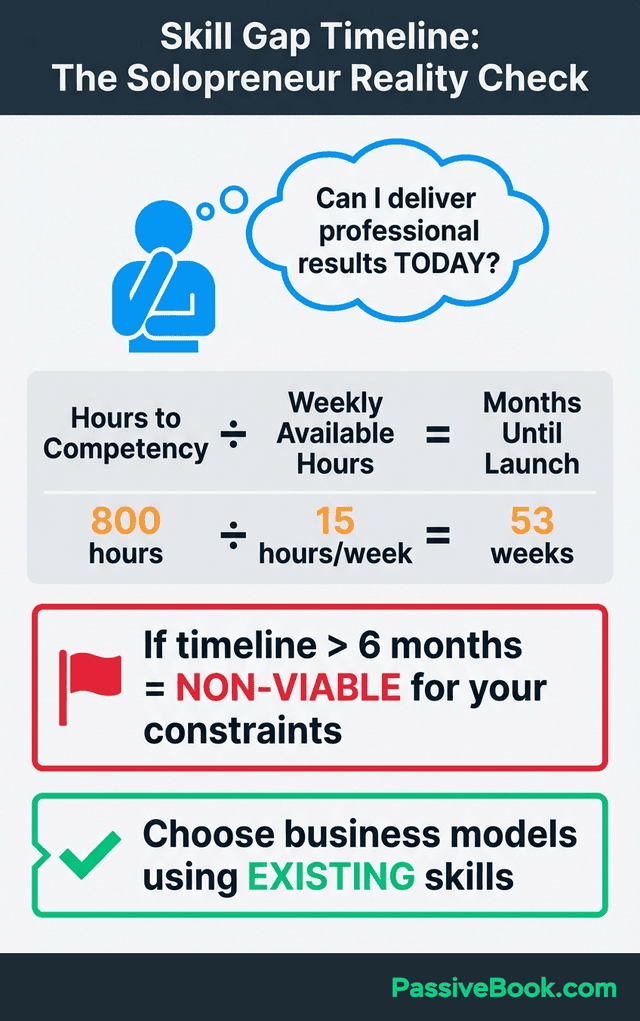
Technical businesses require either deep expertise or experienced partners to compete effectively. If you’re a writer trying to launch a software product with no coding experience, you’re facing an insurmountable challenge unless you bring on a technical co-founder. The same applies to any specialized field.
Ask yourself honestly: Could you deliver professional-quality results in this domain right now? If the answer is no, calculate how many hours you’d need to reach competency.
Divide that by your available weekly hours. If the timeline stretches beyond six months, you’re looking at a non-viable business idea for your current situation.
The solution isn’t to abandon entrepreneurship. It’s to choose business models that align with skills you already possess. Content creation, coaching, and service-based businesses often allow you to monetize existing expertise immediately rather than spending years in the learning phase.
6. The Competition Has Resources You’ll Never Match
Competing on price against established platforms or well-funded competitors is a battle you cannot win. They have economies of scale, existing customer relationships, and marketing budgets that dwarf your entire savings.
Thomas Frank built College Info Geek while competing against well-funded education platforms and universities. He used free YouTube hosting and a basic WordPress site instead of trying to match Coursera’s custom platform or university budgets. His constraints became advantages because students wanted relatable advice from someone like them, not corporate training modules.
The key question isn’t whether competition exists. Competition validates market demand. The real question is: What can I offer that better-funded competitors structurally cannot provide?
Your answer needs to be specific and defensible.
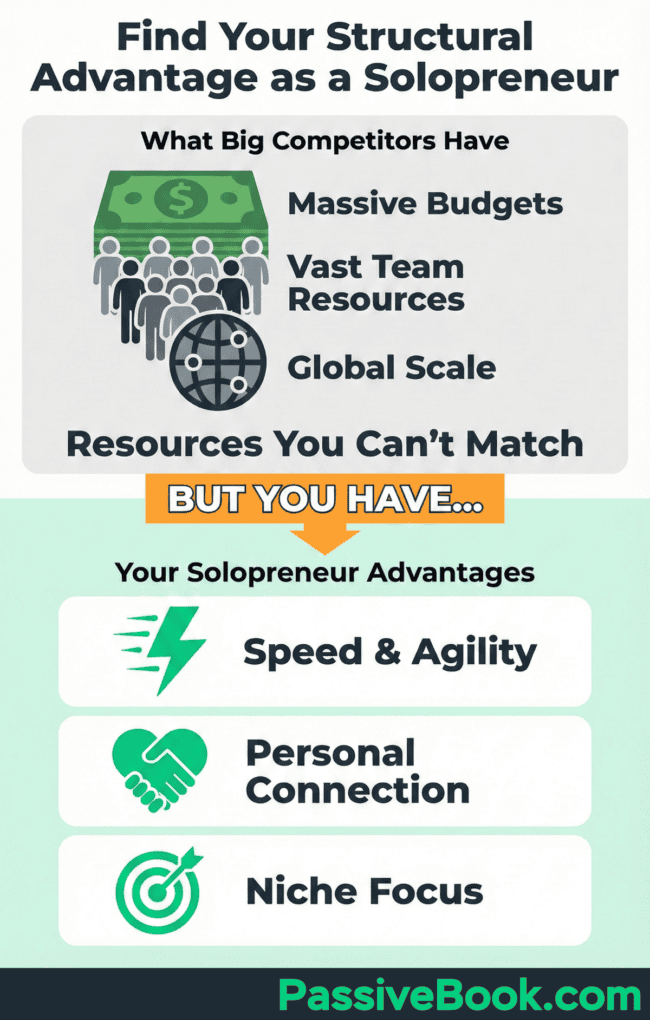
Small business owners succeed by finding underserved niches or delivering superior execution in ways that don’t scale. Maybe you offer personalized service that larger companies can’t match. Maybe you serve a micro-niche too small for big players to care about. Maybe you bring a unique perspective or background that resonates with a specific audience.
For solopreneurs, this might mean using free Notion templates while competitors sell premium productivity apps. Or creating content on free Medium instead of building a custom platform. The key is identifying what you can deliver better because you’re small, not despite it.
Before launching, identify your structural advantage. If your only edge is working harder or wanting it more, that’s not enough. Successful solopreneur businesses find angles that use their constraints as strengths. Being small and nimble becomes an advantage when you’re serving customers who feel ignored by larger alternatives.
If you can’t articulate a clear reason why customers would choose you over established competitors, you’re heading toward failure. Price alone isn’t a sustainable advantage when competitors can afford to lose money acquiring customers for their value over the long term.
7. You’ve Lost Enthusiasm After Three Months
I know this sounds obvious, but you’d be surprised how many people (including past me) ignore this: you need to like working on your business idea. Without authentic enthusiasm, every obstacle feels insurmountable and you’ll quit at the first serious difficulty.
I learned this the hard way with an affiliate site I built around insurance products. The niche showed decent search volume and commission potential, but I found the topic mind-numbingly boring.
After three months of forcing myself to write content, I dreaded opening my laptop. The business limped along for another six months before I finally shut it down.
Over 50% of entrepreneurs experience burnout from pursuing misaligned business ideas or maintaining unsustainable workloads. This isn’t just about feeling tired. It’s about the psychological drain of working on something that doesn’t genuinely interest you.
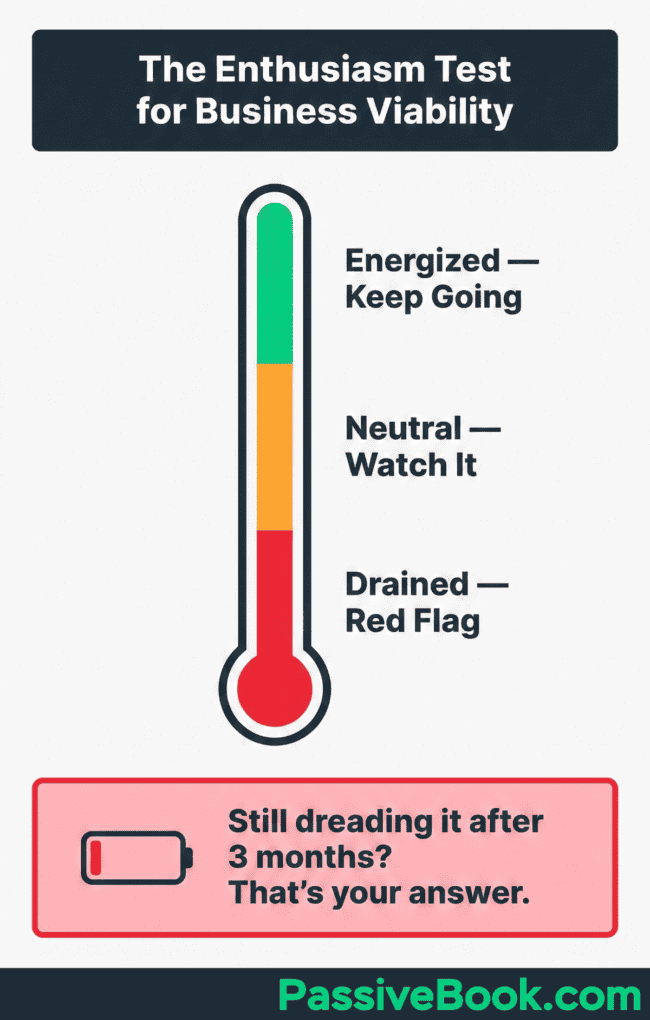
Here’s the test: Does thinking about your business idea energize or exhaust you? When you have free time on a Saturday afternoon, do you feel excited to work on it or do you find excuses to do something else?
Your emotional response reveals the truth about whether you’re going to stick with this long-term.
Your gut knows the truth even when your brain rationalizes.
If thinking about your business drains rather than energizes you, that lack of passion will compound every other challenge you face. You’ll struggle to push through technical difficulties, marketing setbacks, and slow initial growth. The business might be viable for someone else, but it’s not viable for you.
This doesn’t mean you need to be obsessed with your business every moment. Sustainable enthusiasm means you’re generally interested in the problem space and curious about solutions. You don’t mind spending weekend hours on it because the work itself feels meaningful or engaging.
8. You’re Only Continuing Because You’ve Already Invested
The sunk cost fallacy is one of the biggest red flags that you’re no longer making rational business decisions. This psychological trap is one of the most common reasons entrepreneurs waste years on non-viable ideas.
Tony Dinh sold his 2-year-old business for $128,000 after realizing continued investment in the wrong direction would waste more resources than pivoting. Walking away felt painful given the time invested, but quitting freed him to build new products that generated $45,000 per month within two years.
Here’s the permission-to-quit test: Would you start this business idea today knowing what you know now? If your gut says no, you’re only continuing because of past investment, not future potential.
That’s a terrible reason to keep going.
Past investment is economically irrelevant to future success. The time you’ve already spent and the money you’ve already lost are gone regardless of your next decision.
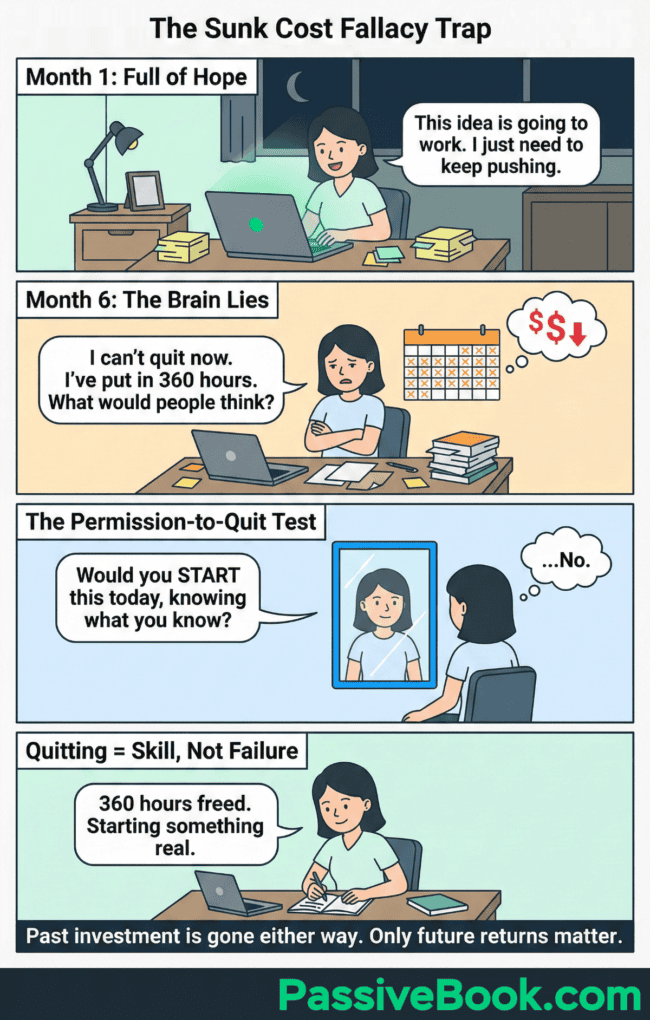
The only rational question is whether future investment of time and resources will generate positive returns.
This is the part where your brain lies to you. You’ve invested six months of Saturdays. You told your family this was going to work. Walking away feels like admitting you wasted all that time. That shame keeps you trapped longer than any rational analysis would.
You tell yourself you’ve come too far to quit now. You think about the months of weekends spent building your product. You feel embarrassed to admit failure after telling friends and family about your business. These feelings are understandable but they’re not valid business reasons.
The most successful entrepreneurs quit non-viable projects quickly. They recognize sunk costs for what they are and redirect their limited resources toward better opportunities.
Knowing when to quit is a skill, not a character flaw.
If your only reason for continuing is the time you’ve already invested, that’s not a reason. That’s the exact sign your business idea is not viable and it’s time to move on.
The Real Cost Isn’t Just Money – It’s Your Next Opportunity
Every hour you spend on a failing business idea is an hour you can’t spend on a viable one. This opportunity cost is invisible but devastating for solopreneurs with only 10-15 hours per week to invest.
Let’s make this concrete. If you spend six months pursuing an idea showing clear red flags, that’s 360 hours (assuming 15 hours weekly). Those same 360 hours could have validated three different ideas using the 90-day framework outlined later in this article. Your persistence on the wrong idea doesn’t just waste time. It prevents you from finding the right one.
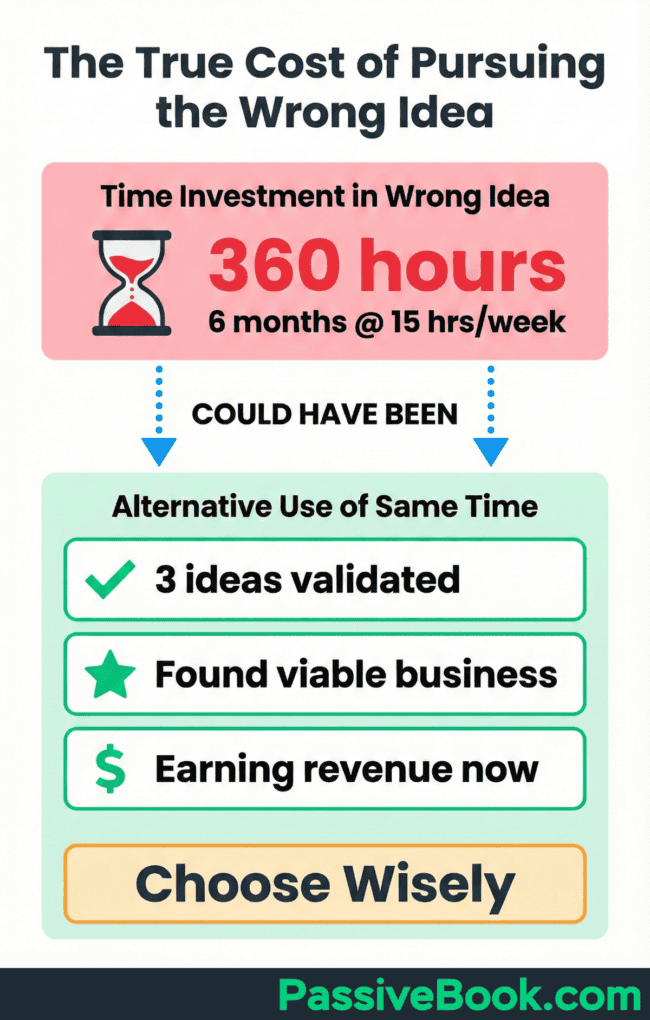
The question isn’t just “Is this idea viable?” It’s “Is this idea the best use of my limited resources?” When you only get one serious attempt before burning out or running out of money, choosing the wrong idea has cascading consequences that extend far beyond the immediate failure.
9. AI Will Automate Your Model Within 12 Months
Basic content creation, data entry, and generic consulting services face imminent commoditization from AI tools. If your entire business model can be replicated by ChatGPT or Claude, you’re building on quicksand.
Research shows 38% of AI-focused startups fail due to insufficient market differentiation or unrealistic technology promises despite initial excitement. But the bigger threat isn’t AI startups failing. It’s AI tools making certain business models obsolete for solopreneurs.
WordPress content sites focused purely on SEO traffic face direct competition from AI-generated content. If your monetization strategy relies on producing generic informational articles at scale, that advantage disappears when anyone can generate similar content in seconds with AI tools. If you’re building a blog purely for ad revenue using AI-generated posts, you’re competing with millions of others doing the exact same thing.
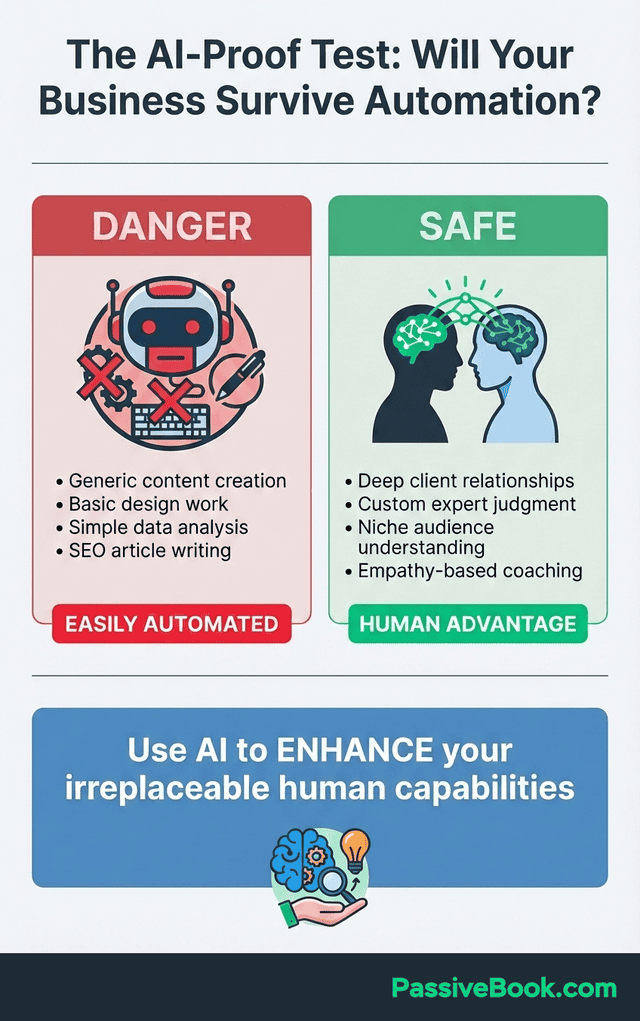
The future-proof test is straightforward: Does your business require irreplaceable human judgment, relationships, or creative insight? Can AI replicate 80% of the value you provide? If yes, you need to rethink your model before investing limited resources.
Half of what I do – writing blog posts, creating outlines, drafting email sequences – AI handles better than I did five years ago. The only reason I’m still competitive is the relationships I’ve built and the specific audience I understand. Without that human layer, I’d be obsolete.
This doesn’t mean avoiding AI entirely. The smartest solopreneurs use AI to enhance their unique human capabilities rather than competing directly with what AI does best. If you’re building a coaching business, AI can help you create content and marketing materials. But the coaching relationship requires human empathy and customized guidance that AI cannot replicate.
Service businesses that combine deep expertise with client relationships remain defensible. Products that solve specific problems for niche audiences stay viable. But generic content production, basic design work, and simple data analysis are increasingly difficult to monetize as AI capabilities expand.
What Most “Validation” Advice Gets Dangerously Wrong
Conducting 50 customer interviews without generating any conversions proves nothing about business viability. Talking to people doesn’t validate demand. Only purchasing behavior does.
This represents one of the most damaging misconceptions in startup advice. Founders spend months interviewing potential customers, meticulously documenting feedback, and refining their product based on suggestions. Then they launch to crickets because nobody bought anything.
I spent two months interviewing people for a course idea once. Got amazing feedback. Everyone said they’d buy it. Launched to zero sales. Turns out “this sounds great” and “I’ll pay $197 for this” are completely different commitments.
The Lean Startup methodology emphasizes validated learning where customer opinions mean nothing compared to behavior. Pre-payment or significant time investment from early adopters proves validation. Interview enthusiasm does not.
Analysis paralysis disguises itself as thoroughness. You convince yourself you need more research, more feedback, more data before making a decision. Meanwhile, this delays revenue-generating activities for months while burning through your limited time and motivation.
The solution is defining your minimum evidence threshold before you start validation, not after gathering data. Decide in advance: What specific behaviors or outcomes would prove viability? How many pre-sales do you need? What conversion rate from landing page to email signup would indicate interest?
Without predetermined criteria, you’ll keep moving the goalposts. When you get five pre-sales, you’ll tell yourself you need ten. When search volume looks decent, you’ll worry it’s not growing fast enough. This endless loop prevents you from making clear go or no-go decisions.
Set the threshold first. Collect the evidence. Make the decision. If you hit your predetermined criteria, move forward. If you don’t, either pivot or quit. But don’t fall into the trap of believing more customer interviews will somehow transform a non-viable idea into a viable one.
How to Test Your Idea in 90 Days (without Quitting Your Job)
This step by step validation framework fits within 10-15 hours per week while you keep your day job. The 90-day timeline forces decisive action instead of endless research.
I wish I’d followed this framework for my failed SaaS attempt in 2019. Would’ve saved me nine months of building features nobody wanted and $3,000 in development costs.
Week 1-4: The Problem Validation Phase
Email five to ten potential customers weekly asking about their biggest problems. Don’t pitch your solution yet. Your only goal is understanding whether the problem you’re planning to solve matters to them.
Conduct these conversations in social media communities like niche-specific Reddit forums or Facebook Groups where your target audience already gathers. Look for communities where people discuss challenges related to your business idea. The presence of these communities itself validates that people care about this problem space.
Track response quality and engagement levels carefully. Are people writing detailed responses about their pain points? Do they ask follow-up questions? High engagement signals genuine interest. Generic or brief responses suggest the problem isn’t significant enough to warrant a solution.
You can streamline this research phase using AI. Ask ChatGPT to analyze Reddit threads in your niche and identify the most frequently mentioned problems. Use it to draft initial outreach messages that feel personalized rather than templated. The tool won’t replace human conversations, but it accelerates the research and outreach process dramatically.
Week 5-8: The Willingness-to-Pay Test
Create a simple landing page using Carrd or WordPress that describes your solution clearly. Focus on the problem you solve and the specific results customers can expect. Keep the design minimal since you’re testing demand, not building a final product.
Offer a 50% discount to your first five customers in exchange for detailed feedback. This discount makes the ask easier while still requiring real payment.
If people won’t buy at half price, they definitely won’t buy at full price later.
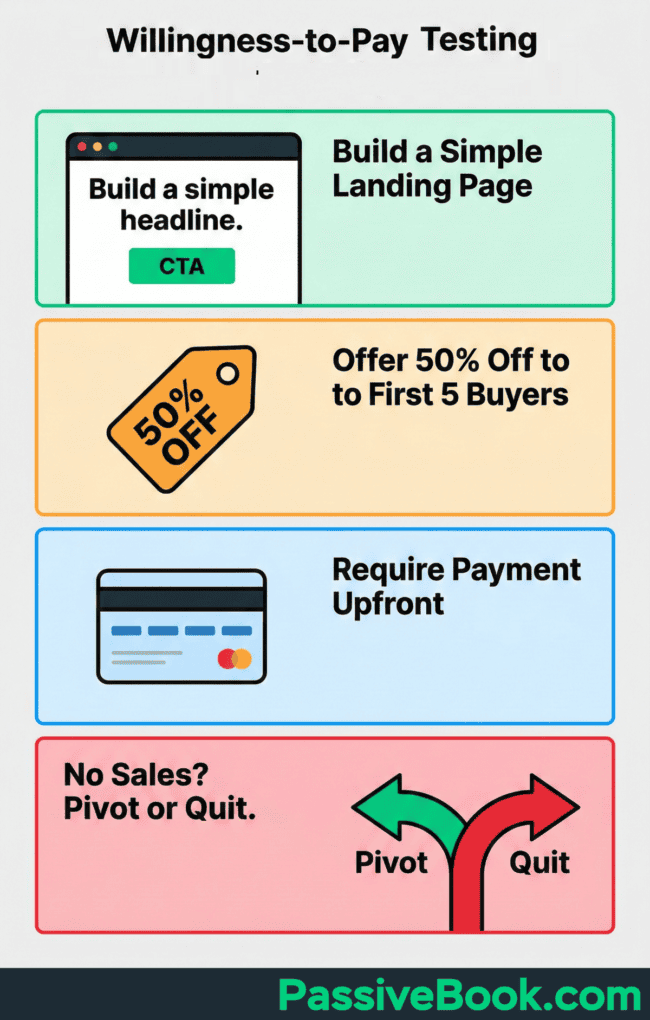
Require payment upfront even at these discounted rates using Stripe or PayPal. This is the critical test that separates genuine interest from polite encouragement. You can collect payments without building complex infrastructure. The goal is validating buying intent, not creating a perfect checkout experience.
Drive traffic to this landing page through the same communities where you conducted problem validation. You already have relationships there and understand the language that resonates. If you can’t generate five pre-sales from an audience that knows you and gets a 50% discount, your idea lacks sufficient demand.
Week 9-12: The Go/No-Go Decision Framework
By week nine, you have clear data about problem significance and willingness to pay. Now you make the decision using predetermined criteria you set back in week one.
Pivot signals look like good initial traction but wrong execution or pricing. Maybe you got interest in one aspect of your solution but not others. Maybe customers wanted a different format than you planned. These signals suggest adjusting your approach, not abandoning the core idea.
The hardest part of this decision is accepting that your initial assumptions were wrong. You probably told friends and family about this idea. You might have bought a domain name or set up social media accounts. None of that matters. The market has given you clear feedback. Listen to it.
Quit signals mean zero paying customers despite correct execution and clear messaging. If you followed the framework honestly, reached your target audience effectively, and still couldn’t generate pre-sales, the market has spoken. The idea isn’t viable for your constraints and resources.
Calculate your effective hourly rate if you did get some traction. Take the revenue you generated and divide it by hours invested. If this number falls below minimum wage after 90 days of focused effort, you need to seriously reassess whether this business can ever reach your income goals.
Rob Walling validated Drip by pre-selling to his podcast and blog audience before building any features. He secured paying customers who validated market demand before he invested significant development time. This methodical approach proves that validation works for bootstrapped founders willing to test ideas honestly.
The framework only works if you’re honest with yourself about the results. Don’t rationalize weak signals or move the goalposts when results disappoint. Trust the data and make a clean decision based on evidence, not attachment.
Frequently Asked Questions
How Do You Know If Your Business Idea Is Bad?
Your business idea is bad if nobody will prepay for it even at a steep discount. Conduct the willingness-to-pay test by offering your product or service to 100 people at 50% off in exchange for early access. If fewer than five people commit with payment, you lack validated demand and should abandon the idea or pivot significantly.
How to Check If a Business Idea Is Viable?
Check viability by validating three things: search demand exists, people prepay for your solution, and unit economics work at small scale. Use free keyword tools to confirm monthly search volume for your solution. Require prepayment from at least five early customers before building anything. Calculate whether one sale covers acquisition cost plus your time at a reasonable hourly rate.
How Do You Tell If a Business Is Not Doing Well?
A business is not doing well when your effective hourly rate falls below minimum wage after six months of consistent effort. Calculate total revenue divided by hours invested to determine your real hourly earnings. If this number stays low despite improving execution and messaging, the fundamental business model likely doesn’t work for your constraints and available resources.
How Can You Determine If a Business Idea Is Feasible?
Determine feasibility by testing whether you can deliver results with skills you already possess using 10-15 weekly hours. Map the complete customer journey from discovery to delivery and calculate realistic time requirements for each step. If total time exceeds your availability or requires expertise you’d need years to develop, the idea isn’t feasible for your current situation regardless of market demand.Use this three-question test: First, could you deliver one successful outcome to a customer this week if they paid you right now? Second, could you document your process clearly enough that you could repeat it consistently? Third, would doing this work energize or drain you? If you answered no to any question, the idea isn’t feasible yet.
What Next?
You now have a clear framework for evaluating whether your business idea is viable before wasting months of weekends and limited capital. The nine signs give you permission to quit ideas showing fatal red flags. The 90-day testing protocol shows you exactly how to validate demand with the constraints you face.
Most aspiring solopreneurs never make it past the idea stage because they can’t distinguish between viable opportunities and attractive distractions. You’re now equipped to make that distinction confidently. The hardest part is being honest with yourself about what the evidence shows rather than what you hope it shows.
If you found this framework valuable, use the share buttons below to help another aspiring entrepreneur avoid costly mistakes. Someone in your network is wrestling with these exact questions right now. Your share might save them from pursuing a non-viable idea.
I’d love to hear about your experience testing business ideas. Which of these nine signs resonated most with your situation? Have you already walked away from an idea after recognizing red flags, or are you currently evaluating something? Share your story in the comments below.
Share this post with your friends & followers: