Three years into my first online business, I was spending $600 monthly on ads, working until 2 AM most nights, and my email list had grown to 3,000 subscribers. On paper, it looked like progress.
But I hadn’t made a profit in 14 months, and my day job manager had just flagged my declining performance. I’d missed two project deadlines in one quarter – something that had never happened in my five years there. My savings had dropped from $8,000 to $1,200. I was one more bad month from losing both my business and my paycheck.
I faced the question every struggling solopreneur dreads: should I quit or pivot?
That moment taught me something most business advice ignores. The decision to quit or pivot isn’t about motivation or grit. It’s about recognizing specific, measurable signals that your current path is unsustainable. This guide breaks down exactly when it’s time to make that call, using data instead of emotion.

- •What "Quit" and "Pivot" Actually Mean for Solopreneurs
- •Your Cash Runway Has Less Than 6 Months Left
- •Customer Acquisition Cost Exceeds Lifetime Value by 3x
- •Your Health Metrics Are Declining
- •You Can't Articulate Your Value Proposition After 12+ Months
- •You've Tested 5+ Offers With Zero Traction
- •Your Day Job Performance Is Suffering
- •You Have Audience Engagement but No Sales
- •Customers Keep Asking for Something You're Not Offering
- •One Revenue Stream Outperforms All Others by 3x
- •You Dread Tasks You Once Enjoyed for 3+ Months
- When to Pivot: Testing Before Fully Committing
- •How to Make a Clean Exit Without Regret
- When Should You Quit Your Business?
- •What Next?
What “Quit” and “Pivot” Actually Mean for Solopreneurs
Most business owners conflate quitting with failure, but these terms have distinct strategic meanings. Understanding the difference helps you make decisions based on logic rather than shame.
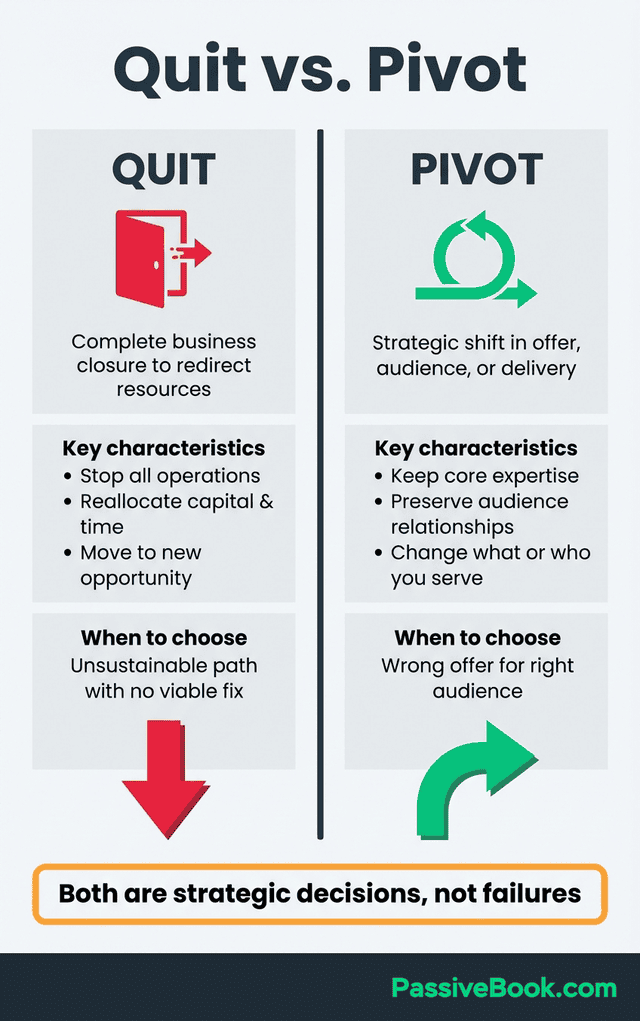
Quitting means complete business closure to redirect your time and capital elsewhere. You shut down operations, stop investing resources, and move on to a different opportunity or back to full-time employment. It’s not an admission of defeat. It’s a rational reallocation of finite resources when the data shows your current venture can’t deliver acceptable returns.
A pivot is a strategic shift in your offer, audience, or delivery method without abandoning the skills and relationships you’ve built. You keep your core expertise but change what you sell or who you sell it to. Most successful pivots preserve your existing audience while solving a different problem they actually pay to fix.
The stakes are real. Nearly half of all small businesses fail within five years.
But failure stems from continuing down the wrong path too long rather than making strategic changes when early signals appear.
The biggest obstacle to smart decision-making is emotional attachment to your original vision. What you’ve already invested – time, money, and identity – shouldn’t dictate whether continuing makes financial sense.
Successful entrepreneurs separate sunk costs from future opportunity costs. They evaluate future value objectively rather than irrationally continuing failing ventures because of past investment.
Your job as a solopreneur is to recognize which path makes sense before you drain your savings or damage your health permanently.
Your Cash Runway Has Less Than 6 Months Left
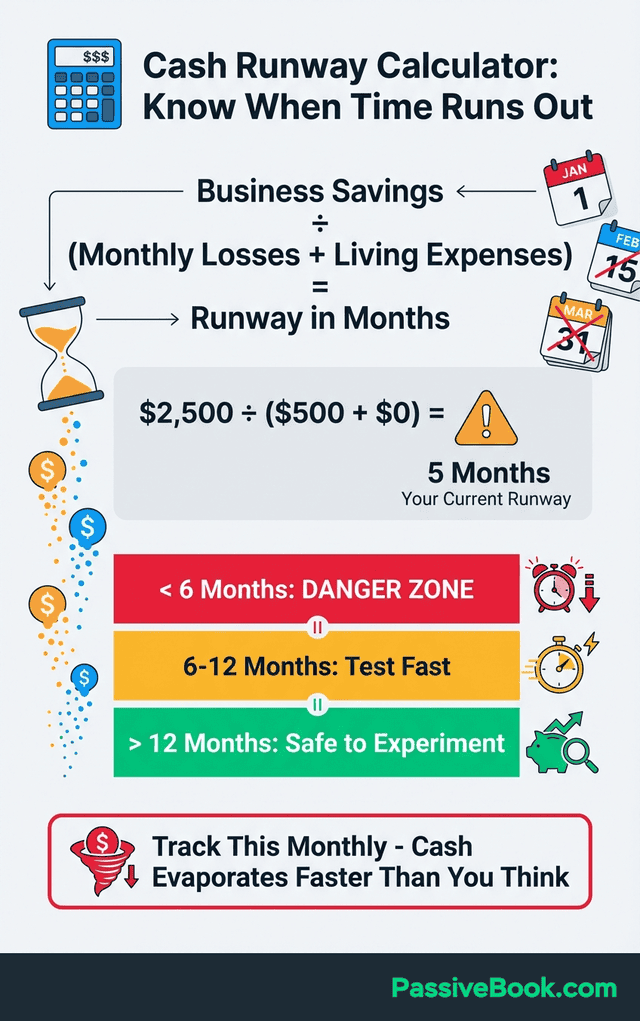
I learned this calculation after nearly draining my savings. Take your current business savings and divide it by your monthly business losses plus the minimum living expenses you need. That number is your runway in months.
If you’re burning $500 per month on your business with $2,500 in dedicated savings and no clear revenue growth trend, you have five months before you hit zero. Most solopreneurs underestimate how fast cash evaporates when you’re running experiments that don’t convert.
The numbers are brutal. Cash flow problems consistently rank as the top reason for small business closures. Not bad products or poor marketing, but running out of money before finding traction.
Emergency funds aren’t just safety nets. They protect your ability to pivot or restart later with fresh perspective and capital.
Draining your savings to $0 means your next venture starts from a position of desperation rather than strategic choice.
Calculate this number monthly. When it drops below six months, it’s time to either generate revenue immediately or make the exit decision before financial damage becomes permanent.
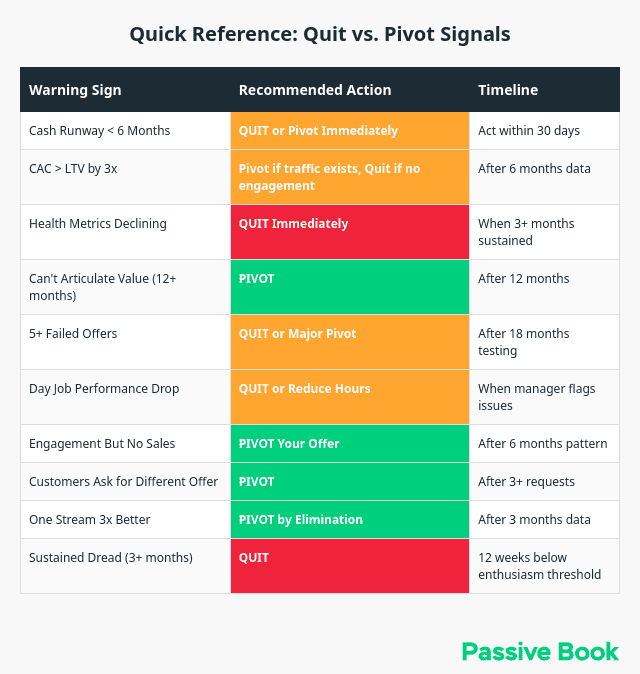
This sign indicates: QUIT or PIVOT immediately. With less than 6 months runway, you don’t have time to test major changes. Either generate revenue in 30 days or shut down before financial damage becomes permanent.
Customer Acquisition Cost Exceeds Lifetime Value by 3x
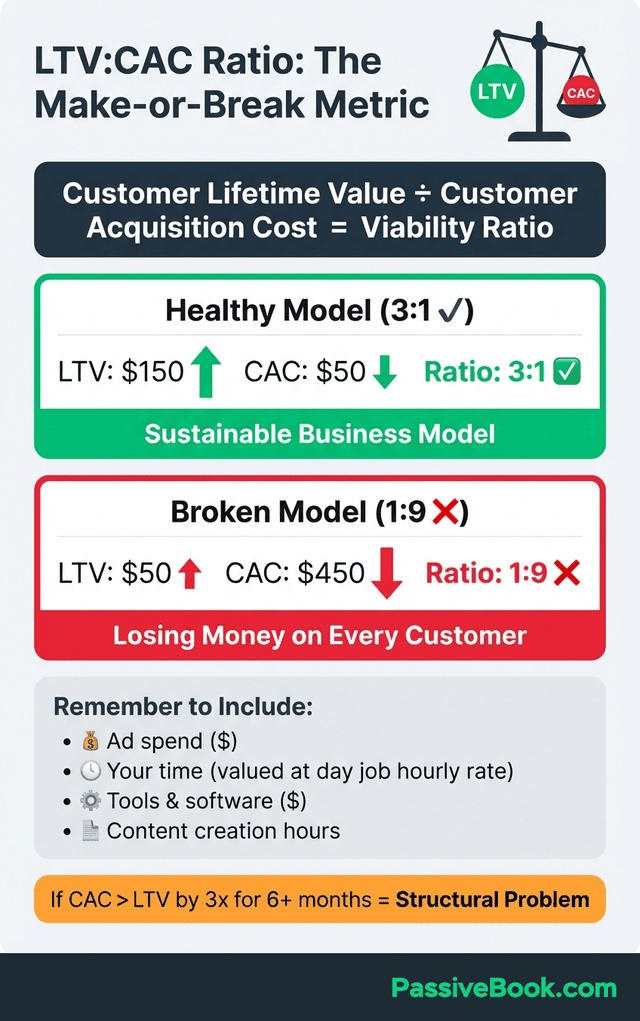
Track every dollar and hour you spend acquiring customers, then divide that by their total lifetime purchases. This ratio reveals whether your business model actually works.
Successful SaaS businesses maintain LTV:CAC ratios of 3:1 or higher for long-term sustainability. That means customers should generate at least three times what you spent to acquire them. For solopreneurs, this threshold matters even more because you can’t scale out of bad unit economics.
If you’re spending $150 in ads and 10 hours of your time (valued at $30/hr from your day job) to acquire customers who generate $50 in lifetime revenue, that’s $450 in total acquisition cost for $50 in return. Your economics are fundamentally broken. Even if you increase volume, you’re just losing money faster.
Calculate your hourly rate at your day job equivalent when tracking time as acquisition cost. If you earn $30 per hour at your job and spend 10 hours acquiring one customer, that’s $300 in opportunity cost plus any ad spend.
When your customer acquisition costs persistently exceed lifetime value by more than 3x for six months despite testing different channels, you’re facing a structural problem that pivoting or quitting must address.
This sign indicates: PIVOT if audience exists, QUIT if no engagement. Bad unit economics with traffic means wrong offer. No traffic means wrong market entirely.
Your Health Metrics Are Declining
Chronic sleep under six hours per night, anxiety requiring medication, or stress-related physical symptoms that persist for months signal your business is costing more than money. When your body starts breaking down, no amount of future success justifies the permanent damage.
The mental health crisis among entrepreneurs is well-documented. Depression, anxiety, and burnout actively sabotage the decision-making and consistency required to build anything sustainable.
These conditions don’t just feel bad – they guarantee failure by destroying your capacity to execute.
If relationship strain or declining work performance at your day job has lasted three or more months, your health outweighs any business potential. The irony is brutal: the stress from trying to succeed often guarantees you’ll fail by destroying your capacity to execute.
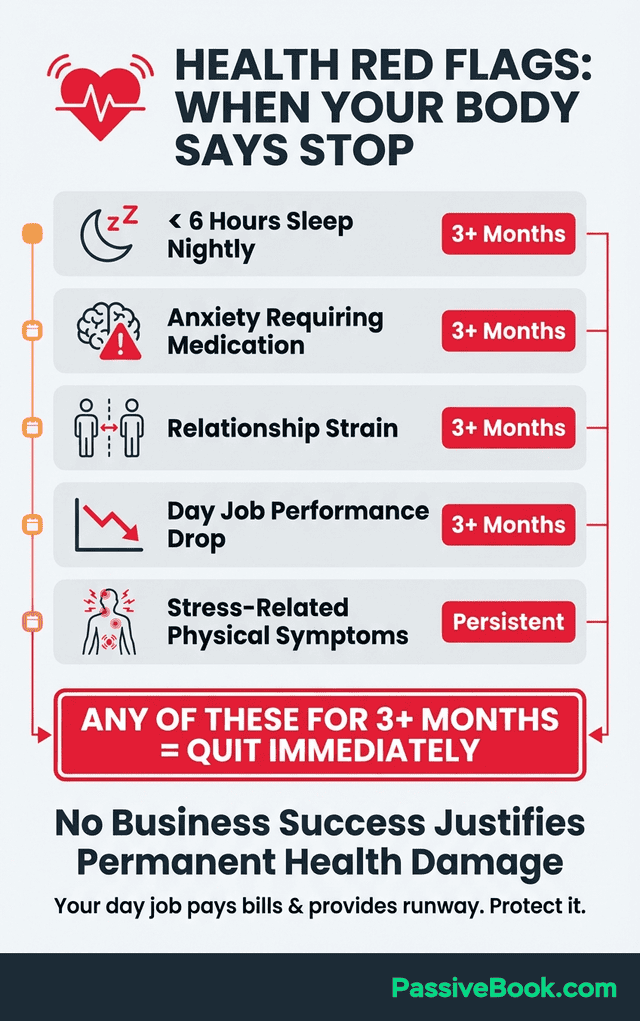
No side hustle success justifies permanent physical damage or losing your primary income source. Your day job pays for your living expenses and provides the financial runway to experiment. Sacrificing it for a struggling business eliminates your safety net entirely.
I tracked this in a simple spreadsheet – sleep hours, relationship quality, and day job performance reviews as business metrics. When these decline for a full quarter despite efforts to improve, it’s time to scale back or exit completely.
This sign indicates: QUIT immediately. No business success justifies permanent health damage. Scale back to protected time blocks or shut down completely.
You Can’t Articulate Your Value Proposition After 12+ Months
If you can’t explain what you do and who you help in one clear sentence after a year in business, you have a foundational problem. Constantly changing your bio, tagline, or positioning indicates you haven’t found product-market fit yet.
Unclear positioning consistently ranks as a top marketing challenge. But for established businesses, this becomes an existential crisis rather than just a marketing problem.
Prospects consistently misunderstand your offering or ask “so what exactly do you do?” after reading your website. If you’re explaining your business differently to every person depending on their questions, you haven’t crystallized your core value.
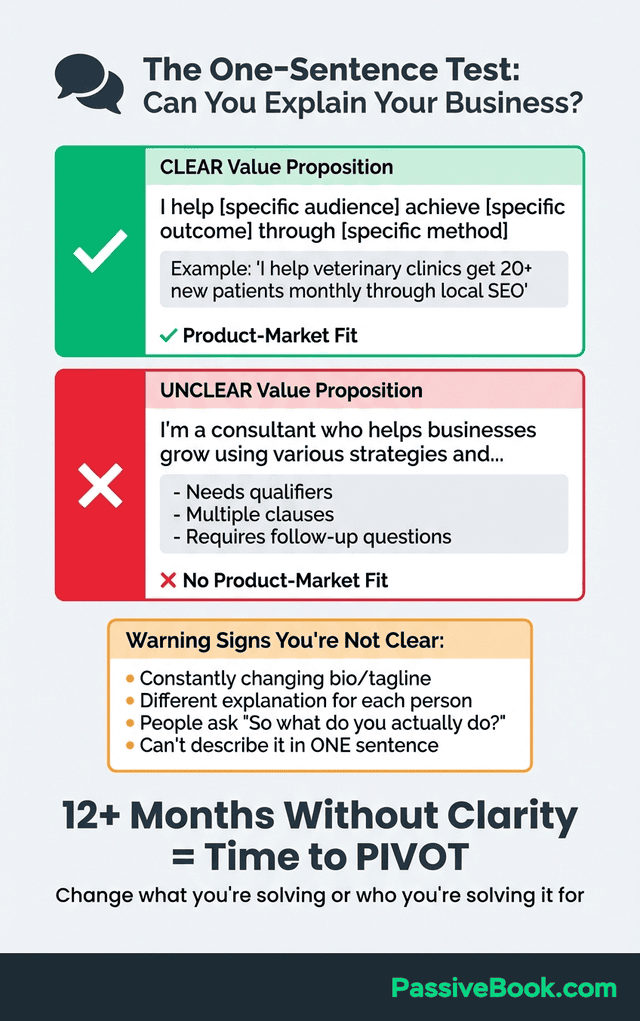
A clear value proposition should emerge naturally after serving your first 10 to 20 customers. You start to see patterns in who gets the most value and why they hired you.
Absence of this clarity after a year signals you’re either serving the wrong market or solving a problem people don’t actually pay to fix.
Test this right now. Write one sentence explaining your business to a stranger. If you need qualifiers, multiple clauses, or follow-up explanations, your positioning needs serious work or a complete pivot.
This sign indicates: PIVOT. If you can’t articulate your value after 12 months, you haven’t found product-market fit. Change what you’re solving or who you’re solving it for.
You’ve Tested 5+ Offers With Zero Traction
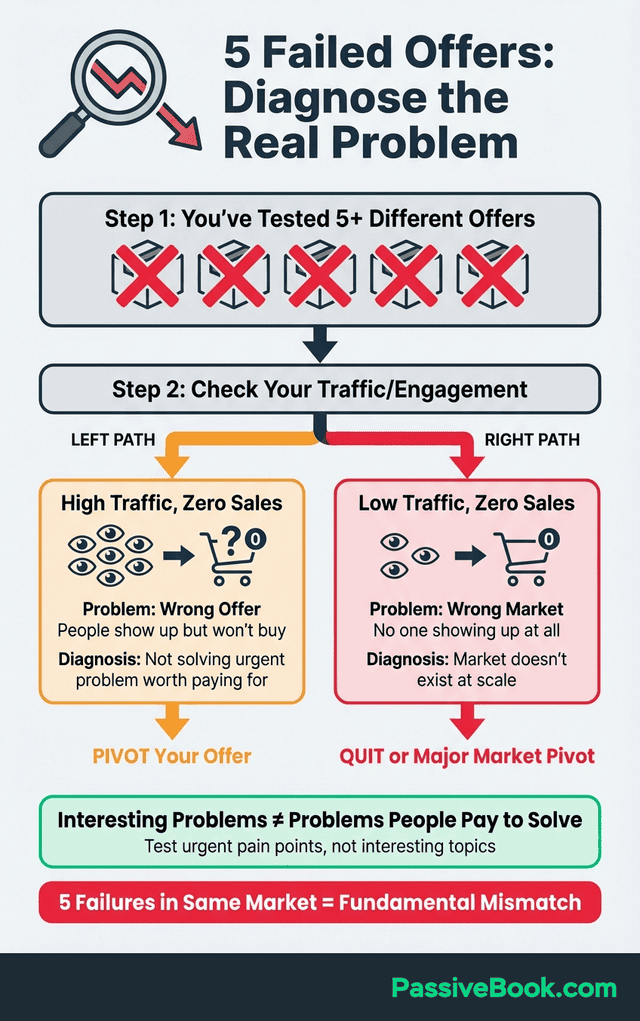
Multiple products, pricing models, and messaging angles all failing indicates a fundamental market-fit problem rather than execution issues. When nothing sticks after five genuine attempts, you’re solving a problem people don’t pay to fix or targeting an audience that can’t afford your solution.
Track traffic or engagement separately from sales. High attention without purchases signals you have the wrong solution for a real audience. People show up, consume your content, then disappear when you ask for money. This pattern means your offer doesn’t address an urgent problem worth their budget.
Sara Blakely of Spanx tested dozens of prototypes and pitches before finding product-market fit with her final design. The key difference: she kept iterating on solving the same core problem (uncomfortable undergarments) rather than jumping between completely different markets.
I violated this exact principle with my first course. After it flopped, I created a membership site. Then a coaching program. Then a podcast sponsorship model. Five different monetization attempts in 14 months, each solving different problems for different audiences. I was chasing tactics instead of finding one problem worth solving deeply.
Interesting problems don’t pay the bills. Urgent problems do.
Five failed offers over 18 months means your market doesn’t exist at sufficient scale or you’re fundamentally misunderstanding what they value enough to purchase.
This sign indicates: QUIT or major pivot. Five failures testing the same market means fundamental mismatch. Either pivot to completely different audience or exit entirely.
Your Day Job Performance Is Suffering
Missed deadlines, declining work quality, or negative performance reviews emerging repeatedly signal your side business is cannibalizing your primary income source. When your manager starts flagging issues, you’re playing with fire.
Your day job pays your bills and provides the financial runway that makes experimentation possible. Losing it eliminates your safety net entirely and forces you into desperate decisions about your business. Most solopreneurs can’t afford that risk.
Differentiate between temporary fatigue and sustained performance decline. Everyone has rough weeks. But negative feedback lasting multiple review cycles or spanning several months indicates a structural problem with your time allocation and energy management.
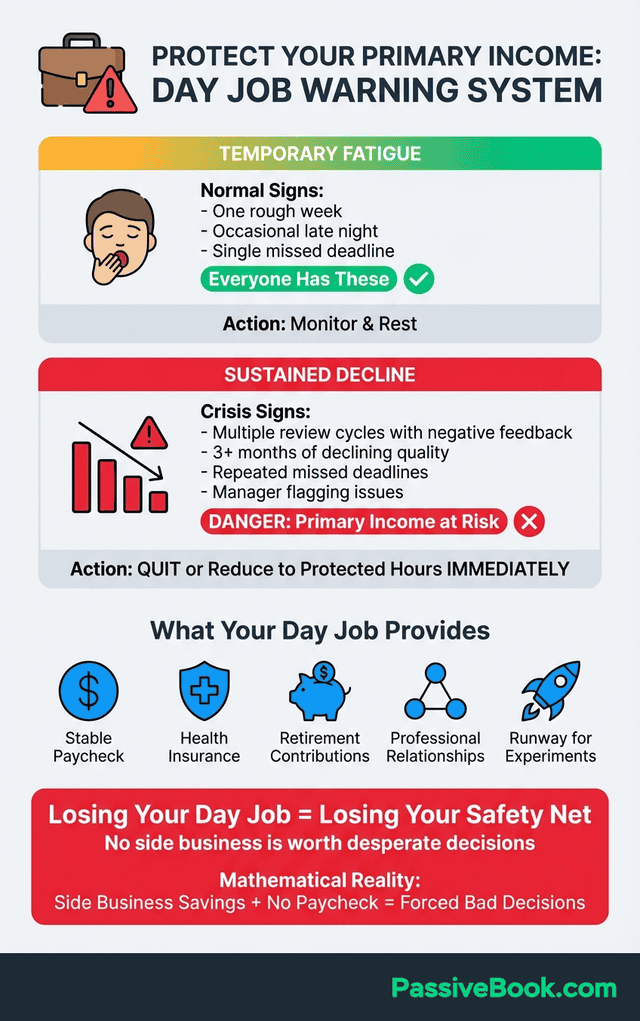
Missed deadlines and termination risk from your primary income source demands immediate attention. No business opportunity justifies losing the stable paycheck funding your entrepreneurial experiments.
When your primary income is at risk, it’s time to acknowledge the math doesn’t work.
If you can’t maintain baseline performance at work while building on the side, scale back your business efforts immediately.
Your day job isn’t just income. It’s credibility, health insurance, retirement contributions, and professional relationships. Sacrificing these for a struggling side business rarely makes mathematical sense for solopreneurs.
This sign indicates: QUIT or reduce to protected hours. Your primary income is non-negotiable. If you can’t maintain baseline job performance, your business model requires too much time.
You Have Audience Engagement but No Sales
Growing your email list, social followers, or YouTube views without generating revenue signals a messaging-offer mismatch rather than a market problem. Your audience exists and pays attention, but your current offer doesn’t solve their urgent problem.
High engagement proves market presence. People are interested enough to follow you and consume your content. The breakdown happens when you ask them to buy. This pattern indicates you need to pivot your messaging or create an offer that addresses the questions they ask repeatedly.
Pat Flynn of Smart Passive Income experienced this exact scenario. His audience engagement revealed they cared more about his entrepreneurial journey than architecture exam prep.
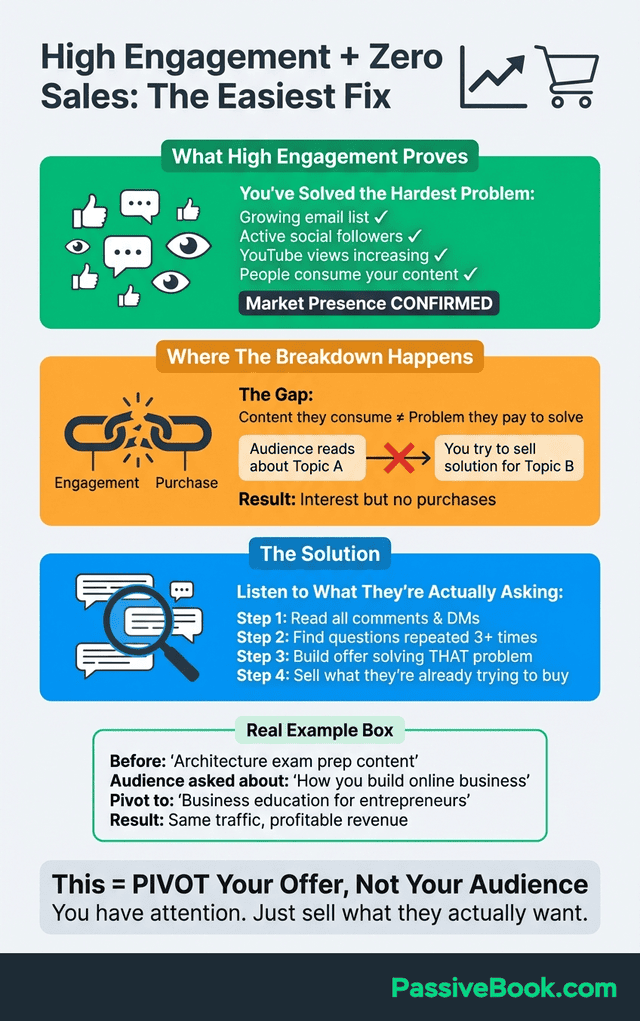
He pivoted to broader business education. His traffic stayed, but his revenue model completely changed.
Read your comments and DMs. Paying customers reveal what matters more than your assumptions about what you should sell. When the same question appears three times, that’s your signal to build an offer around it.
This situation is actually the easiest to fix because you’ve already solved the hardest problem: getting attention. You just need to match your monetization to what your audience actually values enough to purchase.
This sign indicates: PIVOT your offer. You’ve solved the hardest problem – getting attention. You just need to sell what your audience actually wants to buy.
Customers Keep Asking for Something You’re Not Offering
Multiple prospects requesting a specific service variation, pricing option, or related product consistently reveals exactly where you should pivot. This is market research happening in real time, delivered directly by people willing to pay.
Michelle Schroeder-Gardner of Making Sense of Cents started as a personal finance blogger sharing her debt payoff journey. After readers repeatedly asked how she monetized her blog, she pivoted to create her flagship course on affiliate marketing for bloggers. She followed the money her audience was literally asking to spend.
In my second year blogging, three different readers emailed asking how I organized my content calendar. I ignored it because I was focused on selling my SEO course. By month four, I had seven requests. I finally created a simple $19 Notion template. It outsold my $197 course 12:1 in the first month.
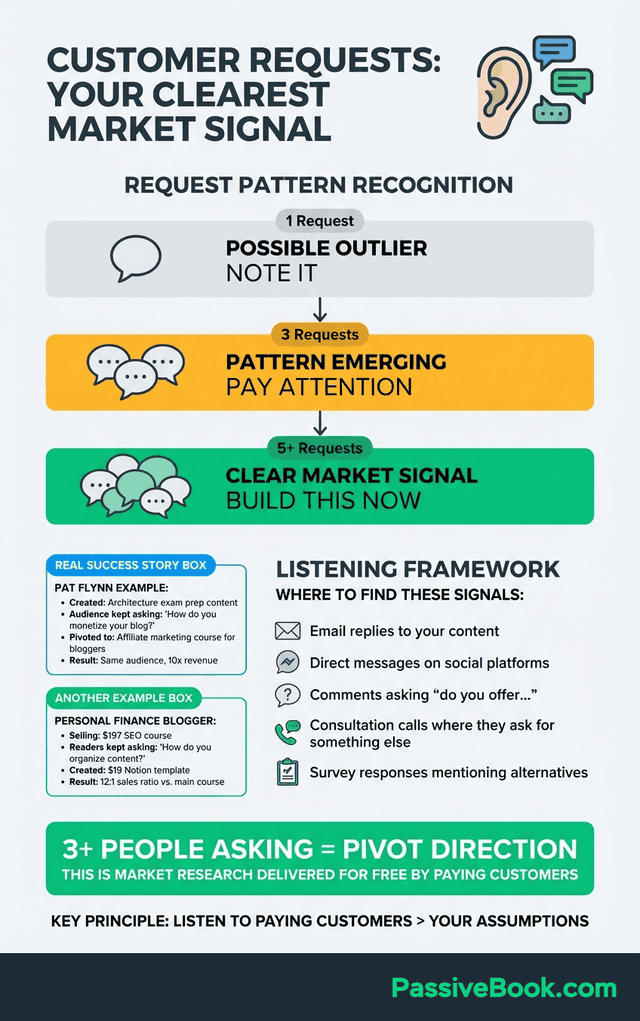
Listen to paying customers over your personal assumptions about what you should sell. When three or more customers request the same alternative offer, you have a viable pivot direction backed by actual demand rather than theory.
The pattern matters more than individual requests. One person asking for custom work might be an outlier. Five people asking for the same thing within three months signals a market gap your current positioning misses.
This scenario is the clearest green light for pivoting rather than quitting. You have proven demand from engaged prospects. You just need to build what they’re already trying to buy from you.
This sign indicates: PIVOT. This is the clearest market signal possible. Build what paying customers are literally asking to buy from you.
One Revenue Stream Outperforms All Others by 3x
Track performance metrics across all your offerings to identify disproportionate revenue concentration patterns. When one product or service generates three times the revenue of everything else combined, that’s your market telling you what it actually values.
Business owners should eliminate underperforming offers that drain your focus and resources from what actually converts. Solopreneurs have limited time and attention. Every hour spent maintaining a product that generates $50 monthly is an hour not spent optimizing the offer generating $500 monthly.
Solo creators on Teachable often discover this pattern when they pivot from complex multi-module courses to simple implementation guides. The comprehensive course took 80 hours to create and sells occasionally. The simple PDF checklist took 4 hours and sells consistently at a lower price point but higher volume.
Revenue concentration reveals what your market actually values versus what you assumed they needed. A coaching client once told me his $27 email template pack outsold his $297 course 10:1 in volume, generating nearly equal total revenue with dramatically less support burden.
When one offer dominates your revenue for three consecutive months, double down on it and consider eliminating or pausing everything else until you’ve maximized that winner’s potential.
This sign indicates: PIVOT by elimination. Double down on what works and cut everything else. This isn’t failure – it’s focus.
You Dread Tasks You Once Enjoyed for 3+ Months
Content creation, customer calls, or product development feeling like punishment for months consecutively signals fundamental misalignment rather than temporary burnout. When work you initially found energizing becomes something you actively avoid, the problem runs deeper than fatigue.
Sustained loss of engagement destroys both quality and consistency in work output. You start procrastinating on core business tasks, quality declines because you’re forcing yourself through the motions, and your audience notices the shift in energy even if they can’t articulate why.
Differentiate temporary fatigue from fundamental misalignment before making permanent decisions. Everyone has rough months where motivation dips. But if you’ve dreaded opening your laptop for three solid months, outsourcing won’t fix the underlying problem.
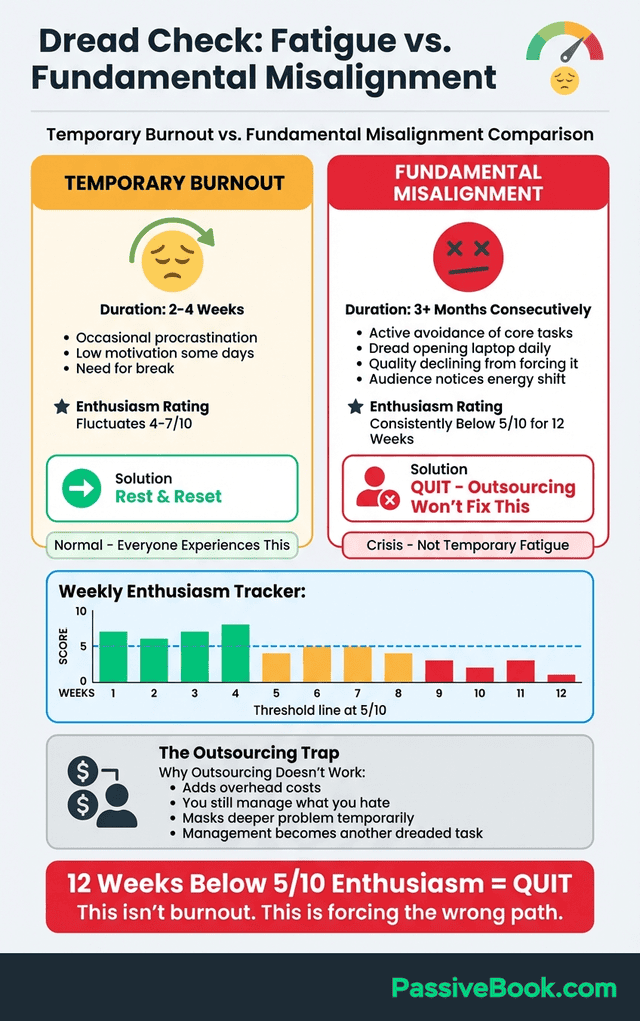
Outsourcing won’t fix passion problems. It only masks deeper misalignment temporarily while adding overhead costs.
You’ll still need to manage the person doing the work you hate, and that management becomes another dreaded task.
Rate your enthusiasm for core business activities weekly on a scale of 1 to 10. If you’re consistently below 5 for 12 consecutive weeks, it’s time to admit you’re not experiencing normal fatigue. You’re forcing a path that doesn’t match your actual interests or strengths.
This sign indicates: QUIT. Three months of sustained dread means fundamental misalignment. Outsourcing won’t fix passion problems.
When to Pivot: Testing Before Fully Committing
The decision to pivot or quit feels risky because you’re changing direction after investing time and money. But testing your pivot hypothesis before fully committing reduces both financial and emotional costs dramatically.
Most solo business owners pivot too slowly, holding onto failing models too long. Others pivot too quickly, abandoning strategies before giving them adequate time to work. The solution is structured testing that provides clear data within a short timeframe.
How to Run a 2-Week Pivot Test
Presell your new offer to 10 people before building anything to validate demand. This approach tests whether people will actually pay for your pivot idea rather than just saying it sounds interesting.
Use a simple landing page tool like Carrd or WordPress to collect email signups as your validation metric. Aim for 20 or more signups from 100 visitors within two weeks. That 20% conversion rate indicates genuine interest worth pursuing.
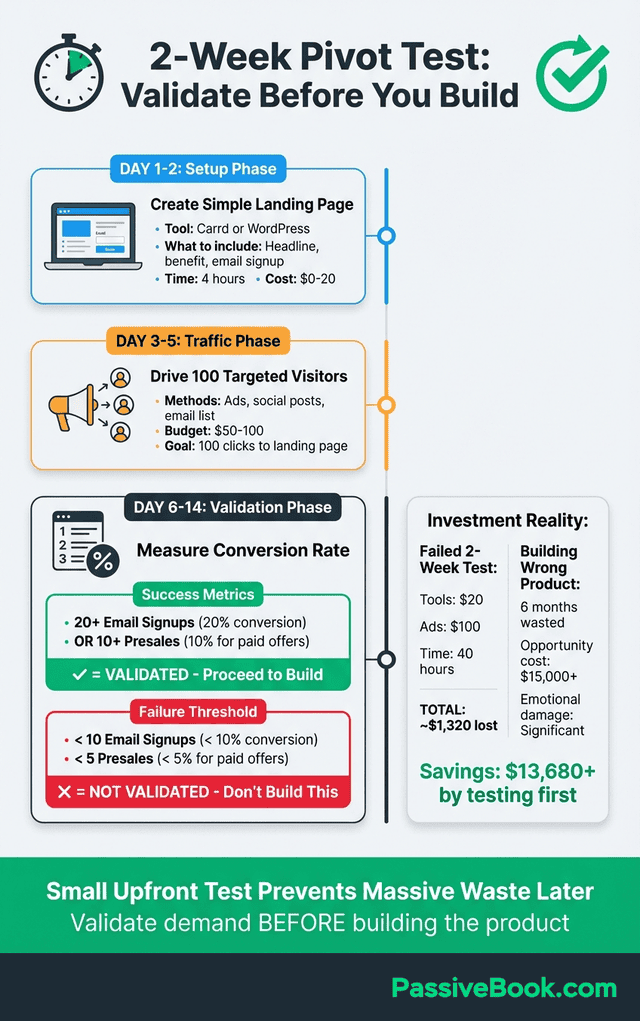
Use landing page tests with a 10% conversion rate as your validation threshold for paid products. If you’re asking people to prepay for something you’ll deliver later, 10% conversion from cold traffic suggests viable demand. Below that threshold, your positioning or offer needs refinement.
A failed test costs around $100 in tools and ads plus 40 hours of your time. Compare that to spending six months building the wrong product. The small upfront investment in validation prevents massive waste later.
If your test hits the validation threshold, proceed with building a minimum viable version. If it fails, you’ve learned what not to pursue without major financial damage.
Common Pivot Patterns That Work for Solopreneurs
Failed product businesses often succeed as service-based consulting using the same expertise. You’ve already learned the domain knowledge. Packaging it as done-for-you services or strategic consulting generates revenue faster than building and marketing products.
Content creators successfully repurpose YouTube videos into newsletters, courses, or podcasts without starting from scratch. The research and core ideas remain the same. You’re just changing the format and distribution channel to reach different audience segments or monetization models.
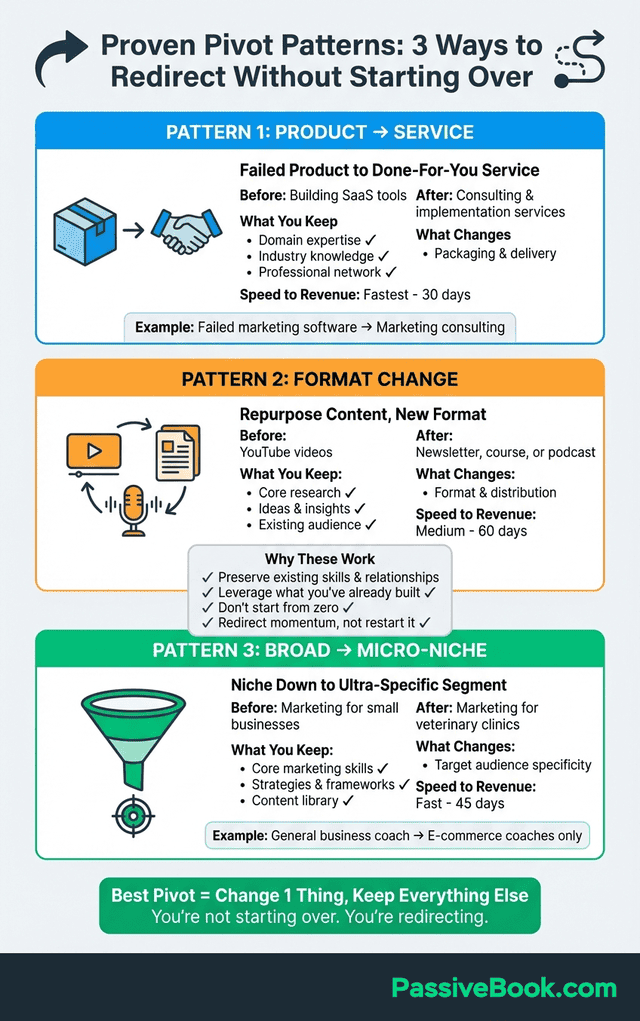
Shifting from a broad audience to a micro-niche serving an ultra-specific customer segment often unlocks profitability. Instead of “marketing for small businesses,” pivot to “marketing for veterinary clinics.” The narrower focus makes your positioning instantly clearer and reduces competition dramatically.
These patterns work because they preserve your existing skills and relationships while changing what you sell or how you package it. You’re not starting over. You’re redirecting momentum you’ve already built toward a more viable path.
How to Make a Clean Exit Without Regret
I shut down my first dropshipping business in 2017 after 18 months of grinding with no profit. I’d spent $14,000 testing products and $6,000 on a Shopify developer to build custom functionality I never needed. The total loss was $22,000 over 18 months.
My biggest mistake? I kept ‘testing new products’ instead of admitting the business model didn’t work for my schedule.
The decision hurt, but the way I handled the exit preserved relationships and extracted valuable lessons I still use today.
Communicate transparently with existing customers and fulfill all outstanding commitments completely. Send individual emails explaining your closure timeline, offer refunds or alternatives where appropriate, and maintain support through your final day. Your reputation outlasts any single business.
Document lessons learned systematically to extract value from the experience for future ventures. Create a simple document answering: What worked? What failed? What would I do differently? Which skills did I develop? This transforms a “failed business” into paid education for your next attempt.
Woocommerce site owners can convert active stores to portfolio sites, preserving credibility and SEO value. Change your homepage to showcase your work, keep your best content live, and add a simple note that you’re no longer taking new orders. Your domain authority and backlinks remain assets for future projects.
Calculate total sunk costs versus opportunity cost of continuing for rational closure decisions. Add up everything you’ve invested – money and time valued at your hourly rate. Then estimate what six more months would cost versus the realistic probability of reaching profitability. Often the math makes the exit decision obvious.
A clean exit isn’t failure. It’s strategic resource reallocation based on data. You’re choosing to stop losing money and time on a path that doesn’t work so you can redirect those resources toward opportunities with better odds.
When Should You Quit Your Business?
How long should you try before quitting?
It’s time to evaluate after 12 to 18 months of consistent effort before concluding your core business model is broken. I give myself four full quarters. That’s enough time to test seasonality, iterate based on feedback, and see whether growth compounds or stays flat. This timeline allows enough iterations to find product-market fit without wasting years on something fundamentally flawed. Evaluate quarterly using objective metrics like cash runway, customer acquisition cost versus lifetime value ratio, and customer engagement patterns rather than subjective feelings about whether you’re “passionate enough.”
What’s the difference between a pivot and rebranding?
A pivot changes your core offer, target audience, or business model while rebranding only updates your visual identity and messaging. Rebranding means you keep selling the same thing to the same people with a fresh look. Pivoting means you fundamentally change what you sell or who you sell it to based on market feedback. Most struggling businesses need a pivot, not prettier branding.
Can you pivot without losing your existing audience?
You can pivot successfully while retaining your audience if the new direction serves their adjacent needs. Ask your email list directly: ‘What’s your biggest struggle with [topic]?’ The answers tell you where to pivot. Survey your current followers to understand what problems they’re actually trying to solve, then pivot toward offers addressing those needs. The key is maintaining trust and relevance rather than forcing your audience to follow you into completely unrelated territory.
How do you know if low sales mean you should quit or just improve marketing?
Track engagement separately from sales to diagnose the root problem. High traffic or content engagement with zero sales means your offer doesn’t solve an urgent problem worth paying for. Low traffic and low sales means your marketing needs work. If you’ve tested five different offers with visible traffic and still can’t generate sales, the market is telling you to pivot or quit rather than just improve marketing tactics.
Should you quit if you’re making some money but not enough?
Calculate whether your current trajectory can realistically reach your income goals within 12 months. If you’re making $300 monthly after 18 months with flat growth, that’s not a viable business model. At that rate, you’d need five more years to hit $2,000/month – a number that still doesn’t replace a day job. That’s not a business. That’s an expensive hobby. Some money isn’t the same as a viable business model. Don’t confuse slow progress with inevitable success.
What Next?
You started reading this because you’re stuck between continuing down your current path and admitting it’s time for a change. The framework here gives you the specific metrics to make that decision without guilt or shame.
Making this decision pivot or quit is hard. You’ve invested time, money, and identity into your business. But staying stuck in analysis paralysis costs more than either quitting or pivoting decisively.
If this guide helped clarify your thinking, hit the share buttons below to help another solopreneur wrestling with the same decision. Drop a comment sharing which sign resonated most with your situation. Are you leaning toward quitting or pivoting, and what specific metric finally made it clear for you?
Share this post with your friends & followers: