I spent three months building a print-on-demand store around what I thought was a brilliant niche. The designs were solid, the mockups looked professional, and I’d invested hours into supplier research. Then reality hit: zero sales in the first month because I’d entered a dying market. One 10-minute Google Trends search would have saved me from that expensive mistake.
You’re staring at a list of potential business ideas with no clue which one has real market demand. Google Trends is the free validation tool that reveals whether people actually want what you’re planning to build, before you waste months of your limited time on the wrong idea.

- What Google Trends Is for Idea Validation
- Master Core Google Trends Features for Validation
- •1. Master the Interest Over Time Graph
- •2. Use Geographic Breakdown to Find Underserved Markets
- •3. Mine Related Queries for Content Angles
- •4. Track Breakout Terms for Early-mover Advantage
- •5. Overlay Volume Data to Avoid Small Numbers Trap
- •6. Set up Your First Validation Search Correctly
- •7. Use Comparison Mode to Choose Between Ideas
- •8. Distinguish Evergreen From Seasonal Trends
- •9. Catch Breakout Trends 6-12 Months Before Saturation
- •10. Test Willingness to Pay With Pre-sales
- •11. Use Youtube Search Filter for Video Demand
- •12. Validate Blog Niches With 2-3 Year Growth Patterns
- •13. Check Podcast Topic Sustained Interest Over 12 Months
- •14. Compare Content Formats Before Choosing Your Medium
- •15. Identify Blog Content Gaps With Declining Related Queries
- •16. Use Regional Data for Location-specific Content
- •17. Validate Newsletter Topic Durability
- •18. Find Youtube "hockey Stick" Growth Opportunities
- •19. Use Question-based Queries for Course Ideas
- •20. Track Tiktok-related Search Patterns
- •21. Validate Social Media Content Pillars
- •22. Use Instagram-related Queries for Visual Content
- •23. Check Linkedin Content Topic Demand
- •24. Validate Substack Newsletter Topics
- •25. Find Underserved Tutorial Opportunities
- •26. Validate Print-on-demand Design Niches
- •27. Check Dropshipping Product 6-12 Month Growth
- •28. Validate Online Course Topics With 12+ Month Interest
- •29. Identify High-value Geographic Markets for Ecommerce
- •30. Pair Trends With Aliexpress Supplier Availability
- •31. Validate Digital Product Demand Before Creation
- •32. Check Marketplace Competition Before Listing
- •33. Use Breakout Status With Low Seller Count
- •34. Validate Saas Tool Ideas With Search Patterns
- •35. Find Product Variation Opportunities
- •36. Validate Coaching Program Topics
- •37. Test Membership Site Topic Sustainability
- •38. Identify Affiliate Marketing Opportunities
- •39. Validate Freelance Service Demand
- •40. Check Consulting Niche Viability
- •41. Avoid Mistaking Viral News Spikes for Demand
- •42. Recognize Market Saturation Before Launch
- •43. Balance Niche Specificity to Avoid Zero Volume
- •44. Set Proper Timeframes to Filter Meaningless Spikes
- •45. Compare Within Same Geography and Timeframe
- •46. Layer Three Validation Tools Minimum
- •47. Cross-reference With Reddit Community Pain Points
- •48. Pair With Answer The Public for Question Keywords
- •49. Plan Launch 3-4 Months Before Peak Season
- •50. Export and Track Competitor Terms Monthly
- •51. Document Validation Research for Future Pivots
- •Frequently Asked Questions
- •What Next?
What Google Trends Is for Idea Validation
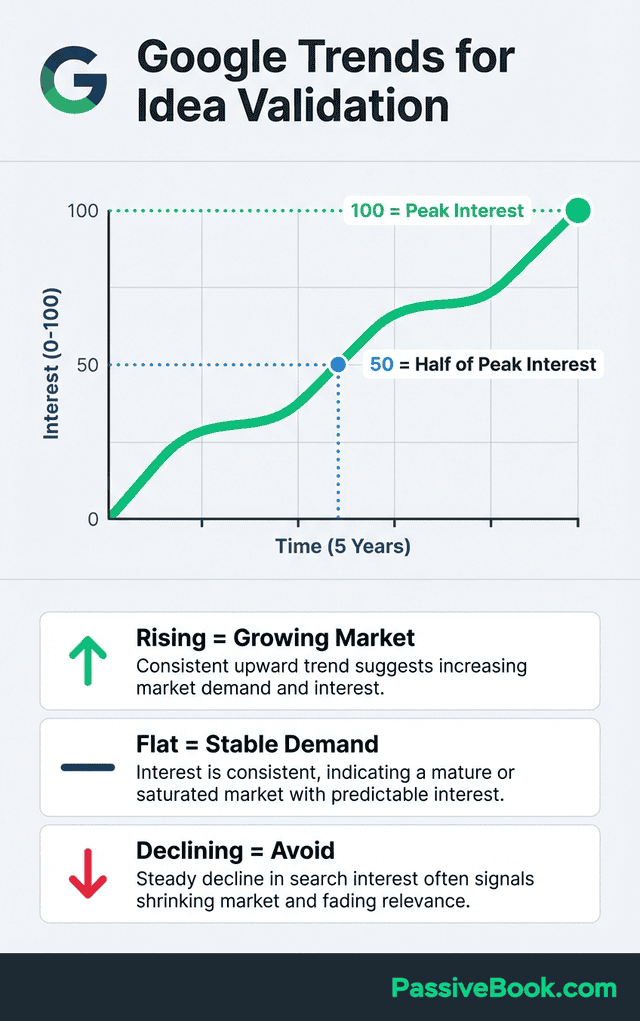
Google Trends is a free tool that reveals search data showing relative interest for any topic on a scale from 0 to 100 over time. Instead of showing absolute search volume, it displays how popular a search term is compared to its peak moment. This gives you a clear picture of whether interest is rising, falling, or staying flat.
The power comes from combining multiple data points. Shopify research confirms that pairing Google Trends data with direct customer feedback validates real market demand more accurately than either method alone. This combination prevents the costly mistake of building something people search for but won’t actually buy.
For time-starved solopreneurs, this matters because you can’t afford to guess. You need fast, data-backed decisions about where to invest your 10-15 weekly hours before committing to a business model that might take 6-12 months to show results.
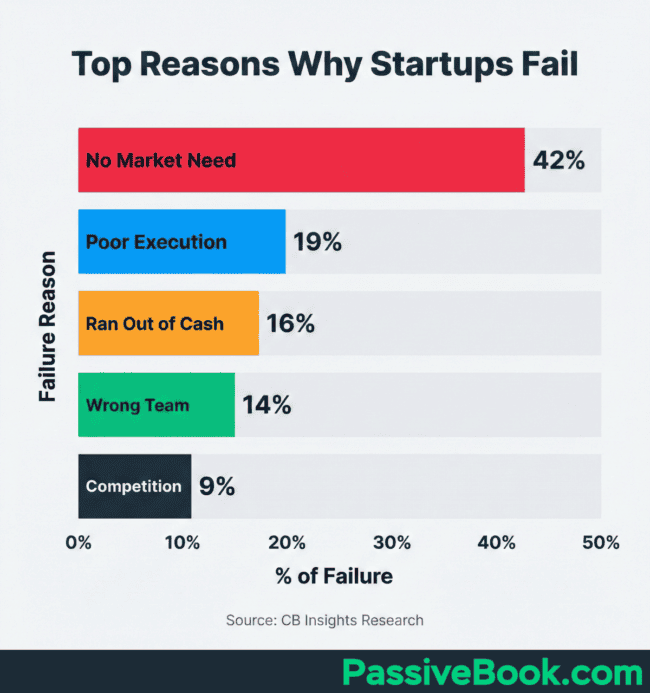
Why 42% of Startups Fail Without Proper Validation
The numbers tell a brutal story. CB Insights research shows 35-42% of startup failures stem from no market need (percentages vary by industry and year), not because of poor execution or lack of funding. These founders spent months solving problems that didn’t exist or entering markets that were already dying.
Google Trends prevents this specific failure mode by showing you market reality before you commit scarce time. If search interest has been declining for 18 months, no amount of hustle will create demand that isn’t there. If a market shows flat interest for three years with 10,000 existing sellers, you’re walking into saturation before you start.
The validation step takes 30 minutes but saves you from the three-month mistake I made. It’s the difference between launching into a growing market with momentum behind you versus fighting uphill against declining interest every single day.
Master Core Google Trends Features for Validation
Before you can validate anything, you need to understand what the search data actually means. The interface looks simple, but misreading a single metric can send you chasing a trend that peaked two years ago or avoiding an opportunity that’s just starting to break out.
1. Master the Interest Over Time Graph
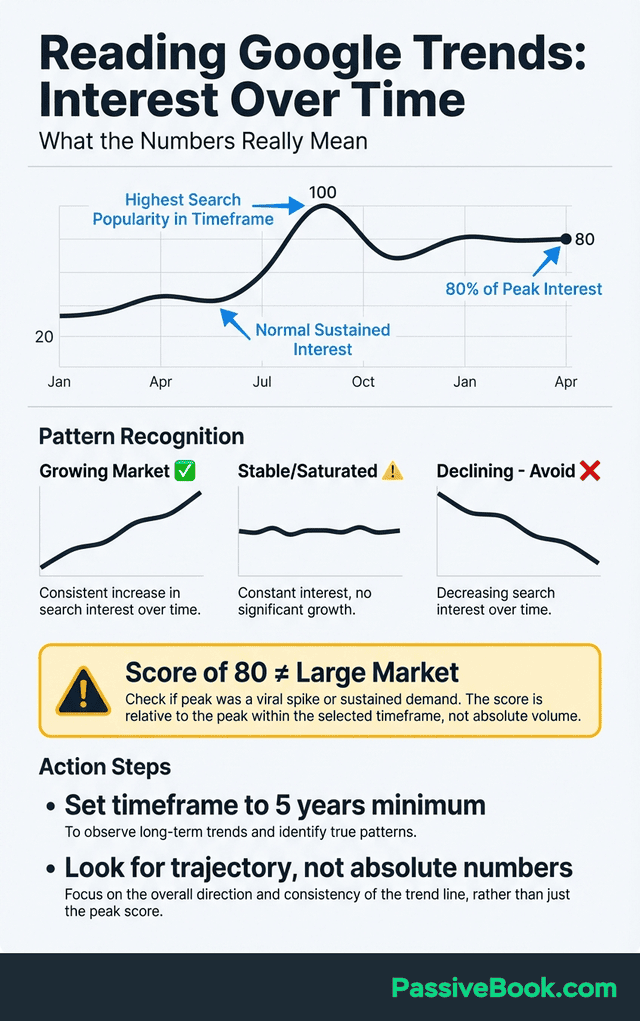
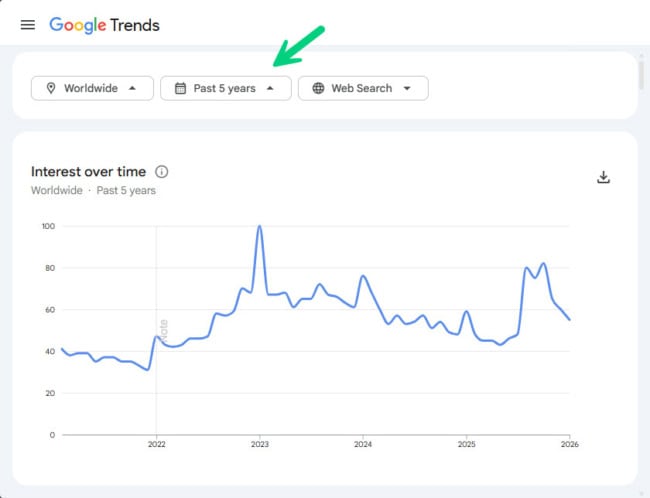
A score of 100 represents peak popularity for your search term within the selected timeframe. Every other point on the graph scales proportionally to that peak moment. A score of 50 means the term was half as popular as its highest point.
This relative scaling of search data trips up beginners constantly. A score of 80 today doesn’t mean your market is huge. It means searches are at 80% of whatever the peak was.
If that peak happened during a viral news cycle with 10,000 searches and normal baseline is 200 searches, you’re looking at a temporary spike, not sustainable demand. What you want is an upward trajectory over five years. That pattern signals a growing market worth exploring, where early movers can still capture audience attention before saturation hits.
Look for the line graph’s overall shape from left to right. An upward-sloping line means growing interest regardless of absolute numbers. A downward slope signals decline. Ignore short spikes and focus on the baseline trajectory.
2. Use Geographic Breakdown to Find Underserved Markets
The map view shows darker shading in regions with higher relative search concentration by state or city. This geographic data reveals where demand clusters, helping you target marketing spend or tailor products to specific regions.
Etsy sellers use location data to identify regional preferences and adjust product offerings accordingly. Use these geographic insights to create localized case studies.
A design that crushes in California might flop in Texas because the audience wants something completely different. The geographic breakdown shows you this before you invest in inventory.
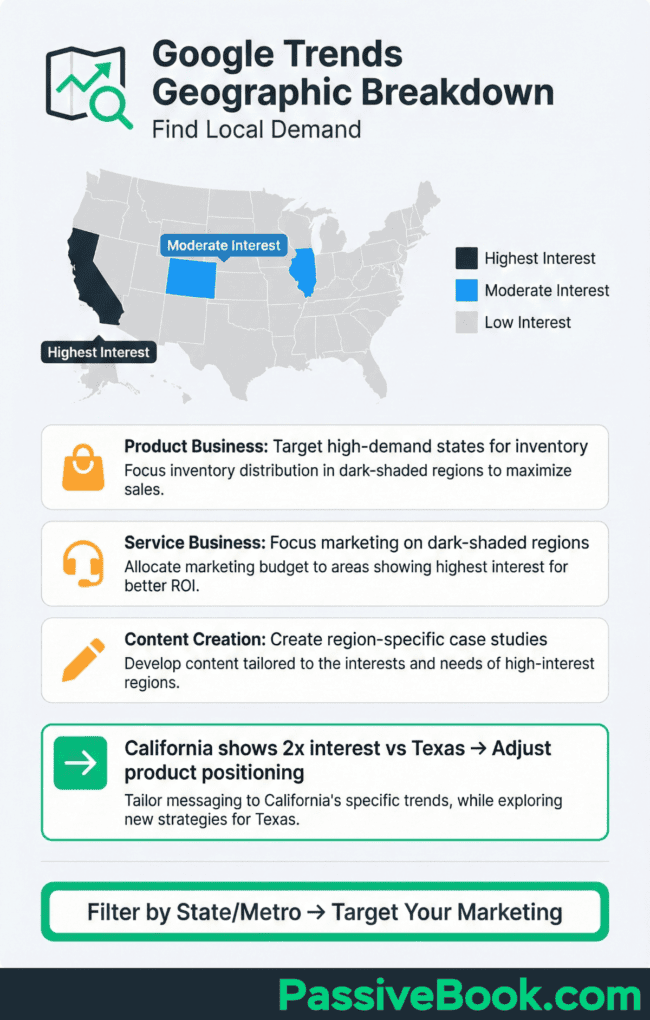
For service-based businesses, darker regions show client concentrations. If you’re launching a coaching program, you can prioritize outreach in states showing the strongest search interest from your target audience instead of spreading yourself thin across markets that don’t care about your topic.
3. Mine Related Queries for Content Angles
The Related Queries section (similar to related topics in other tools) splits into two filters that reveal different opportunities. The “Rising” filter shows breakout terms with explosive growth that few competitors have noticed yet. “Top” displays the most popular related searches showing what audiences actually type into Google.
Rising queries are your early-warning system for emerging sub-niches. If you’re in fitness and see “Nordic walking” appear as a rising term with 450% growth, you’ve spotted a content gap before every other creator floods the space.
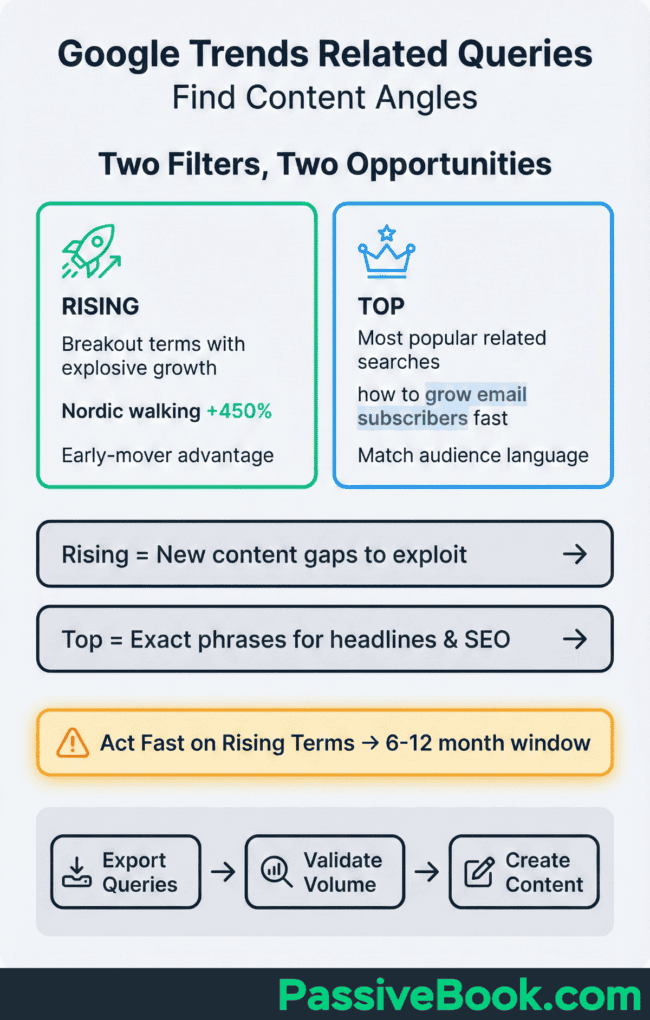
Top queries show you the exact language your target audience uses. If you planned to write about “email list building” but the top query is “how to grow email subscribers fast,” you now know the specific angle and phrasing that matches search intent.
4. Track Breakout Terms for Early-mover Advantage
Breakout designation means a search term spiked 5,000% or more year-over-year. These terms represent opportunities where demand is exploding but supply hasn’t caught up yet. You get a 6-12 month window before competition saturates the space.
The key is acting immediately when you spot breakout status. Set up weekly monitoring for your core niche keywords and create content or products the moment you see that label appear. Waiting even a month can mean the difference between being the first resource people find versus being buried on page five.
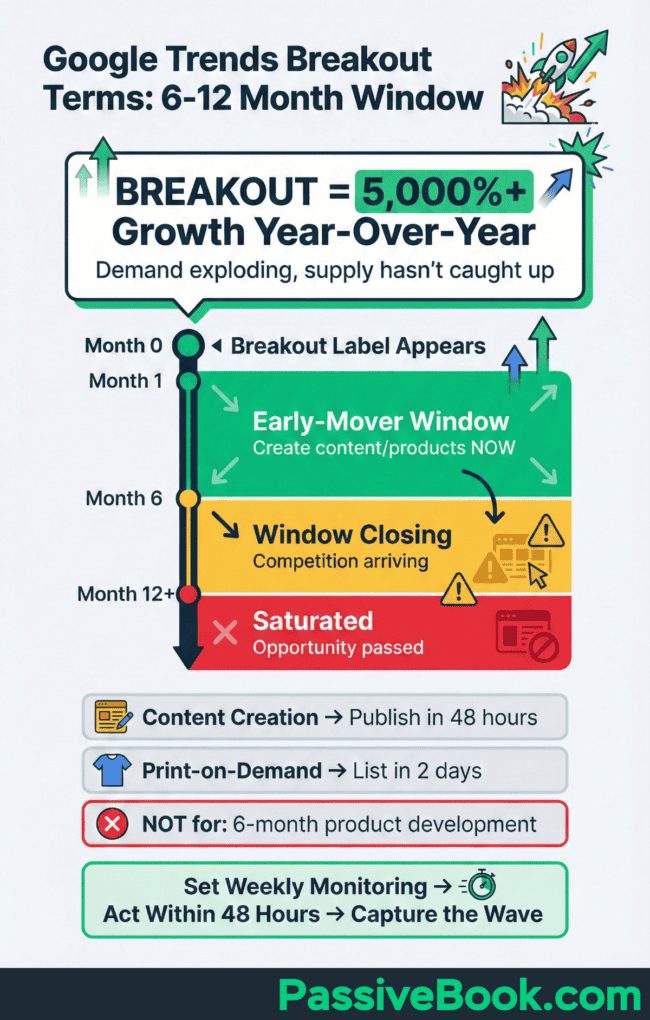
Breakout terms work best for content creators and print-on-demand sellers who can move fast. If you need six months to develop a product, breakout terms are too volatile. But if you can publish a blog post or design a t-shirt in 48 hours, you’re positioned to capture that wave.
5. Overlay Volume Data to Avoid Small Numbers Trap
Google Trends search data shows relative interest, not absolute search volume. A perfect upward trend might represent 50 searches per month or 50,000, and the graph looks identical. This creates the “small numbers trap” where you chase growth that’s mathematically irrelevant to building a business.
Tools like Keywords Everywhere are browser extensions that overlay actual monthly search volume directly on the Google Trends interface. Suddenly you can see whether your beautiful upward trend represents 4,000 monthly searches with real commercial potential or 40 searches that will never support a business.
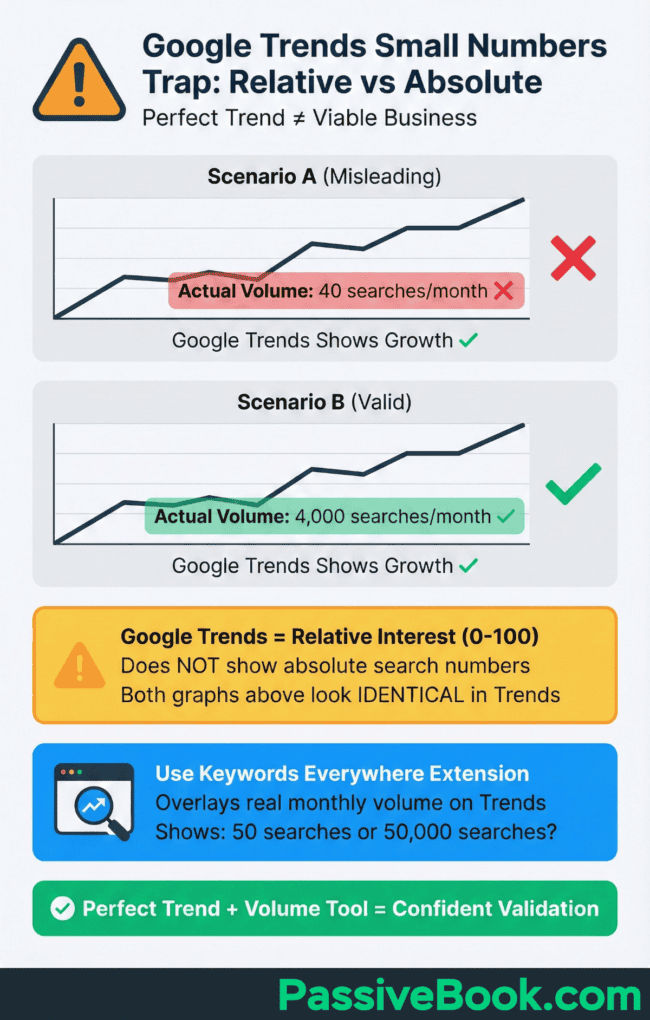
Small trend numbers might still represent thousands of monthly searches in reality if the peak was massive. Always cross-reference the shape of the trend with absolute volume data before making final decisions about where to invest your time.
6. Set up Your First Validation Search Correctly
Select your target geographic market from the dropdown menu before analyzing any data. If you’re building a US-focused business, leaving the default set to “Worldwide” will show you irrelevant patterns from countries you’re not serving.
Set the timeframe to “Past 5 years” as your default starting point. This window is long enough to distinguish sustainable trends from temporary fads but recent enough to reflect current market conditions. Anything shorter risks mistaking seasonal spikes for real growth.
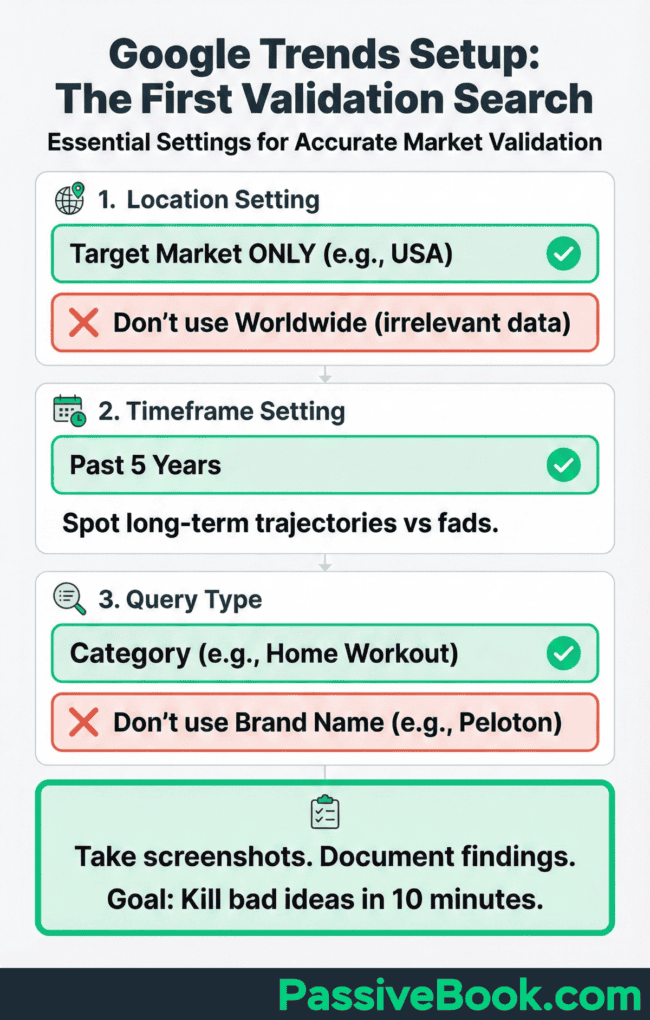
Enter your core business idea as a search term, not a branded product name. If you’re validating a fitness niche, search “home workout equipment” instead of “Peloton” to see category demand, not brand-specific interest that you can’t capture as a new entrant.
This first validation search takes 5-10 minutes and reveals whether your idea deserves deeper research or should be eliminated immediately. Take screenshots at each validation step and label them in a folder. This documentation becomes your decision record when choosing between multiple ideas later.
7. Use Comparison Mode to Choose Between Ideas
Google Trends allows you to add up to five search terms simultaneously, plotting them on the same graph to identify the strongest relative performer. This head-to-head comparison reveals which of your potential ideas has the most momentum when measured against the same timeframe and geography.
The winner isn’t always the term with the highest peak. Look for sustained upward interest over multiple years, not a term that spiked once during a viral moment and then crashed back to baseline.
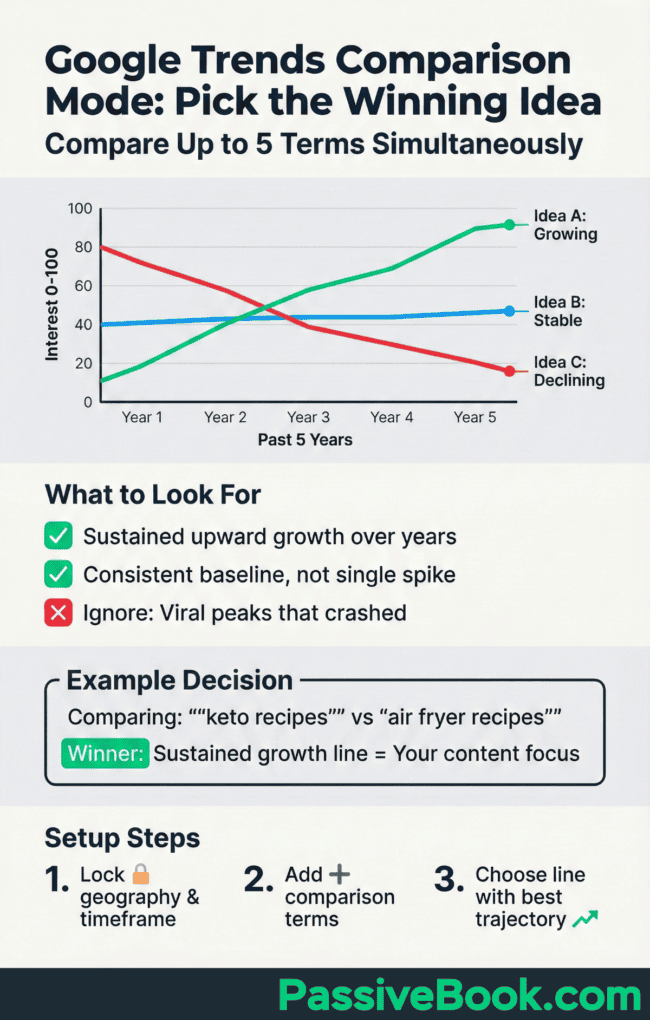
If you’re choosing between starting a YouTube channel about “keto recipes” versus “air fryer recipes,” the comparison graph shows you which topic has more durable search interest. It also reveals whether one is growing while the other plateaus. That single comparison can save you months of creating content for a declining audience.
8. Distinguish Evergreen From Seasonal Trends
Evergreen topics show relatively flat, consistent interest year-round. These provide predictable, stable income because demand doesn’t disappear for months at a time. Blogging, affiliate marketing, and course creation work well with evergreen topics since you’re building long-term assets.
Seasonal trends spike dramatically during specific months and plummet to near-zero the rest of the year. Lunchbox searches peak every August before the school year starts, creating a predictable seasonal opportunity for ecommerce sellers who can capitalize on the timing.
The mistake is treating seasonal demand like evergreen income. If you’re dropshipping Halloween costumes, you need enough capital reserves to survive nine months of minimal sales while waiting for your next peak season.
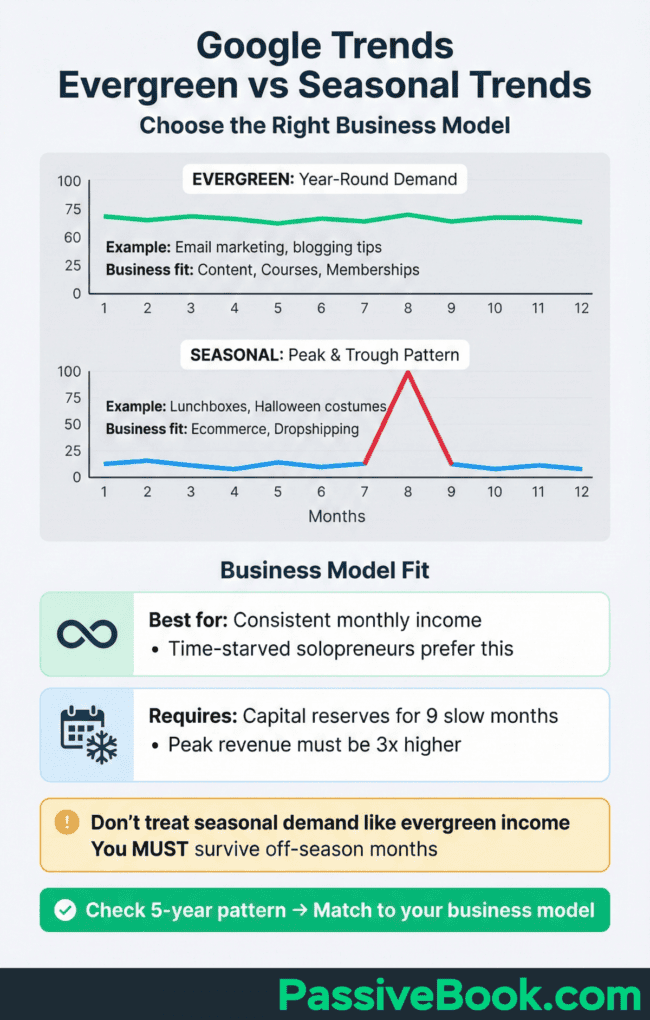
Time-starved solopreneurs often do better with evergreen topics that generate consistent results month after month.
9. Catch Breakout Trends 6-12 Months Before Saturation
The strategy works because most sellers react to trends after they’ve already saturated. By the time you see 5,000 listings for a design concept on Etsy, the opportunity has passed. But if you catch the breakout term when there are only 200 listings, you can rank on page one and capture sales for months before competition arrives.
Set up a monitoring routine where you check your core niche keywords every Monday morning. When you spot a breakout term, create and list products within 48 hours. Speed matters more than perfection in this window because being first with decent quality beats being perfect but late.
10. Test Willingness to Pay With Pre-sales
Google Trends shows search interest, but searches don’t equal sales. Dropbox validated demand with a simple explainer video before building their product, collecting 75,000 email signups overnight. That single validation test confirmed people wanted the solution enough to take action.
Collect actual payment commitments through Kickstarter campaigns or paid waitlists before investing months in development. If people won’t prepay $20 for early access to your course, they definitely won’t pay $97 when it launches.
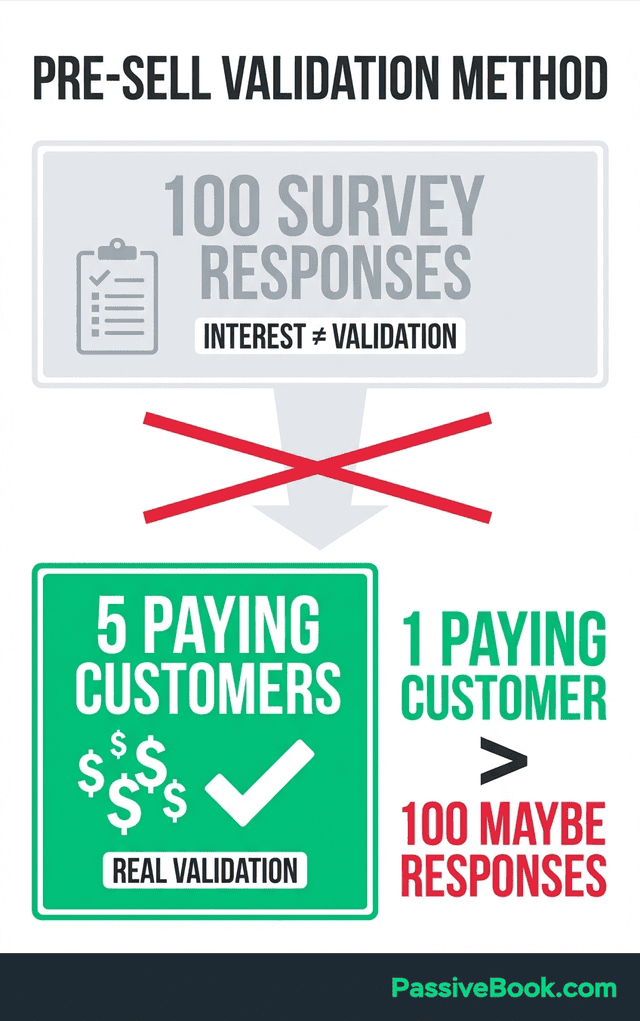
Pre-orders reveal true purchase intent beyond survey interest. Someone saying “I’d probably buy this” in a Reddit thread means nothing compared to someone entering their credit card number today for a product shipping in six weeks.
11. Use Youtube Search Filter for Video Demand
YouTube Search demand differs completely from web searches. The YouTube Search filter reveals video-specific demand that’s separate from general web searches. People might Google “keto diet plans” to read articles but search YouTube for “keto meal prep” to watch tutorials, and these patterns differ significantly.
Switch the search type dropdown from “Web Search” to “YouTube Search” when validating video content ideas. This shows you what people actually want to watch, not just read about.
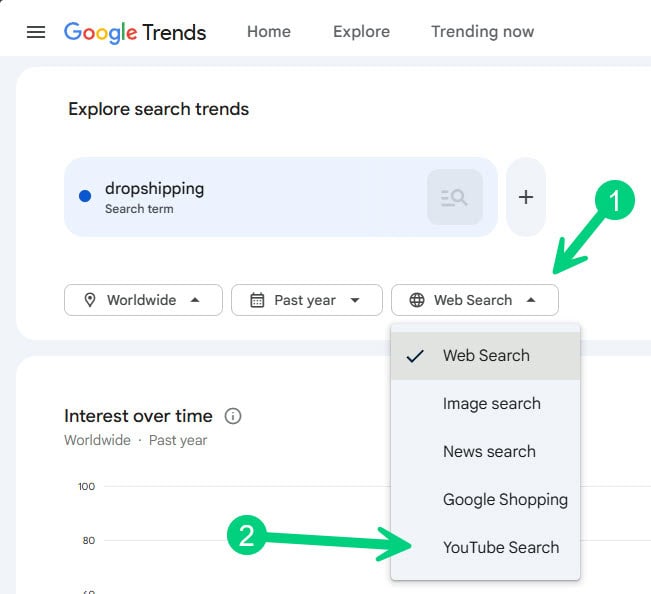
If your topic shows strong web search interest but weak YouTube search interest, you’re better off blogging. The inverse pattern means your target audience prefers video explanations for that topic, making YouTube or TikTok the smarter content medium choice.
12. Validate Blog Niches With 2-3 Year Growth Patterns
A blogger in this case study grew to $5,000 per month in six months by using Google Trends to identify rising search patterns before starting. The validation step showed sustained upward interest over multiple years, not a temporary spike. This confirmed the niche had room for a new voice.
Focus on topics showing steady upward growth over two to three years minimum. Blogging takes 12-18 months to build traffic, so you need proof the trend will outlast your growth timeline. A six-month upward spike might reverse before your site gains traction.
Use the Related Queries data to identify specific article angles within your niche. If “budget meal planning” is rising while “gourmet cooking” is flat, you know which content direction has momentum behind it.
13. Check Podcast Topic Sustained Interest Over 12 Months
Successful podcasters spend four to six hours or more per episode on research, recording, and editing (The Independent Podcaster Report). That level of commitment requires absolute certainty your topic has durable audience interest, not a three-month fad that dies before you hit episode 20.
Validate sustained search interest for at least 12 consecutive months before launching a podcast. Look for flat or rising baseline interest without dramatic seasonal drops, since you’ll be publishing weekly regardless of whether your topic is currently “hot.”
Podcasting rewards evergreen topics more than trending ones because your back catalog keeps delivering value for years. A flat trend line at interest level 60-70 is better than a spike to 100 followed by a crash to 20.
14. Compare Content Formats Before Choosing Your Medium
Cross-reference blog, YouTube, and podcast search interest for the same topic using comparison mode. Add search terms like “how to [topic]” for blogs, “[topic] tutorial” for YouTube, and “[topic] podcast” to see which format your audience prefers.
If “productivity tips podcast” shows higher relative interest than “productivity tips blog,” you have directional guidance on where to invest your limited time. Don’t force yourself to blog if your audience overwhelmingly prefers audio content.
Some topics work across all formats, but most show clear format preferences. Financial advice often performs better as YouTube content because people want to see charts and examples, while storytelling topics thrive as podcasts during commutes.
15. Identify Blog Content Gaps With Declining Related Queries
When a related query shows declining interest, it signals either a saturating niche you should avoid or an angle losing relevance. If you’re in the fitness space and “low-fat diet plans” is declining while “high protein meal prep” is rising, the market is telling you where attention is shifting.
I’ve published 200+ blog posts chasing declining topics because I ignored this signal. Every one became a traffic dead-end within 18 months.
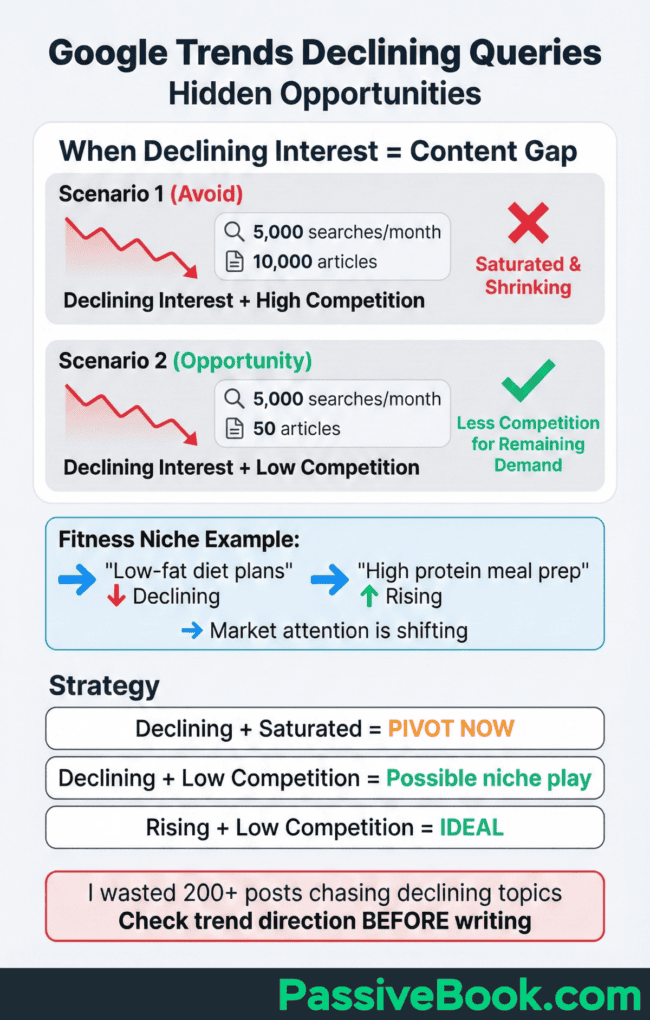
Declining queries become content gap opportunities when you spot them early. If fewer creators are covering a declining topic but search volume is still 5,000 monthly searches, you might face less competition for that remaining audience. The simultaneous pattern of declining interest and saturating competition is your signal to pivot immediately.
16. Use Regional Data for Location-specific Content
Drill down to metro-level data using the geographic filter to validate local demand. If you’re a freelancer offering services in specific cities, the geographic breakdown shows you which markets have actual demand versus where you’re guessing based on population size.
A coaching business targeting “career transition coaching” can identify whether Seattle or Austin shows stronger search interest. Focus marketing spend on the city with demonstrated demand. This prevents spreading yourself thin across regions where your target audience doesn’t actively search for solutions.
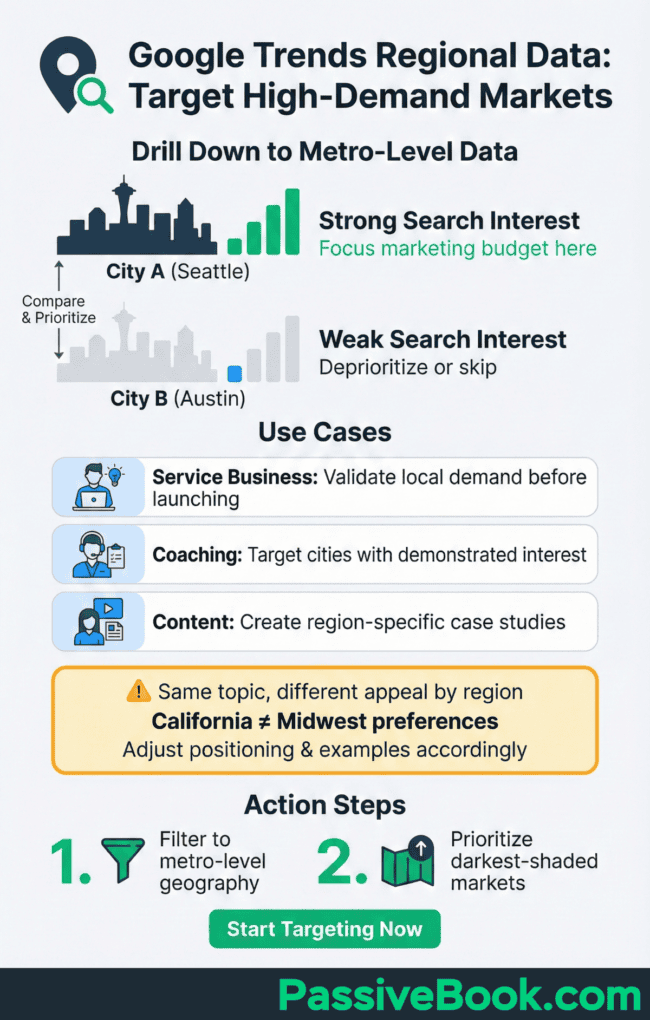
Regional data also reveals cultural preferences impacting content strategy. A topic dominating searches in California might barely register in the Midwest, suggesting you need different positioning or case studies for different markets.
17. Validate Newsletter Topic Durability
Email lists take 18 months or more to build to meaningful size for most solopreneurs. Before committing to that timeline, check for flat baseline interest over the same 18-month period. You need to ensure your topic won’t be obsolete before your list reaches critical mass.
Newsletter topics need evergreen demand because you’re building a long-term asset. A trend that’s currently hot but shows declining interest over the past year is a terrible newsletter topic. This is true even if your first 100 subscribers come easily.
Map out 12-24 months of newsletter content ideas using the queries data before launching. If you can’t find 50+ related queries with sustained interest, your topic might be too narrow to support weekly emails.
18. Find Youtube “hockey Stick” Growth Opportunities
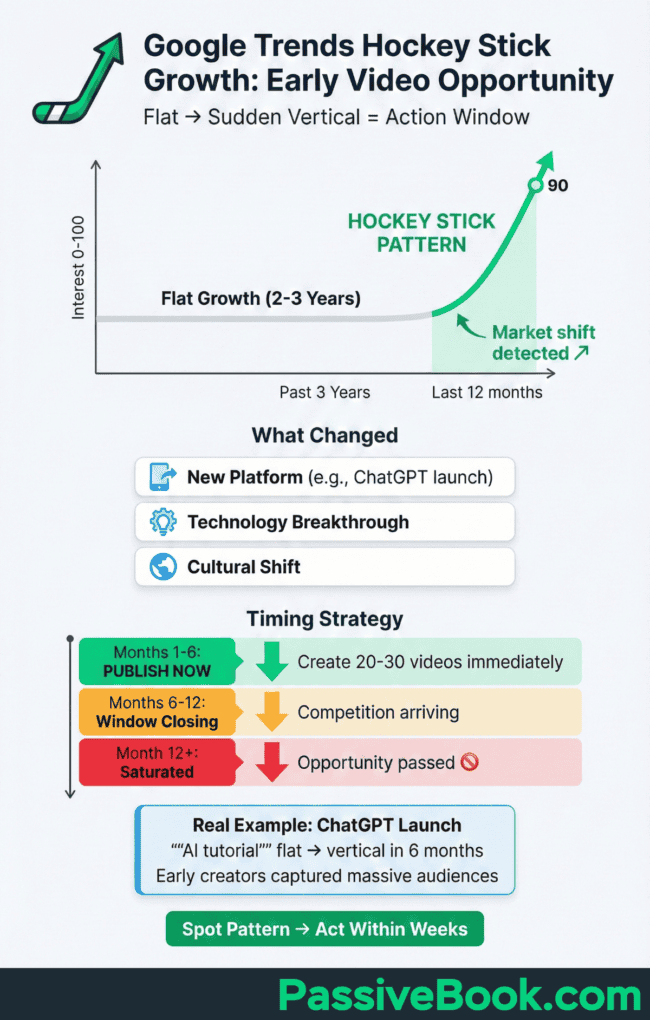
Look for search terms showing relatively flat interest for two to three years followed by a sudden 12-month upward acceleration. This “hockey stick” pattern indicates something changed in the market, creating emerging video opportunities before every content creation competitor pivots to cover them.
The acceleration often signals a platform change, new technology, or cultural shift making video the preferred format. When ChatGPT launched, “AI tutorial” searches went from flat to vertical in six months. This created a window where early video creators could capture massive audiences.
Act fast when you spot hockey stick growth because the window closes quickly. Within 6-12 months, the space becomes saturated with creators who spotted the same pattern. You need to already have 20-30 videos published to compete.
19. Use Question-based Queries for Course Ideas
Question format searches reveal specific pain points your online course can solve. People typing “how do I start freelancing with no experience” have different intent than those searching “freelancing.” The question format shows you the exact transformation students need.
Filter queries to find question-based terms, then build your course curriculum directly around those questions. Each module answers one high-volume question, ensuring your content matches what people actively search for.
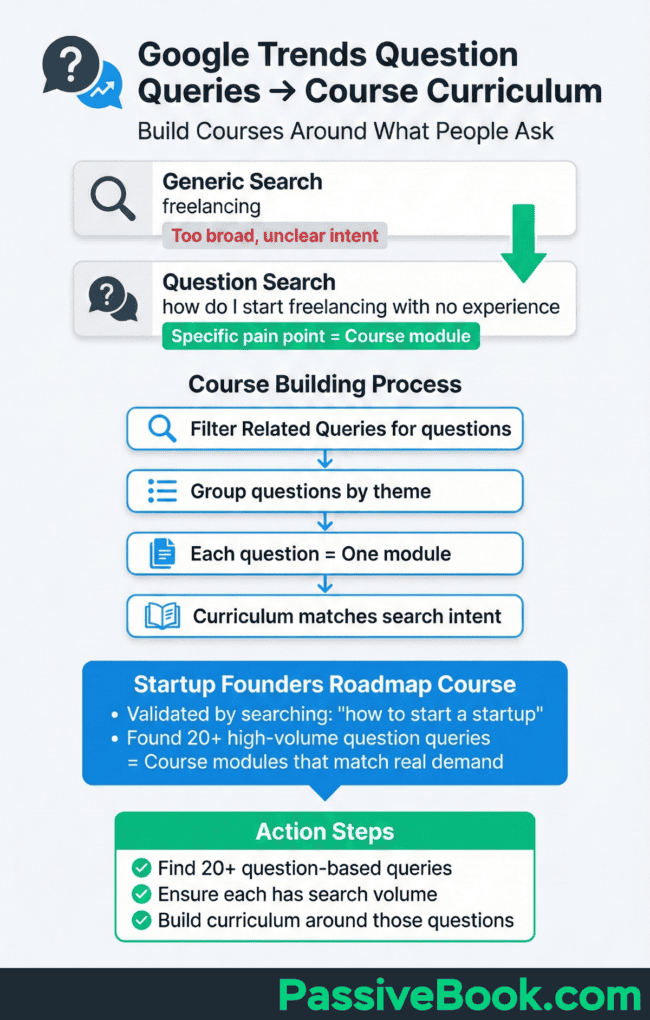
The Startup Founder’s Roadmap course validated demand by checking search volume for startup education questions before recording a single lesson. That upfront validation confirmed people were asking questions the course curriculum could answer.
20. Track Tiktok-related Search Patterns
Rising TikTok-adjacent search terms reveal video-first content opportunities before the trend fully matures. When you see “[topic] TikTok” or “TikTok [topic]” appearing in Related Queries with rising status, audiences are actively seeking short-form video content in that niche.
These patterns appear three to six months before the trend hits other platforms. This gives you an early-mover window to create content. If “productivity TikTok” is rising, you can start publishing short-form content while competition is still minimal.
TikTok trends often migrate to other social media platforms like YouTube Shorts and Instagram Reels. Validating TikTok demand tells you whether to invest in short-form video infrastructure across all platforms.
21. Validate Social Media Content Pillars
Test three to four core topic areas to ensure each has sustained search interest before committing them as social media content pillars. Your social media accounts need multiple topics to avoid repetitive content. Each pillar should show independent validation.
Use comparison mode to plot all potential pillars simultaneously. If one shows declining interest while others are flat or rising, drop the declining topic now before you invest time creating content nobody wants.
Social media content creation requires volume, so validate each pillar has enough subtopics. Use the queries data to confirm each pillar has 30+ related searches you can turn into individual posts.
22. Use Instagram-related Queries for Visual Content
Related terms containing “Instagram” or “aesthetic” reveal what visual content formats audiences search for. These queries tell you whether people want infographics, carousels, quote graphics, or video content for your specific niche.
If “[your niche] Instagram ideas” is a rising query, your target audience is actively looking for visual inspiration. This makes Instagram the right platform choice. If no Instagram-related queries appear, your audience might not be visually oriented, suggesting Twitter or LinkedIn could be better fits.
Visual content validation prevents wasting time on beautifully designed posts for audiences who prefer text-based content. Match your content format to demonstrated audience preferences, not your personal strengths.
23. Check Linkedin Content Topic Demand
LinkedIn audiences want steady, reliable insights, not viral spikes. Professional topics should show steady baseline interest rather than viral spikes. Flat interest at level 50-70 over three years is ideal.
Search for “[your topic] professional development” or “[your topic] business strategy” to find LinkedIn-oriented queries. These phrases signal business-focused intent different from casual consumer interest.
If professional versions of your topic show weaker interest than consumer versions, LinkedIn might not be your primary platform. Focus your limited time where demand is strongest rather than building presence everywhere.
24. Validate Substack Newsletter Topics
Newsletter creation through Substack requires 18 months or more of consistent publishing before meaningful income appears. Choose growth markets exclusively by checking for sustained upward trends over the past two years, not flat or declining interest.
Substack succeeds with depth over breadth, so validate your topic supports 50+ newsletter issues without running out of angles. Check Related Queries to map potential topics, ensuring you have material for at least one year of weekly publishing.
The mistake is choosing a topic you’re passionate about without validating anyone else cares. If search interest is flat at level 30 for three years with no related queries showing growth, your passion won’t translate to subscribers.
25. Find Underserved Tutorial Opportunities
“How to” related queries with rising interest indicate tutorial gaps where audiences are actively searching for educational content. These queries represent opportunities where existing tutorials either don’t exist or don’t satisfy user needs.
Look for the combination of rising interest and low competition on YouTube or Google. If a “how to” query shows 2,000 monthly searches but only 10 YouTube videos addressing it, you’ve found a tutorial gap worth filling.
Tutorial content builds long-term traffic because people search for education repeatedly. One comprehensive tutorial ranking on page one can deliver visitors for 2-3 years with minimal updates.
26. Validate Print-on-demand Design Niches
Cross-reference search volume against competition before designing anything. A breakout trend with 5,000 existing products means you’re too late. The same trend with 200 products gives you a launch window.
The validation sequence matters: Trends first to confirm demand exists, marketplace second to confirm you’re not too late, supplier third to confirm you can actually source or create the product. Skipping any step wastes time on ideas that can’t succeed.
27. Check Dropshipping Product 6-12 Month Growth
Ecomposer’s guide shows how to distinguish seasonal spikes from sustained demand by comparing multiple years of data. A product showing upward growth across two consecutive years has more potential than one with a single viral spike.
My first dropshipping store targeted a product with flat interest over two years. Sales were consistent but capped at $400/month because I was competing for static demand. When I switched to an upward-growth product, revenue hit $1,200 in month three.
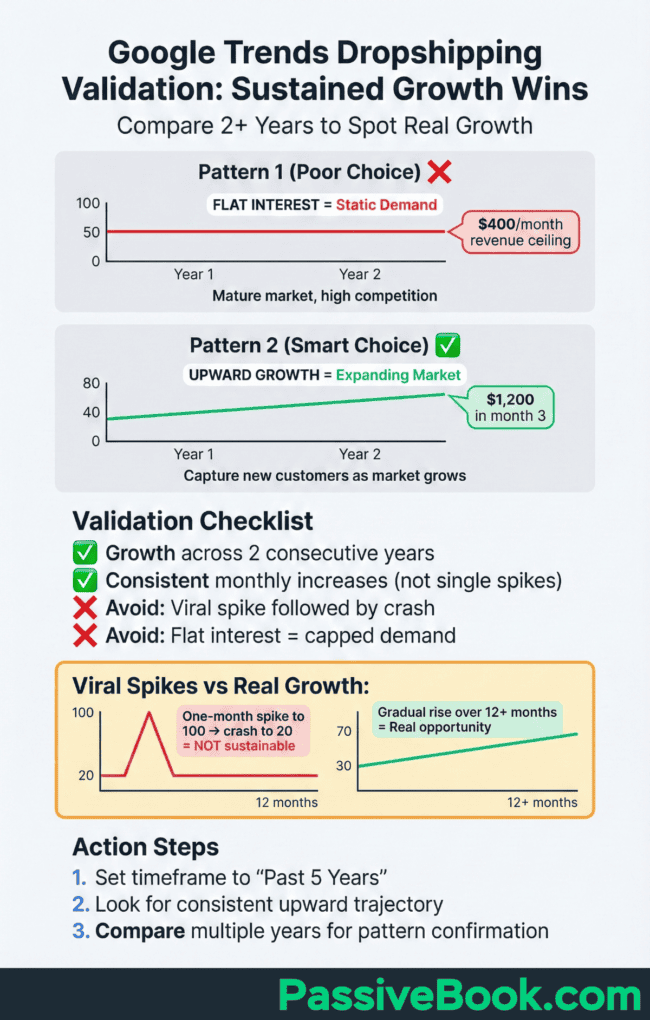
Target products showing upward growth trajectories rather than flat sustained interest. Flat interest means the market is mature and competitive. Upward growth suggests you can still capture new customers as the market expands.
Check if growth is consistent across multiple months or concentrated in brief spikes. Consistent monthly increases indicate real market expansion. Brief spikes followed by crashes back to baseline suggest viral moments that won’t support ongoing sales.
28. Validate Online Course Topics With 12+ Month Interest
Course creation demands 40-60 hours minimum investment, so validation isn’t optional. Before investing this time creating an online course, verify the topic shows consistent search interest for at least 12 consecutive months. This confirms the topic isn’t a temporary trend that will be irrelevant before you finish recording lessons.
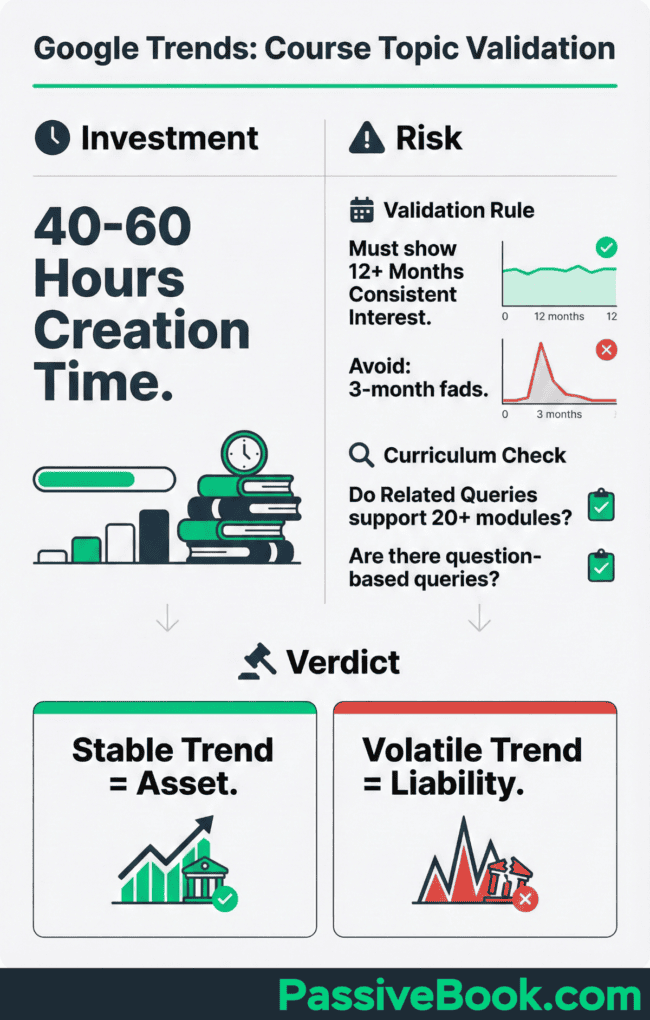
Course topics need enough depth to support multiple modules. Check that Related Queries contains 20+ subtopics you can turn into lessons. If the main term has interest but no related queries appear, your topic might be too narrow to fill a complete curriculum.
Students buy courses to solve specific problems, so validate question-based queries exist within your topic area. If people aren’t asking questions, they might not perceive the problem your course solves as urgent enough to pay for.
29. Identify High-value Geographic Markets for Ecommerce
Geographic data reveals markets like Netherlands, Belgium, and Australia showing disproportionately high search interest for certain products. These markets often have less competition from local sellers, creating opportunities for US-based stores to serve international customers.
If you’re dropshipping or selling digital products without physical shipping constraints, darker-shaded regions outside the US represent expansion opportunities. Set up targeted Facebook ads or Google Shopping campaigns for those specific countries.
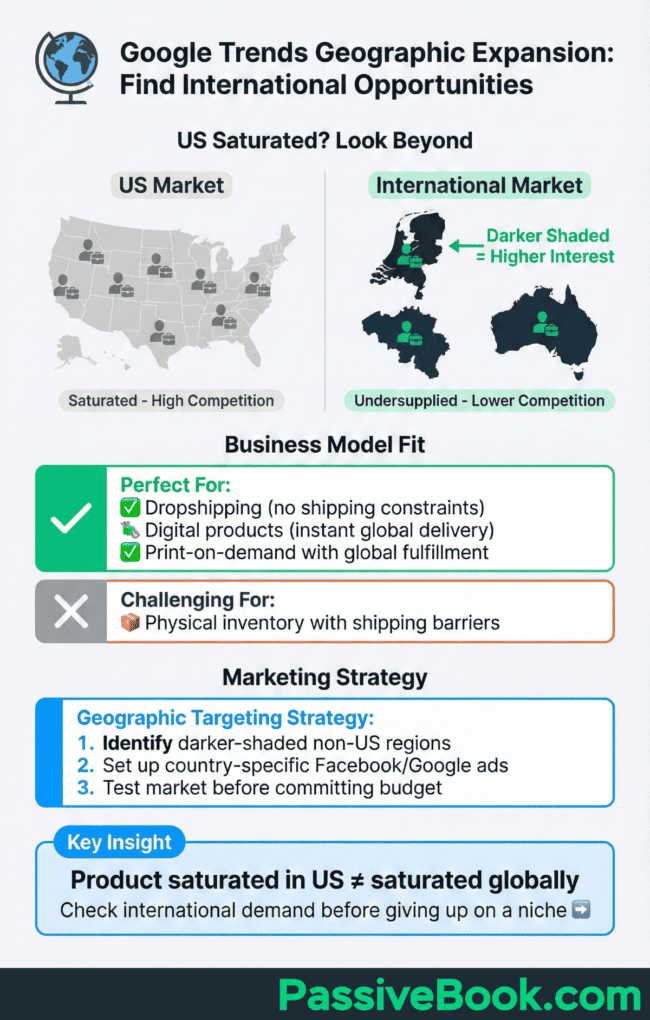
The validation prevents assuming your local market represents global demand. A product saturated in the US might be undersupplied in European markets. The geographic data shows you exactly where to focus international expansion efforts.
30. Pair Trends With Aliexpress Supplier Availability
If a product shows “rising” interest in Google Trends but already has 500+ listings on AliExpress, you’re likely too late to the opportunity. The ideal validation combines rising Trends status with under 100 suppliers, indicating demand is growing faster than supply.
Check supplier availability immediately after validating search demand. Finding a perfect trend means nothing if you can’t source the product reliably or if 1,000 other dropshippers already have the same supplier.
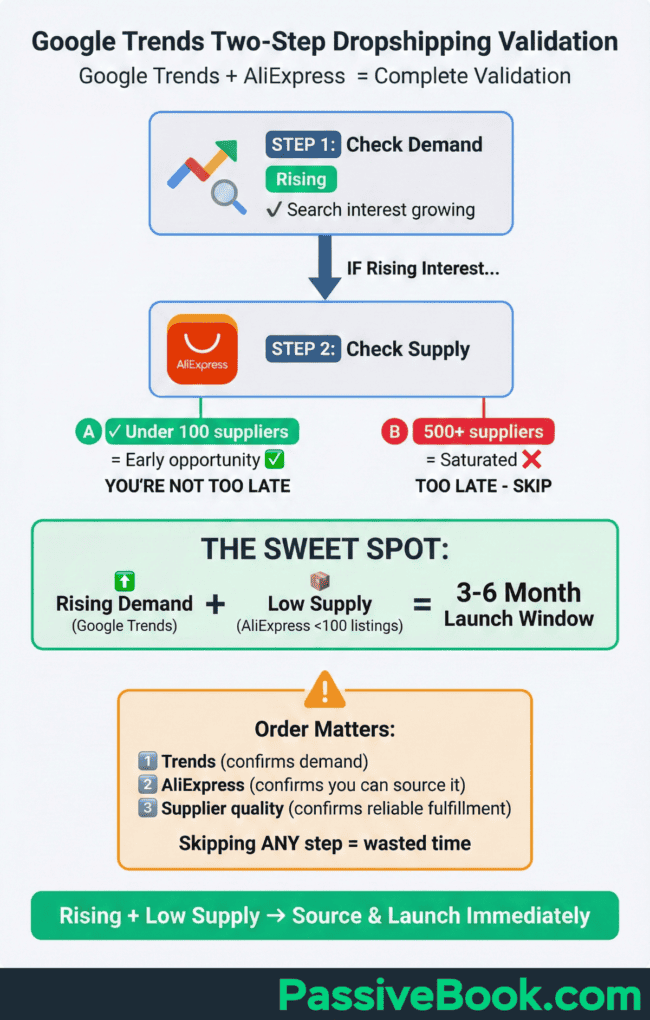
The sequence matters: Trends confirms the market wants it, AliExpress confirms you can get it. The combination of both confirms you have an executable opportunity worth pursuing.
31. Validate Digital Product Demand Before Creation
Test ebook, template, or tool topics with sustained six-month interest minimum before investing time in creation. Digital products take 20-40 hours to create at quality levels customers will pay for, so validation prevents building products nobody wants.
Search for “[your topic] template” or “[your topic] checklist” to see if audiences actively search for the specific format you plan to create. If no one searches for “budget spreadsheet template,” creating one is a guess, not a validated idea.
Check whether existing products on Gumroad or Etsy already serve the need. If 50 similar templates exist but search interest is still rising, the market is large enough for another entrant. If interest is flat and competition is high, skip it.
32. Check Marketplace Competition Before Listing
Cross-reference Google Trends with Udemy and Coursera to identify content gaps where search demand exists but course supply is limited. If a topic shows rising interest on Trends but only five courses exist on Udemy, you’ve found a gap worth filling.
Check the existing courses’ ratings and enrollment numbers to gauge whether current offerings satisfy demand. High search interest combined with low-rated existing courses suggests customers want better solutions, creating an opportunity for quality differentiation.
Avoid topics where 50+ highly-rated courses already exist unless you bring a unique angle. The combination of high supply and satisfied customers means breaking through will require exceptional quality or a specific niche positioning.
33. Use Breakout Status With Low Seller Count
The ideal sweet spot combines “breakout” interest designation with fewer than 200 existing sellers on your target marketplace. This indicates explosive demand growth supply hasn’t yet matched. You get a 3-6 month window to establish positioning.
Monitor breakout terms weekly because the window closes fast. Once 500+ sellers enter a breakout market, you’ve moved from early-mover advantage to competing on price and marketing budget. Time-starved solopreneurs can’t win that game.
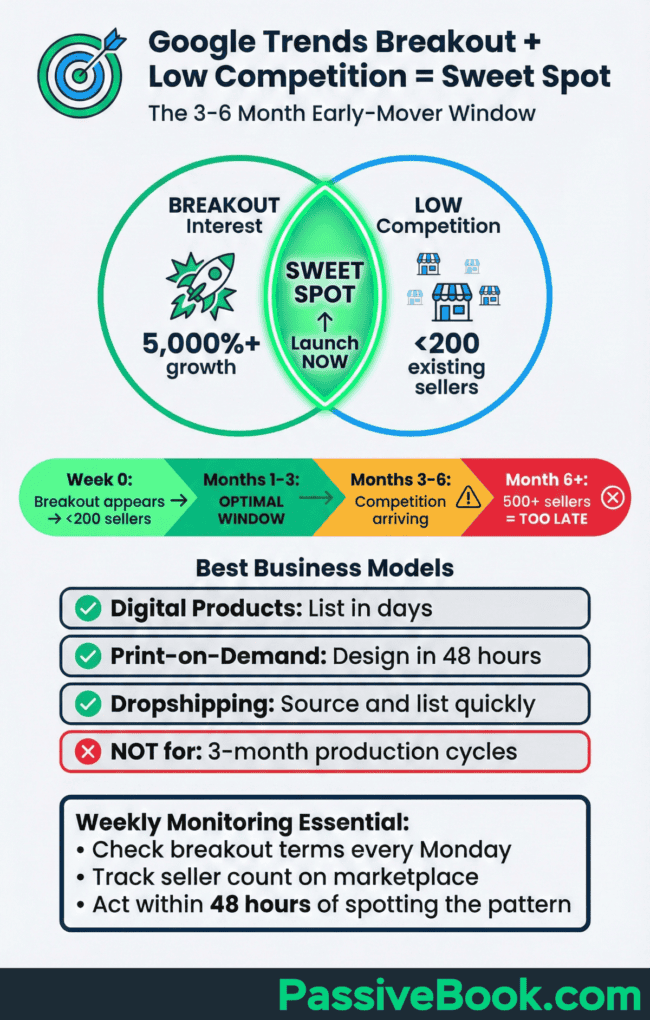
Don’t chase breakout terms in markets you can’t enter quickly. If tooling up for production takes three months, the breakout window will close before you launch. Breakout opportunities favor digital products, print-on-demand, and dropshipping where you can move in days.
34. Validate Saas Tool Ideas With Search Patterns
Software solutions should show steady growth over two years minimum before you invest months in development. SaaS products take longer to build than content or physical products. You need confidence the market will still exist when you finish coding.
Search for “[problem] software” or “[problem] tool” to validate people are actively seeking software solutions, not just manual workarounds. If all related queries focus on “how to do X manually,” audiences might not be ready to pay for automation.
Check competitor tool names directly in Google Trends to see if the category is growing. If established tools show declining interest, the market might be consolidating around winners, making new entrant success unlikely.
35. Find Product Variation Opportunities
Related queries show specific variations customers actually search for. This reveals how to differentiate in crowded markets. If “yoga mat” shows flat interest but “extra thick yoga mat” is rising, the variation opportunity is clear.
Product variations let you enter mature markets by serving specific sub-segments. Instead of competing on “phone case,” you target “waterproof phone case” or “leather phone case” where competition is lower and customer intent is more specific.
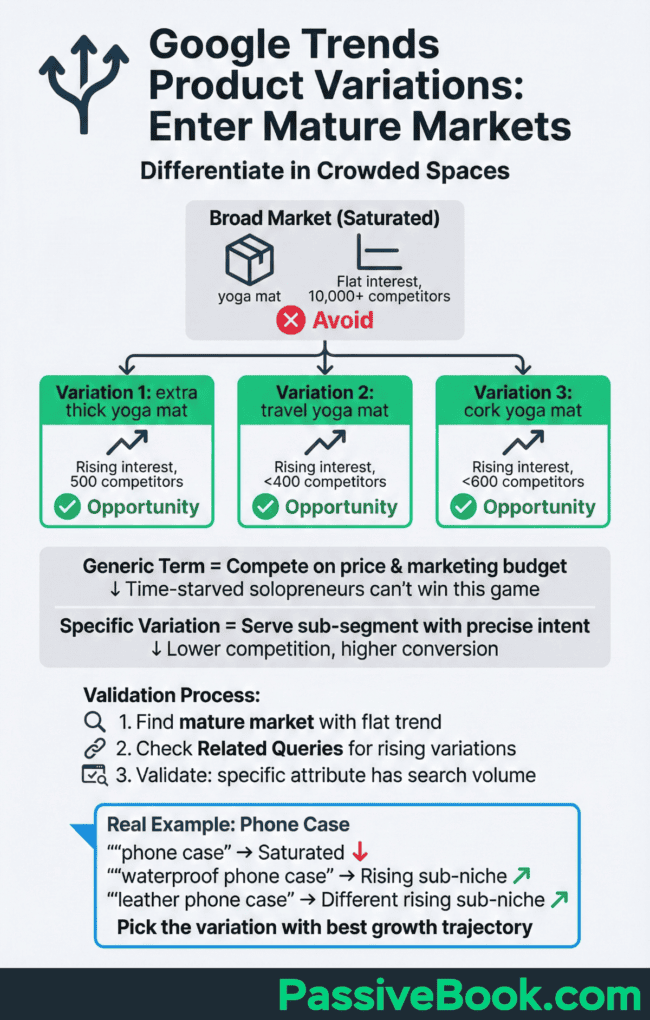
The validation prevents guessing which variation matters. Use the related queries data to see which specific attributes customers search for, then source or create products matching those exact specifications.
36. Validate Coaching Program Topics
Service businesses need durable demand because you’re trading time for money. Declining markets mean constantly hunting for new clients. Check three-year trends minimum to ensure your coaching niche has sustained interest, not a temporary spike.
Coaching topics should show stable or rising baseline interest without dramatic seasonal fluctuations. If interest drops 60% during summer months, you’ll struggle with inconsistent income unless you have capital reserves to cover slow periods.
Search for “[your topic] coaching” specifically to distinguish between people wanting free information versus those searching for paid guidance. The presence of “coaching” in related queries indicates audiences understand the value of paid help in your area.
37. Test Membership Site Topic Sustainability
Recurring revenue models require evergreen interest because your business model depends on subscribers staying long-term. Avoid trending topics that might be irrelevant in 18 months, collapsing your member base before you’ve recouped acquisition costs.
Membership topics need enough depth to support ongoing content creation. Check for 50+ related queries indicating sufficient subtopics to publish weekly or monthly content without repetition.
The ideal membership pattern shows flat interest between 60-80 on the relative scale over three years. This indicates stable demand without the risk of building on a declining trend or a temporary spike.
38. Identify Affiliate Marketing Opportunities
Rising product-related searches indicate affiliate potential before market saturation. When you spot a product category in Google Trends showing upward growth with breakout related queries, research affiliate programs before every blogger pivots to that niche.
Search for specific product names or categories, not just generic terms. “Standing desk” is too broad, but “Flexispot standing desk” tells you whether a specific brand is gaining traction worth promoting as an affiliate.
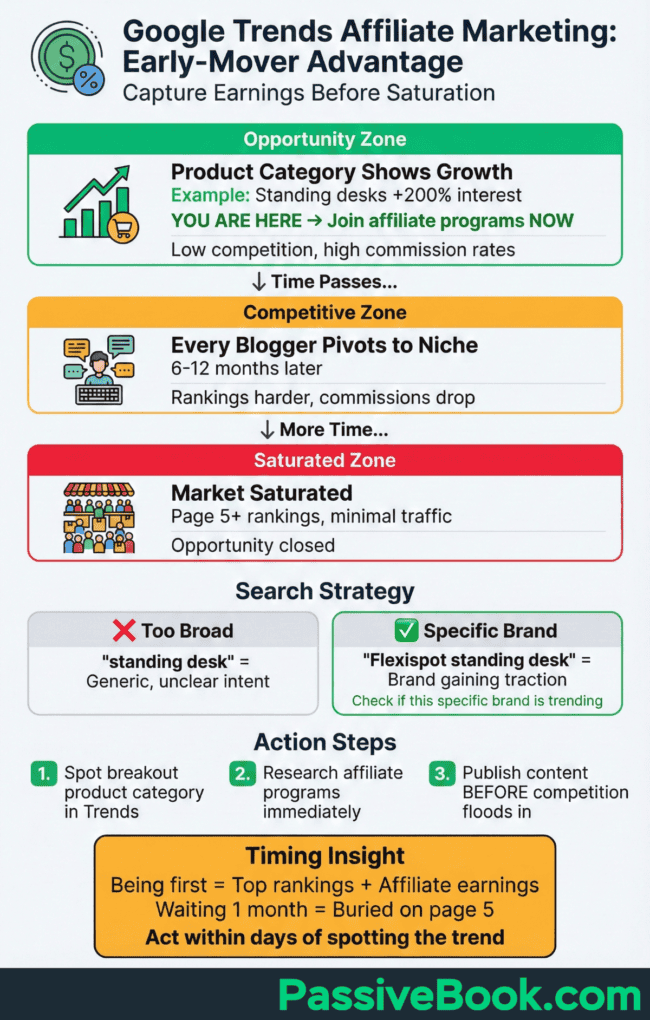
The timing advantage matters because affiliate commissions get more competitive as markets saturate. Being the established authority when a product category explodes means you capture the top rankings and affiliate earnings before competition intensifies.
39. Validate Freelance Service Demand
Geographic filtering shows which markets actively need your specific service. This prevents you from marketing to regions without demonstrated demand. If you offer “technical writing services,” the map shows whether demand clusters in tech hubs or spreads broadly.
Service-based businesses can’t scale infinitely, so targeting high-demand markets maximizes your limited capacity. Focus client outreach on the darkest-shaded regions instead of spreading effort across markets showing minimal interest.
Check if service demand is growing or declining over time. If “freelance graphic design” shows declining interest for three years, you’re entering a market where buyers have more options than ever and pricing power is shifting away from sellers.
40. Check Consulting Niche Viability
B2B consulting topics should show steady professional interest patterns without the dramatic spikes characterizing consumer trends. Look for consistent search volume between 50-70 on the relative scale over multiple years.
Search for business-oriented variations of your topic like “[topic] consulting” or “[topic] business strategy” to distinguish between casual interest and professional demand. Business buyers search differently than consumers. The presence of professional terms validates B2B demand.
Consulting requires significant credibility-building before clients pay premium rates. Ensure the topic has enough depth and related queries to support 50+ LinkedIn posts, articles, and case studies you’ll need to establish expertise.
41. Avoid Mistaking Viral News Spikes for Demand
A viral news event can send search interest to 100 for a week, but commercial viability requires sustained interest over months. Many founders confused temporary news-driven curiosity with commercial demand.
Set your timeframe to “Past 2 years” minimum and ignore any keyword that’s only high within the last three months. If interest spiked from 10 to 100 after a celebrity endorsement but was flat for 18 months prior, you’re chasing a news cycle, not a market.
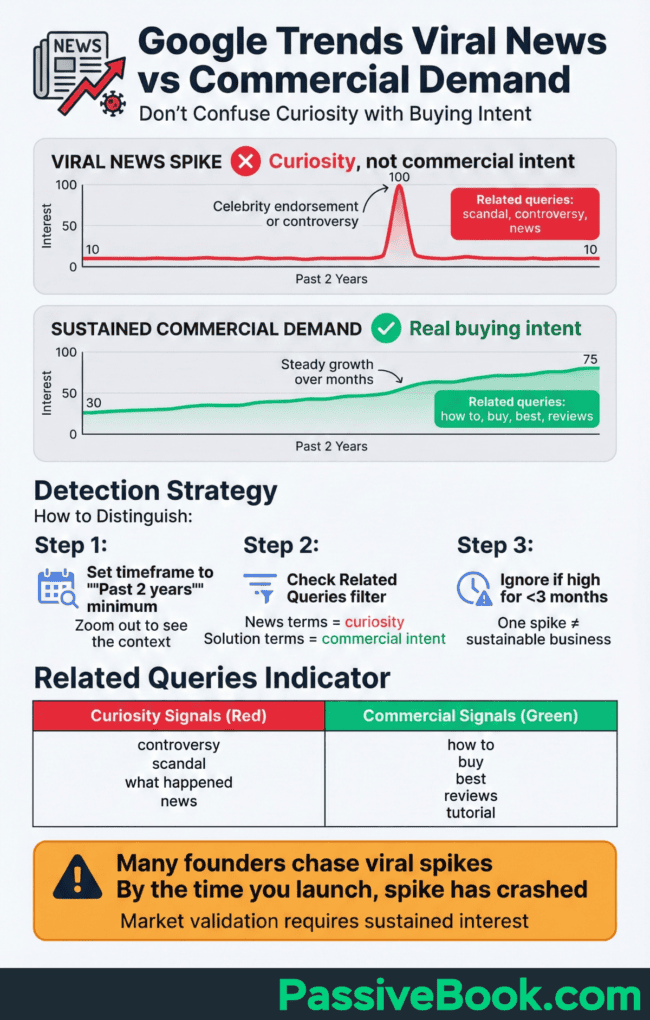
Distinguish between curiosity and commercial intent by checking related queries. If all related terms are news-focused like “controversy” or “scandal” rather than solution-focused like “how to” or “buy,” people are browsing, not buying.
42. Recognize Market Saturation Before Launch
FF.co statistics show entering saturated markets where demand exists but competition has made new entry economically unviable accounts for many failures. Flat or declining interest for 12+ months combined with thousands of existing sellers gives you double-confirmation to pivot.
Market saturation shows up in Google Trends as flat interest despite growing supply. If search interest stays at 60 for three years while Amazon listings grow from 100 to 5,000 products, more sellers are competing for the same static demand pool.
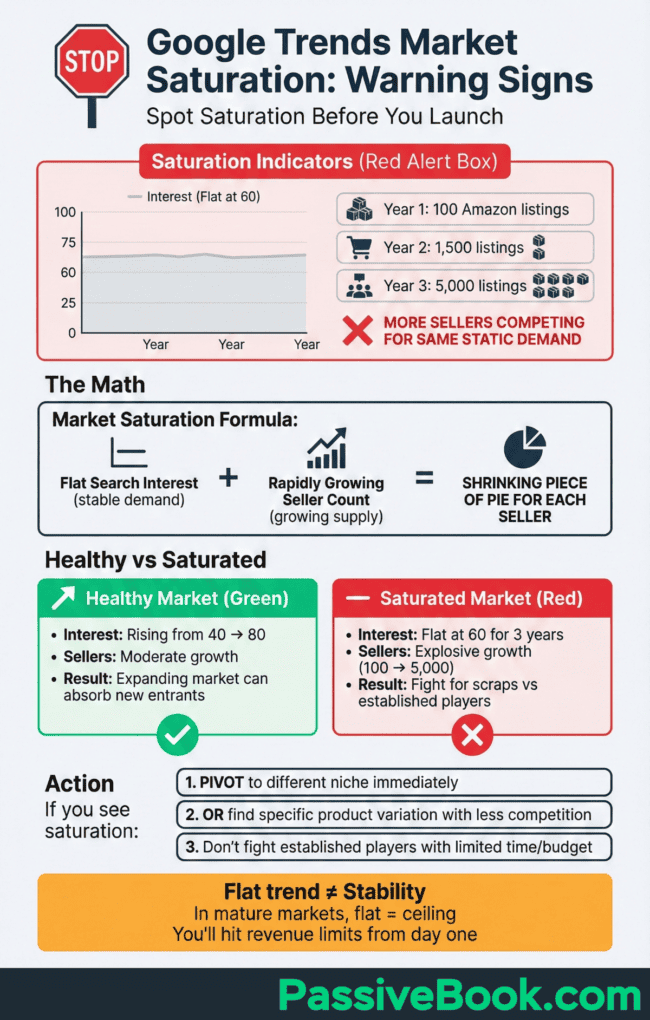
The mistake is seeing flat interest as stability when it’s actually a ceiling. Flat trends in mature markets mean you’ll fight for scraps against established competitors with bigger budgets and better positioning.
43. Balance Niche Specificity to Avoid Zero Volume
“Marketing” is too broad because you’re competing against every marketing agency and course creator. “Email marketing for dentists” might be too narrow if only 20 dentists per month search for it. The sweet spot sits somewhere between these extremes.
Test keyword variations at increasing specificity levels. Start broad, then add one qualifier at a time while watching how interest levels change. “Email marketing” then “email marketing for small business” then “email marketing for healthcare” shows you where volume drops below viable levels.
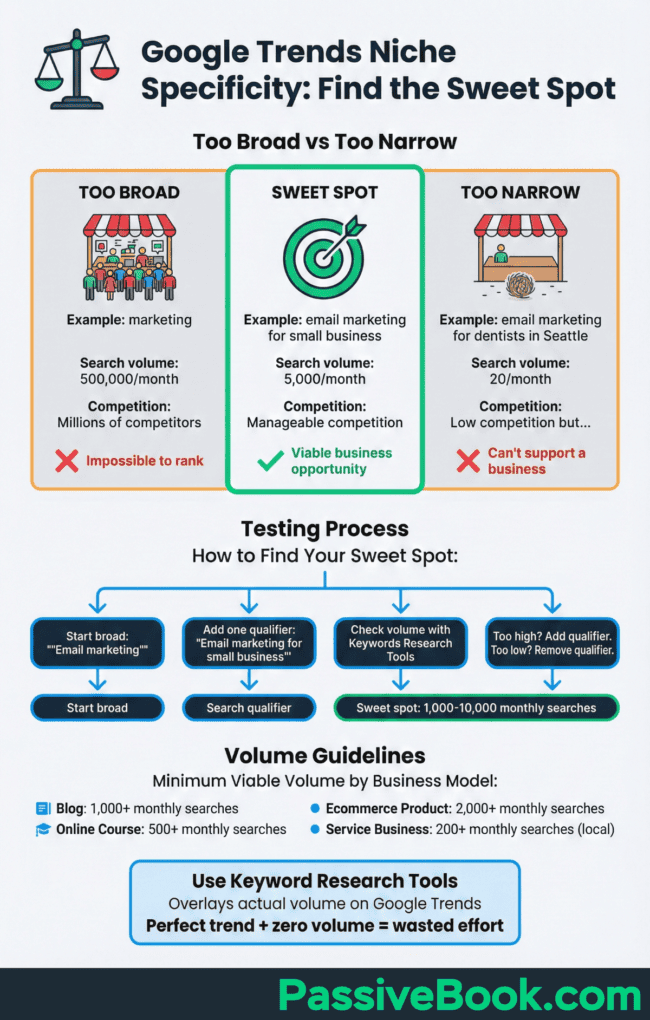
Use tools like Keywords Everywhere extension to overlay actual search volume on your Trends data. A perfect upward trend means nothing if it represents 50 monthly searches that will never support a business model requiring 1,000+ monthly visitors.
44. Set Proper Timeframes to Filter Meaningless Spikes
Use “Past 5 years” as your default timeframe to distinguish fads from sustainable opportunities. One-year timeframes hide the context revealing whether current interest is abnormally high, normal, or declining from previous peaks.
Five-year windows show you whether the current trend is part of a longer trajectory or an anomaly. If interest is at 70 today but was at 90 two years ago and 100 four years ago, you’re looking at a declining market despite the absolute number looking healthy.
Avoid the “Past 90 days” timeframe for validation entirely unless you’re tracking breaking news or viral moments. Three months doesn’t provide enough search data to distinguish signal from noise in most markets.
45. Compare Within Same Geography and Timeframe
Cross-timeframe comparisons become meaningless because Google Trends sets the peak to 100 within each specific timeframe. A keyword at 100 in “Past 90 days” might be at 20 when you Zoom out to “Past 5 years” if the real peak happened three years ago.
Always set geography and timeframe identically when comparing multiple keywords. If you compare “keto diet” set to Worldwide against “paleo diet” set to United States, you’re comparing different datasets revealing nothing useful.
The comparison feature only works when every variable except the keyword itself stays constant. Lock in geography and timeframe first, then add comparison terms to get meaningful relative performance data.
46. Layer Three Validation Tools Minimum
I validate every article topic with three tools now after wasting a month on a “perfect” keyword with 40 monthly searches in reality. The 15 minutes I spend validating saves me weeks of writing content nobody will read.
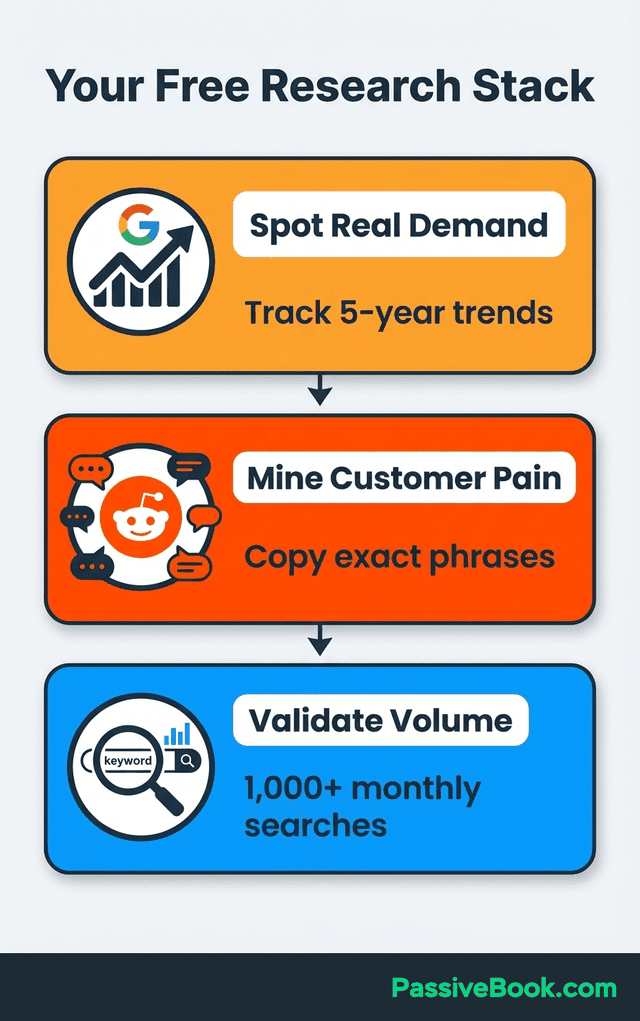
Google Trends alone doesn’t provide enough data to validate an idea confidently. Tools like Glimpse extension add absolute search volume to the Trends interface. Exploding Topics finds breakout trends across multiple data sources you might miss searching manually.
Each tool validates different aspects of your idea. Trends shows relative interest over time, Keywords Everywhere adds absolute volume, and Reddit or niche forums show whether people will actually pay for solutions. The combination builds confidence that all three signals align.
47. Cross-reference With Reddit Community Pain Points
Reddit validation mines real willingness to pay beyond search curiosity by finding communities where people actively discuss spending money to solve problems. Search interest tells you people are curious. Reddit tells you if they’re frustrated enough to pay.
Check subreddit subscriber counts and post engagement alongside Trends data. A topic with 100,000 subscribers and daily posts about problems signals an active community willing to engage with solutions. Meanwhile, 5,000 subscribers with one post per week suggests lukewarm interest.
Look for posts where people explicitly ask for product or service recommendations. When someone writes “I’d pay $100 for a tool doing X,” they’ve validated demand more clearly than any Google Trends graph can.
48. Pair With Answer The Public for Question Keywords
Question-generation tools like Answer The Public generate question-based keywords showing specific user intent Google Trends alone might miss. While Trends shows relative interest, Answer The Public reveals the exact questions people ask, giving you content angles and product positioning.
Question keywords indicate problems people need solved, not just topics they’re curious about. “What is keto” shows curiosity, but “how do I start keto with no time” shows a specific pain point you can address with content or products.
Use Answer The Public to map out your content strategy, then validate each question cluster in Google Trends. This combination ensures you’re creating content around questions people actually ask with search volume to justify the effort.
49. Plan Launch 3-4 Months Before Peak Season
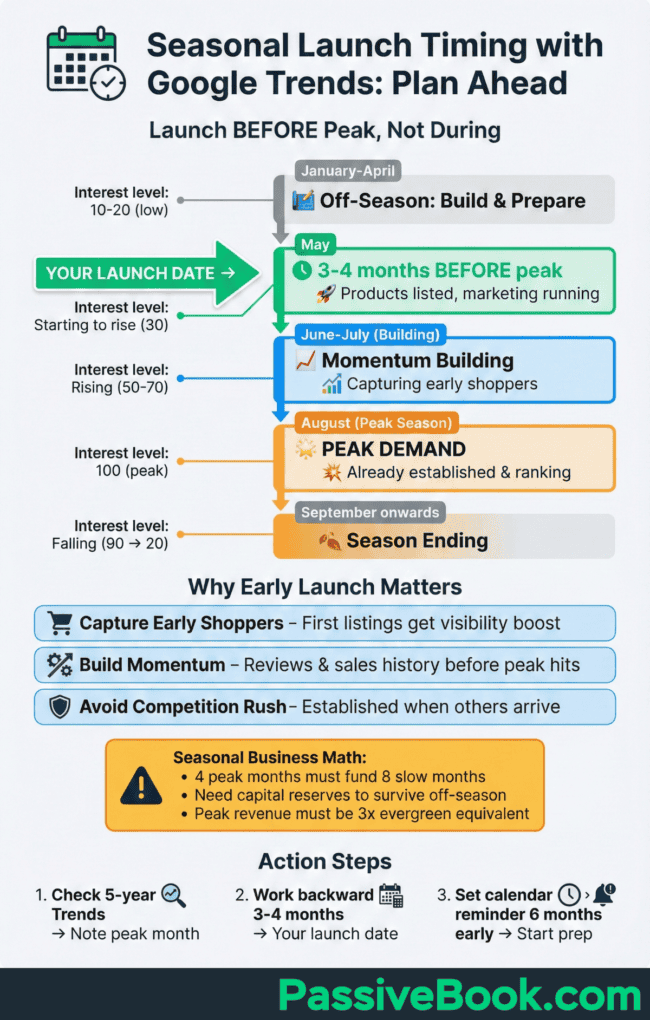
Seasonal trends require planning 3-4 months before peak demand hits. Seasonal businesses need to launch before peak demand, not during it. If lunchbox searches peak in August, you need products listed and marketing running by May. This lets you capture early shoppers and build momentum before competition intensifies.
The validation data shows you exactly when to launch by revealing historical peak timing. Set Google Trends to “Past 5 years” and note which month hits 100 each year. Work backward from that date to set your launch timeline.
Remember seasonal businesses need capital reserves for off-season months. If you have eight slow months funding four peak months, your peak revenue needs to be 3x higher than an evergreen business to achieve the same annual income.
50. Export and Track Competitor Terms Monthly
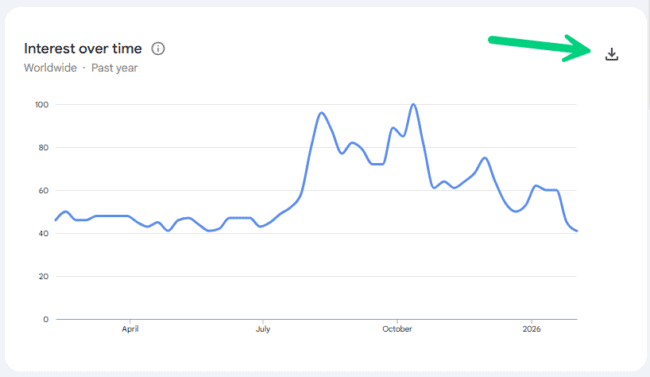
Click the download icon to export Trends charts as CSV files for spreadsheet tracking. This lets you monitor competitor terms over time and spot when their interest peaks, declines, or gets disrupted by new entrants.
Set up a monthly tracking routine where you check the same 10-15 keywords and export fresh data. Comparing month-over-month changes reveals gradual shifts you’d miss checking sporadically. Examples include a competitor’s slow decline or a new term’s steady rise.
While Google Trends doesn’t provide real time updates by the minute, monthly exports let you track changes before they become obvious to competitors. Tracking competitor terms shows you when markets are shifting before it’s obvious. If a major competitor’s branded searches decline for three consecutive months while a new entrant’s searches rise, the market is redistributing attention and you need to adjust strategy.
51. Document Validation Research for Future Pivots
Build a comparison spreadsheet ranking multiple ideas with trend scores, related query counts, competition levels, and personal interest ratings. This documentation becomes invaluable when your first choice doesn’t work and you need to pivot quickly.
The spreadsheet prevents starting from scratch every time you validate a new idea. You’ve already researched 10 potential niches, so pivoting means reviewing existing data rather than spending another week on validation research.
Track both quantitative metrics and qualitative observations. Note things like “high search volume but toxic community” or “lower volume but passionate audience” don’t show up in Trends data but matter for long-term sustainability.
Frequently Asked Questions
Can Google Trends predict exact sales numbers?
No, Google Trends shows relative search interest, not sales forecasts. A score of 100 means peak search popularity within your timeframe, but it doesn’t tell you whether that peak represents 100 sales or 100,000 sales. Use it to compare ideas and spot trends, not to project revenue.
How often should I check Google Trends after launching?
Check monthly for the first six months to ensure your market isn’t collapsing, then quarterly after that. Set up a recurring calendar reminder and export the data each time so you can track changes over your business lifetime. Dramatic drops in search interest signal when to pivot before revenue crashes.
Does low search volume always mean a bad business idea?
Low volume can indicate a tight niche with passionate customers willing to pay premium prices. If “custom pet portrait artists in Seattle” shows minimal search volume but three local competitors charge $300+ per commission, the small market might be highly profitable. Cross-reference volume with pricing power and competition before deciding.
Should I avoid topics with declining search interest entirely?
Declining interest usually signals markets to avoid, but exceptions exist when competition is declining faster than demand. If interest dropped 20% but competitors dropped 60%, you might capture a larger share of a shrinking market with less effort than fighting in a growing but saturated space. Evaluate both sides of the equation.
Can I use Google Trends for local business validation?
Yes, drill down to metro-level data using the geographic filter to validate local demand. Search for service-based terms like “personal trainer” or “bookkeeping services” filtered to your specific city to see if local search volume justifies opening a business there versus a neighboring market.
What Next?
You now have 51 specific ways to use Google Trends for validating business ideas before you waste months building something nobody wants. The validation process takes 30-60 minutes and prevents the failure mode killing 35-42% of startups. This makes it the highest-leverage hour you’ll spend on your business.
Starting a side business while working full-time means every hour counts. Google Trends gives you data-backed confidence to choose the right idea, but only if you actually use it before committing to a business model. Validation can become procrastination if you overdo it. Set a hard limit: 90 minutes of research per idea, then decide. Analysis paralysis kills more businesses than wrong decisions.
Share this guide using the buttons below if it helped you avoid a costly mistake or validate an idea with confidence. What business idea are you validating right now, and what did Google Trends reveal about its market potential? Drop your findings in the comments so others can learn from your validation research.
Share this post with your friends & followers: