I almost launched a course nobody wanted. I spent three months building content about advanced AI automation for bloggers. The modules were polished, the worksheets were beautiful, and I was ready to charge $297. Then I posted in r/Blogging asking what their biggest automation challenge was. The responses crushed me. They weren’t struggling with advanced AI. They were still trying to write consistently. My fancy solution solved a problem my audience hadn’t reached yet. That forum post saved me from a spectacular failure.
Online forums are where your future customers already discuss their problems without a sales pitch getting in the way. If you’re building something (a course, a product, a service) and you’re not sure people will actually pay for it, forums offer the fastest, cheapest validation path available. This guide walks you through finding the right communities, asking questions that get honest answers, and organizing feedback so you can make confident decisions without wasting months building the wrong thing.

- •What Online Forums Are for Business Feedback
- •Why Forums Work Better Than Friends and Family
- Finding the Right Forums for Your Business Model
- •Realistic Timeline: How Long Does Forum Validation Take?
- •The Lurking Phase: Learning Before Asking
- •Building Trust Through Value-first Participation
- How to Ask for Feedback: Questions That Get Results (not Bans)
- •What Forum Feedback Won't Tell You: Critical Limitations
- •Organizing Responses to Identify Patterns
- •When Forum Feedback Signals You Should Pivot
- •Free Tools to Track Forum Mentions
- •How AI Tools Are Changing Forum Research
- •Frequently Asked Questions
- •What Next?
What Online Forums Are for Business Feedback
After that r/Blogging reality check saved my business, I’ve used forums to validate every product idea since. Here’s what makes them different from every other validation method.
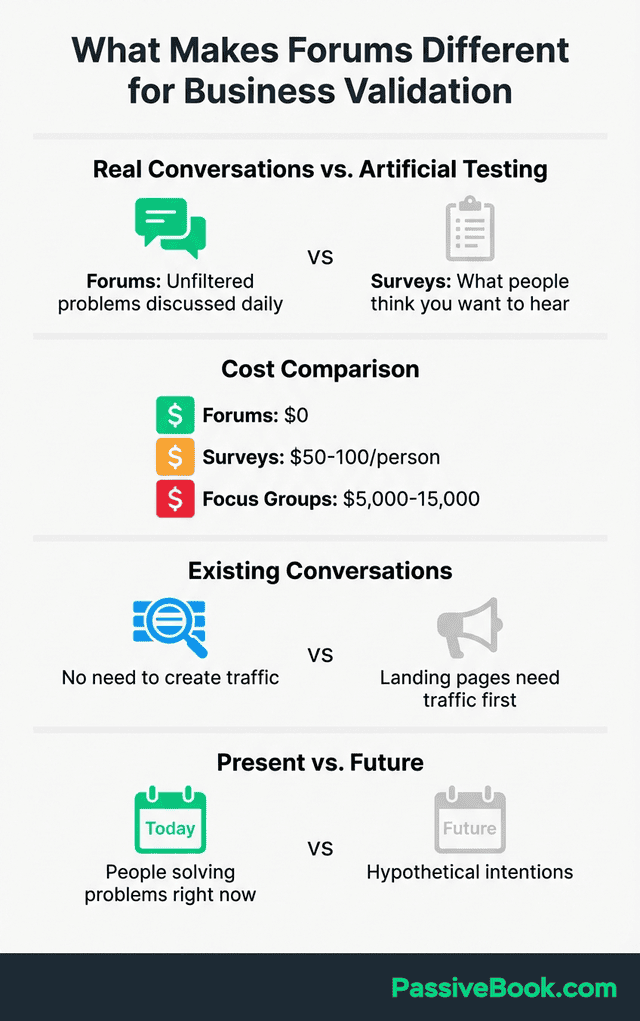
Online forums are digital communities where your target customers discuss problems without sales pressure or filtering. Unlike surveys where people tell you what they think you want to hear, forums capture real conversations happening right now.
Someone posts about struggling to find reliable dropshipping suppliers. Another person shares frustration with email marketing tools. These are unfiltered problems being discussed in real-time.
Platforms like Reddit, Indie Hackers, and Discord host thousands of niche groups organized by interest, industry, and problem type. Reddit alone has over 100,000 active communities covering nearly every business model imaginable.
Indie Hackers focuses specifically on bootstrapped founders building profitable businesses. Discord servers create real-time conversations through text and voice channels.
Unlike social media platforms where algorithms control visibility, forums surface content based on community votes and engagement. Paid surveys through platforms like UserTesting cost $50-100 per respondent. Focus groups run $5,000-15,000 for a single session. Forums cost nothing except your time. You’re joining existing conversations rather than paying to create artificial testing scenarios.
Forums reveal what people are actually struggling with today, not what they think they might want in the future. Surveys ask hypothetical questions about future intent. Landing pages require traffic you don’t have yet.
Forums let you research existing conversations where people are already asking for help, sharing frustrations, and discussing what they’ve tried. You’re observing natural behavior rather than creating artificial testing conditions.
Why Forums Work Better Than Friends and Family
Friends and family are the worst place to validate business ideas. They love you. They want to support you. They’ll tell you your idea is great even when it’s terrible.
This positive bias has real consequences. According to research on startup failures, 83% of startups fail due to lack of market need. Most founders discover this problem too late, after investing months or years building something nobody wants.
Strangers in forums reveal fatal flaws because they have no emotional investment in protecting your feelings. They’ll tell you pricing is too high, the problem isn’t painful enough, or a competitor already solved it better.
This brutal honesty feels harsh but saves you from wasting time on ideas with no market demand.
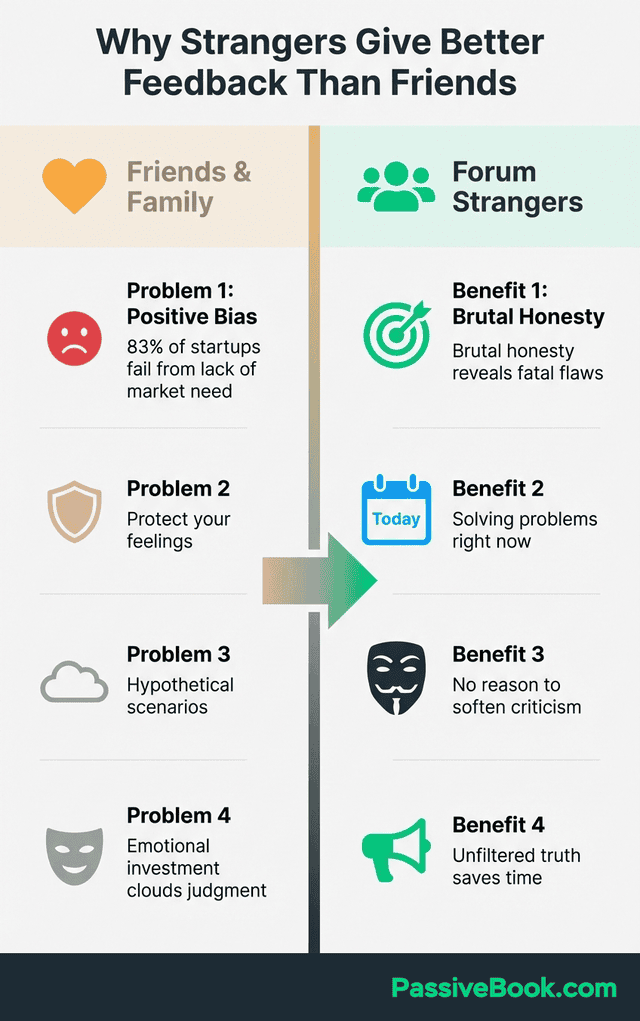
Forum members are solving the problem today, not imagining hypothetical future scenarios. When someone in r/ecommerce complains about inventory management, they’re actively dealing with that pain point right now.
They’re not your mom saying she’d “probably use something like that someday.” They’re potential customers experiencing the exact problem your business aims to solve.
Anonymity encourages honesty you won’t get from personal networks. People in forums don’t know you, don’t owe you anything, and have no reason to soften criticism.
They’ll tell you if your idea solves a problem they don’t actually have. They’ll point out cheaper alternatives. They’ll explain why they’d never pay for what you’re offering. This feedback is valuable precisely because it’s unfiltered.
Finding the Right Forums for Your Business Model
Finding the right forums starts with matching community demographics to your actual customer profile, not who you wish would buy from you. If you’re building a tool for freelance writers working from home, don’t validate in entrepreneur communities filled with venture-backed founders. The problems, budgets, and priorities are completely different.
Active communities matter more than large ones. A forum with 5,000 members posting daily provides better feedback than a 50,000-member ghost town with one post per week.
Check the timestamps on recent posts. Look for communities where the top posts from the past week have at least 10-20 comments. This signals engaged members who actually help each other.
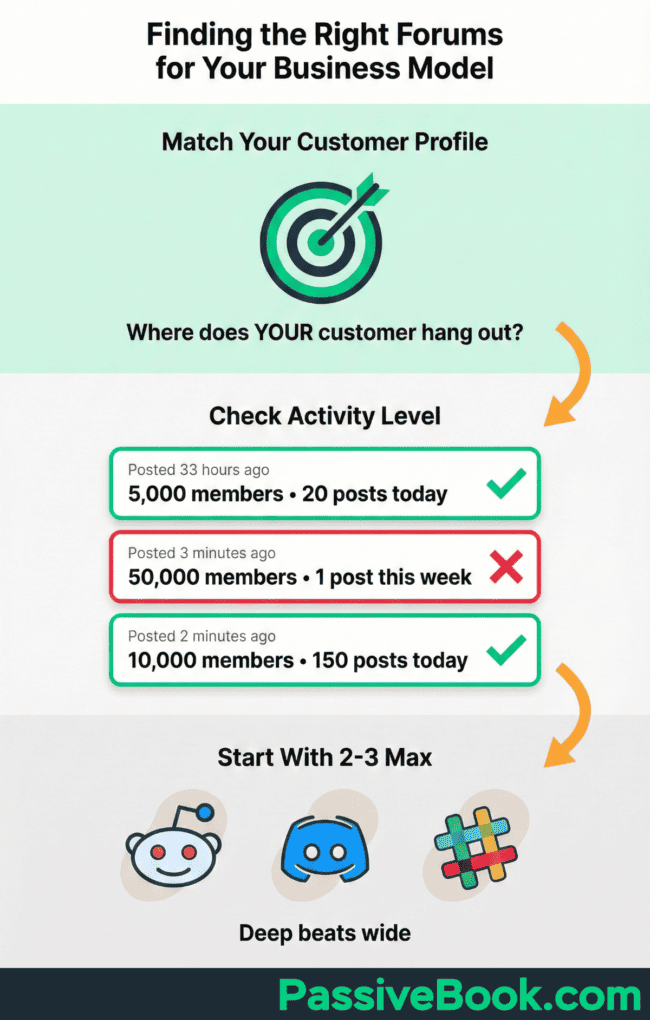
Choose 2-3 platforms maximum. You need time to lurk, understand culture, and build trust before asking for feedback.
Trying to participate in five forums simultaneously means you’ll do none of them well. Choose platforms where your target customers already spend time, then commit to learning those communities deeply.
Forums offer validation data that informs your broader digital marketing strategy, from messaging to channel selection.
Reddit Communities for Solopreneurs
Reddit hosts the largest collection of niche communities for nearly every business model. r/startups brings together over 1.9 million members discussing validation, early-stage feedback, and founder challenges. The community culture favors detailed posts with specific questions over vague “rate my idea” requests.
r/SideProject and r/smallbusiness offer validation from peers at similar stages. These communities understand the constraints of building with limited budgets and time.
Members share real experiences with specific tools, platforms, and tactics. You’ll find people solving the same problems you’re facing right now.
Finding niche subreddits requires targeted searching. Type “your niche + Reddit” into Google to discover active communities. Someone building a print-on-demand t-shirt business would search “print on demand Reddit” or “e commerce Reddit.”
Look for subreddits with posts from the past 24-48 hours and active comment threads discussing real problems.
Startup and Tech Communities for Validation
Hacker News connects technical founders through Show HN validation posts. The community skews toward developers and technical product builders.
Post your MVP (Minimum Viable Product) with a clear explanation of the problem you’re solving. Expect direct, sometimes harsh feedback focused on technical implementation and market fit. The audience values substance over polish.
Product Hunt enables early product launches and community feedback collection. Launch on Product Hunt when you have a working prototype, not just an idea.
The platform surfaces new products daily to an audience of early adopters actively looking for new tools. Comments reveal what resonates and what confuses potential users.
Niche forums provide deeper technical feedback than generalist entrepreneur groups. A founder building accounting software for freelancers gets better insights from freelance-specific communities than broad startup forums.
Look for forums organized around your specific industry, customer type, or problem domain rather than general business advice platforms. Communities organized around specific products services reveal unmet needs in existing solutions.
Buffer validated their minimum viable product by creating a simple landing page and posting to forums, collecting email signups before building anything. This $0 validation approach led to paying customers within 7 weeks.
They didn’t build features based on assumptions. They asked forum members what scheduling problem frustrated them most, then built exactly that.
Discord and Slack Communities
Y Combinator Startup School community offers real-time feedback from thousands of active founders. The community combines structured curriculum with peer support.
Founders share weekly updates, ask specific questions, and provide feedback to others. The quality of discussion rivals paid mastermind groups.
Startup Study Group and Startup Chat Slack workspaces connect over 6,000 helpful founders across different stages and industries. These communities move faster than Reddit or traditional forums.
You can ask a question and get responses within hours instead of days. Members often share recent experiences with specific tools, tactics, and strategies.
Video huddles in Discord enable quick validation calls with target customers. Instead of typing lengthy explanations, jump on a 15-minute voice call to walk through your concept and hear immediate reactions.
The real-time format reveals confusion points that written feedback misses. You’ll hear hesitation in someone’s voice when they don’t understand your value proposition.
Realistic Timeline: How Long Does Forum Validation Take?
Most founders either rush forum validation or drag it out indefinitely. Neither approach works. Rushing means you haven’t built enough trust for honest feedback.
Dragging it out means you’re procrastinating on actually building something. The optimal validation timeline takes 6-7 weeks with clear phases and time commitments that fit around a day job.
Week 1-2 focuses on the lurking phase. Spend 15 minutes daily reading posts to understand community culture and identify pain points.
Don’t comment yet. Notice what types of posts get helpful responses. Watch for recurring problems mentioned by multiple people. Save the most helpful threads for reference later.
Week 3-4 shifts to trust building through value-first participation. Dedicate 20 minutes daily to answering questions in your expertise area.
Your goal is 10 helpful comments that genuinely solve problems for others. Don’t mention your business idea yet. Establish yourself as someone who provides value before asking for anything in return.
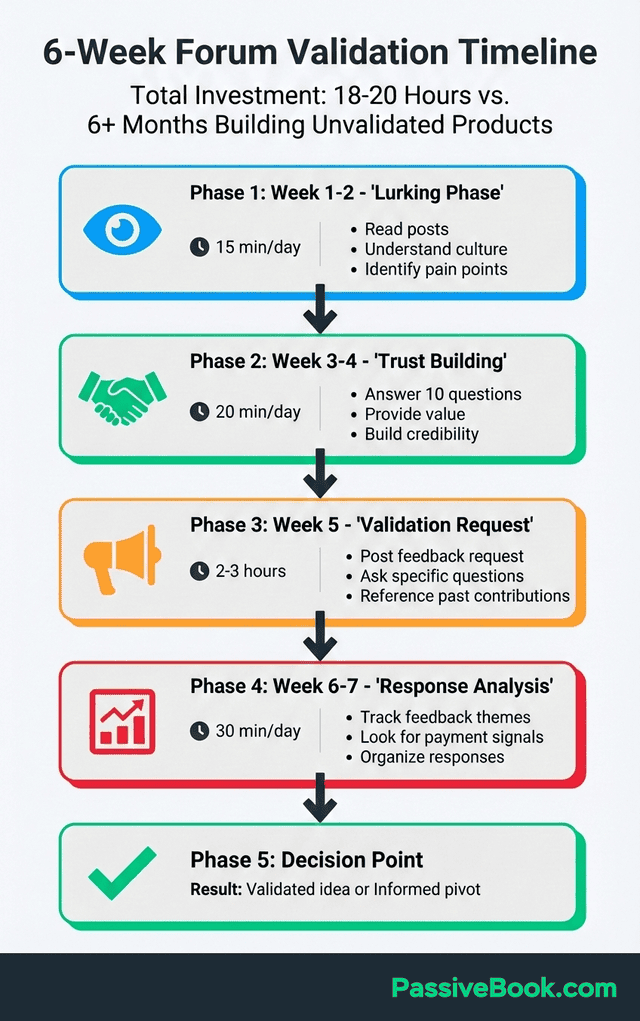
Week 5 is validation request time. Block 2-3 hours to craft and post your feedback request in 2-3 communities you’ve been active in.
Reference previous helpful conversations you’ve had. Frame your request around the problem, not your solution. Ask specific questions that reveal whether people experience the pain point intensely enough to pay for a solution.
Week 6-7 focuses on response analysis. Spend 30 minutes daily tracking feedback themes and looking for payment signals.
Not everyone who says “cool idea” will become a customer. Look for responses like “I currently pay $X for something that doesn’t solve this” or “Where do I sign up?” These indicate real demand, not polite encouragement.
Total time investment runs approximately 18-20 hours across 6-7 weeks. Compare this to the 6+ months most founders spend building unvalidated products.
You’re investing roughly 2-3 work days of effort spread across several weeks to avoid potentially wasting half a year on something nobody wants. The time saved from avoiding a bad idea pays for the validation effort many times over.
The Lurking Phase: Learning Before Asking
I made the mistake once of joining a new subreddit and immediately posting my feedback request. The post got removed by moderators within an hour.
I hadn’t taken time to understand the community’s rules about self-promotion. I hadn’t noticed that successful feedback requests in that forum always came from established members who’d been helping others for weeks. My rushed approach signaled I only cared about taking value, not providing it.
Community research shows lurkers learn interaction patterns before participating publicly. It’s strategic observation, not laziness.
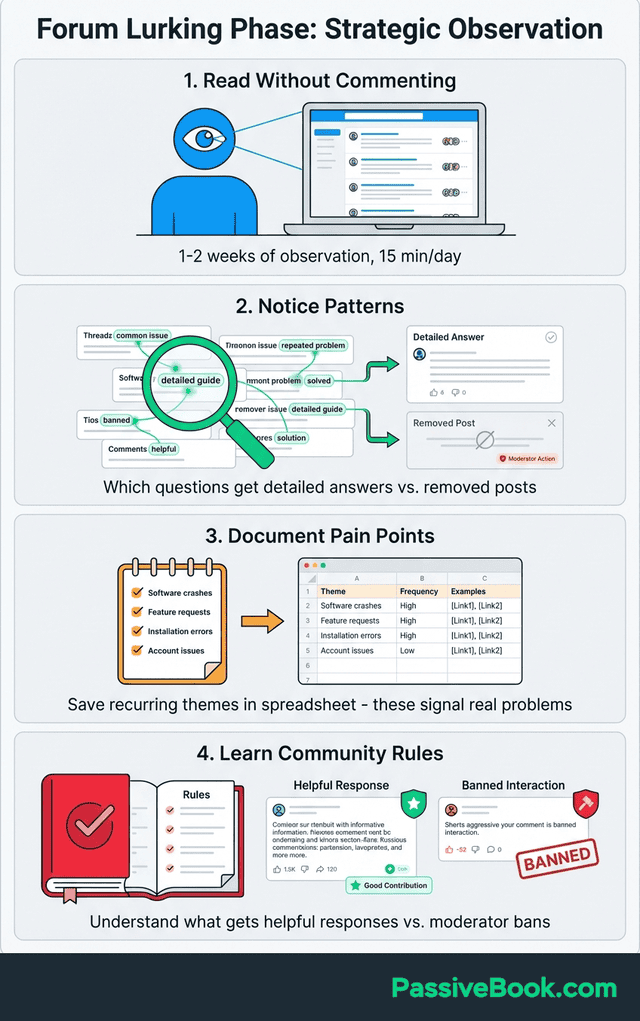
Spend 1-2 weeks reading posts without commenting. Notice which questions get detailed answers versus one-word replies. Watch how established members phrase requests for help. Pay attention to what makes moderators remove posts.
During this phase, identify frequently discussed pain points that match your business solution. Someone in r/ecommerce mentions difficulty finding reliable suppliers three times in one week.
Multiple people in a freelance writing forum complain about invoice tracking. These recurring themes signal real problems worth solving. Document them in a simple spreadsheet or notes app.
Note what types of feedback requests get helpful responses versus moderator removals. Successful requests focus on specific problems and ask clear questions.
Removed posts usually pitch products directly, include affiliate links, or come from brand-new accounts with no community participation history. Learn these patterns before crafting your own request.
Building Trust Through Value-first Participation
Answer 10 questions in your expertise area before requesting feedback on your idea. Why the 10-comment minimum? Credibility.
Communities value contribution over extraction. If you’re building customer service tools, answer questions about support workflows, ticket management, and response time optimization. Show you understand the problem space deeply.
Share relevant experiences and lessons learned without mentioning your business initially. Someone asks about converting cold email subscribers into customers.
You share a tactic you’ve tested: segmenting new subscribers based on their signup source and sending targeted welcome sequences. You’ve provided value without pitching anything. The community remembers helpful contributors.
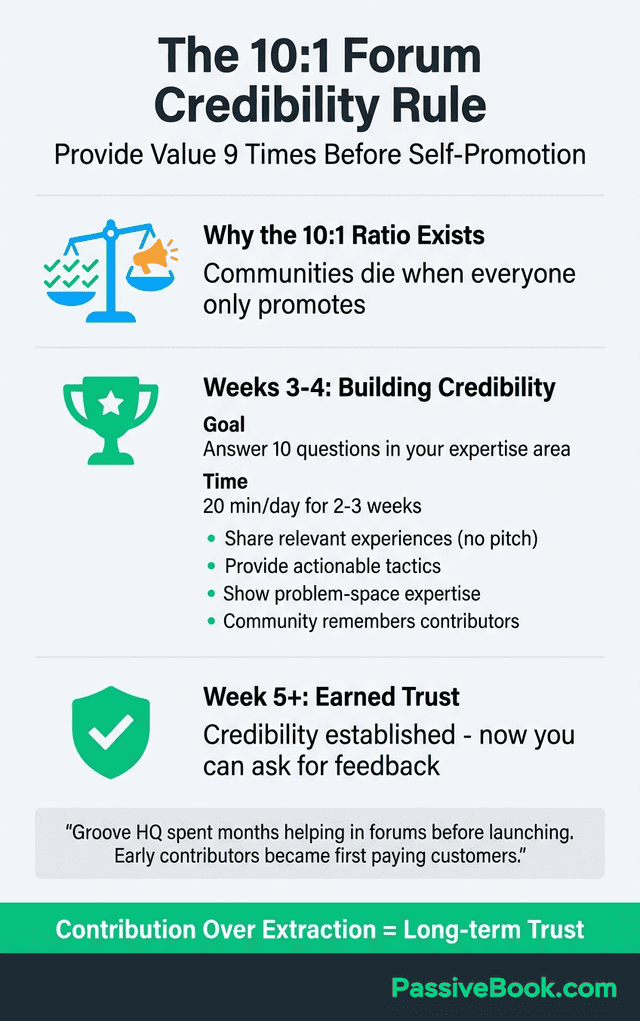
Active participation for 3-4 weeks establishes credibility before asking for feedback. This approach builds thought leadership organically rather than through forced self-promotion.
Most forums follow the 10:1 rule: provide value nine times before any self-promotion. This ratio exists because communities die when everyone only promotes their own stuff.
Nobody wants to hang out in a place that feels like a constant sales pitch. The 10:1 ratio maintains a healthy balance where the community stays valuable for everyone.
Groove HQ validated their help desk software by spending months in customer service forums answering questions before launching. They built credibility by genuinely helping people solve support problems.
When they finally mentioned building a new tool, the community trusted their expertise and provided critical feature feedback. Some of those early forum contributors became their first paying customers.
How to Ask for Feedback: Questions That Get Results (not Bans)
Frame requests as questions about problems, not product pitches or links. Bad: “Check out my new course on dropshipping.” Good: “I’m researching common struggles with finding reliable suppliers. What’s been your biggest challenge?”
The first gets removed. The second starts conversations that reveal real pain points.
Lead with “I’m researching [problem]” not “I built a solution.” This subtle shift changes how people respond.
They focus on describing their actual experience with the problem rather than evaluating your specific implementation. You’ll learn what features matter most, what alternatives they’ve tried, and how much pain the problem causes. Ask about their current workflow and user experience with existing solutions.
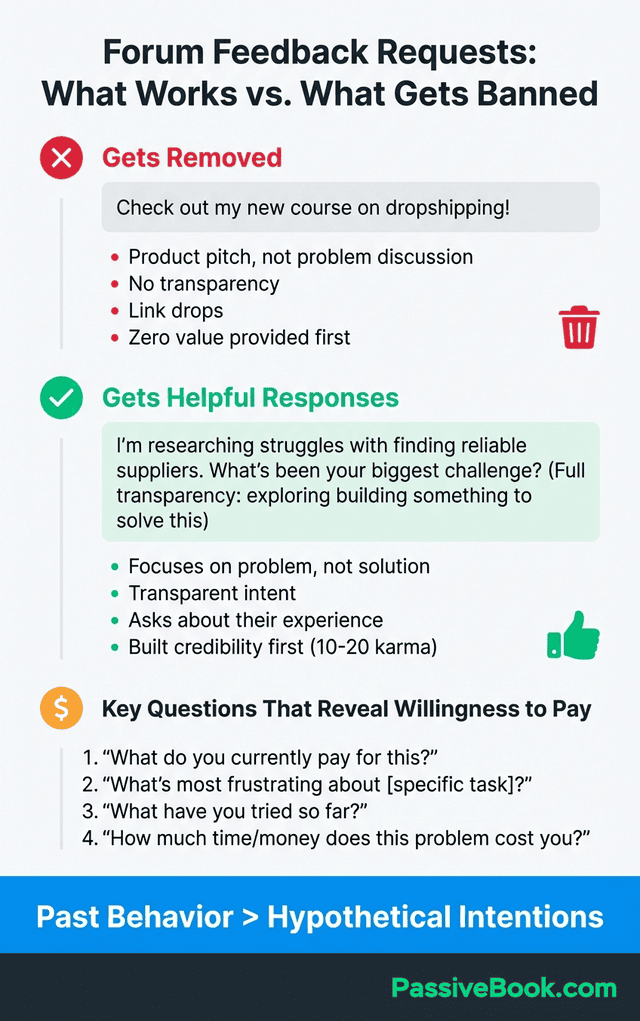
Disclose you’re building something because transparency prevents moderator removals. Most communities allow validation questions if you’re upfront about your goals.
A simple statement works: “Full transparency: I’m exploring building something to solve this. But first, I want to understand if this is actually a painful problem for people.” Honesty builds trust rather than suspicion.
New Reddit accounts typically need 10-20 karma before commenting freely in most subreddits. This prevents spam from throwaway accounts.
Build karma by posting helpful comments in low-restriction communities first. Reddit’s self-promotion guidelines recommend 10% or less of posts be self-promotional content. Follow this ratio to avoid bans.
Ask specific questions that reveal willingness to pay, not hypothetical interest. “Would you pay $X to solve [problem]?” tells you more than “Do you like this idea?”
People who respond with budget constraints (“That’s too expensive”) or comparison points (“I currently pay $Y for Z”) are giving you valuable pricing signals. Enthusiastic “Yes!” responses without context often don’t convert.
Request pain point validation by asking what’s most frustrating about a specific task. “What’s most frustrating about managing inventory across multiple platforms?” reveals unmet needs you might not have considered.
The answers often point to adjacent problems your solution could expand to solve later.
Research on Indie Hackers engagement shows visual polls increase engagement by 30% compared to text-only posts. Images, mockups, or simple diagrams help people understand your concept faster.
You don’t need fancy design. A hand-drawn sketch explaining your workflow often gets better feedback than a polished but confusing diagram.
Focus on past behavior rather than hypothetical intentions. “What do you currently pay for?” reveals actual budget allocation and willingness to pay for solutions in this category.
“Would you pay for X?” encourages people to imagine a future scenario that rarely materializes. Past behavior predicts future action far better than stated intentions.
Responding to Critical Forum Feedback
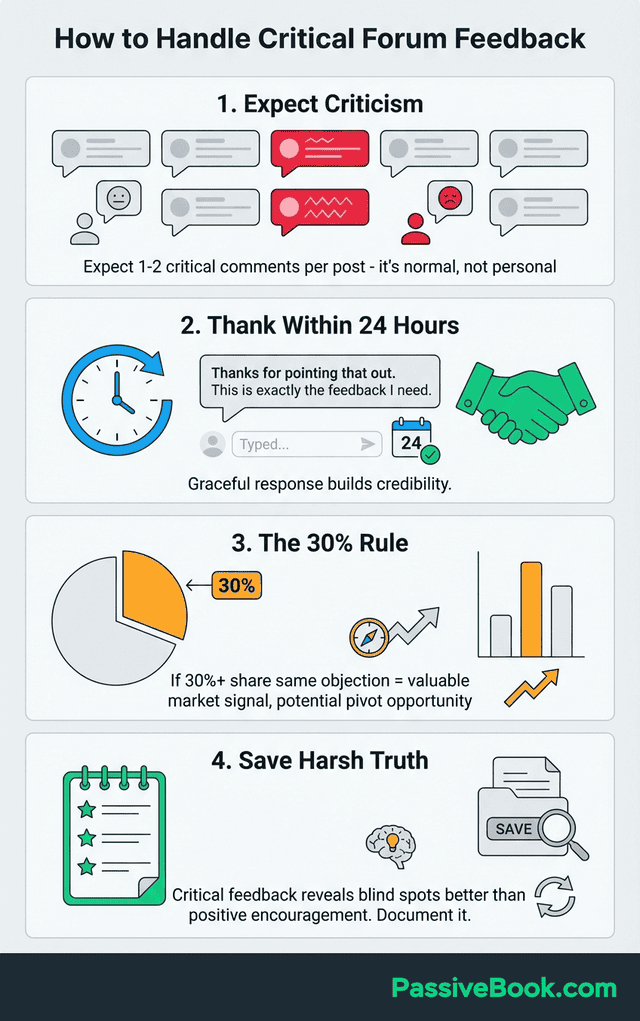
Expect 1-2 critical comments per post, even when your idea is solid. Not everyone will understand your vision immediately.
Some people enjoy playing devil’s advocate. Others have had bad experiences with similar products and bring that baggage to your conversation. The key is distinguishing constructive criticism from trolling by evaluating whether feedback addresses your actual question.
Thank critics for specificity within 24 hours to signal openness to improvement. “Thanks for pointing out the pricing concern. That’s exactly the kind of feedback I need.”
This response shows you’re listening, not defensive. Other community members notice how you handle criticism. Graceful responses build credibility even when the feedback stings.
If 30% or more of responses share the same objection, treat it as valuable data signaling a potential pivot opportunity. Five people independently saying “This already exists, I use Competitor X” isn’t hostility.
It’s the market telling you something important. Maybe Competitor X has gaps your solution could fill. Maybe you need to target a different customer segment. Maybe your positioning needs work.
Save genuinely helpful critical feedback in your tracking sheet because harsh truth often reveals blind spots better than positive encouragement. The person who says “I don’t think anyone would pay for this because X, Y, Z” gives you testable hypotheses.
You can validate whether their concerns apply to your broader target market or just their specific situation. Either way, you’ve learned something valuable.
What Forum Feedback Won’t Tell You: Critical Limitations
Enthusiasm rarely converts to paying customers. This is the most painful lesson in forum validation.
Twenty people comment saying “This is brilliant, I’d definitely use it!” Then you launch and crickets. Industry experience suggests a 10:1 ratio between positive comments and actual purchases is optimistic. Many founders see even lower conversion rates.
Landing page data reinforces this gap between interest and action. Average landing page conversion rates are 2.35% across industries, according to Unbounce’s conversion benchmarks.
If 100 people say they love your idea in a forum, converting 2-3 of them into email signups or purchases would be a strong result. Most founders expect 50-60 conversions and feel devastated when reality hits.
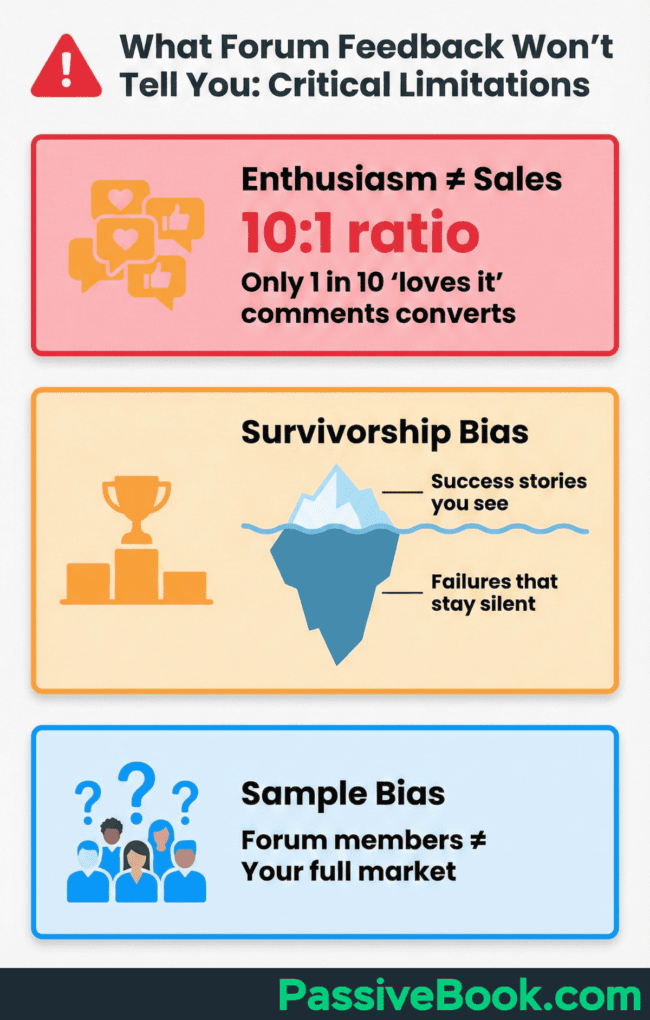
Founders participating in validation studies consistently report that forum upvotes and “I’d use this” comments rarely translate to signups. Y Combinator’s guidance on talking to users emphasizes that pre-selling with payment collection proves validation better than positive sentiment alone.
Someone who gives you their credit card believes in your solution. Someone who says “cool idea” is just being polite.
Survivorship bias means successful founders post more while failures stay silent, creating distorted perceptions. You see posts from people who validated ideas and succeeded.
You don’t see the hundreds who validated ideas, got positive feedback, launched anyway, and failed. The sample is biased toward success stories, making validation seem more reliable than it actually is.
Forum members don’t represent your entire target market demographics or willingness to pay. Someone active in r/Entrepreneur might be more tech-savvy and risk-tolerant than your average small business owner.
Someone posting in free tool subreddits probably has a lower budget than someone paying for premium solutions. Consider whether forum members match your ideal customer profile or just represent a subset.
Organizing Responses to Identify Patterns
I learned this the hard way after trying to remember feedback from 40+ Reddit comments across five threads. By week three, I couldn’t recall who said what or which pain points came up most often. The spreadsheet approach emerged from that chaos.
Use Google Sheets to track feedback themes, frequency, and commenter profiles. A simple spreadsheet beats trying to remember dozens of conversations across multiple platforms.
You need one central place to spot patterns emerging across different forums and timeframes. This organized approach transforms scattered opinions into actionable data.
Create columns for Date, Platform/Thread Link, Commenter Username, Pain Point Mentioned, Positive/Neutral/Negative Sentiment, Willingness to Pay Signal (Yes/Maybe/No), and Your Follow-up Action.
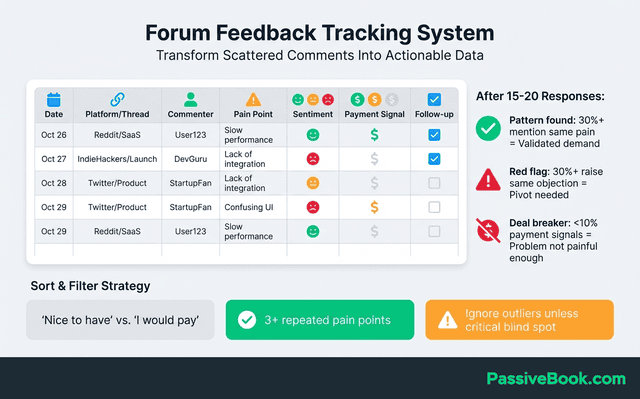
This structure reveals patterns when sorted by Pain Point frequency. You’ll quickly see which problems get mentioned most often and which comments deserve deeper follow-up conversations.
Separate “nice to have” comments from “I would pay for this” signals. Someone saying “That sounds useful” is very different from “I currently pay $50/month for a tool that doesn’t do this well.”
The second person has demonstrated willingness to pay for solutions in this category. They’re a qualified lead. The first person might never convert.
Look for repeated pain points mentioned by three or more different people independently. If five people across three forums all complain about the same specific problem without prompting, you’ve found validated demand.
One person mentioning something might be an edge case. Multiple people experiencing the same frustration signals a real market need.
Ignore single outlier suggestions unless they reveal a critical blind spot. Someone suggesting you build 47 features doesn’t represent common needs.
But if one person points out a legal compliance issue you hadn’t considered, that’s a critical blind spot worth investigating. Use judgment to distinguish between “that would be cool” and “this is actually important.”
Once you’ve tracked 15-20 responses, apply the 30% rule for decision-making. If 30% or more mention the same pain point without prompting, you’ve validated demand.
If 30% or more raise the same objection, you need to pivot or adjust positioning. If less than 10% express willingness to pay, your problem might not be painful enough to monetize.
When Forum Feedback Signals You Should Pivot
Slack started as a gaming company building an online game called Glitch. The game failed. But their internal team communication tool worked incredibly well.
Forum and user feedback revealed developers were more excited about the chat tool than the game. Slack pivoted completely, focusing on the communication platform instead. This decision saved them from pursuing the wrong market and built a multibillion-dollar company.
Consider pivoting when the same objection appears in 30% or more of responses. If nearly a third of people independently point out the same flaw, competitive alternative, or reason they wouldn’t pay, the market is sending a clear signal.
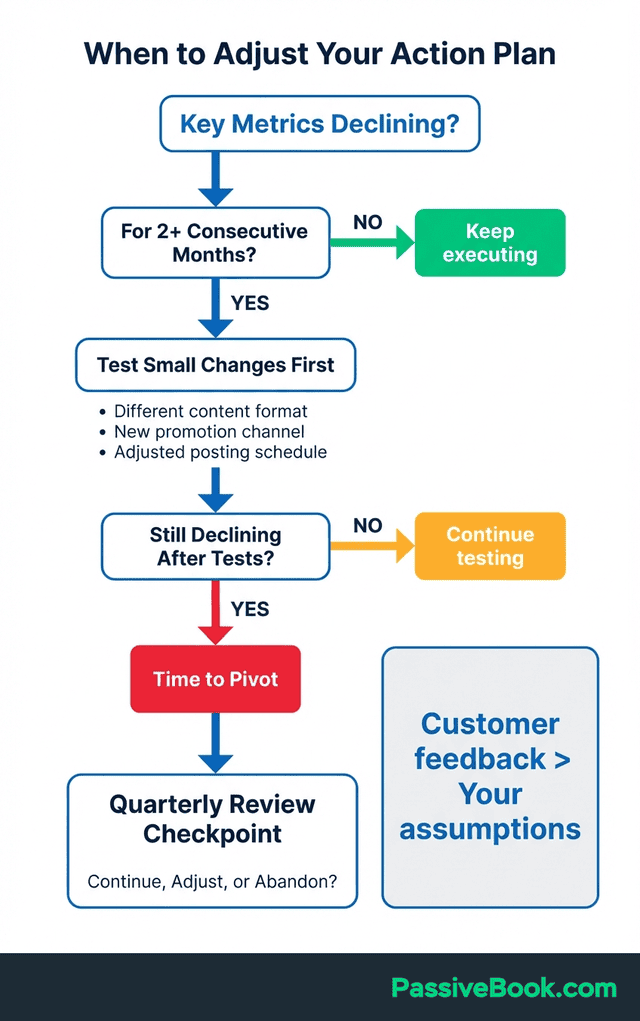
You don’t need to scrap everything. It means the current positioning, feature set, or target audience needs significant adjustment.
Pre-sales matter more than positive comments for validation decisions. Ten people saying “Great idea!” means less than two people saying “Where do I pay?”
If you can’t get anyone to put money down (even $5 as a deposit) you haven’t validated real demand. Enthusiasm without financial commitment is just polite encouragement.
Test a modified concept with a quick follow-up poll before completely rebuilding. You’ve already built relationships in these forums.
Post an updated version addressing the main objections. “Based on feedback, I’m pivoting from X to Y. Does this solve the problem better?” Quick validation saves you from pivoting in the wrong direction.
Free Tools to Track Forum Mentions
I’ve tested most of these over the past two years. Some looked promising but died from lack of maintenance. The tools below still work reliably as of January 2026.
Set Google Alerts for your business name plus relevant keywords like “Reddit” to catch organic discussions. Someone might mention your product without tagging you.
Google Alerts emails you when new results appear for your chosen search terms. This passive monitoring requires zero ongoing effort after initial setup.
F5Bot sends free email alerts for Reddit, Hacker News, and Lobsters mentions with no signup required. Just enter keywords related to your business or the problems you solve.
F5Bot checks these platforms continuously and emails you when someone posts relevant content. The tool is completely free and requires no account creation.
Manual weekly searches in target subreddits remain effective for bootstrapped validation. Spend 15 minutes every Monday searching your problem keywords in the 2-3 communities you’re most active in.
Sort by “new” to catch recent posts. This hands-on approach helps you spot conversations where you can provide value while learning about evolving customer needs.
Syften offers Slack integration for Reddit monitoring with a free tier, unlike F5Bot’s email-only approach. If your team already uses Slack for communication, Syften posts relevant mentions directly into your channels.
For teams, Syften’s Slack integration helps your support team monitor mentions in real-time. The real-time integration makes it easier to respond quickly to forum discussions while they’re still active.
Track keywords in specific threads using browser bookmarks for time-constrained solopreneurs. Find 3-5 highly active threads where your target customers discuss problems regularly.
Bookmark them. Check these threads twice weekly rather than trying to monitor entire platforms. This focused approach gives you quality insights without overwhelming time commitment.
How AI Tools Are Changing Forum Research
Monitoring tools like Brand24 and Mention track your brand across forums, blogs, and social media platforms simultaneously. These platforms aggregate mentions from dozens of sources into one dashboard.
You’re no longer manually checking six different platforms daily. The tools do the monitoring work and alert you to important conversations.
AI surfaces key themes and sentiment patterns faster than manual reading. Instead of reading 200 comments to find common threads, AI summarizes the three most frequent pain points and shows you representative examples.
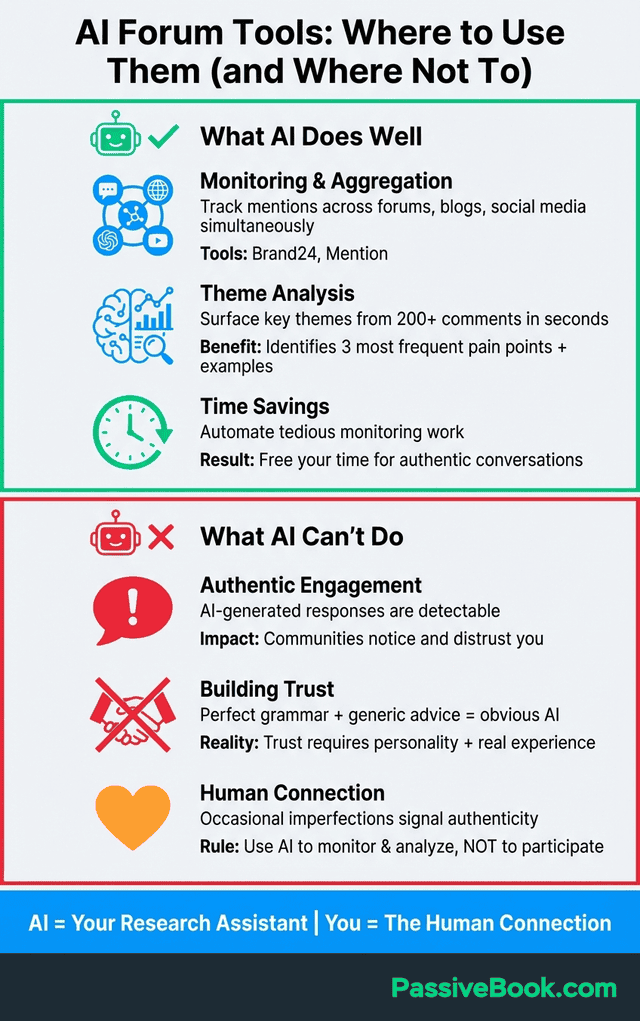
This speeds up analysis dramatically for solopreneurs juggling multiple responsibilities.
Automated monitoring frees time for authentic relationship-building activities. Let tools handle the tedious work of checking for mentions.
Spend your limited time having real conversations with potential customers. Answer their questions. Share your experiences. Build genuine connections that lead to valuable insights and early customers.
AI-generated responses are increasingly detectable and damage credibility in forums. Communities notice when your comments sound like ChatGPT outputs.
They notice perfect grammar, formal tone, and generic advice. Human engagement with personality, occasional imperfections, and genuine experience remains essential for building trust. Use AI to monitor and analyze, not to replace authentic participation.
Frequently Asked Questions
Are Forums Still Relevant for Validation in 2026?
Yes, forums remain highly relevant because they host active communities discussing real problems daily. Social media channels prioritize engagement metrics over problem-solving discussions, making validation difficult. Check any major subreddit or Discord community and you’ll find recent posts from people actively seeking solutions.
How Many Forum Responses Do I Need to Validate My Idea?
You need at least 10-15 detailed responses that discuss pain points, not just u0022sounds coolu0022 comments. Look for responses explaining current workarounds, budget constraints, or competitive alternatives people use. Three responses from people willing to pre-pay matter more than fifty enthusiastic comments without financial commitment.
What If I Get Mostly Negative Feedback on My Idea?
Negative feedback from your target market saves you months of wasted effort building something nobody wants. Thank people for their honesty, ask follow-up questions to understand their concerns, and consider whether a pivot addresses the core objections. Sometimes negative feedback reveals you’re solving a real problem but targeting the wrong customer segment.
Should I Reveal I’m the Business Owner When Asking for Feedback?
Always disclose you’re researching a potential business solution because transparency builds trust and prevents moderator bans. Frame it as u0022I’m exploring whether this problem is worth solvingu0022 rather than u0022buy my product.u0022 Communities appreciate honesty and provide better feedback when they understand your actual goals.
Can I Use Forums If My Business Isn’t Tech-related?
Absolutely. Forums exist for nearly every niche from gardening to real estate to fitness. Search u0022[your industry] forumu0022 or u0022[your industry] u003ca href=’https://www.reddit.com/’u003eRedditu003c/au003eu0022 to find active communities. Local business owners often gather in city-specific subreddits discussing challenges with restaurants, retail stores, and service businesses. The validation process works the same regardless of industry.
How Do I Know If Forum Feedback Is Trustworthy?
Check the commenter’s history and context. Someone with 2+ years of post history in your niche community offers more reliable insights than a brand-new account. Look for specific details in responses. People sharing actual budget figures, competitor names, or detailed workflows are giving you real data. Generic u0022sounds coolu0022 comments from accounts with no relevant history probably aren’t your target customer. Trust the patterns across 10+ responses more than any single comment.
What Next?
You now have a complete framework for validating business ideas through forums without spending money on surveys or building products nobody wants. Start by identifying 2-3 communities where your target customers already discuss problems. Spend two weeks lurking to understand culture and pain points. Build trust by answering questions before asking for feedback.
The insights you gather inform not just product development but your entire marketing strategy, from positioning to channel selection.
Forum validation feels uncomfortable at first. You’re putting your idea in front of strangers who might tear it apart. That discomfort protects you from wasting months building something with no market demand.
The honest feedback you receive in forums (both positive and negative) gives you the confidence to either move forward or pivot before investing serious time and money.
If you found this guide valuable, use the social sharing buttons below to help other founders discover it. Someone in your network is probably struggling with the same validation challenges you just solved.
What forum will you join first to start validating your idea? Drop your answer in the comments below, and if you’re feeling stuck on finding the right community, describe your business model and I’ll suggest some specific forums to explore.
Share this post with your friends & followers: