I spent three months building an online course nobody bought. The sting wasn’t just the wasted evenings after work. It was realizing I’d ignored the clearest signal.
My email list of 300 subscribers produced exactly two questions and zero pre-orders when I announced the launch. I’d spent $220 on Facebook ads to build that list, and my five “value-building” emails got 18% open rates but zero replies. Those numbers were screaming “nobody cares,” but I ignored them because the list kept growing. They weren’t interested, and I’d been too afraid to ask earlier.
Email signups can reveal whether your business idea has real demand, but only if you interpret them correctly. Most solopreneurs treat every signup as validation when the truth is more nuanced. This guide shows you how to use email validation as a reliable testing method, what numbers indicate market demand, and how to make the go-or-pivot decision before you waste months building something nobody wants.

- •What Email Validation Really Tests
- •Why Most Solopreneurs Misread Email Signup Signals
- The Right Number of Signups for Real Validation
- Building Your Validation Landing Page on a Bootstrap Budget
- Driving Traffic Without Draining Your Wallet
- Beyond the Number: Measuring Email List Quality
- •The Survey Step Most Solopreneurs Skip
- •Pre-selling: The Validation Signal That Matters
- •Pre-sell or Pivot: Your Next Move After Collecting Signups
- •Frequently Asked Questions
- •What Next?
What Email Validation Really Tests
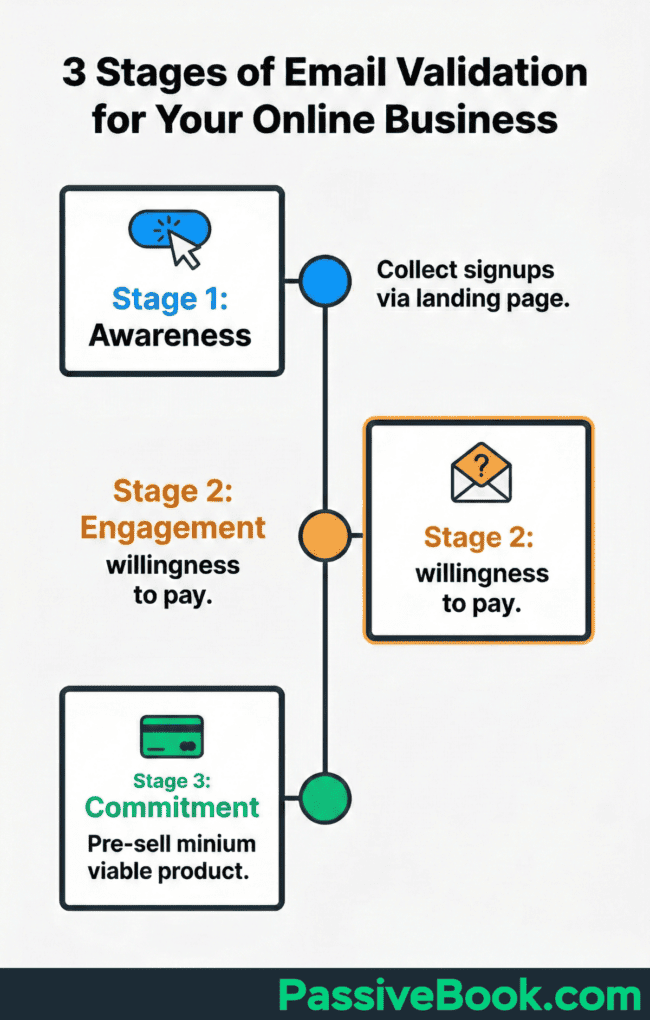
Email signup validation isn’t a single metric. It’s a three-stage process that tests different levels of commitment.
Stage 1 collects interested signups through a simple landing page. You’re measuring awareness of the problem you want to solve. Stage 2 engages those subscribers with value-focused content while surveying their willingness to pay. Stage 3 pre-sells a minimum viable version to confirm actual purchase intent. If you stop at Stage 1 and call it “validated,” you’ll wonder why nobody buys when you launch.
I know this sounds tedious. Most people want a simple yes-or-no answer: “Is 100 signups enough?” But validation doesn’t work that way. Each stage tests a different level of commitment, and skipping stages is how you end up building courses nobody buys.
A signup confirms someone wants updates about your topic. That’s useful. But it doesn’t prove they’ll open your emails. It doesn’t prove they’ll engage with your content. And it definitely doesn’t prove they’ll spend money when you launch.
CB Insights research shows 42% of startups fail due to no market need, and many of those failures had impressive email lists. The disconnect happens because founders confuse interest with intent.
True validation requires converting signups into paying customers. Everything before that is just a hypothesis.
Why Most Solopreneurs Misread Email Signup Signals
Your email list decays at 22% annually according to industry research on list engagement. Yesterday’s interested subscriber becomes less valuable with every passing week. Yet most solopreneurs treat their list like a static asset that appreciates over time.
Polite signups differ hugely from willingness to pay. Someone might genuinely want to learn about productivity hacks for side hustlers. But that doesn’t mean they’ll pay for your course. Maybe they prefer free YouTube videos. Maybe they’re broke. Maybe your specific approach just doesn’t click for them. The signup told you they’re curious, nothing more.
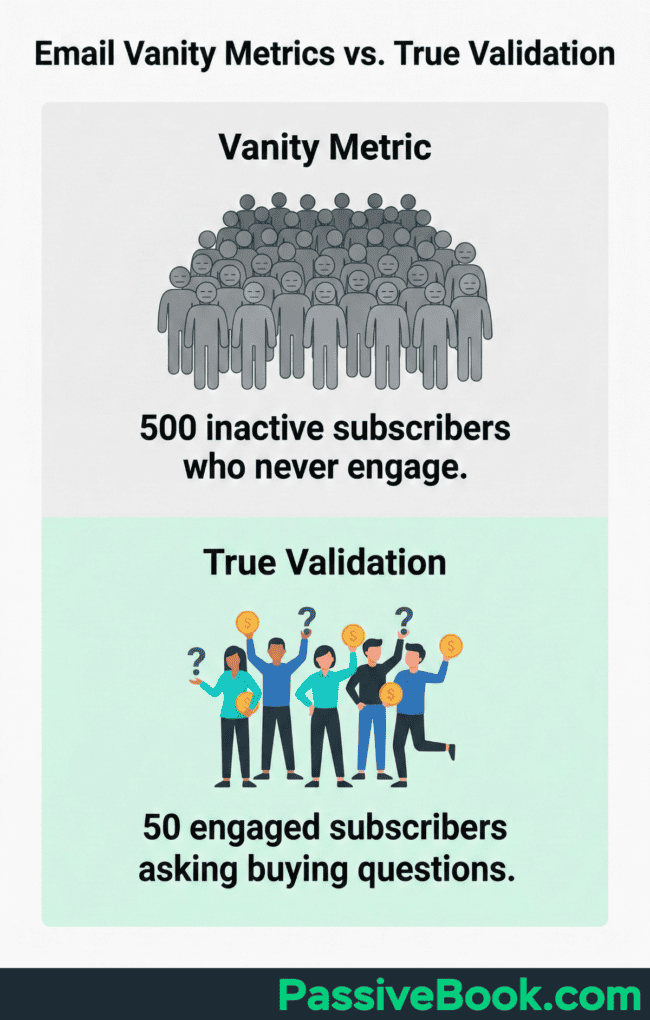
Many list builders confuse vanity metrics with validation of their business model. Hitting 500 subscribers feels like progress, and it is, but it’s progress toward the wrong goal if those subscribers never engage. Low engagement from inactive subscribers skews your email marketing metrics and wastes your limited free time – the most precious resource you have as a nights-and-weekends entrepreneur.
Treating all signups equally ignores engagement and demographic fit differences. Ten subscribers who reply to your emails and ask detailed questions are worth more than 100 who never open a message. The size of your email lists matters far less than what those people do after they join.
Don’t wait for a perfect list size before asking for money. Start testing willingness to pay once you have 50 to 100 engaged subscribers. That’s enough to get meaningful feedback without spending six months in validation limbo.
The Right Number of Signups for Real Validation
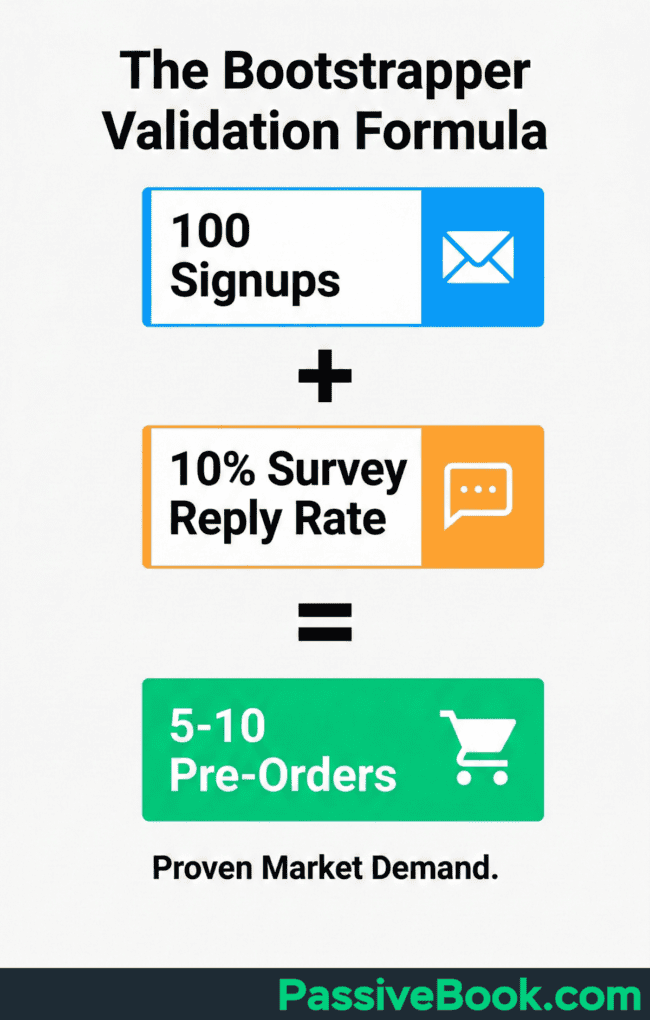
The magic number varies by business model and price point. For bootstrapped course creators and content entrepreneurs, 50 to 100 highly engaged subscribers can validate demand if 10% or more respond to your pricing survey and five to ten people pre-purchase. Quality engagement matters more than hitting an arbitrary number.
B2B consulting and high-ticket services need fewer signups. Twenty to 50 engaged prospects who fit your ideal customer profile provide sufficient validation because each sale brings substantial revenue. Low-price consumer products benefit from 300 to 500 or more signups to demonstrate broad market appeal. Your unit economics determine the threshold.
Quality trumps quantity every time. Fifty highly engaged subscribers who open every email, reply with questions, and share your content beat 500 inactive ones who ignore everything you send. Track engagement rates as your primary quality metric from day one, not just list size.
Converting Traffic to Signups: What the Numbers Tell You
Average landing page conversion rates vary by industry from 2% to 15% according to landing page research. Your conversion rate is the percentage of visitors who submit their email address. Calculate this by dividing signups by total visitors, then multiply by 100. For example: 25 signups ÷ 250 visitors = 0.10 × 100 = 10% conversion rate.
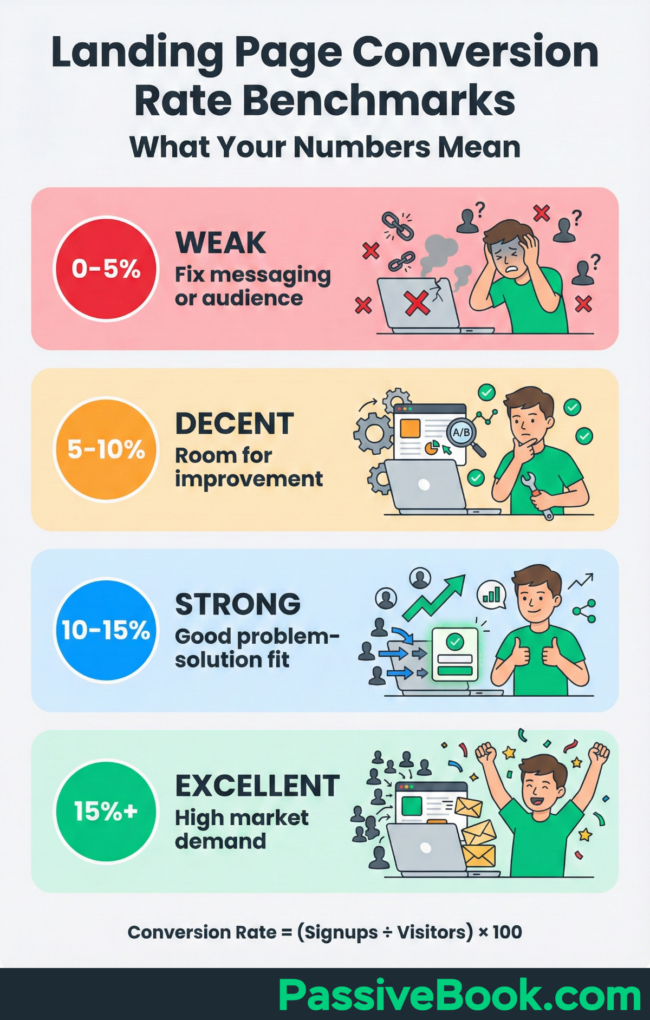
Conversion rates of 10% or higher indicate strong problem-solution fit. You’re attracting the right traffic and your messaging resonates with their pain points. Below 5% suggests weak messaging or insufficient market demand for your offer. Either your copy isn’t compelling or you’re promoting to the wrong audience.
If you’re getting 200 visitors but only 6 signups, that 3% conversion rate is a yellow flag. Test different headlines, simplify your call to action, or reconsider whether your target market cares about this problem.
From Email Signup to Paying Customer: Reality Check
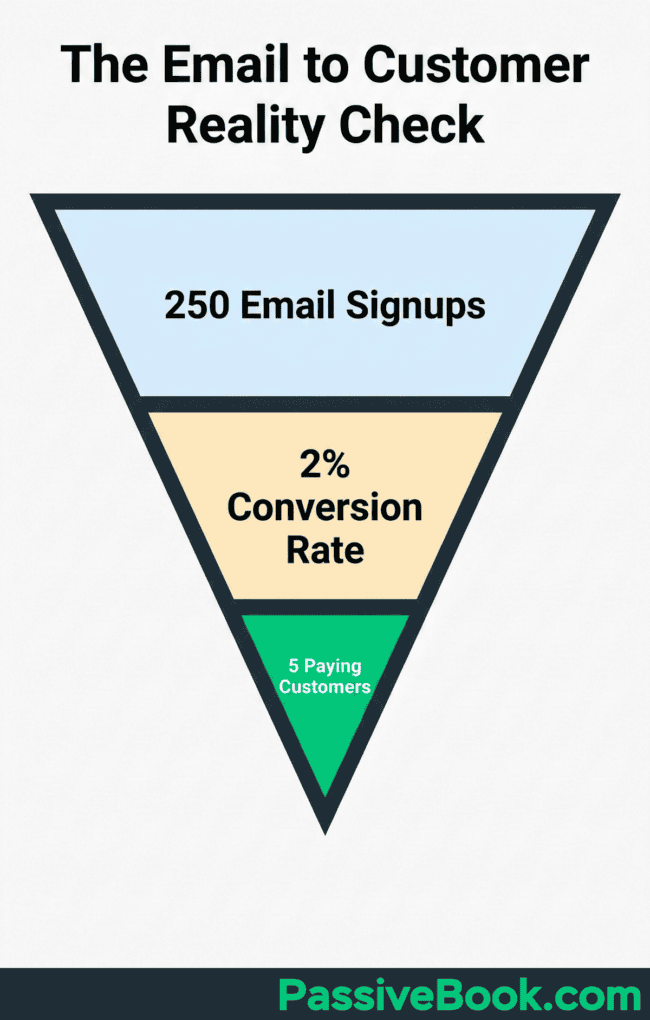
Course creators typically convert 1% to 2% of email subscribers to paying customers. This benchmark comes from established course platforms and represents realistic expectations for your first launch. With 2% conversion, you need 250 subscribers to get five course sales.
Do the math before you build. If your course costs $197 and you have 200 subscribers, a 2% conversion rate yields 4 sales for $788 in revenue. That might validate demand, or it might tell you to increase your list size or raise your price point. These benchmarks help set realistic revenue expectations before you invest months in course creation.
Track click through rates in your email campaigns to identify which messages drive action. A 2-3% click through rate on promotional emails is typical for early-stage lists. Your best email campaigns will show higher click through as subscribers get to know you.
Your conversion rate improves with email list maturity and launch experience. First-time course creators often see 0.5% to 1% conversion. By your third launch to the same audience, you might hit 3% to 5% as trust builds. Factor in your experience level when projecting revenue.
Building Your Validation Landing Page on a Bootstrap Budget
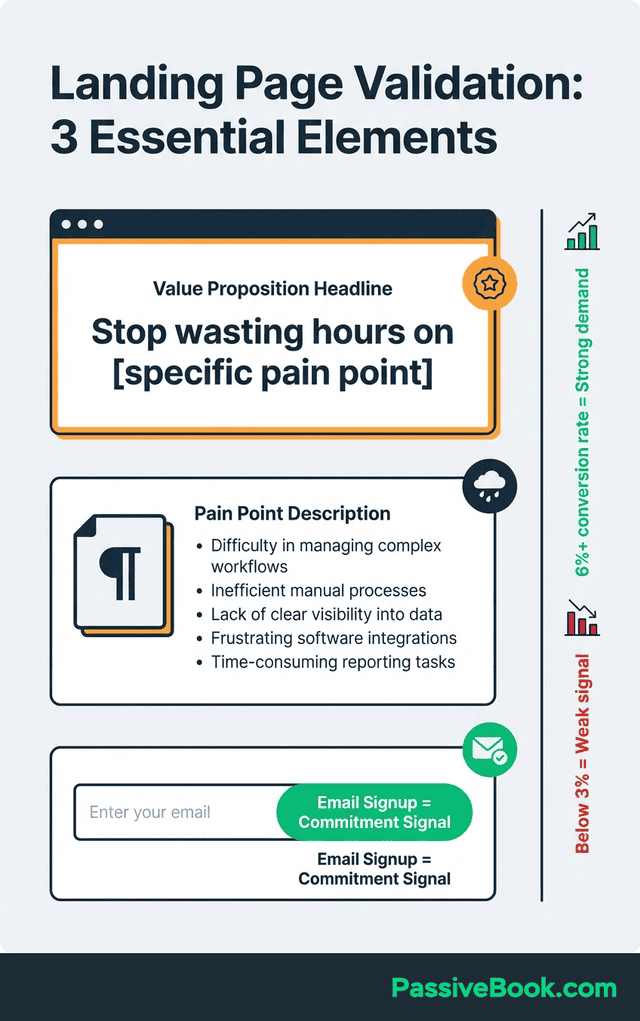
A single-page validation site tests demand before you invest months in a full product. You need one clear page that explains the problem you solve, who it’s for, and why someone should care enough to give you their email address.
Clear problem statements beat fancy design for early validation testing. Your struggling solopreneur doesn’t care about parallax scrolling or custom animations. They want to know if you understand their frustration and have a solution worth exploring. State the problem in the headline, describe the transformation in two sentences, and ask for their email. That’s the entire page.
Here’s what nobody tells you: the worst landing pages often convert best during validation. I’ve tested both – a beautiful custom-designed page with animations converted at 4%, while an ugly Carrd page with typos converted at 11%. For validation, ugly plus clear beats pretty plus polished. Save the design budget for after you’ve confirmed people will buy.
Include your email capture form above the fold with one focused call to action. Above the fold means visitors see it without scrolling. One call to action means you’re not offering three different lead magnets and confusing people about what they’re signing up for. Keep it ruthlessly simple.
Make your sign up form simple – just email address and one button. Add a privacy policy link below the form to build trust and avoid spam traps that email service providers use to catch bad actors. Never buy email addresses or add people without explicit permission.
Course creator Susanne Rieker validated her Blissful Brand Blueprint course using a simple landing page to pre-sell before creating a single lesson. This bootstrap approach confirmed demand and brought revenue to fund development. She didn’t need a professional designer or expensive tools, just clear messaging and a working form.
Free Tools That Work
Carrd creates simple landing pages in under an hour with no coding required. The free plan supports three sites per account, which is enough for testing multiple business ideas. The interface uses drag-and-drop blocks, so you’re building visually instead of wrestling with HTML.
MailerLite‘s free plan handles 1,000 subscribers at zero cost with automation features included. You get email campaigns, landing pages, and basic segmentation. The interface is cleaner than most free email tools, and you can upgrade when you have revenue to justify the expense.
Connect your landing page builder directly to your email service provider in real time for seamless list building. Carrd integrates with MailerLite, Convertkit, and most major email platforms through built-in form actions. Someone submits their email on your Carrd page, and they’re instantly added to your MailerLite list. No manual exports or complicated Zapier workflows needed.
Writing Copy That Converts Curious Visitors
Lead with the specific problem your target audience faces daily. Don’t write “Struggling with productivity?” Write “Spending 20 hours weekly on repetitive tasks while your business ideas sit in a notebook?” Problem-first copy resonates more than solution-first pitches because it proves you understand their reality.
Focus on the transformation outcome, not feature lists or technical specifications. Your course might include 47 video lessons and 12 worksheets, but nobody cares about that on a validation landing page. They care about the result: “Launch your first digital product in 30 days without quitting your job.” Describe where they’ll be after working with you, not what’s inside the package.
Use the reader’s language from forums, Reddit threads, and Facebook groups where they complain about this problem. If they say they’re “drowning in admin work,” use that exact phrase in your headline. When your copy mirrors their internal dialogue, conversion rates improve because they feel understood.
Driving Traffic Without Draining Your Wallet
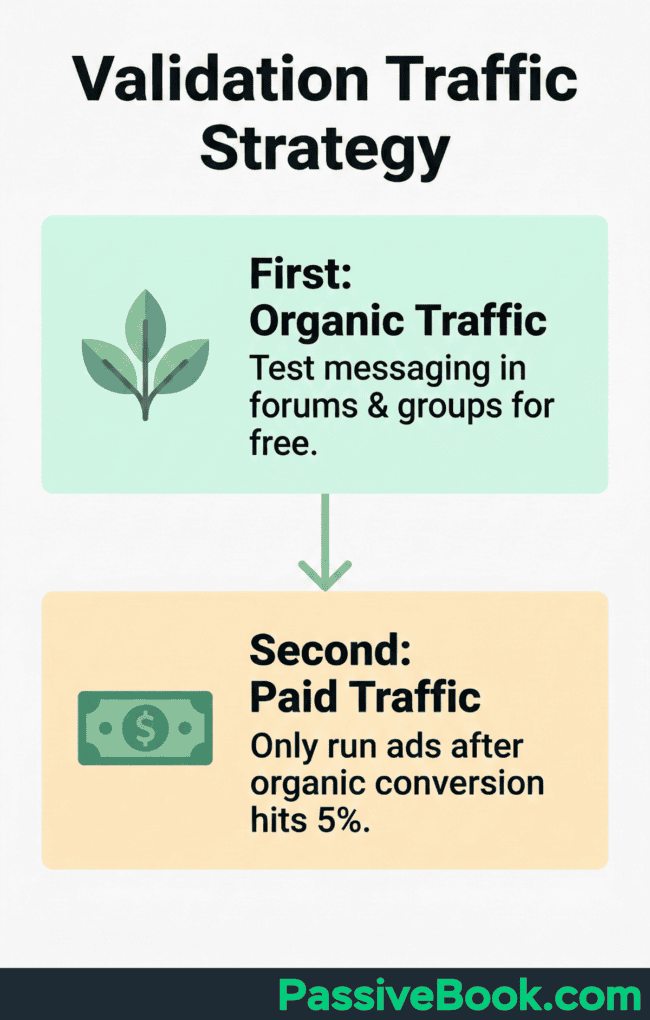
Start with organic channels to test your messaging before spending on ads. Organic traffic from communities, content, and conversations gives you qualitative feedback before you invest in paid email marketing. Your validation marketing strategy should test messaging organically first, then amplify what works. This protects your limited budget and ensures your email marketing efforts focus on proven positioning.
Consistent posting in three to five relevant communities brings your first validation traffic. Relevant means your target customer already hangs out there discussing the exact problem you solve. Consistent means showing up daily with helpful comments, not dropping your link once and disappearing.
I wasted $200 on Twitter ads once because I got excited about the traffic volume. Sent 300 people to my landing page. Got 6 signups. None of them ever opened an email. Meanwhile, 40 people from a Reddit comment converted at 25% and three of them became customers. Traffic quality beats traffic volume, but you only learn that by tracking both.
Track which channels produce highest-quality signups, not just the most traffic. Reddit might send 50 visitors who convert at 2%, while a Facebook group sends 20 visitors who convert at 15%. The Facebook group wins because those 3 signups are more engaged than the 1 signup from Reddit. Quality beats volume.
Organic Channels for Your First 100 Signups
Engage authentically in two or three target subreddits by providing value first. Reddit‘s self-promotion guidelines recommend 90% helpful content before promotional posts to build community trust. That ratio exists because communities punish obvious self-promotion. Spend two weeks answering questions and sharing relevant insights before you mention your landing page.
Answer five to ten questions daily in relevant Facebook groups or LinkedIn threads where your ideal customers discuss their problems. Then invite engaged commenters to your landing page via direct message.
This micro-interaction approach builds trust faster than broadcasting your link to thousands of strangers. When someone replies “This is exactly my problem,” send them a DM: “I’m testing a solution for this. Would you be interested in early access?”
Publish two or three LinkedIn posts each week sharing your validation journey transparently. Write posts like “Testing if course creators need a better way to validate ideas – here’s what I’m learning.” This builds an authentic following invested in your progress. People enjoy watching someone build in public, and many will sign up just to see how your experiment unfolds.
When Paid Ads Make Sense (and When They Don’t)
Facebook ads average $1.72 per click across industries with significant variation by niche. That cost per click means you need to budget based on how many visitors you need. If you want 200 landing page visitors at $1.72 per click, you’re spending $344 minimum.
Only spend on ads after organic channels show 5% or higher conversion rates. This rule protects you from burning money on unproven messaging. If your free traffic converts well, paid ads amplify that success. If your free traffic doesn’t convert, paid ads just lose money faster.

Budget $500 to $1,000 minimum for meaningful paid traffic testing and data collection. Anything less doesn’t produce enough volume to draw conclusions.
At $1.72 per click, $500 buys roughly 290 visitors. With a 10% conversion rate, that’s 29 signups. With a 3% rate, it’s 8 to 9 signups. The difference tells you whether ads are viable for your business model.
| Budget | Visitors (at $1.72 CPC) | Signups at 3% CVR | Signups at 10% CVR | Cost per Signup (3%) | Cost per Signup (10%) |
|---|---|---|---|---|---|
| $250 | 145 | 4 | 15 | $62.50 | $16.67 |
| $500 | 290 | 9 | 29 | $55.56 | $17.24 |
| $1000 | 581 | 17 | 58 | $58.82 | $17.24 |
Beyond the Number: Measuring Email List Quality
Email open rates average 21.5% across all industries according to email marketing benchmarks. Open rate measures the percentage of subscribers who open your email when you send one. It’s your first indicator of list quality because unopened emails can’t create engagement or sales.
Your bounce rates (percentage of emails that don’t reach inboxes) directly impact email deliverability and sender reputation. High bounce rates from invalid email addresses signal poor list hygiene to email service providers, which can land future marketing campaigns in spam folders. A clean email list improves deliverability for every campaign you send.
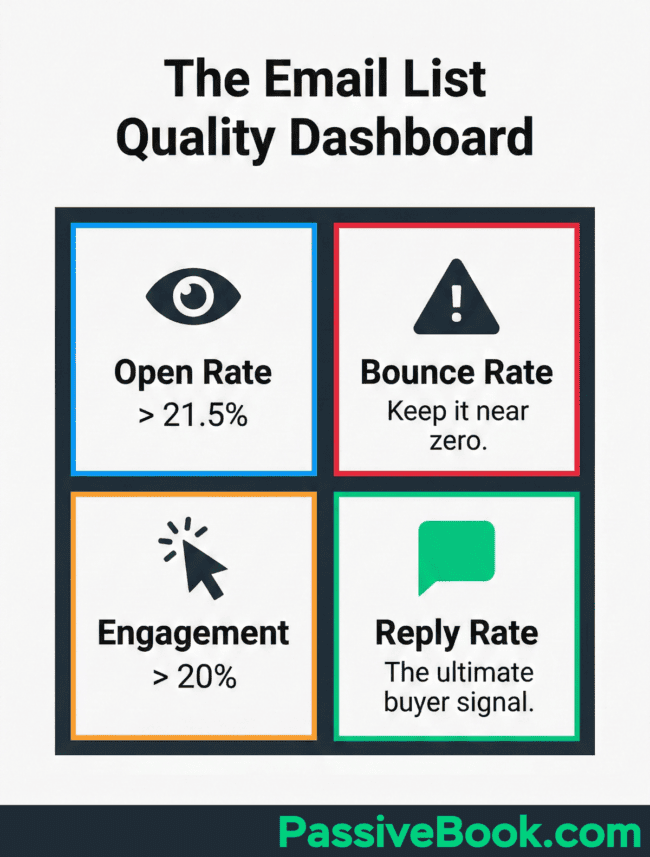
Engagement rates above 20% indicate you’ve attracted genuinely interested subscribers. They’re paying attention to your emails and finding value in what you send. Below 15% suggests you’ve either attracted the wrong audience or your content doesn’t match what they expected when they signed up.
Track reply rates and questions as your strongest signal of serious buyer consideration. Someone who replies to your email asking “When will this be available?” or “Does this work for specific use case?” is far more valuable than 100 subscribers who silently open every message. Replies indicate active interest and give you direct insight into what they need.
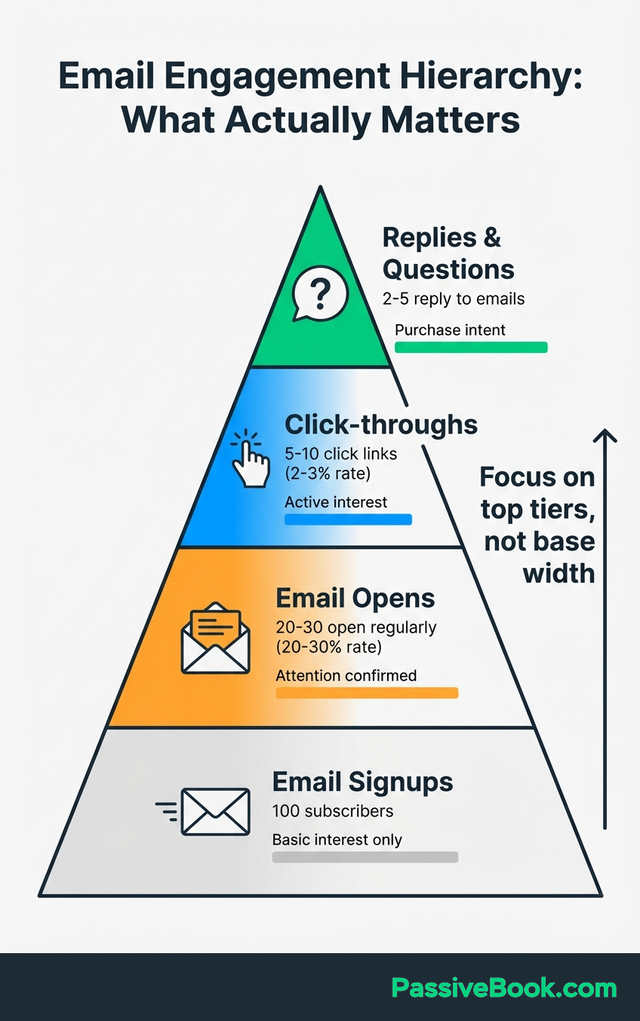
Most people never reply to newsletters. I get that. But the ones who do? They’re gold. When someone takes time to hit reply and ask a real question, they’re raising their hand and saying “I might buy from you.” That’s worth more than a thousand silent opens.
What to Do With Inactive Subscribers
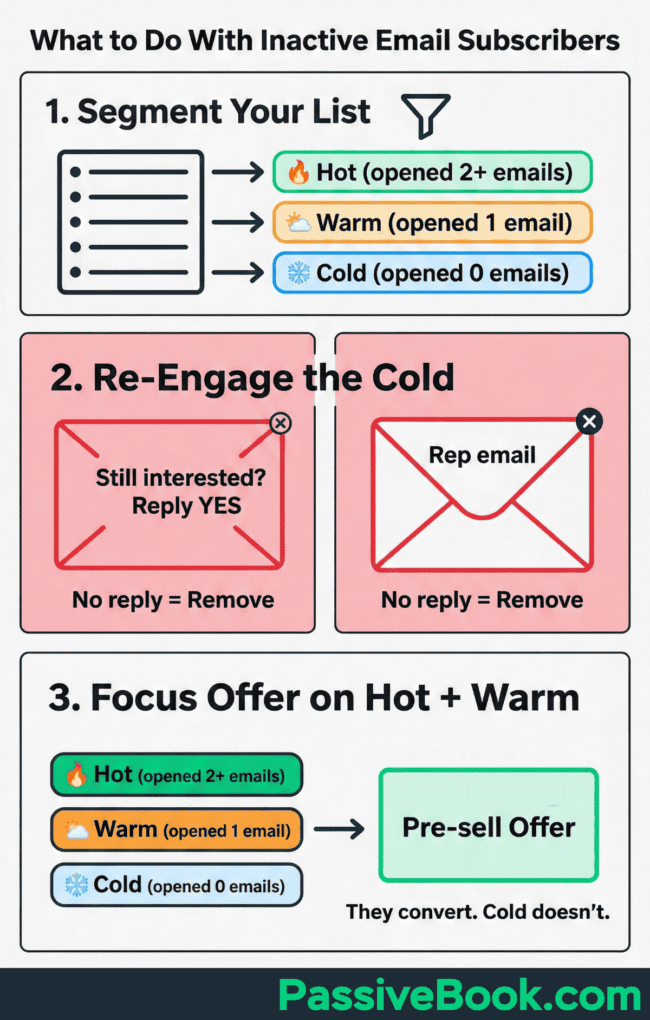
After three to four weeks, segment your subscribers into hot, warm, and cold based on email opens. Hot subscribers opened 2 or more emails, warm subscribers opened 1 email, and cold subscribers opened zero. Focus your pre-sell offer exclusively on hot and warm segments because they’ve demonstrated interest.
Send a re-engagement email to cold subscribers asking “Still interested in this topic? Reply YES or I’ll remove you from updates.” This email verification process removes invalid email addresses, keeps your list clean, and prevents future bounce rates from damaging your sender reputation. Before you send emails to your full list, segment by engagement.
Email service providers penalize senders with low engagement rates, so removing inactive subscribers protects your sender reputation. Watch for disposable email addresses that never engage – remove them quickly. Confirm you’re collecting valid email addresses from real people who actually receive emails and open them.
For lists under 200 subscribers, prioritize engagement quality over list size. Ten highly engaged subscribers who reply to your emails and share your content provide better validation than 100 inactive ones who ignore everything. When you’re testing demand, engagement matters infinitely more than vanity metrics. Focus on maintaining a clean list rather than a large one.
The Survey Step Most Solopreneurs Skip
Within 7 days of collecting 100 signups, send a five-question survey to your list. Ask them about their biggest pain point, solutions they’ve already tried, their ideal outcome, their willingness to pay, and how urgently they need this solved.
If fewer than 20% respond or most select the lowest price point, that’s a signal to refine your positioning before building anything.
I made the mistake of waiting three months to survey my list. By then, half the subscribers had forgotten why they signed up. My response rate was 8%, and the feedback was too vague to act on. When I tested early surveying on my next idea, I got 34% response rates and detailed answers that shaped the entire product. Timing matters enormously.
Use free tools like Google Forms or Tally to collect detailed subscriber feedback efficiently. Both integrate with email platforms and let you export responses to spreadsheets for analysis.
Google Forms offers basic logic branching if you want to customize follow-up questions based on previous answers.
Survey responses reveal whether signups represent your actual target customer. If everyone says they’ve tried expensive solutions and failed, you’re attracting a burned audience that might resist purchasing again. If they say they haven’t found any good options yet, you’ve found an underserved market. The language they use in open-ended responses becomes your marketing copy.
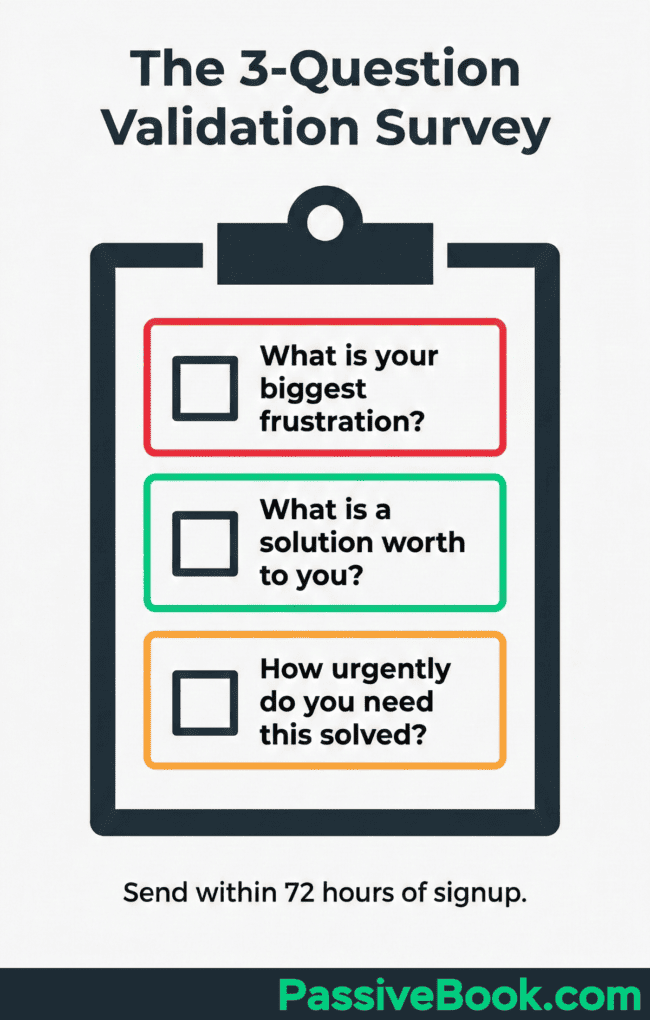
Online course validation experts recommend a simple three-question survey sent within 72 hours of signup. Question 1: “What’s your biggest frustration with this topic?” Question 2: “What would a solution be worth to you?” Question 3: “How soon do you need this solved?” Responses revealing high urgency and realistic pricing expectations confirm strong validation potential.
Survey responses tell you IF people will pay and what price range makes sense. But surveys still measure intent, not commitment. The next step converts intent into actual dollars.
Pre-selling: The Validation Signal That Matters
Money commitments validate stronger than any survey response or email signup. When someone gives you their credit card information before your product exists, you’ve proven actual demand. Everything before that moment is just interest, which is cheap and unreliable.
Justin Welsh’s case study shows how powerful pre-selling can be at small scale. He collected 16 signups for a new offering and converted 8 of them into discovery calls with paying offers. That 50% conversion rate from signup to sales conversation proves the power of asking early. He didn’t wait for 1,000 subscribers or a polished product.
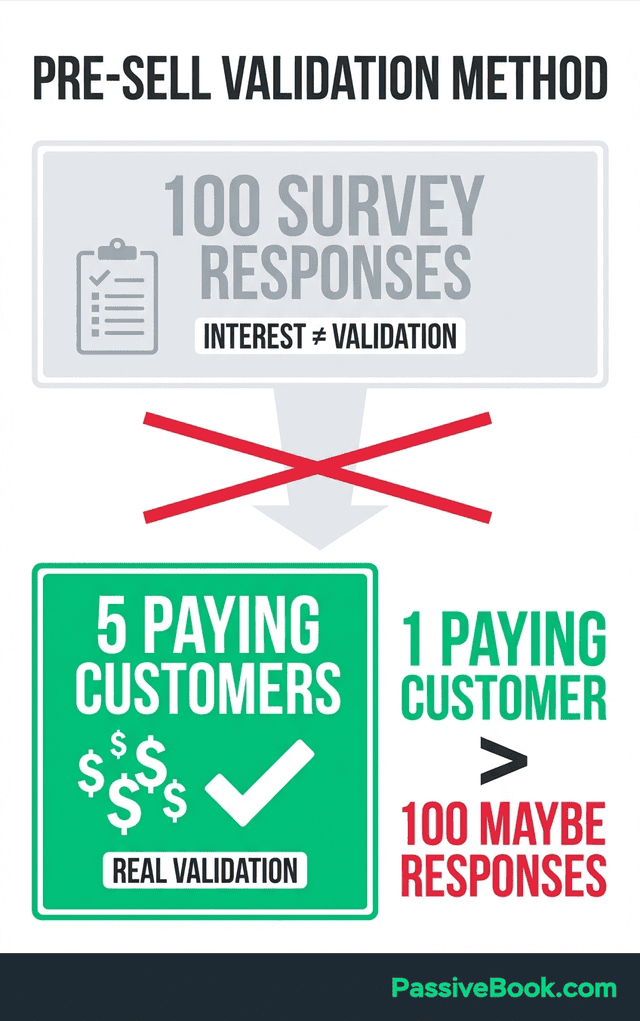
Gumroad enables creators to accept pre-orders and validate product ideas before building them. You can set up a product page with a description, price, and delivery timeline, then collect payments immediately. The money sits in your account while you build, giving you both validation and funding. If nobody buys, you refund the few who did and pivot without wasting months.
Even five to ten pre-orders from 200 signups confirms genuine purchase intent. That’s a 2.5% to 5% conversion rate before you’ve delivered any value. It tells you people will pay for a solution to this problem, your positioning makes sense, and your price point is acceptable. Those five to ten customers become your beta group who shape the final product.
Pre-sell or Pivot: Your Next Move After Collecting Signups
Email your subscribers weekly with valuable content to maintain engagement and trust. Weekly cadence keeps you top of mind without overwhelming people. Each email should deliver one useful insight, technique, or perspective related to the problem you’re solving. You’re building relationship capital you’ll spend when you make an offer.
After collecting 250 subscribers, one solopreneur course creator sent an early-bird offer to gauge purchase intent. Within 48 hours, 12 people pre-ordered at a discounted rate. Those 12 pre-orders confirmed demand and funded development of the full course. She built the curriculum knowing she already had paying students waiting, which eliminated the risk of creating something nobody wanted.
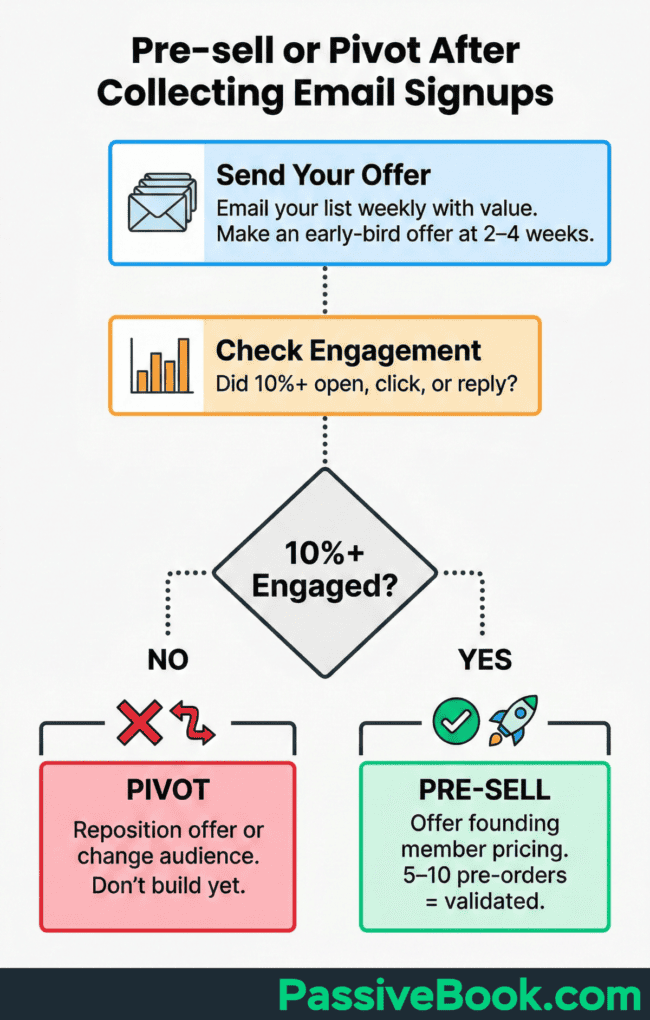
Offer early-bird pricing or pre-order options within two to four weeks of collecting your initial signups. This timeline feels counterintuitive because the product doesn’t exist yet, but that’s the point. You’re testing whether people will pay for the outcome you’re promising, not the polished deliverable. Frame it as “founding member” access or “beta pricing” to acknowledge the early nature.
Pivot if under 10% engage with pricing conversations or pre-sale offers. Ten percent engagement means if you email 200 subscribers about your offer, at least 20 people should open the email, click through to the sales page, or reply with questions. If only 5 people show any interest, your positioning is wrong or the market doesn’t care enough to pay.
Frequently Asked Questions
What Conversion Rate Means My Landing Page Is Working?
A landing page conversion rate of 10% or higher indicates strong demand and effective messaging. Calculate this by dividing your total signups by total visitors, then multiply by 100. For example: 25 signups ÷ 250 visitors = 0.10 × 100 = 10% conversion rate.Rates between 5% and 10% suggest decent interest but room for improvement in your headline or call to action. Below 5% signals weak problem-solution fit or misaligned traffic sources.
What If I Can’t Reach 100 Signups After a Month of Promotion?
Failing to reach 100 signups in 30 days suggests limited market demand or ineffective promotion strategy. Analyze your traffic sources and landing page conversion rate separately. If you’re getting 500 visitors but only 10 signups, fix your messaging. If you’re getting 50 visitors total, you need more promotion in places where your target audience congregates.
Should I Offer a Lead Magnet to Boost Signup Numbers?
Lead magnets increase signup volume but can reduce list quality if people want the freebie but not your paid offer. For validation purposes, a simple u0022Join the waitlist for early accessu0022 approach attracts more qualified subscribers. Save elaborate lead magnets for after you’ve confirmed people will buy, when growing list size becomes the priority over list quality.If you do offer a lead magnet during validation, make it small and fast to create – a one-page checklist or 5-minute video. Spending two weeks creating a 30-page guide before you’ve validated demand defeats the purpose of quick testing. Your lead magnet is bait, not the product. Keep it simple.
Can I Validate With Fewer Than 100 Email Signups?
High-ticket B2B services can validate with 20 to 50 engaged subscribers if several convert to paid discovery calls or projects. Low-price products need 200 or more signups to demonstrate sufficient market size. The key is conversion rate, not absolute numbers – 5 paying customers from 50 signups validates better than 2 customers from 300 signups.
What Next?
The three-stage framework – collect signups, survey willingness to pay, then pre-sell – protects your limited time by testing demand before you build. This approach won’t eliminate risk, but it reduces the chance of spending six months creating something nobody wants.
Email validation feels uncomfortable because you’re asking people to commit before you’ve delivered value. That discomfort is valuable feedback. If you’re too scared to survey your list or offer a pre-sale, you might be building something you don’t fully believe in yourself. The validation process tests your conviction as much as it tests market demand.
Share this article using the buttons below if you found it helpful – other solopreneurs in your network might be wasting time on unvalidated ideas right now. Drop a comment about your biggest validation challenge, or if you’ve already tested an idea this way, share what conversion rate convinced you to build or pivot. Your experience helps the entire community make better decisions.
Share this post with your friends & followers: