You’re about to spend 200 hours building an online course nobody buys. Or six months developing a print-on-demand store that generates zero sales. I know this because I’ve launched three online businesses in the past decade, and two failed within six months for exactly this reason.
The one that succeeded started only after I spent four weeks talking to potential customers about their actual search behavior and information gaps. Those conversations saved me from building something nobody wanted, and they revealed a pain point I never would have discovered on my own.
Customer interviews aren’t optional research for solopreneurs with limited time. They’re the fastest way to avoid wasting months on a business idea that sounds brilliant but solves a problem nobody has.But here’s what nobody tells you: The hardest part isn’t conducting the interviews. It’s knowing when you’ve learned enough to make a confident decision. Should you proceed after 5 interviews? 10? 20? This guide gives you the specific signals to watch for, the red flags that mean stop, and the quantitative thresholds that indicate genuine market demand. You’ll learn exactly what ‘enough validation’ looks like for a bootstrapped solopreneur.
This guide shows you how to conduct effective customer interviews in 5-10 hours per week, using free tools, to get clear go/no-go signals for your online business idea.

- •What Customer Interviews Are
- •Why Most Validation Feedback Is Worthless
- Good Vs. Bad Interview Questions: A Real Example
- •1. Distinguish Problem Interviews From Solution Interviews
- •2. Use Jobs-to-be-done to Uncover Real Motivations
- •3. Record Interviews With Free Transcription Tools
- •4. Ask About Past Behavior, Not Future Promises
- •5. Recruit From Niche Online Communities for Free
- •6. Offer Small Gift Card Incentives to Respect Time
- •7. Pre-screen Candidates With Simple Survey Tools
- •8. Apply the Five Whys Technique
- •9. Use Follow-up Questions to Dig Deeper
- •10. Watch for Politeness Bias Red Flags
- •11. Test Willingness to Pay With Pricing Questions
- •12. Leverage AI for Pattern Recognition
- •13. Stop at Data Saturation
- Your Go/No-Go Decision Framework
- •How to Know When Your Idea Isn't Worth Pursuing
- •What Next?
What Customer Interviews Are
Customer interviews are structured conversations designed to reveal whether people experience the problem you want to solve. They’re not surveys or pitches. They’re detective work, uncovering real behavior patterns that predict whether your idea has a market.
The stakes are high. Building products without market need is the top reason startups fail, according to CB Insights research analyzing 101 startup post-mortems. Product managers at companies like Dropbox and Airbnb used this exact research method during product development to ensure their minimum viable product solved real problems. Customer interviews prevent you from becoming that statistic. They force you to confront reality before you invest hundreds of hours building a course, launching a print-on-demand store, or creating content nobody needs.
For time-strapped solopreneurs, the timeline matters. Plan for 4-6 weeks total. Week 1 focuses on recruiting and screening participants.
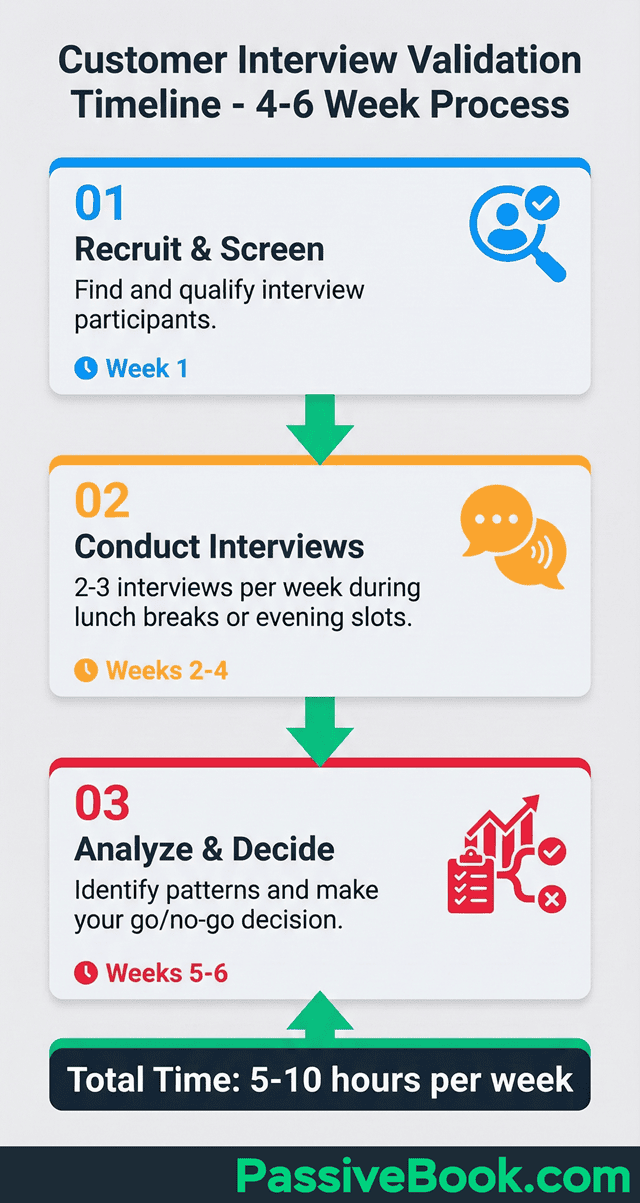
Weeks 2-4 involve conducting 2-3 interviews per week, fitting them into lunch breaks or evening slots. Weeks 5-6 are dedicated to analyzing patterns and making your go/no-go decision.
This entire validation process fits within your 5-10 hours per week constraint while delivering the clarity you need to proceed with confidence or pivot quickly.
Scheduling around a day job is easier than you think. I conducted most interviews during my lunch hour (12-12:25pm), before work (7-7:25am), or after dinner (7-7:25pm). Book your calendar in 30-minute blocks with 5-minute buffers. Most people can swing a 20-minute call during their lunch break too. Evening slots fill faster than morning ones in my experience.
Why Most Validation Feedback Is Worthless
Here’s what I learned the hard way. Three years ago, I interviewed eight people about a course idea for freelance writers. Seven said it sounded great. All seven praised the concept. Not one of them bought when I launched.
The problem was politeness bias. People told me what they thought I wanted to hear. The Mom Test framework by Rob Fitzpatrick explains why asking opinions yields useless compliments instead of truth. When you ask someone if your idea sounds good, their brain switches into encouragement mode. They don’t want to hurt your feelings, so they offer vague enthusiasm that means nothing.
This pattern kills businesses before they start. CB Insights found that building products without market need is the top reason startups fail.
The gap between what people say and what people do is where most solopreneurs lose their savings and months of nights and weekends.
The other trap is confusing your personal pain with customer pain. Just because you experience a problem doesn’t mean others care enough to pay for a solution.
I assumed all freelance writers struggled with client onboarding because I did. Turns out most writers I interviewed had already solved it with free tools like Google Docs and Calendly. My pain point was real for me, but it wasn’t urgent enough for my target audience to justify another monthly subscription.
Good Vs. Bad Interview Questions: A Real Example
The difference between useful and useless customer interviews comes down to how you ask questions. Leading questions invite polite lies. Behavioral questions reveal truth.
Here’s the wrong approach: “Would you pay $10/month for a tool that helps you manage your freelance clients?” This question is garbage. It’s hypothetical, it mentions price too early, and it begs for agreement. Most people will say yes to be nice, then never pull out their credit card.
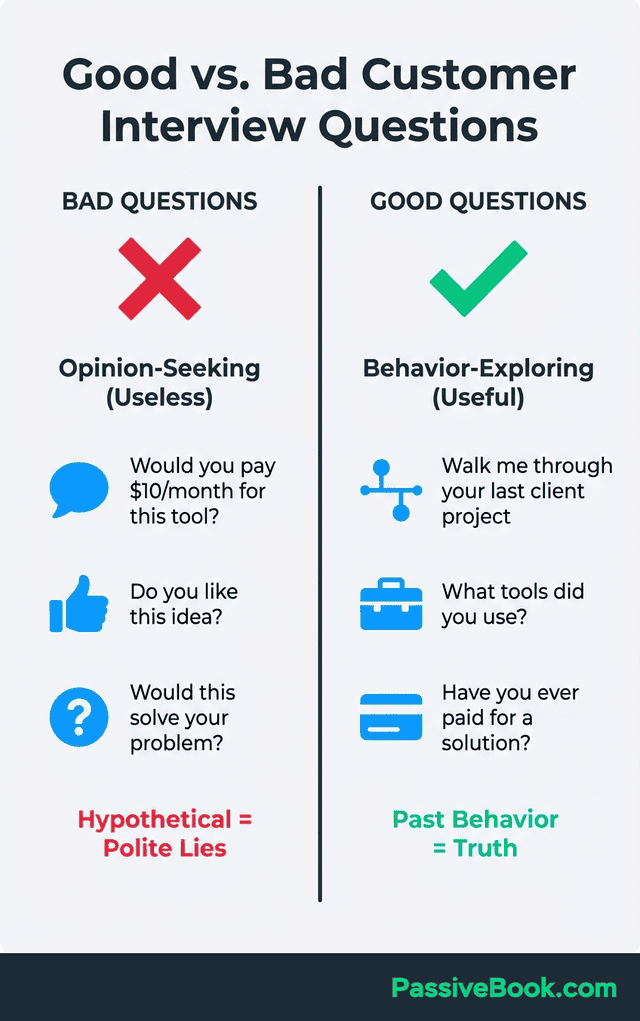
The right approach sounds completely different: “Walk me through how you managed your last client project. What tools did you use? Where did you get frustrated? Have you ever paid for a client management tool?” These questions focus on past behavior. They avoid your sales pitch entirely.
They let the interviewee tell you what happened in real life, not what they imagine they might do in the future. This distinction between hypothetical opinions and real life behavior separates effective customer interviews from useless surveys. You’re trying to understand what they did, not what they think they might do.
The shift from opinion-seeking to behavior-exploring transforms your validation process. You stop collecting compliments and start collecting evidence.
1. Distinguish Problem Interviews From Solution Interviews
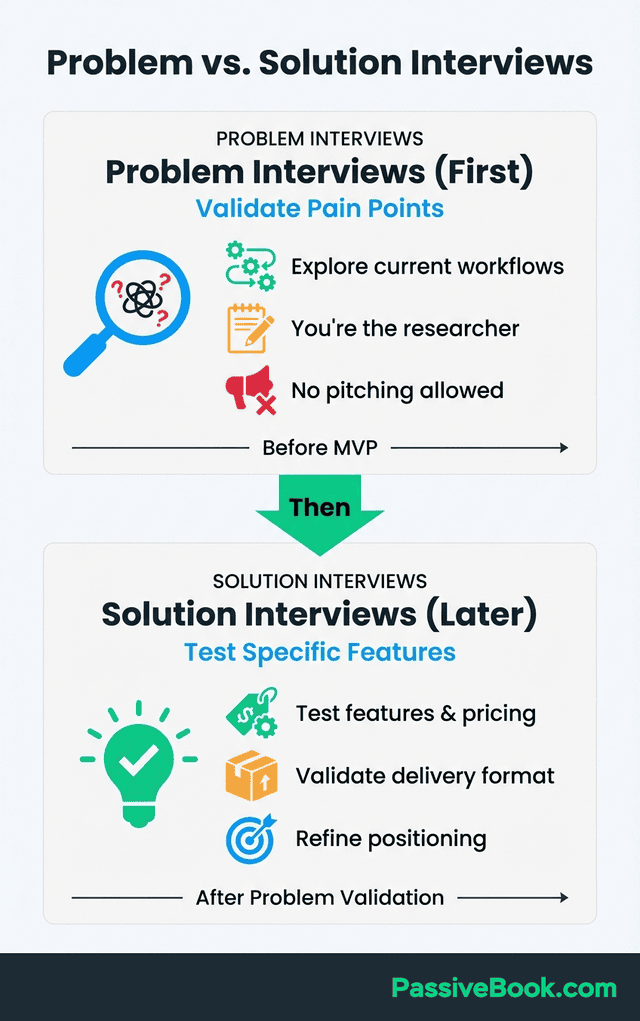
Problem interviews validate pain points first by exploring current workflows without pitching your solution. You’re a researcher, not a salesperson. Your goal is understanding whether the problem you’re solving exists in the wild and whether it’s painful enough that people seek alternatives.
Solution interviews happen later, after you’ve confirmed the problem matters. These conversations test specific features, pricing models, or delivery formats. They answer questions like “Would you prefer video lessons or written guides?” or “How much would be too cheap for this type of solution?”
Jumping straight to solutions wastes everyone’s time. If the problem doesn’t matter to potential customers, your brilliant feature set is irrelevant.
I’ve watched solopreneurs spend entire interviews explaining their product concept to people who never experienced the underlying problem. Those interviews yield zero useful data because you’re building on a foundation that doesn’t exist.
This problem interview phase happens before you build your minimum viable product. Solution interviews come later, after you’ve validated the pain point is worth solving.
Validation Checkpoint: By this point (4-6 interviews), you should be able to list 3-5 recurring pain points. If you can’t, your screening questions need refinement.
2. Use Jobs-to-be-done to Uncover Real Motivations
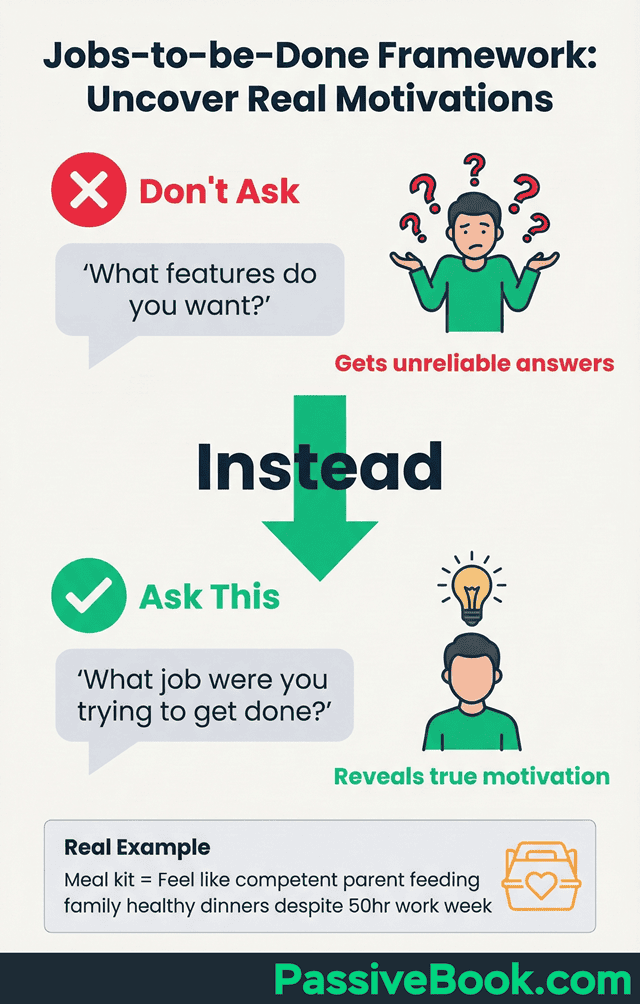
The Jobs-to-be-Done framework by Clayton Christensen shifts your focus from features to tasks. Instead of asking what features customers want, you ask what job they’re trying to accomplish. This one change reveals needs that customers can’t articulate on their own.
Ask “What job were you trying to get done when you last faced this problem?” instead of requesting feature lists. The answer exposes the underlying motivation that drives purchasing decisions. Someone hiring a meal kit service isn’t buying ingredients and recipes. They’re hiring a solution to feel like a competent parent who feeds their family healthy dinners despite working 50 hours per week.
This framework prevents the trap of building features customers request but never use. People are terrible at predicting what they’ll value once a product exists. But they’re excellent at describing what they were trying to accomplish the last time they struggled with a specific task. That behavioral data tells you what to build.
I know this sounds abstract, but once you start seeing Jobs-to-be-Done in your own purchasing decisions, you can’t unsee it. That $8 coffee isn’t about caffeine – it’s about having an excuse to leave the house on a Saturday.
3. Record Interviews With Free Transcription Tools
Otter.ai provides free transcription for up to 300 monthly minutes. That’s enough for 12-15 interviews at 20-25 minutes each, fitting perfectly within your validation timeline and zero-dollar tool budget. The transcription accuracy is strong enough that you can focus on the conversation instead of frantically typing notes.
Google Meet and Zoom both include built-in recording capabilities. Google Meet is completely free with a Gmail account. Zoom‘s free tier allows 40-minute meetings, which is longer than your target interview length. Both platforms let you download recordings and transcripts after each session.
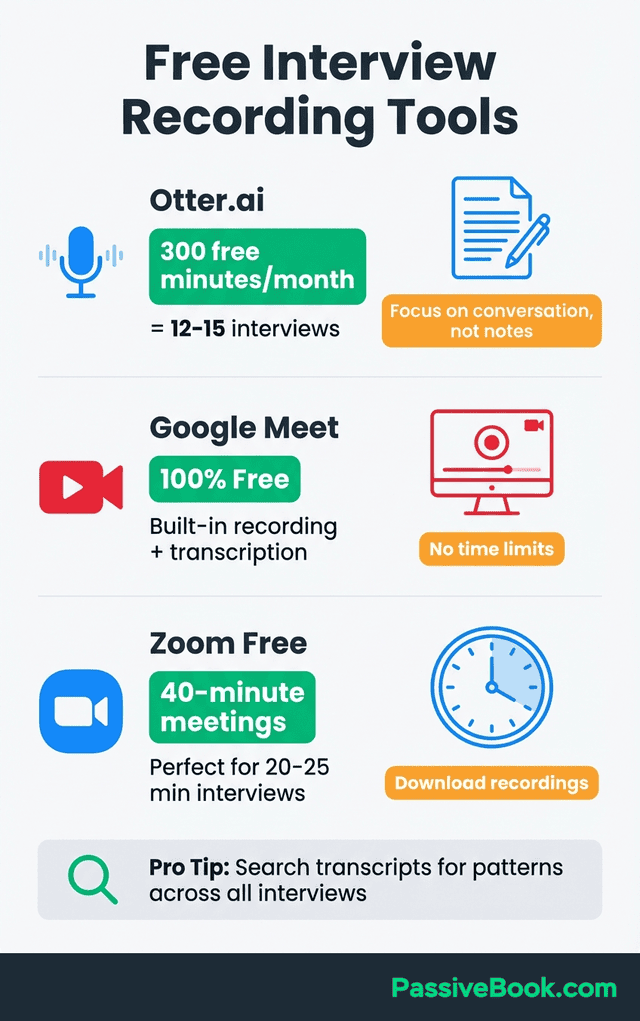
Transcripts become invaluable during analysis. You can search for specific phrases across all interviews, spot patterns you missed during live conversations, and pull exact quotes for your go/no-go decision documentation. I used to rely on handwritten notes and missed critical details. Now I review transcripts and discover insights I didn’t catch in real time, like three different people using the exact same phrase to describe their frustration.
4. Ask About Past Behavior, Not Future Promises
The Mom Test emphasizes asking the right questions about their life, not your idea. The best validation question sounds like this: “Walk me through the last time this problem cost you money or time.” This forces the interviewee to recall a specific incident with real consequences, revealing whether the pain point exists in their daily life.
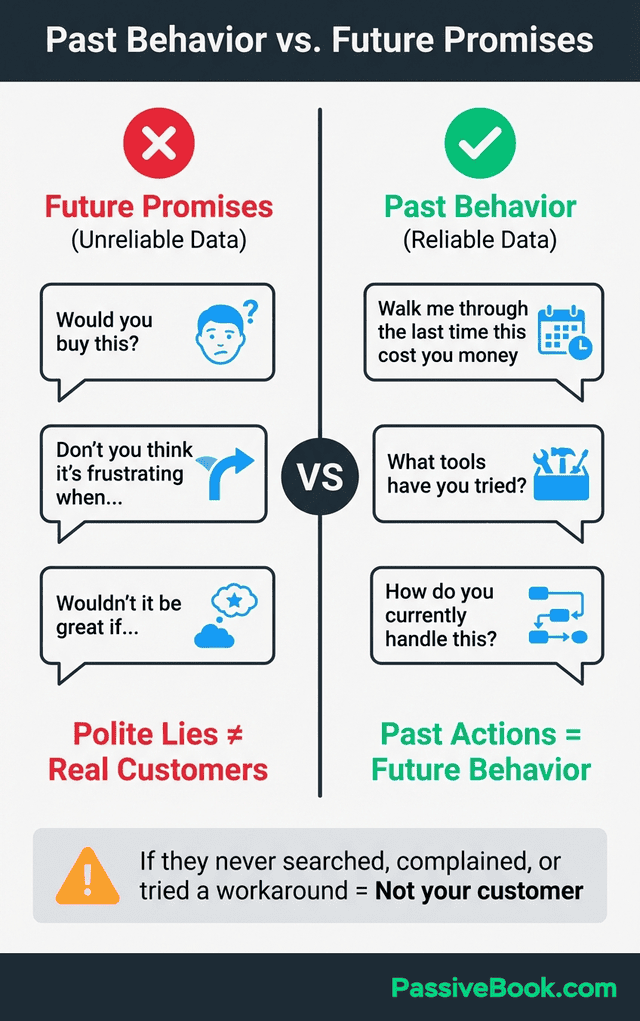
Past behavior predicts future action. Someone who has never searched for a solution to your problem, never complained about it to a colleague, and never attempted a workaround is not a real customer. They might think your idea sounds interesting, but interesting doesn’t pay your bills.
Avoid leading language that telegraphs the answer you want. Questions like “Don’t you think it’s frustrating when…” or “Wouldn’t it be great if…” prime people to agree with you. Instead, use neutral phrasing: “How do you currently handle this situation?” or “What tools have you tried?” These open-ended questions let the interviewee share their unfiltered experience without pressure to validate your idea.
5. Recruit From Niche Online Communities for Free
Reddit subreddits and Facebook groups where your target audience congregates provide free access to potential customers. The key is finding active communities where your target audience discusses the problems you’re trying to solve, not generic entrepreneur groups.
Post with a genuine value exchange instead of asking for free labor. Offer early access to your solution once it’s built, or promise to share aggregated insights from your research that could help the community. Transparency matters. State clearly that you’re researching a business idea and need their expertise to build something useful.
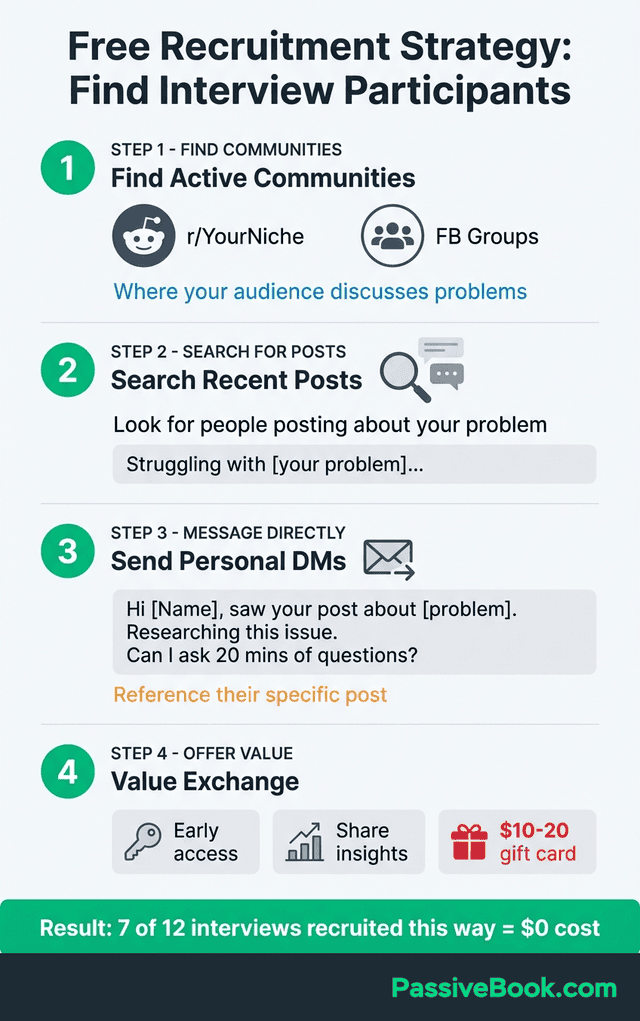
Search relevant subreddits and message active members directly. Look for people who recently posted about the exact problem you’re investigating. A DM that references their specific post and asks for 20 minutes of their time to understand their experience converts far better than a generic recruiting post.
I recruited seven of my twelve customer validation interviews this way, spending zero dollars. This go to market research approach works whether you’re testing a startup idea for a SaaS product or validating demand for an online course.
6. Offer Small Gift Card Incentives to Respect Time
I learned this lesson expensively: People value their time. UserTesting research shows that appropriate incentives improve both recruitment quality and participation rates. You’re asking busy people to share their experiences, and compensation signals that you value their expertise. This isn’t bribery. It’s professional respect.
$10-20 Amazon gift cards fit comfortably within your under-$500 validation budget while recruiting 15-20 interviews.
At $15 per interview, you can conduct 20 conversations for $300, leaving plenty of budget for other validation expenses like a pre-screening survey tool or a landing page builder.
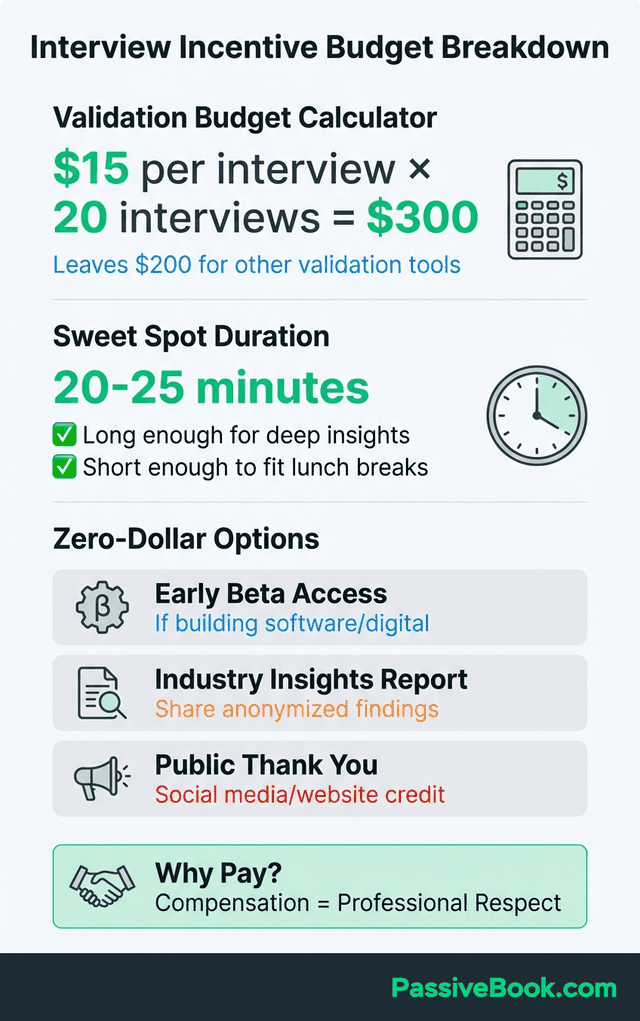
Keep interviews to 20-25 minutes. That’s long enough to explore 2-3 key pain points in depth, but short enough that most people can fit it into a lunch break or before dinner. Longer interviews yield diminishing returns anyway because participant energy drops after 30 minutes.
If your budget is ultra-tight, offer non-monetary value instead. Early beta access works if you’re building software or a digital product. A detailed industry insights report summarizing your anonymized findings gives participants something valuable. A public thank-you on your future website or social media acknowledges their contribution. Transparency about budget constraints builds trust with fellow solopreneurs who understand bootstrapping.
7. Pre-screen Candidates With Simple Survey Tools
Use Google Forms or Typeform to filter qualified interviewees before you waste calendar slots. Google Forms is free with unlimited responses. Typeform‘s free tier allows up to 10 questions and 100 monthly responses, which is more than enough for validation research.
Include 3-5 qualifying questions that reveal whether someone belongs to your target audience and experiences the problem. Ask about their current role or business type, how frequently they encounter the problem, what solutions they’ve already tried, and whether they’ve ever paid for a solution in this category.
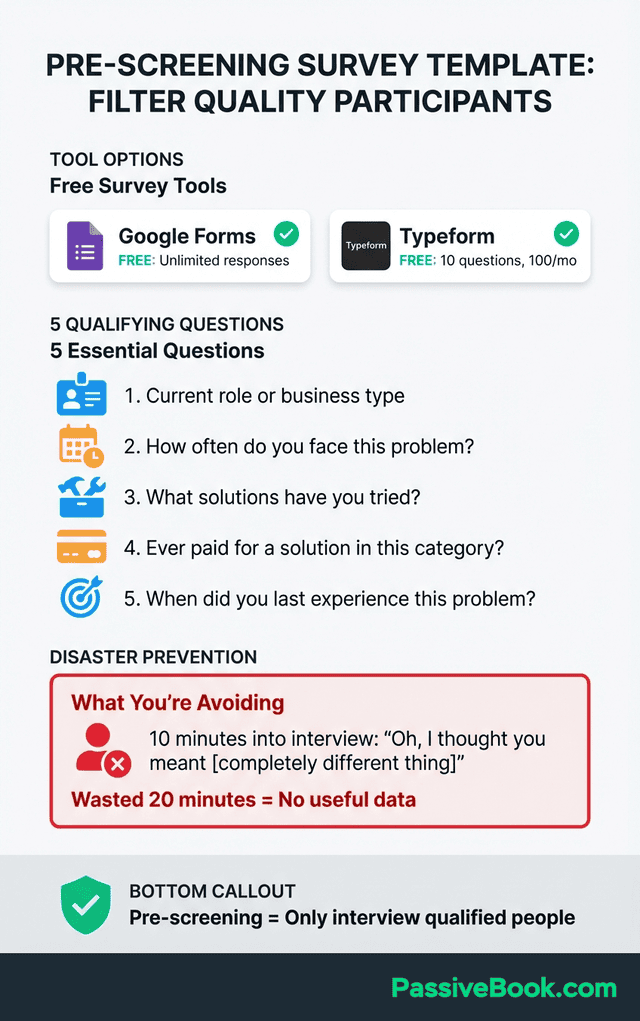
This pre-screening prevents a common disaster: spending 20 minutes interviewing someone who is outside your target market or has never experienced your problem. Nothing sucks more than realizing 10 minutes in that you’re interviewing someone who thought your survey was asking about something completely different. I once interviewed a freelancer about client management tools only to discover they had only ever had one client and used a shared Google Doc. That interview yielded zero useful data because I skipped the screening step.
8. Apply the Five Whys Technique
Developed by Toyota for root cause analysis, the Five Whys technique helps you dig beneath surface-level complaints to understand the real problem. Ask “why?” five times, using each answer as the foundation for your next question. This prevents you from building solutions that address symptoms instead of root causes.
I used this on a recent project interview: An interviewee said, “I need better project management software.” I asked why. They explained their current tool was too complicated. I asked why that matters. They admitted they waste 30 minutes daily just updating task statuses. I asked why they don’t switch tools. They revealed they’ve already tried three alternatives and found them equally confusing.
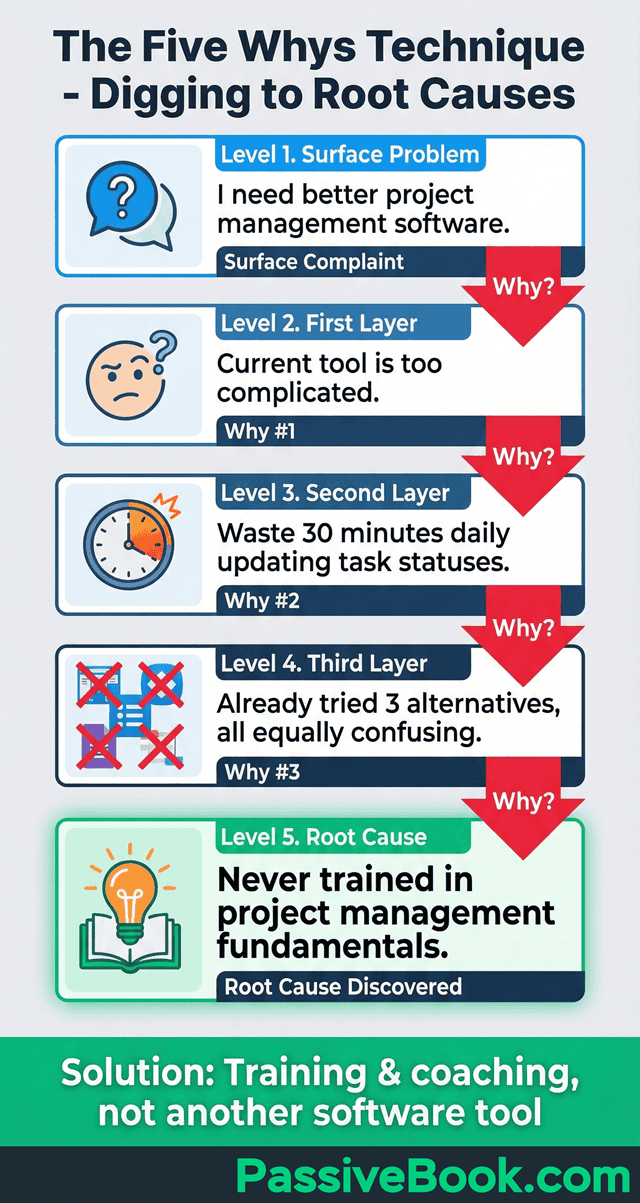
I asked why they think new tools are confusing. They finally explained that their real problem is they’ve never been trained in project management fundamentals, so every tool feels overwhelming.
That final answer changes everything. The root cause isn’t software features. It’s a knowledge gap. A better solution might be project management coaching or simplified templates, not another software tool. Without the Five Whys technique, you would have built features based on the first answer and missed the real problem. This is why problem interviews are critical before you define what your product does.
Validation Checkpoint: When the same root cause appears in 3+ interviews, you’ve found your real opportunity.
9. Use Follow-up Questions to Dig Deeper
The magic phrase in every good interview? “Tell me more about that.” Ask this whenever interviewees mention vague terms like “frustrating,” “difficult,” or “time-consuming.” This simple phrase invites elaboration without leading them toward a specific answer. It’s the easiest way to uncover details they assume you already understand.
“Describe how that made you feel” uncovers emotional drivers behind behavior. Logic doesn’t explain most purchasing decisions. Emotion does. When someone explains they felt embarrassed using a janky homemade system in front of clients, that’s a powerful buying trigger you can address in your positioning.
Product Talk’s interview guide emphasizes probing questions like “Can you elaborate?” and “What happened next?” to surface hidden patterns. These questions keep the interviewee talking without inserting your assumptions into their story.
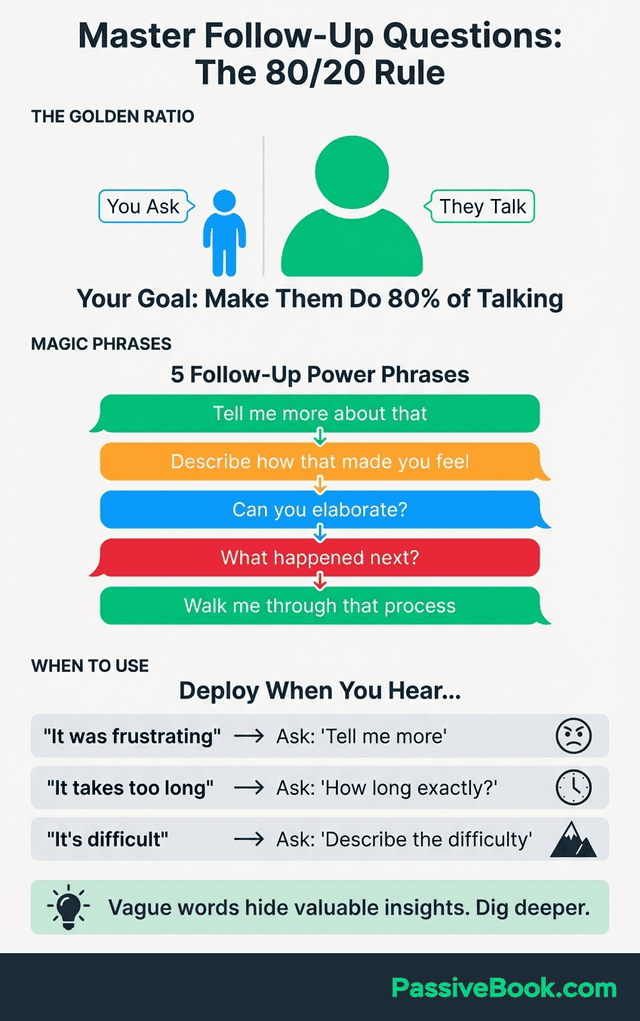
The goal is to make them do 80% of the talking while you do 20% by asking follow-ups that encourage deeper sharing. Taking notes during these follow-ups helps you track which questions yield the richest responses, improving your decision making process for future interviews.
10. Watch for Politeness Bias Red Flags
Vague answers about current spending signal low problem urgency for the problem you’re solving. When you ask “Have you ever paid for a solution?” and someone says “Not yet, but I’ve been thinking about it,” that’s a red flag. Real pain makes people pull out their credit card immediately, not someday.
Rescheduling twice is another warning sign. People prioritize what matters to them. If someone cancels and reschedules multiple times, the problem you’re investigating probably isn’t urgent enough to warrant their attention, let alone their money.
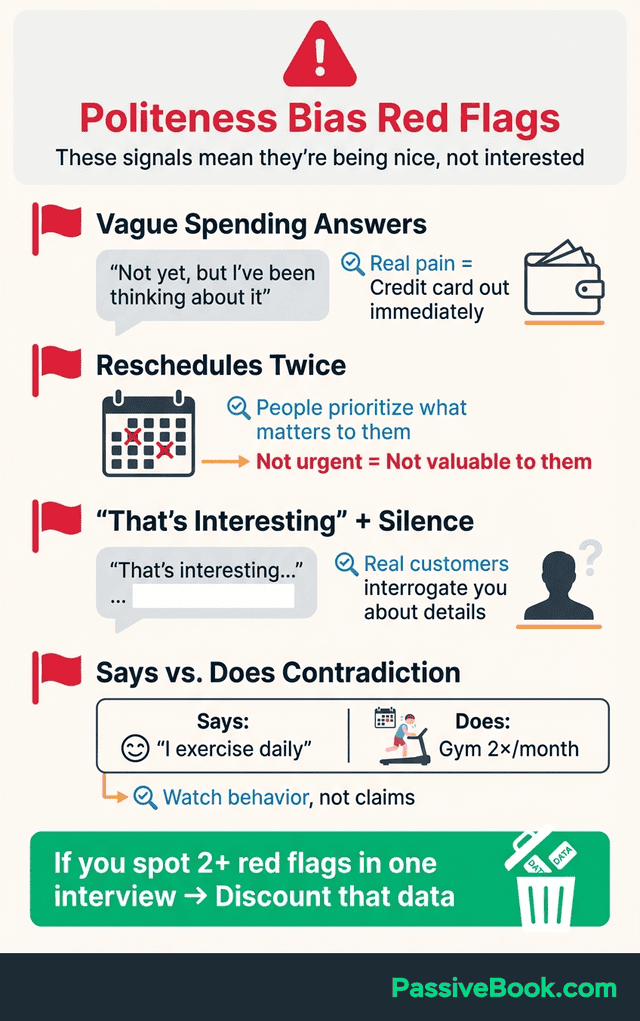
“That’s interesting” without follow-up questions reveals courtesy, not genuine interest. When an interviewee responds to your idea with generic enthusiasm but doesn’t ask clarifying questions about pricing, features, or availability, they’re being polite. A real potential customer interrogates you about details because they’re mentally evaluating whether your solution fits their needs.
Social desirability bias causes participants to give overly agreeable responses that don’t match their behavior. They’ll say they exercise daily when they really hit the gym twice a month.
They’ll claim they’d pay $50 monthly for your solution when their spending history shows they never pay for anything above $10. Watch for contradictions between what they say and the evidence they share about past behavior.
11. Test Willingness to Pay With Pricing Questions
Here’s where most solopreneurs chicken out: asking about money. But past purchases for similar solutions reveal their spending behavior. “What have you already spent trying to solve this problem?” reveals their willingness to invest in this category. Someone who has never spent a dollar on this problem category is not your customer, no matter how enthusiastically they praise your concept.
Use “What would be too cheap?” and “What’s too expensive?” to find the acceptable pricing range. The “too cheap” question reveals quality expectations. If someone says anything under $5 monthly would feel suspiciously cheap, you know they associate this category with premium solutions. The “too expensive” question sets your upper boundary.
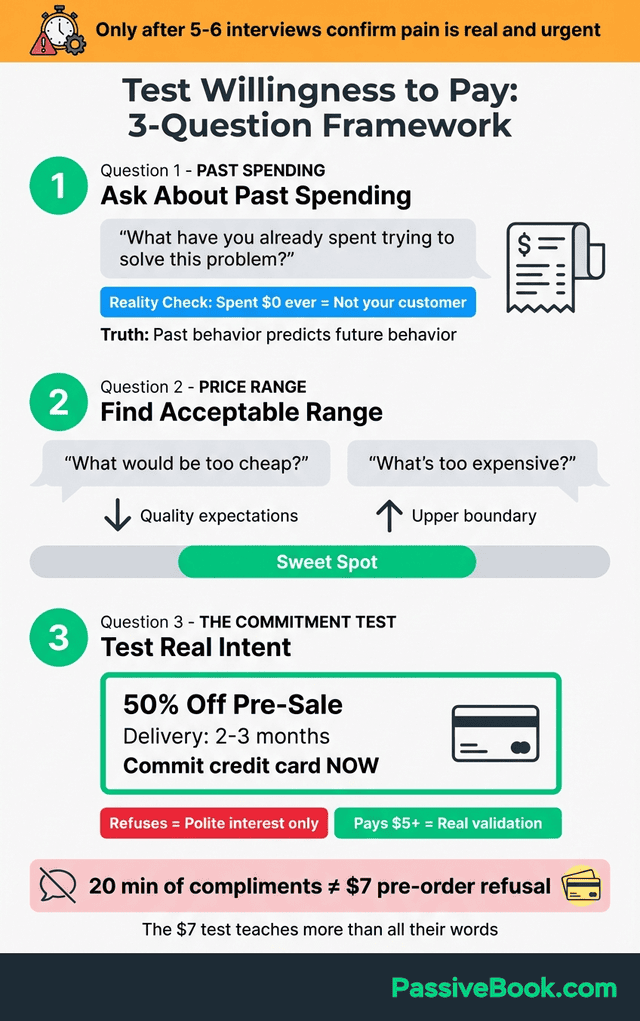
After 5-6 interviews confirm the pain is real and urgent, test purchase intent. Offer a pre-sale at 50% off for early access, with delivery in 2-3 months. Ask them to commit a credit card right then, even if it’s just $5. This separates genuine interest from politeness. I’ve had interviewees rave about an idea for 20 minutes, then suddenly remember budget constraints when I asked for a $7 pre-order. That taught me more than all their compliments combined.
Validation Checkpoint: If 2 out of 3 people won’t pre-commit at 50% off, pricing isn’t your problem – urgency is.
12. Leverage AI for Pattern Recognition
Feed interview transcripts to AI tools like ChatGPT or Claude to identify recurring themes across multiple conversations. The best approach is feeding each transcript separately with a structured prompt like this: “Analyze this customer interview transcript and identify: (1) the top 3 pain points mentioned, (2) any past solutions they’ve tried, (3) their emotional response to the problem, and (4) any budget or spending signals.”
After processing all transcripts individually, ask the AI to compare patterns. Paste summaries from 5-8 interviews and prompt: “What pain points appeared in at least 3 of these interviews? What objections came up repeatedly? What solutions did multiple people say they’d already tried? What does this tell you about your business model? What does user feedback suggest about initial idea feasibility? Are people describing the problem the way your product does, or is there disconnect in language?” This reveals the signal beneath the noise.
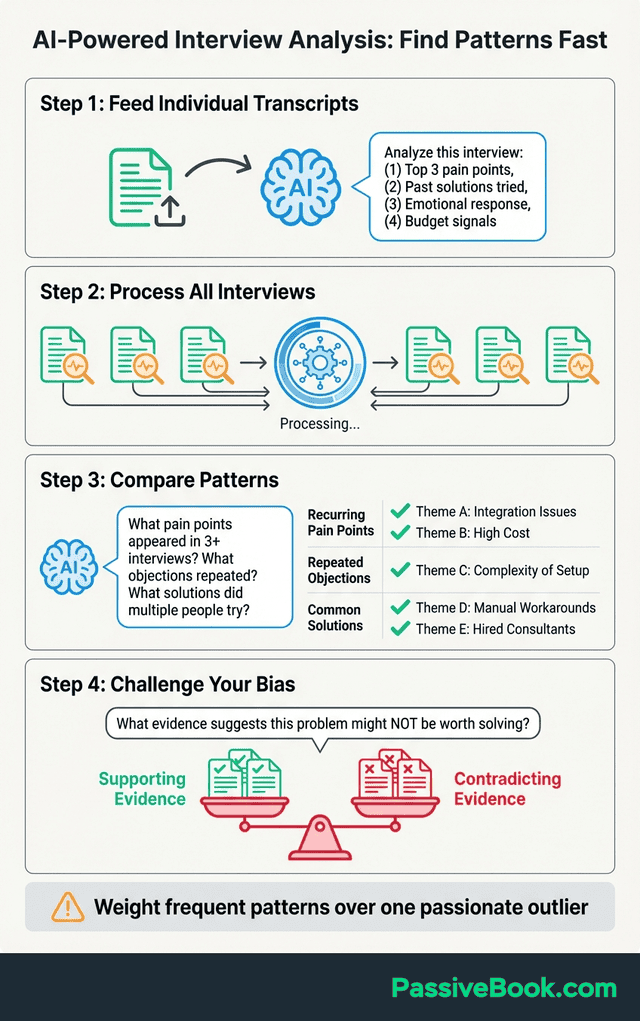
Beware of confirmation bias during analysis. Search for data that contradicts your hypothesis, not just evidence that supports it. Ask the AI: “What evidence suggests this problem might not be worth solving?” Weight frequent pain points mentioned by multiple people over one person’s passionate complaint. One enthusiastic interviewee who rants for 15 minutes about your exact problem might be an outlier, not your target market.
13. Stop at Data Saturation
NNG research indicates that most usability issues emerge within 5 interviews, though validation research needs more depth for business decisions. For business validation, aim for 8-12 interviews as your baseline. But the real signal is data saturation, not hitting an arbitrary number.
Stop when three consecutive interviews reveal no new pain points, objections, or behavioral patterns. If interview 10, 11, and 12 all tell you the same story with the same struggles and the same attempted solutions, you’ve learned what you need to know. Additional interviews at that point yield diminishing returns.
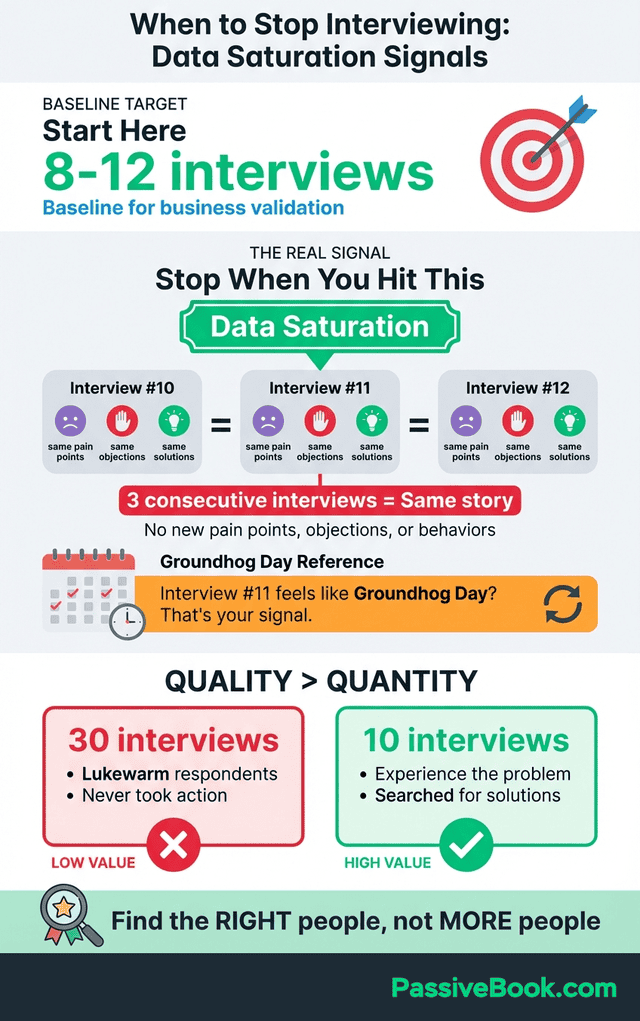
Quality of participants matters far more than quantity. Ten interviews with people who experience your problem and have searched for solutions deliver more value than 30 interviews with lukewarm, polite respondents who’ve never taken action. Though I’ll admit, interview number 11 when you’ve already heard the same story ten times feels like Groundhog Day. That’s your signal to stop. Focus your limited time on finding the right people, not maximizing your interview count.
Your Go/No-Go Decision Framework
After 8-10 interviews, apply the “3 Yes Rule” to evaluate whether your idea has real potential. Think of this as the real life validation test that determines whether your initial idea merits building a minimum viable product. You need affirmative evidence for three specific criteria.
First, interviewees must have experienced this problem in the past 3 months, not years ago. Recent pain is urgent pain. Second, they tried to solve it with existing tools, free solutions, or manual workarounds. This proves they care enough to take action. Third, they would commit payment for a solution today, not someday. Ask them to pre-order at a discount and see if they pull out their credit card.
Watch for the “Red Flag Threshold” during your interviews. If 3 or more separate interviews reveal the same core objection, it’s probably fatal.
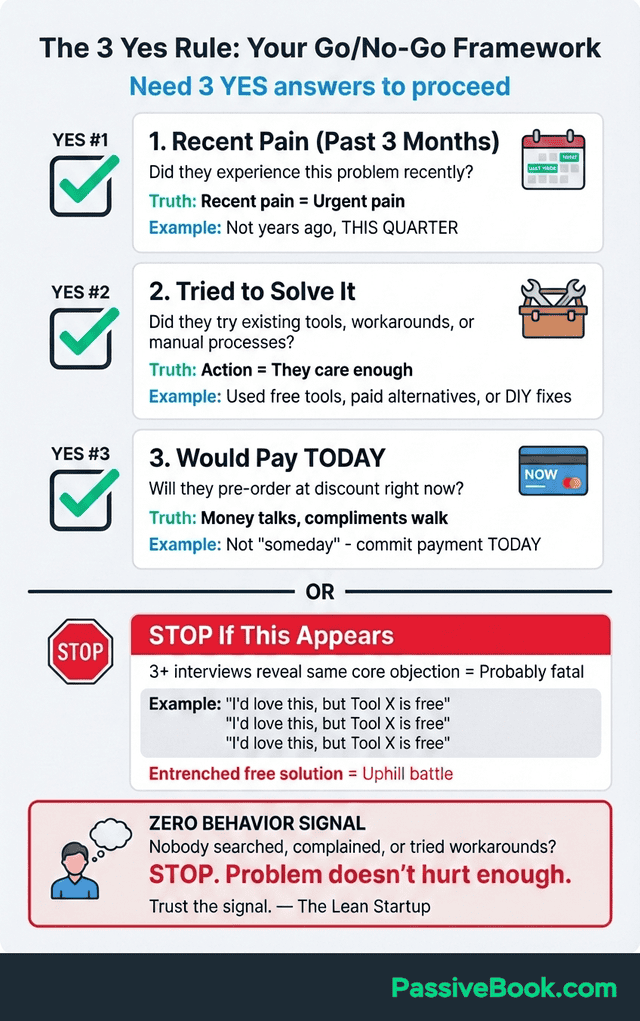
If someone says “I’d love this, but I already use Tool X and it’s free,” and two other people say essentially the same thing, you’re facing an uphill battle against an entrenched free solution. That’s a strong signal to pivot or stop.
Zero past behavior across multiple interviews is your clearest stop signal. If nobody has ever searched for a solution, complained to a colleague, or attempted a workaround, the problem doesn’t hurt enough to justify a business. The Lean Startup methodology by Eric Ries emphasizes validated learning through real customer behavior over hypothetical interest. Your interviews exist to validate demand before you invest hundreds of hours building something. Trust the signal when it tells you to walk away.
What Mixed Signals Mean
Most validation isn’t clean yes/no. You’ll face ambiguity. What if 5 people say yes but only 2 will pre-pay? This suggests the pain is real but not urgent. Either your timing is off, your positioning didn’t convey value clearly, or the pain threshold hasn’t been crossed yet. Try reframing the problem in terms of cost (time wasted, money lost, opportunities missed) and retest with 3 more interviews.
What if the pain is real but no one has ever bought a solution before? This is the classic “create a new category” trap. It’s possible but extremely hard for bootstrapped solopreneurs. You’ll need to educate the market before you can sell to it. Ask yourself: Do I have 12-18 months and a marketing budget to create awareness? If not, find a problem where people are searching for solutions.
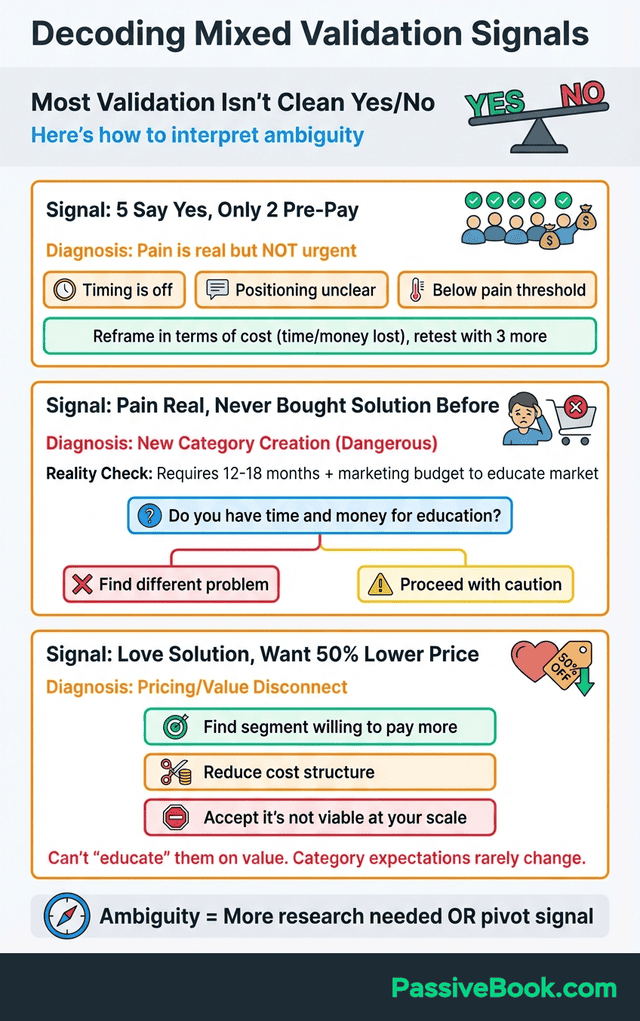
What if people love your solution but name a price point 50% lower than you need to be profitable? Your options: find a different segment willing to pay more, reduce your cost structure, or accept that this isn’t viable at your scale. Don’t convince yourself you can “educate them” on value. Pricing resistance based on category expectations rarely changes.
How to Know When Your Idea Isn’t Worth Pursuing
Sometimes the hardest decision is admitting your idea doesn’t have a market. Here are the clear signals that should make you stop and pivot instead of pushing forward.
Interviewees can’t recall the last time they experienced the problem. When you ask “When was the last time this happened?” and people respond with “I’m not sure, maybe a few months ago?” or “It happens occasionally but I can’t think of a specific time,” the problem isn’t urgent. Urgent problems have recent, vivid examples that people remember because they hurt.
They’re satisfied with current free or manual workarounds already in place. If most interviewees say “I just use a Google Sheet and it works fine” or “I’ve figured out a process that handles this,” you’re competing against “good enough.” Displacing good enough requires either dramatically better results or dramatically less effort. If you can’t deliver either, you don’t have a viable business.
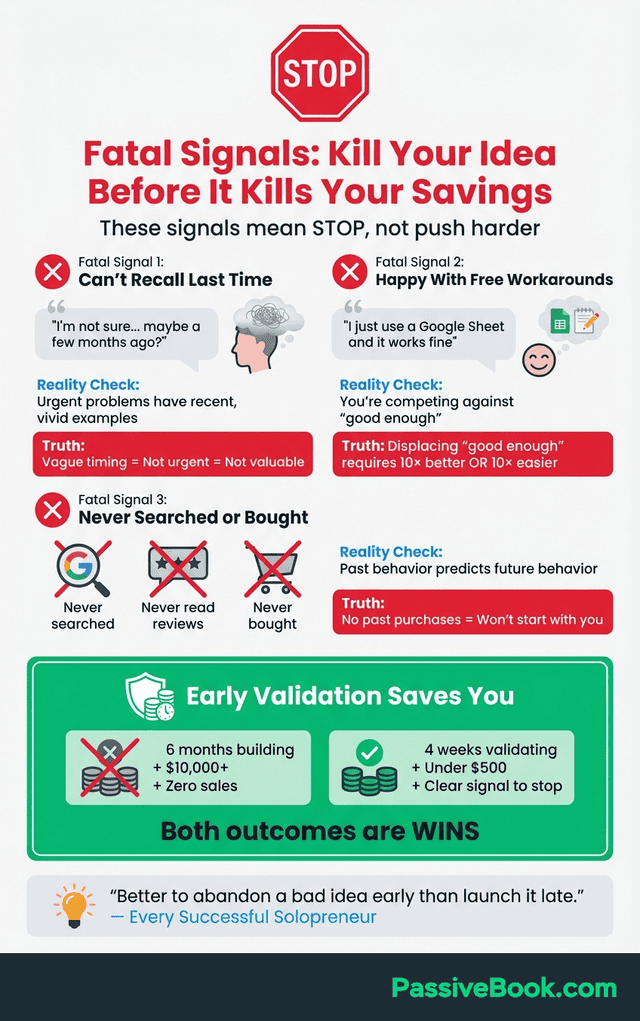
No one has previously searched for or purchased a solution to this pain. Past purchasing behavior is the single best predictor of future purchasing behavior. If your target audience has never typed your problem into Google, never read reviews of potential solutions, and never bought anything in this category, they won’t suddenly start when you launch.
Founders who validate early save thousands of dollars and hundreds of hours by killing bad ideas before investing in development. It feels brutal to abandon an idea you’re excited about, but it’s far less brutal than spending six months building something nobody buys. The validation process exists to save you from that outcome.
What Next?
You now have a complete framework for conducting customer interviews in 4-6 weeks, using free tools, while working 5-10 hours per week around your day job. These conversations will either validate your idea with clear buying signals or save you from wasting months building something nobody wants. Both outcomes are wins.
This process can feel intimidating if you’ve never interviewed strangers about their problems before. But remember, you’re not selling. You’re researching. Most people enjoy sharing their experiences when you ask good questions and genuinely listen. The worst case is learning your idea won’t work before you invest serious time and money.
If this guide helped clarify your validation approach, hit those share buttons below. Someone in your network is probably sitting on a business idea right now, afraid to test it. Share this resource and potentially save them from an expensive mistake. Then leave a comment: What’s the biggest fear holding you back from conducting your first customer interview? I read every comment and often reply with specific advice for your situation.
Share this post with your friends & followers: