I spent three months building an online course about productivity before checking if anyone actually wanted it. Zero sales in the first week taught me a brutal lesson. Passion doesn’t equal demand.
What I should have done first was competitor analysis – a 10-minute exercise that would have shown me the market was oversaturated with free YouTube content. If you’re validating a business idea while working full-time, you don’t have months to waste. Competitor analysis for idea validation reveals whether real customers pay for solutions like yours before you invest a single hour building. This guide walks you through the exact competitive landscape analysis process using free tools you can access tonight.

- •What Competitor Analysis Is for Idea Validation
- •Why 42% of Startups Fail Without Competitive Research
- Three Types of Competitors to Analyze
- •How to Find Your Real Competitors in Under 10 Minutes
- Free Tools Time-strapped Solopreneurs Actually Need
- •What to Analyze in Competitor Content Strategy
- •Mining Customer Feedback and Reviews for Unmet Needs
- •Reddit and Online Communities as Validation Goldmines
- •Using AI to Speed up Competitor Analysis
- •Extracting Pricing Intelligence From Competitors
- Critical Mistakes That Waste Your Limited Time
- Turning Insights Into Your Go/No-Go Decision
- •Frequently Asked Questions
- •What Next?
What Competitor Analysis Is for Idea Validation
Competitor analysis is systematic evaluation of existing businesses to verify real customers pay for solutions in your space. You’re not copying their features. You’re proving market demand exists before investing your limited nights and weekends.
Competitor analysis differs from broader market research in scope and timeline. Market research investigates overall market size, customer demographics, and industry trends – work that takes weeks. Competitor analysis focuses specifically on existing businesses serving your target market, revealing validated demand in days rather than weeks. For side hustlers, competitor analysis provides faster validation with limited research time.
Among the most compelling success stories, Morning Brew validated demand for business newsletters by analyzing competitors before their $75M exit. They didn’t invent the newsletter format.
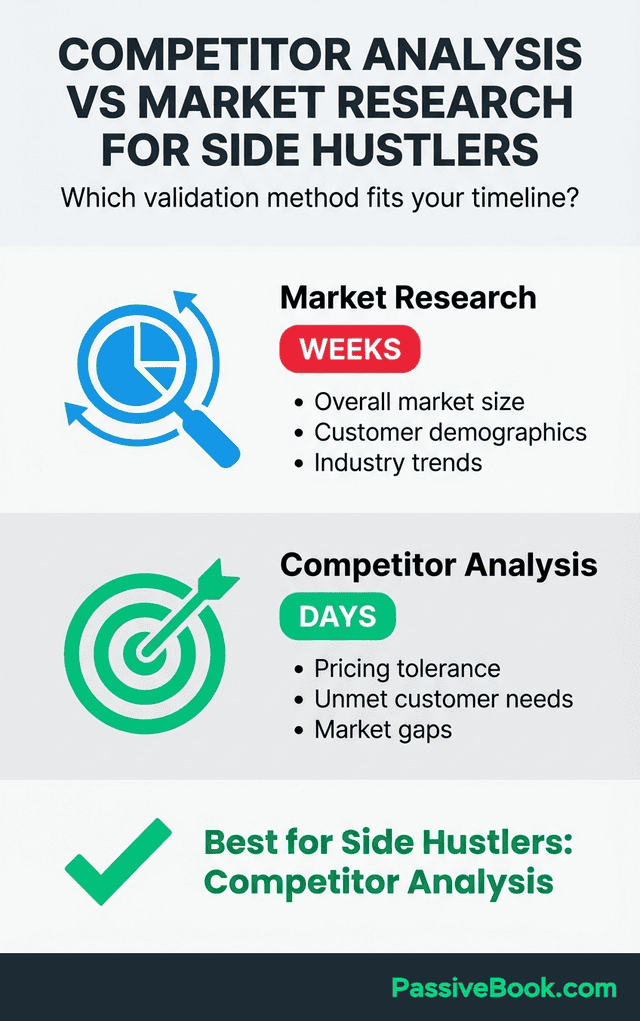
They studied what worked, identified gaps in tone and delivery, and positioned themselves differently. This process reveals three critical insights. First, pricing tolerance – what customers already pay. Second, unmet customer needs and market gaps where current solutions fall short. Third, profitable positioning opportunities in underserved segments.
When you see competitors charging $29 monthly for a solution, you know customers already accept that price point. When you read 100 reviews complaining about the same missing feature, you’ve found your differentiation angle. These insights help you grow business strategically rather than guessing which features matter most.
Why 42% of Startups Fail Without Competitive Research
According to CB Insights’ analysis of startup failures, lack of market need consistently ranks as the top reason businesses close. This failure is preventable with competitor analysis. Yet most solopreneurs skip this step, convinced their idea is unique enough to succeed without validation.
The fear that competitors mean “saturated market” blinds founders to profitable micro-niches. I made this mistake with my first blog. I saw established sites ranking for my keywords and assumed I couldn’t compete.
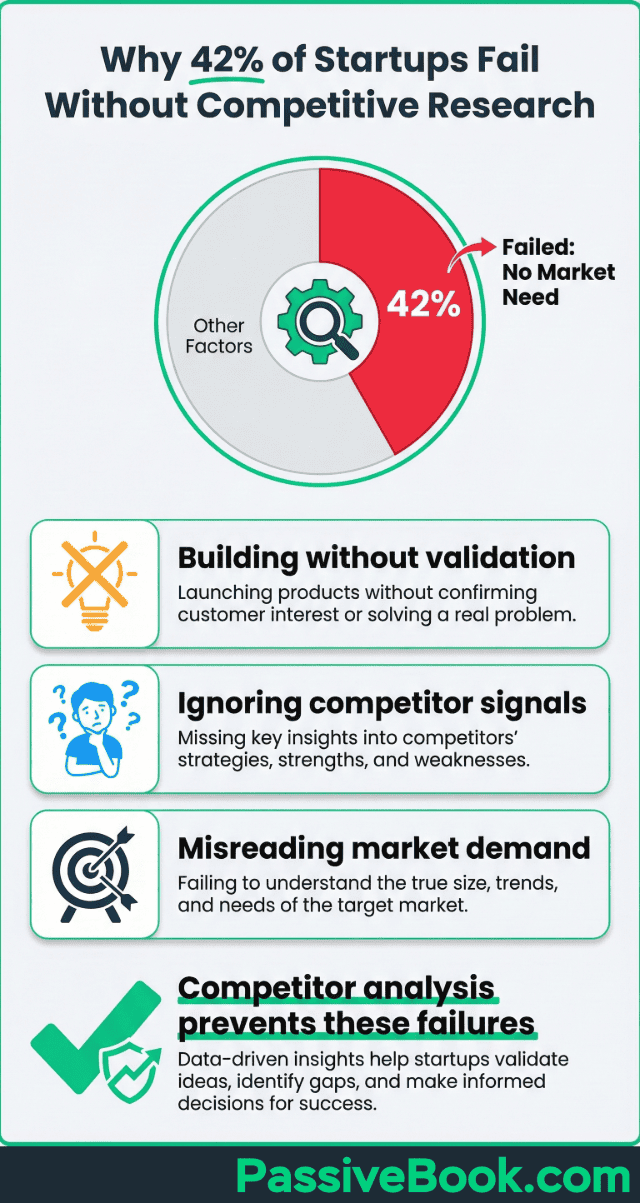
What I missed was that none of them addressed my specific audience – corporate employees building side hustles. Competitor presence actually proves customers actively seek and purchase these solutions. Zero competitors signals zero demand rather than an untapped goldmine. If no one else solves this problem profitably, ask why before proceeding.
Three Types of Competitors to Analyze
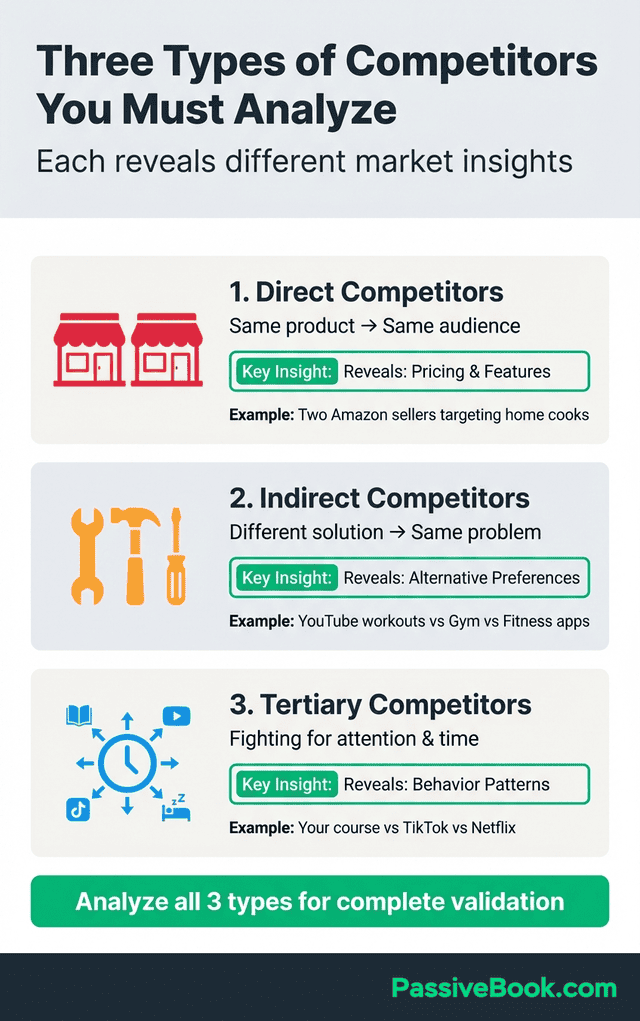
Your competitive landscape breaks into three distinct competitor types. Each reveals different aspects of market demand and customer behavior.
Direct Competitors Selling Similar Solutions
Direct competitors offer identical products to the same target market – the specific customer segment you both serve. Two Amazon sellers offering kitchen gadgets to home cooks are direct competitors.
Focus your analysis on their pricing, product features, and customer acquisition channels. If they’re running Facebook ads consistently for six months, they’ve likely found profitable customer acquisition.
If their pricing clusters around $30-50, that’s your market’s price tolerance range. Mapping their strengths weaknesses helps you identify where you can realistically compete given your time and budget constraints.
Indirect Competitors Solving Problems Differently
Indirect competitors solve identical pain points through different approaches. A fitness content creator competes with Chloe Ting’s free YouTube workouts, local gym memberships, and paid apps like Kayla Itsines’ Sweat.
Study their messaging to understand diverse solution preferences customers consider.
When someone searches “lose weight at home,” they’re comparing your workout program against free YouTube content and $29 monthly app subscriptions. Your value proposition must address why they should choose your approach over these alternatives.
Tertiary Competitors Fighting for Attention
Tertiary competitors represent any alternative your target audience considers before purchasing your solution. Netflix competes with TikTok for evening entertainment time, even though they’re not in the same industry.
Track their content themes to identify broader market conversations.
If your audience spends hours on TikTok watching quick productivity tips, your in-depth course competes for that same attention window. Understanding this competition helps you position your offering within their existing behavior patterns.
I used to skip tertiary competitors entirely. Felt like overthinking. Until I launched a productivity course that competed with TikTok. Turns out my audience preferred 60-second dopamine hits over 60-minute lessons. Tertiary analysis would’ve caught that.
How to Find Your Real Competitors in Under 10 Minutes
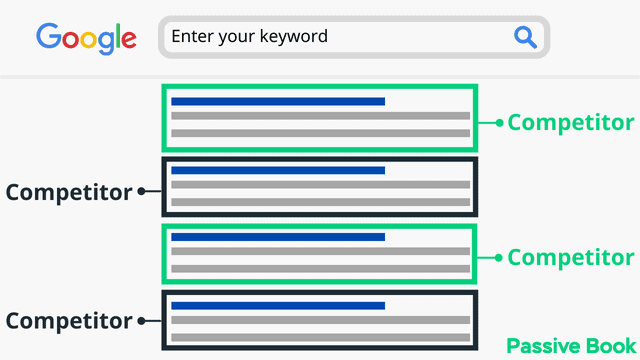
Search your core keyword in incognito mode and document first page results. Google ranks sites it believes best answer user intent. These top 10 results are your primary competitors.
Check the Google Ads section above organic results to identify businesses investing in paid traffic. Companies spending money on ads for your keywords have validated profitable customer acquisition. Screenshot these ads for pricing and messaging analysis later.
Use LinkedIn to search industry hashtags and find professionals solving similar problems. Search terms like “#contentcreator” or “#ecommercetips” reveal individuals and companies actively serving your target market.
Join Reddit communities where your audience discusses pain points and solutions. Subreddits like r/Entrepreneur or niche-specific forums show real conversations about what people struggle with and which solutions they recommend to potential customers.
Side note: If you’re analyzing competitors at 11pm after your day job, skip the LinkedIn deep dive on night one. Reddit gives you faster insight into real problems. Save LinkedIn for night two when you’re mapping professional positioning.
Free Tools Time-strapped Solopreneurs Actually Need
Premium competitor analysis tools cost hundreds monthly. You don’t need them for initial validation. These free alternatives provide enough data to make informed go/no-go decisions.
Similarweb for Traffic Patterns
Before building Nomad List to over $600K annually, Pieter Levels spent weeks studying where competitors got traffic using free tools. He focused on understanding traffic sources, not precise visitor counts.
Similarweb‘s free tier shows competitor traffic sources and top performing pages. You can compare up to five websites simultaneously without monthly subscription costs.
Look for traffic trends over the past six months. Consistent growth signals healthy demand. Declining traffic suggests market saturation or shifting customer preferences.
Spyfu for Keyword & Ad History
Spyfu provides extensive historical Google Ads data for competitor campaigns. This reveals which keywords competitors bet money on and how long they’ve sustained that investment.
Access Pay Per Click (PPC) spending estimates and ad copy competitors tested over time. Use SpyFu’s free tier to check if competitors spend on paid ads for your keywords.
Sustained spend over six months signals profitable customer acquisition. If they stopped advertising after two months, that keyword likely didn’t convert profitably.
Social Platform Native Analytics
Chloe Ting analyzed competitor posting patterns using Instagram’s free analytics before launching her workout programs, growing to over 25 million YouTube subscribers. She didn’t need expensive tools. Platform native analytics showed what content formats drove engagement.
Check which content gets saved and shared, not just liked. Saves indicate utility. Shares suggest emotional resonance.
Monitor posting schedules to understand different strategies. Daily consistency versus sporadic weekly content reveals resource allocation and audience expectations.
Check competitor website footers for legal signals like copyright notices (All Rights Reserved) and Privacy Policy pages. These indicate established businesses that have formalized operations. Newer competitors without these pages may be testing the market, while those with comprehensive legal frameworks signal long-term commitment and likely profitability.
What to Analyze in Competitor Content Strategy
Dan Koe’s path to $1M+ annual revenue started by tracking which tweet formats drove replies versus retweets among competitors on Twitter/X before launching his newsletter and Kortex productivity app. He tracked which content formats drove different audience engagement levels.
Document posting frequency, content formats like Reels versus carousels, and engagement rates across your top three competitors. High comment-to-like ratios above 5% indicate active community.
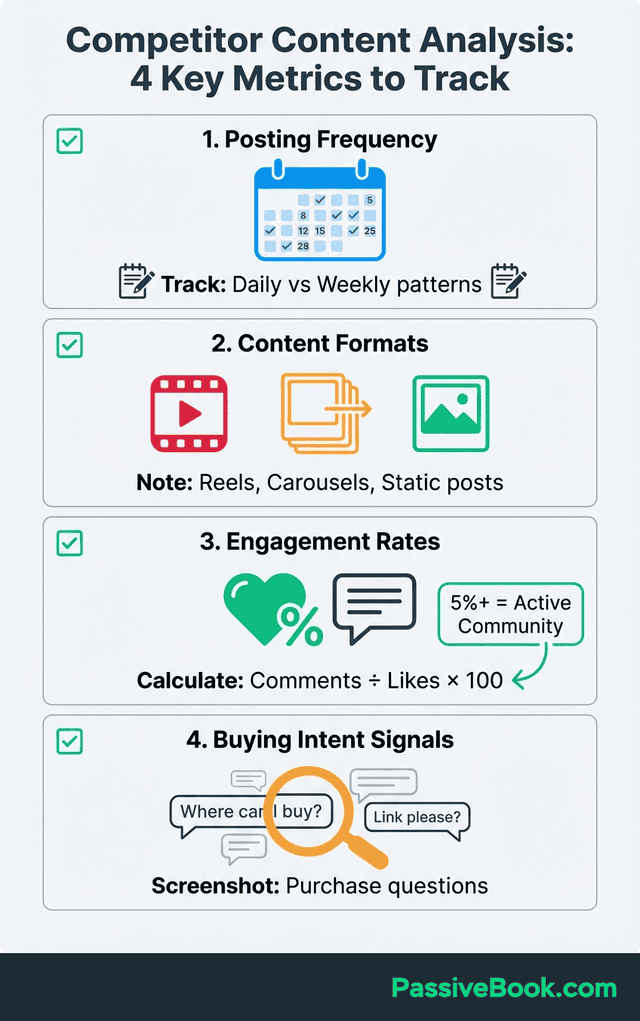
Spend 10 minutes checking top five competitor posts to calculate this benchmark for your niche. Look for repeat commenters asking “where can I buy?” This language signals clear buying intent.
If you see the same usernames engaging across multiple posts and asking purchase questions, you’ve found an audience ready to pay for solutions. Screenshot these interactions to understand the customer journey from content consumption to purchase consideration.
Mining Customer Feedback and Reviews for Unmet Needs
Online reviews directly influence purchasing decisions for most consumers. Reviews are unfiltered market research where customers tell you exactly what they want and what frustrates them.
Small business owners selling on Amazon identify profitable product improvements by analyzing competitor 2-3 star reviews. Five-star reviews show what works. One-star reviews are outliers.
But 2-3 star reviews reveal fixable frustrations. Someone who took time to write a moderate review wanted to like the product service but hit specific dealbreakers.
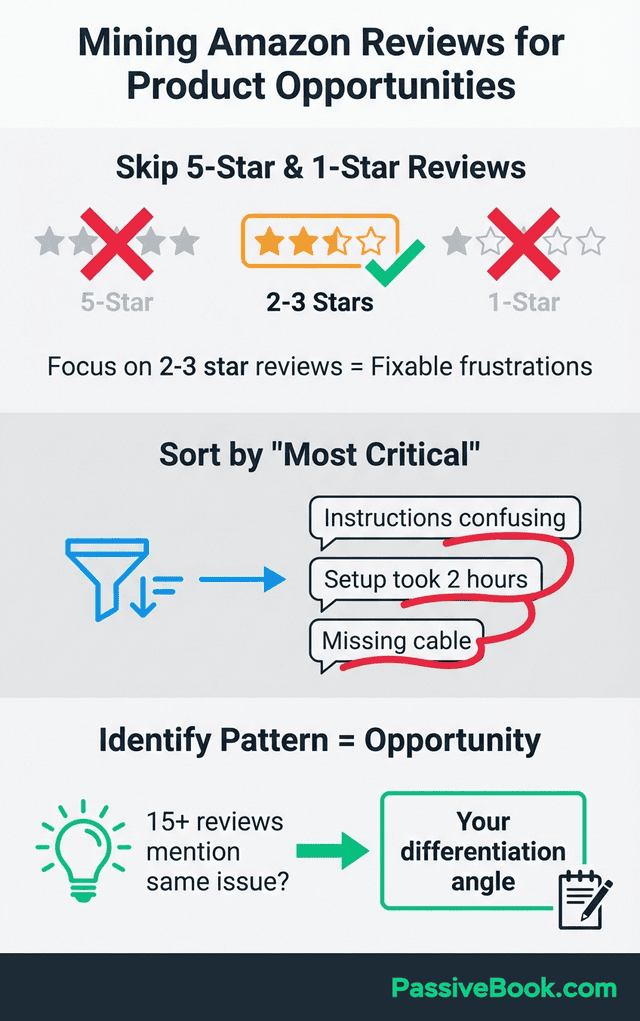
Sort competitor reviews by “most critical” to find recurring complaints. If 15 reviews mention “instructions were confusing,” you’ve found a differentiation opportunity.
Track praise patterns showing what customers value most in existing solutions. When reviews repeatedly mention “fast shipping” or “responsive support,” you know these operational elements matter more than fancy features.
Reddit and Online Communities as Validation Goldmines
Nathan Barry validated demand for creator-focused email marketing by monitoring complaints in Reddit‘s r/Entrepreneur, leading him to build Convertkit which now generates over $2M monthly. He spent weeks reading threads where creators complained existing tools were built for e-commerce, not content businesses.
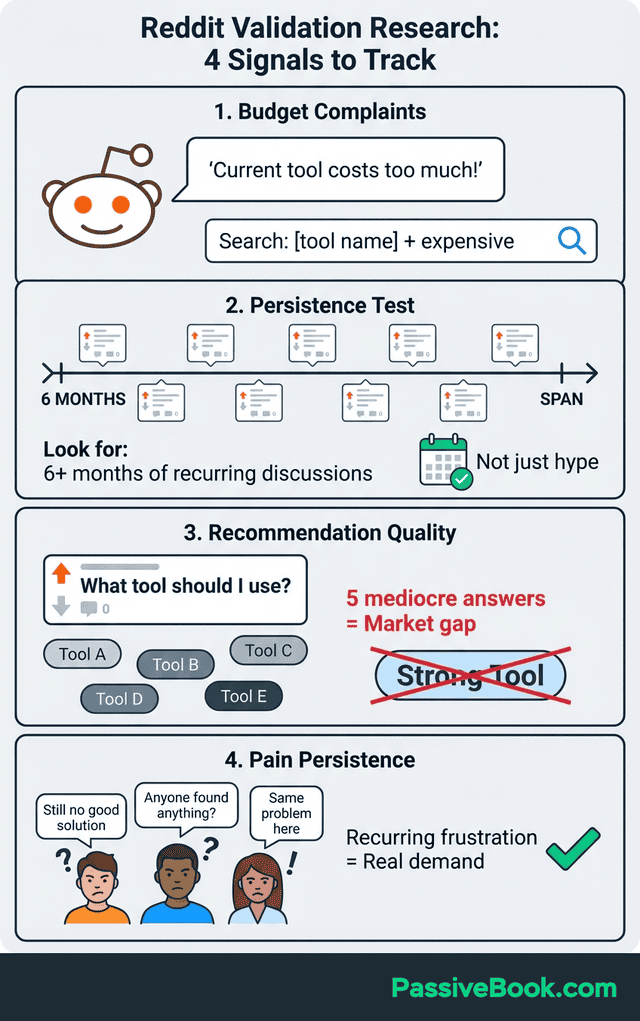
Search for budget signals like “current tool costs too much” language. When multiple people complain about pricing, you’ve identified willingness to pay for better alternatives at lower price points.
Look for discussions spanning six months or longer showing persistence, not fleeting hype. Note whether people recommend competitors enthusiastically or complain about lack of good options.
Threads where someone asks “what tool should I use?” and gets five different mediocre recommendations signal market gaps. If one tool dominated every response, that’s a strong incumbent you’d compete against directly.
Using AI to Speed up Competitor Analysis
You can cut research time in half by prompting ChatGPT to summarize competitor websites and identify positioning patterns. Copy a competitor’s homepage text and ask it to analyze the website’s value proposition, target audience, and pain points they address.
Prompt Artificial Intelligence (AI) to extract pricing tiers, features, and customer testimonial themes across multiple competitors simultaneously. Feed it five competitor pricing pages and ask it to create a comparison table showing pricing tiers, included features, and target customer segments for each company.
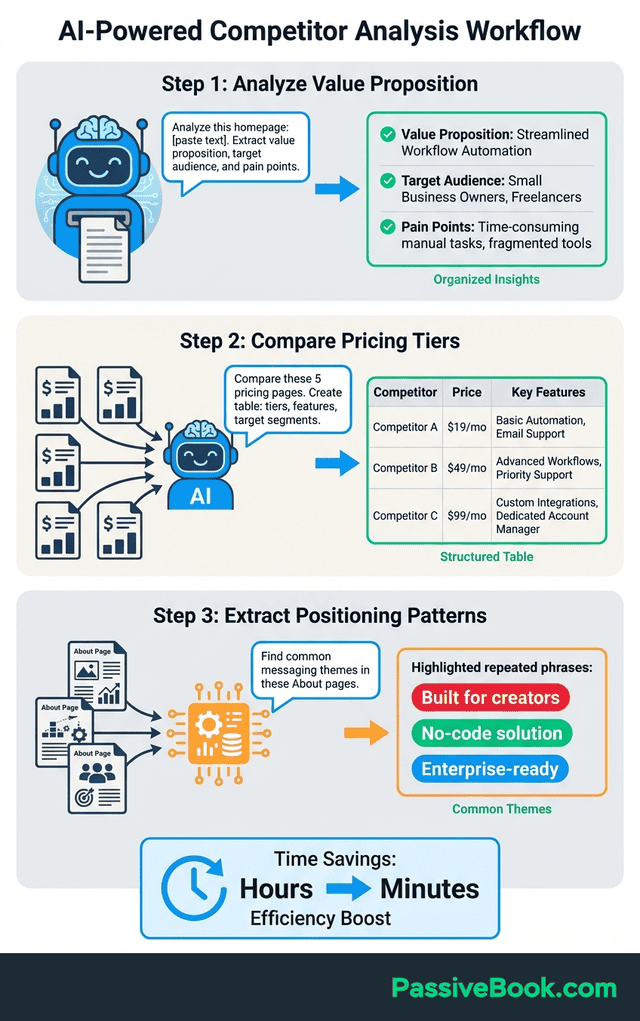
AI-powered tools like ChatGPT automate hours of manual competitive research into minutes. I now paste competitor About pages into Claude and ask it to identify common messaging themes.
This reveals industry positioning patterns I’d miss reading individually. The AI spots repeated phrases like “built for creators” or “no-code solution” that signal market positioning trends.
Extracting Pricing Intelligence From Competitors
Pat Flynn analyzed competitor pricing on course platforms like Udemy and Teachable before launching his own courses, building 7-figure annual revenue through strategic pricing differentiation. He noticed most courses clustered at $19-49 or $200+, with almost nothing in between.
Screenshot competitor pricing pages alongside listed product features to understand what capabilities justify premium tiers versus entry-level offerings. Spend 20 minutes comparing three to five competitors to identify pricing sweet spot between budget and premium tiers.
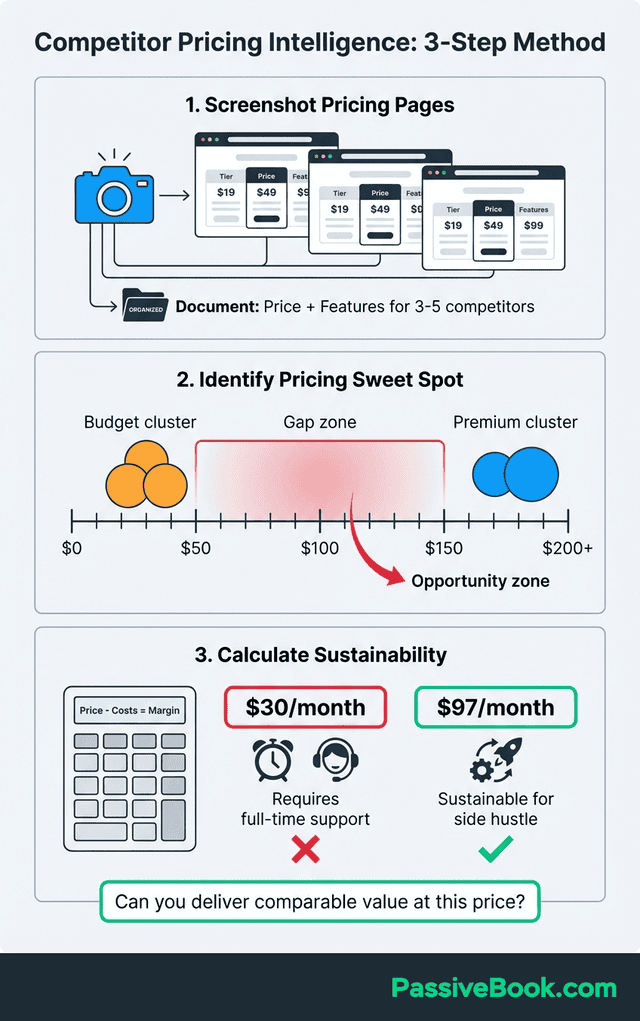
For e-commerce, analyze Shopify stores using browser extensions revealing which apps they use. This shows their operational costs and capabilities.
Calculate whether you can profitably deliver at competitive rates with your constraints. If competitors charge $30 monthly but require full-time customer support, that pricing won’t work for your side hustle model. Look for price-to-value ratios where you could deliver comparable results at sustainable margins given your time limitations.
Critical Mistakes That Waste Your Limited Time
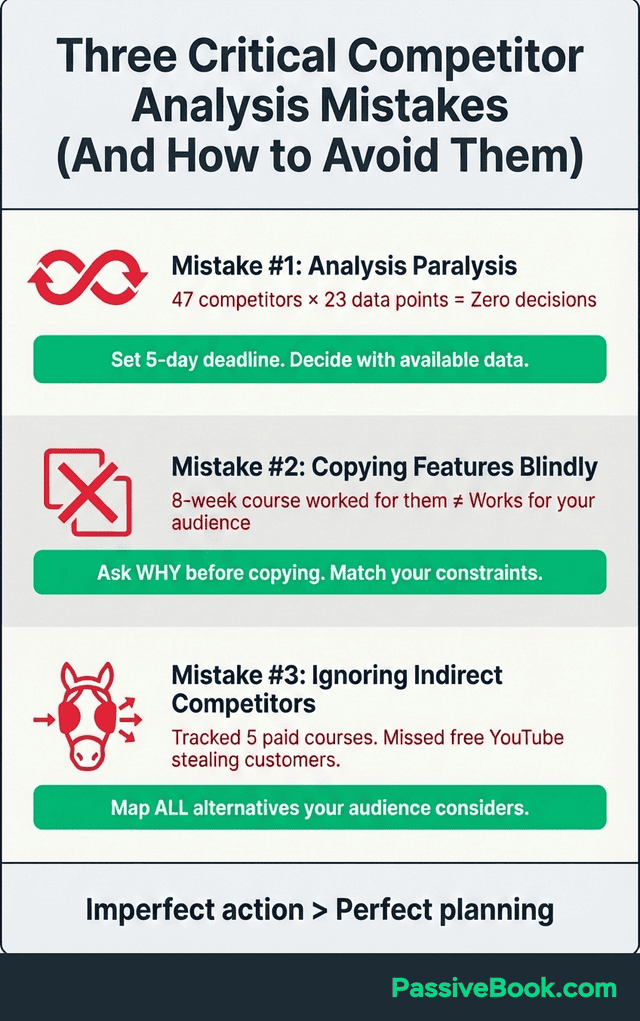
I wasted my first month of competitor analysis diving into rabbit holes. I analyzed 47 competitors across spreadsheets with 23 columns of data.
None of it helped me make a decision. These mistakes killed momentum I couldn’t afford losing as a side hustler.
Analysis Paralysis and Research Rabbit Holes
Decision-makers waste weeks gathering every data point instead of acting. You’ll feel productive compiling information, but validation requires decisions, not perfect data.
Set a research deadline of three to five days maximum for side hustlers. After day five, you must make a go or no-go decision with available information. More research rarely changes the core answer. It just delays action.
Copying Features Without Understanding Why They Work
Competitors succeed despite flaws, not because of feature lists. I once copied a competitor’s 8-week course structure without understanding their audience wanted comprehensive depth. My audience needed quick wins, making my copied format a mismatch.
Surface-level feature comparisons miss the “why” behind customer loyalty.
Before copying any element, ask what problem it solves for their specific audience. Your constraints and customer base may require completely different solutions.
Ignoring Indirect Competitors
Focusing solely on direct rivals is the most common competitive analysis mistake. I tracked five direct competitors selling similar courses but missed that my audience was choosing free YouTube videos over any paid option.
Indirect competitors reveal alternative solutions customers already choose. If your paid newsletter competes with free blogs, Twitter threads, and podcasts, you need differentiation beyond just content quality. You’re competing against “free” and “convenient,” not just other newsletters.
Turning Insights Into Your Go/No-Go Decision
Successful validated founders like Justin Welsh pivoted from broad ideas to specific niches after competitive research. Justin initially considered general business coaching but found the market saturated.
His competitor analysis revealed an underserved niche – solopreneurs specifically seeking one-person business models. This competitive analysis becomes a core component of your business plan, providing data-driven validation rather than assumptions. Each validated competitor proves your target market actively seeks and purchases this type of solution.
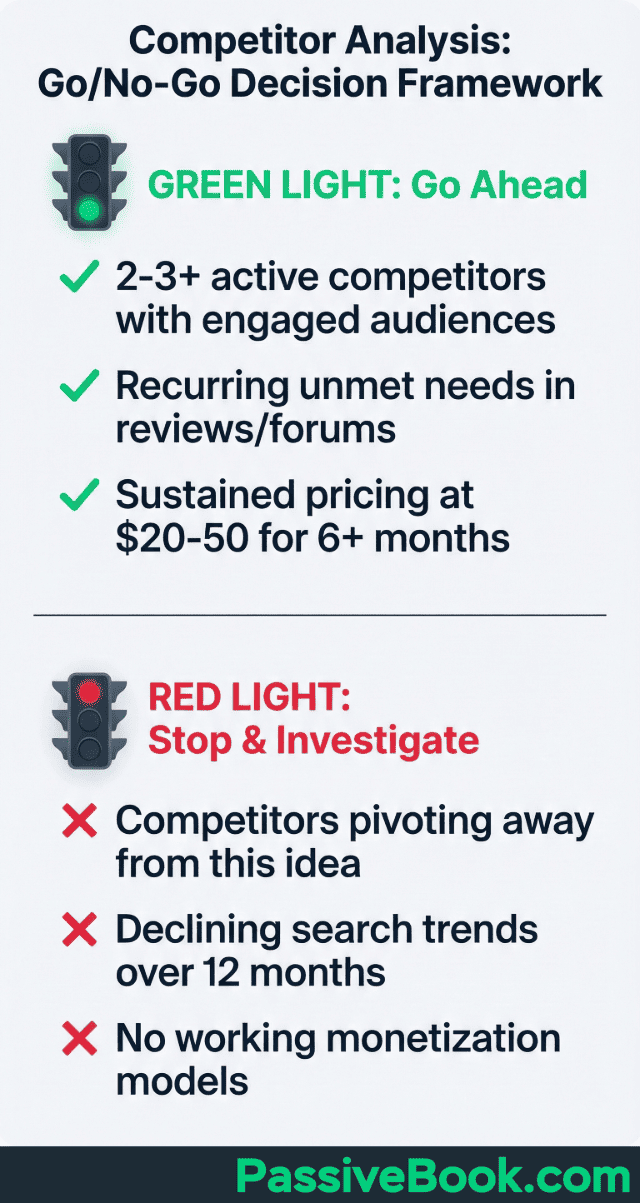
Green light signals include multiple competitors with engaged audiences and recurring unmet needs in reviews and forums. If you see three competitors each generating steady revenue with audiences asking for specific improvements, you’ve found validated demand with differentiation opportunities.
Red light signals include competitors pivoting away from your business idea, declining search trends over 12 months, or no working monetization models. If every competitor you find has shut down or shifted business models, investigate why before proceeding. Market timing might be wrong, or structural problems exist you haven’t identified yet.
Quantifiable Success Metrics for Validation
Beyond qualitative signals, specific metrics help you measure validation confidence objectively. Use these thresholds to make data-driven go/no-go decisions.
Minimum competitor threshold matters. Two to three active competitors signals healthy demand. Zero to one requires deeper investigation. Ten or more means evaluate differentiation angles carefully.
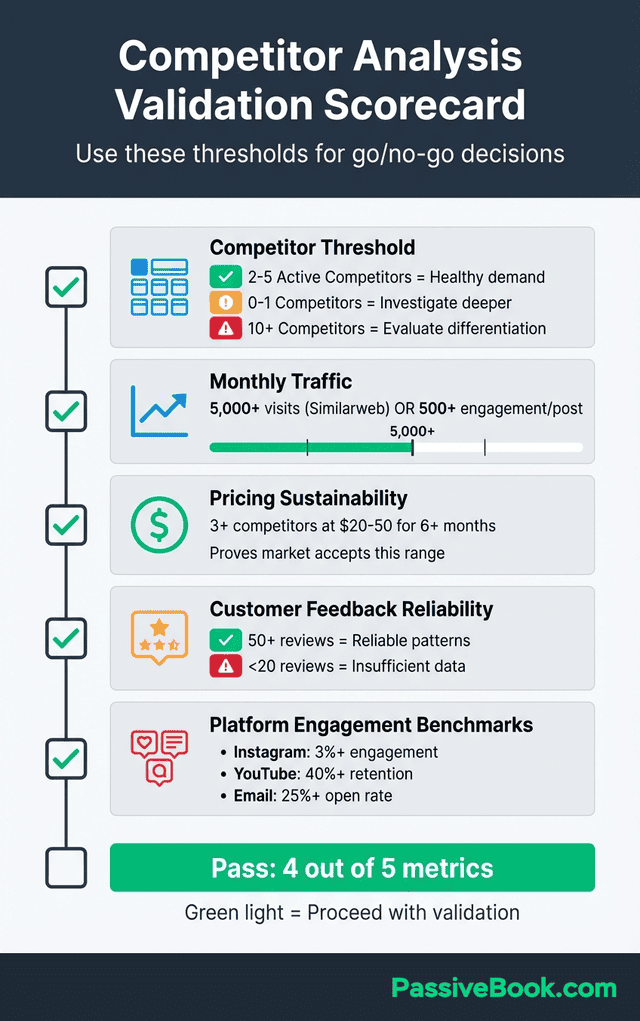
For traffic validation, look for competitors receiving 5,000+ monthly visits according to Similarweb estimates or consistent 500+ engagement per social media post. Pricing validation requires three or more competitors sustaining $20-50 pricing for six months or longer – this proves the market accepts that range.
Review volume provides reliability benchmarks. Products with 50+ reviews provide reliable customer feedback data patterns. Under 20 reviews proves insufficient for pattern identification. Engagement rate standards vary by platform. Instagram engagement above 3%, YouTube retention above 40%, and email open rates above 25% signal strong audience connection worth pursuing.
Frequently Asked Questions
How Many Competitors Should I Analyze Before Validating?
Analyze three to five direct competitors. Here’s why. Competitor one shows whether demand exists. Competitor two confirms it’s not a fluke.Competitors three through five reveal patterns in pricing, positioning, and customer acquisition. Analyzing a sixth competitor when you’re working nights around a day job doesn’t improve your decision quality. It just delays action. Include a mix of established leaders and newer entrants to see both mature business models and emerging approaches that might signal market shifts.
What If I Find Zero Competitors in My Niche?
Zero competitors signals zero demand rather than an untapped goldmine opportunity. Every truly viable market has someone attempting to serve it.Expand your search to include indirect and tertiary competitors solving similar problems through different methods before concluding you’ve found a unique opportunity.
Should Big Competitors Scare Me Off?
Large competitors validate the market exists but ignore micro-niches. Solopreneurs like Justin Welsh built small business empires into multi-million dollar revenues in spaces with established players by serving specific underserved segments.Big companies can’t profitably serve every micro-audience, creating opportunities for focused positioning that addresses overlooked needs.
How Often Should I Revisit This Analysis?
Monthly check-ins for the first six months help spot emerging threats and validate your positioning remains relevant. Quarterly deep-dives once you’ve launched and gained traction are sufficient unless you notice significant market changes.Set calendar reminders to review competitor pricing, content strategy, and customer feedback systematically rather than reactively.
What Next?
You now have a systematic process to validate business ideas through competitor analysis using only free tools and 10-minute research sessions. This framework prevents the costly mistake of building products nobody wants while working your full-time job. This framework works whether you’re among the first-time founders or experienced business owners exploring new markets.
Starting competitor analysis can feel overwhelming when you’re already time-strapped. Remember that imperfect action beats perfect planning. Three competitors analyzed thoroughly beats 20 competitors skimmed superficially.
Your immediate next step is to open an incognito browser window right now and search your core keyword. Screenshot the top 10 results. That’s your competitor list for tomorrow night’s 10-minute analysis session.
Then come back and tell me what you found. What competitor insight surprised you most? Drop your answer in the comments below.
Share this post with your friends & followers: