I spent three years running Passive Book while holding a corporate job. Most weeks I worked 50–60 hours total, split between the office and late-night content sessions. My family saw me at dinner, but I was mentally drafting blog headlines. My colleagues saw me at meetings, but I was secretly troubleshooting Pinterest automation on my phone.
I wasn’t really present anywhere.
What finally forced the change was a single metric: after 18 months of that schedule, my business revenue had grown only 12%, while my output quality had dropped noticeably. I was working more and achieving less.
This article walks you through the specific systems I use now to protect personal time without sacrificing business growth. I’ll also cover the psychological shifts that made those systems stick.
Before we dive into systems, here’s the permission you might be waiting for: working fewer hours with clear boundaries is not lazy. It’s strategic. The most sustainable online businesses are built by people who protect their mental clarity, not by those who grind until they burn out. If you’re reading this while feeling guilty about wanting more personal time, that guilt is not evidence you should keep working – it’s evidence you need better boundaries.

- •What Is Work-Life Balance for Online Entrepreneurs?
- •Why Overworking Is Destroying Your Output, Not Growing Your Business
- •Work-Life Balance vs. Integration: Which Model Is Right for You?
- How to Design a Work Schedule When You Are Your Own Boss
- •Designing a Work Environment That Enforces Your Boundaries
- •Task Batching and The Maker's Schedule: Protecting Your Creative Time Blocks
- •The 80/20 Rule: Eliminating Low-Value Tasks to Reclaim Personal Time
- •Automation and AI Tools: Let Your Business Run While You Rest
- •Overcoming Entrepreneurial Guilt and the Hustle Culture Trap
- •Frequently Asked Questions
- •What Next?
What Is Work-Life Balance for Online Entrepreneurs?
Work-life balance means consciously protecting personal time from work so neither completely consumes the other. It has two core components: defined working hours and clear boundaries that signal when work ends. Without both, your business bleeds into every waking moment.
This balance directly impacts your well being and mental health. Without it, business owners experience chronic stress that degrades both physical health and decision-making quality.
Adobe surveyed 1,018 entrepreneurs and found nearly 3 in 5 report better balance than in traditional employment.
Yet nearly half still struggle to fully disconnect. The freedom to set your own schedule is worthless if you never actually stop working.
It is not about doing less work. It is about doing work in defined containers so your personal life stays intact. A solopreneur working 25 focused hours per week inside clear boundaries often outperforms someone grinding 60 diffuse hours with no off switch.
Why Overworking Is Destroying Your Output, Not Growing Your Business
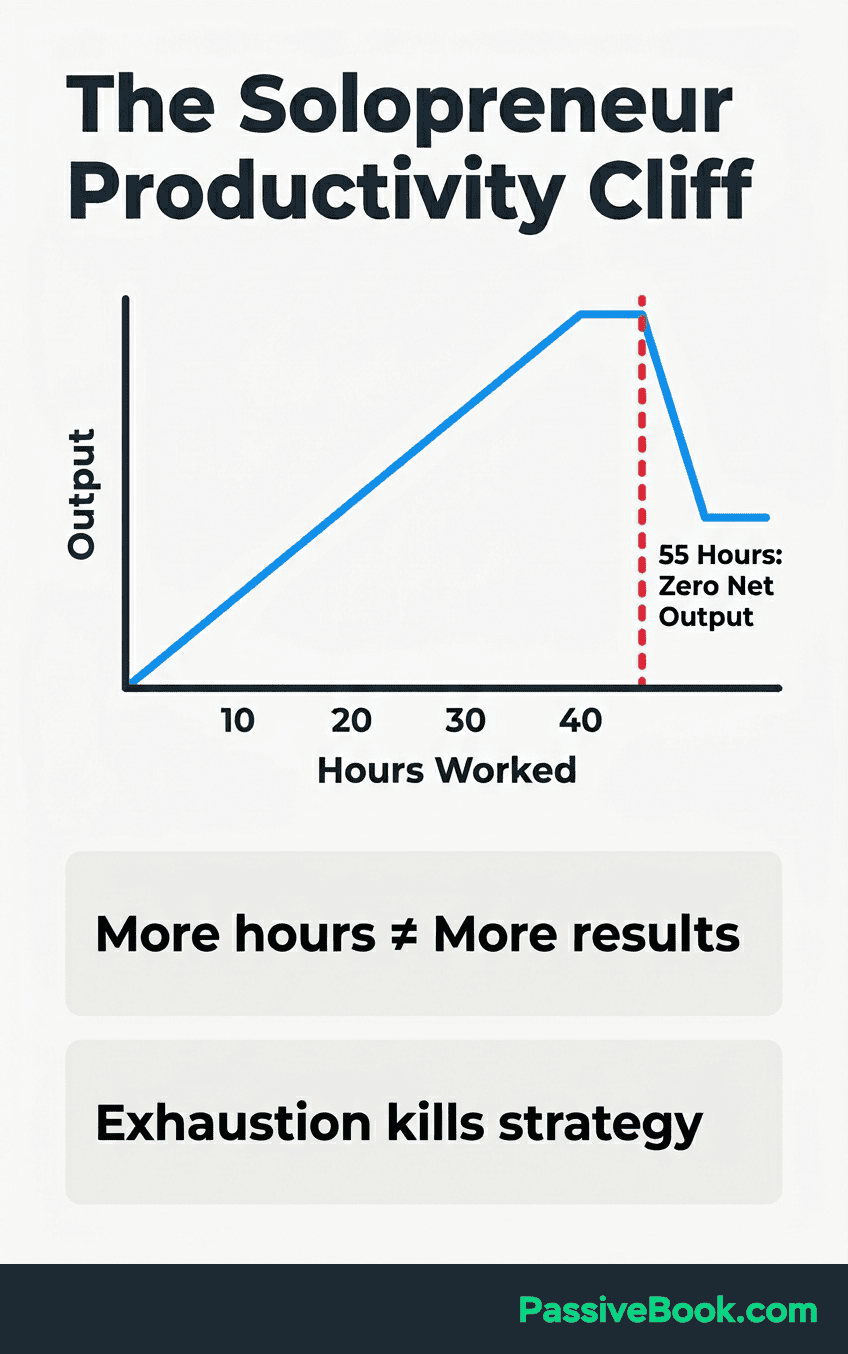
Productivity per hour collapses beyond 50–55 hours per week.
Research shows extra hours produce zero net output once you cross that threshold. 87.7% of entrepreneurs already struggle with at least one mental health issue, and chronic overwork is often the root cause.
A Sifted survey of founders found more than half experienced burnout in the past year. Work-life balance ranked as the second biggest challenge. This is not a niche problem; it is the majority experience.
The hidden cost goes beyond health. Chronic overwork erodes the creativity and decision-making that your online business actually runs on.
When I abandoned my membership site project in 2021, it was not because the model failed. It was because producing weekly premium content alongside a day job became unsustainable. I was shipping work, but the quality had dropped to the point where renewal rates started falling.
Work-Life Balance vs. Integration: Which Model Is Right for You?
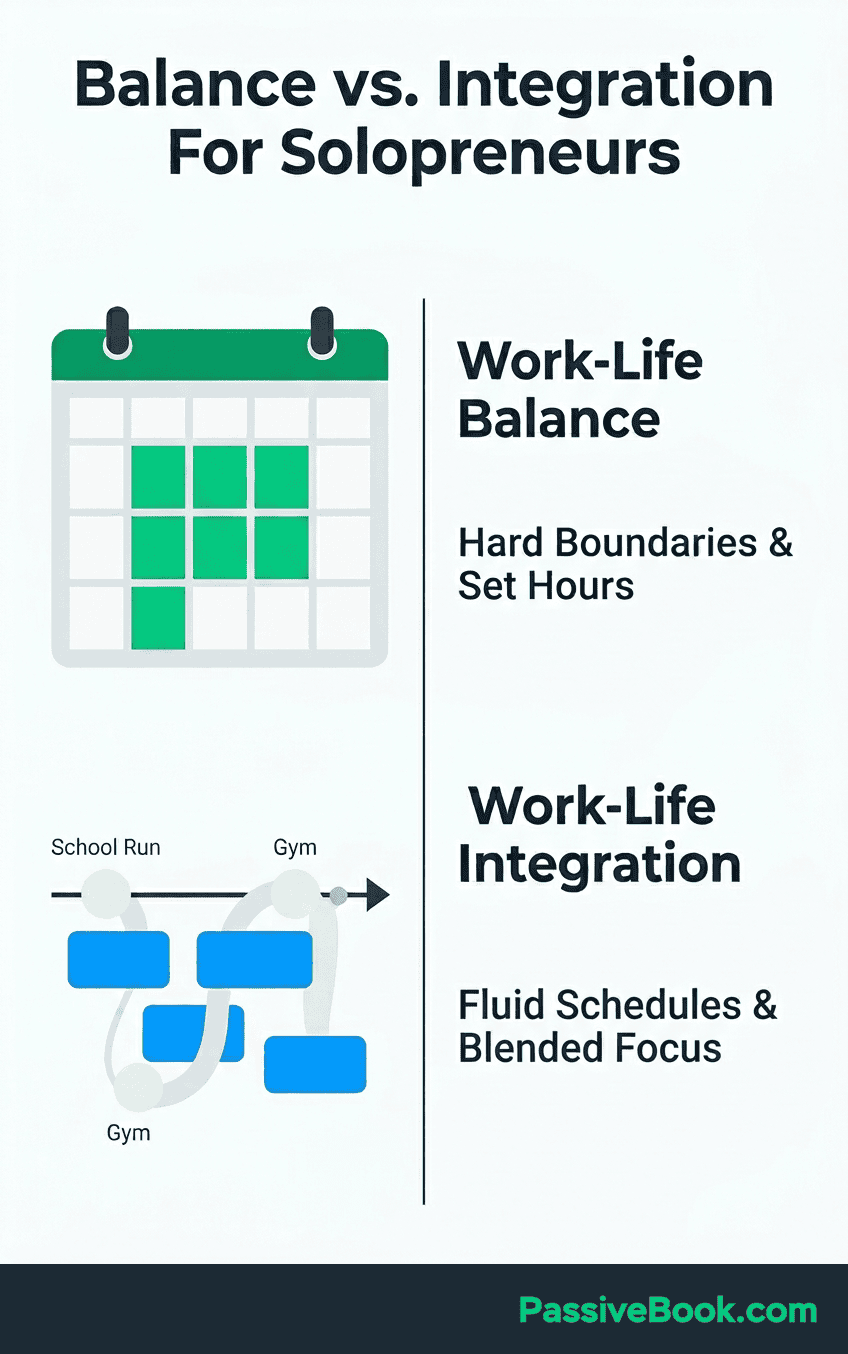
Healthy work life balance draws hard on/off boundaries between work and personal time. Work-life integration blends them fluidly around life’s natural rhythms. Neither is superior; the right choice depends on your constraints and personality.
Balance suits solopreneurs who need clean separation to avoid mental bleeding.
Integration suits those with day jobs, young kids, or irregular schedules where rigid blocks are impractical. A parent blogging during nap times or filming YouTube videos on Sunday mornings is practicing integration.
Gillian Perkins, a homeschooling mom of five, runs a six-figure online business working just 15 hours per week by batching work into fixed life windows.
She wakes 1–2 hours before her kids and works during nap times, so she is fully present with her family when she is not working. That is integration executed with boundaries.
The goal is not the label. It is intentional hours where you always know whether you are at work or off work. Without that clarity, both models collapse into chronic overwork.
How to Design a Work Schedule When You Are Your Own Boss
Choose fixed, recurring work windows that fit your existing life. A parent might block 6–8 AM before the school run or 8–10 PM after the kids are asleep. A side hustler might claim Saturday mornings and three weekday evenings. The specific hours matter less than their consistency.
Treat those windows as non-negotiable appointments.
Block them in Notion or Reclaim.ai with a distinct color code.
When someone asks for your time during a blocked window, you say you have a commitment – because you do.
Declare business hours to your household and clients, just like a physical shop posts opening times. Put them in your email signature. Add them to your website contact page. Include them in client onboarding documents. Most people respect boundaries when they are clearly stated upfront.
This clarity helps you manage time effectively and establish clear expectations with everyone in your life. When you set boundaries explicitly, you remove the ambiguity that causes guilt and interruptions.
A one-week time audit reveals where hours silently disappear. Track every 30-minute block for seven days. You will immediately see which tasks are worth your limited time and which are pure waste.
I learned this the hard way when a friend kept asking to “grab coffee” during my morning writing block. After three months of saying “maybe,” I finally sent him my Calendly link with only afternoon slots available. He booked a slot immediately. He wasn’t offended – he just needed clarity.
Building a Start-Of-Day “On” Ritual
In Atomic Habits, James Clear documents choreographer Twyla Tharp’s daily start ritual: she hails a cab to the gym each morning not as exercise, but as a cue that tells her brain creative work mode has begun. For solopreneurs, a consistent 5-minute start sequence works on the same principle.
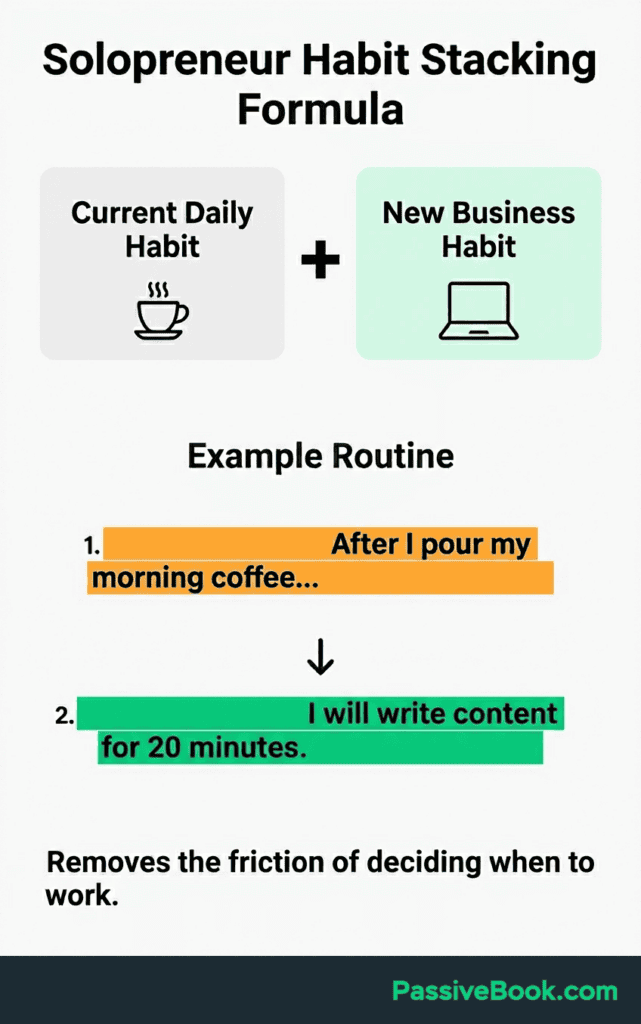
The ritual can be simple: make coffee, open Notion, review your three priority tasks, close Slack. Your brain learns that this sequence means work has started.
Avoid checking notifications or email first. Enter your first task proactively, not reactively. The moment you open email before your own priorities, you are working on someone else’s agenda.
Building a Shutdown “Off” Ritual
Cal Newport’s shutdown ritual involves reviewing open tasks, capturing tomorrow’s priorities, then closing all apps and saying a closing phrase.
It takes under 5 minutes. The phrase matters because it creates a psychological bookmark.
Capturing all open loops in a trusted system removes the mental burden that causes work to replay at dinner or during sleep.
Write down every unfinished thought in a notebook or Notion. Your brain can relax when it knows nothing will be forgotten.
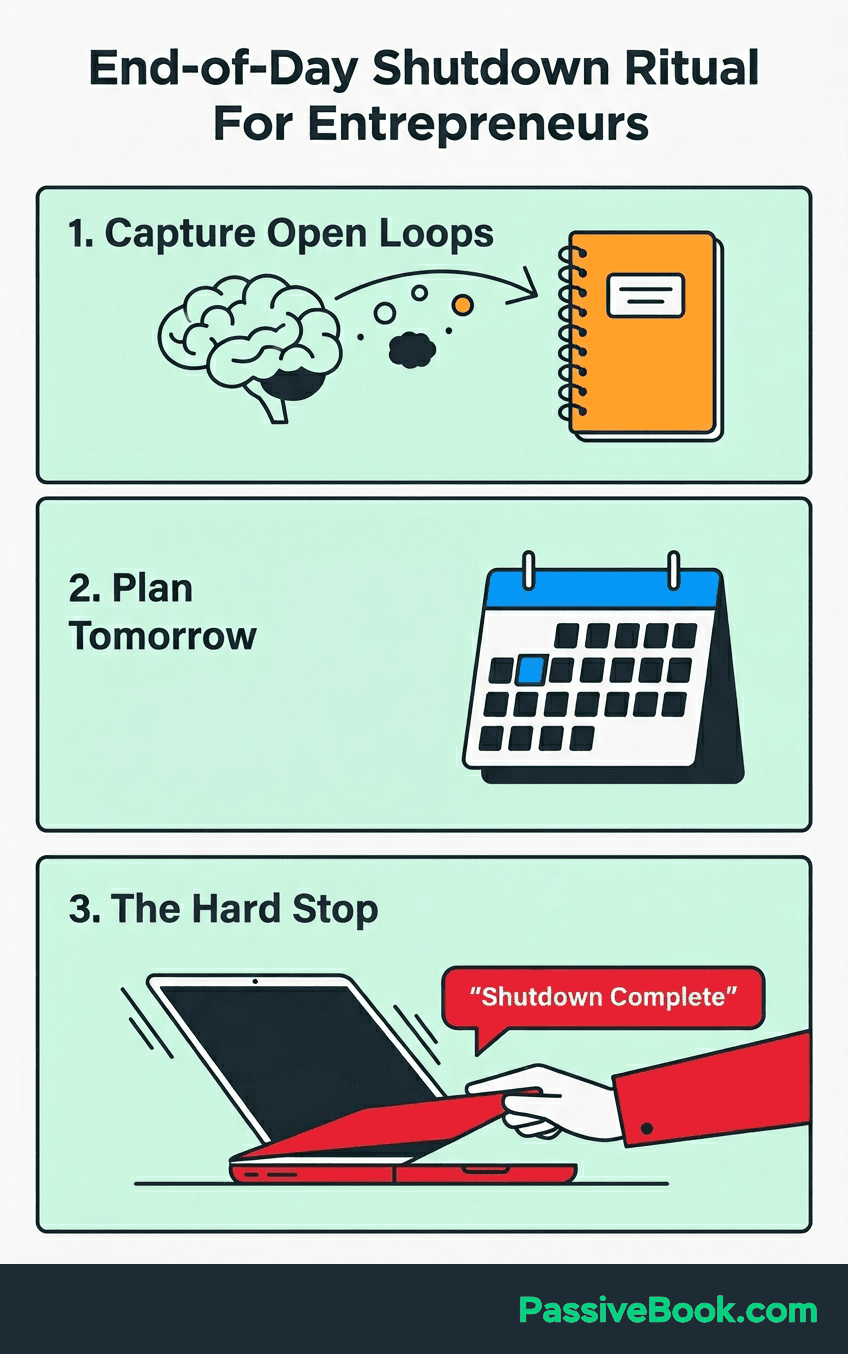
The physical anchor matters. Close the laptop. Leave your workspace. Put your phone in a drawer. These actions signal the day is done. Without a clear ending, work just fades into personal time with no boundary.
Communicating Your Availability to Clients Without Losing Their Trust
Publish your business hours explicitly in your email signature, your website contact page, and your onboarding documents. Clients self-select into your schedule rather than guessing when you might respond. This prevents the expectation mismatch that creates after-hours pressure.
Set up an auto-responder outside your declared hours: “I respond to all emails between 9 AM and 5 PM, Monday through Friday. You’ll hear from me then.” Most clients prefer predictability over immediacy. They want to know when to expect your reply, not receive it instantly.
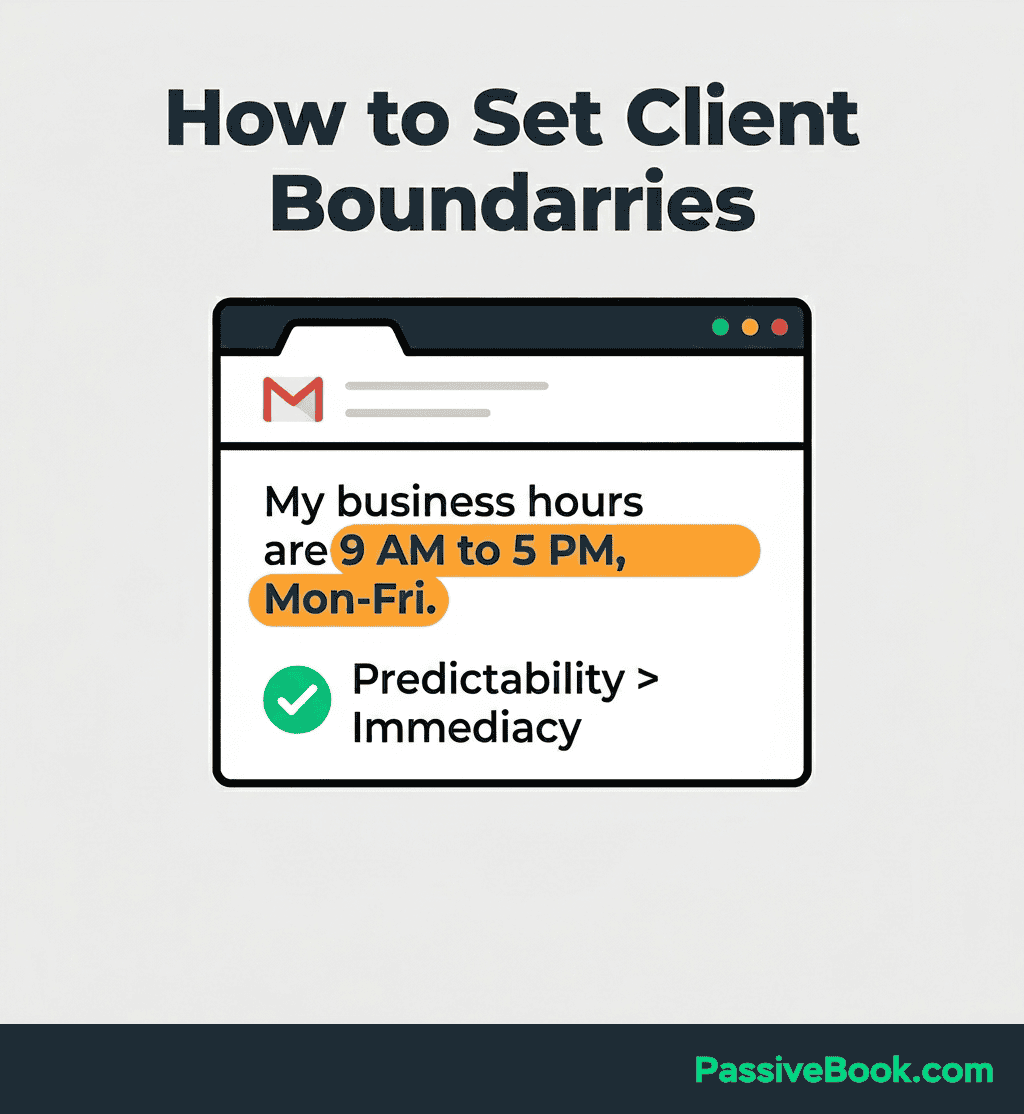
One Late Too Many’s freelancer boundary guide documents that stating response windows in a welcome packet eliminates the majority of after-hours contact without a single difficult conversation. The key is setting expectations before work begins, not negotiating them mid-project.
Designing a Work Environment That Enforces Your Boundaries
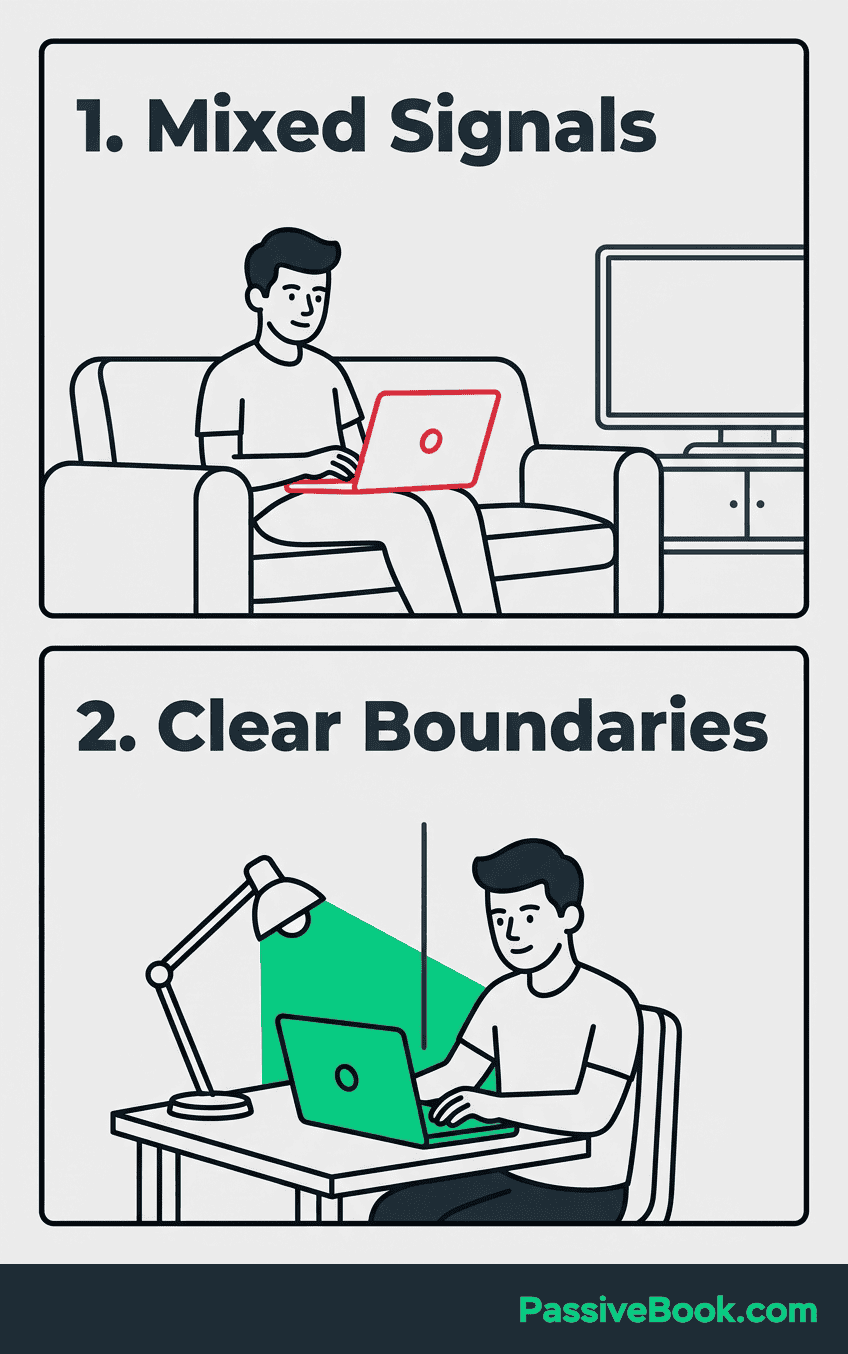
Your schedule sets when you work. Your environment determines how completely your brain switches between modes. A dedicated workspace creates a physical cue separating work mode from life mode. Leaving it signals your day is over.
Even a specific desk or corner works if you lack a separate room. The boundary is psychological, not architectural.
When you sit there, you work. When you leave, you stop. Your brain learns the association through repetition.
My own workspace is a corner desk in my bedroom. Not glamorous, but it works because I never sit there unless I’m working. My family knows: if I’m at that desk, I’m unavailable. If I’m on the couch, I’m present.
Research shows the average person checks their phone 186 times per day – roughly once every five waking minutes.
Enabling Focus or Do Not Disturb during both work blocks and personal hours is one of the highest-ROI friction-removal habits available. It costs nothing and immediately reduces context switching.
Your work environment also affects your personal well being. A cluttered desk or shared space without clear physical boundaries makes it harder to be fully present when you leave. Small changes like a dedicated monitor, noise-canceling headphones, or even a specific chair reserved for work help reduce stress by creating a sensory cue that work mode is active – or over.
Use separate browser profiles for work versus personal use. Put your phone in a drawer during family time. Simple, free habits that break the “just check one thing” cycle that destroys presence.
Task Batching and The Maker’s Schedule: Protecting Your Creative Time Blocks
Paul Graham’s Maker’s Schedule shows that creative work requires long, uninterrupted blocks. Even one task switch can destroy an entire half-day of deep work. Once you know your 20% tasks, batching is how you protect them.
Task batching means grouping similar activities. Record all YouTube videos in one session. Write all blog posts in one morning. Handle all admin in one low-energy window. Context switching is expensive; batching eliminates it.
Batching also protects outside work hours. When you know Wednesday afternoon is your recording block, you won’t feel tempted to “just film one quick video” on Saturday morning. Your personal time stays protected because the work already has a home.
Gillian Perkins describes in her batching breakdown how recording and writing in dedicated monthly batches compresses her entire business into 15 hours per week.
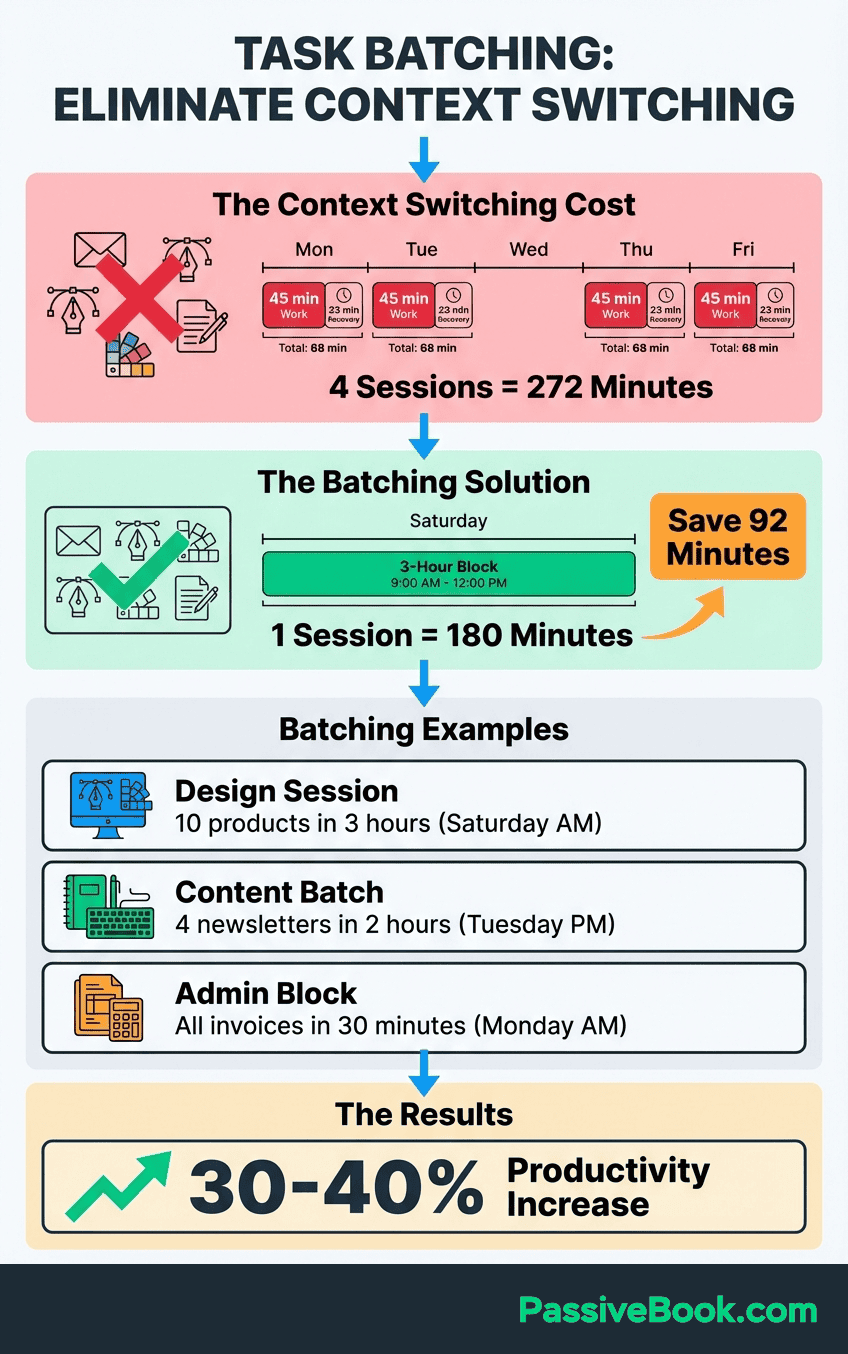
She records four videos in a single afternoon rather than spreading them across four weeks. This frees her evenings and weekends entirely.
The alternative is the fragmented schedule where you spend Monday morning writing, Monday afternoon on admin, Monday evening on social media, Tuesday morning editing. Every switch costs 15–20 minutes of ramp-up time. Batching converts that wasted ramp-up into productive output.
My own batching schedule: I write all blog outlines on Monday mornings (3–4 hours), draft full posts on Wednesday afternoons (4 hours), and schedule Pinterest pins once per month (2 hours). This compresses 20+ weekly tasks into three focused sessions. The rest of my week is completely free of content creation.
The first time I tried batching, I resisted it. It felt too rigid, too “corporate.” Then I actually tracked my time and realized I was spending 20 minutes every single morning just remembering where I left off yesterday. Batching eliminated that waste entirely.
The 80/20 Rule: Eliminating Low-Value Tasks to Reclaim Personal Time
The Pareto Principle applied to small business owners and solopreneurs: roughly 80% of business results come from 20% of activities. Ruthlessly cut or defer anything that does not directly generate revenue, grow your audience, or build a core asset. Everything else is negotiable.
One solopreneur’s documented 80/20 marketing audit revealed he had spent 10+ hours per week on Twitter, yet zero of his last ten clients had originated from it. He cut the channel entirely and immediately recovered 10+ hours per week with no revenue loss.
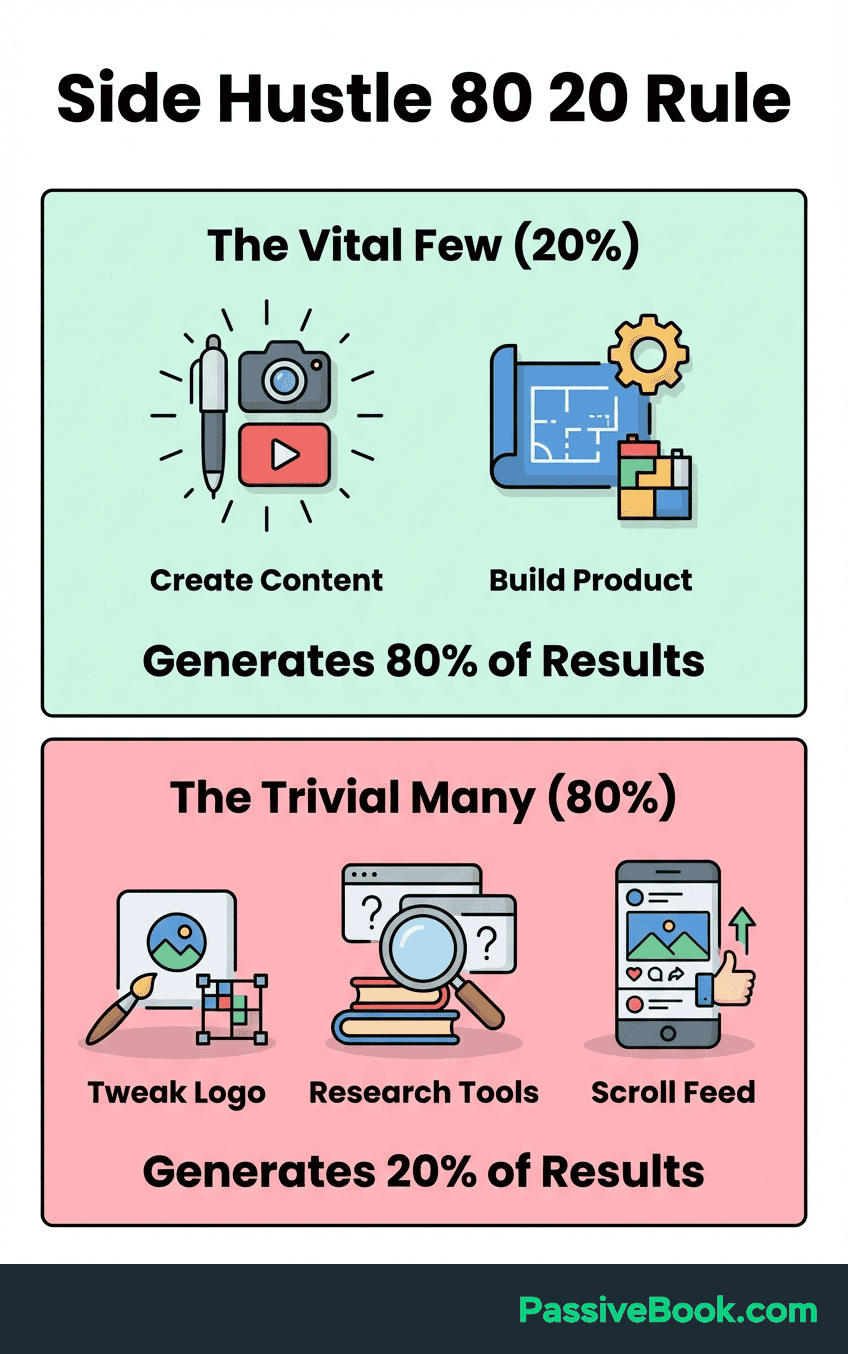
When I ran my own 80/20 audit in late 2024, I discovered three tasks consuming 40% of my week: manually cross-posting Pinterest pins, responding to generic blog comments, and tweaking old blog posts for minor SEO gains. Combined revenue impact from all three: roughly $0. I automated the Pinterest workflow with n8n, turned off comments site-wide, and stopped the endless optimization loop. I immediately recovered 15+ hours per week.
Use Streamlined Solopreneur’s free Time and Tools Audit Template to run your own 80/20 review. It identifies which tasks and subscriptions drain time and money with zero return. Most solopreneurs discover they can cut 30–40% of their weekly workload without impacting results.
This is the direct counter to hustle culture. Fewer, better-targeted hours protect personal time and accelerate the business. The person working 25 focused hours on their 20% tasks will outperform someone grinding 60 hours on diffuse busywork.
Automation and AI Tools: Let Your Business Run While You Rest
Pat Flynn runs 145+ email automations via Kit that nurture leads and deliver courses 24/7. This saves hundreds of hours per year without any manual effort. The sequences run while he sleeps, travels, or spends time with his family.
Zapier connects your tools without code. A typical workflow: new sale triggers a welcome email, which updates your CRM, which logs the transaction in a Google Sheet – all automatically.
A full AI and automation stack covering content, customer support, and workflows costs roughly $75–$150 per month, well within a bootstrapped budget.
AI tools now automate 10–40% of a solopreneur’s daily workload, reclaiming 20+ hours per week that would otherwise bleed into evenings and weekends.
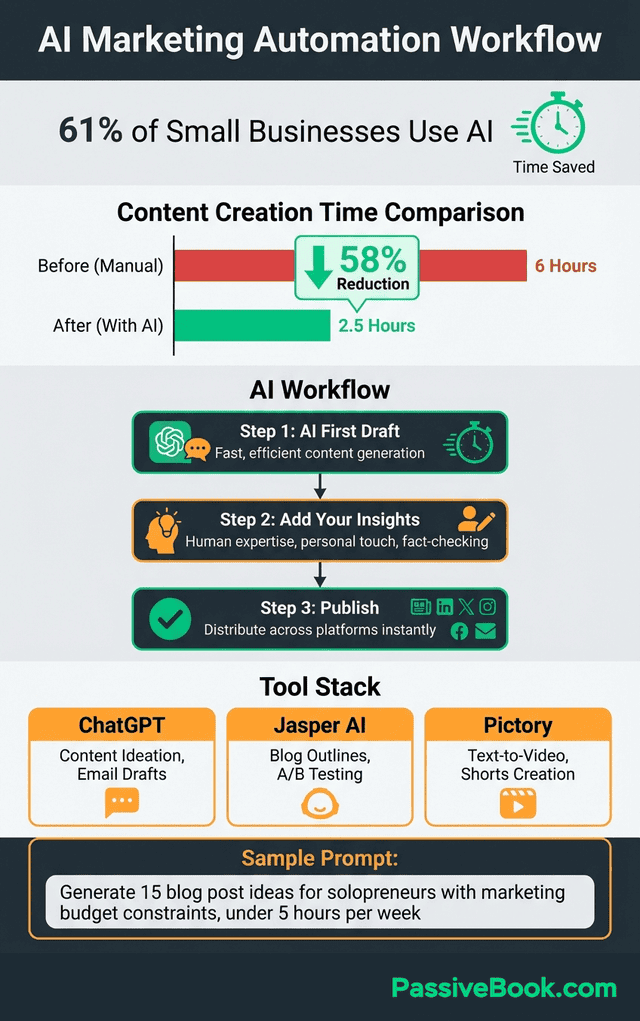
Use ChatGPT to draft email sequences, Claude to outline blog posts, or Notion AI to summarize meeting notes. Each saves 30–60 minutes per task.
Automation is not just a time-saver. It is a boundary enforcer. Your business keeps running during your protected personal hours. The alternative is manually handling every task, which guarantees work will invade your evenings.
Most solopreneurs waste the first hour of their day manually reposting content to social media. Instead, use Buffer or Hootsuite to schedule a month of posts in one sitting. That single automation reclaims up to 20+ hours per month.
Overcoming Entrepreneurial Guilt and the Hustle Culture Trap
A Sifted survey of founders found work-life balance ranked as the number two challenge for entrepreneurs. The desire to reclaim personal time is not a weakness or a generational trend. It is the majority experience. Solving it is a competitive advantage, not a compromise.
Gillian Perkins – who runs a six-figure business in 15 hours per week – attributes her sustained productivity specifically to protected personal time. “I have a dedicated home office and dedicated work hours, which means when I’m not working, I can be fully present with my family. That separation is not a luxury. It is what makes the work sustainable.”
The guilt is not evidence that you should keep working. It stems from fear, not from actual inaction.
Reframe self care and rest as business inputs that restore creative energy. Taking time off isn’t a reward – it’s a requirement for long term sustainability. Practice mindfulness during your protected personal hours: notice when work thoughts intrude, acknowledge them, and gently redirect your attention to the present moment. This strengthens the mental boundary between modes.
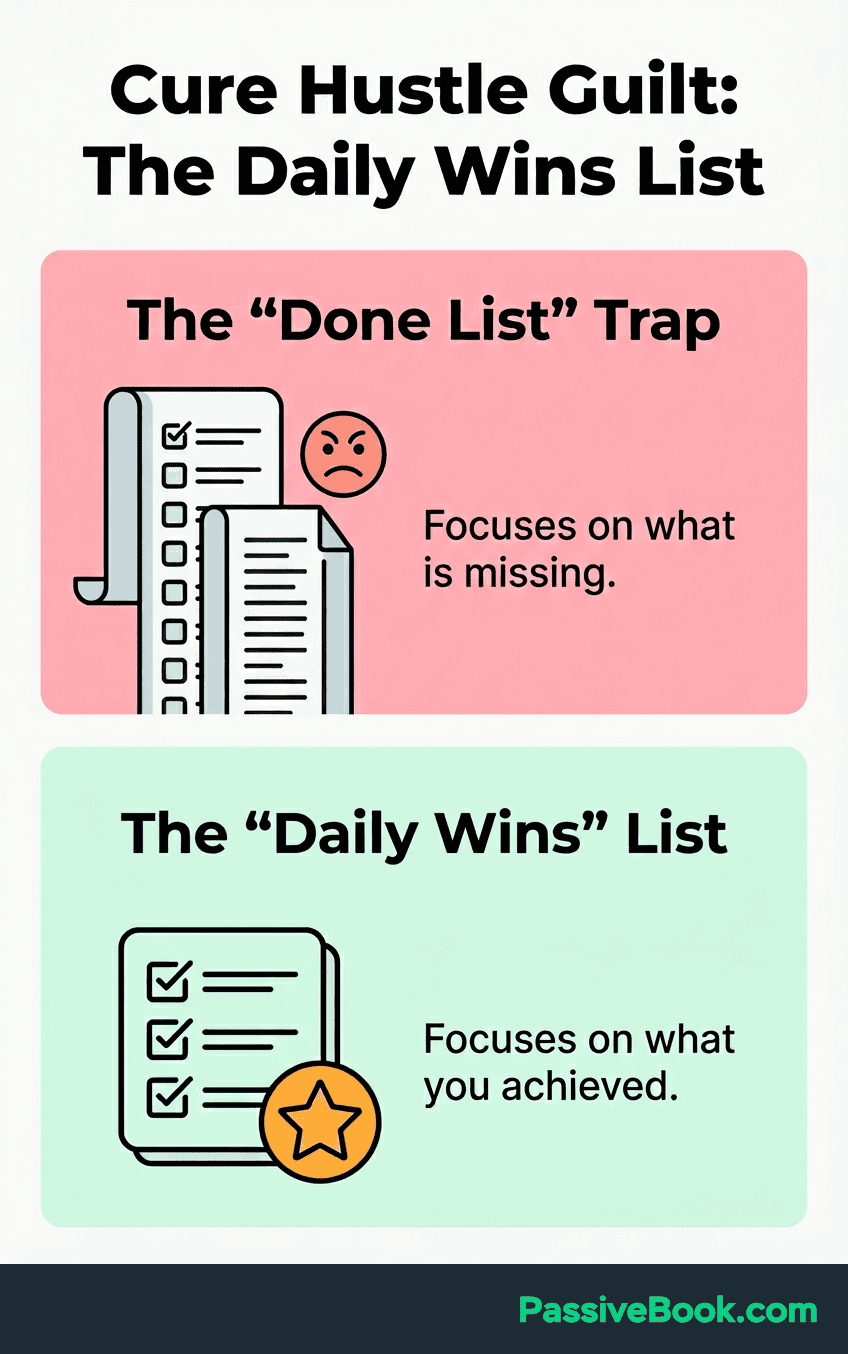
Replace the “done list” trap with a daily wins list. Reviewing what you did complete counters the irrational pull to keep working past your stop time. Write down three wins before you close the laptop. Your brain will internalize that you accomplished enough.
Frequently Asked Questions
Is It Realistic to Achieve Work-Life Balance in the Early Stages of an Online Business?
Yes, but your definition of balance must match your stage. Early-stage solopreneurs typically work 20–30 hours per week on their business alongside existing commitments.Professional personal balance does not mean equal hours; it means intentional hours with clear stop times. A parent working 6–8 AM and 9–11 PM has balance if those windows are protected and they are fully present outside them.
How Many Hours Per Week Should a Solopreneur Realistically Work?
Most sustainable solopreneurs work 15–30 hours per week on their business. Gillian Perkins runs a six-figure business in 15 hours. Pat Flynn built Smart Passive Income working evenings and weekends before quitting his day job.The goal is a healthy balance that protects your overall well being while maintaining momentum. It’s important to remember that long hours without boundaries destroy the focus that makes those hours productive.The specific number matters less than whether those hours are focused on your 20% tasks and protected by clear boundaries.
How Do I Stop Thinking About My Business During Family Time or Evenings?
Implement a shutdown ritual that captures all open loops in a trusted system. Use Cal Newport’s protocol: review tasks, write tomorrow’s priorities, close all apps, and say a closing phrase. The phrase creates a psychological bookmark. Your brain stops replaying work once it knows nothing will be forgotten.The first two weeks after implementing a shutdown ritual, I still replayed work problems at dinner. My brain didn’t trust the system yet. What helped: I kept a small notebook on the kitchen counter. Whenever a work thought intruded, I wrote it down immediately, then returned to the conversation. This externalized the thought so my brain could let it go. After two weeks, the intrusive thoughts dropped by roughly 80%. The system earned my brain’s trust.Physical anchors help: leave your workspace, close the laptop, put your phone in a drawer.
How Do I Explain Work Boundaries to Family Members Who See Me at Home All Day?
Publish your business hours explicitly and ask your household to respect them as if you were in an office. Use a physical signal: a closed door, headphones, or a specific desk.Explain that interruptions during work hours hurt your ability to finish on time, which means less personal time later. Most family members respect boundaries once they understand the trade-off.
Can I Maintain Consistent Content Output (Blogging, YouTube, Etc.) While Working Fewer Hours?
Yes, through task batching and automation. Gillian Perkins records four YouTube videos in one afternoon and writes all blog content in dedicated monthly sessions.Use AI to draft outlines, automate social sharing via Buffer, and repurpose one piece of content into multiple formats. Consistency comes from systems, not from working more hours.
What Next?
This article walked you through the systems I use to protect personal time without sacrificing business growth. You learned how to design fixed work windows, build start and shutdown rituals, automate repetitive tasks, and overcome the guilt that keeps you working past your stop time.
Building a sustainable online business requires a business strategy that protects your personal life, not sacrifices it. The solopreneurs who succeed long-term are the ones who treat rest as a business input, not a reward earned after burnout. Your next product launch, blog post, or sales call depends on your mental clarity. Protecting personal time is not selfish; it is strategic.
If you found this helpful, hit the share buttons below. Send it to a fellow solopreneur who is grinding 60-hour weeks and wondering why results are not matching effort. Drop a comment with your biggest work-life balance challenge right now. What is the one boundary you are struggling to enforce? I read every comment.
Share this post with your friends & followers: