I still remember the night I calculated my true hourly rate after six months of side hustling. Between my day job and late-night work sessions, I was earning roughly $4 per hour from my online business.
The problem wasn’t effort but how I spent those precious few hours each week. Most solopreneurs face the same brutal reality. You’re squeezing business tasks between day jobs, family commitments, and basic survival needs.
The 15 strategies below aren’t theory but battle-tested methods that transformed my scattered 10-hour weeks into focused execution blocks that actually moved metrics. Effective time management isn’t about working more hours but protecting the few you have.

- •Why Side Hustlers Fail at Time Management and How to Beat the Odds
- Choose a Sustainable Weekly Commitment
- •1. Set Artificial Deadlines Using Parkinson's Law
- •2. Identify Your Peak Performance Hours With Time Blocking
- •3. Track Every Hour for One Week
- •4. Batch Similar Tasks to Slash Context-switching Costs
- •5. Use Automation Tools to Reclaim Hours Weekly
- •6. Master the Two-minute Rule for Mental Clarity
- •7. Write Down Three Quarterly Goals
- •8. Block One 90-minute Deep Work Session Per Day
- •9. Implement the Daily Highlight Method
- •10. Outsource Your First Task at Your Buyback Rate
- •11. Automate Scheduling and Reduce Email Ping-pong
- •12. Create Decision-making Frameworks to Save Mental Energy
- •13. Say No Using the "Hell Yeah or No" Filter
- •14. Build Recovery Time to Prevent Burnout
- •15. Review Progress Weekly, Adjust Quarterly
- •Frequently Asked Questions
- •What Next?
Why Side Hustlers Fail at Time Management and How to Beat the Odds
The numbers tell a sobering story about solopreneur survival rates. Most small business owners and solopreneurs struggle with the same challenge.
85.8% of U.S. small businesses are solopreneurships, yet poor time management remains their biggest operational obstacle. When you’re the CEO, marketer, customer service rep, and content creator rolled into one person working 5-15 hours weekly, every wasted time without realizing it compounds into lost revenue.
About 20% of small businesses fail within their first year, with inadequate planning and poor time management as critical contributing factors. The side hustler’s schedule makes this worse.
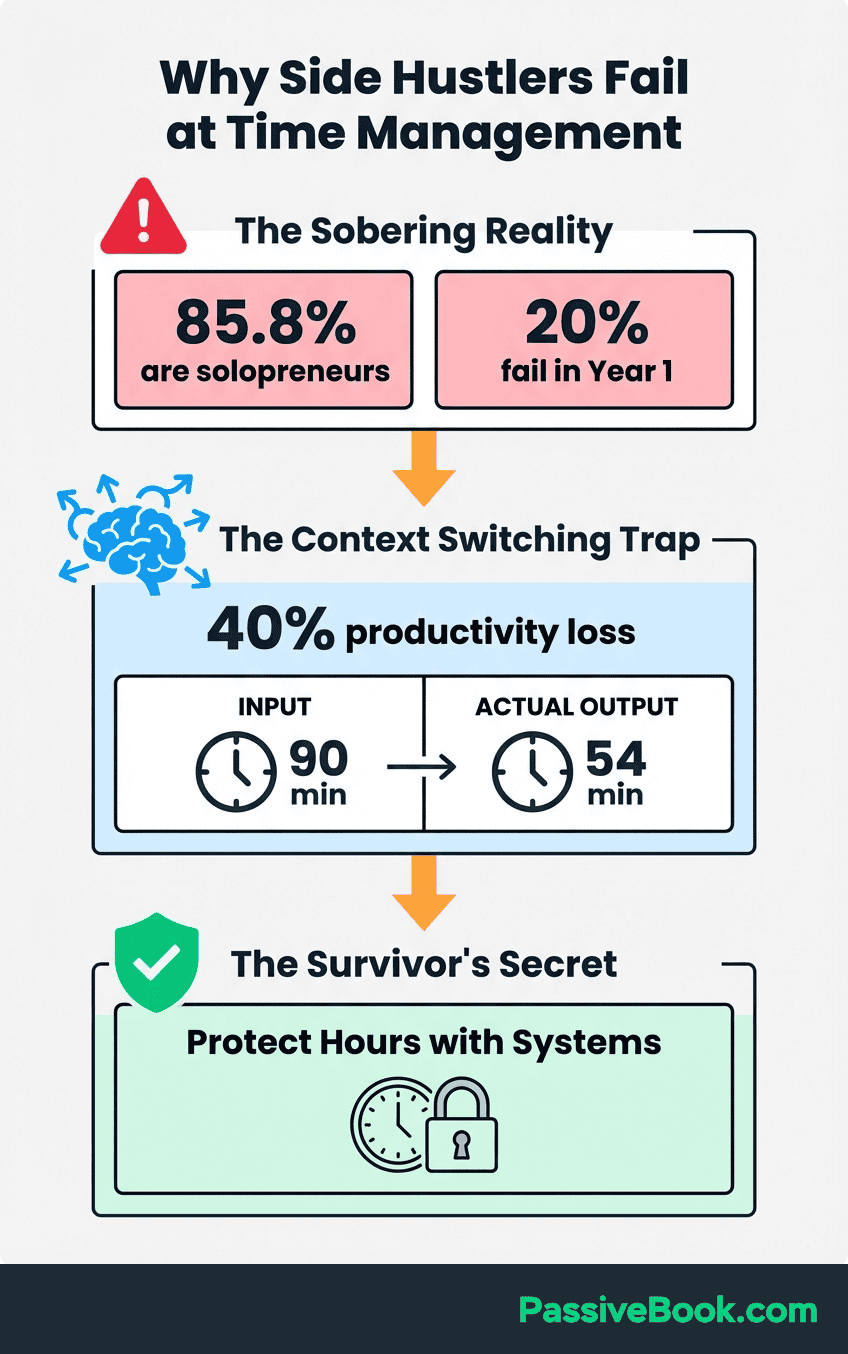
You don’t have the luxury of eight-hour workdays to recover from inefficiency. Research shows context switching reduces productivity by 40%.
When you jump from your day job to answering client emails, then to product creation, then to social media management, your brain burns energy constantly reorienting. For someone with only 90 minutes that evening, losing 40% means just 54 productive minutes.
The solopreneurs who beat these odds don’t work harder. They protect their limited hours with the systems detailed below.
Choose a Sustainable Weekly Commitment
Start with a minimum viable schedule you can maintain for four weeks: two protected 45-minute blocks, or one 90-minute block plus a short planning session. Use the time to complete a defined output, then add hours only when the baseline fits your sleep, job, and family responsibilities.
For example, an illustrative 3-hour-15-minute baseline could be:
- Tuesday evening — 45 minutes: outline or draft one defined deliverable.
- Thursday evening — 45 minutes: edit and finish that deliverable.
- Saturday morning — 90 minutes: batch the next build task or publish the finished work.
- Sunday — 15 minutes: review what shipped and schedule the next blocks.
Adjust the days to your real calendar. Pair every block with a task and completion signal so the schedule produces shipped work.
Match the workload to the model. A service that needs daytime calls is a poor fit for fixed evening blocks; asynchronous assets, content, or fixed-scope deliverables are easier to pause between sessions. Decide this before you promise turnaround times.
Use commutes and waiting periods only for safe, low-risk tasks such as recording a voice note, reviewing an outline, or answering a short message. Never work while driving. Keep a queue of tasks that fit 10–15 minutes so these small windows support your protected blocks instead of replacing them.
1. Set Artificial Deadlines Using Parkinson’s Law
Parkinson’s Law states that work expands to fill the time available for its completion. If you give yourself four weeks to launch a digital product, you’ll use all four weeks.
Give yourself one week with the same task, and you’ll find ways to finish. This principle transforms how solopreneurs approach projects.
Generous deadlines create real danger. Research shows 25% of projects fail due to overly generous timelines causing scope creep.
When you have months to complete something, you add unnecessary features and second-guess decisions that waste your limited weekly hours. Start by cutting your estimated project timeline in half.
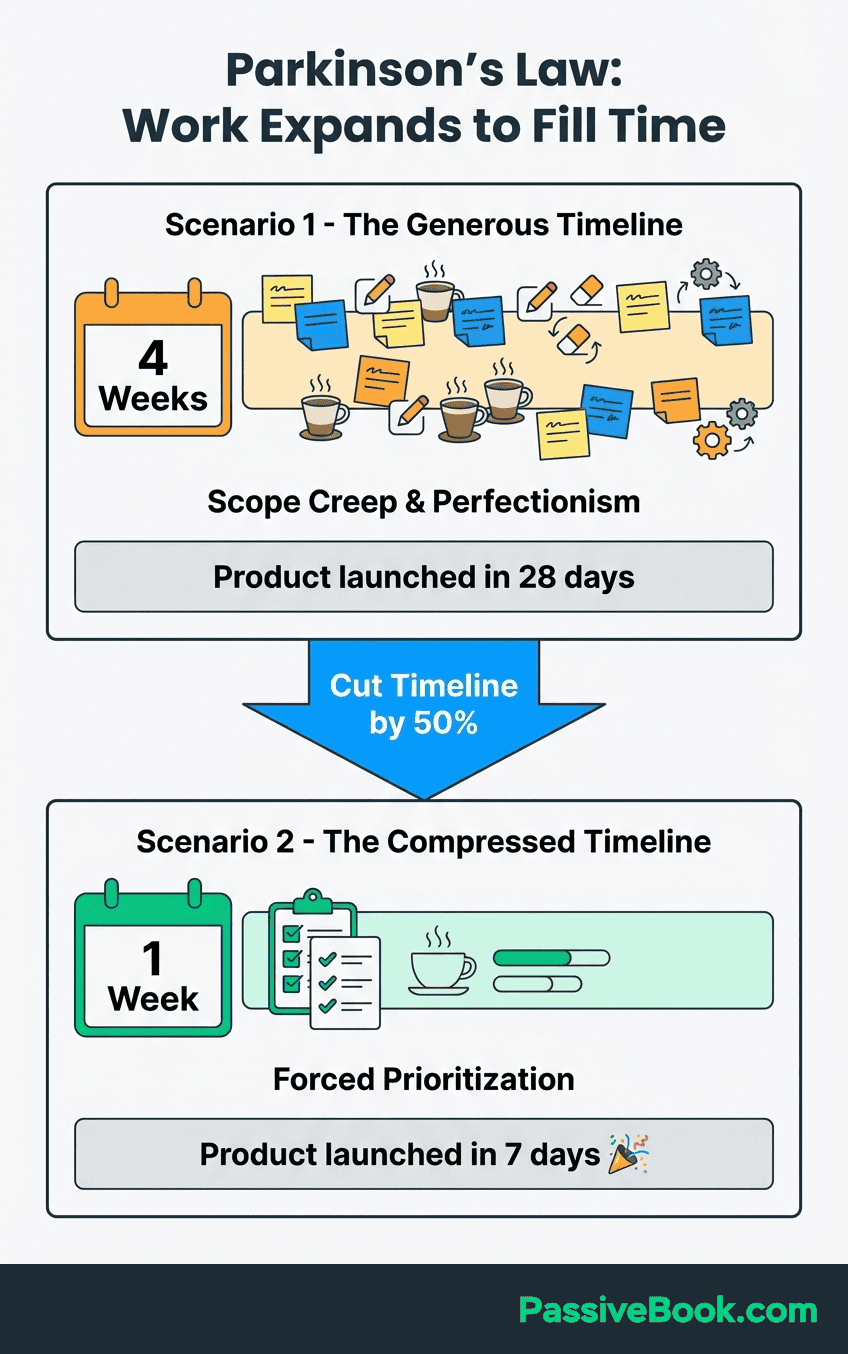
If you think designing five print-on-demand products takes two weeks, impose a one-week deadline. You’ll cut low-value activities and focus only on work that directly contributes to launch.
2. Identify Your Peak Performance Hours With Time Blocking
Time blocking improves productivity efficiency by scheduling 60-90 uninterrupted minutes daily for your highest-value work before meetings or distractions consume your energy. This isn’t optional for side hustlers with severely limited hours.
Research confirms this approach works. Recovery from interruptions takes 23 minutes on average, according to research on workplace productivity.
When you have just 90 minutes after your day job, a single interruption destroys half your productive window. Your personal biology matters more than generic advice.
Identify your peak performance window by tracking energy levels for one week. Most people experience highest mental clarity 2-3 hours after waking, but your rhythm might differ. Some solopreneurs find their sharpest focus late at night after household responsibilities end.
A solopreneur working under 3 hours daily credits time-blocking three 45-60 minute sessions around a day job as the structure enabling consistent business growth. The key isn’t total hours but protecting those specific windows from all distractions.
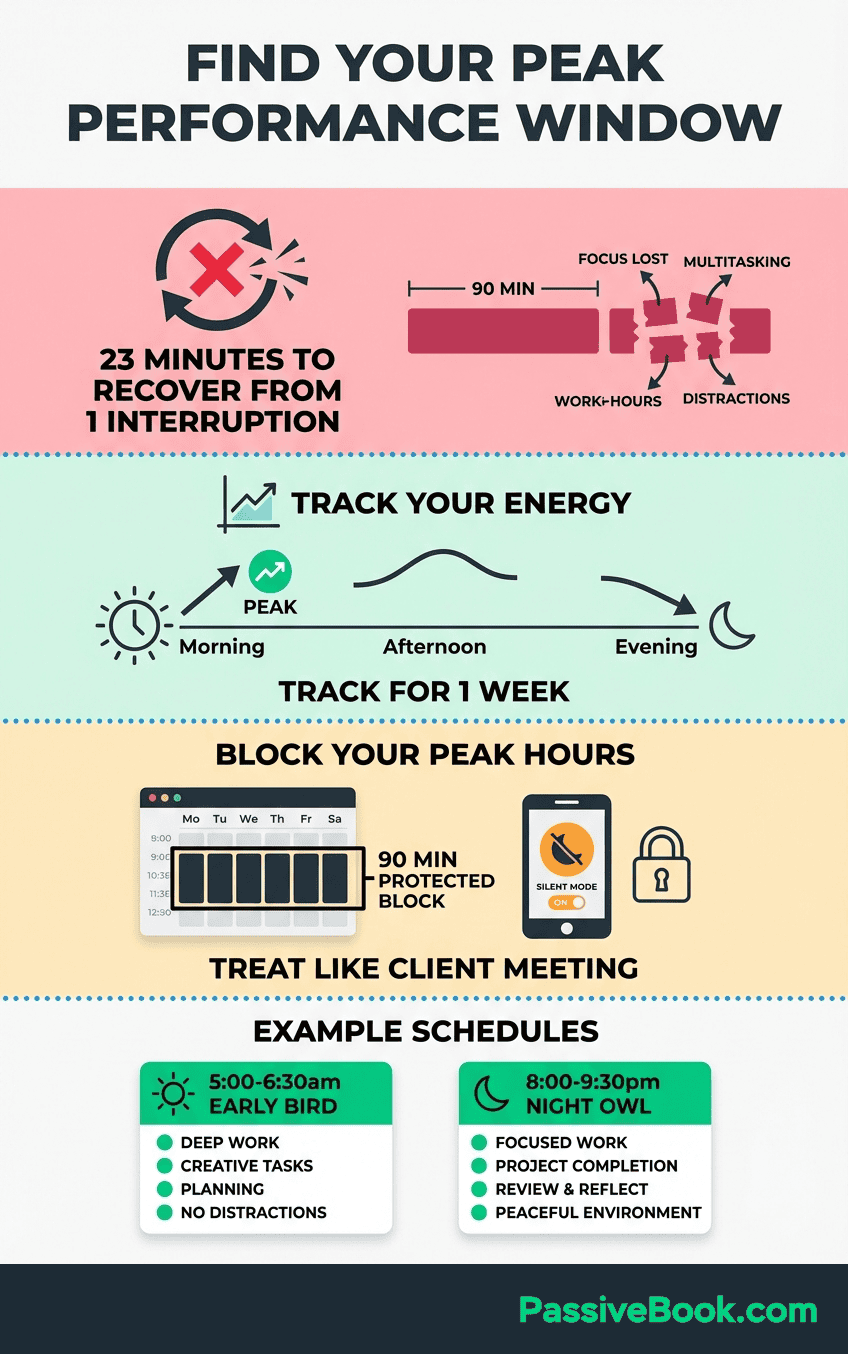
My deep work window is 5:00-6:30am, which sounds insane until you realize it’s the only 90 minutes my phone doesn’t buzz with day job emergencies. I’m not a morning person. I hate waking up early. But I hate scattered, unproductive evenings more.
Pick your poison. Treat your time blocks like client meetings you cannot reschedule. Put them on your calendar, set your phone to do-not-disturb mode, and close email completely.
The first week feels uncomfortable, but the productivity spike becomes addictive.
3. Track Every Hour for One Week
This exercise changed how I viewed my entire business. Use free tools like Toggl Track or Clockify to audit exactly where your hours go for seven days.
Results are usually humbling. You will realize that tasks took significantly longer than estimated and platform-switching consumed hidden hours weekly.
She thought product photography took 20 minutes per item but tracking revealed 35 minutes with setup and editing. I ran this audit three years ago and discovered similar gaps.
I estimated content creation at 90 minutes per blog post, but actual time including research, writing, editing, and formatting averaged 3 hours. That data forced me to either improve efficiency or adjust my content calendar to match reality.
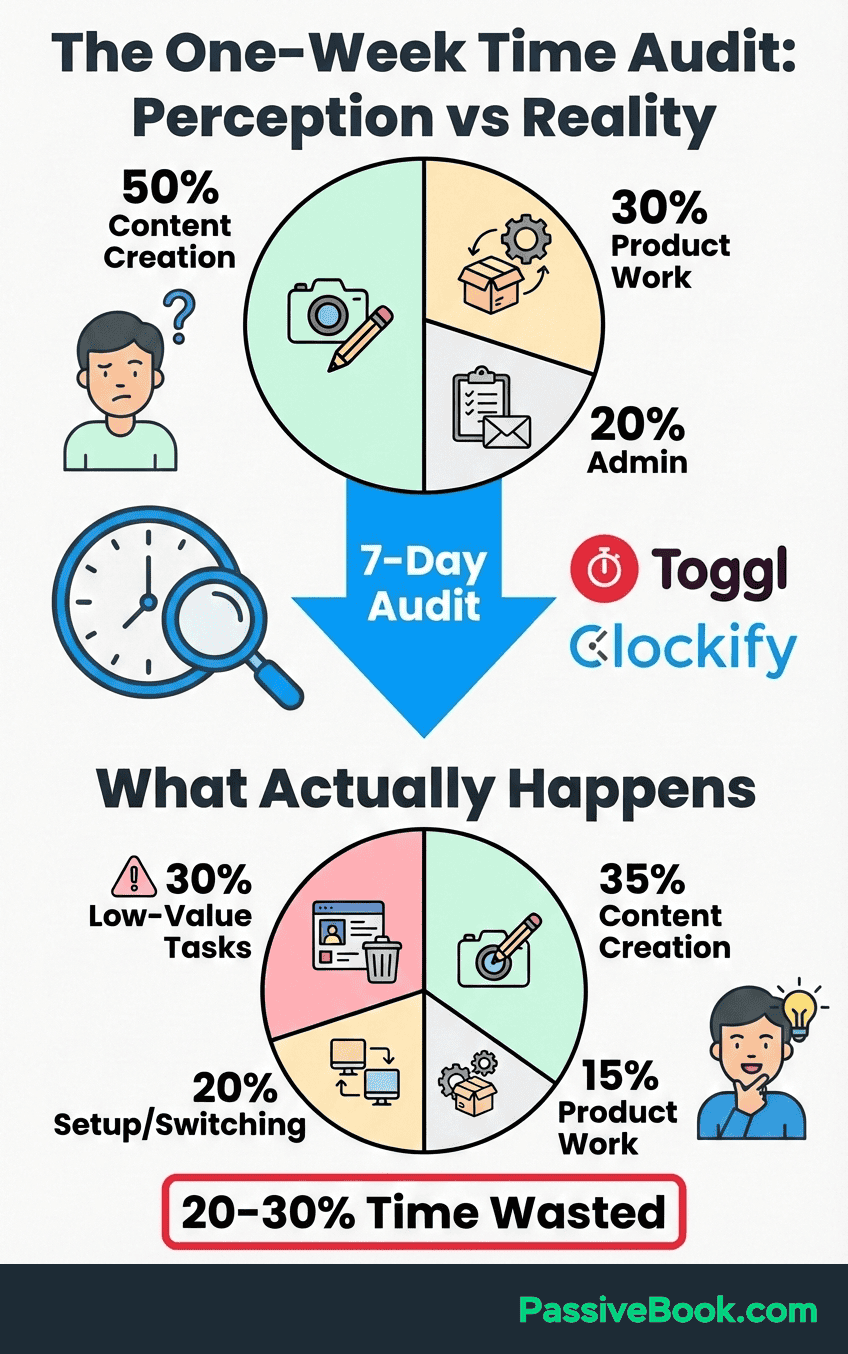
This is a one-time diagnostic exercise, not a permanent tracking system. Continuous time tracking adds overhead that defeats the purpose for solopreneurs.
Run the audit, identify the gaps between perception and reality, then build systems to address the biggest time drains. The audit reveals where you’re wasting time without realizing it.
Most solopreneurs find 20-30% of time goes to low-value activities they don’t even remember doing.
4. Batch Similar Tasks to Slash Context-switching Costs
Batching means grouping similar tasks into dedicated sessions instead of scattering them throughout your week. Design all your social media graphics on Saturday morning. Write all your email newsletter content on Tuesday evening.
Handle all customer service inquiries in one 30-minute block. Solopreneurs using batching report grouping similar tasks as a top 5 productivity strategy.
One print-on-demand creator designed 10 products in a single 3-hour Saturday session by batching design work. Previously, she designed one product per day across multiple evenings, losing momentum each time she reopened design software.
Batching can increase productivity by 30-40% by removing setup costs. When you batch content creation, you enter a creative flow state once instead of four separate times. Your brain stays in the same mode, reducing the 23-minute recovery penalty from context switching.
I learned this the expensive way when I tried designing Pinterest pins “as needed” for two months. I’d open Canva, stare at a blank canvas, make design decisions, export, upload, then close everything.
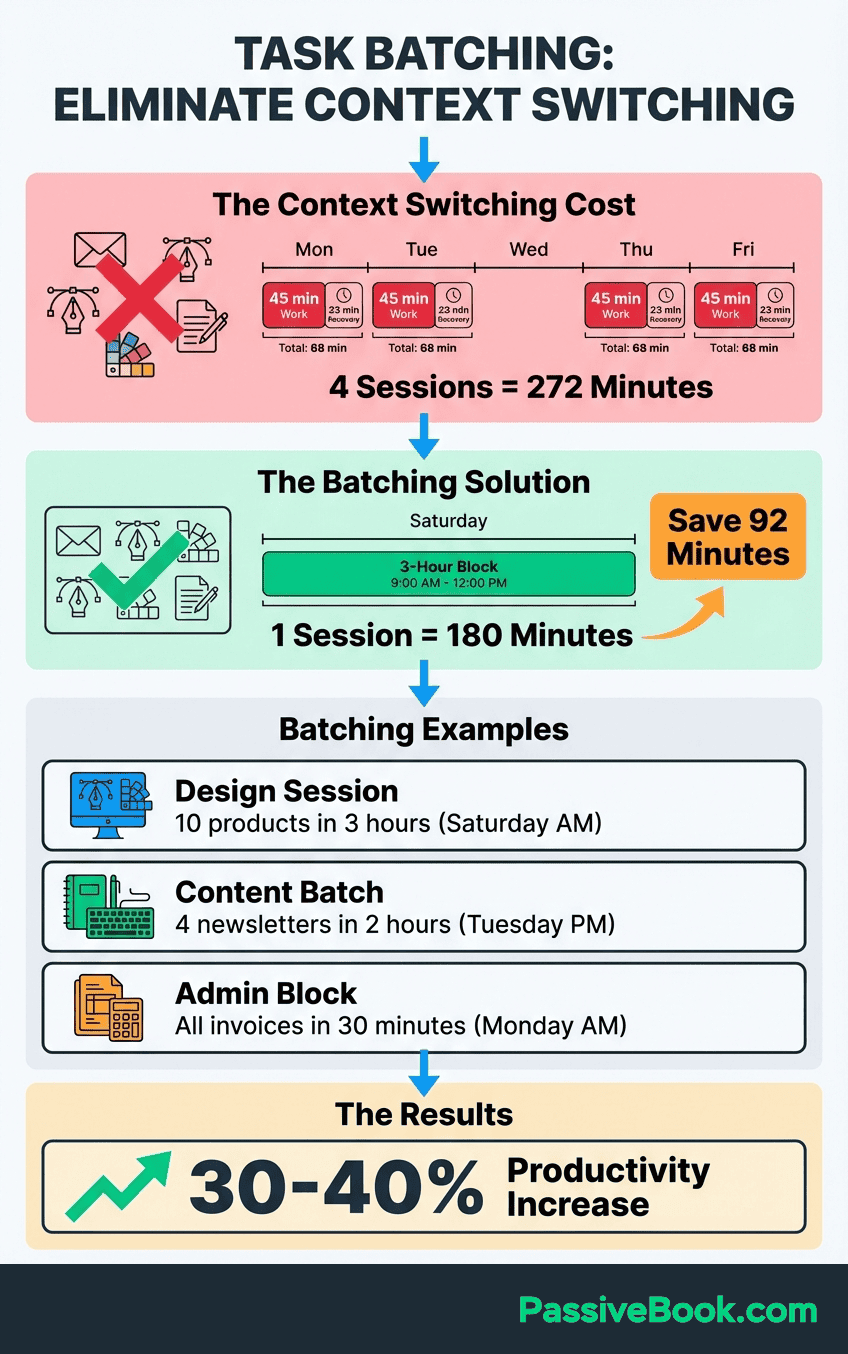
Three days later, I’d repeat the entire process. Batching forced me to make all my design decisions in one session. I went from 45 minutes per pin across the week to completing five pins in 90 minutes on Sunday mornings.
This works for administrative tasks too. Process all invoices Monday mornings. Schedule all social media posts for the week on Sunday.
Answer non-urgent emails in two daily batches instead of constantly checking your inbox. Batching also reduces decision fatigue.
When you’re in writing mode, you make all writing-related decisions at once. When you shift to design mode, you make all visual decisions together. This preserves mental energy for high-value strategic thinking.
5. Use Automation Tools to Reclaim Hours Weekly
Automation is the solopreneur’s force multiplier. Small businesses using automation save several hours per week on average through workflow automation tools. For someone with only 10 hours weekly, that’s substantial time reclaimed.
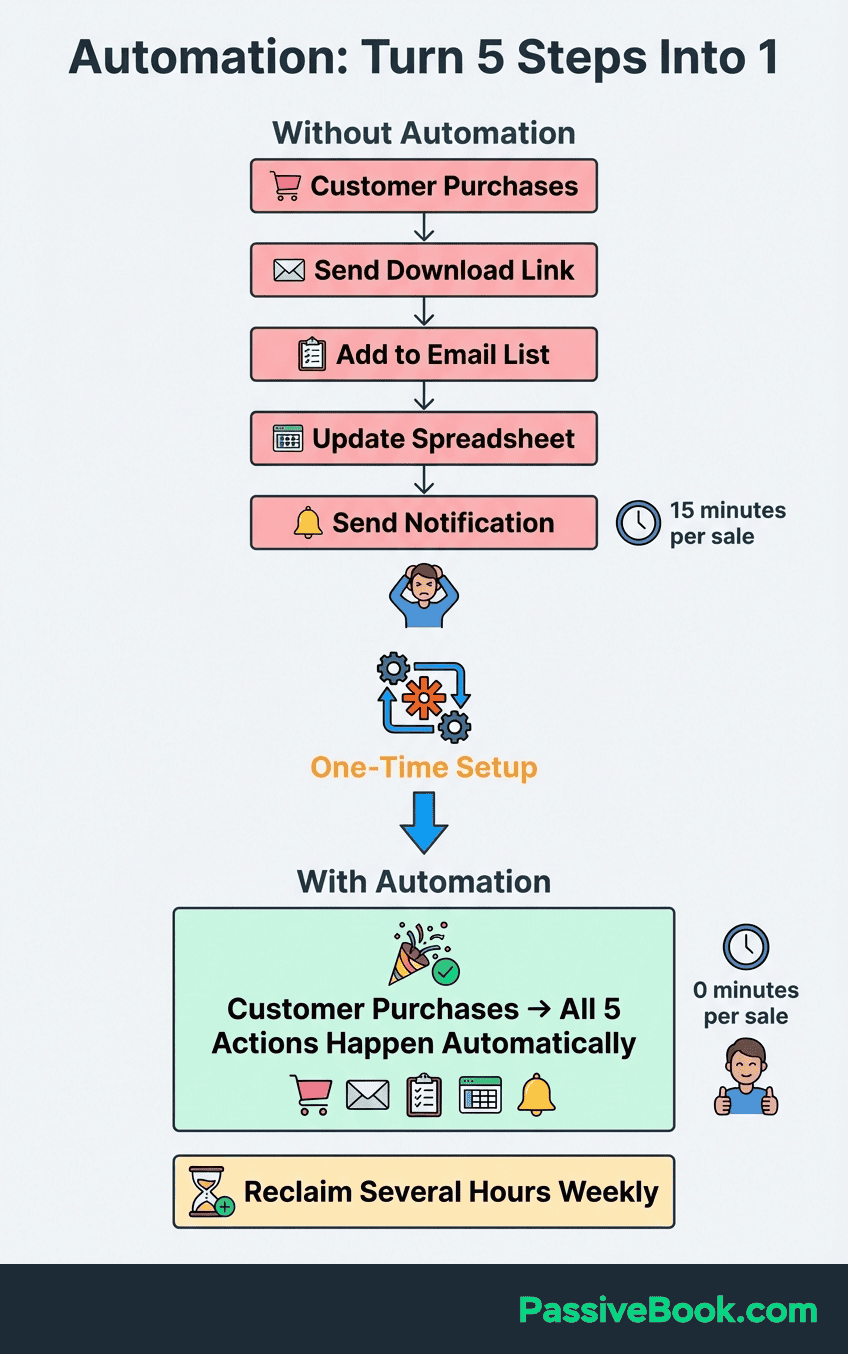
Zapier connects over 7,000 apps to automate repetitive workflows without coding skills. When someone purchases your digital product, Zapier can automatically send the download link, add them to your email list, update your spreadsheet, and notify you via Slack.
One setup replaces five manual steps. Start with the tasks you repeat most frequently.
Automate social media scheduling using Buffer or Hootsuite so you post consistently without daily manual uploads. Set up email marketing sequences in Convertkit or Mailchimp that nurture subscribers automatically. Use IFTTT to back up Instagram posts to Dropbox or save email attachments to Google Drive.
Budget reality: Zapier‘s free plan offers 100 tasks monthly, enough for most solopreneurs starting out. Convertkit has a free tier up to 1,000 subscribers. Buffer allows 3 social profiles free.
Start with these free tiers and upgrade only when you hit limits. Start budget-conscious by automating one workflow per month using free tool tiers. Each automated workflow permanently removes a task from your to do list.
Here’s your first automation to implement: When someone purchases your product through Stripe or PayPal, automatically send them to your email list via Convertkit or Mailchimp and add their info to a Google Sheet for record-keeping. This single Zapier workflow replaces three manual steps you’d otherwise do after every sale.
The goal isn’t removing all manual work but removing repetitive tasks that drain energy without advancing business goals. Automation handles routine operations while you focus on business strategy, content creation, and customer relationships.
6. Master the Two-minute Rule for Mental Clarity
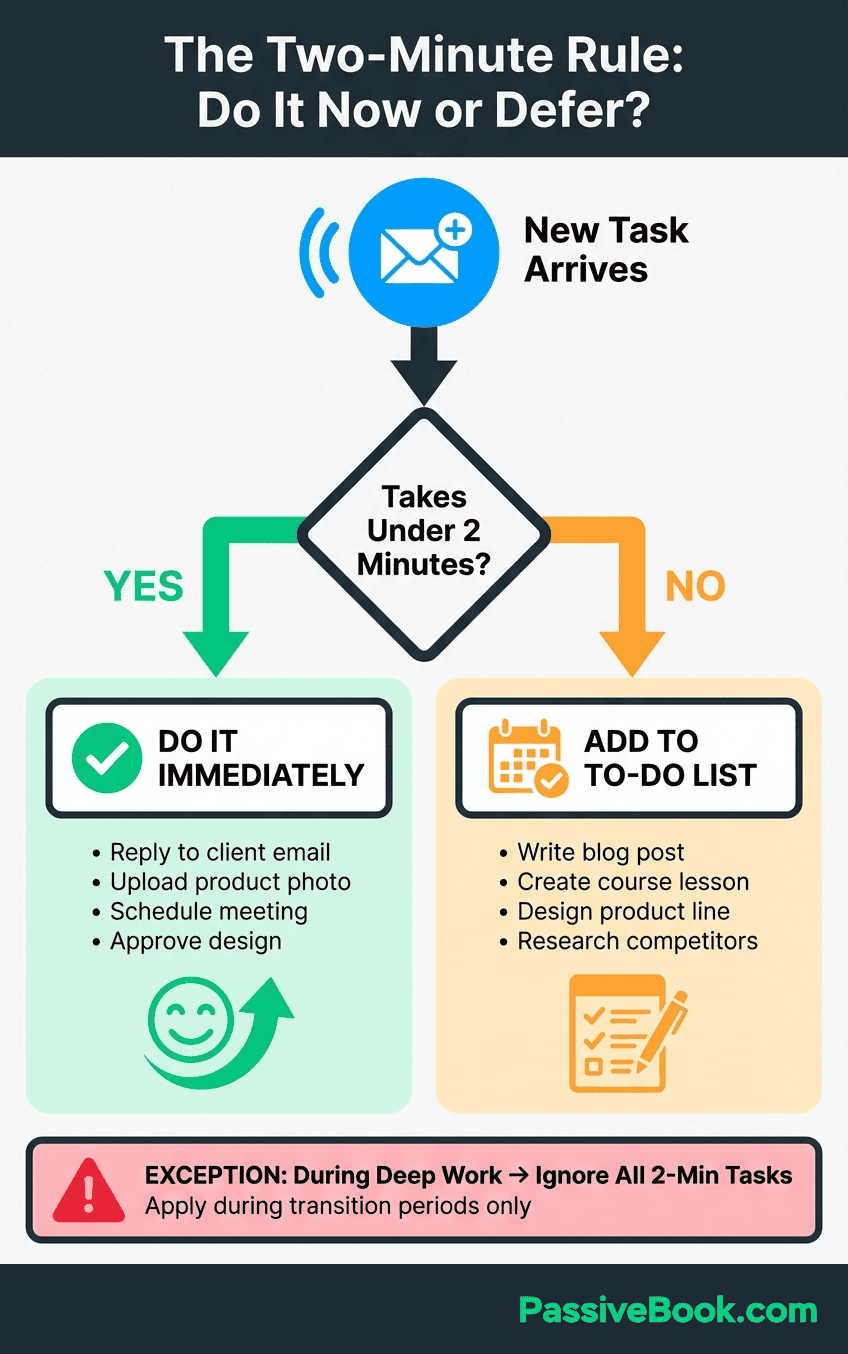
The two-minute rule from David Allen’s GTD methodology states that if a task takes under two minutes, complete it immediately instead of adding it to your to do list. This prevents small tasks from accumulating into an overwhelming backlog.
Examples include quick client responses, uploading product photos to your store, approving simple design requests, or scheduling a meeting. These micro-tasks feel insignificant individually but pile up to create mental clutter that drains focus.
The psychological benefit matters as much as time savings. Completing small tasks immediately gives you momentum and removes them from your mental load. When you constantly defer two-minute tasks, your brain expends energy remembering and tracking them.
This rule has limits for solopreneurs with limited time blocks. During your protected 90-minute deep work session, ignore all two-minute tasks to maintain focus on high-value work.
Apply the rule during transition periods between day job and business work, or while handling administrative batches. The two-minute rule removes decision fatigue. You don’t evaluate, prioritize, or schedule quick tasks. You simply complete them and move forward.
7. Write Down Three Quarterly Goals
Research shows written goals increase achievement rate by 42% compared to unwritten ones. The act of writing forces clarity and creates commitment. Written goals transform vague business strategy into concrete execution plans.
Quarterly goal cycles work better than annual planning for side hustlers. The 12-week year methodology advocates quarterly cycles because they create urgency while remaining realistic.
A year feels infinite when you’re working 10 hours weekly. Twelve weeks feels achievable. Limit yourself to three quarterly goals maximum.
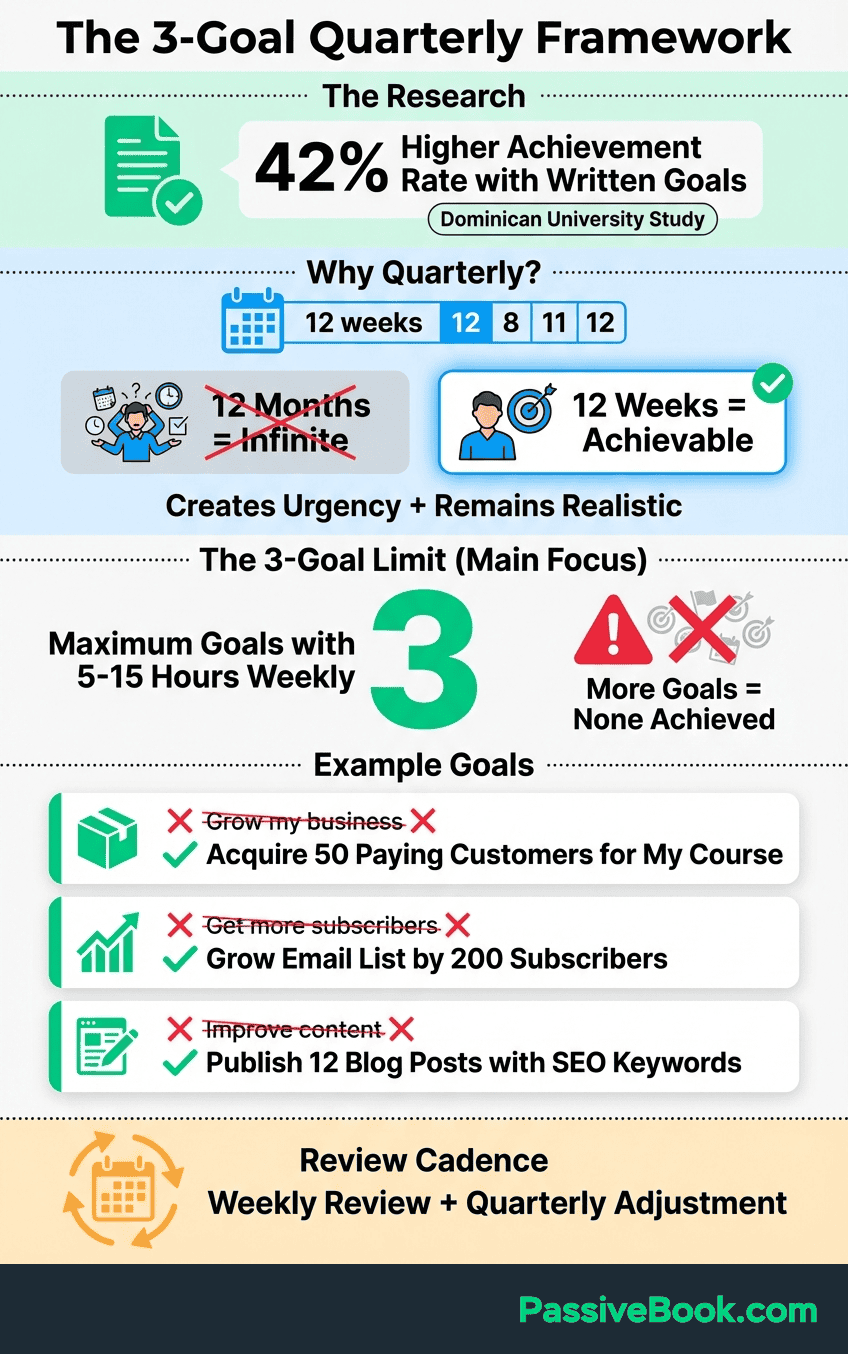
With 5-15 hours weekly, attempting more guarantees none receive adequate attention. One solopreneur might focus on launching one digital product, growing email subscribers by 200, and publishing 12 blog posts. That’s it.
Specificity matters. Don’t write “grow my business” but “acquire 50 paying customers for my course.” Don’t write “improve content” but “publish two YouTube videos monthly with timestamps and custom thumbnails.”
Vague goals don’t provide direction for your limited weekly hours. Review these three goals weekly and adjust tactics based on progress.
The quarterly timeline allows strategy shifts without abandoning goals prematurely. Most solopreneurs underestimate what’s achievable in 12 focused weeks while overestimating what happens in a scattered year.
8. Block One 90-minute Deep Work Session Per Day
Schedule one realistic 90-minute block that matches your actual available windows, not an idealized schedule you’ll never maintain. Cal Newport’s research shows deep work sessions produce highest-quality output when protected from all distractions.
Deep work means zero distractions. Phone off or in another room, email closed, single browser tab open, and family informed you’re unavailable. These sessions help you stay focused on complex work that requires unbroken attention.
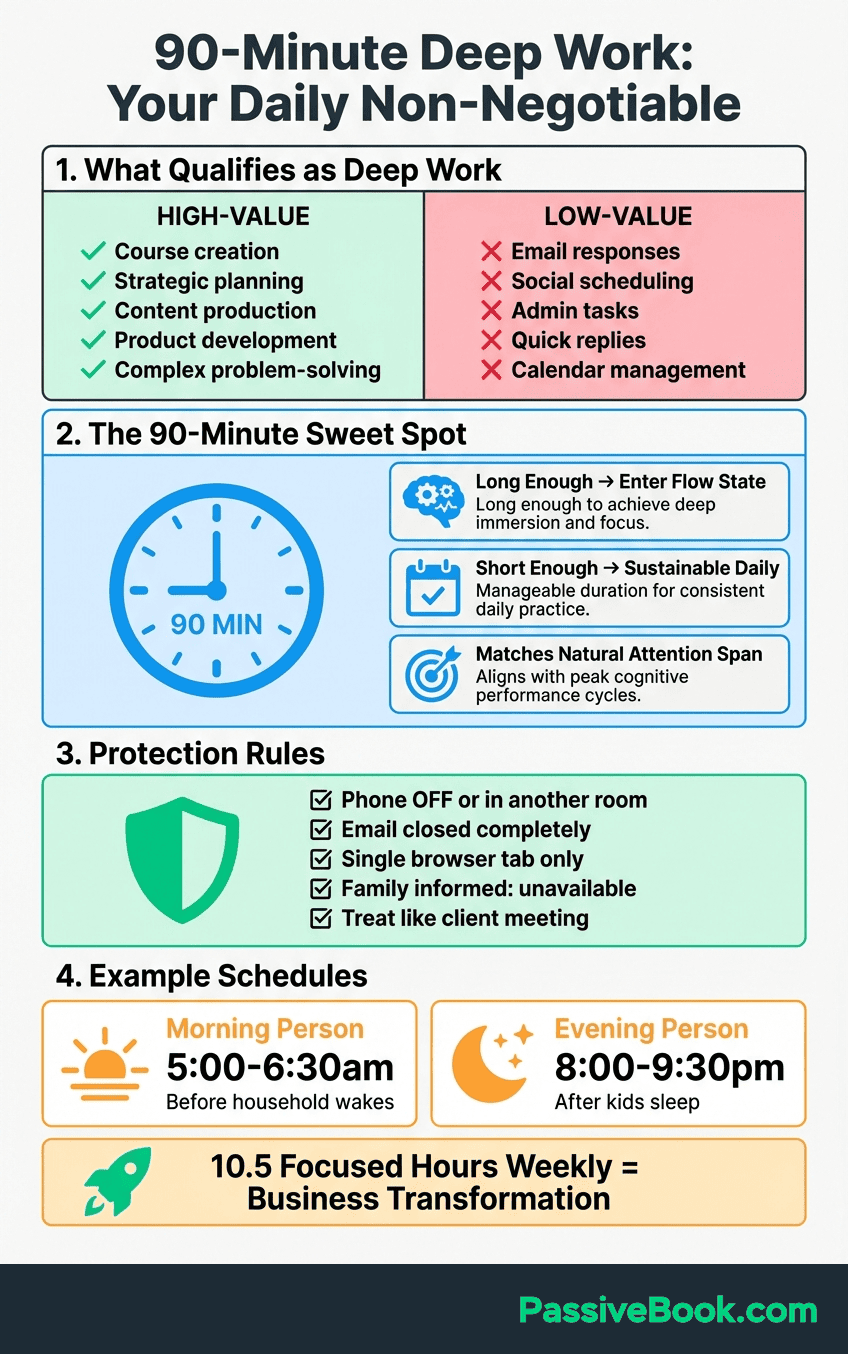
These sessions are unmovable commitments, treated with the same seriousness as client meetings. The 90-minute duration matches natural attention spans for cognitively demanding work.
Shorter sessions prevent entering flow state. Longer sessions lead to diminishing returns without adequate breaks. For solopreneurs juggling day jobs, 90 minutes is achievable without requiring superhuman discipline.
Use deep work sessions for your highest-leverage activities. Course creation, strategic planning, content production, product development, or complex problem-solving belong here. Email responses, social media scheduling, and administrative tasks do not.
Some solopreneurs find their deep work window is 5-6:30am before household obligations start. Others protect 8-9:30pm after kids sleep. The timing matters less than consistency and genuine protection from interruption.
Day job conflict: If you work from home and your employer monitors computer activity, use a separate device for your business. If that’s not feasible, protect your lunch hour or first 90 minutes after logging off.
Your day job will drain decision-making energy, so schedule deep work when you’re freshest, not after 10 hours at your desk job. Your business transforms when you protect one daily 90-minute window.
That’s 10.5 hours weekly of focused execution compared to fragmented scattered work with constant context switching.
9. Implement the Daily Highlight Method
Choose one from your important tasks to complete each day, regardless of what else happens. This single task becomes your non-negotiable daily win.
Productivity expert Tiago Forte holds that completing just one meaningful task each day puts you in the top 10% of productivity. The psychology works because you create consistent satisfaction instead of feeling perpetually behind.
Your daily highlight should advance one of your three quarterly goals. If your goal is launching a course, today’s highlight might be recording one lesson.
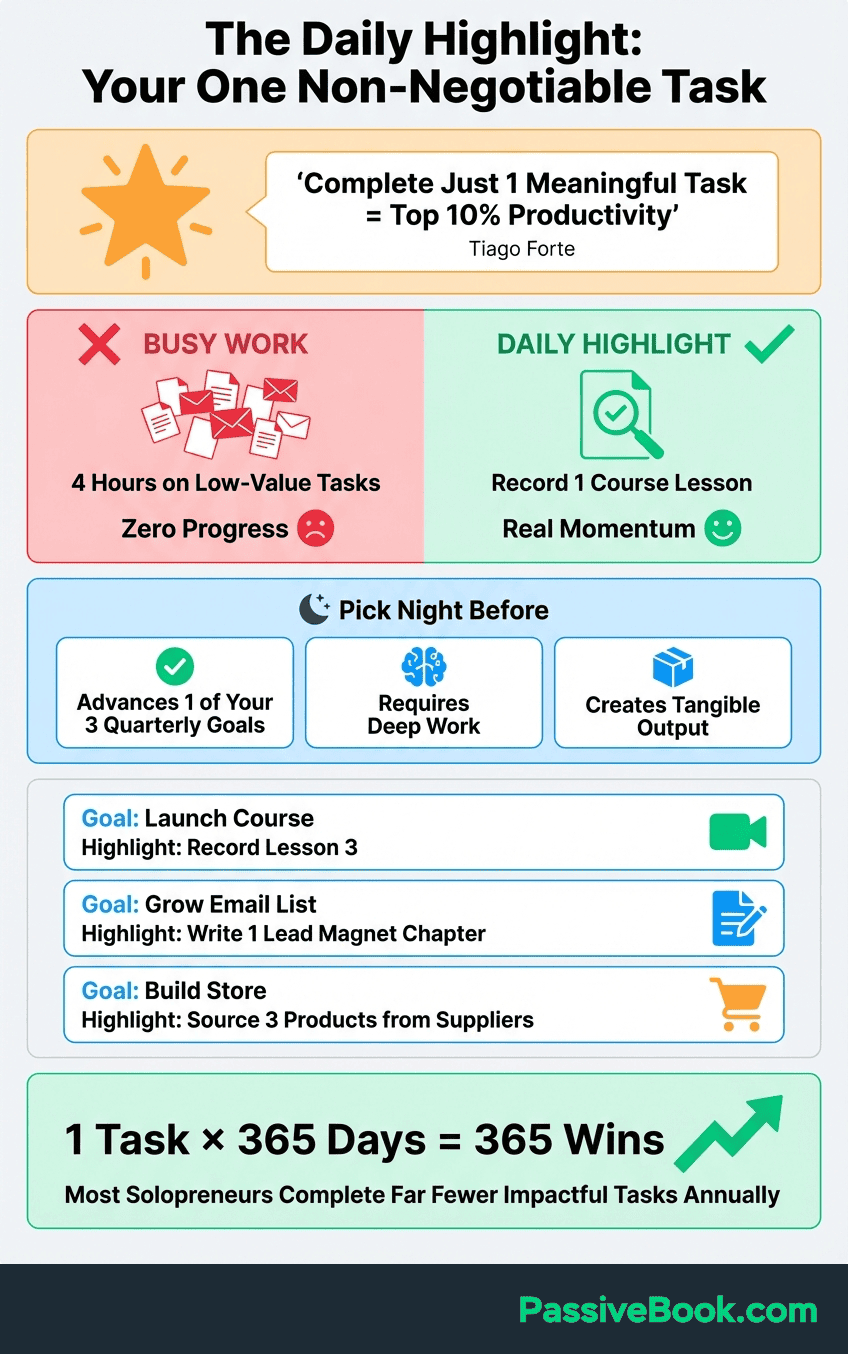
If you’re growing email subscribers, it might be writing one lead magnet chapter. If you’re building a dropshipping store, it could be sourcing products from three suppliers.
This method prevents the trap of busy work masquerading as progress. You can spend four hours on low-value tasks and feel productive while accomplishing nothing meaningful. One completed daily highlight creates actual momentum.
The compound effect is substantial. One meaningful task daily equals seven per week, 30 per month, and 365 per year. Most solopreneurs complete far fewer truly impactful tasks annually while staying perpetually busy with operational noise.
Choose your daily highlight the night before so your first work session has clear direction. Don’t start your limited hours deciding what to work on.
10. Outsource Your First Task at Your Buyback Rate
Calculate your buyback rate by dividing your annual profit by 2,000 hours in a standard work year, then dividing that result by 4 to find the rate where outsourcing becomes profitable after accounting for your time freed up for higher-value work.
If your side business generates $20,000 annual profit, your hourly value is $10. Your buyback rate is $2.50. Any task you can outsource for under $2.50 per hour makes mathematical sense.
Virtual assistants cost $10-30 per hour depending on skills and experience level. For many solopreneurs, this means outsourcing administrative tasks even before profitability if it frees hours for revenue-generating activities.
A boutique marketing agency solopreneur used virtual assistants for administrative tasks, reclaiming several hours each week for high-value strategy work. The VA handled email management, calendar scheduling, basic graphic design, and data entry for $15 per hour.
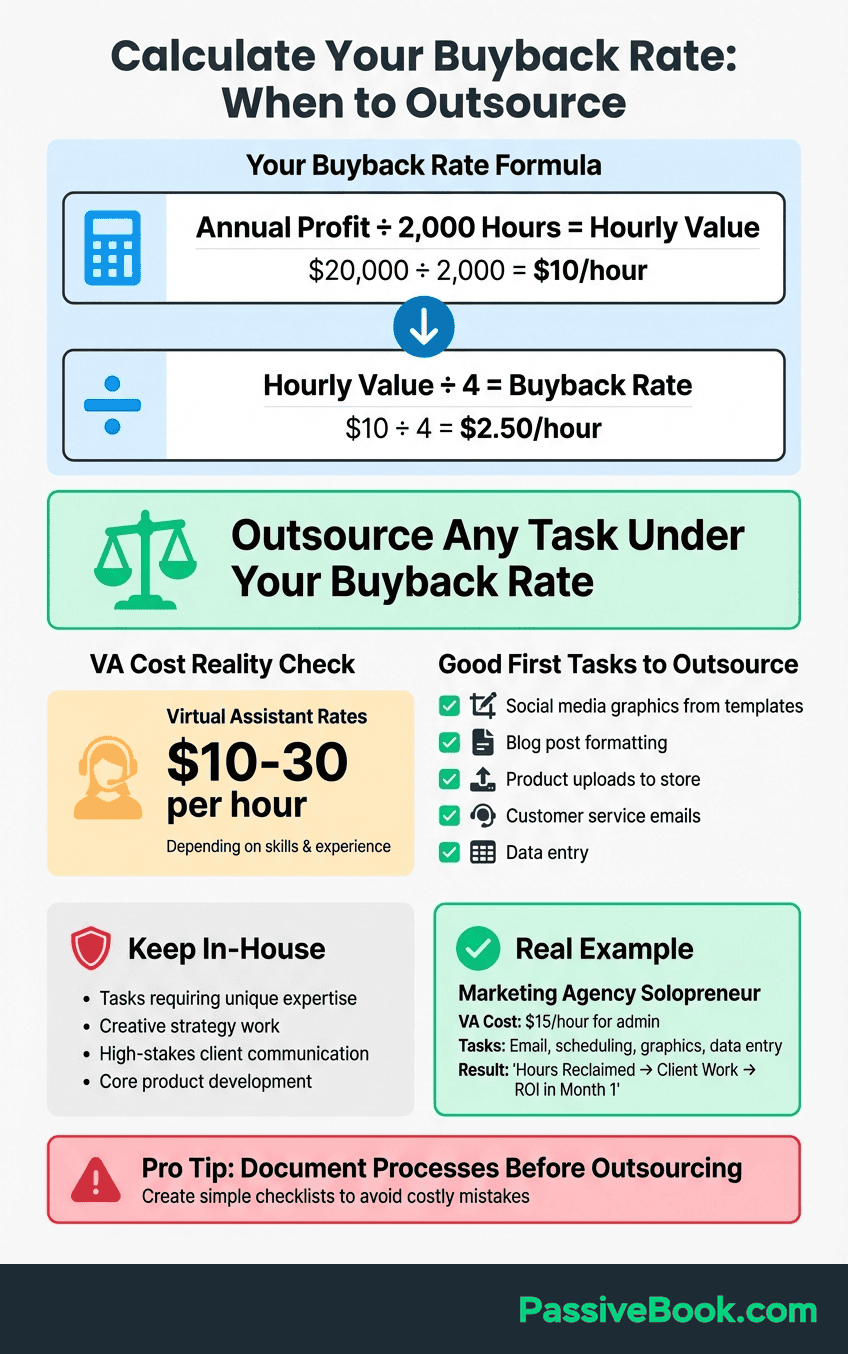
Those reclaimed hours generated enough additional client revenue to cover costs within the first month. Start by learning to delegate tasks that are repetitive and clearly defined.
Creating social media graphics from templates, formatting blog posts, uploading products to your store, or managing customer service inquiries are good candidates. Tasks requiring your unique expertise or creativity should remain in-house initially.
My first outsourcing attempt was a disaster. I hired a VA to manage Pinterest without creating templates or documentation. She uploaded 20 pins with the wrong dimensions and broken links before I noticed.
That $50 mistake taught me to document processes before outsourcing. Now I create a simple checklist for every delegated task. The mental resistance to outsourcing is often greater than the financial barrier.
Many solopreneurs feel they can’t afford help, but the real question is whether you can afford not to. Your limited weekly hours are your scarcest resource.
11. Automate Scheduling and Reduce Email Ping-pong
Before you hire a VA, automate the easiest wins yourself. Use Calendly or Cal.com to remove back-and-forth booking emails that waste your limited hours. These time management tools sync with your calendar and let clients or collaborators book available time slots directly.
Business coach Mel Larsen saves 30-60 minutes daily using Calendly to simplify scheduling. She removed the back-and-forth emails asking about availability, proposing times, handling conflicts, and confirming meetings.
Clients simply book open slots matching their preferences. For client-based businesses like coaching, consulting, or freelancing, meeting coordination consumes 3-5 hours monthly.
That’s 7-12% of a 10-hour weekly side hustle budget. Automation removes this overhead completely at zero ongoing cost using free tool tiers.
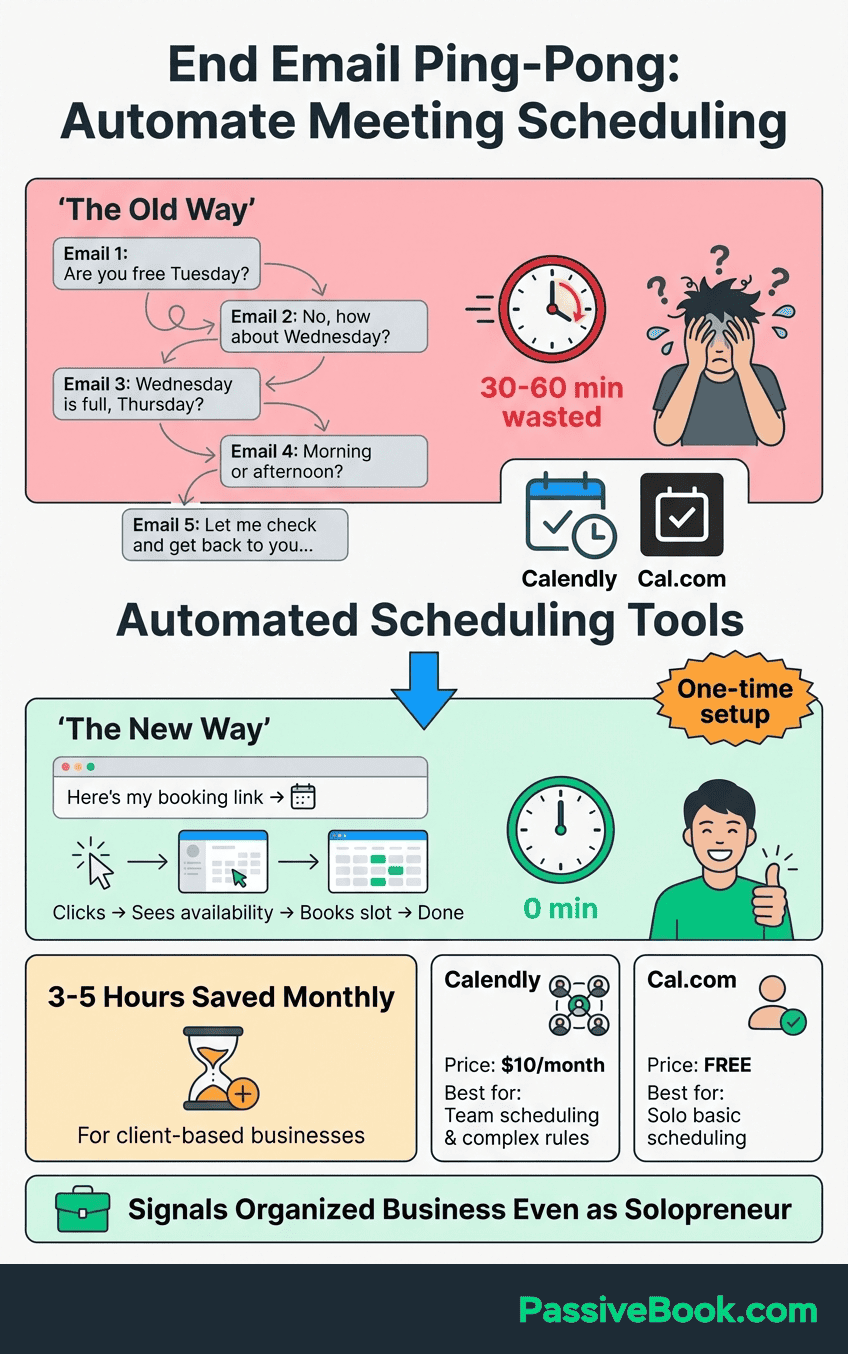
Choose Calendly if you need team scheduling or complex availability rules at $10 per month. Choose Cal.com if you want free open-source scheduling with basic features. Both remove email ping-pong equally well for solopreneur use cases.
Set up your availability template once to reflect realistic windows around your day job. Block out your deep work sessions and personal commitments. Let the tool handle the rest.
You can even embed booking links in email signatures or website contact pages. Professional impression matters too.
Automated scheduling signals you value time and run an organized business, even as a solopreneur. It removes the amateur perception of manually coordinating every call.
12. Create Decision-making Frameworks to Save Mental Energy
Research on decision fatigue shows willpower depletes throughout the day, making later choices progressively worse. Every decision you make drains the same mental energy required for creative work and strategic thinking.
Build simple if-then rules for recurring situations. For pricing: “If a project requires under 5 hours, charge my standard rate. If over 5 hours, add 20% for project management.”
For client acceptance: “If the project doesn’t align with at least two of my three quarterly goals, decline regardless of pay.” For meetings: “If the agenda isn’t clear or meeting could be an email, suggest async communication.”
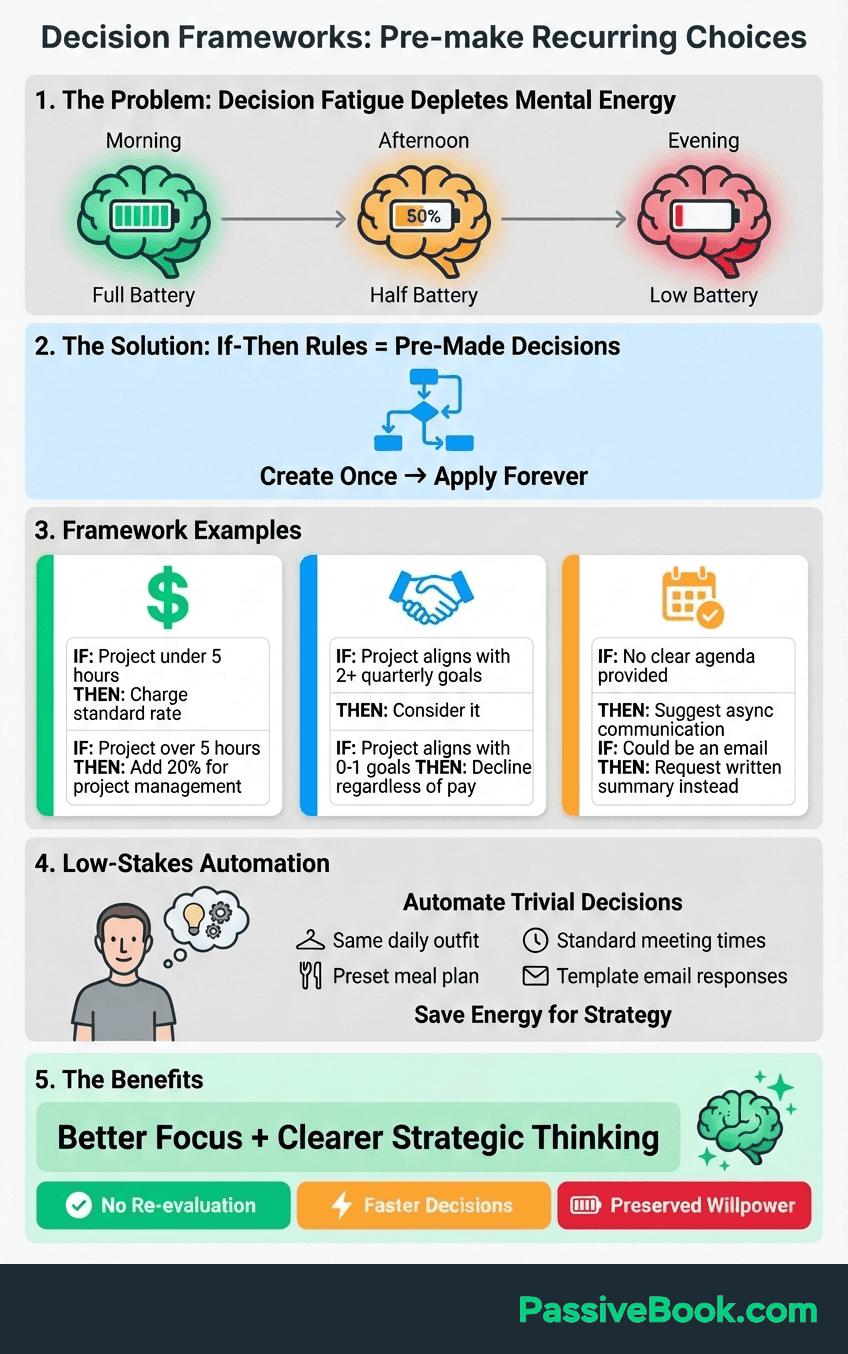
These frameworks remove the need to evaluate every situation from scratch. You’ve already made the decision when creating the rule. Now you simply apply it.
Automate low-stakes decisions with preset criteria to preserve mental energy for strategy. Successful solopreneurs often adopt similar principles as executives like Mark Zuckerberg, who wears identical clothing daily to avoid trivial wardrobe decisions.
The time savings seem small per decision, but the mental energy preservation compounds. After implementing frameworks, you’ll notice better focus during deep work sessions and clearer strategic thinking during planning.
13. Say No Using the “Hell Yeah or No” Filter
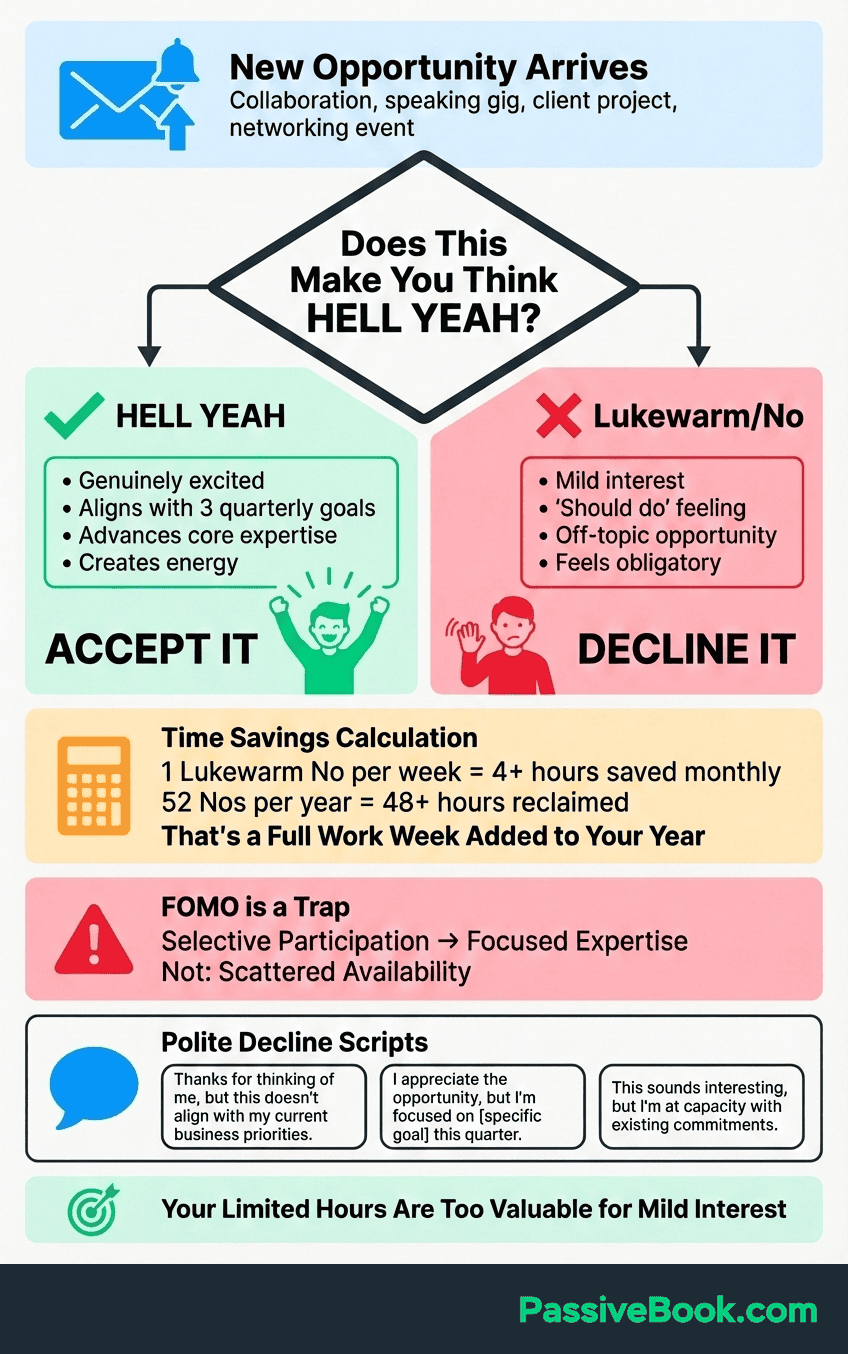
Derek Sivers advocates the “Hell Yeah or No” principle: if you’re not feeling enthusiastic about an opportunity, decline it. Lukewarm yeses accumulate into calendar bloat that drains energy without providing value.
Declining just one lukewarm commitment weekly protects 4+ hours monthly for high-value work aligned with your quarterly business goals. Those recovered hours compound into 48+ hours annually, giving you an entire work week to your side hustle schedule.
This filter applies to networking events, collaboration requests, client projects outside your focus, speaking opportunities, and even social obligations that masquerade as business development. If the opportunity doesn’t make you think “hell yeah, I want to do this,” the answer is no.
FOMO or fear of missing out hits solopreneurs especially hard. You worry declining opportunities closes doors or damages relationships. In reality, selective participation builds a reputation for focused expertise rather than scattered availability.
Last year someone offered me $500 to write a sponsored post about a tool I’d never used. The money would’ve helped, but the topic had zero connection to my content strategy.
I declined. That decision felt terrible for exactly 24 hours. Six months later, I can’t even remember what the tool was, but I can see the traffic gains from staying focused on my core topics.
Practice responses for common situations. “Thanks for thinking of me, but this doesn’t align with my current business priorities” works for most professional requests. You don’t need elaborate explanations.
Brief, polite refusals preserve relationships without overcommitting. Your limited hours are too valuable to spend on opportunities that generate mild interest. Reserve time for projects that genuinely excite you and advance your three quarterly goals.
14. Build Recovery Time to Prevent Burnout
Maintaining work life balance prevents burnout. Nearly 30% of entrepreneurs report high stress levels that negatively impact both business performance and physical mental health.
The side hustler’s schedule makes burnout especially dangerous because you’re compressing business work into already limited discretionary hours. Schedule one full day off weekly for genuine rest, not catching up on neglected tasks.
This means no email checking, no quick product updates, and no business-related social media. Complete disconnection allows your brain to recover. Solopreneurs who schedule one full weekly rest day and use walking breaks to transition between day jobs and evening business sessions report sustained energy over months and years.
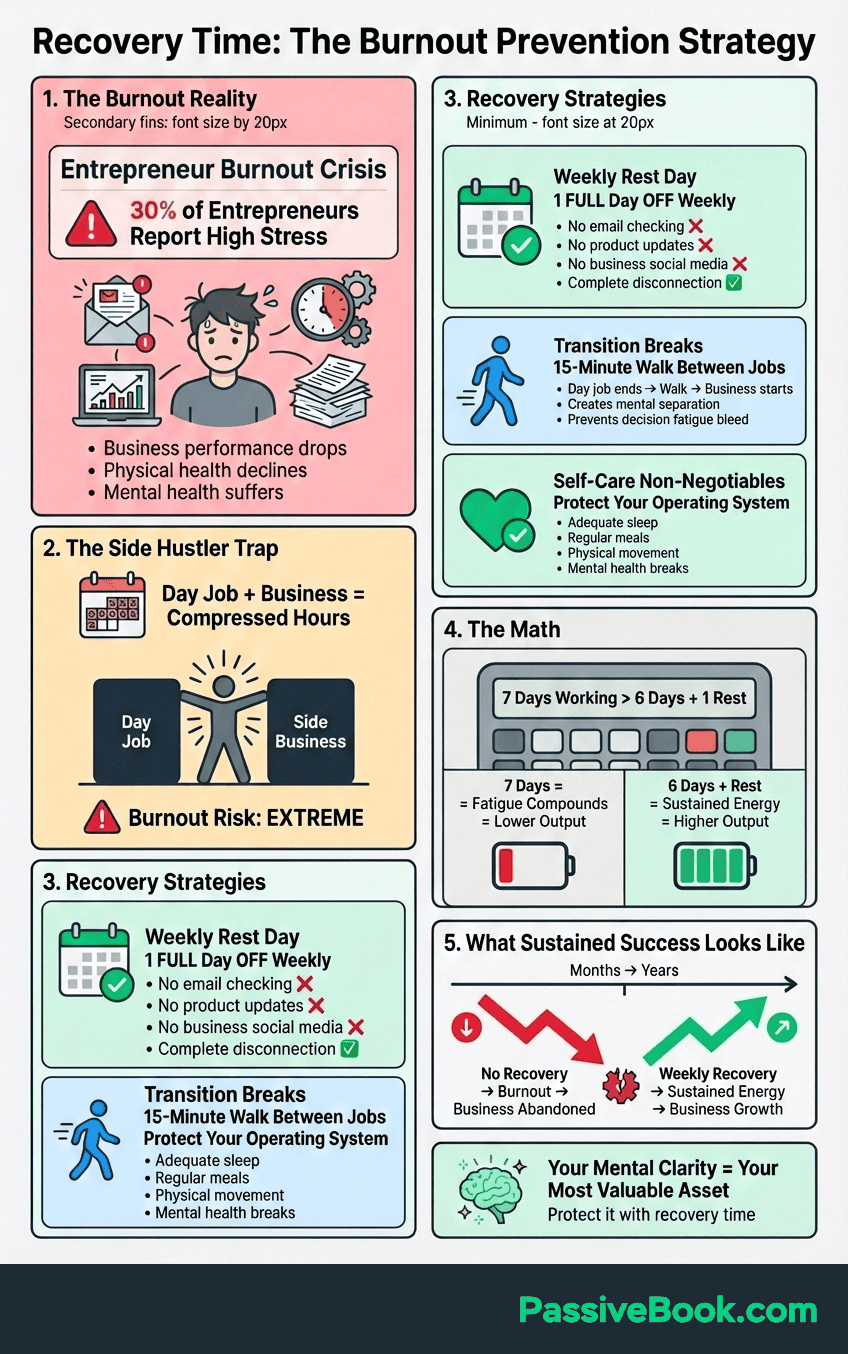
They avoid the burnout cycle where many solopreneurs abandon viable businesses not due to market failure but personal exhaustion. Physical movement between work contexts helps.
A 15-minute walk after your day job before starting business work creates mental separation. The break prevents decision fatigue from one role bleeding into the other.
Self-care isn’t a luxury but operational necessity. You can’t sustain quality output on perpetual empty. Regular breaks, adequate sleep, and genuine recovery time protect your most valuable asset: the mental clarity required for strategic decisions and creative problem-solving.
Working seven days weekly produces less output than working six days with one dedicated recovery day. Fatigue compounds faster than output.
15. Review Progress Weekly, Adjust Quarterly
David Allen’s Getting Things Done weekly review is the critical habit for maintaining system integrity and ensuring your limited hours drive actual progress toward goals. These time management skills compound through consistent practice.
Spend 10 minutes every Sunday conducting a strategic review. Clear your email inbox to zero, assess project progress against your three quarterly goals, and plan next week’s Daily Highlights.
This weekly checkpoint prevents drift where you stay busy without accomplishing meaningful outcomes. Weekly reviews help you stay organized despite chaotic schedules.
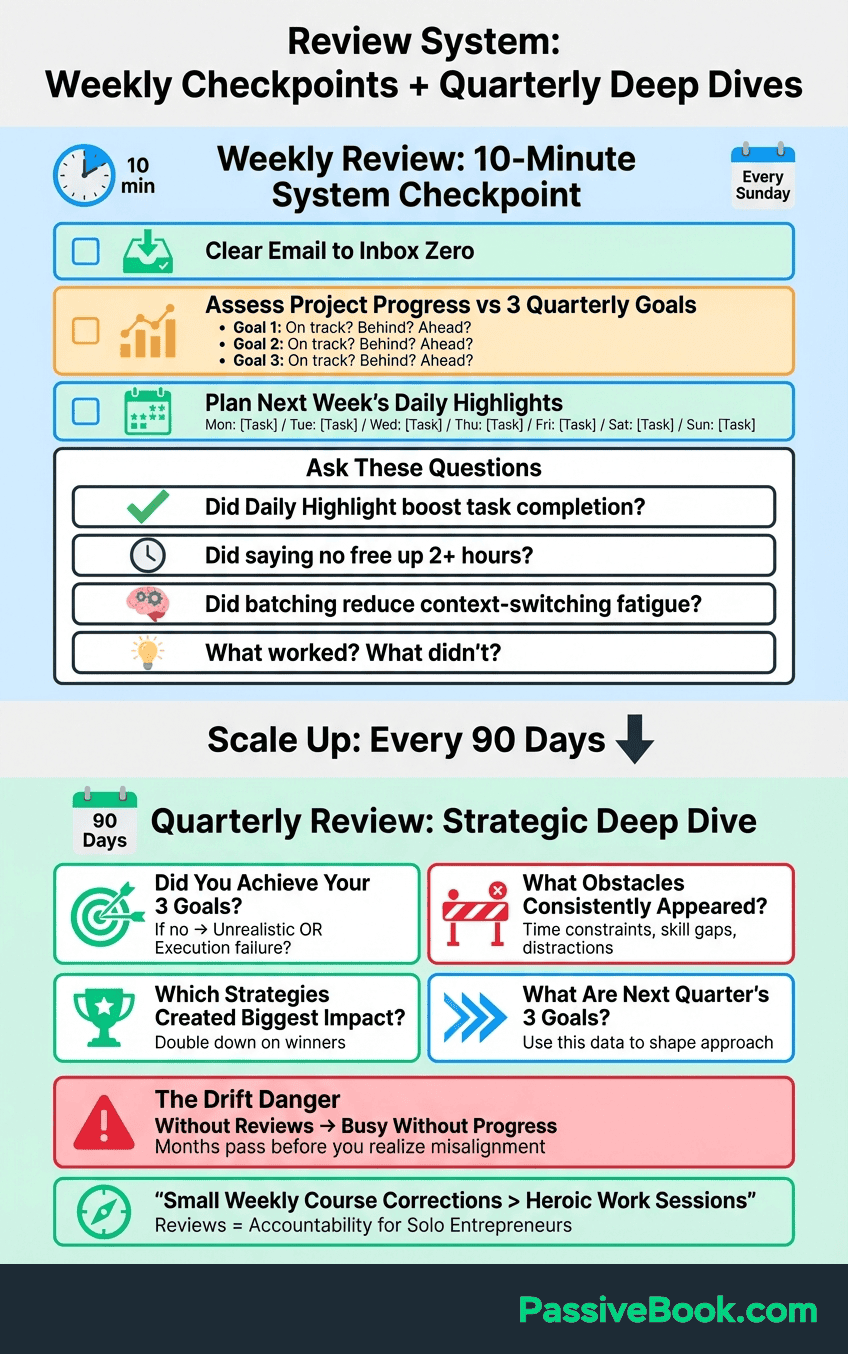
Ask specific questions during your review. Did your Daily Highlight approach boost productivity through increased task completion rates? Did saying no to lukewarm commitments free up 2+ hours? Did batching similar tasks reduce context-switching fatigue?
Use this data to double down on tactics producing results and drop those that don’t. The consistency challenge: Solopreneurs fail not from bad strategy but from abandoning good strategy too early.
Your weekly review creates accountability when you work alone. If you miss a weekly review, you’ll drift for weeks before realizing you’ve been busy without progress.
Quarterly reviews require deeper analysis. Did you achieve your three goals? If not, were they unrealistic for your available hours, or did execution fail?
What obstacles consistently appeared? Which productivity strategies created the biggest impact? This information shapes your next quarter’s goals and approach.
The review habit creates accountability even when you work solo. Without scheduled evaluation, solopreneurs often realize months later they’ve been executing tactics disconnected from strategic goals. The weekly review ensures your limited hours compound toward meaningful outcomes instead of dissipating across random activities.
Most successful solopreneurs credit consistent review habits, not heroic work sessions, as the key differentiator. Small weekly course corrections prevent months of misdirected effort.
Frequently Asked Questions
What Are the 5 P’s of Time Management?
The 5 P’s of time management are Prioritization, Planning, Productivity, Perseverance, and Patience. For solopreneurs with limited hours, prioritization matters most because you literally cannot do everything competing for your attention.Plan your three quarterly goals, protect your productivity during 90-minute deep work blocks, persevere through the messy middle when progress feels slow, and practice patience knowing compound effects take months to materialize.
How to Manage Time as an Entrepreneur?
To effectively manage time as an entrepreneur, protect your highest-value hours through time blocking and cut context switching via task batching. Automate repetitive workflows that don’t require your unique expertise.Track where your hours actually go for one week to identify gaps between perception and reality. Most entrepreneurs discover 20-30% of time disappears into low-value activities they don’t remember doing, creating immediate opportunities for improvement.
How Do I Find Time for My Side Business When I Work Full-Time?
Protect your chronotype’s peak energy window. If you’re sharpest in early morning, wake up 90 minutes before your day job starts. If evenings work better, block 8-9:30pm after dinner.The key isn’t finding time but protecting the 5-15 hours you have from interruptions. One focused 90-minute block produces more than three scattered 30-minute sessions with constant context switching.Track your energy for one week to identify your peak window, then treat it like an unmovable client meeting.
What Are the 5 Tips in Effective Time Management?
Five tips for effective time management include identifying your peak performance hours for deep work, batching similar tasks to reduce context switching, implementing the two-minute rule to prevent small task accumulation, writing down three quarterly goals for focus, and conducting weekly reviews to ensure tactics align with strategy.These five practices create compounding productivity gains for time-constrained solopreneurs who can’t afford wasted effort.
Can I Really Build a Business on Just 10 Hours Per Week?
Yes, if those 10 hours are protected and strategically allocated. A solopreneur working under 3 hours daily built consistent business growth using time-blocking and automation. The bottleneck isn’t total hours but wasted hours on context switching and low-value tasks.Apply Parkinson’s Law to compress projects, batch similar tasks to reduce setup costs, and automate repetitive workflows. Ten focused hours beats 20 scattered hours.Your constraint forces better prioritization than entrepreneurs with unlimited time who fill days with busy work.
Should I Invest in Paid Productivity Tools on a Tight Budget?
Start with free tiers of productivity tools before upgrading to paid versions. Zapier offers 100 free monthly automation tasks, enough for most solopreneurs starting out. Clockify and Toggl Track provide unlimited free time tracking.Cal.com includes core scheduling features at no cost. Invest in paid tools only after consistently using the free version for 30+ days and identifying specific limitations blocking your workflow. Most solopreneurs discover free tiers meet 80% of needs during the first year.
What Next?
You now have 15 battle-tested time management strategies designed specifically for solopreneurs with limited hours and tight budgets. These aren’t theoretical concepts but practical systems that transform scattered weekly hours into focused execution blocks that actually advance your business goals.
The reality is that implementing all 15 strategies simultaneously would violate the core principle they teach. Start with three that address your biggest pain points.
If context switching destroys your productivity, begin with time blocking and task batching. If you’re drowning in administrative work, prioritize automation and the two-minute rule. If you lack direction, implement quarterly goals and weekly reviews first.
Here’s your immediate next action: Open your calendar right now and block one 90-minute window tomorrow for deep work. Protect it like a client meeting.
That single block will produce more progress than three days of fragmented work sessions. Do this before you close this tab.
Share this article using the buttons below if it helped clarify how to protect your limited hours and maximize their impact. I’d love to hear which of these 15 strategies resonates most with your current situation.
Drop a comment below sharing your biggest time management challenge right now and which tip you’ll implement first this week.
Share this post with your friends & followers: