I wasted six months rebuilding a website that didn’t need rebuilding. The logo was fine. The color scheme worked. But sitting down to write the actual content – the thing that would bring in traffic and money – felt terrifying. So I convinced myself the site needed one more redesign first. Then another. Then another.
If you’re reading this, you already know what you should be doing. You’ve watched the courses. You’ve bookmarked the articles. The problem isn’t information.
The problem is you keep not doing it. Let me show you why that happens and how to fix it, starting today.
First, let’s get clear on what we’re actually dealing with. Procrastination isn’t what you think.
- •What Is Procrastination for Online Entrepreneurs?
- •Why Procrastination Hits Solopreneurs Harder Than a Day Job
- The Real Reason You're Procrastinating (It's Not Laziness)
- •Why Standard Productivity Advice Backfires on Solopreneurs
- •Tackle the Right Task First: The Eat the Frog & MIT Methods
- •Work in Short Bursts: The Pomodoro Technique for Side Hustlers
- •Design Your Environment to Make Procrastination Harder
- •Use AI to Remove the Friction That Causes Avoidance
- •Build Accountability Systems That Replace the Missing Boss
- •Build a Procrastination-Proof Identity for Long-Term Consistency
- •Frequently Asked Questions
- •What Next?
What Is Procrastination for Online Entrepreneurs?
Procrastination is choosing a comfortable task now instead of an important task that feels hard or scary. You reorganize your workspace. You research one more tool. You tweak your bio. All of it feels like work, but none of it moves your business forward.
I once spent an entire Saturday color-coding my Notion workspace. It looked beautiful. I published nothing.
Research published in ScienceDirect confirms it functions as an emotion-regulation strategy. Your brain seeks short-term mood relief at the cost of long-term goals.
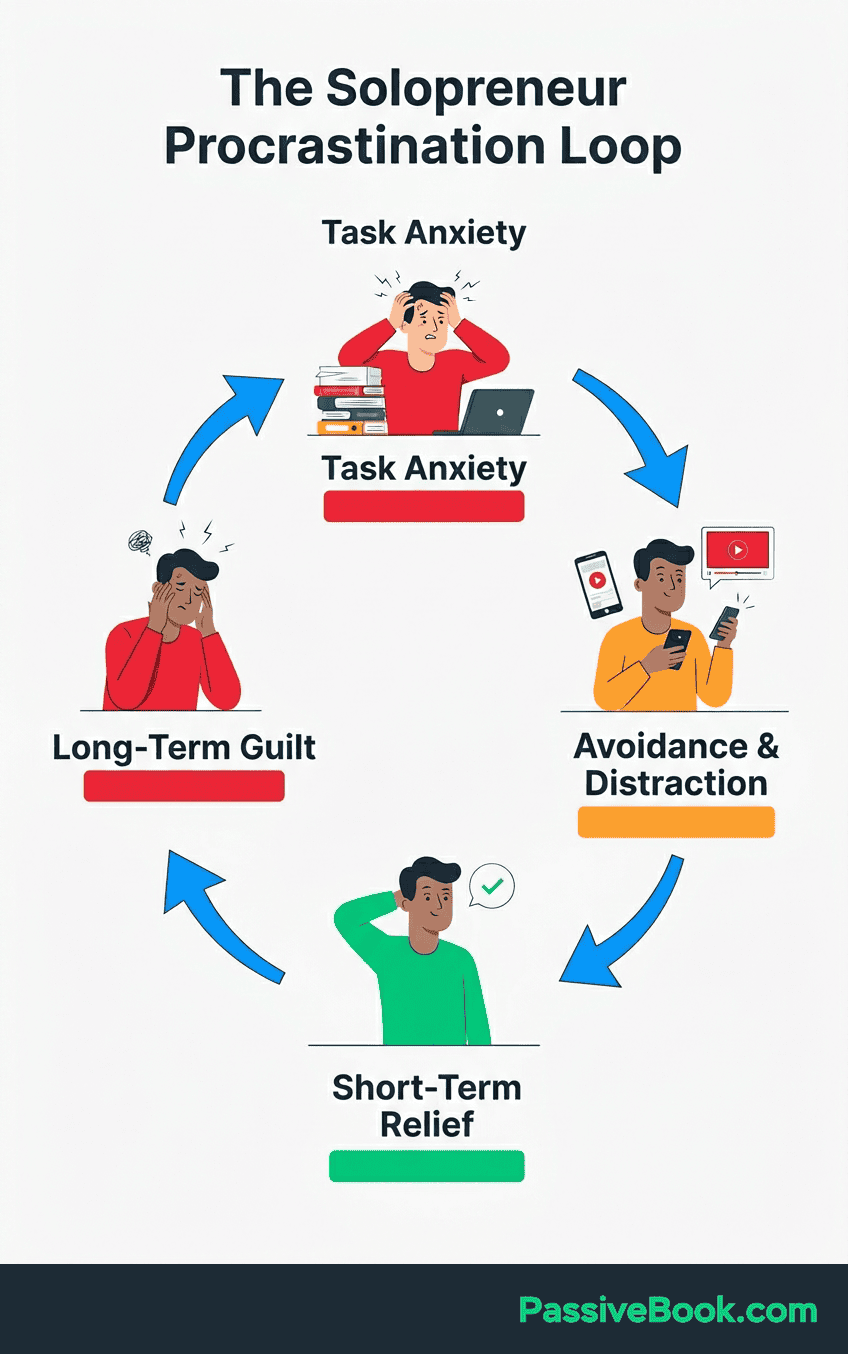
The anxiety of writing your first blog post or filming your first YouTube video gets temporarily erased by scrolling through Canva templates instead.
For online entrepreneurs, procrastination shows up as endless research, course-hopping, redesigning logos, and planning sessions that never turn into launched products. You’re not lazy. Lazy people don’t feel guilt. You feel it constantly.
The difference matters. Laziness is apathy. Procrastination is anxiety dressed up as productivity.
Why Procrastination Hits Solopreneurs Harder Than a Day Job
At a job, deadlines and a manager create external pressure. You show up because someone else is watching. As a solopreneur, you are your only accountability structure.
No one cares if you skip today’s work session except you.
According to the Simply Business 2026 Solopreneur Report, 35% of solopreneurs report high stress levels, compared to 26% of business owners with employees. Isolation isn’t a personal failing. It’s a structural reality of solo work.
Even successful creators struggle. Pat Flynn has documented how “getting-ready mode” kept him stuck long after his business was profitable. Ali Abdaal has built an entire content series around his own ongoing battle with procrastination.
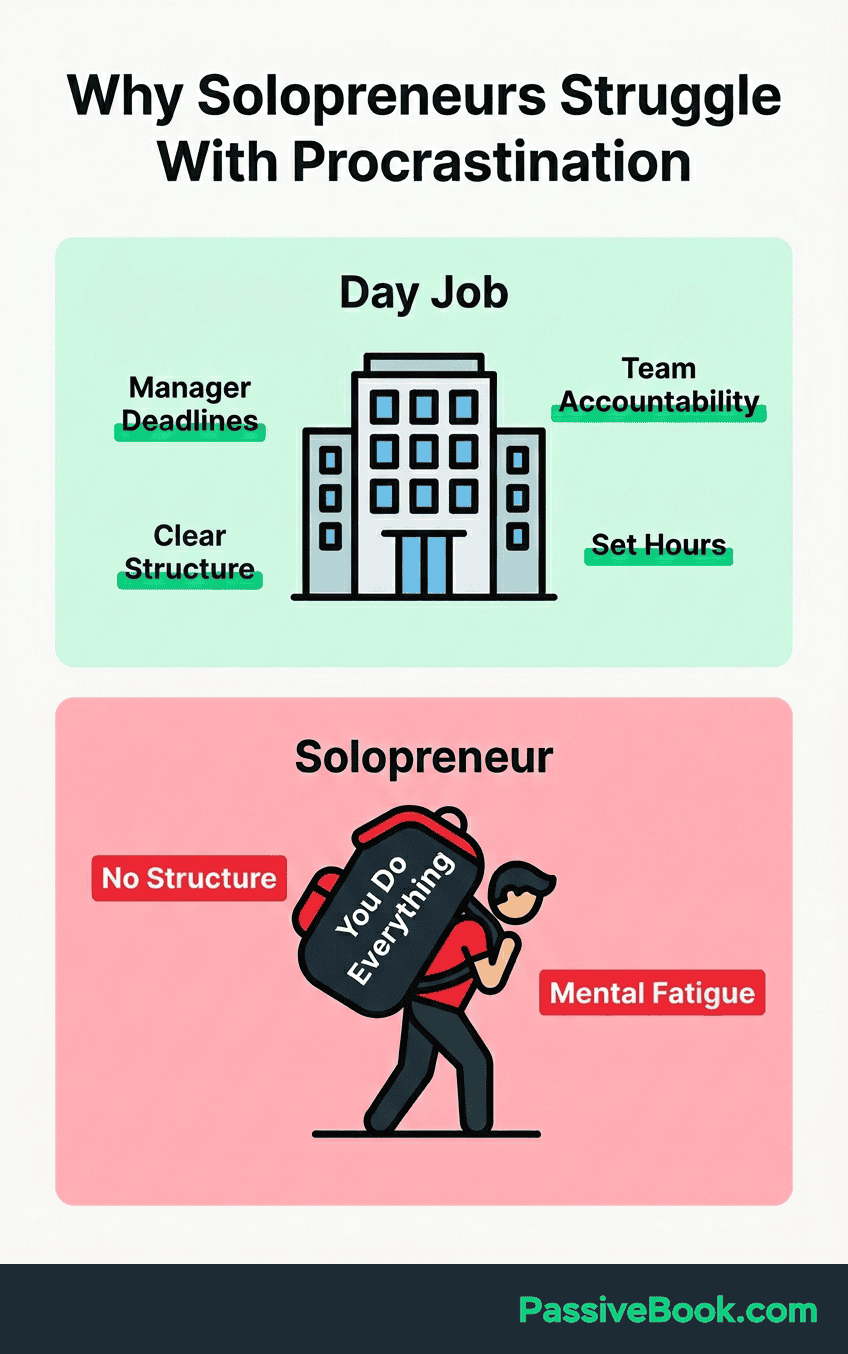
If it hits them, it hits everyone. Building an online business around a full-time job means fragmented hours and harder-won momentum. That’s not a discipline failure. That’s the reality of working with two hours on Tuesday night and maybe three hours on Saturday morning.
Some weeks, I get one good session. That’s it. One. And I still have to make progress.
The Real Reason You’re Procrastinating (It’s Not Laziness)
Before we dive into tactics, hear this: you’re not broken. Procrastination is not a character flaw. It’s a solvable behavioral pattern.
Psychology Today identifies fear of failure, judgment, and financial loss as the dominant emotional drivers of entrepreneur procrastination. A 2024 scoping review synthesizing over a decade of entrepreneurial psychology research corroborates this.
You’re not avoiding the work because you’re lazy. You’re avoiding it because it feels risky. Every blog post you publish can be ignored. Every course you launch can flop. Every YouTube video can get criticized. So your brain offers a deal: let’s just plan a little more first.
Fear of Failure and Task Ambiguity
When your task is “work on my blog,” your brain has no clear instruction. Ambiguity defaults to avoidance.
The solution is specificity. Replace vague goals with named actions. “Write intro paragraph for post #4” is a task. “Work on content” is not. The more ambiguous the task, the easier it is to avoid.
Pat Flynn explains in detail how “learning mode” becomes a sophisticated form of procrastination. He spent months consuming courses and podcasts before he published anything. Committing to imperfect, consistent publishing was the single behavior shift that built Smart Passive Income into a multi-seven-figure platform.
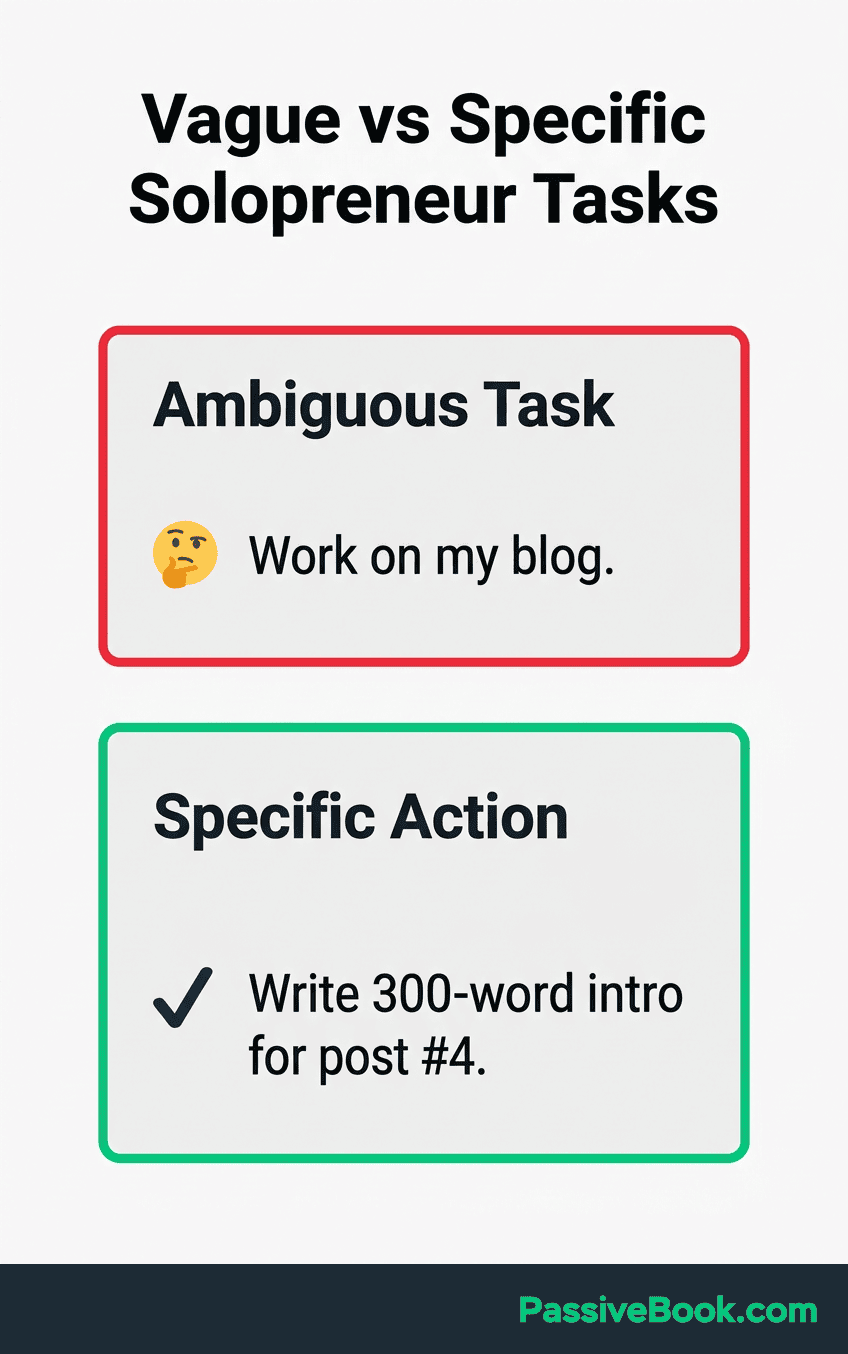
You don’t need more information. You need a named task and a timer. When you genuinely don’t want to do something, it’s almost always because you haven’t defined what “it” actually is.
The Perfectionism-Procrastination Trap
Perfectionism disguises fear of public judgment as quality control.
First-time YouTubers, bloggers, and course creators are especially vulnerable. The gap between their taste and their current output triggers avoidance.
Ali Abdaal now has over 5 million YouTube subscribers. He publicly states: “It is far more important to make 100 really bad videos than to try to make 10 really good videos.” He built his audience by publishing consistently before he was good, not after.
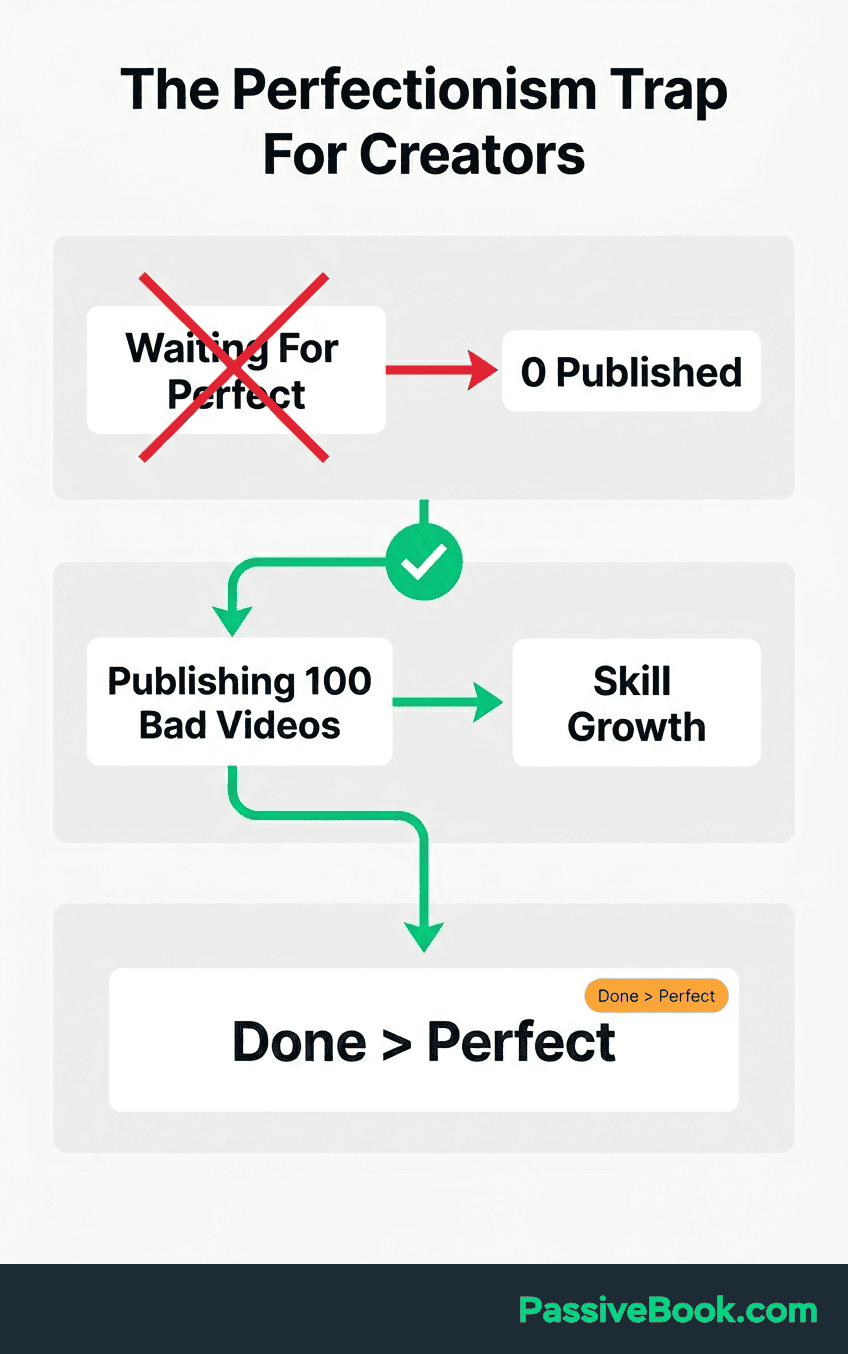
“Done and published” consistently beats “perfect and delayed” for solopreneurs building an audience from zero. Your first 20 pieces of content will be bad. That’s the cost of getting to the good ones. Pay it fast.
Why Standard Productivity Advice Backfires on Solopreneurs
Generic productivity systems assume fixed hours, a team, and external deadlines. Solopreneurs have none of these. YourStory’s 2026 analysis confirms that standard systems assume routine and predictability. Structures that simply don’t exist when building solo around a day job with no external deadlines.
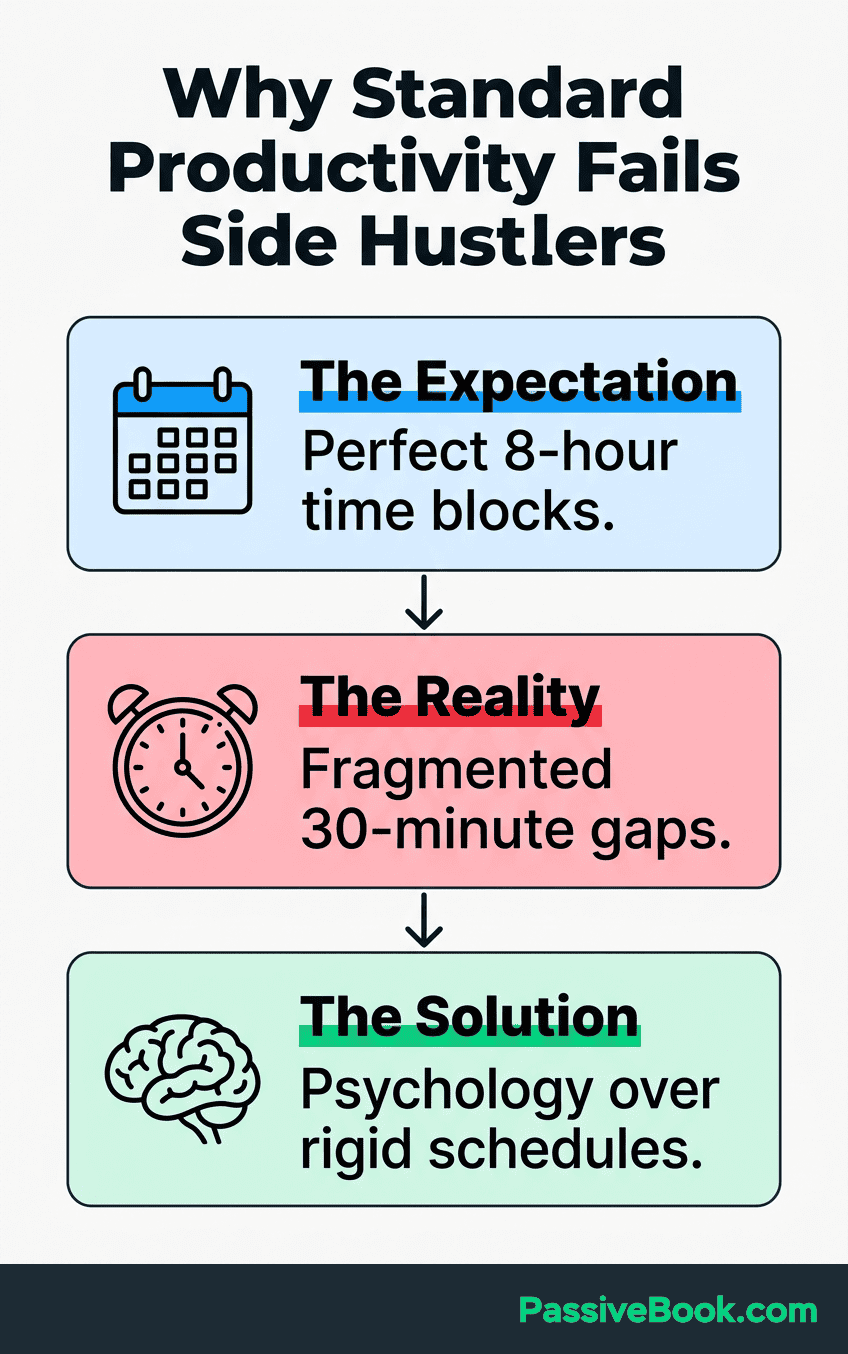
A system designed for a corporate employee with an 8-hour workday and a boss checking in daily will fail when you have 90 minutes on a Wednesday night and no one watching. The structure has to be different.
Tackle the Right Task First: The Eat the Frog & MIT Methods
Brian Tracy’s Eat That Frog method: start every session with the single most-avoided, highest-impact task before email, social media, or admin. Your willpower is highest at the start of a session. Use it on the work that matters.
For a blogger, the “frog” is writing 300 words. For a dropshipper, it’s researching one winning product. For a course creator, it’s recording one slide deck. Everything else is displacement activity.
The Most Important Task (MIT) method narrows your day to 1–3 truly business-building actions. This eliminates the paralysis of a sprawling to-do list. When you only have two hours, you can’t do 15 tasks. Pick one.
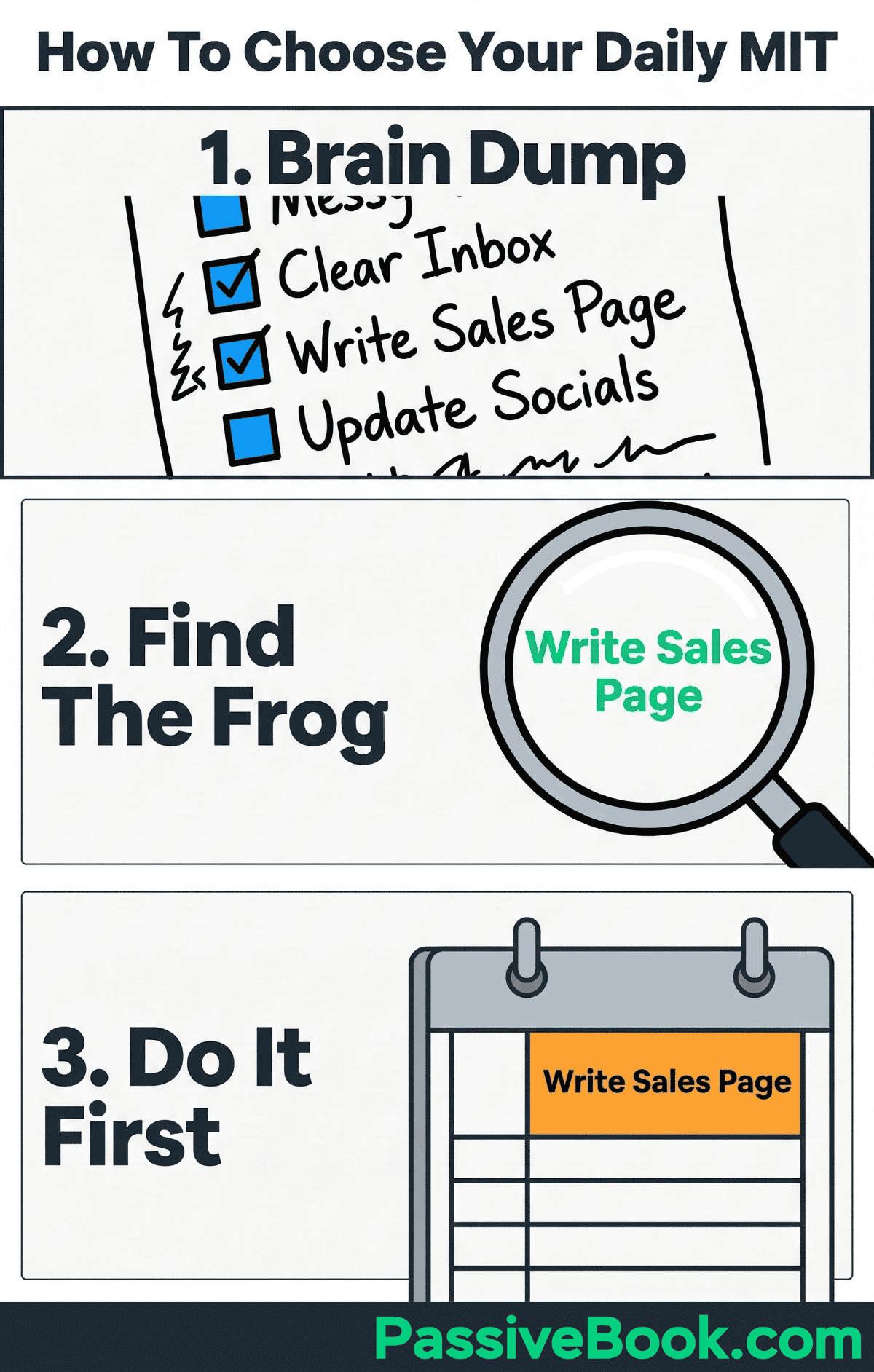
Write it down before you start your session. “Today’s MIT: Draft the sales page intro.” If you finish that, everything else is bonus. If you don’t, you know exactly where to start tomorrow.
If you’re unsure which task qualifies as your MIT, ask: “If I only finish one thing today, which one would I regret not doing?” That’s your frog. Everything else can wait.
Work in Short Bursts: The Pomodoro Technique for Side Hustlers
The Pomodoro Technique uses 25-minute focused sprints followed by a 5-minute break. This technique was designed for solopreneurs with only 1–2 hours per day.
A 2026 peer-reviewed review found consistent positive associations between structured timed-interval work and improvements in focus, time management, and reduced cognitive fatigue. Constraints make intimidating tasks feel finite. That’s why this works.
The mechanics are simple. Set a timer for 25 minutes. Work on one task only. When the timer rings, take a 5-minute break.
After four cycles, take a longer 15–30 minute break.
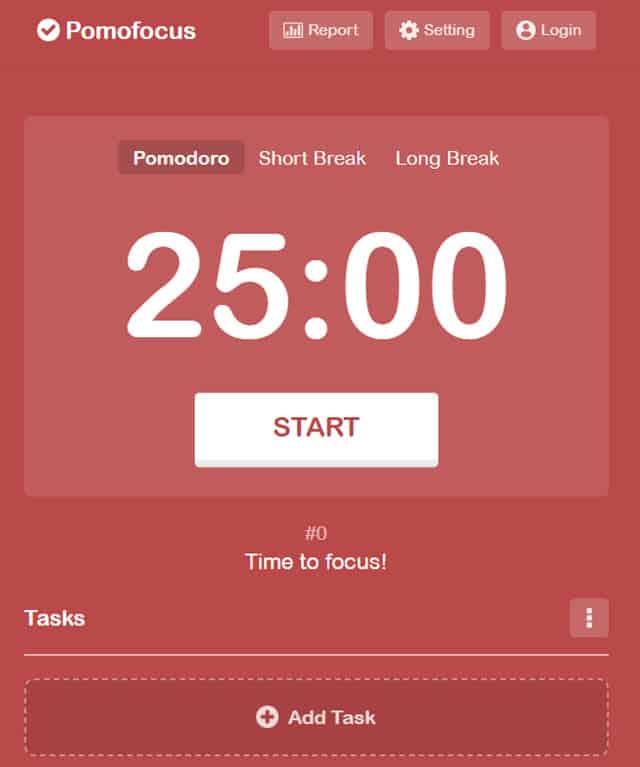
Filming a YouTube video feels overwhelming. Filming for 25 minutes feels manageable. Writing a landing page feels impossible. Writing for 25 minutes feels doable. The timer gives you permission to stop, which paradoxically makes it easier to start.
I do most of my content work in Pomodoros. Two cycles gets me a draft. Four cycles gets me a finished piece. Without the timer, I’d still be staring at the blank page convincing myself I need to research more first.
If you have less than 25 minutes, do a micro-Pomodoro. Ten minutes counts. Five minutes counts. The habit of starting matters more than the duration.
Design Your Environment to Make Procrastination Harder
A dedicated workspace signals “work mode” to your brain. Dr. BJ Fogg’s Behavior Model and a meta-analysis on digital self-control tools both confirm that reducing environmental friction is more reliable than relying on willpower alone.
Use Freedom app to block distracting sites across all devices during scheduled focus blocks. Remove the option to scroll. If the site is blocked, you can’t rationalize “just checking” for five minutes.
Social media platforms are designed to be addictive. If you’re building a YouTube channel or blog, you need social media for promotion, but scrolling your feed is different from posting your content. Schedule specific blocks for content distribution, then block the apps outside those windows.
RescueTime automatically tracks time on sites and activates distraction-blocking focus sessions on command. You’ll see exactly where your time goes. The data is uncomfortable, but it’s useful.
Mine showed I spent 90 minutes a day on Twitter. I thought it was 20. Ouch.
Habitica turns your task list into an RPG. Completing real tasks levels up your character. Skipping them deals damage. The gamification is silly, but it works. Humans respond to immediate feedback, even fake feedback.
If you work from home, separate your work area from your relaxation area. Even if it’s just a specific chair or a corner of the kitchen table, the physical boundary helps your brain switch modes.
Use AI to Remove the Friction That Causes Avoidance
Task ambiguity is procrastination’s primary trigger. Paste your to-do list into ChatGPT and ask: “I have two hours tonight. What’s the single highest-leverage action I should take first?” AI converts vague goals like “work on my business idea” into named, sequenced next steps in seconds.
According to an Adobe-commissioned study covered by Small Biz Trends, entrepreneurs who adopt AI tools save an average of six hours per week. This is time typically lost to repetitive admin.
I use this exact prompt when I’m stuck: “I’m building a blog about productivity tools. I have 90 minutes tonight. I’ve written two posts so far. What should I do next to grow traffic?” The AI will prioritize. Sometimes it’s writing. Sometimes it’s optimizing an existing post. Sometimes it’s building one backlink.
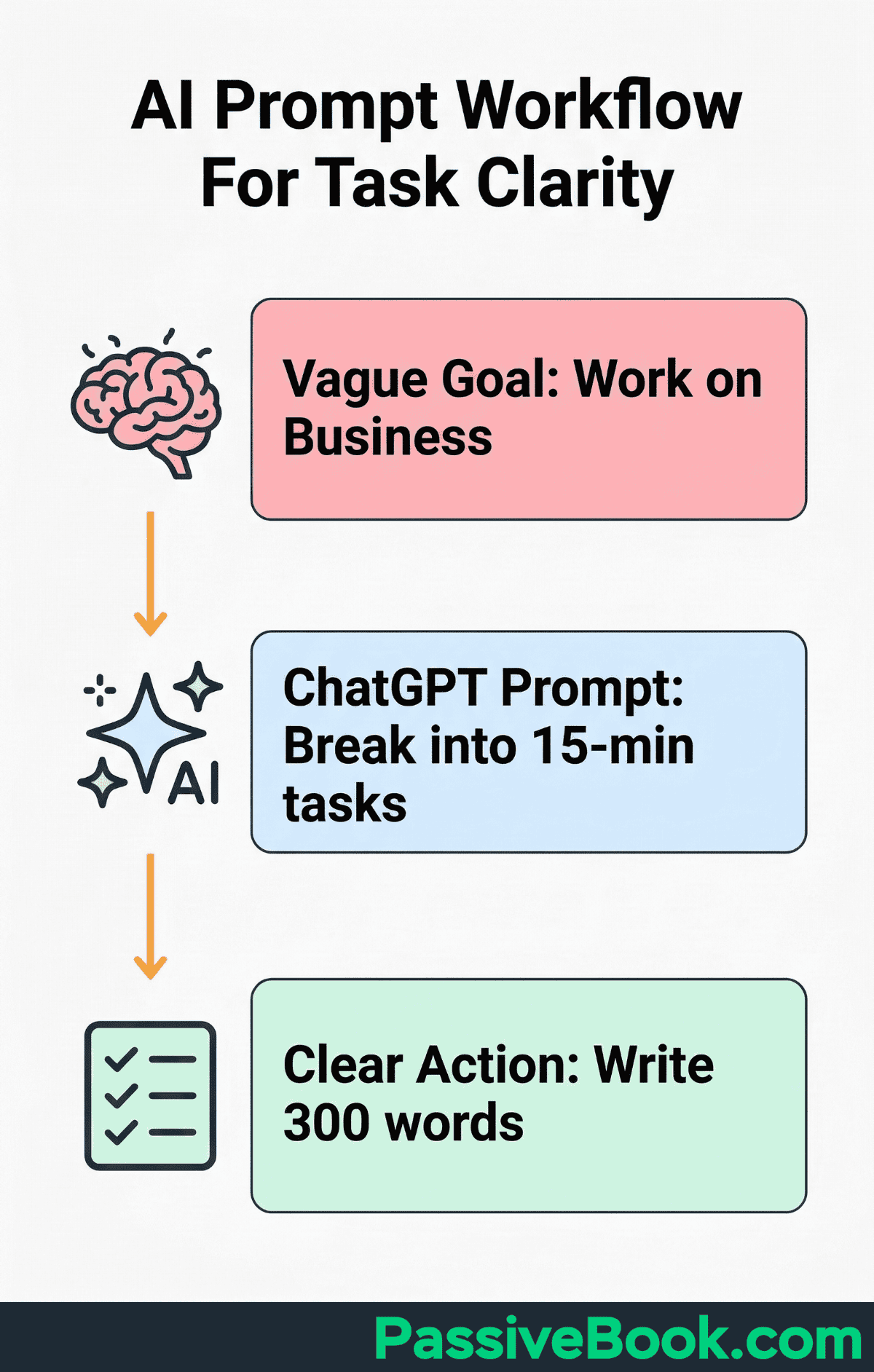
AI handles content drafts, research groundwork, and scheduling templates, removing the “I don’t know where to start” friction before your session even begins. You’re not outsourcing the thinking. You’re outsourcing the setup.
If you’re stuck on a blog post, paste your outline into Claude and say: “Write a rough first draft of this section in a conversational tone.” You’ll edit it, but the blank page is gone. That’s the friction point. Remove it.
Build Accountability Systems That Replace the Missing Boss
Without a manager or team, you must engineer external pressure deliberately. It does not appear on its own.
Focusmate is a free virtual co-working platform pairing you with a stranger for a 50-minute live session. Research on body doubling confirms that working alongside others, even virtually, meaningfully boosts task initiation and follow-through.
Widely cited research on accountability (often attributed to the American Society for Training and Development) suggests that committing a goal to another person raises completion likelihood to 65%, and scheduling a specific accountability check-in raises it to 95%. While the original study is difficult to trace, the principle has been validated repeatedly in behavioral psychology.
A weekly Focusmate session or peer DM check-in achieves this at zero cost.
Find one other person building something similar. Text them your MIT at the start of the week via a direct message, email, or even social media DM if that’s where you naturally communicate. Report back on Friday with your result. That’s it. The system doesn’t need to be complex. It needs to be consistent.
I have a friend building a YouTube channel. Every Monday, we text each other our upload commitment for the week. Every Friday, we confirm we shipped. Neither of us has missed a week in four months. We don’t critique each other’s work. We don’t coach. We just text: “Did you do it?” That’s enough.
The accountability is simple, but it works.
Build a Procrastination-Proof Identity for Long-Term Consistency
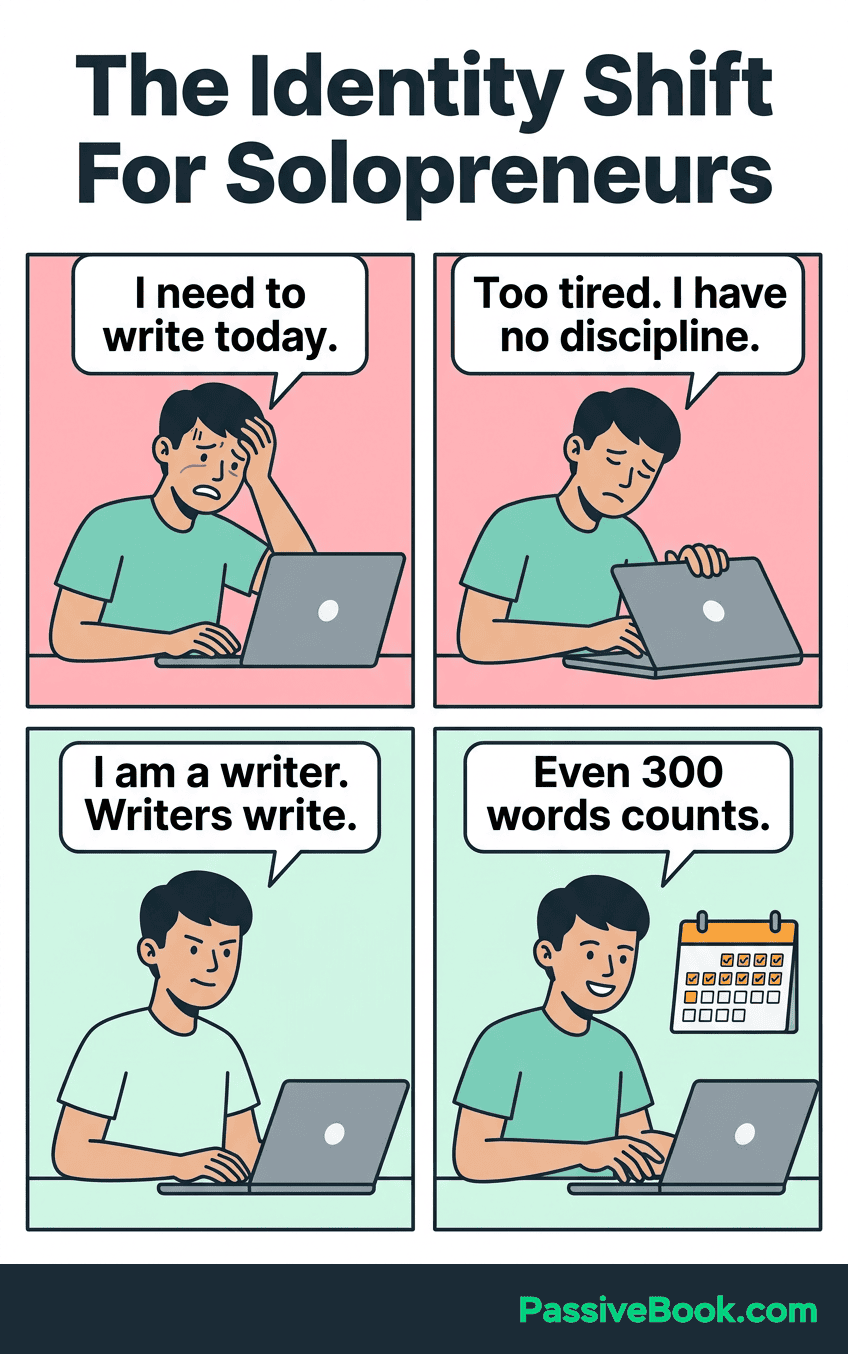
James Clear’s identity-based habits framework argues lasting change starts with identity, not outcomes. Stop saying “I need to post this week.” Start saying “I am someone who publishes every week.”
The shift is subtle but powerful. “I need to” is external pressure. “I am” is internal identity. When you miss a session, you’re not just behind on tasks. You’re contradicting who you claim to be.
Build momentum through habit stacking and simple tracking. After morning coffee, open your draft for one Pomodoro. Mark a daily one-task streak on a paper calendar or habit app. The visual chain becomes its own motivation.
Research by Dr. Fuschia Sirois at the Greater Good Science Center found that people who procrastinate tend to be much harder on themselves. Forgiving yourself for a missed session actively reduces future avoidance.
When you skip a day, don’t spiral. Acknowledge it, identify what caused it, and restart the next day. The streak is useful, but the identity is more important. One missed day doesn’t erase the habit. Two weeks of missed days does.
Frequently Asked Questions
Is Procrastination a Sign That My Business Idea Isn’t Right for Me?
No, procrastination is almost never about the business idea itself. Every new business feels uncomfortable at first because you’re risking public failure and investing time with no guaranteed return. If you’re delaying because the work feels scary, that’s normal fear, not a sign you should quit. If you’re delaying because you fundamentally don’t care about the outcome anymore, then reconsider the idea.
I Only Have 30–60 Minutes Per Day. Can I Still Make Progress?
Use the Pomodoro Technique and the MIT method together. Identify one high-impact task before you sit down, set a timer for 25 minutes, and work only on that task until the timer rings. Short sessions work because they remove the “I don’t have enough time to make progress” excuse. Progress in 25-minute chunks beats waiting for a mythical four-hour block that never comes.
What Should I Do First If I Feel Completely Overwhelmed by Everything My Online Business Requires?
Write down every task you think you need to do, then ask yourself: “Which one task, if completed this week, would make the biggest difference?” Ignore everything else for now. Overwhelm is usually caused by trying to do 15 things at once instead of one thing well. Pick the single most important task and do only that until it’s finished.
What Is the Difference Between Productive Planning and Procrastinating Through Over-Planning?
Productive planning has a clear output and a time limit: “I will spend 30 minutes outlining my next five blog posts.” Procrastinating through over-planning is open-ended research with no decision: “I need to figure out the perfect content strategy first.” If your planning session doesn’t end with a named next action and a deadline, it’s procrastination.
I Missed Several Days of Work. How Do I Restart Without Guilt?
Acknowledge the missed days without judgment, identify what caused the gap (overcommitment, burnout, unclear task), and choose one small task to restart momentum today. Guilt doesn’t motivate action. It paralyzes it. Research shows self-compassion reduces procrastination more effectively than self-criticism. The best time to restart was yesterday. The second-best time is now.
What Next?
You now have the framework, the techniques, and the research. The only thing missing is the decision to start. Not tomorrow. Not after one more course. Today.
Procrastination isn’t a personality flaw. It’s a solvable behavioral problem. You’ve learned what triggers it, how to design your environment to reduce friction, and how to build accountability systems that replace the external pressure you’re missing as a solopreneur. The strategies work. I’ve used them. Thousands of others have used them. Now it’s your turn.
If this article helped you, use the social share buttons below to share it with another entrepreneur who’s stuck in the same cycle. Sometimes the most valuable thing you can do is show someone they’re not alone in the struggle. What’s the one task you’ve been avoiding this week? Write it in the comments below. I read every one, and I’ll reply with the exact first step you should take. Naming it publicly is the accountability you need to start.
Share this post with your friends & followers: