Your product update has moved to next week again because customer emails, file fixes and small admin jobs filled the hours you set aside for it.
You could hire help, but checking every reply sounds like another job. And when customers are involved, “close enough” is an expensive standard.
The challenge is making room for that product update while someone else learns to handle the daily requests. This guide shows you how to choose an affordable first assignment, set clear standards and reduce supervision as the person’s work becomes dependable.
Choose the First Task to Delegate
Start with one assignment you can afford to hand over. You don’t need a full team or a business that feels completely established.
The assignment needs a clear outcome, a capable person, enough authority to act and agreed checkpoints. That follows the Center for Creative Leadership’s delegation model: someone else handles delivery, but you remain responsible for making sure the work gets completed.
Decide What to Keep, Delegate, Automate, or Stop
Review a representative working week. Add monthly or occasional jobs from your calendar, because tax paperwork and product launches won’t appear in every week’s notes.
For each task, record why it exists, how often it happens, how much of your time it takes, the skill it needs and what happens if it goes wrong. Then choose an action.
Imagine you run an online shop selling printable cat-sitter instruction packs. The assignments, costs and time savings below are illustrations.
Your task review might look like this:
| Task | Purpose | Frequency | Owner Time | Required Skill | Error Consequences | Proposed Action |
|---|---|---|---|---|---|---|
| Resolve download-access requests | Help buyers use their purchase | Each weekday | 3 hours weekly | Clear writing and order checks | Wrong instructions delay access | Delegate with review |
| Approve new product promises | Keep offers accurate and achievable | Before each launch | About 1 hour per launch | Product knowledge and business judgment | Buyers expect something you cannot deliver | Keep |
| Route support messages | Put requests in the right queue | Each weekday | 15 minutes weekly | Simple sorting rules | A request reaches the wrong person | Automate and check exceptions |
| Compile an unused traffic report | Originally intended to guide promotion | Weekly | 30 minutes weekly | Basic reporting | Nothing changes if it stops | Stop |
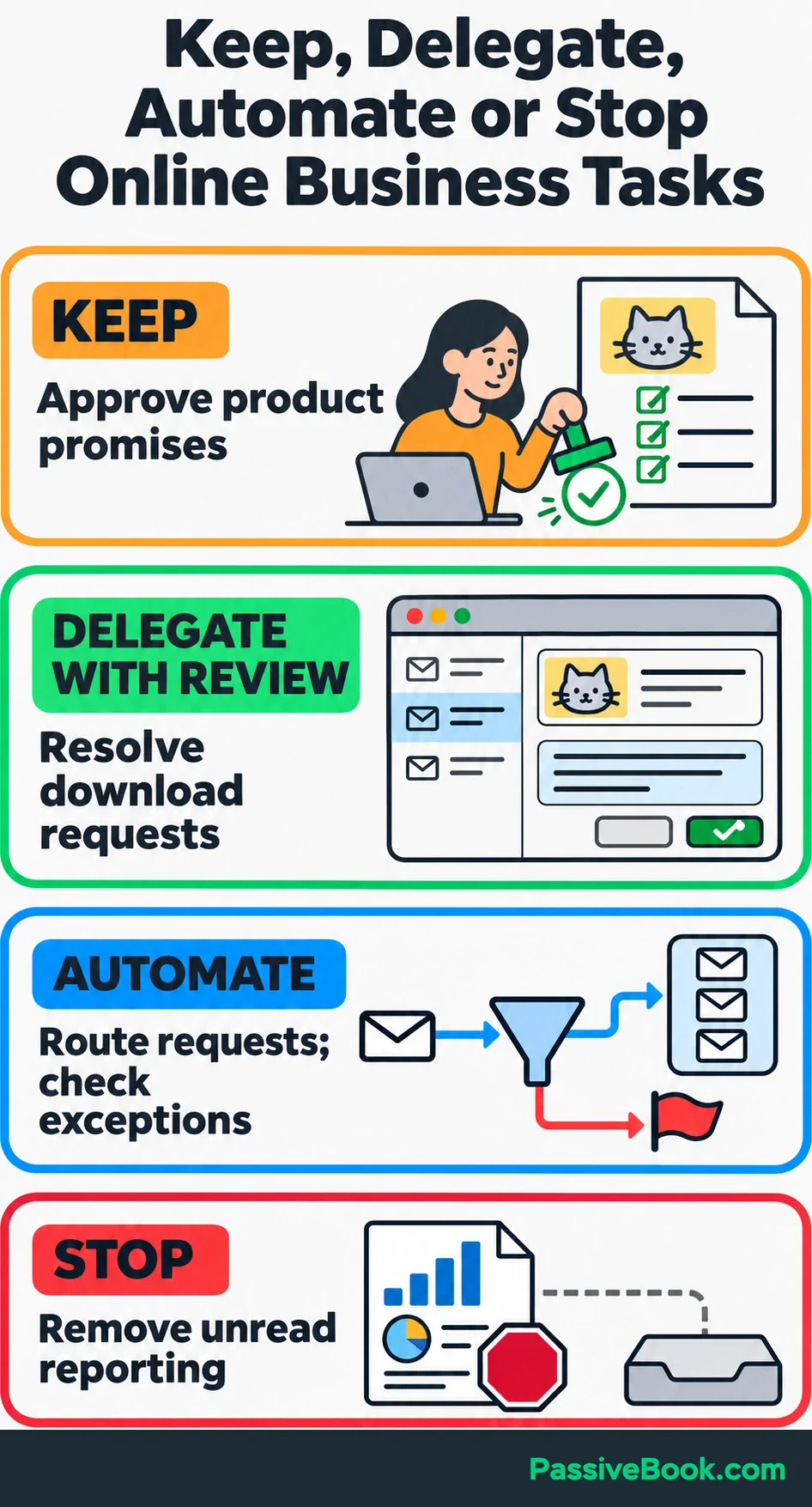
I would choose routine download support first. It repeats, completion is visible and you can review replies before they reach customers.
Keep business direction, spending commitments, product promises and consequential exceptions initially. You can still delegate the research and execution around those decisions. Revenue-generating work is also fair to hand over when the person has the right skills and clear limits.
Automation can support the same assignment. A rule can route a download request, while a person checks the order and resolves it. If you already connect your apps with Make or n8n, use that tool to route the requests. I would skip building a new workflow just to sort a handful of messages.
And stop work that serves no useful purpose. Paying someone to produce an unread report makes the report more expensive.
Apply the 80/20 and 70% Rules
The 80/20 rule asks you to look for the small share of activities contributing most to your results. Protect time for those activities by handing over supporting work.
The percentages are prompts to investigate your business. Richard Koch explicitly describes the principle as hypotheses to test against your experience, rather than a guaranteed split.
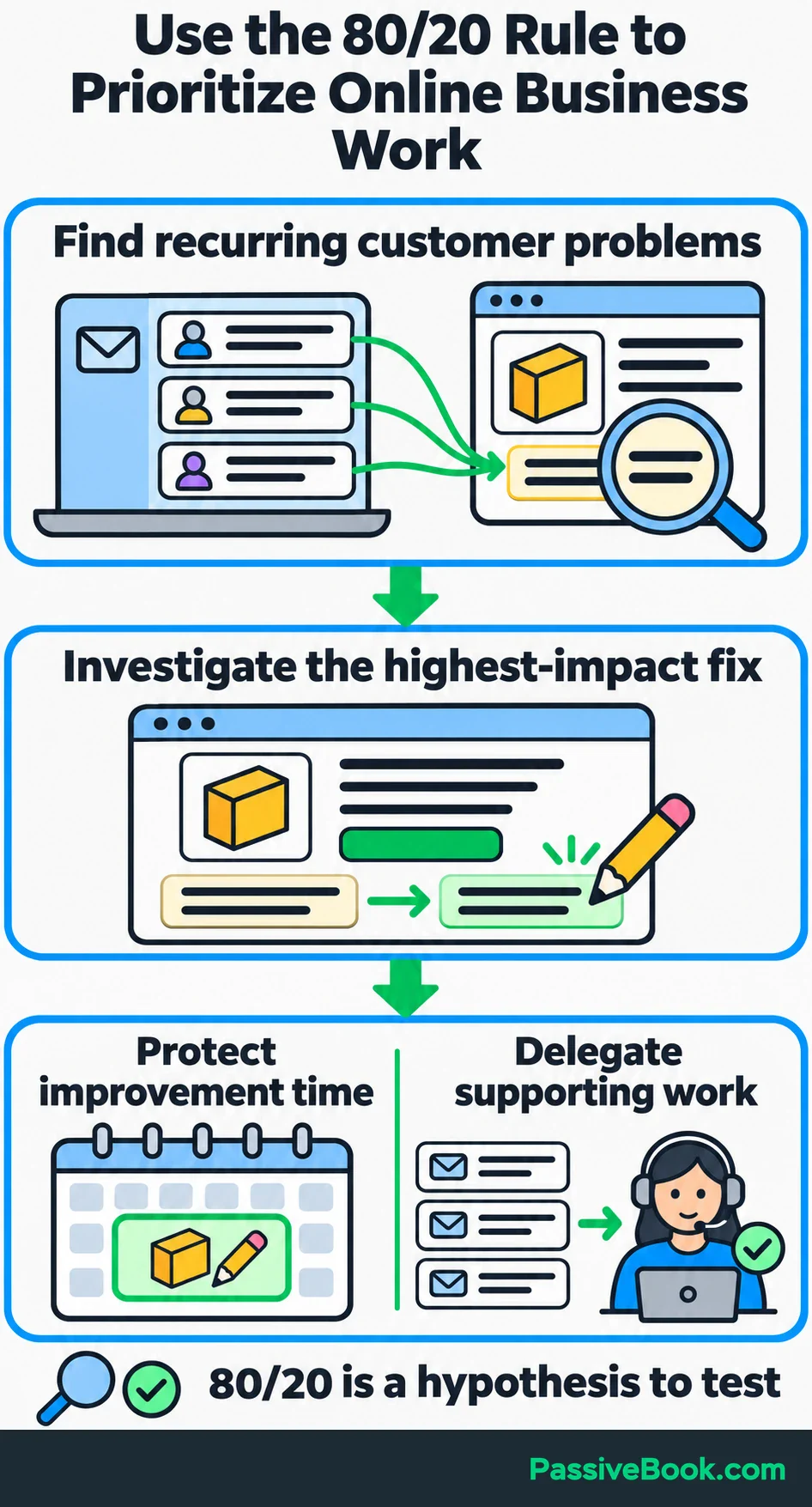
In the shop, improving a confusing product page might deserve your attention more than repeatedly resending access instructions. Check whether that matches the problems your customers actually report.
The 70% rule tackles a different obstacle: waiting until someone can do everything exactly as well as you. BELAY recommends considering delegation when a person can perform a task at least 70% as well as you.
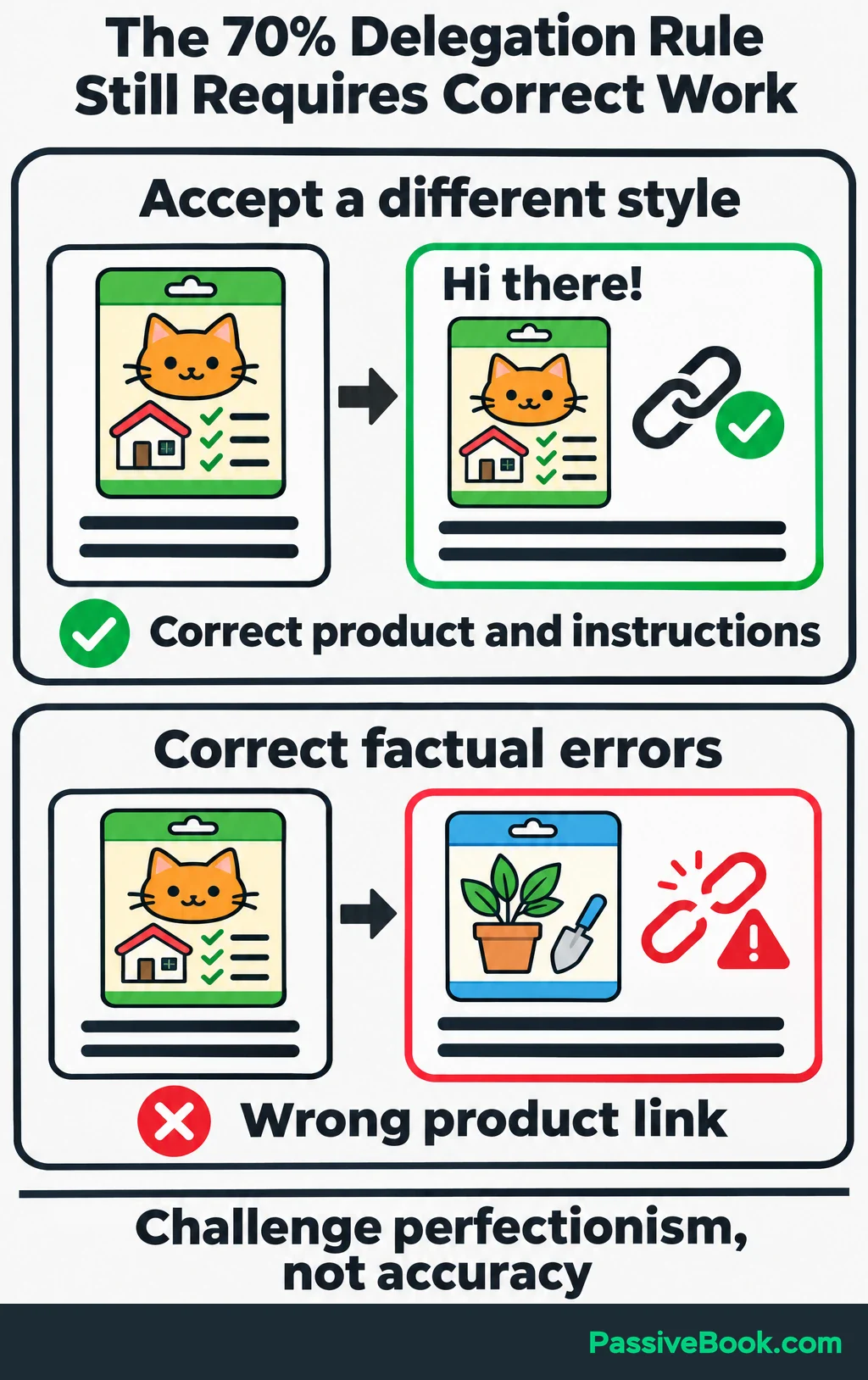
I would use that to challenge perfectionism, not score someone’s competence.
A reply can be less polished than yours and still help the customer. Sending the wrong product link is a failure. Accept differences in style and speed, but require correct information, correct actions and sensible escalation.
Set a Budget for the First Handoff
Set a spending ceiling before you look for help. Include the paid trial, delivery fees, platform charges, extra software and paid training. Also reserve your own time for documentation and review.
During my print-on-demand attempt, hiring designers ate into already thin margins. I now look at the cost of the whole handoff before deciding that a task is worth delegating.
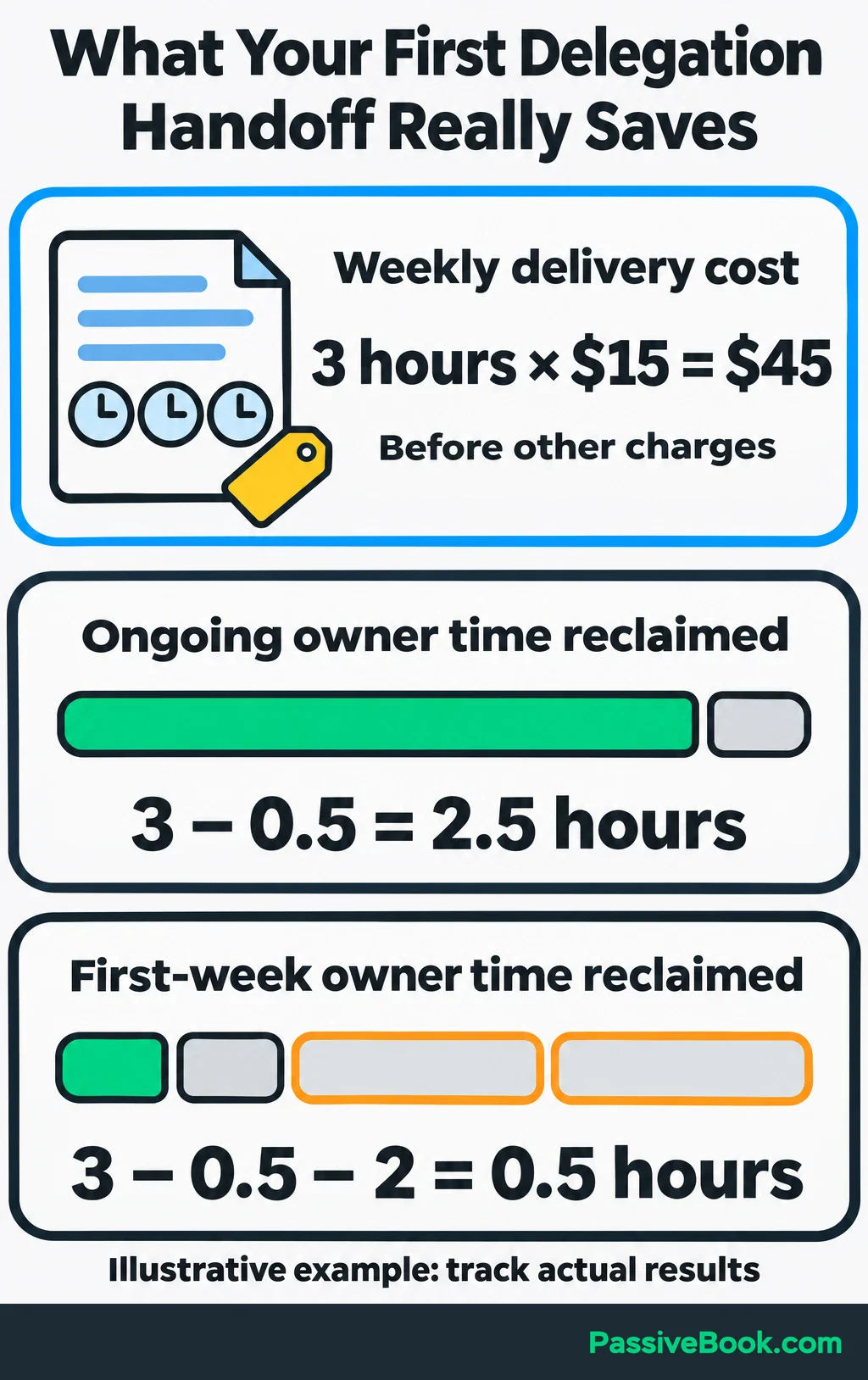
Count time savings the same way. Start with the time you previously spent doing the work, then subtract the time you still spend briefing, checking, correcting and handling exceptions.
For the shop, suppose support takes three owner hours each week. A contractor also needs three hours, at an illustrative rate of $15 per hour, and your ongoing oversight takes 30 minutes. Allow two additional owner hours in the first week to document the task and prepare the trial.
| Item | Calculation | Result |
|---|---|---|
| Weekly delivery cost | 3 contractor hours × $15 | $45 before other charges |
| Weekly owner time reclaimed | 3 previous hours − 0.5 oversight hours | 2.5 hours |
| First-week owner time reclaimed | 3 previous hours − 0.5 oversight hours − 2 setup hours | 0.5 hours |
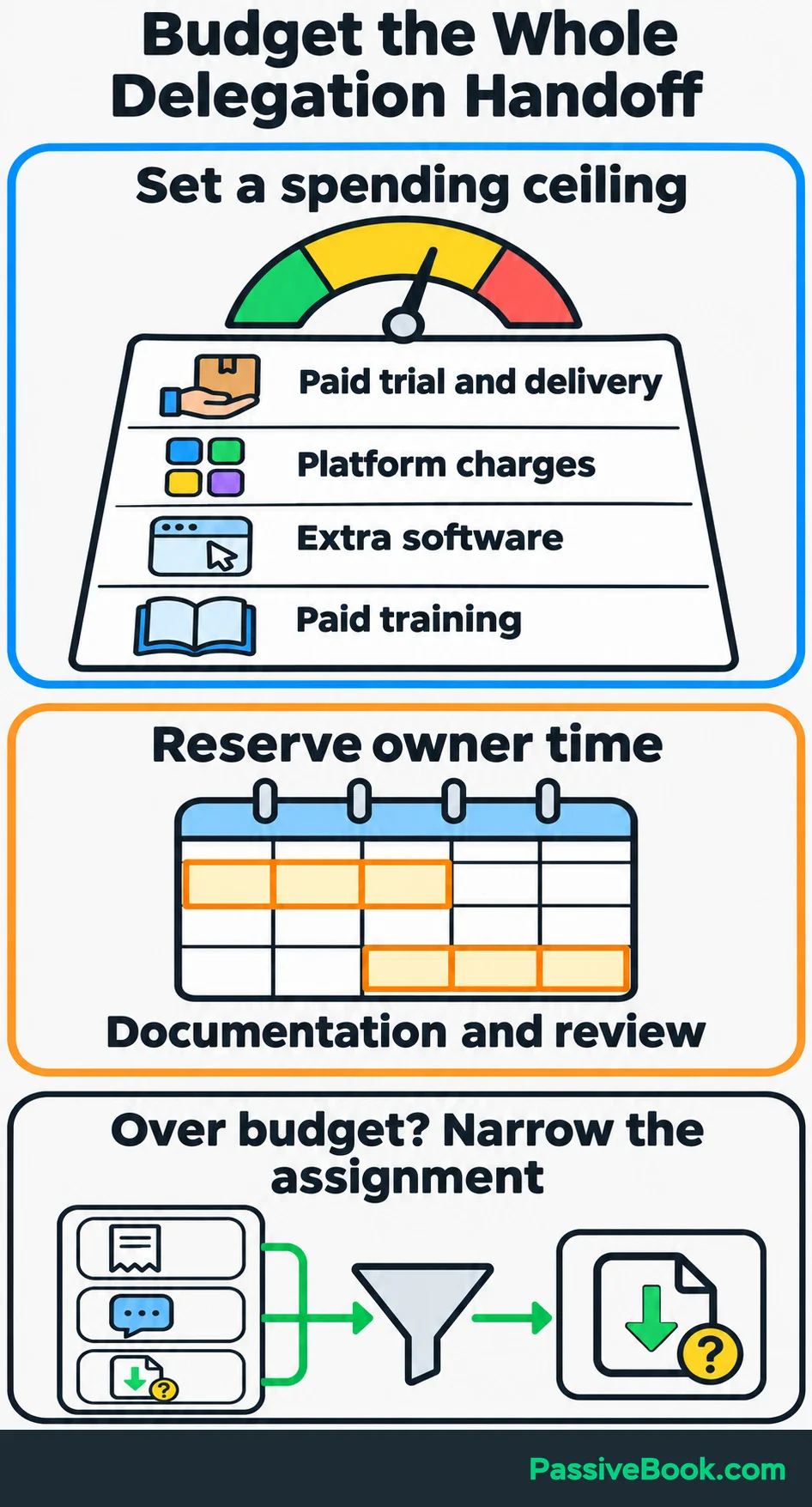
That first week barely moves the calendar. Track actual review time and corrections to see whether later weeks deliver the expected saving.
If the assignment costs too much, narrow it to one type of download problem.
Create a Clear Delegation Brief
Define the Outcome and What “Done” Means
Write down the result before explaining the steps. “Handle customer support” leaves too much room for interpretation.
A useful brief states what someone must deliver, when it is due and how you will judge it. That matches HBS Online’s advice to define outcomes, timelines and measures before work begins.
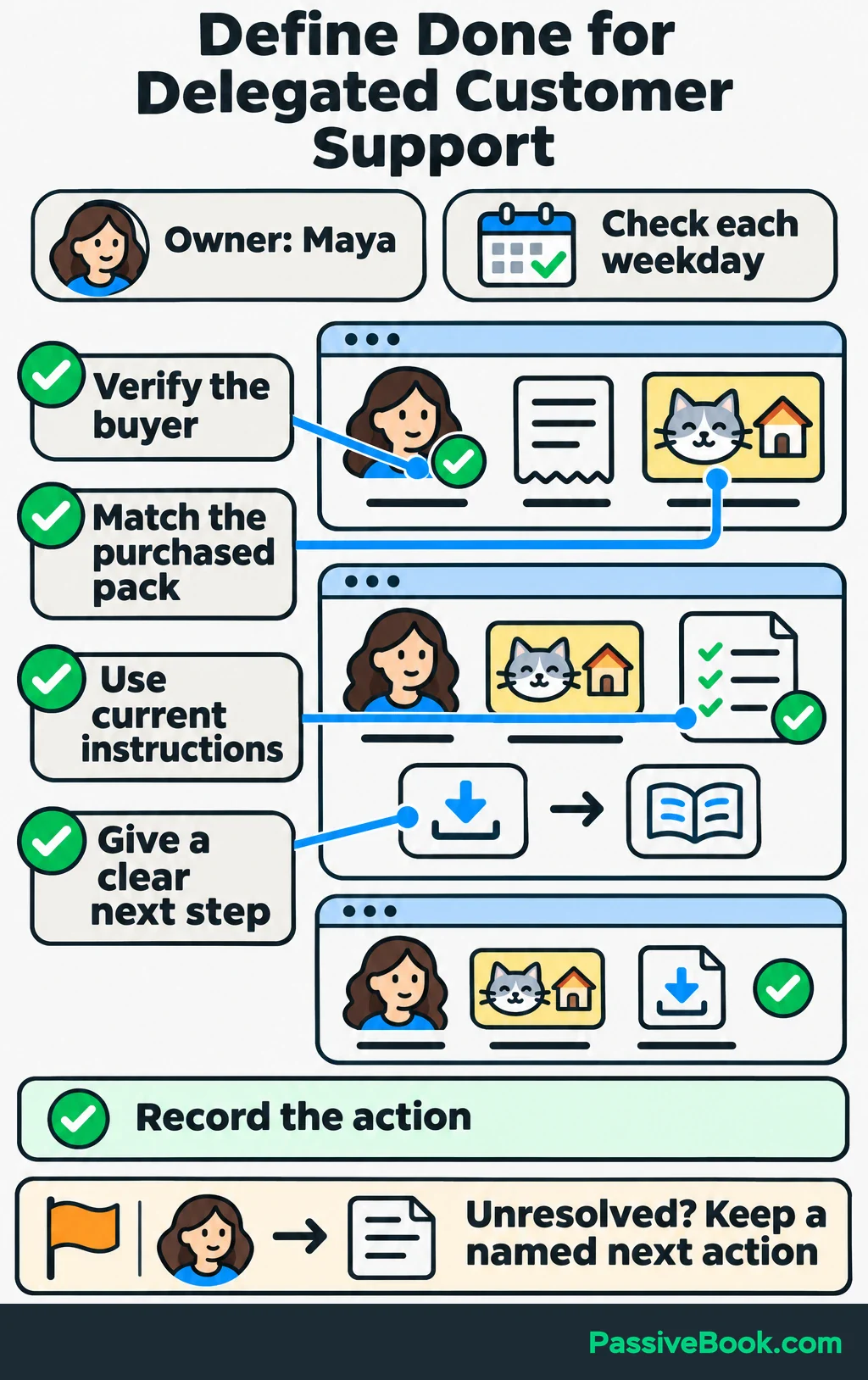
Give one person responsibility for the assignment. A shared inbox can have several users, but each request still needs a named owner.
For the shop, a brief could look like this:
- Purpose: Help buyers access the cat-sitter pack they purchased.
- Owner: Maya, the contractor handling routine download support.
- Scope: Routine missing-download and file-opening requests. Refunds and payment disputes stay with me.
- Coverage: One agreed inbox check each weekday, within three paid hours weekly. Record the check time and time zone before starting. I cover requests outside those checks.
- Deliverable: Address routine requests during each check and record the action taken. Keep unresolved cases open with a named next action.
- Quality Standard: Confirm the correct customer and purchased pack, use current instructions, give a clear next step and escalate cases outside your authority.
- Resources: Order lookup access, current access instructions, approved reply examples and the shared support log.
- Decision Limits: Resend approved access instructions to a verified purchaser. Do not change orders, issue refunds or promise policy exceptions.
- Escalation: Flag unverified purchases, failed fixes, refund requests and workload that exceeds the agreed hours.
- Review: Draft replies for approval during the trial. We agree when routine replies can be sent independently.
Attach one acceptable finished reply. Add a short checklist beside it so the person can check their own work.
Match Authority to Responsibility
Someone responsible for fixing access needs enough information and permission to fix access. Otherwise, every request becomes a message asking you to click a button.
Separate decisions into three groups:
- Routine actions they can take independently.
- Exceptions that need your approval.
- Problems that need immediate attention.
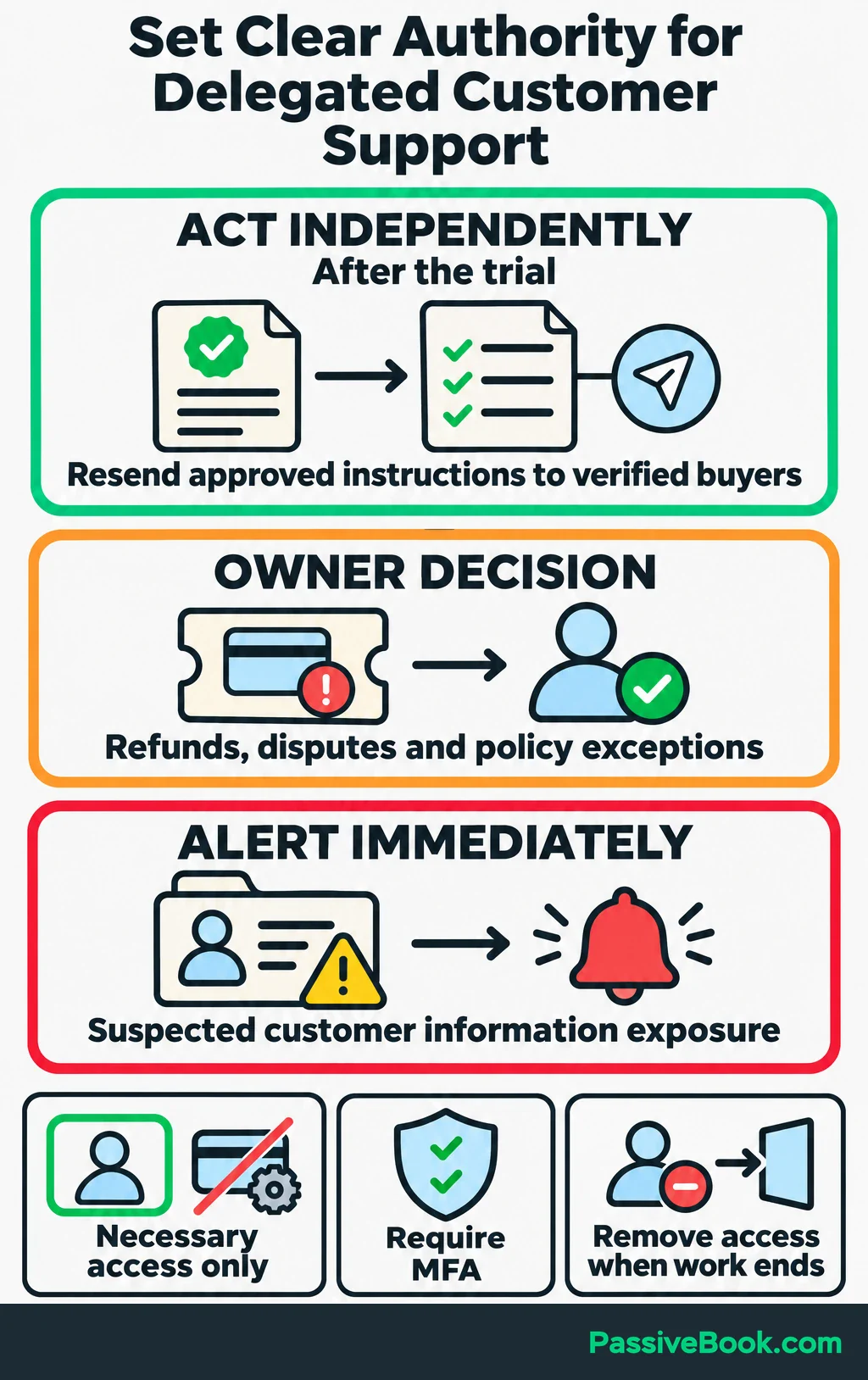
In the shop, resending documented access instructions can be independent work after the trial. A payment dispute goes to you. Suspected exposure of customer information needs an immediate alert through an agreed contact route.
Before live work, create individual accounts, limit access to necessary systems and customer records, and require multifactor authentication—a second login check beyond a password. Arrange to remove access when the engagement ends. These limits follow the FTC’s guidance on vendor access and security.
The support person needs to verify a purchase. They don’t need control of your payment settings.
Document the Shortest Usable Process
Record yourself completing one representative task, or write a short checklist while you do it. A screen recording in Loom can help, but a clear page of notes may be enough.
Include:
- What starts the task.
- What information is required.
- The essential actions and checks.
- What counts as complete.
- What to do when the normal process fails.
For the shop, the normal case starts with a missing-download message. Verify the purchase, identify the purchased pack, send the approved instructions and record the action.
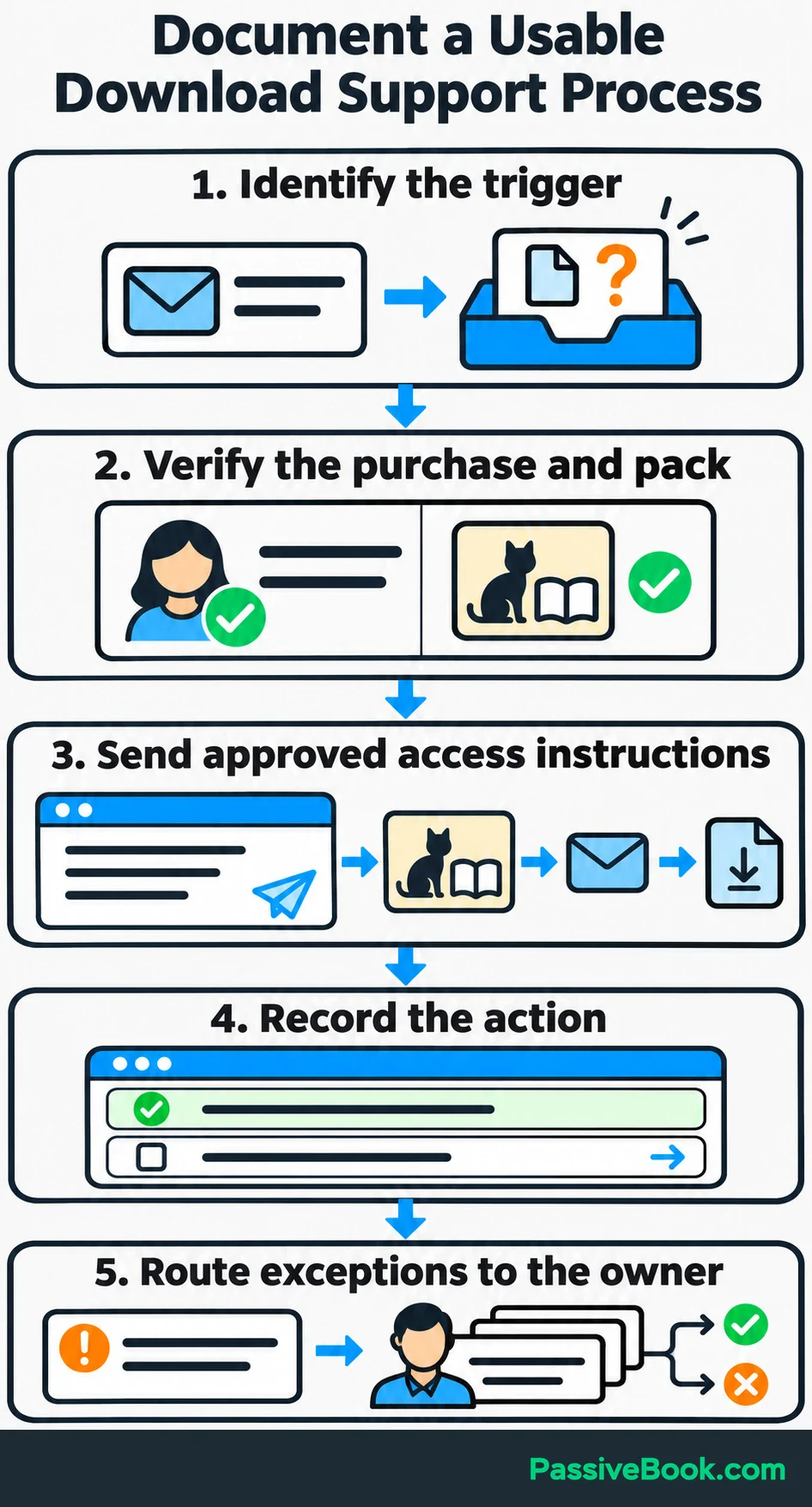
Then show an exception. If the customer asks for a refund outside the stated policy, record the request and send it to you for a decision.
Keep the process, approved replies and examples together in one shared document or Notion page. Ask the person using them to flag unclear steps during the trial.
You do not need to turn rough notes into polished instructions yourself. Our AI Skill can draft the brief, process and quality checks together, with gaps marked for you to resolve before anyone starts.

Free AI Operations Writer




For specialist work, give the outcome and constraints, then ask the specialist to propose a method. Hiring expertise and dictating every click is a peculiar way to spend money.
Choose Someone Through a Small Paid Trial
Define the skills and workload before choosing a person. An assistant may suit an established support routine. A broken checkout needs someone who understands the relevant technology.
If you already have a teammate, check capacity first. Assigning more work without removing anything can simply move the overload.
For outside help, review relevant work samples and agree on availability, turnaround, communication, scope and payment terms. I would choose evidence of careful work over a confident promise to “handle everything.”
Before engaging paid help, check the worker-classification requirements that apply to the arrangement. For U.S. federal employment taxes, the IRS considers control, independence and the working relationship. Calling someone a contractor does not settle their status.
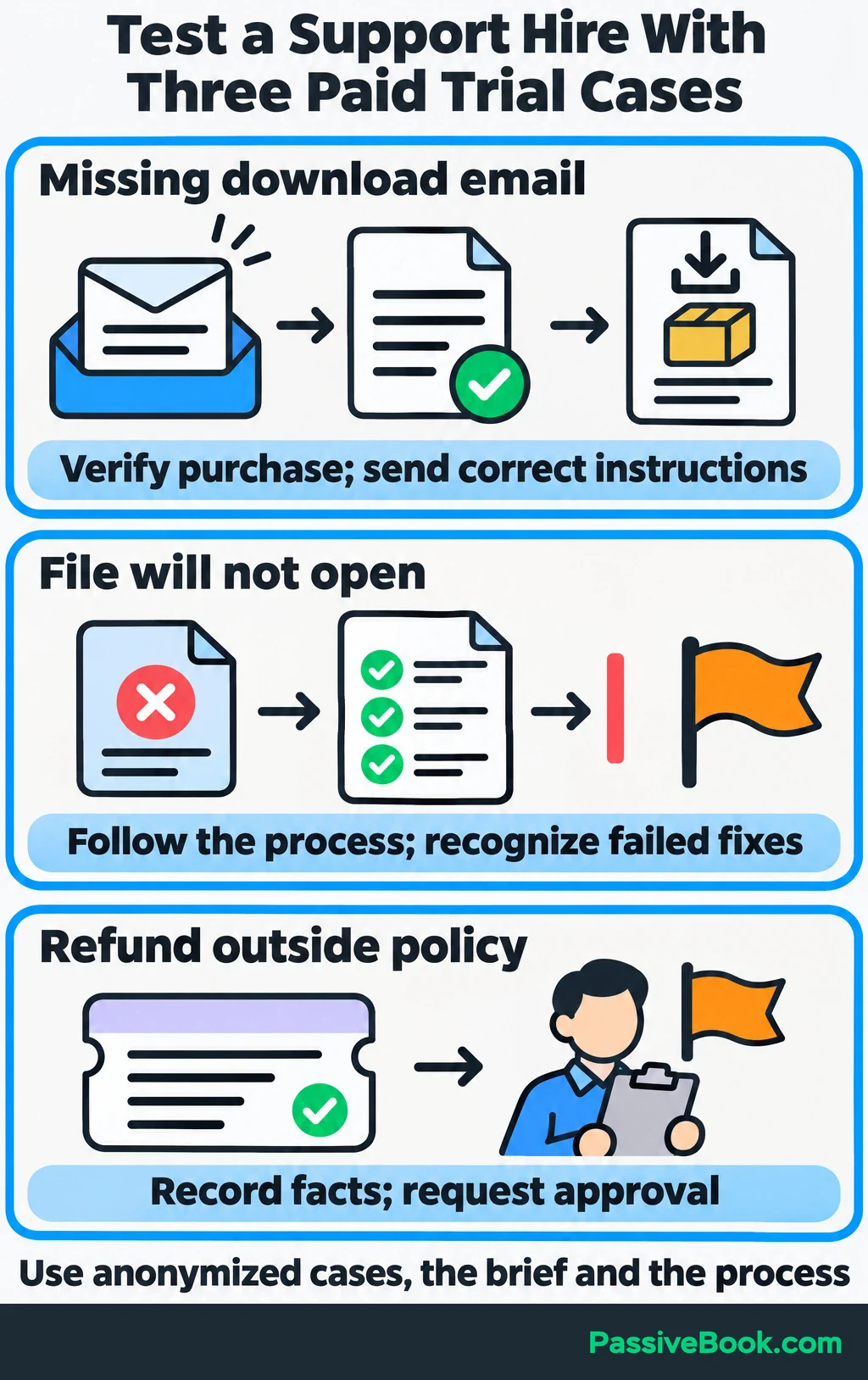
Then run a small paid trial. Give the shop’s candidate anonymized cases, the brief and the process:
| Trial Case | What Good Work Shows |
|---|---|
| A buyer cannot find the download email | Verifies the purchase and provides the correct access instructions |
| A buyer cannot open the file | Uses the documented troubleshooting steps and recognizes when they have failed |
| A buyer requests a refund outside the policy | Records the relevant facts and asks for approval without promising a refund |
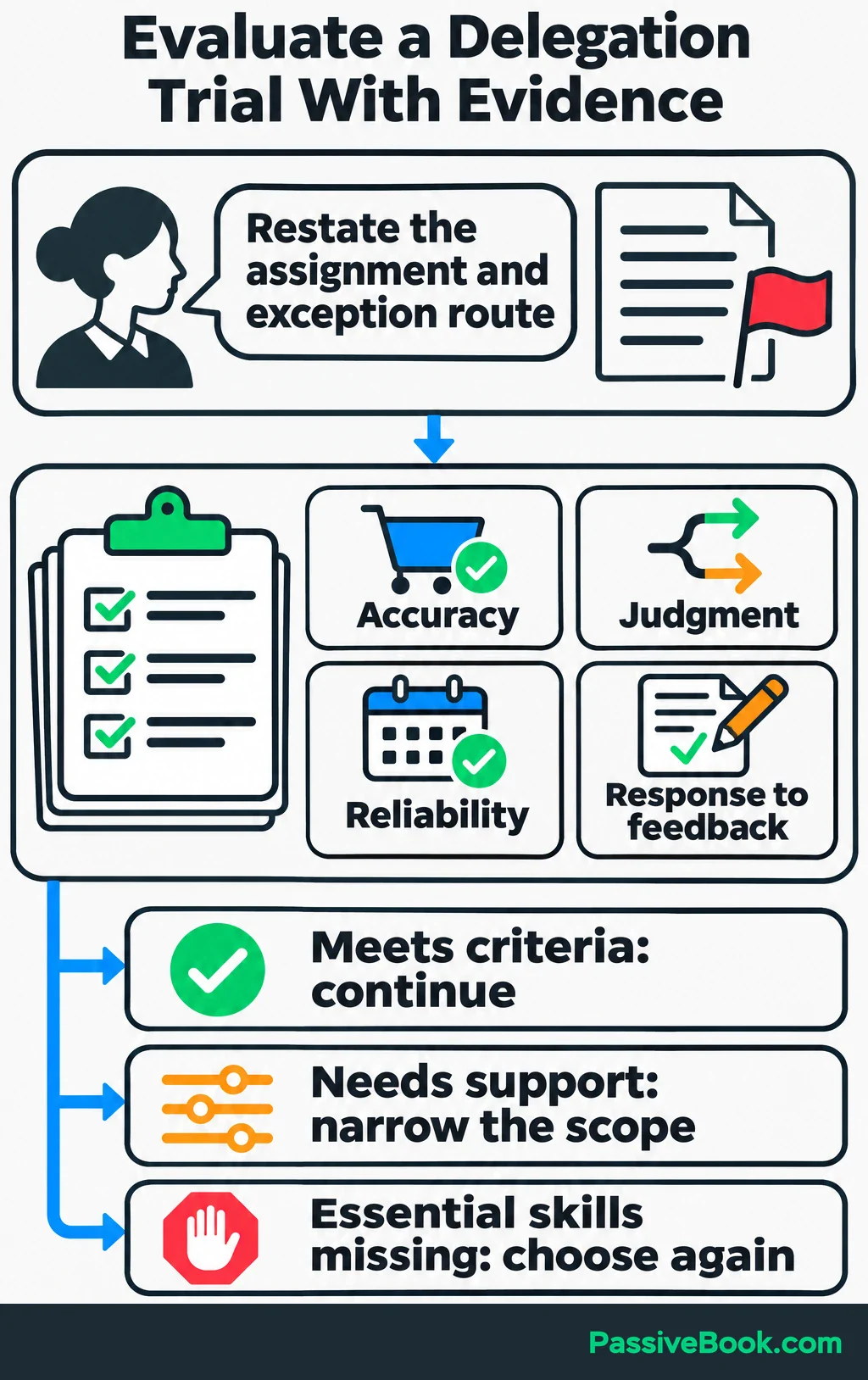
Before they begin, ask them to restate the assignment and explain what they would do with an exception. Resolve missing information then.
Judge accuracy, judgment, reliability and response to feedback. A slower candidate who checks the purchased product may be a better fit than a fast one who guesses.
Continue if the work meets the criteria. Narrow the assignment if one part needs more support, or choose someone else if the essential skills are missing.
Transfer Ownership Through Staged Checkpoints
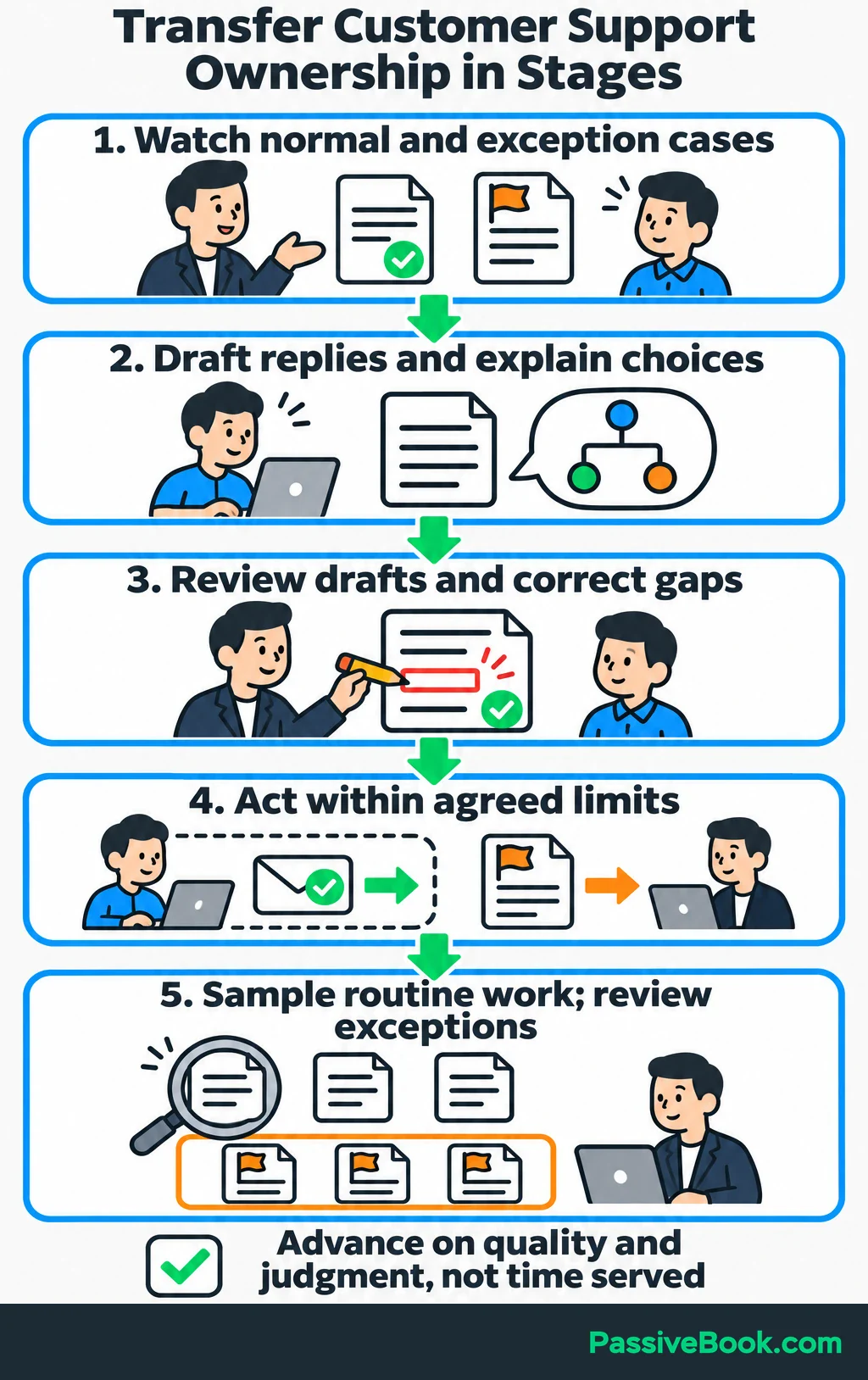
Move responsibility over in stages. Demonstrate the task, have the person perform it and review their reasoning before independent delivery.
For routine support, I would use this progression:
- They watch you handle a normal case and an exception.
- They prepare replies and explain their choices.
- You approve drafts and correct misunderstandings.
- They act independently within the agreed limits.
- You review a sample of routine work and continue reviewing exceptions.
Advance when the work meets the brief’s quality checks and the person recognizes cases they should escalate. Time served is not evidence of readiness.
Use one shared record for completed work, next actions, blockers and decisions needed. Avoid scattering updates across email, chat and private notes.
Agree on when you will review that record and when someone should interrupt you. A routine refund decision might wait for the next review. A deadline or customer commitment at risk needs an early warning.
Checkpoints should become lighter as delivery becomes dependable. If every ordinary reply still needs your approval months later, identify which decision or skill has failed to transfer.
Correct Poor Work Without Taking Everything Back
Compare the work with the agreed criteria before deciding what went wrong.
An incorrect result might come from unclear instructions, missing access, insufficient skill or too much work. Each needs a different fix.
Give feedback that names the gap, its effect and the correction:
“The customer received the wrong pack link and still cannot access their purchase. Confirm the purchased product, resend the correct instructions and add that check to the process.”
The responsible person should make the correction and update the checklist. If a customer needs an urgent fix, step in, then explicitly return follow-up ownership.
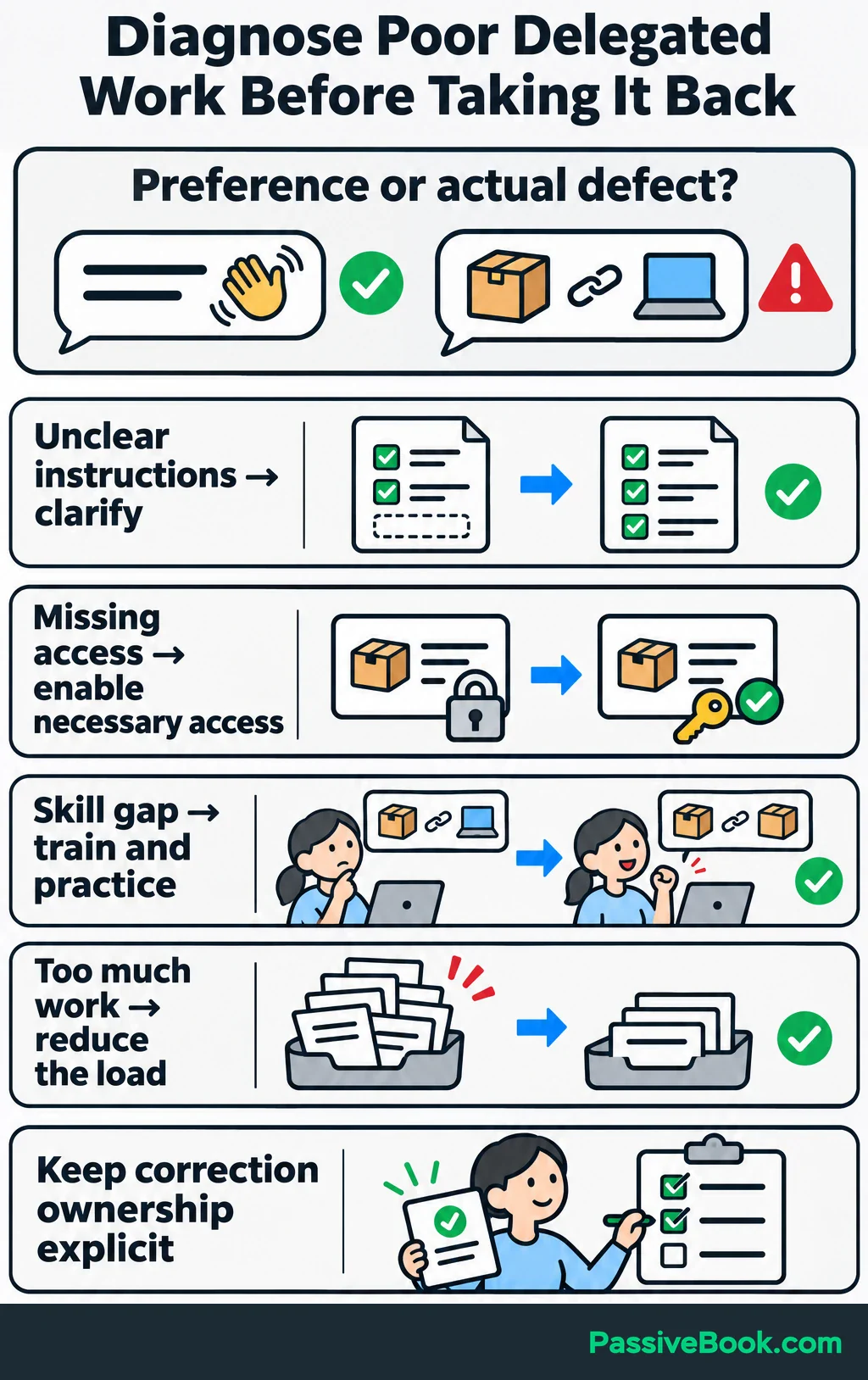
I learned to separate preferences from defects when reviewing delegated blog formatting. I kept changing heading spacing after drafts came back, even when the pages were readable and consistent. Eventually, I put the actual publishing requirements into the checklist and stopped treating every personal preference as a correction.
Use that distinction in your own reviews. A different greeting is a preference. An incorrect download link needs fixing.
When someone brings a routine problem, ask what they recommend and why. MIT Sloan’s delegation guidance recommends helping people reason through questions while remaining available for support.
Keep that invitation supportive. You want early warnings, so don’t make asking for help feel like failing a test.
If standards remain unmet after clear feedback and suitable support, narrow authority, retrain or reassign the work. Also acknowledge dependable delivery and improvements that make the process easier for the next person.
Use Reclaimed Time to Build Capacity
After several complete work cycles, compare the time you still spend on the assignment and its total cost with your estimate. Check missed commitments, corrections and customer-impacting errors, including reopened requests.
Review unresolved requests individually: waiting for a customer’s reply is different from forgetting to follow up.
Reserve the recovered time for a named priority. You might improve the cat-sitter pack, test a distribution channel or take an evening away from work. Reclaimed time creates capacity. Extra revenue depends on what you do with it.
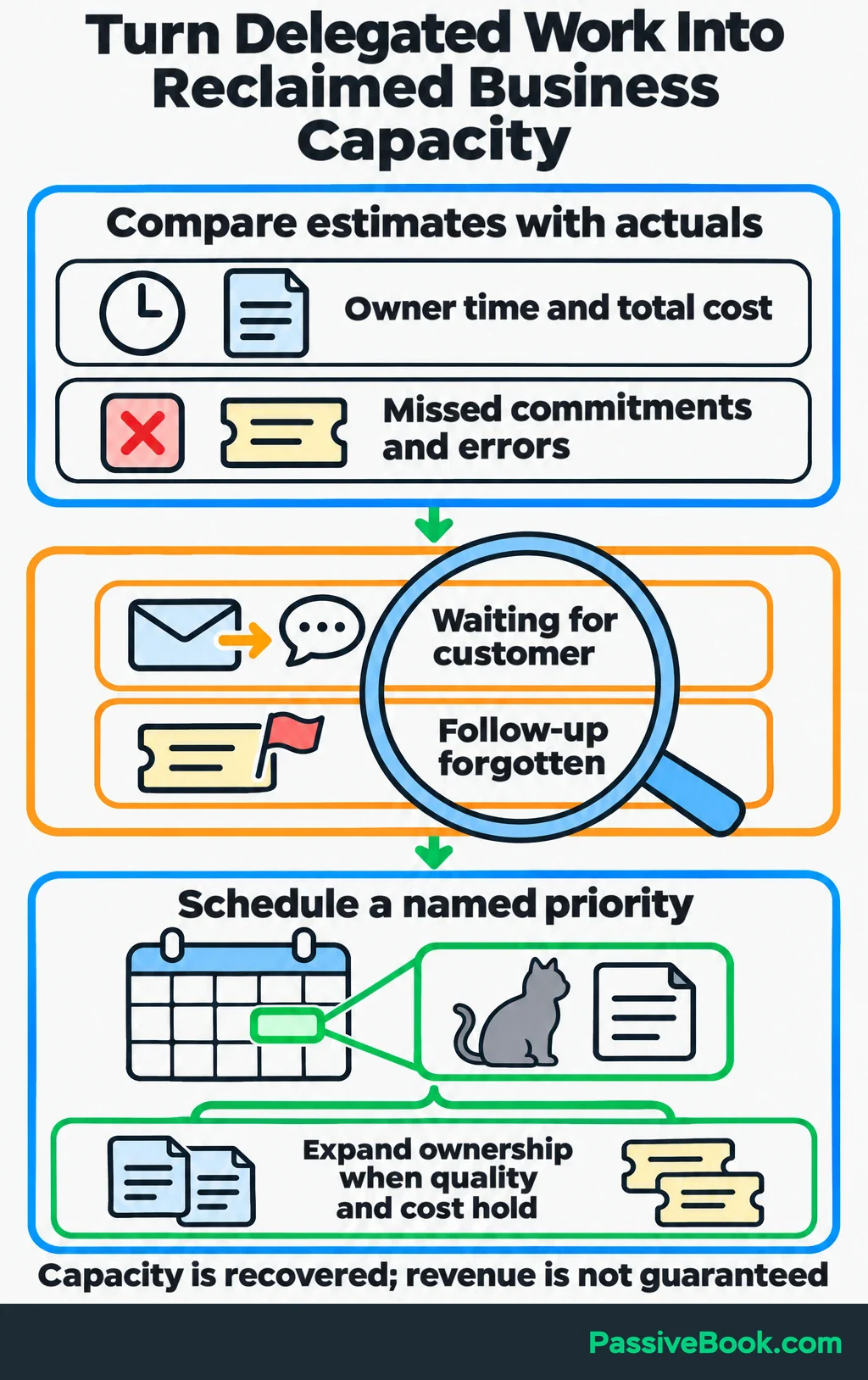
Once quality and cost are dependable, expand responsibility from answering individual requests to owning routine support. That can include maintaining reply templates, keeping the queue current and reporting recurring customer problems.
For a broader review, use the four Cs that Selina Johnson explains in her interview with Megan Sumrell:
- Communicate: Make the goal clear.
- Clarify: Identify the right people for the work.
- Command: Give clear instructions and confirm understanding.
- Cultivate: Help people develop judgment so they can handle more without you.
Johnson adds a fifth step, “claim,” which means deliberately reclaiming your time. Put that time on your calendar. Otherwise, another small job will happily occupy it.
What Next?
Choose one recurring task from this week and write its outcome, quality checks and decision limits on a single page. Use that page to scope an affordable paid trial.
Use the social buttons to share this guide when the conversation turns to getting work off your plate without letting standards slip.
Which task would you hand over first, and what would you need to see before trusting someone to own it? Share your answer, along with any other questions, in the comments.
Share this post with your friends & followers:

