A useful article can answer a question and still leave the reader with nowhere to go. You earn the visit, but the conversation stops before your offer becomes relevant.
Keep publishing without fixing that gap and you have more content to maintain, while the route to a sale stays unclear. Buyers can face the same problem after checkout when nobody shows them where to begin.
Mapping the stages helps you connect those moments. Here’s how to choose the message, next action and measurement that carry someone from discovering your advice to using your product and recommending it.
What Are the Marketing Funnel Stages?
Marketing funnel stages group people by what they need from your business as they discover it, consider buying and become customers.
This guide uses six stages:
Awareness → interest → consideration → conversion → retention → loyalty.
Each stage gives you a different job:
| Stage | What The Person Needs |
|---|---|
| Awareness | Help with a problem and a reason to notice your business |
| Interest | More useful guidance and a way to stay connected |
| Consideration | Enough information to judge whether your offer fits |
| Conversion | Clear purchase details and a working checkout |
| Retention | Help using the purchase and continuing to get value |
| Loyalty | Reasons to prefer your business and recommend it |
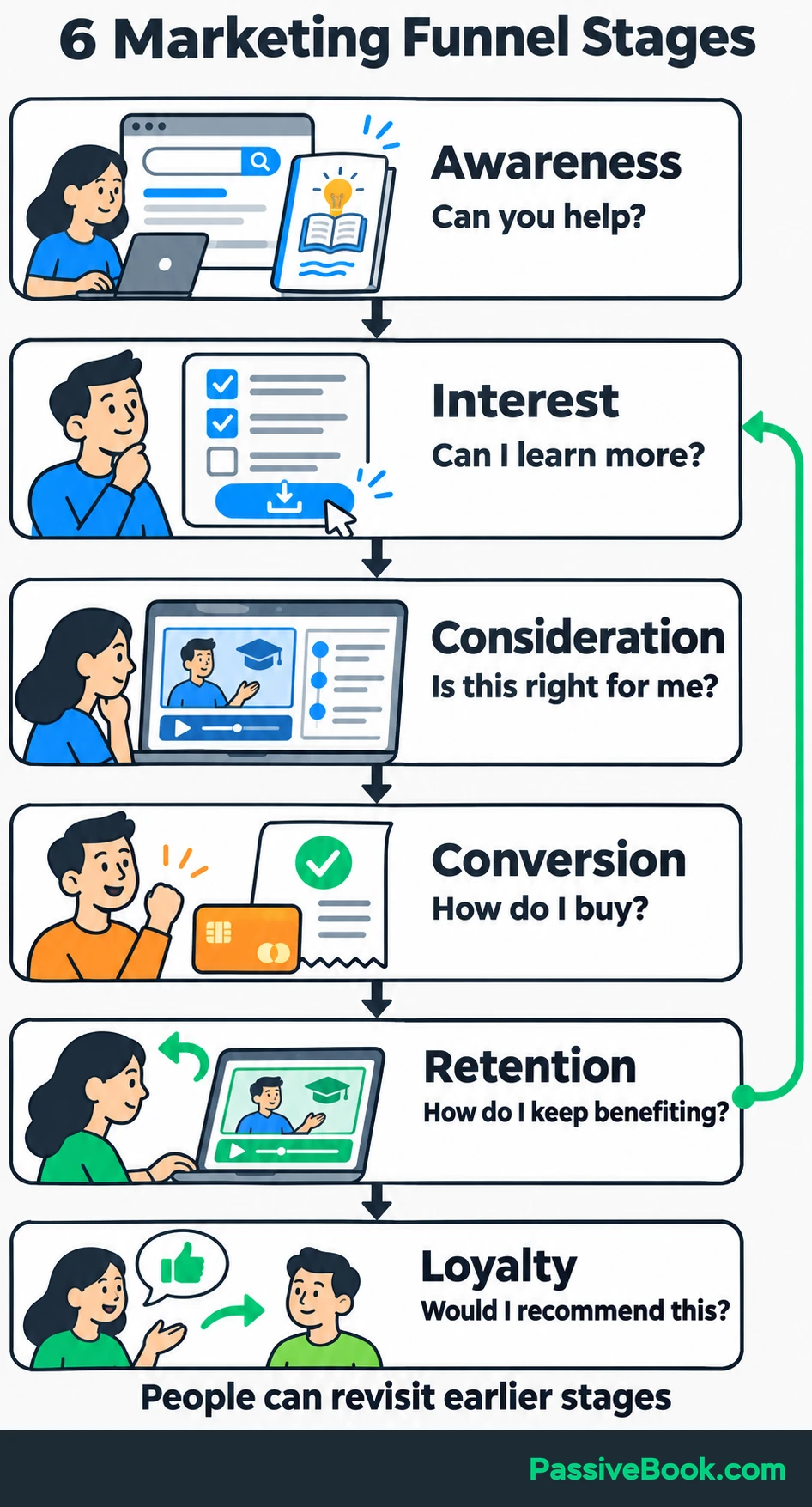
Retention and loyalty deserve separate attention. A customer might keep buying because switching is inconvenient. Loyalty adds preference: they would choose you again or recommend you.
Here, conversion means a completed purchase. A newsletter signup can also count as a conversion in your reports, but it is an intermediate action on this path.
To identify someone’s likely stage, look at their question alongside their behavior. Requesting a checklist suggests interest. Checking equipment requirements suggests consideration. Starting checkout signals readiness to purchase.
These are clues, and people can revisit earlier questions. Google’s purchase-decision research describes shoppers looping between exploring options and evaluating them. My practical takeaway: keep product details and buying routes available even when you have a longer sequence planned.
Why Do Some Funnels Have Three, Four or Five Stages?
Different models combine different parts of the relationship.
| Model | How It Groups The Journey |
|---|---|
| Three broad groups | Top of funnel covers awareness and early interest; middle covers further learning and evaluation; bottom supports purchase |
| Four stages | Awareness, consideration, conversion and loyalty |
| Five stages | Awareness, interest, consideration, conversion and loyalty |
| Six stages used here | Awareness, interest, consideration, conversion, retention and loyalty; customer use gets its own stage |
You may see the three groups shortened to TOFU, MOFU and BOFU. They describe the top, middle and bottom of the funnel and mainly summarize the path to purchase.
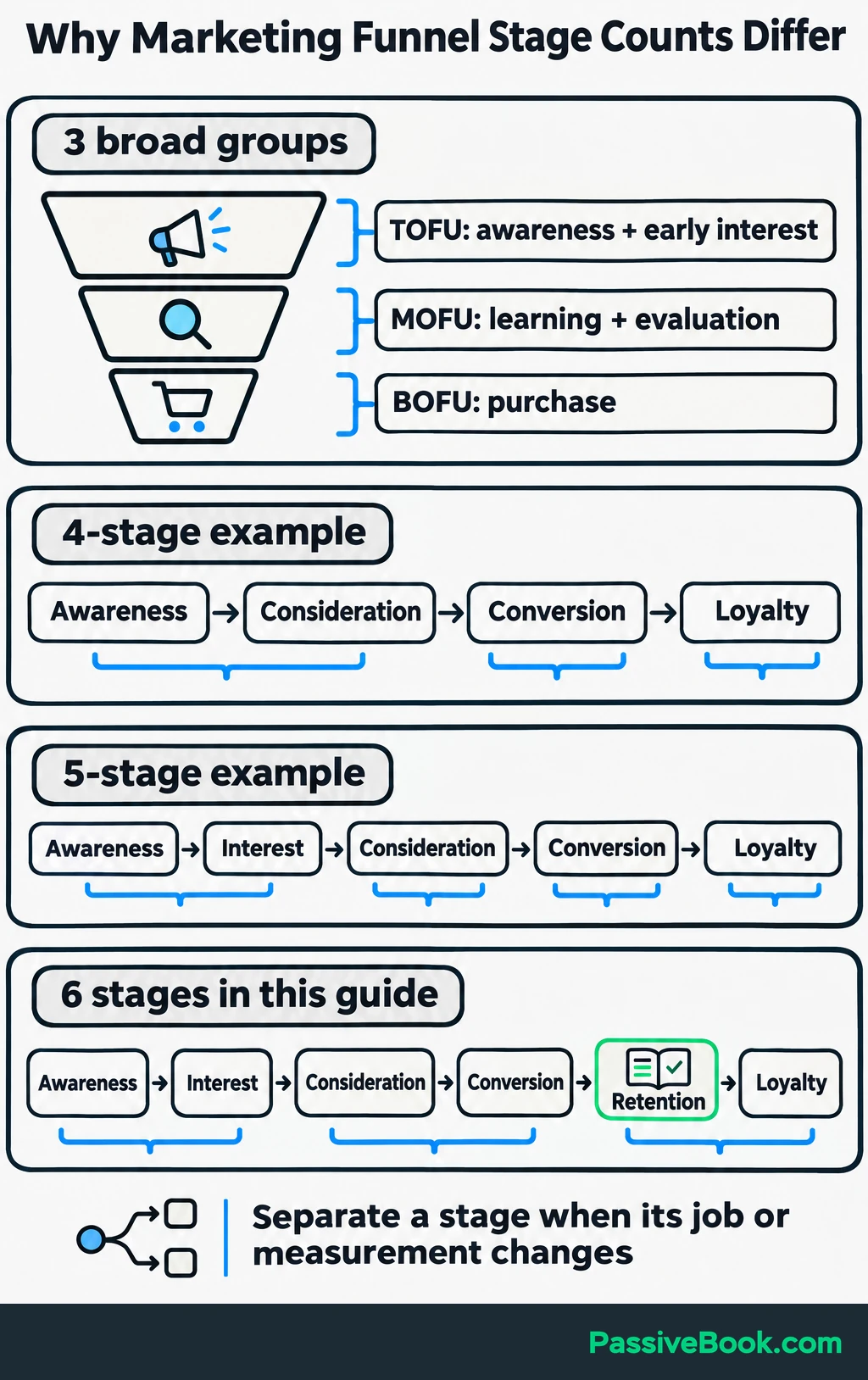
LinkedIn’s guide maps those groups to its five-stage model, which puts customer experience, repeat buying and advocacy under loyalty. Amazon’s four-stage model combines more of the early journey and notes that there is no universally accepted stage count.
I would keep a separate stage when it changes what you say, what you ask someone to do or what you measure. Six labels do not require six tools.
What Should You Do at Each Funnel Stage?
Start with the person’s current question. Then choose a piece of content that answers it, a call to action (CTA) that names the next step and a metric that shows whether people take it.
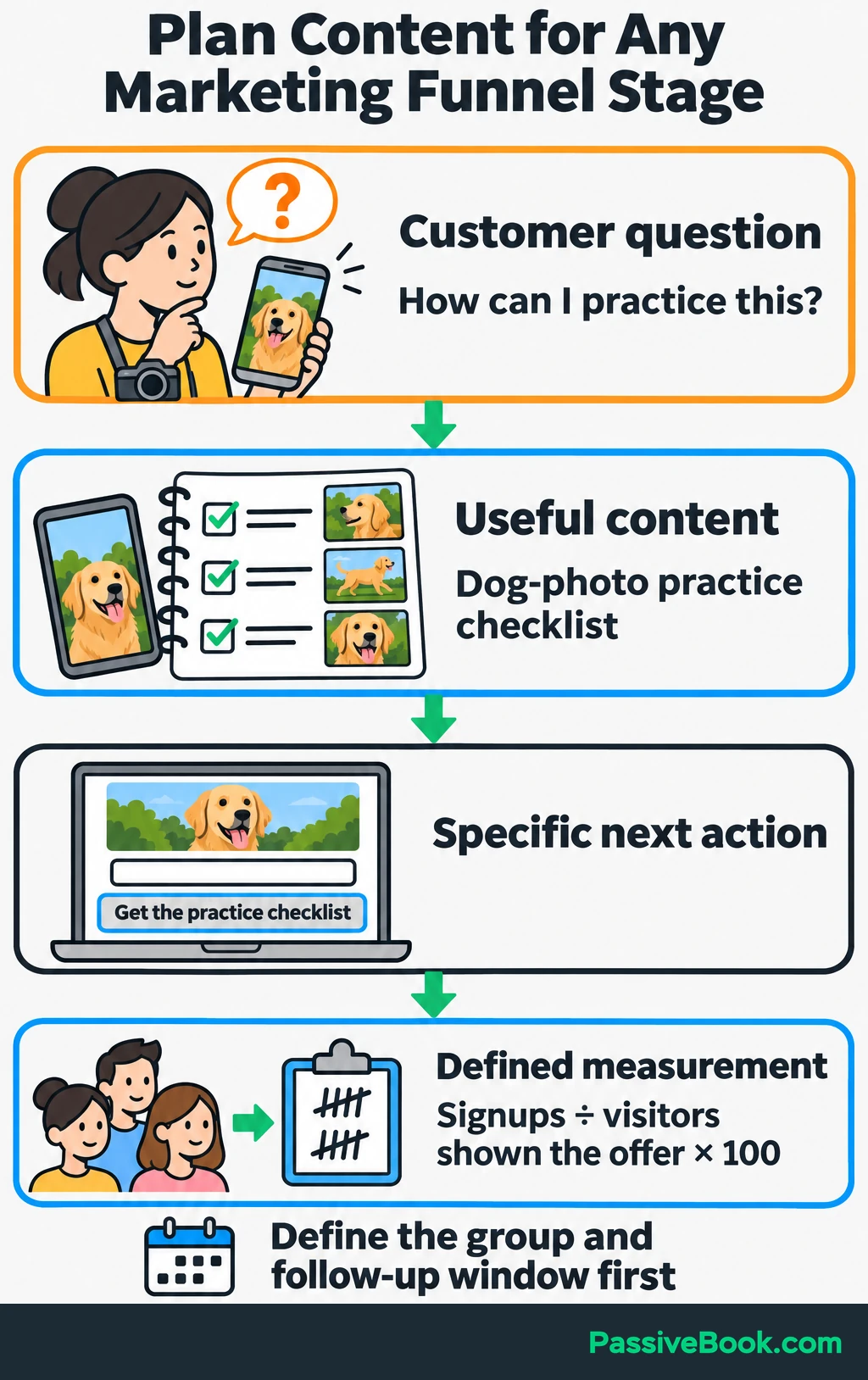
Throughout this guide, imagine you sell a self-paced course on photographing dogs with a smartphone. Customers want clearer, better-composed photos without buying a separate camera. The assets, copy and figures below are illustrations.
For each rate, define the starting group and follow-up window before counting results. The measurement section shows how.
Awareness: Help People Discover Useful Advice
At this stage, answer the problem that brought someone to you. Your course can become relevant later, but the first piece of advice should stand on its own.
For the dog-photo course, someone searches, “Why are my dog photos blurry?” A starter guide could explain how movement affects a photo and offer one simple practice exercise.
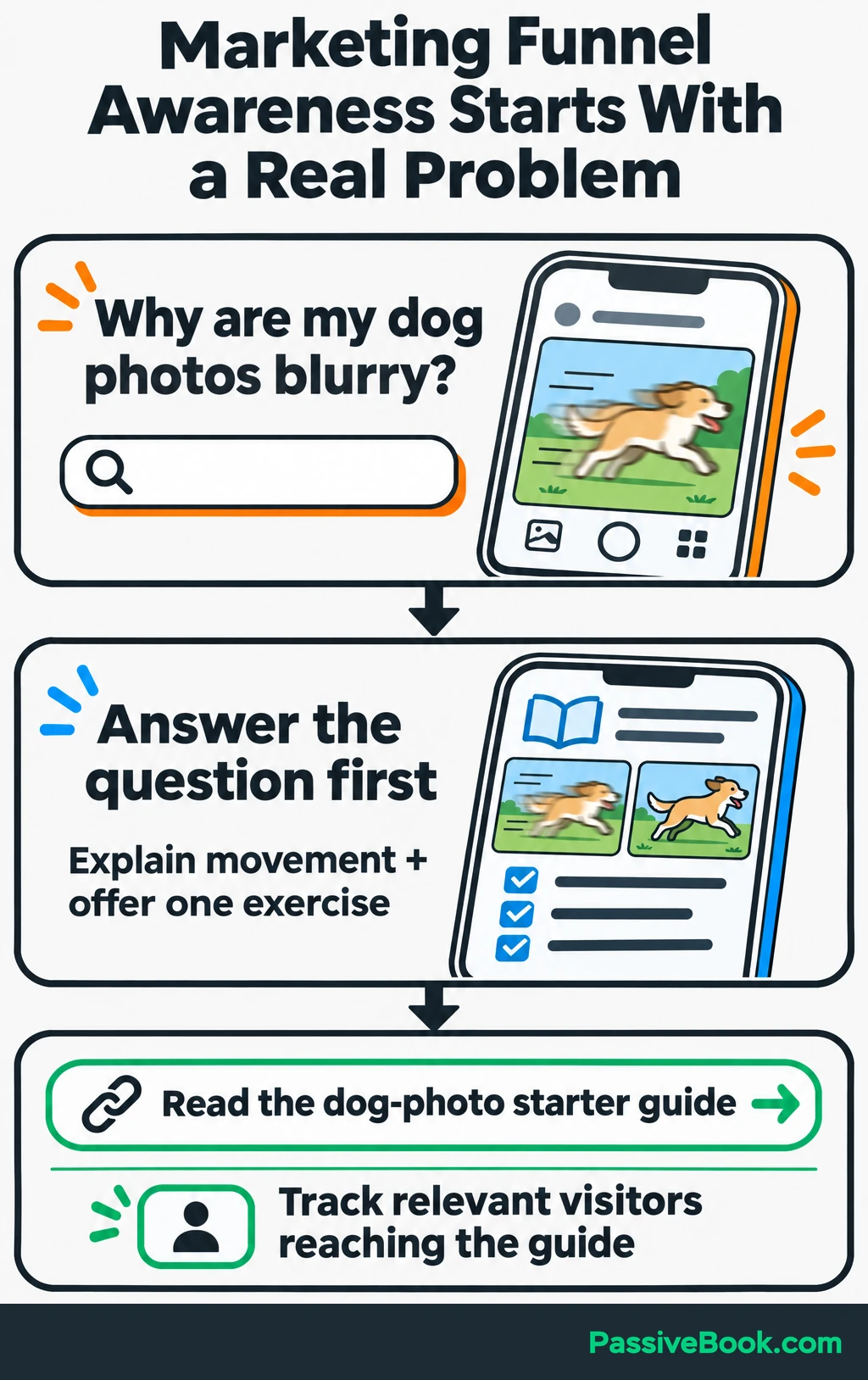
Your discovery message might be:
“Dog photos coming out blurry? Start with this simple phone-photo exercise.”
- Asset: A starter guide reached through search, a shared link or a Pinterest pin.
- CTA: “Read the dog-photo starter guide.”
- Metric: Unique visitors reaching the guide from relevant discovery sources.
I spent six months chasing Instagram and Twitter/X followers in another niche while revenue barely moved. That experience makes me suspicious of attention reports with no connection to an offer. Those channels can have a role, but I want to know where an interested person can go next.
Interest: Give Visitors a Useful Next Step
Interest shows up when someone wants more help. They might read another tutorial, request a resource or reply with a question.
Offer a next step that extends what they just learned. A dog-photo practice checklist fits the starter guide because it helps readers repeat the exercise.
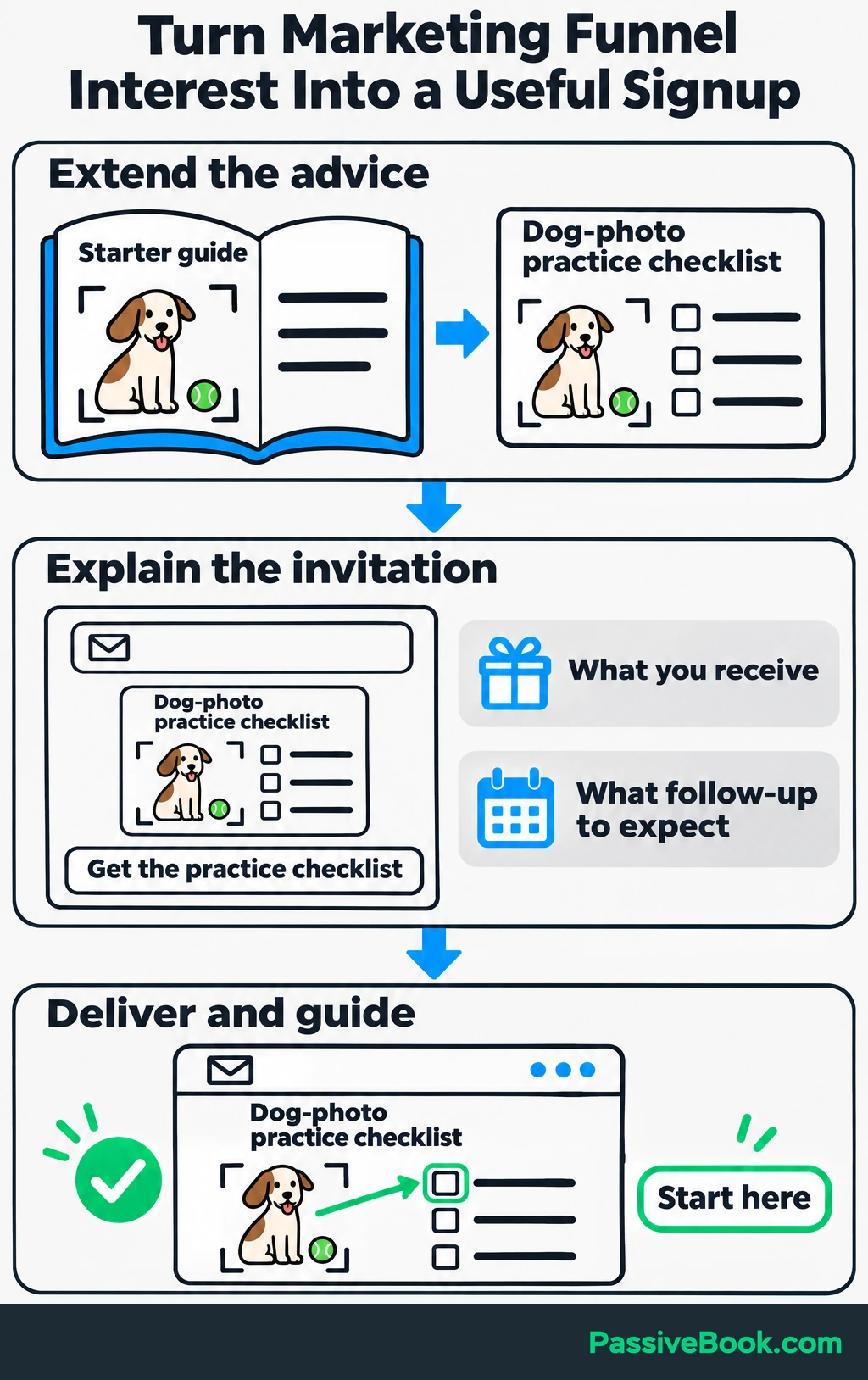
Explain what they will receive and what follow-up to expect. Then deliver the checklist with a short welcome email showing where to begin.
- Asset: A practice checklist and delivery email.
- CTA: “Get the practice checklist.”
- Metric: The percentage of unique guide visitors shown the offer who sign up for the checklist within your chosen window.
I would skip a broad “Join my newsletter” invitation here. “Get the practice checklist” gives the visitor a concrete reason to stay connected.
Consideration: Show Whether the Offer Fits
Someone considering the course has a different question: “What would I get here that I cannot get from free tutorials?”
Help them judge that. Explain the skills taught, starting knowledge, equipment, lesson format, access and support. A sample lesson lets them assess how you teach, even before you have student results to share.
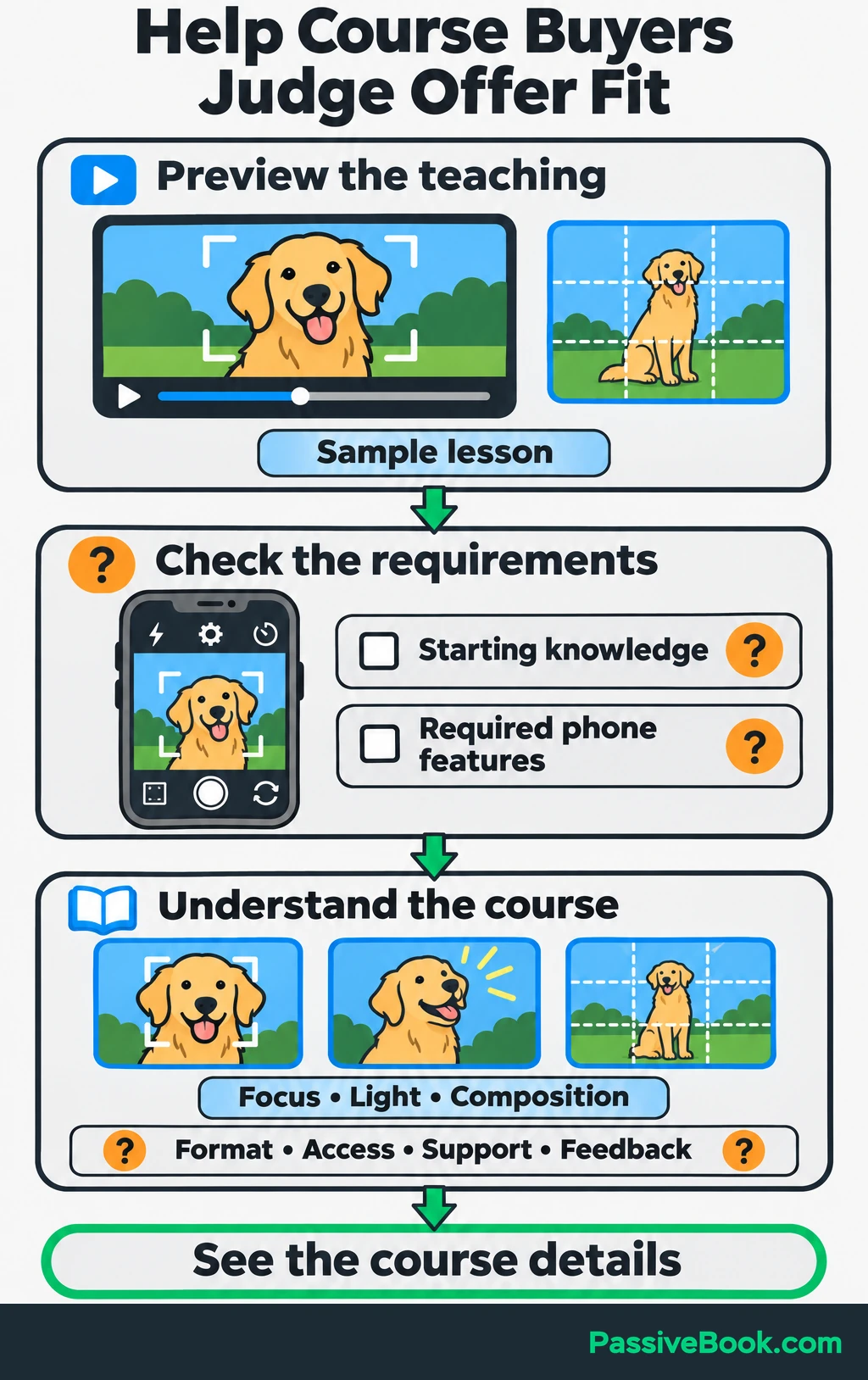
For this example, the course page could describe a sequence of exercises covering focus, light and composition. It should also state which phone features the lessons require and whether personal photo feedback is included.
A useful excerpt might say:
“See how the lessons work, check the phone requirements and review the exercises before enrolling.”
- Asset: A sample lesson linked to a clear curriculum and course page.
- CTA: “See the course details.”
- Metric: Among unique sample-lesson visitors shown the course-page link, the percentage who follow it within your chosen window.
Conversion: Make the Purchase Straightforward
Now the question is, “Am I ready to buy, and what happens after I pay?”
Keep the purchase promise consistent with the advice and sample lesson that brought the visitor here. State the total price, included material, access arrangements, support and refund terms before payment.
- Asset: A sales page and checkout that answer final purchase questions.
- CTA: “Buy the dog-photography course.”
- Metric: The percentage of unique sales-page visitors who buy within your chosen window. Separately, track the percentage of unique checkout starters who complete payment within that window.
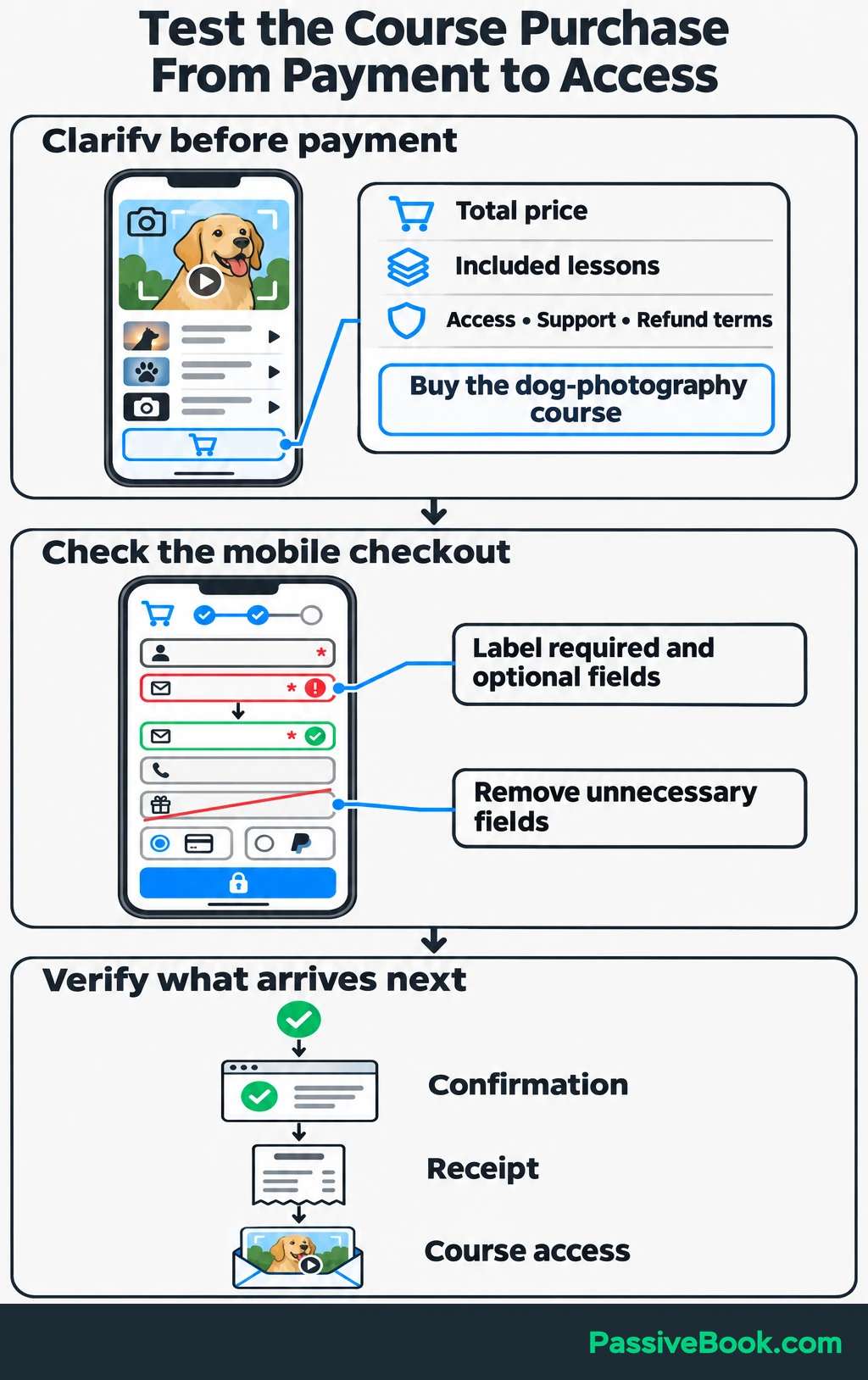
Test the purchase on a phone. Check the payment, confirmation, receipt and course-access message.
Remove unnecessary checkout fields and label required and optional fields clearly. Baymard’s checkout research found that unclear field requirements caused confusion, errors and slower completion in its usability testing. That is a useful reason to inspect the form before writing another sales email.
Retention: Help Buyers Keep Getting Value
The first post-purchase message should make starting easy. A buyer needs access, a clear first lesson and a manageable task.
For the dog-photo course, point them to one lesson and one assignment. A later reminder can help them attempt the next exercise or ask for help.
- Asset: An access email, a clear starting lesson and a relevant practice reminder.
- CTA: “Start your first lesson,” followed later by “Try the next exercise.”
- Metric: Among buyers with at least 30 days since purchase, the percentage who returned for another lesson during their first 30 days.
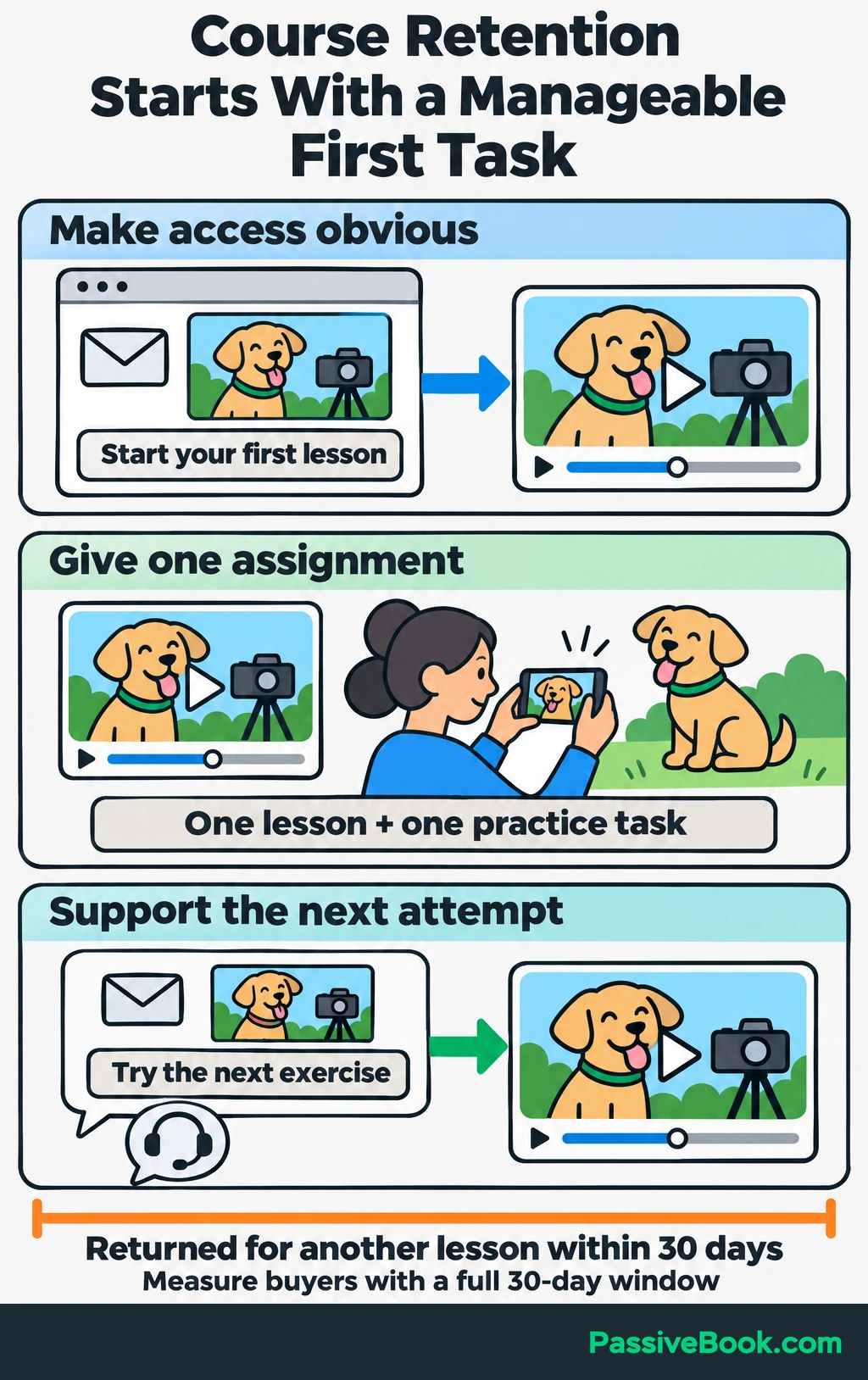
For a one-time course, continued use is a useful sign of engagement. You do not need to manufacture another purchase to measure it.
If you later create another offer, introduce it when it serves a further need. Buying the first course should not feel like qualifying for the next sales pitch.
Loyalty: Encourage Preference and Recommendations
Loyalty develops when customers have reasons to choose your business again and speak well of it.
Continue useful support, and invite customers who have used the lessons to share their experience. A recommendation request makes more sense after someone has tried the course than immediately after payment.
- Asset: A personal check-in or recommendation invitation linked to the course page.
- CTA: “Recommend the course to another dog owner.”
- Metric: Referred buyers, alongside feedback explaining why customers recommend the course.
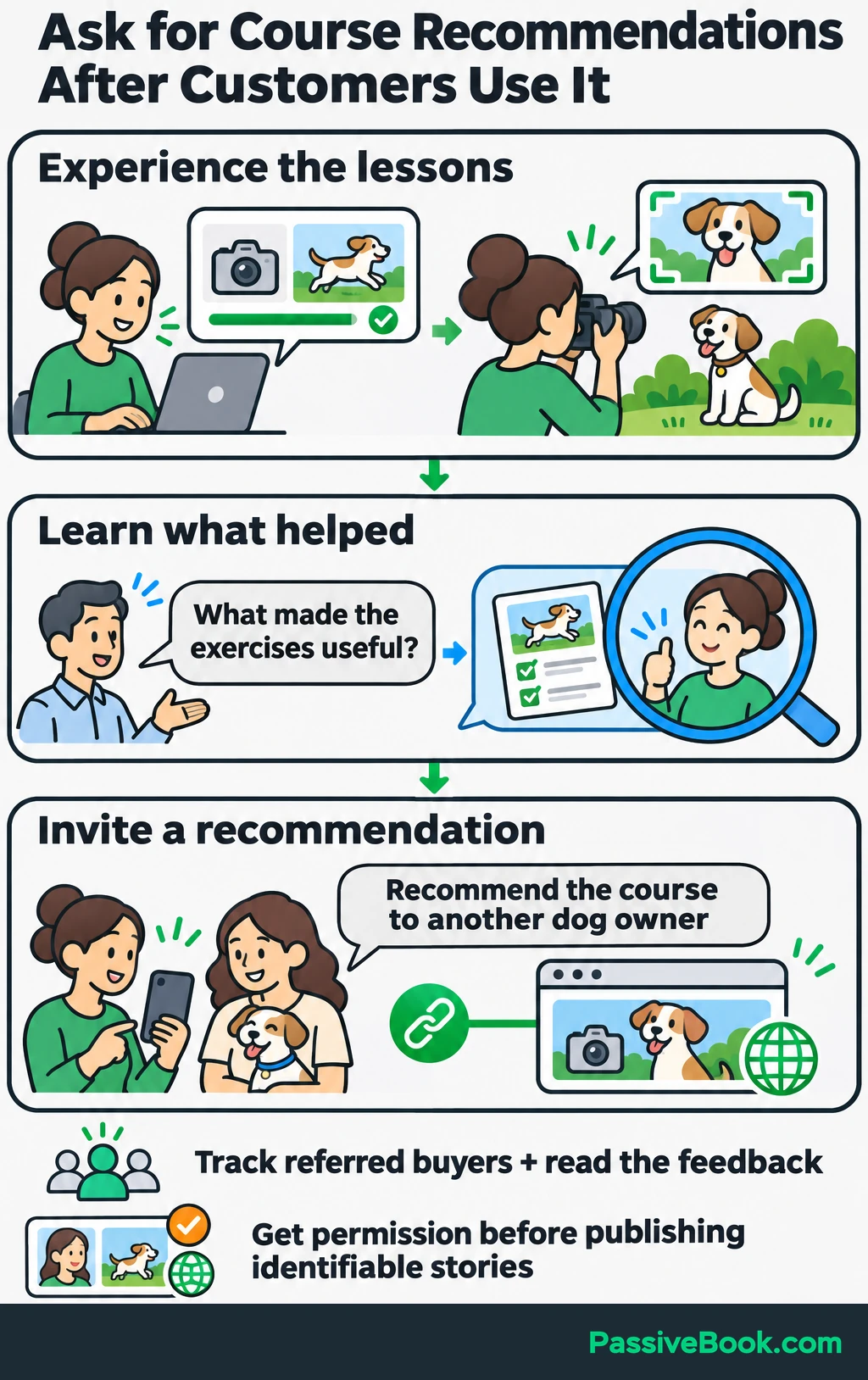
Referrals show advocacy, which is one expression of loyalty. Read the feedback too. It may reveal that customers value your clear exercises more than the bonus material you keep promoting.
Get permission before publishing identifiable customer stories or images.
How Do You Connect the Stages Into One Campaign?
Choose one audience need, one offer and a defined purchase event. Then list the questions someone needs answered before buying and after receiving the product.
For this example, the need is clearer dog photos with a smartphone. The offer is the self-paced course, and the purchase event is a successfully paid enrollment.
Inventory what you already have before creating anything else. Mark each asset as ready, needs work or missing.
A compact campaign plan could look like this:
| Stage | Asset To Check | Next Action And Destination |
|---|---|---|
| Awareness | Starter guide answering the blurry-photo question | Discovery link leads to the guide |
| Interest | Practice-checklist invitation and delivery email | Signup leads to the checklist |
| Consideration | Sample lesson explaining the teaching approach | Course-details link leads to the course page |
| Conversion | Course page with purchase details | Buy button leads to checkout |
| Retention | Access email and first assignment | Lesson link leads into the course |
| Loyalty | Check-in after customers have used the lessons | Recommendation link leads to the public course page |
In your working sheet, add columns for the customer’s question, behavior signal, message and metric. Use the stage sections above to fill them.
The example’s planned route is:
Search result or Pinterest pin → starter guide → checklist → sample lesson → course page → checkout → onboarding and practice → recommendation invitation.
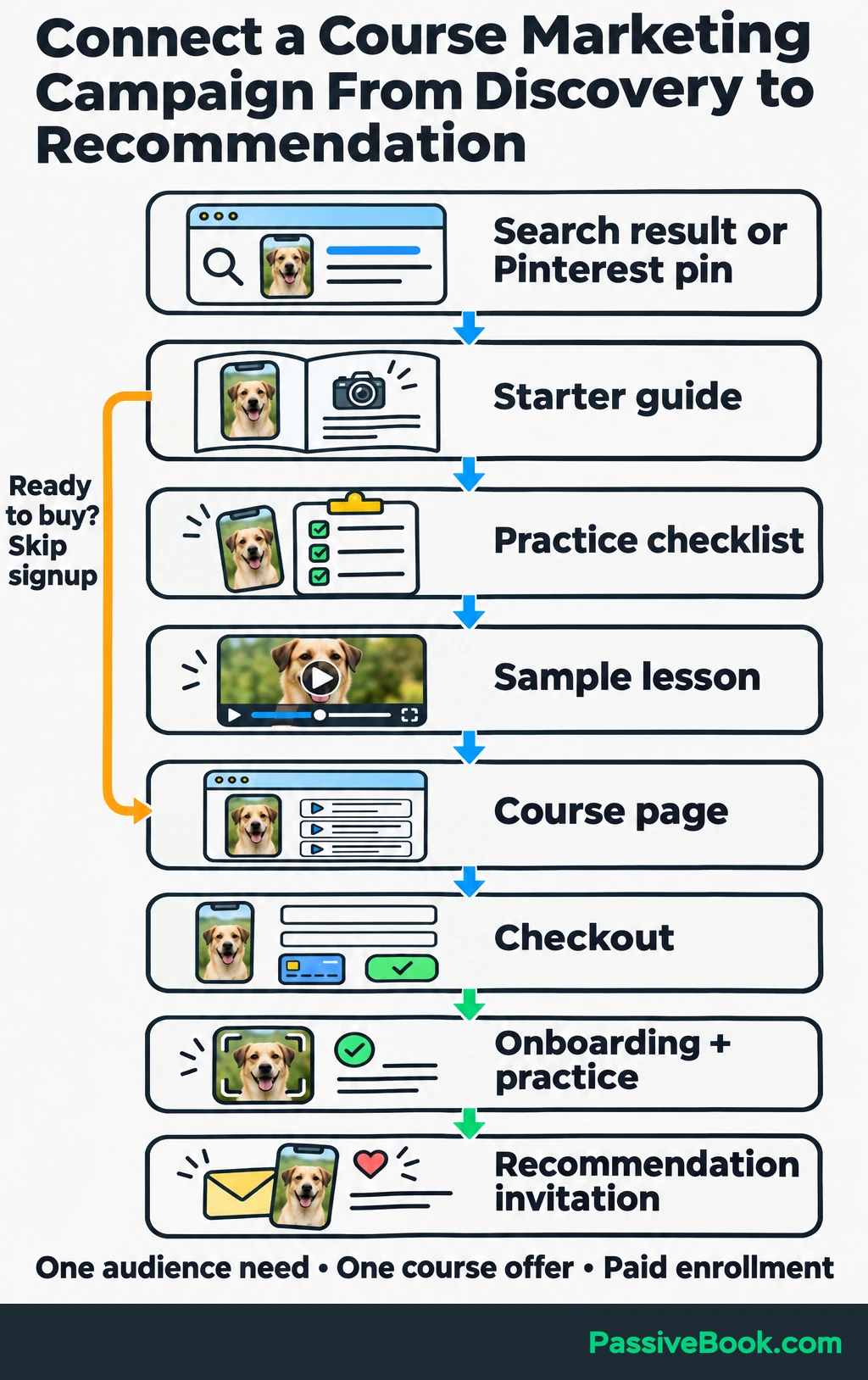
Keep a direct route from the guide to the course details too. Someone ready to buy should be able to skip the email signup.
You can also reuse assets. One course page can answer both suitability questions and final purchase questions. The stages describe customer needs, so they do not create a publishing quota.
Once you know the route, you still need the words that connect it. This AI Skill drafts those messages around your existing content and offer, including what changes after someone buys.

Free AI Copywriting Studio




Automate the connections you have defined:
- Deliver the requested checklist.
- Send relevant follow-up leading to the sample lesson and course details.
- When payment is confirmed, stop reminders to buy that course.
- Send access and guidance for the first exercise.
On WordPress, FluentCRM would be my first choice for email follow-up. If you sell through WooCommerce, a WordPress shop plugin, FluentCRM can start follow-up emails after a purchase. That integration requires FluentCRM Pro. If your existing tools already handle the necessary connections, I would keep them.
You can begin with organic discovery and your current website, email, checkout and reporting tools. Add software when a missing capability blocks a useful connection.
Test with a sample contact who subscribes but does not buy, and another who purchases. Check every destination and make sure the buyer leaves the relevant sales sequence.
Also decide who handles replies, failed payments and access problems. In a one-person business, that may be you, but give those issues an inbox and a regular review time. Automation needs somewhere to send the exceptions.
Which Funnel Stage Should You Improve Next?
Choose the point where a useful next action is blocked. Stage totals help you find it, but the percentage alone cannot explain the problem.
Measure Movement Between Specific Actions
Define where each measured step starts and ends. “Engaged subscriber” is vague. “Checklist subscriber who visits the course page” names an action you can track.
Use website, email and order records together, and compare recorded purchases with actual paid orders. If you cannot connect the records to the same people, report the separate step results without presenting them as one tracked journey.
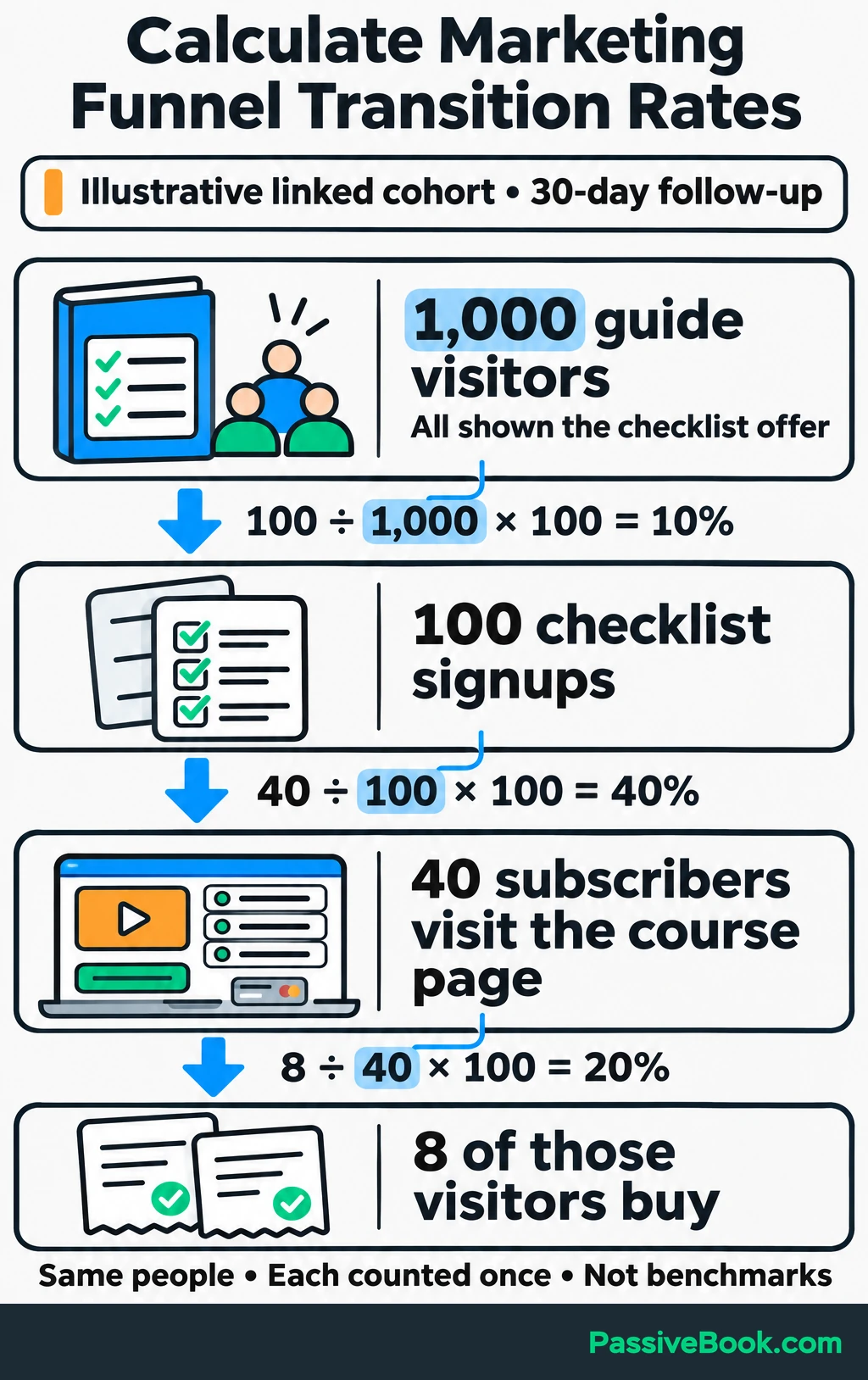
For a transition rate, count how many people in a starting group complete the next action. Divide that number by the people in the starting group, then multiply by 100.
Count each person once within each rate and keep the observation window clear.
For illustration, take 1,000 unique guide visitors, all shown the checklist offer. Follow each person for 30 days from their first guide visit. Within that window:
- 100 sign up.
- 40 of those subscribers visit the course page.
- Eight of those 40 visitors buy.
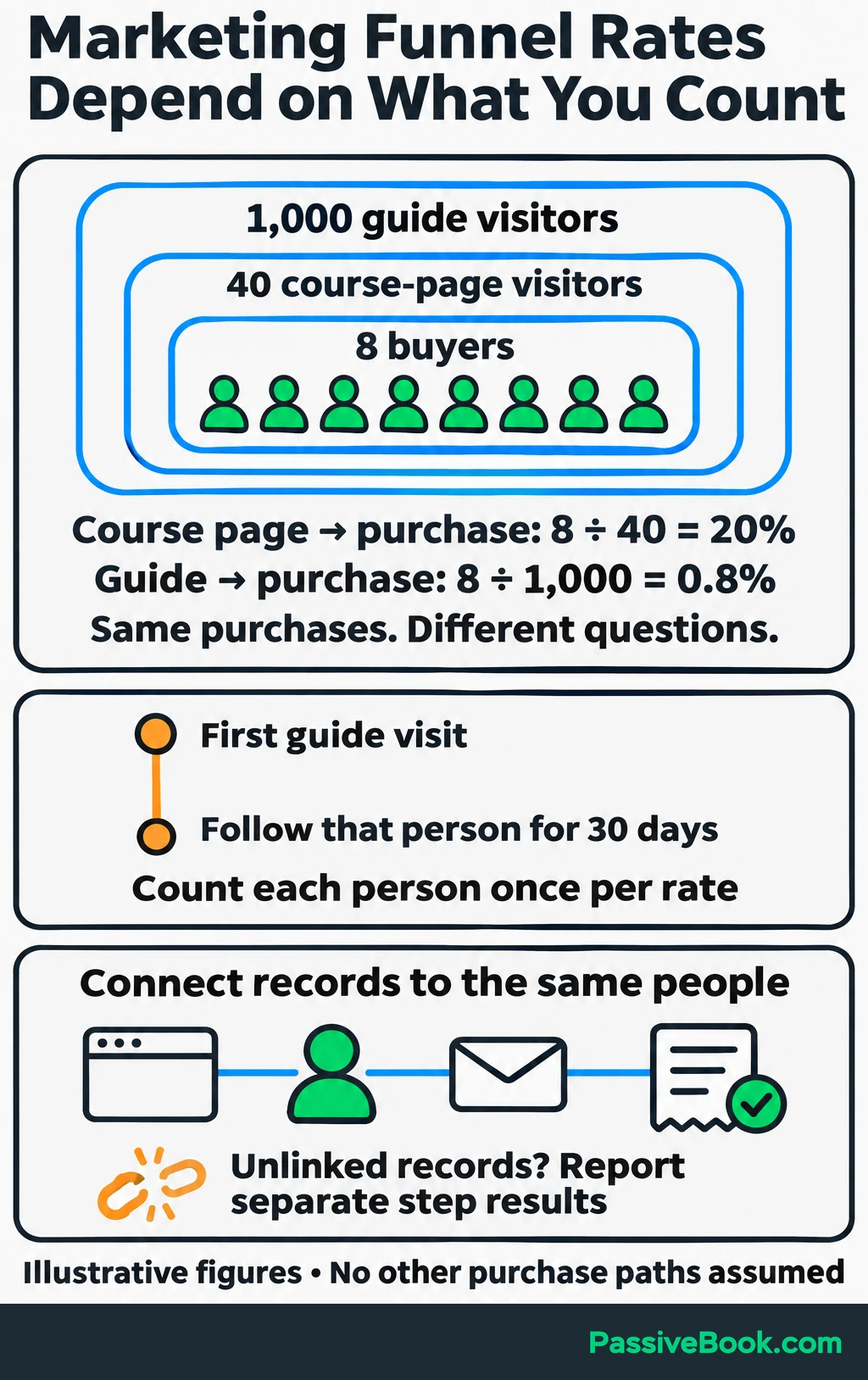
Assume the records connect these actions to the same people and this example includes no other purchase paths.
| Transition | Calculation | Rate |
|---|---|---|
| Guide visitor to signup | 100 ÷ 1,000 × 100 | 10% |
| Subscriber to course-page visit | 40 ÷ 100 × 100 | 40% |
| Course-page visitor to purchase | 8 ÷ 40 × 100 | 20% |
| Guide visitor to purchase overall | 8 ÷ 1,000 × 100 | 0.8% |
These are illustrative figures, not benchmarks.
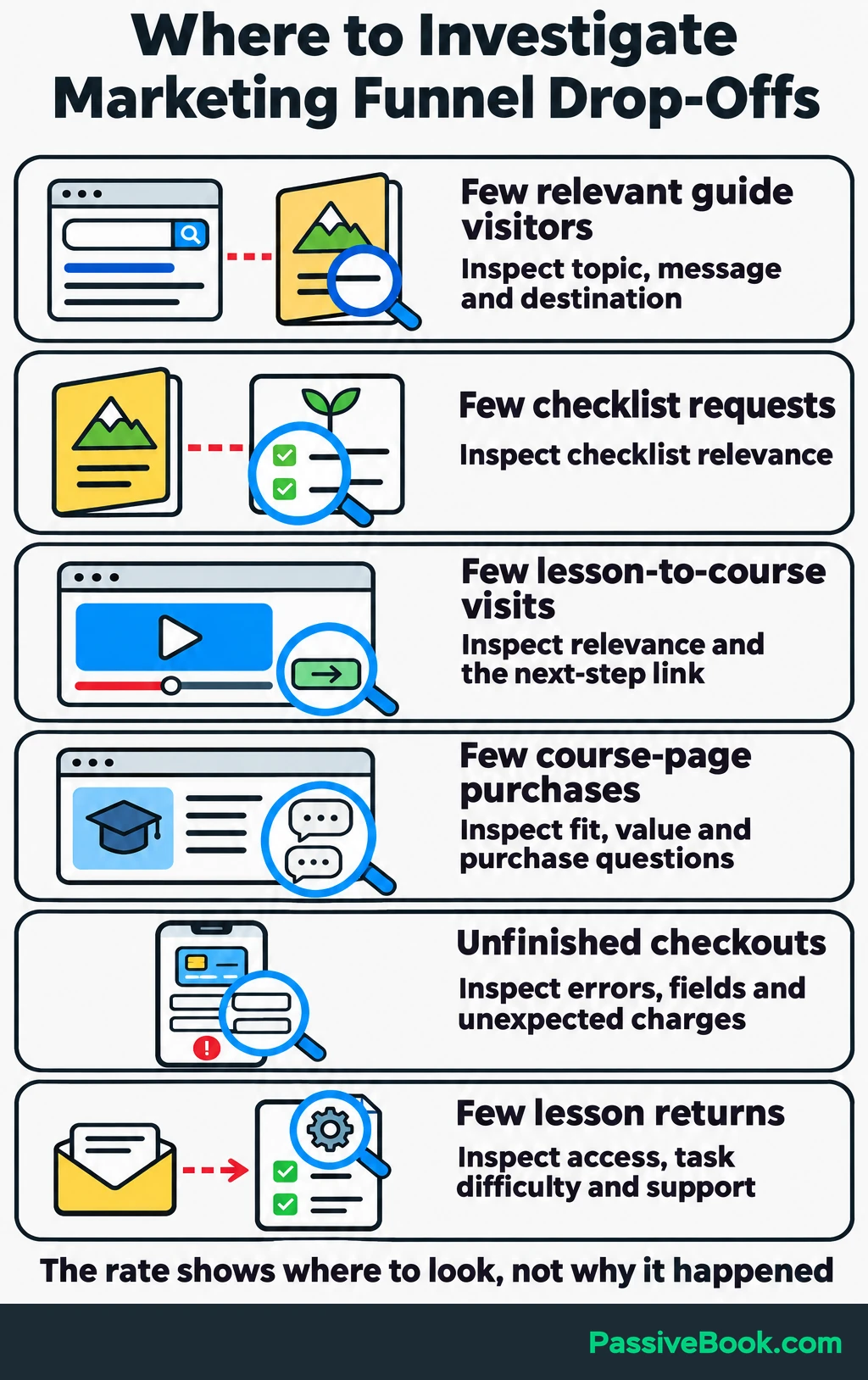
The table shows where people stopped along this route. To understand why, inspect the affected content and read the questions people ask.
Fix the Obstacle Behind the Drop-off
Match the investigation to the action people are not taking.
| What You Observe | What To Inspect First |
|---|---|
| Few relevant visitors reach the guide | Search topic, discovery message and destination |
| Visitors rarely request the checklist | Whether the checklist helps with the problem they came to solve |
| Sample-lesson viewers rarely visit the course page | Lesson relevance, explanation of the paid course and next-step link |
| Course-page visitors rarely buy | Unanswered fit, value or purchase questions |
| People start checkout but do not finish | Payment errors, confusing fields and unexpected charges |
| Buyers rarely return to lessons | Access, first-assignment difficulty and support questions |
I have caught myself answering the same file-format question by email instead of fixing a digital-product page. The answer was already in my inbox, but buyers needed it before purchase. That is the sort of repeated question I now look for when reviewing a page.
Prioritize by the number of people affected, likely business value and effort required. The lowest percentage does not automatically offer the best return on your time.
A broken checkout deserves attention before a new discovery campaign. Weak course use calls for checking access and the first exercise before adding another promotion.
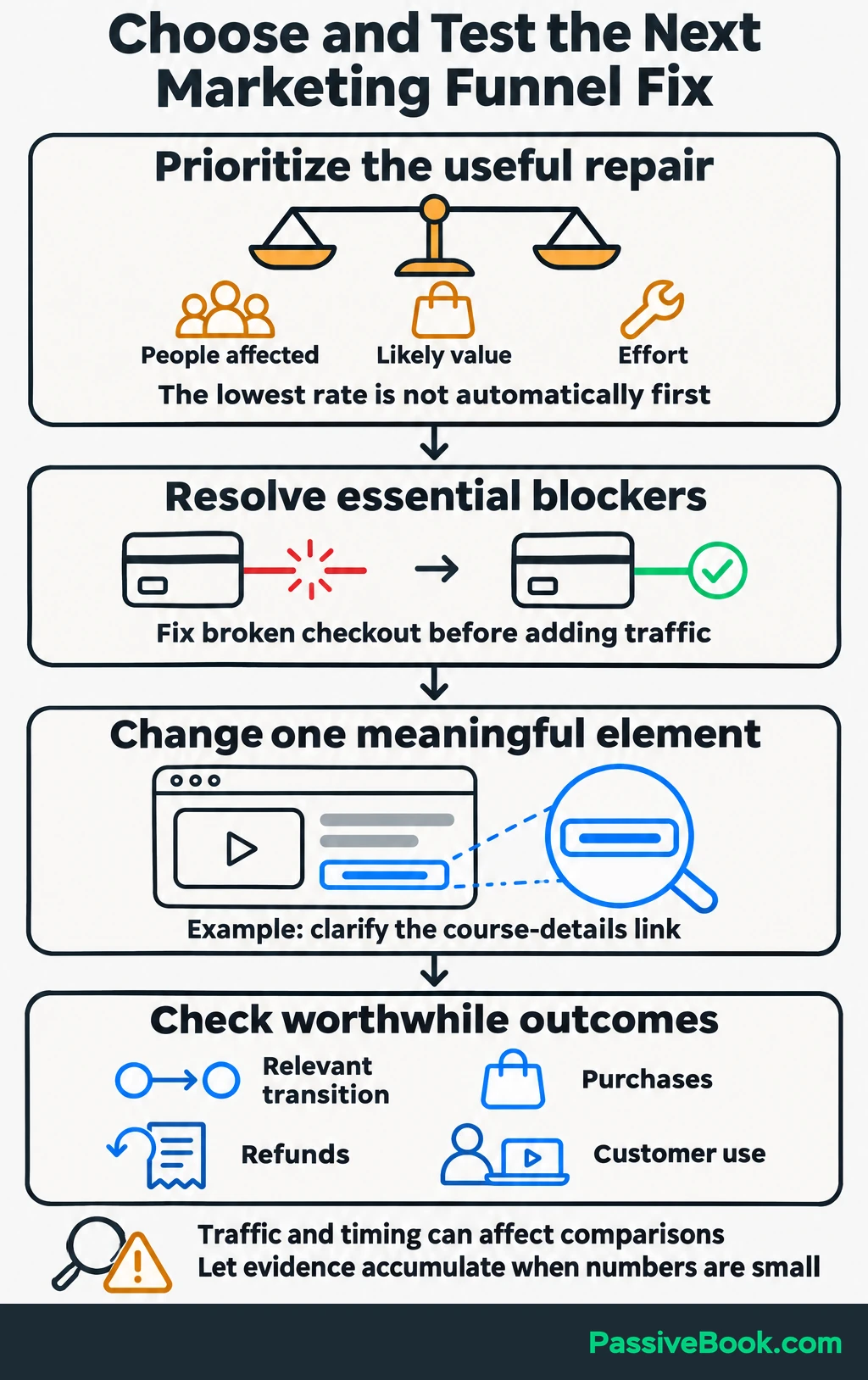
Change one meaningful element, such as the sample lesson’s next-step message. Then compare the relevant transition alongside purchases, refunds and customer use. More clicks are useful only if they help people reach a worthwhile outcome.
A before-and-after comparison gives you a direction to investigate; other changes in traffic or timing may affect the result. With small numbers, let evidence accumulate rather than rewriting the funnel after every quiet day.
What Next?
Open one article or landing page that already gets visitors and follow its next link. Check whether the destination answers the reader’s next question, then fix one missing connection.
Use the social buttons to share this guide when you want a clearer way to connect content, sales and customer follow-up.
Which transition in your business feels least clear right now? Leave your answer in the comments, and bring any other questions too.
Share this post with your friends & followers:

