You need a useful article, a follow-up email and a clear summary for sales. AI can draft all three, but someone still has to check whether they answer the buyer’s question and describe your offer correctly.
When that checking takes longer than writing from scratch, the promised shortcut becomes another job. And a growing folder of drafts tells you little about whether marketing is bringing in suitable buyers.
This guide follows one campaign from customer question to sales handoff, so you can choose where AI helps, keep control of the output and measure whether the work earns its place.
Start With One Marketing Bottleneck
To decide how to use AI for B2B marketing, look for a recurring task with clear inputs and an output someone can check. Start there before trying to automate an entire department.
Drafting from approved material and summarizing existing notes are useful starting points. Neither requires a custom predictive model or a huge customer database.
Compare a few candidates:
| Bottleneck | Available Inputs | AI Output | Reviewer | Success Measure |
|---|---|---|---|---|
| Buyer questions stay buried in conversations | Authorized inquiry emails and sales notes | Questions grouped by problem, with supporting excerpts | Person who speaks to buyers | Useful themes accepted for campaign planning |
| One content asset takes too long to adapt | Approved checklist or article | Email and social drafts | Content owner | Total time per approved content package |
| Follow-up messages need repeated rewriting | Stated buying need and approved service details | Relevant email draft | Account owner | Qualified replies and accepted consultations |
| Sales receives scattered lead notes | Forms, emails and qualification rules | Structured handoff summary | Sales owner | Accurate summaries accepted by sales |
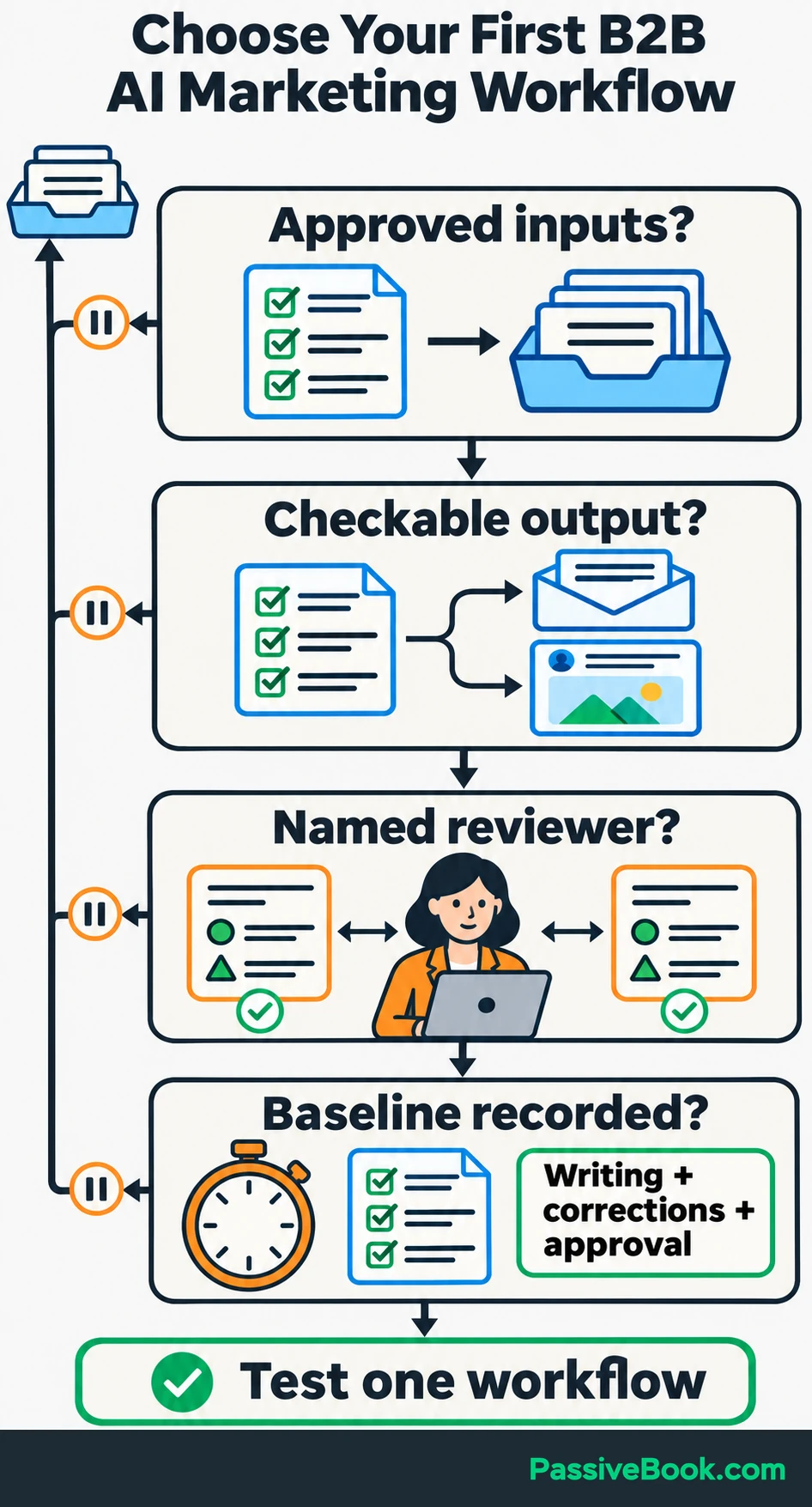
I would start with content repurposing when your source material is already sound. It gives you a contained task and makes mistakes easier to catch before anything reaches a buyer.
Record the current time spent writing, correcting and approving the work. Choose one main improvement target, such as less production time, and a quality threshold: every service claim must match the approved scope.
For the running example, imagine you run an agency selling website maintenance to independent dental practices. A maintenance checklist helps interested practices request a consultation. The agency, messages and figures below are illustrations.
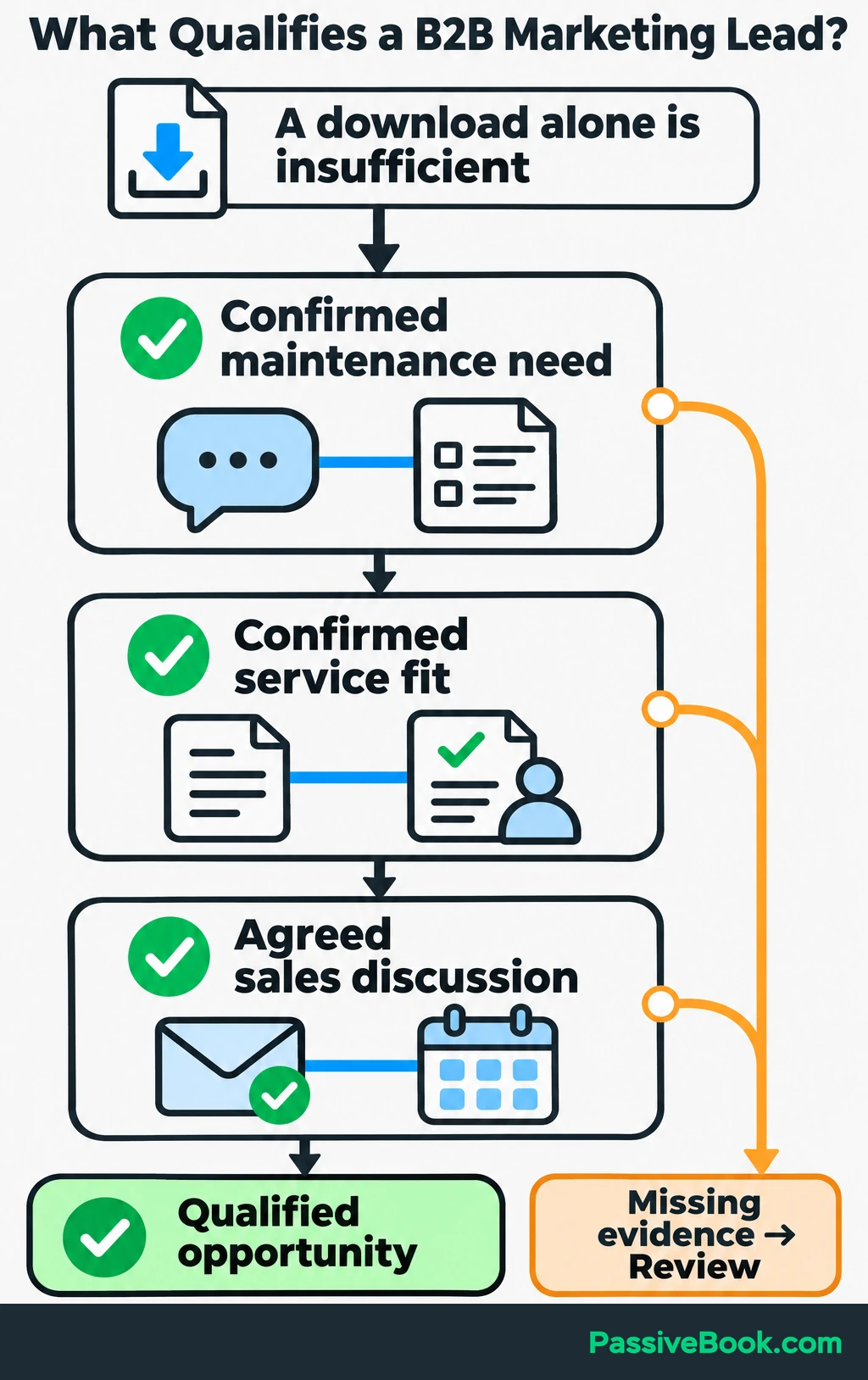
A qualified opportunity means the practice has a confirmed maintenance need, fits the service and has agreed to a sales discussion. A checklist download alone does not meet that definition.
Choose Tools That Fit the Task
Start with one approved AI assistant and the tools you already use for customer records, email and reporting.
Claude is my first choice to test for drafting and working through source material. Give it a representative task before buying anything else. A polished demonstration tells you less than seeing how much editing your own material needs.
If you compare assistants, use the same brief and sources. Check:
- Accuracy: Does the output preserve service details and distinguish facts from guesses?
- Relevance: Does it answer the buyer’s actual question?
- Editing: How much work remains before approval?
- Data Controls: Do retention, training-use, access and deletion terms fit your requirements?
- Practical Fit: Can you export the work and connect it to your existing process?
Count setup, usage, review and maintenance alongside subscription costs. A cheaper tool that needs constant repair can still be expensive.
Before adding a subscription, work out how much review time the proposed workflow can afford. This calculator lets you test your estimates and see what would need to change for the numbers to work.
Free Automation Value Calculator




Add a connector when a proven process needs information moved between systems. Make provides a visual workflow builder, which I would consider for a first setup. Check that its integrations support the exact trigger and actions you need.
Keep the roles clear: the assistant drafts or interprets, the connector moves information, and your customer relationship management system—the CRM—stores contact and opportunity records.
Complete a manually reviewed trial before connecting live systems. You can learn whether a draft is useful without giving it permission to email anyone.
Build a Reusable Marketing Brief
A useful brief gives AI the decisions it should follow. Without one, you keep explaining the business and correcting the same mistakes.
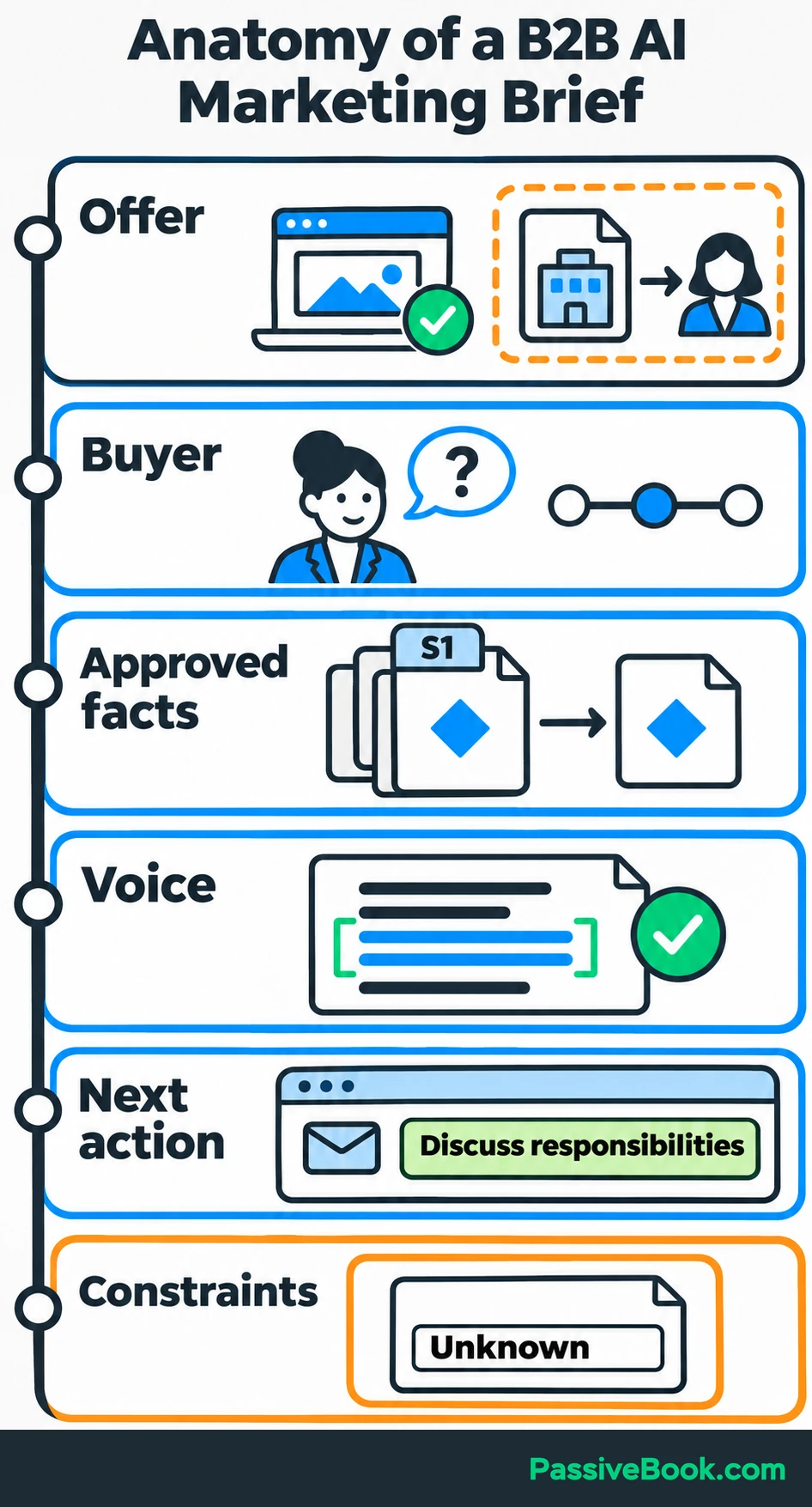
Create a short reference document containing:
- Offer: What you sell and what falls within the service.
- Buyer: Who needs it, what they are trying to solve and where they are in the buying process.
- Approved Facts: Service details, evidence and claims you can support.
- Voice: A few examples of writing you would approve.
- Next Action: The one thing this asset should encourage.
- Constraints: What the output must preserve, avoid or leave unanswered.
Label source documents with an ID and a last-updated date. This lets a reviewer trace a claim without searching through a folder.
For the agency, source S1 might say:
Routine website updates are included in the maintenance plan. The practice approves changes to its business information.
That distinction must survive every adaptation. “We handle everything” would change the offer.
Use this reusable prompt:
Using only the approved sources below, create [deliverable] for
[buyer] at [buying stage].

Address [buying problem] and support this next action: [action].

Preserve these facts: [facts].
Follow these constraints: [constraints].

Return [format].
In separate review notes, identify the source IDs supporting factual
claims. Mark missing information as unknown rather than filling gaps.

Approved sources:
[paste sources]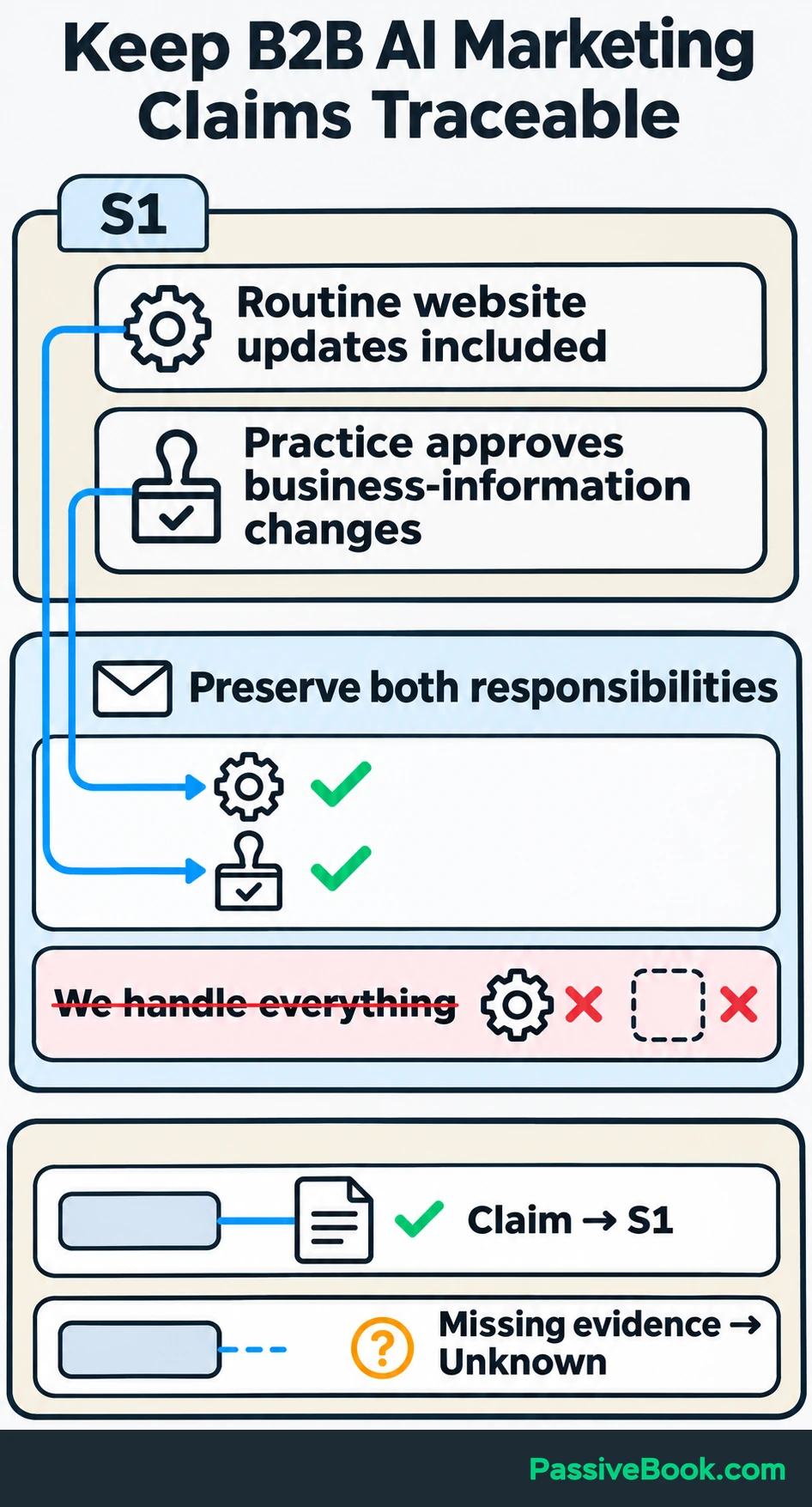
Before generating, define what passes: correct facts, useful buyer detail, suitable tone and a clear next action. Save approved examples beside the brief and update both when the offer changes.
Check claims and citations against the originals. NIST documents how generative AI can confidently produce false content and invented citations in its Generative AI Profile, section 2.2.
Share only authorized information needed for the task and remove unnecessary personal or confidential details. Where UK GDPR applies, establish an appropriate lawful basis before processing personal data with AI, as explained in the ICO’s AI guidance.
Find Buyer Questions in Customer Conversations
Use AI to organize what buyers have said before asking it what buyers might want.
Gather a small set of authorized inquiry emails, interview excerpts, support questions or sales notes. Remove information the analysis does not need and give each excerpt a source ID.
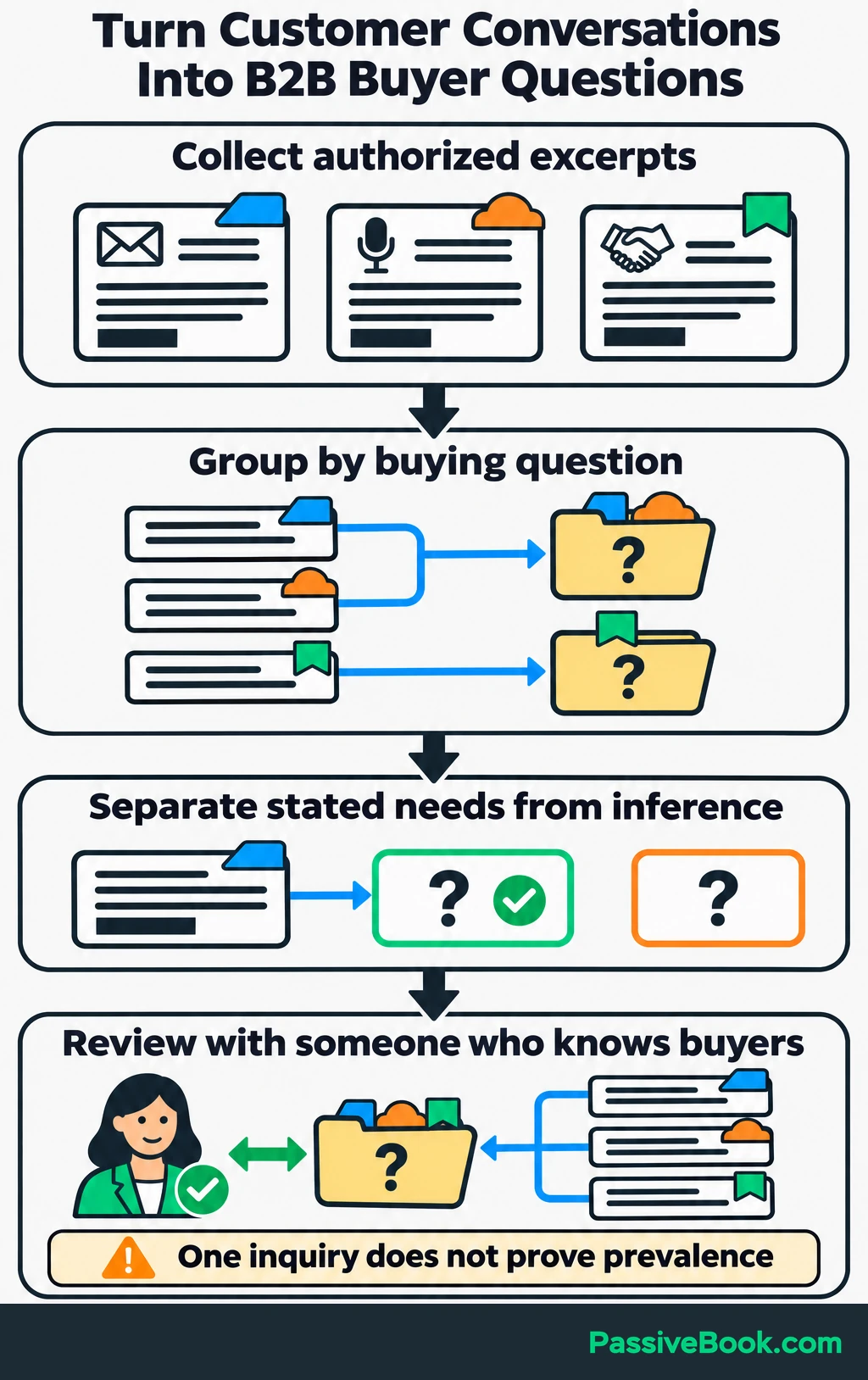
Then ask:
Group these excerpts by buying question. For each group, return the question, supporting source IDs and a representative passage. Keep explicitly stated needs separate from inferred concerns.
Review the groups with someone who talks to buyers. A neat theme can still be a poor reading of the conversation.
Suppose inquiry Q1 says:
“Does your plan include website updates, or do we handle those?”
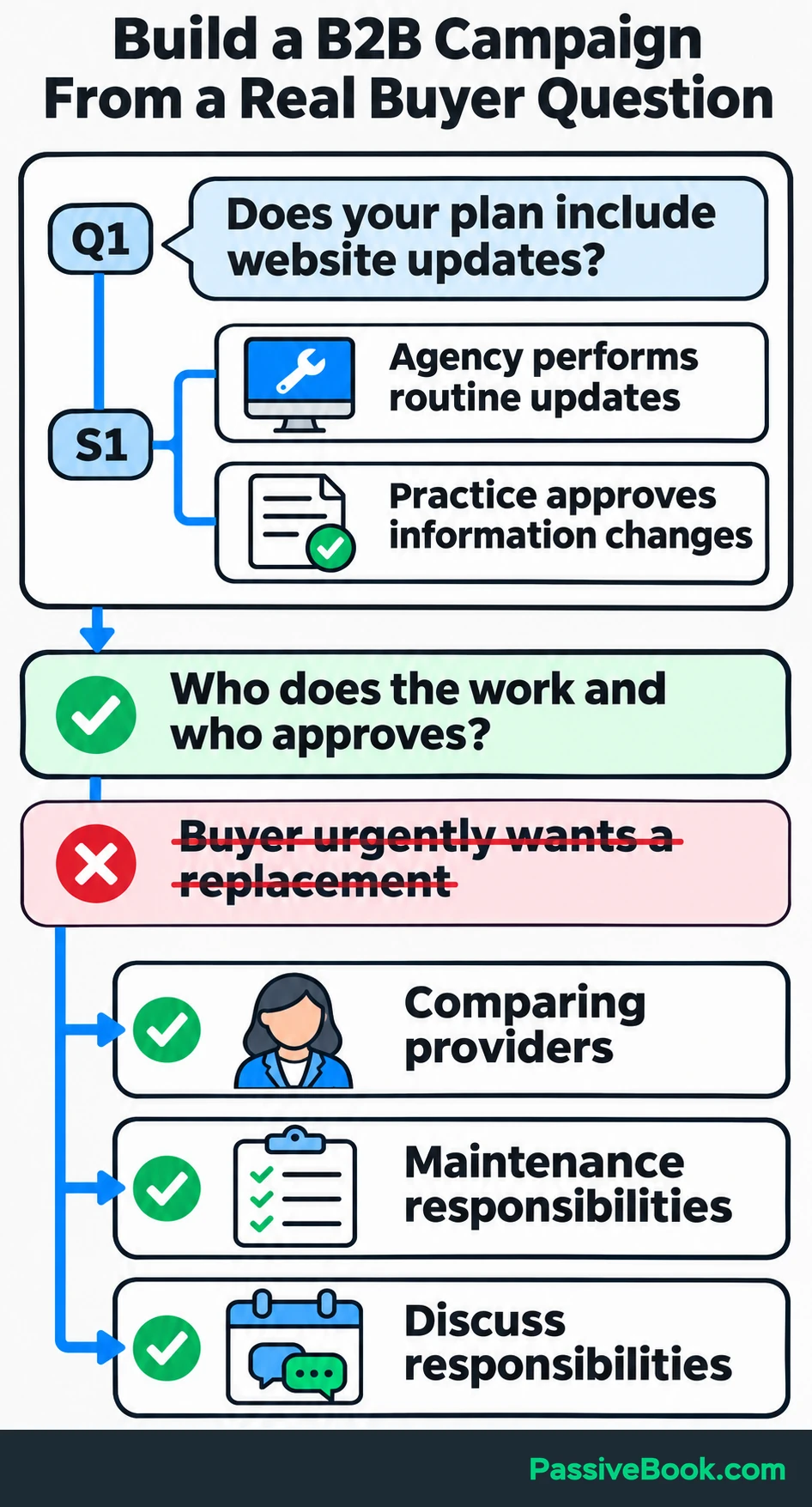
The stated question concerns responsibility for updates. It does not establish that the buyer dislikes their current provider or needs an urgent replacement.
That question gives the agency a useful campaign direction:
| Campaign Decision | Example |
|---|---|
| Buyer | Practice manager comparing maintenance providers |
| Buying problem | Unclear division of update responsibilities |
| Main message | Agree who does the work and who approves changes |
| Supporting material | Q1 asks who handles updates; S1 includes routine updates and requires practice approval for changes to business information |
| Asset | Website-maintenance responsibilities checklist |
| Next action | Discuss responsibilities for the practice’s website |
One inquiry can justify answering a useful question. It does not prove the question is widespread. Look for further evidence before making it the center of your entire marketing plan.
Create and Repurpose Content From Approved Expertise
Choose the buyer question and next action first. Then supply an expert explanation and approved references.
Ask AI for an outline, check what it covers, and only then request the draft. Fixing a missing idea at the outline stage is easier than removing it from four finished assets.
For the agency, the checklist should help a practice establish:
- Who applies routine website updates?
- Who approves changes to practice information?
- What falls outside the maintenance agreement?
Add the agency’s practical judgment. For example, advise the practice to write down both the person requesting a change and the person approving it. That makes “we thought they were handling it” harder to hide behind.
In my own content pipeline, I found that a draft could explain a topic neatly and still leave the reader unable to choose what to do. I started checking whether each section contained a useful decision, example or action before approving it.
That check matters even with a fast system. My custom AI pipeline reduced article production from days to hours, but I still review whether the article helps someone act.
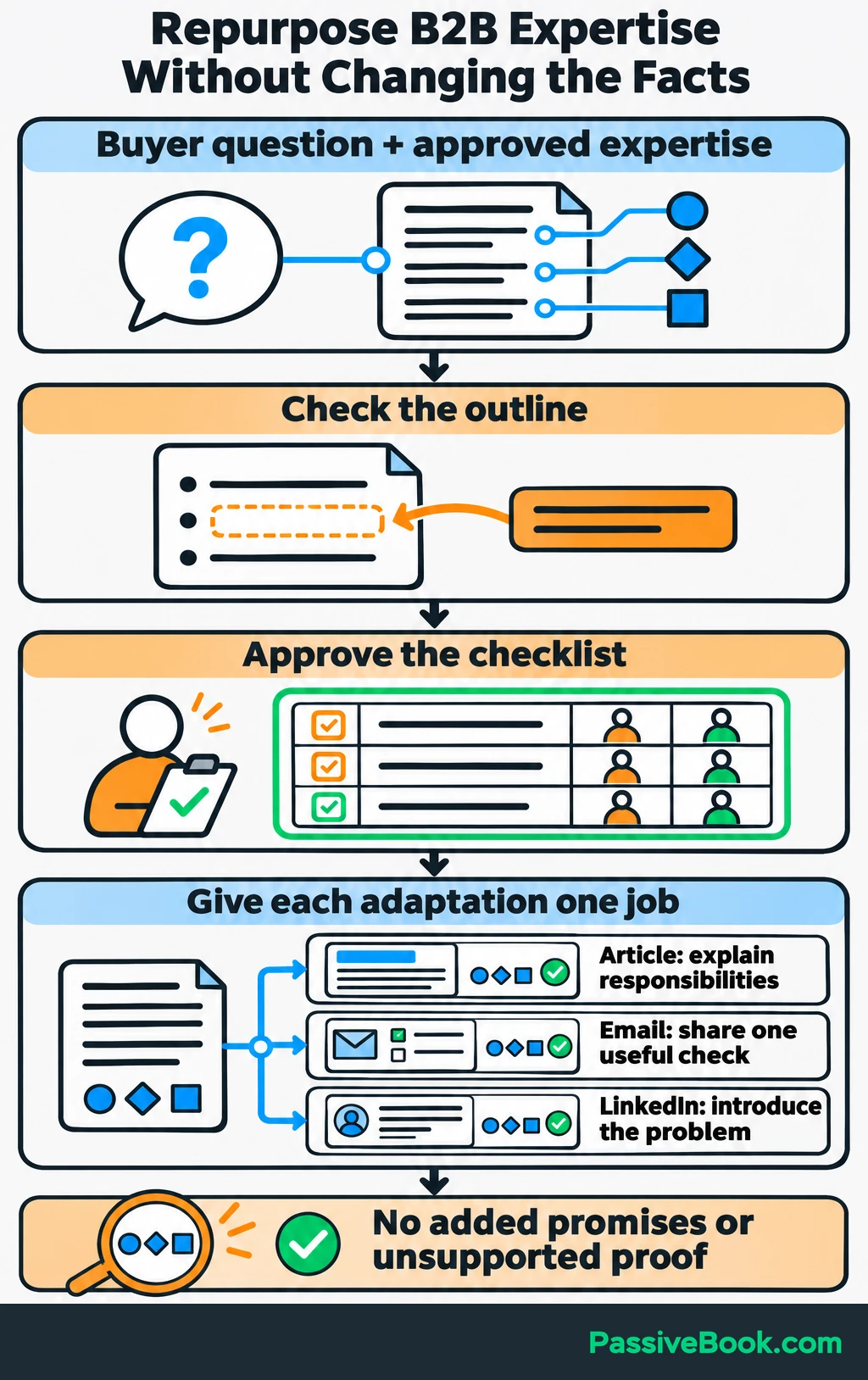
Once the checklist is approved, give each adaptation a separate job:
| Asset | Its Job |
|---|---|
| Supporting article | Explain how to divide maintenance responsibilities |
| Subscriber email | Deliver one useful check and invite a conversation |
| LinkedIn post | Introduce the problem and offer the checklist |
A focused repurposing prompt might be:
Turn this approved checklist into a short LinkedIn post. Open with unclear update responsibilities, share one useful check and invite readers to get the checklist. Preserve the service scope and add no new claims.
Check the adaptations for added promises, altered responsibilities and unsupported proof. A shorter format does not get a smaller accuracy requirement.
You can use AI Copywriting Studio to turn an approved asset into email and social drafts. It also puts the supporting passages beside the claims so you can review the copy against your source.

Free AI Copywriting Studio
Shared reference material can support much larger operations too. Anthropic’s Cox Communications case study reports 55% faster speed to market for work involving a marketing suite built with Accenture, a shared knowledge base and connected systems. That vendor-reported enterprise result is not a benchmark for a small pilot. The useful design choice is giving related assets the same approved facts.
Track time through approval and outputs accepted for use. Ten drafts that need rebuilding are ten editing assignments.
Personalize Follow-up Around Buying Needs
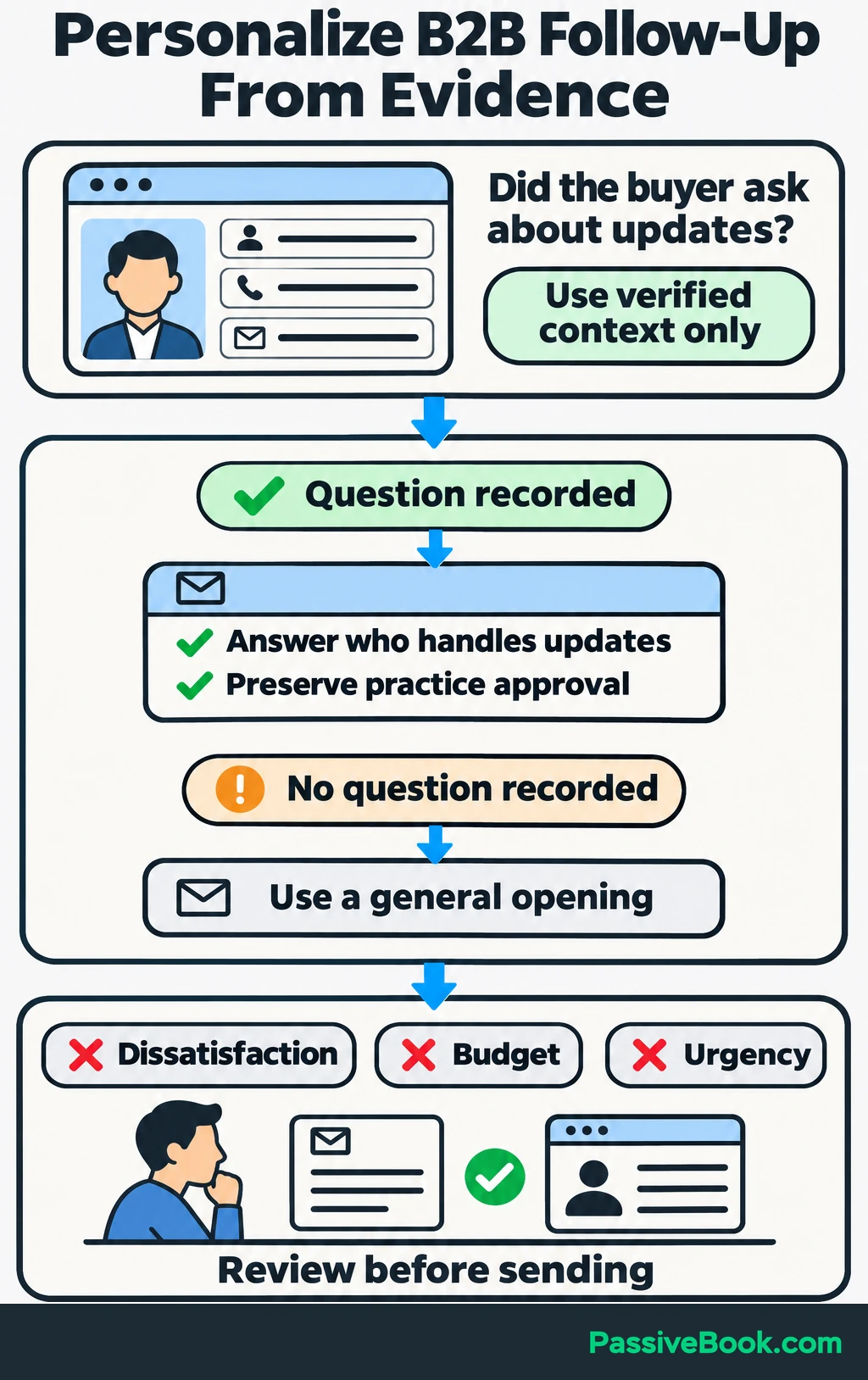
Choose the appropriate answer and resource before asking AI to personalize a message.
Useful context includes the person’s stated problem, buying role and relevant CRM history. A first name and an observation about their company logo add little.
Specify which fields AI may use, which facts must remain unchanged and what should happen when context is missing. Use a general message when the record does not support a more specific one.
For the agency:
Draft a follow-up for a practice manager who requested the maintenance checklist and asked who handles updates. Use approved scope S1, answer that question and offer a consultation. Do not infer dissatisfaction, budget or urgency. Put missing information in separate review notes.
Here is a complete email you can adapt:
Subject: Who handles your website updates?
Hi [First name],
You asked whether website updates are included or handled by your team.
Our maintenance plan includes routine website updates, while your team approves changes to practice information.
As you work through the checklist, write down who requests each change, who approves it and who carries it out. Any blank space is worth discussing with your provider.
Would you like a short consultation to discuss how those responsibilities would work for your website?
Thanks,
[Sender name]
[Agency name]
[Contact details]
Prefer no further marketing emails? Reply “unsubscribe.”
Remove the opening reference to a question if the person did not ask it. Personalization should reflect the record, not make the message feel more researched than it is.
Before sending, check permission and sender-identification requirements and offer an opt-out. Exclude contacts on your suppression lists, which record who must not receive marketing. In the UK, sole traders and certain partnerships generally need consent or a valid exception for marketing email, while corporate subscribers have different rules. The ICO’s B2B marketing guidance explains that distinction.
Compare qualified replies, accepted consultations and opportunities with your existing approach. Watch unsubscribes and complaints alongside those results.
Prepare Qualified Lead Handoffs
Agree with sales on qualification before asking AI to summarize leads.
Define the required fit, buying need, disqualifying conditions, missing information and next owner. Otherwise, “qualified” can quietly become “filled in a form.”
Have AI extract information into a fixed format. Require a source for each important detail and keep interpretations separate from confirmed facts.
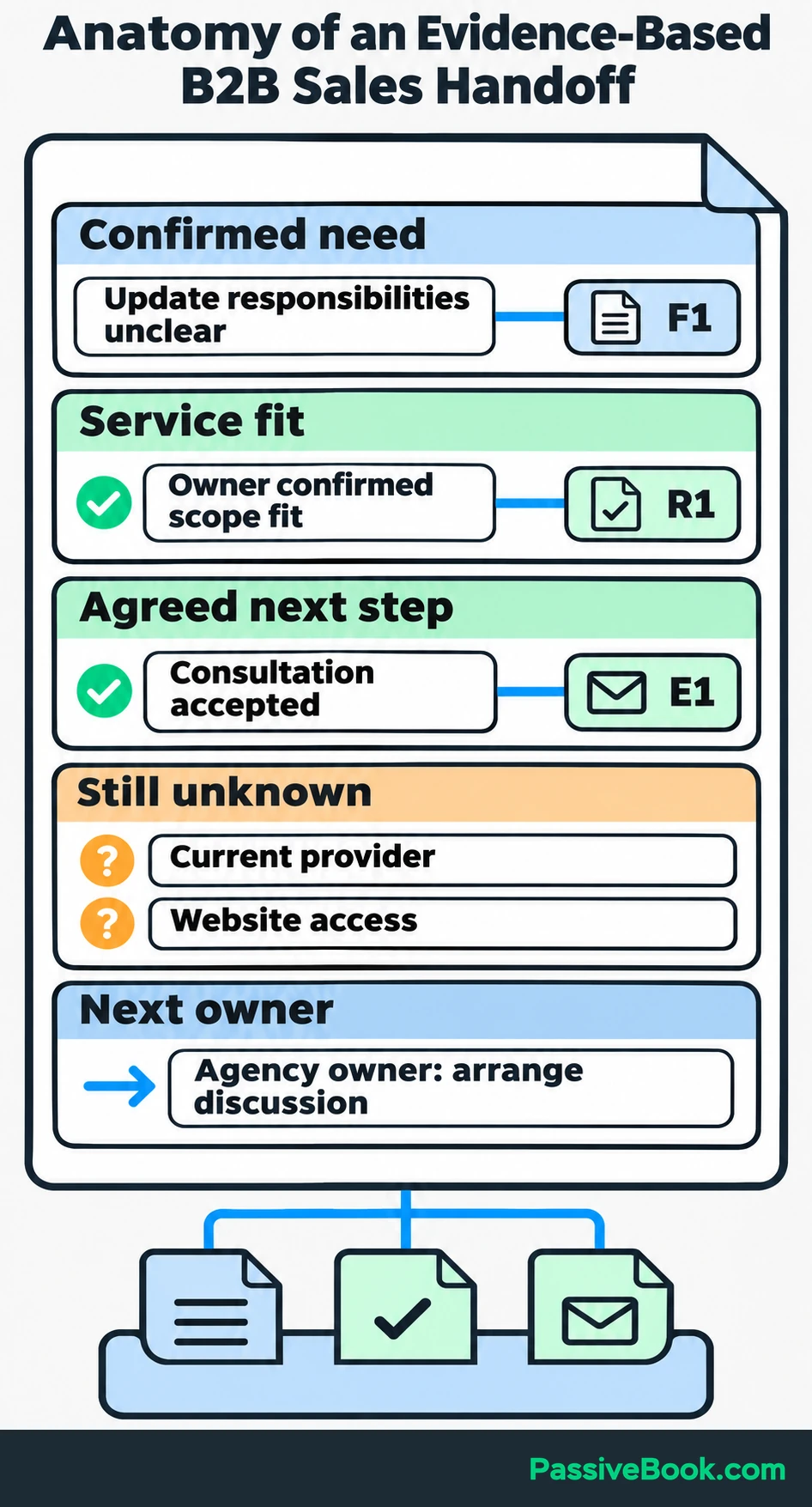
An agency handoff could look like this:
- Confirmed Need: Practice manager says update responsibilities are unclear [form F1].
- Service Fit: Owner reviewed the request against the maintenance scope and confirmed fit [review R1].
- Agreed Next Step: Practice manager accepted a consultation [email E1].
- Still Unknown: Current provider and website access arrangements.
- Owner: Agency owner to arrange the discussion.
AI can prepare this summary, but explicit rules should determine whether the required evidence is present. Route uncertain cases for review rather than asking the model to make uncertainty sound decisive.
Send the reviewed summary with its supporting records. Measure extraction accuracy, sales acceptance and handoff time.
I would skip predictive lead scoring until you have reliable historical outcomes and enough examples to test it against your existing rules. A mysterious score is not an improvement over a clear unanswered question.
Automate the Workflow After It Works Manually
Write down the trigger, required inputs, AI task, review criteria, destination and owner. If you cannot explain the sequence plainly, connecting the tools will not make it clearer.
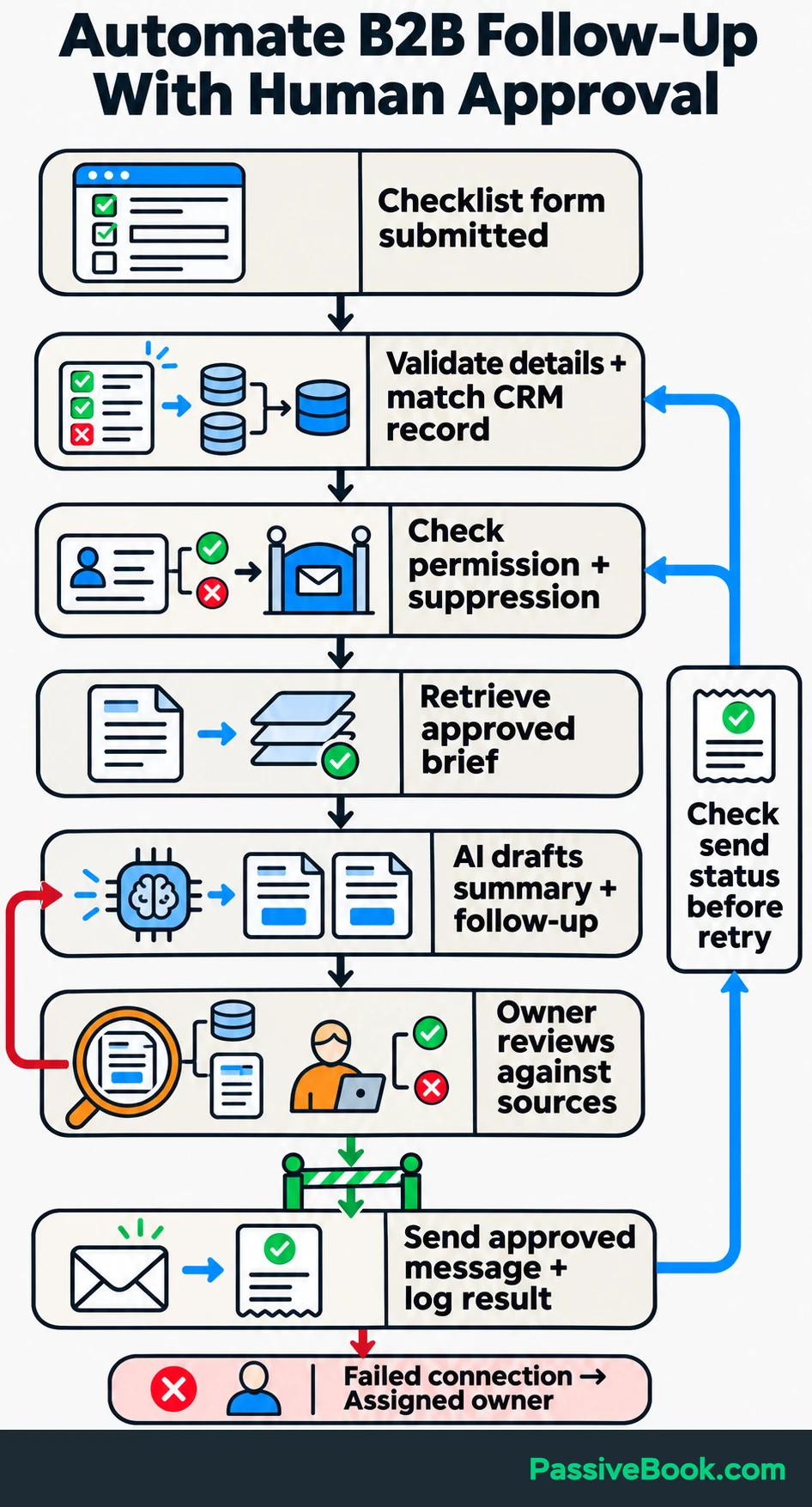
For the agency, the workflow could be:
- A practice submits the checklist form.
- Fixed rules validate required details and check for an existing CRM record.
- The workflow checks sending permission and suppression status.
- It retrieves the approved service brief.
- AI drafts a need summary and relevant follow-up.
- The owner reviews both against the source records.
- The approved message is sent and the result is recorded.
Use fixed rules for known conditions, such as a missing email address or an existing record. Use AI where language needs interpreting or drafting.
I use n8n to connect tools in my own workflows. For this kind of process, I would keep approval before generated messages are sent or important customer records are changed. n8n supports human review of selected AI-agent tool actions, pausing execution until someone approves or denies them.
Test the awkward cases before launch:
- Incomplete Submission: Ask for missing information or route it for review.
- Duplicate Record: Update the correct record without creating another follow-up.
- Unsupported Request: Flag it instead of promising work outside the service.
- Failed Connection: Put the failure in a visible queue with an assigned owner.
- Retry After Sending: Check the recorded send status before attempting another message.
Keep an activity log and a way to pause the workflow. Expand automation when representative outputs meet your acceptance criteria, and retain review where a mistake could change the offer or damage a customer relationship.
Measure Impact Before Expanding
Compare Efficiency and Quality
Compare equivalent completed work using the same approval standard. Record approved assets, total working time and operating costs, including setup, prompting, editing, review, failed runs and maintenance. Track how many reviewed outputs need material corrections.
For illustration, each agency content package includes a checklist, supporting article, email and social post. Before AI, each takes eight hours; afterward, five hours, including review. Across four comparable packages per month, that releases 12 hours: three hours saved × four packages.
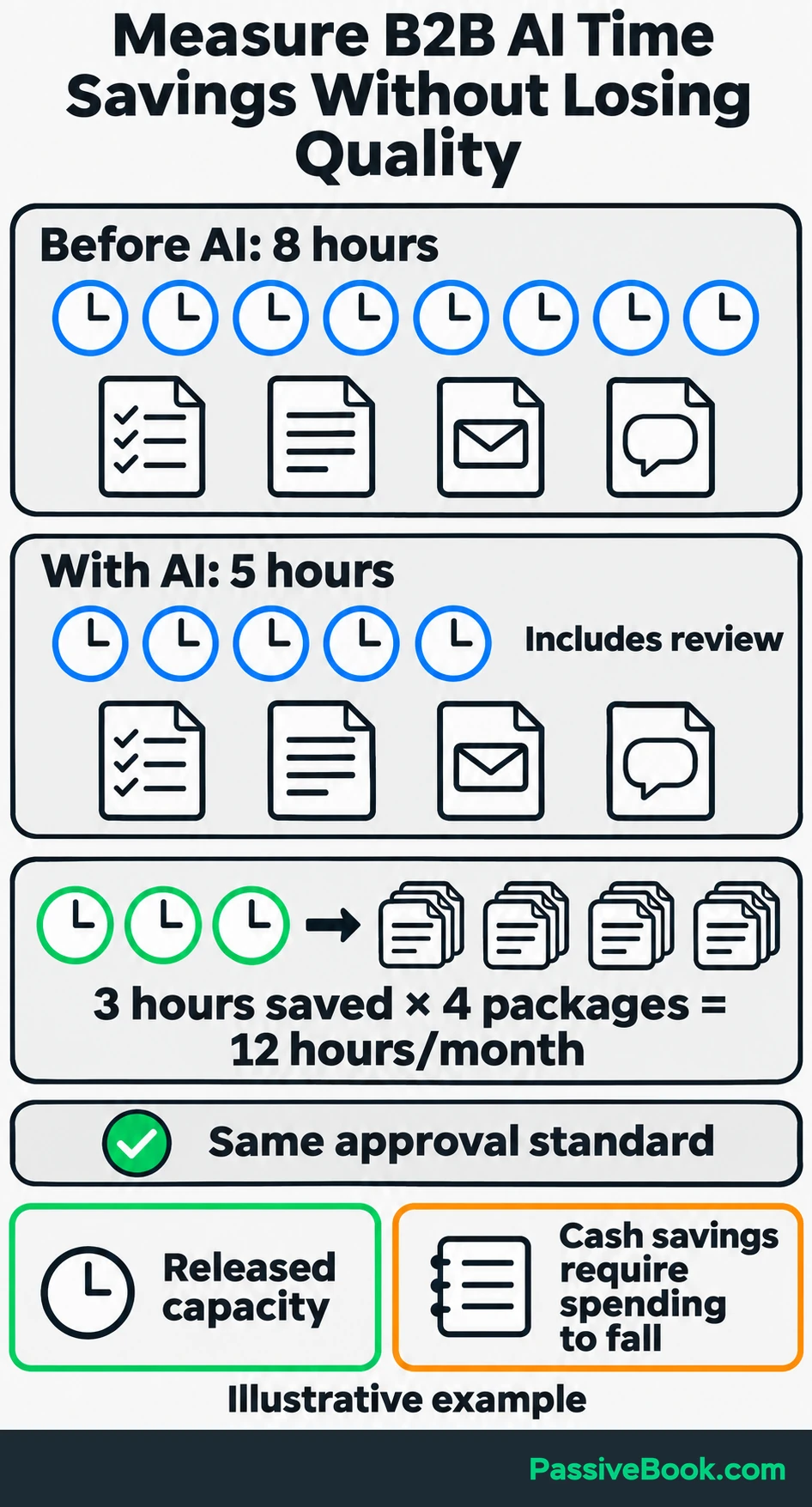
Those hours are released capacity. They become cash savings only if spending actually falls.
Check quality alongside speed. If the faster process keeps changing service promises, it has failed the acceptance standard even if the stopwatch looks pleased.
Connect Activity to Qualified Pipeline and Revenue
Carry a consistent campaign identifier into contact, account and opportunity records. Use the same definitions as sales to track qualified conversations, accepted opportunities and closed business.
Calculate totals and conversion rates in your CRM or spreadsheet, then ask AI to suggest the next test from those verified figures.
For example, suppose 10 of 40 consultations held during a defined quarter became accepted opportunities within 60 days of each consultation. Once every consultation has had that full observation period:
Consultation-to-opportunity rate = 10 ÷ 40 × 100
                                = 25%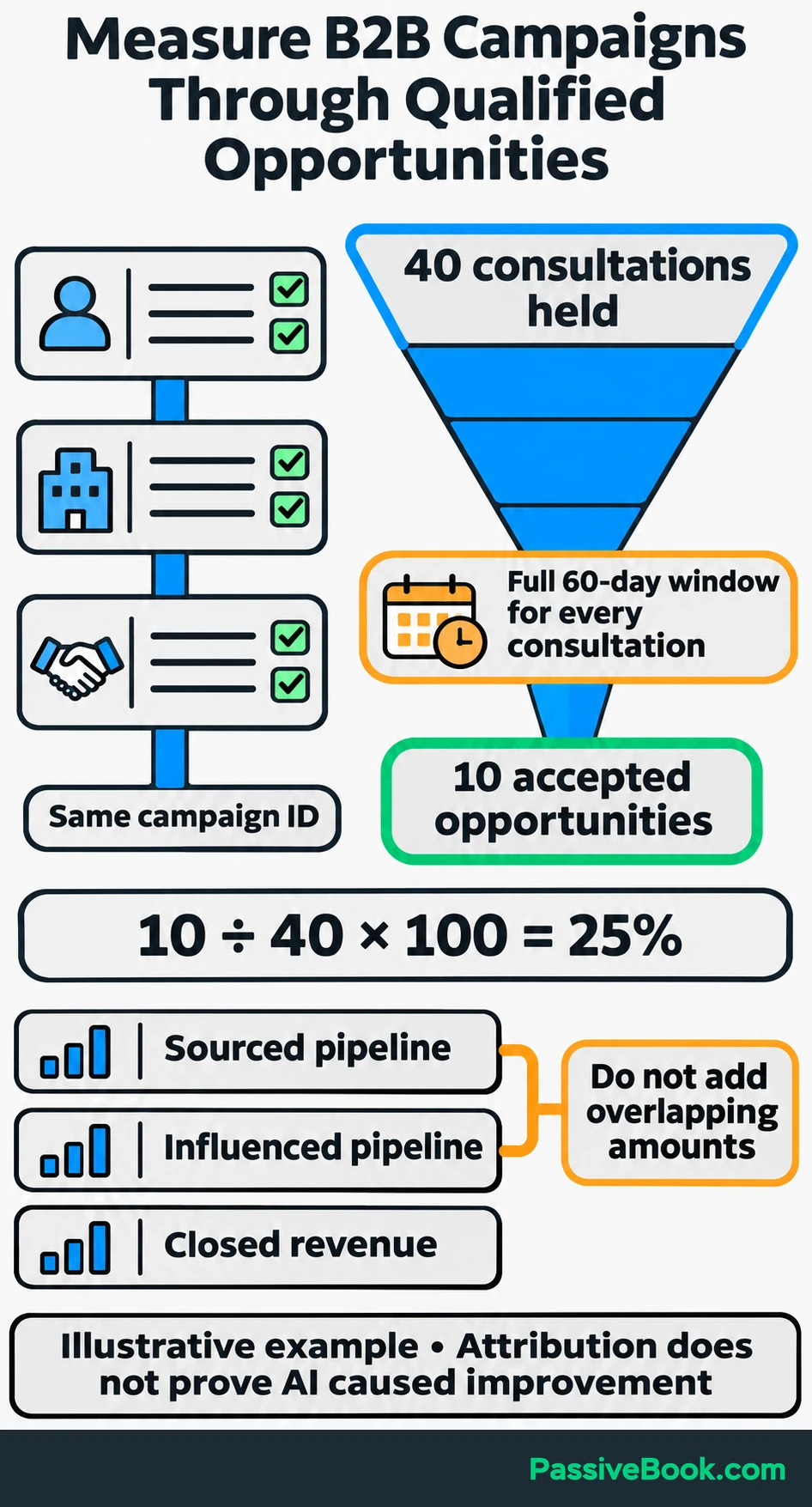
Report sourced pipeline, influenced pipeline and closed revenue separately:
- Sourced Pipeline: Opportunity value credited to the campaign under your agreed source rules.
- Influenced Pipeline: Opportunity value where the campaign contributed a recorded touch.
- Closed Revenue: Revenue from won business.
Do not add overlapping sourced and influenced amounts. A campaign touch does not prove AI caused an improvement. To test AI’s effect on follow-up, randomly split comparable prospects between AI-assisted messages and your existing approach.
For return on investment (ROI), compare added profit and actual cash savings with the extra workflow costs over the same period. Added profit means extra revenue after delivery costs, before AI workflow costs. Count each cost and benefit once.
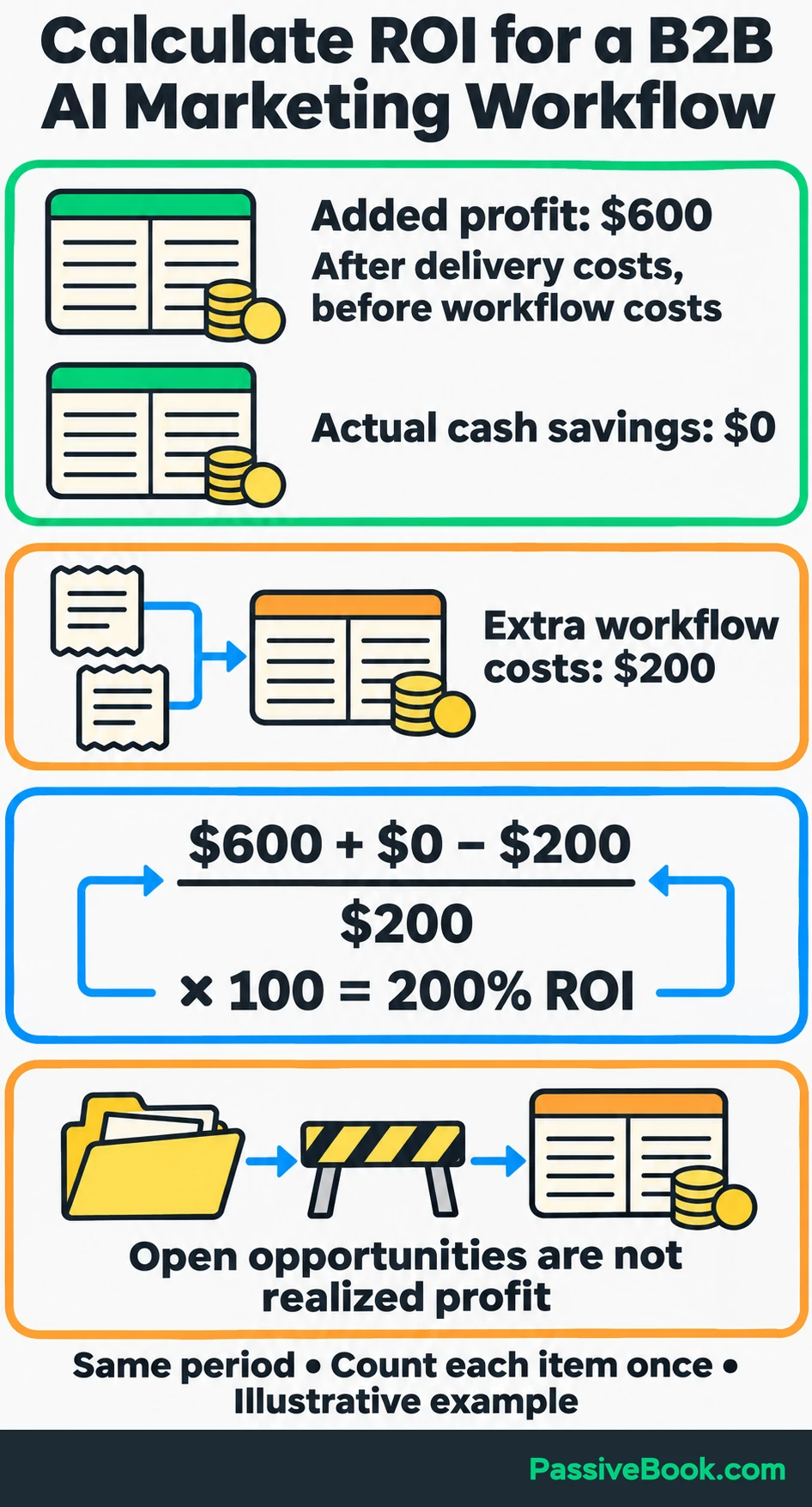
Suppose the agency can attribute $600 in added profit to the workflow, avoids no cash costs and incurs $200 in extra workflow costs:
ROI = ($600 + $0 − $200) ÷ $200 × 100
    = 200%
This is an illustration, not a customer result. Open opportunities do not count as realized profit.
Allow the normal sales cycle before judging revenue.
What Next?
Pick one recurring marketing task and record how long the next completed version takes, including corrections and approval. Use that as the baseline for your first AI trial.
If this guide helps you connect faster production to qualified opportunities, use the social buttons to share that approach with your team.
Which task would you trust AI to help with first, and what would an acceptable result look like? Share your answer—or any other questions—in the comments.
Share this post with your friends & followers:

