Readers ask what you recommend, where to buy it, or whether you can help them solve a problem. You answer, send the next issue, and still have no clear way for the newsletter to earn.
Adding a sales pitch is easy. Choosing an offer readers want—and delivering it without creating another exhausting job—is harder.
This guide connects those reader questions to five ways your newsletter could earn, with a complete first-offer example to make the work, costs, and trade-offs easier to judge.
Can You Monetize a Small Newsletter?
Yes. You don’t need thousands of subscribers to offer a useful product or service. Direct sponsorships have no universal minimum either, although each advertiser decides what reach it needs. Affiliate programs and advertising networks set their own admission rules.
A small list gives you fewer chances to make a sale, so relevance matters. Start with evidence of a buying problem:
- Questions about which product to choose.
- Replies asking for help completing a task.
- Clicks on content closely related to a potential offer.
- Previous purchases from your business.
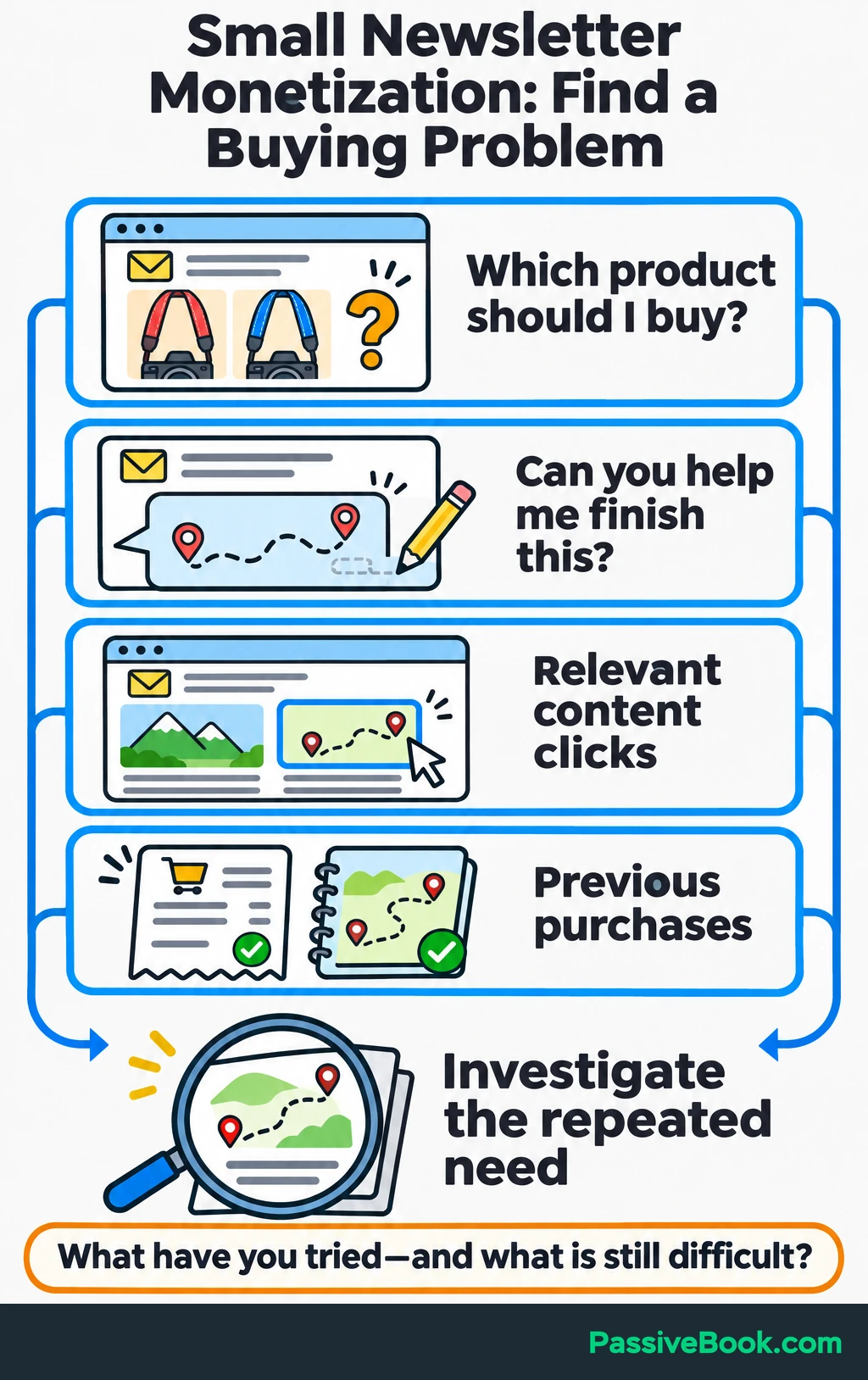
If you have little evidence, ask: “What have you tried to solve this, and what are you still struggling with?” That gives you more to work with than “Would you buy something from me?”
Throughout this guide, imagine you run Weekend Photo Walks, a newsletter about planning short photography outings. Its offers and figures are illustrations.
Readers might want equipment recommendations, help choosing locations, or a reusable way to organize an outing. Investigate those needs before deciding what to sell.
Choose Your First Newsletter Monetization Strategy
Choose the method that matches what readers already want and the work you can sustain.
| Method | Who Pays | Buying Signal | Prerequisites | Upfront Work | Ongoing Work | Control Over Pricing |
|---|---|---|---|---|---|---|
| Affiliate recommendations | A merchant or program | Readers ask which item to buy | Program approval and permitted email promotion | Select products and assess terms | Maintain recommendations and links | Merchant sets prices and commissions |
| Digital product | Readers | People repeatedly need the same reusable solution | Useful product, checkout, and delivery | Validate and create a small product | Support and updates | You set the price |
| Sponsorship | An advertiser | A business wants to reach your readers | Relevant audience and credible reporting | Find prospects and agree on a placement | Sales, approvals, and reporting | Negotiated with the advertiser |
| Paid subscription | Readers | People want fresh help regularly | Recurring benefit, billing, and paid access | Create a sample and delivery plan | Produce benefits and retain subscribers | You set the price |
| Service or workshop | Readers | People ask for individual help or instruction | Relevant competence and available time | Define scope and prepare delivery | Sessions, preparation, and follow-up | You set the price |
I would start with an affiliate recommendation when readers are already choosing products. If the same task keeps causing trouble, I would test a small digital product.
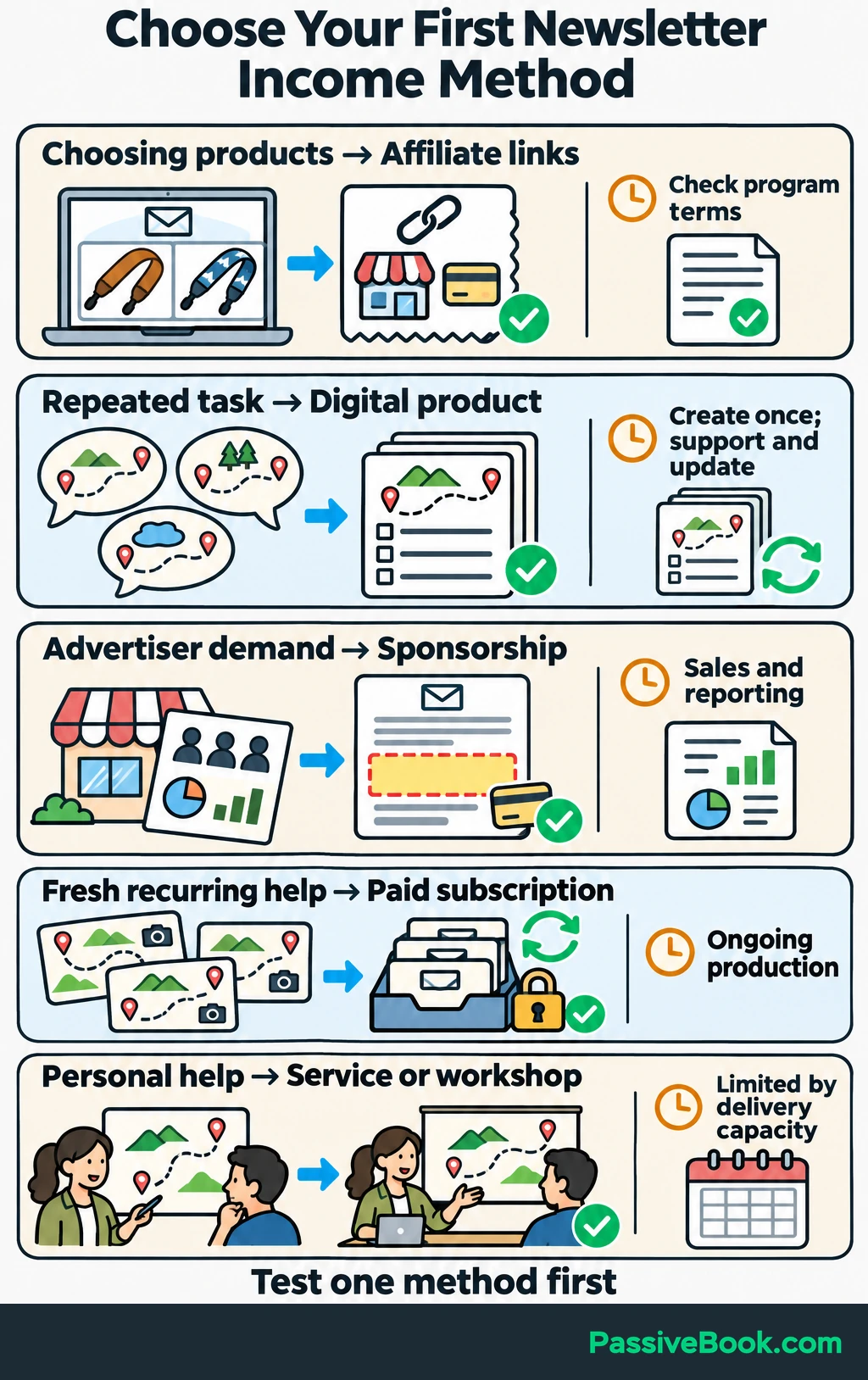
Services can help you learn what people will pay for, but they consume your time. Paid subscriptions need a dependable production schedule, and sponsorships require selling to advertisers.
These methods can work together. Test one first so you can tell whether it earns enough to justify its workload.
Recommend Relevant Products Through Affiliate Links
Affiliate marketing pays you when a reader completes a qualifying purchase or action through your referral link.
Look for a partner or affiliate page on a relevant brand’s website. You can also search an affiliate network such as Impact, which connects publishers with brand programs.
Before applying, check:
- Whether your audience, location, and publishing channel qualify.
- Whether the agreement permits links in email.
- Which purchases earn commission and which are excluded.
- How long a referral remains eligible for credit.
- When commissions become approved, what can reverse them, and when payouts occur.
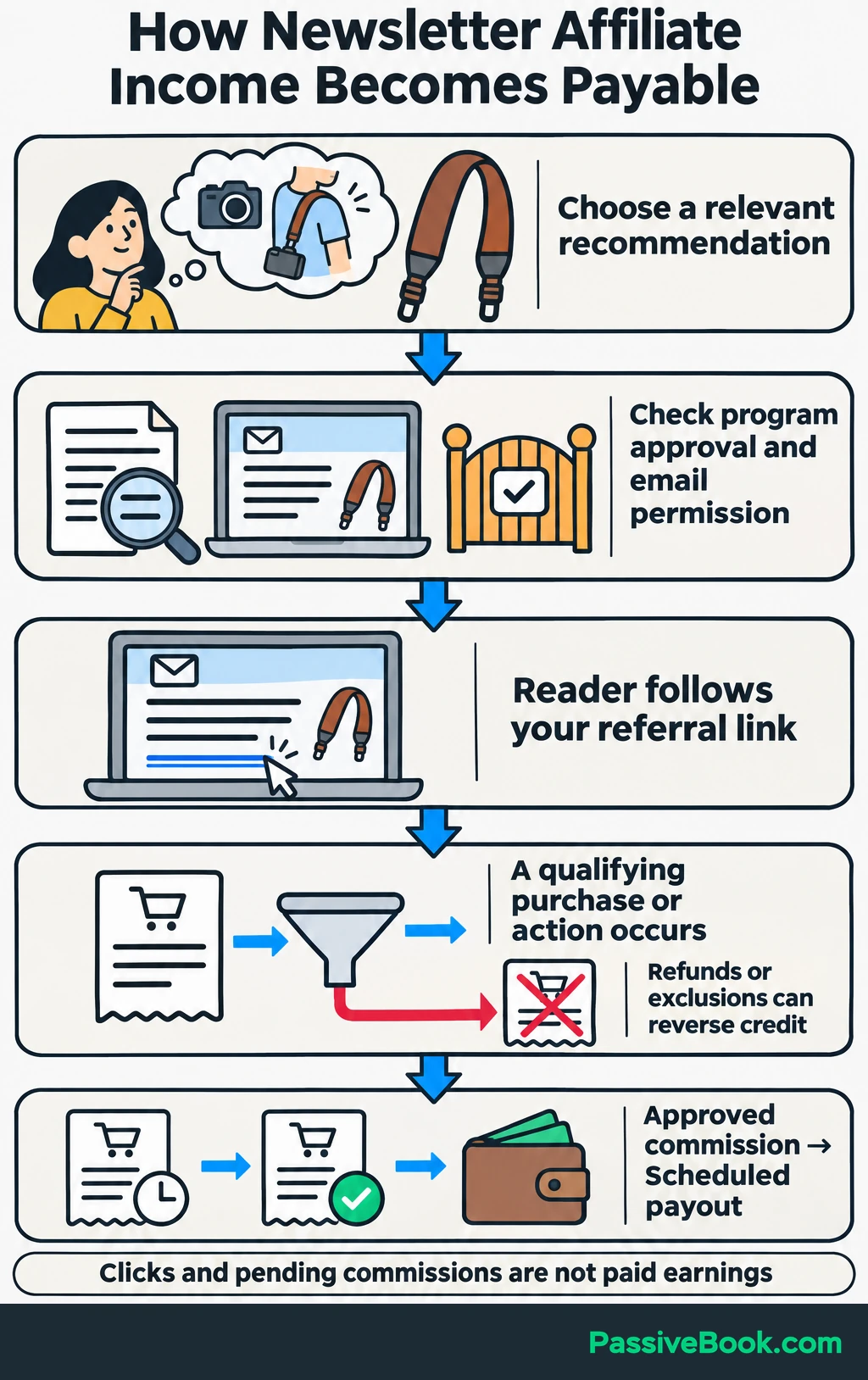
For Weekend Photo Walks, a camera strap recommendation could fit an issue about carrying equipment comfortably. Explain what you used, what you liked, and what might make another option more suitable. If you haven’t tested it, say what your assessment is based on.
My first three months in affiliate marketing earned about $23 because I chased the wrong products. Focusing on honest reviews of tools I used eventually brought in roughly $340 a month. Those were affiliate results across my work, not established newsletter earnings.
That experience shapes my rule: choose the recommendation first and assess the commission second.
Sell a Digital Product
A digital product turns a repeated problem into something readers can use without booking your time.
Start with the smallest product that completes one useful task. That might be a checklist, editable worksheet, short guide, or recorded lesson.
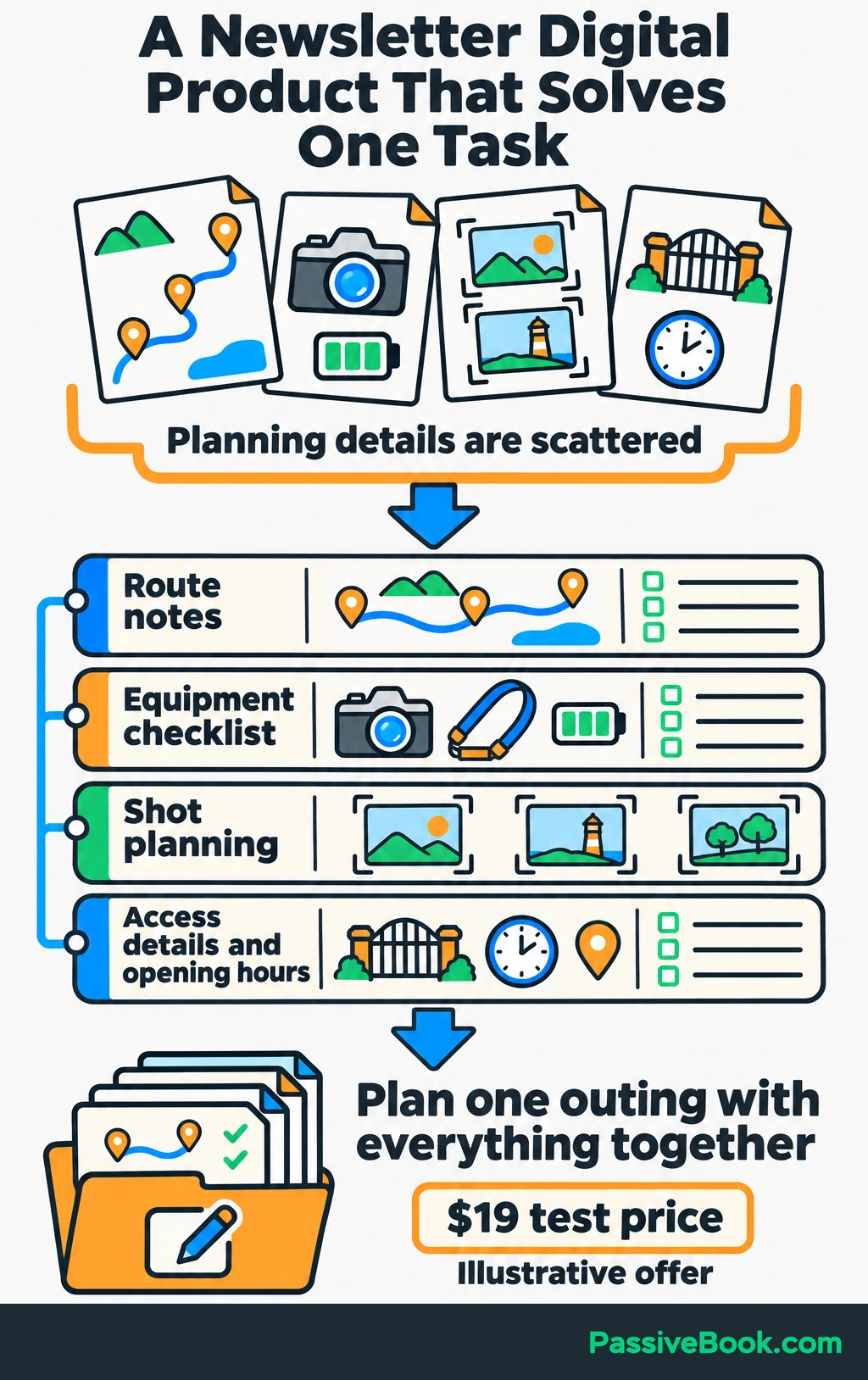
For Weekend Photo Walks, you could test a photo-walk planning pack containing:
- An editable route-notes sheet.
- A short equipment checklist.
- A shot-planning worksheet.
- A page for recording access details and opening hours.
The offer should describe the result: “Plan your next photo walk and keep the route, equipment, and shot ideas together.”
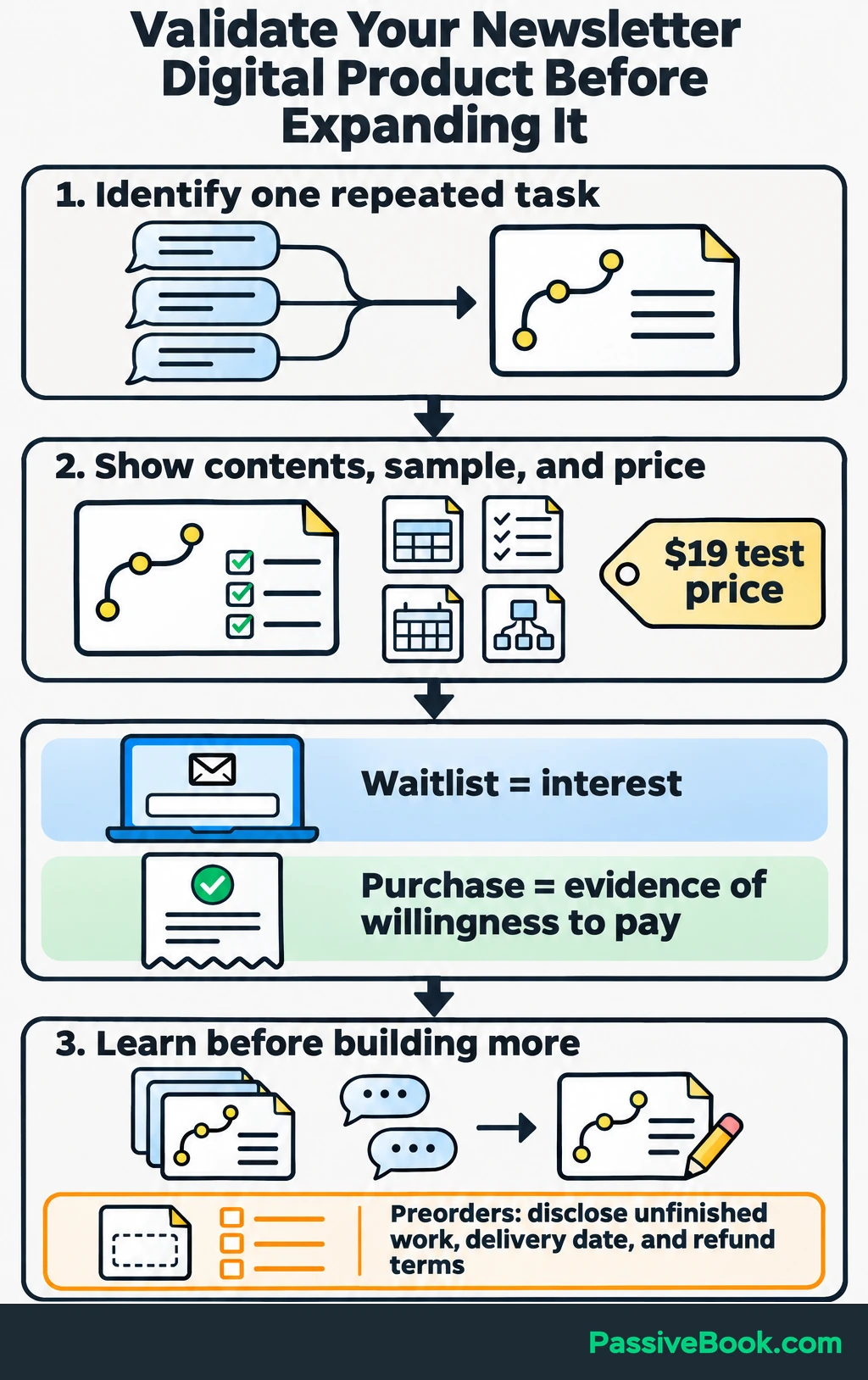
Show the contents, a sample page, and a proposed price before expanding production. A waitlist shows interest, but completed purchases tell you whether people will pay. If you take preorders, state what is unfinished, the delivery date, and the refund terms.
I once rushed a course into production without validating demand. It attracted few sales and a bad review, and I withdrew it. That was an expensive way to discover that finishing a product doesn’t make it worth buying.
For pricing, compare relevant alternatives and account for creation, delivery, support, and updates. For this example, use a $19 test price.
Sell Sponsorships and Paid Partnerships
A sponsor pays for an agreed placement in your newsletter. An affiliate program pays for qualifying results. A partnership can combine a placement fee with affiliate commission, but keep those payment terms separate.
Find prospects among brands your readers mention, businesses selling relevant products, and advertisers in related publications. A local business makes sense only if enough readers can visit or buy from it.
Your pitch should include:
- The newsletter’s subject and audience interests.
- Subscriber count and recent delivered-email reach.
- Relevant click results, with the issue and measurement period.
- Previous advertiser outcomes, if available.
- One placement idea that fits an upcoming issue.
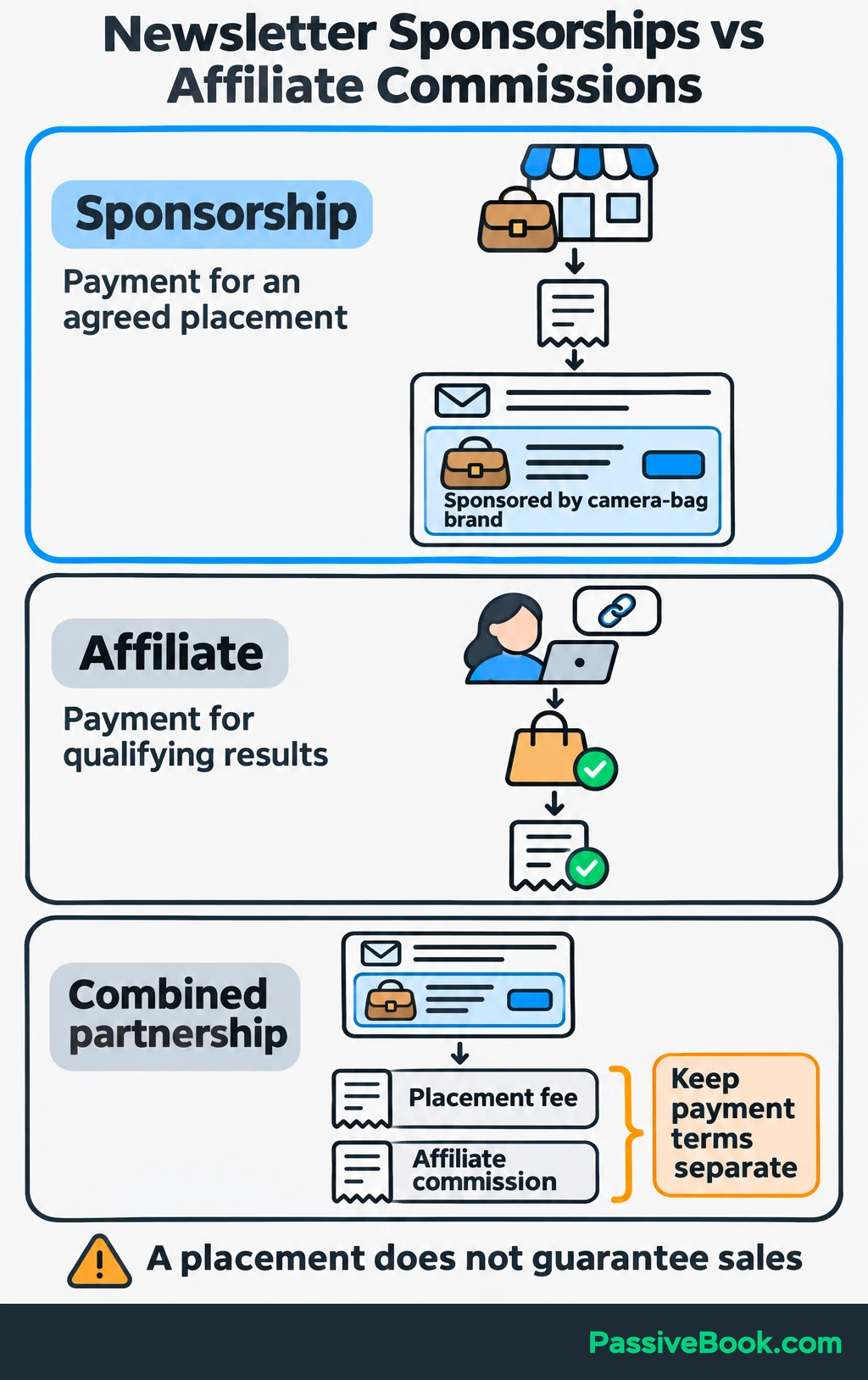
Weekend Photo Walks could approach a camera-bag brand for an issue about packing for a short outing. Describe the proposed placement and use your actual audience figures.
Be careful with engagement claims. Automated security scans can inflate opens and clicks, as Mailchimp explains in its bot-activity guidance. Use filtered reports where available and include confirmed purchases or qualified inquiries when you can.
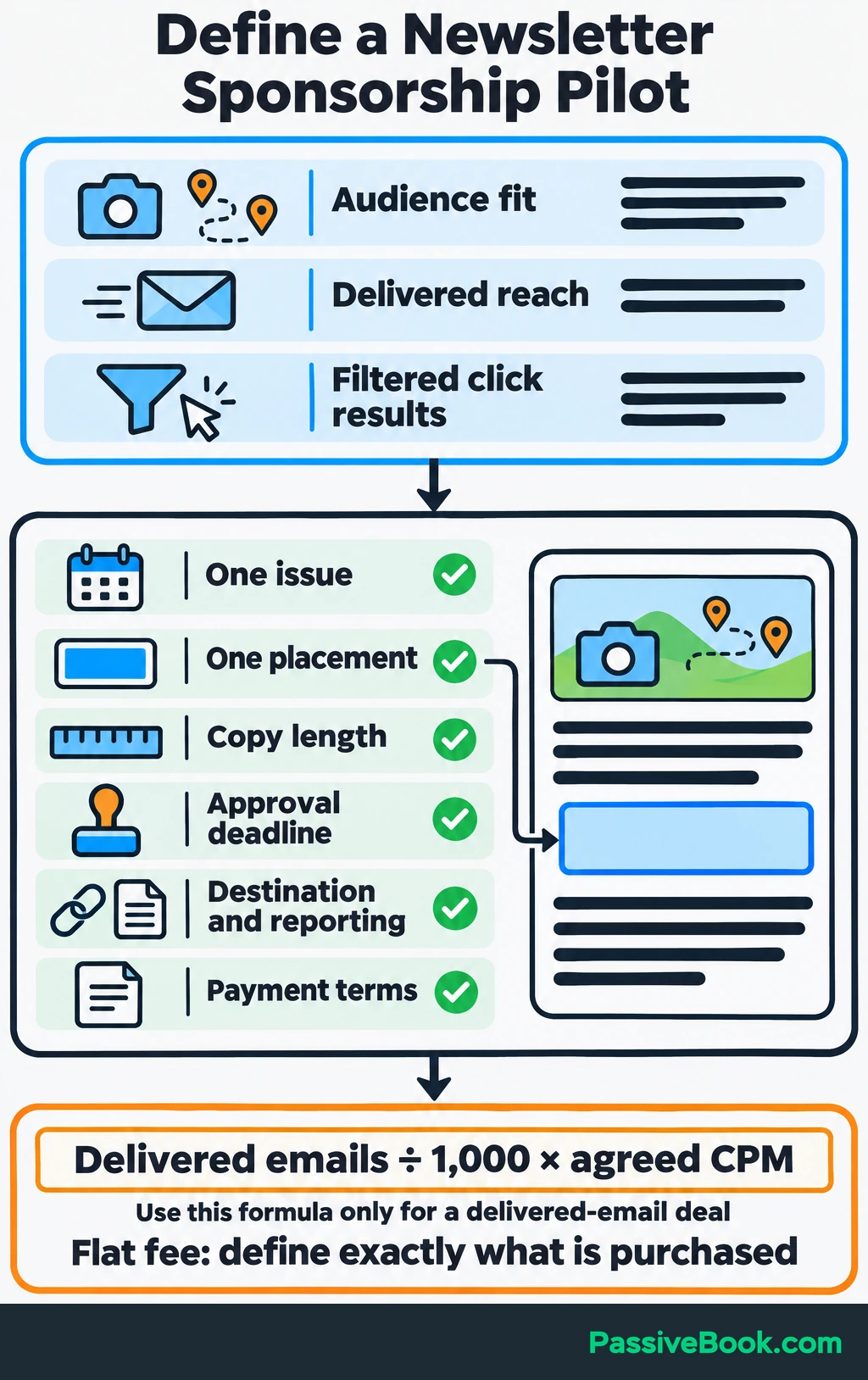
I would offer a defined pilot: one issue date, one placement, a copy length, an approval deadline, a destination link, reporting, and payment terms.
Quote for the audience fit, placement, exclusivity, and work involved. Don’t promise sales.
If you use CPM pricing—a price per thousand—agree whether you’re counting delivered emails, subscribers, or ad views. For a deal based on delivered emails, calculate the fee as:
Delivered emails ÷ 1,000 × agreed CPM
For an early direct deal, I prefer a flat placement fee because both sides can see exactly what is being purchased.
Offer a Paid Newsletter Subscription
A paid newsletter needs a benefit readers want repeatedly. “More emails” is a delivery schedule, not much of a sales argument.
Useful recurring benefits could include fresh research, original analysis, carefully selected opportunities, or resources that need regular updates.
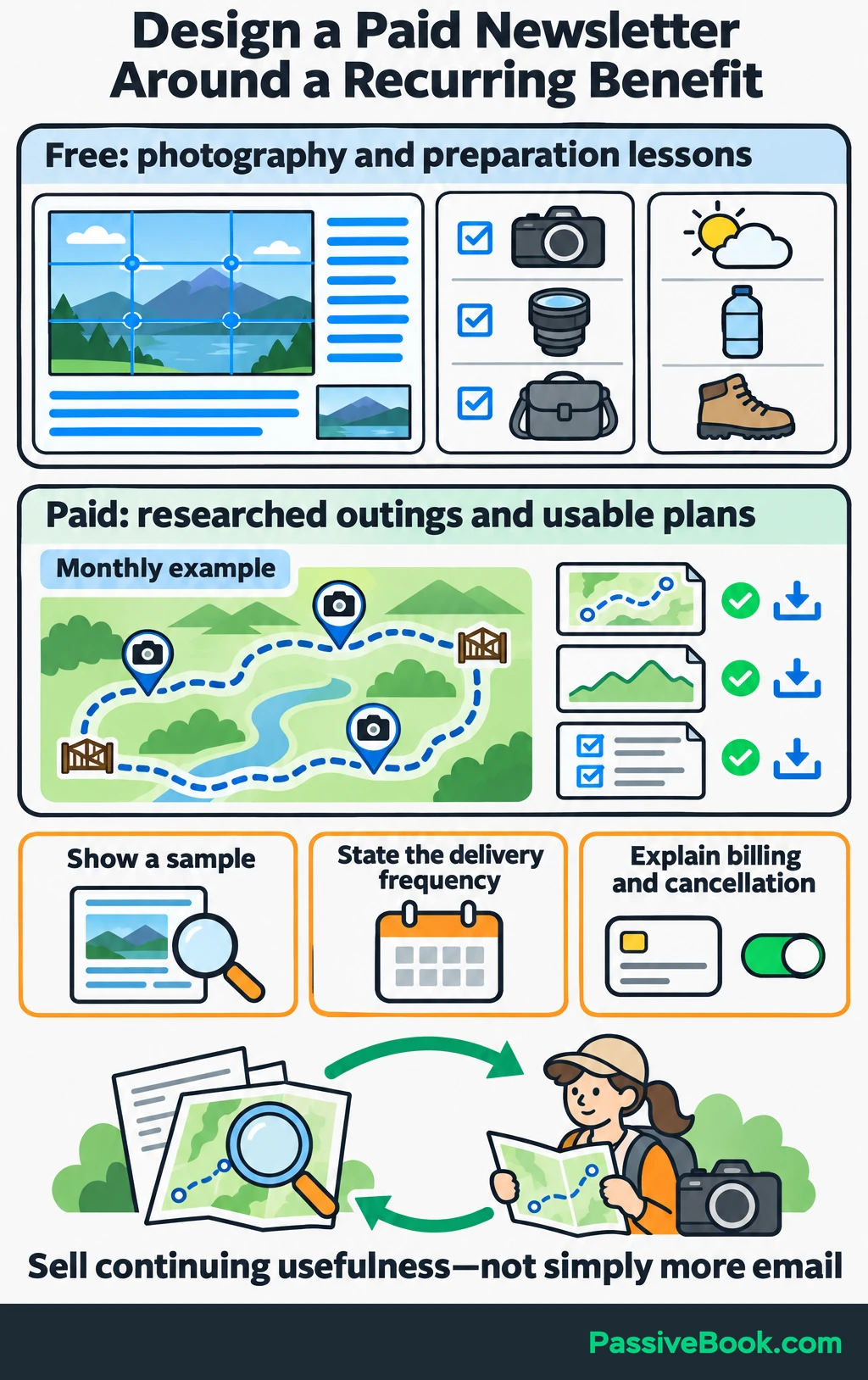
Weekend Photo Walks might test a monthly local-outing digest with researched access details, suggested photo stops, and downloadable plans. The free edition could continue teaching photography and outing preparation.
Show a sample and state:
- What paying readers receive.
- How often it arrives.
- What remains free.
- How billing and cancellation work.
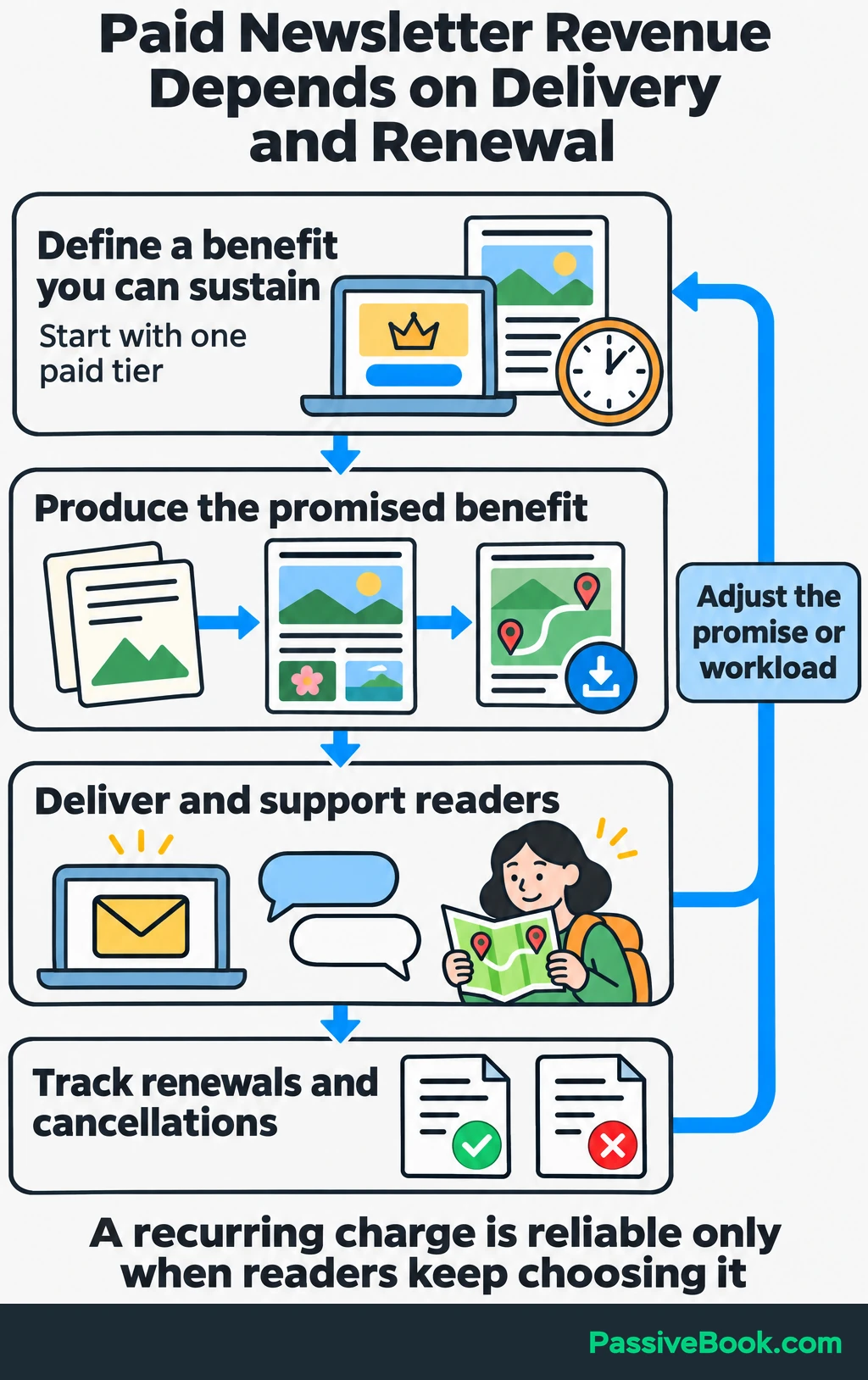
Start with one paid tier and price it against relevant alternatives, production time, support, and payment costs.
I abandoned a membership site after six months of building it alongside corporate work because the content workload was unsustainable. That makes me cautious about any recurring promise that requires constant new material.
Before building a premium library, sell a clearly defined subscription that you can deliver. Then track renewals and cancellations alongside initial purchases. A recurring charge becomes reliable income only when readers keep choosing it.
Sell a Service or Live Workshop
A service fits when readers want help applying what you teach. A live workshop works when several people need the same instruction.
Define the deliverable, scope, turnaround, and capacity before promoting it.
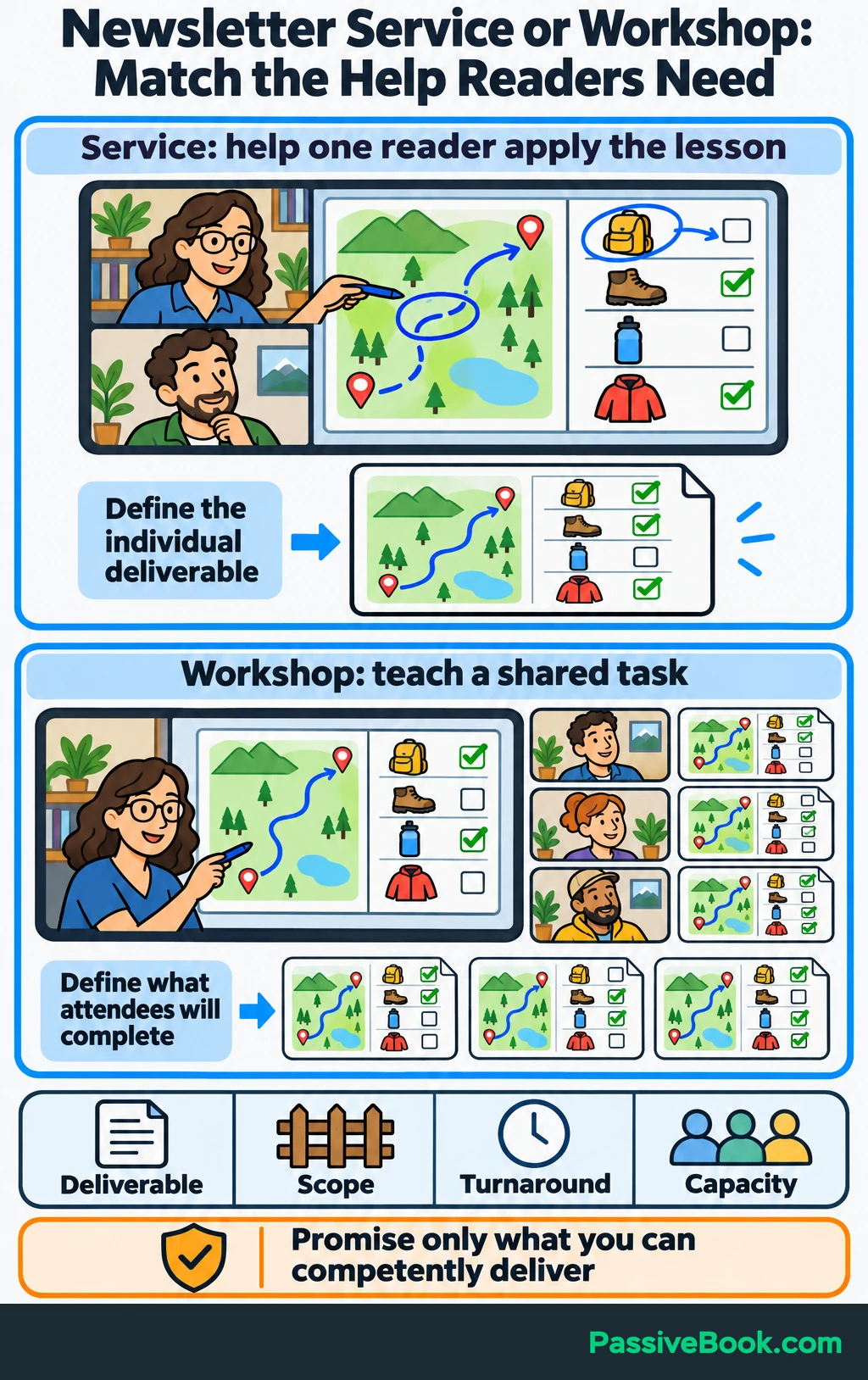
For Weekend Photo Walks, someone with suitable planning experience could offer a session helping a reader organize an outing. A workshop could demonstrate how to complete the planning pack. Keep the promise within your competence.
Price for preparation, delivery, administration, and follow-up. A one-hour call rarely consumes only one hour.
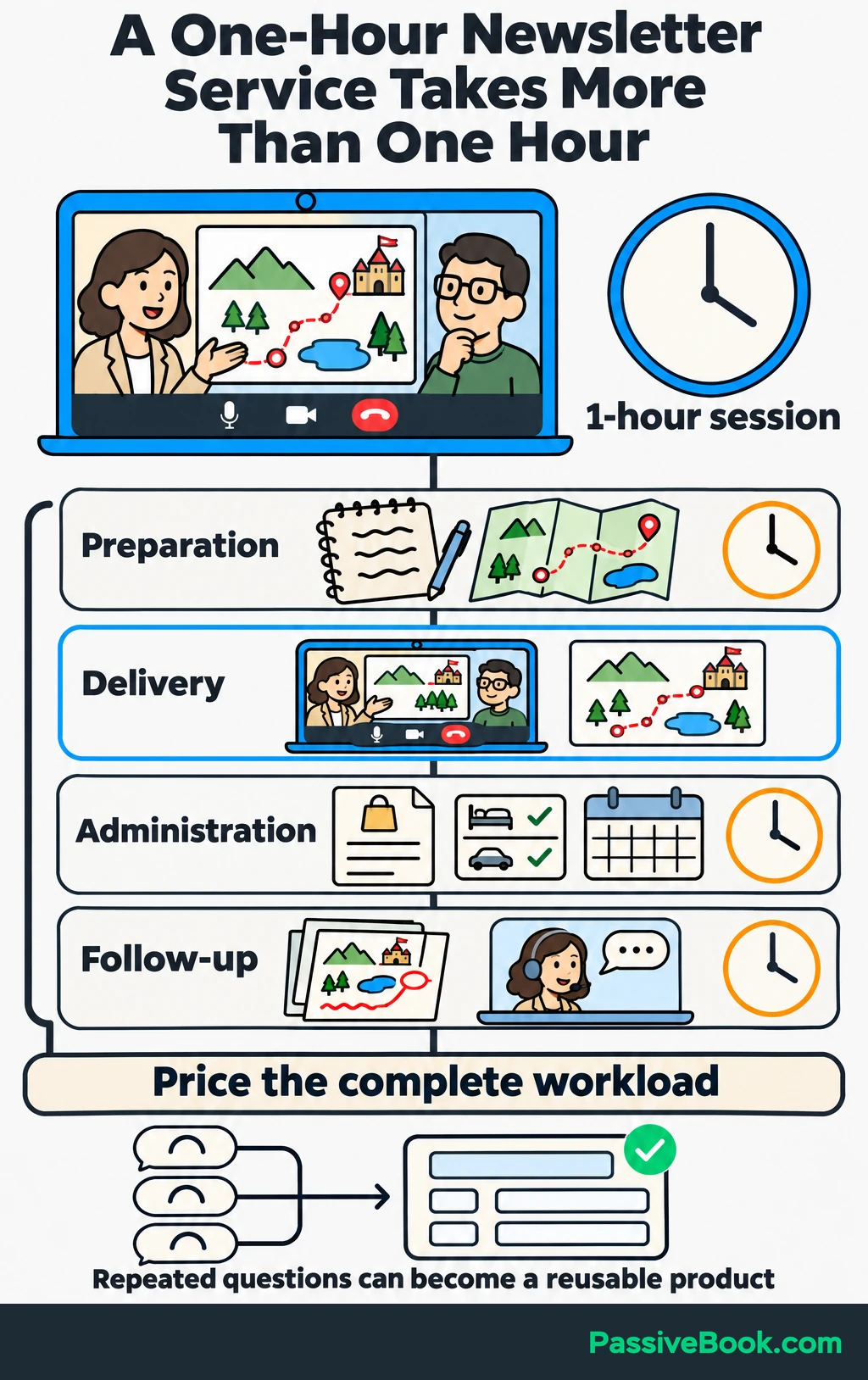
My freelancing experience made that distinction painfully clear: income could look healthy while the work still depended on every available hour.
I would use a service to earn and learn, then watch for repeated questions that belong in a reusable product. That gives the work somewhere to lead beyond another booking.
Estimate What Your Offer Could Earn
Estimate how many people receive the promotion, how many click the offer, and how many of those clickers buy. Then subtract the costs.
For the planner, suppose you count activity during the seven days after one send. These are assumptions for learning the calculation, not expected results.
| Item | Illustrative Result |
|---|---|
| Successfully delivered emails | 500 |
| Unique recipients who click the offer within seven days | 40, or 8% of delivered recipients |
| Buyers among those 40 clickers within seven days | Four, or 10% |
| Product price | $19 |
| Gross revenue | Four × $19 = $76 |
| Assumed combined direct costs, with no refunds | $16 |
| Earnings before labor and tax | $60 |
The revenue estimate is:
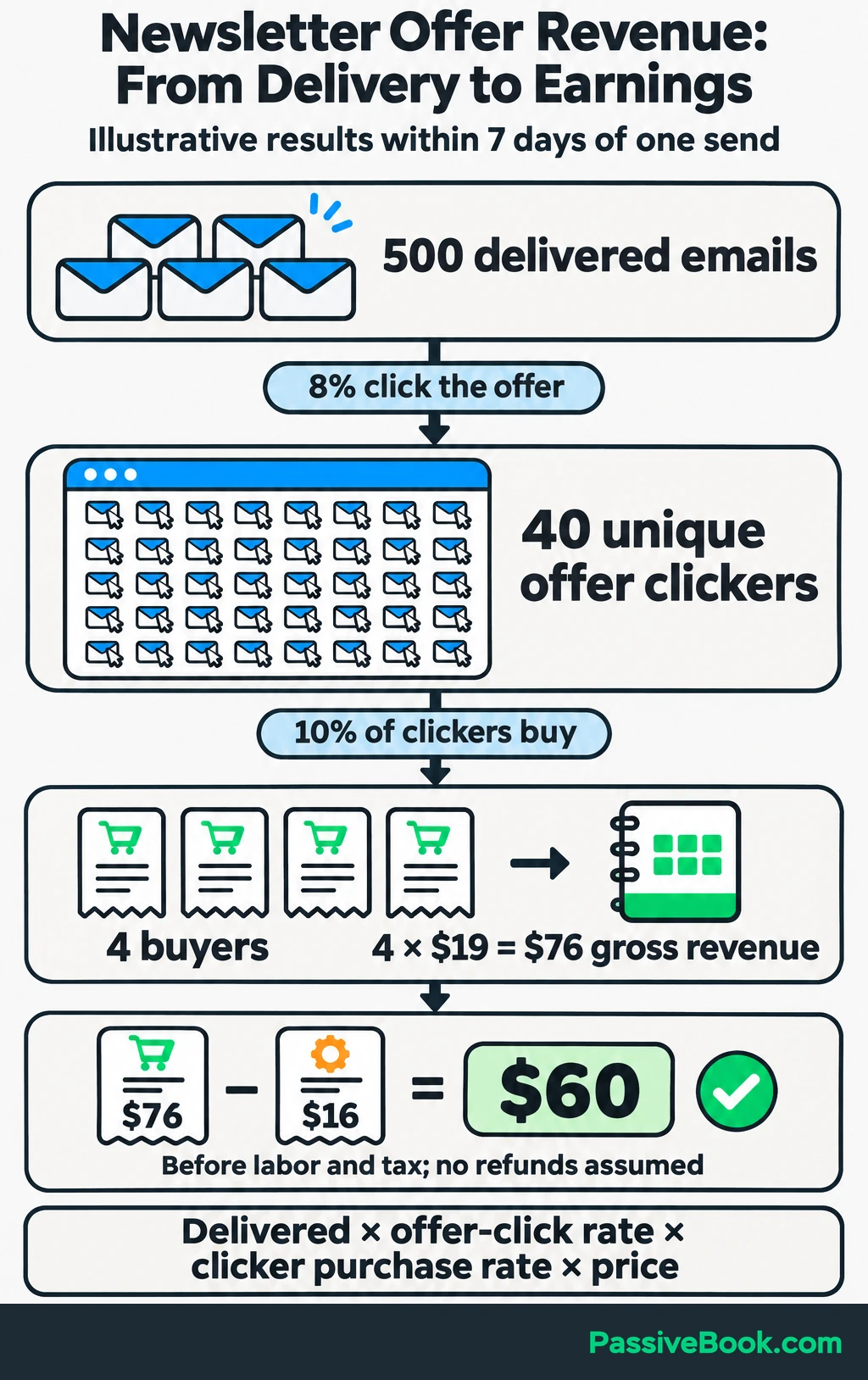
Delivered emails × unique offer-click rate × purchase rate among those clickers × price
Include payment and platform fees, refunds, fulfillment, and additional experiment costs when estimating earnings. Track your hours separately so a small positive balance doesn’t hide an afternoon of work.
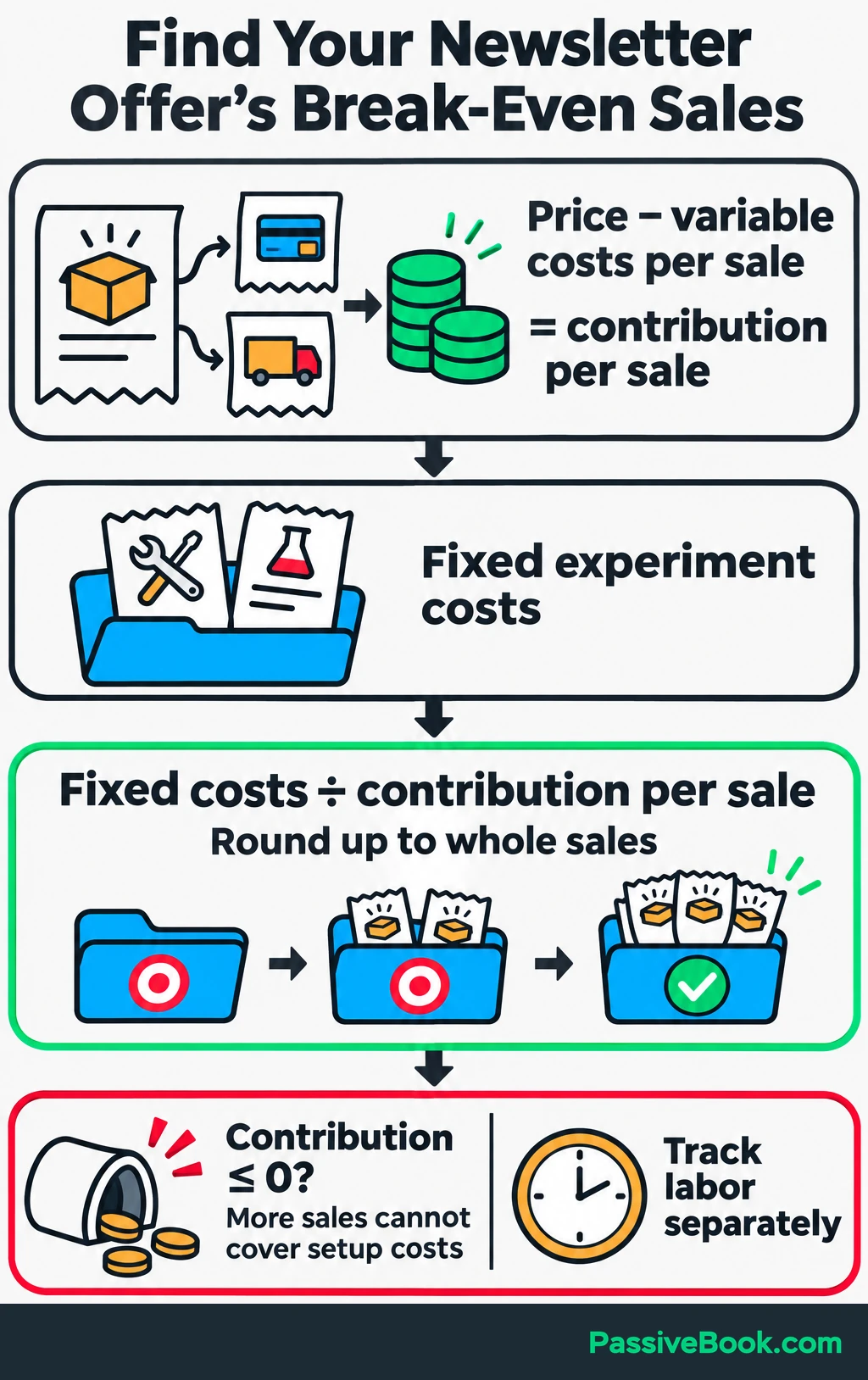
To find break-even sales, first work out what each sale contributes after its variable costs. Divide fixed experiment costs by that contribution and round up. If each sale contributes nothing or loses money, additional sales won’t cover setup costs.
Other models need different calculations:
- Affiliate income uses approved commissions, not pending ones.
- Sponsorship income follows the agreed payment basis.
- Service income comes from paid bookings, with delivery time counted.
- Subscription revenue uses active paying subscribers at their actual prices.
Keep one-time sales separate from recurring revenue. Four purchases can justify another test, but they cannot establish a dependable monthly forecast.
A positive balance can still be a poor return on your time. Use the calculator to work backward from your income target and check whether the sales and delivery hours fit.
Free Audience Revenue Calculator




Launch Your First Newsletter Offer
Set Up the Tools Your Offer Needs
Keep your existing email service if it can send the promotion and connect readers to the right destination.
Buy software only when you can name the missing capability:
| Offer | Minimum Setup |
|---|---|
| Affiliate recommendation | Approved referral link and access to commission reporting |
| Sponsorship | Agreed destination link and placement reporting |
| Digital product | Checkout, confirmation, and file delivery |
| Service or workshop | Payment, booking or registration, and attendance instructions |
| Paid newsletter | Recurring billing, paid access, and cancellation handling |
For a simple hosted starting point, I would consider Kit. Its free plan supports broadcasts and selling digital products or subscriptions; transaction charges still apply. Check the current plan comparison before relying on sequences or automation.
If you already run WordPress and are comfortable maintaining it, my preference is FluentCRM, which manages email campaigns and automation inside WordPress. Budget for email delivery, hosting, and maintenance as well as the plugin.
Confirm seller eligibility before building checkout pages. Kit Commerce has its own supported-country list, and other Stripe-based setups depend on Stripe’s account availability. A platform letting you send email doesn’t necessarily mean it can pay you.
Compare total cost at your list size and sending frequency, including transaction fees, revenue shares, integrations, and upkeep.
Prepare and Test the Purchase Path
Write an offer page that answers the buying questions: who it helps, what is included, the price, delivery, and available support.
For the planner, show a sample page and name the file formats. Confirm that buyers can download and edit them.
Give the promotion a distinct tracking link or campaign identifier so you can connect visits with orders or inquiries.
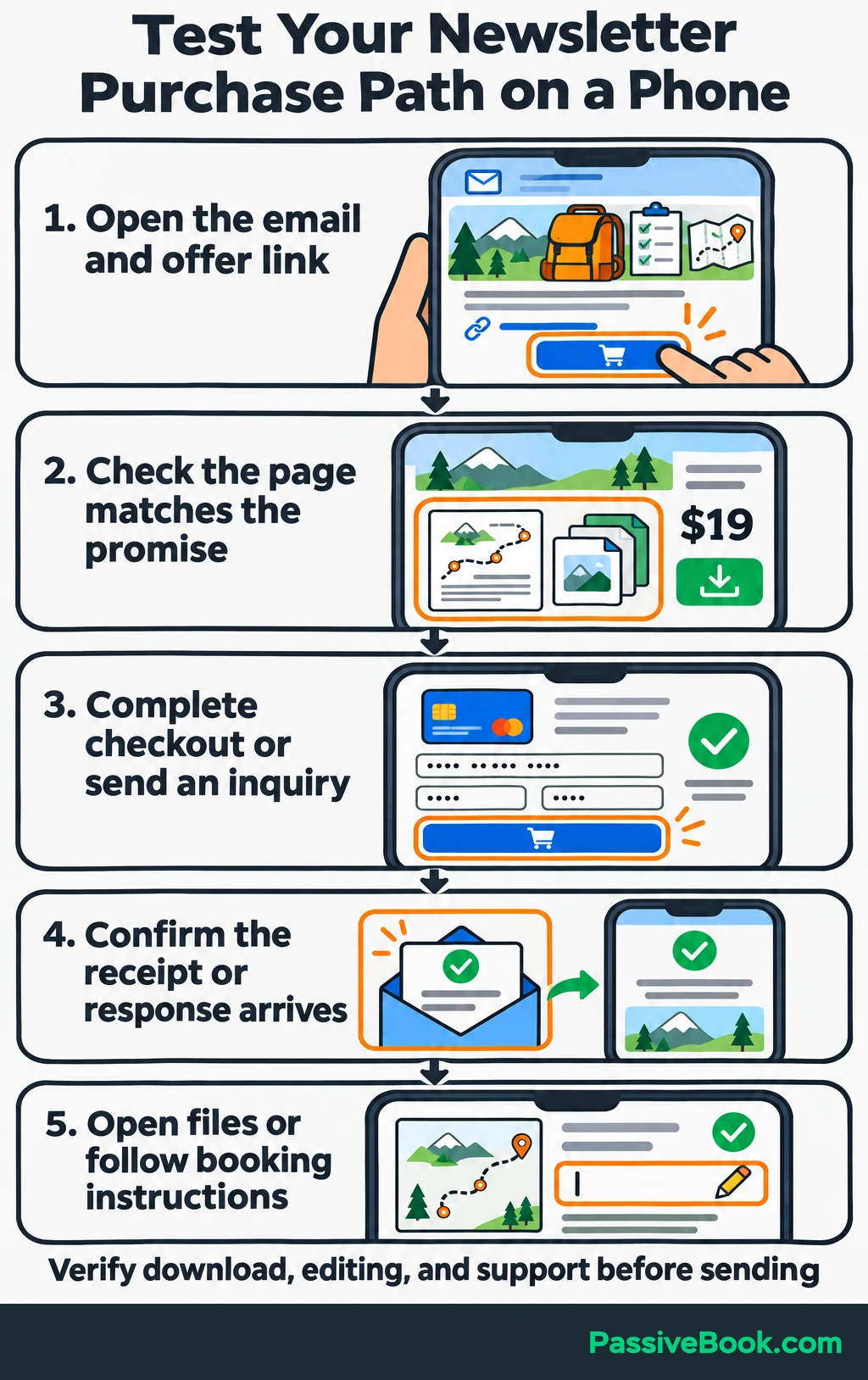
Then test the complete journey on a phone:
- Open the email and follow the offer link.
- Check that the destination matches the promise.
- Complete checkout or submit the inquiry form.
- Confirm that the receipt or response arrives.
- Open the files or follow the booking instructions.
Prepare fulfillment and support before sending. The first buyer shouldn’t also be your unpaid quality-control department.
Send a Useful Issue With One Clear Offer
Teach something useful, explain the remaining problem, and offer a way to solve it.
An outing-preparation issue could explain how to choose a starting point, check access details, and decide which shots to attempt. Then introduce the planner:
“If your route notes and shot ideas keep ending up in different places, the editable photo-walk planning pack brings them together. Get the pack for $19.”
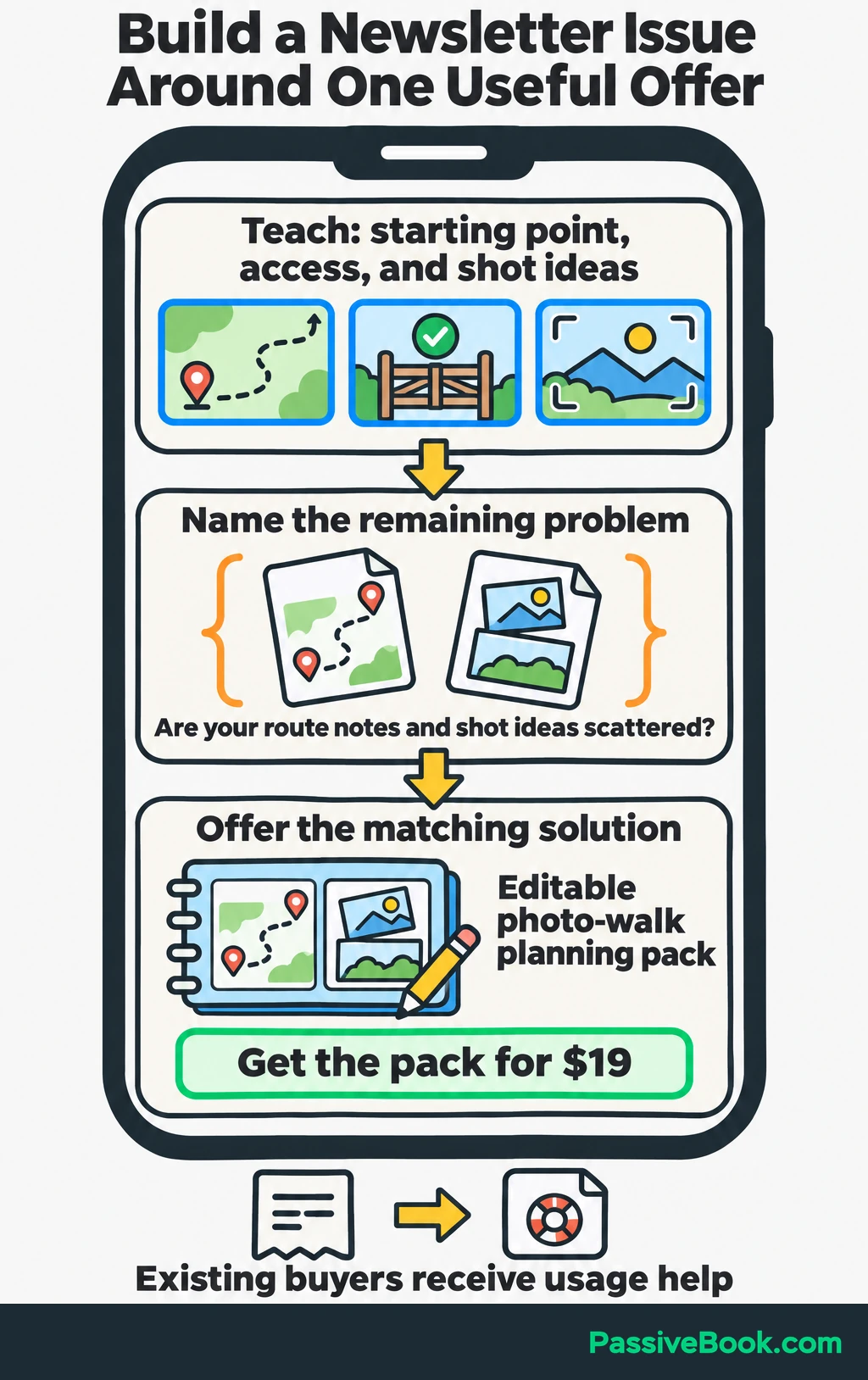
Use one primary call to action. Existing buyers should receive help using the planner rather than another request to buy it.
If you have the offer but keep rewriting the pitch, AI Messaging Studio can turn your notes into a draft. Start with one promotion, then use the same offer details for the page or follow-up message it needs.

Free AI Messaging Studio
Send to readers whose stated interests or relevant activity fit the offer. With little data, use an appropriate regular issue and learn from replies and clicks.
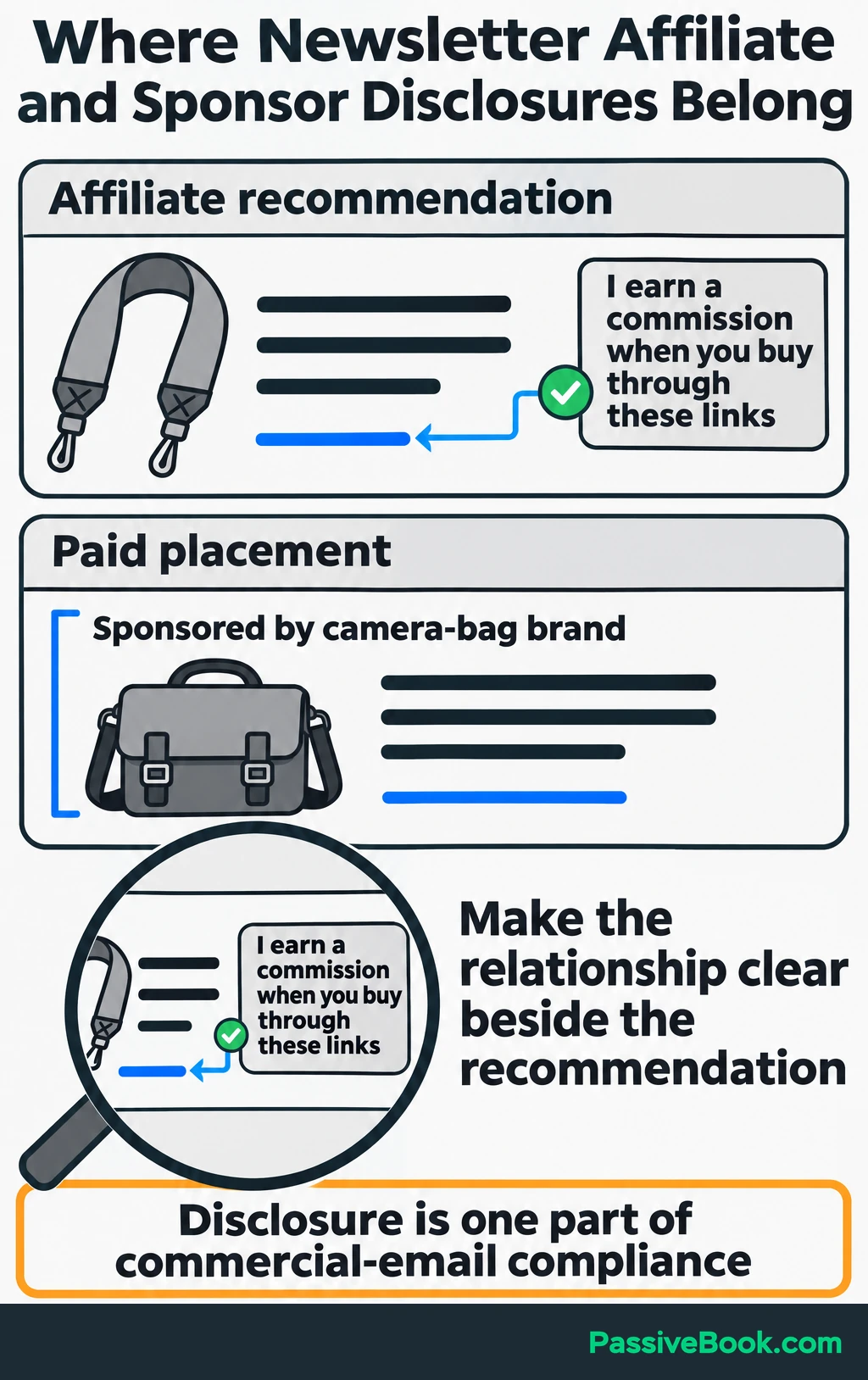
Make commercial relationships clear beside the recommendation. “I earn a commission when you buy through these links” explains an affiliate relationship. Label paid placements plainly, such as “Sponsored by [brand].” The FTC’s endorsement guidance explains the need for clear disclosure of material connections.
Follow applicable consent and commercial-email rules. For U.S. commercial email, that includes accurate sender details and subjects, clear advertising identification, a valid postal address, and an opt-out method. Unsubscribe requests must be honored within 10 business days. See the FTC’s CAN-SPAM guide.
Measure Revenue and Reader Response
Record one row per promotion in a spreadsheet. Include the issue, offer, delivered emails, unique offer clicks, purchases or qualified inquiries, approved revenue, refunds, direct costs, unsubscribes, complaints, and hours worked.
Use a consistent measurement window so you can compare sends fairly.
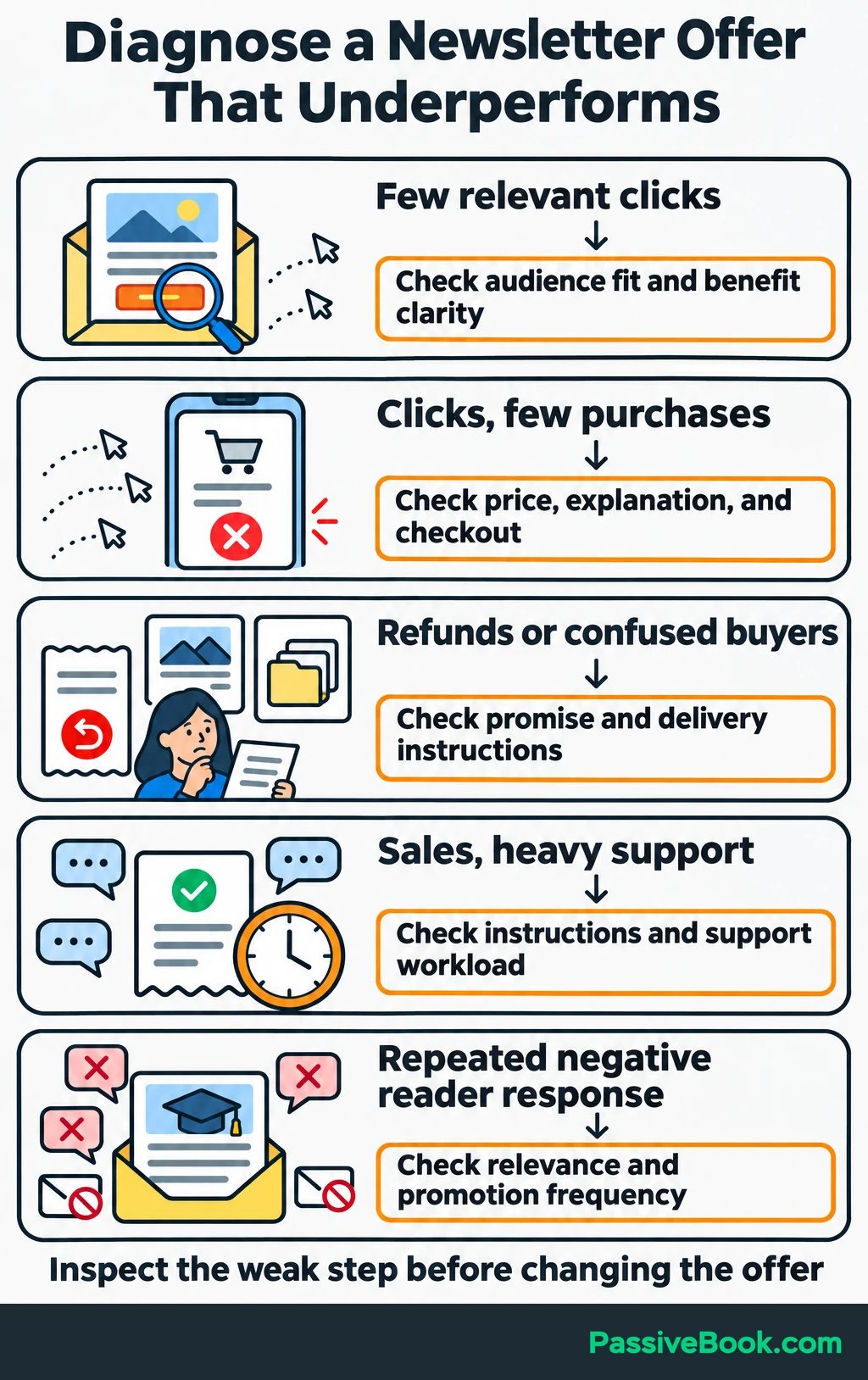
The weak step tells you what to inspect:
| What You Observe | What to Check |
|---|---|
| Few relevant clicks | Whether the offer fits the issue and readers understand its benefit |
| Clicks but few purchases | Price, product explanation, mobile checkout, and payment failures |
| Refunds or confused buyers | Whether the product matches the promise and delivery instructions are clear |
| Sales with heavy support | Missing instructions, confusing files, or an offer that needs more help than priced |
| Repeated negative replies or higher unsubscribes | Promotion frequency, relevance, and whether useful content is being crowded out |
In a newsletter I ran in another niche, I put a download offer and a call-booking invitation in the same issue. Replies asked which one they should start with. I separated the promotions because I wanted a clear decision for readers and a clearer result for myself.
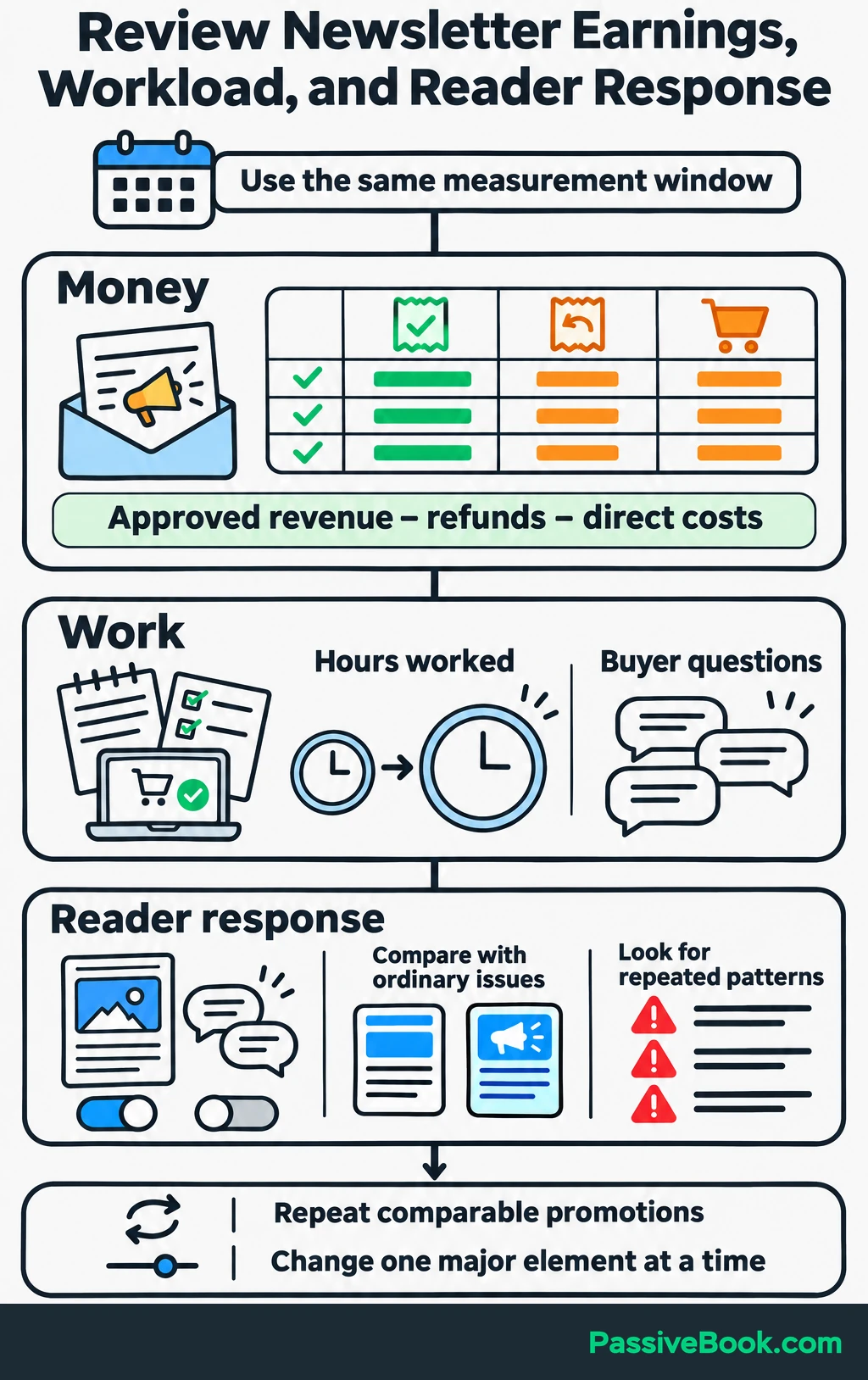
Compare reader response with ordinary issues. One unsubscribe doesn’t explain much, but repeated complaints deserve attention.
Repeat comparable promotions and change one major element at a time. Judge earnings after direct costs alongside hours worked and buyer questions.
Build Repeat Income From Offers That Work
Automate a process after you have evidence that it helps readers and earns enough to operate.
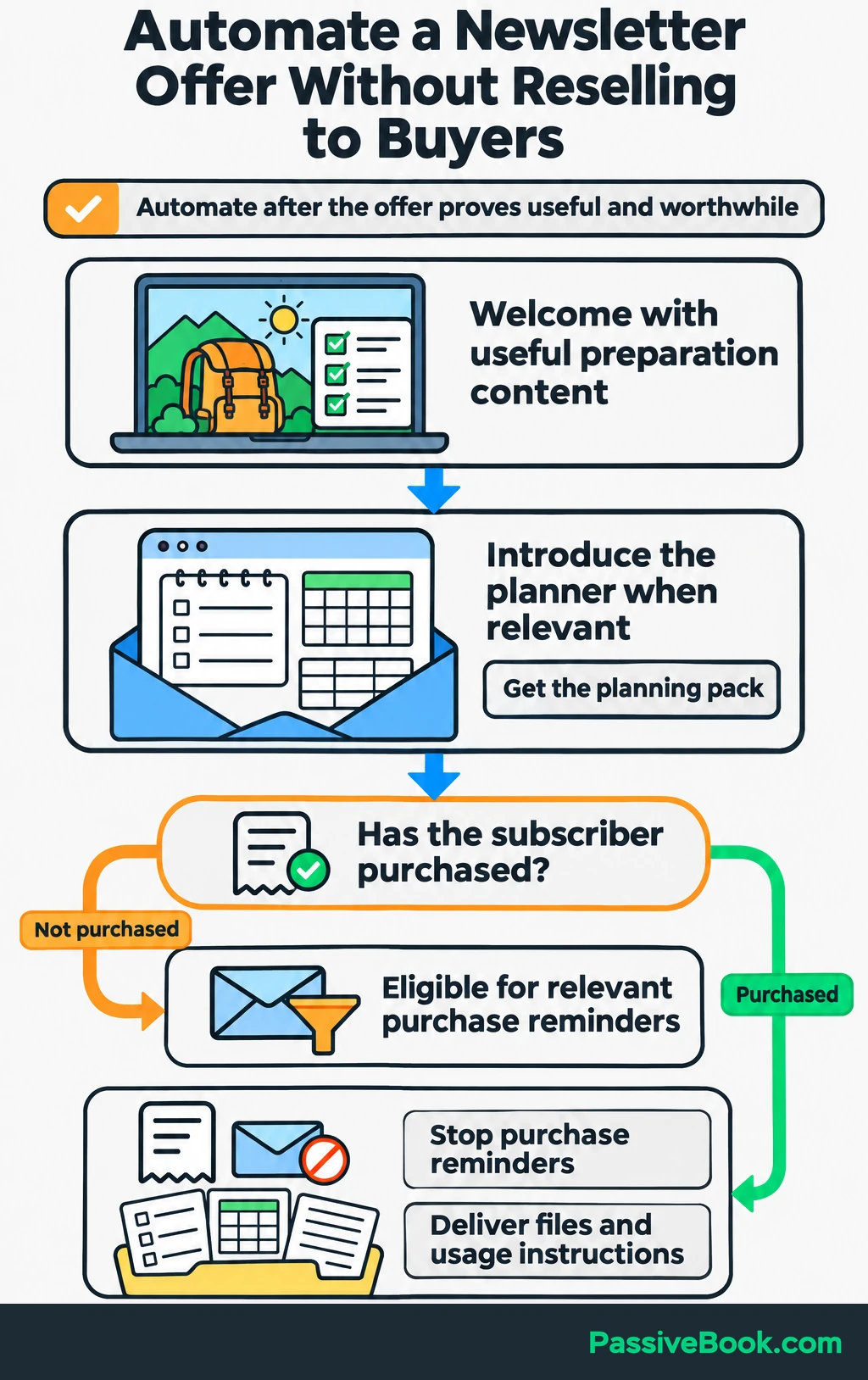
For the planner, a simple sequence could:
- Welcome a subscriber with useful outing-preparation content.
- Introduce the planner when it fits that lesson.
- Stop purchase reminders when the subscriber buys.
- Deliver the files and explain how to complete them.
Use your email platform’s built-in features first. Add another automation tool only when a specific connection is missing. You don’t need a complicated system to deliver four files and a receipt.
Schedule maintenance too. Check links, product availability, affiliate terms, customer questions, and whether the offer still matches the newsletter.
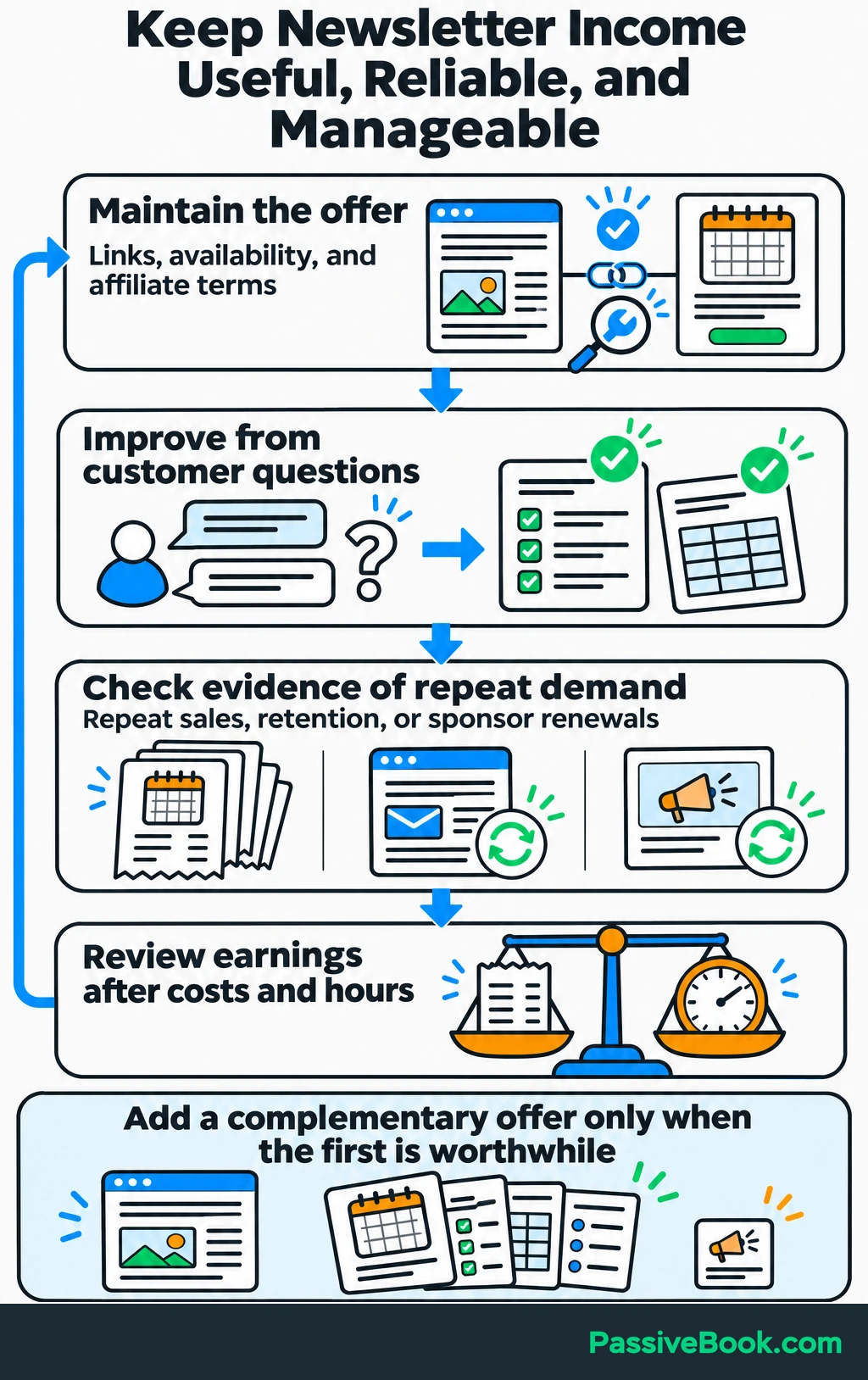
Look for reliability in repeat sales, subscription retention, sponsor renewals, earnings after costs, and manageable hours. Automated delivery saves work, but it doesn’t remove the need to keep the offer useful.
Once the first method is worthwhile, add something complementary. The planner could sit alongside occasional relevant sponsorships while the free newsletter continues delivering its original promise.
I would rather maintain one useful product and a few suitable partnerships than juggle five weak offers because a monetization checklist had five boxes.
What Next?
Read your last ten subscriber replies and write down one problem people keep mentioning. Choose the smallest offer that could solve it, then draft its promise and price before buying software or building more content.
Use the social buttons to share this guide when the conversation turns to earning from a small newsletter.
Which reader problem could become your first paid offer? Leave your answer in the comments, and bring any other questions there too.
Share this post with your friends & followers:

