You buy the same dog supplies again and again, so selling refills on subscription looks like a sensible business. The harder question is whether customers will pay enough for scheduled delivery to cover the product, postage and your time.
A shelf full of stock doesn’t answer that question. Neither does a checkout that can charge a card every month. Before you fill that shelf, this guide shows how to test a refill subscription with a small, costed pilot—and judge whether its renewals justify buying more stock.
1. Choose a Product Customers Have a Reason to Receive Again
Start with something people already replace or a benefit they keep using. Your first job is to understand that buying habit.
Ask prospective customers:
- What do you buy repeatedly, and where?
- How much do you use before ordering again?
- What makes you choose one product over another?
- What goes wrong with your current option?
- Would scheduled delivery help, or would you rather reorder yourself?
If you already have a store, check repeat purchases and the gaps between orders. Customers’ actual buying patterns give you a better starting point than a poll asking whether they “like” your idea.
Then compare competing offers on delivered price, quantity, delivery frequency and repeated complaints. Look for a specific improvement you can provide, such as a more useful quantity or fewer delivery problems.
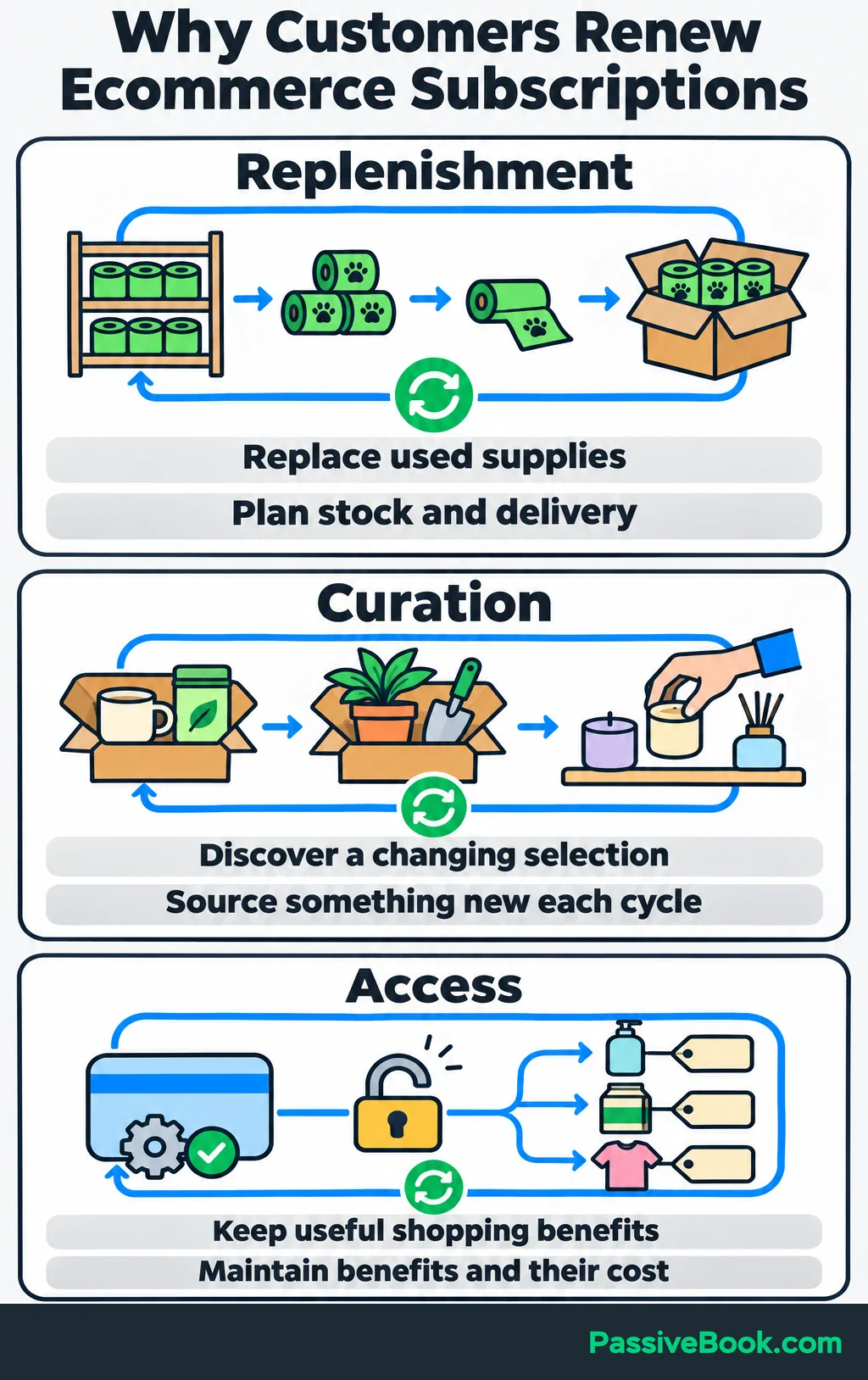
Choose the subscription model that fits that improvement.
| Model | Reason to Renew | Operating Workload |
|---|---|---|
| Replenishment | Replace supplies as customers use them | Forecast usage, maintain stock and deliver reliably |
| Curation | Receive a changing selection worth discovering | Find new products, manage changing stock and keep selections appealing |
| Access | Keep receiving shopping benefits, such as member pricing | Maintain benefits customers use and check their cost |
For a first physical-product subscription, I would favor replenishment when there is clear repeat demand. Curation gives you another purchasing decision to make every cycle. Your customers get a surprise, and so does your workload.
Throughout this guide, imagine launching unscented dog-waste-bag refills. All example prices, quantities and costs are illustrative planning assumptions in US dollars, not supplier quotes or observed results.
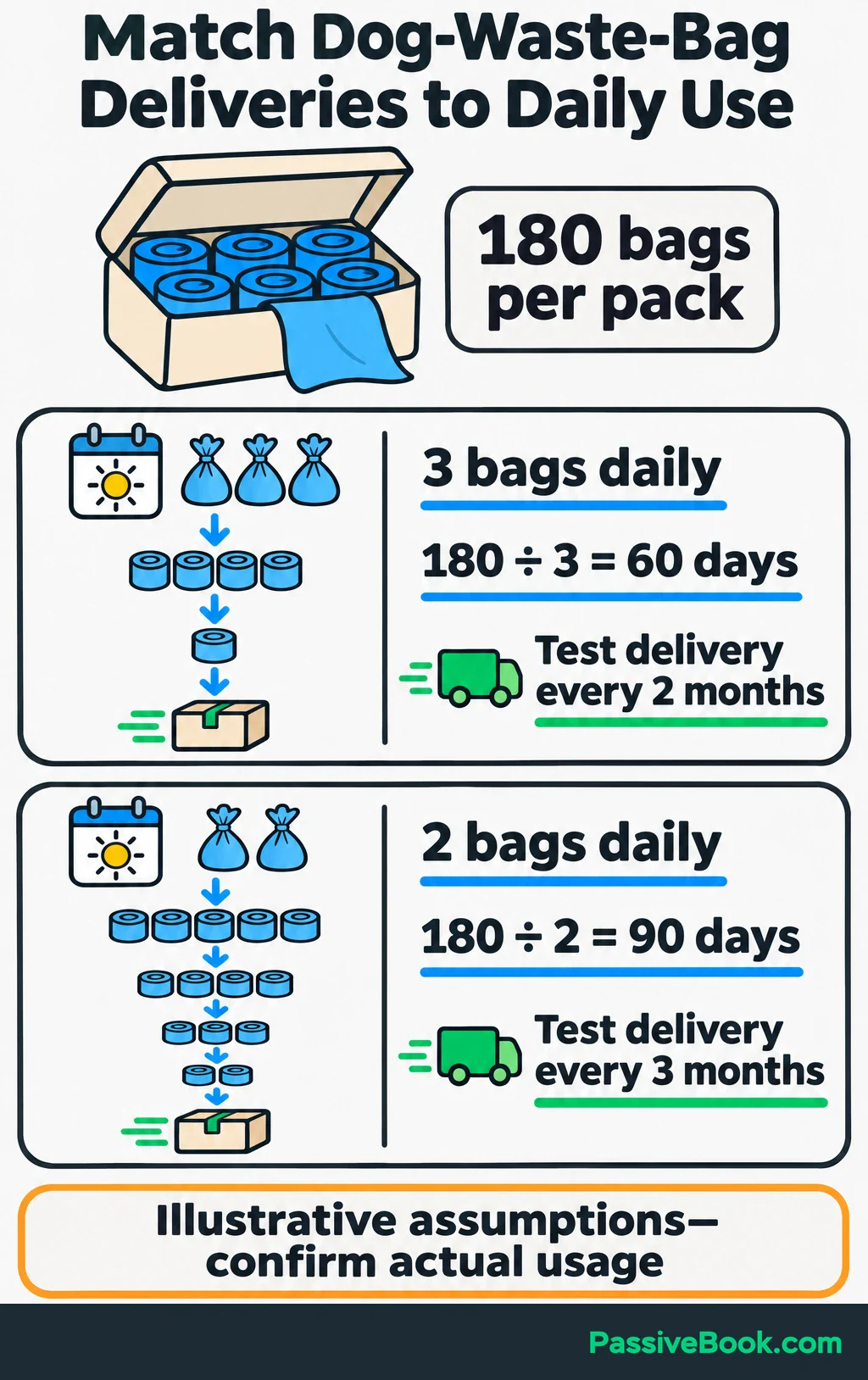
Start with one pack containing 180 bags. Ask how many bags people use daily. At three a day, that pack lasts about 60 days; at two a day, about 90 days. That suggests testing delivery every two or three months rather than assuming everyone needs a monthly shipment.
Turn the idea into one sentence:
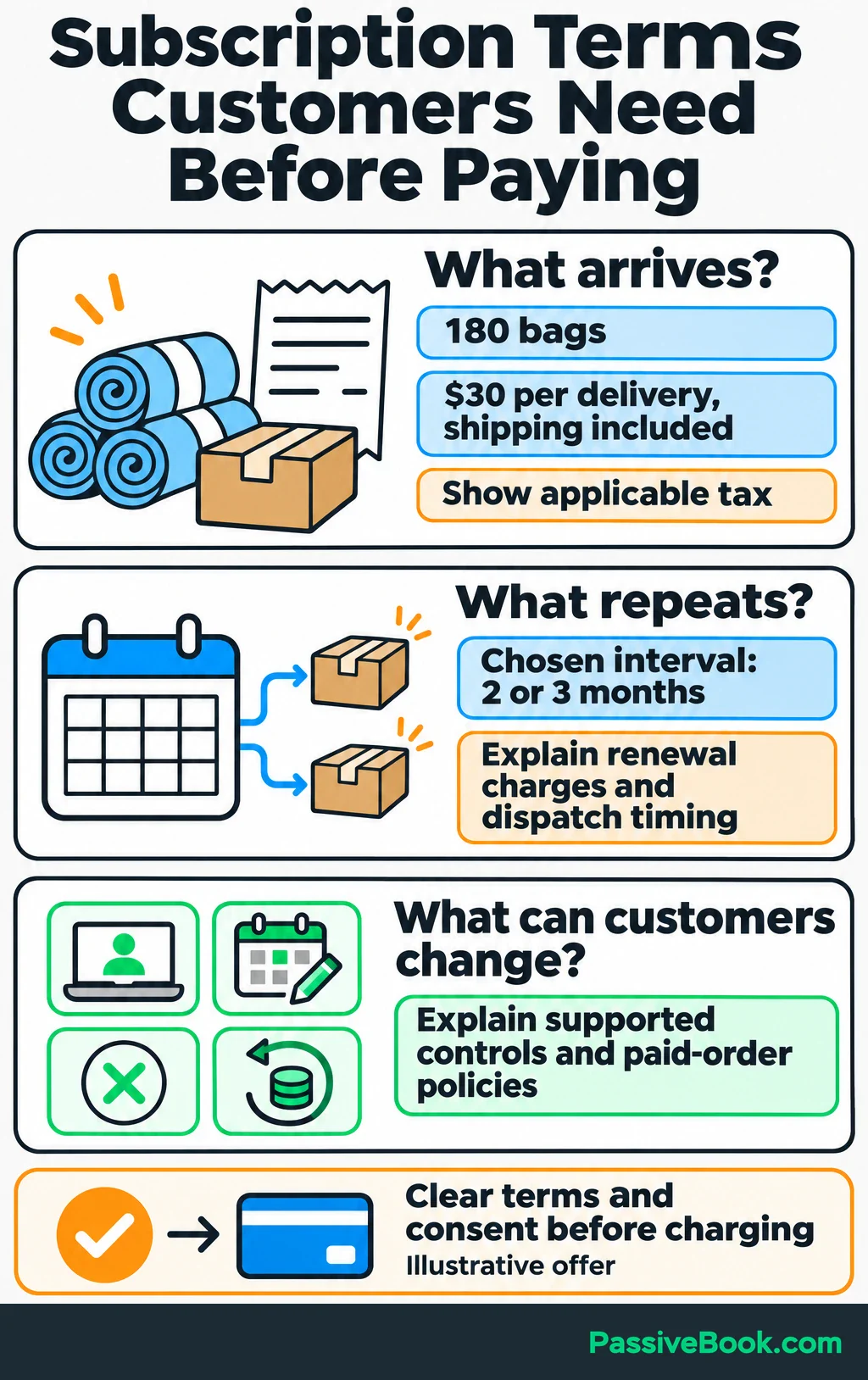
Receive 180 unscented dog-waste bags for $30 per delivery, shipping included, every two or three months so you spend less time remembering to reorder.
That is an offer to test. Begin with one product and a limited delivery area so you can learn without juggling several stock types and shipping arrangements.
2. Confirm That You Can Source and Deliver the Product Reliably
A subscription creates a repeated promise. Check whether your supplier and delivery process can support it before you make that promise to customers.
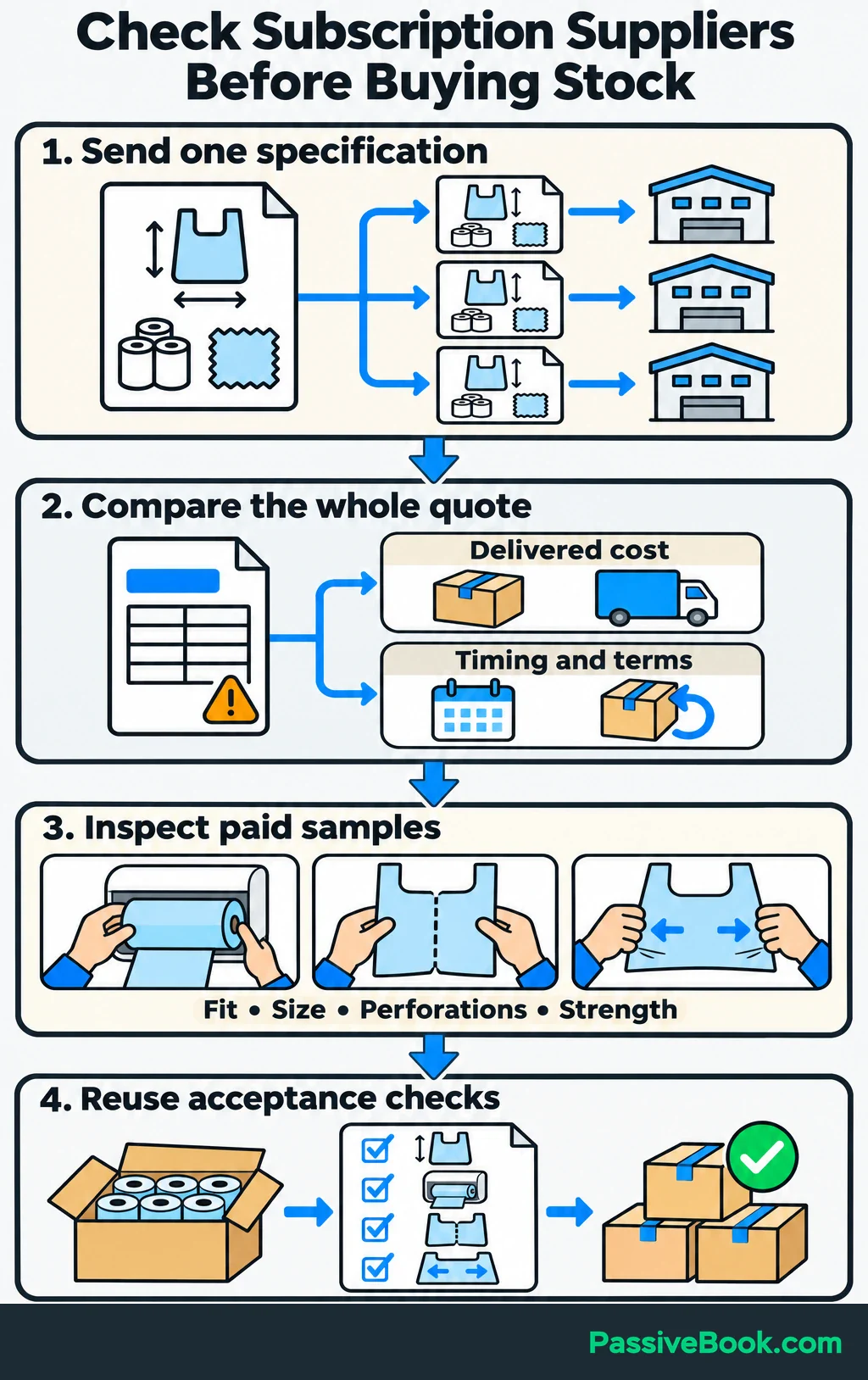
Send the same product specification to each supplier. Otherwise, a cheaper quote may simply cover a different product.
Request:
- Order Requirements: Minimum quantity, pack contents and available customization.
- Delivered Cost: Product cost, freight and any applicable import charges.
- Timing: Production time, transit time and likely delays.
- Payment Terms: Deposit, balance due date and payment method.
- Problem Handling: Replacement or credit terms for missing or defective goods.
Buy samples before pilot inventory. For the refill packs, check bag dimensions, dispenser fit, perforations and resistance to tearing. Write down those checks and use them when accepting later batches.
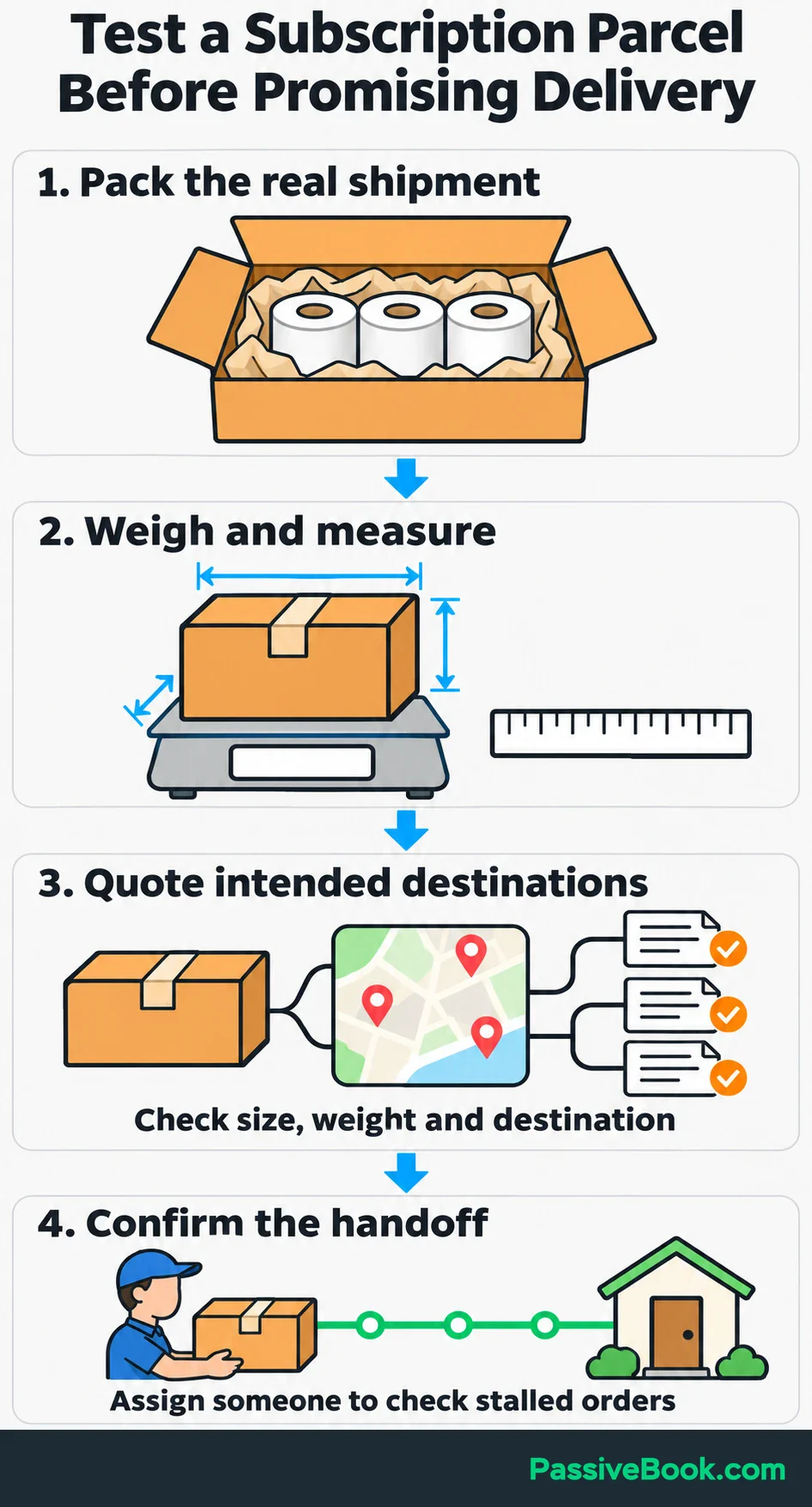
Next, pack a shipment exactly as a customer would receive it. Weigh and measure the finished parcel, including its packaging, and get delivery quotes for the destinations you intend to serve. Package size and weight can affect postage, as explained in USPS parcel guidance.
Choose fulfillment based on the whole job:
- Pack Orders Yourself: You control quality and see problems early, but storage and packing take time.
- Use Supplier-Direct Shipping: You avoid handling each parcel, but need reliable stock updates, dispatch confirmation and clear responsibility for mistakes.
- Hire a Fulfillment Provider: You hand off storage and packing, but must include receiving fees, storage, minimum charges and returns.
I would usually pack a small pilot myself. It gives you direct evidence of how long each order takes before you pay someone else to handle it.
Map the order cycle: successful payment, stock allocation, packing, carrier handoff and tracking. Decide who checks stalled orders and what happens during a shortage. Pause enrollment when capacity runs out, and contact affected customers with clear options when you cannot meet an existing promise.
3. Set a Sustainable Price and Launch Budget
Calculate Contribution per Shipment
Work out how much money each shipment leaves after the costs of selling and delivering it. That remaining amount is its contribution toward fixed overhead and profit.
Start with revenue after discounts, excluding taxes collected for authorities. Subtract the product’s landed cost, packaging, postage, packing labor, payment and app transaction fees, and an allowance for replacements or refunds.
Here is the refill example:
| Item | Amount per Shipment |
|---|---|
| Revenue, including shipping | $30 |
| Landed product cost | −$8 |
| Packaging | −$1 |
| Outbound shipping | −$5 |
| Payment and app transaction fees, assumed combined | −$1 |
| Packing labor | −$2 |
| Replacement and refund allowance | −$1 |
| Contribution | $12 |
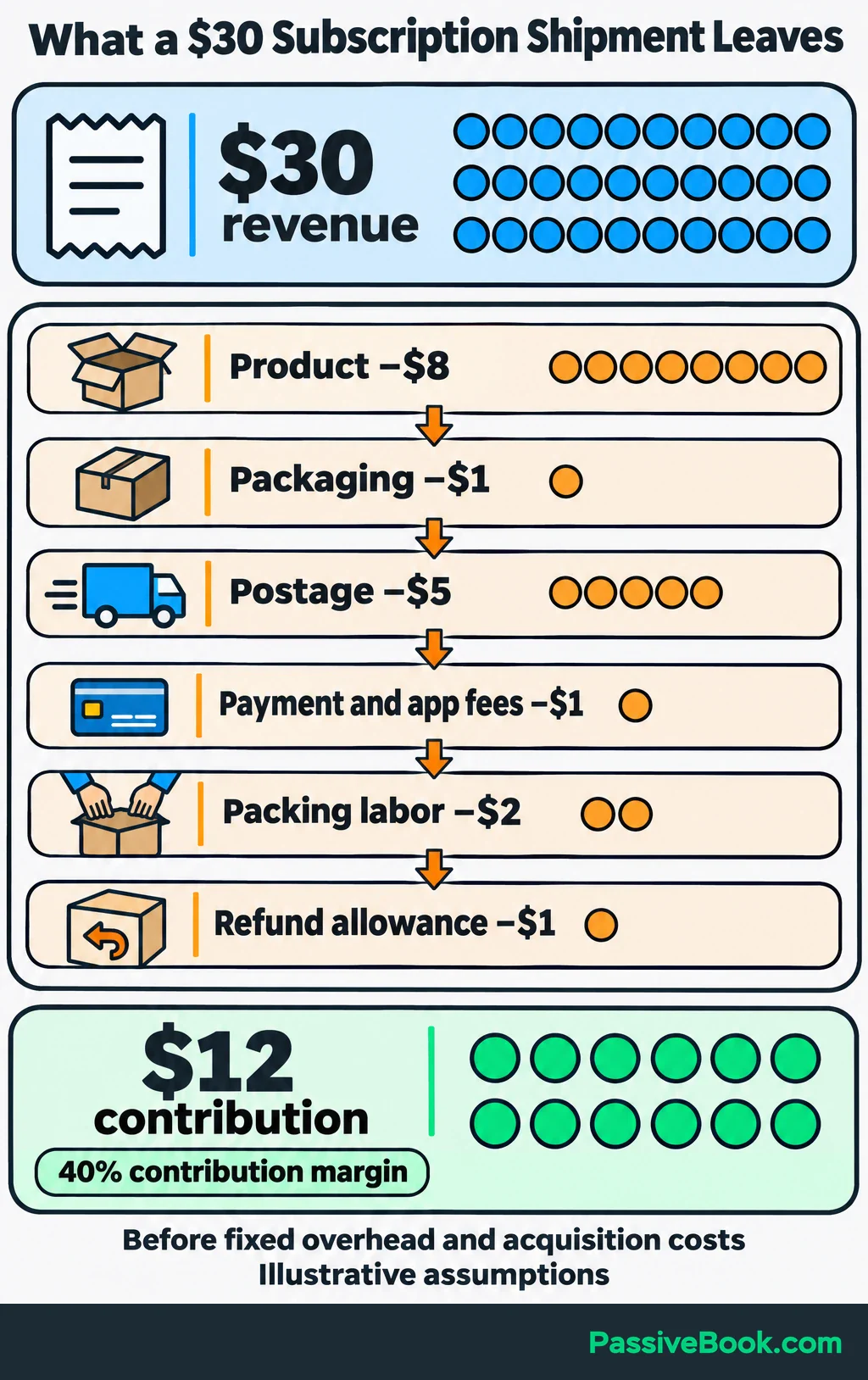
The shipment leaves $12 from $30 of revenue, giving a contribution margin of 40%.
Include your packing time even when you do the work yourself. Otherwise, your spreadsheet quietly assumes you work for free forever.
To estimate monthly operating break-even, count how many shipments must contribute enough to cover monthly fixed overhead. Divide that overhead by contribution per shipment and round up.
With $120 in monthly fixed costs and $12 contribution, you need 10 shipments to cover that overhead. Those shipments have not yet covered customer acquisition, startup-cost recovery or income taxes.
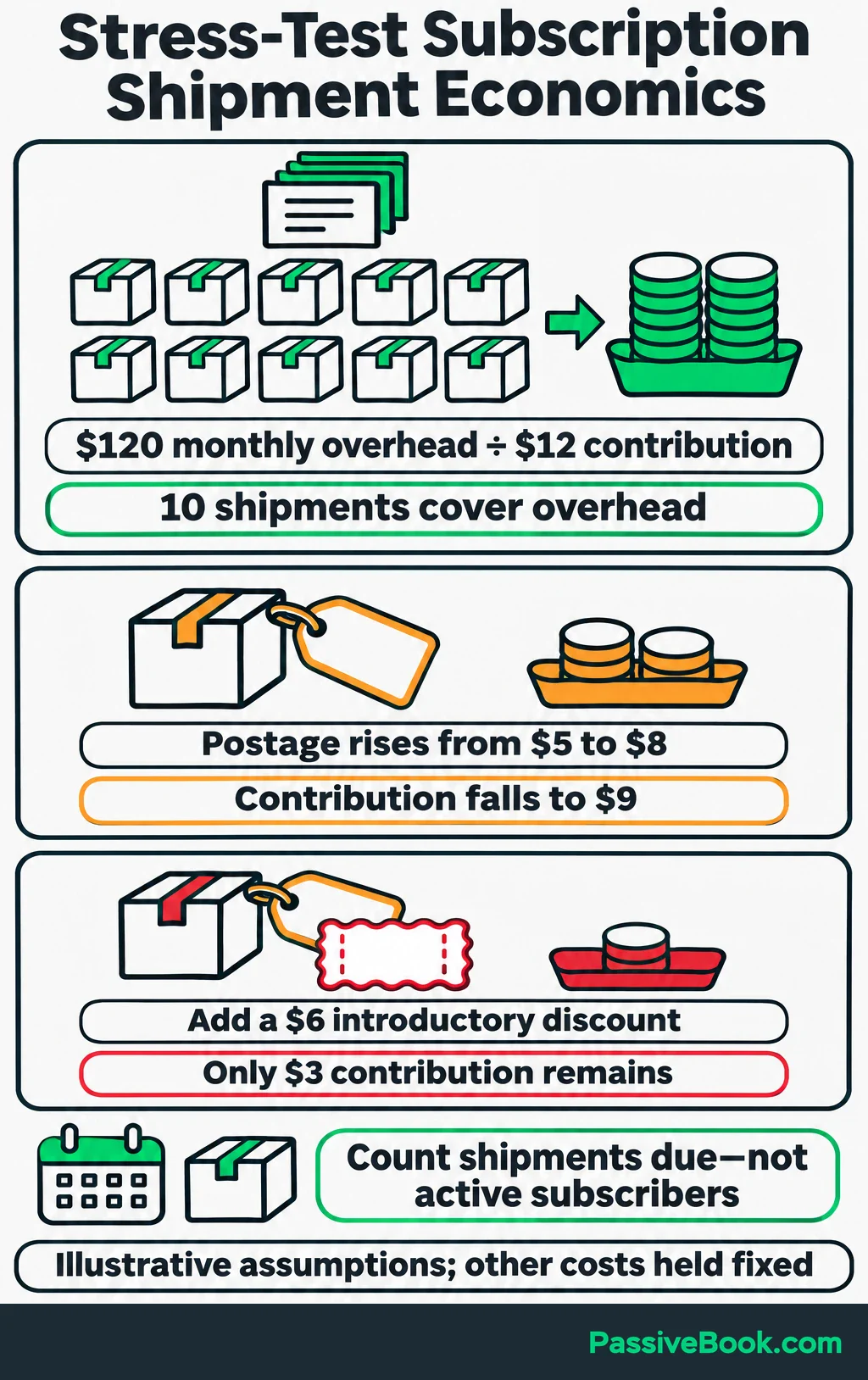
Count shipments due during the month. Ten active subscribers receiving deliveries every three months do not produce ten shipments every month.
Then test less comfortable conditions. Holding the other assumptions fixed, raising postage to $8 cuts contribution to $9. Add a $6 introductory discount and only $3 remains.
Your price must pass two tests: it covers the business’s costs, and customers see enough value to pay it. I would skip an automatic subscription discount until you know you need one. Reliable replenishment can be the benefit.
A discount can make the first shipment look quite different from the renewals. Use the calculator to compare both before deciding what you can afford to spend on a customer.
Free Pricing Profit Calculator




Estimate the Cash Needed Before Launch
Profit per shipment and launch cash answer different questions. You may have a viable margin and still lack money to buy inventory before customer payouts arrive.
Separate setup expenses, inventory purchases, recurring overhead and cash held for upcoming bills.
| Expense or Cash Need | Timing | Illustrative Amount |
|---|---|---|
| Samples and basic setup | Before launch | $100 |
| Twenty refill packs | Before enrollment opens | $160 |
| Packaging for twenty shipments | Before dispatch | $20 |
| Postage float | Available before shipping | $100 |
| First month’s fixed overhead | At setup and during month one | $120 |
| Reserve for refunds, delays and other needs | Held in cash | $200 |
| Subtotal | $700 |
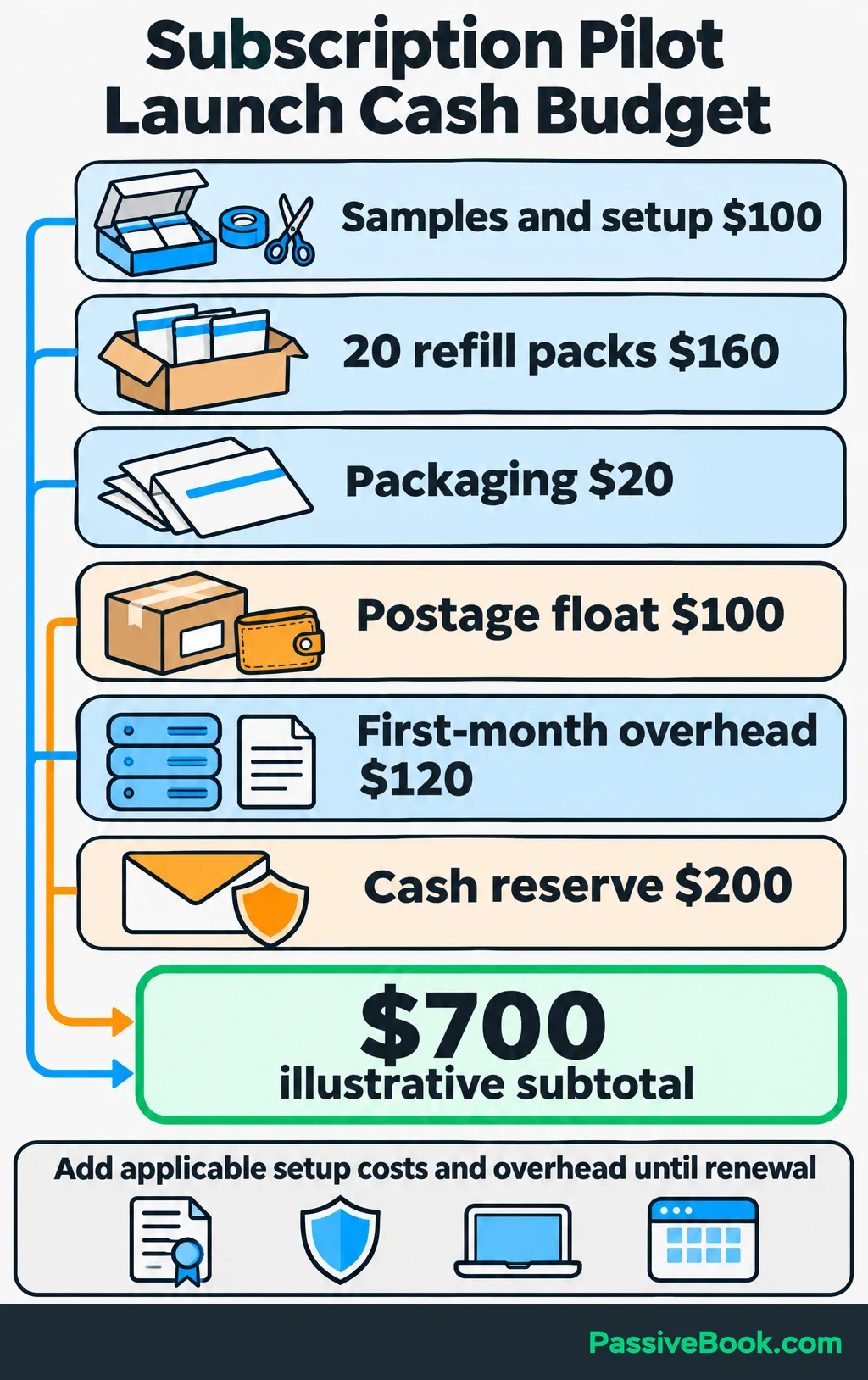
Add applicable registration, insurance, equipment and tax costs to this subtotal. Replace these allowances with supplier quotes and actual bills, including annual software charges due upfront. For this refill pilot, budget fixed overhead until the first renewal, two or three months after the first shipment.
Add payment due dates and expected customer payout dates to your budget. Keep cash available for postage, the next batch and refunds. Prepaid deliveries still need stock and shipping money when they come due.
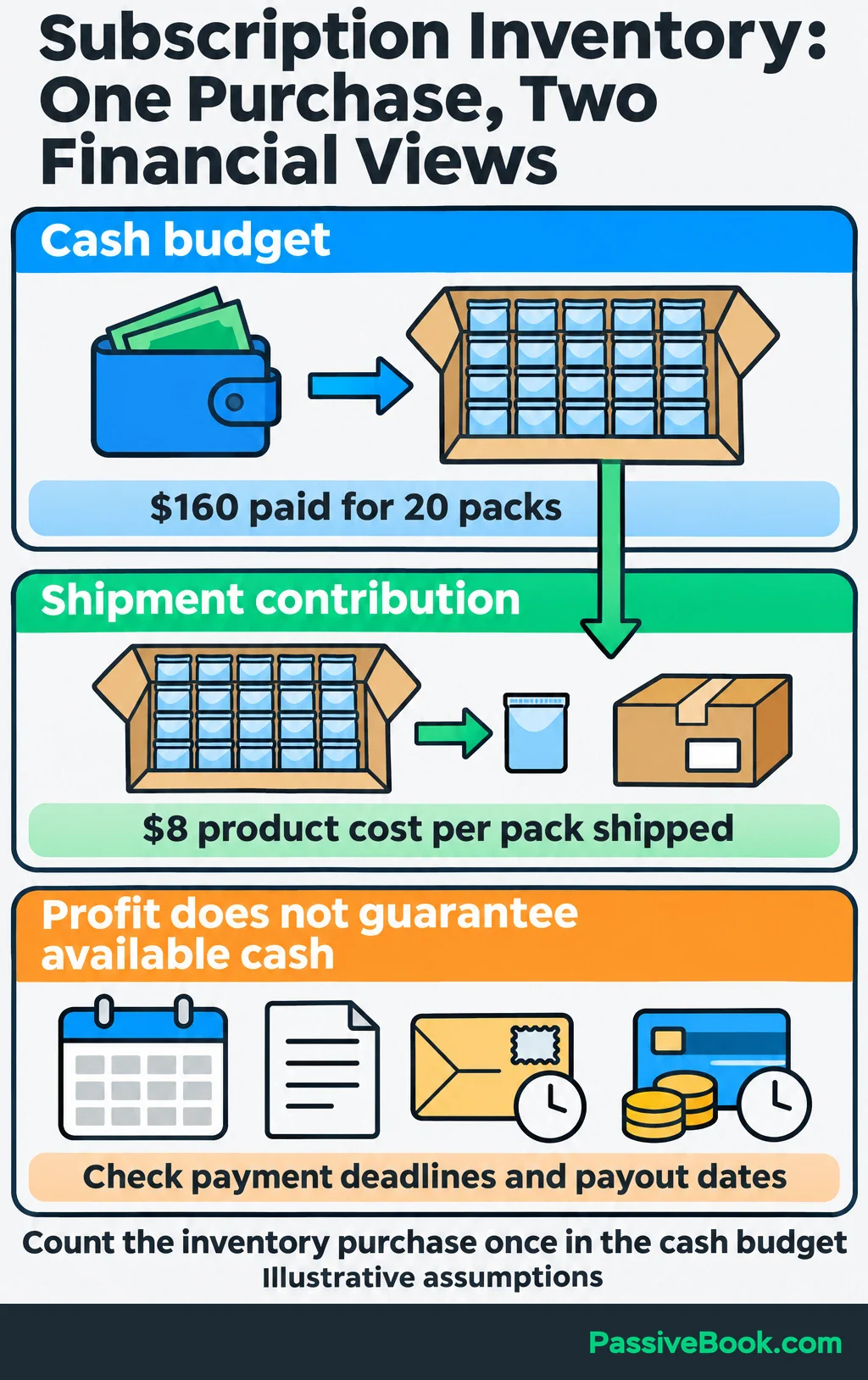
Count inventory once in the cash budget. Its cost still belongs in the contribution calculation when you ship it; those are two views of the same purchase.
Set a maximum pilot spend before ordering. If the requirement exceeds it, reduce the batch, product range or delivery area.
4. Validate the Priced Offer Before Committing to Inventory
Test the offer people would actually buy, including its sustainable price.
Build a simple landing page using Carrd or an existing WordPress site. Show the sampled product, quantity, delivered price, proposed intervals, your own product photos and the intended first-shipment window. Explain that visitors are registering interest before launch.
Then invite suitable people to review it through personal contacts, relevant communities that permit promotion, or an existing customer list.
Ask what they currently buy and what would make them switch. Separate two questions:
- Do they want this product?
- Do they want this product delivered repeatedly at this price?
Someone can answer yes to the first and no to the second.
You need wording that tests the price and delivery commitment, not just whether people like the product. This AI Skill drafts that copy from your offer details, including a clear explanation that you are collecting interest before launch.

Free AI Copywriting Studio
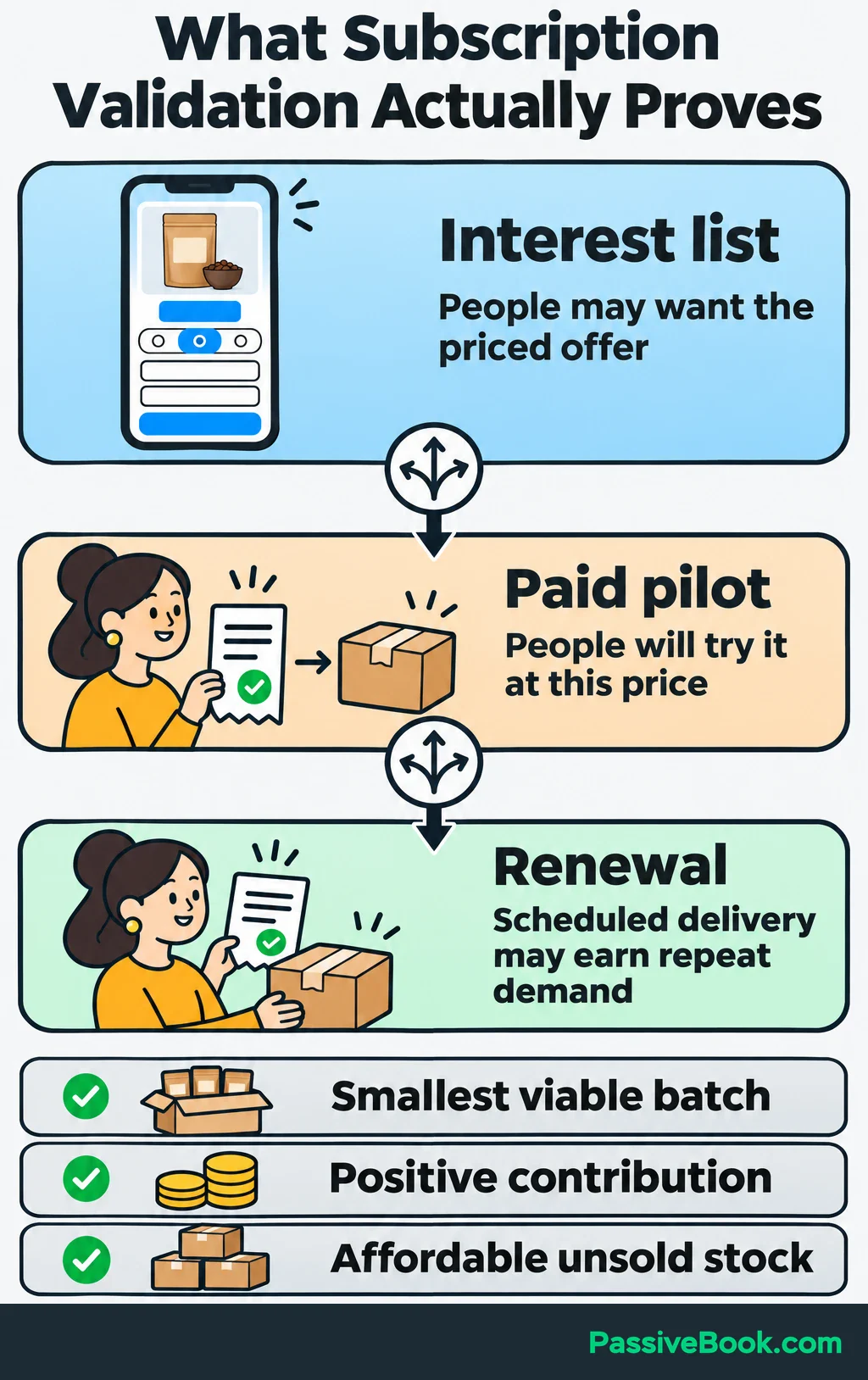
Record preferred intervals, price objections and unanswered questions. Before spending more, set a decision rule: enough interested buyers to justify testing the smallest supplier batch, positive shipment contribution, and an affordable loss if some stock remains unsold.
An interest list helps you decide whether to run a paid pilot. It does not prove those people will buy or renew.
I learned the cost of skipping that distinction with my jewellery store. I put roughly $1,200 into the business without doing market research, ended up with unsold inventory and lost most of the investment. I had spent money answering “What can I sell?” before answering “Who wants this at my price?”
That experience is why I would rather revise a landing page than negotiate a larger opening order.
If buyers reject the sustainable price, change the offer or stop. If they want occasional purchases, consider selling that way. A product does not become a better business because you attach recurring billing to it.
5. Build and Test the Subscription Store
Choose a Complete Platform Setup
Choose the store, subscription software and payment gateway together. A gateway processes payments; it must support automatic renewals in your country.
These are the two setups I would compare first. Shopify hosts the store for you. On WordPress, WooCommerce runs the store and WooCommerce Subscriptions adds recurring billing.
| Decision | Shopify With Shopify Subscriptions | WordPress With WooCommerce Subscriptions |
|---|---|---|
| Software costs | Store plan, domain and paid extras; Shopify Subscriptions is free | Hosting, domain and the paid annual WooCommerce Subscriptions extension |
| Maintenance | Shopify manages hosting | You manage hosting, backups, security and updates |
Check Shopify’s store pricing, the Shopify Subscriptions app listing, and WooCommerce Subscriptions’ annual pricing and features. Include processing fees and any extra transaction charges, and budget the full upfront payment for annual plans.
For a store you run alongside a day job, I would start with Shopify. Choose WooCommerce if you already maintain WordPress comfortably.
Confirm Shopify’s payment requirements or WooCommerce’s automatic-payment compatibility list for your country, product and payment methods. Test billing every two or three months and each customer control you offer. Check quantity and interval changes separately from skips; support for one does not guarantee the others.
Configure the Recurring Offer
Enter the product quantity, recurring price, shipping charge and billing interval. Set a dispatch promise your fulfillment process can meet.
Make these details clear before purchase:
- Initial Payment: What the customer pays now, including shipping and applicable tax.
- Renewal Terms: The later charge amount and frequency, including when an introductory offer ends.
- Delivery Timing: When the first parcel ships and how later dispatches relate to payment dates.
- Customer Changes: How to update details, manage the schedule and cancel.
- Paid Orders: How cancellation, returns and refunds affect orders already charged.
Complete applicable registration, licensing and tax requirements before taking payments, and keep business finances separate. US founders can use the SBA’s launch guidance to identify the paperwork involved.
For US online recurring offers, 15 USC §8403 requires clear disclosure of all material terms before collecting billing information, express informed consent before charging, and a simple way to stop recurring charges. Check additional requirements in the markets you serve.
Enable account access, subscription messages and failed-payment recovery. Choose a retry schedule and decide when unresolved failures suspend fulfillment.
Test the Complete Order Cycle
A successful first checkout proves only the first checkout.
Use the platform’s testing tools to check:
- Signup and the first payment.
- Renewal and the resulting order.
- Failed payments, retries and customer notifications.
- Payment-detail and address changes.
- Each pause, skip or schedule-change option you offer.
- Cancellation and refunds.
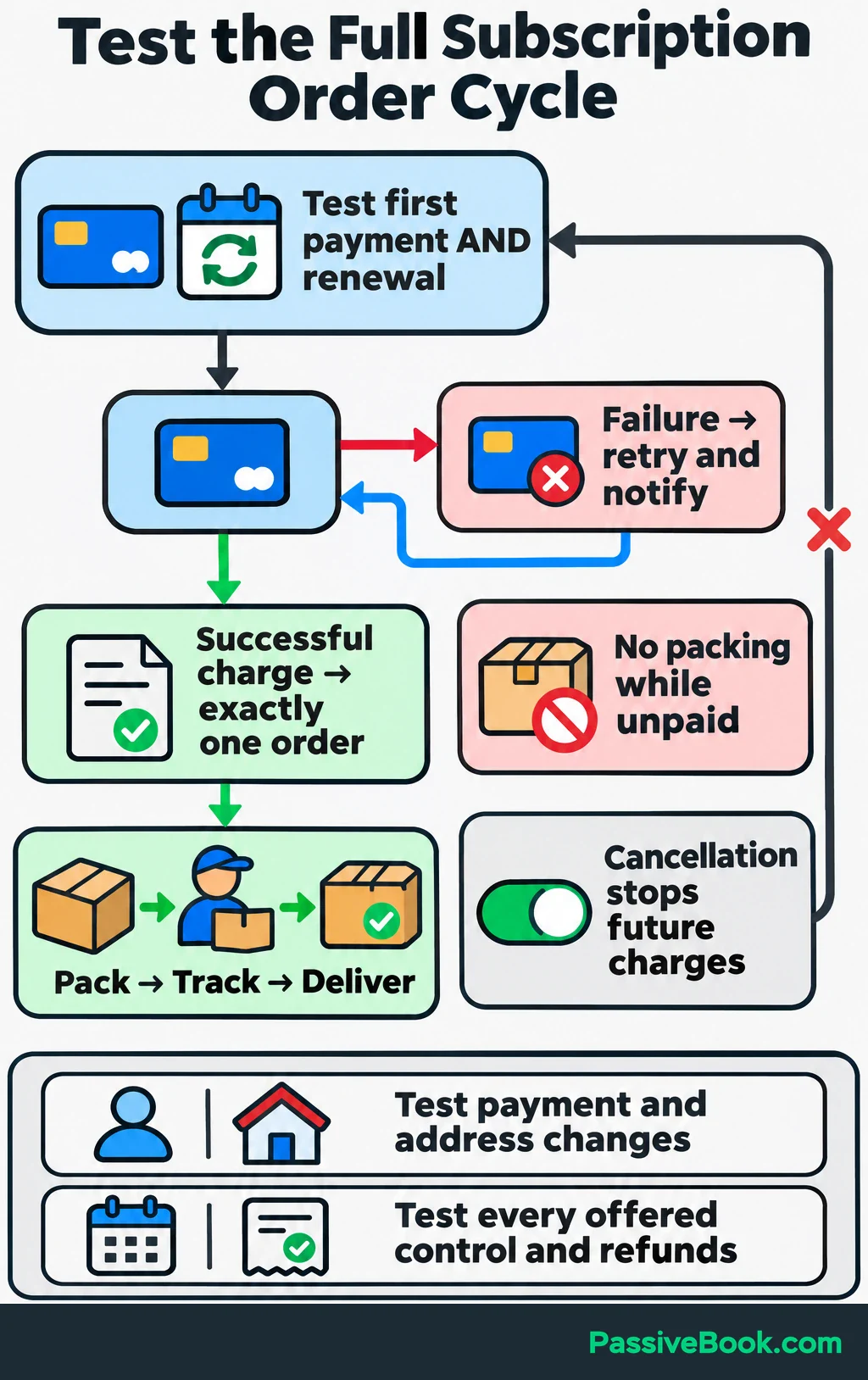
Verify that each successful charge produces the correct fulfillment order once. Unpaid orders should stay out of packing, and cancellation should prevent future renewal charges.
Then follow a physical parcel through packing, carrier handoff, tracking and delivery. Write a packing checklist and decide how you will handle damaged or missing shipments.
Measure packing and support time. Set the pilot cap from the tightest constraint: stock, cash or the hours you can reliably give it. Leave room for replacements and mistakes.
6. Launch a Small Paid Pilot and Attract Your First Subscribers
Buy the validated pilot quantity and open enrollment when inventory, checkout, delivery and support are ready.
Invite your interest list to purchase the finalized offer. State the contents, delivered price, available intervals, first-shipment timing and recurring commitment.
Use the questions from validation to improve the product page. For the refill packs, show bag dimensions, dispenser compatibility and quantity. Explain how customers can estimate their delivery interval from daily use.
Start with one way to reach prospective buyers. I would test a dog-walker partnership for this example because it creates a direct route to people who regularly use the product.
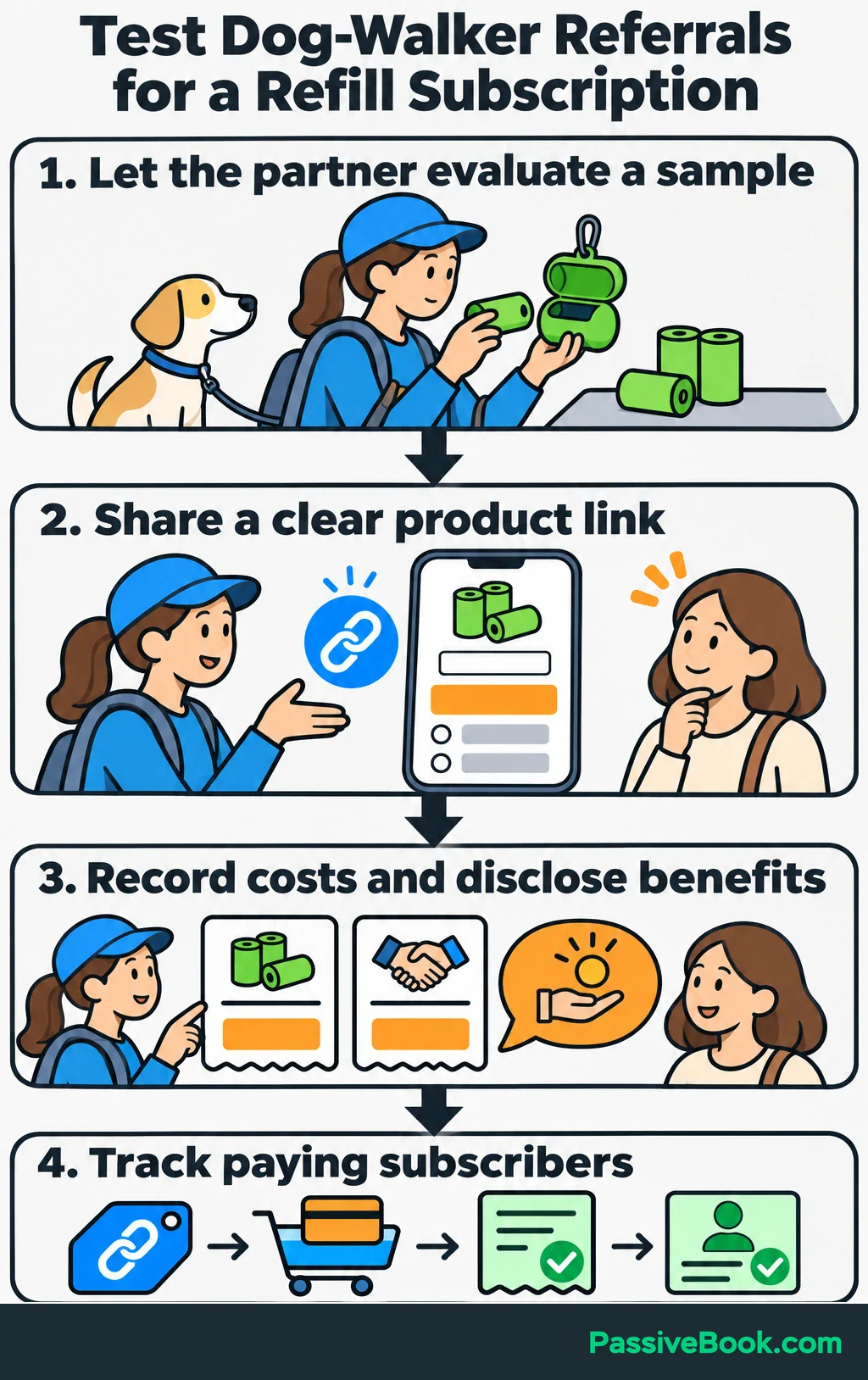
The pilot could work like this:
- Give a dog walker a sample to evaluate.
- If they want to recommend it, provide a clear product-page link for interested clients.
- Record sample costs and any agreed referral commission.
- Track resulting purchases through a referral code or tagged link.
Tell customers if the dog walker receives a referral payment or other benefit.
Follow up with people who expressed interest but did not purchase. Ask what stopped them. Repeated concerns belong on the product page or in the offer itself.
Track visits, checkout starts and new paying subscribers by source. If people leave after seeing the delivered price, ask prospective buyers whether the product feels worth that amount. If they start checkout but cannot finish, test the payment experience.
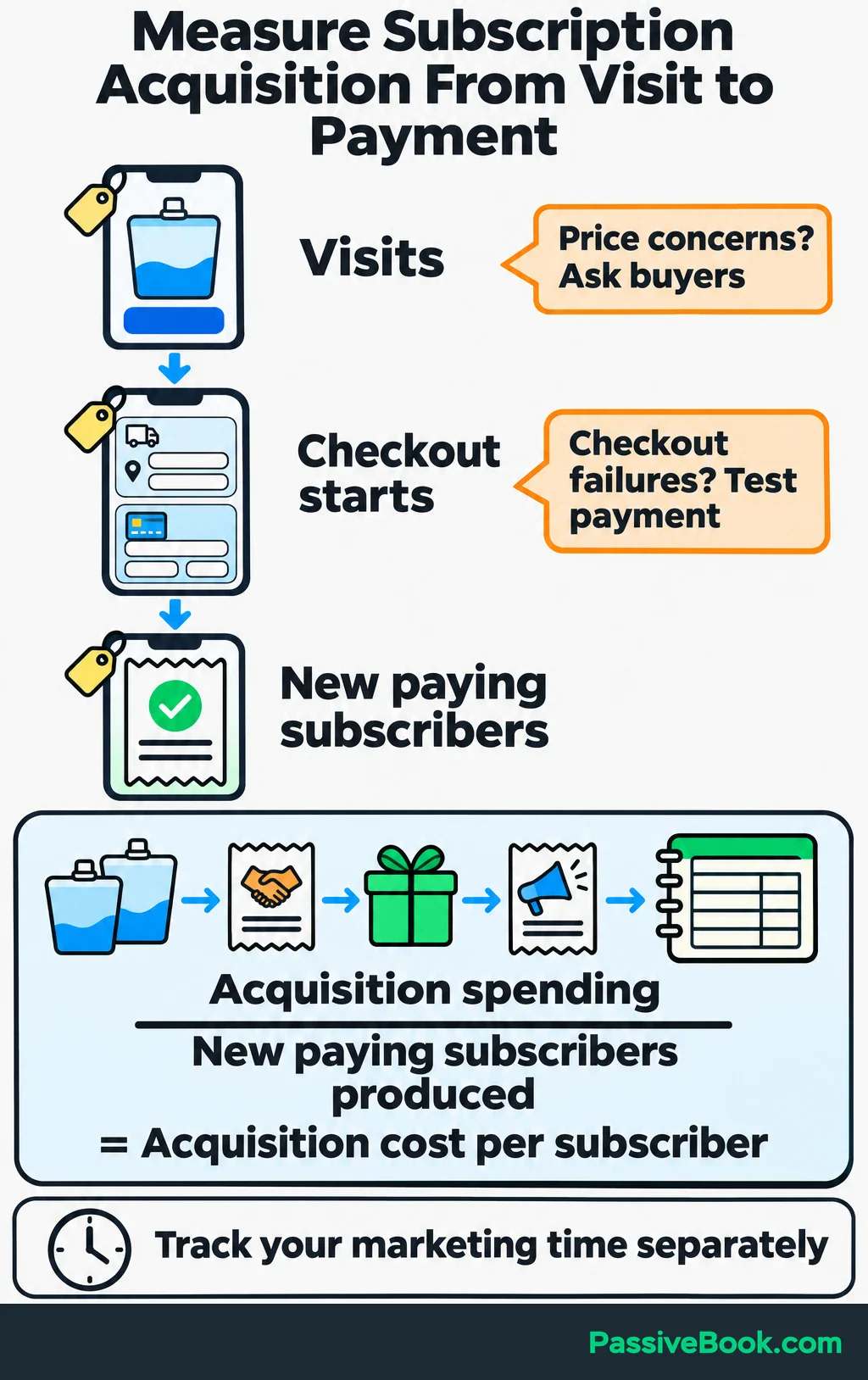
To calculate acquisition cost, add the spending used to acquire a group of customers and divide it by the new paying subscribers that spending produced. Include samples, commissions, referral rewards and marketing tools. Track your own marketing time separately.
During fulfillment, record actual postage, packing time, support requests, damage and refunds. Replace the planning assumptions in your contribution calculation with these observations.
I would review the first renewal before making a larger inventory commitment. A successful opening batch tells you people will try the offer. Renewal begins to show whether scheduled delivery earns its place.
Keep enrollment inside the tested cap.
7. Improve Profitable Retention Before Increasing Volume
Match Deliveries to Actual Usage
Send a welcome message confirming the product, payment, delivery timing, account access and support contact. After delivery, check whether the order arrived correctly and the product met expectations.
Before the next shipment, ask how much remains.
For the refill packs, that could be:
How many rolls do you have left? If this delivery would arrive too soon, use your account link to skip it or contact us about a longer interval.
Product accumulation deserves attention. In McKinsey’s research involving US subscription shoppers, excess product and limited ability to adjust order volumes appeared among cancellation problems. That supports checking actual usage rather than treating every cancellation as a request for a discount. See its subscription ecommerce research.
Send upcoming-order notices early enough for customers to make the changes you permit before processing.
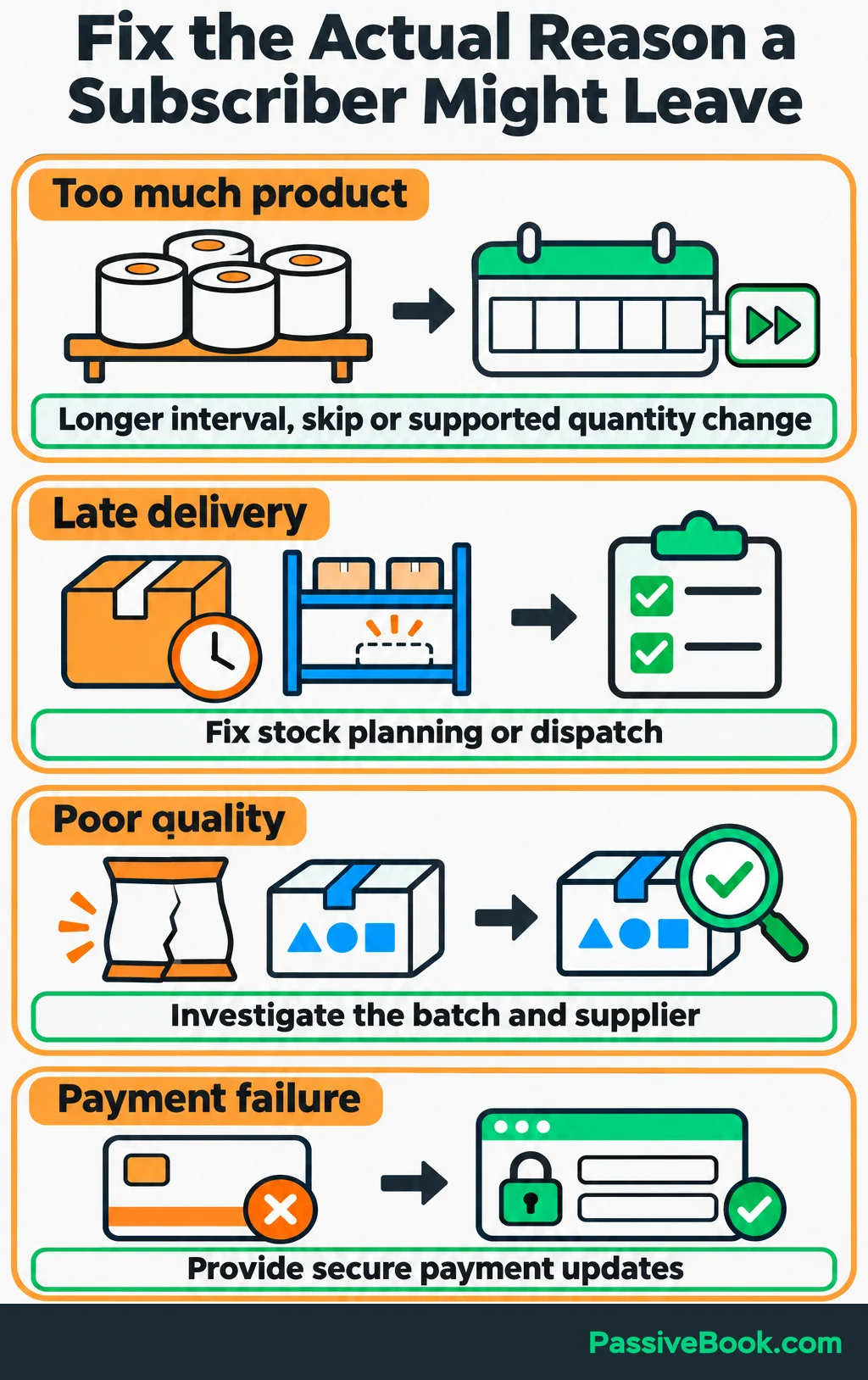
Match the response to the problem:
- Too Much Product: Extend the interval, reduce quantity where supported, or offer a skip.
- Late Delivery: Fix stock planning or dispatch.
- Poor Quality: Investigate the batch and supplier.
- Payment Failure: Provide a secure route to update payment details.
I would fix an accumulating cupboard before writing another “Please stay” email. The cupboard has stronger evidence.
Measure Renewals and Acquisition Payback
Review active subscribers, successful renewals, cancellations, payment failures, shipment contribution, acquisition cost and cash available for restocking.
Group customers by when they joined and their delivery interval. Compare their progress through renewals only after they have had the opportunity to reach those renewals. Someone on a three-month schedule should not look worse simply because a monthly customer has been charged more often.
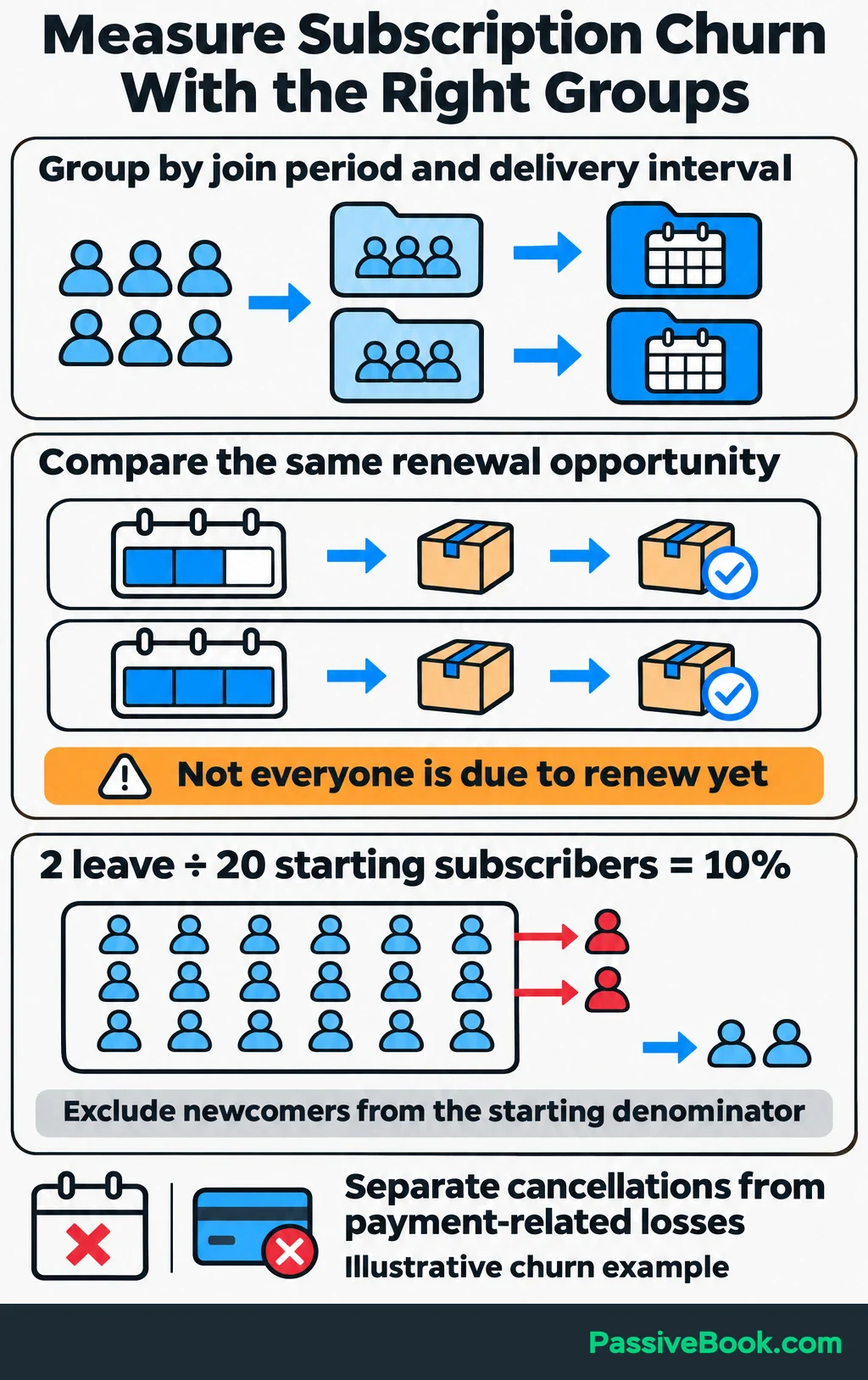
For period churn, count how many subscribers active at the start left during that period, then divide by the starting group. If 2 of 20 starting subscribers leave, period churn is 10%. New subscribers do not belong in that starting denominator.
Separate voluntary cancellation from payment-related losses so you can act on the right cause.
Judge acquisition payback using contribution, rather than sales revenue. Under the refill assumptions, each shipment contributes $12. Two shipments contribute $24 and recover a $24 acquisition cost.
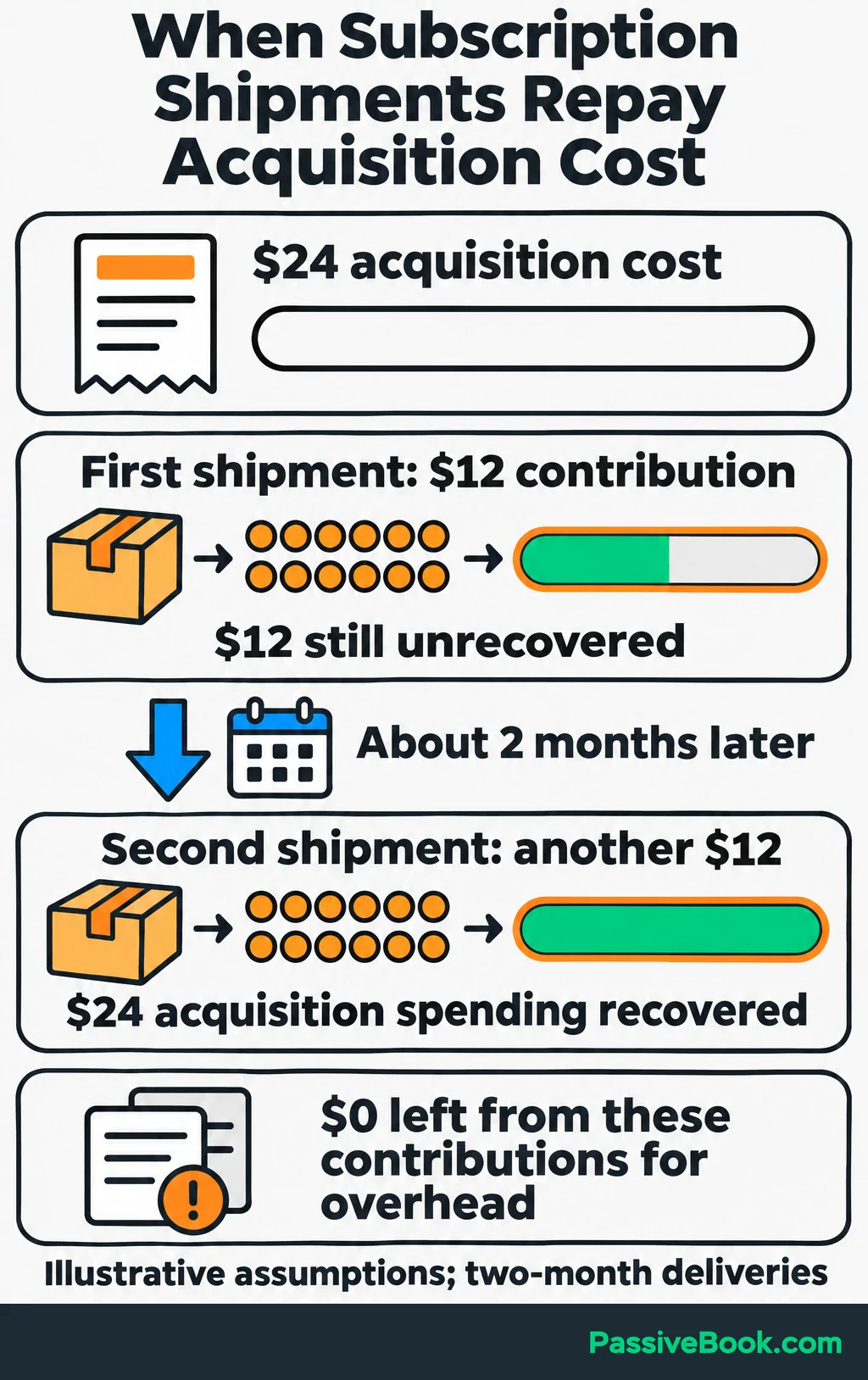
At that point, those shipments have left nothing for fixed overhead. You have recovered the acquisition spending, not earned a $24 profit.
Delivery intervals also affect when that money returns. With two-month deliveries, the second shipment’s contribution arrives roughly two months after the first.
Use your renewal history to decide whether acquisition spending is affordable. I would avoid confident lifetime-value forecasts while you are still learning whether customers want a second delivery.
Automate the Delivery Cycle That Works
Start with the store’s existing tools for payment confirmations, renewal reminders, tracking and failed-payment follow-up.
Then add alerts for exceptions:
- Low stock before upcoming orders.
- Paid orders that never reach fulfillment.
- Shipments overdue for dispatch.
- Unresolved payment failures.
Keep human review for shortages, unusual refunds and delivery disputes. These are decisions where a careless rule can turn one problem into several.
If your tools cannot pass necessary information between them, consider Make for a straightforward connection or n8n when you already maintain a self-hosted setup. Give the integration one clear job, such as flagging paid orders missing from the packing queue.
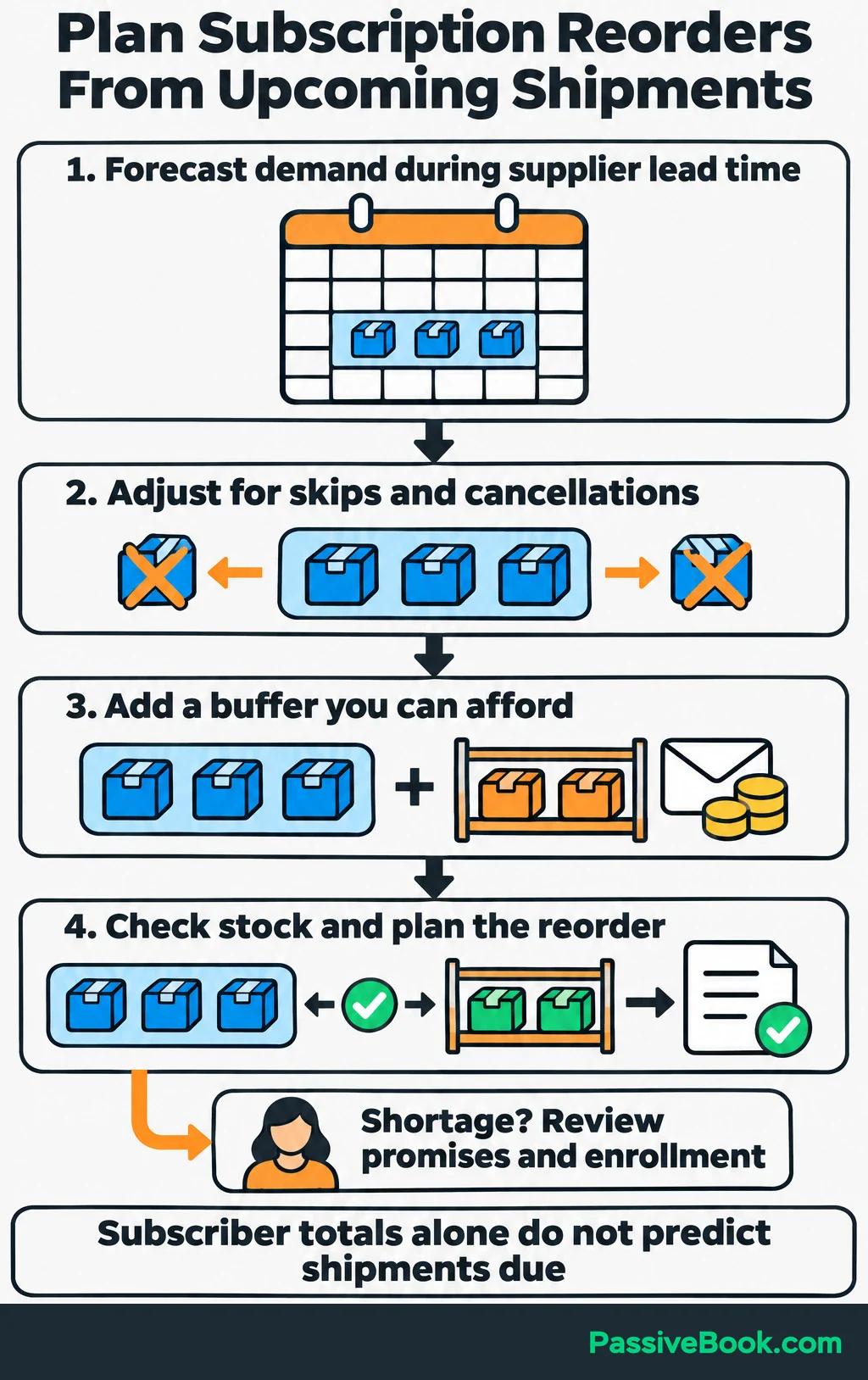
Plan reorders around expected demand during the supplier’s lead time, plus a buffer you can afford. Adjust for skips and cancellations rather than ordering from the subscriber total alone.
Increase enrollment when renewals help cover overhead, acquisition payback fits your available cash and fulfillment remains dependable.
Track operating hours alongside profit. Recurring billing removes some payment work, but your business still needs sourcing, delivery and support. The useful goal is a process you can run reliably within the time you have.
What Next?
Write one priced offer for one refill product, then ask prospective buyers how it compares with what they currently purchase. Keep inventory spending on hold until you understand their answers.
Use the social buttons to share this guide when you want to compare launch budgets and subscription ideas with others.
Which assumption needs testing most in your idea: repeat demand, shipment margin or delivery frequency? Share it in the comments, and bring any other questions too.
Share this post with your friends & followers:

