You want to sell original products without turning your spare room into a warehouse. Printing each item after a customer orders makes that possible, but it doesn’t tell you what people will buy or whether the sale will leave you any money.
Samples, shipping, selling fees, and design work still need a budget. A store full of products can become an expensive hobby even without unsold stock.
The difficult part is knowing what deserves that budget. This guide follows one mug collection from idea to first sales, with supplier comparisons and worked costs to help you judge whether the business is worth continuing.
How Does a Print-on-demand Business Work?
You create a design and publish it on a product listing. When someone orders, your fulfillment partner prints the product, packs it, and ships it to the customer.
The work divides like this:
- You choose the products, prepare the designs, set prices, attract buyers, and handle customer service.
- Your fulfillment partner makes and ships the products.
- Your sales channel provides the listings, checkout, and payment process.
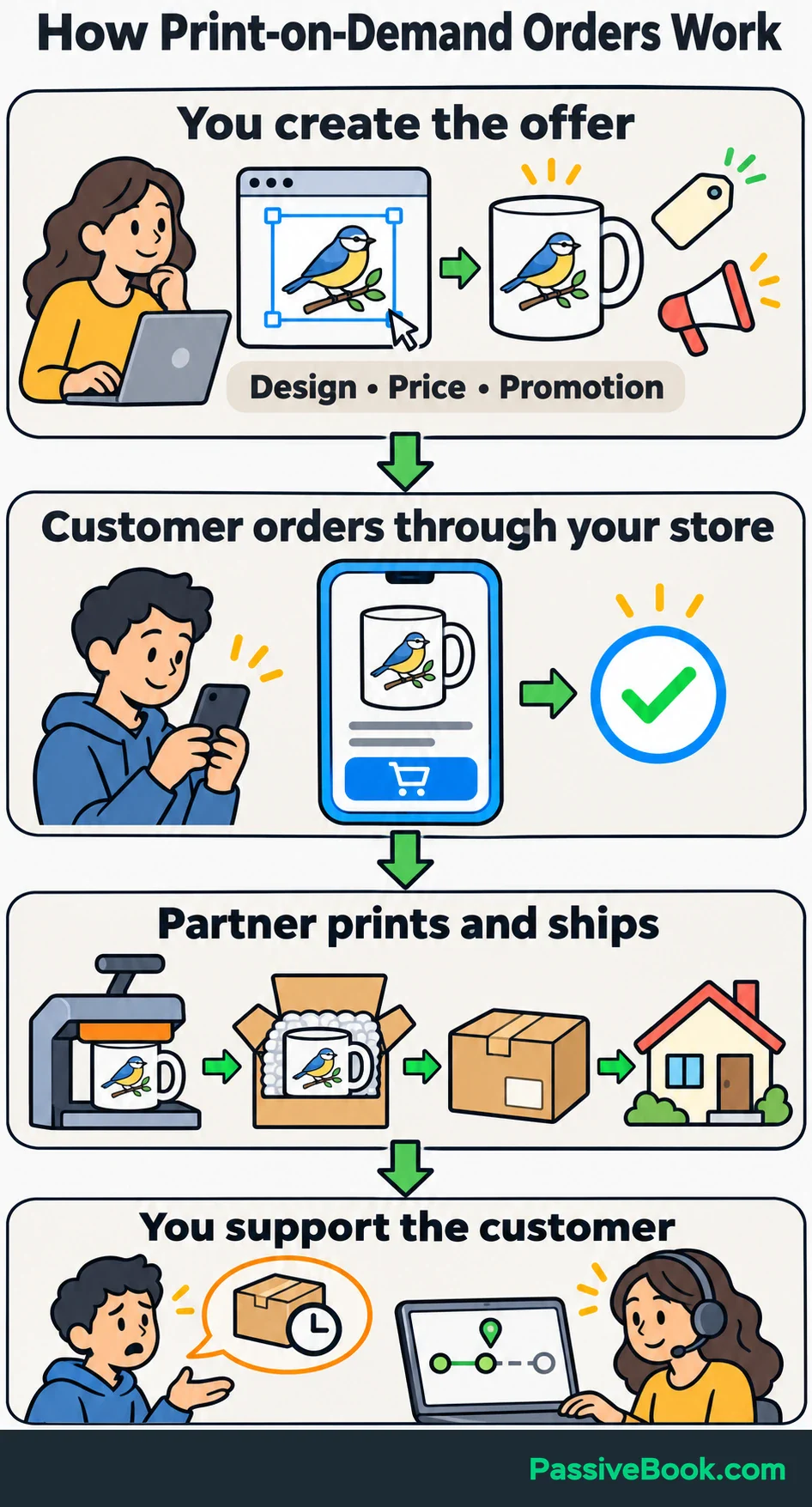
You avoid buying finished inventory in bulk, but you still pay to fulfill each order. And connecting your store to a supplier won’t answer a customer asking why their birthday gift hasn’t arrived.
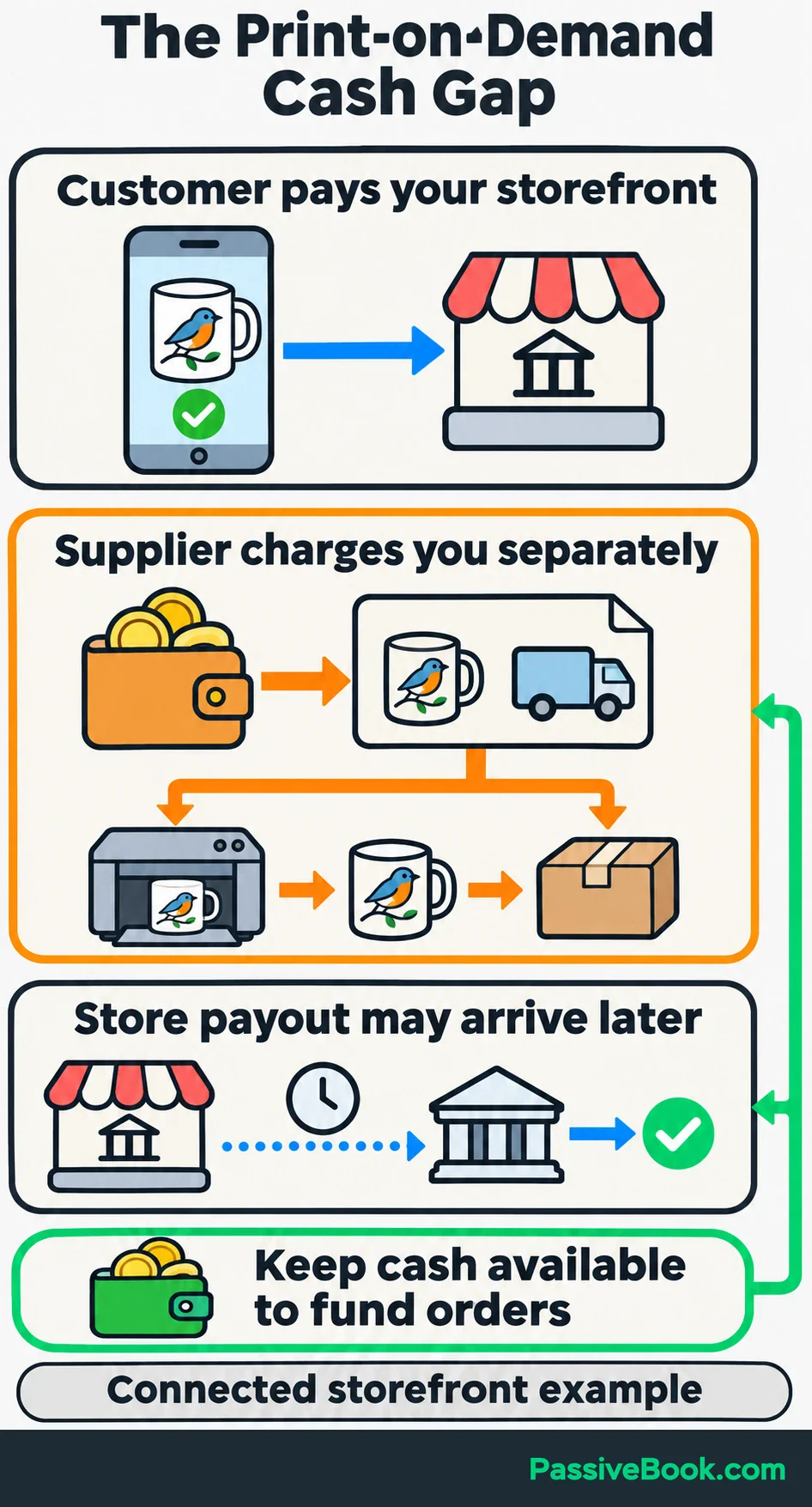
There is also a cash gap to plan for. With a connected storefront, Printify charges production and shipping separately from the payment your customer makes. Your store payout may arrive after the supplier needs payment, so you need money available to fund orders. Printify explains this payment arrangement here.
Can print on demand be profitable? Yes, when sales cover fulfillment, selling fees, promotion, refunds, and ongoing expenses. Whether the remaining profit justifies your time is a separate question.
My own experiment around 2019 lasted about six months and brought in roughly $1,200 in revenue and $300 in profit. The designs were mediocre, and hiring designers added costs without making the business strong enough to keep.
That experience shapes how I would start again: test a small collection before paying to build a large one.
Throughout this guide, we’ll follow a shop selling original birdwatching-themed mugs as gifts for backyard birdwatchers. Its designs, promotional copy, and financial figures are illustrations, except where platform fees are identified.
1. Choose a Niche and a Product Worth Testing
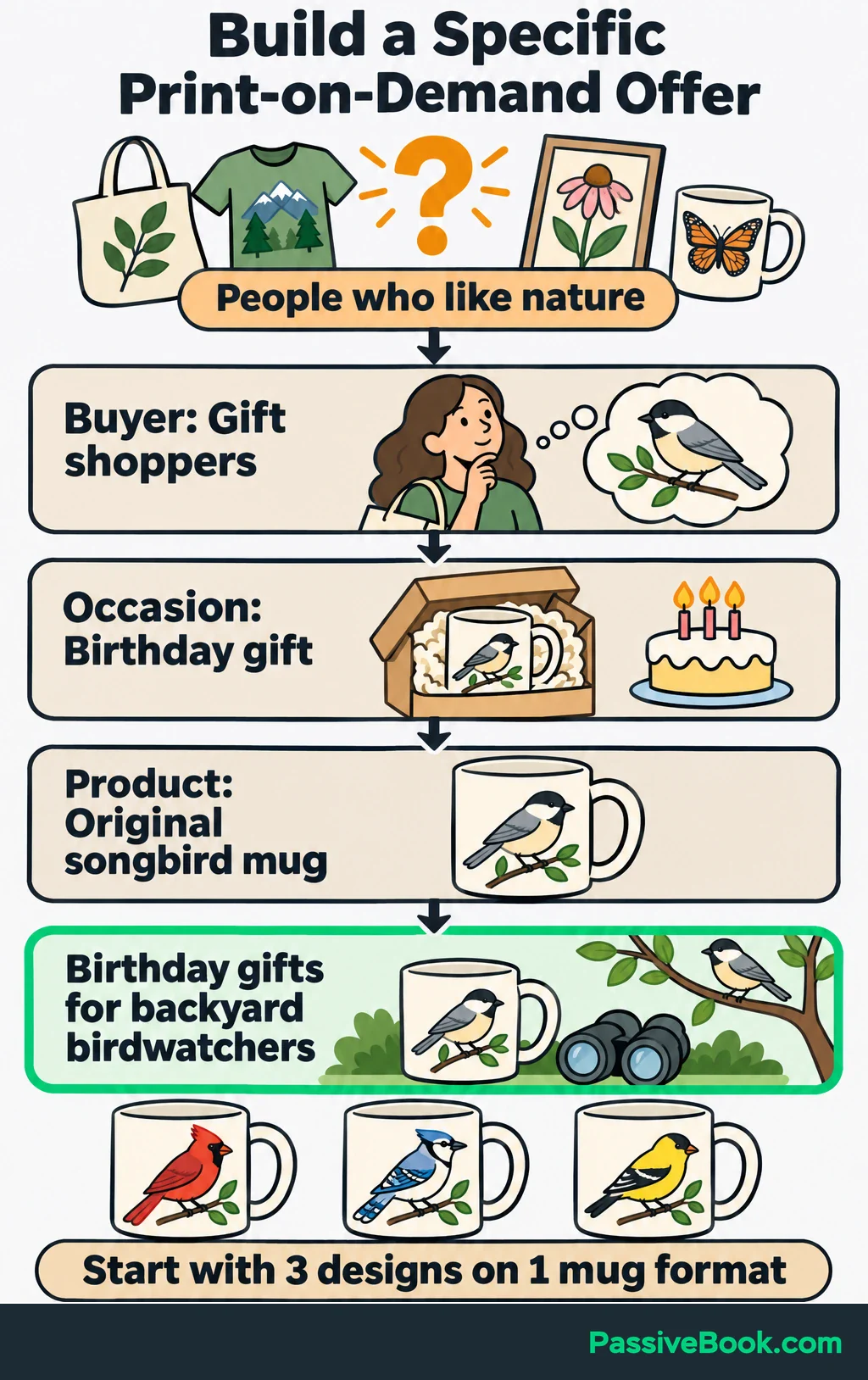
Start by choosing a buyer, a reason to buy, and a clear design direction. “People who like nature” leaves too many decisions open.
A more useful offer is:
Original songbird mugs for people buying birthday gifts for backyard birdwatchers.
That gives you something specific to research. You can compare gift prices, look at how birds are illustrated, and ask prospective buyers whether the product suits the person they have in mind.
Search a few relevant phrases on your proposed marketplace. For the mug shop, you might investigate “birdwatcher gift mug” and “songbird coffee mug.” These are research starting points, not verified keyword opportunities.
Record what you find:
- The price buyers pay after shipping.
- Recent reviews that mention the specific product.
- Common illustration styles and product formats.
- Complaints about print quality, packaging, or delivery.
- Questions the listings leave unanswered.
Listing counts show competition, and reviews can offer clues about buying activity. Neither tells you a competitor’s current profit. A crowded search result deserves investigation, not an automatic rejection or a victory speech.
Next, choose a difference a buyer can see. For the mug shop, that could be recognizable backyard birds drawn in one consistent style. “High quality and great service” won’t distinguish a thumbnail beside twenty similar mugs.
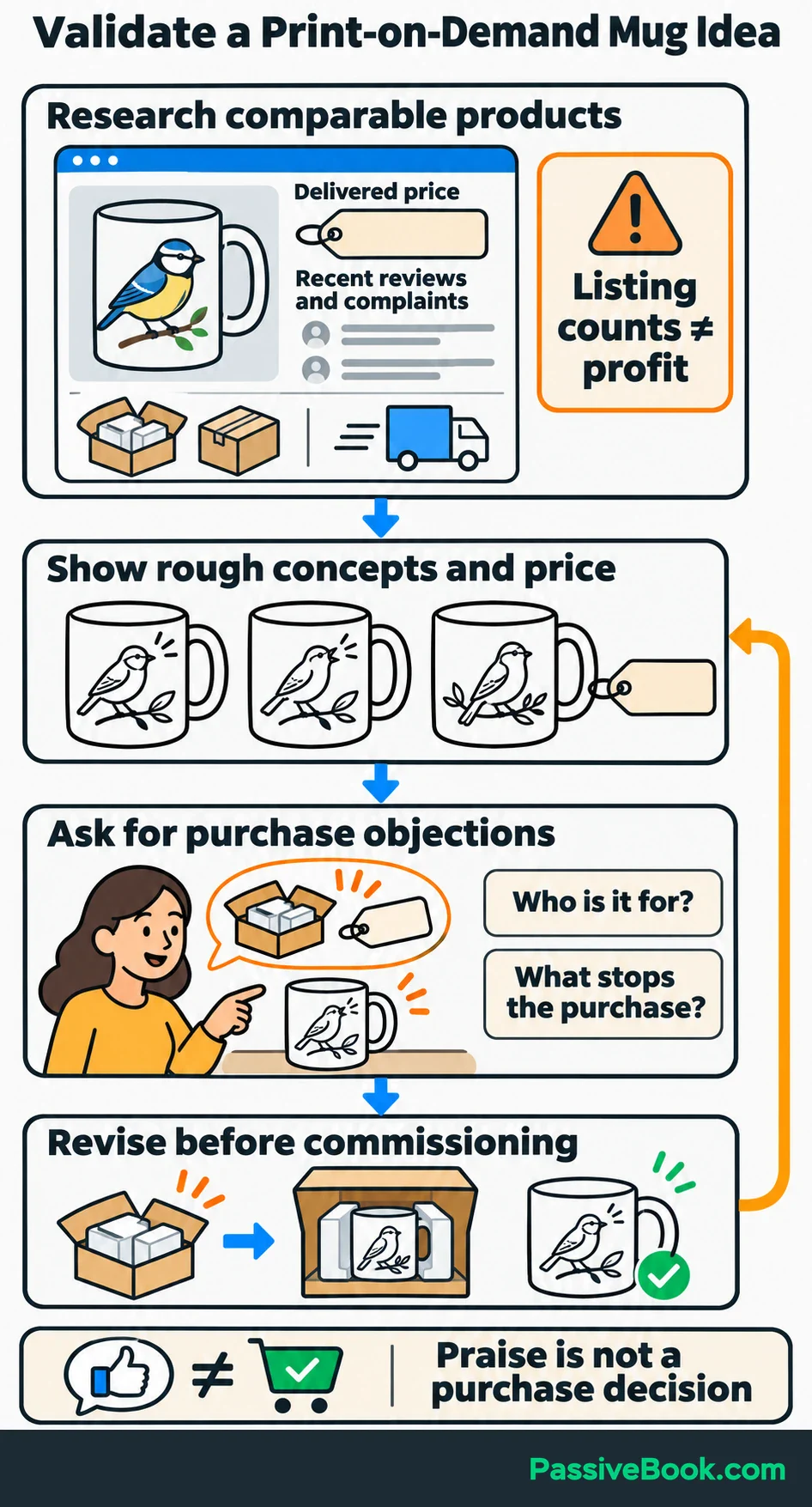
Show a few rough concepts to prospective buyers before commissioning finished artwork. Include a proposed delivered price, then ask:
- Which design would you choose at this price?
- Who would you buy it for?
- What would stop you from ordering?
- What would you need to know before deciding?
Praise is pleasant, but a specific purchase objection is more useful. If someone likes the illustration but wouldn’t pay the delivered price, you have a pricing or product problem to investigate.
Check the physical product before finalizing the concept too. A detailed bird illustration needs enough printing space, and a gift mug needs packaging that protects it.
I would begin with three original bird designs on one mug format. Finish this step with a clear offer and a practical place to reach buyers. If you cannot name either, keep researching before opening the store.
2. Choose Where to Sell
Your storefront and fulfillment partner serve different purposes. Etsy, Shopify, and WooCommerce help you sell. A partner such as Printify, Printful, or Gelato makes and ships the item.
Choose the sales channel around how buyers will find you and how much store maintenance you can handle.
| Channel | How Buyers Find You | Costs to Budget For | Who Maintains the Store |
|---|---|---|---|
| Etsy | Marketplace search, where listings compete for visibility. | Listing, selling, and payment fees, plus any setup or account-specific charges. | Etsy runs the marketplace; you manage listings, policies, messages, and orders. |
| Shopify | You bring visitors through content, search, email, or another channel. | Subscription, payment charges, domain, and paid apps. Check Shopify’s pricing before choosing a billing term. | Shopify handles hosting; you manage the store, apps, and customer experience. |
| WooCommerce | Your WordPress site needs its own source of visitors. | Core software is free; hosting, processing, maintenance, and selected extensions cost extra. See WooCommerce’s cost explanation. | You handle hosting, updates, backups, security, and compatibility. |
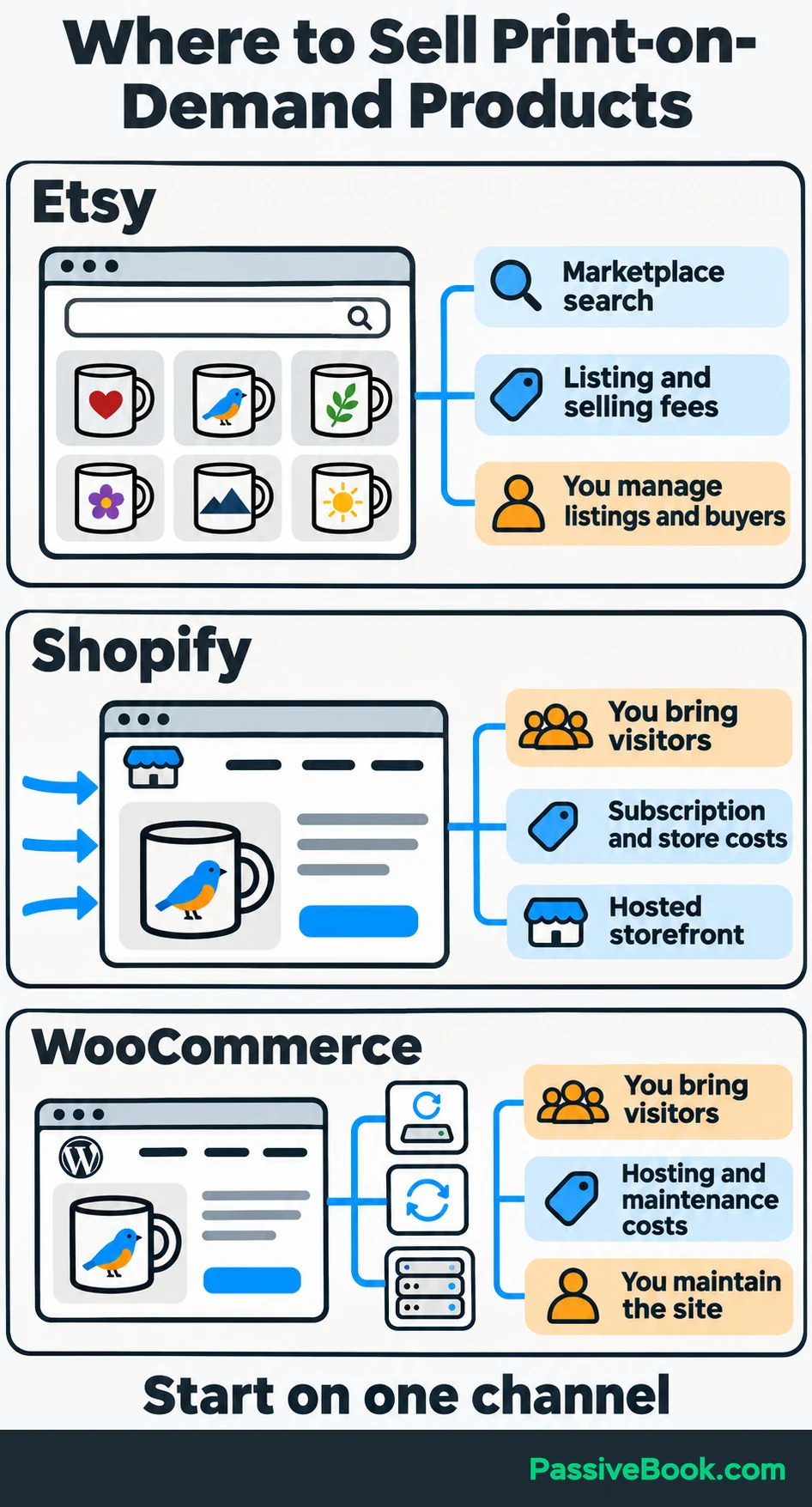
For the birdwatching mug test, I would investigate Etsy first because the offer fits gift searches. I would still check the actual search results before committing.
If you already have a relevant WordPress audience, adding WooCommerce may make more sense than building elsewhere. Shopify is a reasonable choice when you want a hosted standalone store, but opening one creates another job: bringing people to it.
Before spending on setup, confirm that the channel supports your seller country, bank account, and payment arrangements. Start on one channel so your early work produces useful evidence in one place.
3. Shortlist Fulfillment Partners for Your Product
Choose the product specifications and first delivery market before comparing suppliers. A cheap headline price means little if it applies to a different mug or excludes shipping to your customers.
For the running example, the comparison might cover one white, 11-ounce ceramic mug, the required print area, and delivery within the US.
I would shortlist these three options:
- Printify: Compare individual print providers within the platform. Product prices, shipping rates, variants, print areas, locations, and equipment can differ. Evaluate the specific provider you would use, as explained in Printify’s provider comparison guidance.
- Printful: Get a quote for the matching product and destination. Its free option has no setup fee, monthly subscription, or order minimum, but production, shipping, and applicable taxes remain payable. Printful’s cost breakdown explains the distinction.
- Gelato: Include it when its product range and delivered quote fit your offer. It supports direct connections to Etsy, Shopify, and WooCommerce, according to Gelato’s integration list.
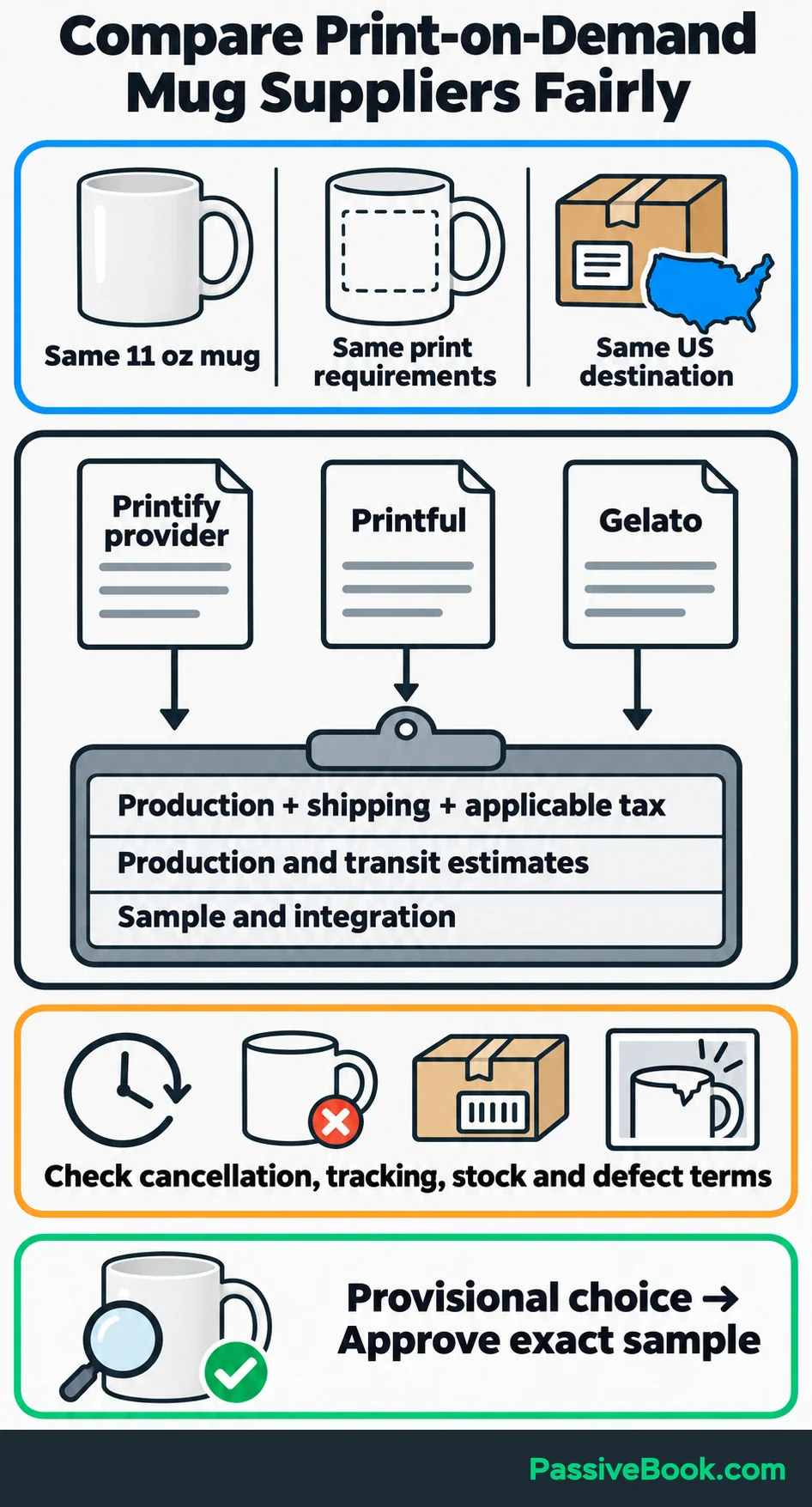
Keep a simple comparison sheet. For each exact product, record production cost, shipping to the same destination, applicable supplier taxes, production and transit estimates, sample cost, storefront connection, and defect coverage.
Then check what happens when something goes wrong:
- How long can you cancel before production starts?
- What happens if the selected product becomes unavailable?
- Does tracking return to your store automatically?
- What evidence is needed for a damaged-item claim?
- Which refunds or replacements would you fund yourself?
These answers matter more than a small difference in production price. A birthday gift that arrives broken creates customer service work as well as a replacement cost.
Choose a provisional partner based on the complete delivered cost and service terms. Approve the physical sample before treating that choice as final.
4. Calculate Your Prices and Startup Budget
Price Each Product From Its Full Order Cost
Count the item price and shipping paid by the customer, excluding taxes collected for remittance. Subtract production, supplier shipping, selling and payment fees, discounts, unrecoverable taxes, promotion, and an allowance for refunds or replacements.
The money left is your contribution toward fixed expenses and profit.
Here is a worked example for one mug sold for $24 with shipping included. The production, supplier shipping, and replacement allowance are assumptions.
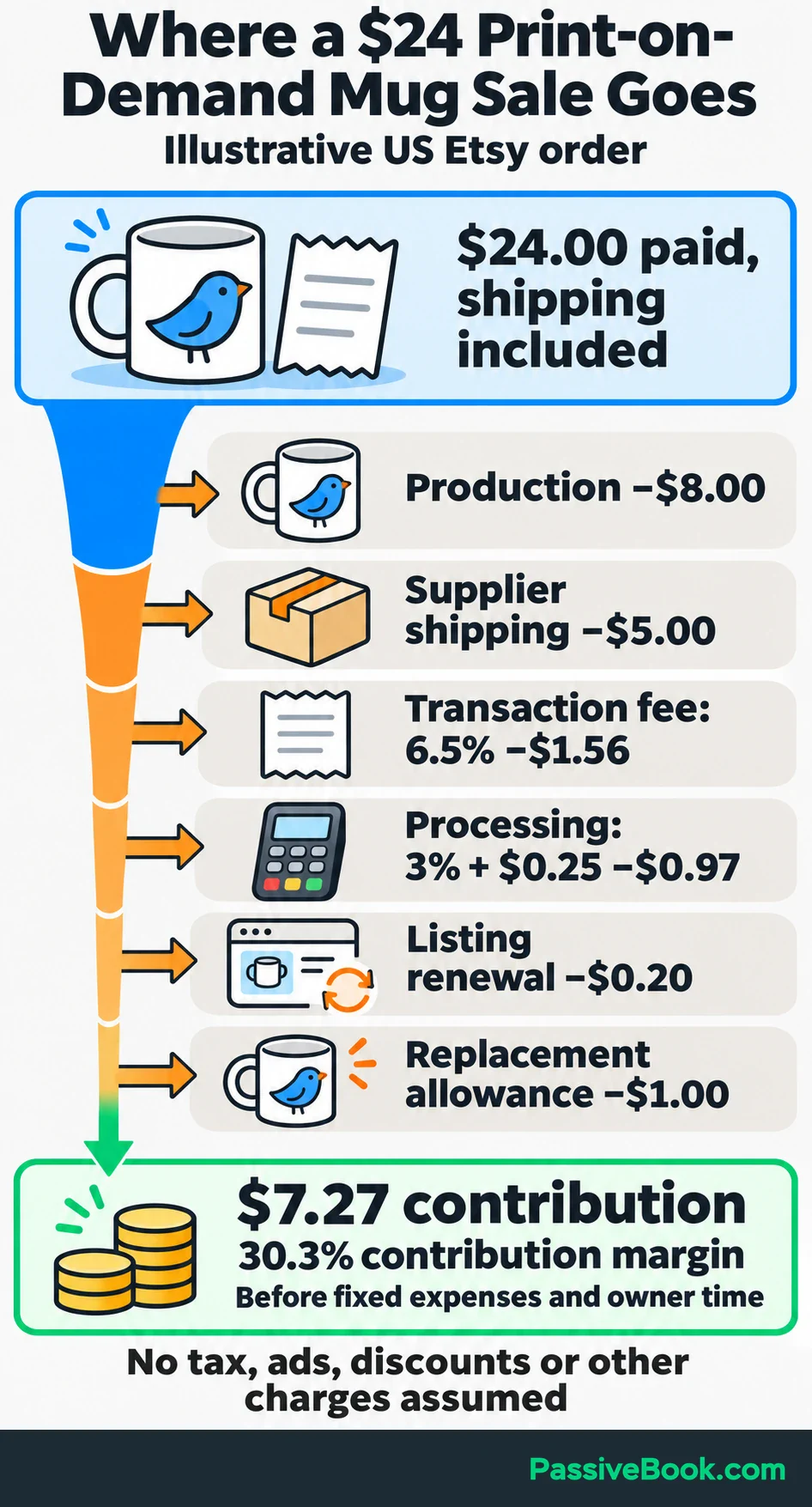
The example uses Etsy’s US bank-account processing rate. Transaction fees apply to the item price, charged shipping, and gift wrapping; processing fees also include applicable buyer tax. Check Etsy’s fees policy for additional charges, including Offsite Ads, and its processing-fee schedule for your bank-account country.
| Order Item | Amount |
|---|---|
| Customer payment, including shipping | $24.00 |
| Production | −$8.00 |
| Supplier shipping | −$5.00 |
| Etsy transaction fee: 6.5% of $24 | −$1.56 |
| Payment processing: 3% of $24 plus $0.25 | −$0.97 |
| Listing renewal | −$0.20 |
| Replacement allowance | −$1.00 |
| Contribution per order | $7.27 |
This scenario assumes no buyer sales tax, supplier tax, advertising, discounts, currency charges, or other account-specific fees. Add those where they apply before approving your price.
The $24 example only works with the costs shown. Use your own quotes to find your price floor, then check what happens when shipping rises or you offer a discount.
Free Pricing Profit Calculator




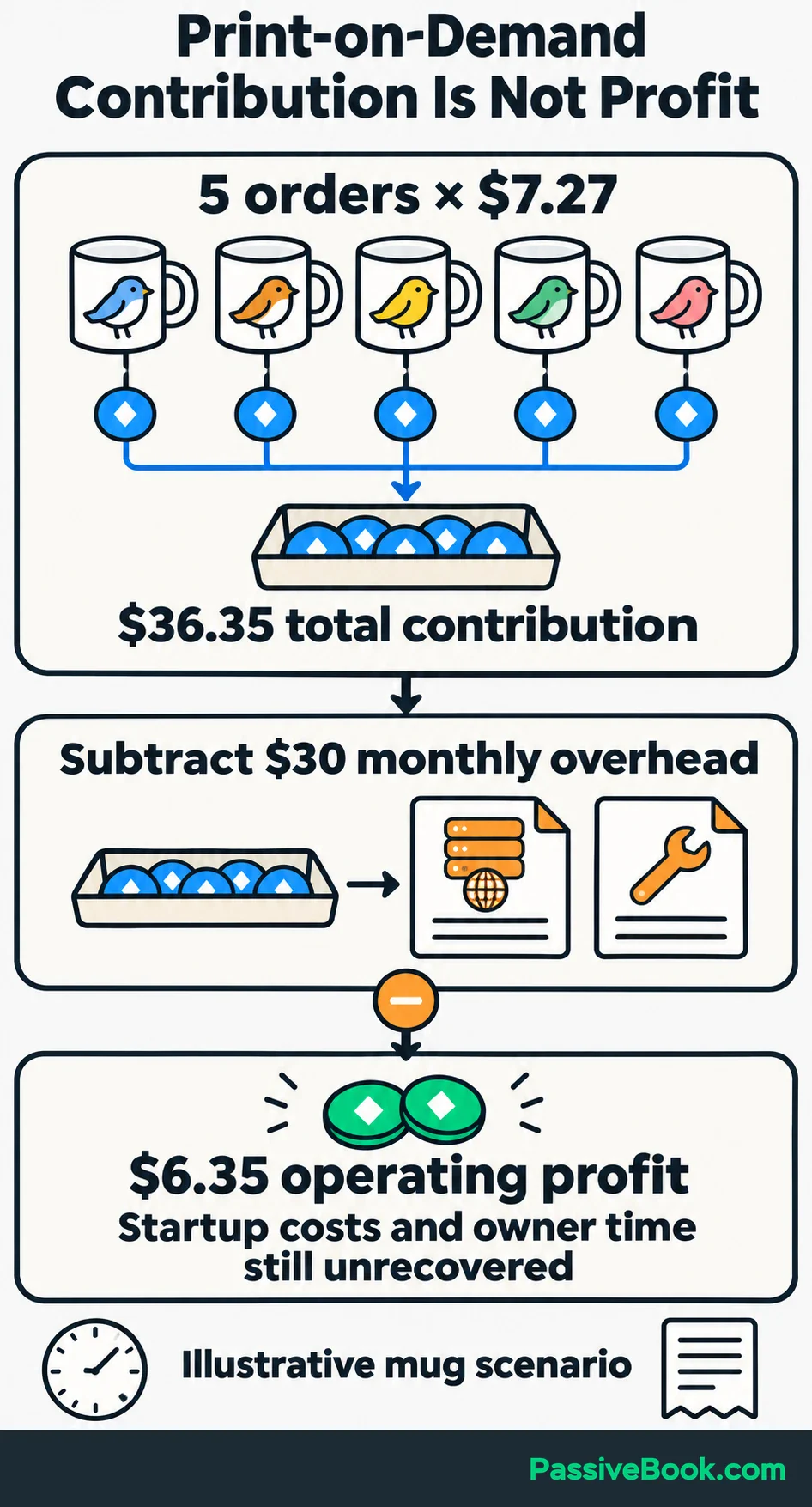
The order leaves about 30.3% of revenue toward fixed expenses and profit; this is its contribution margin.
To estimate monthly operating profit, subtract fixed expenses from total contribution. Five orders at $7.27 cover an assumed $30 in monthly overhead, but do not recover startup costs or pay you for your time.
Now compare the required delivered price with buyer feedback. If buyers will only pay an amount that leaves you with little or nothing, change the product, supplier, or offer.
I would skip paid ads until this calculation works without them.
How Much Money Do You Need to Start?
Separate money you will spend from money you need available while orders are being fulfilled.
Your budget has four parts:
- One-Time Costs: Samples, checkout testing, artwork, and any required setup or registration.
- Recurring Costs: Store subscriptions, hosting, domains, and essential tools.
- Per-Order Costs: Production, shipping, fees, and expected refund or replacement costs.
- Working Capital: Cash available to pay suppliers before store payouts arrive.
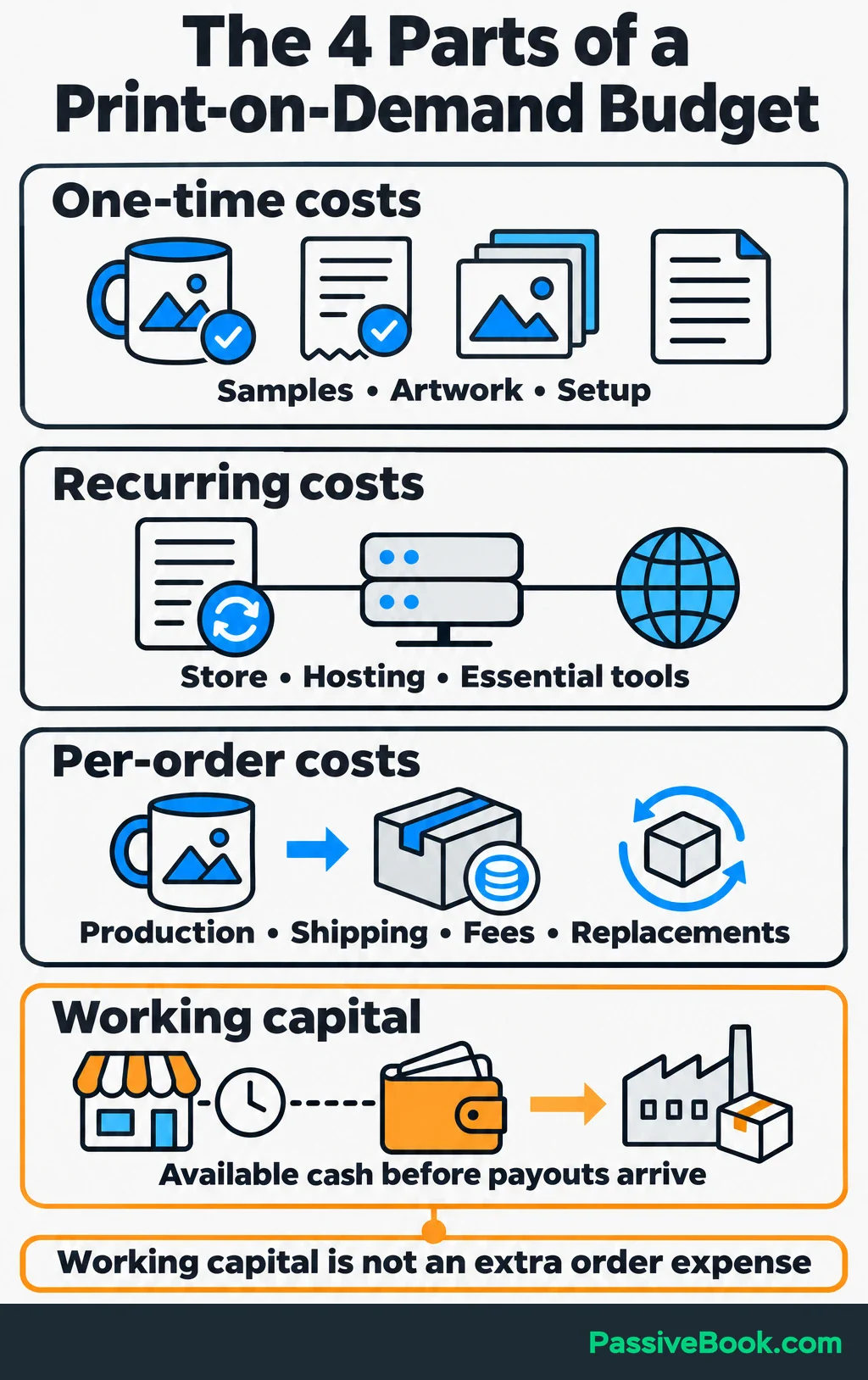
For the illustrative mug test, assume you create the artwork yourself and launch three Etsy listings.
| Cash Requirement | Assumed Amount |
|---|---|
| Product sample and a later test order | $35.00 |
| Three initial listings | $0.60 |
| Reserve to fund five pending orders at $13 each | $65.00 |
| Contingency | $25.00 |
| Starting cash required | $125.60 |
This is a test scenario before any setup fee, required registration, additional taxes, or paid artwork. Replace each assumption with your actual quote.
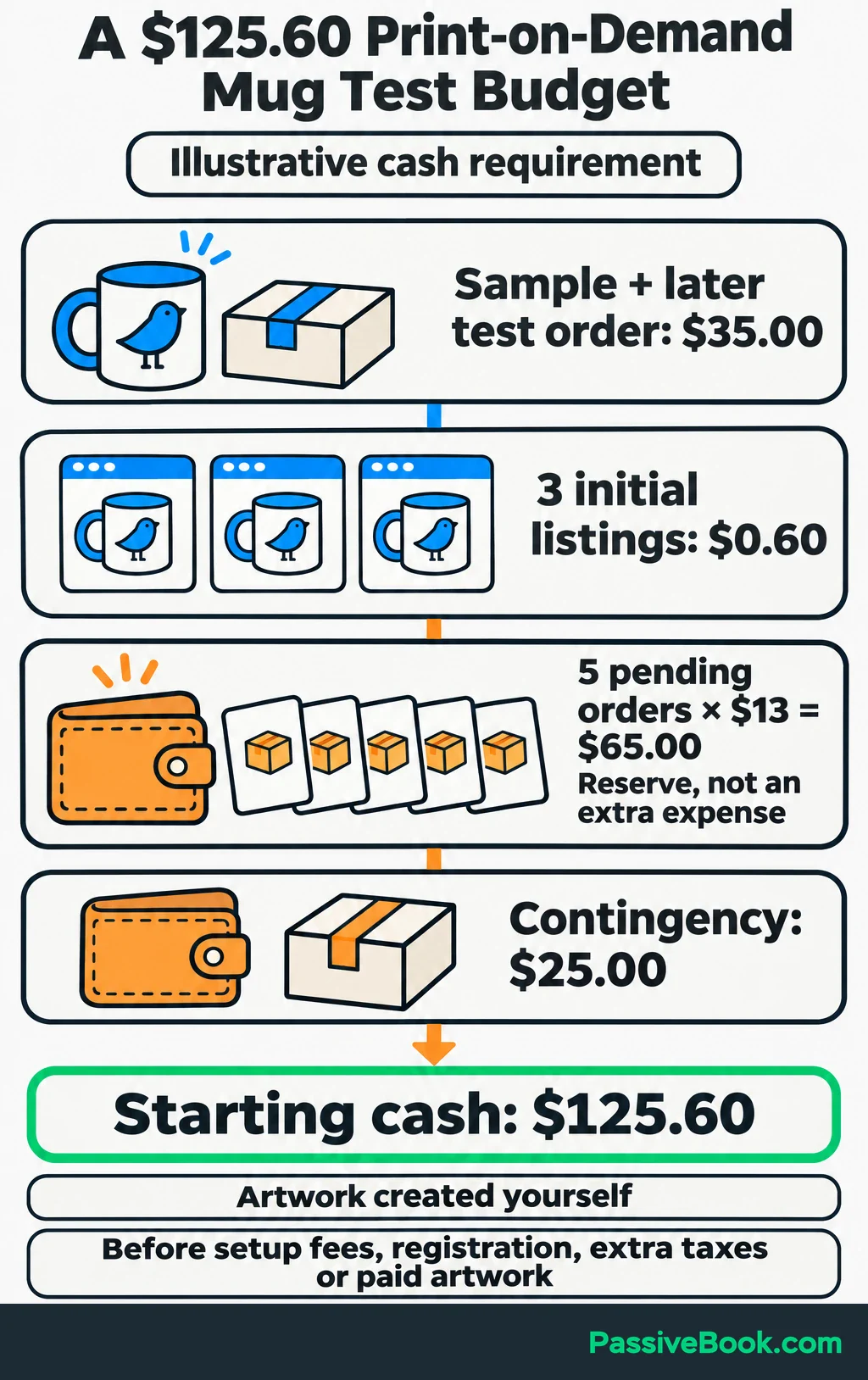
The $65 reserve funds production and shipping before payouts arrive; it is not an extra expense. Increase it if more orders need funding during that delay.
Set a maximum test budget before hiring a designer or subscribing to extra tools.
5. Create Your Designs and Approve Samples
Prepare Artwork for the Selected Product
Write a short creative brief before opening a design tool or hiring anyone. Include the buyer, purchase occasion, visual style, colors, and intended placement.
For the mug collection, a useful excerpt might be:
Three original backyard songbird illustrations in a consistent line-and-color style. Each bird must remain recognizable at the mug’s final print size.
That gives the collection a shared direction without requiring every design to look identical.
You can create the artwork yourself or commission it. Canva can help you arrange your own illustrations and prepare promotional graphics. If you hire a designer, agree on the finished files, revisions, merchandise usage rights, and budget before work begins.
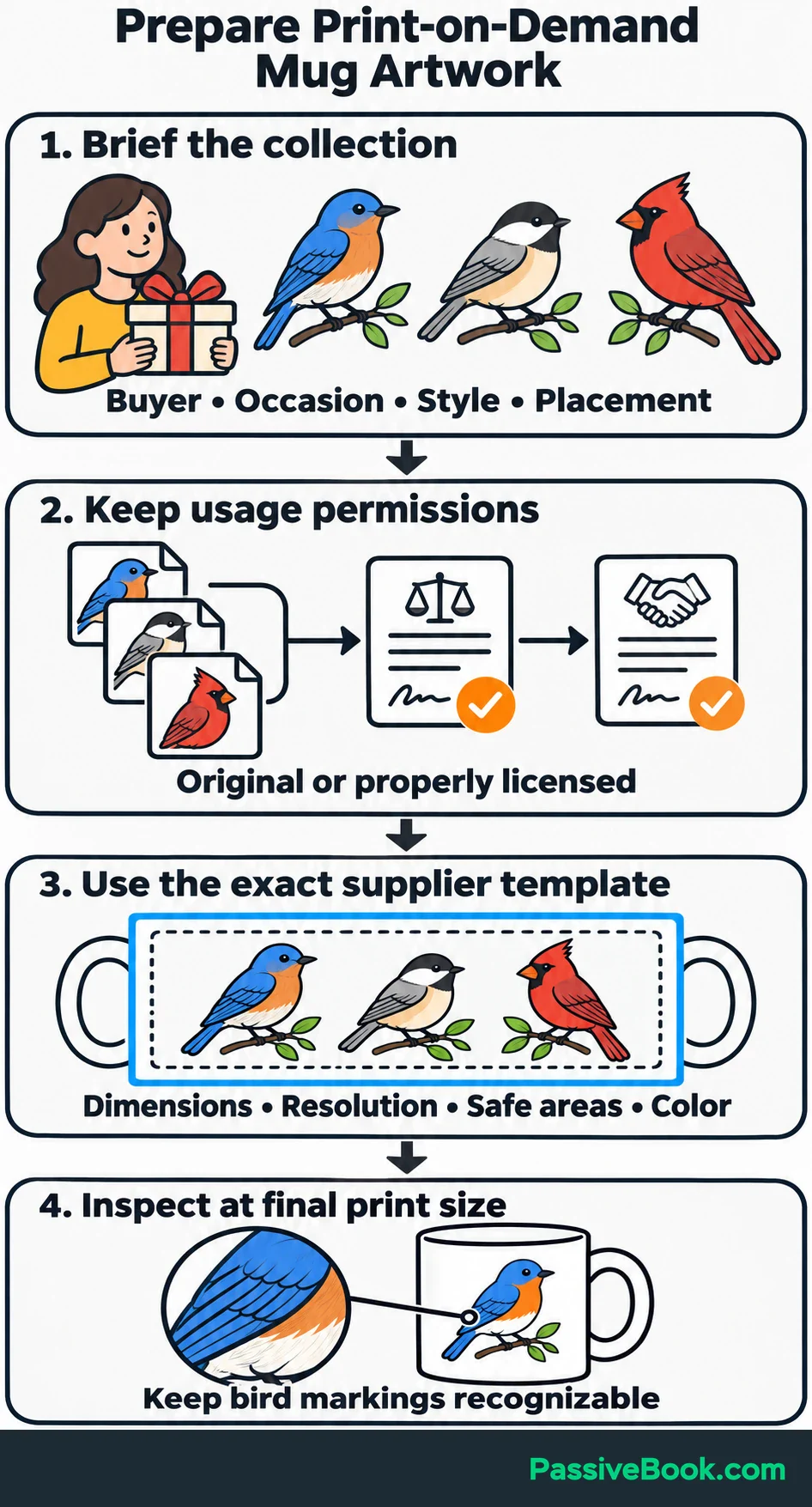
Keep licenses and written permissions with the design files. Use original artwork or assets whose licenses permit your intended merchandise use. Changing someone else’s protected artwork does not automatically give you permission to use it; the US Copyright Office explains the rights involved in adaptations.
Check your proposed shop name and any slogans too. Search for confusingly similar marks on related goods and existing commercial use in the markets you plan to serve. The USPTO’s clearance-search guidance provides a US starting point.
Once the artwork is ready, use the exact supplier template. Follow its dimensions, resolution, safe areas, transparency, and color requirements. Inspect the file at its intended print size.
For the bird mugs, check whether fine markings remain visible. An illustration can look excellent enlarged on your monitor and become a small, confused pigeon on ceramic.
Test the Physical Product
Order the exact product and printing configuration you intend to sell. A sample of another mug does not approve this one.
Inspect it as a buyer would:
- Is the illustration clear and positioned correctly?
- Does the product match the listing’s material and capacity?
- How does the print look around the curved surface?
- Is its position beside the handle sensible?
- Did the packaging protect it during delivery?
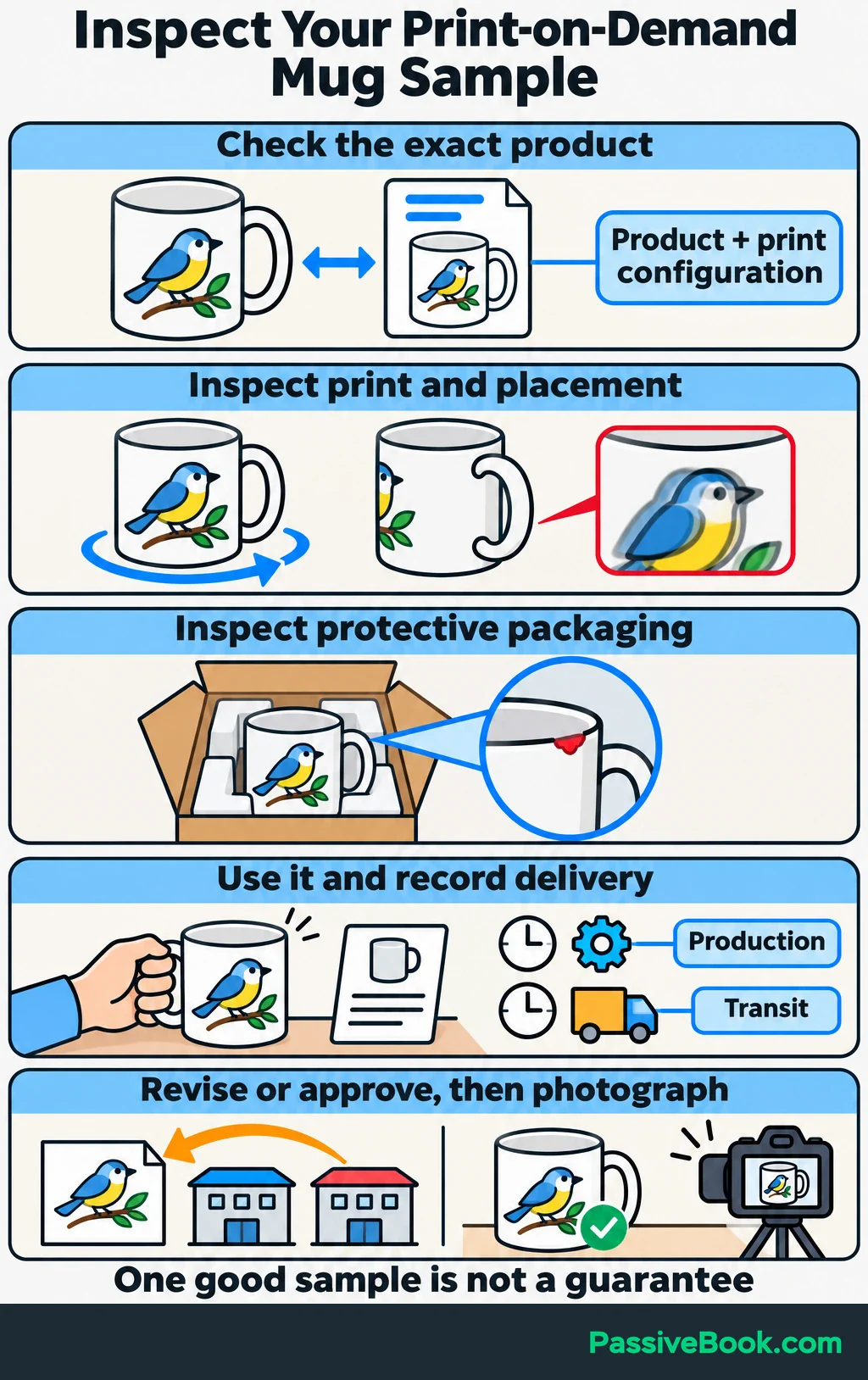
Use the mug according to the supplier’s care instructions, and check whether normal use changes your view of its quality. Record production and delivery time separately so you can compare the experience with the supplier’s estimates.
One good sample cannot prove every future order will be good, but it can reveal a product you should never publish.
Revise the artwork or change providers if the result does not support your selling price. Then photograph the approved sample. Show its scale, print placement, and handle-side view, and correct any mockup that gives a misleading impression.
6. Build Your Store and Test an Order
Before accepting sales, complete the registration, licensing, and tax setup required for your location and business structure. Check the relevant government requirements rather than assuming a small side business is exempt. The SBA’s launch guide is a starting point for US sellers.
Keep supplier invoices, selling fees, refunds, and sales records from the beginning. Those records will also tell you whether the business makes money.
Next, build product listings that answer the questions a buyer needs resolved:
- What design will arrive?
- What is the product made from?
- What are its capacity or dimensions?
- Which variants are available?
- How should it be cared for?
- What is the total delivered price?
- When is it expected to arrive?
A readable title such as “Songbird Illustration Mug, 11 oz Ceramic” gives buyers a clear starting point. Add relevant detail where it helps the purchase decision.
You have the product details; the next job is making them useful to a buyer. This tool drafts your listing around the person buying, the occasion, and the questions that could hold up an order.
Free AI Ecommerce Copy Studio
If you sell on Etsy, use designs that meet its rules. Original seller designs made by a production partner require partner disclosure and accurate dispatch information. Etsy also requires disclosure in the listing description when an item is created using AI. These requirements appear in Etsy’s Creativity Standards.
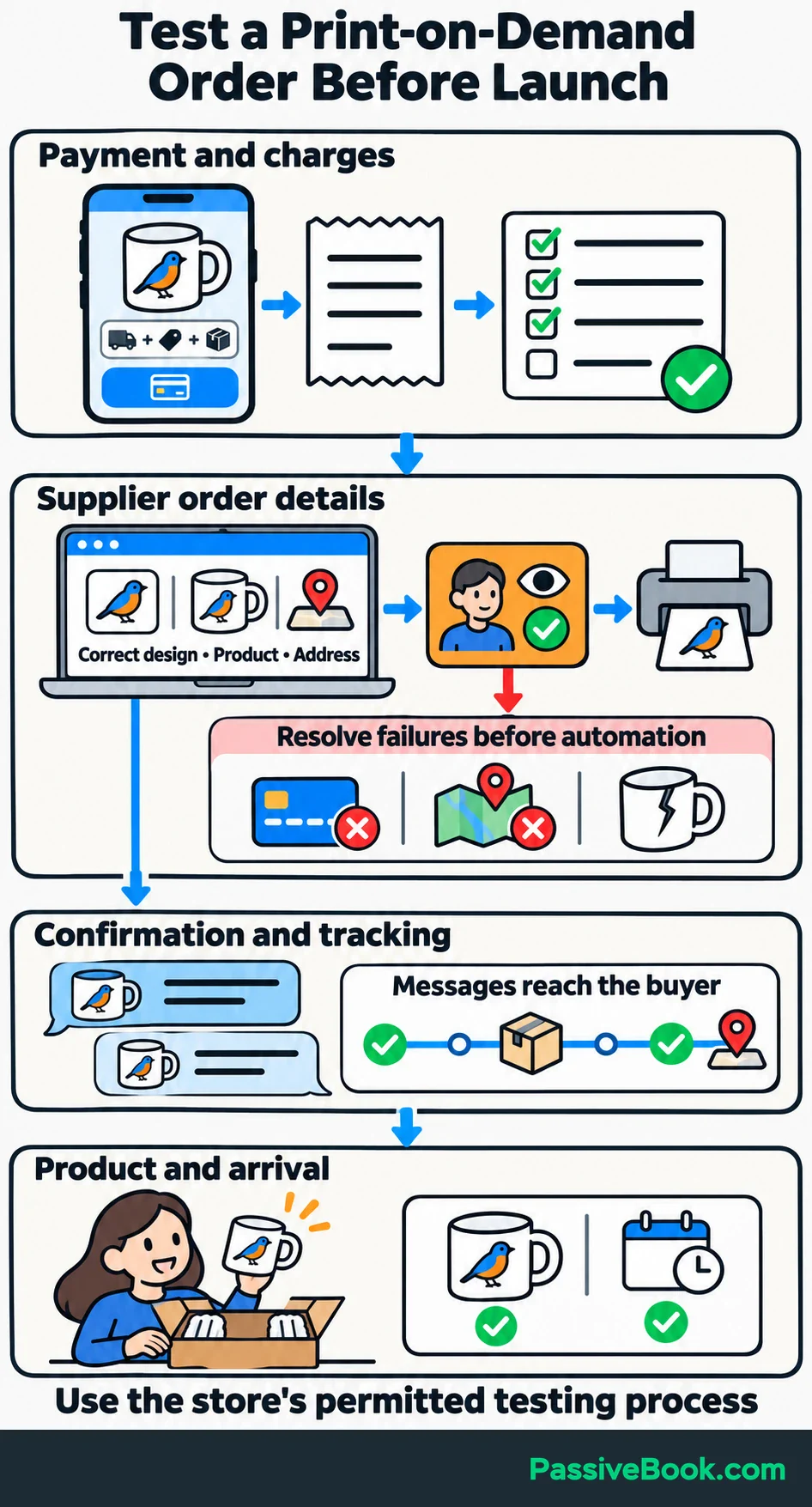
Connect the fulfillment partner and check every product variant. Confirm that each listing sends the correct design, mug format, and delivery information to the supplier.
I would review the first orders manually before enabling automatic production. A small delay for checking is easier to fix than several wrongly printed orders.
Set arrival estimates using both production time and transit time for the actual destination. Then publish clear contact, shipping, cancellation, returns, and privacy information.
Your customer policies must follow applicable law, even when the supplier excludes a particular refund. For example, EU online purchases generally have a 14-day withdrawal period, with exceptions for qualifying made-to-order or personalized goods. Check whether your product qualifies rather than assuming every POD item does. EU consumer guidance explains the rights and exceptions.
Finally, place a real order through the store’s permitted testing process. Confirm:
- Payment works and the actual charges match your worksheet.
- The supplier receives the right design, product, and address.
- Confirmation and tracking messages reach the buyer.
- The correct product arrives within the estimate you gave.
Prepare a simple response process for failed payments, wrong addresses, unavailable products, damage, and refund requests. Keep the order number, customer messages, photographs, and supplier claim deadline together.
7. Get Your First Customers
Choose one repeatable way to reach people who could buy the product. Begin with a channel you can maintain around your existing work.
For an Etsy launch, I would start with marketplace search. Use the language buyers use in titles, categories, tags, and attributes, but keep the title readable. A string of repeated gift keywords makes a poor introduction to your product.
For the cardinal design, test “cardinal mug” alongside a phrase such as “birdwatcher birthday gift.” Show the cardinal clearly in the first photograph, and use the relevant bird name and product details in the listing. Give each of the three designs its own listing so buyers can land on the bird they want.
For a standalone store, you need a separate traffic plan. Pinterest, useful niche content, or an existing relevant audience can give you somewhere to begin. Pick one, and send people to the matching product page.
For Pinterest, make two image posts, called Pins: one showing the recognizable bird illustration and another presenting the mug as a gift. Give each a title that matches its angle, and link directly to that mug’s product page. Prepare these alongside your listing photos so promotion fits one planned work session.
The bird mug sample gives you several things to show:
- A close-up that makes the illustration easy to judge.
- A photograph showing the mug’s size.
- A handle-side view.
- A gift presentation with accurate delivery information.
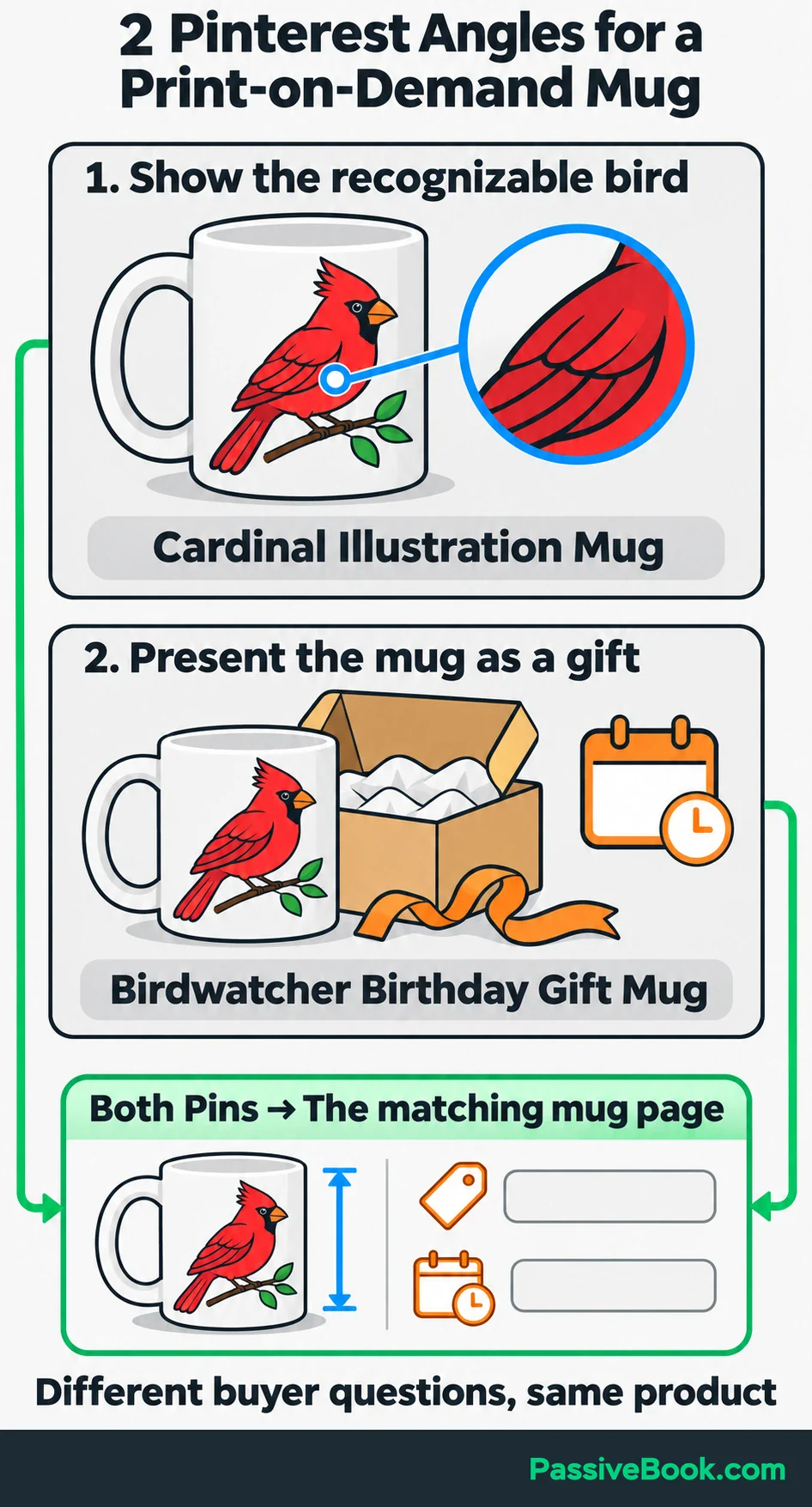
Each piece should answer a buyer question or give someone a reason to look at the product. Changing the background color twelve times does not create twelve useful reasons.
Keep the invitation specific. A short promotional excerpt might read:
A songbird mug for the person who knows every visitor to the feeder. See the illustration, mug size, and delivery estimate.
Contact people who asked for launch information during concept testing, and show the finished product at its actual delivered price. Share it in relevant communities only where promotion is permitted.
You do not need to start with paid ads, but organic promotion still costs time. Give each channel enough consistent, useful effort to learn from it rather than expecting one post to settle the question.
Use buyer questions to improve the listing. If people keep asking which side the bird appears on, add a photograph. If they ask whether it will arrive before a birthday, make the delivery estimate easier to find.
After a purchase, ask what made the buyer choose the mug and what nearly stopped them. Pair those answers with relevant product visits, purchases, and contribution from each traffic source.
A post that attracts birdwatchers who consider buying gives you more useful evidence than a large audience that only enjoys the picture.
8. Improve Profitable Products and Automate Routine Work
Review actual orders against the pricing worksheet before expanding. Supplier charges, discounts, refunds, and platform fees can turn an attractive estimate into a weak result.
Look at operating profit alongside the hours spent designing, promoting, and helping customers. A business can leave money in the account and still demand more time than you want to give it.
Use the problem you observe to choose the next change:
| What You See | What to Check | A Useful Next Test |
|---|---|---|
| Few relevant product visits | Whether the product appears where prospective buyers search or participate. | Improve one search listing or try a more relevant promotional placement. |
| Relevant visits but few purchases | Design appeal, price, photographs, product details, and delivery expectations. | Address a repeated buyer objection and observe later visits. |
| Started checkouts without purchases | Unexpected delivered costs, payment problems, or mobile usability. | Complete checkout on a phone and investigate where buyers leave. |
| Sales with little money left | Actual production, shipping, fees, discounts, and refunds. | Recalculate the price or compare a different supplier or product. |
Treat these as starting points for investigation. A handful of visits cannot tell you that an entire niche has failed.
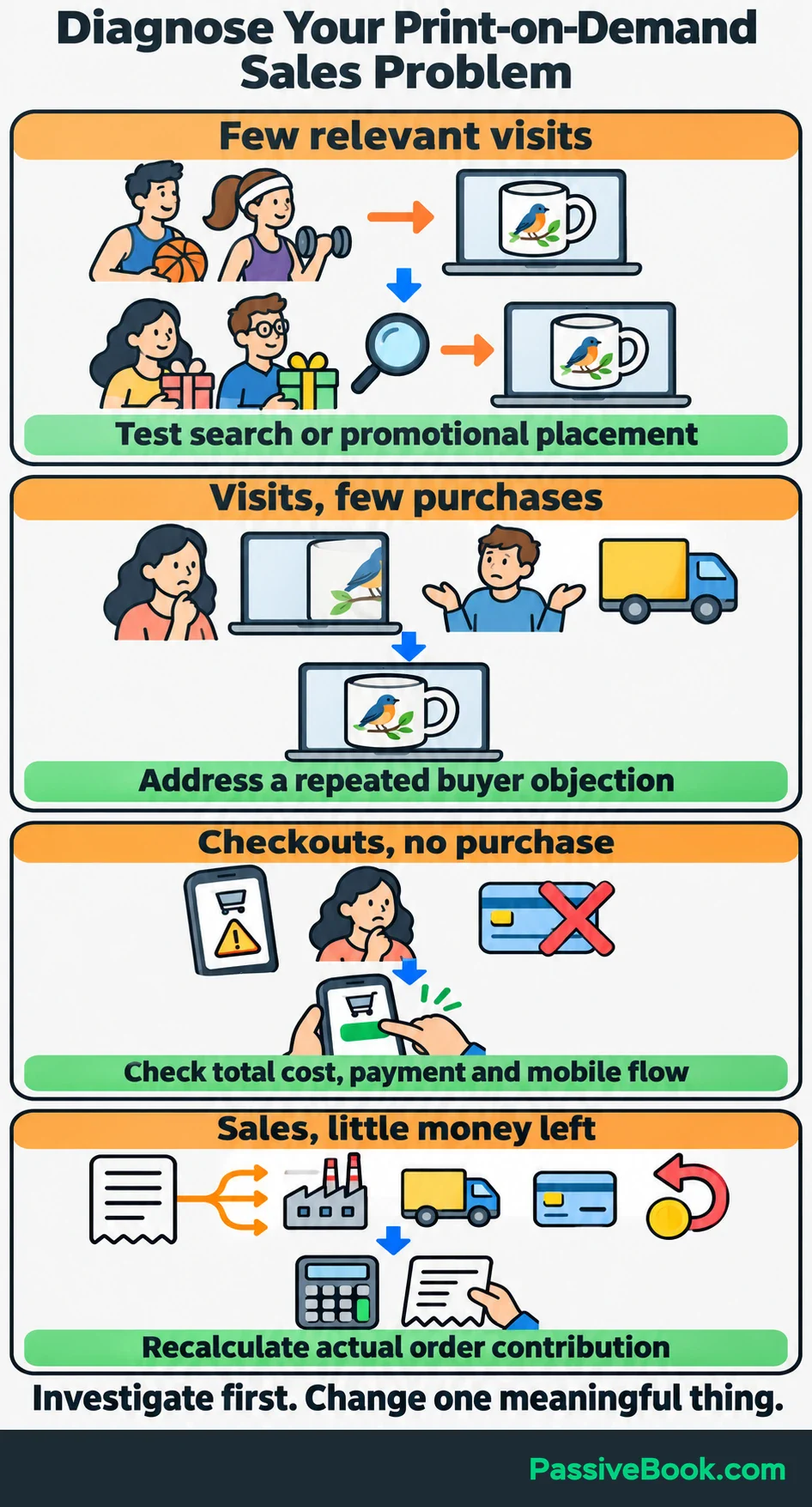
Improve one meaningful part of the offer at a time. For the mug shop, strengthen the bird illustration style that attracts paying buyers before adding unrelated products. Sample any new product or provider and calculate its costs before publishing it.
Once ordering works reliably, enable the supplier integration’s routine order routing and tracking updates. Keep payment failures, unavailable products, quality complaints, and unusual orders visible for review.
I would use the built-in connection before adding another automation subscription. Make or n8n becomes useful when you have a proven task the integration does not handle, such as sending failed-order alerts to one place.
Automation can reduce repetitive work. It cannot make an unwanted design sell or decide whether a disappointed customer deserves extra help.
Continue when buyers pay, quality holds up, and the profit justifies the workload. Revise when you can identify a specific problem to test. Stop when the product repeatedly fails those checks and another round would only spend more money avoiding that conclusion.
What Next?
Write one sentence naming your buyer, purchase occasion, and first product, then get a production-and-shipping quote for it. That gives you something concrete to test before paying for a full store.
Use the social buttons to share this guide when a conversation about print on demand needs real costs alongside the appeal of avoiding inventory.
Which part of your proposed offer would you most want to test before spending money? Share your answer in the comments, and bring any other questions too.
Share this post with your friends & followers:

