A supplier offers a lower price if you buy 500 units. The discount looks good, but you still have to find somewhere to put them—and customers willing to buy them.
The hard part is judging that commitment before you have steady sales. Stock can tie up money needed for bills or another order, while alternatives bring their own costs and daily work. This guide compares inventory ownership with running a marketplace and dropshipping, using a treat-pouch store to show what you would fund, what each sale leaves, and who handles delivery.
The Key Difference Is Who Owns the Stock
In an inventory-based ecommerce business, you buy or make products, own the stock, and sell it to customers. Money stays committed to those goods until they sell or you recover some value another way.
A marketplace connects customers with independent sellers, who generally own the listed products. The marketplace operator earns commissions or fees for services such as subscriptions and advertising.
Keep three decisions separate:
- Ownership: Who buys and owns the products?
- Sales channel: Where do customers place their orders?
- Fulfillment: Who stores, packs, and ships the goods?
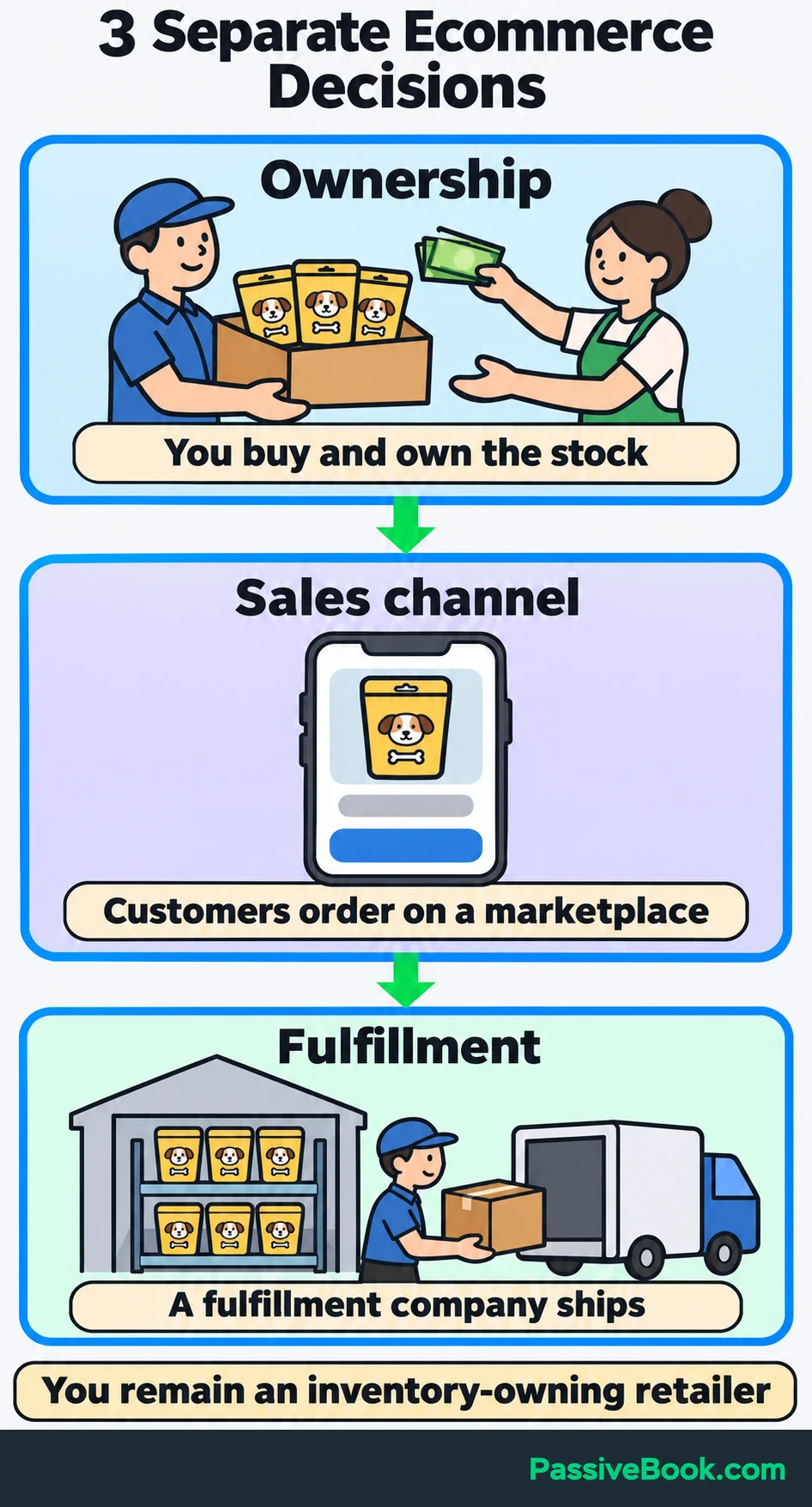
You can own stock, sell it through an existing marketplace, and pay another company to ship it. You are still an inventory-owning retailer.
For the examples throughout this article, imagine you run a dog-walking accessories store selling treat pouches. The store and all figures are illustrative.
You buy a batch of pouches for resale. Your basic cycle is:
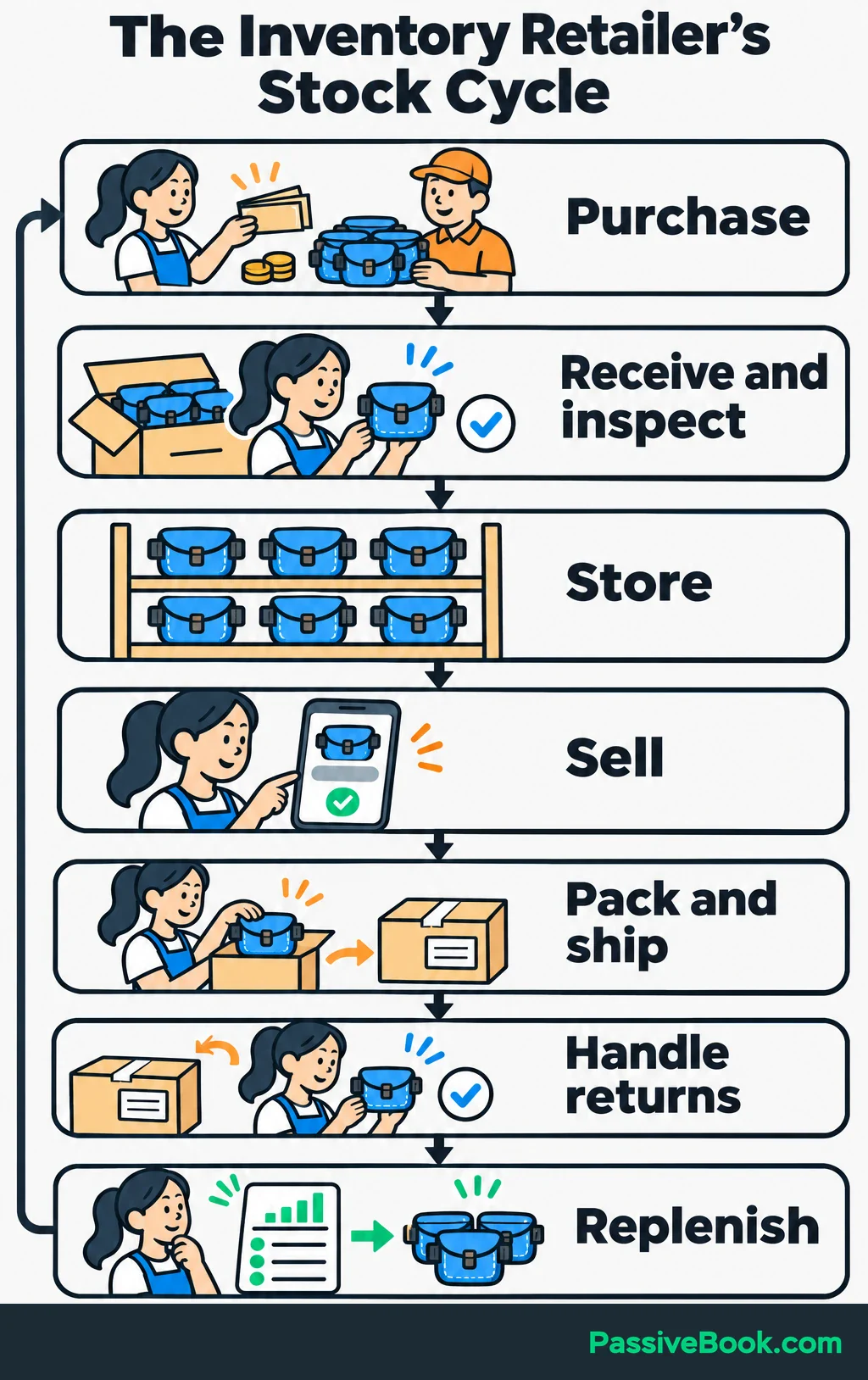
Purchase → receive and inspect → store → sell → pack and ship → handle returns → replenish.
You do not need to manufacture the pouches or own a warehouse. A small batch might fit on a shelf, and a fulfillment company could handle larger volumes.
Operating a marketplace for dog-walking accessories would be a different business. Independent sellers would list their products, and you would run the system that helps them transact with buyers.
Inventory-based Ecommerce Vs Marketplace: Key Differences
Both models need customers, reliable operations, and money to grow. Their main costs and daily work differ.
| Factor | Inventory-based retailer | Marketplace operator |
|---|---|---|
| Inventory and financial risk | Pays for stock and bears losses from unsold, damaged, or discounted goods. | Generally avoids buying sellers’ stock but funds the platform and attracts buyers and sellers. |
| Revenue and profitability | Earns product sales revenue, then pays product, selling, fulfillment, and operating costs. | Earns commissions and service fees, then pays platform, payment, support, and other operating costs. |
| Product and customer-experience control | Chooses purchases, inspects goods, and sets packaging and fulfillment arrangements. | Sets platform standards but relies on sellers to carry out their responsibilities. |
| Fulfillment and workload | Manages suppliers, stock records, replenishment, and delivery arrangements. | Manages seller onboarding, listings, transactions, disputes, and platform reliability. |
| Growth constraints | Needs cash for replenishment and enough capacity to fulfill orders. | Needs relevant sellers and enough purchasing customers to keep those sellers engaged. |
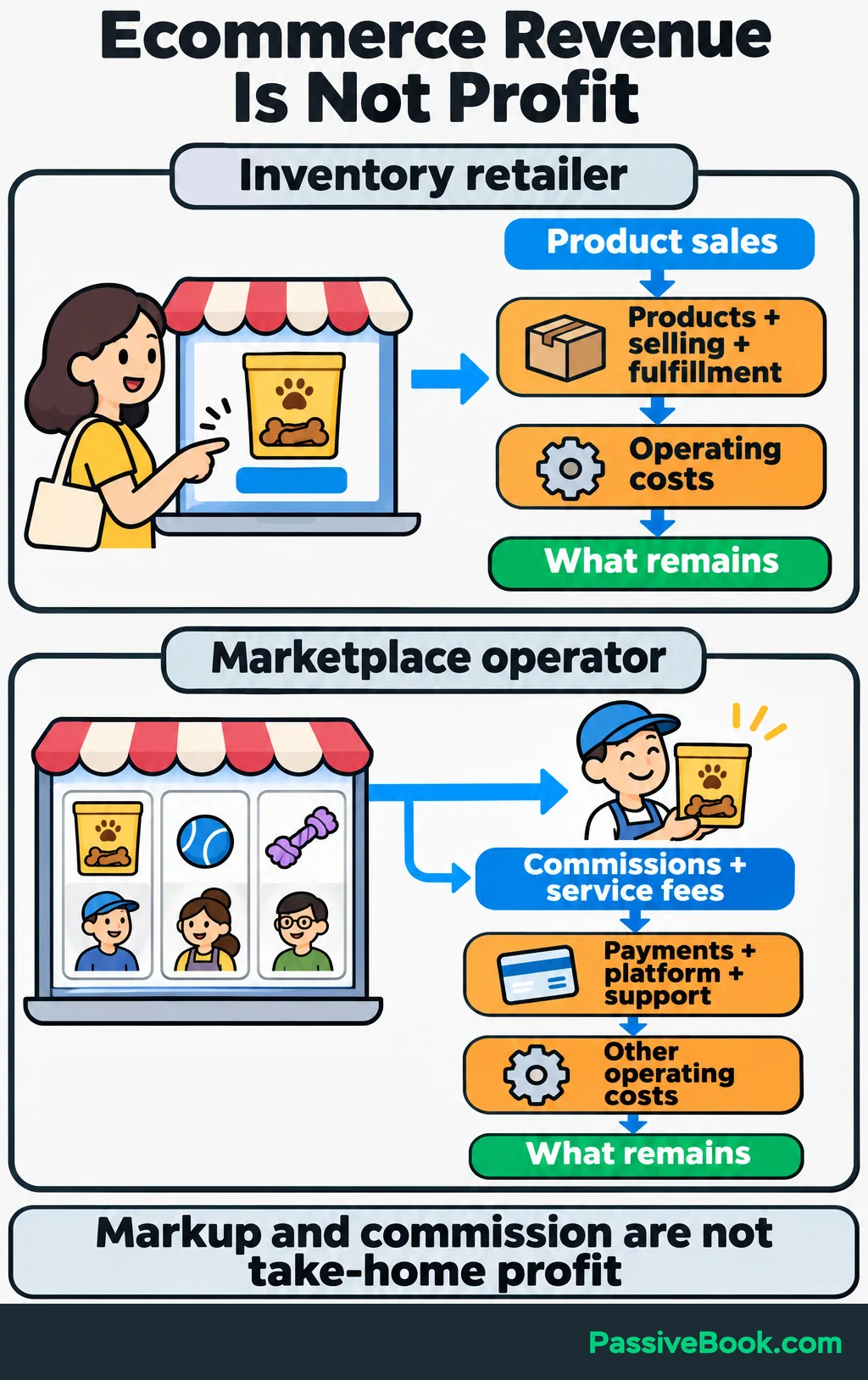
Compare what remains after costs. A retailer’s markup is the amount added to its product cost, while a marketplace’s commission is its fee on a seller’s sale. Neither tells you what remains after all expenses.
For example, eBay’s annual report describes revenue from transaction, subscription, and advertising fees, alongside costs such as payment processing, customer support, and site operations. Avoiding inventory purchases does not remove operating expenses.
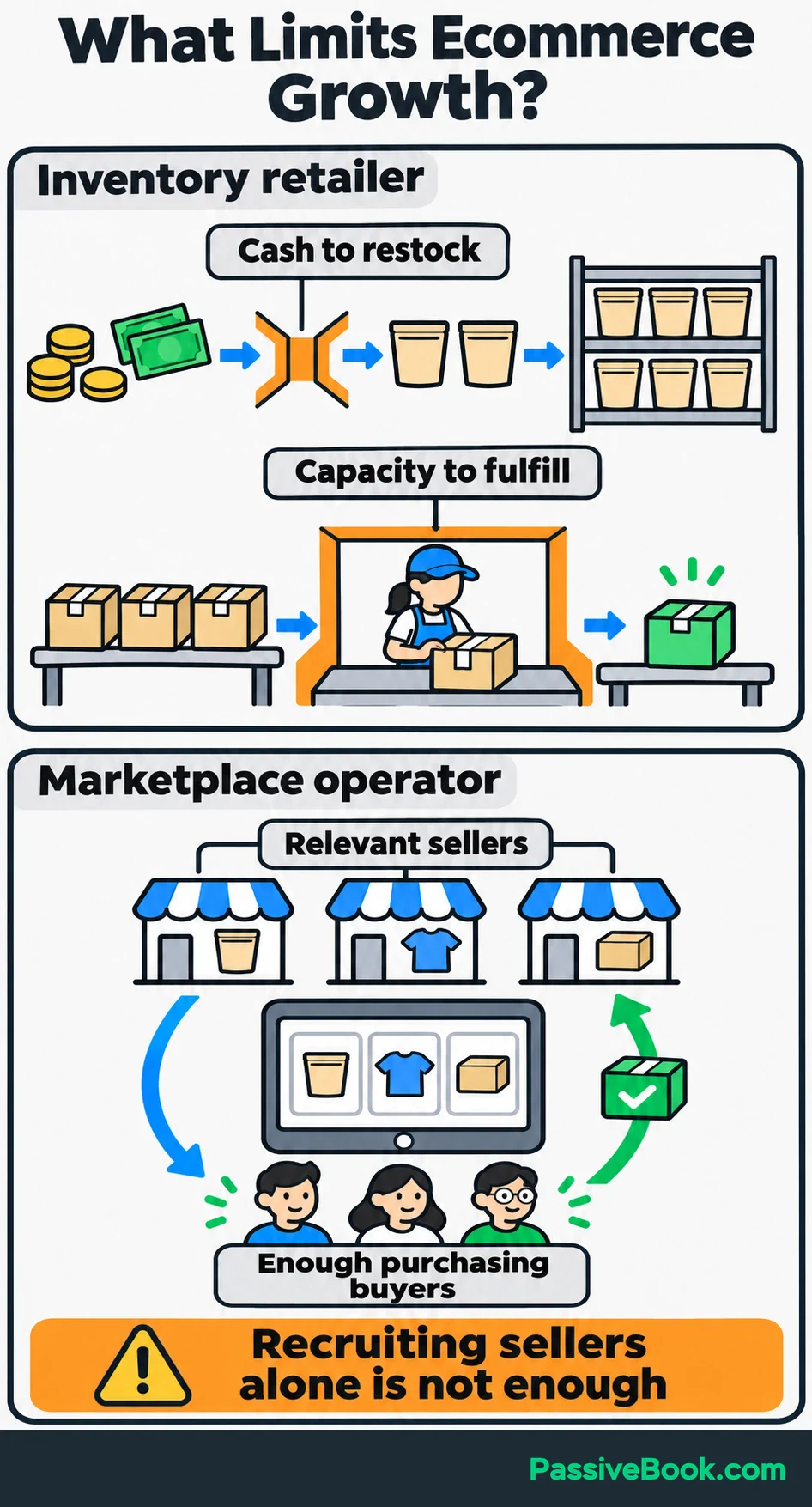
I would also reject “marketplaces scale easily” as a reason to start one. Recruiting accessory sellers is one job. Bringing them enough buyers to justify staying is another.
A business can combine both models by selling its own stock alongside third-party listings. It then takes on both sets of responsibilities.
Where Does Dropshipping Fit?
Dropshipping is a retail fulfillment arrangement. A supplier holds products and ships individual orders directly to your customers, so you avoid buying a batch upfront.
You still run the store and remain responsible for customer service and order tracking. Shopify’s explanation of dropshipping makes that division clear.
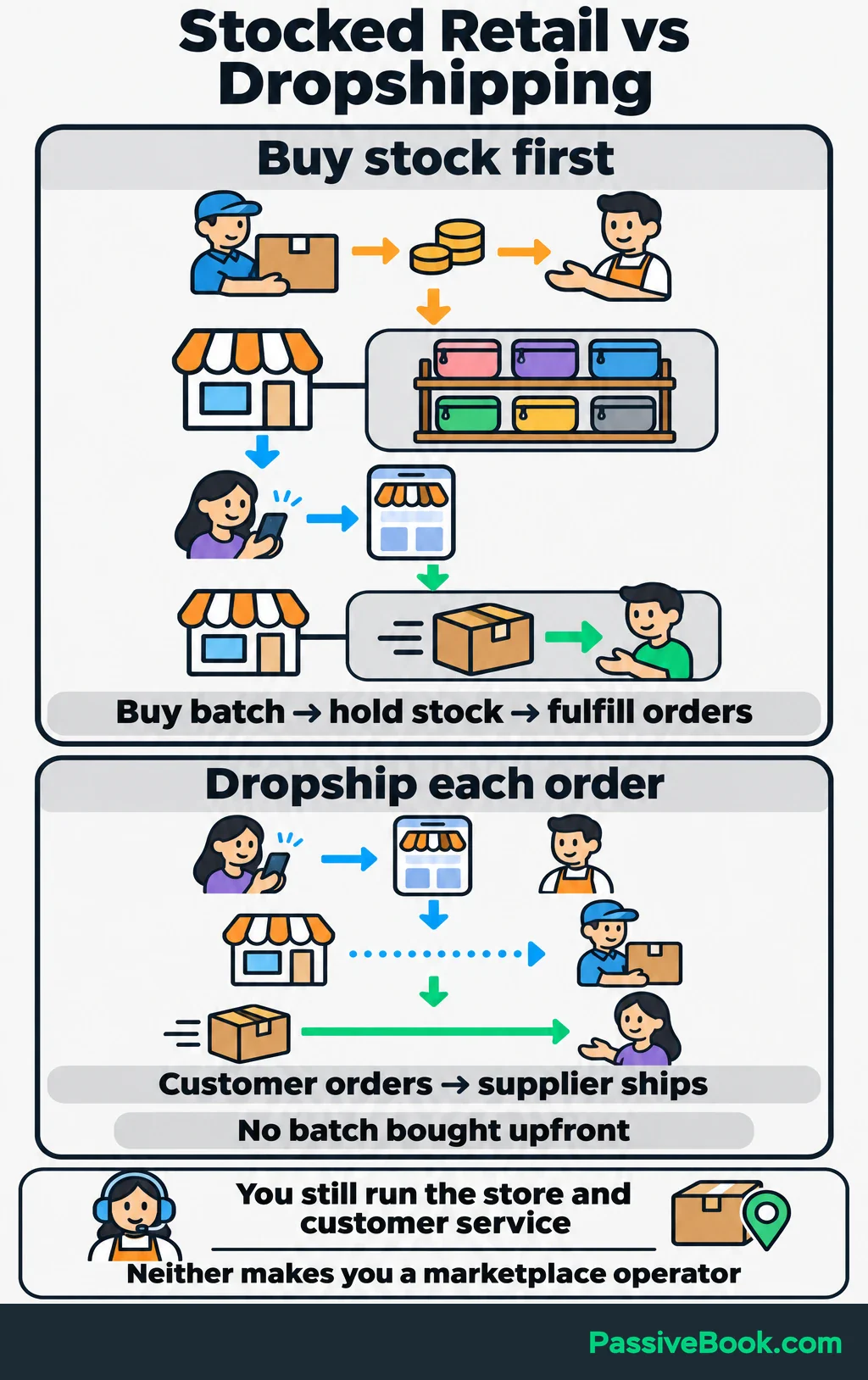
Your treat-pouch store could therefore:
- Buy pouches in advance and arrange their storage and shipping.
- Send each order to a supplier that ships directly to the customer.
Either approach could serve orders from your website or an existing marketplace, subject to that channel’s rules. Neither makes you a marketplace operator.
Compare the supplier’s product price, shipping charges, availability, quality, and return terms before choosing. Lower upfront spending does not automatically mean better margins.
I would order a sample through the proposed delivery process before offering it to customers. A good product sample tells you about the pouch. A test shipment also tells you about packaging, tracking, and delivery.
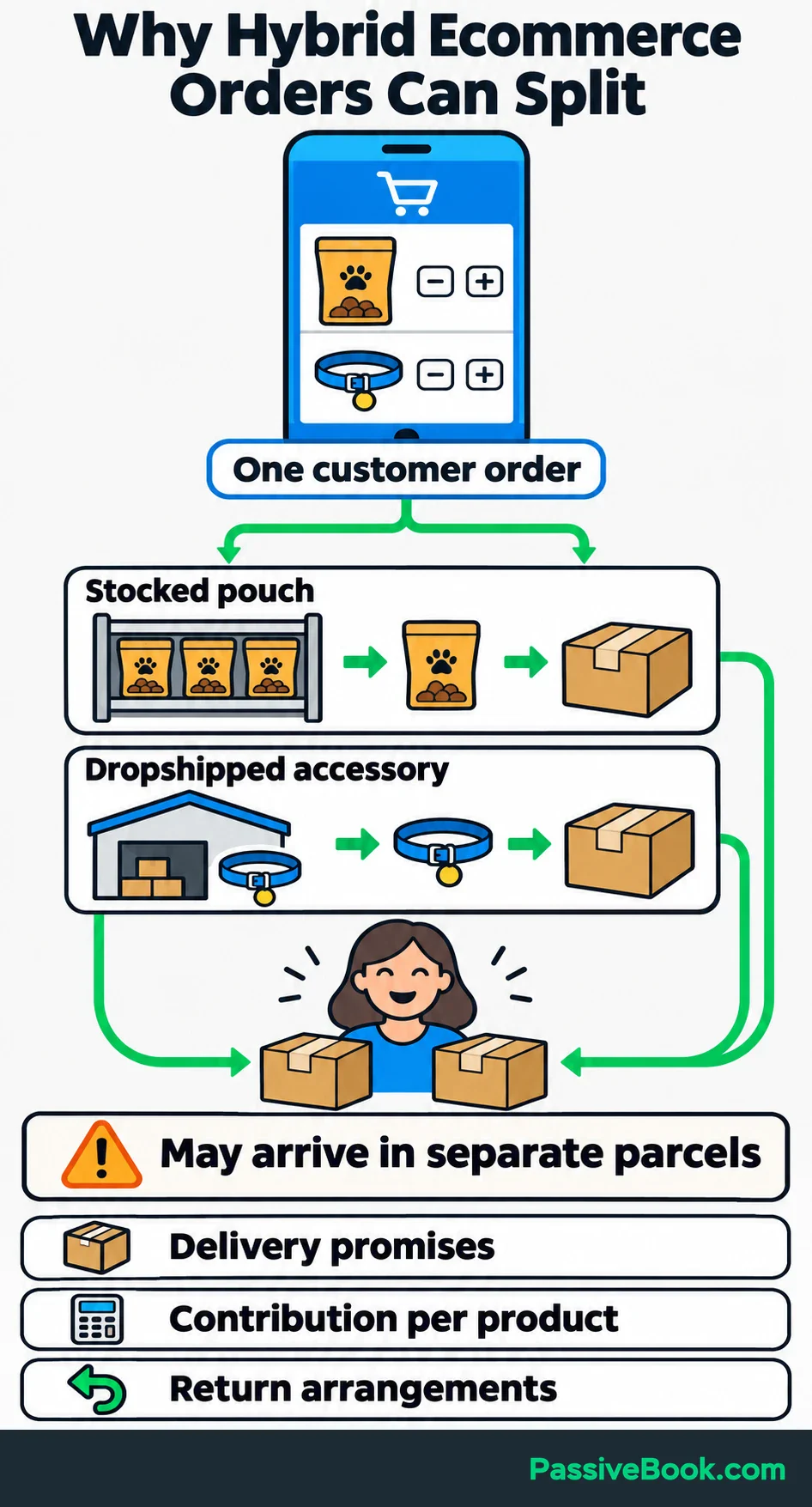
You can stock a proven pouch and dropship selected additions. Check each product’s contribution and delivery arrangements separately, especially when one customer order could arrive in separate parcels.
What Does Owning Inventory Cost?
The supplier’s invoice is only part of the budget. You also need money to get products ready for sale, fulfill orders, and keep operating while stock waits for buyers.
Budget for Stock Before It Sells
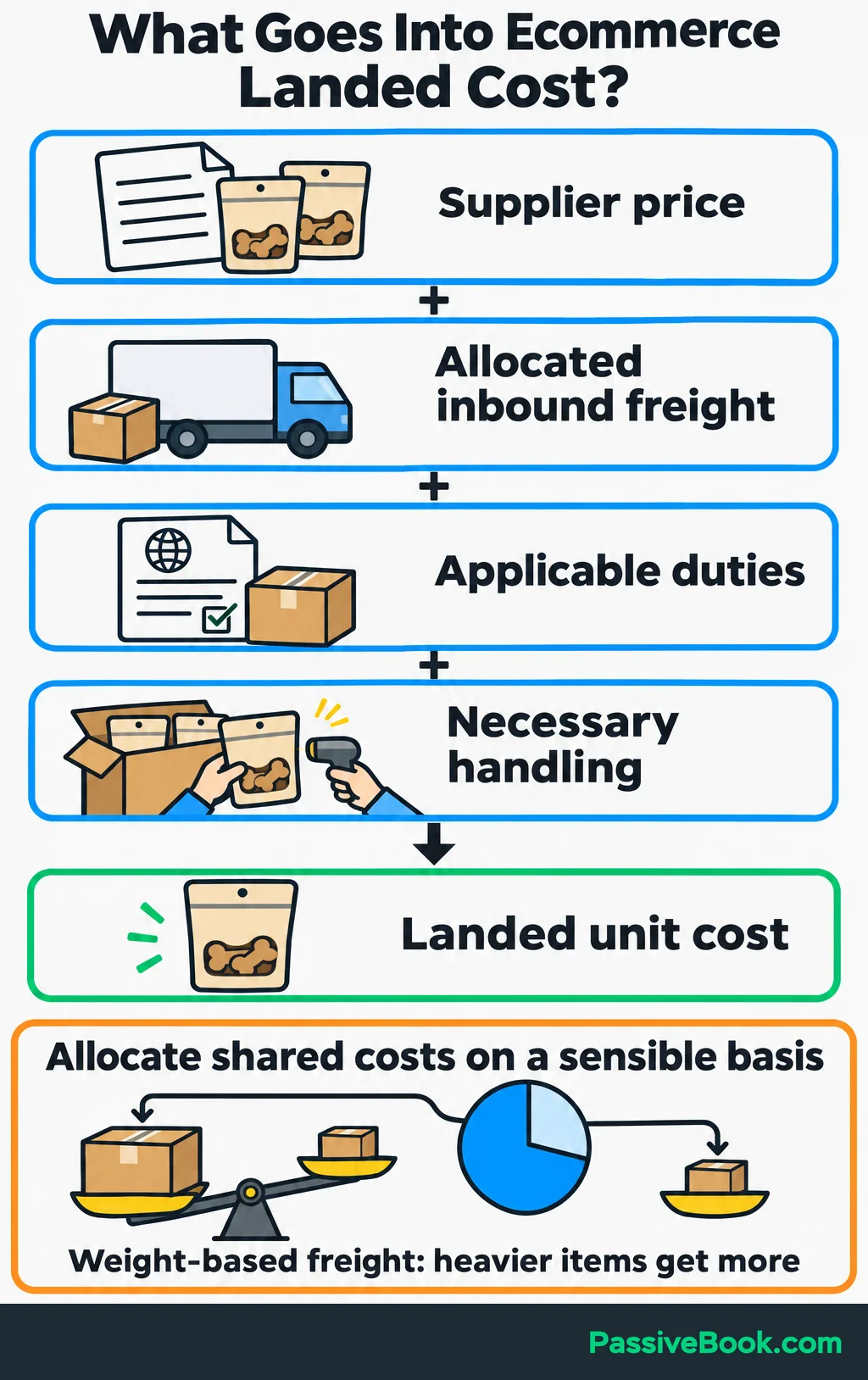
Start with the landed unit cost: what each item costs to buy and bring into a condition and location where you can sell it.
For purchased goods, include the supplier price, allocated inbound freight, applicable duties, and necessary handling. Divide shared shipment costs across the units using a sensible basis. For freight charged by weight, for example, allocate more to heavier items.
Keep your opening cash budget in separate groups:
- Stock: The purchase and costs of getting it ready for sale.
- Setup: Samples, store setup, product photography, and packing equipment.
- Operations: Storage, software, and other ongoing bills.
- Reserve: Fulfillment spending, refunds, and the next supplier payment.
Check when each payment falls due. A supplier requiring full payment before production creates a different cash need from one offering payment terms.
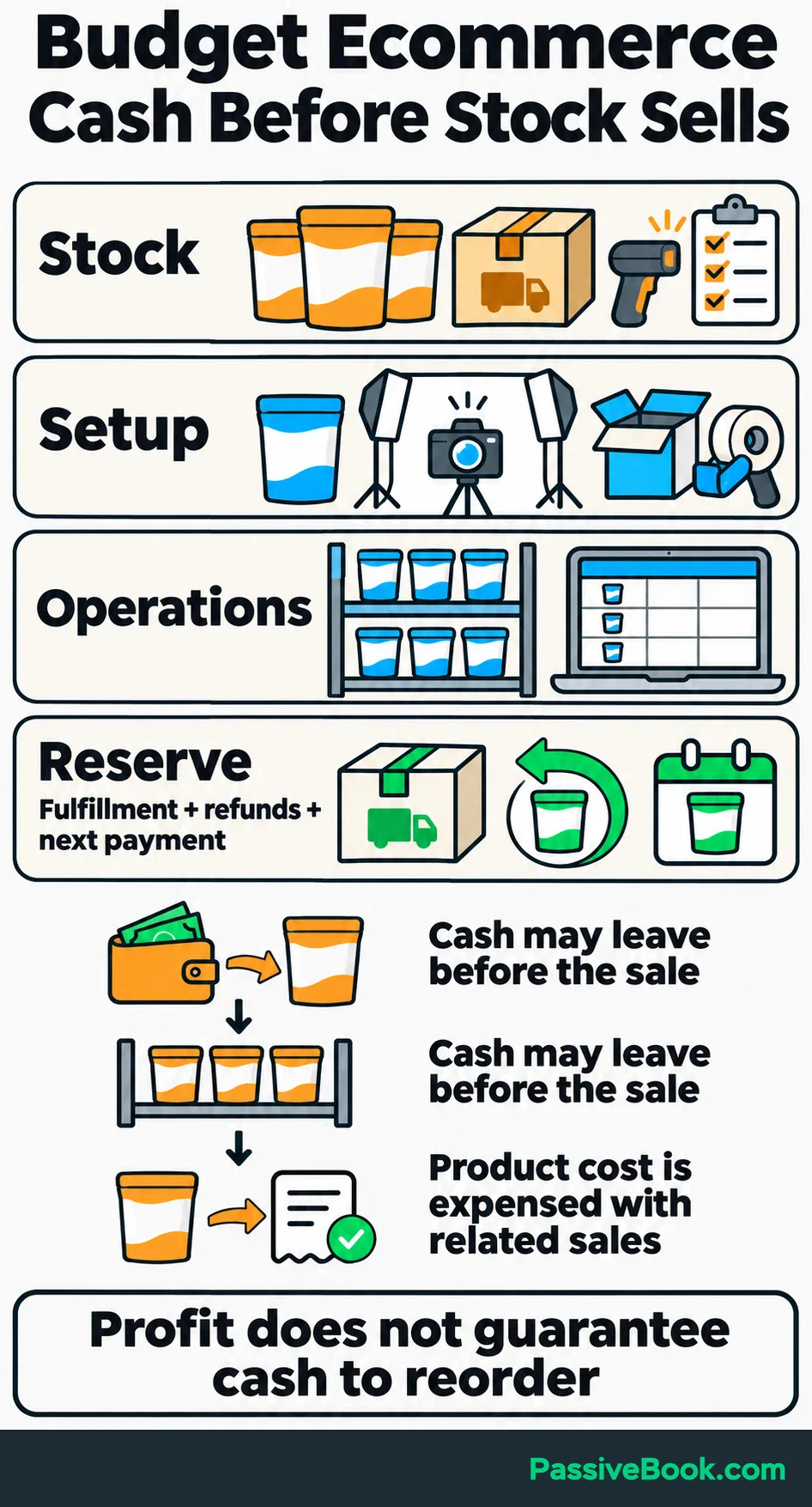
You can pay for stock before its cost appears as an expense. Under IAS 2’s inventory guidance, the cost of goods sold becomes an expense in the same period as the related sales revenue.
The practical lesson is simple: a profitable month can still leave you short of cash for another order.
Set your maximum stock commitment after protecting money needed for other obligations. There is no useful universal starting budget because product costs, minimum orders, and payment terms vary.
Calculate What Each Order Contributes
Work out how much one order leaves toward fixed expenses and profit after its product and variable costs.
Start with net sales after discounts and refunds, excluding sales tax collected for authorities. Then subtract landed product cost, packaging, fulfillment, shipping you pay, payment or channel charges, expected return losses, and attributable customer acquisition costs.
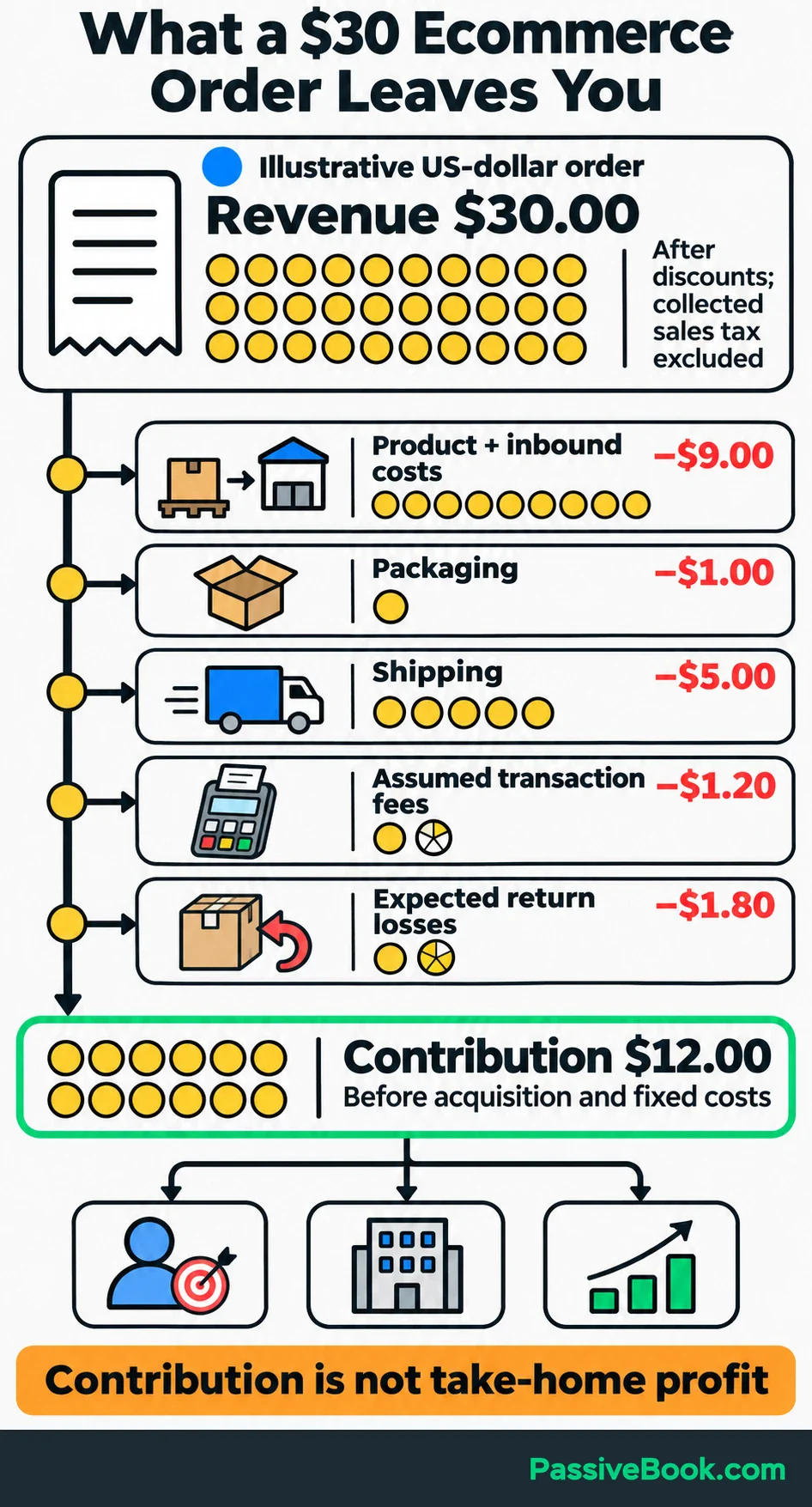
For one treat pouch per order, assume:
| Item | Amount per order |
|---|---|
| Net sales revenue | $25 |
| Landed product cost | −$8 |
| Packaging, fulfillment, and shipping | −$6 |
| Payment or channel charges | −$2 |
| Expected return losses | −$1 |
| Customer acquisition | −$3 |
| Contribution toward fixed costs and profit | $5 |
Here, the return allowance covers losses not already included elsewhere. Count each expense once.
Now consider the batch. Buying 100 pouches at an $8 landed cost commits $800 to stock. If you sell 40 during a month:
- Contribution: 40 orders × $5 leaves $200.
- Fixed expenses: Subtracting $150 leaves $50 before owner pay and tax.
- Remaining stock: 60 pouches still hold $480 at cost.
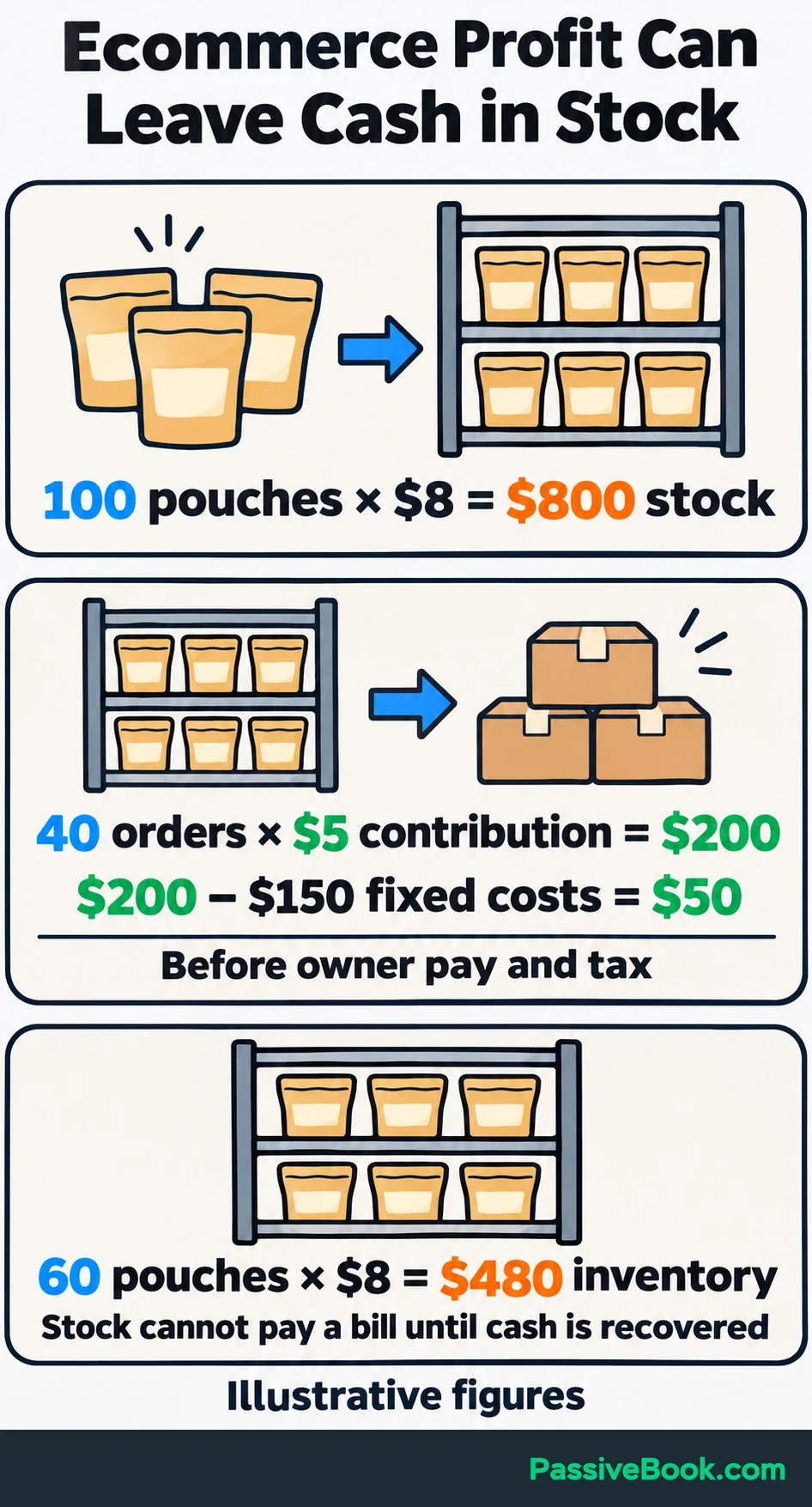
That $480 is inventory, so you cannot use it to pay a bill. Damage, discounts, or weak demand may also reduce what you recover.
I would check this calculation before negotiating a larger order. A lower unit price is useful only if the extra stock sells well enough to justify the cash commitment.
The Business Cash Planner includes a stock check for planning a conservative first inventory batch. Use your own estimates to check a proposed batch before committing to the supplier.
Free Business Cash Planner




How Can You Limit Inventory Risk and Workload?
Control the first purchase, make fulfillment workable, and let sales guide replenishment. Those choices matter more than having a large catalog.
Validate Demand Before Ordering a Batch
Start with one product and few variants. Every extra color or size creates another purchasing decision and another stock count.
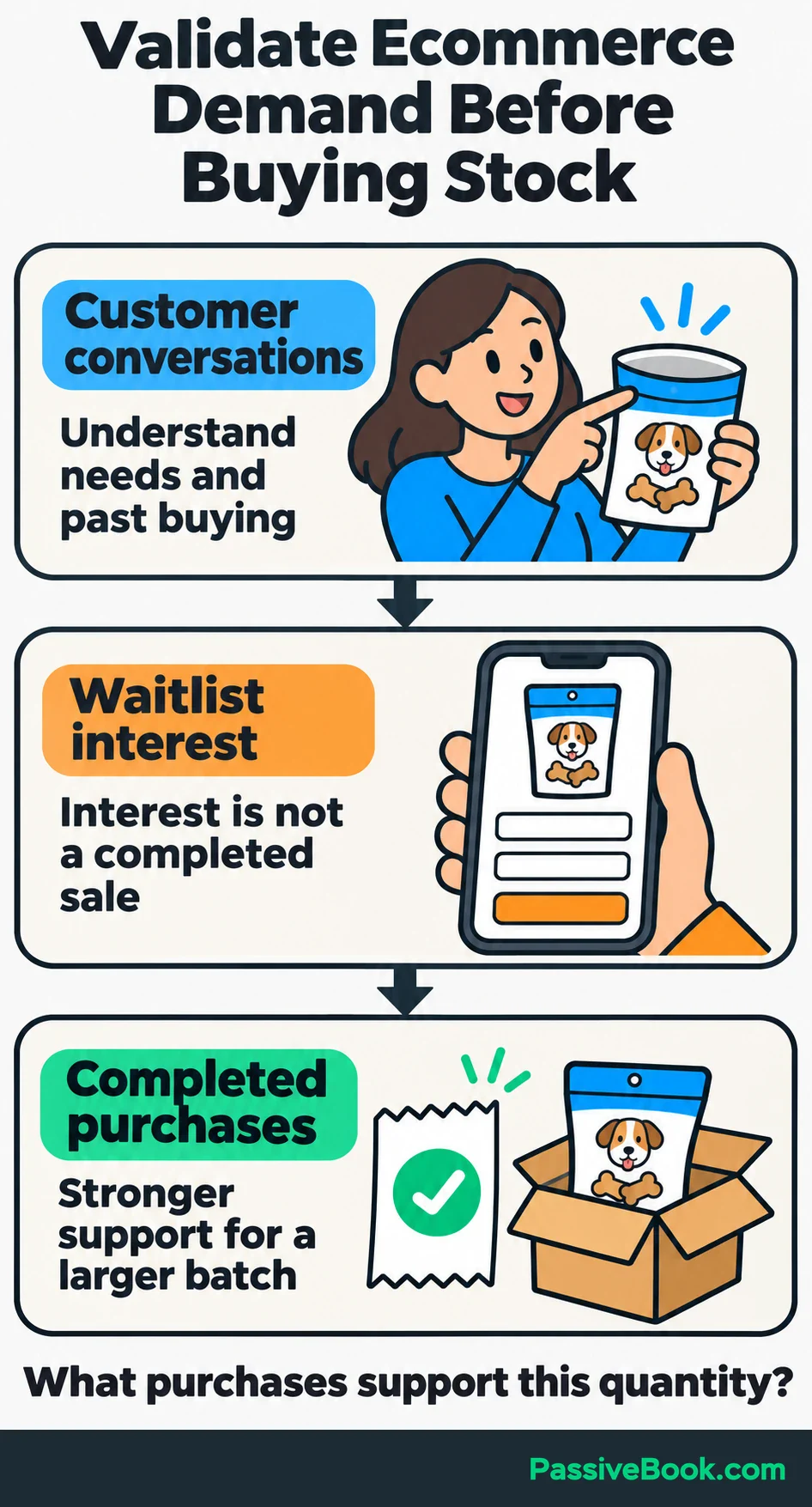
Use customer conversations to understand what people want from a treat pouch. Ask what they currently use, what bothers them, and what they have already bought. A waitlist can reveal interest, but completed purchases give you stronger evidence for a larger order.
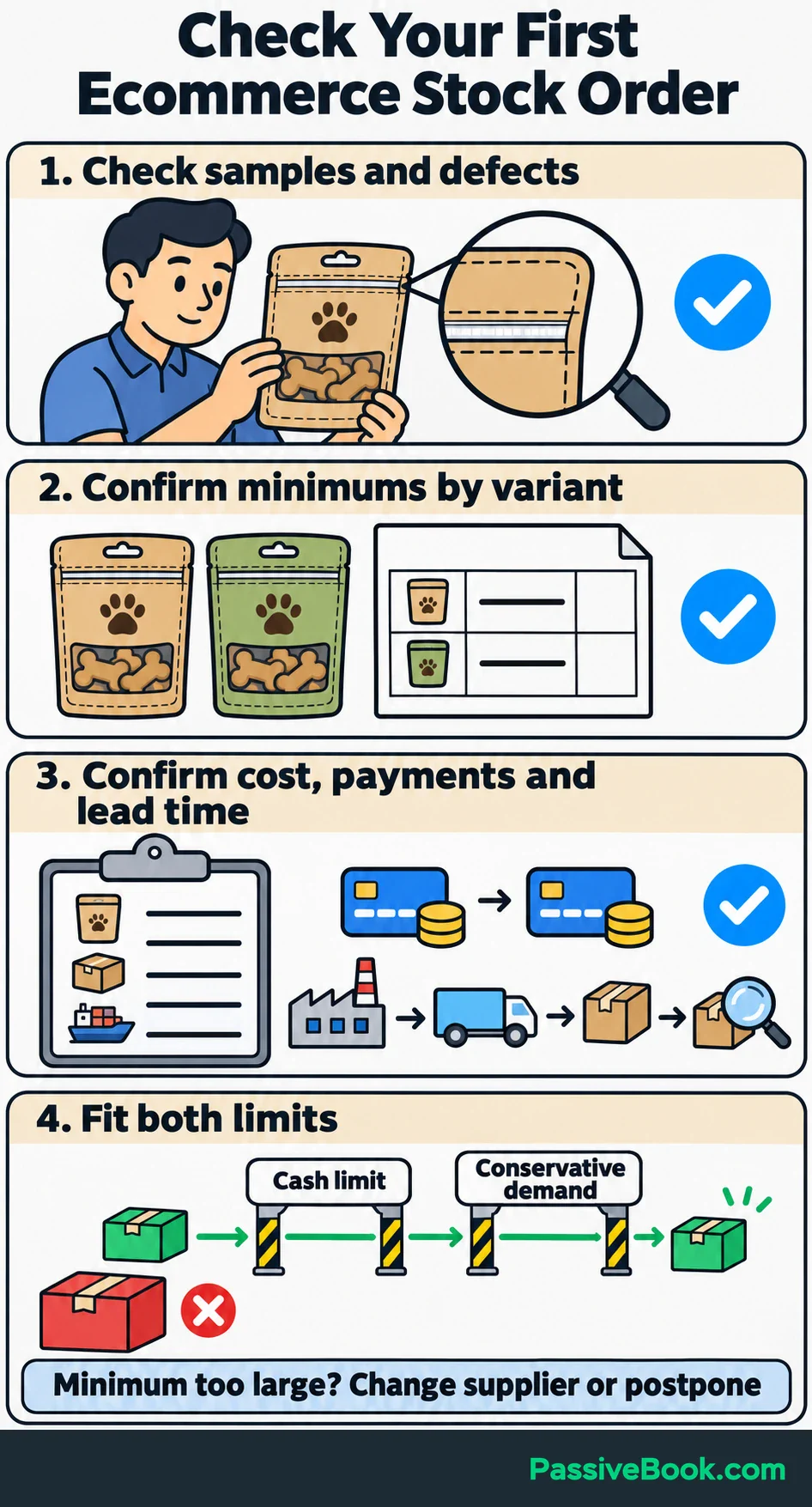
Before committing, obtain samples and confirm:
- Order size: Minimum quantities for each product and variant.
- Cost and payment: Landed cost, deposit, balance, and payment dates.
- Quality problems: How defects are reported and resolved.
- Lead time: How long production, transit, receiving, and inspection take.
Keep the first batch within both your cash limit and a conservative estimate of demand. If the minimum order exceeds either, find another supplier or postpone the purchase.
I learned this through my online jewellery store. I started with about $1,200 and lost most of it after buying stock without enough market research. I spent more time choosing products than checking why customers would choose them.
That experience changed what I would ask before placing an order. “Do I like this?” is easy to answer. “What purchases support this quantity?” is more useful.
Choose Fulfillment That Fits Your Capacity
Map the whole job before deciding to handle shipping yourself:
Receiving → inspection → storage → picking → packing → dispatch → customer support → returns.
For a small pouch batch, self-fulfillment may fit your space and schedule. Check whether you can meet the dispatch promise during a busy workweek, not just on a quiet Sunday.
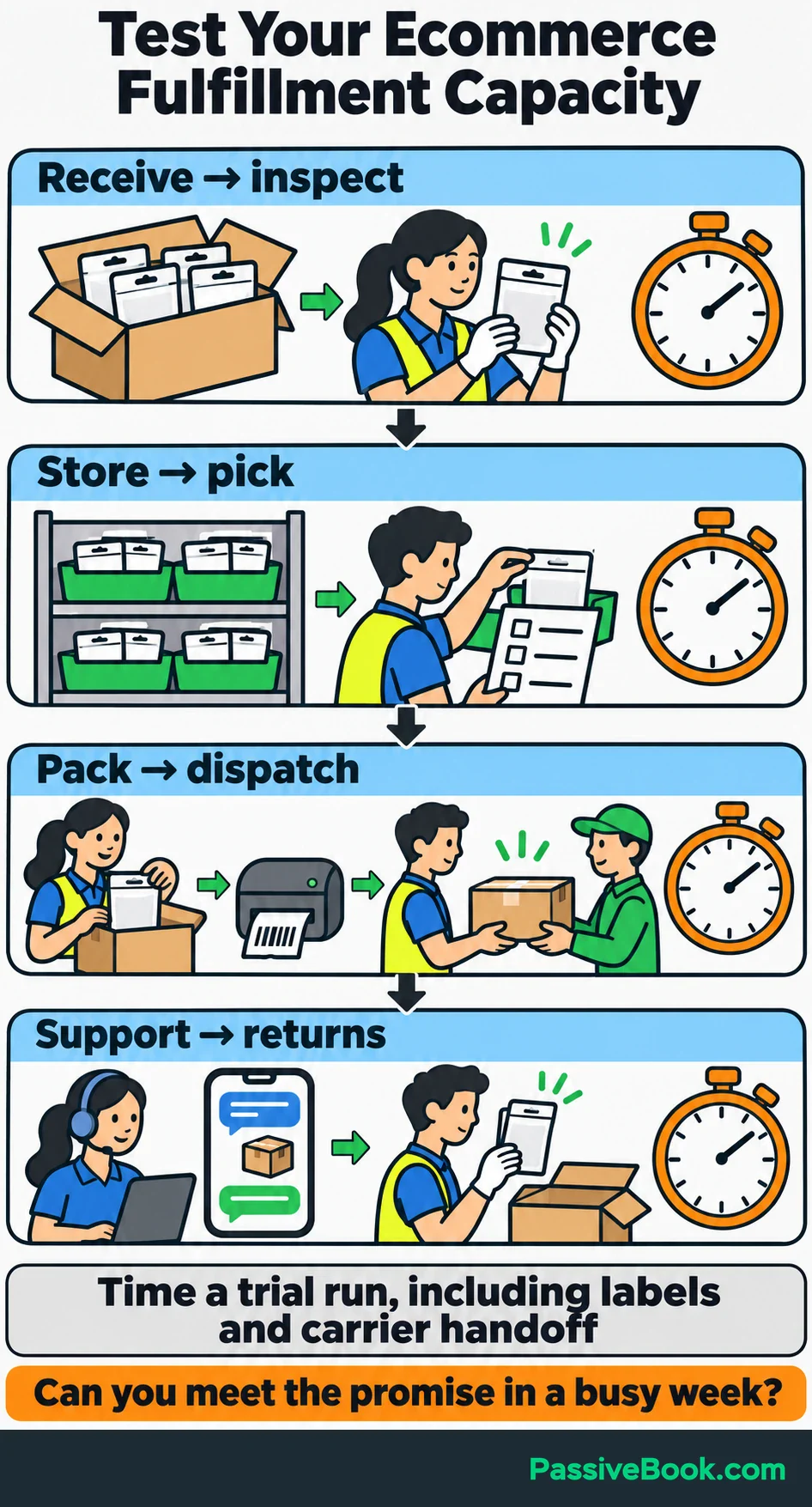
Time a trial run from finding the product to preparing the parcel. Include printing labels and handing parcels to the carrier.
A third-party logistics provider stores and ships goods for you. Compare complete quotes covering receiving, storage, picking and packing, packaging, shipping, returns, and minimum charges. Include your own handling time when weighing the alternatives.
Amazon’s Fulfillment by Amazon service, for example, handles storage, packing, shipping, customer service, and returns for participating orders. You still own the inventory and carry its financial risk.
I would outsource when the full cost works and the service solves a clear capacity problem. Paying a warehouse minimum while a few pouches sit untouched does not make the business more efficient.
Replenish Against Sales and Available Cash
Keep stock records by variant and location. Separate units that are sellable, reserved for orders, incoming, or damaged. Count physical stock regularly and reconcile differences before buying more.
For replenishment, estimate how many units will sell while you wait for the next delivery, then add a buffer for demand or delivery variation. That is the basis of the reorder-point calculation:
Reorder point = expected demand during replenishment lead time + safety stock.
Suppose later records show sales of 10 pouches a week. Replenishment takes three weeks, including receiving and inspection, and you choose a 10-pouch buffer. Your trigger is 40 units: 30 expected sales plus 10 spare.
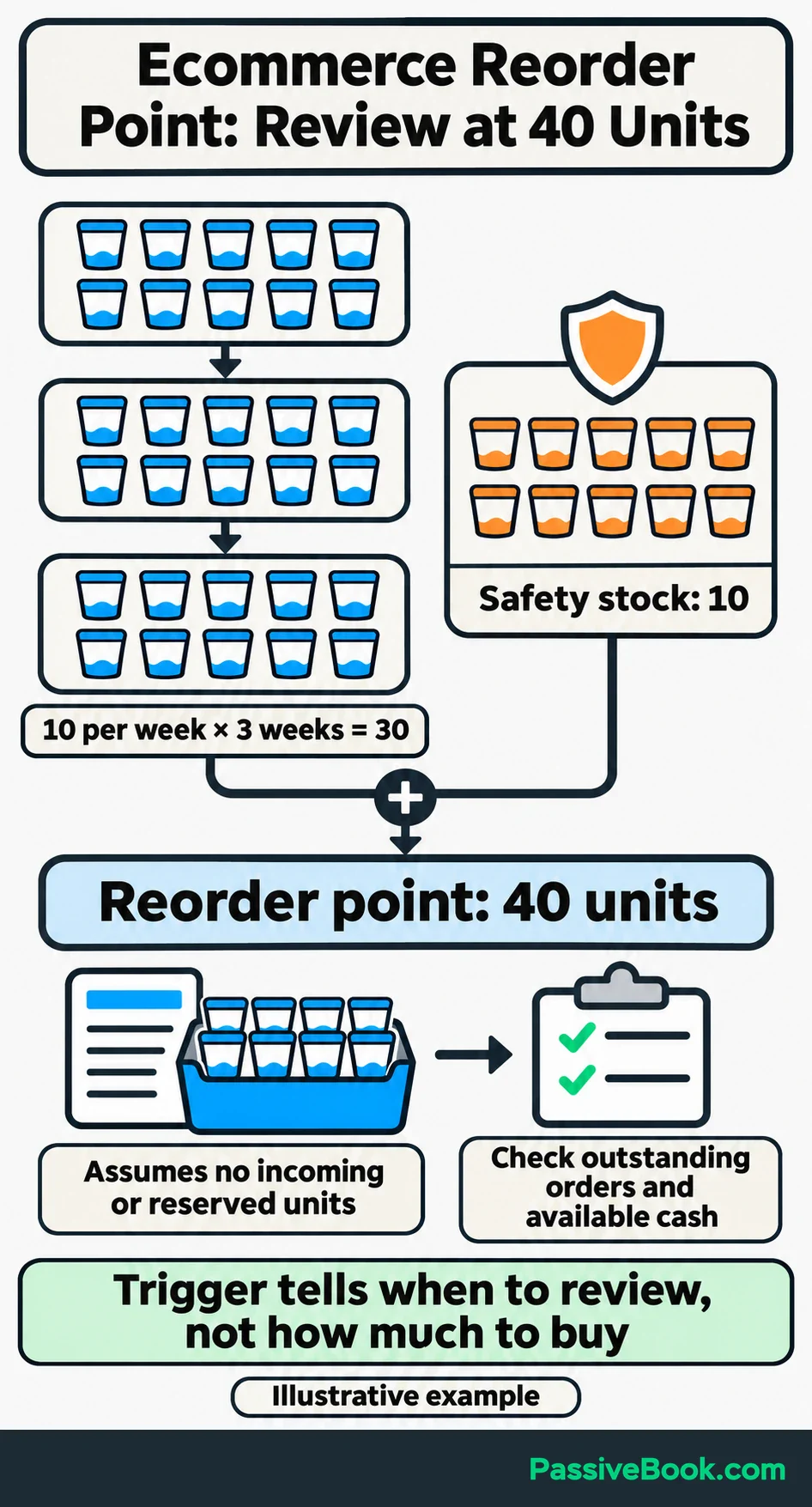
If there are no incoming orders or reserved units, reaching 40 sellable pouches prompts a purchasing review. Check outstanding purchase orders before placing another one.
The trigger tells you when to review. Supplier minimums, demand, and available cash determine how much to buy.
Also review stock age. Stop replenishing weak variants, and compare the cash a markdown could recover with the cost of continuing to hold them.
Use software to keep stock counts aligned across sales channels, send low-stock alerts, and forward orders to whoever ships them. Before buying more, compare upcoming supplier payments with the cash you have and expect to receive, allowing for refunds and payout delays. Automation can send an alert; it cannot make an unaffordable order affordable.
Which Model Fits Your Business?
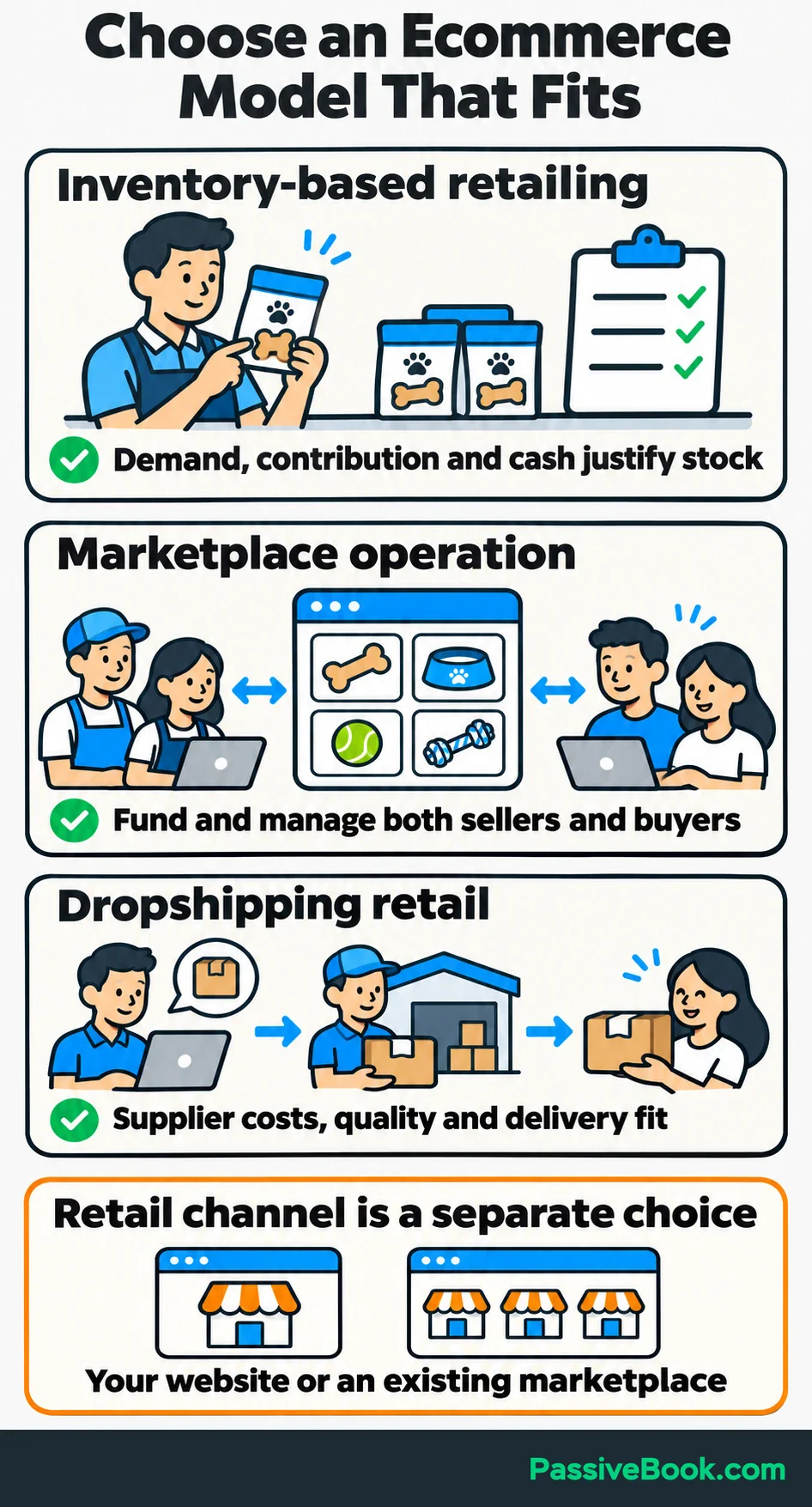
Choose according to the work you want to run and the resources you can commit.
| Option | Choose it when… |
|---|---|
| Inventory-based retailing | Demand and order contribution justify buying stock, and inspection, availability, packaging, or delivery give customers a reason to choose you. |
| Marketplace operation | Your opportunity is connecting independent sellers with buyers, and you can fund and manage both sides. |
| Dropshipping | Limiting upfront stock purchases matters, and the supplier’s costs, quality, delivery, and return terms meet your needs. |
| Selling through an existing marketplace | Access to its shoppers justifies its fees and rules. Decide stock ownership and fulfillment separately. |
For the treat-pouch store, I would answer four questions before committing:
- How much cash can I leave tied up without missing other obligations?
- What completed purchases support the batch I want to order?
- What does each order contribute after its variable costs?
- Who will fulfill orders and handle problems within the promised times?
Inventory ownership can fit a side business or a growing company. Small batches can keep the initial commitment manageable, and outsourced fulfillment can reduce daily handling.
It still needs someone responsible for purchasing, cash, and exceptions. I would start with one pouch whose demand and costs I could understand before adding a shelf of variations.
What Next?
Request a sample and a landed-cost quote for one product, then calculate what an order would leave after product, selling, and delivery costs. Use that figure to decide whether a small test is worthwhile. Set a first-batch cash limit that leaves money for other bills, fulfillment, refunds, and the next supplier payment.
Use the social buttons to share this comparison when the conversation turns to buying stock or launching a marketplace. Separating those choices makes the budget discussion much clearer.
Which would constrain your first batch most: cash, evidence of demand, or time to fulfill orders? Share your answer and any other questions in the comments.
Share this post with your friends & followers:

