You find a product you can buy for $6 and sell for $25. That looks promising, especially if Amazon can store it and ship every order while you get on with your day.
But the difference between those two prices is not your profit. Shipping stock to Amazon, paying its fees, handling returns, and funding the next order all draw from that gap.
Before buying inventory, you need to see where the money goes and which jobs remain yours. Let’s follow one product from supplier to customer, then work out whether the convenience leaves enough money behind.
What Is Amazon FBA?
Amazon FBA stands for Fulfillment by Amazon. You send inventory to Amazon’s fulfillment centers, and Amazon stores it, picks and packs customer orders, ships them, and handles fulfillment-related customer service and returns. Eligible offers can also provide Prime delivery. Amazon’s FBA overview
You still own the business decisions. You choose products, pay suppliers, create listings, set prices, attract buyers, and decide when to buy more stock.
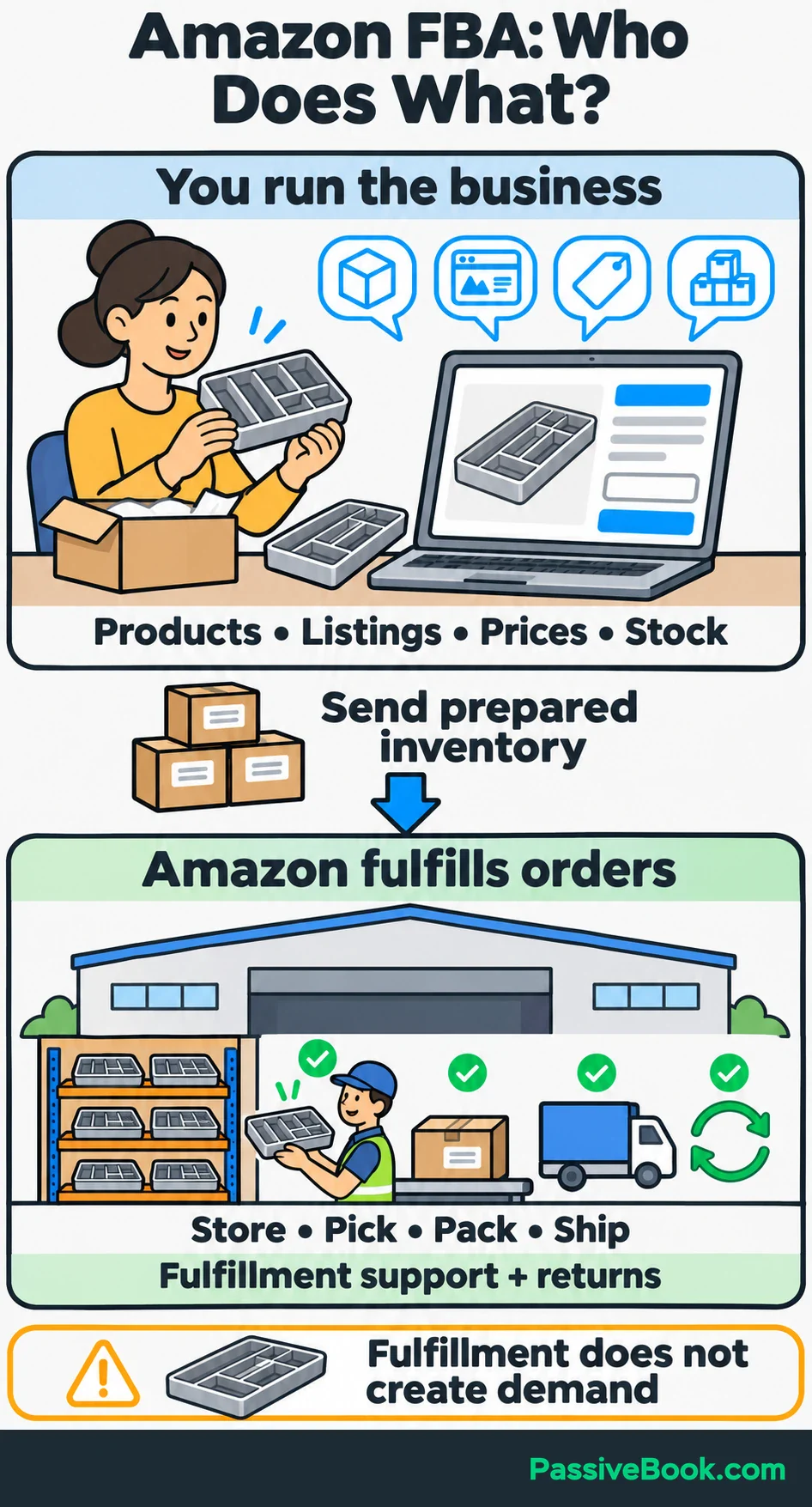
That distinction matters. Amazon can ship a bad product choice very efficiently.
For the examples below, imagine you sell compact kitchen drawer organizers. We’ll follow the same product through fulfillment, costs, and startup cash. The business and its financial figures are illustrations, not my selling results or a forecast of yours.
How Amazon FBA Works
Prepare Products and Send Inventory to Amazon
Start with the product and its numbers before ordering stock.
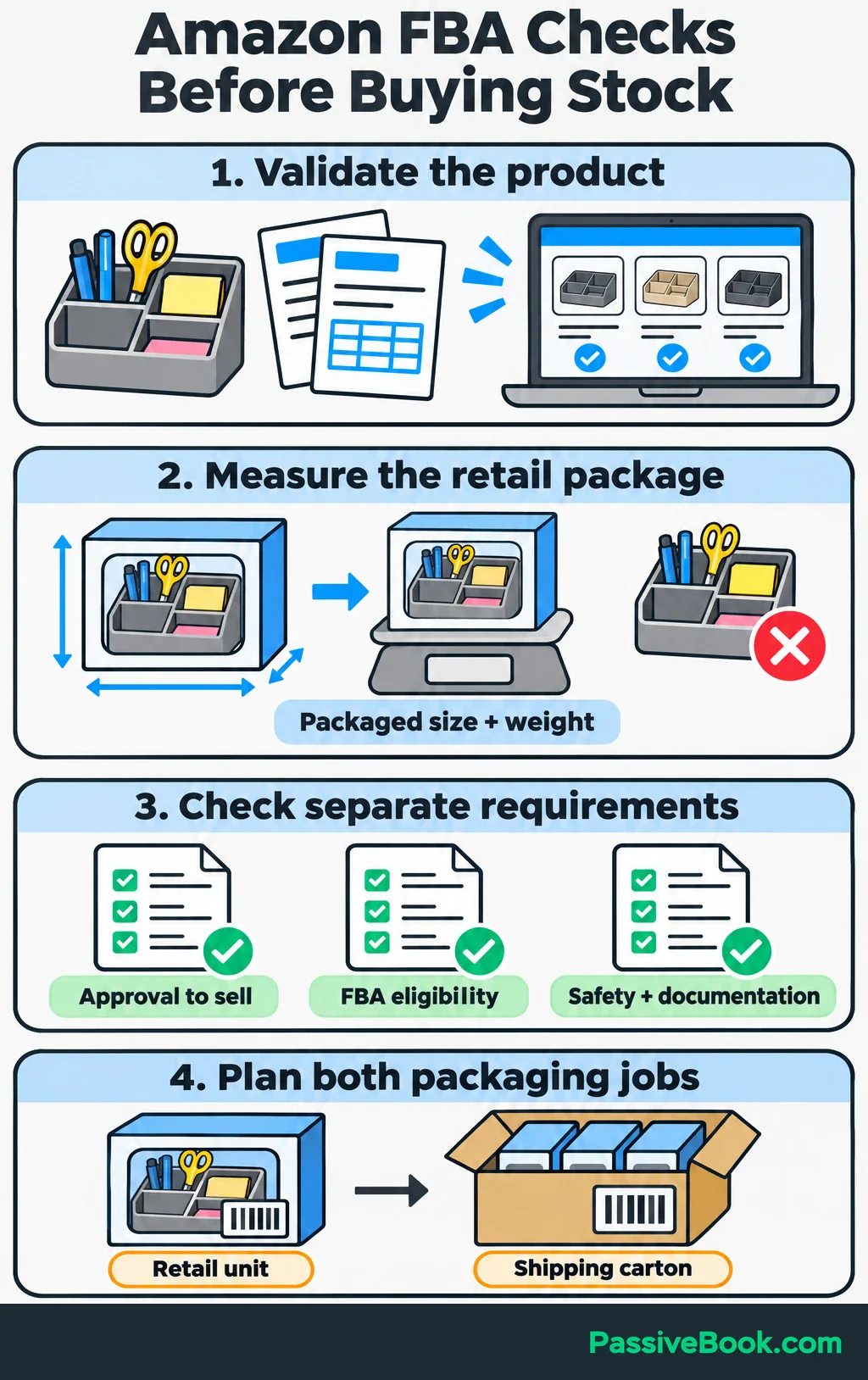
Check competing offers, evidence of purchases, supplier quotes, and the price your product could reasonably command. Then get a sample and measure its retail packaging. Amazon’s fees depend partly on packaged size and weight, so measuring the bare organizer can give you a misleading estimate.
Confirm these three things before committing to a supplier:
- You have any approval needed to sell the product.
- The product qualifies for FBA.
- You can meet its safety, packaging, and documentation requirements.
A product can be allowed for sale on Amazon but ineligible for FBA. That is a useful distinction to discover before several cartons arrive. Amazon’s FBA product restrictions
Once those checks make sense, create your seller account and either match the exact product to an existing listing or create a new listing. Assign eligible inventory to FBA. Both Individual and Professional selling plans support it.
Next, arrange preparation and labeling. You can do this yourself, have your supplier do it, or hire a preparation provider. Amazon ended its US FBA prep and item-labeling services for shipments created from January 1, 2026, so include that work in your supplier instructions and budget. Amazon’s prep-service announcement
Preparing each retail unit and packing the shipping cartons are separate jobs. Each organizer needs suitable product packaging and the required barcode or label, and the cartons need to meet shipment requirements too.
Create the inbound shipment in Seller Central, Amazon’s seller dashboard. Review the assigned destinations and charges, then arrange delivery to those facilities.
Amazon Stores Inventory and Fulfills Orders
Amazon receives your shipment, processes the inventory, and makes received units available for orders.
When a customer buys an organizer, Amazon picks one from storage, packs it, and dispatches it. You do not need to print that customer’s shipping label or make a parcel drop-off.
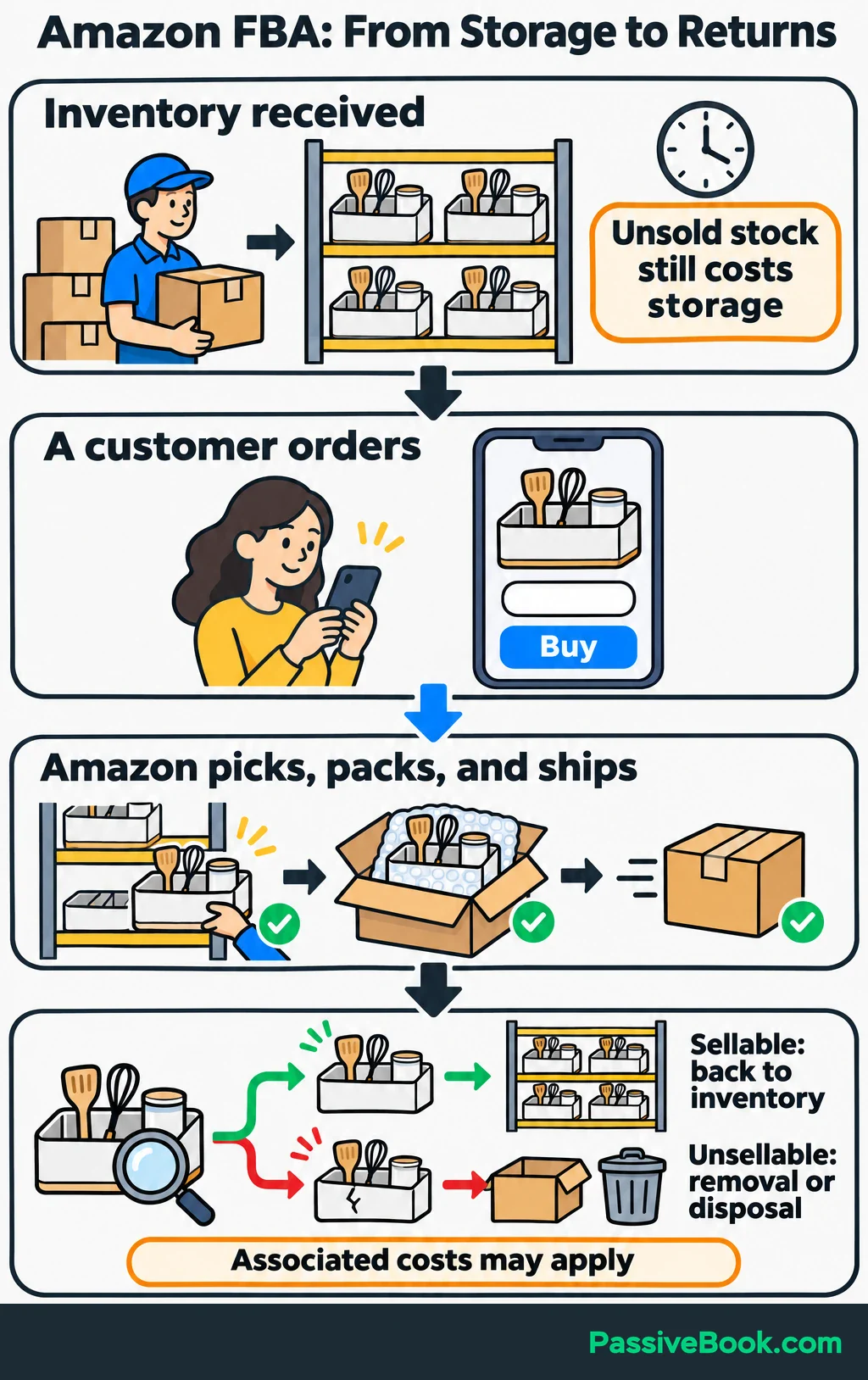
But sending inventory to Amazon does not create demand. An organizer sitting on a shelf is still unsold stock, and storage costs continue while it waits.
Amazon also processes FBA customer returns. A sellable organizer can go back into available inventory. An unsellable one may need to be returned to you or disposed of, with associated costs. Amazon’s explanation of FBA returns
You Manage Stock and Business Performance
I would set aside a regular review block for:
- Available stock and incoming shipments.
- Listing problems and account-health notices.
- Actual fees compared with your estimates.
- Return reasons and product complaints.
- Sales pace and the next purchasing decision.
Plan replenishment around how long the whole journey takes: supplier production, inspection, transport, and Amazon receiving. If replacement stock takes weeks to arrive, waiting until the last organizer sells is too late.
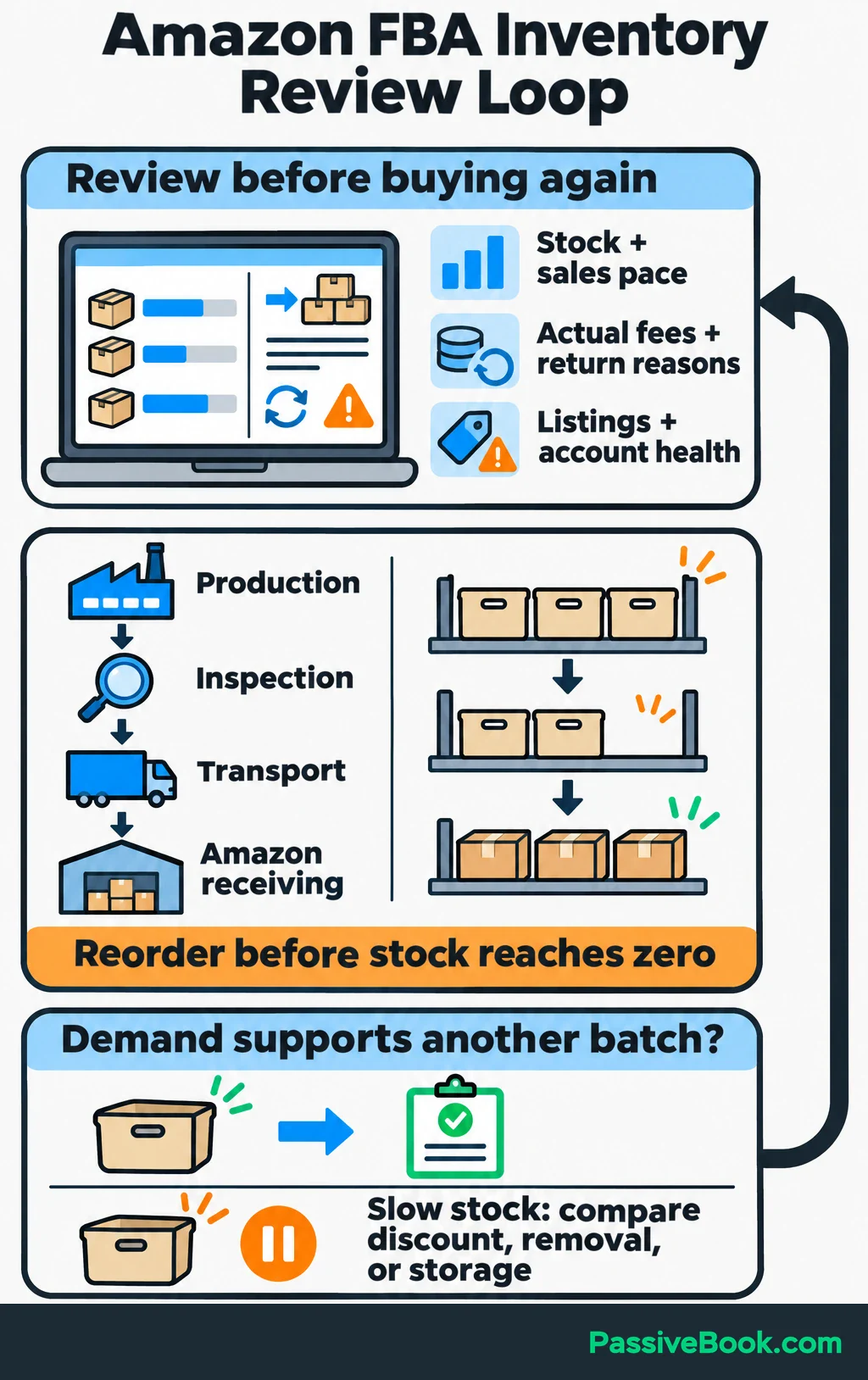
Review slow products before buying more. Compare the likely outcome of a discount, removal, or disposal with the cost of leaving them in storage.
Amazon handles individual orders. You decide whether another batch deserves your money.
How Much Does Amazon FBA Cost?
The figures here use the US marketplace and US dollars. Other marketplaces have their own fees and requirements.
Think in three groups: Amazon selling fees, FBA charges, and your other business expenses. A single claim such as “Amazon takes 30%” hides too much to help you make a purchasing decision.
Selling-plan and Referral Fees
Amazon offers two main selling plans:
| Plan | Plan charge | How I Would Choose |
|---|---|---|
| Individual | $0.99 per item sold | Consider it for low-volume testing when its available features are enough. |
| Professional | $39.99 per month | Consider it for higher volume or when you need features such as Amazon advertising. |
On plan charges alone, Professional becomes cheaper at 41 items sold per month. Features can justify it sooner.
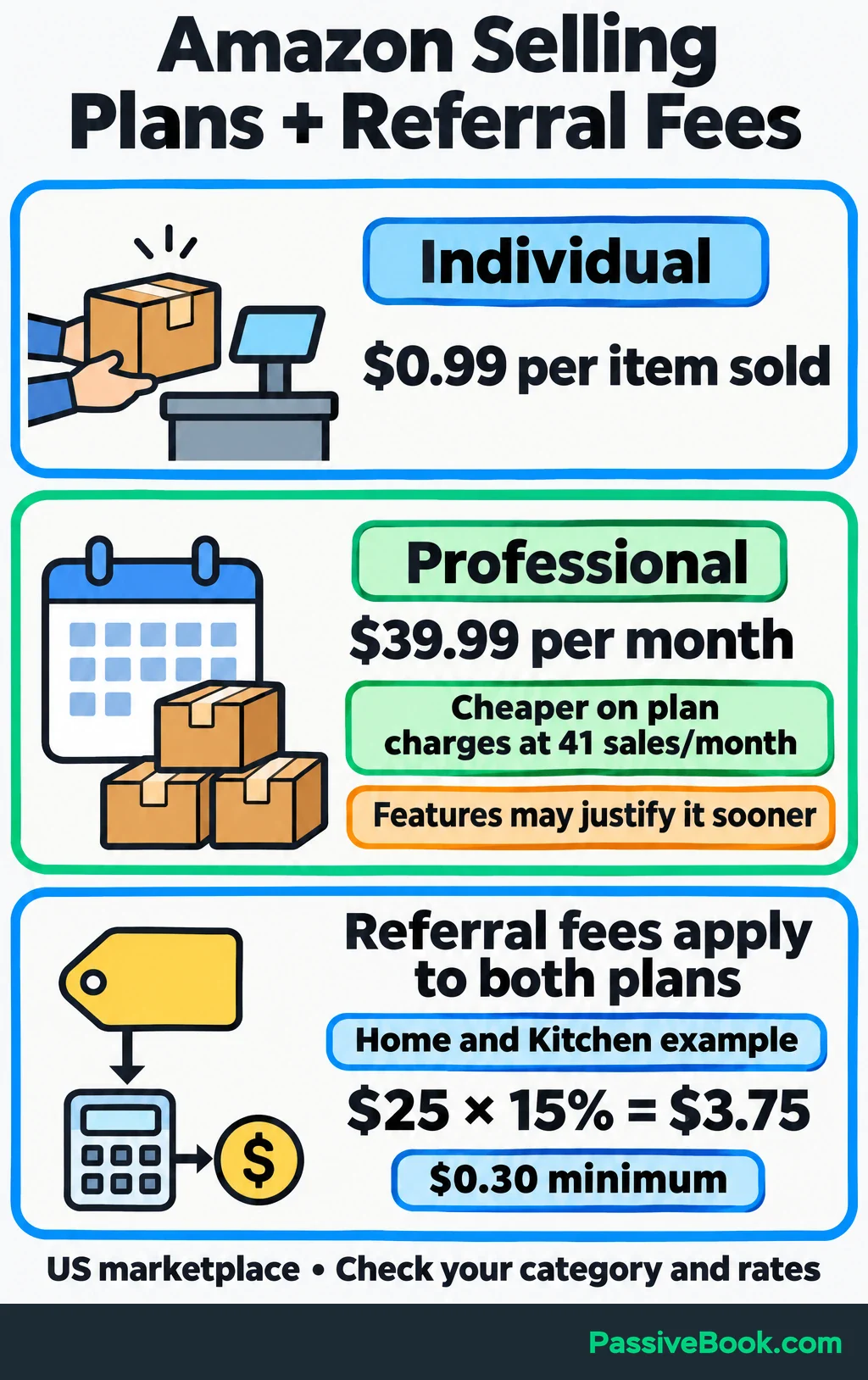
Both plans also incur referral fees. These depend on the product’s fee category and apply whether Amazon or the seller fulfills the order.
For Home and Kitchen, the referral fee is 15% of the total sales price, with a $0.30 minimum. If your organizer belongs in that fee category, a $25 sale creates a $3.75 referral fee. Check your category and the current charges on Amazon’s selling-fee schedule.
Fulfillment and Storage Fees
The FBA fulfillment fee is charged per unit shipped. Amazon uses the product type, packaged size and weight, and selling-price band to set the rate.
Packaging matters here. For some size categories, Amazon uses a weight calculated from package volume when it exceeds the package’s actual weight. A bigger box can therefore increase the fee even when the product inside has not changed.
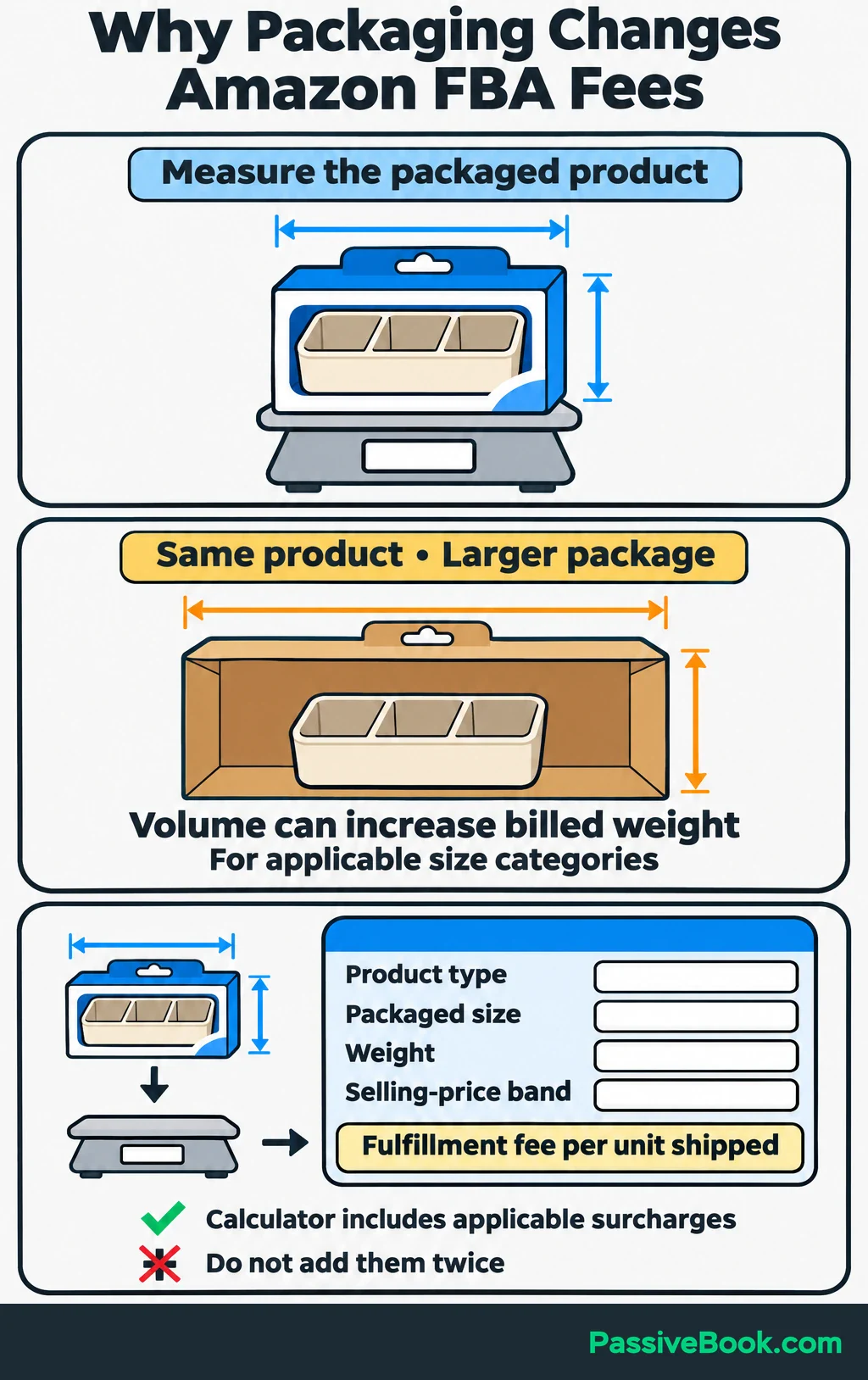
US FBA fulfillment fees also carry a 3.5% fuel and logistics surcharge, introduced on April 17, 2026. Holiday peak fulfillment rates apply from October 15, 2026, through January 14, 2027, with the surcharge on top. Amazon’s updated Revenue Calculator includes these charges in its fee estimates, so do not add them again. Amazon’s fulfillment-fee schedule
Storage is separate. Amazon calculates monthly storage using the average daily volume your inventory occupies.
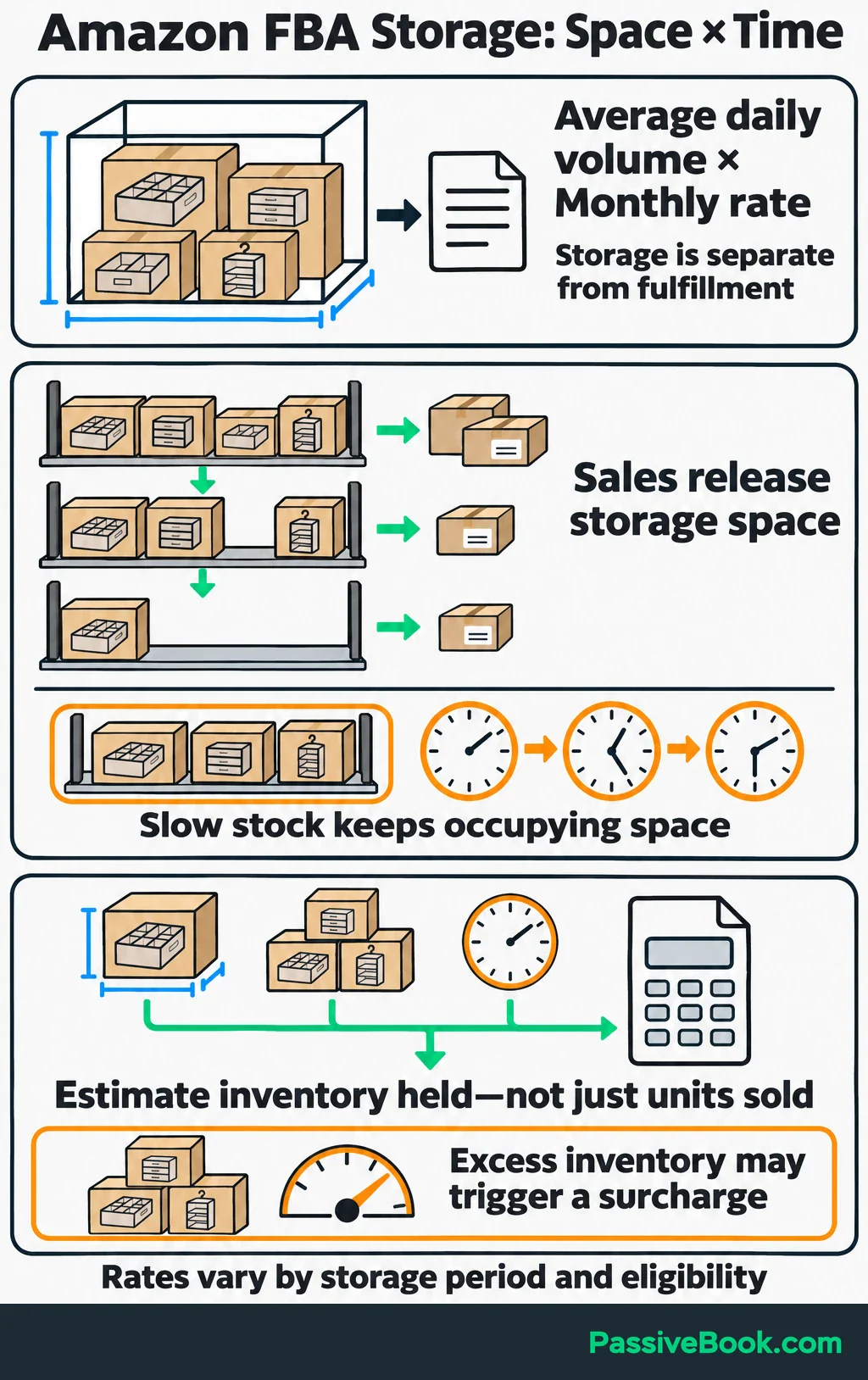
For non-dangerous, standard-size inventory, base storage costs are:
| Storage Period | Base Monthly Rate |
|---|---|
| January–September | $0.78 per cubic foot |
| October–December | $2.40 per cubic foot |
A separate storage-utilization surcharge can apply to qualifying sellers carrying excess inventory relative to sales. The practical lesson is to estimate storage using both package volume and expected time on the shelf. Amazon’s monthly storage schedule
Inbound and Conditional Charges
Getting inventory into Amazon is a separate expense from shipping customer orders.
Budget for transport to the assigned facilities and any inbound placement fee, Amazon’s charge for distributing stock across its fulfillment centers. The fee depends on product size, weight, destinations, and how you split the shipment. Compare transport and placement costs together. A lower placement fee is not much help if freight rises by more. Amazon’s inbound placement rules
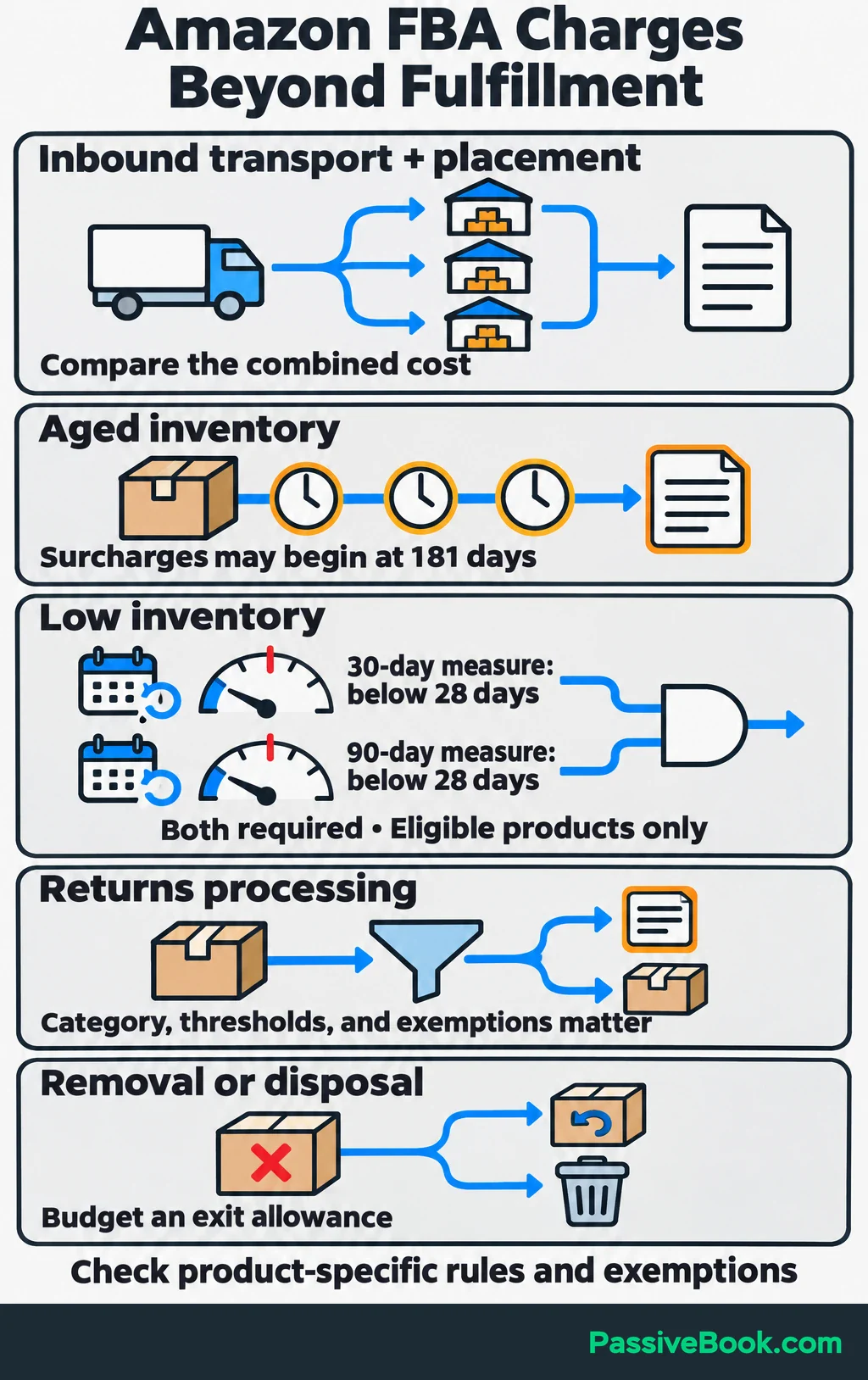
Other charges depend on what happens to your inventory:
- Aged inventory: Additional monthly surcharges can begin when stock reaches 181 days in Amazon’s network, although some categories are excluded from the earliest bands. These sit on top of ordinary storage fees. Aged-inventory rules
- Low inventory: Amazon compares average stock levels with average daily shipments over the past 30 and 90 days. Each measure, called historical days of supply, shows how many days of shipments that stock represents. Eligible products incur a fee per unit shipped only when both measures are below 28 days. Check exemptions before buying extra stock simply to avoid this charge. Low-inventory-level rules
- Returns processing: Apparel and shoes incur charges per returned unit. For other eligible products, Amazon tracks returns from each month’s shipped units through the following two calendar months. Only returns from that group above the applicable threshold incur this fee. Products shipping fewer than 25 units that month are exempt; other exemptions also apply. Returns-processing rules
- Removal or disposal: Include an exit allowance for stock you need returned or destroyed. Amazon handling a return does not mean every consequence of that return is free.
You do not need to memorize every rate. You do need to identify which charges could apply to the product you are about to buy.
Expenses Outside Amazon’s Fees
Your supplier invoice is only part of your cost.
Include inspection, packaging, preparation, freight, and applicable import duties. Also allow for advertising if you plan to use it, losses from returns, and business expenses such as software or bookkeeping.
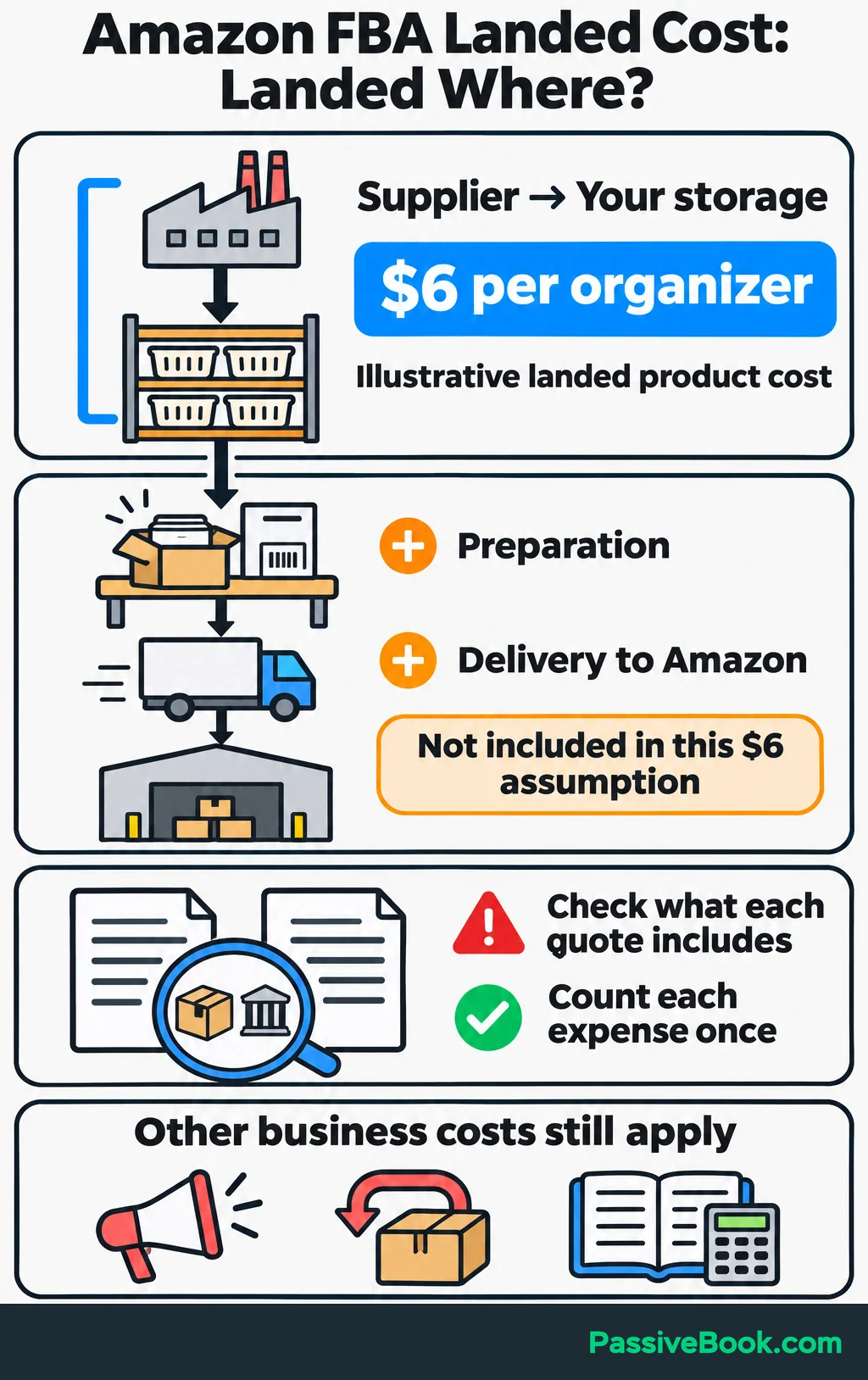
Be precise about “landed cost.” Landed where? A quote covering delivery to your local warehouse may exclude preparation and transport to Amazon.
For our organizer example, assume the $6 landed product cost gets each unit to your own storage location, before preparation and delivery to Amazon. We will count those later costs separately.
Check bundled quotes carefully. If a supplier already includes packaging or a logistics provider includes duties, counting them again makes the estimate wrong in the other direction.
How to Calculate Your Amazon FBA Profit
Estimate the Full Cost per Sale
Start with what one completed sale brings in, then subtract everything needed to make and support that sale.
That includes the product, preparation, inbound transport, Amazon fees, expected return losses, advertising, and a share of monthly business expenses.
For batch expenses, spread the cost across the units in that batch. For monthly expenses, use a realistic monthly sales assumption. Storage needs its own estimate based on how much inventory remains on hand.
Amazon’s free Revenue Calculator is a useful starting point. Enter the intended marketplace, category, packaged dimensions, weight, selling price, average inventory stored, and expected monthly sales.
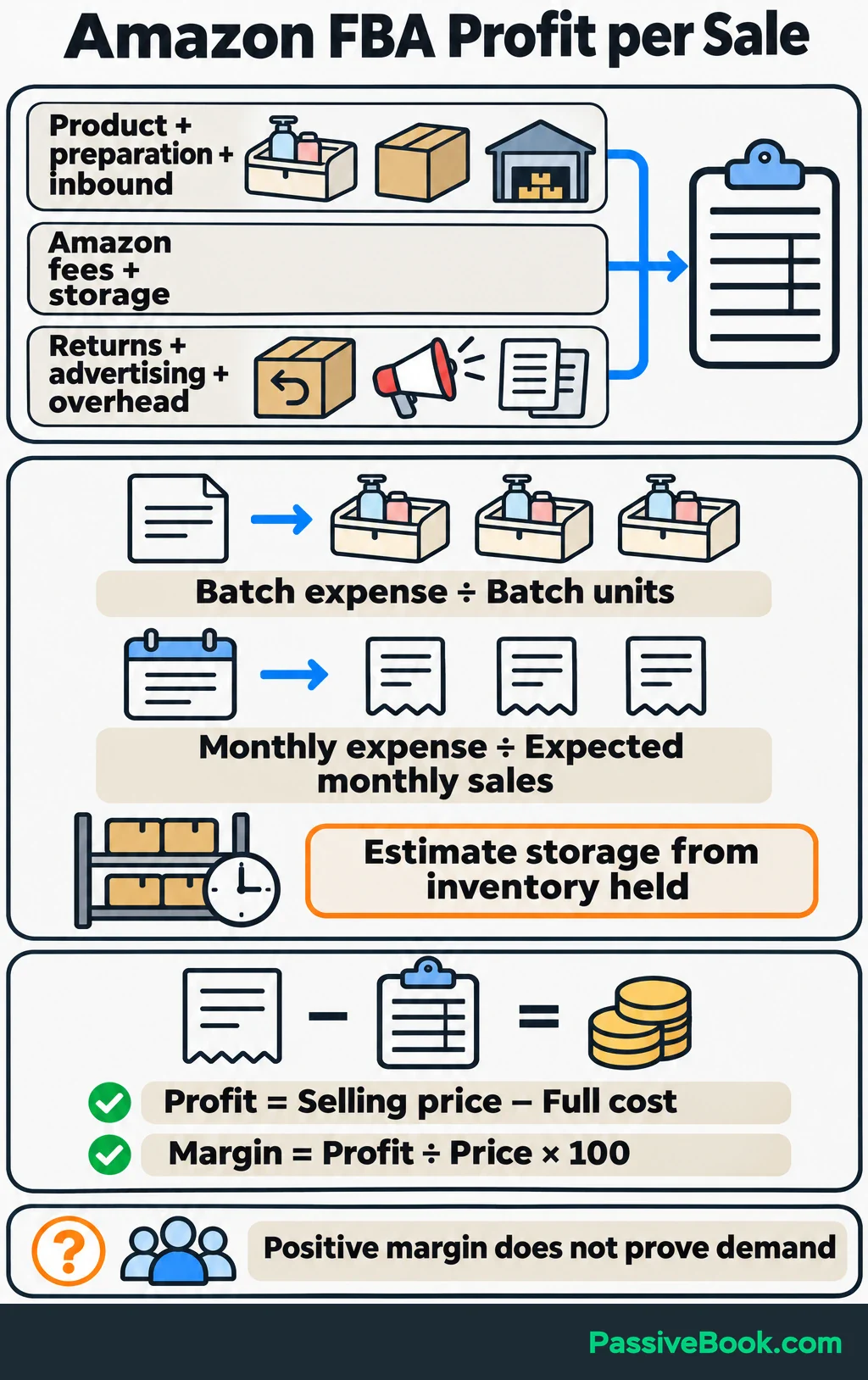
Then add relevant costs missing from the estimate, including return losses, removal allowances, and overhead. Amazon’s calculator guidance
I would use a spreadsheet beside the calculator. It gives supplier quotes, assumptions, and actual charges somewhere to live, and you can see which number changed when profit drops.
Calculate margin by dividing the estimated profit per sale by the selling price, then multiplying by 100.
A positive answer tells you the assumptions leave money behind. It does not prove that people will buy at that price or in that volume.
Work Through an Organizer Sale
Suppose the organizer sells for $25 and the business makes 100 total sales per month.
The table counts the cost attached to each sale, plus a share of plan and storage expenses. Apart from the referral rate and selling-plan price discussed above, the amounts are illustrative allowances. The $5 fulfillment figure is not an Amazon quotation.
| Revenue or Expense | Amount per Unit | Assumption |
|---|---|---|
| Selling price | $25.00 | One organizer sold at full price |
| Landed product cost | −$6.00 | Excludes preparation and delivery to Amazon |
| Preparation, inbound transport, and placement | −$1.25 | Combined batch costs spread across its units |
| FBA fulfillment | −$5.00 | Illustrative allowance including applicable surcharges |
| Referral fee | −$3.75 | Home and Kitchen rate applied to the selling price |
| Storage | −$0.15 | Assumed monthly storage total of $15 across 100 sales |
| Expected return costs | −$0.75 | Average allowance per sale, not a fee on every order |
| Advertising | −$2.50 | Assumed advertising spend divided by total sales |
| Professional-plan allocation | −$0.40 | Monthly plan charge spread across 100 total sales |
| Total estimated costs | −$19.80 | Rounded allowances above |
| Remaining before other overhead and taxes | $5.20 | Selling price minus estimated costs |
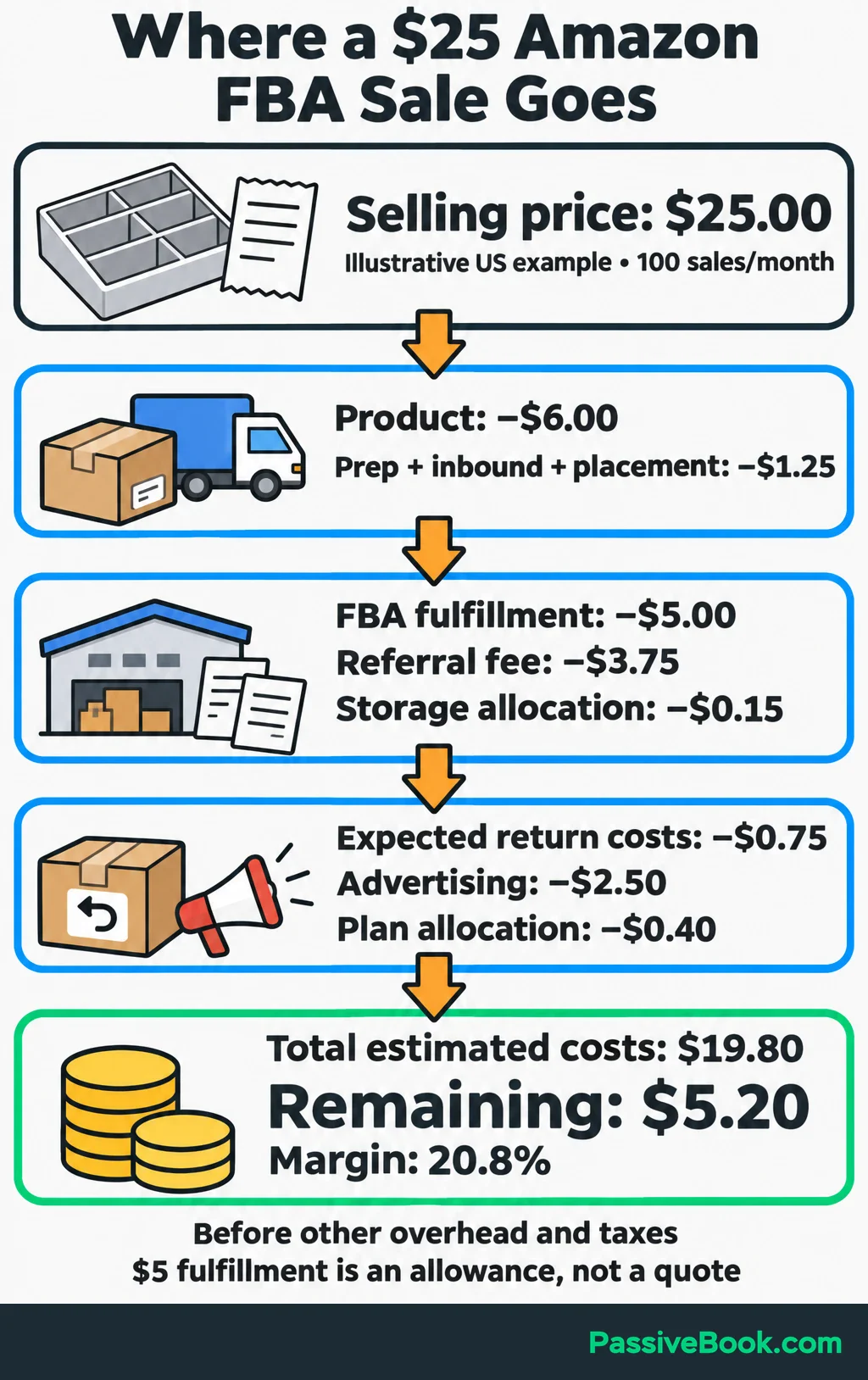
The remaining $5.20 divided by the $25 selling price gives a 20.8% margin before other overhead and taxes.
Now test what happens when the assumptions get less comfortable:
| Change Tested Separately | Remaining per Sale | What Changed |
|---|---|---|
| Price falls to $20 | $0.95 | Referral fee falls to $3; other dollar allowances stay the same |
| Monthly sales fall to 50 | About $4.65 | The same plan charge and assumed $15 storage total are spread across fewer sales |
| Advertising rises to $4 per sale | $3.70 | Advertising costs an extra $1.50 per sale |
At the $20 price, total estimated costs are $19.05 and the margin falls to 4.75% before other overhead and taxes. There is very little room left for a damaged unit or an expense you forgot.
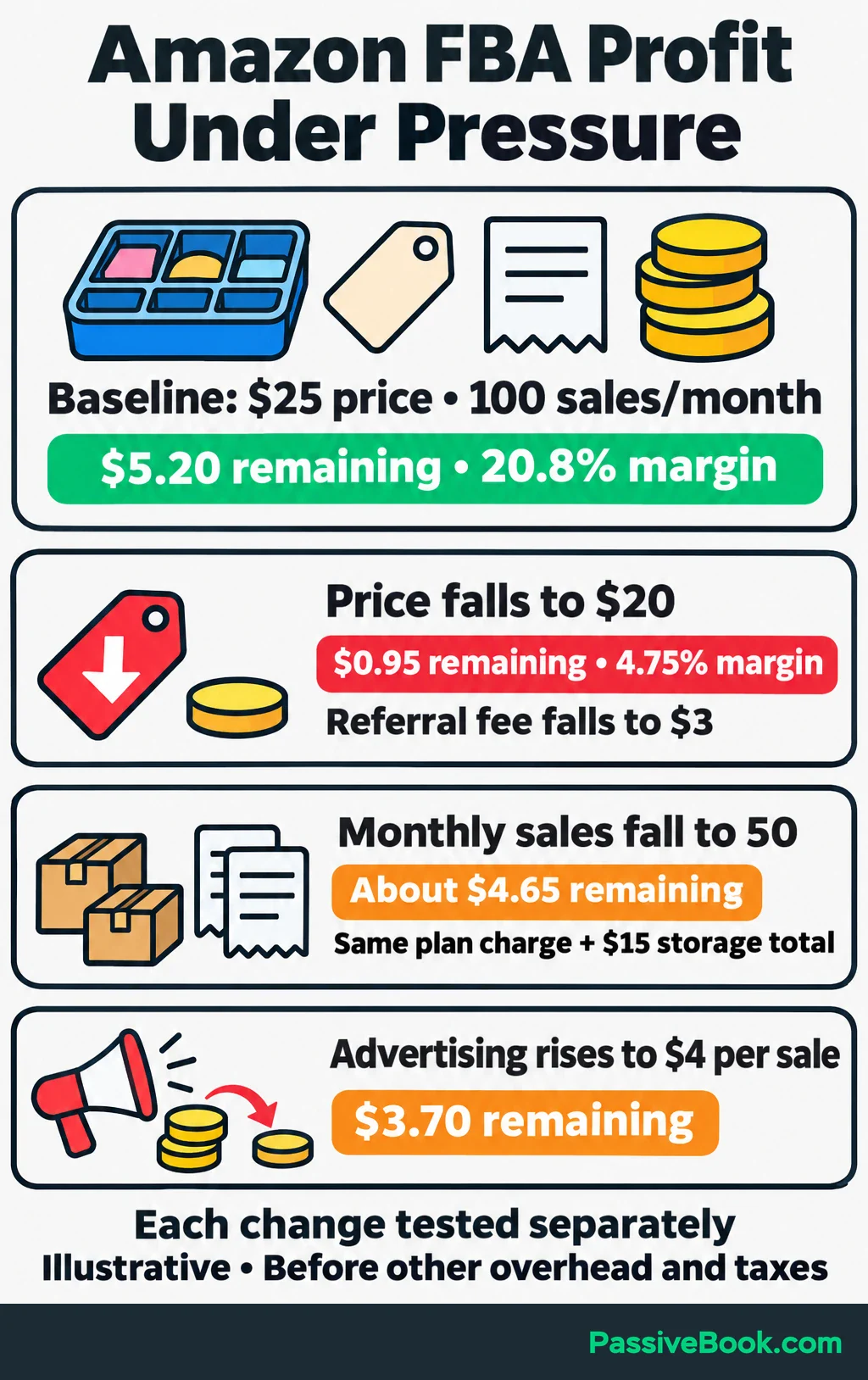
The slower-sales test holds the monthly storage bill constant to show how allocation changes. If unsold stock builds up, update the storage estimate too.
I would run these tests before negotiating a larger order. A supplier discount can save money per unit while committing you to much more stock than demand supports.
To run these tests on your own product, use the free Pricing Profit Calculator. You add Amazon’s fees and your other costs, and it shows what each sale leaves behind and how that changes when your assumptions get worse.
Free Pricing Profit Calculator




How Much Money Do You Need to Start?
Build your startup budget from the product upward. A universal “start FBA with this much” figure is not useful when supplier minimums, shipping costs, and lead times vary.
For the organizer example, buying 100 units at $6 each requires $600. Preparation, inbound transport, and placement at the assumed $1.25 per unit add another $125.
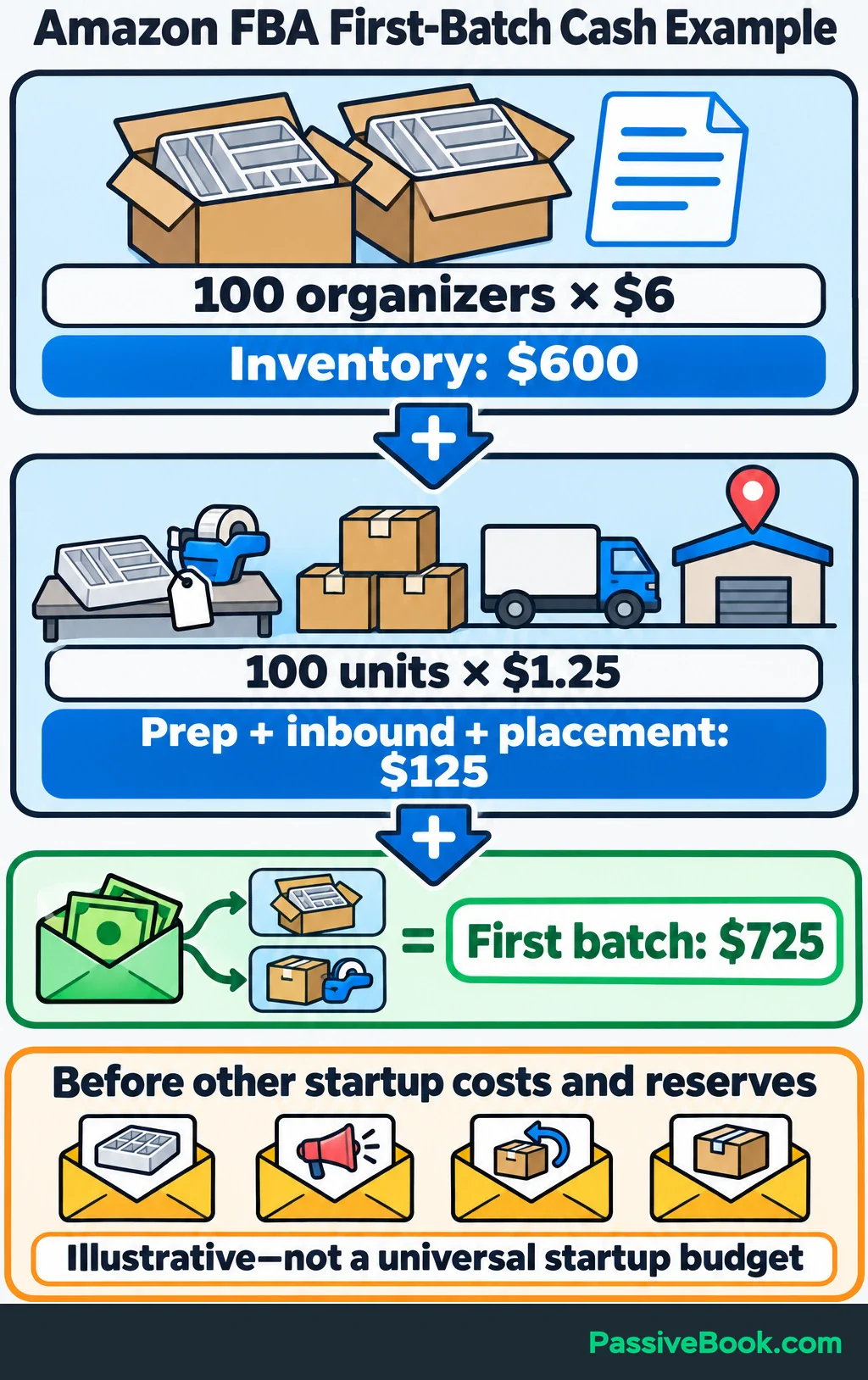
That commits $725 to the first batch before other startup expenses and reserves. Some charges may be collected later, but you still need to fund them.
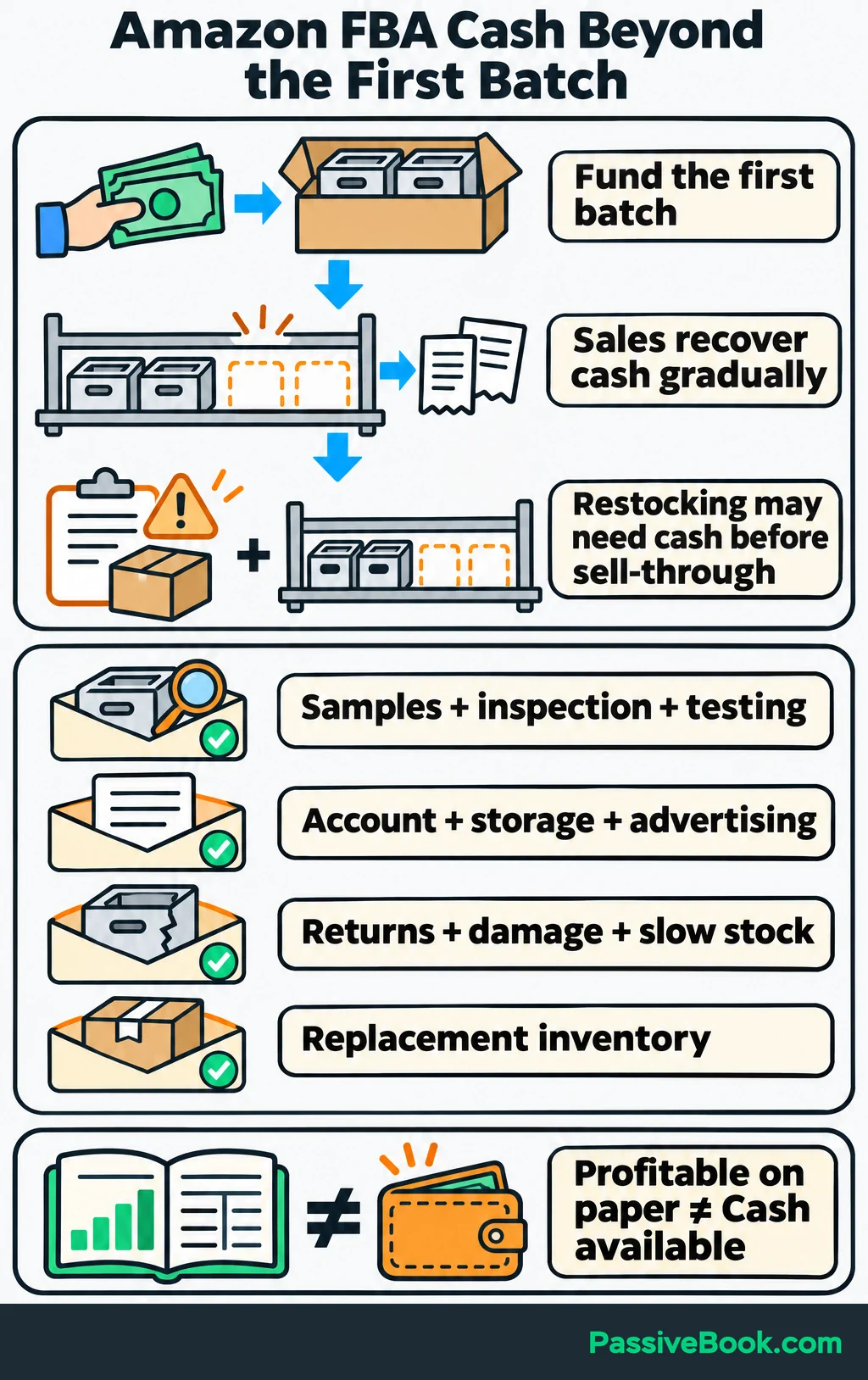
Your cash budget should also cover:
- Samples, inspections, and any required testing.
- Account costs, storage, and planned advertising while sales develop.
- Returns, damaged stock, or an order that sells slowly.
- A replacement order that may come due before the first batch has fully sold.
Profitability and cash flow are different problems. You can have a profitable product on paper and still lack the cash to replenish it.
My online jewellery store started with about $1,200. I had not done enough market research, and unsold inventory cost me most of that investment. This was a separate ecommerce business, not an Amazon FBA store.
When I looked back, I kept returning to the buying decision. I had spent more time choosing stock than checking whether people wanted it at a price that worked. Once I owned it, I was trying to rescue a decision I should have tested earlier.
That is why I would size a first order using demand evidence, supplier constraints, replenishment time, and the amount I could afford to lose or leave tied up. A batch is not affordable merely because you can pay its invoice.
Amazon FBA Pros and Cons
Advantages
- Less work per order: Amazon handles picking, packing, dispatch, and fulfillment-related support. More orders do not require the same increase in your personal packing time.
- Prime delivery eligibility: Eligible FBA offers can provide fast Prime shipping, which gives customers a familiar delivery option.
- Fulfillment infrastructure: You can store and dispatch products without setting up your own warehouse or turning spare space into a permanent packing station.
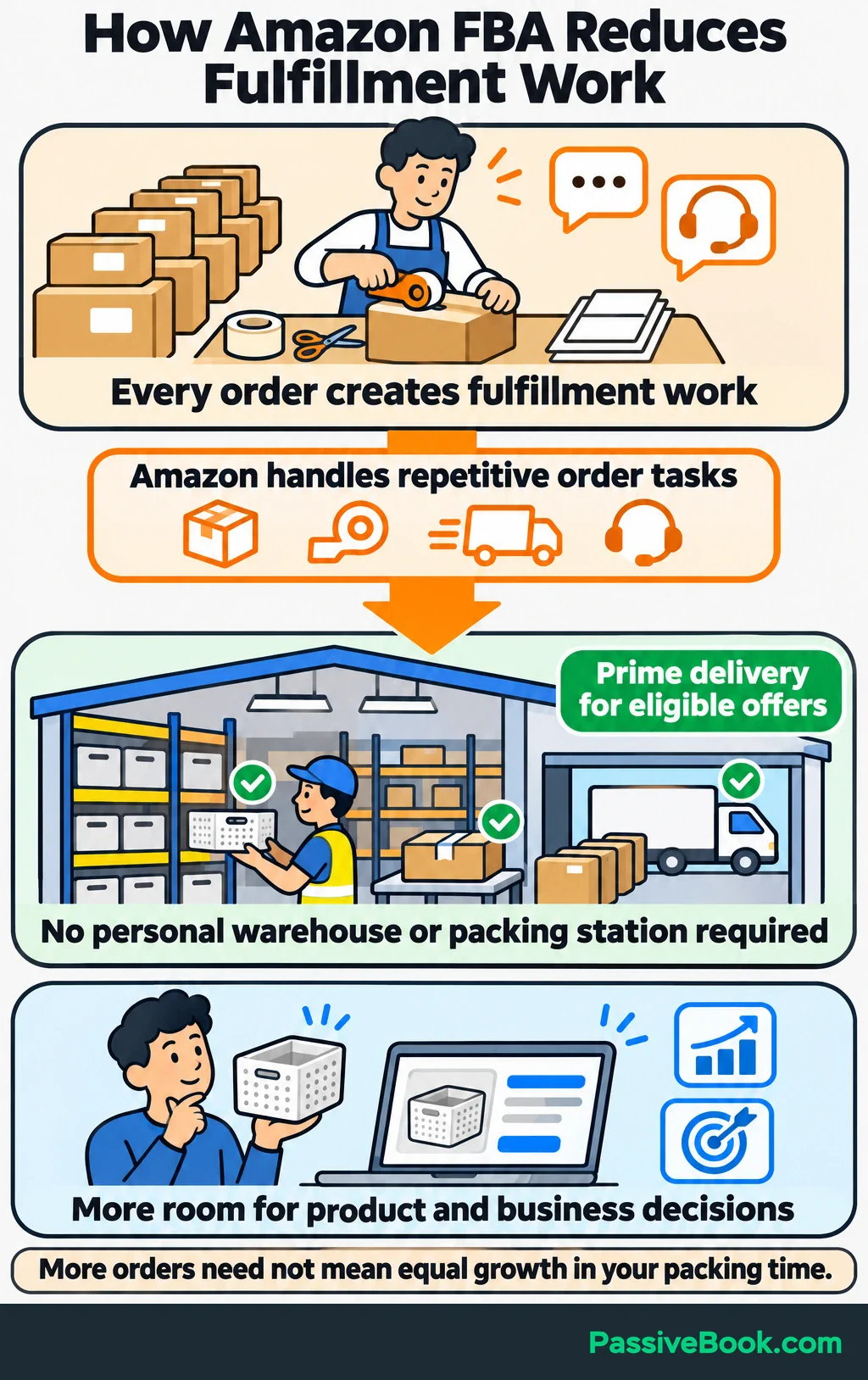
The strongest reason I would choose FBA is practical: it can remove repetitive fulfillment work that otherwise interrupts the day.
That time has value, especially when you are fitting the business around other commitments.
Disadvantages
- Margin pressure: Fulfillment, storage, inbound charges, and returns can consume much of the gap between supplier cost and selling price.
- Capital at risk: Unsold organizers still represent money you cannot use elsewhere, and storing or recovering them adds costs.
- Less fulfillment control: Amazon controls warehouse handling and dispatch, while you must meet its preparation and operating requirements.
- Continuing management: Sourcing, listings, pricing, replenishment, and account problems still need attention.
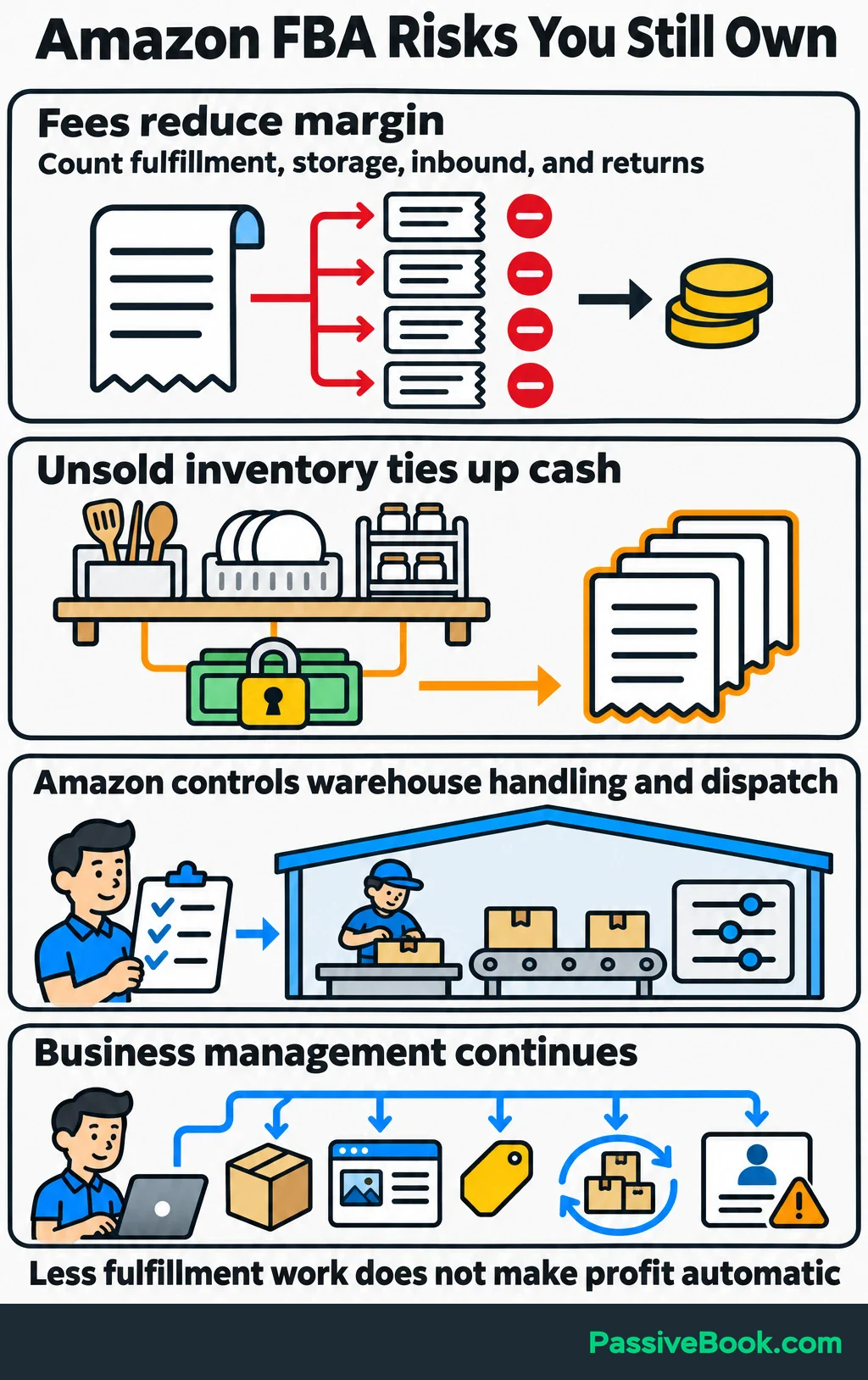
FBA reduces fulfillment work. It does not make product demand, cash management, or profit automatic.
I would happily pay to remove a recurring operational job. I would not assume that removing it makes the whole business passive.
Is Amazon FBA Right for Your Business?
FBA deserves a closer look when an eligible product has enough margin after realistic costs, demand supports stock turnover, and the inventory commitment fits your cash.
It can suit a beginner. Experience alone does not decide whether the numbers work, but being willing to check those numbers matters.
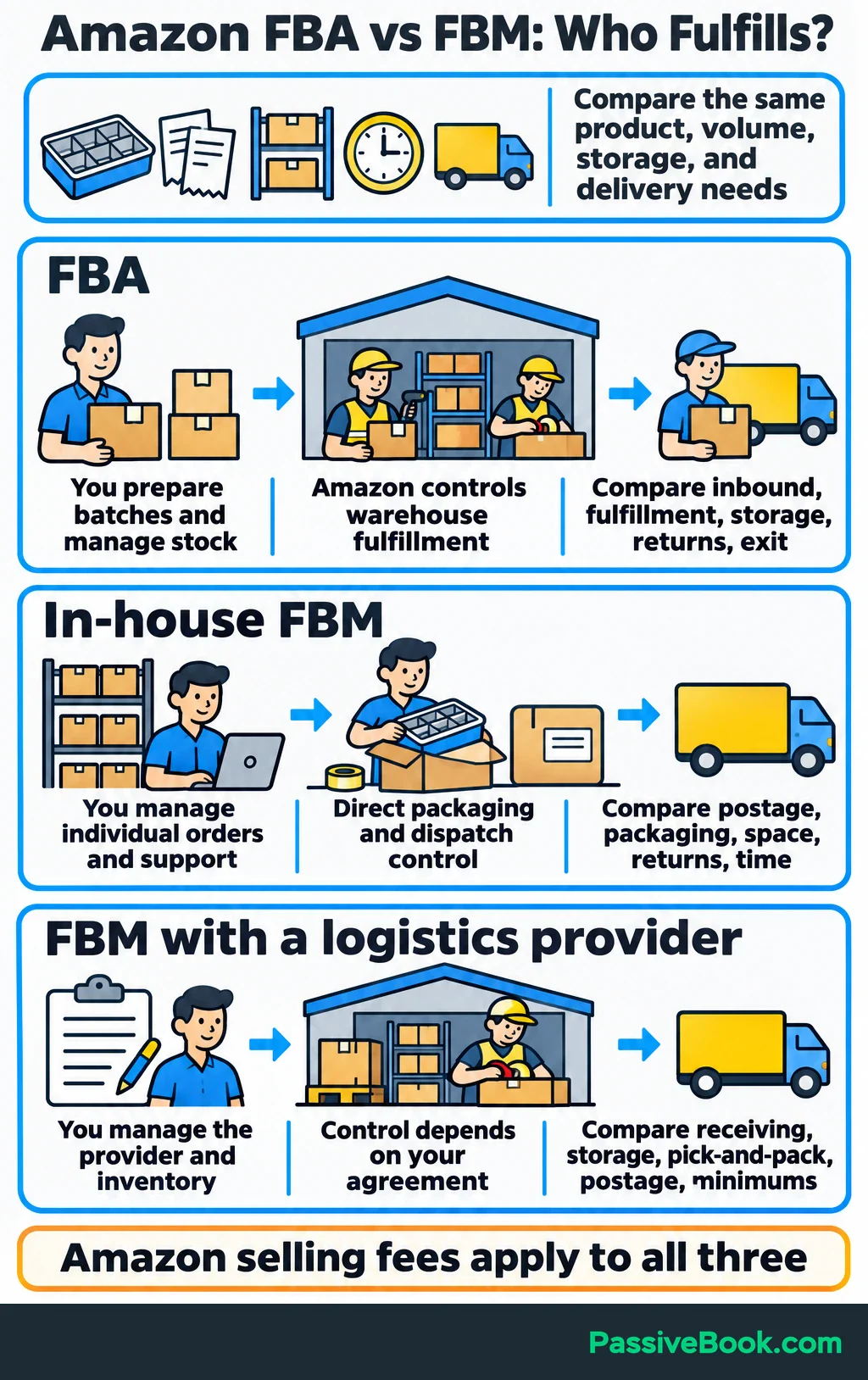
Compare it with Fulfilled by Merchant, or FBM. With FBM, you sell on Amazon and arrange fulfillment yourself, either in-house or through an independent logistics provider. Amazon’s selling fees still apply. Amazon’s FBM overview
Use the same product, sales volume, storage duration, and delivery requirements when comparing options:
| Fulfillment Option | Total Costs to Compare | Seller Workload | Fulfillment Control | Suitable Product Conditions |
|---|---|---|---|---|
| FBA | Selling fees, inbound transport and placement, fulfillment, storage, returns, and exit costs | Prepare stock, send batches, and manage inventory and performance | Amazon handles warehouse operations and dispatch | Eligible products with enough margin and demand to justify stored inventory |
| In-house FBM | Selling fees, postage, packaging, storage space, returns, and your time | Pick, pack, dispatch, track orders, and handle support | Direct control over packaging and dispatch | Products you can ship economically, especially where special handling matters |
| FBM through a logistics provider | Selling fees plus receiving, storage, pick-and-pack, postage, returns, and any minimum charges | Manage the provider, stock, listings, and performance | Packaging options, dispatch times, and return handling depend on your agreement | Products needing custom packaging or special handling the provider supports |
I would investigate FBM when you already ship economically, sales are slow, or packaging control is central to the customer experience. Paying for another fulfillment arrangement makes little sense if the one you have works better.
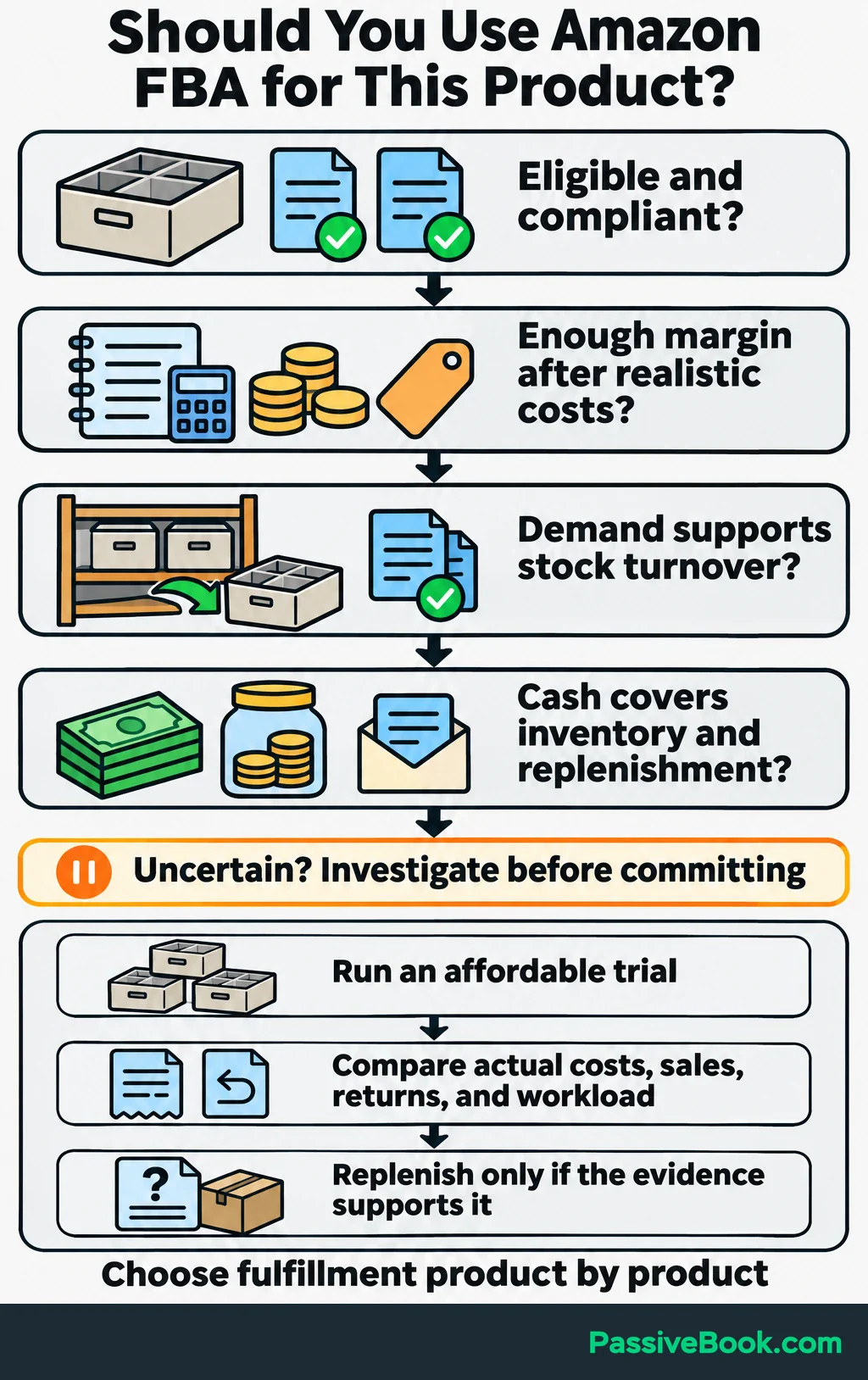
You can also use different methods for different products. One successful FBA product does not mean your whole catalog belongs there.
For the organizers, estimate one product’s full margin and cash requirement first. If an affordable trial batch makes sense, compare actual fees, returns, sales, and workload with your estimate before replenishing.
The useful question is whether the time saved leaves you with a business worth running.
What Next?
Get a packaged sample or reliable package measurements for one product, then build its cost estimate before ordering inventory. Test a lower selling price and slower sales alongside your expected case.
Use the social buttons to share this guide when you want to compare the convenience of Amazon fulfillment with the money it actually leaves behind.
Which assumption in your estimate feels least certain: demand, fees, or the cash needed to restock? Share your answer in the comments, and bring any other questions too.
Share this post with your friends & followers:

