A writer sends you a finished article, but an AI detector flags it. Do you hold publication, ask for drafts, or trust the score? That decision gets harder when another tool gives the same article a different label.
A wrong call can delay useful work or turn a routine review into an accusation. A reassuring result can also leave problems unchecked. This guide helps you decide whether that article needs another review by explaining what detectors look for, what their scores mean and where their results can mislead.
How Do AI Detectors Analyze Text?
AI text detectors look for patterns associated with generated writing or check for signals deliberately added during generation. They estimate origin, but they cannot reconstruct someone’s writing process or definitively prove authorship.
The basic process has four parts:
- Prepare the text: Extract readable text and divide it into units, such as tokens (words or word fragments), sentences or passages.
- Analyze it: Apply a trained classifier, a statistical test, a watermark test or a combination of methods.
- Produce scores: Calculate results for the document, individual passages or both.
- Assign a label: Apply a cutoff, called a threshold, to decide which results receive an AI label.
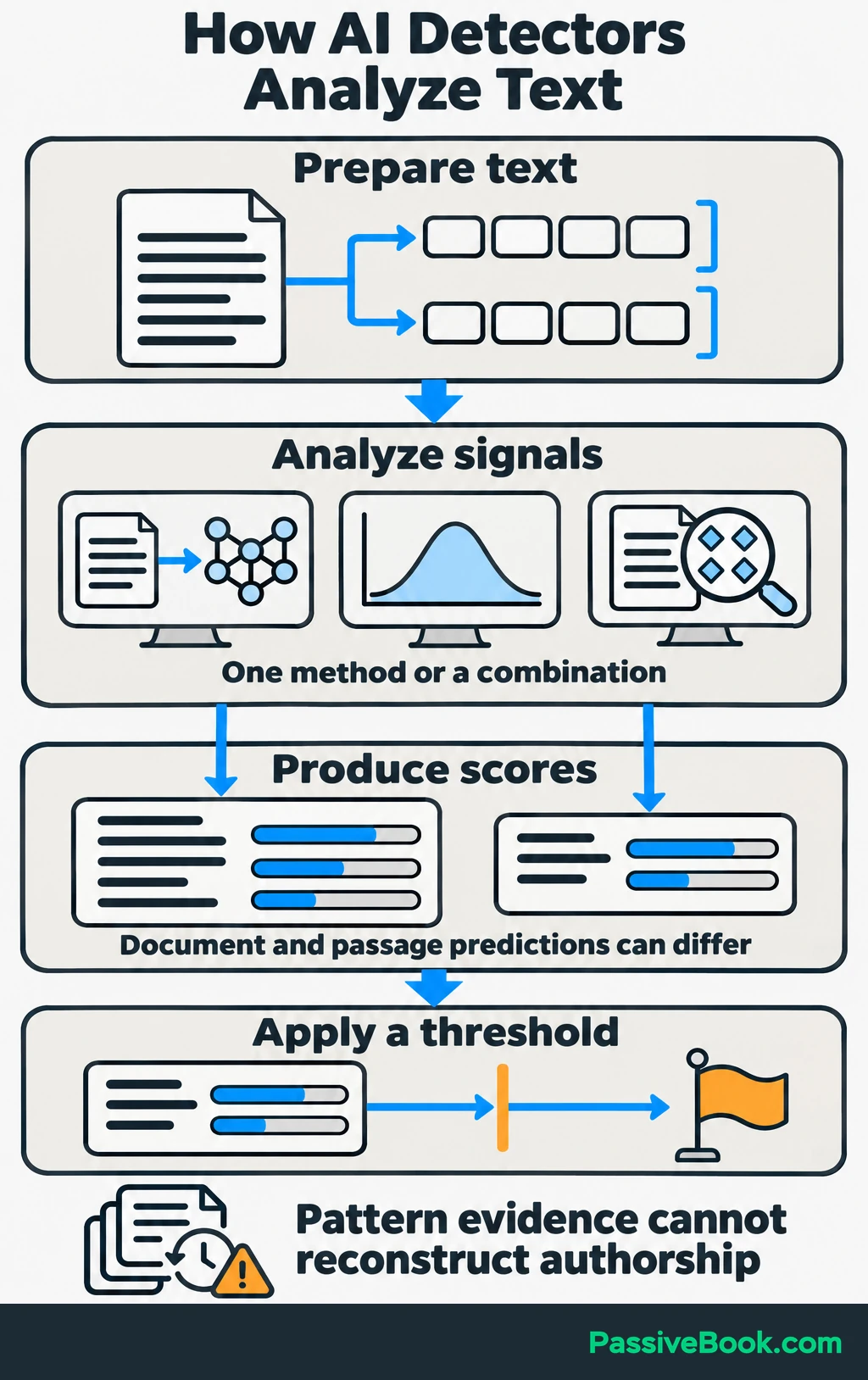
A document label and a highlighted sentence may come from separate predictions. You should not assume the overall score is simply an average of the highlights.
It also helps to separate three checks that often get bundled together:
- AI detection: Does the text show signs associated with AI generation?
- Plagiarism checking: Does it overlap with existing sources?
- Fact-checking: Are its claims correct?
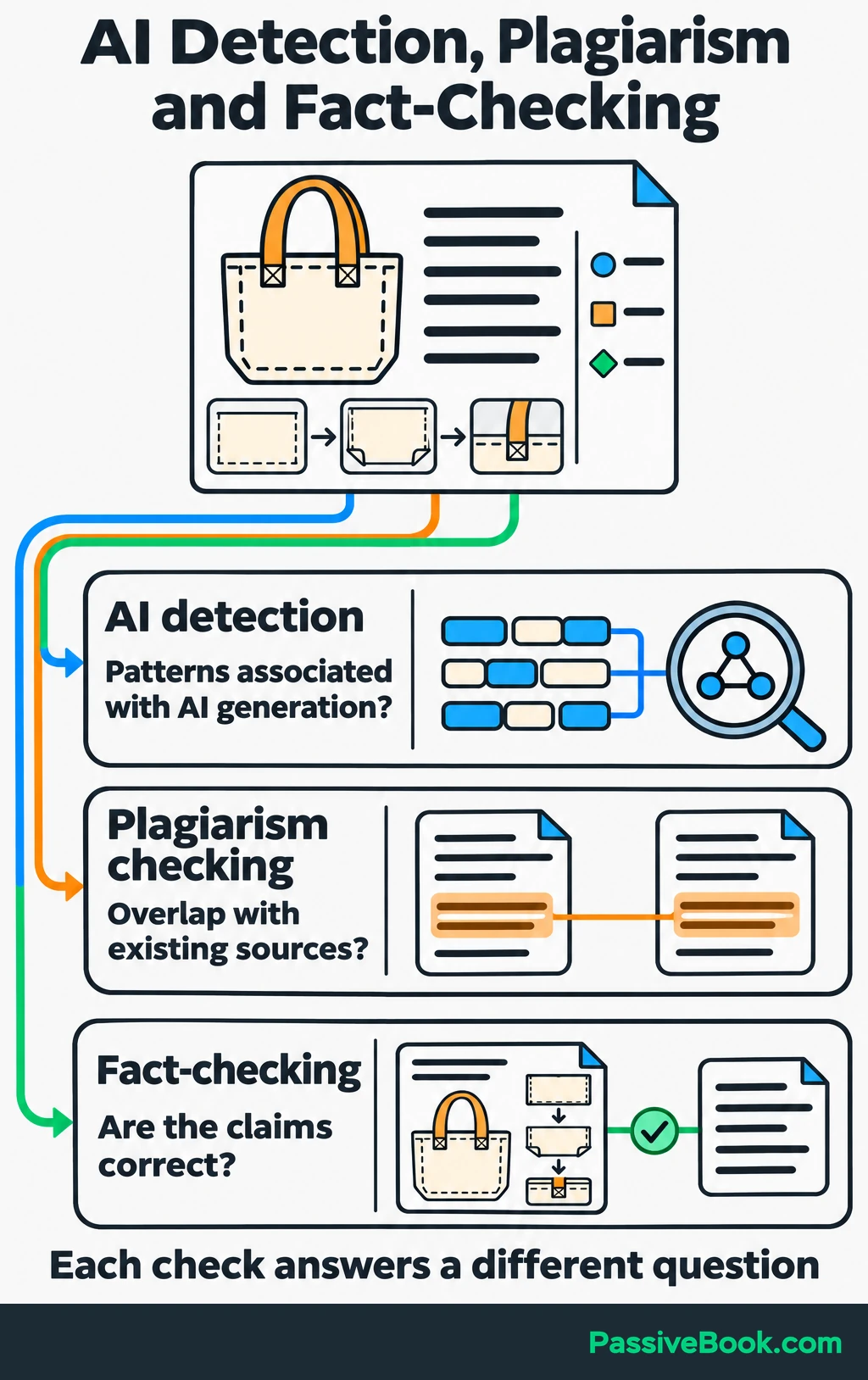
An original, human-written article can contain mistakes. An AI-assisted article can contain accurate information. Each check answers a different question.
Throughout this guide, imagine you run a sewing blog that sells beginner tote-bag patterns. You review both human-written and AI-assisted tutorials before publication. The passages and audit figures below are illustrations.
Classifiers Trained on Human and AI Writing
A classifier learns from examples labeled human-written or AI-generated. During training, it adjusts its internal settings to distinguish those groups. It then uses what it learned to classify unfamiliar text.
Possible signals include vocabulary, repetition and sentence structure. More complex systems convert text into numerical representations that capture broader language patterns, so their decisions can go beyond a list of suspicious words.
The classifier can flag a passage without finding an identical copy anywhere. It recognizes patterns associated with its training examples.
For example, GPTZero’s technical report describes a trained classifier that makes predictions for whole documents and individual sentences. Its document categories include human, AI and mixed writing. That is the vendor’s description of its architecture; it does not establish that every prediction is correct. GPTZero technical report
The important question is whether the patterns learned during training still work on the writing you submit. That becomes harder when the topic, language or generator differs from the training examples.
Statistical Tests of Language Predictability
Language models process tokens, which are often words or word fragments. They assign probabilities to possible continuations, but generation does not always choose the most probable option.
Some detection methods examine those probabilities.
Perplexity measures how surprising a passage is to the model evaluating it. Lower perplexity means the passage is more predictable under that model. It is not a universal measure of how “human” a passage sounds.
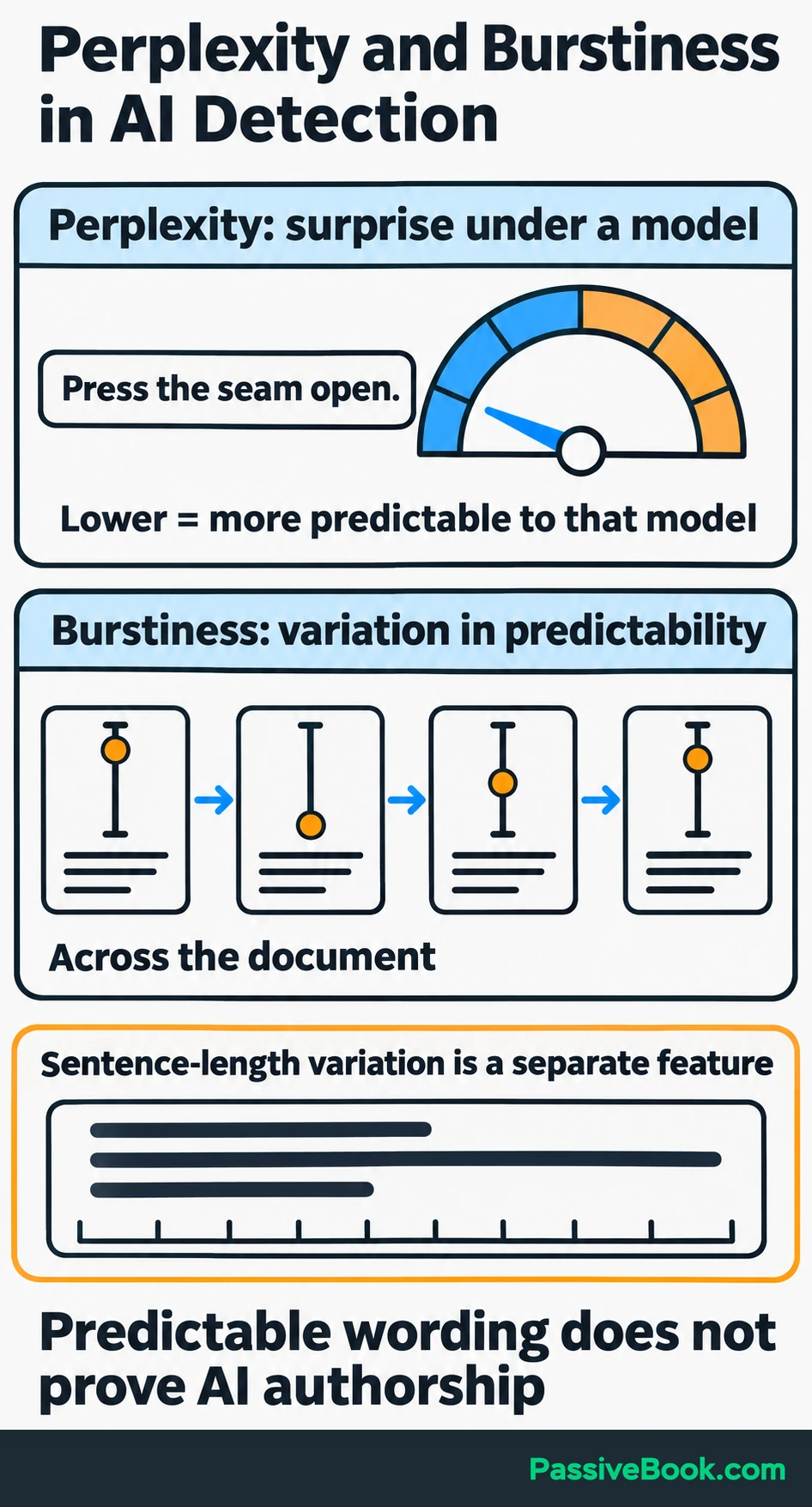
Burstiness, in this context, means variation in predictability across a document. Variation in sentence length is a separate stylistic feature, although explanations sometimes blur the two.
These terms appear often in explanations of how AI detection works, but they do not describe every detector. GPTZero says it stopped using perplexity and burstiness for detection in autumn 2023 when it moved to a deep learning architecture. GPTZero’s explanation of its former metrics
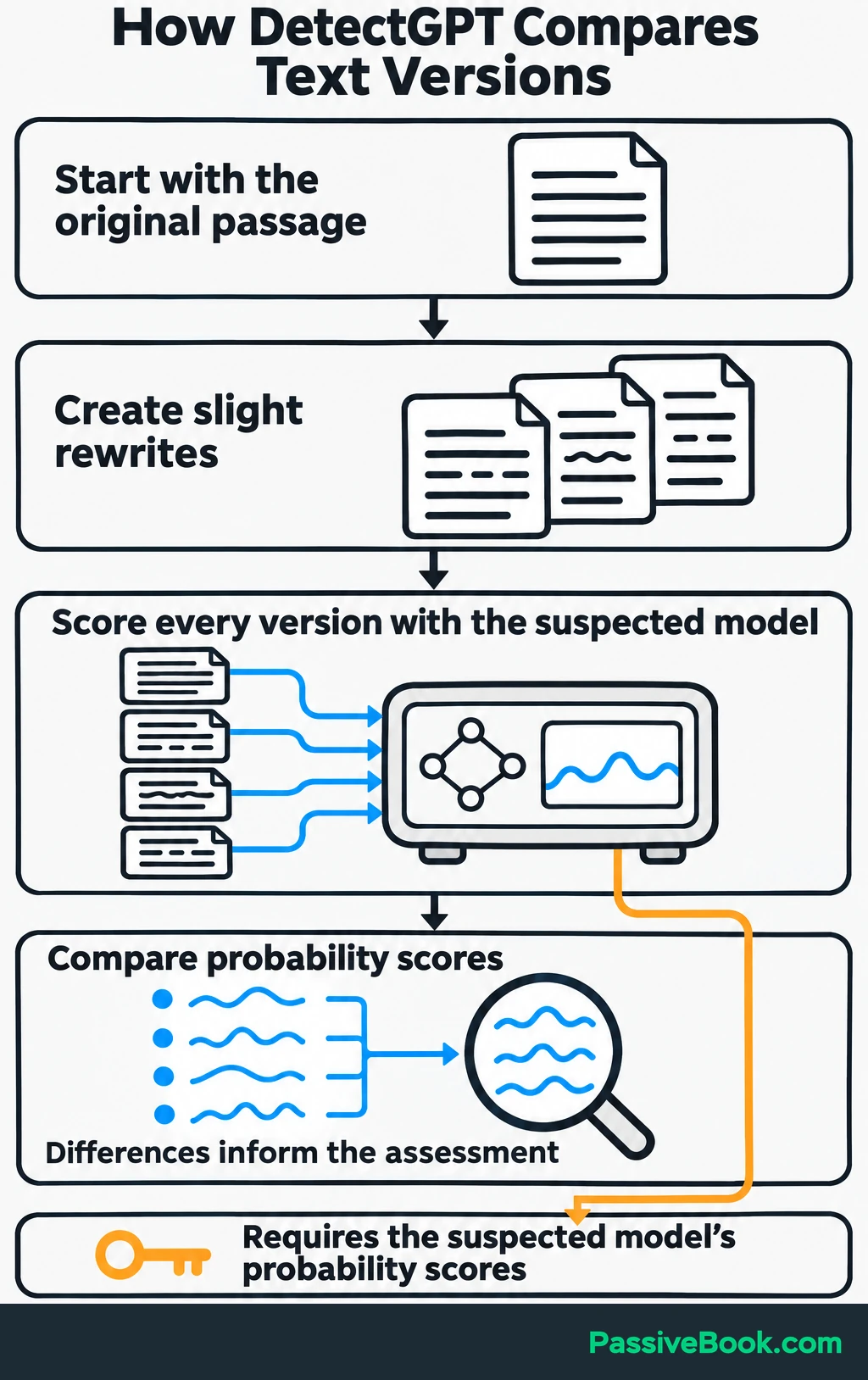
Statistical detection can also do more than check whether a passage is predictable. DetectGPT, a research method, uses the model suspected of generating a passage to score both the original and slightly rewritten versions. Differences between those scores help it assess whether that model generated the passage. This requires access to the suspected model’s probability scores. Original DetectGPT paper
For your sewing tutorial, consider this instruction:
Press the seam open.
Familiar tasks often have familiar wording. Replacing that sentence with something surprising would probably make the tutorial worse.
Predictability, polished grammar, uniform sentence lengths and particular punctuation do not prove AI authorship. A useful instruction is allowed to sound like a useful instruction.
Watermarks Embedded During Generation
A text watermark works differently because the generator deliberately introduces the signal.
In one researched approach, the generator subtly favors selected tokens as it writes. Across enough text, those choices create a statistical pattern that a compatible detector can test for.
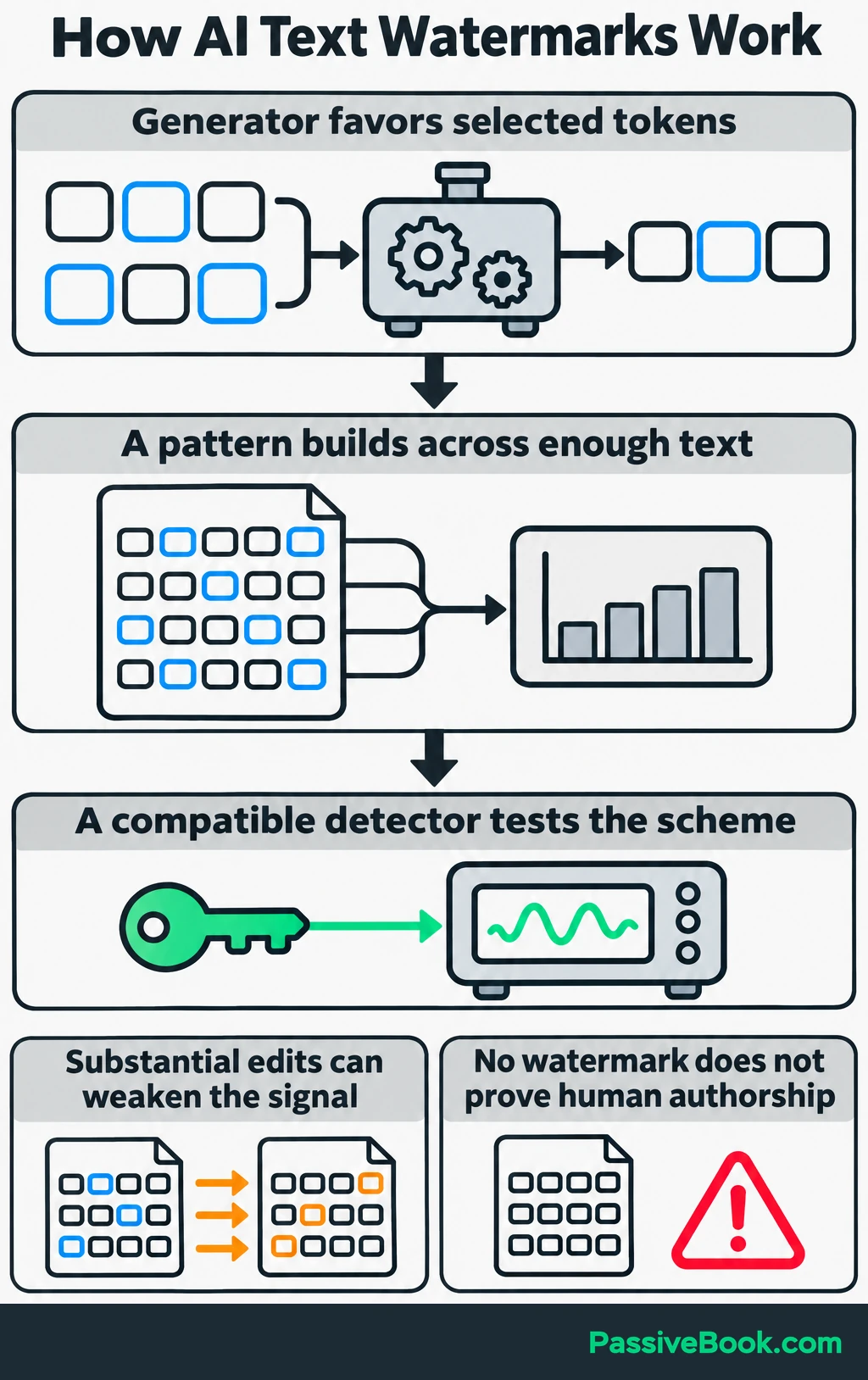
The detector checks for the corresponding watermark scheme. It is not deciding whether the prose sounds robotic.
This creates an important limit: an absent watermark does not establish human authorship. The generator may never have used that scheme. Substantial wording changes can also weaken the signal, as modification experiments in the original watermarking research show. Original text-watermarking research
A watermark result can provide evidence about a particular generation process, but it still does not tell you who submitted the text or what edits they made afterward.
What Does an AI Detection Score Mean?
Read the tool’s definition before interpreting its percentage. Different outputs can look similar while answering different questions.
| Output Type | Documented Meaning | Justified Interpretation |
|---|---|---|
| Classification confidence, such as “90% AI” | Where defined this way, the model’s confidence that the document belongs to its AI category | The model strongly favors that label. It does not mean 90% of the words were generated. |
| Flagged-text proportion, such as Turnitin’s percentage | The share of prose sentences in long-form writing identified as likely AI-generated; bullet points and tables do not count | A portion of eligible text was flagged. The percentage is not the probability that the writer used AI. |
| Passage highlights | Sentences or passages the detector judged suspicious | These are places to examine during review, rather than a verified record of AI insertions. |
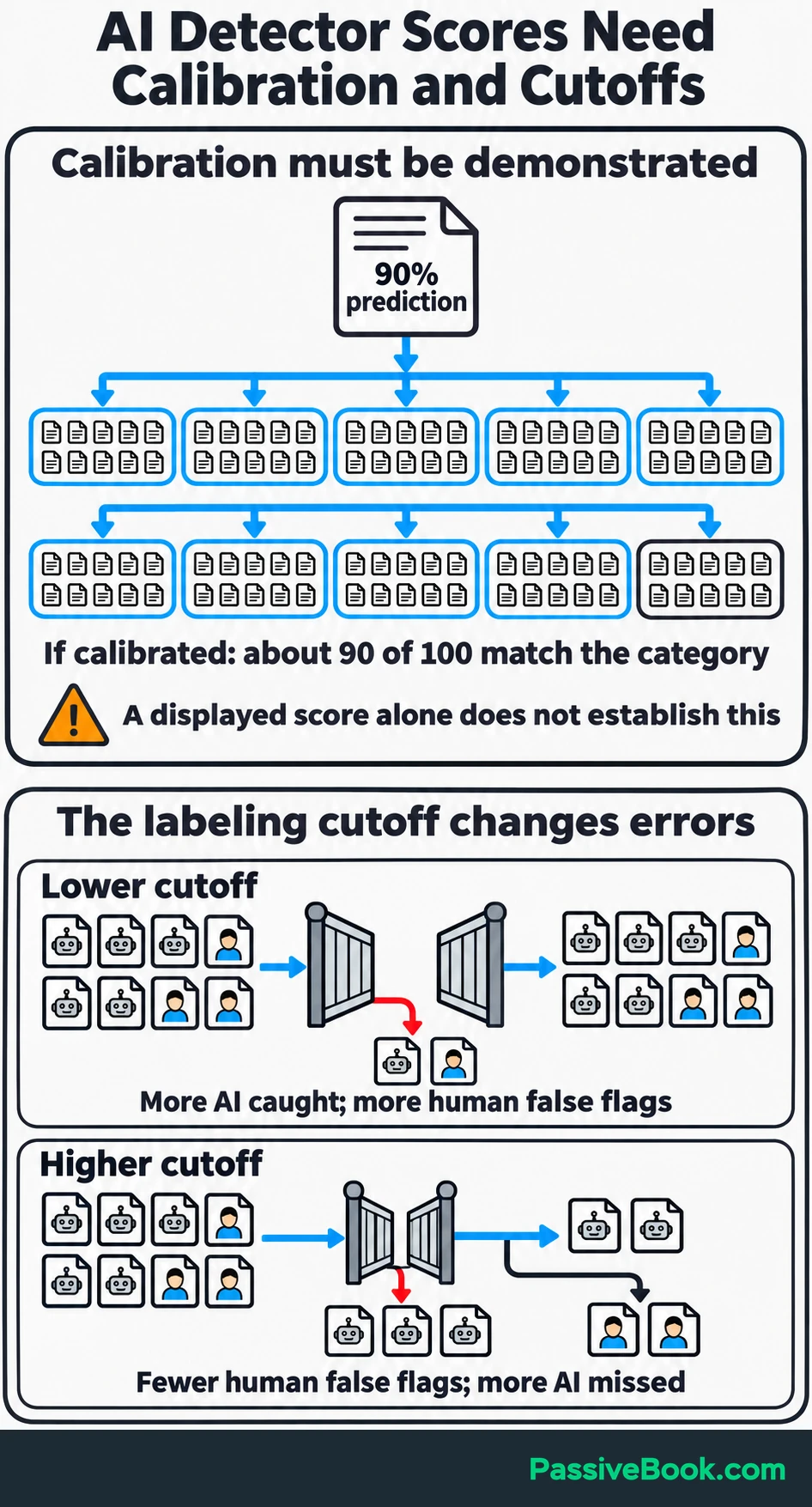
A confidence score is not automatically a calibrated real-world probability. Calibration would mean, for example, that among comparable documents receiving a 90% prediction, roughly 90 out of 100 actually belong to the predicted category. The displayed number alone does not establish that relationship.
Turnitin provides a useful example of a different score type. Its English AI Writing Report gives the percentage of qualifying long-form prose identified as likely AI-generated, including generated text subsequently modified with AI paraphrasing or bypass tools.
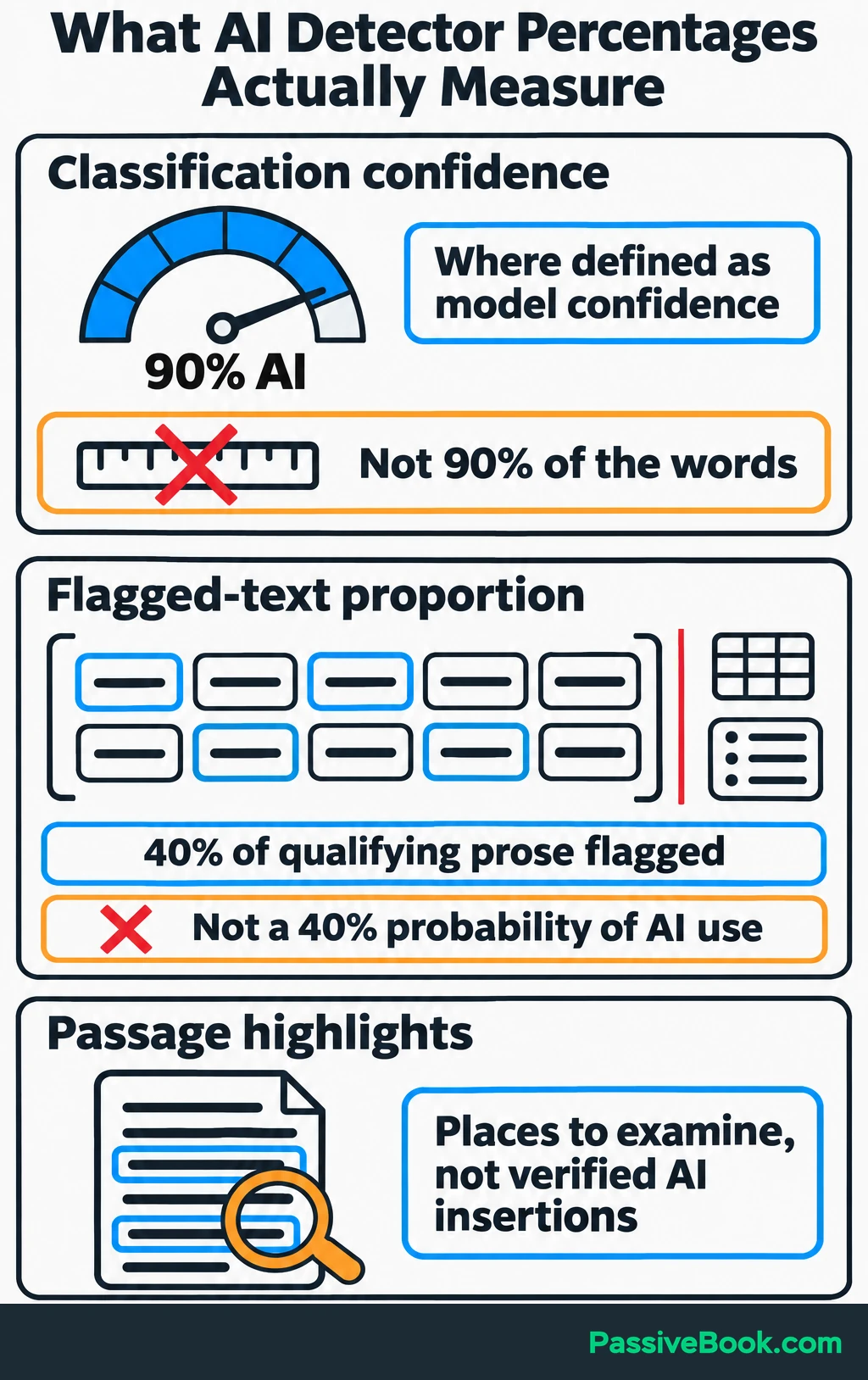
A 40% result therefore means 40% of qualifying prose was flagged. It does not mean there is a 40% probability that the author used AI, and it may not describe 40% of the entire file because some content falls outside qualifying prose. Turnitin’s score definition
The threshold also affects the label. Lowering the cutoff for an AI label generally catches more generated text but increases false positives. Raising it generally reduces false positives but misses more generated text.
There is no universal acceptable percentage. Your decision needs the score’s definition and a clear rule about permitted AI use.
If those rules are not written down yet, start with your publishing workflow. Define which AI uses you permit, what needs human review and who makes the final decision.

Free AI Governance Studio




For the sewing blog, a policy allowing AI editing creates a different review task from a policy requiring an entirely human-written submission. The same score cannot settle both questions.
Do not average percentages from different tools. Their scales and meanings may differ, and combining them does not produce an exact share of human authorship.
How Reliable Are AI Detectors?
Reliability depends on the documents, detector version and testing conditions. A reported accuracy rate is useful when those conditions resemble your own work.
I would be wary of any accuracy claim that leaves you unable to tell how often the tool falsely flags human writing and how often it misses generated writing. Those errors have different costs.
False Positives and False Negatives
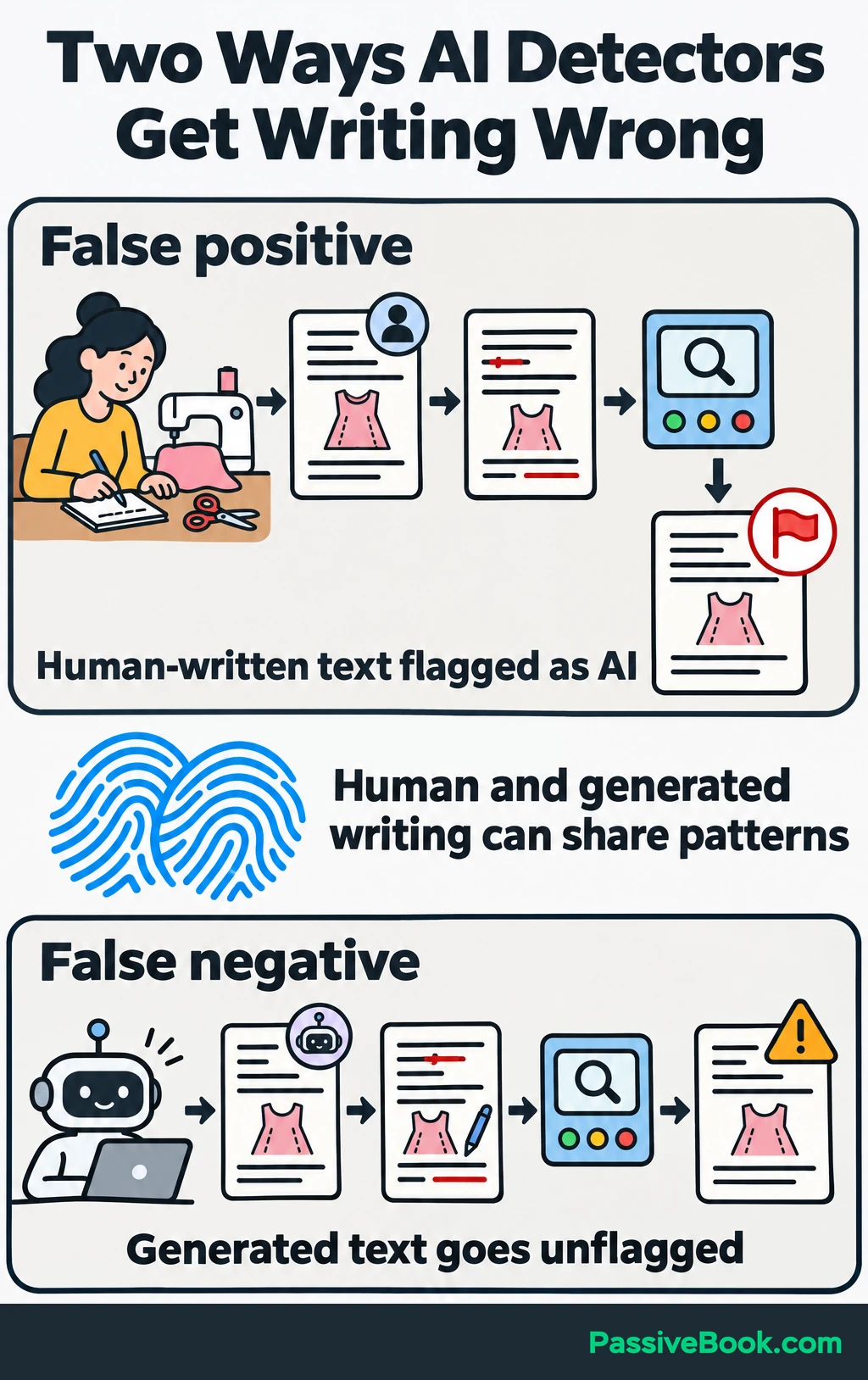
A false positive happens when human-written text is flagged as AI-generated. A false negative happens when generated text is missed.
Both occur because human and generated writing can share patterns. People can write predictable prose, and generators can produce varied prose.
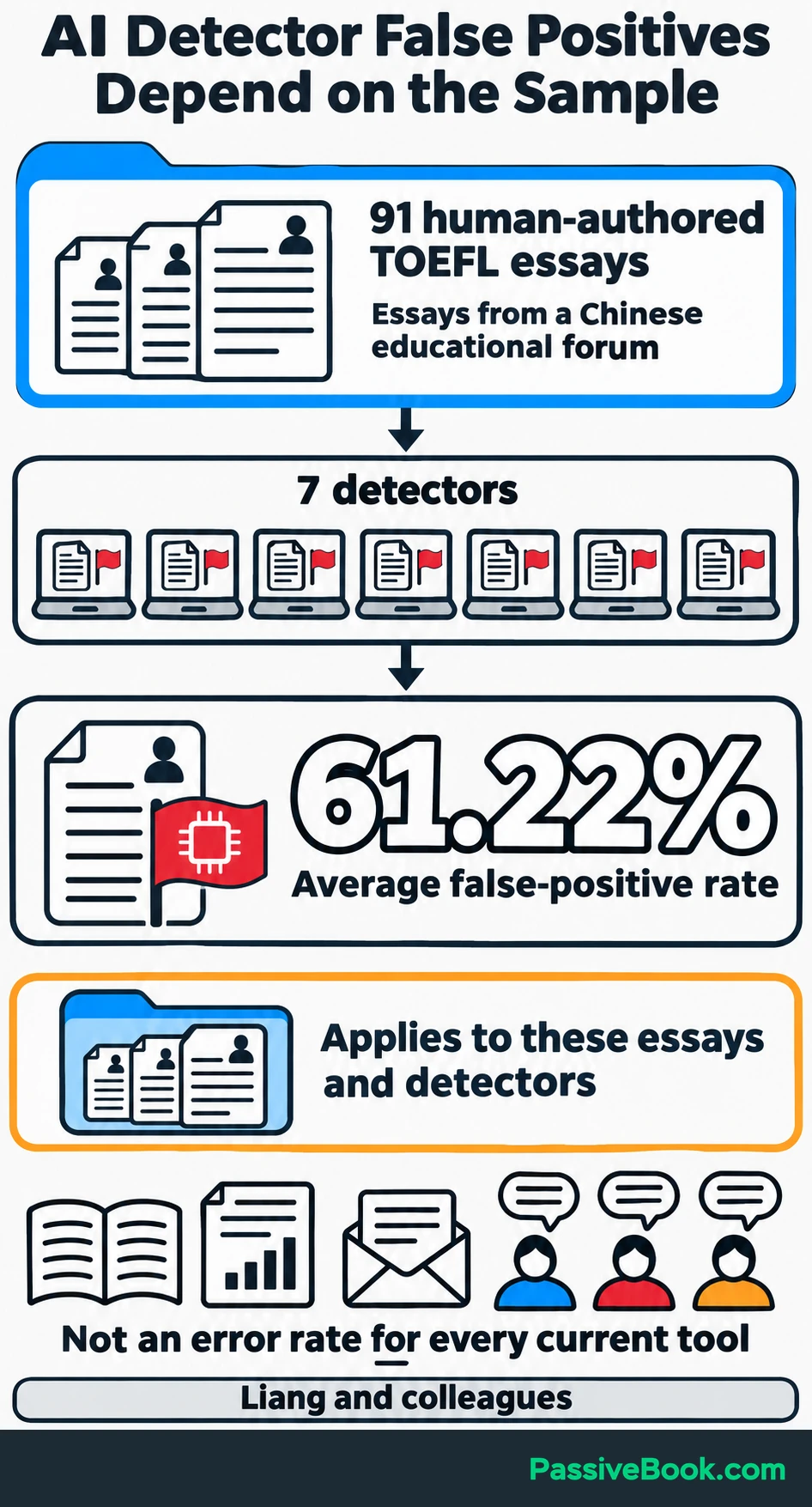
A documented false-positive example comes from Liang and colleagues’ 2023 study. They tested seven detectors on 91 human-authored TOEFL essays obtained from a Chinese educational forum and found an average false-positive rate of 61.22%.
That result applies to those essays and detectors, rather than every current tool. It shows why performance on one kind of English writing cannot establish fairness across writers with different language backgrounds. Original study of non-native English writing
False negatives have several causes. A detector may encounter an unfamiliar generator, different generation settings or text that has been rewritten.
The 2024 RAID evaluation tested 12 detectors and documented weaknesses involving unseen generators, changes in how text was generated, and deliberate modifications intended to defeat detection. Original RAID evaluation
Mixed authorship adds another problem. A person might write a tutorial and ask AI to polish it, or generate a draft and rewrite it extensively.
Those processes are different, even if a detector gives them the same label. The label alone does not establish which process occurred or whether a rule was broken.
What Independent Testing Shows
Independent testing is most useful when it reports false positives and missed generations separately.
Epoch AI tested June 2026 versions of Pangram, GPTZero and Originality.ai at their default settings. Its human sample contained 495 passages of roughly 500 words from blogging, fiction and scientific writing.
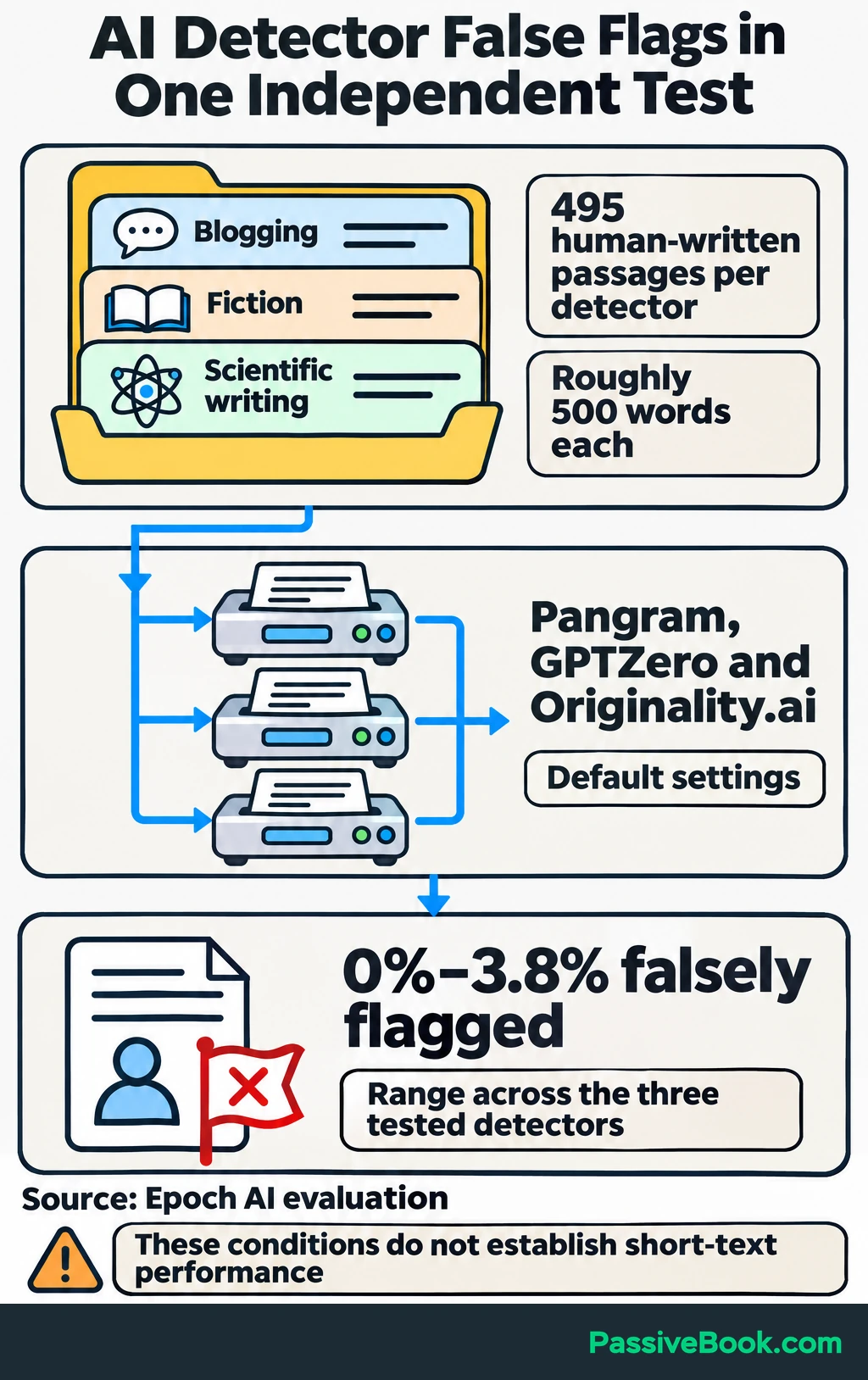
Across the three detectors, the results were:
| Tested Writing | Passages Per Detector | Error Rate Across Detectors |
|---|---|---|
| Human-written passages | 495 | 0%–3.8% falsely flagged |
| AI text generated from basic prompts | 297 | 0%–0.7% missed |
| AI text prompted to imitate an author using five reference passages | 297 | 10.1%–17.8% missed |
The evaluation counted “mixed” verdicts as misses for generated passages because those passages were fully AI-generated. That choice matters when interpreting the results. Epoch AI’s methodology and results
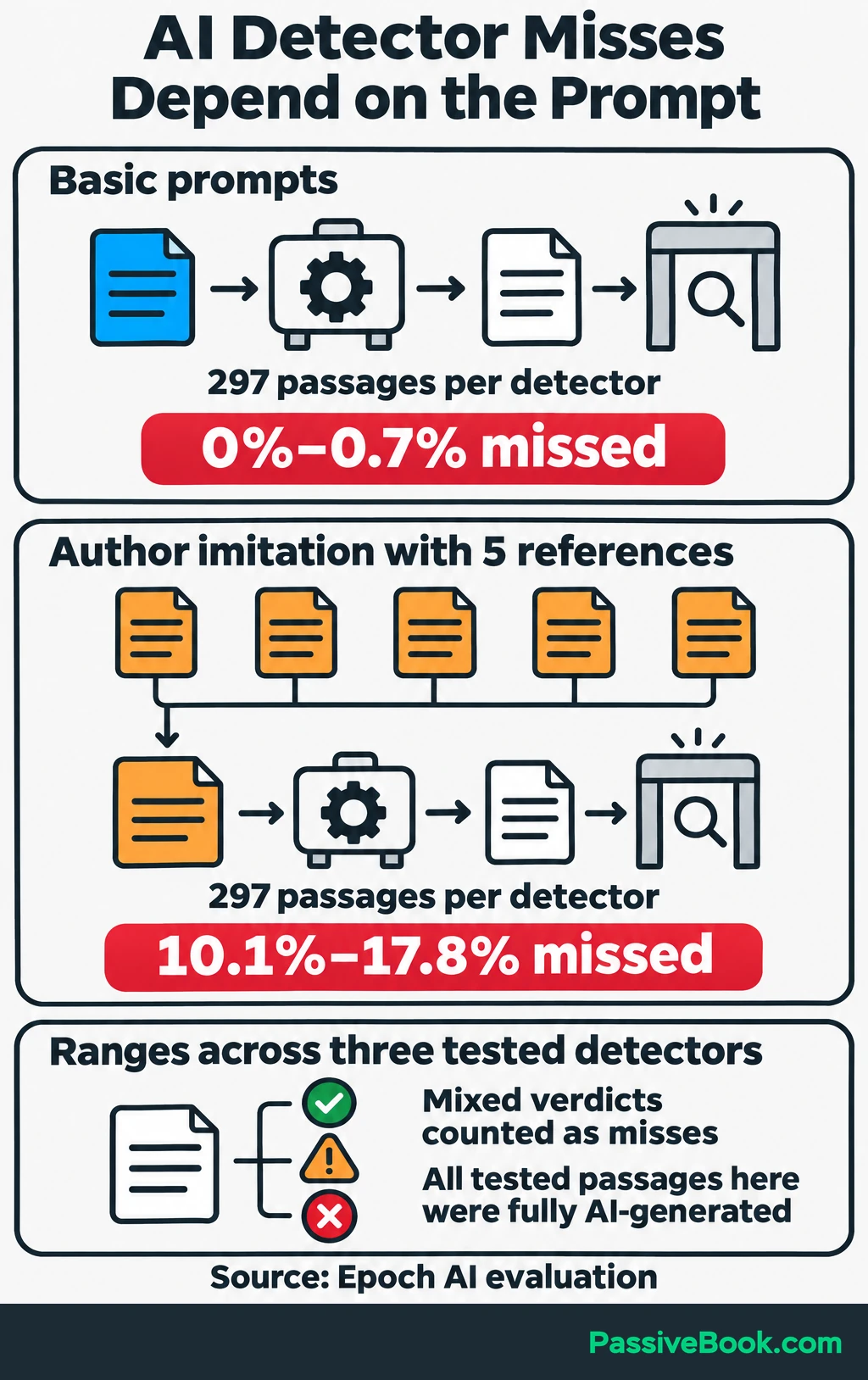
The useful lesson is that prompt conditions changed detection performance. Near-perfect results on basic prompts did not carry over to author imitation.
I would use this evidence to ask better questions before adopting a detector. It is not a current product ranking, and none of these figures tells you exactly how a short sewing instruction or a heavily edited tutorial will perform.
Why an Accurate Detector Can Still Produce Misleading Flags
Even a detector with strong test results can produce a surprising number of incorrect flags when generated documents are uncommon.
Three measures help explain why:
- Detection rate: The share of generated documents correctly flagged.
- False-positive rate: The share of human-written documents incorrectly flagged.
- Precision: The share of all flags that correctly identify generated documents.
Precision matters when you receive a report and need to decide how much trust to place in its flags.
Imagine an audit of 200 sewing-blog articles. For this teaching example, assume 20 are fully AI-generated and 180 are human-written. Also assume the detector catches 90% of generated articles and falsely flags 5% of human articles.
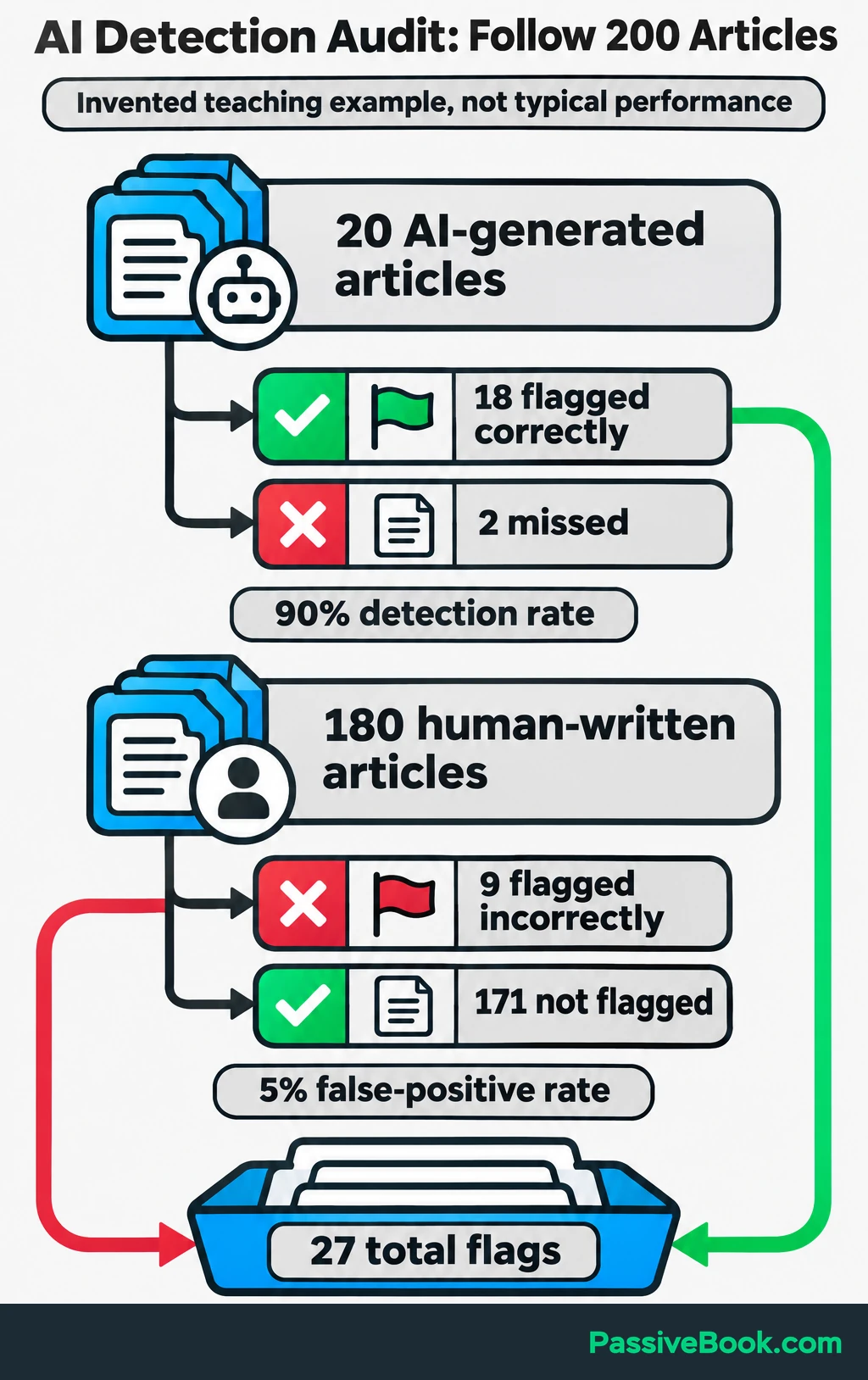
These are invented teaching assumptions, not typical detector performance.
We count correct flags within the generated group and incorrect flags within the human group:
| Actual Origin | Articles Reviewed | Flagged as AI | Not Flagged |
|---|---|---|---|
| AI-generated | 20 | 18 | 2 |
| Human-written | 180 | 9 | 171 |
| Total | 200 | 27 | 173 |
The detector produces 27 flags, and 18 correctly identify generated articles.
So the share of correct flags is:
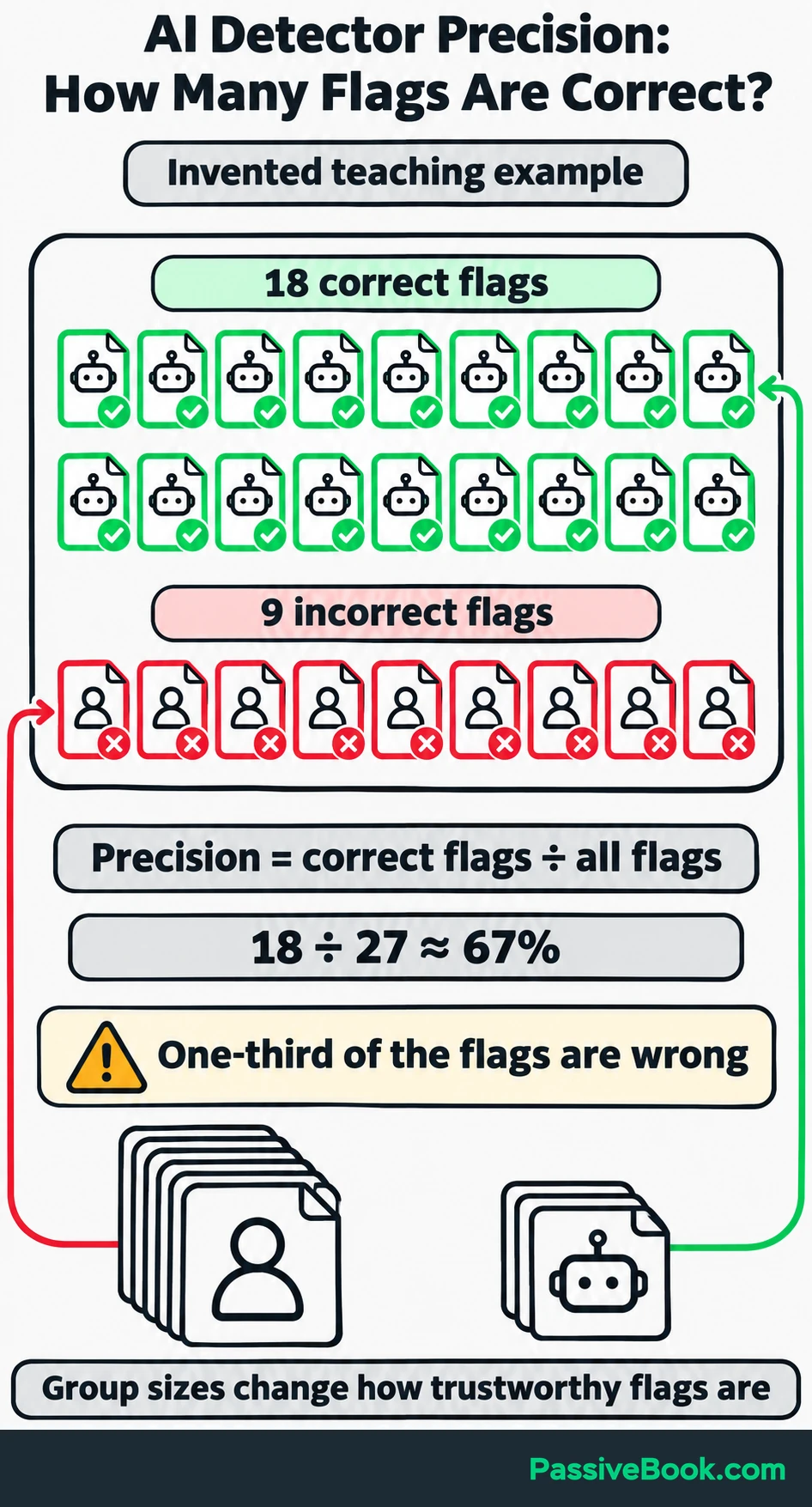
18 ÷ 27 ≈ 67%.
One-third of the flags are wrong, and two generated articles are missed.
The reason is the size of the human-written group. A small false-positive rate applied to many human articles can produce enough incorrect flags to make a substantial share of the review queue.
This is why “it catches 90% of AI text” does not tell you how trustworthy any individual flag will be.
When Is an AI Detector Worth Using?
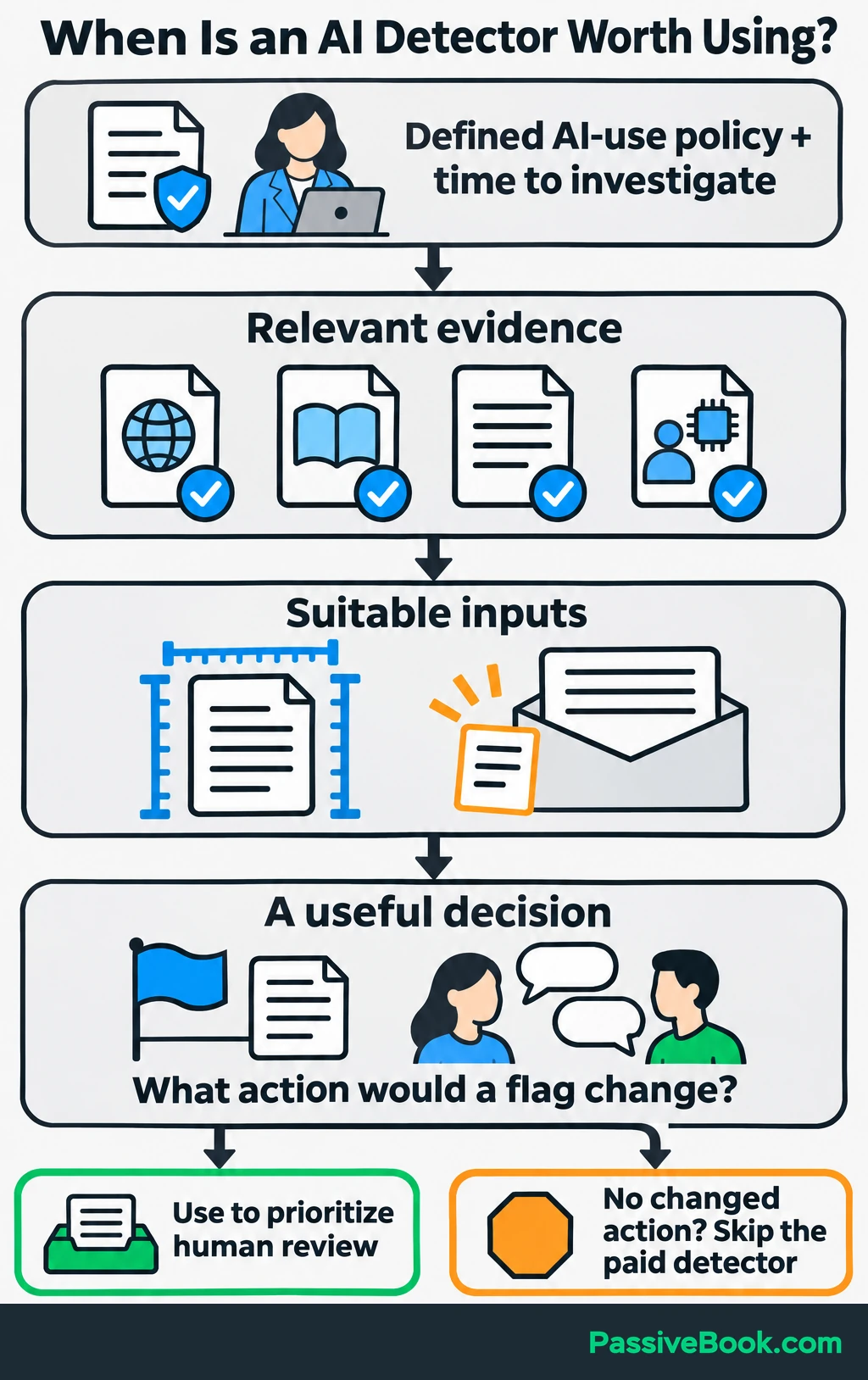
I would use a detector when AI involvement matters to a defined policy and someone has time to investigate the results. Its useful role is to prioritize review.
Before paying, check three things:
- Relevant evidence: Look for evaluations covering your language, document length, genre and degree of AI assistance.
- Suitable inputs: Confirm that your submissions meet the tool’s requirements. A tool tested on long articles may be unsuitable for short instructions.
- A useful decision: Define what a flag will trigger, such as a draft review or a conversation with the writer.
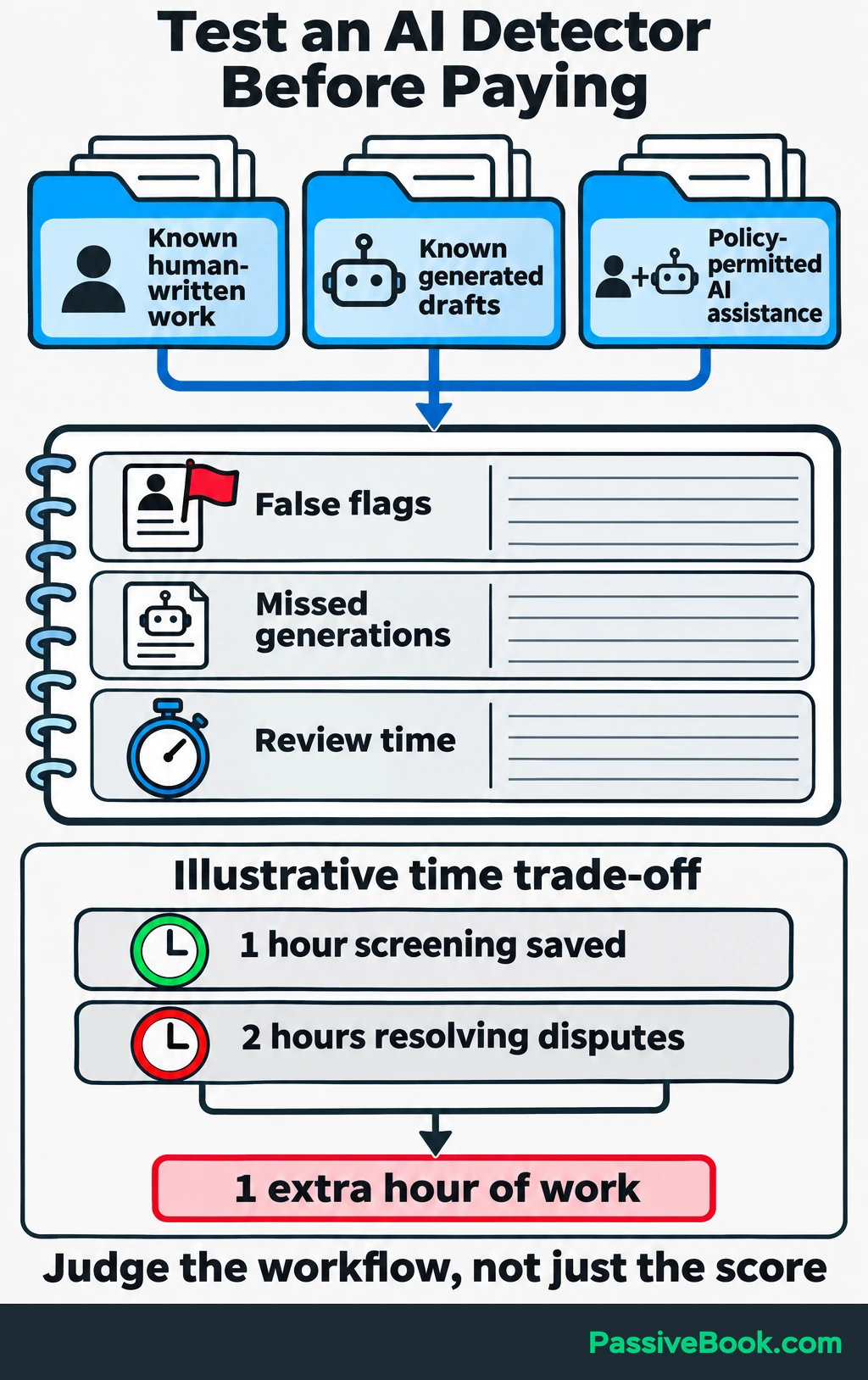
Then try representative documents with known writing histories. Include human-written work, generated drafts and the kinds of AI assistance your policy permits. Record false flags and missed generations separately.
Also track review time. A subscription that saves an hour of screening but creates two hours of disputes has made your workflow more expensive.
While refining my custom AI content pipeline, I caught a draft referring to a screenshot that was not in the article. The sentence read smoothly, but the instruction still needed fixing.
That experience shapes where I spend review time. For a sewing blog that permits AI assistance, I would first check whether the instructions match the pattern, the explanations are useful and factual claims have support. A detector cannot establish whether the tutorial produces a usable tote bag.
I would skip a paid detector if its result would not change any action. Another percentage is not automatically another layer of quality control.
What Should You Do When Text Is Flagged?
Start by reading the score definition and the flagged passages. Then separate the tool’s judgment about AI involvement from evidence that a stated rule was violated.
A practical review follows this order:
- Check the report: Confirm what was scored and whether the input met the tool’s requirements.
- Review the writing process: Examine available drafts, revision history, research notes and sources.
- Hear the writer’s explanation: Ask how the text was produced and give them a chance to respond.
- Apply the policy: Decide what the available evidence establishes about permitted or prohibited use.
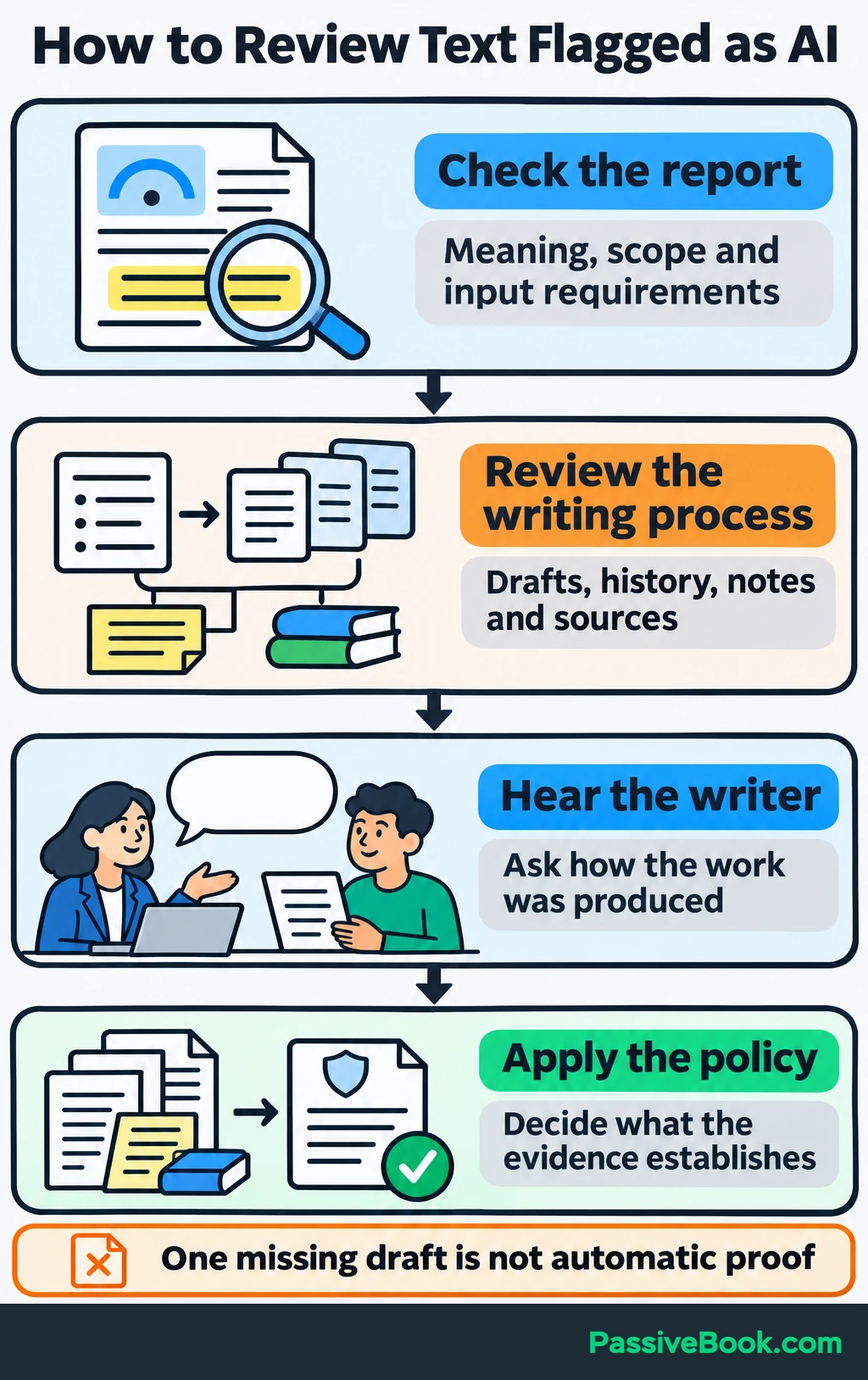
Drafts and revision history provide context, but no single missing document should automatically become proof of misconduct.
Turnitin explicitly advises against using its detector as the sole basis for adverse action against a student. Its guidance calls for further scrutiny, human judgment and the institution’s policies. Turnitin’s responsible-use guidance
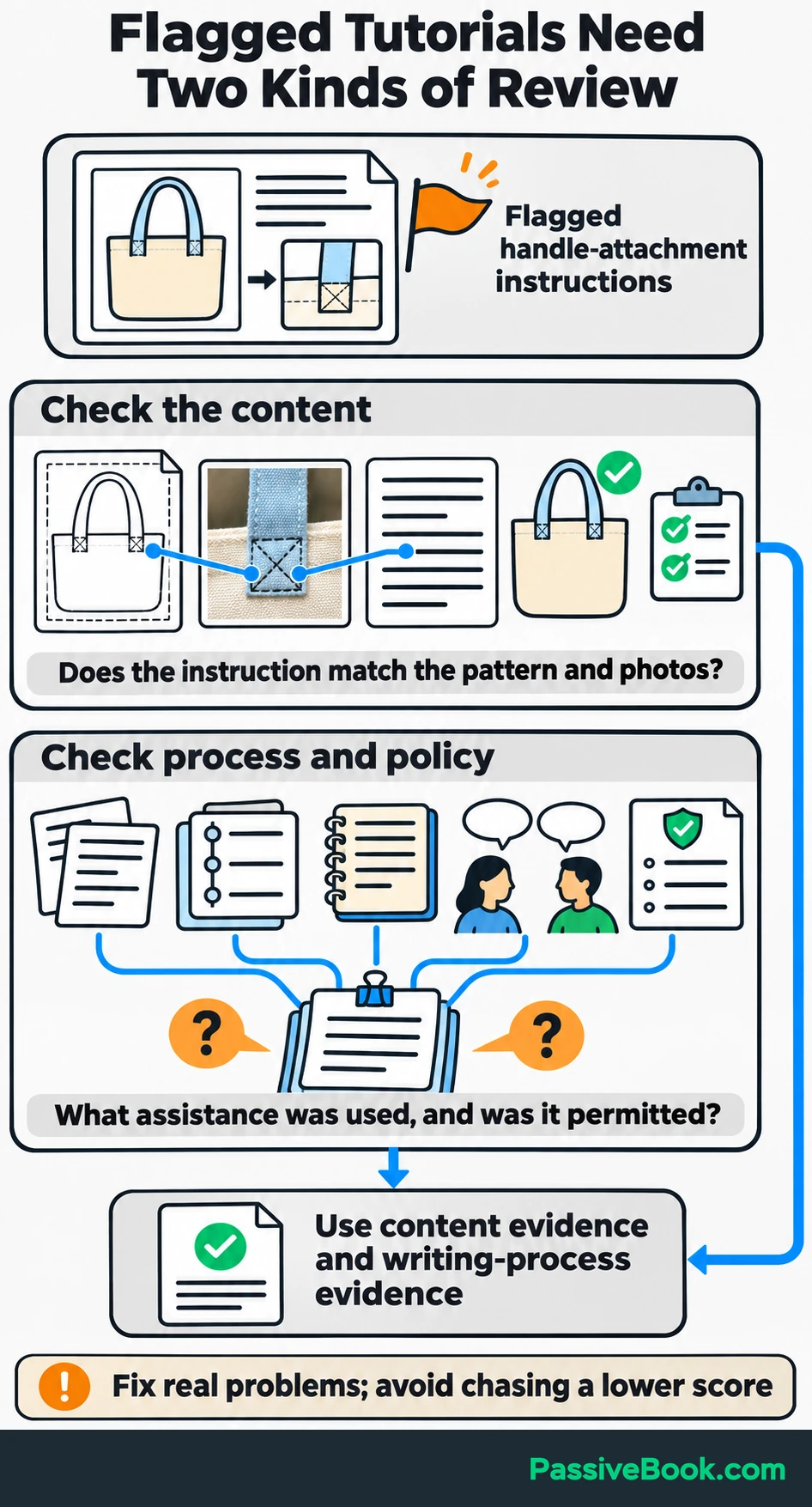
For the sewing blog, suppose the flagged passage explains how to attach the handles. Check the wording against the pattern and the tutorial photos. Ask whether the writer tested that step, and review their explanation alongside the drafts and your AI-use policy.
A correct instruction does not settle authorship, and an AI label does not establish that the instruction is wrong. Your publishing decision needs both the content review and any relevant evidence about how it was written.
If your own writing is flagged, preserve the report and gather your drafts and source trail. Explain your process plainly. Improve errors or unclear passages, but I would avoid repeatedly rewriting good instructions just to chase a lower score. That gives an uncertain measurement control over the quality of your work.
What Next?
Choose one detector report and read its score definition before acting on the percentage. Write down what it measures and what further evidence you would need to make a decision.
Use the social buttons to share this guide when a detector score is being treated as a verdict. Understanding the number can prevent an unnecessary accusation or a wasted review.
Which decision would a detector result actually change in your publishing or review process? Tell me in the comments, and add any other questions you have about scores or flagged text.
Share this post with your friends & followers:

