You want your ads to reach people who might buy, but the buying process sounds like a chain of platforms charging each other to show a banner.
That makes a small budget feel especially exposed. Before spending anything, you need to know who makes the buying decisions, what you’re paying for and whether the reported sales justify the cost.
Programmatic advertising becomes easier to judge once you follow a single ad from campaign settings to placement and purchase reporting. Let’s trace that process, then work through the costs and checks that help you decide whether it deserves a test.
What Is Programmatic Advertising?
Programmatic advertising uses software to automate buying and selling digital ad space within rules you set. You choose the goal, budget, audience and ads, and the system evaluates opportunities to place them.
The basic flow is:
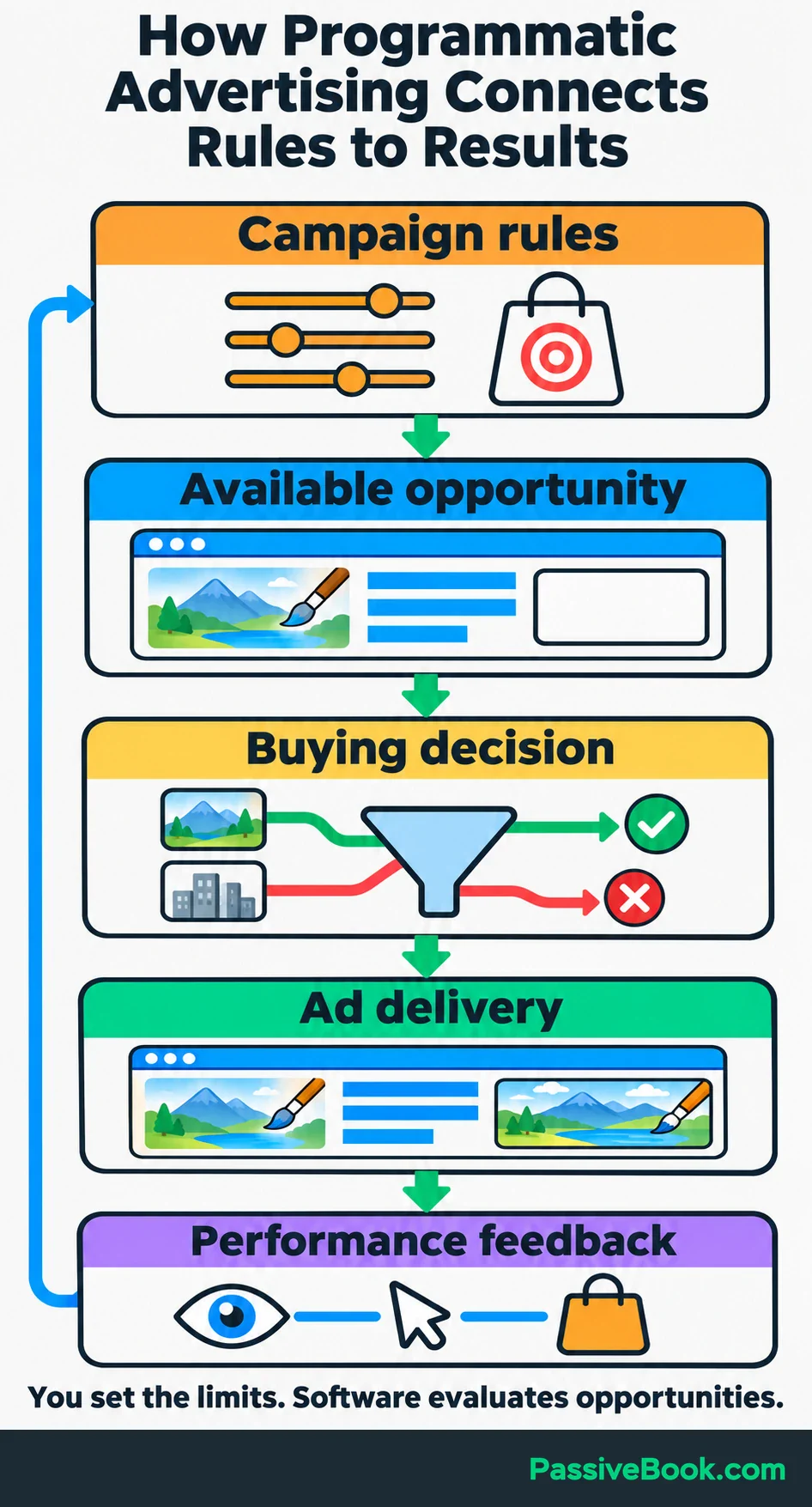
Campaign rules → available ad opportunity → buying decision → ad delivery → performance feedback.
“Programmatic” describes how advertising is bought. Banners, native ads that fit a page’s layout, video, streaming TV and audio are formats you can buy this way.
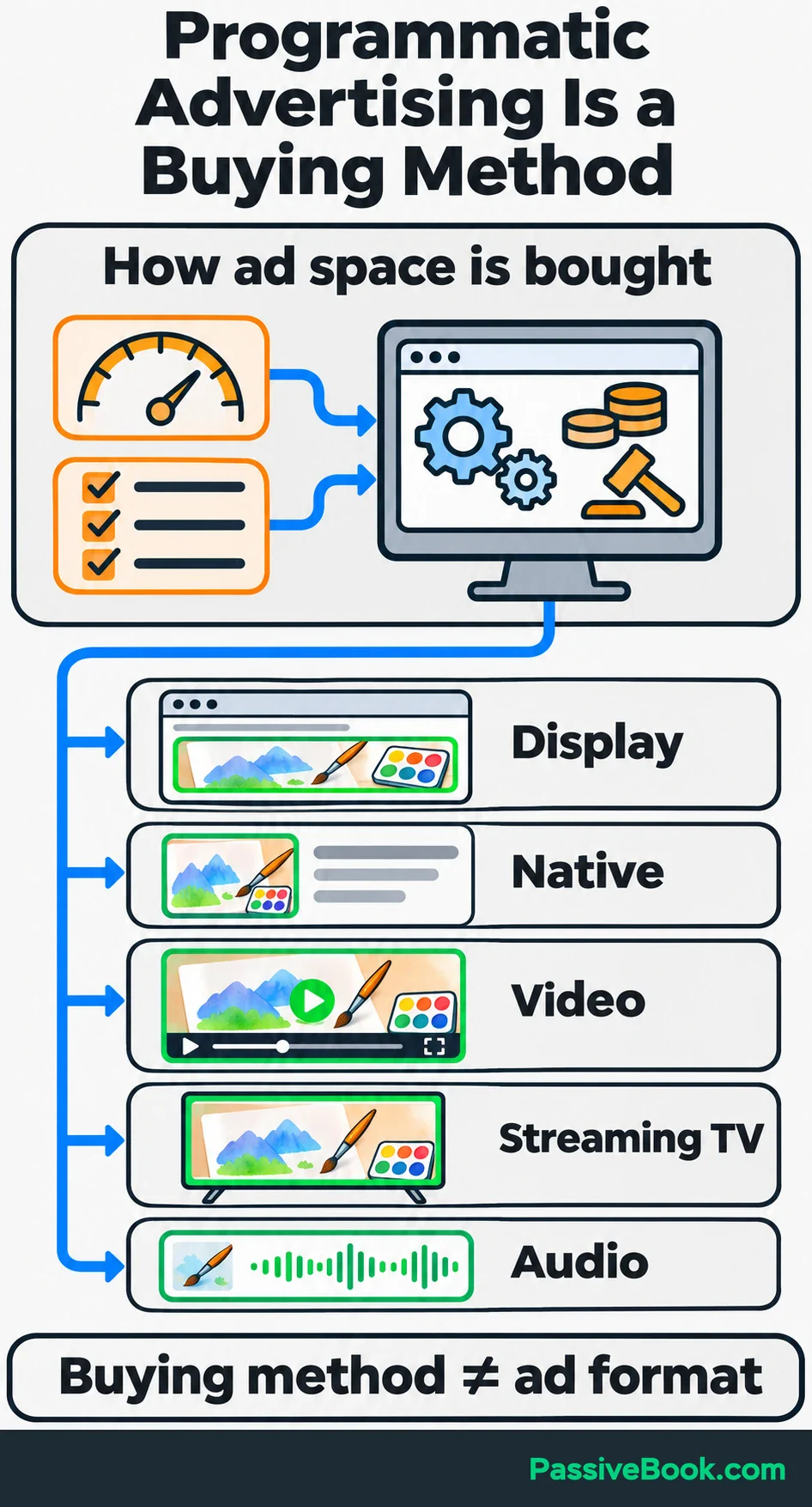
The software handles individual transactions, but you remain responsible for the offer, spending limits and results. Automating a purchase does not make it a good purchase.
Throughout this article, imagine you sell a beginner watercolor-painting course and want to reach potential students beyond your existing visitors.
What Do DSPs, SSPs and Ad Exchanges Do?
The easiest way to understand the platforms is to separate the buyer’s needs from the seller’s.
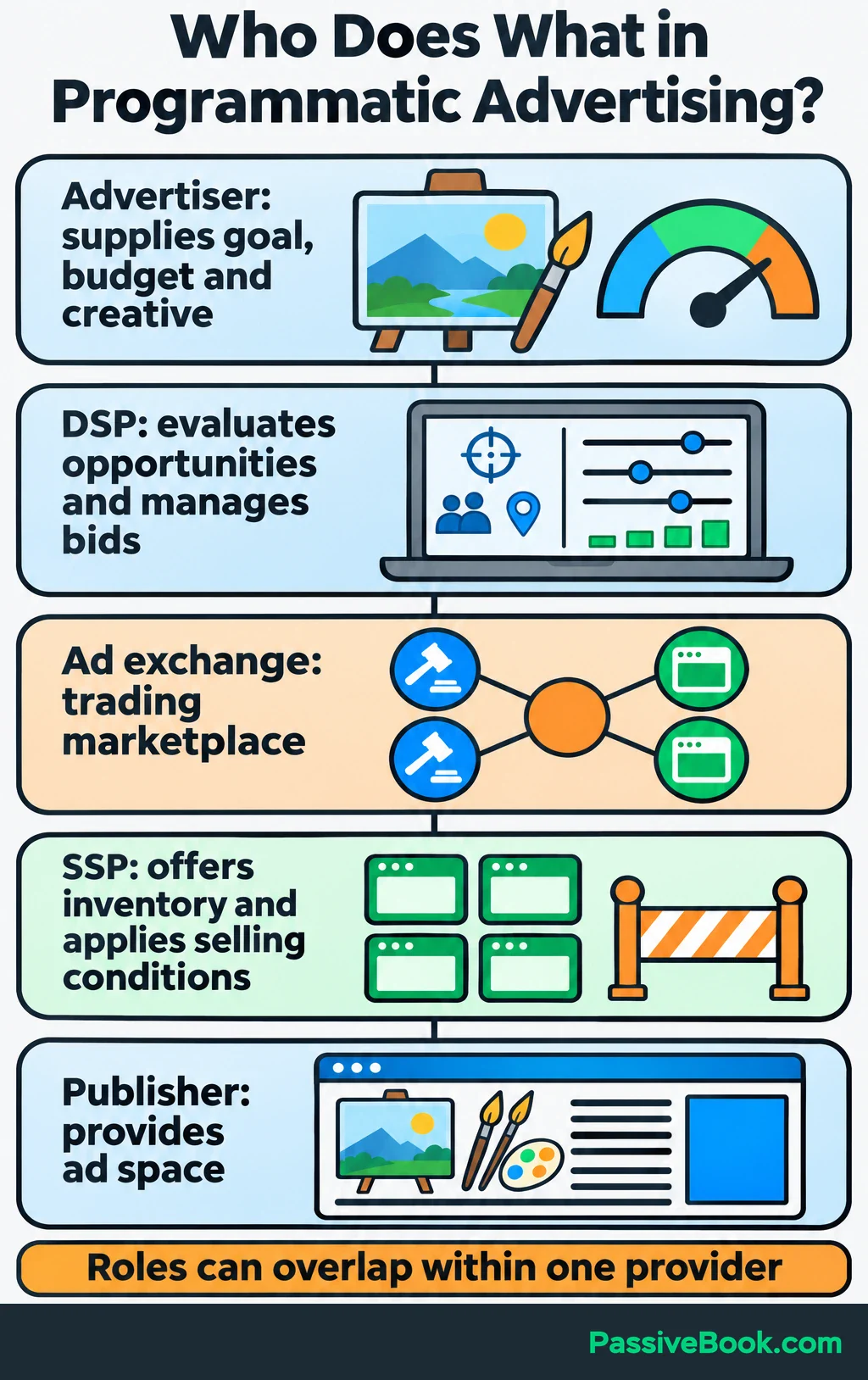
Your course business wants useful exposure at an affordable price. You supply the ad images, video or text, known as creative. A website carrying ads wants to earn money from its available space, also called inventory.
| Participant | Whose Needs It Serves | Its Role |
|---|---|---|
| Advertiser | The business paying for ads | Supplies the offer, creative, budget and campaign goal |
| Publisher | The website, app or media owner | Provides space where ads can appear |
| Demand-side platform, or DSP | Advertisers and their agencies | Evaluates opportunities and manages bids, targeting, budgets and reporting |
| Supply-side platform, or SSP | Publishers | Offers inventory to buyers and applies selling conditions |
| Ad exchange | Buyers and sellers | Provides a marketplace where advertising inventory is traded |
A supply-side platform helps publishers connect with buying systems. SSP and exchange functions can overlap within one provider, so these roles do not always represent separate companies.
The Trade Desk and Google’s Display & Video 360 are examples of DSPs. Google Ads also offers automated buying across the Google Display Network, but it is a separate product from Display & Video 360.
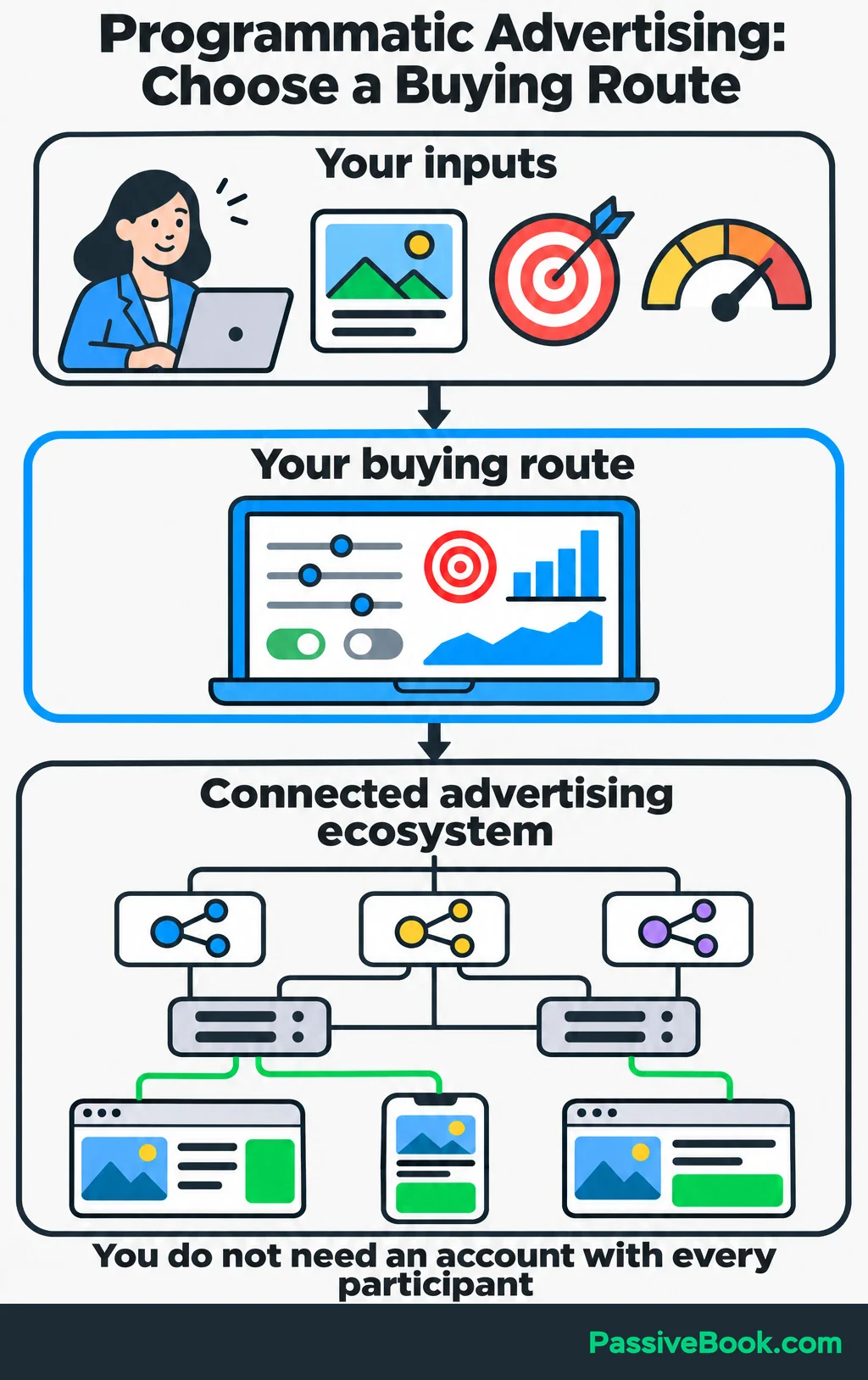
You choose a buying route. You do not need accounts with every participant in the table.
How Does Programmatic Advertising Work?
A common method is real-time bidding, or RTB. Software bids for individual opportunities to display an ad as they become available.
Here is how that auction-based process works.
1. The Advertiser Sets the Campaign Rules
You tell the buying platform what you want to achieve and what it may spend.
The main inputs are:
- Outcome: Purchases, leads or exposure to your ads.
- Creative: The image, video, headline and other material people see.
- Destination: The page people reach after clicking.
- Eligibility: Targeting, locations, formats and placement restrictions.
- Spending rules: Budget, schedule and bidding strategy.
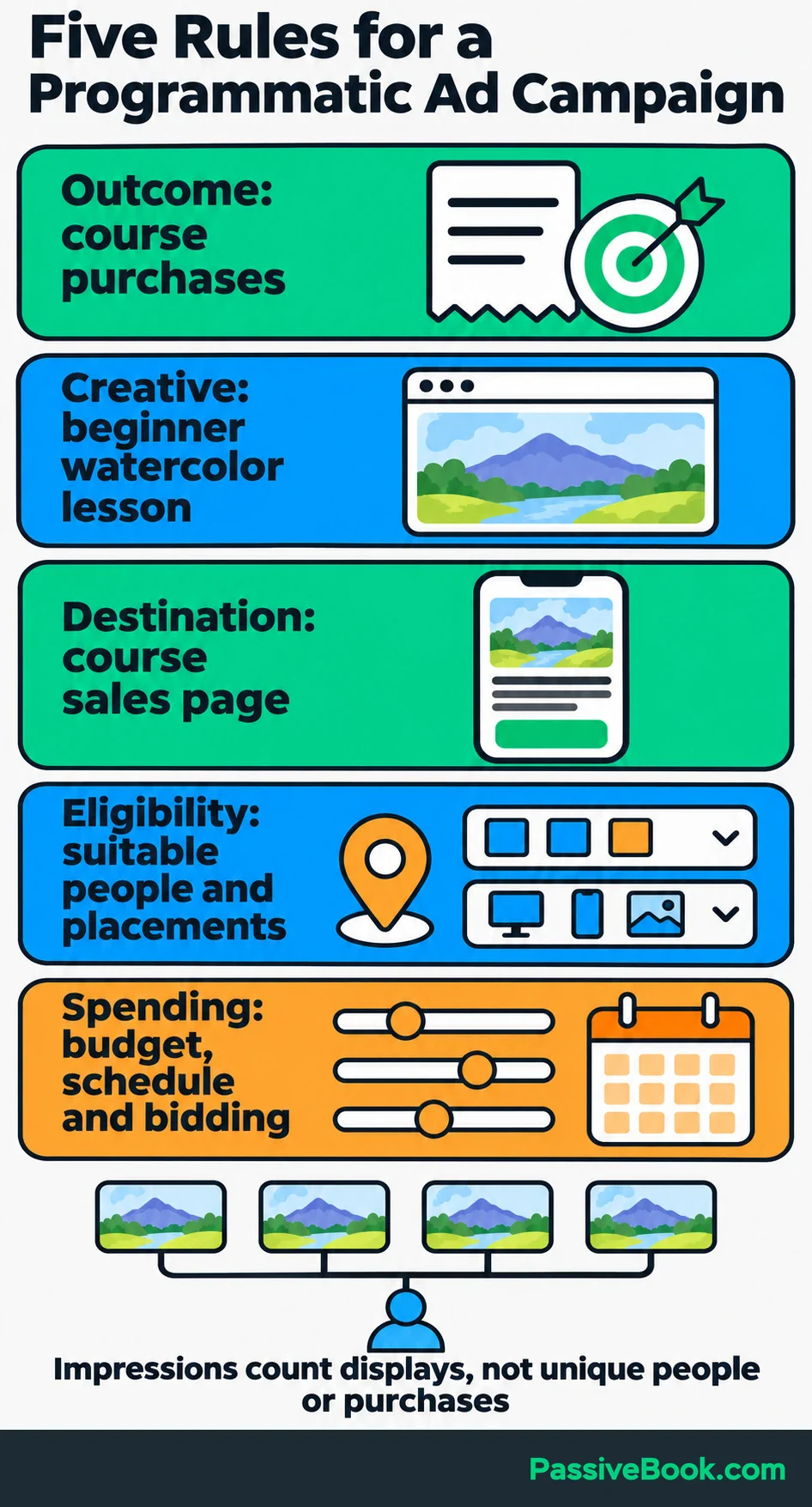
For the watercolor course, you could choose purchases as the outcome and use an image of a painting students will learn to make. The ad links directly to the course sales page.
A short message might read: “Paint your first watercolor landscape with step-by-step beginner lessons.”
An impression is one counted ad display. It is not a unique person, a click or a purchase. One person can receive several impressions.
2. A Publisher Makes an Advertising Opportunity Available
When someone opens a participating website, its advertising system requests an ad.
The publisher’s SSP or ad exchange sends eligible DSPs information about the opportunity. That can include the ad size, placement, surrounding content and permitted audience signals.
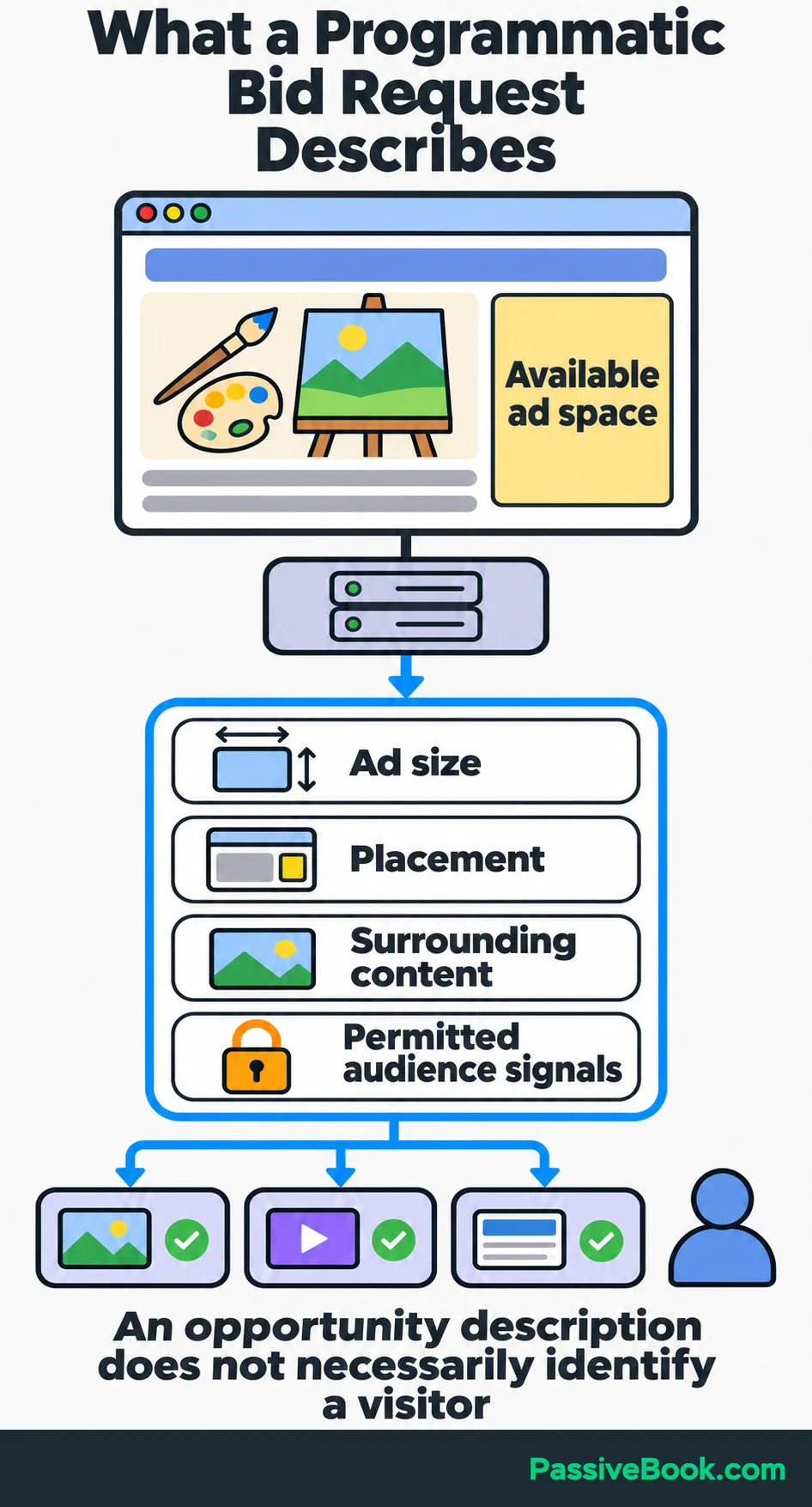
A bid request describes an opportunity; it does not necessarily identify the visitor. As Google’s RTB documentation explains, buyers use the request to decide which creative to offer and how much to bid, if anything.
In the course example, the opportunity might be a banner beside a beginner painting tutorial.
3. Buying Platforms Bid and the Selling System Selects an Ad
The DSP checks whether the opportunity fits your campaign:
- Can your ad fit the available space?
- Does the opportunity meet your targeting rules?
- Is budget available?
- Is the likely value worth the price?
It may bid for the painting-tutorial placement and skip an unrelated one.
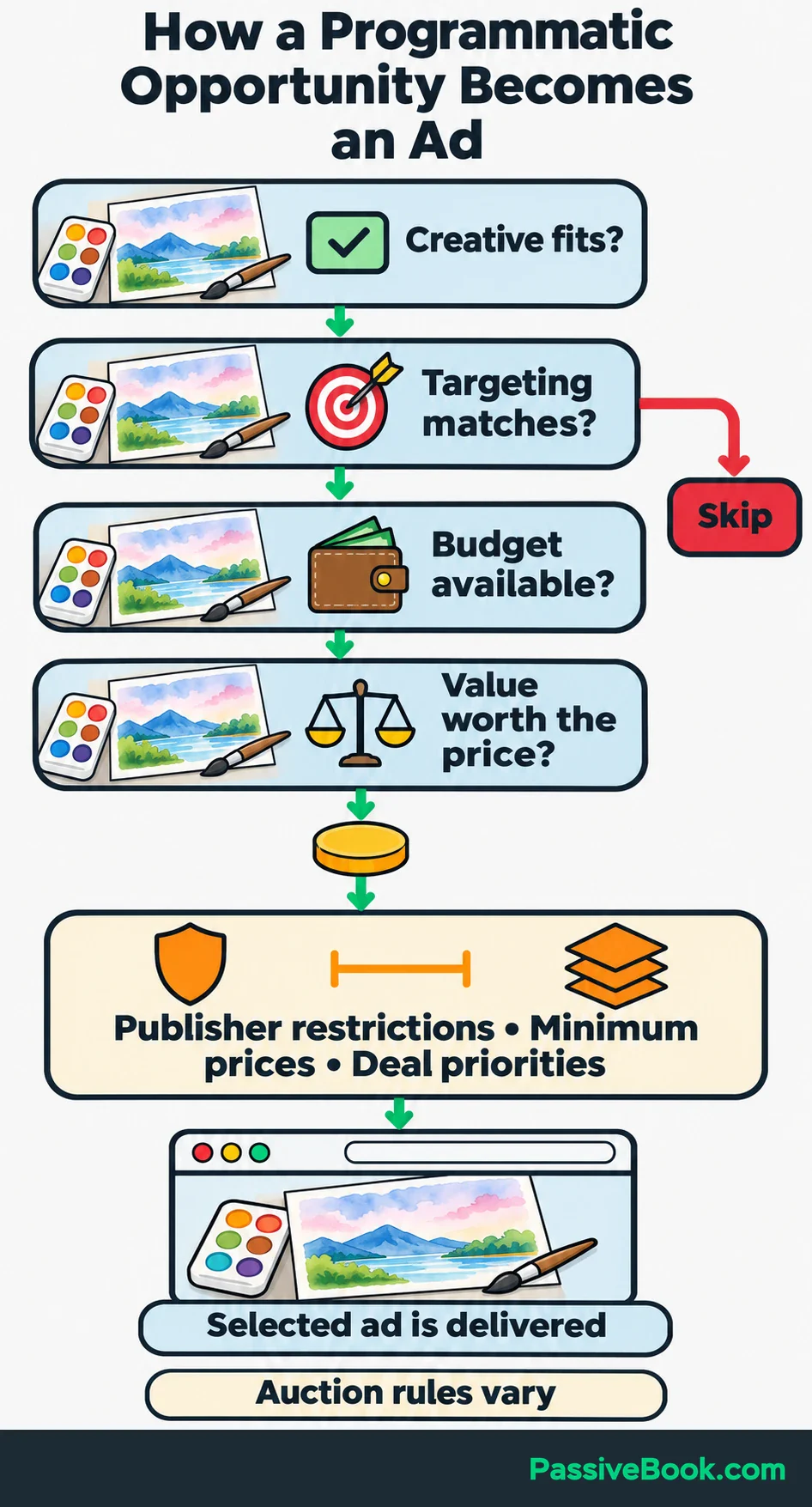
Eligible bids compete under the marketplace’s rules. Publisher restrictions, minimum prices and deal priorities affect which ad wins. The selected creative then returns through the ad-serving system for display.
This is a simplified sequence. Providers can combine functions, and auctions do not all use identical rules.
4. Performance Informs the Next Buying Decision
The platform records delivery, clicks and tracked purchases. Automated bidding can use those signals to adjust later bids or spending.
The goal matters. Optimizing for clicks asks the system to find clicks. Optimizing for purchases asks it to pursue purchases, using the purchase-tracking data available.
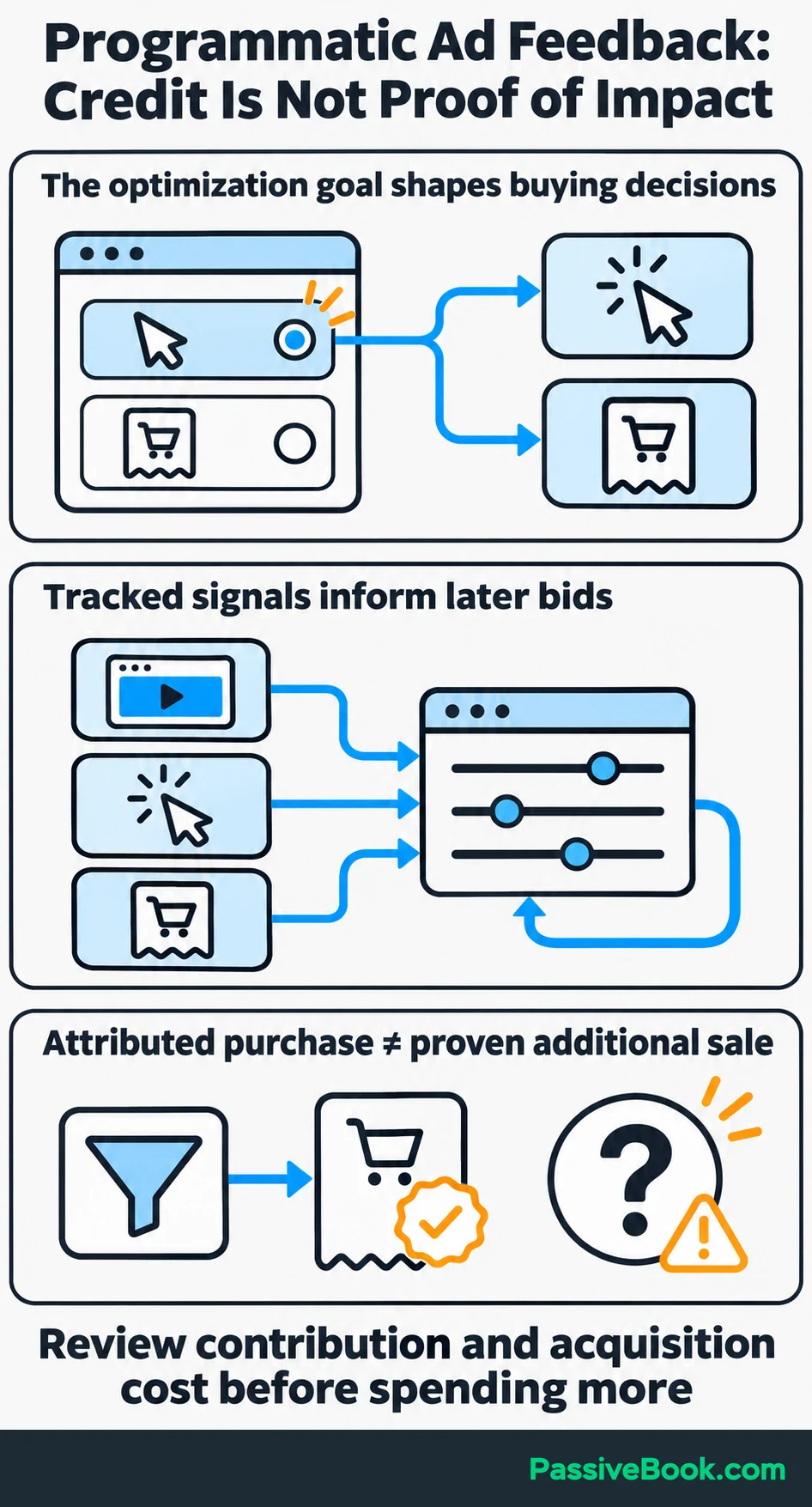
Reporting also uses attribution: rules that assign advertising credit to a sale. A platform might credit a purchase after an eligible click or ad impression within a specified period.
That credit does not prove the ad created an additional sale. Google distinguishes attributed conversions from incremental conversions, which measure purchases that happened because of the advertising.
Your job is to review the sales economics and decide whether to change the creative, targeting or spending. The software can adjust bids, but it cannot decide what your business can afford.
Does Every Programmatic Purchase Use an Auction?
No. Programmatic buying also includes negotiated arrangements with fixed prices.
| Buying Method | Eligible Buyers | Pricing | Is Inventory Reserved? |
|---|---|---|---|
| Open auction | Buyers meeting the marketplace’s eligibility rules | Competing bids, subject to selling conditions | No |
| Private auction | Buyers invited by the publisher | Competing bids, usually with a minimum price | No |
| Preferred deal | The buyer named in the agreement | Negotiated fixed price; the buyer can decline opportunities | No |
| Programmatic guaranteed | The buyer named in the agreement | Negotiated price and delivery terms | Yes, under the agreement |
Open and private auctions can use RTB. The distinction between preferred deals and guaranteed buying is the commitment: preferred inventory is optional to buy, while guaranteed inventory is reserved.
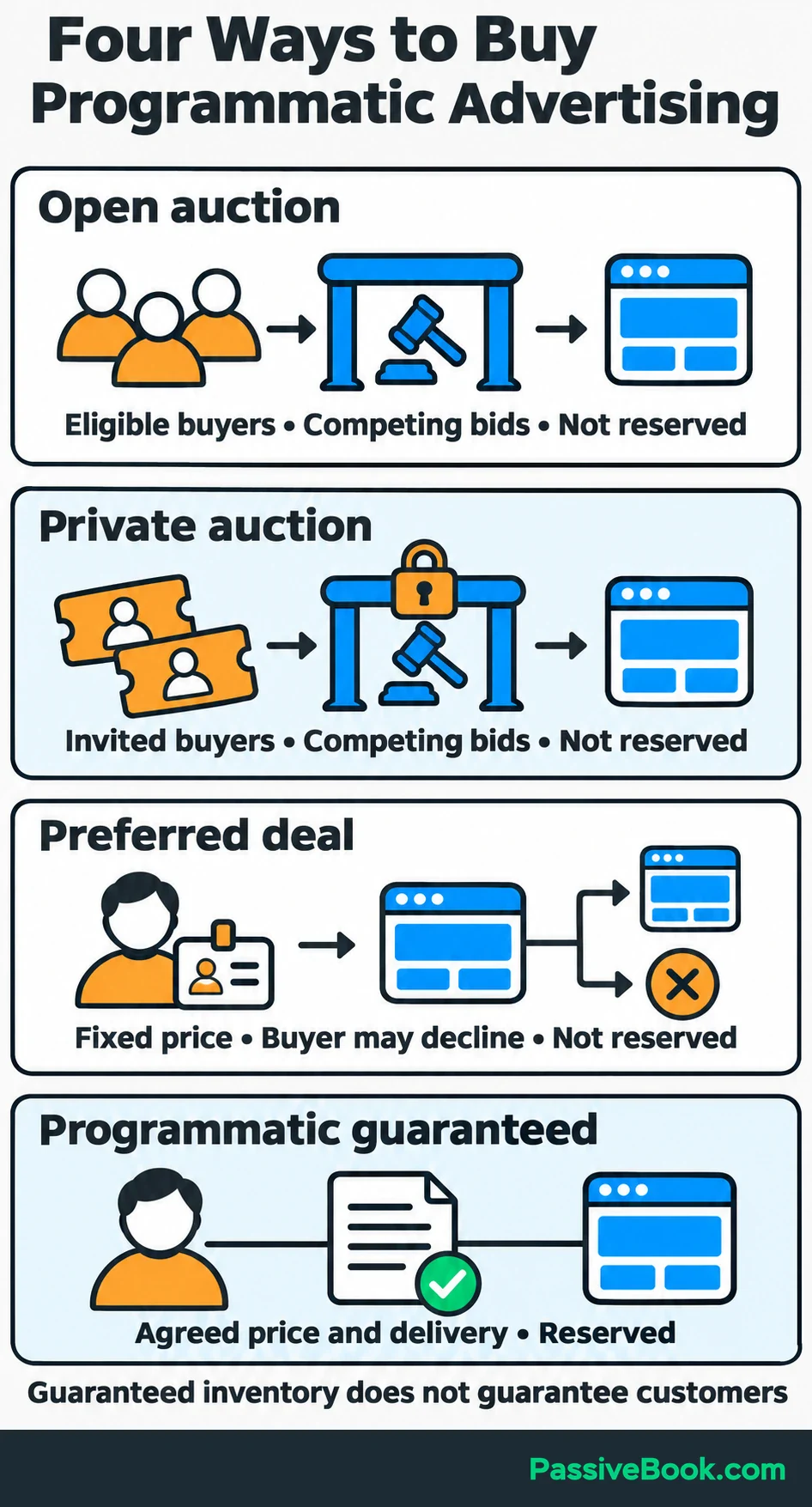
These methods change access, price and delivery commitments. Guaranteed inventory still does not guarantee customers.
For a first small test, I would avoid a reserved commitment unless there is a clear reason to buy that particular inventory.
How Does Programmatic Targeting Work?
Targeting narrows the opportunities your campaign considers. Two approaches matter most.
Contextual targeting uses the content around the ad. Your watercolor-course ad could appear beside painting tutorials because the page discusses a relevant subject.
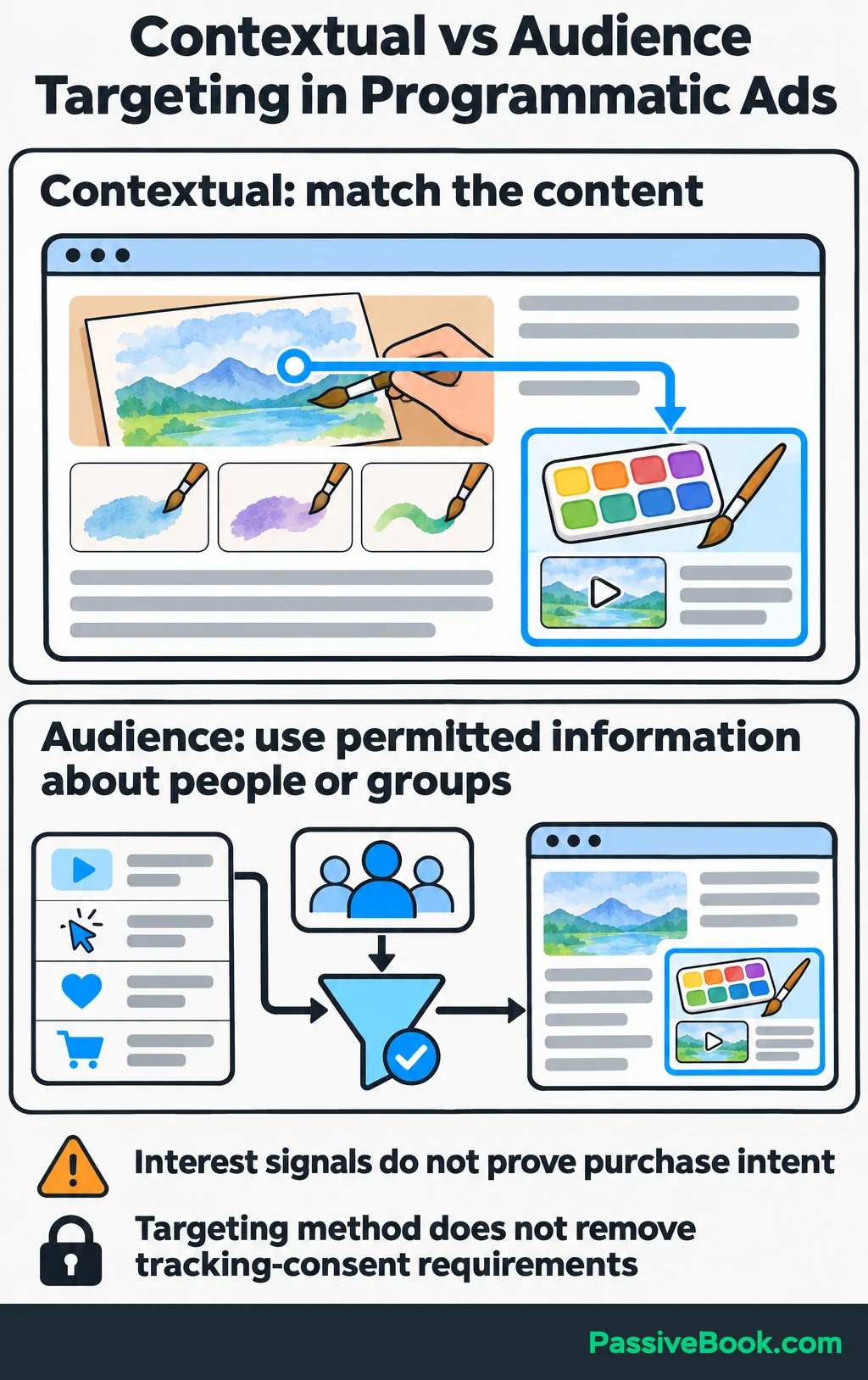
Audience targeting uses information about people or groups. First-party data comes from your own interactions with customers and visitors. Platforms may also offer their own audience groups or third-party audiences built by outside data providers.
These approaches support two different jobs:
- Prospecting: Reaching potential new customers, such as readers of beginner painting content.
- Retargeting: Reaching eligible previous visitors, such as people who viewed your course page and left.
An “art enthusiast” label is a signal, not proof that someone wants lessons. Audience matching also has limits: Google notes that unavailable cookies and device identifiers can affect delivery.
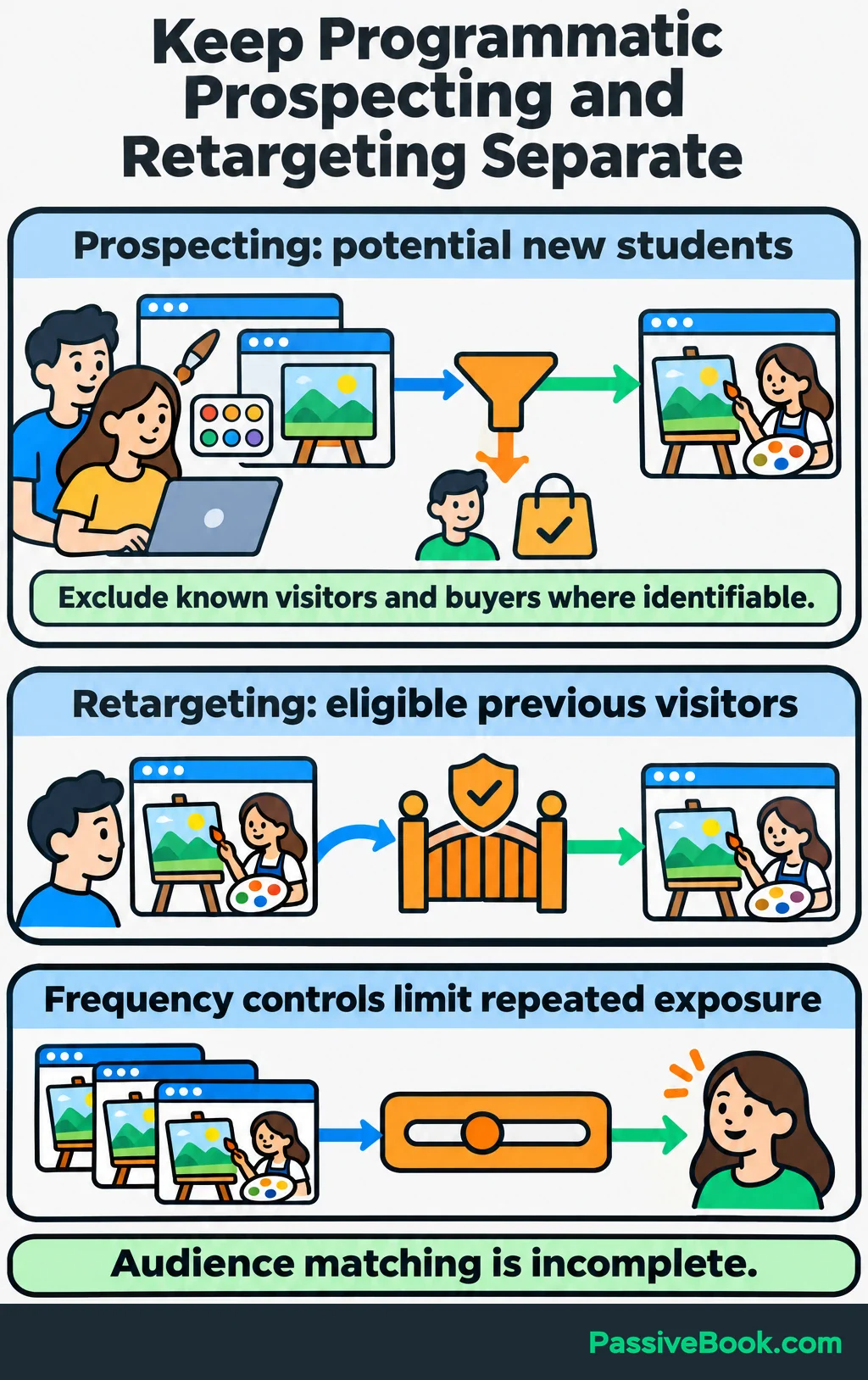
You can add geography, device and placement controls. Frequency measures repeated exposure, and a frequency cap helps limit how often the system shows someone your ad.
I would start the course’s prospecting test with relevant painting content and keep retargeting separate. Where the platform can identify them, exclude previous visitors and purchasers from prospecting to reduce overlap.
Check privacy requirements before enabling tracking or uploading audience data. In the UK, advertising-related cookies and similar storage or access technologies require consent, including when used for contextual advertising. The ICO’s online advertising guidance explains this distinction.
How Much Does Programmatic Advertising Cost?
There is no single programmatic advertising price.
A common pricing measure is CPM: cost per thousand impressions. The price varies with the format, inventory, targeting, competition and deal terms.
To calculate media cost, count the impressions in groups of 1,000 and multiply by the CPM:
Media cost = impressions ÷ 1,000 × CPM
Media spend is only part of the bill. Platform or agency charges, paid audience data, verification services, creative production and taxes may add costs. Google’s billable-cost breakdown shows how media, platform and other fees can sit separately.
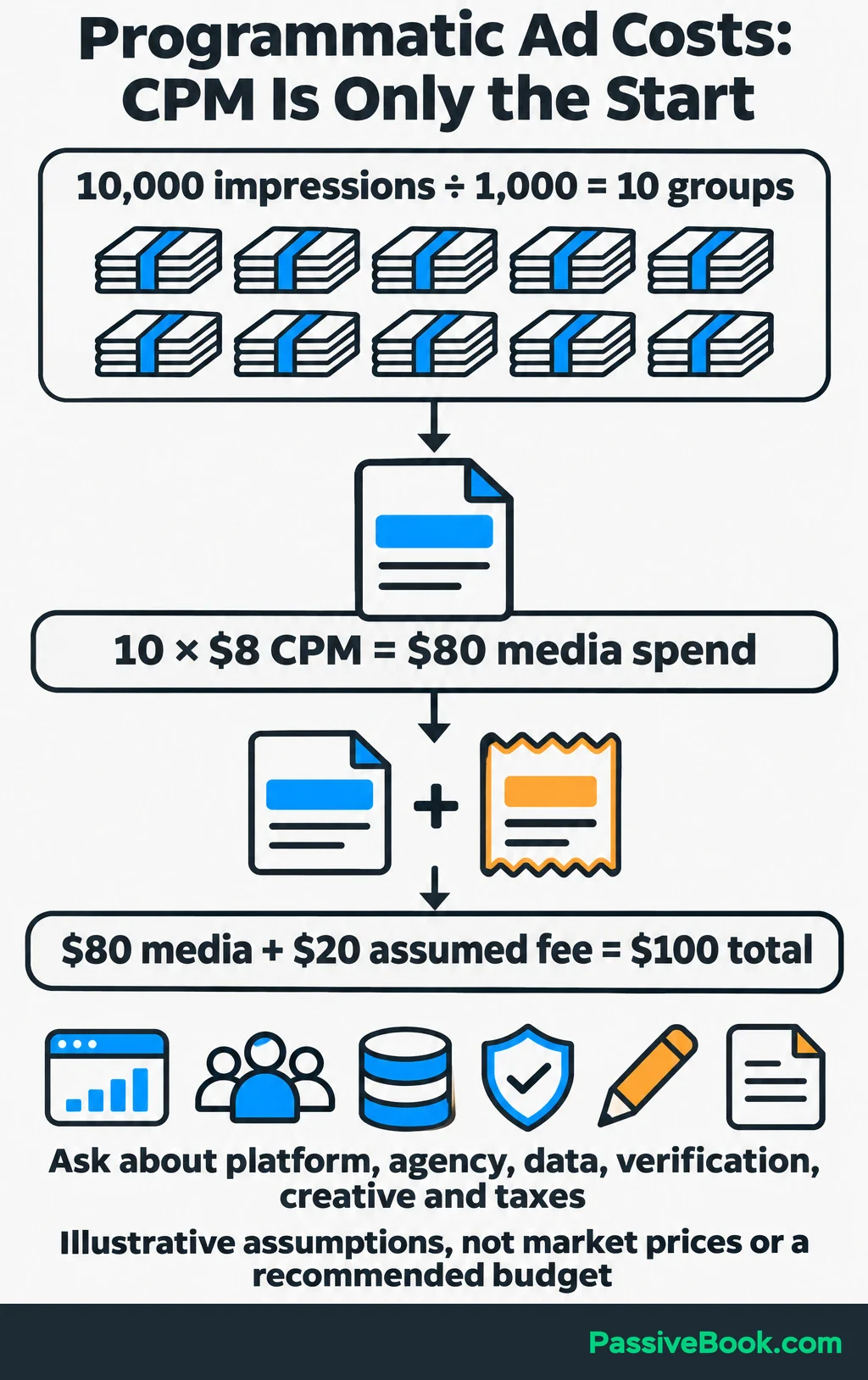
Ask for the total cost and what it includes before comparing providers.
Entry requirements vary too. AdRoll offers self-service, pay-as-you-go advertising, while other buying routes may involve managed services or larger commitments. An affordable entry point does not tell you how much evidence your test will produce.
Here is a worked example for the watercolor course. These are assumed figures for arithmetic, not market benchmarks or a suggested budget. Cost per attributed purchase divides this campaign’s total cost by the orders credited to it under the chosen attribution rules and windows.
| Item | Calculation | Amount |
|---|---|---|
| Media spend | 10,000 impressions ÷ 1,000 × $8 CPM | $80 |
| Other campaign costs | Assumed platform fee for this test | $20 |
| Total campaign cost | $80 + $20 | $100 |
| Ad-attributed revenue | Two purchases × $60 | $120 |
| Cost per attributed purchase | $100 ÷ two purchases | $50 |
Revenue exceeds campaign costs, but that still does not establish profit.
First, work out what each purchase contributes after costs that rise with sales, such as payment fees, royalties or per-sale support costs. This is contribution before advertising.
If each $60 purchase has $20 in variable costs, it contributes $40 before advertising. The two purchases contribute $80, but the campaign costs $100. That leaves a $20 loss before fixed overhead.
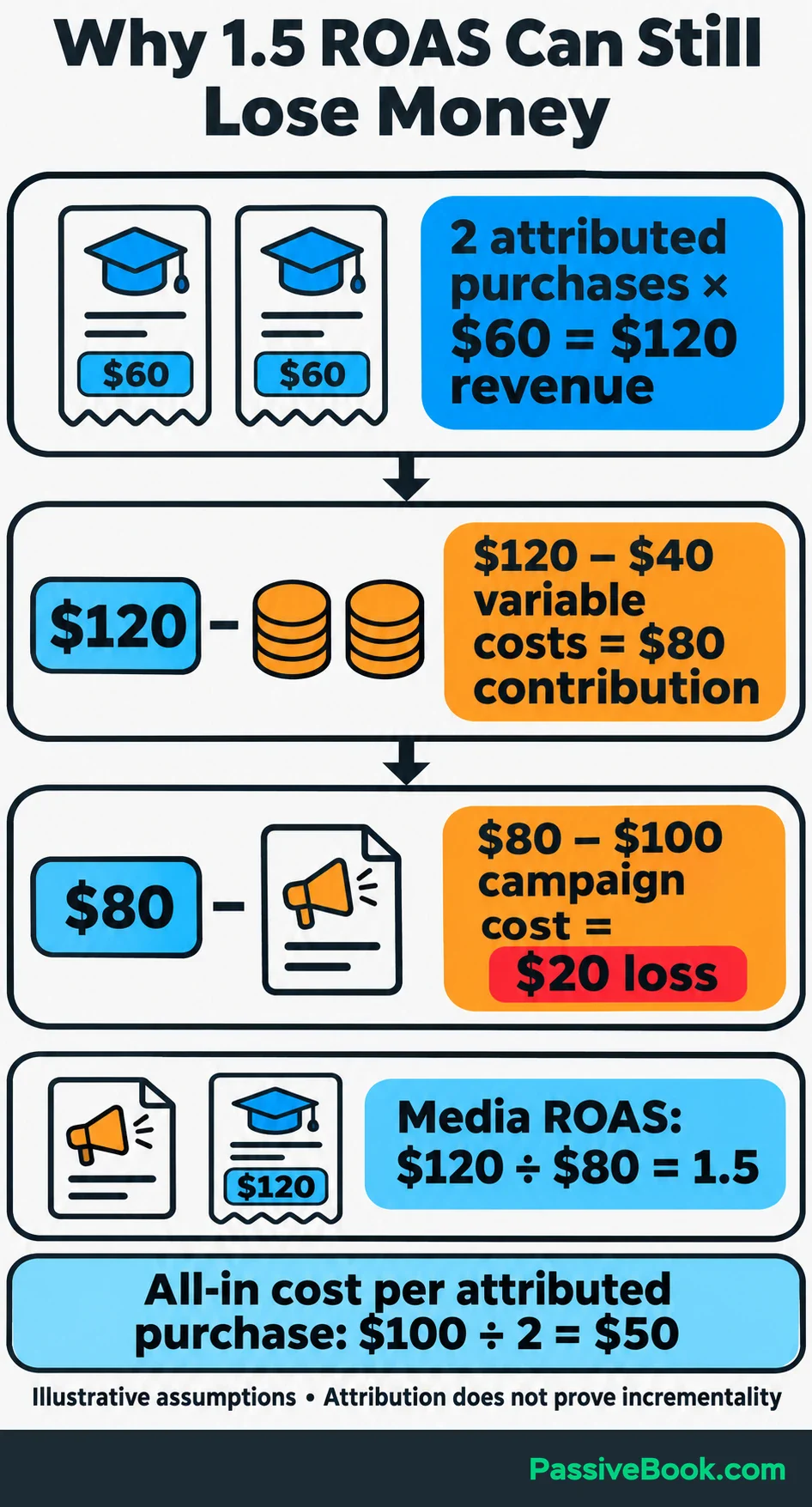
The media return on ad spend, or ROAS, looks better. It divides the revenue credited to this campaign by its media spend:
$120 attributed revenue ÷ $80 media spend = 1.5
That means $1.50 in attributed revenue per dollar of media spend. It leaves out the other campaign costs and the costs of fulfilling those sales.
When reviewing one of my digital-product offers, I found that my planning notes covered the selling price and production work, but left payment fees and buyer support outside the calculation. Putting them together changed what I could justify spending to win a sale.
I use that same rule here: judge acquisition cost against contribution, with room left for profit.
Before funding a test, run this check with your own numbers. Start with net revenue per purchase, non-ad variable costs and the contribution you want to keep.
Free Marketing Profit Calculator




Is Programmatic Advertising Right for Your Business?
Programmatic advertising is a legitimate buying method, and smaller businesses can access it. That does not make it the next channel every business needs.
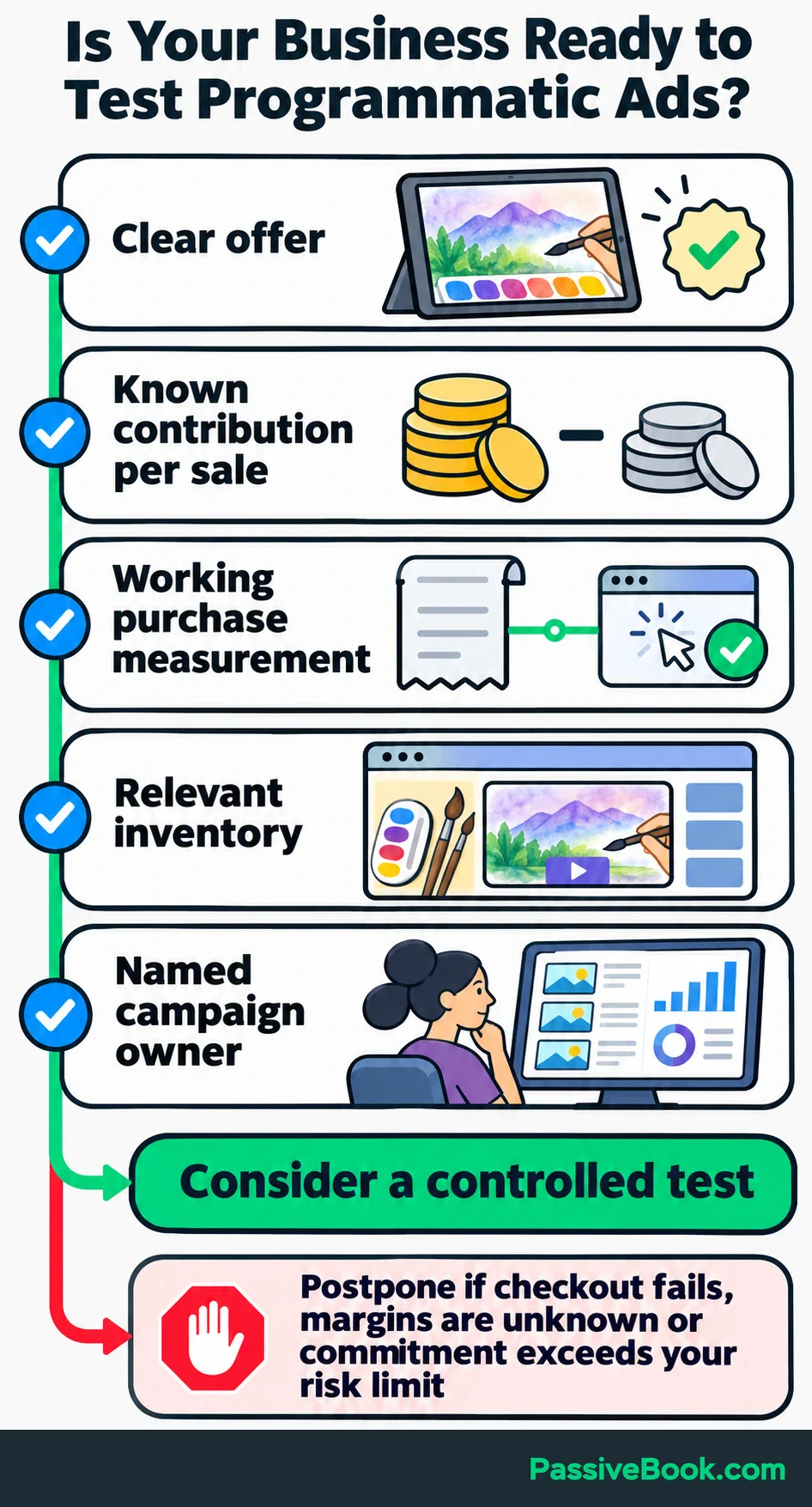
I would consider a test when you have:
- A clear offer: You can explain what buyers get and why they would pay.
- Known margins: You know what remains from each purchase before advertising.
- Working measurement: Purchases and order values are recorded correctly.
- Relevant inventory: The buying route can reach suitable publishing environments.
- Clear ownership: Someone will review placements, costs and results.
The benefit is automated access across publishers. The tradeoff includes intermediary fees, creative work, inventory quality and the effort needed to interpret reports.
Before buying, require enough placement and cost detail to assess what your money buys. I would skip a provider that sells “premium reach” but cannot explain where ads ran or how the bill was calculated.
Postpone spending if checkout is broken, margins are unknown or the minimum commitment exceeds what you can afford to risk.
My old jewellery store left me with unsold inventory because I had skipped market research. Faster distribution would not have fixed that decision. I want evidence that people want an offer before paying to put it in front of more people.
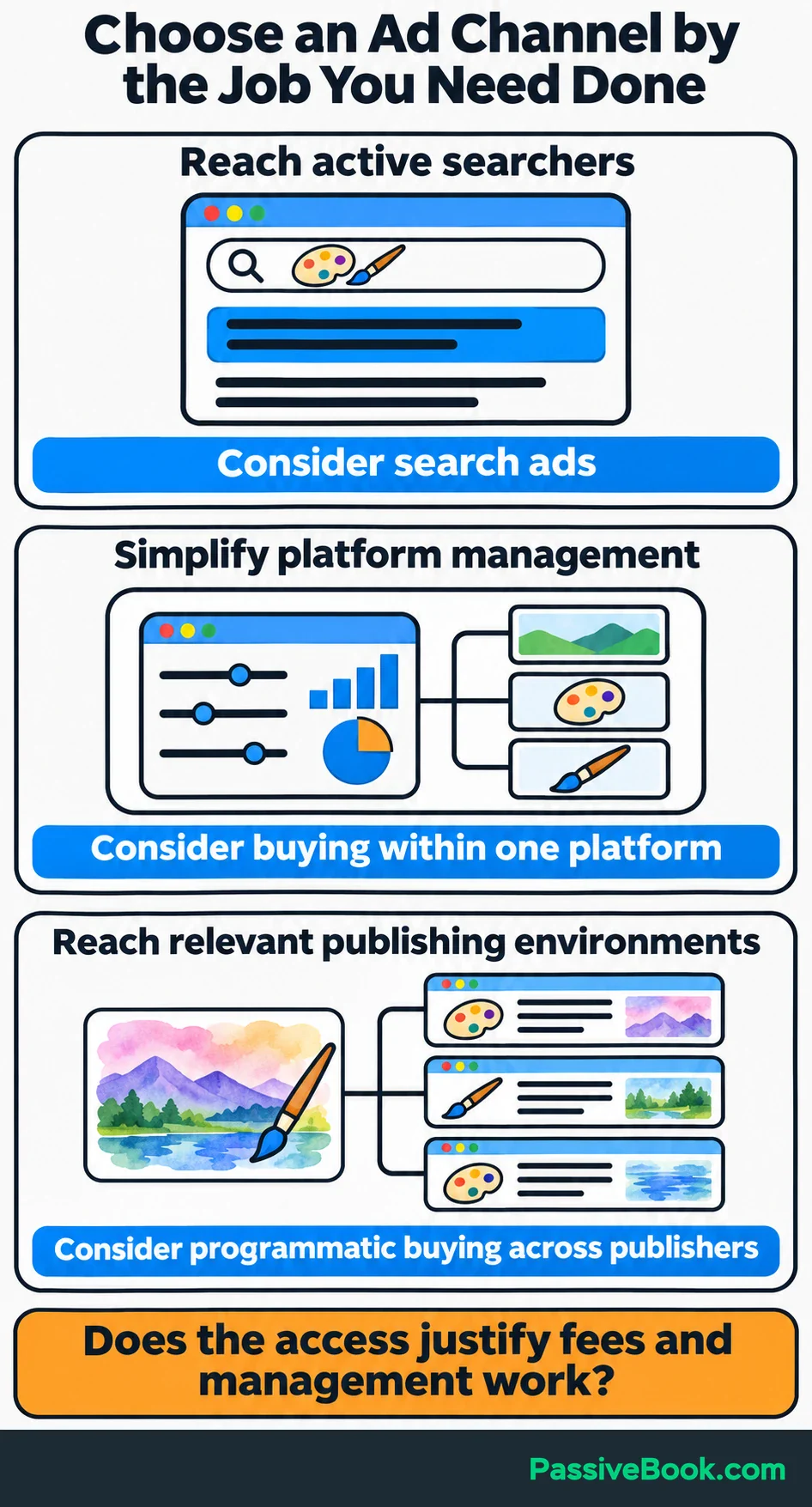
Compare channels by the job you need done. Search ads can reach people actively looking for a solution. Buying within one advertising platform can simplify management. Programmatic buying across publishers may help when you have a reason to reach people in those environments.
For the watercolor course, the question is whether access to potential students across relevant sites justifies the costs and management work.
How Do You Set up and Evaluate a First Campaign?
Define One Outcome and Prepare Measurement
Choose one main outcome before selecting settings.
For the course, I would track purchases and all-in cost per attributed purchase. For awareness, reach and frequency show how many people received ads and how often.
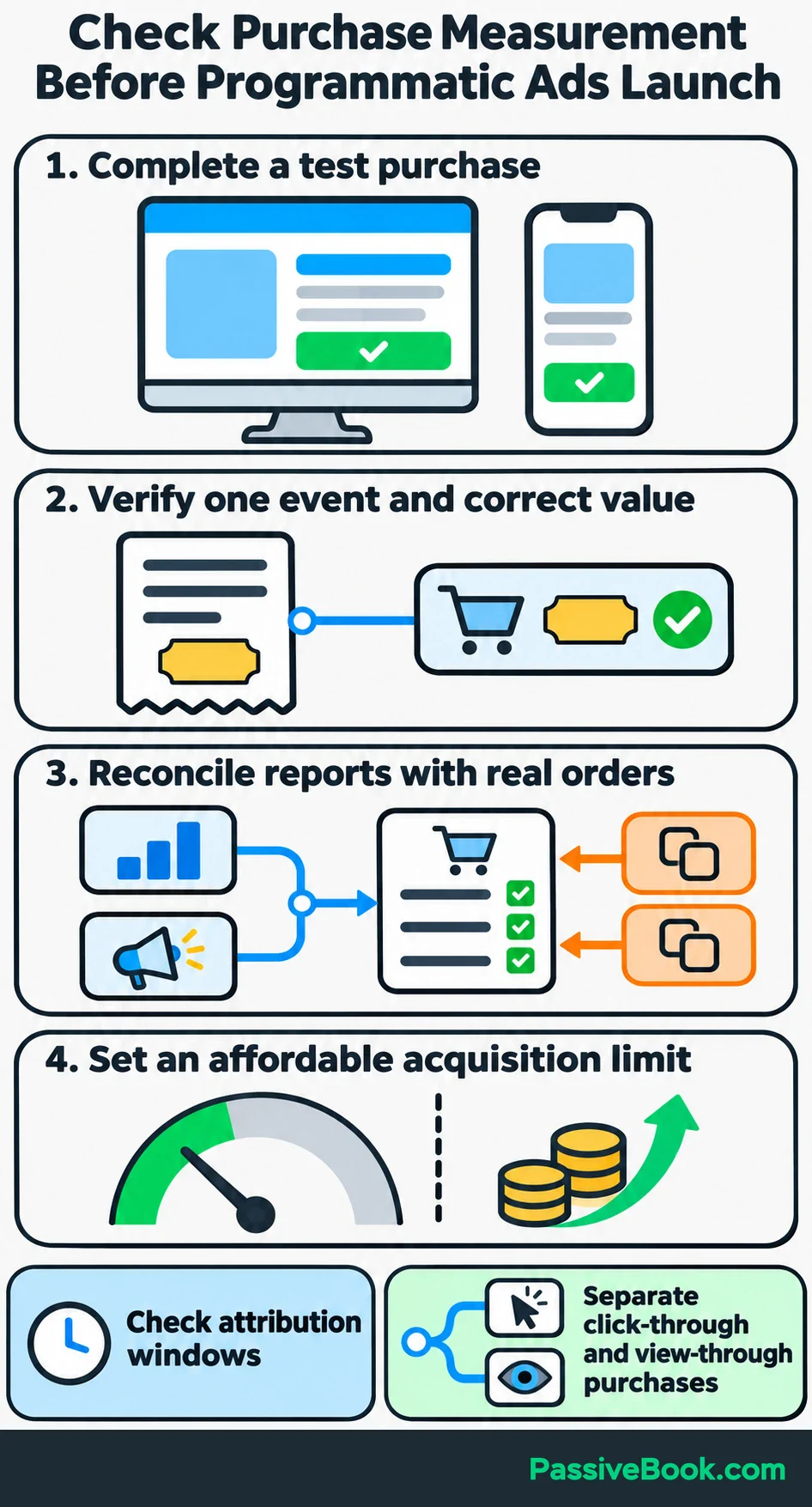
Before launch:
- Check the sales page on desktop and mobile, then complete a test purchase.
- Confirm the purchase event fires once with the correct order value.
- Check how the order appears in analytics and advertising reports.
- Set an acquisition-cost limit below contribution per purchase, leaving room for profit.
Check how long clicks and impressions remain eligible for purchase credit. Keep view-through purchases—credited after an impression without a click—separate from purchases following clicks. Reconcile reports with actual orders; several platforms can claim the same order.
Choose a Buying Route and Launch a Focused Test
Compare self-service buying with a managed service:
- Which relevant sites, apps or formats can I access?
- What fees and minimum spending commitments apply?
- Can I review actual placements?
- Who makes campaign decisions, and what support is included?
For the course, I would start with one offer, display ads and a few creative variations. Trying every format at once spreads a limited budget too thin.
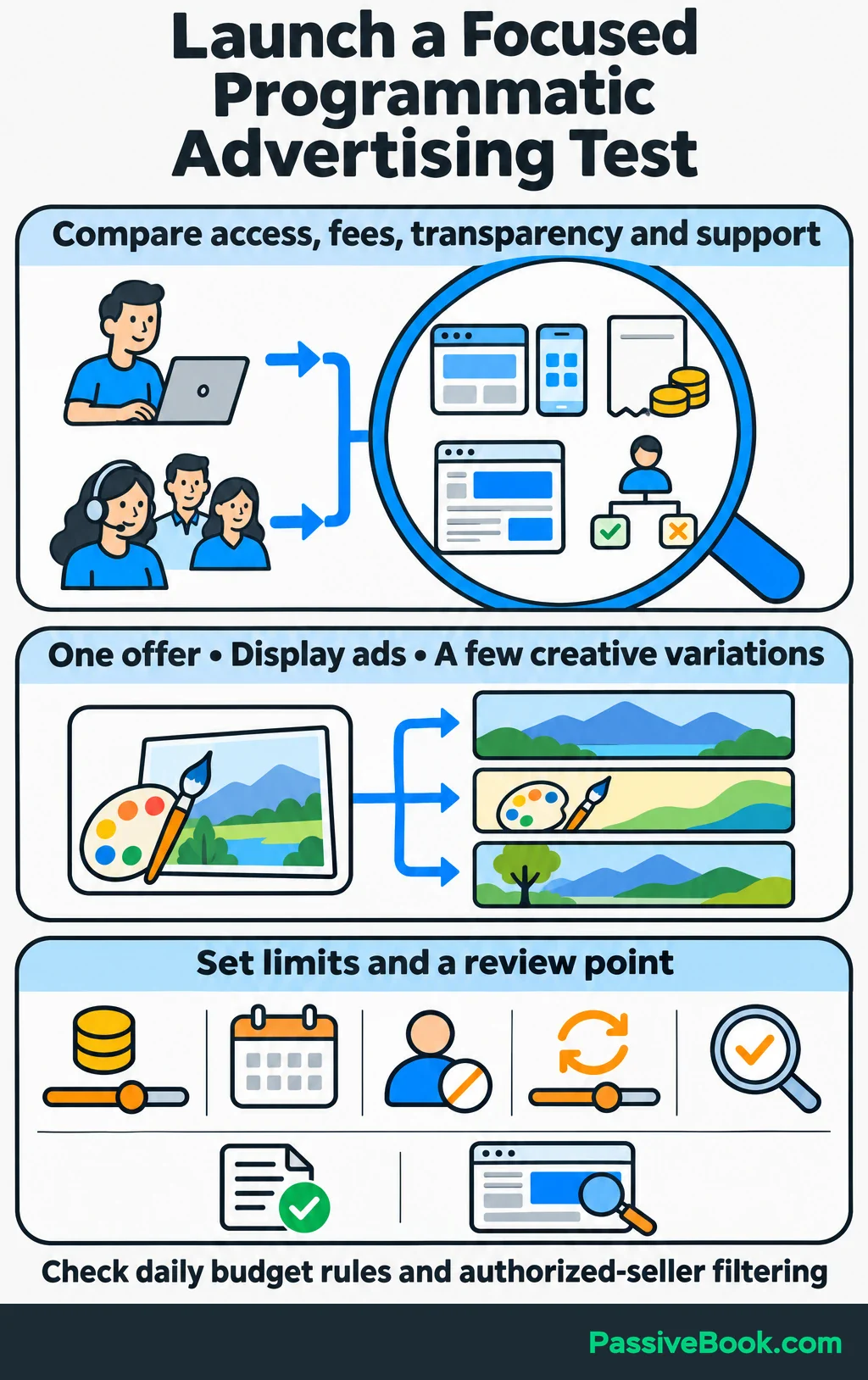
Set a total spending limit, schedule, purchaser exclusions, frequency controls and a review point. Check whether a daily budget is a hard cap or an average that allows higher spending on individual days.
Ask whether the provider filters for authorized sellers using the IAB Tech Lab’s ads.txt standard. Publishers use it to list who may sell their ad space, helping buyers avoid counterfeit inventory. Still review actual placements and traffic-quality controls.
Diagnose Results Before Increasing Spending
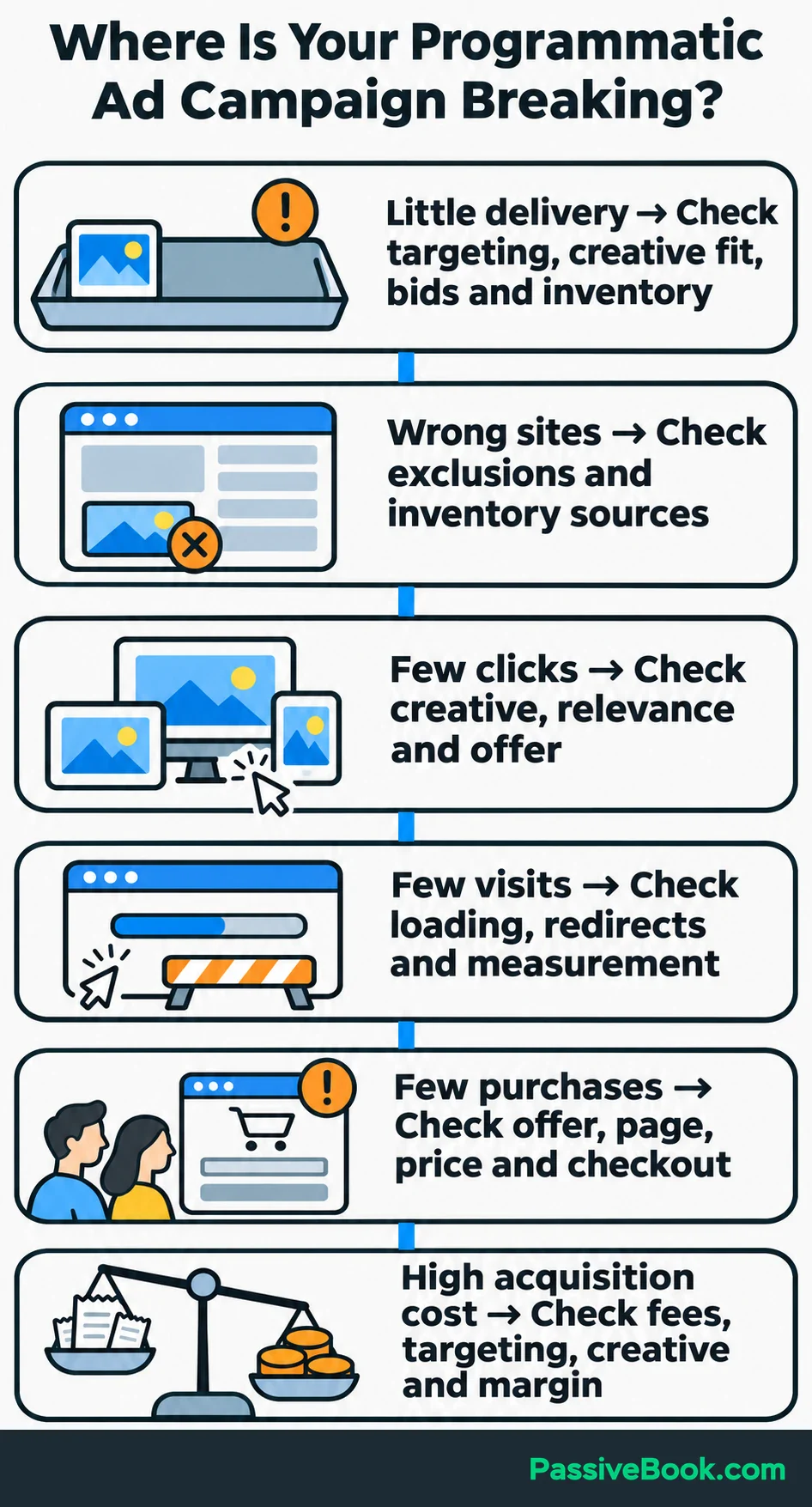
Review delivery, placements, visits, purchases and acquisition cost in that order:
| What You Observe | What to Investigate |
|---|---|
| Little delivery | Restrictive targeting, incompatible creative, bid limits or limited inventory |
| Ads on unsuitable sites | Placement controls, exclusions and the provider’s inventory sources |
| Impressions but few clicks | Creative clarity, relevance and the offer’s appeal |
| Clicks but few recorded visits | Page loading, redirects and measurement |
| Visits but few purchases | The offer, sales page, price, mobile experience and checkout |
| Purchases at excessive cost | Total fees, targeting, creative and contribution margin |
Click-through rate is an ad’s clicks divided by its impressions over the same reporting period, expressed as a percentage. It can help diagnose an ad, but a high rate does not tell you whether buyers were profitable.
Change what the evidence points toward. If checkout is failing, another banner will not repair it.
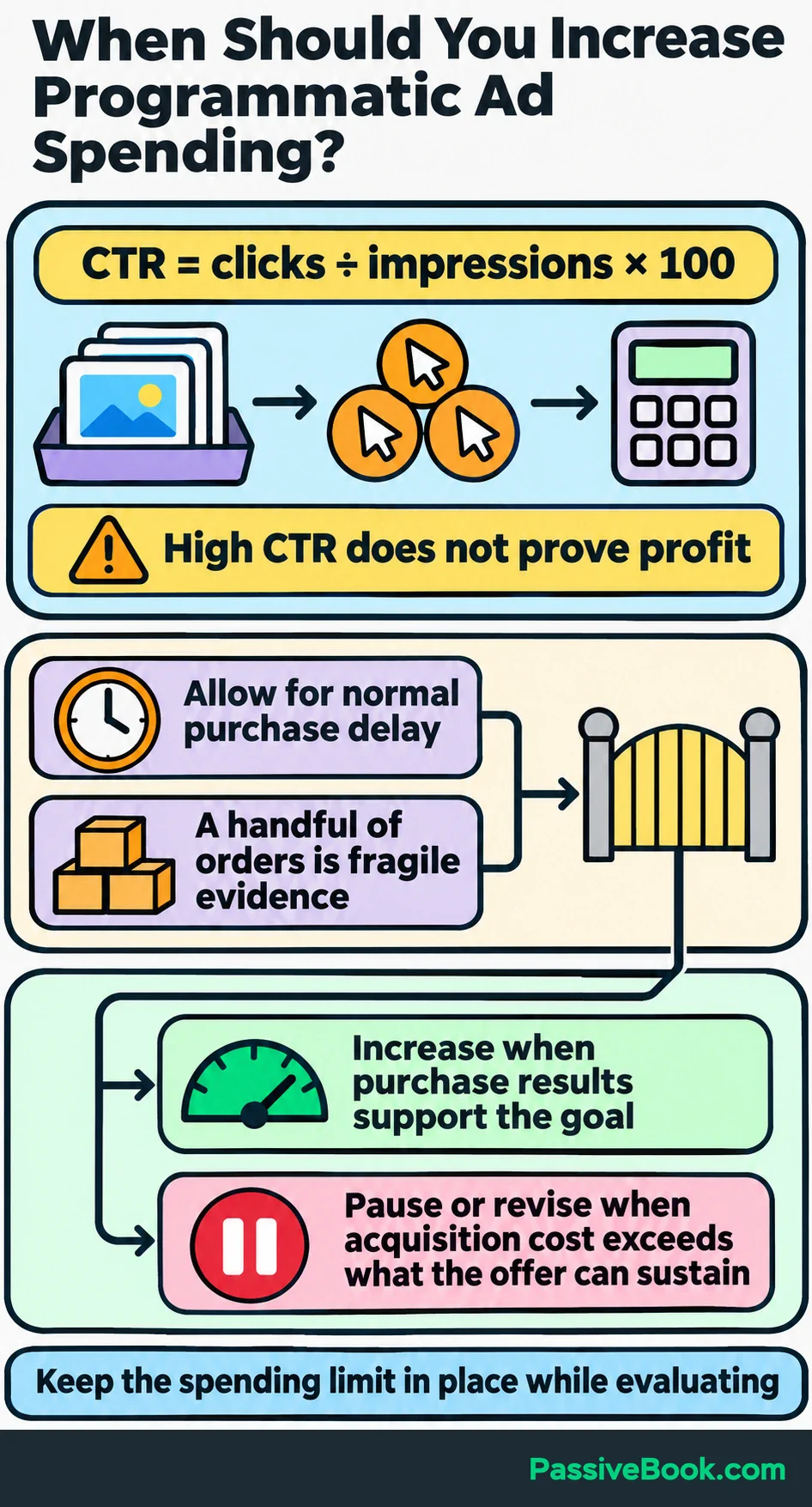
Allow for the time buyers normally take to purchase before judging recent traffic, while keeping the spending limit in place. A handful of orders is also a fragile basis for a large budget increase.
Increase spending when purchase results support your business goal. Pause or revise campaigns whose acquisition costs exceed what the offer can sustain.
What Next?
Write down what one purchase contributes before advertising, then set the highest acquisition cost that still leaves the profit you need. That gives you a useful standard before a platform starts showing you charts.
Use the social buttons to share this guide and make the chain from ad purchase to business profit easier to follow.
Which part would you need to understand better before funding a test: targeting, fees or purchase reporting? Leave your answer in the comments, along with any other questions.
Share this post with your friends & followers:

