You set aside money for ads, but how much of it can you spend to make one sale? The campaign settings offer plenty of choices and no clear answer.
A few clicks arrive, yet you still don’t know whether you’ve reached likely buyers. You could use up the budget before spotting an irrelevant search or a checkout problem.
That uncertainty makes another round of spending hard to justify. This guide follows one Google Search campaign from choosing an offer to reviewing its sales, so you can launch a controlled test and decide what to change before spending more.
How PPC Advertising Works
PPC means pay per click. You pay when someone clicks your advertisement.
Three other terms help you follow what happens:
- An impression is an appearance of your ad.
- A conversion is an action you want a visitor to complete, such as a purchase or enquiry.
- CPC means cost per click.
With a search ad, the journey looks like this:
- Someone searches for a product, service or solution.
- Eligible ads enter an auction.
- An ad appears in the search results.
- The person clicks and reaches your website.
- They decide whether to buy, enquire or leave.
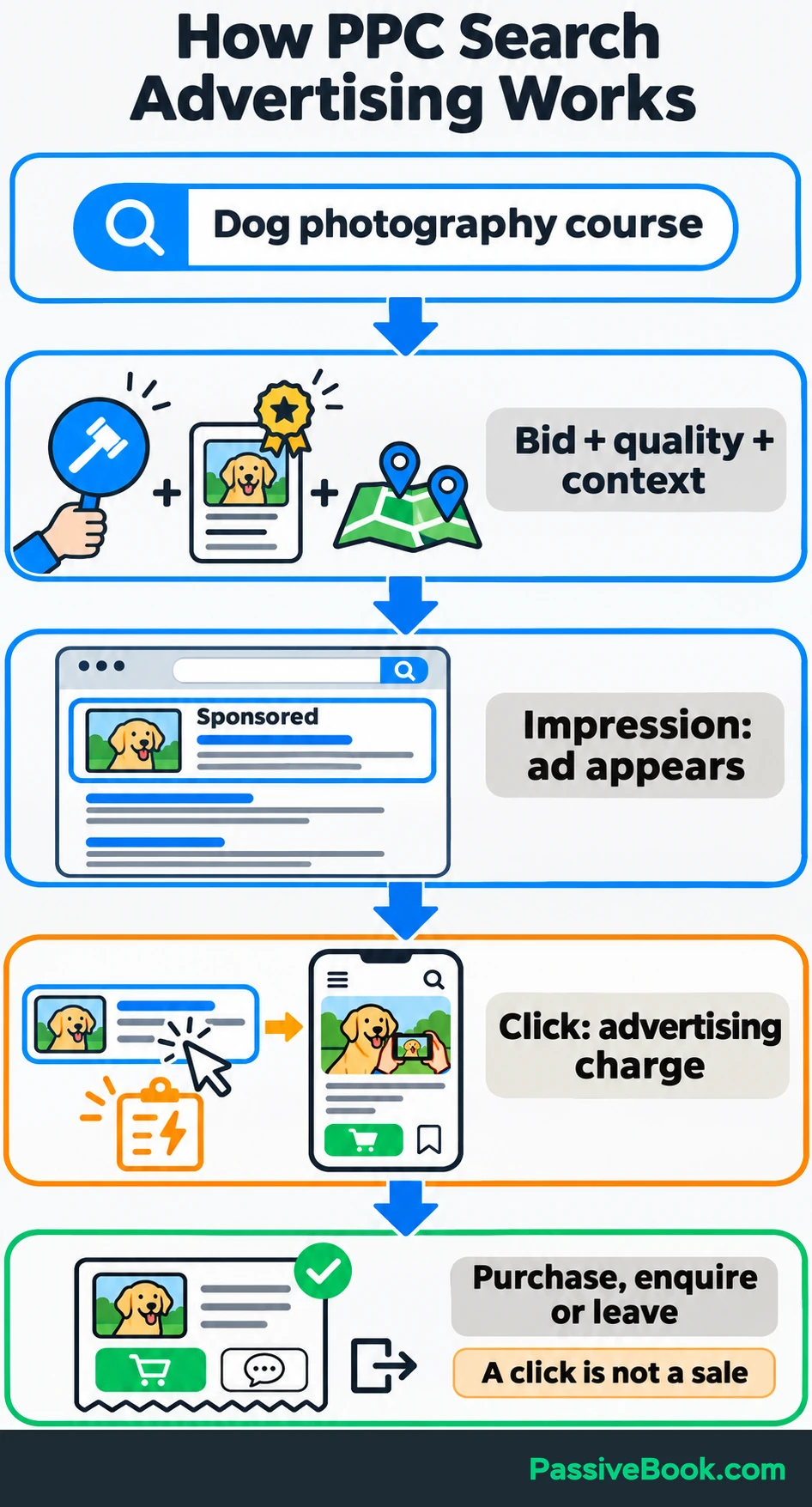
The highest bid does not automatically win the best position. Google also considers ad and landing-page quality, the search context, competition, eligibility thresholds and the expected usefulness of extra ad information. Google’s Ad Rank explanation describes those factors.
Search advertising responds to something a person is already looking for. Audience-based advertising, such as ads in a social feed, introduces an offer while people do something else. Paid ads can also charge for impressions, so check the charging model before comparing costs.
Throughout this guide, imagine you sell an online course teaching smartphone dog photography. The business, copy and all financial figures are illustrations, rather than benchmarks or predictions.
1. Choose an Offer and a Conversion Goal
Start with something specific to sell and a clear reason to buy it.
Before opening an advertising account, write down:
- Who needs the offer.
- What problem they want to solve.
- What they receive.
- What it costs.
- Why they would choose it over another option.
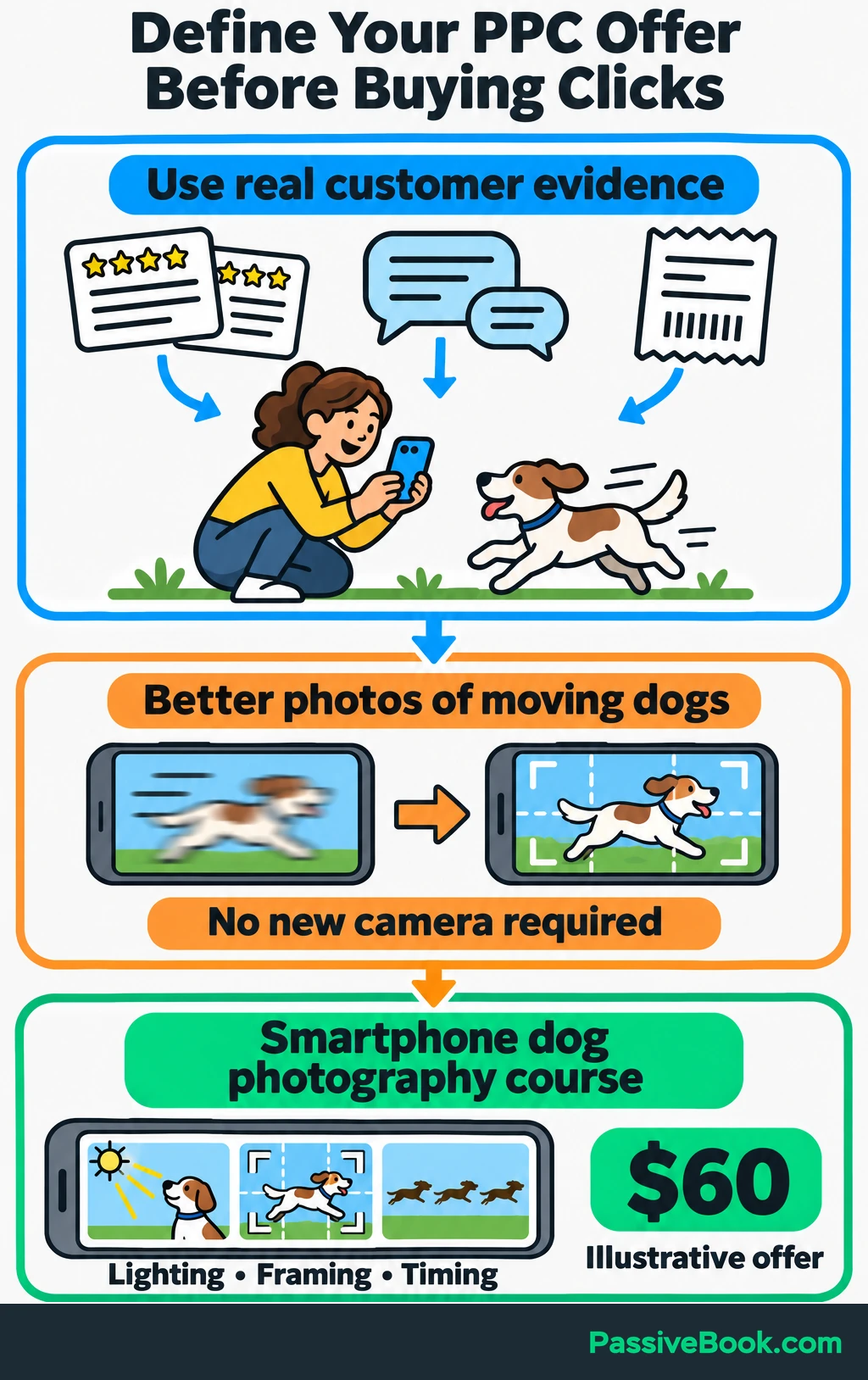
Use customer questions, reviews, enquiries and existing sales to make those answers concrete. “People like dogs” is a weak starting point. “People want better photos of their moving dogs without buying a camera” gives you a problem to investigate.
I skipped market research when I launched my online jewellery store. I bought inventory, accumulated unsold stock and lost most of my investment. That experience is why I would check the offer before paying to attract more people to it.
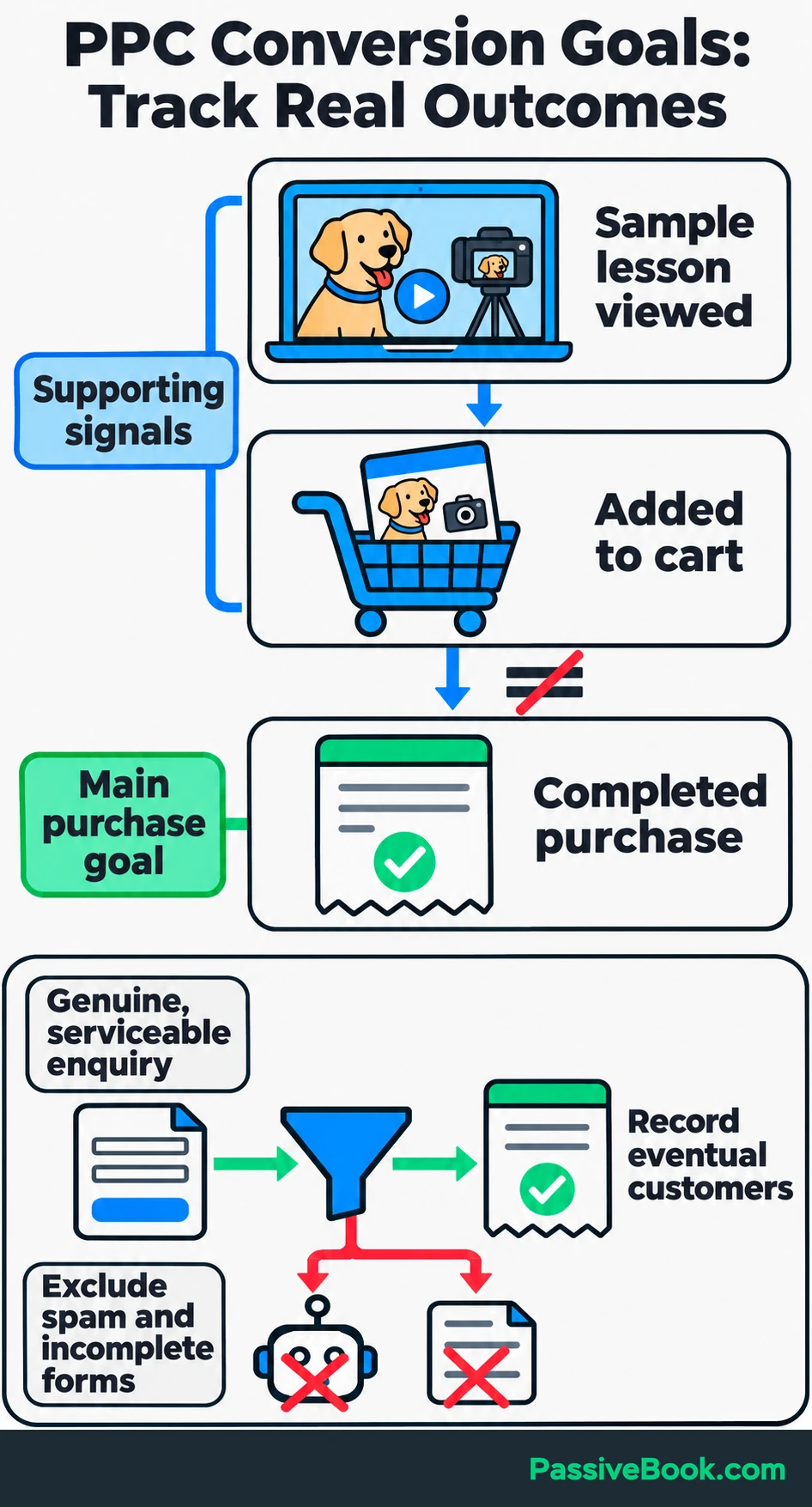
For the photography course, make completed purchases the main result you track. Watching a sample lesson or adding the course to a cart can help explain visitor behaviour, but neither is a sale.
If your campaign seeks enquiries, define a useful lead. A genuine request from a person you can serve is different from an incomplete form or a spam submission. Record which leads eventually become customers.
Calculate Your Target Cost per Acquisition
First, work out how much each sale leaves before advertising.
Subtract costs that increase with sales, including payment fees, fulfilment, expected refunds and extra customer support.
For the example course:
| Item | Amount per purchase |
|---|---|
| Selling price | $60 |
| Variable costs | $15 |
| Contribution before advertising | $45 |
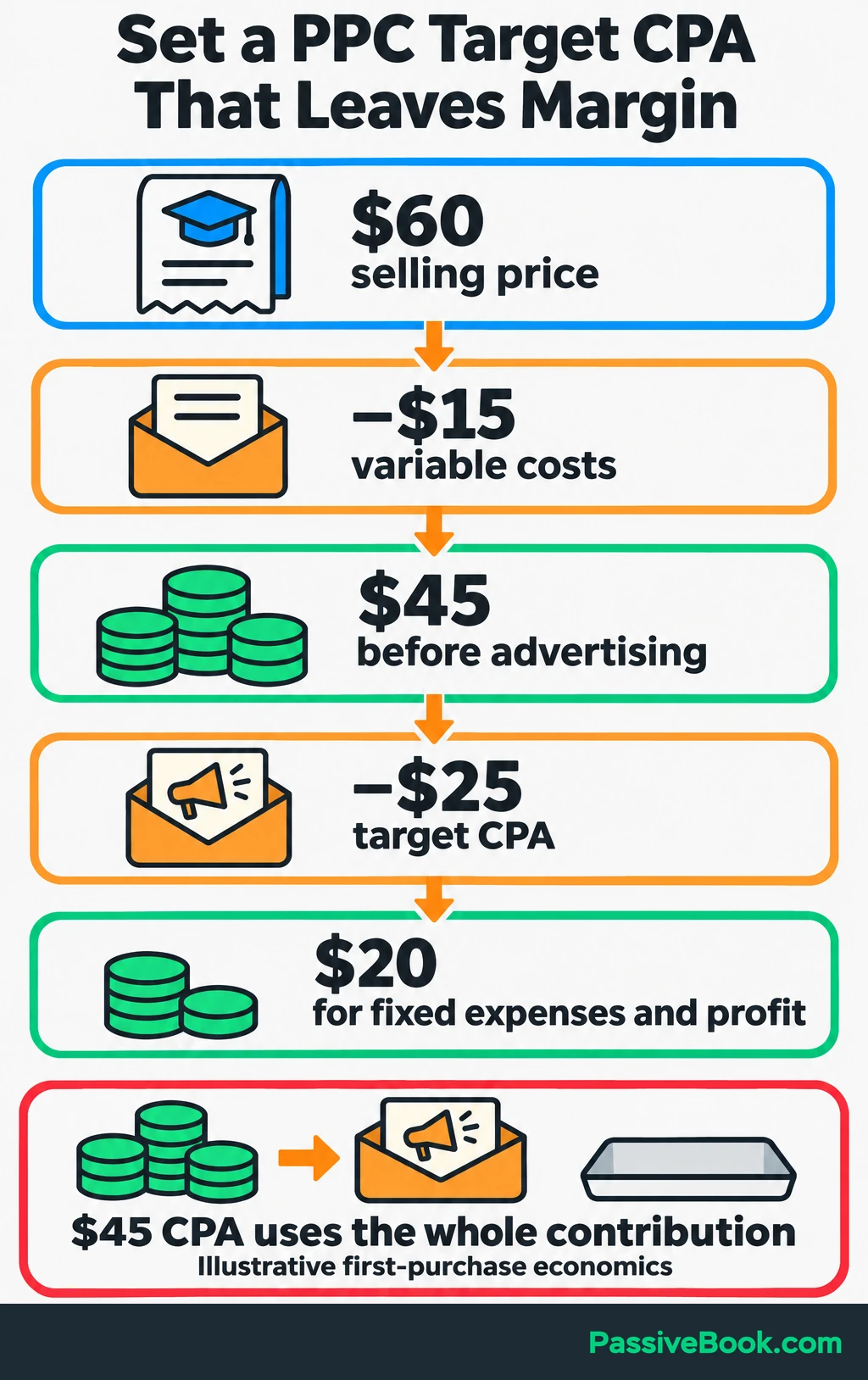
Spending $45 to acquire that purchase uses the entire contribution. Nothing remains for fixed expenses or profit.
I would set a lower target cost per acquisition, or CPA. Here, the target is $25 per purchase, leaving $20 toward remaining expenses and profit.
For an enquiry campaign, use the share of leads that become customers to estimate an affordable lead cost. If you can spend $100 to acquire a customer and 20% of qualified leads buy, your target cost per qualified lead is:
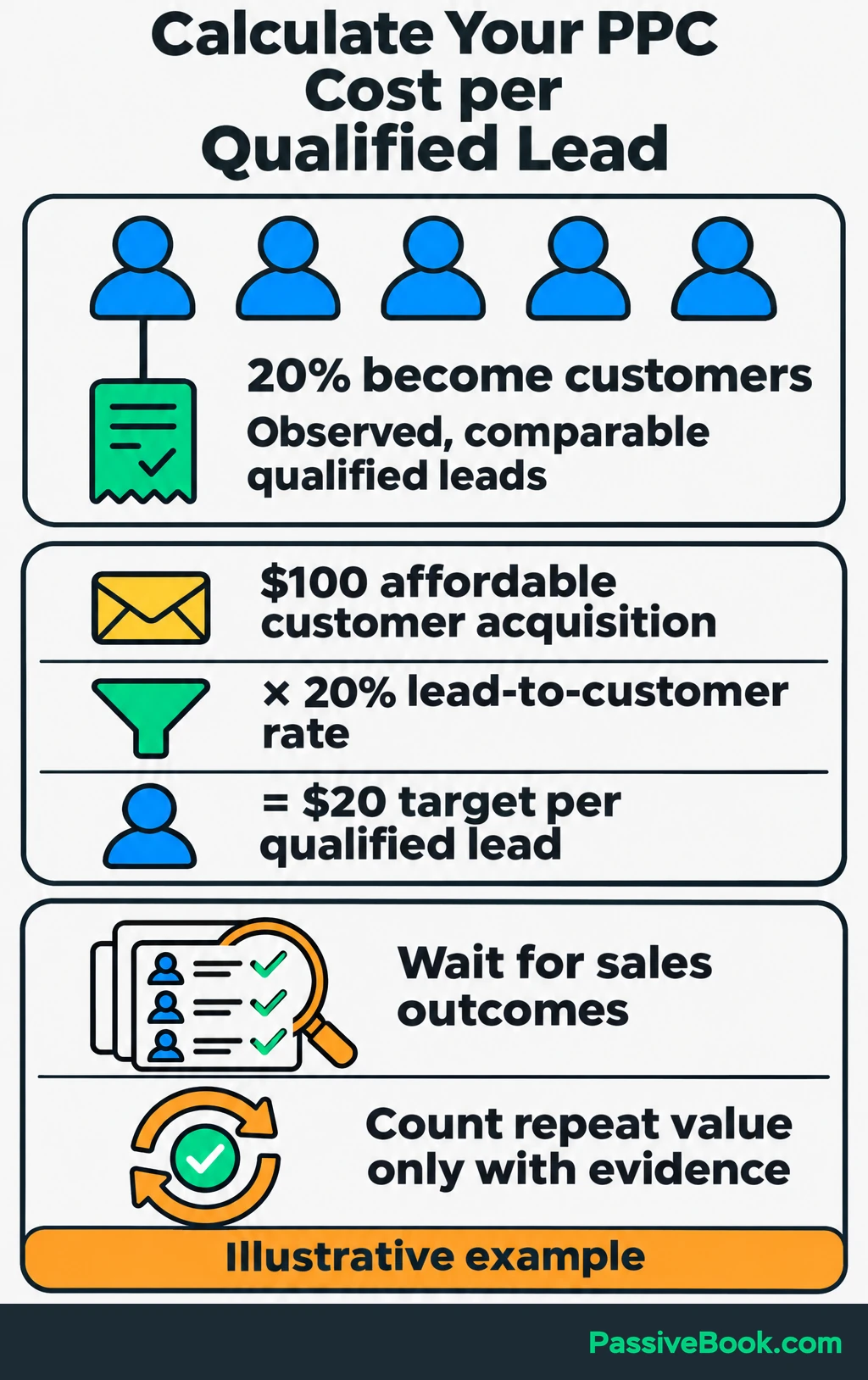
$100 × 20% = $20.
Use a lead-to-customer rate from comparable leads whose sales outcomes you have had time to observe. An optimistic guess can make an expensive campaign look affordable.
Base your initial allowance on the first purchase. Add repeat-purchase value only when your customer records support it.
2. Choose Your First Advertising Platform
Choose a platform according to how people discover your offer, what you can show them and where they buy.
| Platform | Customer context | Suitable offer | Creative required | Destination |
|---|---|---|---|---|
| Google Search | Someone searches for a solution | A course or service with relevant buying searches | Text headlines and descriptions | Your matching offer page |
| Microsoft Search | Someone searches through Bing or search partners | An offer with relevant demand in that audience | Text headlines and descriptions | Your matching offer page |
| Meta: Facebook and Instagram | Someone encounters the offer while browsing | A product or lesson you can demonstrate visually | Images or short video with copy | Your offer page |
| Amazon Sponsored Products | Someone browses marketplace products | An eligible product sold on Amazon | Product listing images and information | The Amazon product detail page |
Amazon Sponsored Products supports marketplace purchases. It would not send buyers to the example course’s website checkout, and seller and product eligibility matter. Amazon explains the requirements and destination.
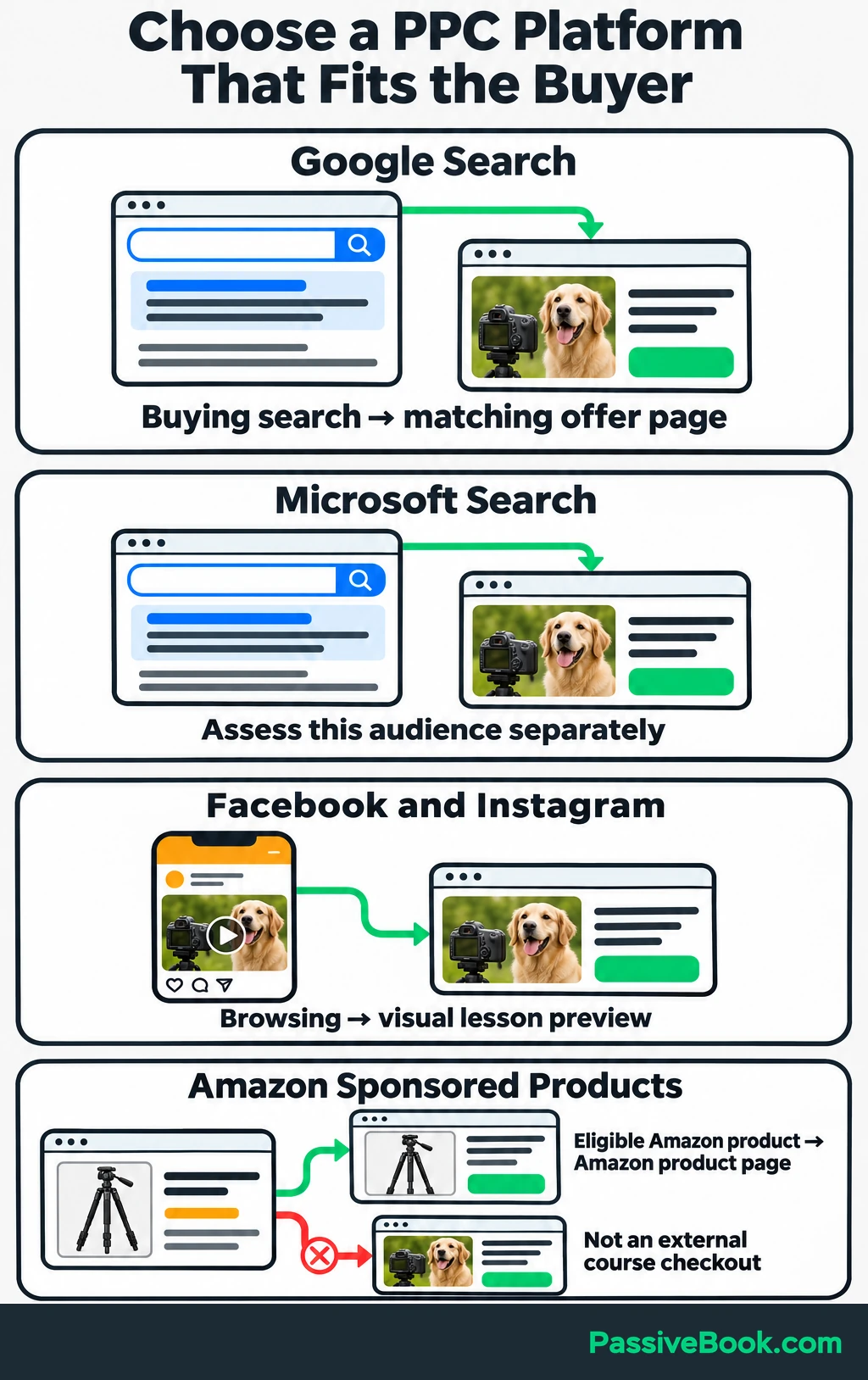
A short photography lesson could give Meta viewers a useful preview. Search ads offer a different opportunity: reaching people already looking for lessons.
We’ll use Google Search for the walkthrough because you can follow the connection between a search, an ad and a purchase. I would choose it for the first test only after checking that relevant searches exist at a plausible cost.
Keep that test on one platform. Microsoft Search deserves its own cost and performance assessment, rather than an assumption that Google’s results will carry over.
3. Find Searches That Match Your Offer
Gather phrases from customer questions and product reviews, then investigate searches that suggest someone wants your solution. Use relevant phrases as keywords—the words you give the platform to help match your ads to searches.
For the course, starting ideas include:
- “online dog photography course”
- “smartphone dog photography lessons”
- “dog photography course for beginners”
Search those phrases and inspect the results. Are people looking for lessons, a photographer to hire, camera equipment or free pictures? The words can overlap while the buying need differs.
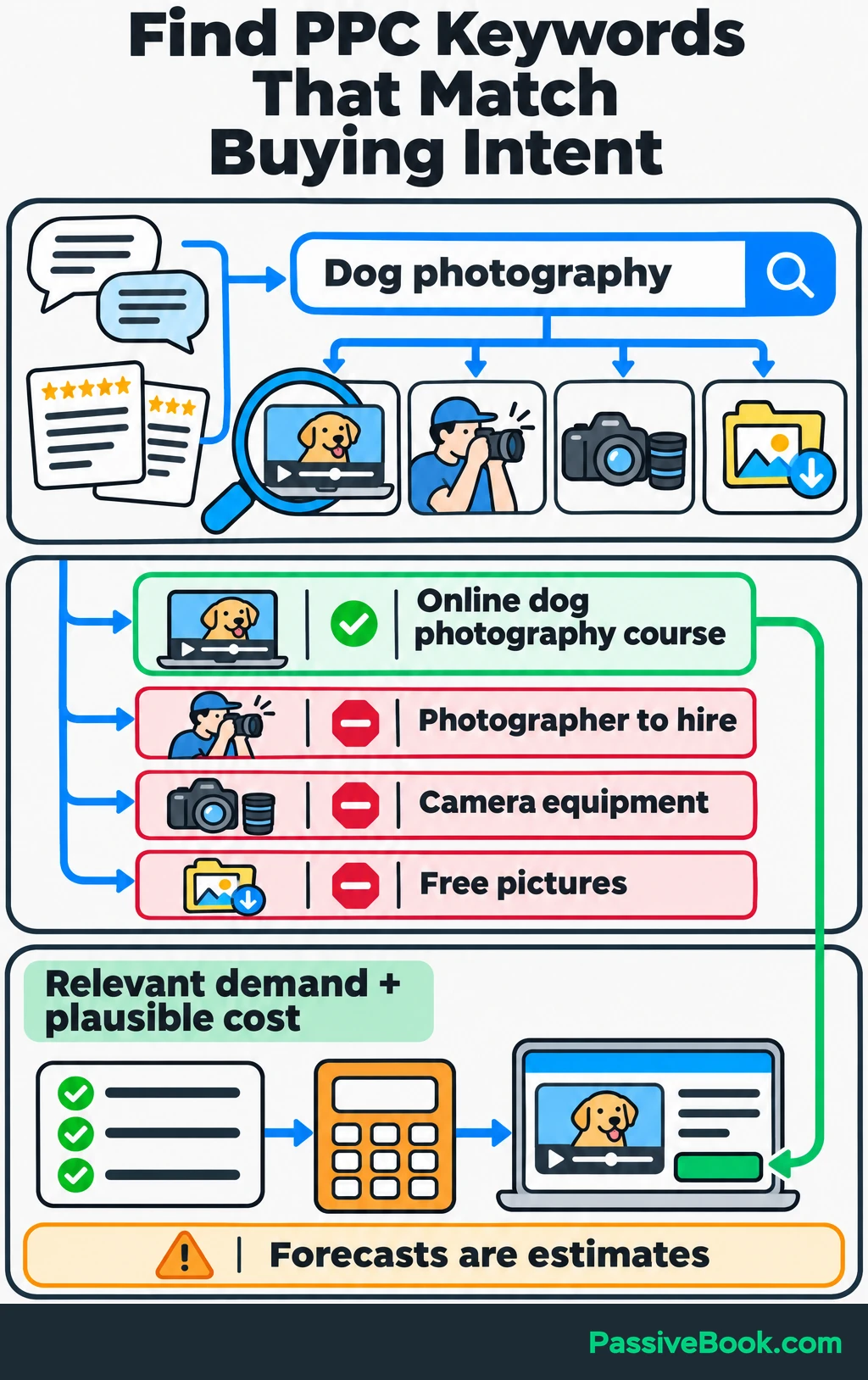
Google’s Keyword Planner helps you investigate search demand and estimated advertising costs in your chosen market. Access requires completed account setup, including billing details. Check the account’s currency and time zone, and keep the campaign inactive while preparing it.
Use the planner to compare relevant terms and build a forecast. Its estimates help with planning; they do not establish what your campaign will achieve. Google explains how its forecasts work.
I would choose a smaller set of relevant, affordable searches over a large list with impressive volume. Paying to reach the wrong need does not become useful at scale.
Choose Keyword Match Types
Match types control how closely a search must relate to your keyword.
| Match type | Example entry | Searches it can reach |
|---|---|---|
| Exact | [dog photography course] | Searches with the same meaning or intent |
| Phrase | "dog photography course" | Searches that include the keyword’s meaning |
| Broad | dog photography course | Searches related to the keyword |
Exact match does not mean identical wording. Phrase match also works through meaning, rather than simply requiring an unchanged string of words. Google’s matching rules explain the distinction.

For this controlled test, I would start with selected exact and phrase keywords. Then review the search terms—the actual searches that triggered your ads.
Treat broad match as a separate expansion test once purchase tracking works. Google recommends pairing it with Smart Bidding, which adjusts bids for individual auctions using conversion signals.
Exclude Irrelevant Searches
Negative keywords prevent ads from appearing for specified searches.
For the photography course, clear mismatches could include photography jobs, stock-photo downloads and camera repairs. Add exclusions that reflect those unwanted searches.
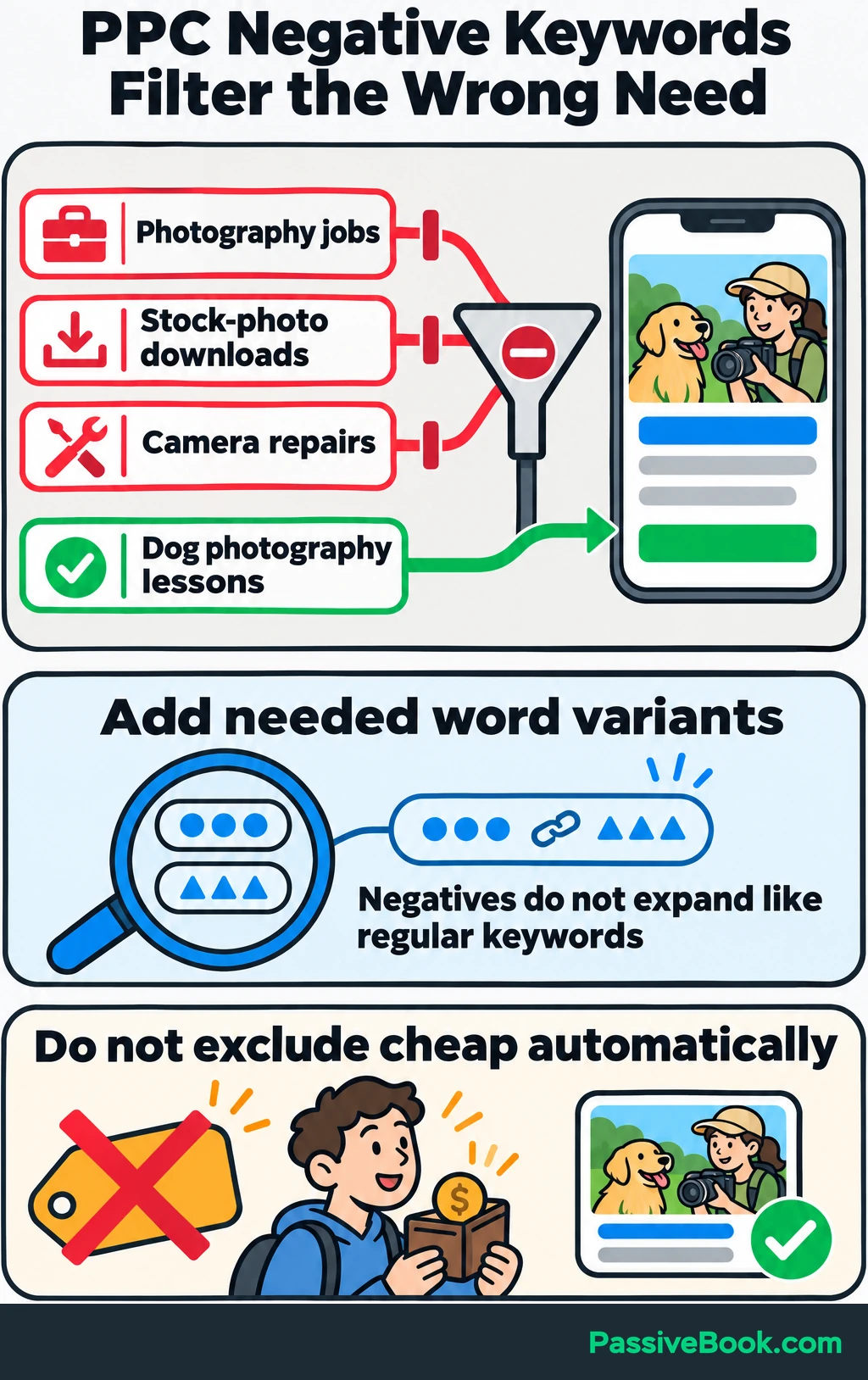
Avoid copying a giant negative-keyword list without reading it. Excluding “cheap,” for example, could remove people who would consider your course.
Negative keywords do not automatically cover synonyms or singular and plural versions, so include those when needed. Google’s negative-keyword rules differ from its regular keyword matching rules.
4. Set a Controlled Test Budget
Choose the total amount you can afford to spend before choosing a daily budget.
Write down the question the test should answer. For example:
Can relevant course-buying searches produce purchases near my $25 target CPA?
Then set a spending stop point. Track page-building, software and management costs separately so you can include them when assessing the full acquisition cost later.
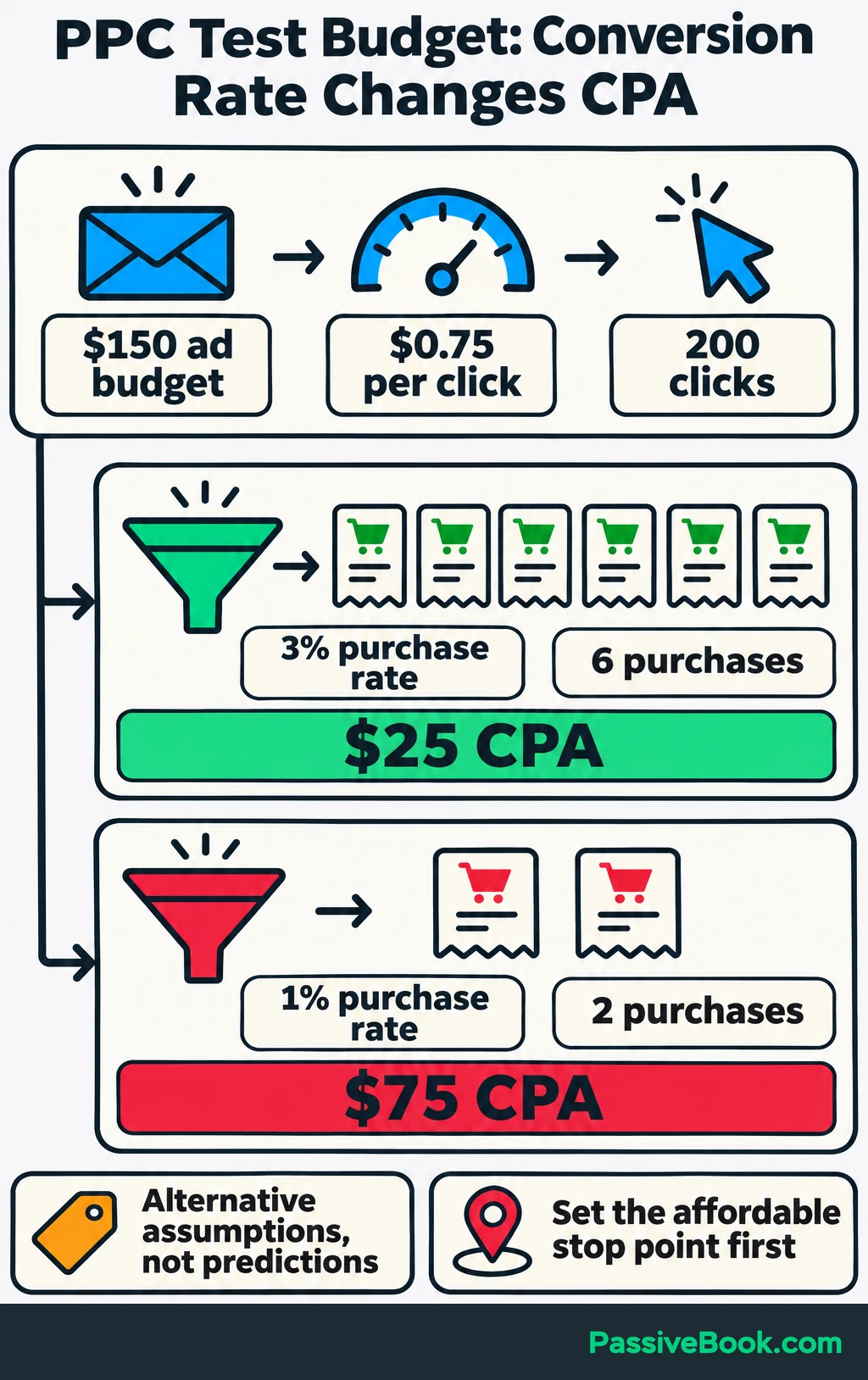
To estimate the traffic your allowance might buy, divide the advertising budget by the expected average click cost.
A $150 budget at $0.75 per click buys 200 clicks.
To estimate purchases, assume what share of those clicks will lead to a purchase. That share is the purchase conversion rate. Multiply the clicks by that rate:
- At 3%, 200 clicks produce six purchases and a $25 CPA.
- At 1%, 200 clicks produce two purchases and a $75 CPA.
That difference matters more than a small saving on each click.
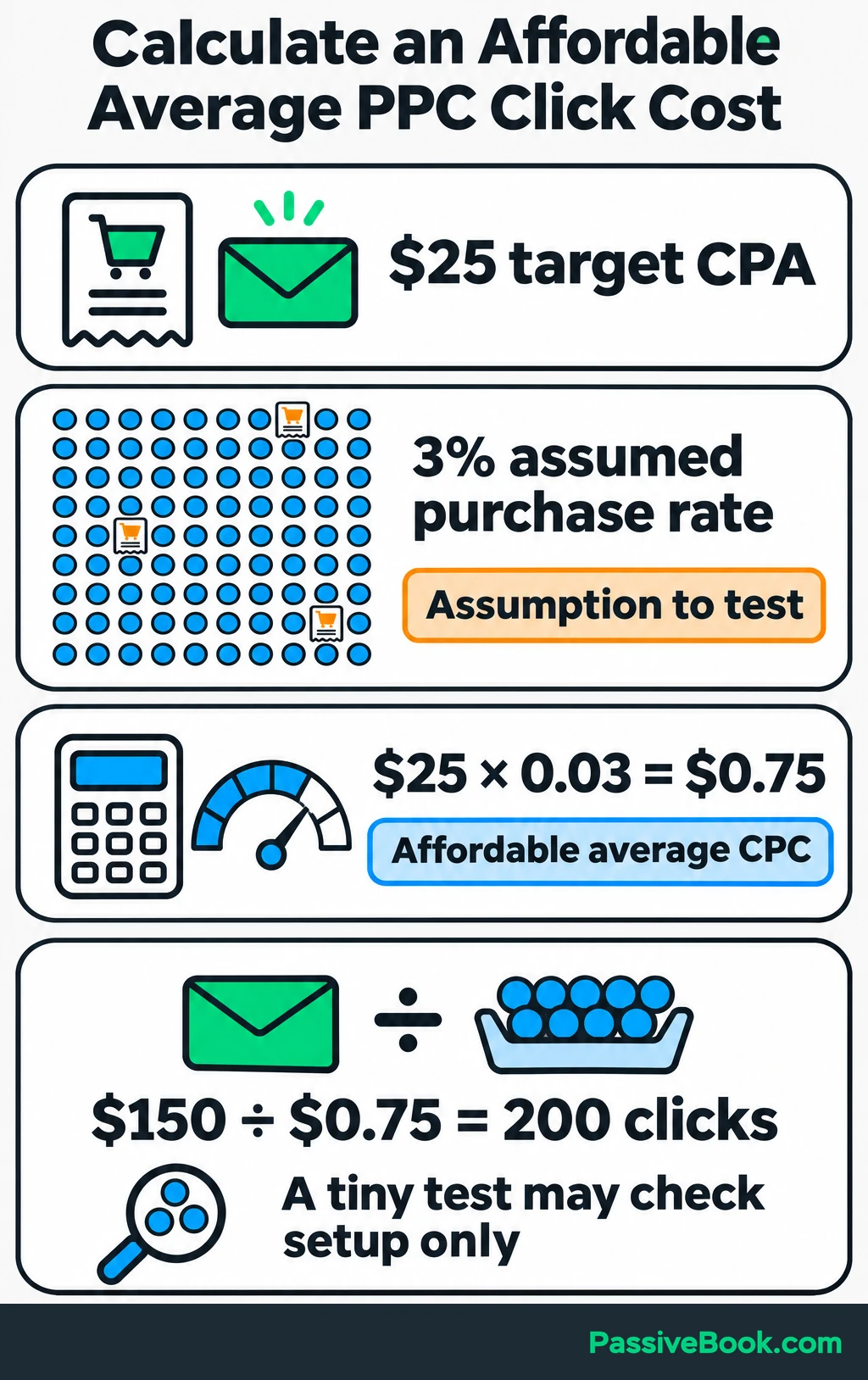
You can also work backwards. Multiply your target CPA by the assumed purchase conversion rate to estimate an affordable average CPC:
$25 × 3% = $0.75.
The 3% assumption needs testing. It is not a rate you should expect merely because it appears in this example.
If your allowance buys too little relevant traffic to answer a useful question, reconsider the offer, targeting or channel. A tiny test can check setup and relevance without proving profitability.
Apply Spending Controls
For a fixed test, I would use a campaign total budget when creating the new Search campaign. Set the total allowance and start and end dates within the supported 3–90-day period.
Google says you will not be charged above that total, but there is no daily spending limit. Choose carefully during creation because you cannot switch the campaign’s budget type afterward. Google’s campaign total budget rules explain these controls.
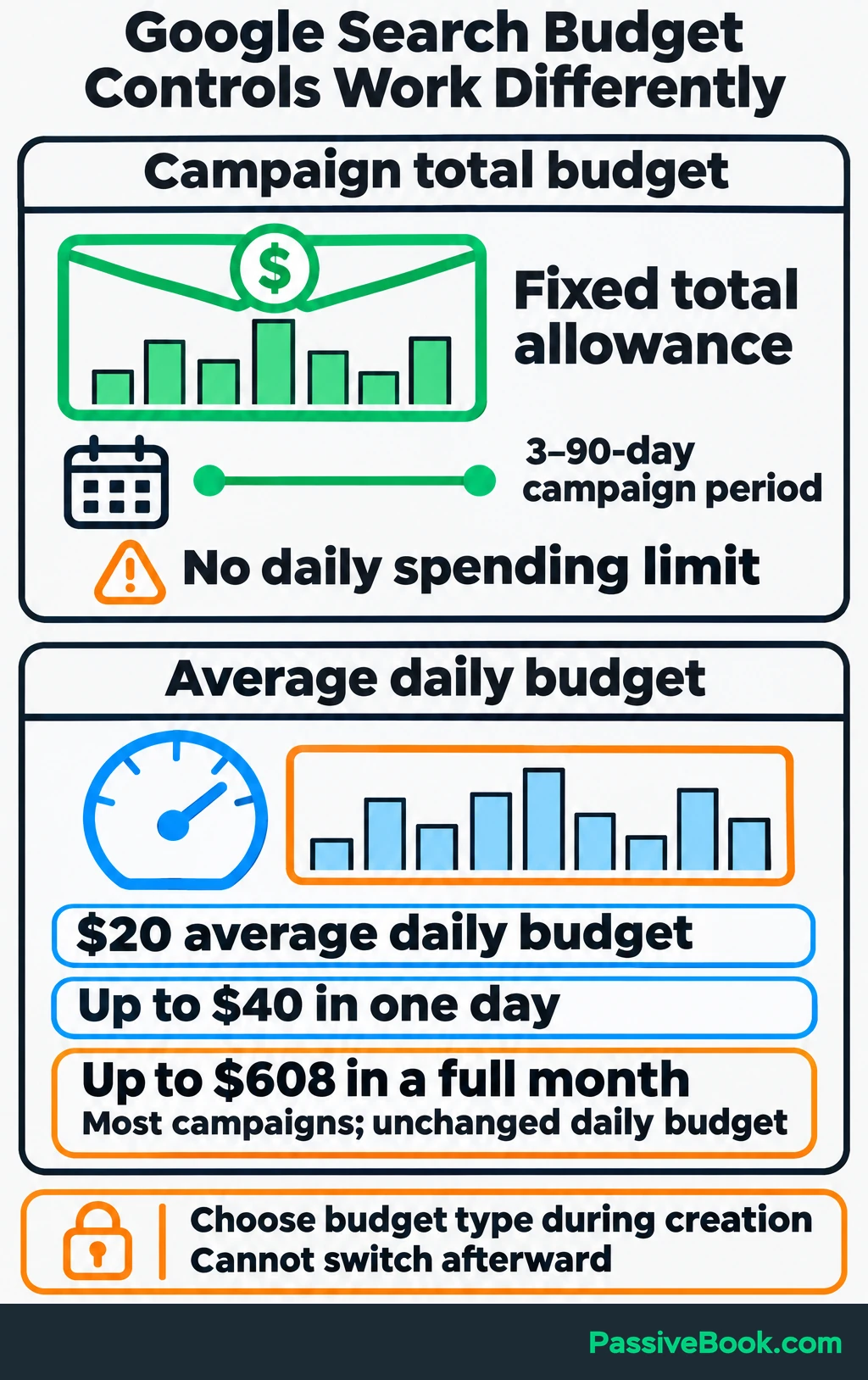
An average daily budget works differently. For most campaigns, billing can reach twice that amount on a day and 30.4 times it over a full month with an unchanged budget.
For example, an unchanged $20 daily budget allows up to $40 on a day and $608 over a full month. Budget changes affect those limits. Google’s spending-limit guidance covers the conditions.
A daily amount is a pacing choice. Choose the total affordable commitment first.
5. Build a Landing Page That Fulfils the Ad’s Promise
Send the visitor directly to the advertised offer.
The search, ad and page should describe the same thing. Someone who clicks an ad for smartphone dog photography lessons should immediately find those lessons, rather than a general homepage.
For the course page, show:
- What the lessons cover.
- A sample lesson.
- The $60 price.
- What smartphone or other equipment is needed.
- How course access works after payment.
- A clear purchase button.
- Contact, payment and refund information.
A suitable headline could be:
Learn to Photograph Your Dog With Your Smartphone
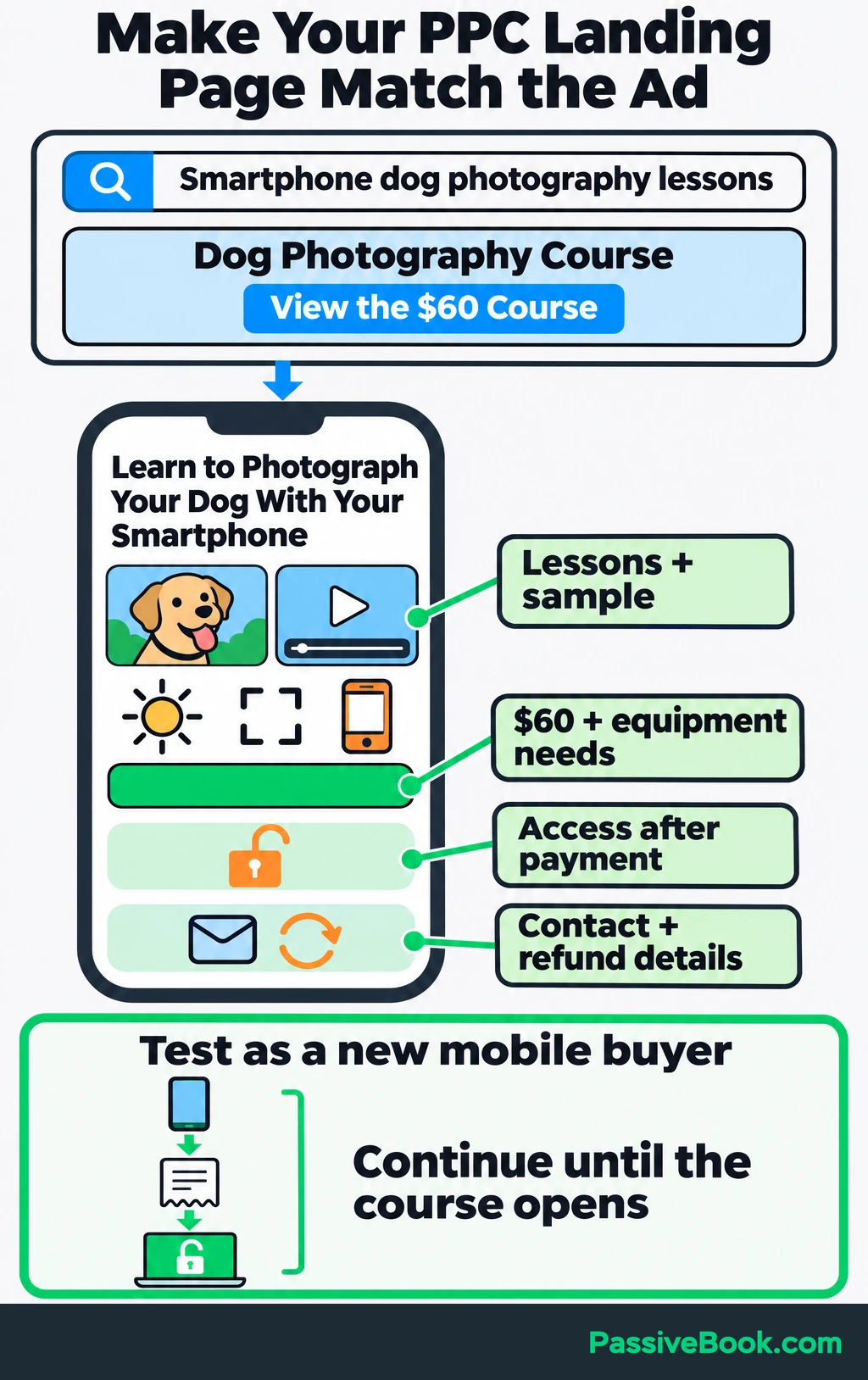
Follow it with a concrete explanation of the course, such as lessons on lighting, framing and timing. Show what buyers will learn instead of promising that every photo will become a masterpiece. Dogs have other plans.
I would build this on the existing website if it supports checkout properly. On WordPress, GenerateBlocks can handle the page and WooCommerce can handle the sale. A separate landing-page subscription needs to solve a problem before it earns another bill.
Test the entire journey on mobile: loading, reading, watching the sample, paying, receiving confirmation and opening the course.
I once checked a digital-product checkout while already logged into the site. Payment worked, but that test missed the access steps a new buyer would face. Now I test from a fresh browser session and continue until the product opens.
Also check readable contrast, labelled form fields, keyboard access and captions or text alternatives for important lesson content.
6. Verify Conversion Tracking Before Spending
Tracking needs to record completed purchases accurately. A purchase-button click is too early because the payment may never finish.
Use your website’s integration or a tag manager—a tool that installs and manages tracking code—to send:
- The purchase event.
- The purchase value.
- The currency.
- A unique transaction ID from the order.
Choose one primary source for purchase measurement. If both a Google Ads tag and an imported Google Analytics purchase measure the same sale, avoid making both primary.
In Google Ads, use the standard purchase goal for this campaign. Set the purchase action to “Primary” so it appears in conversion reporting and guides conversion-based bidding. Keep sample-lesson views and cart activity “Secondary” for observation. Google explains these settings.
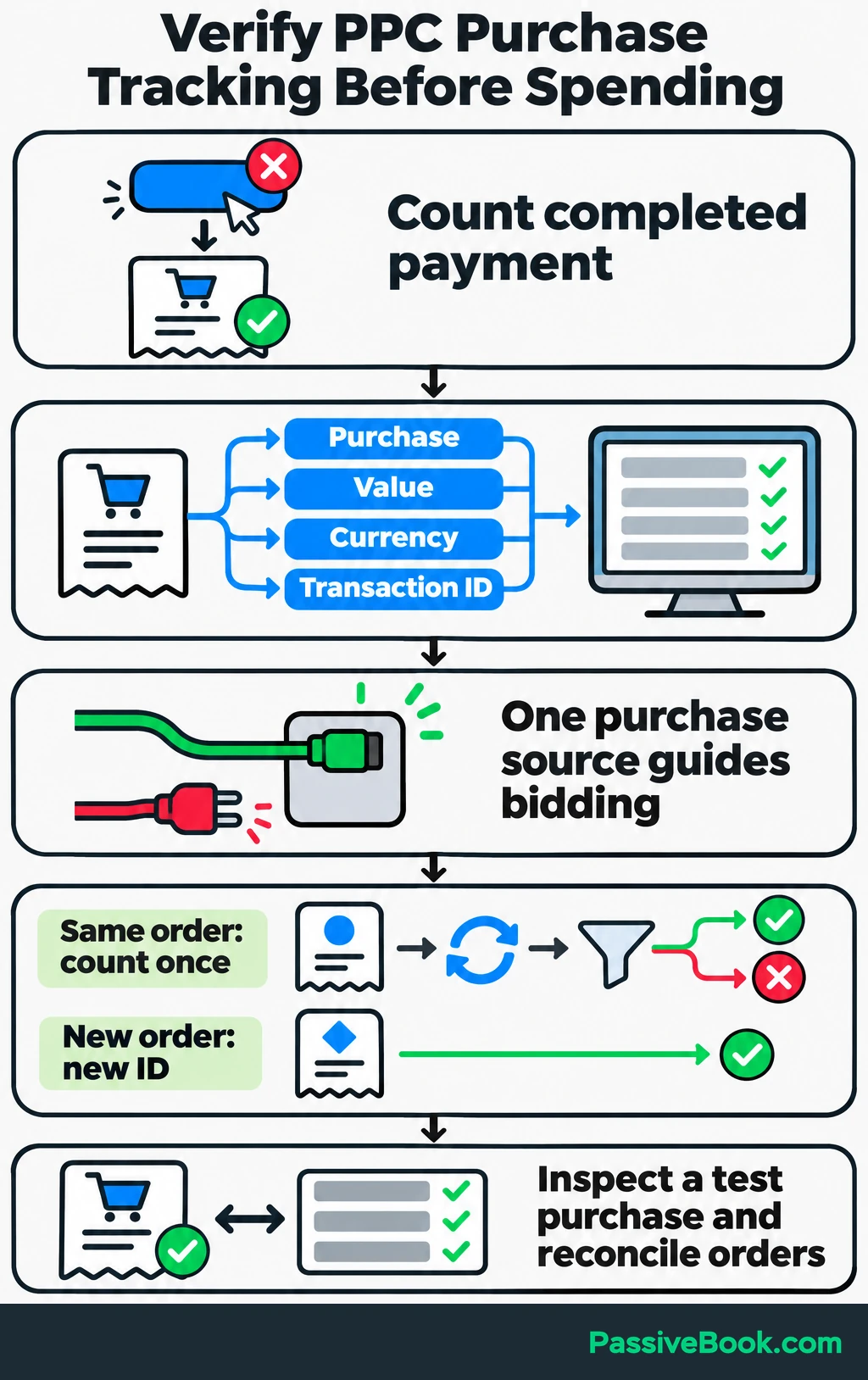
Complete a test purchase and inspect the event through your integration or tag-debugging tool. Check the value, currency and transaction ID, then reload the confirmation page and confirm the order is not counted twice.
Each real order needs its own ID. Reusing one fixed ID across orders can cause undercounting, while a consistent ID for the same order helps prevent duplicates. Google’s transaction-ID guidance explains this behaviour.
If checkout happens on another domain, check that measurement survives that handoff.
Use website analytics to investigate visits and checkout behaviour, then compare the sales credited to your ads with actual order records.
Set up privacy disclosures and consent controls for the locations you serve. For users in the EEA, UK and Switzerland, Google’s EU user consent policy requires specified disclosures and consent, including for cookies where legally required and personal data used to personalize advertising.
7. Build Your First Search Campaign
Organize the Campaign Around Buyer Intent
Create a Search campaign using your purchase goal, then apply the planned budget and dates.
Within the campaign, create an ad group: a set of closely related keywords and the ads that answer them.
For this first test, the structure can stay small:
| Campaign element | Example |
|---|---|
| Campaign | Smartphone dog photography course |
| Ad group | Online dog photography lessons |
| Keywords | [online dog photography course] and "smartphone dog photography lessons" |
| Ads | “Dog Photography Course” and “View the $60 Course” |
| Destination | The smartphone dog photography course sales page |

Add another group when a different buying need requires different copy or a different page. Searches for hiring a photographer do not belong in this course-buying group.
Restrict locations and languages to customers you can serve. When buyers need to be in your selected market, use the presence option for people in or regularly in those locations; the broader option can include people showing interest from elsewhere. Google explains location options.
For this initial test, I would keep ads on Google Search so the traffic is easier to assess. Turn off Search partners, which adds delivery on partner sites, and Display expansion, which can place ads on websites and apps beyond search results. Google explains the network options. Also review automatically applied recommendations to see which settings Google can change without your review.
Choose a Bidding Strategy
Your budget controls campaign spending. Bids influence participation in individual auctions.
For a controlled traffic test, Maximize Clicks is an option. It tries to get as many clicks as possible within the budget, and you can add a maximum CPC bid limit.
For the example, the calculated $0.75 affordable average CPC could inform that limit. Leave bid adjustments—percentage increases or decreases for factors such as device—at zero for this test. Google applies them on top of the CPC bid limit, so an increase could let bids exceed it. A low limit can also prevent ads from showing. Google’s Maximize Clicks guidance explains those details.
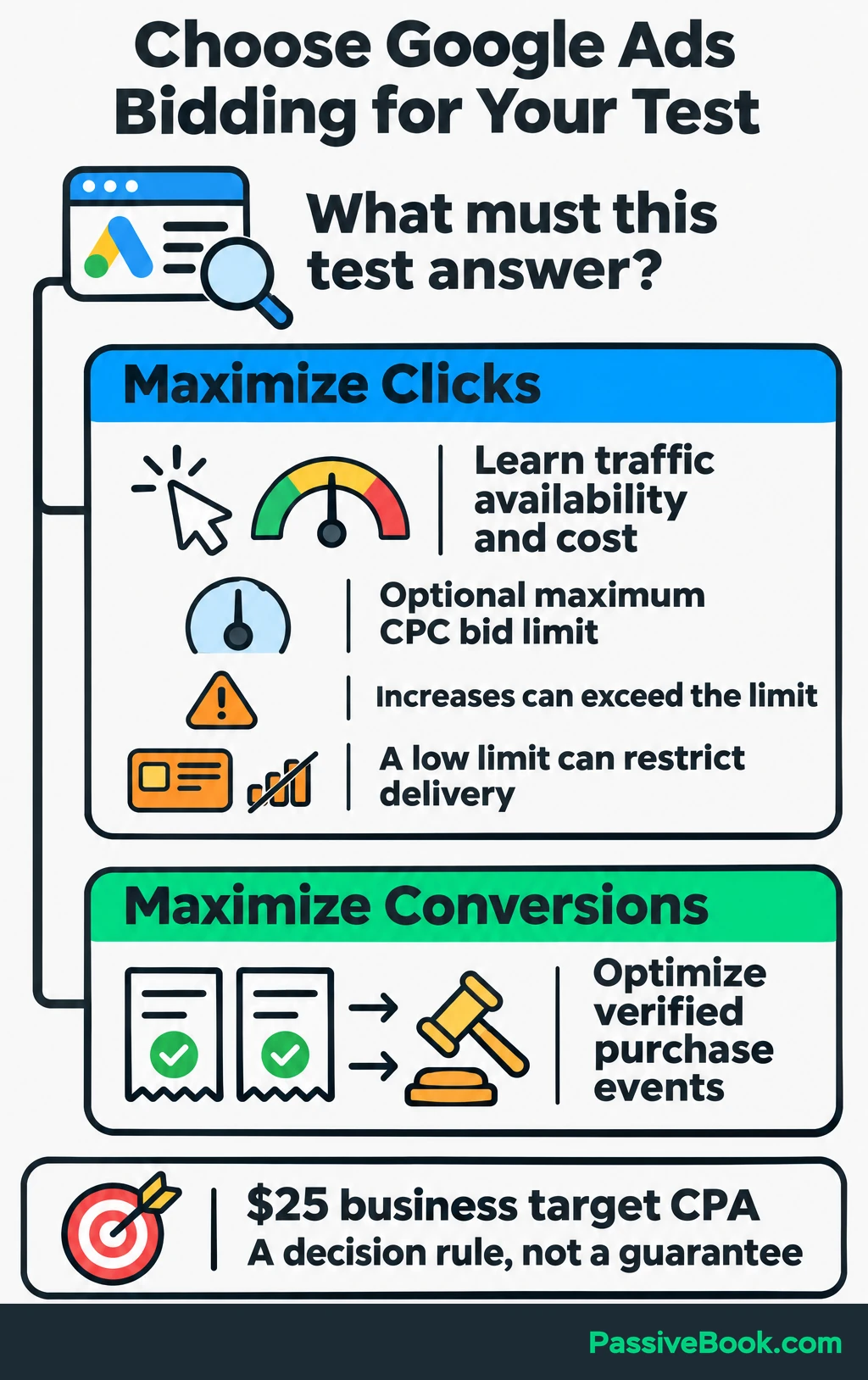
I would choose this option when the immediate question concerns available traffic and its cost. It pursues clicks, so purchases still need separate evaluation.
Maximize Conversions is the option for optimizing directly toward verified purchase events. It requires conversion tracking and aims to spend the available budget to generate conversions. Google describes how it works.
There is no universal rule that every campaign must start with clicks. Choose according to the test question and the quality of your measurement.
Your business’s $25 target CPA remains your decision rule whichever strategy you use. A platform bidding target is a separate setting and does not guarantee that acquisition costs will meet it.
Write Ads That Qualify the Visitor
Tell people what you sell, why it is useful and what to do next.
Including the price can help people decide before clicking. I would rather pay for fewer suitable visitors than attract people who expect a free course.
Responsive search ads combine different headlines and descriptions. Each piece should make sense alone and beside the others.
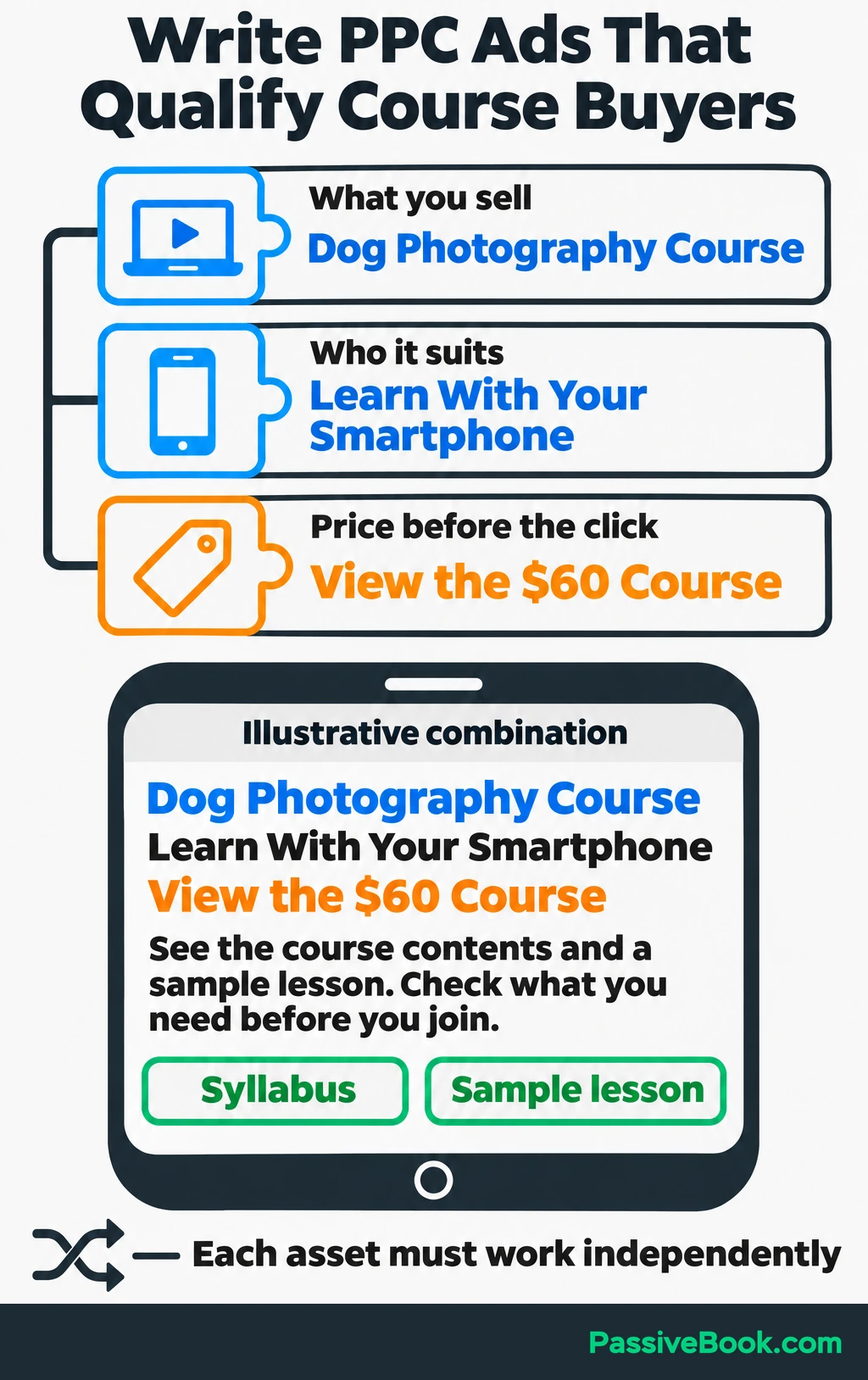
Here is a complete text sample for the example offer:
| Field | Sample copy |
|---|---|
| Headline 1 | Dog Photography Course |
| Headline 2 | Learn With Your Smartphone |
| Headline 3 | View the $60 Course |
| Headline 4 | Lessons on Lighting & Timing |
| Headline 5 | Preview a Sample Lesson |
| Description 1 | Learn lighting, framing and timing for dog photos. Preview the lessons and enrol for $60. |
| Description 2 | See the course contents and a sample lesson. Check what you need before you join. |
| Final destination | Your course sales page |
Google supports up to 15 headlines and four descriptions, with limits of 30 and 90 characters respectively. You do not need to fill every slot with a slightly different version of the same sentence. Google’s responsive search ad specifications explain the format.
Add useful links to the syllabus and sample lesson, then preview the ad on mobile.
The course example gives you a pattern, but your offer needs its own wording. AI Advertising Studio drafts the ads and matching page copy from your details, including the distinctions that help unsuitable buyers recognize the mismatch before clicking.
Free AI Advertising Studio




8. Launch and Improve the Campaign
Before activation, review the purchase goal, destination, keywords, negatives, locations, networks, bidding, budget and spending stop point.
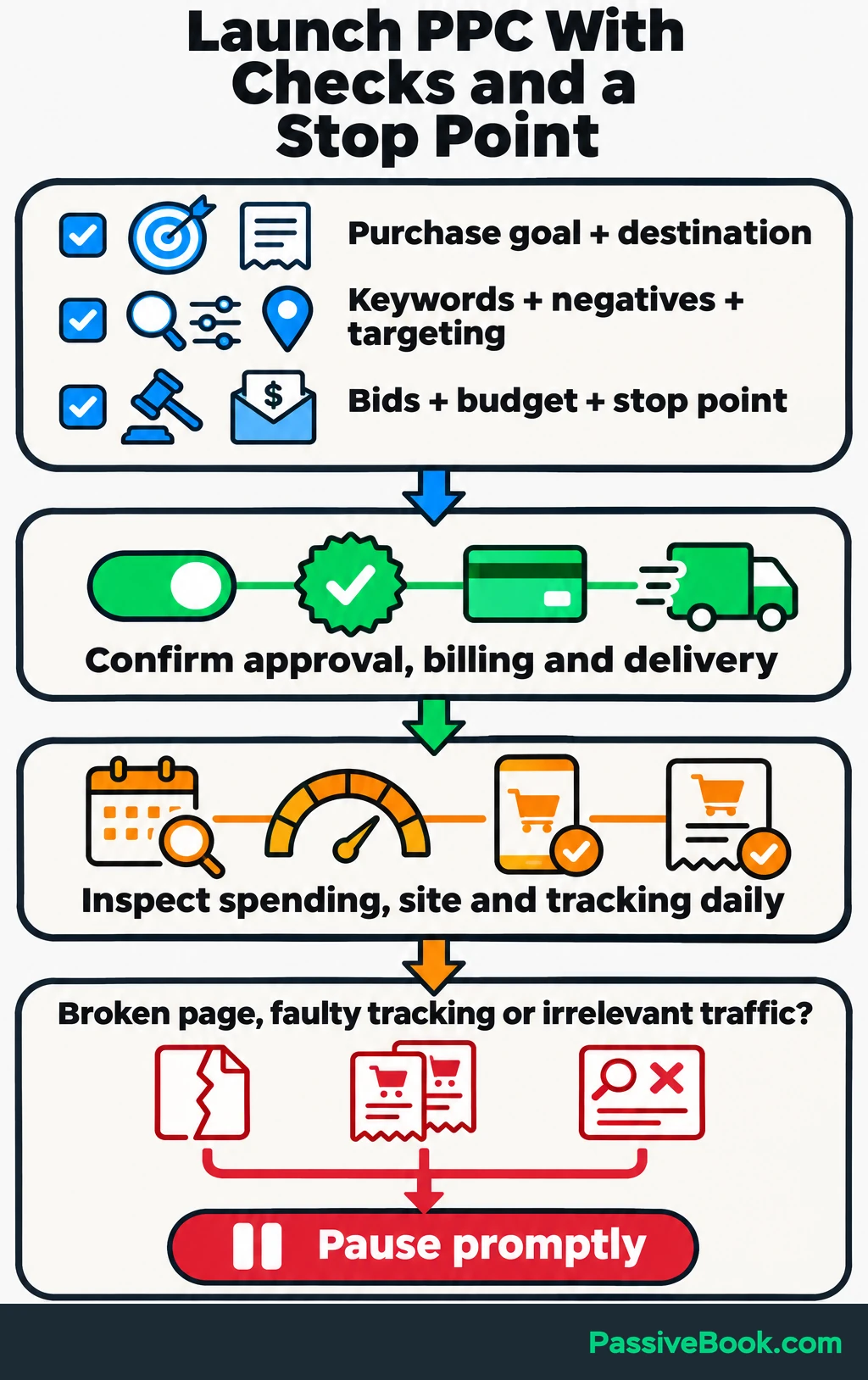
After activation, check approval, billing, delivery, spending and tracking. During the initial test, inspect spending and site function daily.
Pause promptly for broken pages, faulty measurement or clearly irrelevant traffic. There is no useful lesson in continuing to pay for a broken checkout.
Diagnose the Biggest Source of Waste
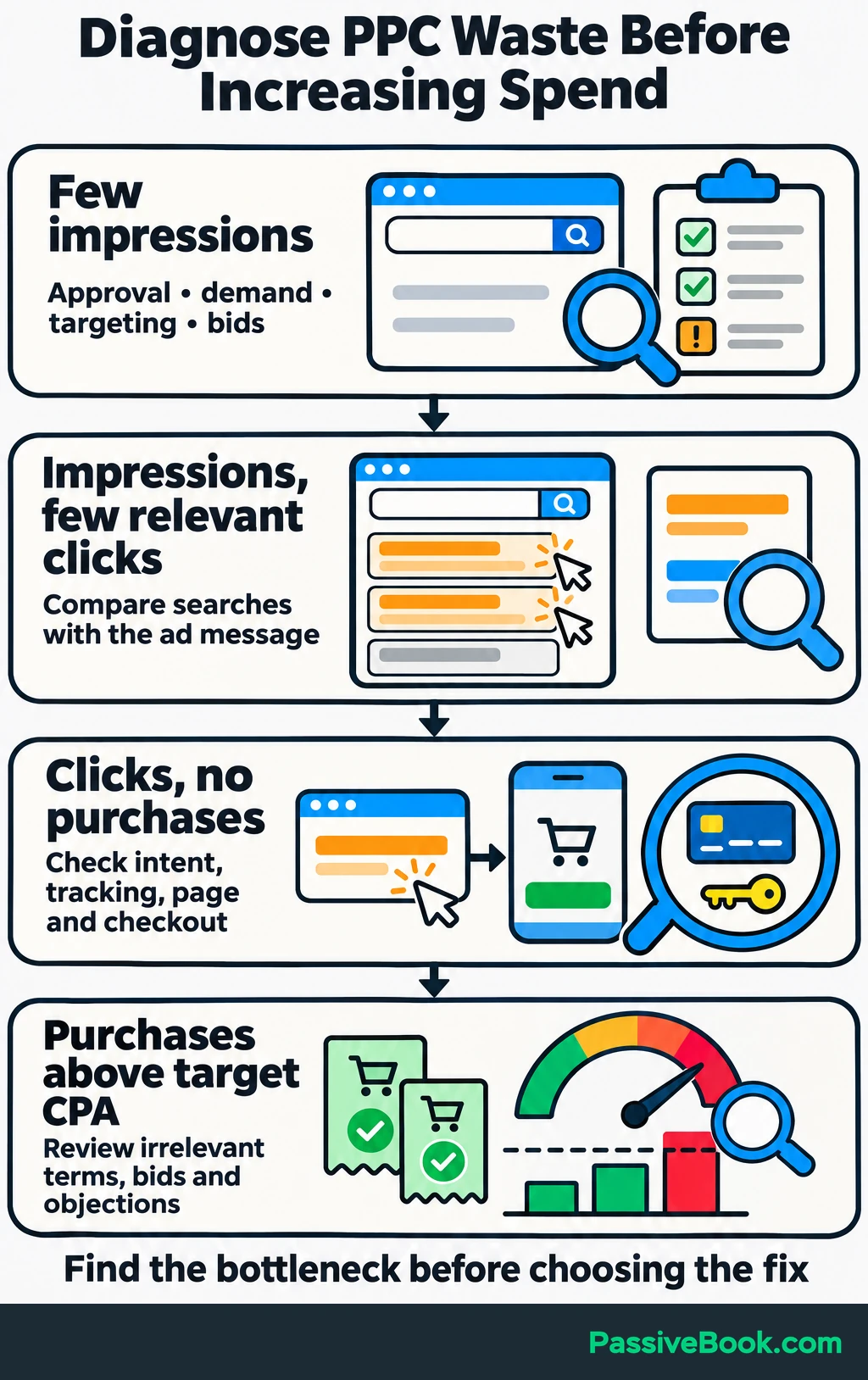
Use the symptoms to choose what to investigate.
- Few impressions: Check ad approval, eligibility, keyword demand, targeting restrictions and bid competitiveness. More budget will not fix every delivery problem.
- Impressions without relevant clicks: Compare the searches with your ad message. Make the offer and its fit clearer.
- Clicks without purchases: Inspect actual search terms, tracking, mobile usability, price, offer clarity and checkout.
- Purchases above target CPA: Remove irrelevant searches, review unaffordable bids and test a specific buying objection on the page.
For example, searches seeking a photographer for hire call for exclusions. Relevant course searches that reach checkout but do not buy call for a closer look at payment, access details and the offer.
Click-through rate, or CTR, shows how often ad appearances produce clicks. Divide clicks by impressions and multiply by 100. For example, 40 clicks from 1,000 impressions gives a 4% CTR.
Use that number to understand the response to an ad. A higher CTR is useful only if those visitors help produce worthwhile outcomes.
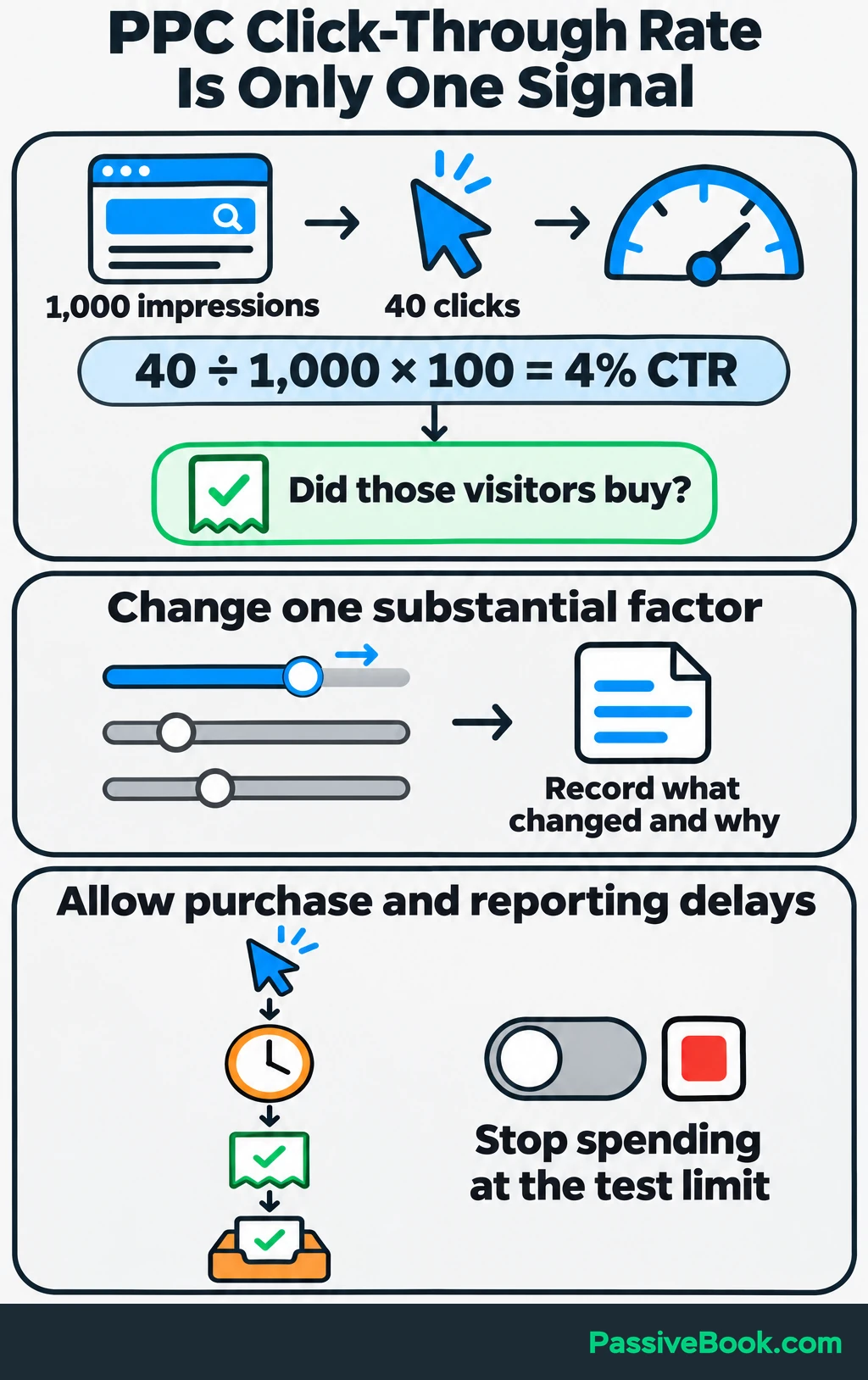
Change one substantial factor at a time when practical, and keep a simple log of what changed and why.
Allow time for people to purchase and for conversions to appear in reports. Recent performance can look weaker while purchases are still being reported, as Google’s bidding evaluation guidance explains. A handful of purchases is also too little evidence for a confident scaling decision.
Waiting for delayed sales does not require leaving spending switched on after your test allowance is used.
9. Decide Whether PPC Delivers Sustainable Returns
Review purchases credited to the campaign’s clicks, allowing for the normal delay between a click, a purchase and its appearance in reports. Do not include unrelated website sales.
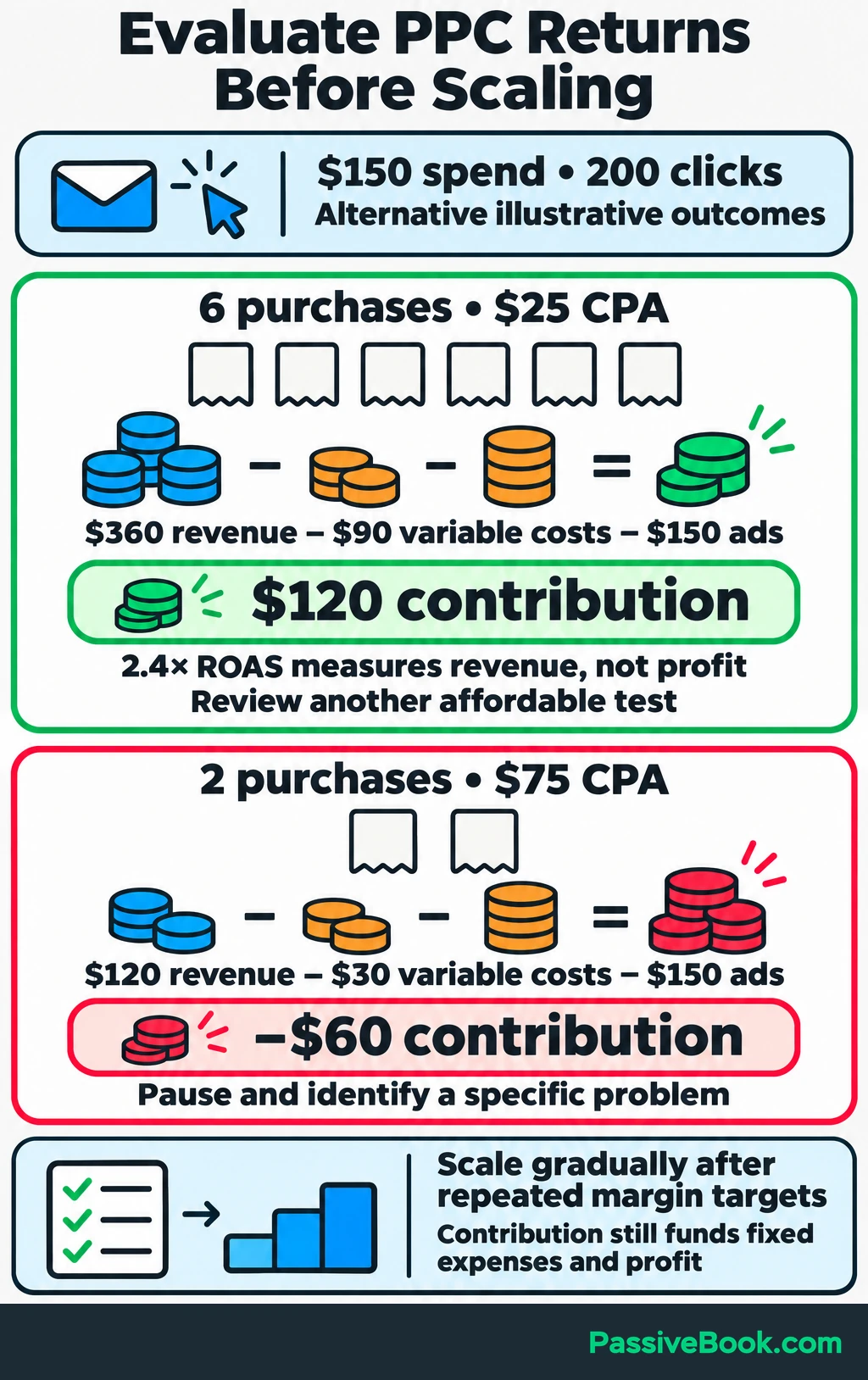
For the example, assume $150 bought 200 clicks and those clicks produced six course purchases worth $360.
| Measure | What it counts | Example result |
|---|---|---|
| Average CPC | Advertising spend ÷ clicks | $150 ÷ 200 = $0.75 |
| Purchase conversion rate | Purchases from those clicks ÷ clicks × 100 | 6 ÷ 200 × 100 = 3% |
| Purchase CPA | Advertising spend ÷ purchases | $150 ÷ 6 = $25 |
| Return on ad spend, or ROAS | Attributed purchase revenue ÷ advertising spend | $360 ÷ $150 = 2.4× |
ROAS measures revenue relative to advertising spend. It does not tell you business profit.
To see what remains, subtract the variable costs of those six purchases and the advertising:
$360 revenue − $90 variable costs − $150 advertising = $120.
That $120 goes toward fixed expenses and profit.
The weaker purchase rate from our budget example produces a different decision:
| Spend | Clicks | Purchases | Revenue | CPA | Contribution after advertising | Next action |
|---|---|---|---|---|---|---|
| $150 | 200 | 6 | $360 | $25 | $120 | Review another affordable test before scaling |
| $150 | 200 | 2 | $120 | $75 | −$60 | Pause and identify a specific problem before retesting |
These are alternative outcomes for the same offer.
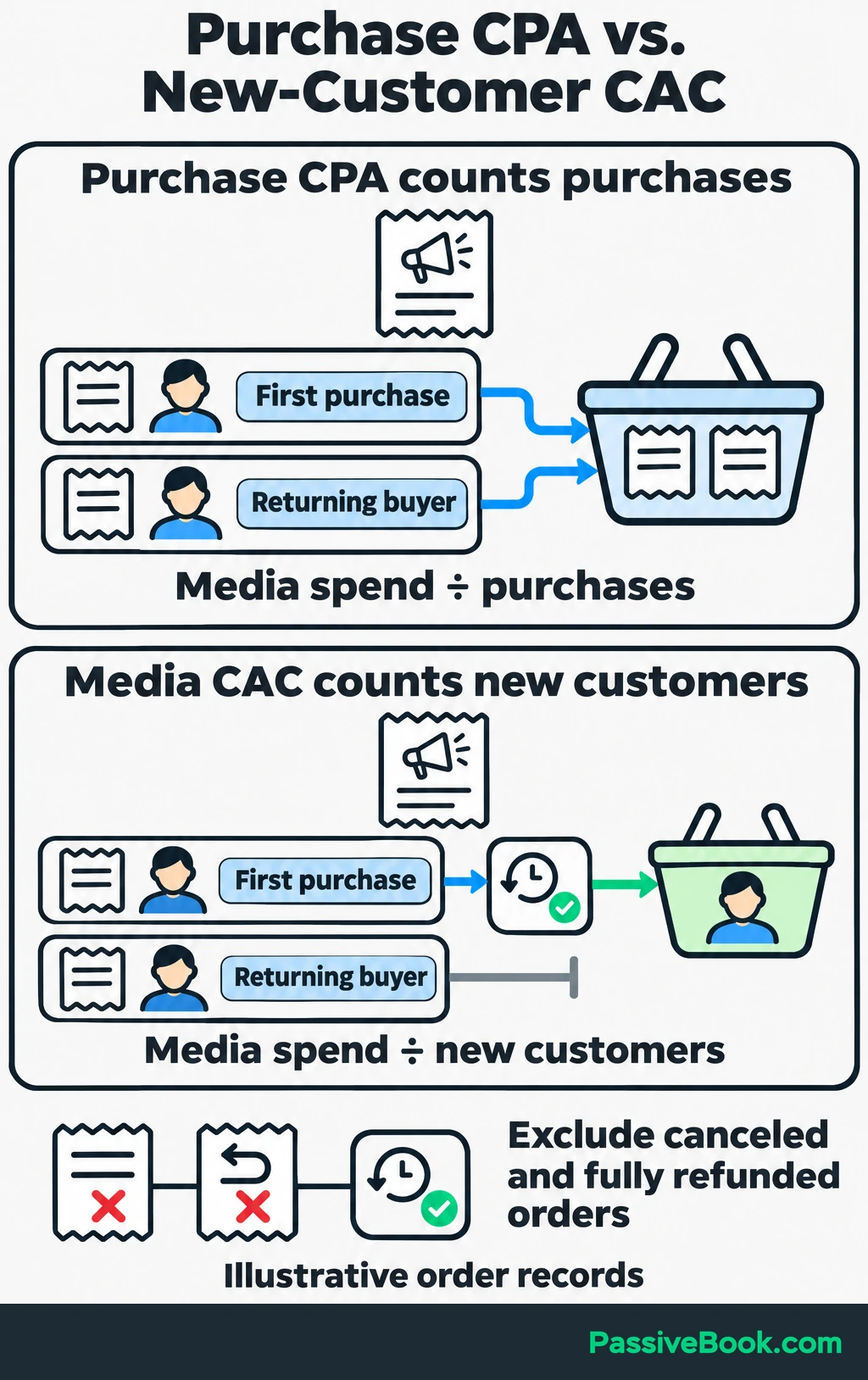
Also calculate customer-acquisition cost. Add relevant acquisition expenses, including advertising, creative and management, then divide by the new customers acquired through that work over the corresponding period.
Keep it separate from purchase CPA. An order can come from an existing customer, and advertising is only one acquisition expense. Use customer records to identify new buyers.
I would make the next decision this way:
- Pause: The affordable test limit is reached, measurement breaks or acquisition costs exceed what the offer can sustain.
- Continue testing: There is a specific weakness to investigate and an affordable allowance remains.
- Scale: Repeated results meet the margin target and you can support more customers.
Increase spending gradually when scaling, then recheck acquisition costs and contribution. Reconcile sales and refunds with business records. Six promising purchases justify attention; they do not justify assuming the next sixty will cost the same.
What Next?
Write down your offer’s price, variable costs and target CPA before creating the campaign. That gives your first test a financial boundary you can actually use.
Use the social buttons to share this guide when a PPC discussion needs numbers alongside the enthusiasm.
What would you need to see from a small test before feeling comfortable increasing the budget? Share your answer in the comments, and bring any other questions there too.
Share this post with your friends & followers:

