You have enough budget to test an ad campaign, but choosing where to spend it feels like placing a bet. Google puts you in front of searchers. Instagram offers visual discovery. Other platforms promise access to a very specific crowd.
The cost goes beyond clicks. Each choice brings ads to make, tracking to connect, and another report to understand. A poor fit can use up your test budget before you learn much about demand. This comparison helps you weigh audience fit, campaign workload, and costs so you can choose a first platform and set a clear spending limit.
Compare Online Advertising Platforms at a Glance
Before comparing the best online advertising platforms, write down five things:
- Offer: What, exactly, are you asking people to buy or request?
- Buyer: What need makes that offer useful to them?
- Territory: Where can you sell and deliver it?
- Conversion: Which completed action will count as a result?
- Destination: Will that action happen on your website, inside a marketplace, or through a sales conversation?
For the running example, imagine you run an online shop selling handmade ceramic coffee mugs. You want completed purchases through your website, and you can ship within your chosen market.
That immediately narrows the list. Google could capture relevant buying searches. Meta could introduce the mugs through photographs and video. Pinterest could place them alongside ideas for a home coffee station. Etsy Ads would serve a different goal: purchases through your Etsy shop.
My initial shortlist would be Google for existing search demand, Meta for visual discovery, Microsoft for additional search inventory, Pinterest for purchase planning, and LinkedIn when professional attributes define the buyer.
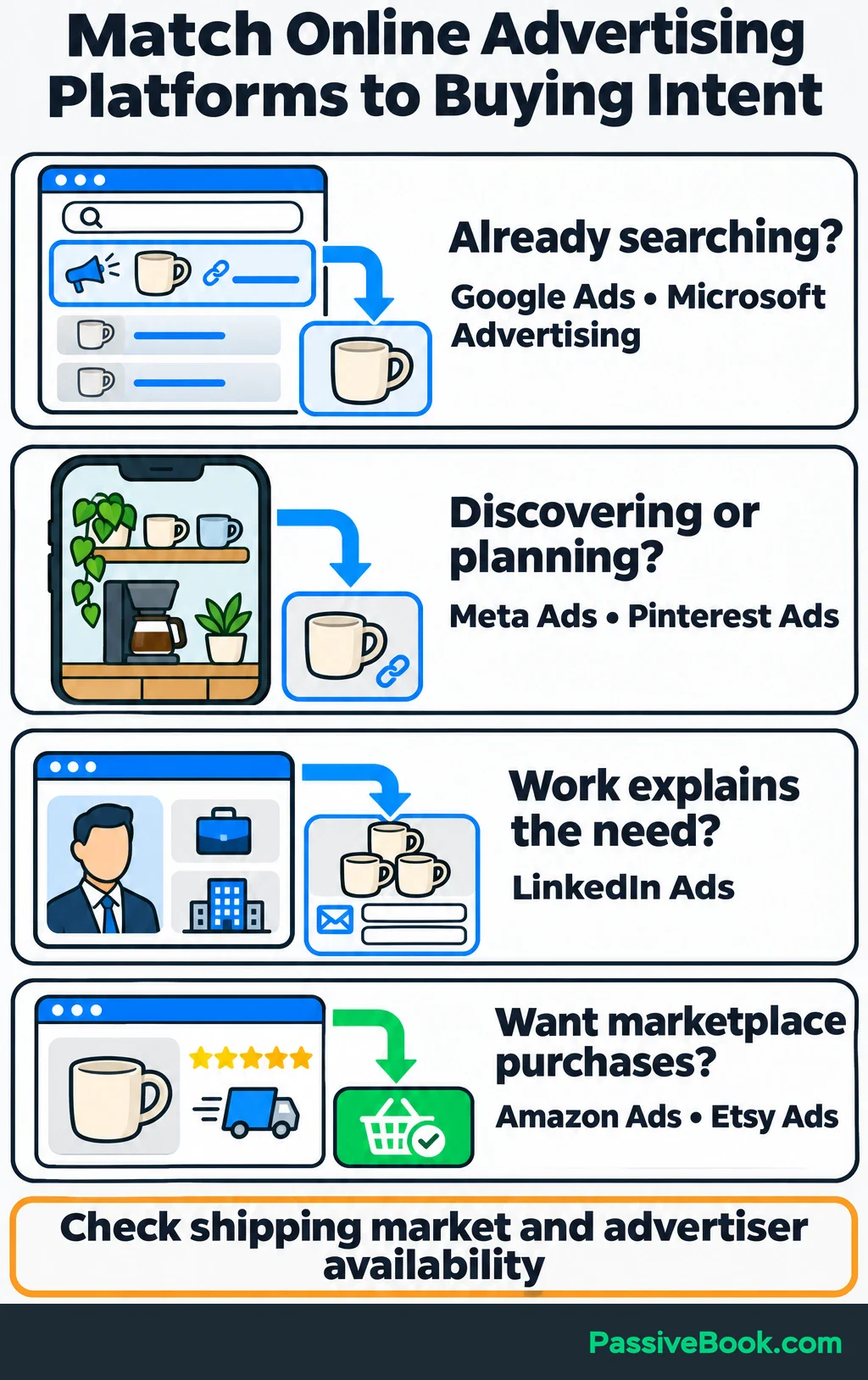
Reach matters within that buying situation. A platform’s total audience tells you little about how many suitable customers you can reach in your shipping area. Check advertiser-country and targeting availability before making assets.
The table compares the practical work involved. “Creative workload” means producing the text, images, audio, or video your campaign needs. Shopping ads also need a product feed, which supplies details such as images, prices, and availability.
The measurement column lists ways to record purchases or leads. A pixel or tag is website code that records visitor actions; a conversion API sends records through a server connection. A customer relationship management system, or CRM, stores leads, customer details, and sales follow-up.
| Platform | Strongest Use Case and Advertising Environment | Targeting | Pricing Model or Documented Minimum | Creative Workload | Measurement and Integrations | Main Constraint |
|---|---|---|---|---|---|---|
| Google Ads | Capture demand through Search and Shopping; video through YouTube | Keywords, location, audiences, product data | Search commonly uses CPC; other formats vary | Text for Search; product feed for Shopping; video for YouTube | Google Analytics 4 connection and conversion reporting | Relevant searches must exist at a workable acquisition cost |
| Meta Ads | Introduce visual offers across Facebook and Instagram | Audience inputs, customer data, automated delivery | Auction pricing; billing depends on campaign setup | Product photos, graphics, short videos, and ongoing variations | Meta Pixel, Conversions API, Shopify connection | Requires a sustainable supply of useful creative |
| Microsoft Advertising | Reach buyers through Bing and search partners | Keywords, location, audiences | Search commonly uses CPC | Search copy; existing campaigns can be imported | Universal Event Tracking and Google Import | Available demand varies by query and market |
| Pinterest Ads | Reach people planning purchases through feeds and search | Keywords, interests, customer and visitor audiences | CPC or CPM options depend on objective and bidding setup | Clear product imagery and vertical designs | Pinterest Tag, Conversions API, partner integrations | Saves and interest must eventually lead to purchases |
| TikTok Ads | Demonstrate products through short video | Demographics, interests, behavior, audiences | When daily budgets are set: above $50 per campaign and $20 per ad group. Budget requirements | Repeated short-video production and editing | Pixel and Events API; Shopify and WooCommerce partners | Budget thresholds and video workload can rule out a small test |
| LinkedIn Ads | Reach professionally defined buyers in feeds and lead forms | Job role, company, industry, professional attributes | Auction pricing; billable activity depends on campaign choices | Images, documents, video, or lead-form campaigns | Insight Tag and Lead Gen Forms with CRM connections | Professional targeting needs a business reason to matter |
| Reddit Ads | Reach people around relevant interest communities | Community engagement, interests, keywords, audiences | Click or impression billing, depending on setup | Direct copy, images, video, and placement review | Reddit Pixel, Conversions API, supported partners | Community targeting does not guarantee placement in one subreddit |
| Amazon Ads | Promote eligible Amazon listings through Sponsored Products | Keywords, products, automatic targeting | CPC | Listing images and product information; optional video | Product, targeting, placement, and attributed-sales reports | Requires eligible listings and Amazon purchase economics |
| Etsy Ads | Increase listing visibility within Etsy | Listing selection and Etsy’s marketplace signals | CPC; $1 minimum daily budget. Etsy Ads requirements | Strong listing photos, titles, and descriptions | Listing-level ad and order reporting inside Etsy | Purchases happen through Etsy, with limited manual targeting |
| Snapchat Ads | Run visual campaigns built for mobile use | Location, demographics, interests, custom audiences | $5 daily minimum; Snapchat recommends $20–$50 daily for exploration. Budget guidance | Vertical images and short videos | Snap Pixel; Shopify and Google Tag Manager installation options | Creative and checkout both need to work well on a phone |
| Quora Ads | Reach people researching relevant questions | Questions, topics, keywords, visitor and customer audiences | CPC and CPM options | Text, images, video, or promoted answers | Quora Pixel and Conversion API | Research interest may be far from a buying decision |
| X Ads | Reach audiences around active conversations | Keywords, follower-based audiences, location, conversations | Auction pricing; billable actions vary by objective | Posts, images, video, and message refreshes | X Pixel, Conversions API, WordPress and WooCommerce plugin | Advertiser verification and suitable placement require attention |
| Nextdoor Ads Manager | Reach geographically concentrated demand in neighborhood placements | Location, interests, personas, custom audiences | CPM for awareness; other bidding options depend on campaign setup | Local images and relevant copy | Nextdoor Pixel and campaign dashboard | Proximity needs to affect the purchase |
| Spotify Ads Manager | Explain an offer through audio, with visual formats also available | Demographics, listening behavior, context, custom audiences | U.S. minimum: $15 average daily budget, with individual days up to twice that amount; lifetime minimum roughly $250 equivalent. Budget and pacing details | Audio script and recording; optional visual assets | Spotify Pixel, Conversions API, measurement partners | An audio offer must make sense without a product close-up |
| Taboola Realize | Expand onto publisher websites through native, display, and video ads | Audience signals, custom audiences, publisher placements | CPC-based campaigns available | Headlines, images, landing pages, and publisher review | Taboola Pixel; Shopify, WooCommerce, WordPress, and tag-manager options | Cheap clicks can hide weak purchase intent |
A few pricing terms help you read that table:
- CPC: You pay per click.
- CPM: You pay per 1,000 ad impressions, or displays.
- CPV: You pay per qualifying video view, using the platform’s definition of a view.
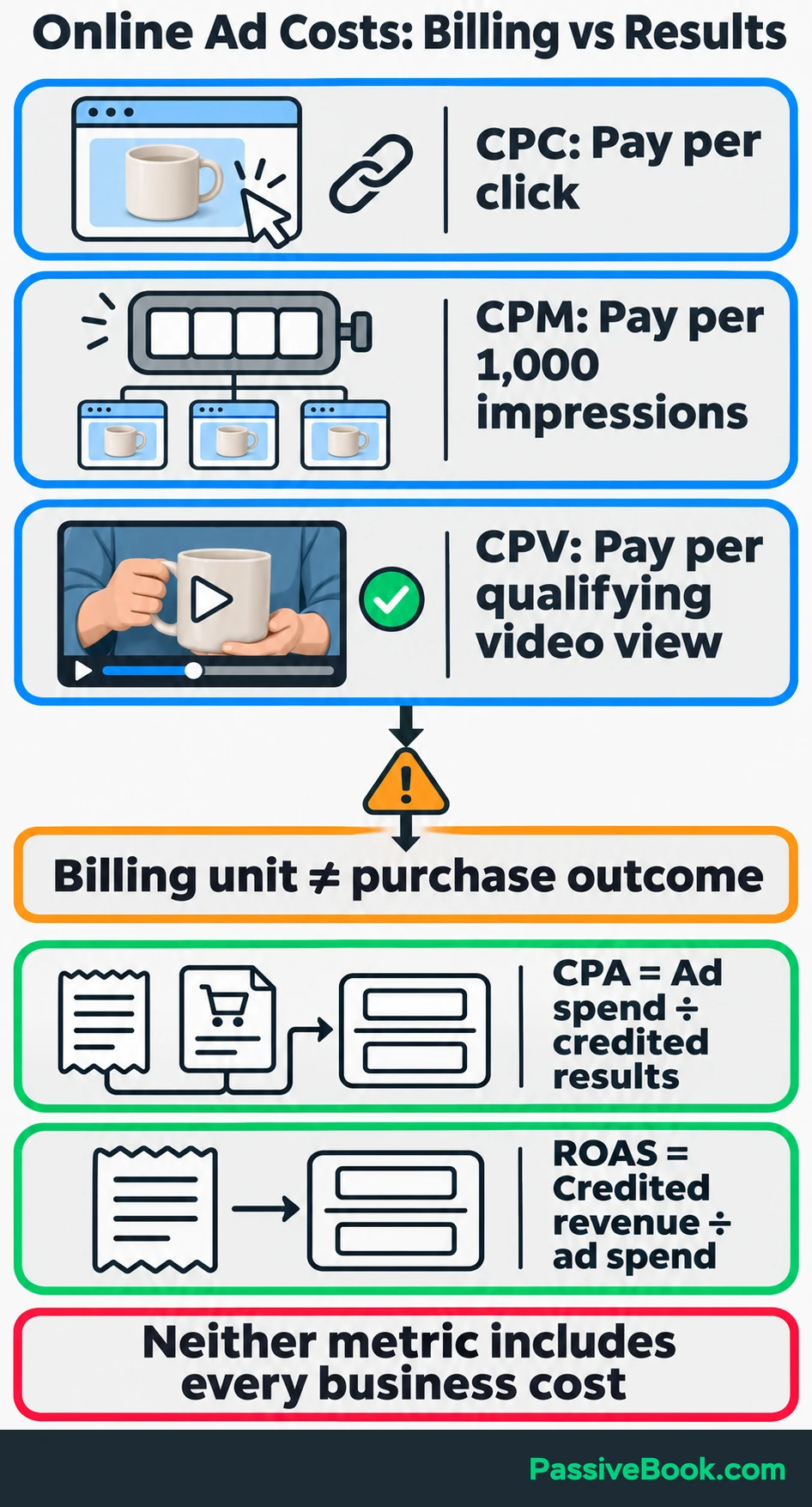
The billing unit and the result you ask the platform to pursue can differ. A target cost per acquisition guides bidding toward conversions, but it does not necessarily mean you pay only when someone buys.
To compare costs, count one result type—purchases or leads—credited to the campaign you are reviewing. Use consistent reporting dates and allow for the normal delay before customers buy or submit a form.
Cost per acquisition, or CPA, is that campaign’s ad spend divided by its credited results. Return on ad spend, or ROAS, is its credited revenue divided by the same ad spend.
Neither metric includes every business cost. We’ll put them against the mug shop’s margins after reviewing the platforms.
The 15 Best Online Advertising Platforms
1. Google Ads: Best for Capturing Existing Search Demand
I would start with Google Search when people already look for what you sell. You can match an ad to a buying query instead of first persuading someone that they need the product.
For the mug shop, “handmade ceramic coffee mugs” is a possible starting phrase to investigate. Check its demand and likely click costs in your market before building a campaign. A plausible phrase is not proof of an affordable opportunity.
Search needs clear text and a relevant landing page. Shopping adds product-feed work, while YouTube requires video. I would choose one format for the first test rather than opening several fronts.
Google Ads can connect with Google Analytics 4 for website analysis, conversion sharing, and audiences. That connection helps you follow the visit beyond the click. Google’s Analytics linking capabilities
2. Meta Ads: Best for Visual Discovery Across Facebook and Instagram
Meta is my shortlist choice when seeing the product helps people want it. A mug’s glaze, shape, and size are easier to show than explain in a search headline.
Start with a clear reason to buy, then show it. For the mugs, I would compare a close-up of the finish with a short clip showing the mug in someone’s hand. Both should lead to the pictured product.
Include creative production in your budget. If every new ad requires an expensive shoot, the media bill is only part of the cost.
Meta Pixel and Conversions API support website-event measurement. Shopify’s Meta integration can send store events, including purchases, through the selected data-sharing setup. Shopify’s Meta data-sharing documentation
3. Microsoft Advertising: Best for Reaching Buyers Beyond Google Search
Microsoft belongs on the search shortlist when your buyers use Bing or its search partners. I would compare available demand for your actual queries and locations, then judge it by purchase cost.
I would skip the assumption that Microsoft traffic must be cheaper. A lower click price means little if fewer visitors buy.
The creative work is familiar: relevant keywords, clear search copy, and a page that answers the query. Universal Event Tracking, Microsoft’s website tracking tag, records actions such as purchases and lets you build ad audiences from previous visitors.
Google Import can transfer supported campaign settings and assets, which reduces setup work. Review the imported budgets, targeting, and conversion goals before activation. A convenient import is still a campaign that needs checking. Microsoft’s import capabilities
4. Pinterest Ads: Best for Visual Planning and Product Inspiration
Pinterest makes sense when your product fits something people are planning, collecting ideas for, or preparing to buy.
First connect the product to a useful setting. Then make the next step obvious. For the mug shop, that could mean a photograph of a home coffee station featuring the exact mugs available on the linked page.
I would keep the product easy to identify. A beautiful room photograph can attract attention while leaving the buyer unsure what is for sale.
Pinterest supports keyword, interest, audience, and placement targeting across feeds, search results, and related Pins. Those capabilities make it worth considering for visual purchase planning. Pinterest’s targeting options
Use purchase reporting to judge the paid test. Saves can help explain interest, but they do not pay for clay, packaging, or shipping.
5. TikTok Ads: Best for Products Demonstrated Through Short Video
TikTok is worth testing when you can show the product’s appeal quickly and keep producing suitable videos.
I would begin with a demonstration that stands on its own. For the mugs, show the glaze in daylight, the handle in use, or the difference in size between two designs. You can do that with product footage without becoming an on-camera presenter.
The budget thresholds in the comparison table matter before production starts. If those requirements leave little room for testing, choose another channel first.
TikTok documents both Pixel and Events API support through Shopify and WooCommerce partner integrations. Confirm the events your chosen connection sends, then verify purchases before launch.
I would skip TikTok if making each video feels like starting a separate business.
6. LinkedIn Ads: Best for Targeting Professional Buyers
Choose LinkedIn when a buyer’s work explains why they need the offer. Job role, industry, or company can then become useful selection criteria.
I would leave it off the mug shop’s first shortlist for individual consumer purchases. But a separate bulk-order offer for workplace gifts could justify a professional audience.
That change also changes the conversion. A bulk buyer may request a quote before ordering, so lead quality and follow-up become part of the campaign.
LinkedIn’s Lead Gen Forms can collect professional information and send leads to supported CRM or marketing-automation tools. Its reporting includes lead volume, form completion, and cost per lead. LinkedIn Lead Gen Forms
Judge that route by qualified opportunities and customers. A full form is the start of a sales process.
7. Reddit Ads: Best for Reaching Relevant Interest Communities
Reddit is worth investigating when your buyers gather around a clear interest and your offer has something useful to say within it.
Read the relevant discussions before writing an ad. Look for buying questions, frustrations, and comparisons. For the mug shop, that might reveal whether people care most about handle comfort, capacity, or finding a gift.
Community targeting can reach people who have interacted with selected subreddits elsewhere on Reddit. It does not simply buy a fixed position inside the community you choose. Reddit’s community-targeting explanation
I would use direct product language and a specific benefit. Trying to sound like a regular member while delivering a sales pitch is an awkward costume.
Include tracking installation and placement review in the test workload, and compare purchases alongside clicks.
8. Amazon Ads: Best for Promoting Eligible Amazon Listings
For this comparison, I would focus on Sponsored Products. These ads promote eligible listings and send shoppers to Amazon product detail pages.
You can use keyword, product, or automatic targeting, and you pay for clicks. Your account and product category must be eligible, and the listing must qualify to appear as the Featured Offer—the main buying option on the product page. Amazon Sponsored Products
This is a useful route when you want Amazon purchases. It serves a separate checkout from the mug shop’s website.
Before bidding, calculate the margin after marketplace and fulfillment costs. Then use the product, targeting, placement, and sales reports to see where spending produces orders.
I would improve an unclear listing before buying more visits to it. Ads give shoppers another chance to inspect the same photographs, description, and delivery offer.
9. Etsy Ads: Best for Increasing Visibility of Etsy Listings
Etsy Ads is a focused option when you already sell through Etsy. You choose which listings to advertise, and Etsy uses its marketplace signals to manage delivery.
For the mug shop, I would begin with listings that have clear photographs, useful descriptions, and some evidence of buyer interest. Turning on every listing makes it harder to see which products deserve the budget.
The entry budget is listed in the comparison table. New shops also have a 15-day waiting period before starting Etsy Ads, and ads reach buyers in countries the listings ship to.
Review listing-level spending, clicks, orders, and revenue inside Etsy. Keep those marketplace results separate from your website campaigns.
Etsy Ads and Etsy’s Offsite Ads program have different charging arrangements, so confirm which program you are evaluating.
10. Snapchat Ads: Best for Mobile Visual Campaigns
Snapchat belongs on the shortlist when your intended customers use it and you can make the product understandable in a vertical mobile ad.
I would test the entire buying path on a phone first. Can someone see the mug’s size, choose a variation, understand delivery costs, and pay without fighting the page?
The low daily minimum in the table makes entry possible, but Snapchat’s larger exploration recommendation shows why minimum spend and a useful test budget are different decisions.
Snap Pixel can measure page visits, cart additions, and purchases. Installation options include Shopify and Google Tag Manager.
For the creative, use a clear product view and one reason to act. I would skip squeezing a desktop banner into a vertical frame and hoping for the best.
11. Quora Ads: Best for Reaching People Researching Specific Questions
Quora can work as a shortlist option when a relevant question reveals a need your offer addresses.
Investigate the available questions and audience before making tailored ads. Quora supports targeting by question, topic, and keyword, so the connection can be quite specific. Quora’s targeting options
For the mug shop, I would look for a genuine connection between the question and the product page. A broad interest in coffee alone would not persuade me to spend.
Text ads keep production manageable. A Promoted Answer requires more writing and a useful explanation, so include that time in the comparison.
Quora Pixel and Conversion API support conversion measurement. Give research traffic room to reach a decision, but keep the review tied to eventual purchases rather than page visits alone.
12. X Ads: Best for Reaching Audiences Around Active Conversations
I would consider X when potential customers already discuss subjects closely connected to the offer.
Keyword, follower-based, and conversation targeting give you ways to reach those audiences. But a lively discussion does not establish buying demand. Check whether your product has a natural place in it.
For the mug shop, I would want more than general enthusiasm for coffee before choosing X over a stronger search or visual-shopping opportunity.
Advertisers must meet X’s verification requirements through an accepted program. Include any applicable subscription cost when comparing the total expense. X advertiser eligibility
X offers Pixel and Conversions API measurement, including a WordPress plugin with WooCommerce event support. Budget time to review placements and refresh messages as conversations change.
13. Nextdoor Ads Manager: Best for Geographically Concentrated Demand
Nextdoor makes sense when being nearby affects the purchase.
Start with the geographic reason, then assess the audience. The mug shop might have one if it offers local pickup or promotes a local studio sale. National shipping by itself would give me little reason to prioritize neighborhood advertising.
Nextdoor Ads Manager includes interest, persona, and custom-audience tools. Its Pixel can track purchases, leads, and sign-ups, with campaign reporting in the dashboard. Nextdoor Ads Manager capabilities
I would use a photograph and message that explain the local benefit plainly. Then check how much work the website tracking requires.
A nearby audience is useful when proximity solves something for the buyer. Otherwise, I would keep comparing.
14. Spotify Ads Manager: Best for Reaching Listeners Through Audio
Spotify is worth considering when people can understand and remember your offer without studying a product image.
Write the spoken promise before producing the ad. If it takes a long explanation to make the offer clear, audio may be a poor first choice.
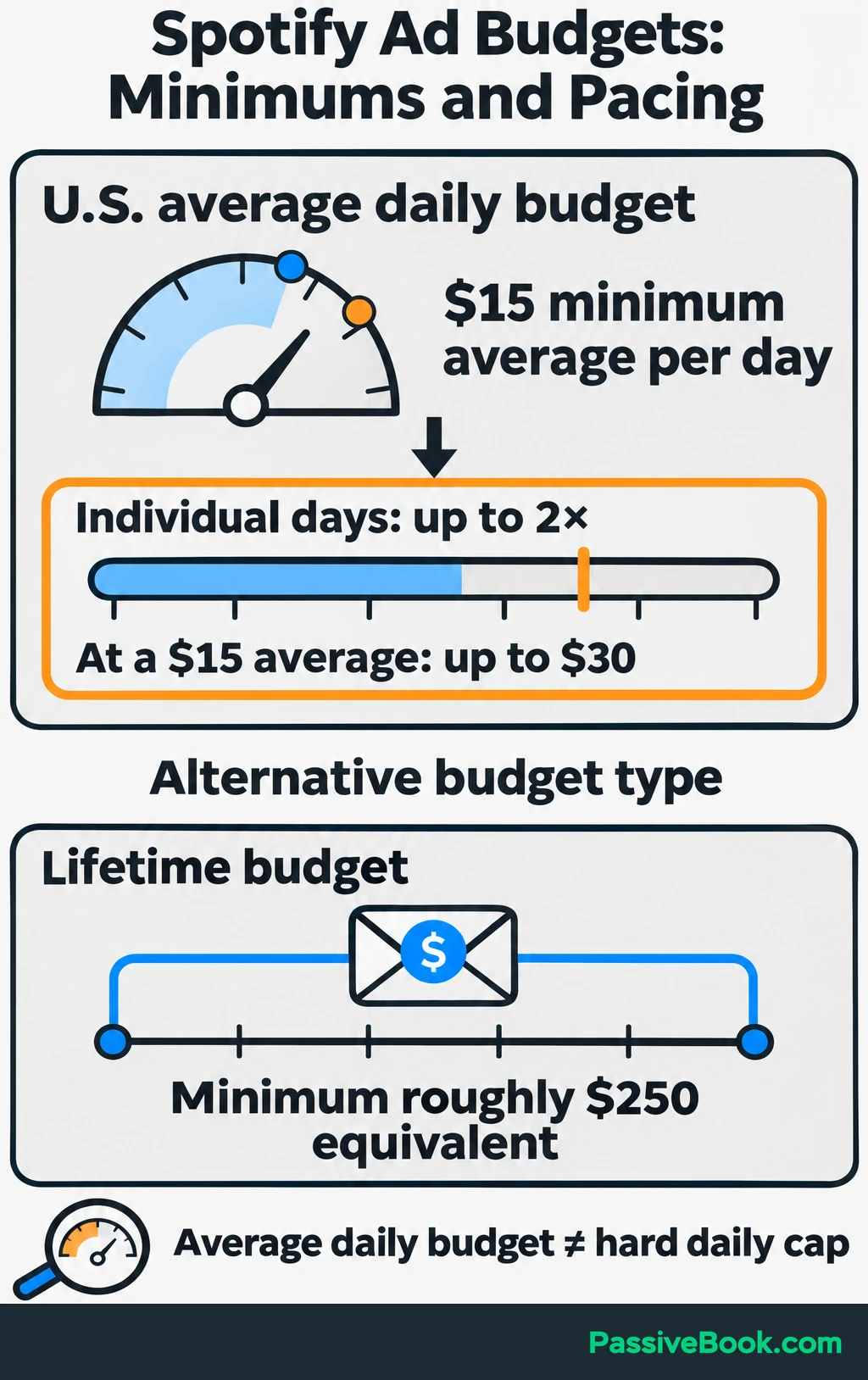
For the mugs, much of the appeal comes from appearance and feel, so I would test a visual channel first. Spotify could enter the shortlist later if you have a clear spoken offer and evidence that the economics support another channel.
Its audience tools include demographics, listening behavior, context, and custom audiences. The budget and pacing conditions are in the comparison table.
Spotify Pixel and Conversions API can connect website actions with campaigns. The API is in beta, so check access and setup requirements before relying on it. Spotify’s Conversions API documentation
Compare purchases alongside reach and frequency, which shows how often people encounter the ad.
15. Taboola Realize: Best for Expanding Onto Publisher Websites
Taboola Realize is my later-stage option for reaching people across publisher websites through native-style, display, and video ads.
Native ads resemble the surrounding page format. Your headline and image need to earn attention, and the landing page needs to explain why the product deserves a closer look.
For the mug shop, I would first establish that an offer converts elsewhere. Then I would test publisher traffic with enough time to review which placements produce purchases.
Taboola’s Pixel supports conversion reporting and optimization, with installation routes for Shopify, WooCommerce, WordPress, and Google Tag Manager. Taboola’s tracking and integrations
Keep the advertising clearly recognizable. For U.S. campaigns, the FTC’s guidance explains when clear, prominent native-ad disclosures are needed. FTC native-advertising guidance
Choose a Platform Your Budget Can Support
Start with the buying situation and remove platforms that fail an obvious requirement.
If relevant searches exist, compare Google and Microsoft. If photographs can introduce the offer, consider Meta or Pinterest. Choose LinkedIn when professional attributes explain the need, and marketplace ads when purchases inside that marketplace match your goal.
Next, work out what you can afford to pay for a purchase.
Count the revenue from an order, then subtract the costs that come with fulfilling it: products, packaging, shipping, payment processing, marketplace fees, and expected refunds. What remains is contribution before advertising.
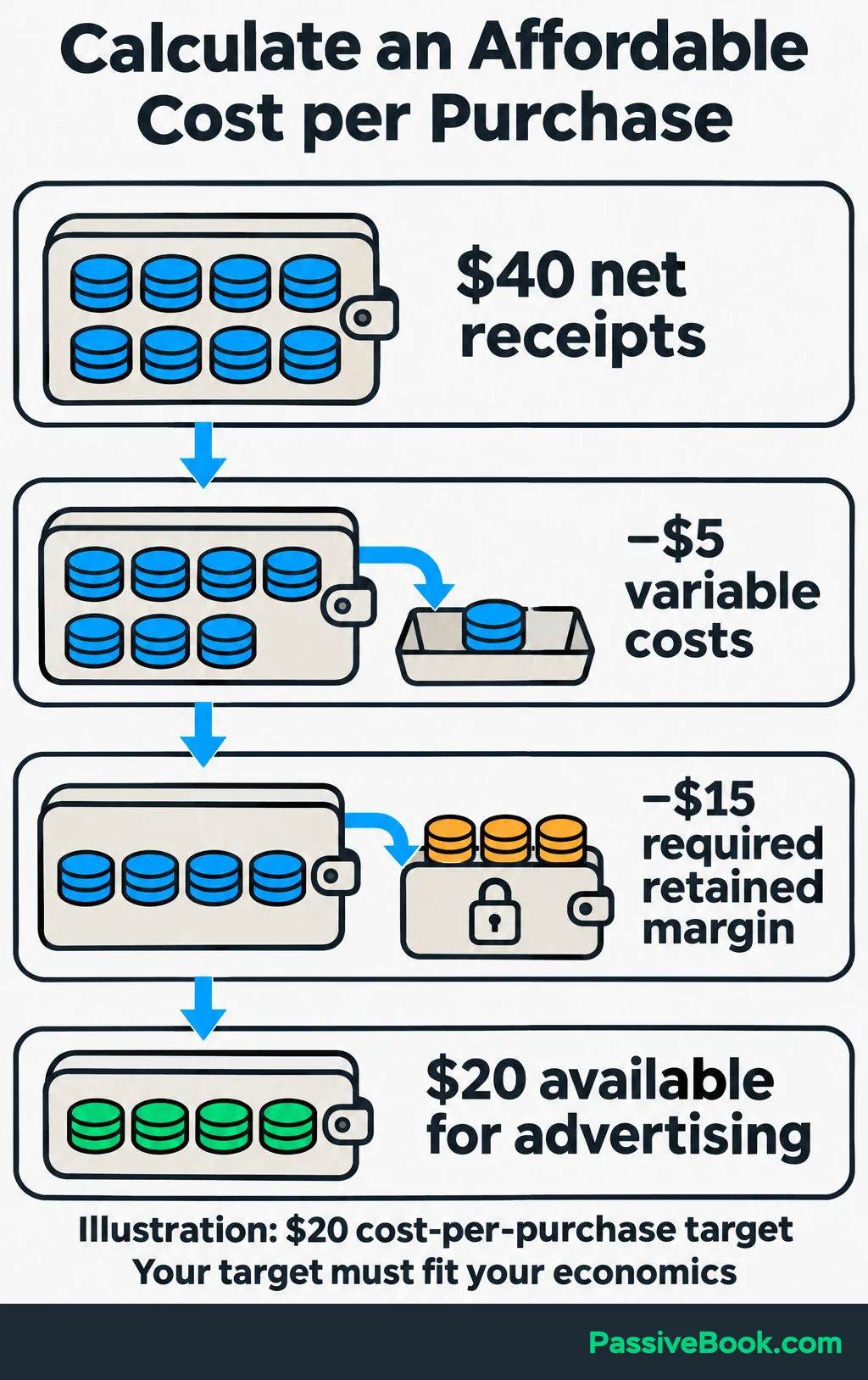
You still need to reserve money for overhead, other marketing work, and profit.
For illustration, suppose the mug shop has these first-order economics. All monetary examples use USD.
| Item | Amount per Order |
|---|---|
| Order revenue | $60 |
| Product, fulfillment, payment, and other variable costs | −$36 |
| Contribution before advertising | $24 |
| Reserved for overhead, non-media marketing, and profit | −$9 |
| Available for advertising per purchase | $15 |
Under those assumptions, I would set a media CPA ceiling of $15—the most I would pay the ad platform per purchase.
The corresponding revenue ROAS is $60 divided by $15, or 4×. That tells you how much revenue the advertising must return under this cost structure. ROAS alone does not measure profit.
Now compare the test budget with more than one possible CPA. With $150 in media spending:
- At a $15 CPA: Ten purchases would generate $600 in revenue and leave $90 after variable costs and advertising.
- At a $30 CPA: Five purchases would generate $300 in revenue and leave a $30 shortfall after variable costs and advertising.
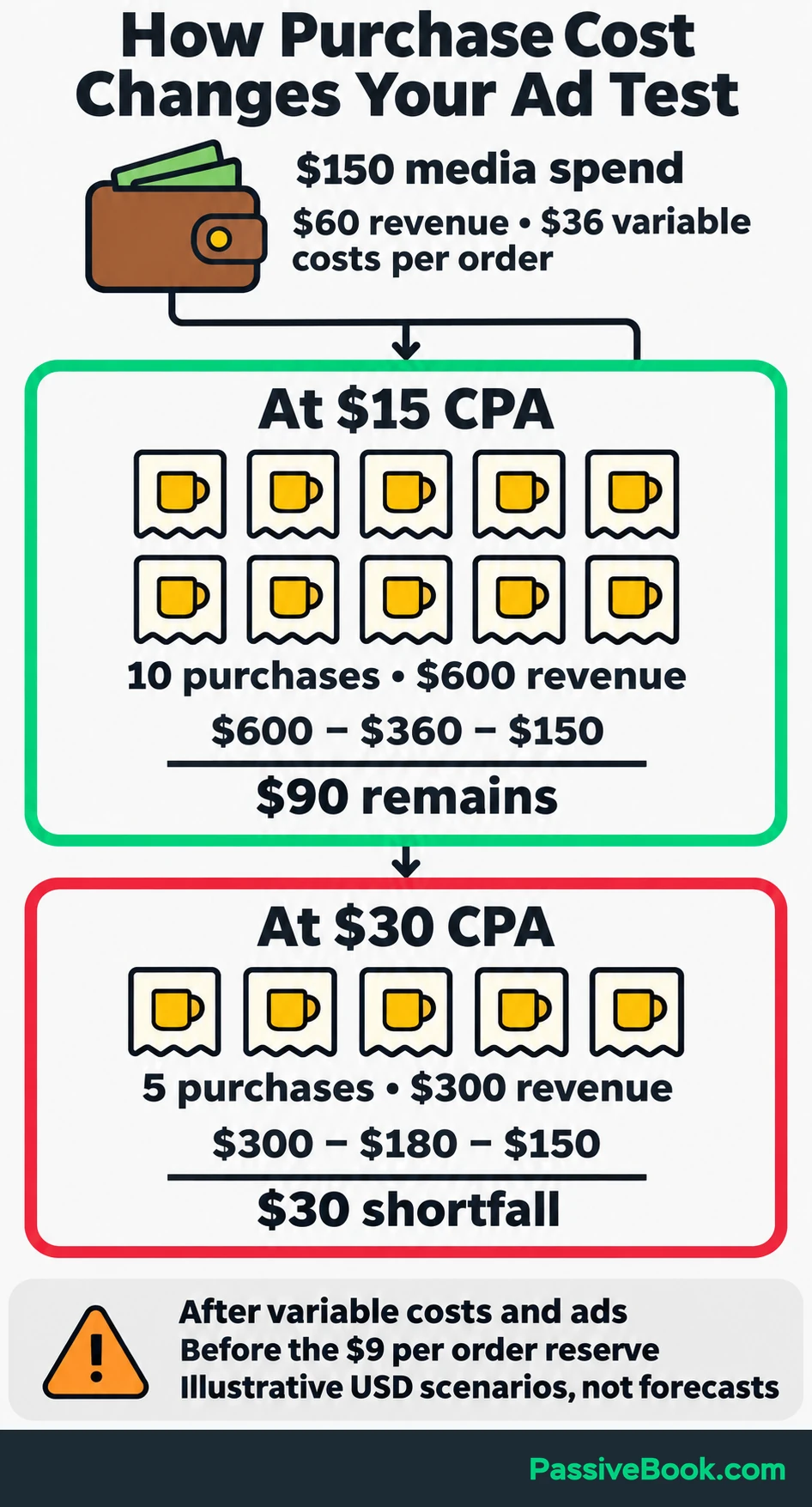
Those are calculations, not expected results. They show why an affordable click or a low platform minimum does not establish an affordable customer.
I would use first-order economics until actual repeat-purchase data supports spending more. Future loyalty is a pleasant idea, but it cannot cover the current invoice.
Set a total test allowance that also includes creative, tracking, connector fees, and any management help. Record the amount you can afford to lose.
The purchase ceiling is only part of the decision: setup costs and conversion rates change what you can afford per click. Use the calculator below to work out those limits for purchases or sales leads before committing your test budget.
Free Marketing Profit Calculator


If that allowance supports only one focused test, choose one platform. Later, give additional platforms distinct jobs: Google could capture buying searches while Meta introduces the mugs visually. Etsy or Amazon would support their own marketplace purchases.
Measure Your First Test Before Expanding
Before activating tracking, apply the consent and customer-data requirements relevant to your market. For example, UK guidance requires consent for storage and access technologies used for online advertising, including associated tracking and measurement. ICO online-advertising guidance
Set your chosen result, such as a completed purchase, as the campaign’s primary conversion and check that it is recorded correctly.
On one of my digital-product sites, I once counted a visit to the download page as a sale. Opening that page to check a file created another “sale.” I moved the purchase event to the completed transaction and checked it against the order record.
That is why I verify the event before trusting the dashboard. A tracking mistake can make an ordinary campaign look excellent.
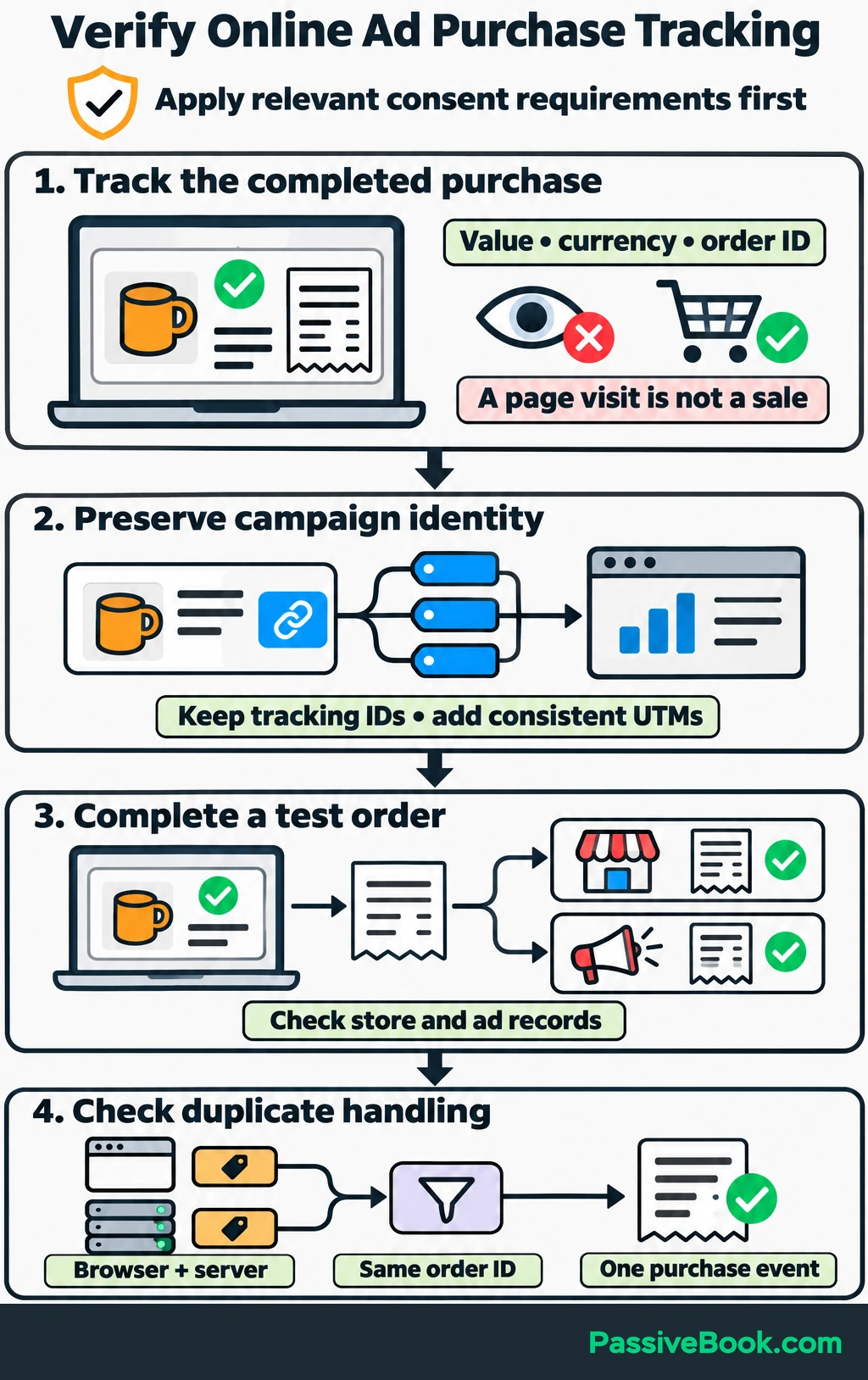
For a website purchase campaign:
- Conversion: Record the completed purchase with its value, currency, and order identifier.
- Campaign identification: Preserve any tracking IDs the platform adds to your links. Add consistent UTM parameters—labels in the link that tell your website analytics which source and campaign brought the visit.
- Test transaction: Complete an order and check that the store and advertising tools receive the intended information.
- Duplicate handling: If browser and server connections send the same purchase, confirm that the platform recognizes it as one event.
For the mug shop, I would write this first-test brief before launching:
| Decision | First-Test Plan |
|---|---|
| Platform | Google Search, provided relevant buying queries exist within the shipping market |
| Offer | One clearly priced pair of handmade ceramic coffee mugs |
| Audience | People searching for closely related products in locations the shop serves |
| Destination | The product page for that pair, with delivery and returns information |
| Messages | Two distinct reasons to buy, such as the handmade finish and the appeal as a gift |
| Primary result | Completed purchase |
| Media CPA ceiling | $15, based on the example margins |
| Media spending cap | $150, within a separately recorded total test allowance |
| Review point | Check delivery and checkout health during the test; assess results at the cap after allowing the normal purchase delay |
| Immediate pause triggers | Broken tracking, checkout failure, or reaching the agreed loss limit |
The same workflow applies to Meta or Pinterest. You would change the audience approach and creative while keeping the offer, purchase goal, economics, and spending controls clear.
For a lead campaign, record which leads fit your offer and which become paying customers in your CRM. Judge the campaign by cost per customer as well as cost per form submission. Otherwise, you may optimize for people who enjoy filling in forms.
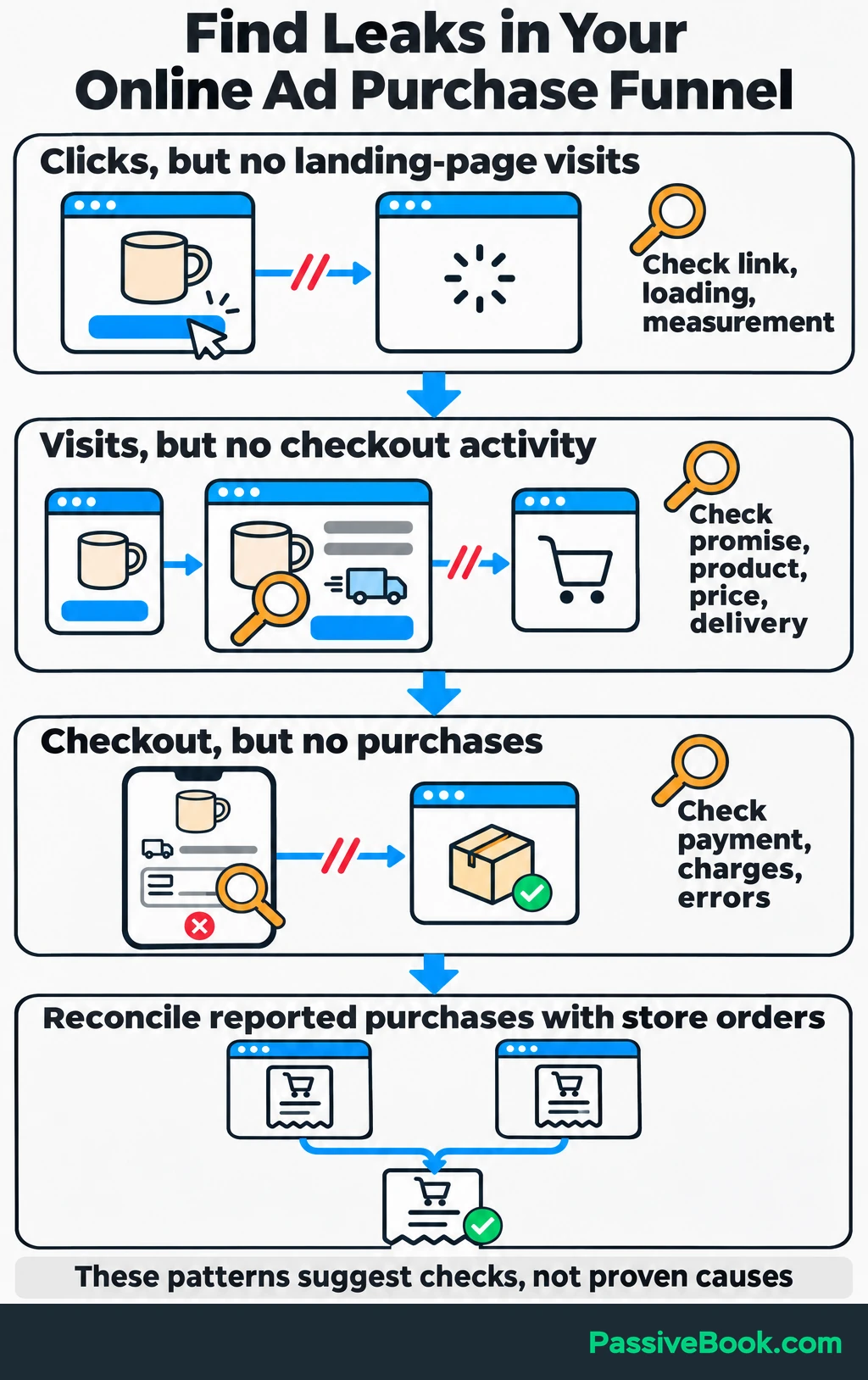
At review time, compare spend, purchases or qualified leads, CPA, and contribution after advertising. Use the earlier steps to locate a weakness:
- Clicks without landing-page visits: Check the link, page loading, and measurement.
- Product visits without checkout activity: Review whether the ad promise, product, price, and delivery terms match.
- Checkout activity without purchases: Test payment, unexpected charges, and checkout errors.
These patterns tell you what to investigate. They do not prove a cause by themselves.
Finally, check reported purchases against actual store orders, or reported customers against your CRM records. Attribution rules determine which ad gets credit for a result, and more than one platform can claim the same purchase. Adding their reported conversions together can overstate sales.
Increase spending when repeated results support the customer economics. Keep the offer and measurement stable enough to understand what changed, and expand gradually.
What Next?
Write down your offer, primary conversion, and maximum affordable acquisition cost, then choose one platform that fits all three.
Use the social buttons to share this comparison when you want a clearer budget discussion before the next campaign starts.
Which platform best matches how your customers decide to buy, and what evidence would make you test it? Share your answer in the comments, along with any other questions.
Share this post with your friends & followers: