Your ad gets clicks from phones, but the sales report barely moves. You can see what you spent and how many people tapped. What you cannot see is whether the next batch of clicks deserves more money.
That uncertainty makes even a small campaign hard to manage. You could be reaching the wrong people, losing buyers at checkout, or missing purchases in your reports. Guessing what went wrong can use up the budget before you learn much. The worked campaign below gives you a concrete way to plan a mobile advertising test and decide what to change before paying for another round.
1. Define the Conversion Your Campaign Should Produce
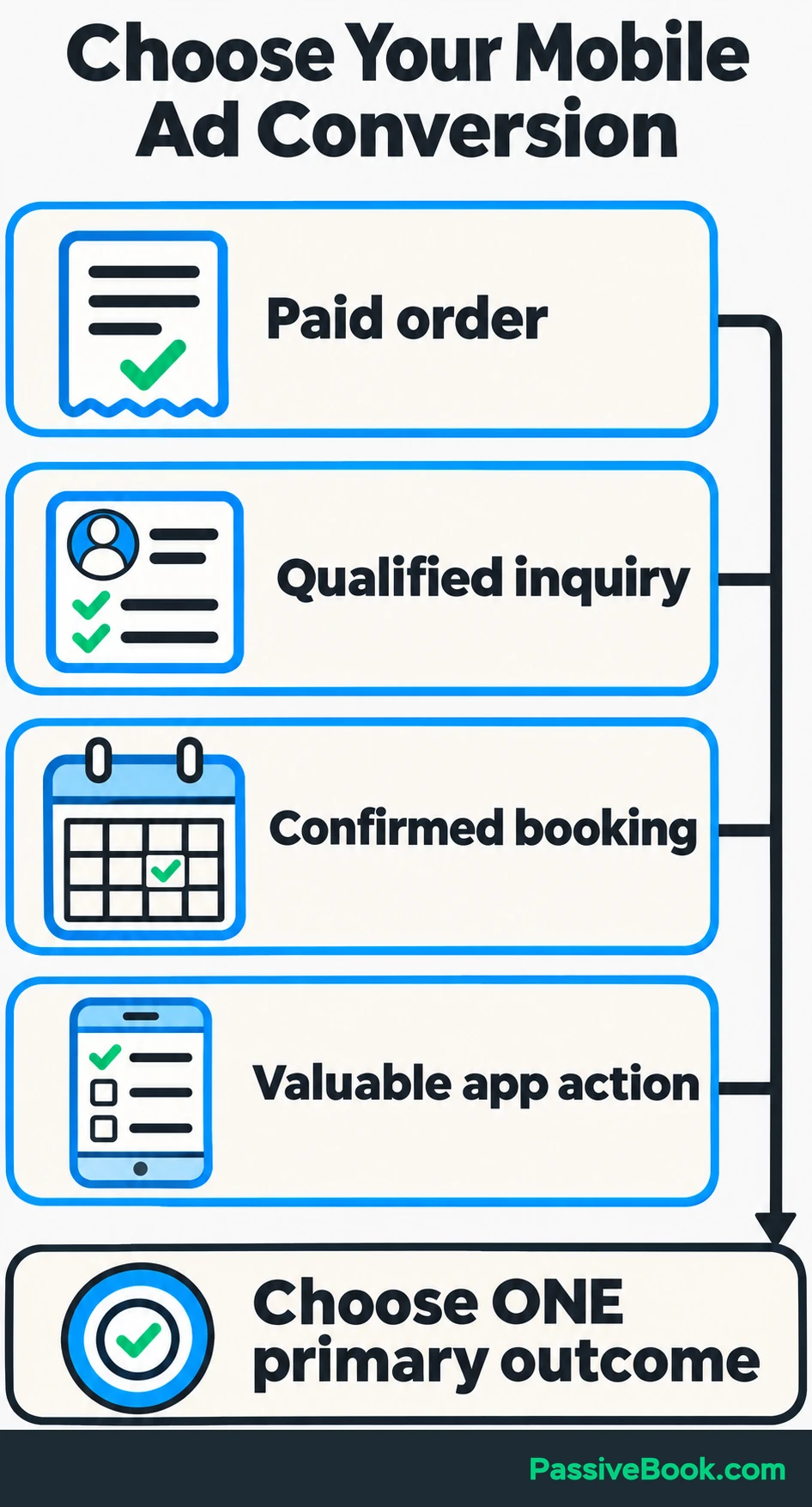
Start with the action you want someone to complete after seeing your ad. Choose one primary conversion and define exactly what counts.
That might be a paid order, a qualified inquiry, a confirmed booking, or a valuable action inside your app. A checkout start can help explain buying behavior, but it is not a completed purchase.
Mobile advertising includes paid placements in search results, social feeds, videos, websites, and apps viewed on phones and tablets. You do not need your own app. You do need a clear destination and a way to confirm the action happened.
Throughout this guide, imagine you sell a beginner watercolor-painting course.
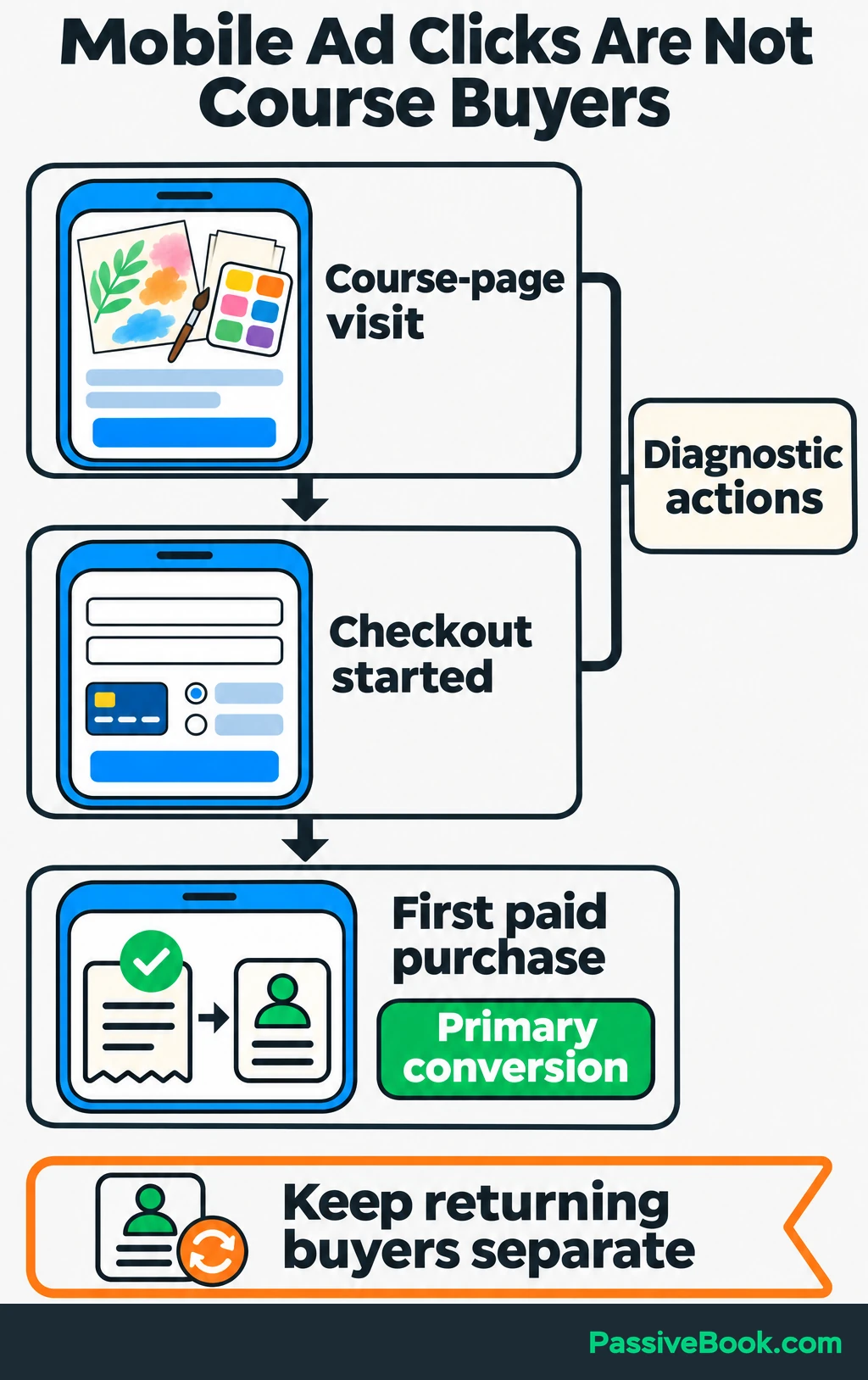
Your primary conversion is a completed first purchase by a new customer. Product-page visits and checkout starts help diagnose problems along the way.
Choose a campaign objective that supports purchases. I would not use a rising view count to justify a campaign whose job is to acquire buyers.
As you work through the guide, record your decisions in a one-page brief. Section 7 brings them together into a complete example.
Calculate Your Advertising CPA Limit
Before choosing a budget, work out how much one new customer can cost.
Start with the revenue from the purchase. Subtract costs that increase when you make a sale, such as payment fees, delivery, expected refunds, and support. The amount left is your contribution before advertising.
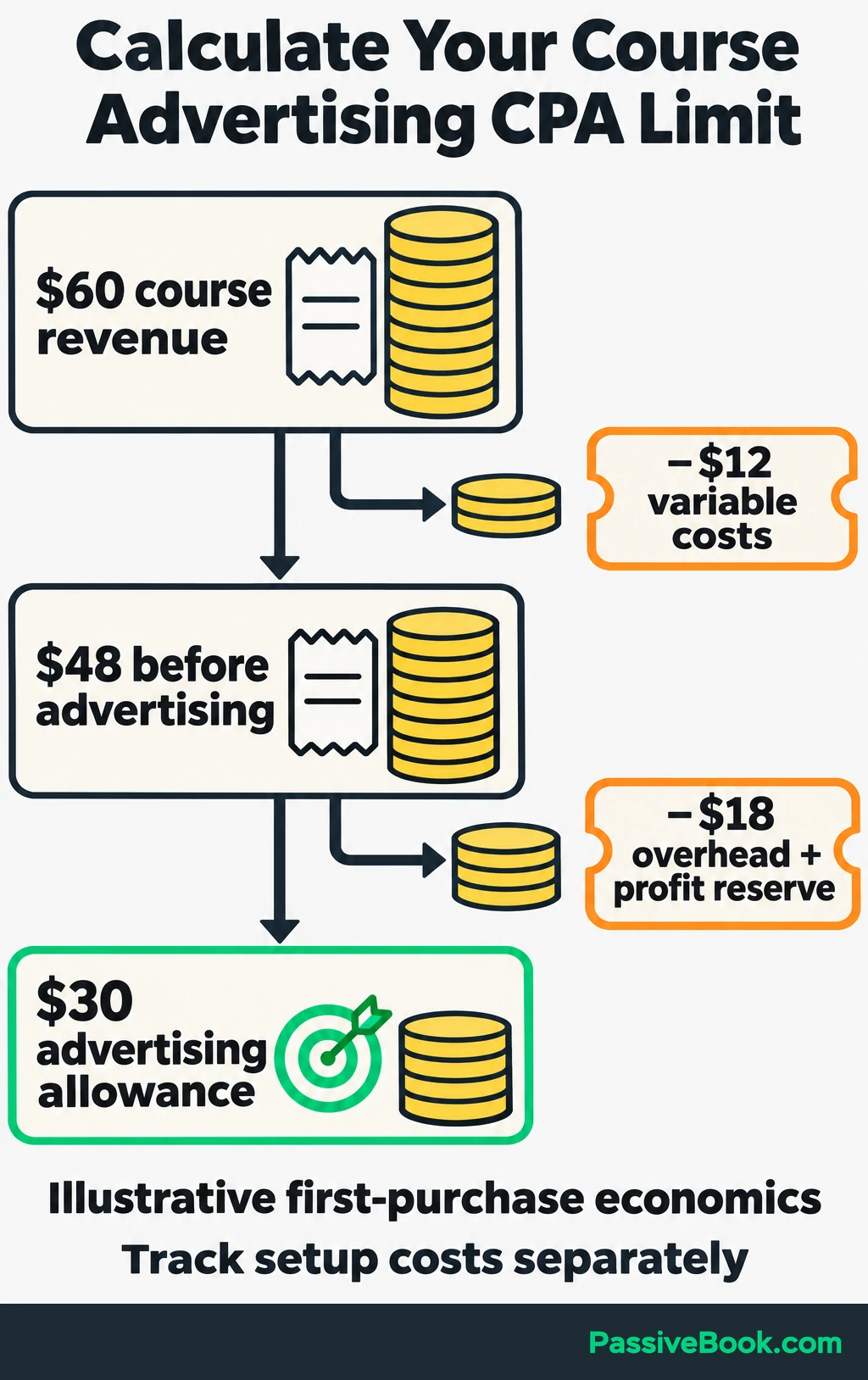
Then reserve what the sale needs to contribute toward overhead and profit.
| Item | Illustrative amount per course sale |
|---|---|
| Course revenue | $60 |
| Variable costs | −$12 |
| Contribution before advertising | $48 |
| Amount reserved for overhead and profit | −$18 |
| Advertising allowance | $30 |
For this course, I would set an advertising cost per acquisition, or CPA, limit of $30.
CPA means advertising spend divided by completed target actions. Because this campaign seeks first-time buyers, count distinct new customers acquired under your chosen attribution rules. Do not include returning customers to make acquisition look cheaper.
Creative production, software, and management also cost money. Track those separately when judging the full cost of acquiring customers.
Base your first allowance on the first purchase. I would only include future purchases after customer records show what those purchases contribute.
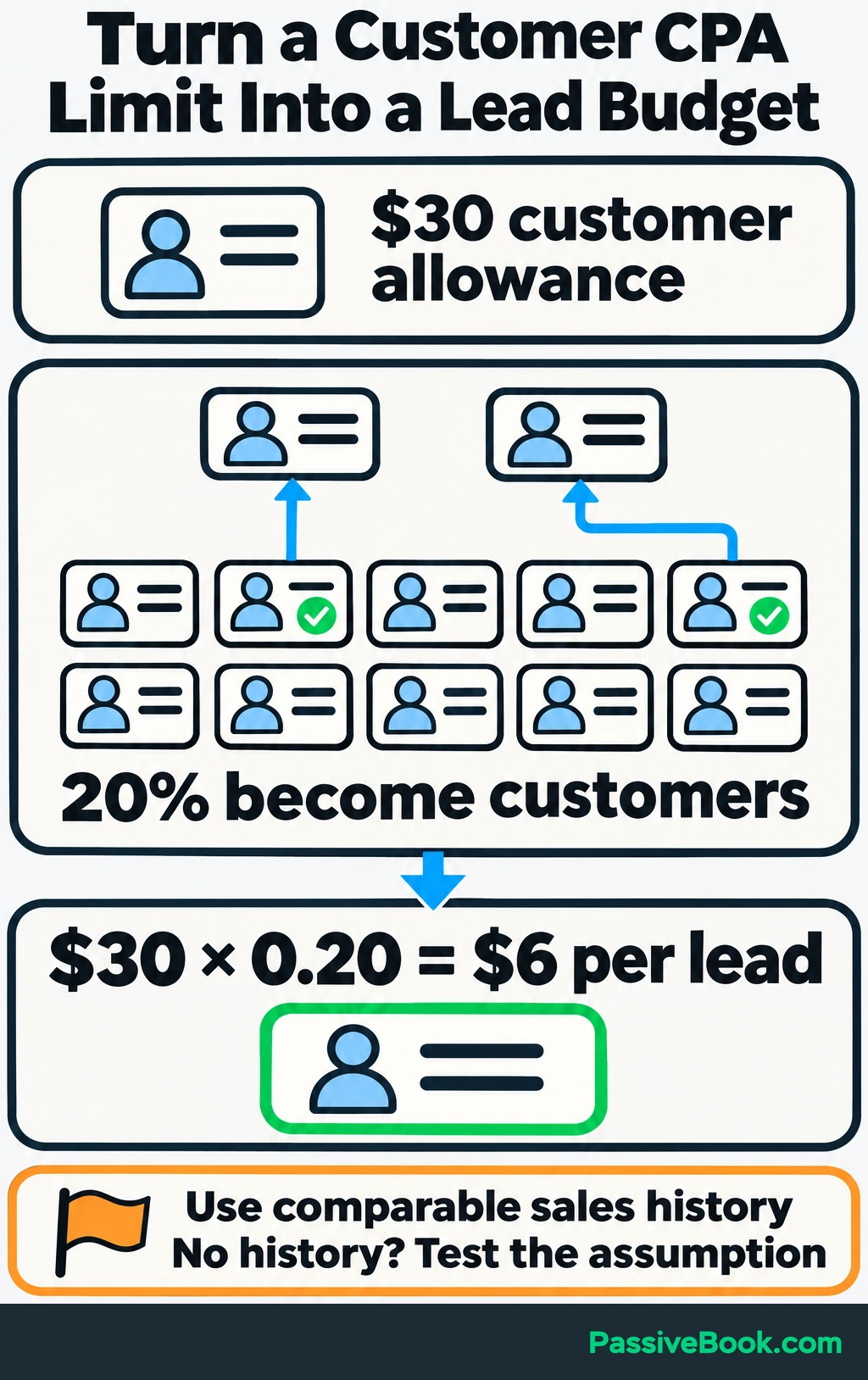
For lead generation, use the share of leads that actually become customers. If your customer allowance is $30 and 20% of comparable leads become customers over your normal sales cycle, your allowable cost per lead is $6: $30 × 0.20. Without that sales history, treat the lead allowance as an assumption to test.
2. Identify Your Audience’s Buying Situation
A useful audience description explains why someone might buy now.
Look through customer questions, purchase records, relevant searches, and existing mobile visits. Find the trigger, the concern, and the information someone needs before paying.
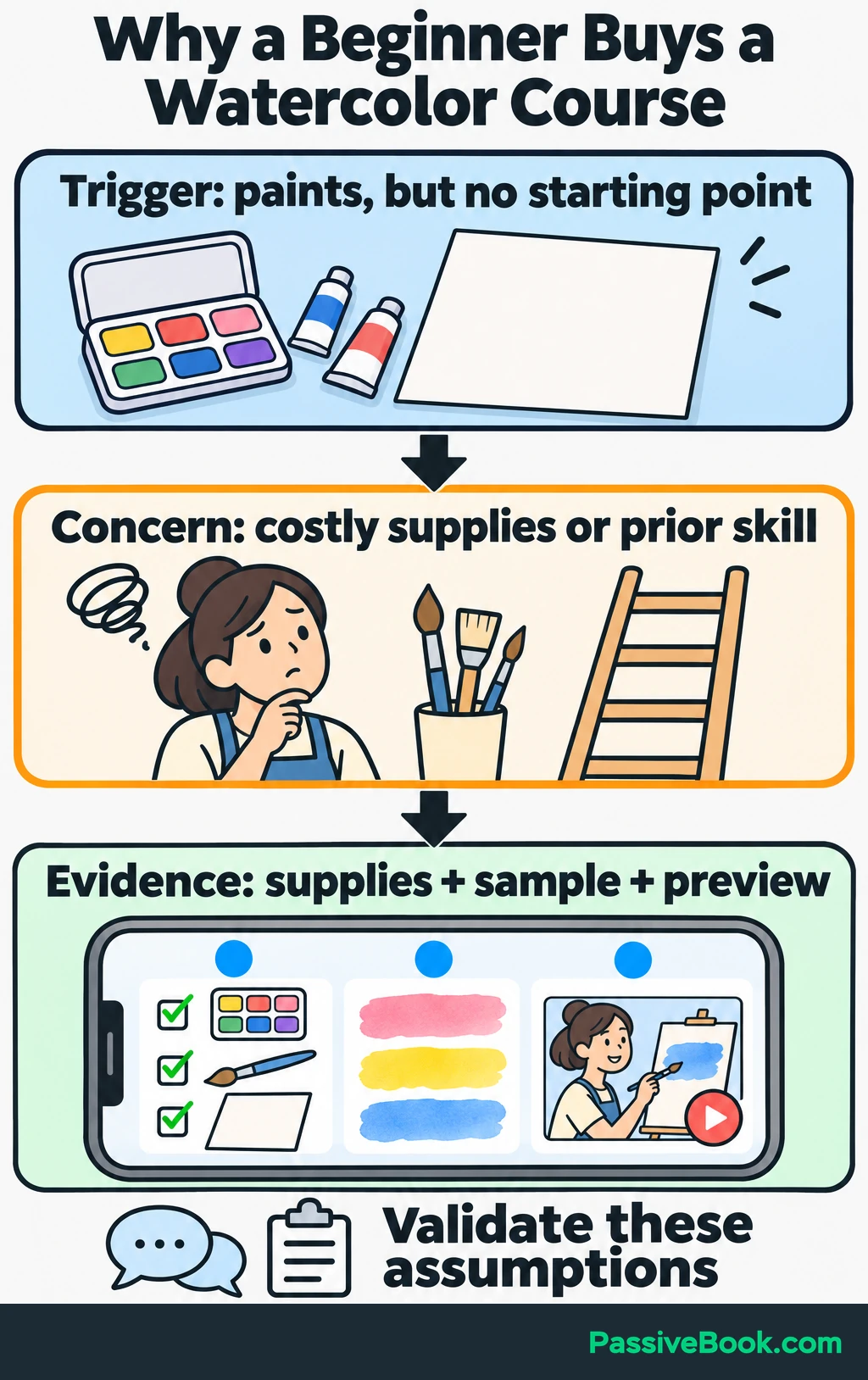
For the watercolor course, those clues might suggest:
- Trigger: They have bought paints but do not know what to practice first.
- Concern: They expect the lessons to require expensive supplies or prior skill.
- Needed evidence: A supply list, a sample exercise, and a preview of how the teaching works.
These are starting assumptions until conversations or buying behavior support them.
The buying situation also changes with the channel. Someone searching for “beginner watercolor course” is already looking for lessons. Someone watching a painting demonstration in a feed may only be curious.
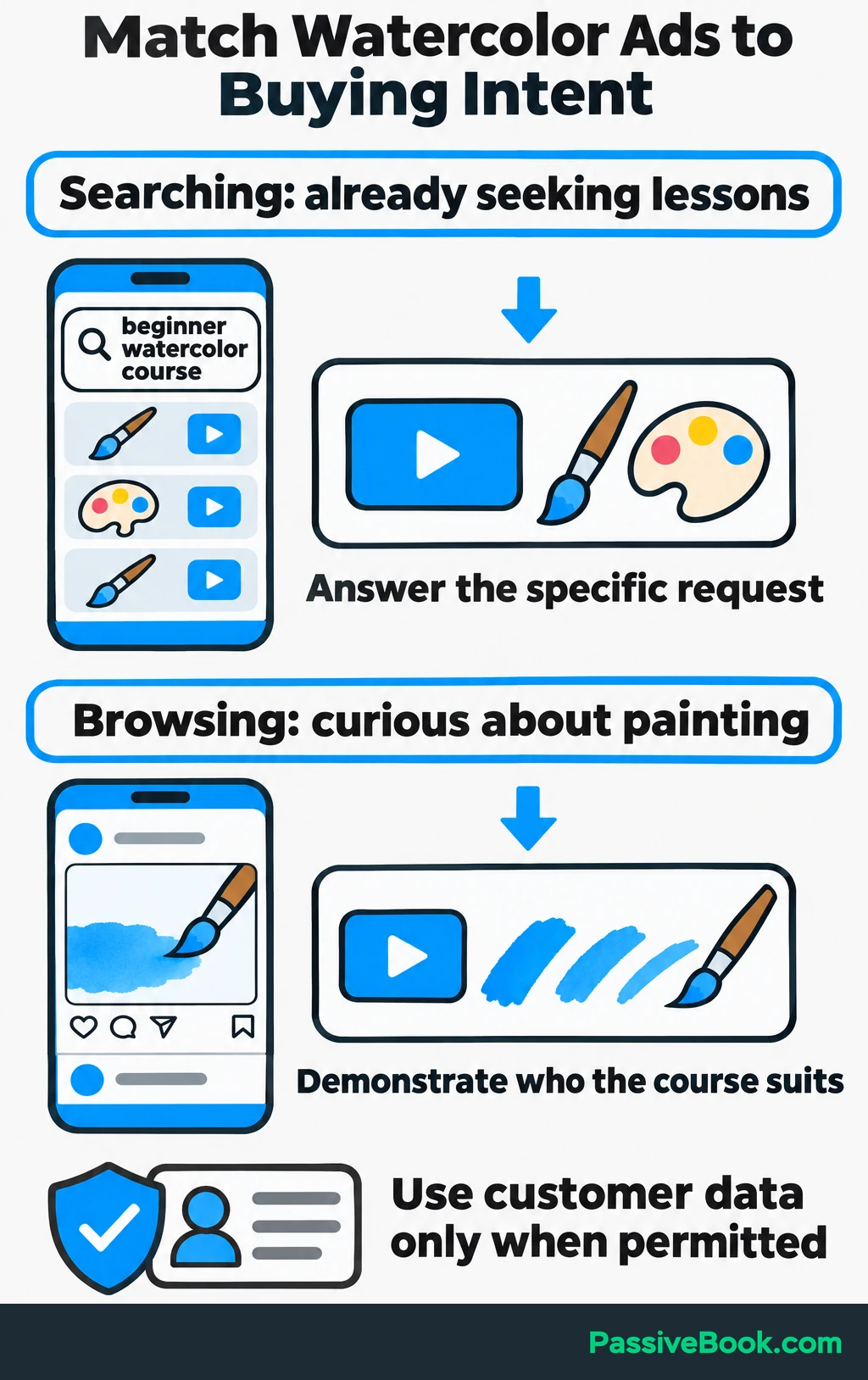
Use those differences to guide both targeting and messaging:
- Search: Choose phrases that describe the lessons you sell, and separate them from requests for free coloring pages or finished paintings.
- Social and video: Use relevant interest or context signals where supported, and let the demonstration show who the course suits.
- Customer audiences: Use visitor or customer data only when you have permission and the platform allows that use.
Set geography and language according to where you can sell and support the offer. Avoid narrowing age, gender, or device without a business reason.
Keep existing customers separate when they need a different message. For a first-purchase campaign, apply available customer exclusions and verify new-customer status in your order records.
3. Choose a Channel That Fits Customer Intent
Compare channels against the buying situation before opening an advertising account.
| Channel | Buying intent | Audience fit | Creative requirements | Destination | Main spending risk |
|---|---|---|---|---|---|
| Paid search | Someone is looking for a product or solution | An offer people can describe in a search | Relevant text, a clear offer, and useful supporting details | Matching product, booking, or inquiry page | Paying for loosely related searches |
| Paid social and video | Someone discovers the offer while browsing or watching | Products you can demonstrate or explain visually | Images or video showing the product and its use | Page that continues the same promise | Paying for attention that never becomes buying interest |
| Mobile display and in-app ads | Someone encounters the offer on another website or app | Relevant browsing contexts or permitted returning audiences | Clear images and copy across supported sizes | Relevant offer page | Buying inexpensive traffic from unsuitable placements |
Paid search is worth considering when customers already search for what you sell. Inspect the actual searches that trigger your ads and exclude unrelated ones.
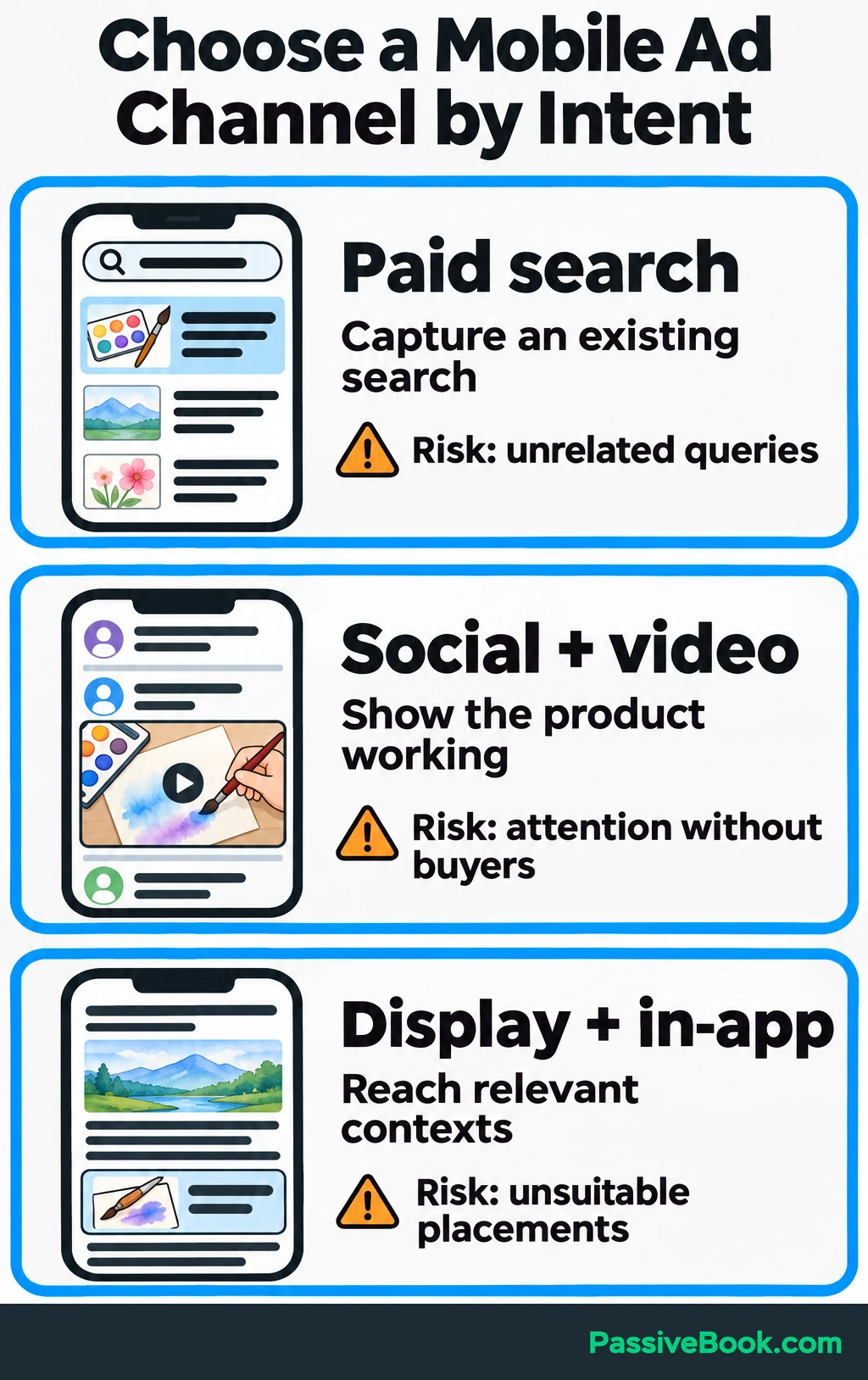
Paid social and video give you room to show the product working. Video can support purchases as well as awareness; Google’s Video campaign guidance describes both uses. Choose the objective and measurement to match your goal.
For the watercolor course, I would start with one paid-social platform because a simple painting exercise gives you something useful to show. That is a testable channel choice, not evidence that social will outperform search.
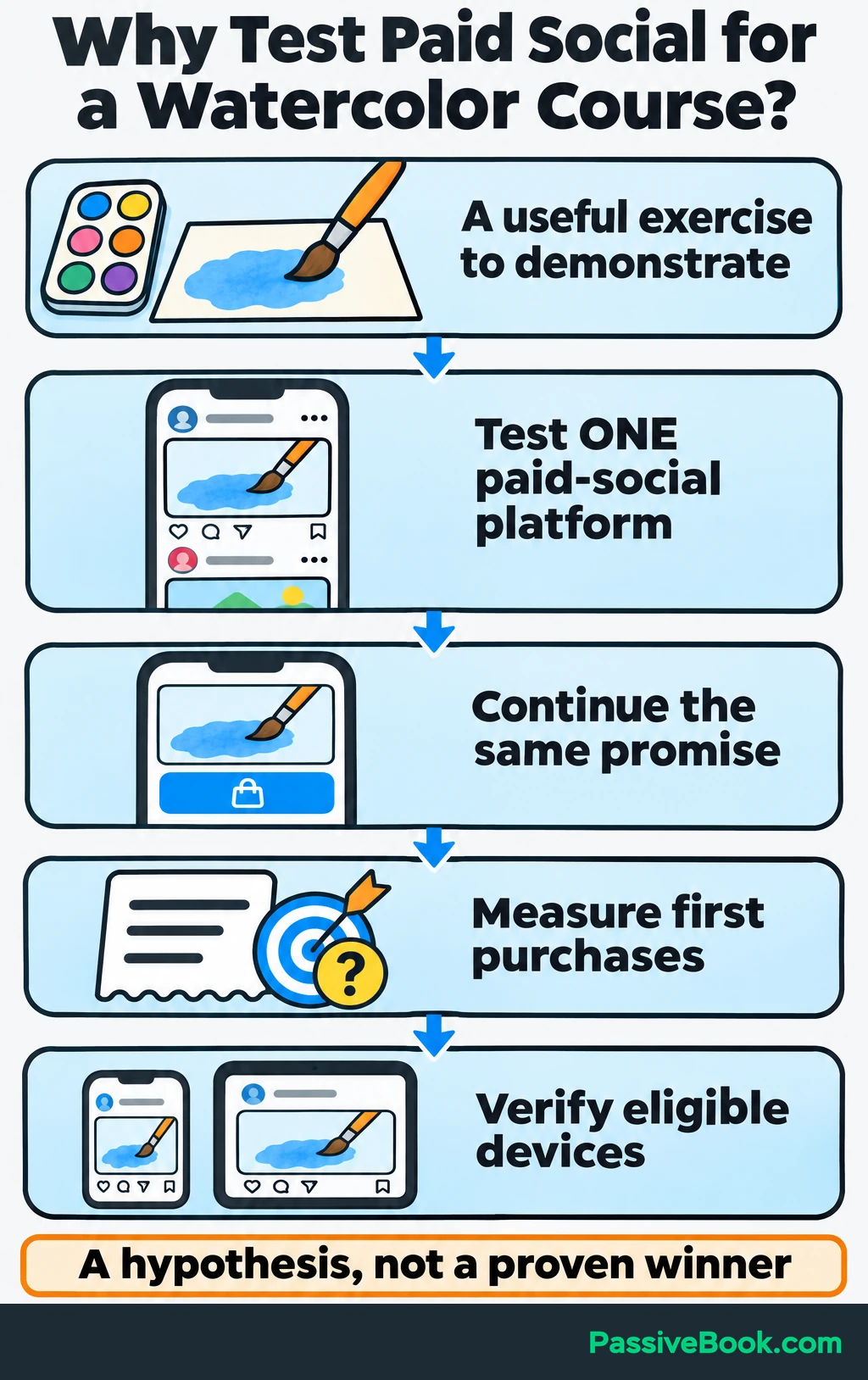
I would skip broad display in this first test because it adds placement decisions before you have established whether the offer converts.
If you own an app, app promotion is a campaign purpose that can span several channels. Google’s App campaigns, for example, can serve across Search, Google Play, YouTube, and other properties. Judge them by activation or purchases beyond installation.
Finally, check eligible devices before launch. A campaign containing mobile placements may also deliver elsewhere, and device controls vary by campaign type. Confirm where ads can run and review performance by device.
4. Set a Test Budget and Spending Boundary
Choose an amount you can afford to lose without disrupting the business. Then separate the first test from the money reserved for a revision.
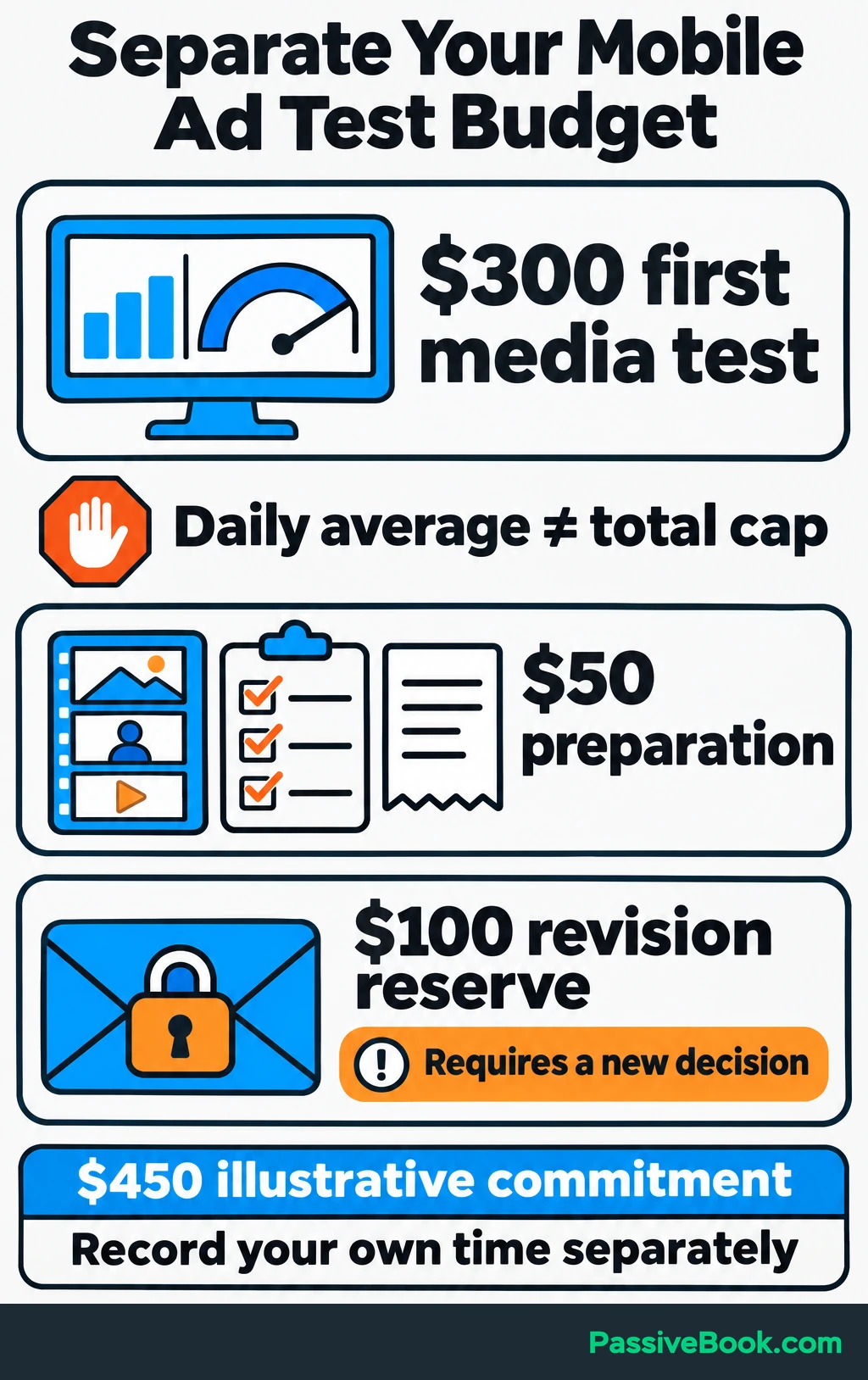
An illustrative total commitment might be:
- First media test: $300 paid to the advertising platform.
- Preparation: $50 for creative or setup expenses, with your own work time recorded separately.
- Revision reserve: $100 held back until you decide whether another test is justified.
These amounts are planning examples, not recommended minimums.
To check whether the economics are plausible, estimate the cost of a website click and the share of those clicks that might bring a first-time buyer.
Count only distinct new customers acquired from those clicks, and allow the same time after each click for a purchase to count. Divide cost per click, or CPC, by the click-to-purchase rate expressed as a decimal.
| Assumed website CPC | Assumed click-to-purchase rate | Implied CPA |
|---|---|---|
| $0.60 | 1% | $60 |
| $0.60 | 2% | $30 |
| $0.60 | 3% | $20 |
At 2%, the calculation is $0.60 ÷ 0.02 = $30. At 1%, the implied CPA reaches $60 and exceeds the course’s $48 contribution before advertising.
These are scenarios, not sales forecasts or typical advertising costs. Replace assumptions with account history or useful forecasts when you have them.
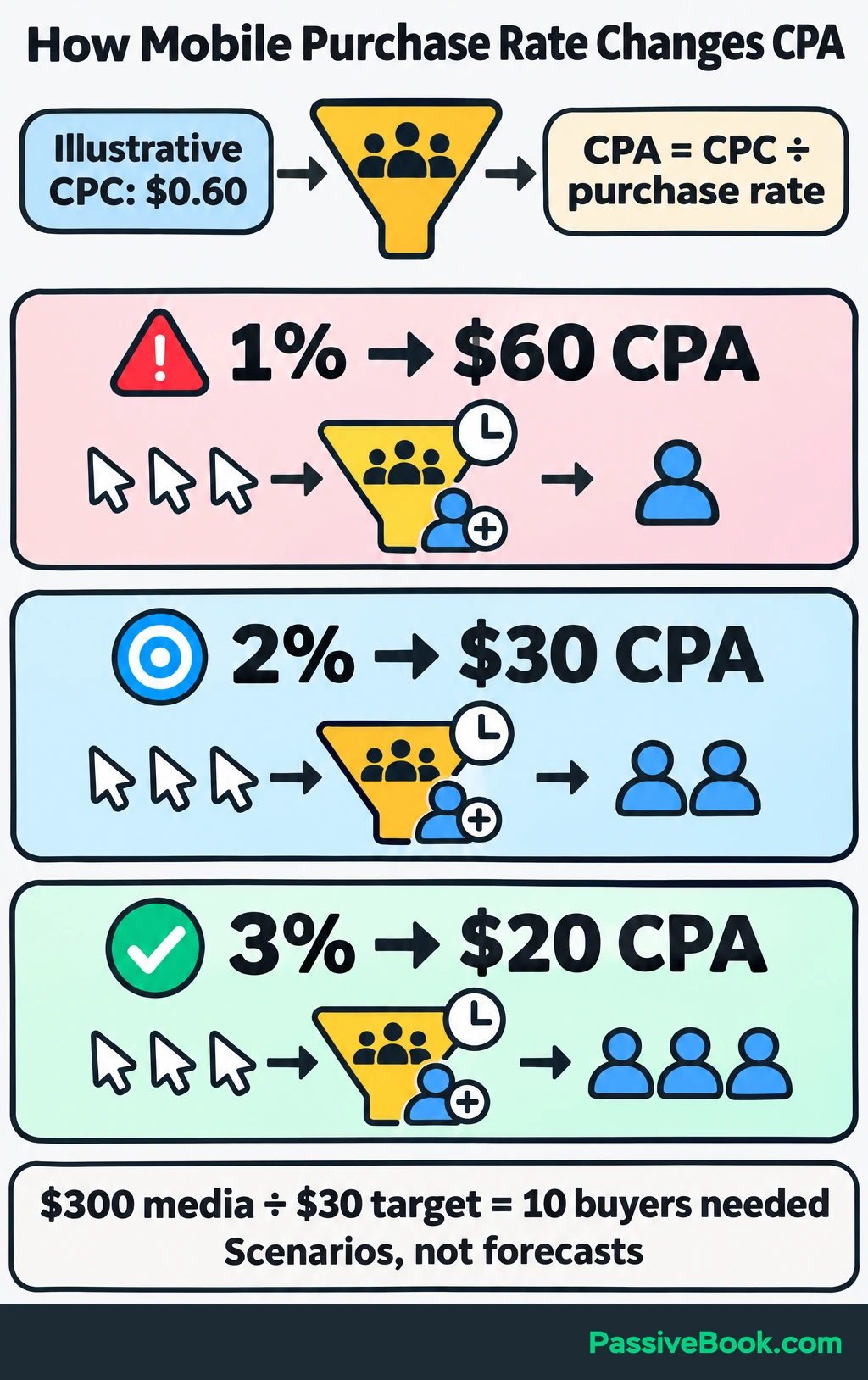
At a $300 media limit, you need at least ten first purchases to meet the $30 CPA target. That arithmetic tells you what success requires; it does not promise ten buyers.
Needing ten buyers is different from being likely to get ten buyers. Use the calculator to compare different purchase-rate assumptions against your own costs and loss limit.
Free Marketing Profit Calculator




Set the campaign’s spending limit, intended pacing, review date, and pause conditions before activation. Check whether the platform setting is an average daily budget or a total cap. Google’s spending-limit guidance, for example, explains that most campaigns can spend above their average daily budget on individual days.
Use available total spending controls that fit your commitment, and monitor spend before it reaches the boundary.
5. Build a Consistent Mobile Conversion Journey
Create Ads for the Selected Placement
Build each creative concept around one problem, one useful benefit, evidence people can inspect, and one next action.
While reviewing one of my digital-product pages, I noticed that I had described the files in detail but barely shown how someone would use them. I added an example of the finished task before polishing another paragraph. That is the same check I would bring to an ad: can a stranger see what they are buying?
For the watercolor course, a lesson excerpt provides that evidence. You do not need a sweeping promise about becoming an artist.
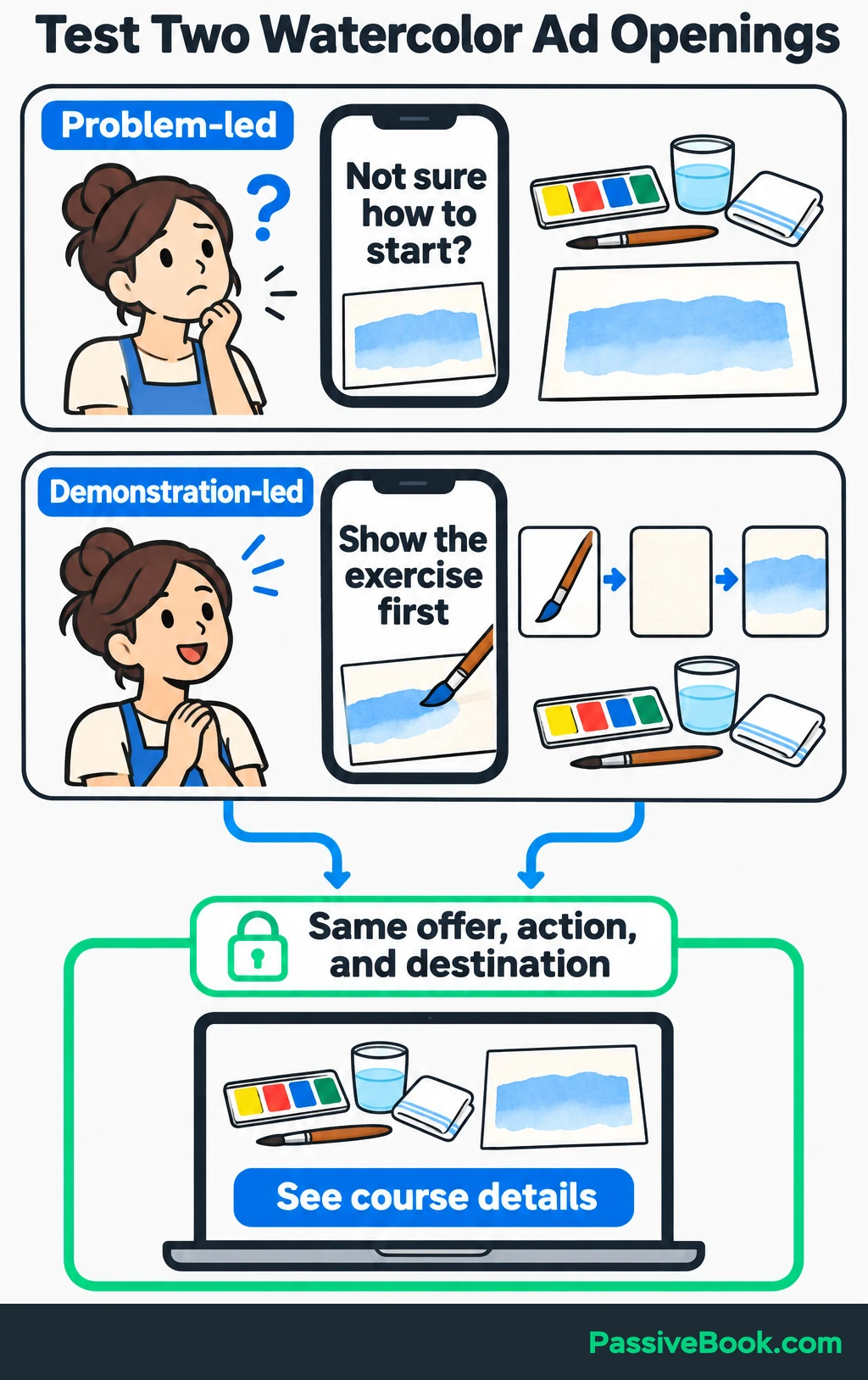
Test two distinct openings:
- Problem-led: “Not sure how to start with watercolor?” Follow it with the supplies and first exercise.
- Demonstration-led: Open with a brush creating a simple color wash, then show how the lesson breaks down that exercise.
Keep the course offer, call to action, and destination consistent so the opening is the main difference.
A short excerpt might say:
“Practice a simple color wash with a step-by-step beginner lesson. Preview the exercise and see the course details.”
Use real course materials and genuine testimonials when available.
For mobile placements, make the central message clear early. Use readable text, caption spoken information, and keep essential words away from interface overlays. Prepare vertical versions for full-screen placements and preview every format you select.
I would use Canva for straightforward layouts and captions if it already fits your workflow. A clear view of the actual lesson matters more than elaborate animation.
You have two opening ideas; the next job is turning them into words for your own offer. AI Advertising Studio drafts both versions and a matching page opening so the promise stays consistent after the tap.

Free AI Advertising Studio
Make the Next Action Easy on a Phone
Send visitors to the page that continues the ad’s promise. A painting demonstration should lead to the course page, where people can find the demonstrated exercise and understand what they receive.
Make these details easy to find:
- Offer: What the course includes and who the lessons suit.
- Requirements: Supplies, prior knowledge, and how students access lessons.
- Evidence: A lesson preview or sample exercise.
- Purchase details: Price, payment options, and relevant refund terms.
- Next action: A clear purchase button and manageable checkout.
Remove unnecessary form fields, oversized media, and pop-ups that block the action. If your existing WordPress setup can build the page, I would use it before buying another landing-page tool.
Complete the whole journey on iOS and Android, including an in-app browser and a slower connection. Open the ad destination, make a test payment, and confirm that the receipt and course access arrive.
For an owned app, also test the app-store destination or deep link—the link intended to open a particular screen—and complete the promised activation action.
6. Verify Conversion Measurement Before Spending
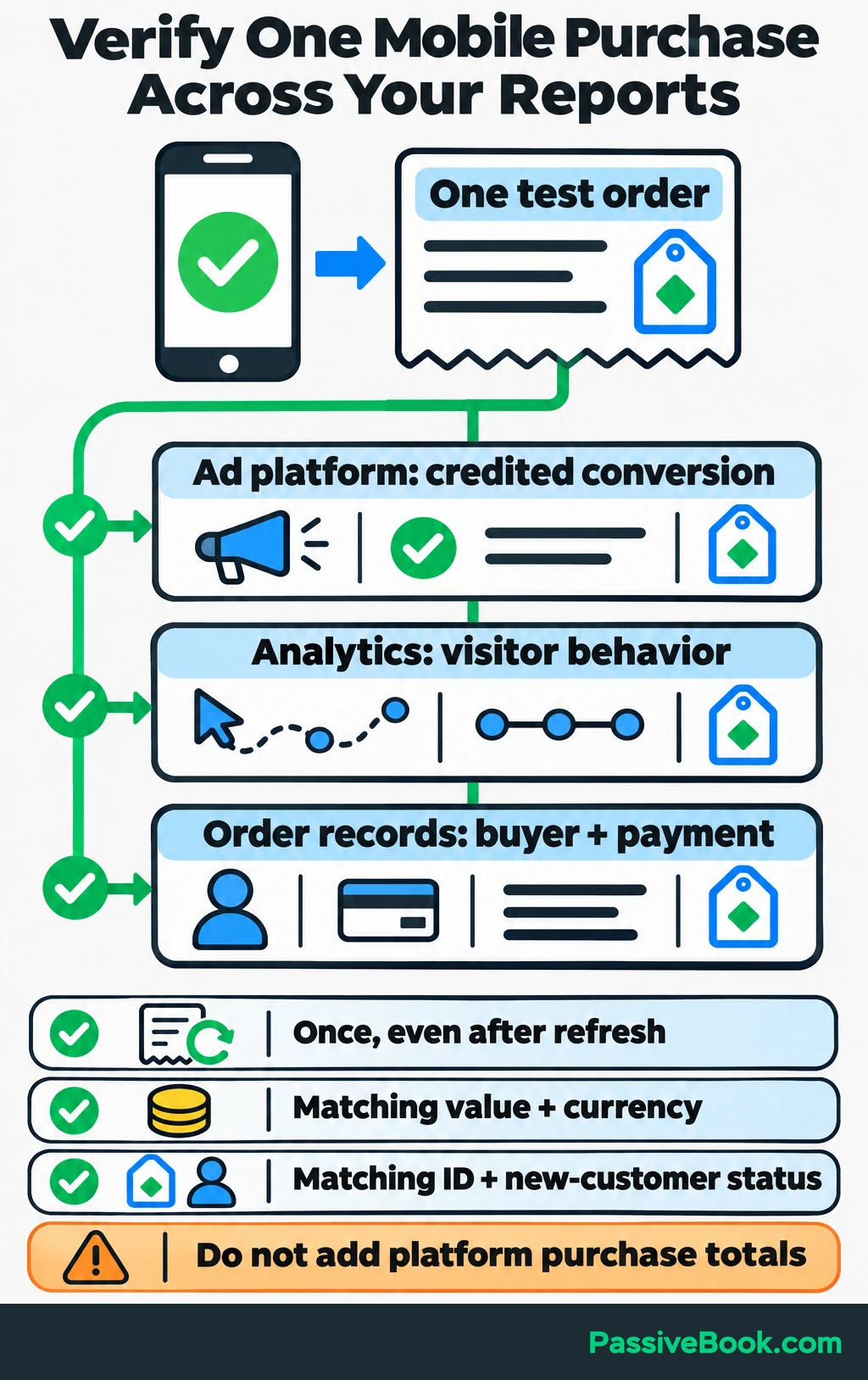
Use the advertising platform to check delivery and credited conversions, website or app analytics to understand visitor behavior, and order records to confirm buyers and payments.
Apply privacy requirements for the markets you serve before enabling advertising trackers or customer-data targeting. For UK users, follow the ICO’s online-advertising guidance: get consent before using advertising cookies or similar technologies, including for ad measurement. Test that your setup respects refusal and withdrawal.
If you own an iOS app, Apple requires App Tracking Transparency permission before tracking users across other companies’ properties or accessing the advertising identifier. This is an app requirement, not a permission prompt every mobile website must show.
For manually tagged ad links, use consistent tracking details so analytics can identify the platform (source), traffic type (medium), campaign, and individual ad (creative identifier).
Complete a test purchase and check that:
- Counting: One order records once, including after a confirmation-page refresh.
- Value: The amount and currency match the order.
- Identity: The transaction identifier matches your business record.
- Customer status: You can distinguish a first purchase from a returning buyer’s order.
- Bidding: The intended purchase event is the action used to guide campaign delivery.
Decide the conversion window—the time allowed after an ad interaction for a conversion to receive credit—and the attribution rules used to assign that credit.
Reports can differ because they use different dates, events, or counting rules. Compare equivalent events and periods, and never add two platforms’ credited purchases together as if they were separate customers.
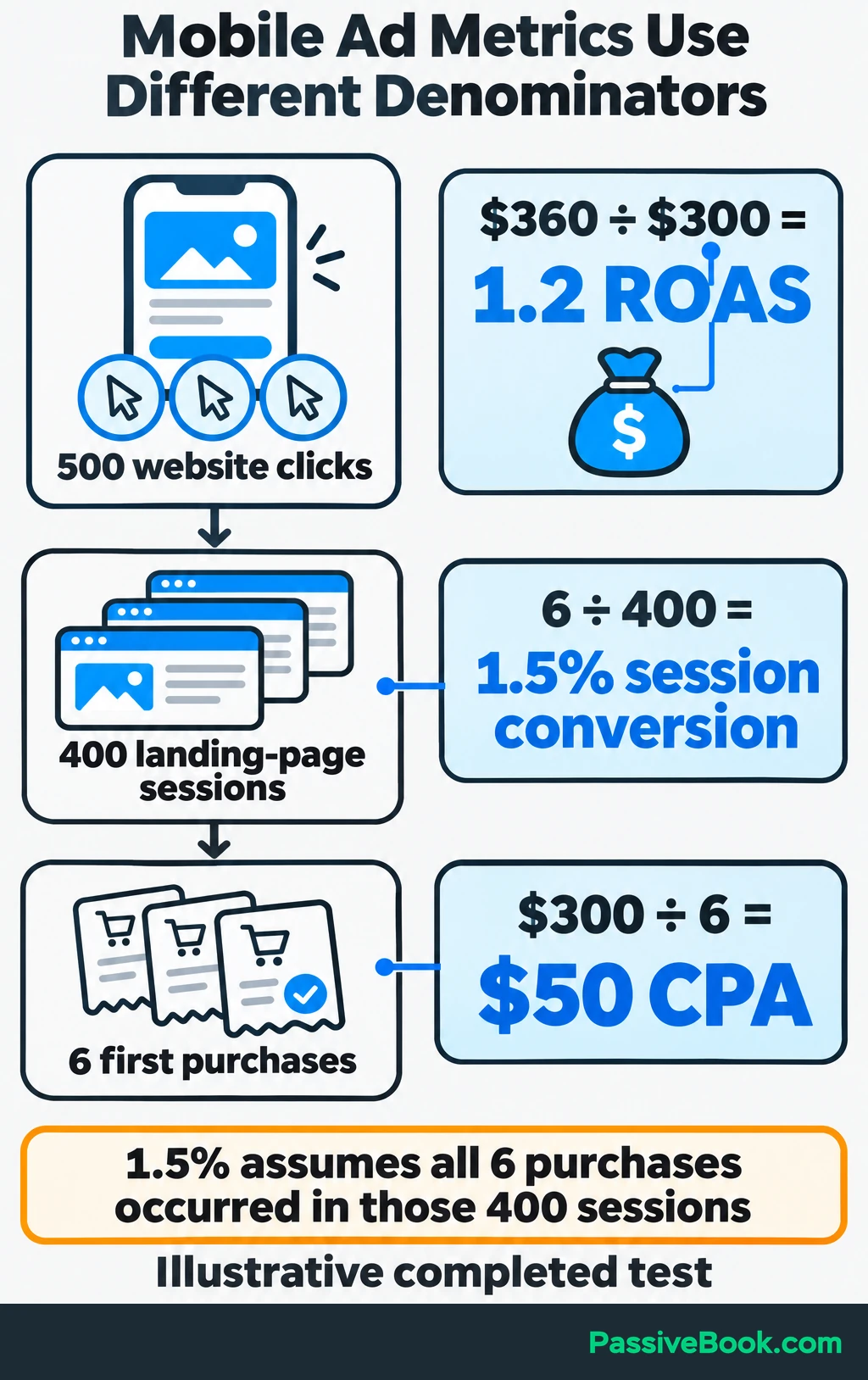
Use a compact report like this. The figures describe an illustrative completed course test, with six distinct first purchases matched to orders and credited under the selected rules.
| Ad spend | Website clicks | Landing-page sessions | First purchases | CPA | Attributed revenue | ROAS |
|---|---|---|---|---|---|---|
| $300 | 500 | 400 | 6 | $50 | $360 | 1.2 |
Return on ad spend, or ROAS, divides attributed revenue by advertising spend. Here, $360 ÷ $300 = 1.2. That is a revenue measure, so assess it against costs.
For the landing-page conversion rate, count purchases completed in the measured landing-page sessions. If all six purchases occurred within those 400 sessions, the rate is 6 ÷ 400 = 1.5%.
Keep that separate from the click-to-purchase rate used in budget planning. Ad clicks and recorded sessions are different groups.
7. Launch a Focused Campaign Test
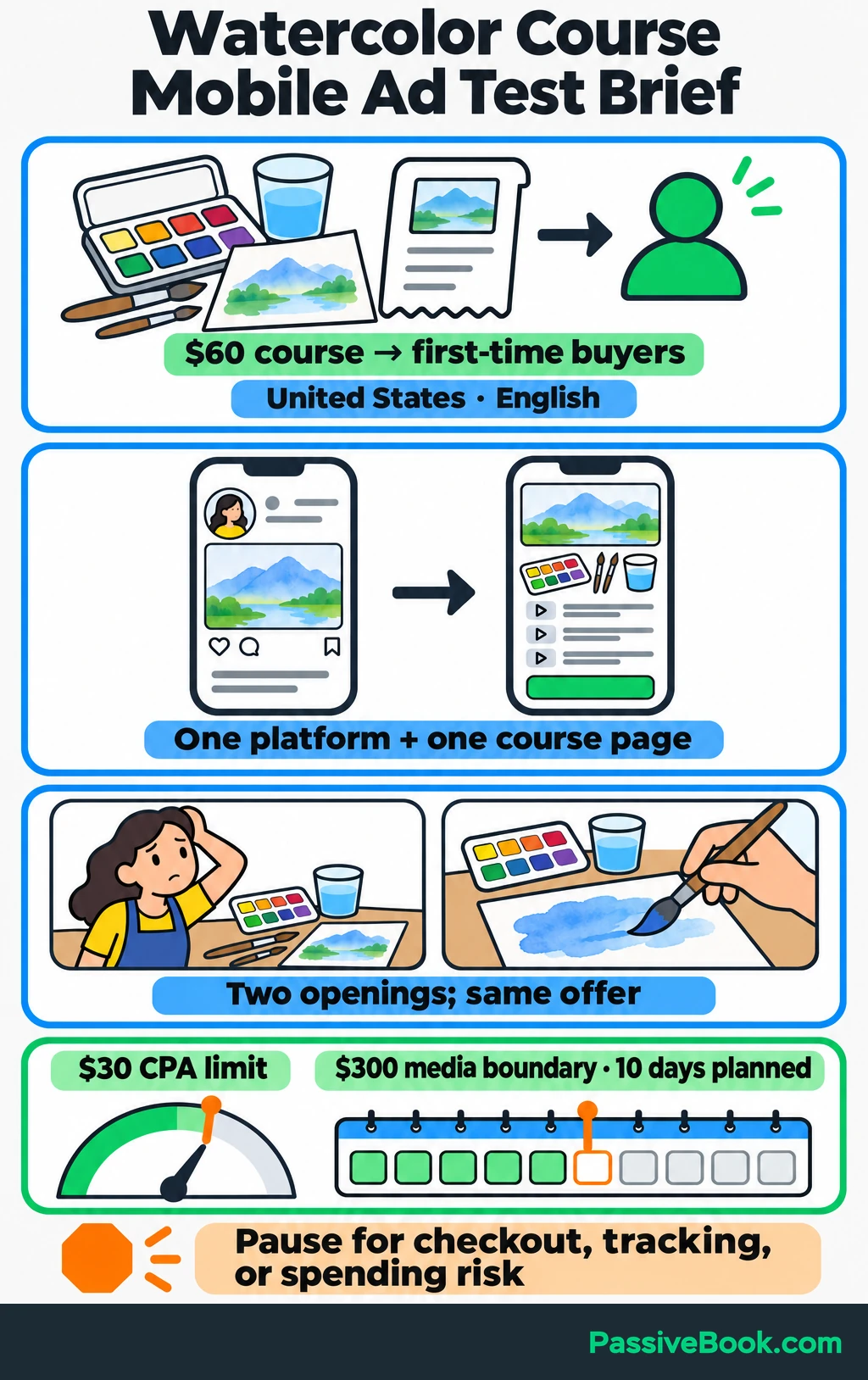
Turn your decisions into a brief before activating the campaign. Here is the course example brought together, with cost per acquisition as its key performance indicator (KPI).
| Decision | Illustrative campaign brief |
|---|---|
| Objective | Acquire first-time course buyers |
| Conversion | Completed paid order from a new customer |
| Audience | Watercolor beginners who need help choosing supplies and starting practice |
| Geography and language | United States; English; course sales and support available there |
| Offer | $60 beginner course with a supply list and guided exercises |
| Channel | One paid-social platform |
| Destination | Course sales page showing the preview, supplies, lessons, and purchase details |
| Creative concepts | Problem-led opening versus color-wash demonstration |
| Primary KPI | Advertising CPA for first-time buyers |
| CPA limit | $30 |
| Media boundary | $300 for the first test; separate revision funds require a new decision |
| Schedule | Plan a ten-day delivery period; check pacing daily and stop at the spending boundary |
| Outcome review | Review after delivery and allow for observed purchase delays |
| Pause rules | Broken checkout, incorrect conversion recording, or risk of exceeding the spending boundary |
| Next-test rule | Fund another bounded test only when the results identify a useful change or support repeating the approach |
Check the objective, audience, geography, customer exclusions, billing, mobile previews, destination, tracking, and spending controls against this brief.
Choose a bidding approach aligned with purchases and the measurement available in your account. A target CPA is an instruction to the delivery system. It is not a guarantee that every customer will cost that amount, and it does not replace a spending limit.
Keep the first test focused on one question: does the problem-led opening or the demonstration give this offer a more promising start?
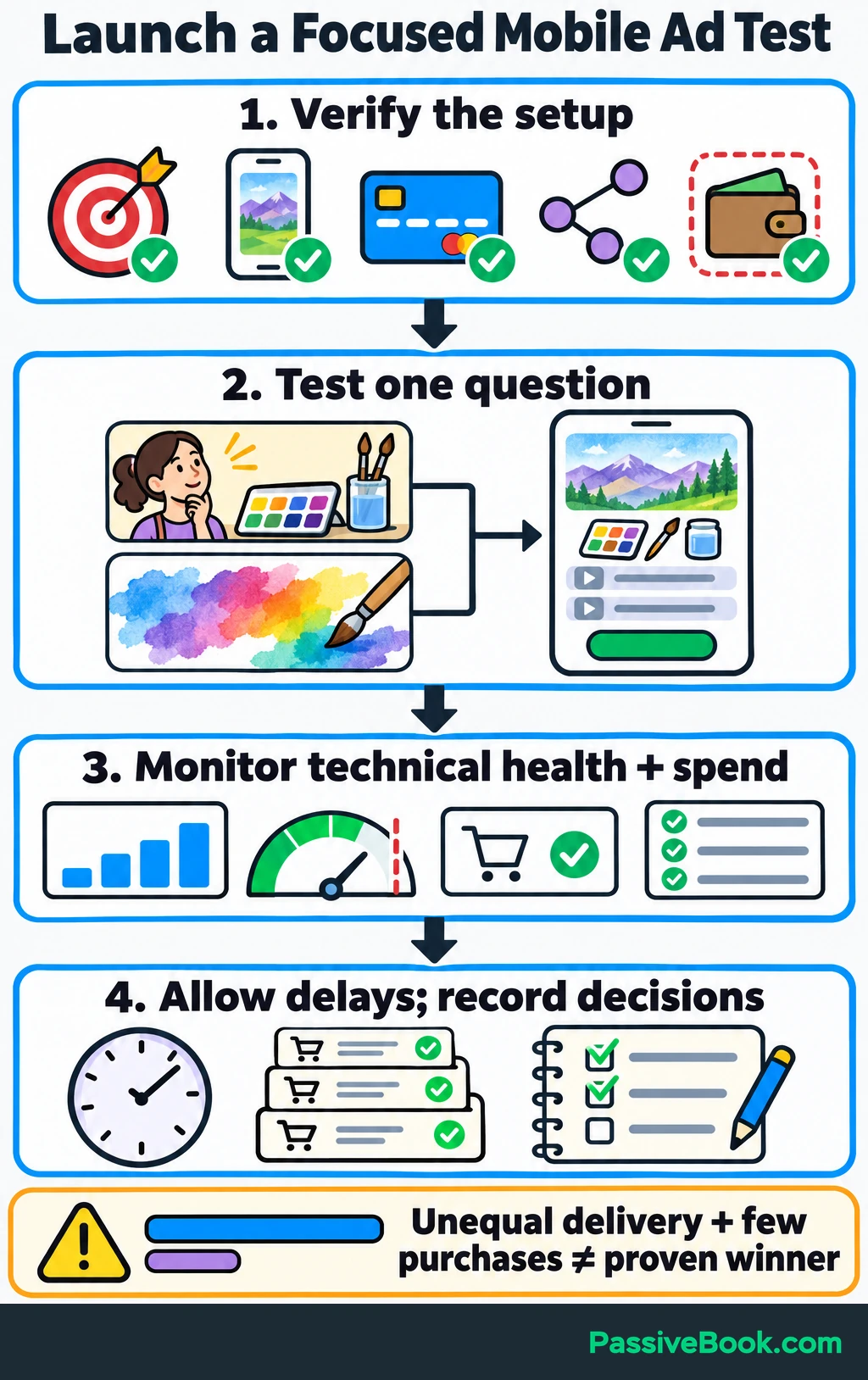
Avoid adding several audiences, prices, and landing pages at once. You would spend more money trying to work out what caused the result.
Also distinguish exploration from proof. A few purchases may justify another bounded test, but they cannot establish a dependable creative winner. Automated delivery may also give the two ads unequal exposure.
Check delivery, spend, links, checkout, and tracking promptly after launch. Record each change and why you made it so the next review has something better than your memory to work with.
8. Improve the Bottleneck Before Increasing Spend
Review technical health promptly, but judge acquisition results after allowing for customers’ time to purchase.
Recent CPA can look worse while conversions are still arriving. Google’s conversion-delay guidance explains why fully reported spend alongside incomplete conversions can distort recent results. Keep the spending boundary in place while you wait; more observation does not require more spending.
Use the journey to locate the problem.
| Observed problem | Checks | Next action |
|---|---|---|
| Little or no delivery | Approval status, audience size, billing, schedule, bids, and eligibility | Fix the restriction before judging the creative |
| Clicks from unsuitable prospects | Search terms, placements, targeting, and whether the ad makes the offer clear | Exclude irrelevant traffic where possible and clarify who the offer suits |
| Impressions but little useful response | Opening message, readable text, product visibility, and placement preview | Test a clearer opening or stronger product demonstration |
| Clicks without recorded landing-page visits | Page loading, redirects, in-app browsers, consent effects, and tracking | Test the link and repair loading or measurement problems |
| Visits without purchases | Offer clarity, supply requirements, price, payment failures, and checkout steps | Fix the most evident buying obstacle |
| Purchases above the CPA limit | Click cost, purchase rate, refunds, and new-customer status | Revise the costly part or stop the test before expanding |
Return to the illustrative report: $300 spent for six first purchases produces a $50 CPA.
That exceeds the $30 allowance and the $48 contribution before advertising. The six sales contribute $288 before advertising—six times $48—so the test loses $12 after media spend, before fixed preparation costs and overhead.
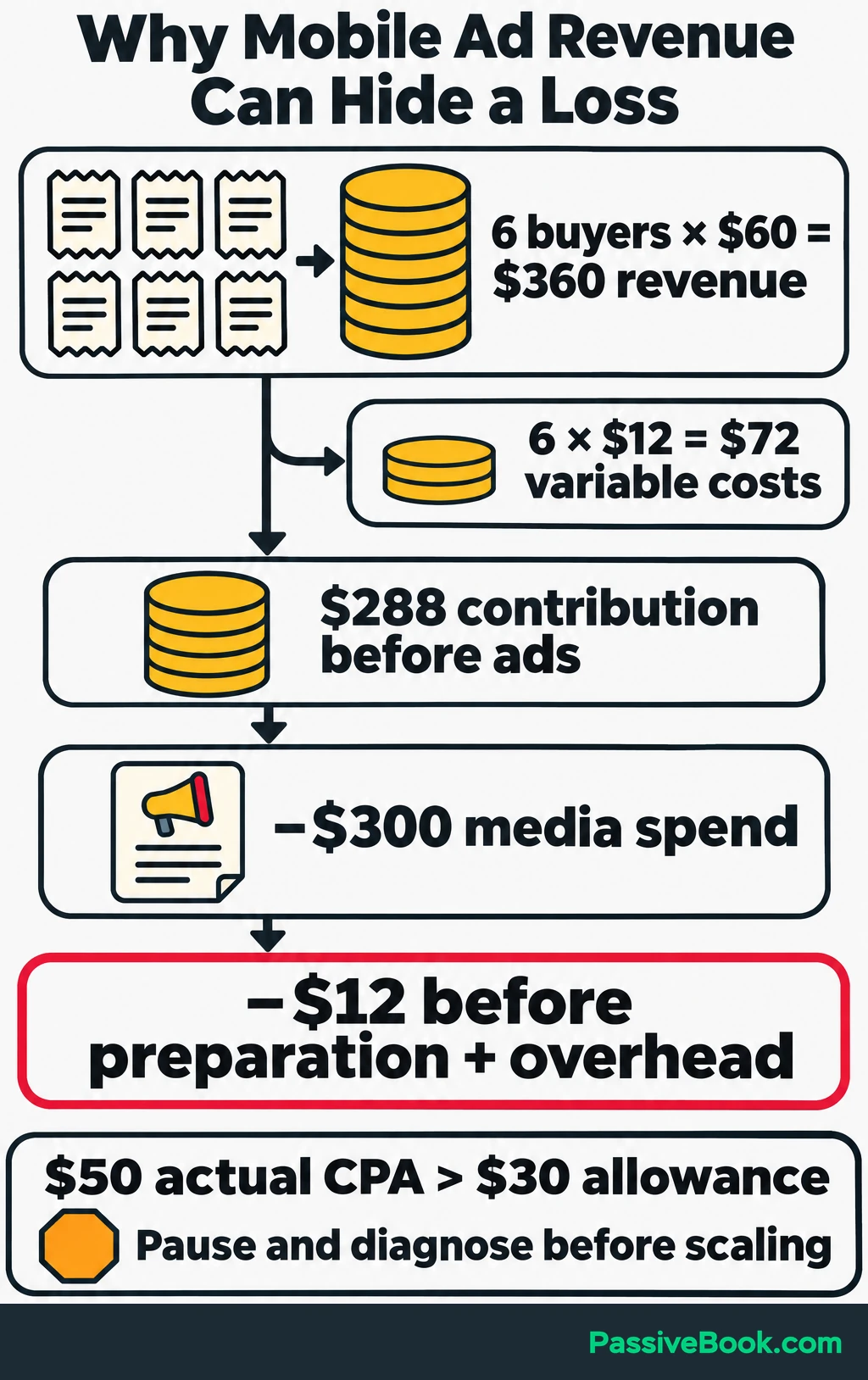
The $360 revenue figure does not rescue those economics. I would pause further spending and inspect the weakest part of the journey.
If customers repeatedly ask whether they need special brushes, clarify the supply requirements and test again within a new boundary. If traffic is unrelated to lessons, fix targeting or the ad’s message first. Another button color would be an optimistic distraction.
Change one major variable at a time when you need to understand its effect. Record the change, the result, and the reason to fund, revise, or stop the next test.
Increase spend in controlled steps only after repeated results meet your cost target and you can serve more customers. Watch the cost and quality of the additional customers, because a larger budget may reach a different audience.
Save the successful audience, message, page, and measurement settings as your next baseline. Once tracking works, automate recurring reports and spending alerts with your existing tools or n8n. Keep a scheduled review of purchases, refunds, and contribution.
Automation can collect the numbers. The decision to keep buying customers still needs a business reason.
What Next?
Write your primary conversion and affordable CPA on one page, then choose one channel to test within a firm spending boundary. Those three decisions will make the rest of your campaign brief easier to complete.
Use the social buttons to share this guide when a campaign discussion needs to move from “more clicks” to affordable customers.
Which part of your mobile journey feels least certain: reaching suitable people, getting the purchase, or measuring it? Leave your answer and any other questions in the comments.
Share this post with your friends & followers:

