Put your offer beside three competitors. If you hid the business names, could a customer tell why they should choose yours?
When every page promises quality, convenience and great service, the customer has to work out the difference alone.
You can spend hours improving your marketing while leaving that buying question unanswered. This guide follows one online course from a vague selling point to a clear reason to buy, giving you a model for explaining why customers should choose your offer on your website and in your marketing.
What Makes a Strong Unique Selling Proposition?
A unique selling proposition, or USP, answers one question: “Why should this customer choose your offer over the alternatives?”
The answer connects something customers value with a meaningful difference you provide, as BDC’s guidance on finding a USP explains.
You don’t need an unprecedented product. You might teach a familiar skill for a particular situation, make a difficult task easier or provide support that other options leave out.
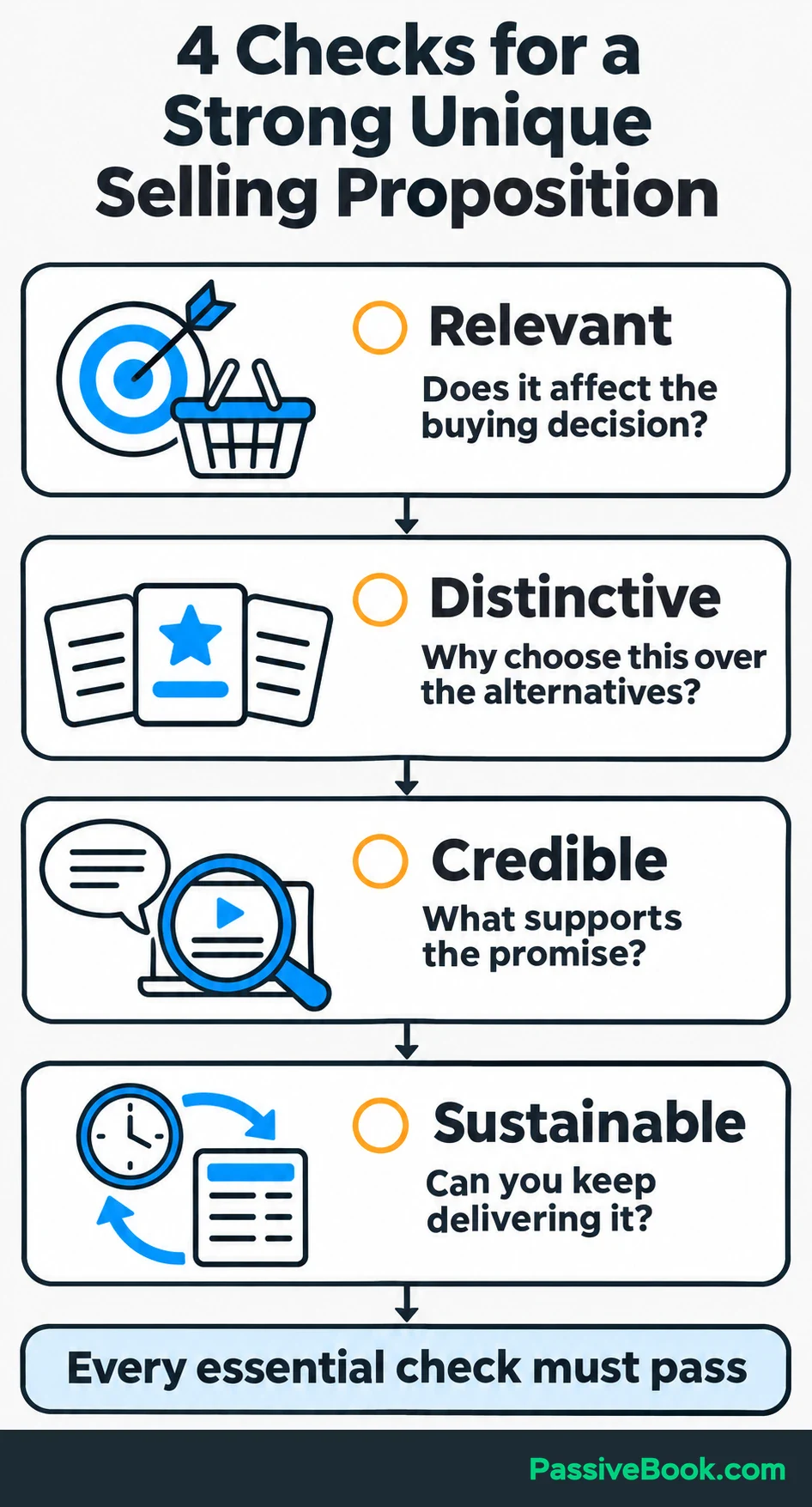
I use four checks:
- Relevant: Does the difference matter enough to affect a buying decision?
- Distinctive: Does it give customers a reason to choose you over the options they consider?
- Credible: What can you show to support the promise?
- Sustainable: Can you keep delivering it at a cost and workload your business can handle?
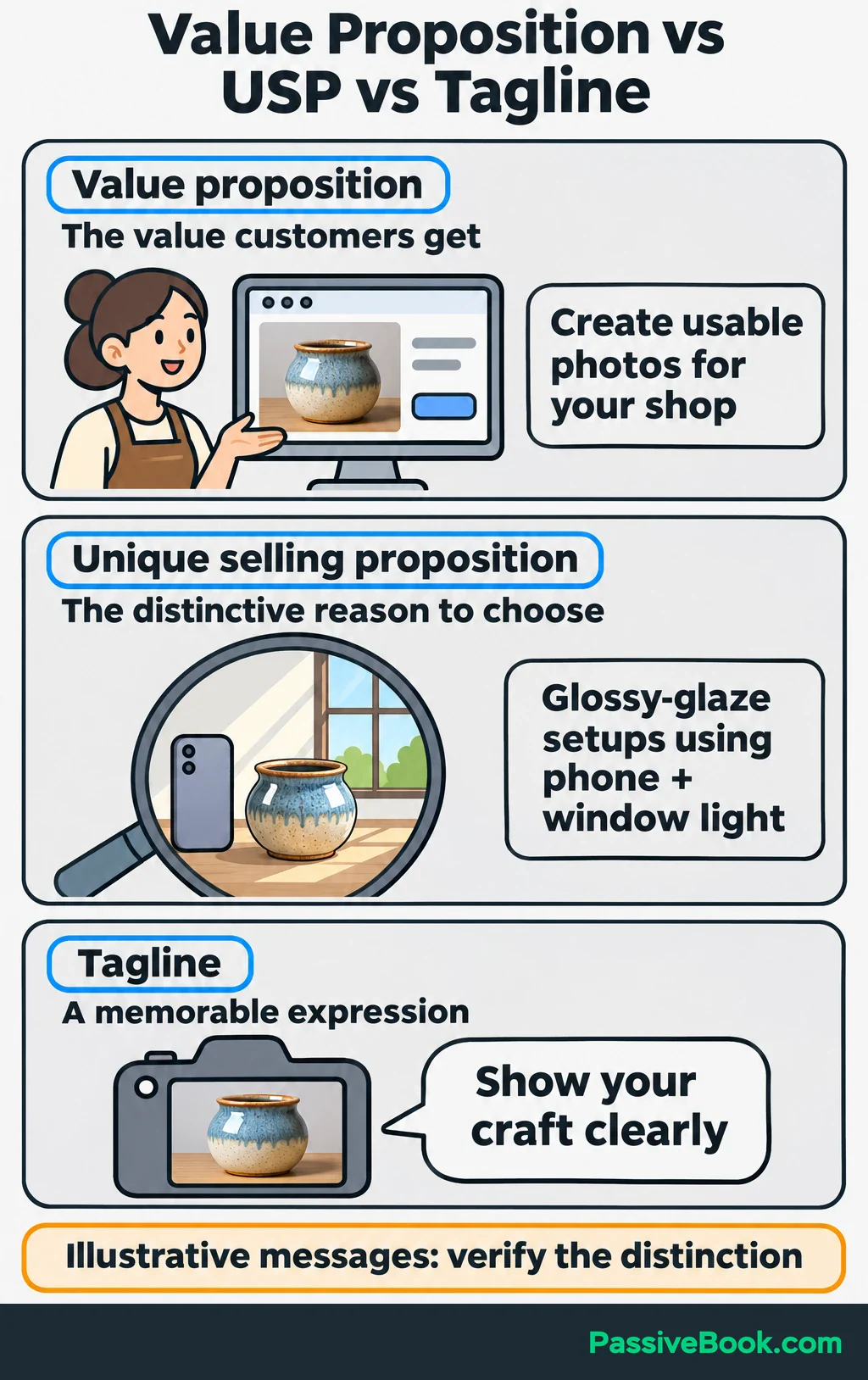
A value proposition describes the value customers get. A USP emphasizes the distinctive reason to choose your offer. A tagline makes a message memorable.
You can have all three, but a catchy tagline won’t do the USP’s job by itself.
1. Choose the Offer and Buying Situation
Start with one offer. Trying to find a single selling point for everything you do can leave you with something so broad it says very little.
Write this working sentence:
This offer helps [customer in a specific situation] achieve [outcome] despite [obstacle].
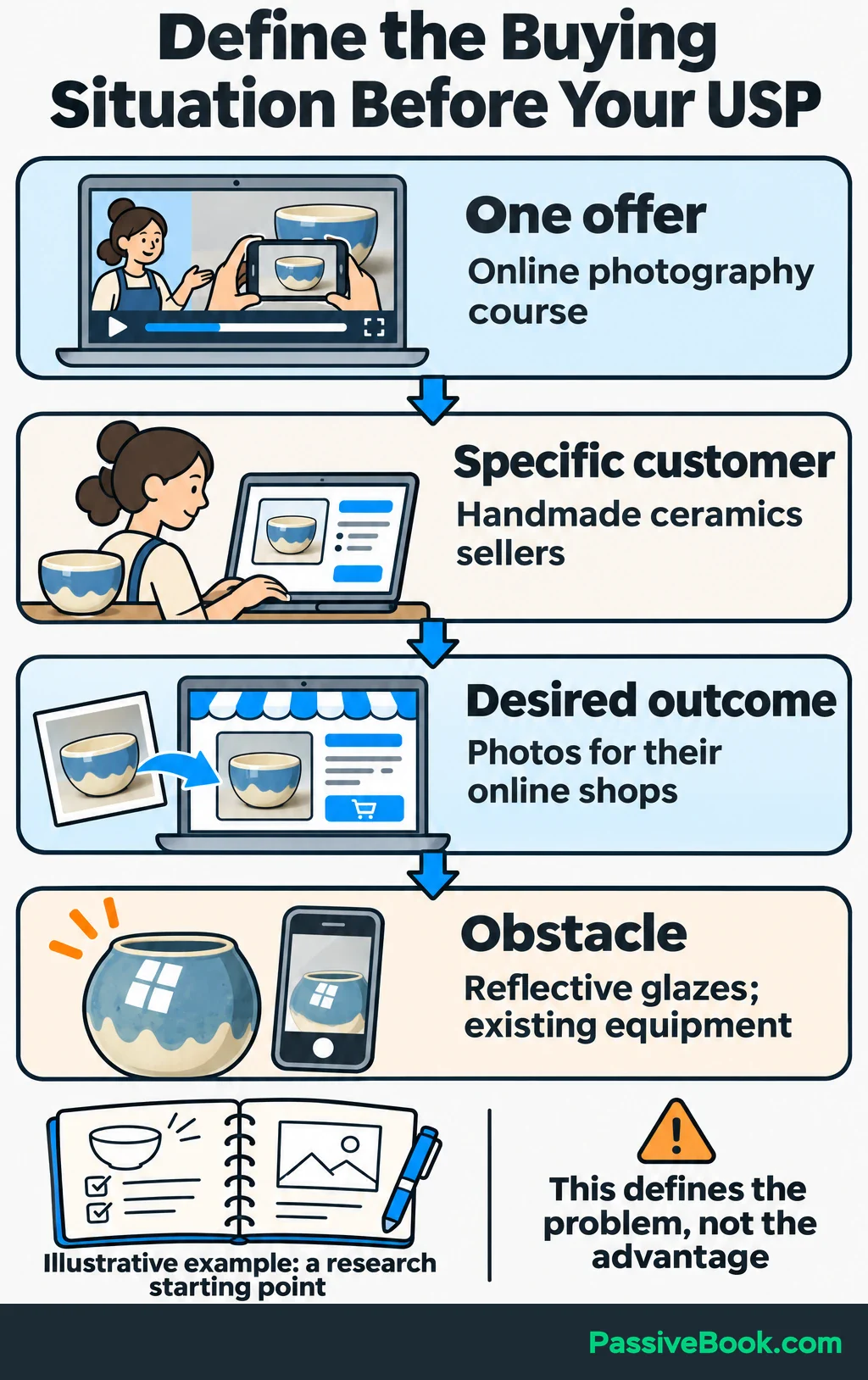
Describe circumstances that affect the purchase. Someone’s age may tell you less than the equipment they have, what they’ve already tried or the deadline they face.
For the running example, imagine you sell an online course teaching handmade ceramics sellers to photograph their products with a smartphone and window light. Its proposed lessons include lighting diagrams and demonstrations for glossy glazes. The customer needs and competitive gaps we explore are illustrative.
Your working sentence could be:
This course helps handmade ceramics sellers create photos for their online shops despite struggling to photograph reflective glazes with the equipment they already own.
That gives you a problem to investigate. It doesn’t yet establish why your course deserves the sale.
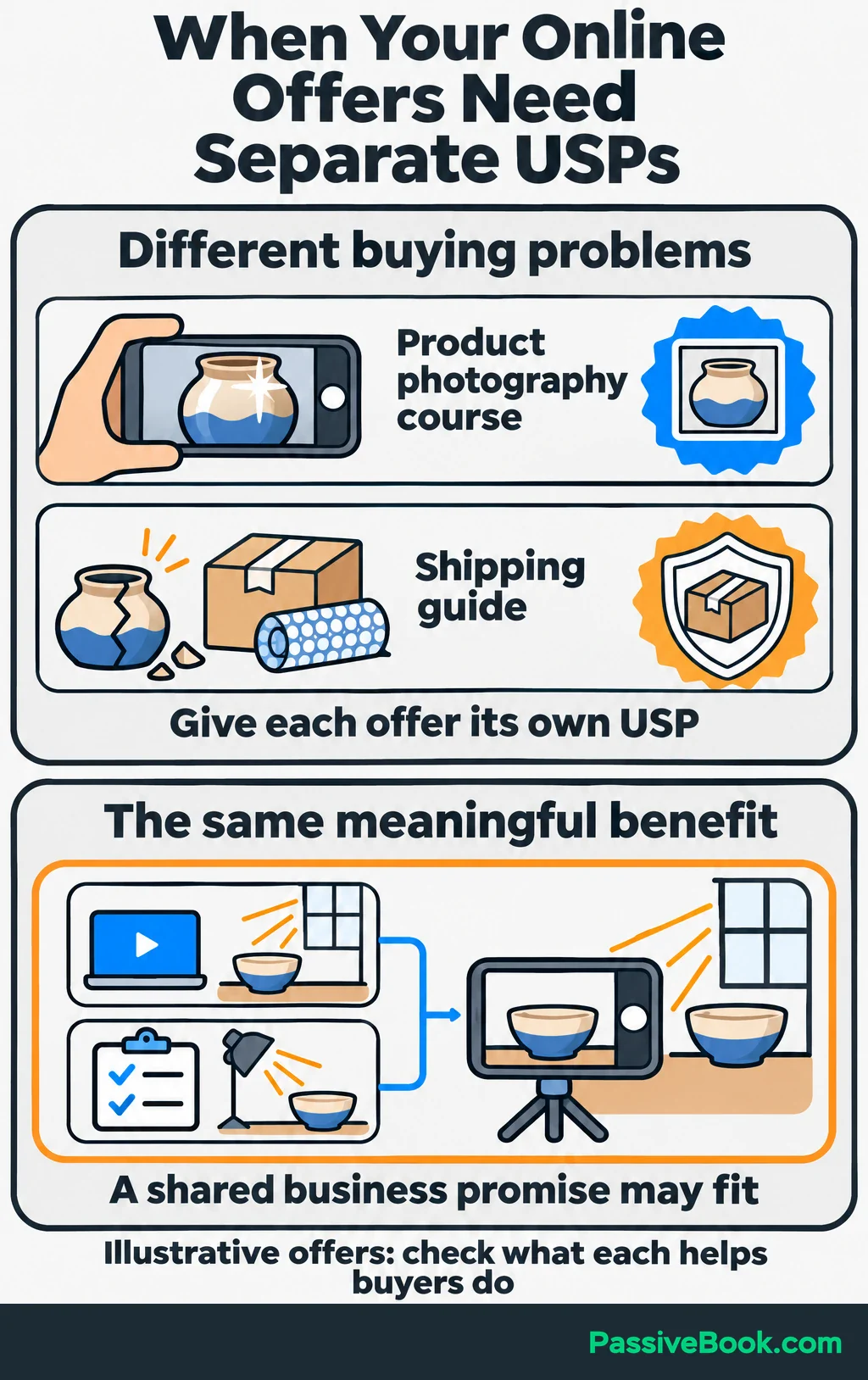
If your offers solve different problems, give each its own USP. A business-wide promise makes sense when the same meaningful benefit runs through everything you sell.
2. Find out What Drives Customers to Buy
Before asking new questions, review the evidence you already have: inquiries, sales conversations, support messages, reviews and refund reasons.
Look for what started the search, what nearly stopped the purchase and what the buyer chose instead.
I launched my online jewellery store without doing market research. I accumulated unsold inventory and lost most of my investment. I had made decisions about what to sell before learning enough about why people would buy. That experience is why I put these conversations before the copywriting.
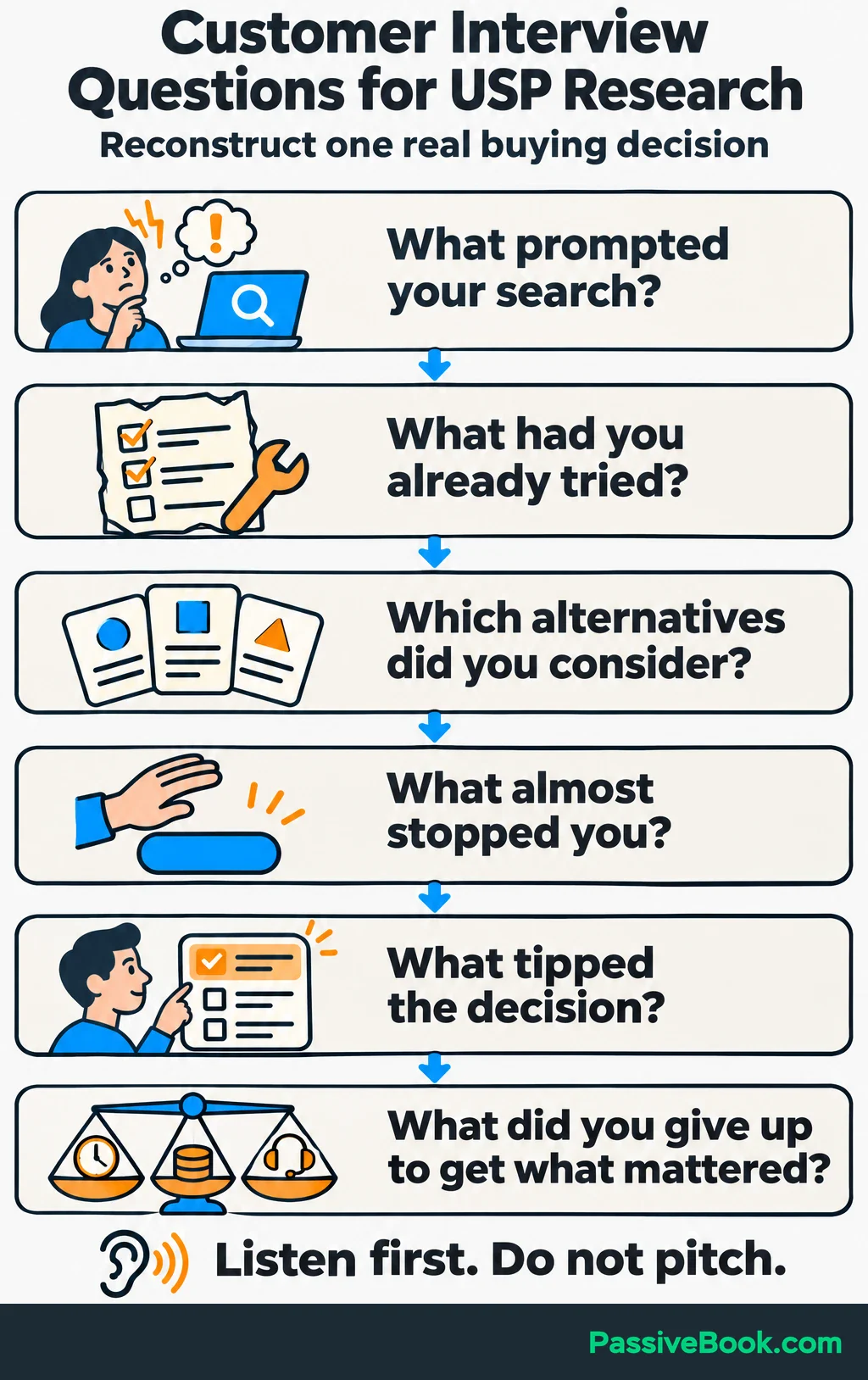
Speak with buyers and people who passed on your offer. If you don’t have customers yet, find people who recently bought an alternative or tried solving the problem themselves. Relevant contacts and niche communities are places to start.
Ask about a particular decision:
- What prompted you to look for a solution?
- What did you try before that?
- Which other options did you consider?
- What almost stopped you from buying?
- What finally tipped the decision?
- What did you give up to get the thing you cared about most?
Keep the conversation open and follow up on concrete experiences. This follows Nielsen Norman Group’s interview guidance, which recommends open questions and prompts about specific events.
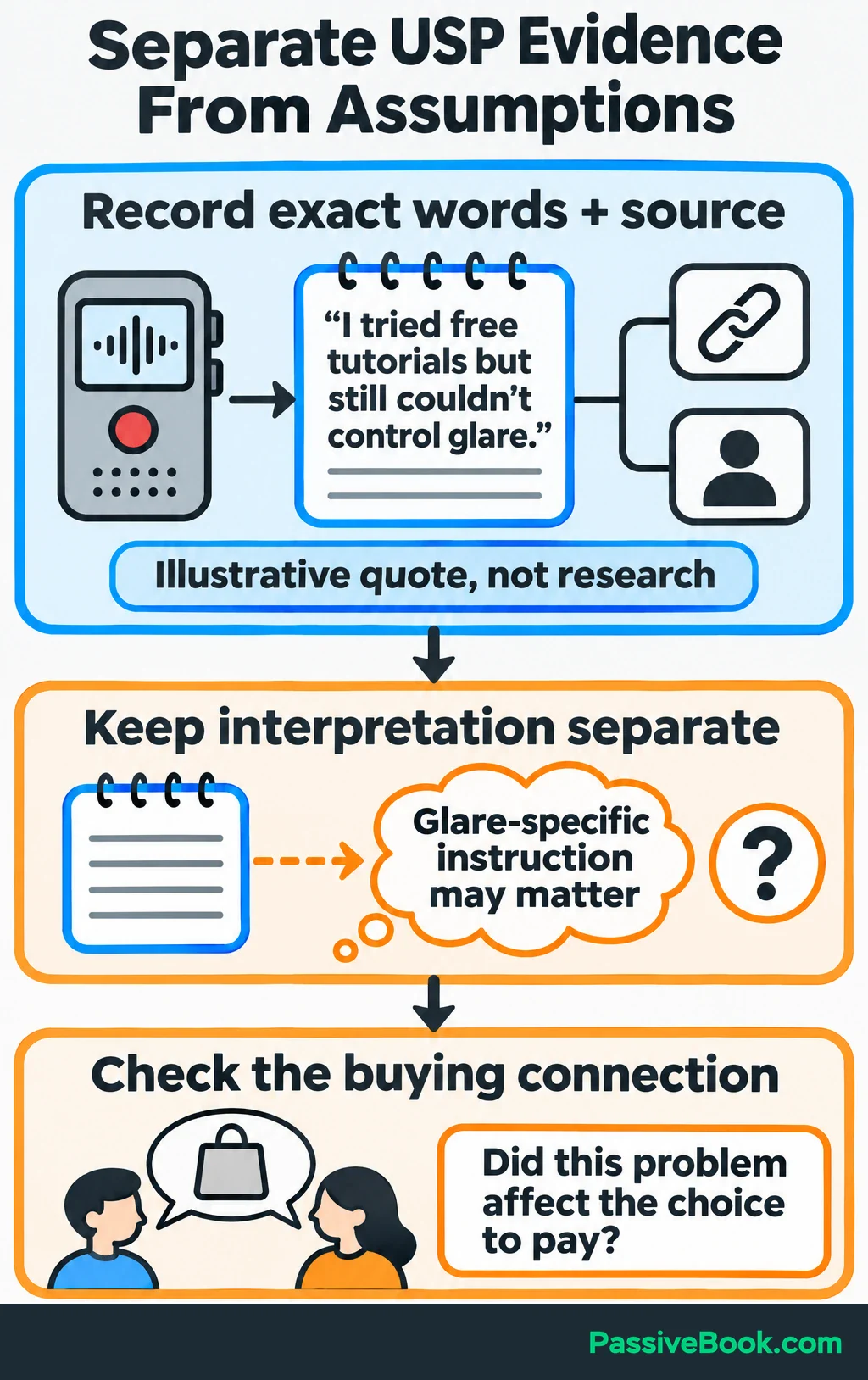
Don’t pitch the course halfway through the answer. You’re trying to hear how the person chose, and a sales pitch changes the conversation.
Keep a simple worksheet with columns for buying situation, desired outcome, obstacle, customer wording, alternative considered and supporting evidence. Record exact quotes separately from your interpretation, and note where each observation came from.
For the ceramics course, find out whether trouble photographing glossy glazes makes sellers look for paid instruction. They may care more about avoiding equipment costs or the effort of adapting general tutorials. Let their reasons for choosing a solution determine which problem leads the message.
3. Compare the Alternatives Customers Actually Consider
Build your comparison from the options customers mention. Include direct competitors, free resources, doing the work themselves and postponing it.
The SBA’s competitive analysis guidance includes indirect competitors because different kinds of businesses can serve the same market.
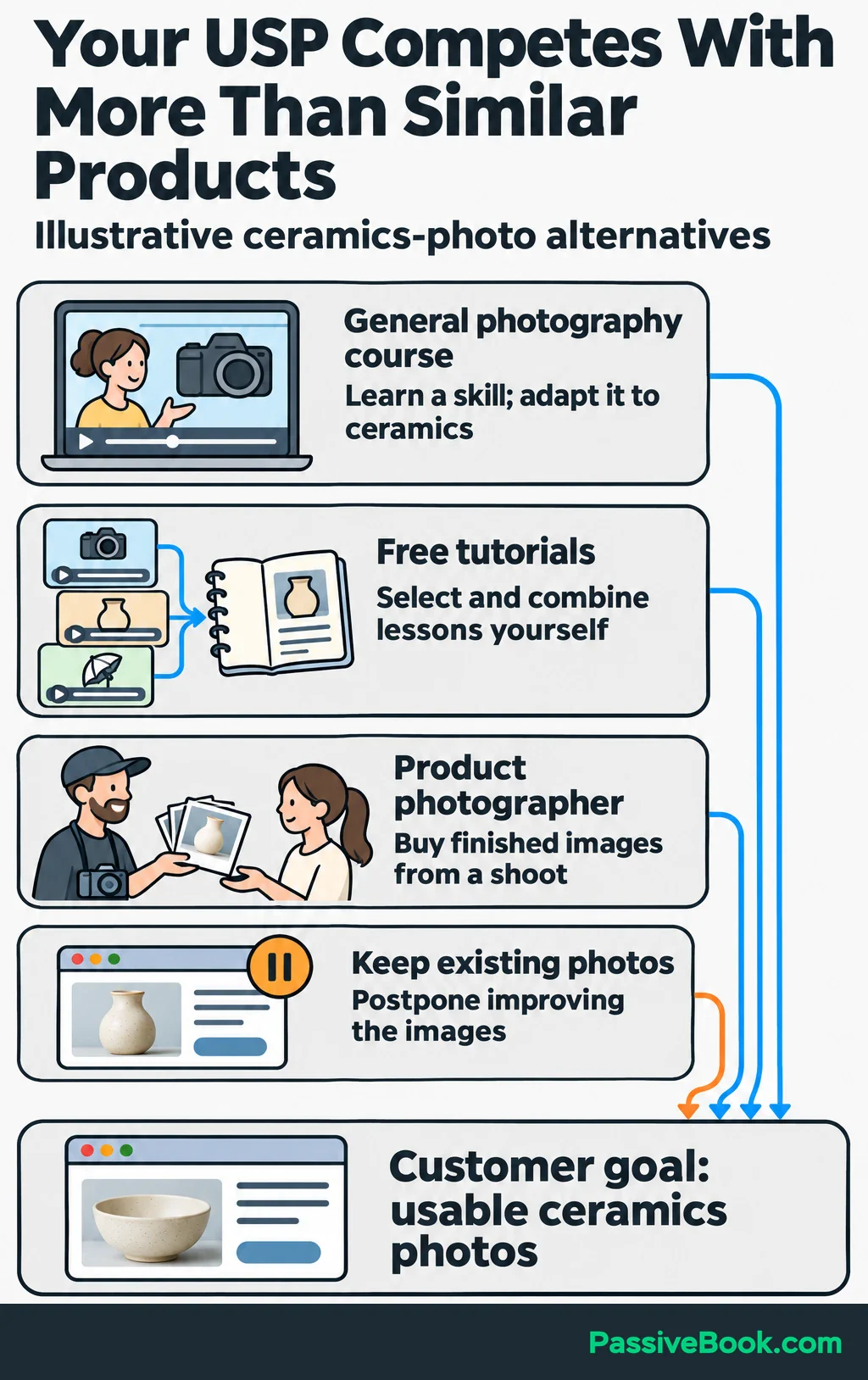
For your course, the wider decision is how to get usable ceramics photos. A buyer might learn the skill or pay someone to produce the images.
Use a short research table to decide what to check:
| Alternative | What the Customer Gets | What to Verify |
|---|---|---|
| General product photography course | Instruction they must apply to their ceramics | Equipment requirements, glossy-product lessons and sample demonstrations |
| Free tutorials | Lessons they select and assemble themselves | Whether the chosen tutorials cover their glaze problem and setup |
| Product photographer | Finished images from an agreed shoot | Quote, deliverables, shipping needs and arrangements for future products |
| Continue with existing photos | No new learning or purchase | Why the customer is willing to postpone improving the photos |
Read offer pages, inspect samples and check the terms. Add actual costs, customer effort and source links to your worksheet as you verify them.
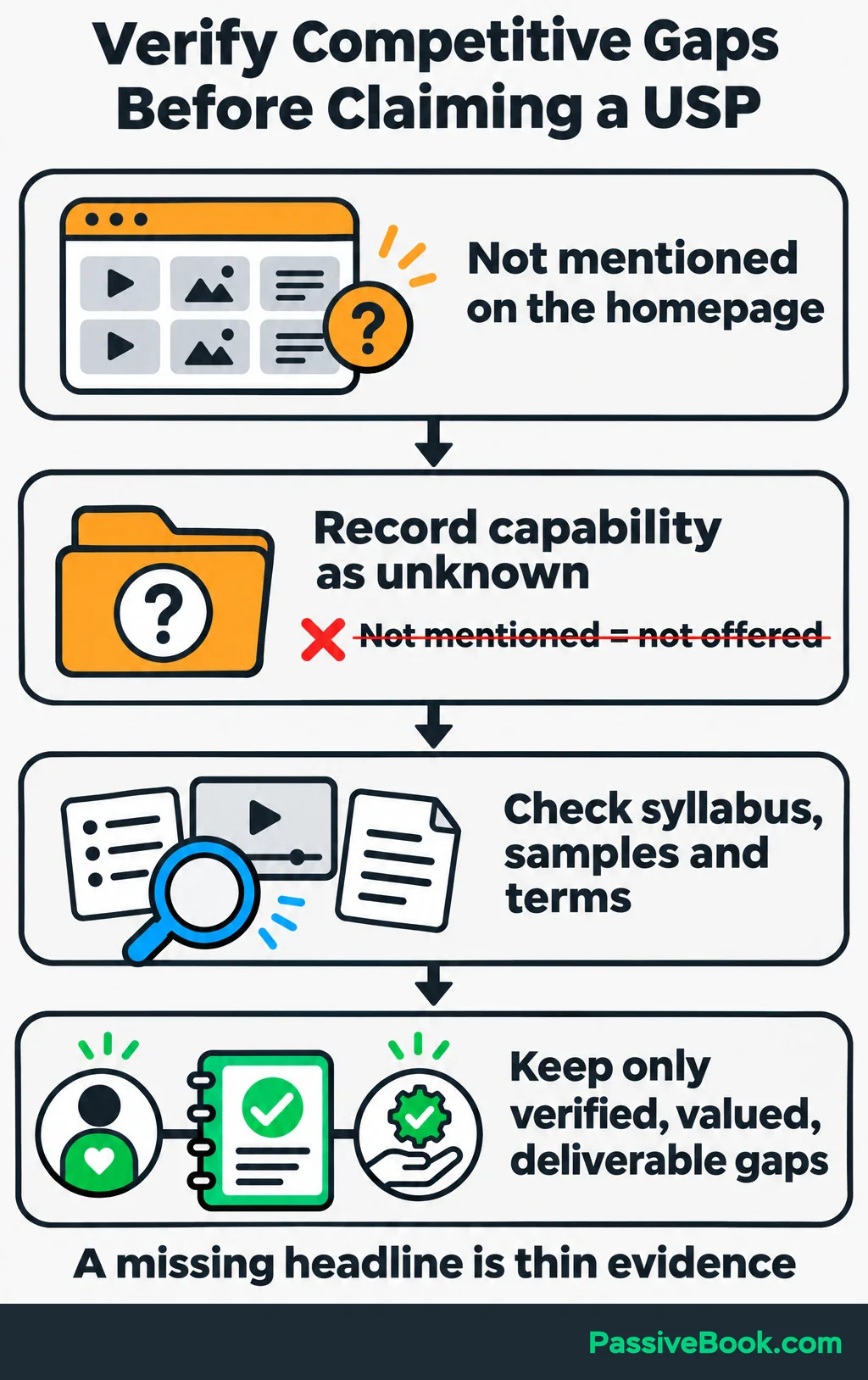
If a competitor’s homepage doesn’t mention glossy glazes, record that capability as unknown. They may cover it inside the course. A missing headline is thin evidence for a competitive advantage.
Courses teach a skill, while photographers supply images. They compete when customers choose how to obtain photos, but someone could also use both.
Keep a possible gap only when customers value it and you can fill it. Being different in a way nobody cares about is an expensive hobby.
4. Choose a Difference You Can Deliver and Prove
Turn Your Strengths Into Customer Benefits
List strengths that help with the buying problem. These might include specialist knowledge, a simpler process, useful resources, customization or a particular delivery method.
Then connect each strength to a benefit and evidence:
Specific strength → practical customer benefit → supporting evidence
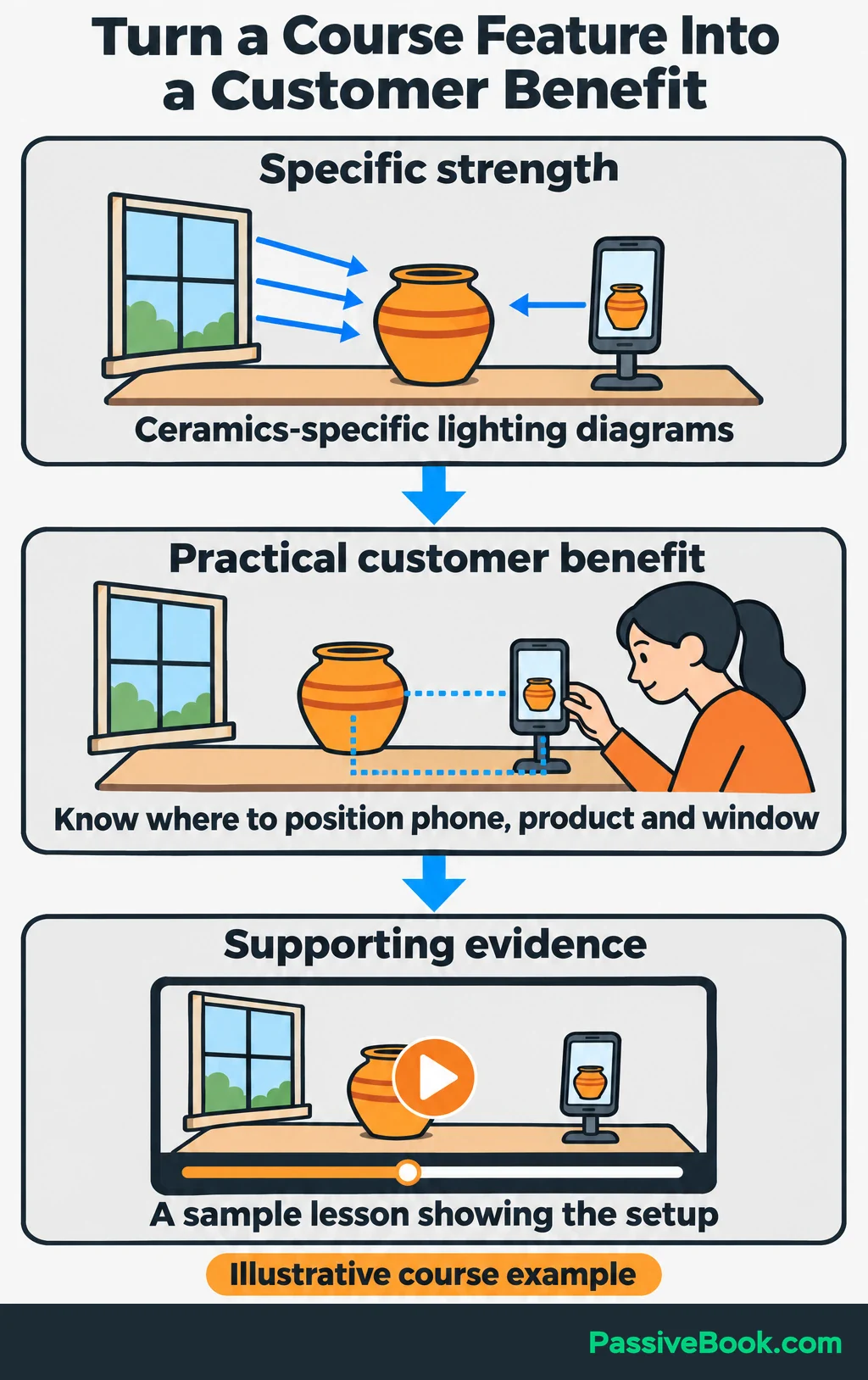
For the course:
Ceramics-specific lighting diagrams → help learners position their phone and product beside a window → a sample lesson showing the setup.
The diagram is a feature. Its value comes from helping the learner apply the instruction to the object in front of them.
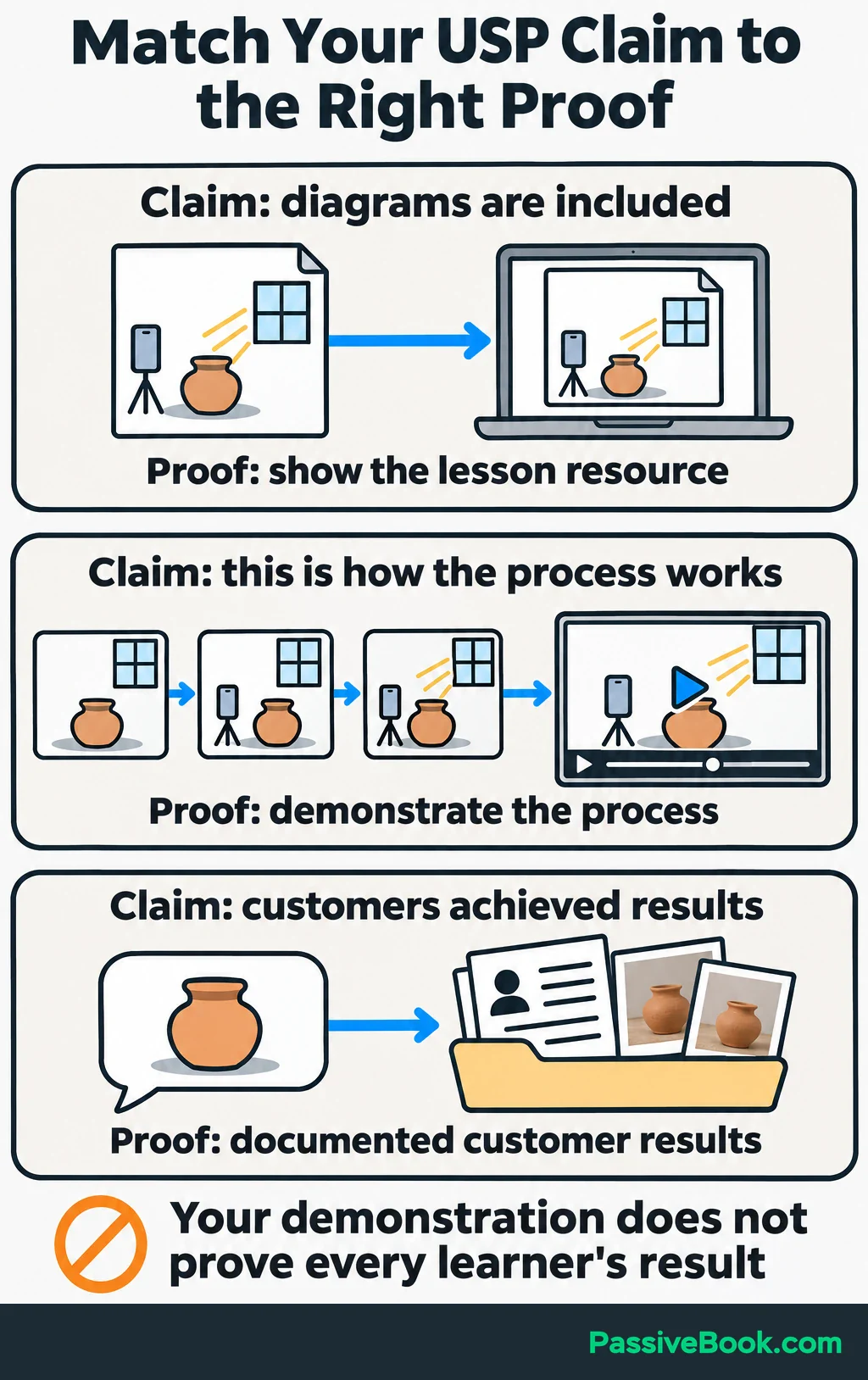
Match your proof to your claim. A lesson preview can show that you teach a particular setup. A walkthrough can show how your process works. Claims about customer outcomes need documented customer results.
Showing your own demonstration doesn’t establish that every learner will get the same result.
Select One Central Reason to Buy
Compare a few possible promises before choosing one. For the course, you might consider:
| Possible Promise | Evidence Needed Before Choosing It | Delivery Requirement |
|---|---|---|
| Instruction focused on photographing ceramics | Buyer accounts of trouble applying general lessons to glossy glazes, plus checked course samples or syllabuses showing how alternatives teach that task | Lighting diagrams and glossy-glaze demonstrations |
| A lower-cost way to learn | Accounts of price affecting buyers’ choices, plus the total cost of suitable alternatives, including free tutorials | A price that covers course updates and support |
| Individual photo feedback | Requests for help with learners’ own images, plus paid trials or purchases that include feedback | A submission limit per learner and time reserved for reviews |
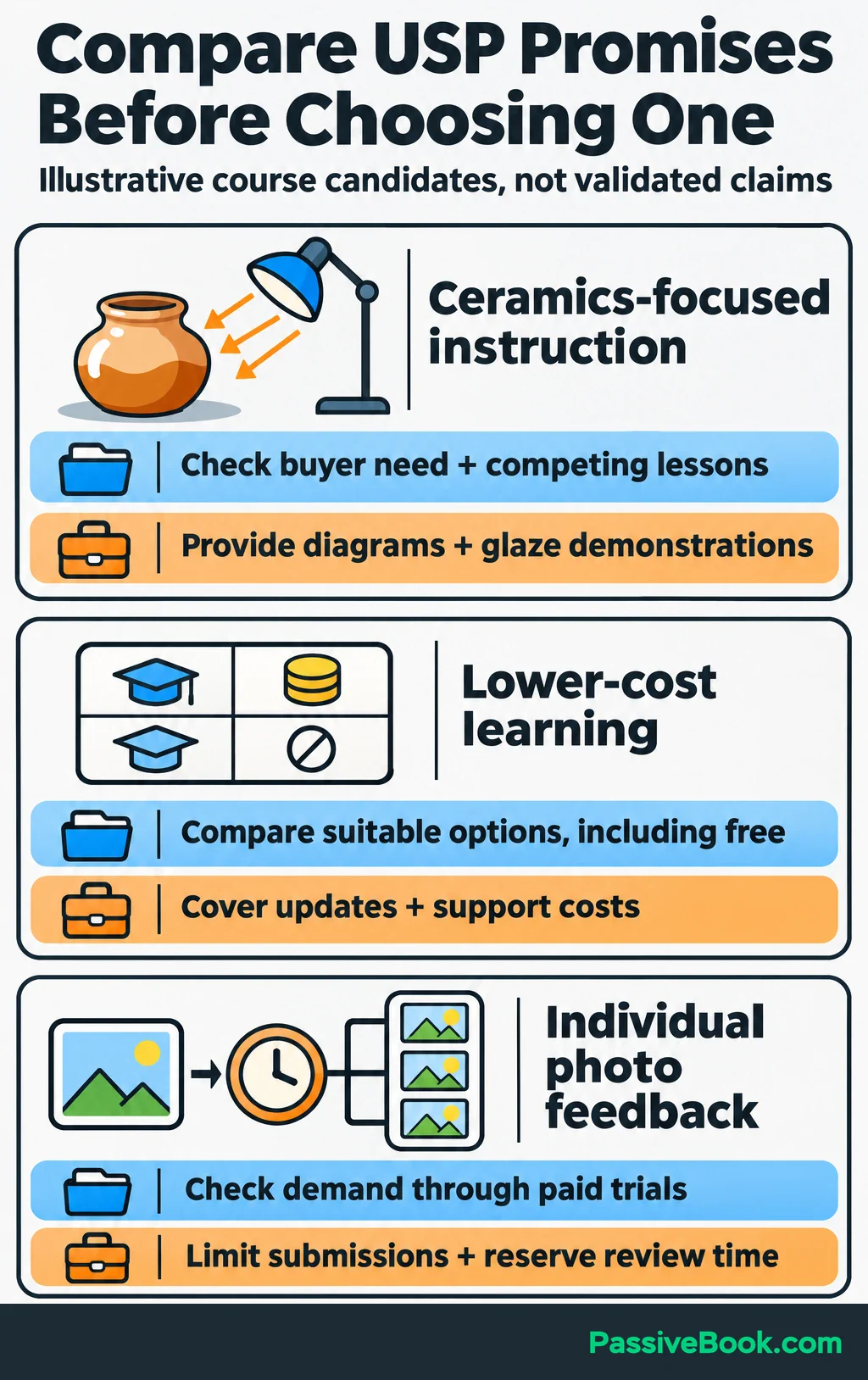
I would skip individual feedback if it meant creating another job you couldn’t maintain alongside your existing work. Recorded lessons and personal reviews have very different demands.
Reject any promise that fails an essential check. Good evidence can’t rescue an irrelevant benefit, and customer interest can’t make an undeliverable service viable.
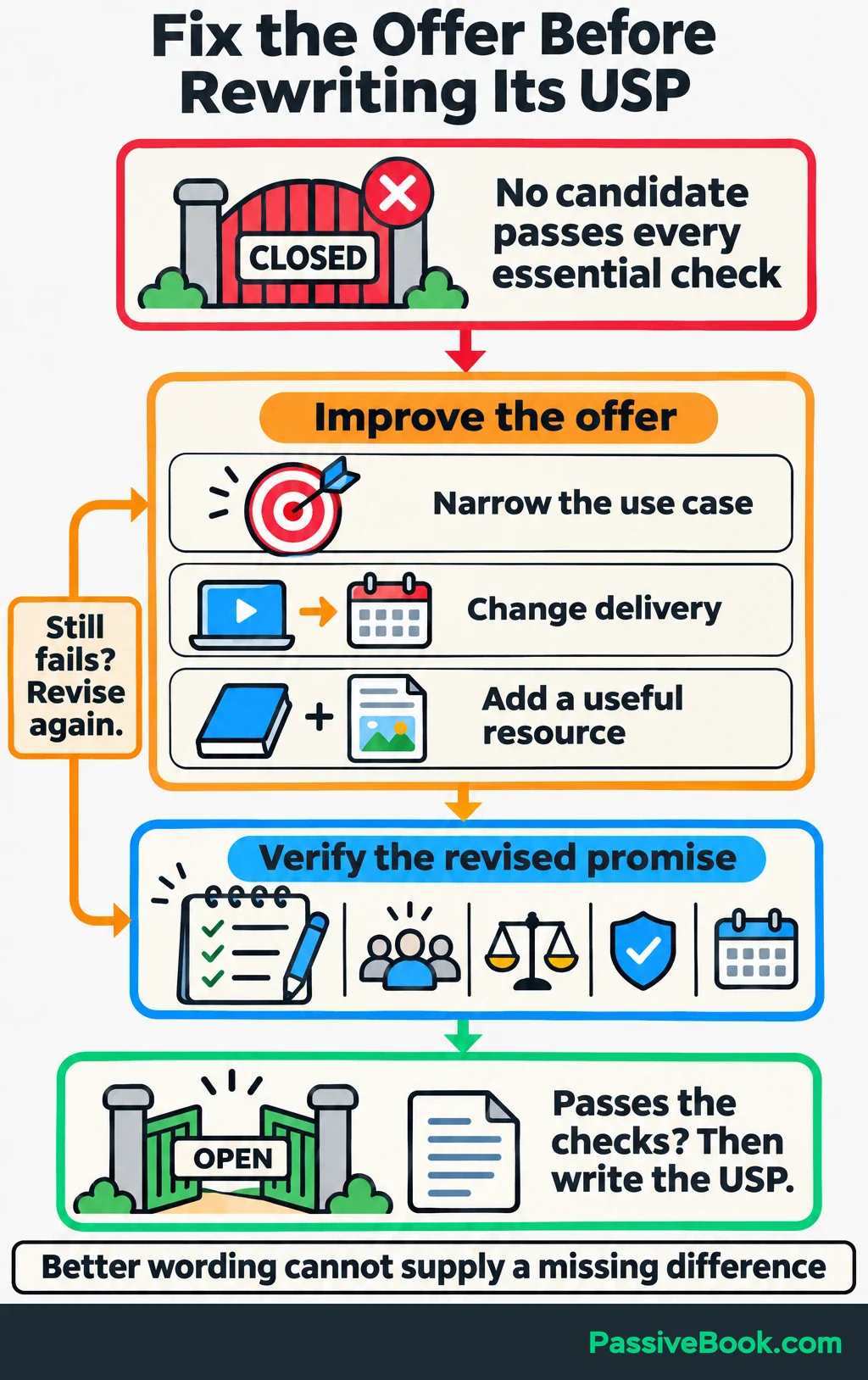
For the rest of the example, suppose your research supports ceramics-specific instruction as the strongest candidate. Make that the central promise. Lighting diagrams and glaze demonstrations then support it.
If no candidate qualifies, improve the offer. Narrow the use case, change how you deliver it or add a resource that solves a verified obstacle. Better wording can explain a difference, but it can’t supply a missing one.
5. Write Your USP in Clear Customer Language
Once you’ve chosen the substance, use this template to organize it:
For [customer or situation], [offer] helps you [benefit] through [meaningful difference].
Then rewrite it as something a person would naturally say. You don’t need to keep the template’s sentence structure.
Start with the weak version:
High-quality photography education.
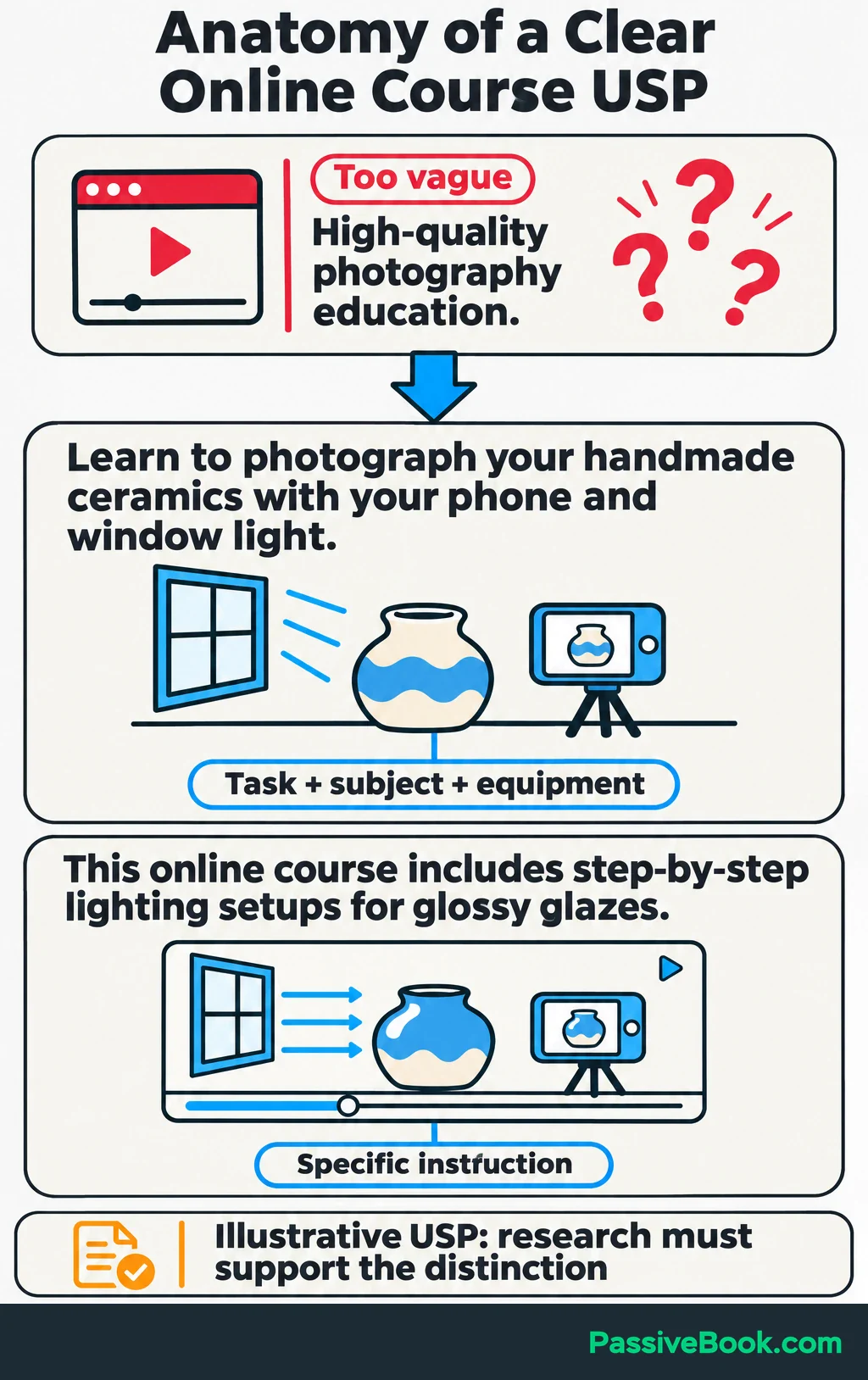
That could describe almost any course. It leaves the customer to guess what makes yours suitable.
Here’s a complete USP statement for the example:
Learn to photograph your handmade ceramics with your phone and window light. This online course includes step-by-step lighting setups for glossy glazes.
The revised version names the task, the equipment and the specialized instruction. It gives a prospective buyer something concrete to assess.
It becomes a credible USP when your research supports that distinction as a reason to choose the course. Adding “only” would create a stronger claim, but you would need evidence for it.
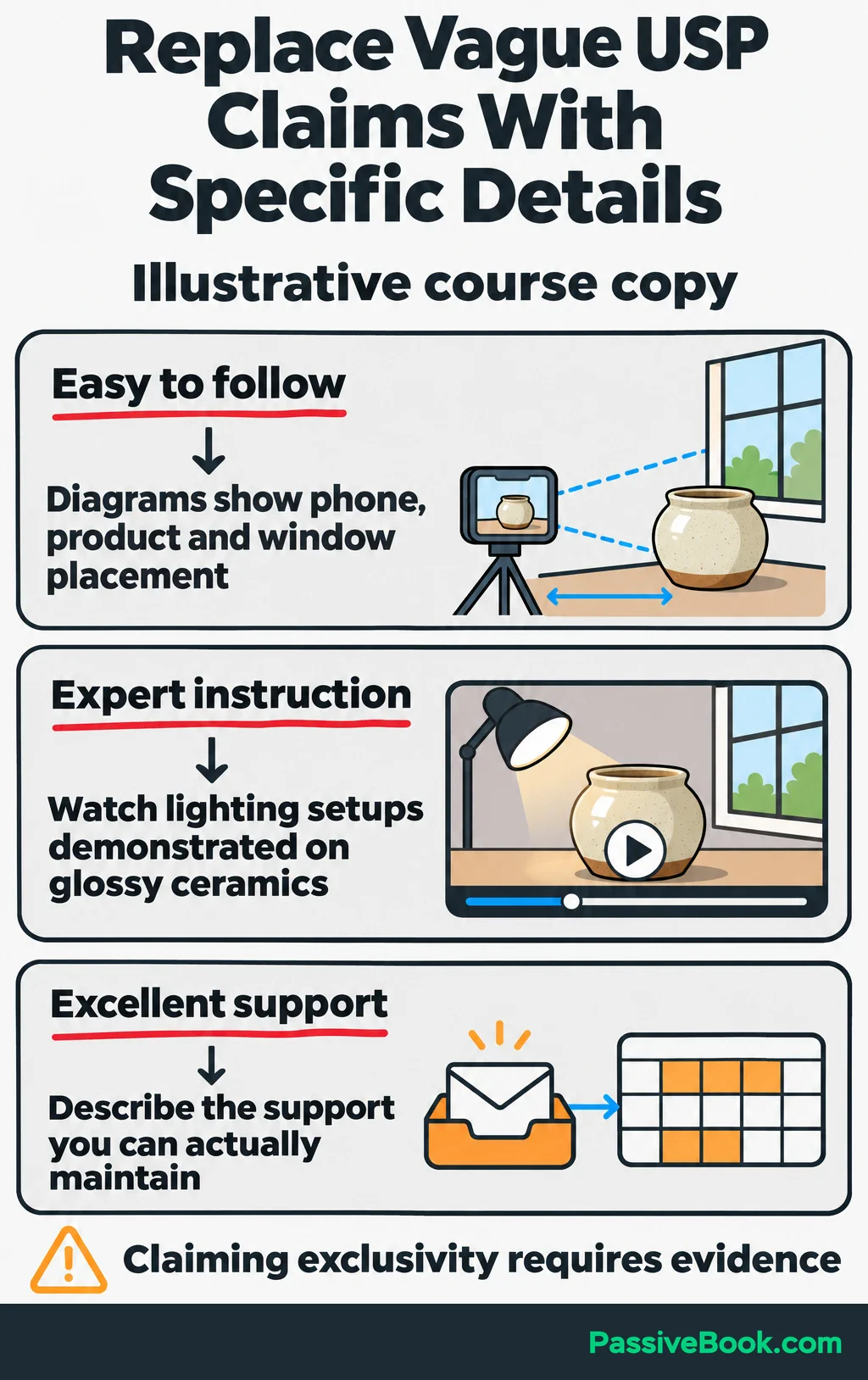
Replace broad praise with details:
- “Easy to follow” could become “lighting diagrams show where to place your phone, product and window.”
- “Expert instruction” could become “watch each lighting setup demonstrated on glossy ceramics.”
- “Excellent support” needs an actual support arrangement you can describe and maintain.
Read the finished statement beside your chosen promise. Can a prospective buyer tell what they get and why it fits their problem? If the answer requires another paragraph of explanation, simplify the sentence or reconsider what you’re trying to promise.
If your version still sounds like every other business, use AI Copywriting Studio to turn your offer details into concrete wording. You’ll get positioning alternatives to compare, with any assumptions kept separate from the copy.

Free AI Copywriting Studio




6. Test Whether Your USP Helps Customers Choose
Put your statement beside its proof in a simple offer-page draft. An existing page or shared document is enough for an initial review.
Show it to people in the buying situation and ask:
- What do you think this offer teaches?
- When would this be useful to you?
- Why would you consider it over the options you’ve tried?
- What feels unclear or difficult to believe?
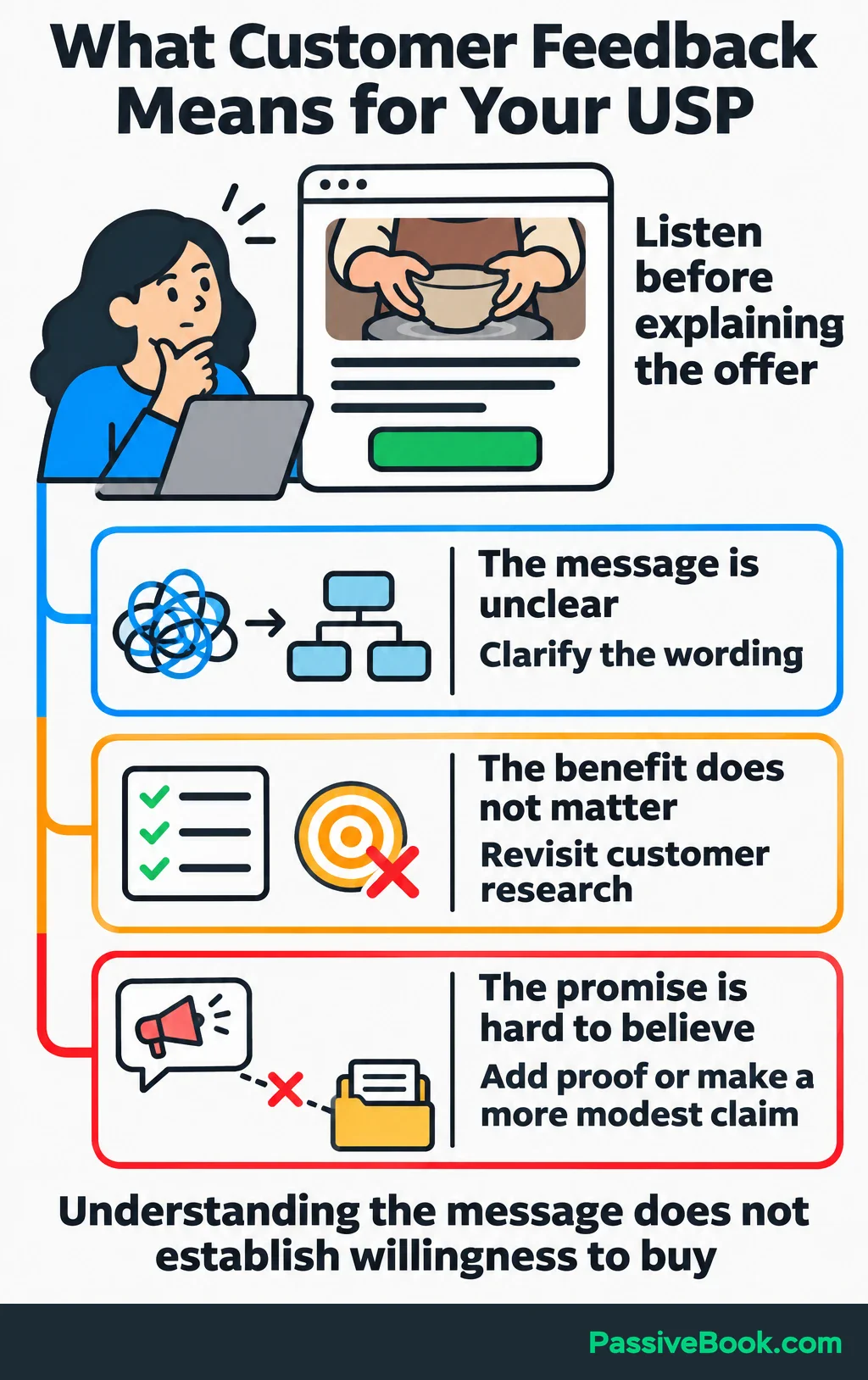
Let them answer before you explain. If you have to translate the headline aloud, the page needs work.
Use the response to identify the next change. Confusion calls for clearer wording. An unimportant benefit calls for another look at the research. Doubt about a claim calls for better evidence or a more modest promise.
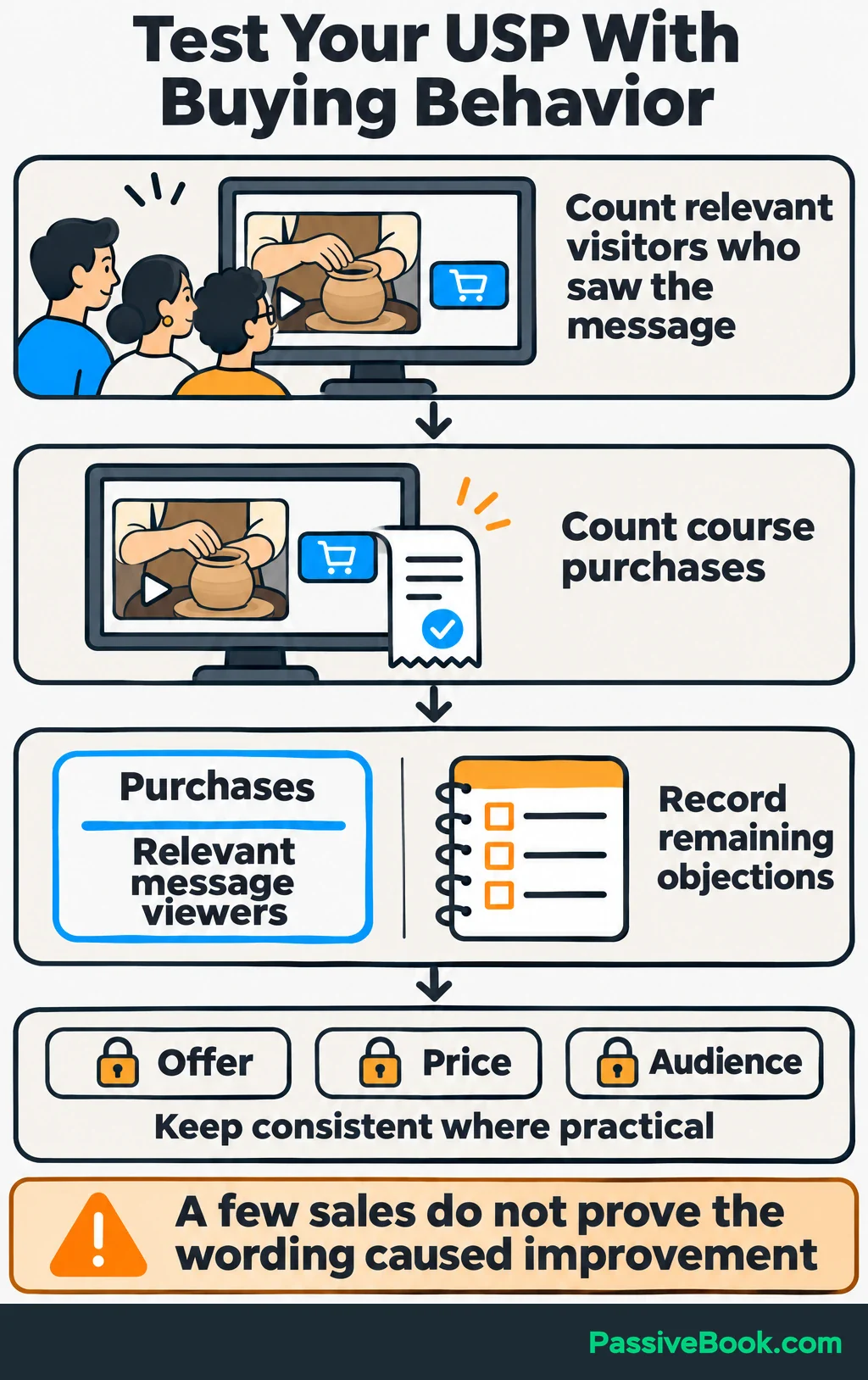
Then test buying behavior through your offer page, email or sales conversations. Strategyzer’s testing roadmap treats customer needs, the proposed solution and willingness to pay as separate tests. Understanding your message doesn’t establish that someone will buy.
If the course is ready to sell, pair the USP with a sample lighting demonstration and a purchase option. During the test period, count visitors in the buying situation who saw the message and how many of them bought the course. Record remaining objections.
Keep the offer, price and audience consistent where practical when comparing messages. With sparse responses, use what you learn to guide the next revision. A few sales or compliments don’t establish that the wording caused an improvement.
7. Put Your USP Where Customers Decide
Place the central promise near the main offer on your homepage or sales page. Keep relevant proof and a clear next action close enough that customers can assess the promise and act on it.
Carry the same purchase reason into product descriptions, emails and promotional content. Adapt the wording to the space.
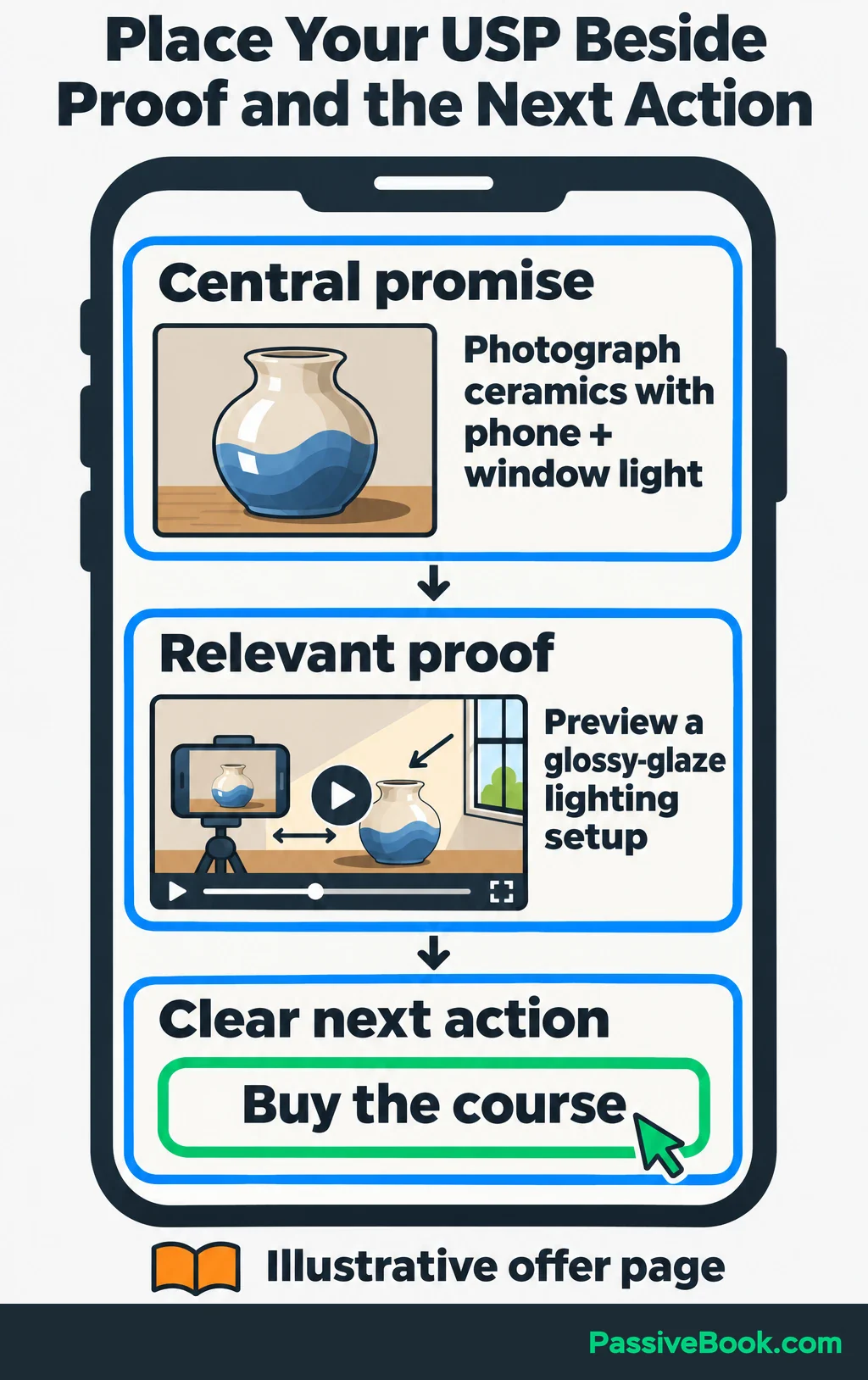
For the course, that might mean:
- Sales Page: Explain the ceramics-specific instruction and show a sample lesson.
- Product Description: Describe the phone-and-window-light setups and included diagrams.
- Email: Show an excerpt from a glossy-glaze demonstration and connect it to the course.
Each piece reinforces the same reason to buy. None needs to repeat the full statement word for word.
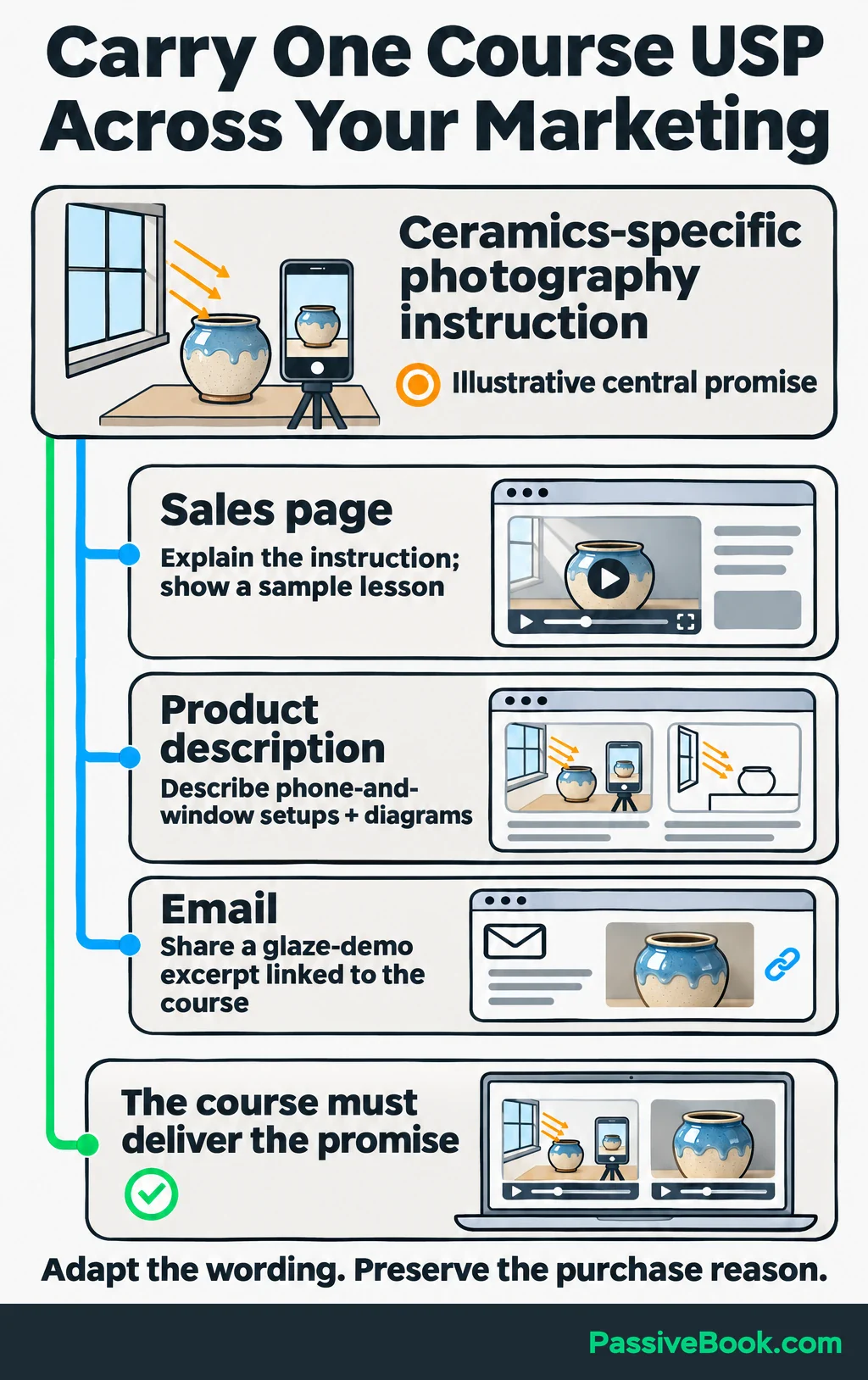
The course itself must then deliver the instruction those previews promise. A distinctive headline followed by generic lessons is a refund waiting to happen.
Revisit the USP when customer needs, competing offers or your ability to deliver change. Use new buying evidence to guide revisions, rather than changing the message because you’ve grown tired of reading it.
What Next?
Choose one offer and review your latest inquiries, reviews or sales conversations. Pull out the buying problem people describe and note which alternatives they considered. Use that evidence to draft one possible reason to choose you.
Use the social buttons to share this guide when your next positioning discussion needs something firmer than “better quality.”
What reason do customers currently give for choosing your offer? Tell me in the comments, and bring any questions about finding or writing your USP.
Share this post with your friends & followers:

