You have a reason your offer is different, but can a buyer explain why that difference matters? “Looks useful” is pleasant feedback. It gives you very little help deciding whether to spend another month building.
The expensive mistake is treating that polite response as proof. You can finish the product, polish the page and still discover that buyers prefer what they already use. To check your assumptions before spending more, this guide shows how to find out whether buyers understand your promise, care about its advantage and take a meaningful next step.
Write a USP Hypothesis Customers Can Challenge
A unique selling proposition gives a particular buyer a reason to choose your offer over their alternatives. You need to test whether that reason is clear, valuable, meaningfully different and believable.
Those are separate questions. Someone can understand your promise perfectly and still have no reason to buy.
I learned this the expensive way with a course I rushed out without validation. It attracted few sales and a bad review, and I removed it. I had treated finishing the course as progress without checking why buyers would choose it over what they already used.
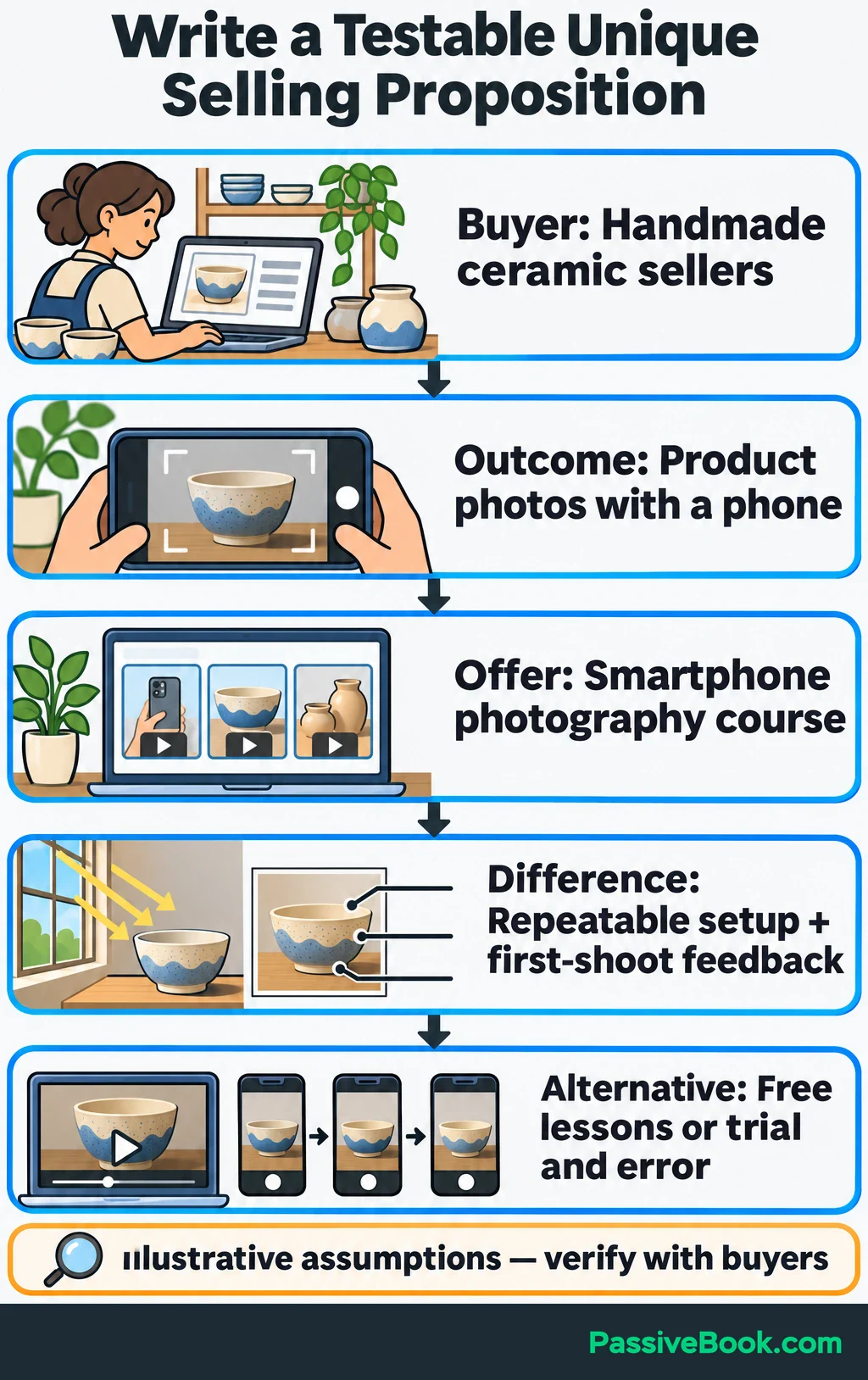
Start by writing down your assumption:
For [buyer] who wants [outcome], [offer] provides [valuable difference] compared with [current alternative].
Name a real alternative. That might be a competitor, a free tutorial, a spreadsheet or simply leaving the problem alone. Confirm it during interviews rather than assuming buyers compare the same products you do.
For a running example, imagine you’re developing an online smartphone photography course for people selling handmade ceramics. Your proposed advantage combines a repeatable window-light setup with feedback on the buyer’s first shoot.
Your initial message is:
Photograph your handmade ceramics with your phone, using a repeatable window-light setup and annotated feedback on your first shoot.
This is an illustrative offer. We have not established that buyers want those features or that alternatives lack them.
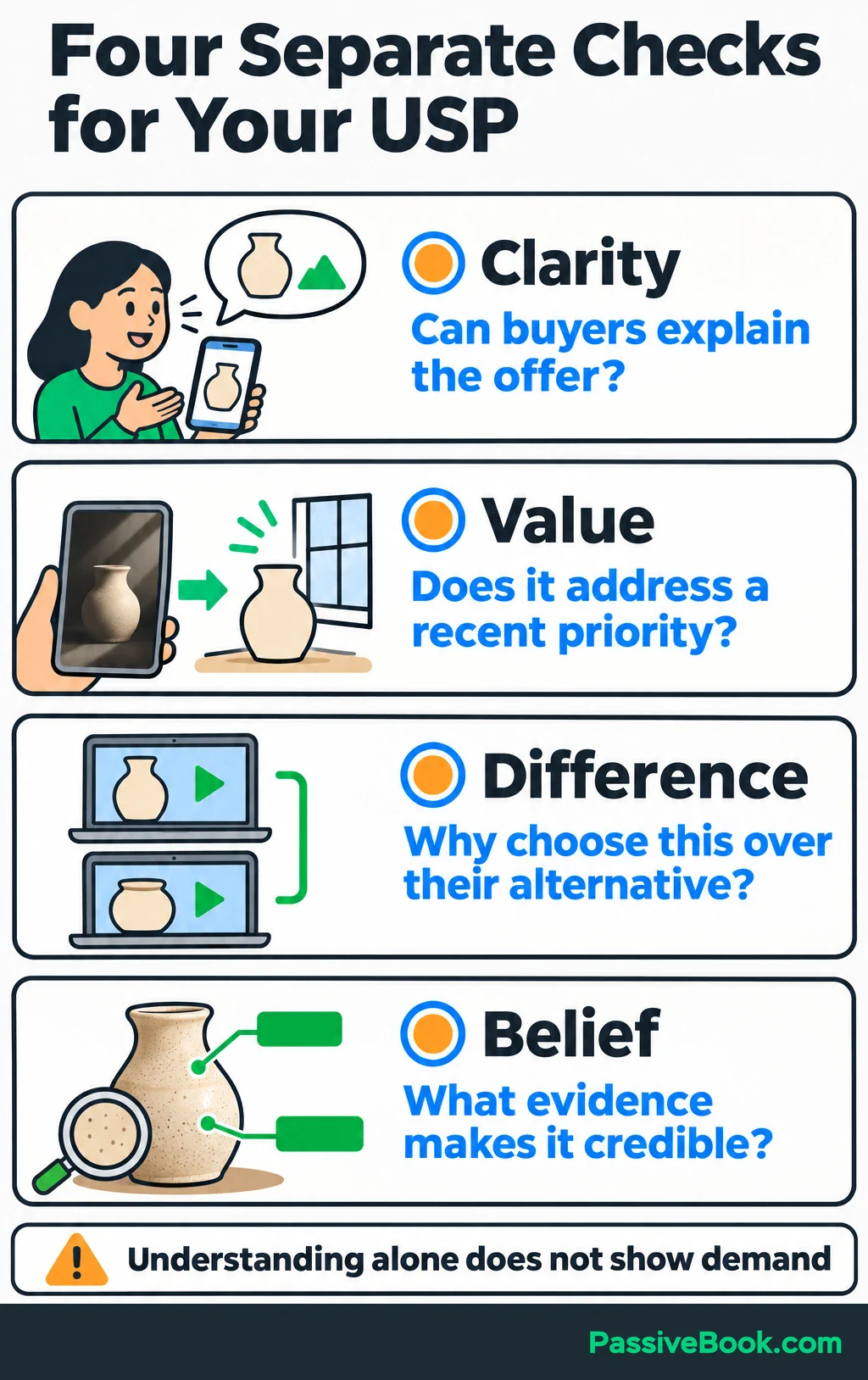
Before interviewing anyone, record what would support or challenge your claim:
- Clarity: Can buyers explain what they would receive without your help?
- Value: Does the proposed benefit address something that mattered in a recent buying situation?
- Difference: Do buyers see an advantage over what they already use?
- Belief: What evidence would make the promise credible?
Also decide what finding would justify your next step. Repeated misunderstanding might mean rewriting the message before building a test page. Clear understanding and a relevant buying problem might justify offering a small paid pilot.
Strategyzer’s Test Card separates the assumption, test, measurement and success threshold. I like that discipline because it makes moving the goalposts harder.
Recruit People Who Face the Buying Decision
Useful feedback starts with relevant experience. A friend who likes your idea may never face the problem your offer solves.
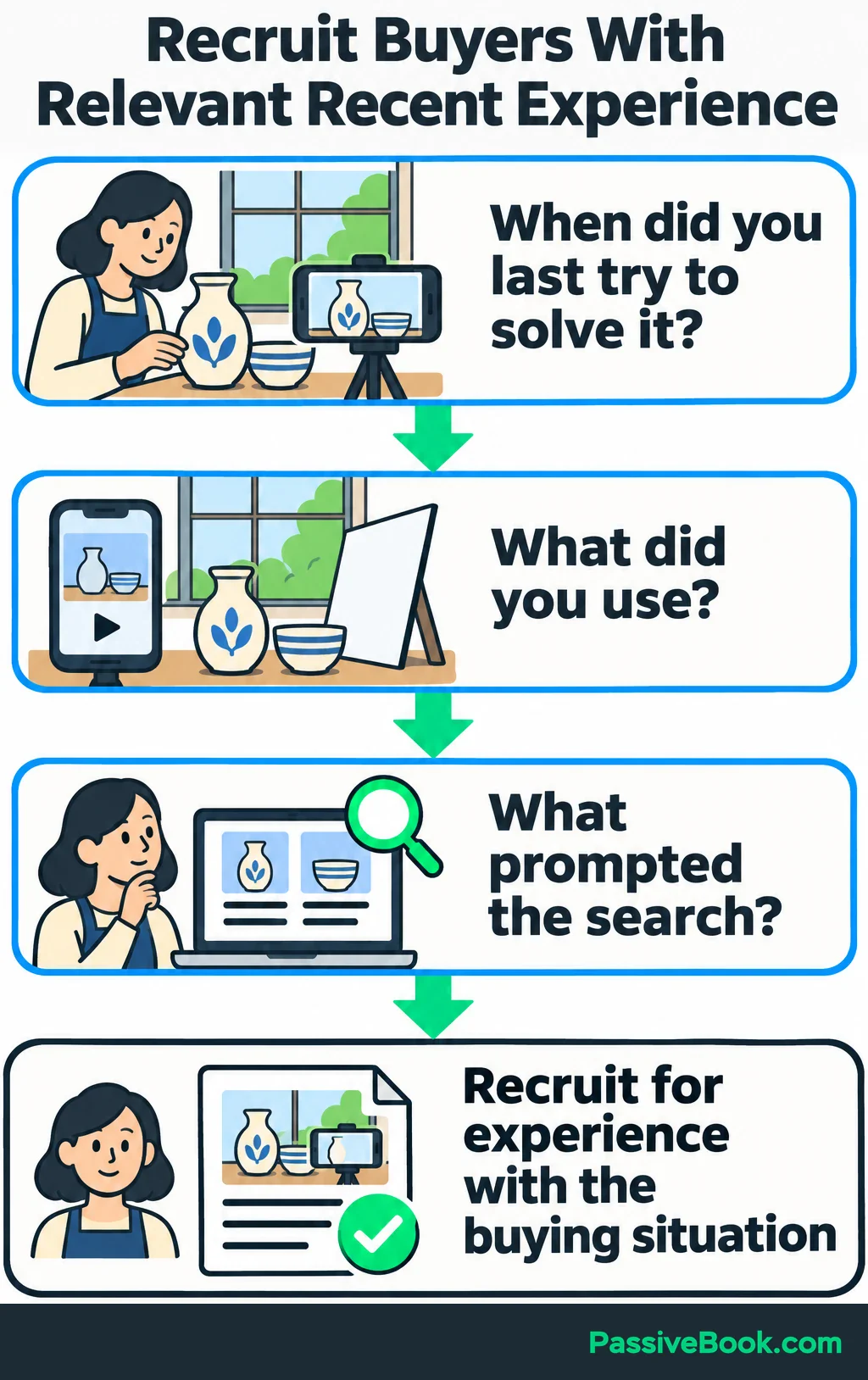
Screen potential participants with a few short questions:
- When did you last try to solve this problem?
- What did you use?
- What prompted you to look for help?
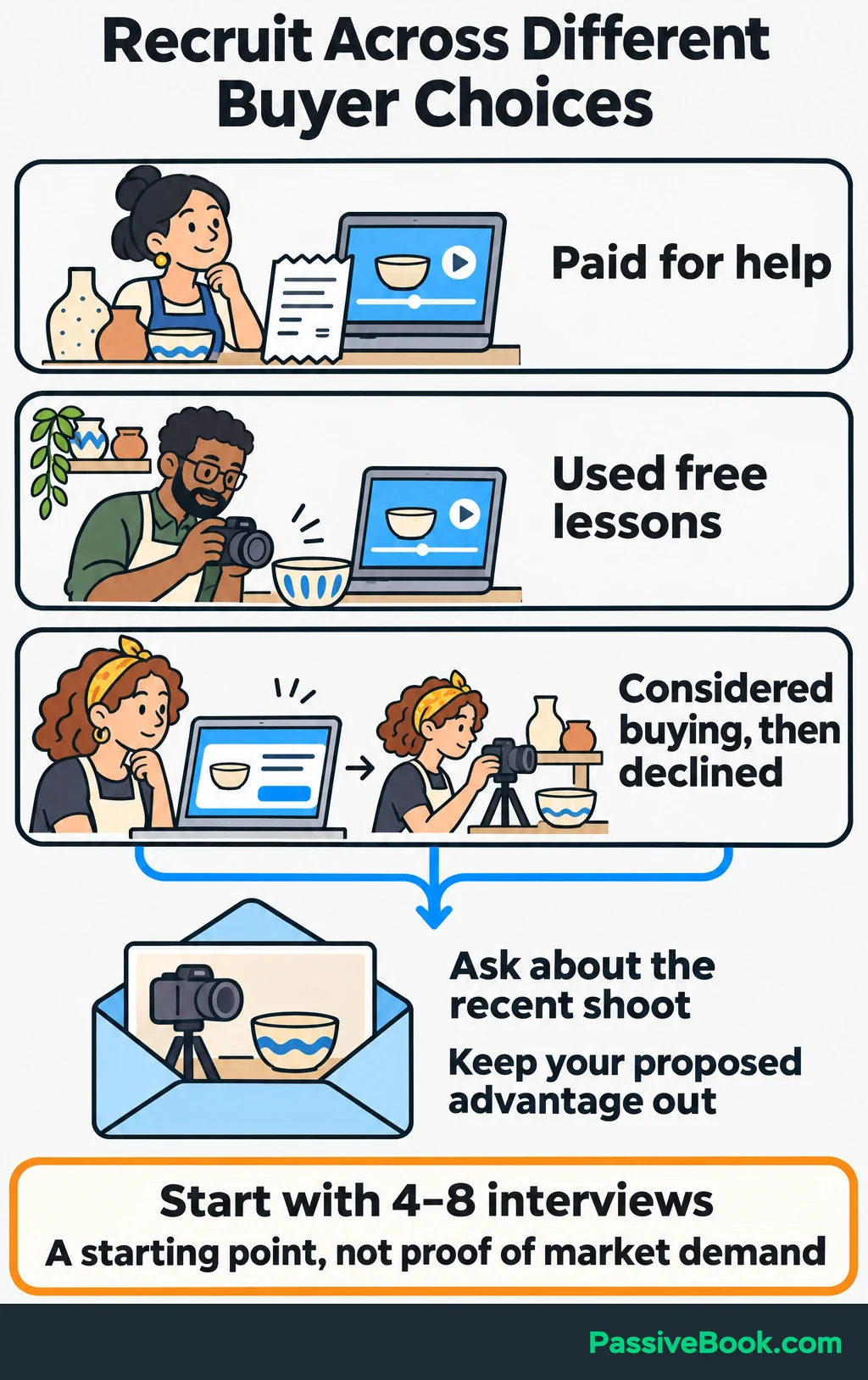
For the photography course, look for people who recently photographed ceramics for online listings. Include people who paid for help, used free lessons or considered buying something and decided against it.
Their different choices can reveal different needs. Someone launching their first collection may face a different problem from someone replacing photos across an established shop.
Start with customers, relevant subscribers and referrals. If you have no audience, approach people in communities that allow research requests. Keep your proposed advantage out of the invitation so you don’t recruit only people already attracted to it.
Here’s an invitation you can adapt:
Hi, I’m researching how ceramic sellers photograph products for online listings. If you’ve photographed a collection recently, would you be open to a 25-minute conversation about your most recent shoot? I’d like to understand what you tried and how it went. This is a research conversation, with no sales pitch.
For a first round, four to eight interviews is a manageable starting point and matches GOV.UK’s recruitment guidance. Recruit further people when you need to investigate a disagreement or a buying situation you missed.
That range helps you plan conversations. It is not a pass mark for demand, and your recruited group does not establish what the whole market wants.
Interview Buyers Before Pitching Your USP
Before starting, explain the purpose, how you’ll use the answers and whether you want to record. Obtain consent for participation and separately for recording, and keep identifiable notes secure.
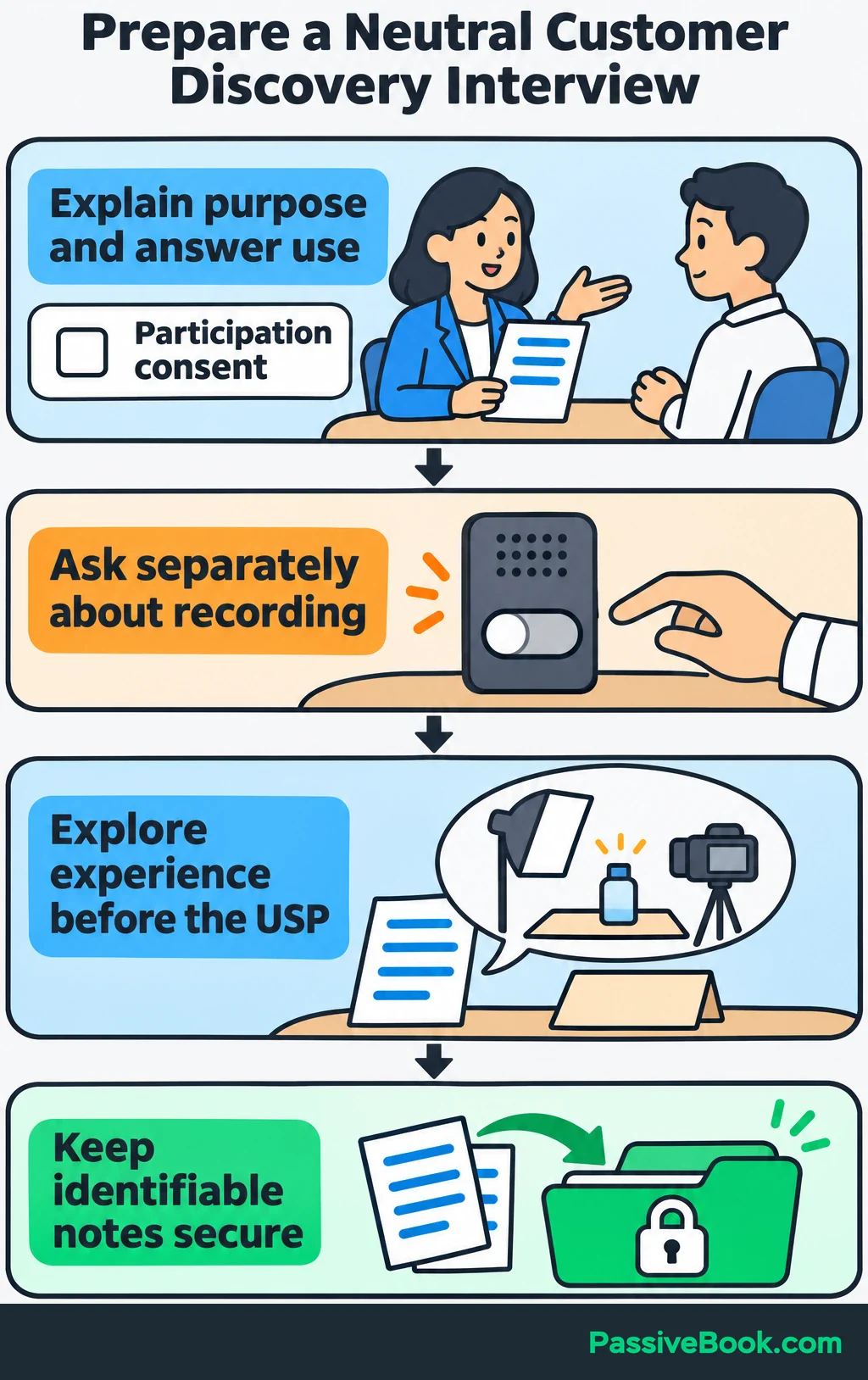
Prepare a short question guide, but leave room to follow a useful answer. GOV.UK’s interview guidance recommends open, neutral questions grounded in stories and real examples.
Your job is to understand the buyer’s decision. Save the presentation skills for another day.
Explore Their Last Attempt to Solve the Problem
Begin with what happened before showing your offer. Otherwise, your message can supply the very priorities you’re trying to discover.
For the course example, work through this sequence:
- “Tell me about your most recent product shoot.”
- “What prompted you to do it?”
- “How did you handle it?”
- “What went well or poorly?”
- “What time or money did you spend?”
- “What mattered when you chose that approach?”
- “What other options did you consider?”
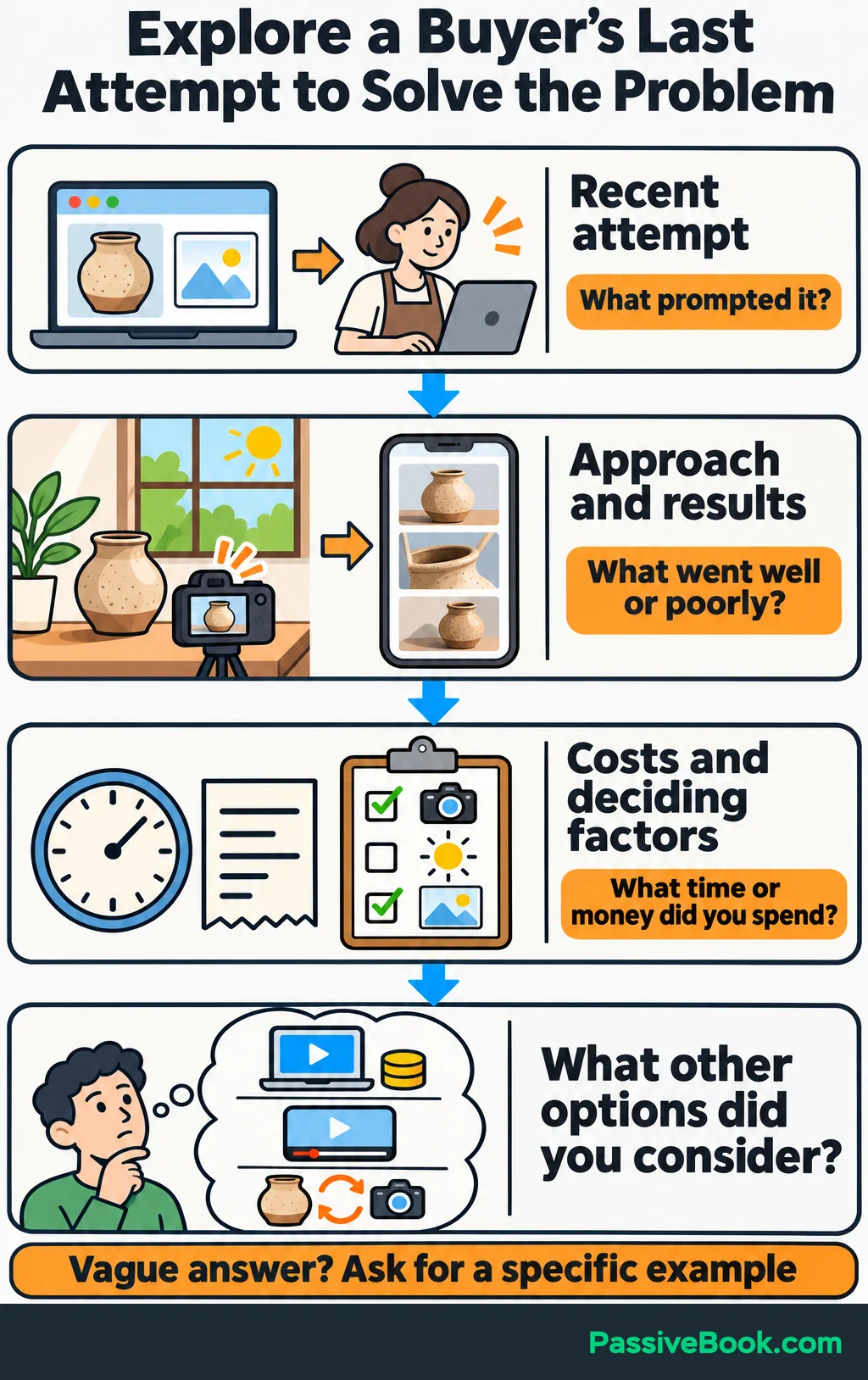
Follow vague answers with “Can you give me an example?” If someone says photography takes too long, ask them to walk through the last shoot. You need to know whether the time went into arranging light, taking photos, editing or choosing images.
Ask about alternatives broadly. A paid course may be competing with free videos and repeated trial and error rather than another course.
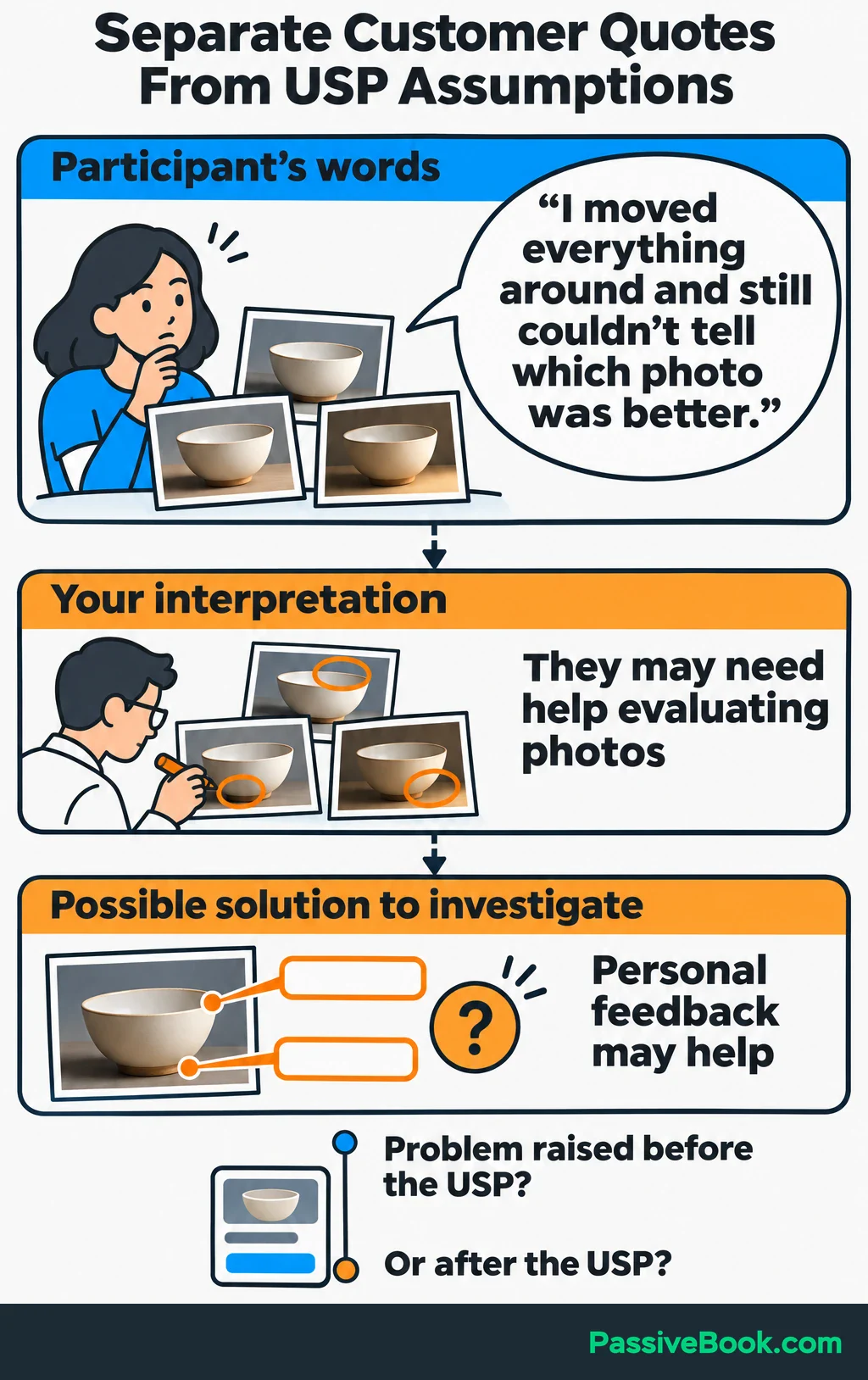
Capture the participant’s words separately from your interpretation. For example, these two notes do different jobs:
- Participant’s words: “I moved everything around and still couldn’t tell which photo was better.”
- Your interpretation: They may need help evaluating their photos.
The participant described trouble choosing a photo. “Needs personal feedback” is your possible explanation, not something they said.
Mark whether each problem appeared before or after you showed the USP. A volunteered problem carries a different meaning from agreement with a benefit you introduced.
Check Understanding, Value and Differentiation
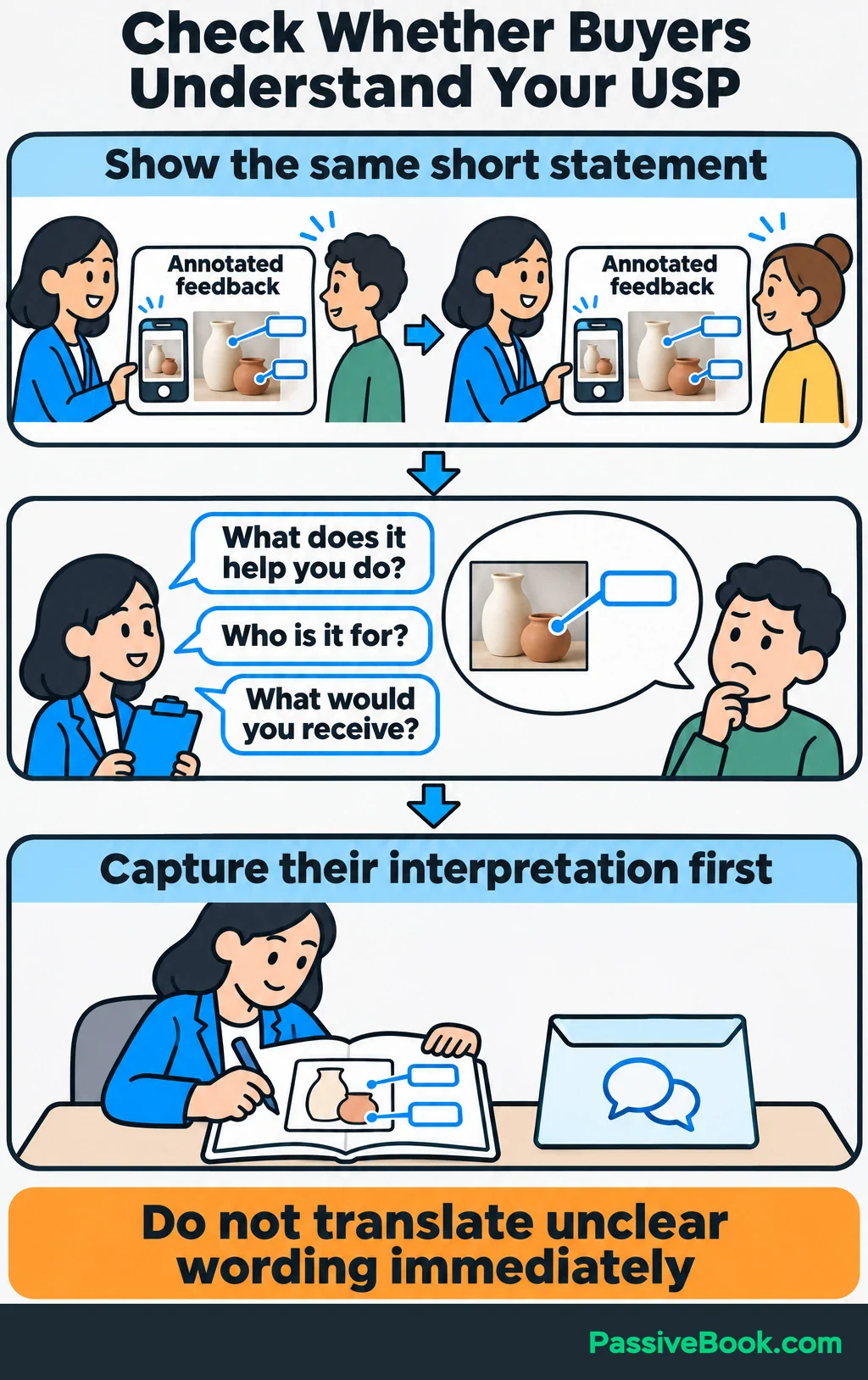
Now show the same short USP statement to each participant. Let them read it before explaining anything.
First check understanding:
- “What does this offer help you do?”
- “Who is it for?”
- “What would you expect to receive?”
Write down their interpretation. If they misunderstand “annotated feedback,” resist translating it immediately. You have just found something useful about the wording.
Then connect the offer to their earlier experience:
- “Where would this fit into the situation you described?”
- “Which part, if any, addresses what was difficult?”
- “How does this differ from what you used?”
- “What would keep you with your current approach?”
Keep questions neutral. “Would personal feedback be valuable?” makes approval easy. “What role, if any, would feedback play in your decision?” leaves room for an honest rejection.
Check credibility too: “Which part would you need evidence for?” A sample photo with comments marked directly on it could show what the course’s feedback includes.
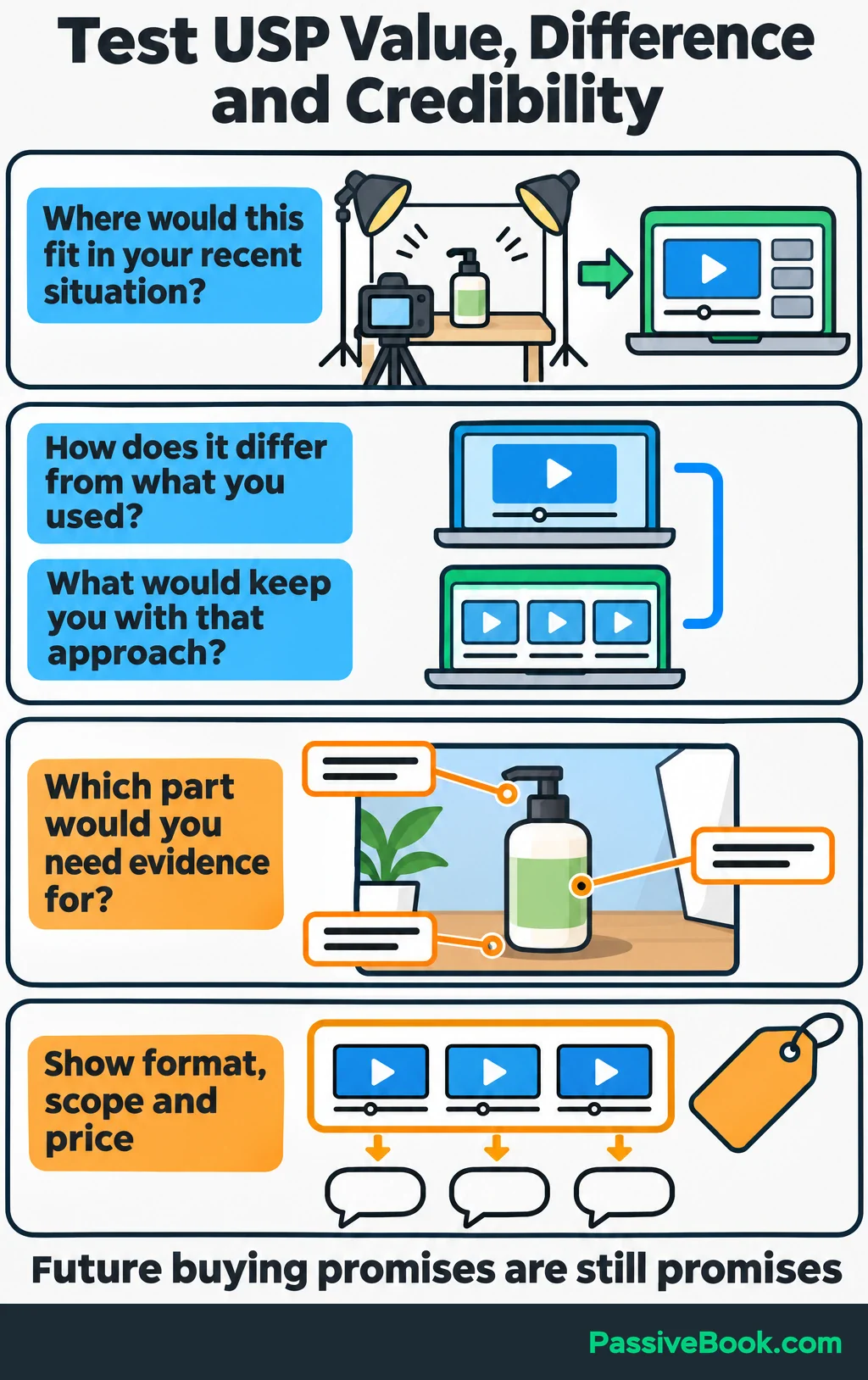
Finally, show the intended format, scope and price before exploring buying objections. Without those details, people are reacting to an offer they have partly invented.
I would skip “Would you buy this?” Ask what they would need to evaluate it and how they decided on comparable purchases. A promise about future buying is still a promise.
If you’re unsure how to ask these questions about your own offer, AI Customer Research Studio can draft your interview. It keeps the recent buying story separate from reactions to your USP, so your pitch does not supply the answers.

Free AI Customer Research Studio




Revise Your USP Around the Findings
After each conversation, put the evidence in a simple spreadsheet. Use one row per participant and record their buying situation, recent problem, current alternative, deciding factor, exact wording, interpretation of the USP and objection.
Then look for repeated priorities supported by specific experiences.
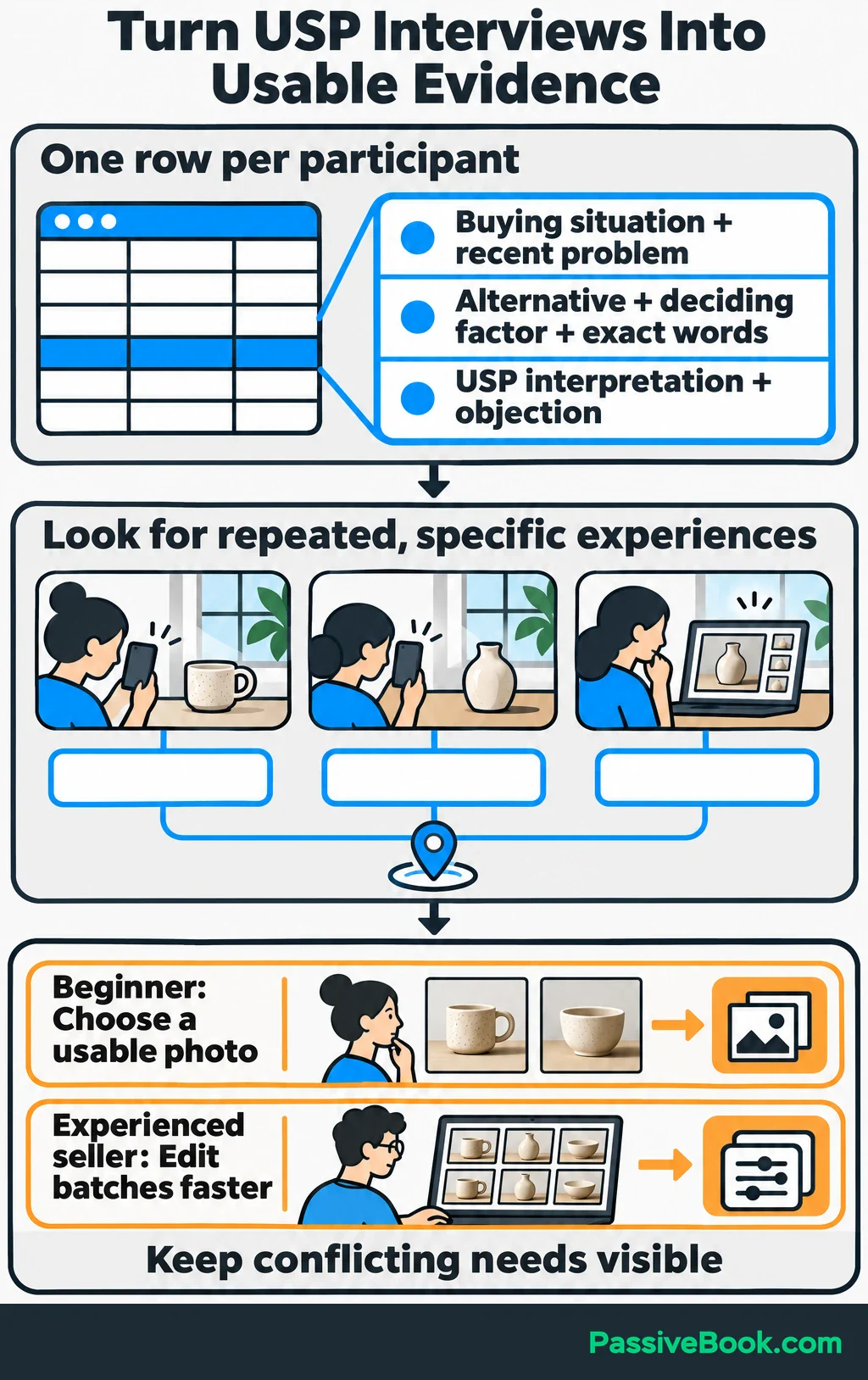
Several people describing the same difficulty is worth investigating. Several people agreeing that your proposed feature sounds nice tells you much less.
Keep contradictory answers visible. If beginners want help choosing a usable photo but experienced sellers want faster batch editing, averaging those needs into “better photography” hides a decision about whom to serve.
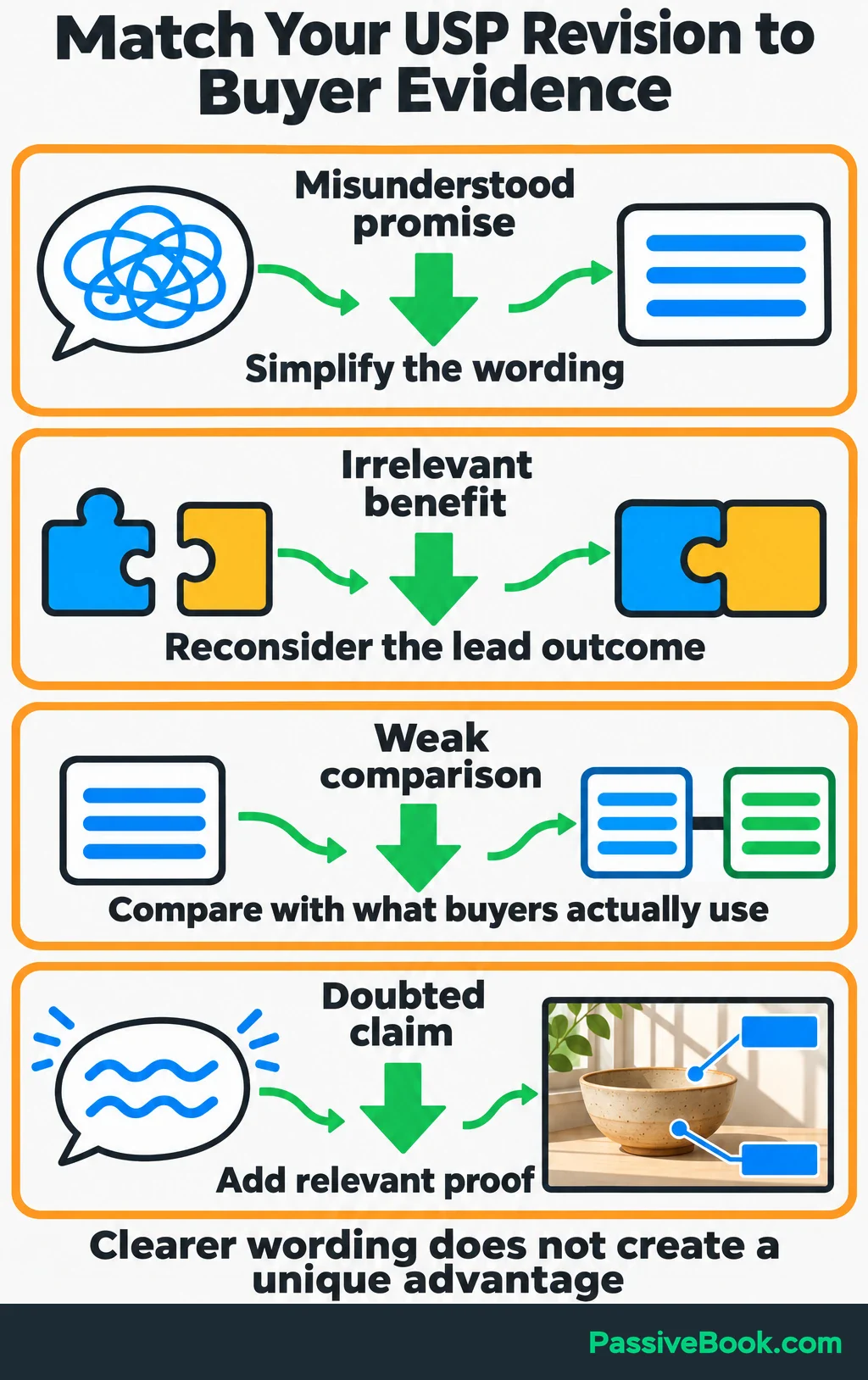
Match the change to the problem you found:
- Misunderstood promise: Simplify the wording.
- Irrelevant benefit: Reconsider which outcome you lead with.
- Weak comparison: Explain the advantage over the alternative buyers actually use.
- Doubted claim: Add a demonstration or other relevant proof.
For the course, suppose buyers value feedback but don’t understand “annotated.” You could test:
Photograph your handmade ceramics with your phone using a repeatable window-light setup. Get comments marked directly on your first product photos.
But if buyers already receive equivalent feedback elsewhere, clearer wording does not establish a new advantage. Investigate what remains unresolved.
Check competitors’ actual offers before claiming a gap. A feature missing from their homepage may still be included in the product.
Use a Short Survey When a Specific Pattern Needs Checking
I would use a survey after interviews reveal a focused question. For example: where do people get stuck during a product shoot, and what help do they currently use?
If you still cannot explain the underlying problem, keep interviewing.
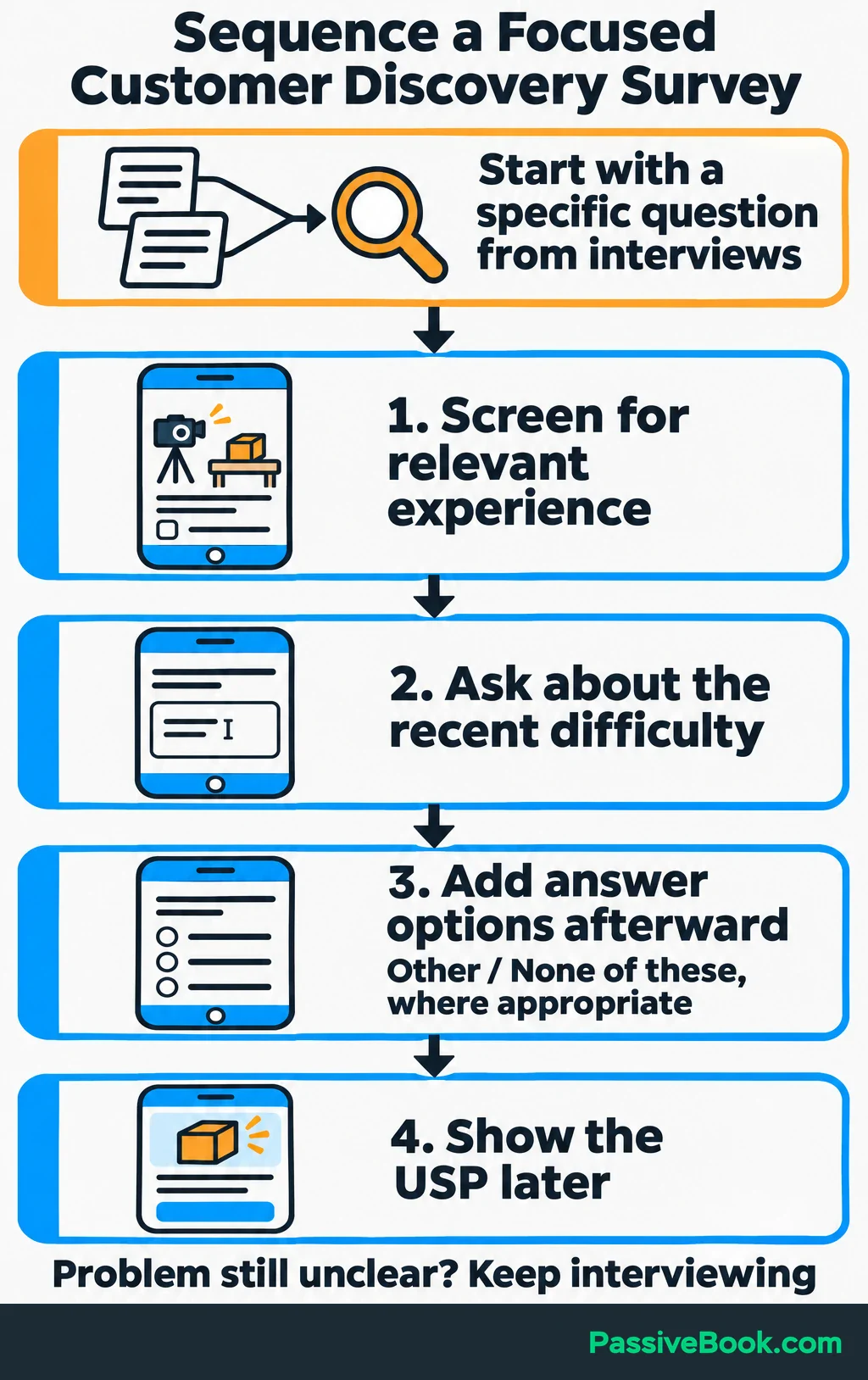
Screen for the same relevant experience, then ask about the recent shoot before showing the USP. Let respondents describe the difficulty in their own words before presenting a list of possible problems.
For questions with answer options:
- Ask one thing at a time.
- Include “none of these” and “other” where they fit.
- Randomize options when their order has no meaning.
- Keep naturally ordered choices, such as frequency ranges, in order.
Pew Research Center’s questionnaire guidance explains how wording, supplied options and question order can affect responses.
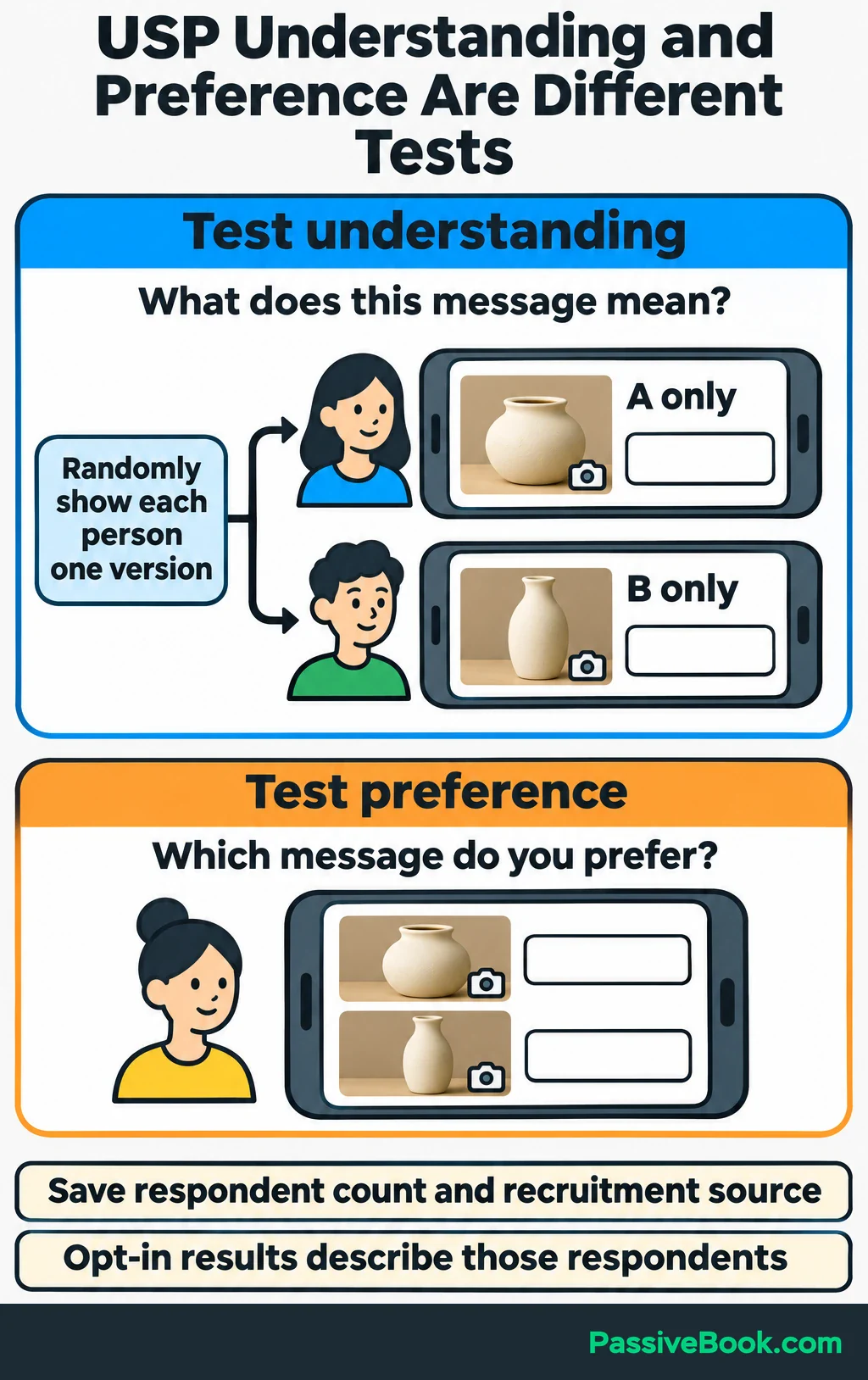
To compare understanding of two messages, randomly show each respondent one version and ask what it means. Showing both side by side and asking for a favorite measures preference instead.
Save the respondent count and recruitment source with the findings. An opt-in survey of your subscribers describes those respondents; it does not establish a market-wide preference.
Test the Revised USP Through Customer Action
Interviews help you understand priorities. The next test asks whether people act on the offer.
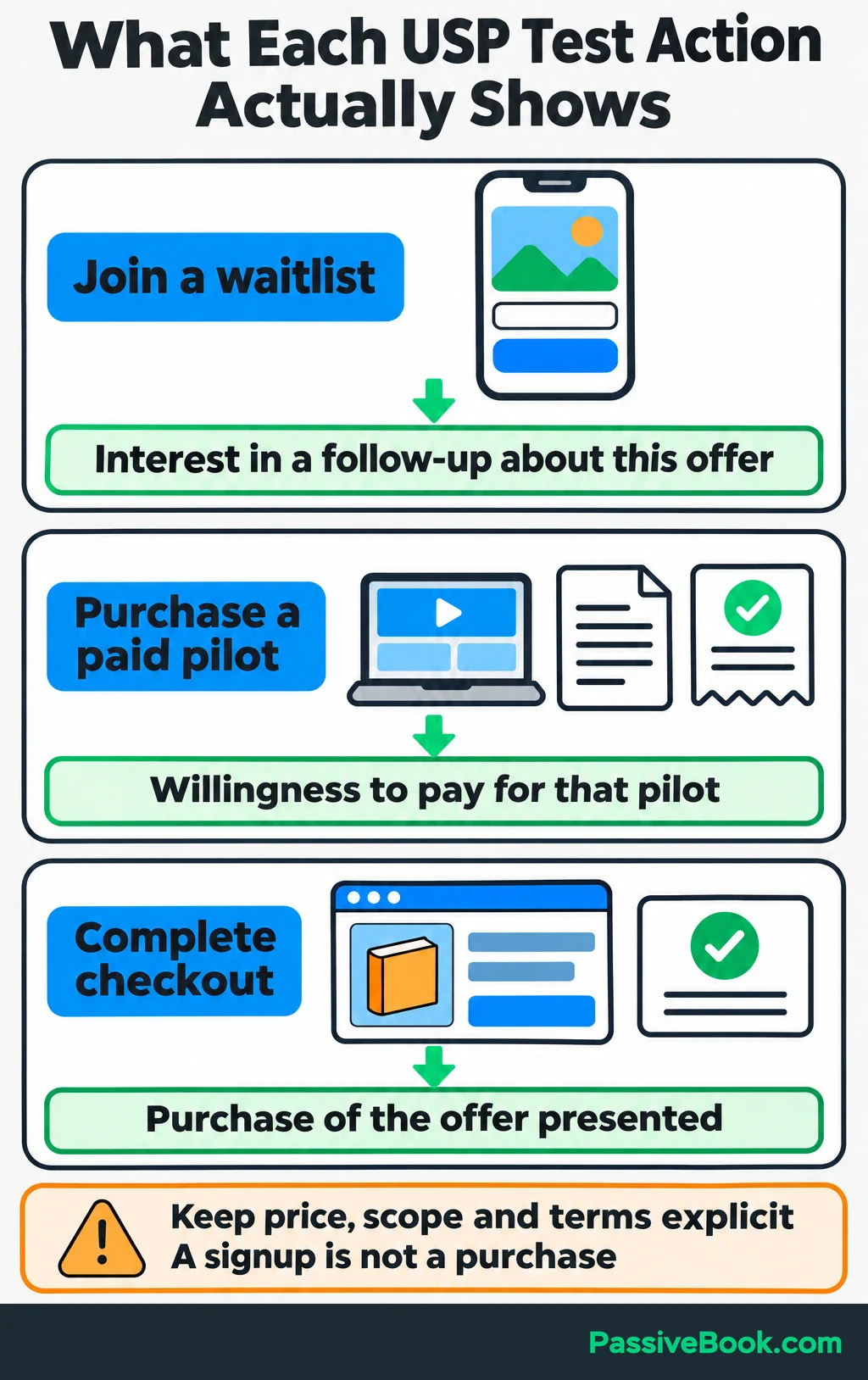
Keep the meaning of each action clear. A waitlist signup shows interest in hearing more. A purchase provides evidence of willingness to pay for the particular offer and terms shown. Strategyzer’s evidence guidance distinguishes what customers say from what they actually do.
Offer a Concrete Next Step
Put the revised promise on a simple page with what buyers receive, relevant proof and one clear action.
Use your existing website where possible. On WordPress, I would use GenerateBlocks for the page and Fluent Forms for a signup form. You do not need a separate funnel subscription to discover whether people want the offer.
Choose an action that answers your next question:
| Your uncertainty | Suitable next step | What completion tells you |
|---|---|---|
| Will relevant people ask to hear about a future offer? | Join a clearly described waitlist | They want a follow-up about that offer |
| Will buyers pay for a small version? | Purchase a paid pilot with stated terms | They will pay for that pilot |
| Will buyers purchase the available product? | Complete checkout | They will buy the offer presented |
For the photography course, show the lesson scope and a sample of comments marked on a photo. If you invite buyers into a paid pilot, state the price, delivery commitments and refund terms accurately.
A demonstration of what you provide is useful even when you have no customer testimonials yet.
Share the page through relevant subscribers, referrals or permitted community posts. Record traffic sources, unique visitors and completed actions, and test the form or checkout yourself before sending traffic.
Follow up with people who expressed interest but stopped:
What kept you from taking the next step?
Their answers may point to price, timing, trust or a confusing purchase process. Investigate those before replacing the differentiator.
Compare Messages When Traffic Supports an A/B Test
An A/B test compares two versions shown to visitors at random. For a USP test, compare your current message with one revised hypothesis while keeping the product, price, design and call to action consistent.
Before starting, decide:
- Primary action: The single outcome you will use to judge the comparison.
- Meaningful improvement: The smallest change worth acting on.
- Traffic requirement: The sample needed for your planned analysis.
- Stopping rule: When and how you will evaluate the result.
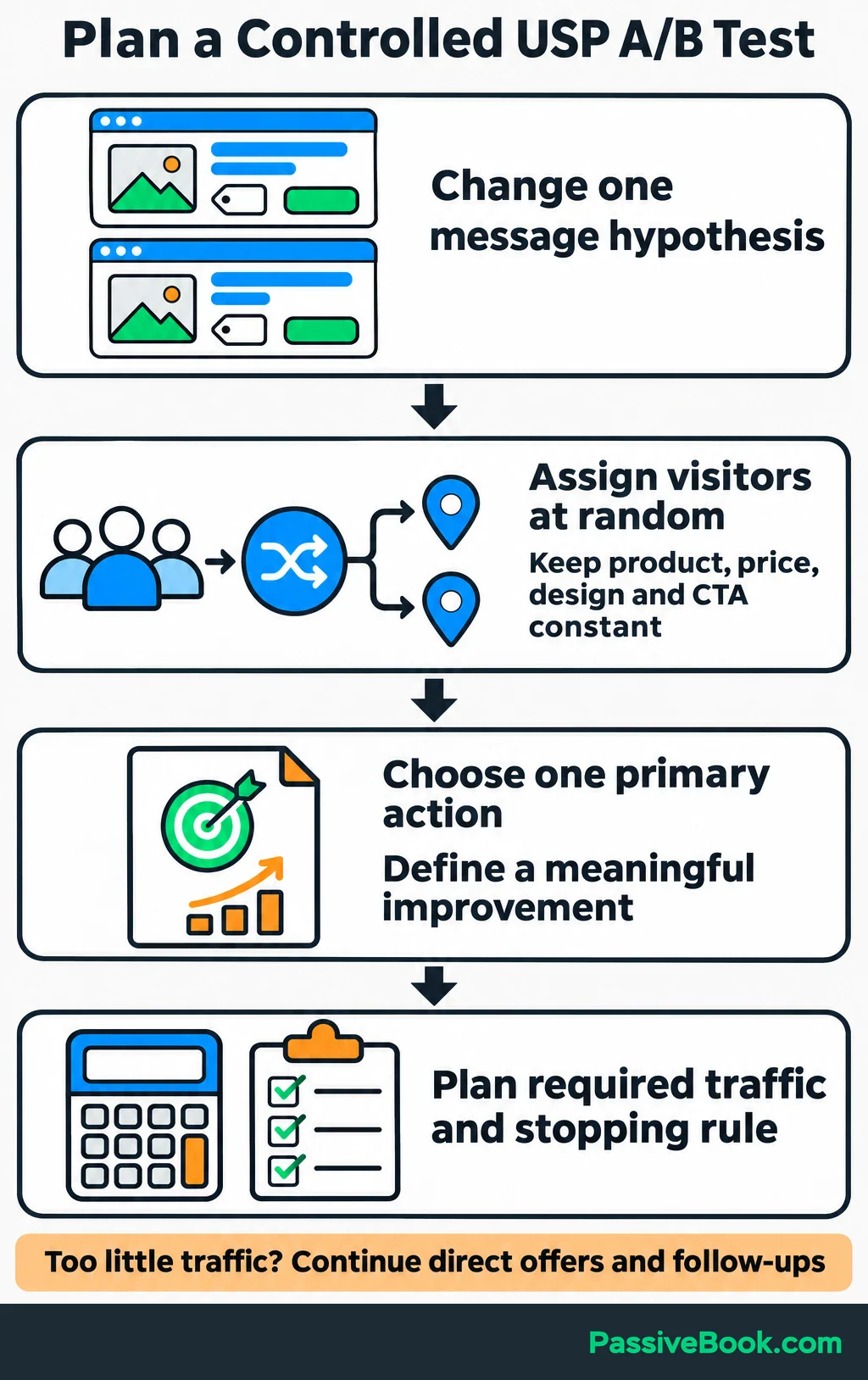
Use a sample-size calculator suited to your statistical test. Required traffic depends partly on your existing conversion rate and the improvement you want to detect; Optimizely’s sample-size guidance explains these dependencies.
If the requirement would take an impractical amount of time, I would continue with direct offers and follow-up conversations. A small site does not need to imitate a large retailer’s testing program.
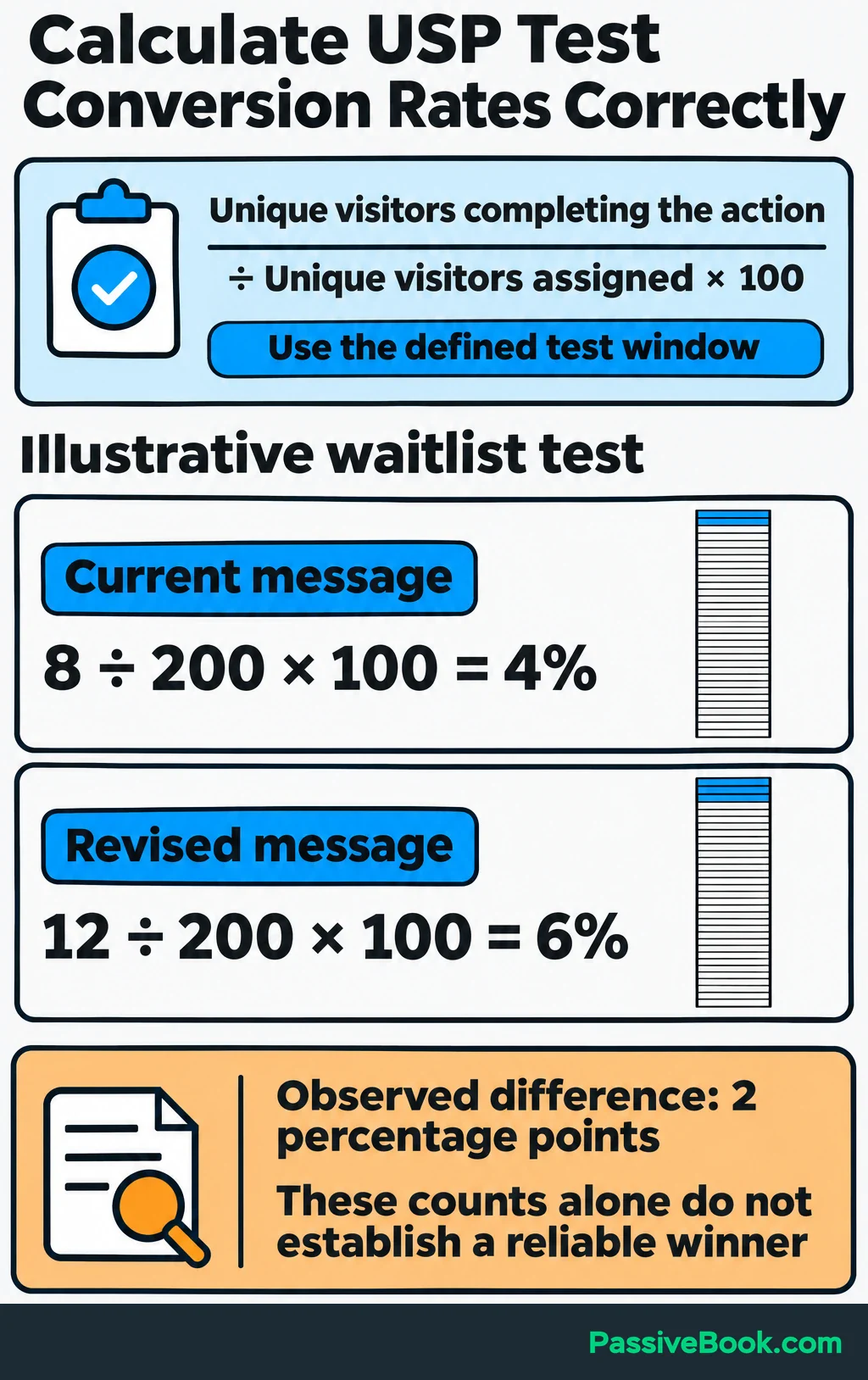
To calculate conversion rate, count the unique visitors assigned to a version who completed the chosen action within the test’s defined window. Divide that count by all unique visitors assigned to that version, then multiply by 100.
For illustration, assume the course waitlist produces:
| Version | Unique visitors assigned | Visitors who signed up | Conversion rate |
|---|---|---|---|
| Current message | 200 | 8 | 4% |
| Revised message | 200 | 12 | 6% |
The observed difference is two percentage points. Those counts alone do not establish a reliable winner. Interpret them through the planned statistical analysis, and avoid stopping simply because one version moves ahead.
Decide Whether to Keep, Refine or Replace Your USP
Decide what the evidence supports before choosing what to change. A weak result does not automatically mean the entire idea is wrong.
Use this table to guide the next decision:
| Evidence pattern | Likely issue | Decision | Next test |
|---|---|---|---|
| Buyers understand the promise, connect it to a repeated priority and act at workable terms | The direction has support | Keep the direction and invest gradually | Test with another relevant group or traffic source |
| Buyers value the offer once you explain it, but misread the original message | Wording hides the value | Refine the message | Check understanding with new participants |
| Buyers understand the promise but already get the benefit elsewhere | The proposed advantage is weak | Rework the difference or buyer focus | Investigate an unresolved problem and compare alternatives |
| Buyers show interest but stop before buying | Price, timing, proof or purchase friction may be blocking action | Diagnose the obstacle | Review the purchase process and interview people who stopped |
| Relevant buyers repeatedly describe a different priority | The offer may target the wrong need | Revisit the promise or intended buyer | Interview people who recently faced that priority |
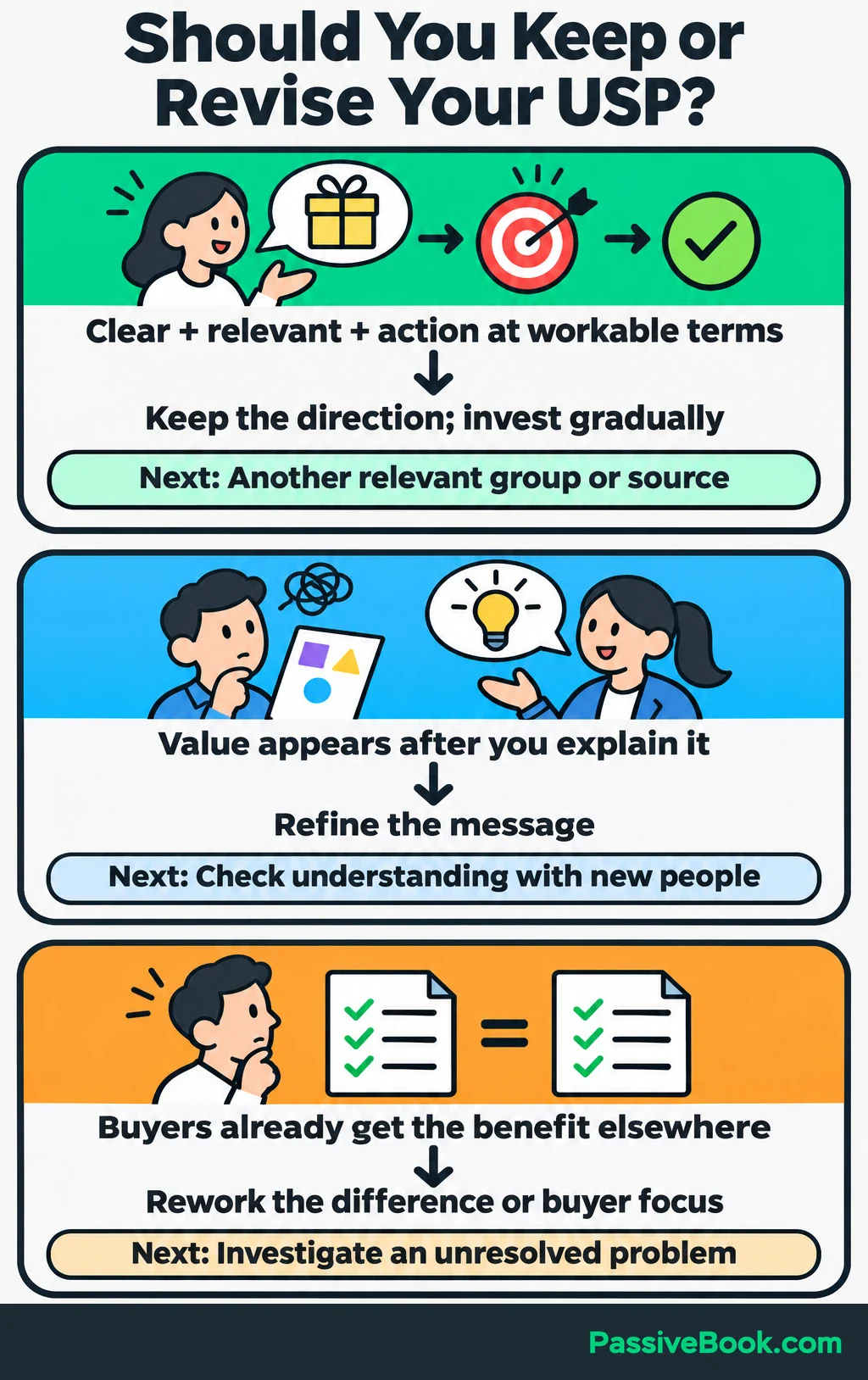
For the course, confusion about “annotated feedback” calls for clearer wording. Equivalent feedback elsewhere challenges the advantage. A broken checkout calls for fixing checkout. Those findings should not produce the same response.
“Workable terms” also matter. If buyers purchase only when you include more personal support than you can afford to deliver, you have evidence for that bundle. You still need to test an offer you can sustain.
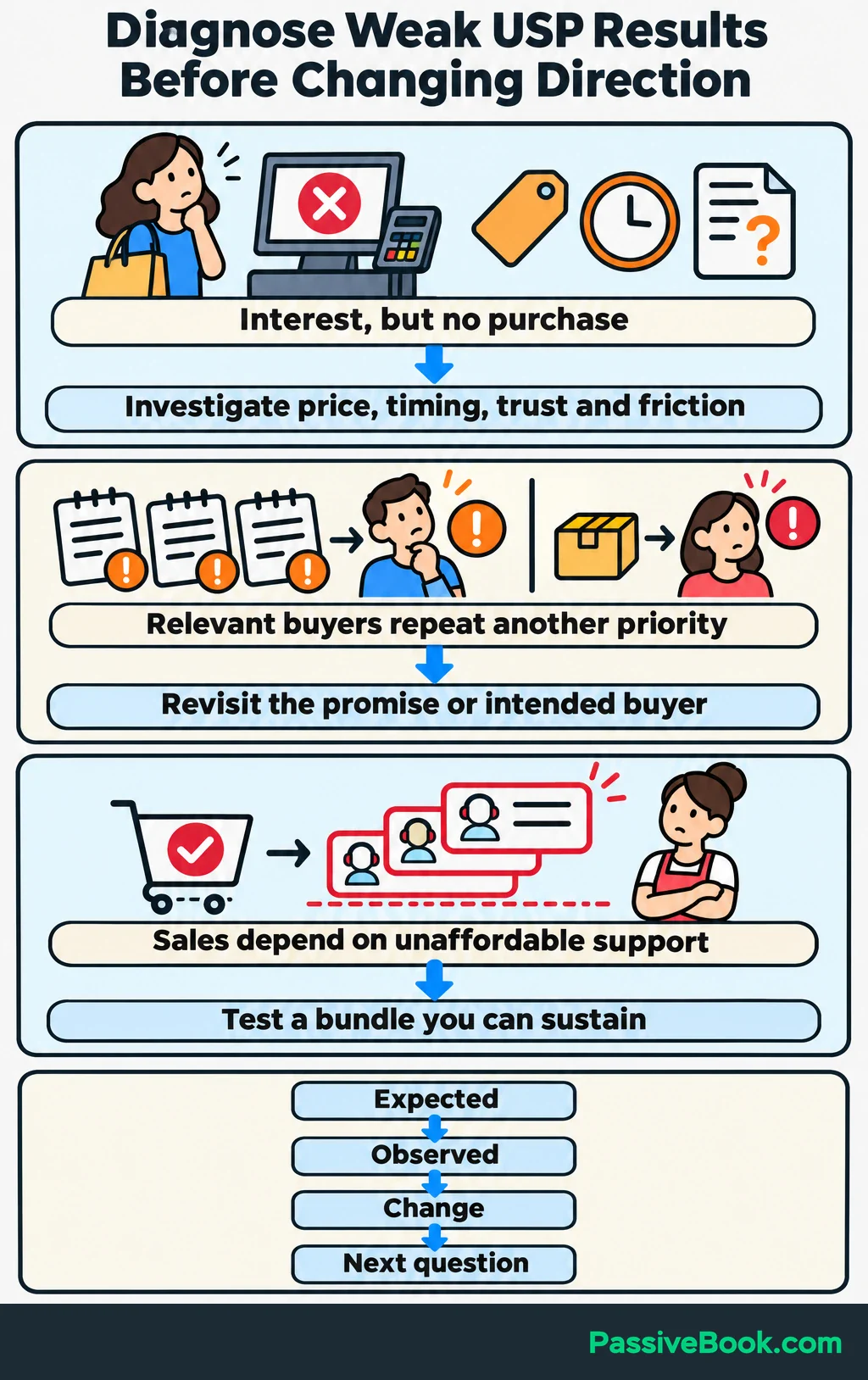
Finish each round with a short decision:
We expected [belief], observed [evidence], and will change [one element] before testing [remaining question].
Make the evidence specific. Record the recent buying situations and completed actions rather than writing “customers loved it.”
Choose the next test that resolves the uncertainty blocking further investment. Confidence should grow because the evidence improves.
What Next?
Write your current USP in one sentence, name the alternative buyers use and invite one relevant person to discuss their last attempt to solve the problem.
Use the social buttons to share this guide when a launch discussion needs a practical way to test its assumptions.
Which part of your USP has the least evidence behind it: clarity, value, difference or believability? Leave your answer in the comments, along with any other questions about testing it.
Share this post with your friends & followers:

