You can sell downloads all year without anyone taking income tax out of each sale. Then filing season arrives, and you have sales reports, receipts, and a nagging question: which returns do you actually need?
Choosing the wrong filing product can waste an evening, but missing a required payment can cost money even when your annual return is accurate. This guide follows a small sewing-pattern business through U.S. federal filing, with checks for state and local taxes, so you can turn sales records into accepted returns and confirmed payments.
1. Identify the Tax Returns Your Business Needs
Match Your Federal Return to Your Tax Classification
Start with your business’s federal tax classification: how the IRS treats it for income-tax purposes. Check your previous return and any accepted tax elections, such as a choice to have an LLC taxed as a corporation, before choosing software.
“LLC” alone does not tell you which federal income-tax return to file. An LLC’s ownership and tax elections determine how it is treated.
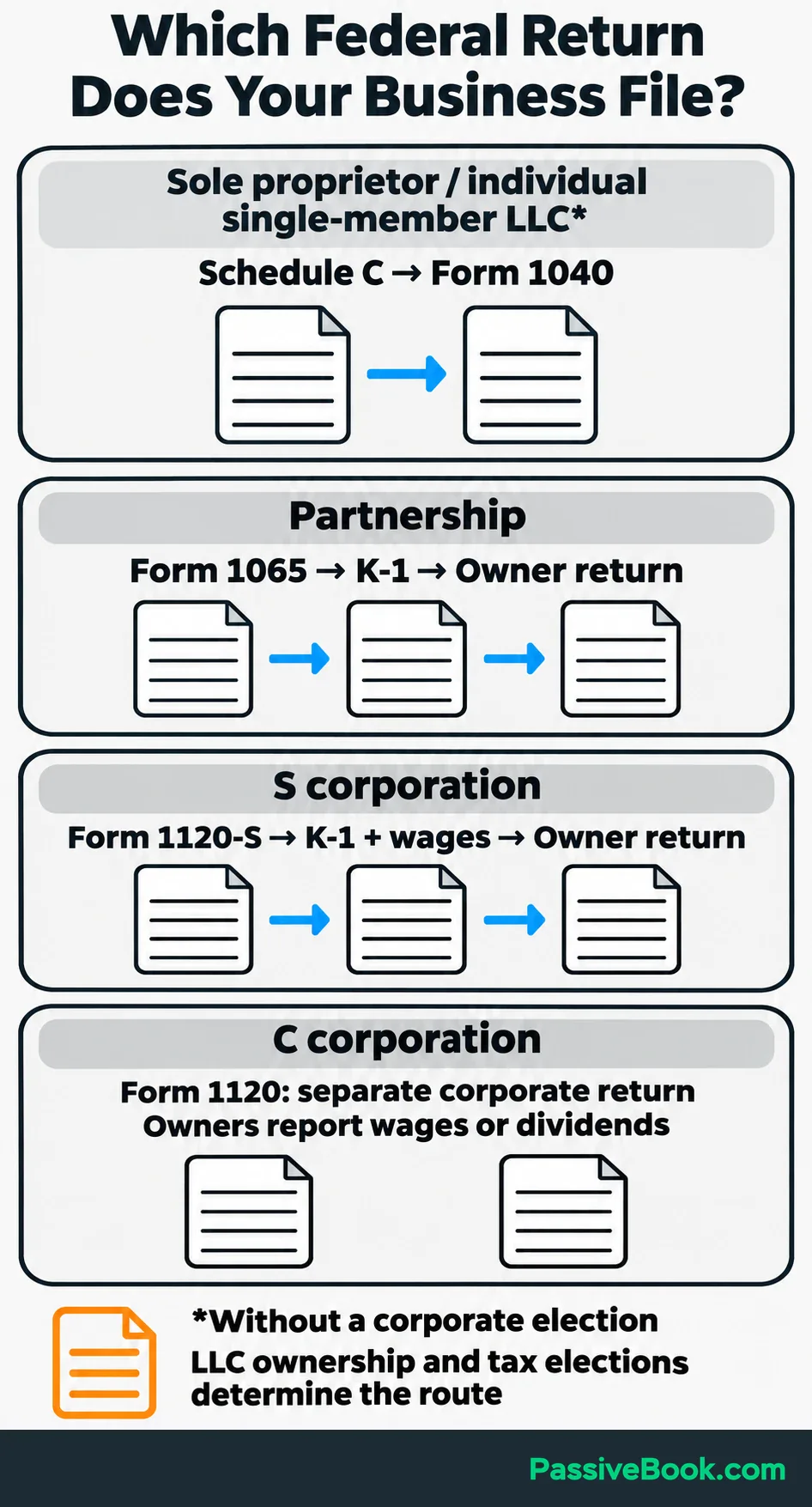
For partnerships and S corporations, Schedule K-1 shows each owner’s share of business income, deductions, credits, and other items to report on their own return.
| Federal Tax Classification | Business Return | Owner Reporting |
|---|---|---|
| Sole proprietor or individually owned single-member LLC without a corporate election | Schedule C attached to Form 1040 | Business profit or loss flows into the owner’s individual return |
| Partnership, including most domestic multi-member LLCs without a corporate election | Form 1065, with a Schedule K-1 for each partner | Partners report their K-1 items on their own returns |
| S corporation | Form 1120-S, with shareholder Schedules K-1 | Shareholders report K-1 items and any wages on their individual returns |
| C corporation | Form 1120 | The corporation files separately; owners report personal income such as wages or dividends |
The IRS classification rules explain how an LLC fits into these categories. If your records show an election you do not understand, resolve that before preparing a return.
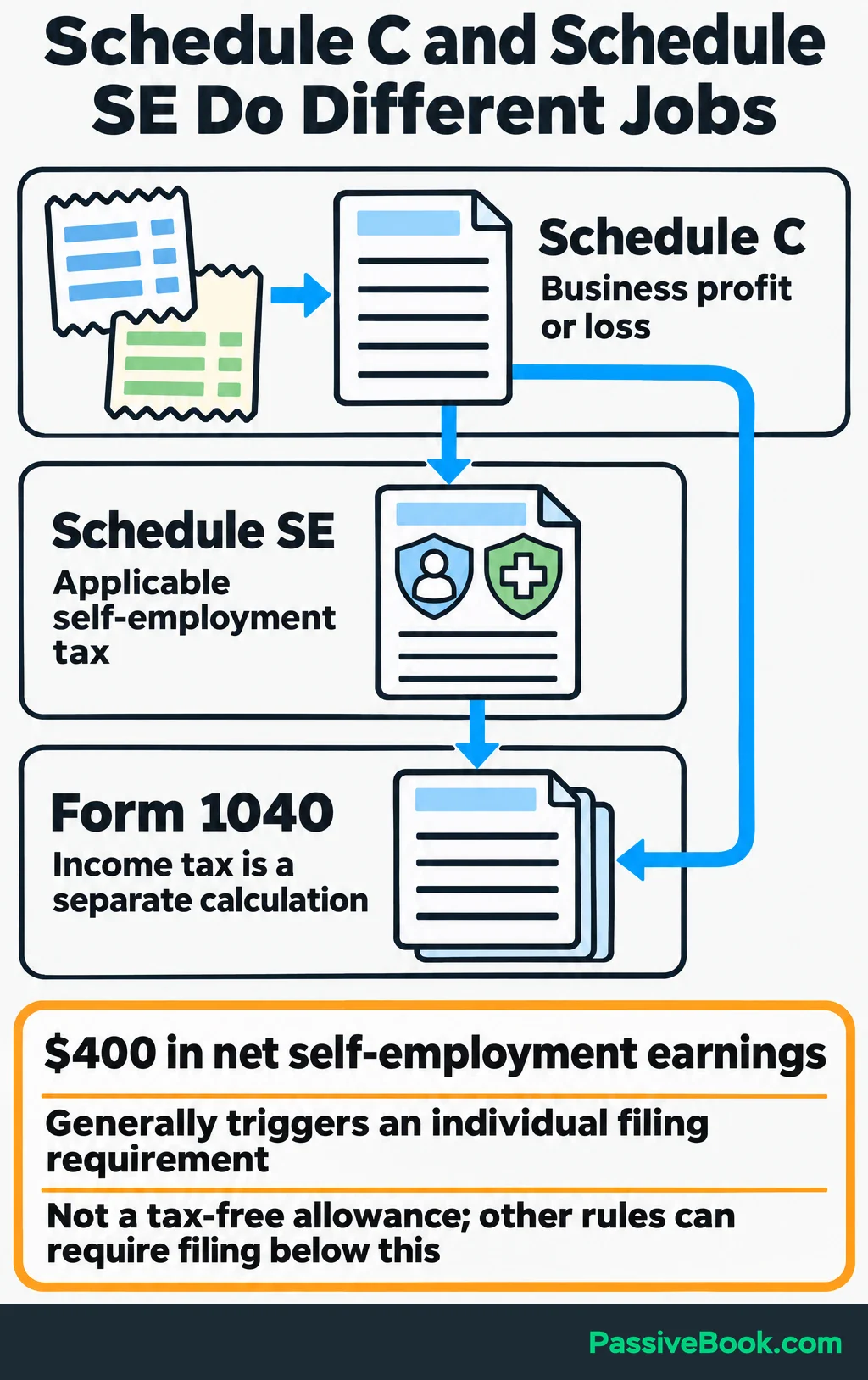
For the running example, imagine you sell downloadable beginner sewing patterns through your own website and an online marketplace. You operate as a sole proprietor, so the business activity goes on Schedule C with your Form 1040.
Schedule C calculates business profit or loss. Schedule SE calculates applicable self-employment tax, which covers Social Security and Medicare. Income tax is a separate calculation.
You generally must file an individual return when net self-employment earnings reach $400. Other filing requirements can apply below that amount, so it is not a tax-free income allowance. See the IRS self-employed filing guidance.
Check Obligations Beyond Federal Income Tax
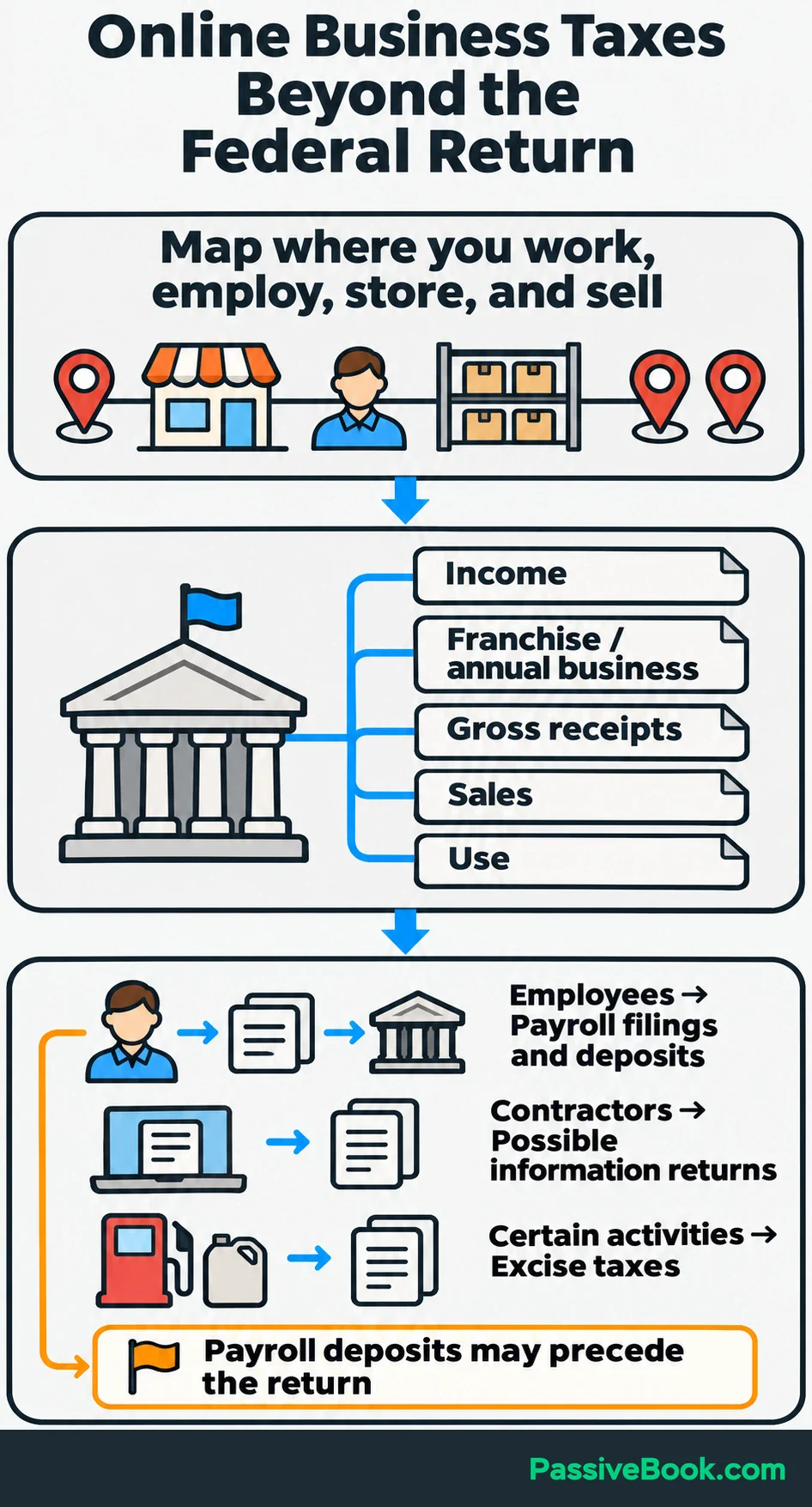
Your online business tax obligations can reach beyond the annual federal return.
List where you work, employ people, store inventory, and sell. Then check the relevant state and local agencies for:
- Income taxes on business or owner income.
- Franchise taxes or annual business taxes.
- Gross-receipts taxes based on revenue.
- Sales tax on taxable sales.
- Use tax on qualifying purchases where sales tax was not collected.
Use USAGov’s state and local tax directory to find the official agencies.
For sales tax, check both physical presence and economic nexus. Economic nexus means enough sales activity in a state to create a tax obligation, even without a physical location there. Each state sets its own rules, including which products count as taxable.
The sewing-pattern shop needs to check how relevant states treat downloadable patterns. Selling a digital file does not settle that question.
Employees add payroll returns, wage statements, and tax deposits. Deposits may be due before the payroll return. Contractor payments may require information returns such as Form 1099-NEC, which reports compensation paid to contractors. Certain goods or activities also trigger excise taxes, which are separate taxes on those goods or activities. Add these to your filing list separately.
2. Check Your Filing and Payment Deadlines
Confirm the tax year first. A return for income earned in one calendar year is usually filed the following year.
For calendar-year 2026 federal returns, the ordinary deadlines are:
| Return | Ordinary Filing Deadline |
|---|---|
| Form 1065 for a partnership | March 15, 2027 |
| Form 1120-S for an S corporation | March 15, 2027 |
| Form 1040 with Schedule C | April 15, 2027 |
| Form 1120 for a calendar-year C corporation | April 15, 2027 |
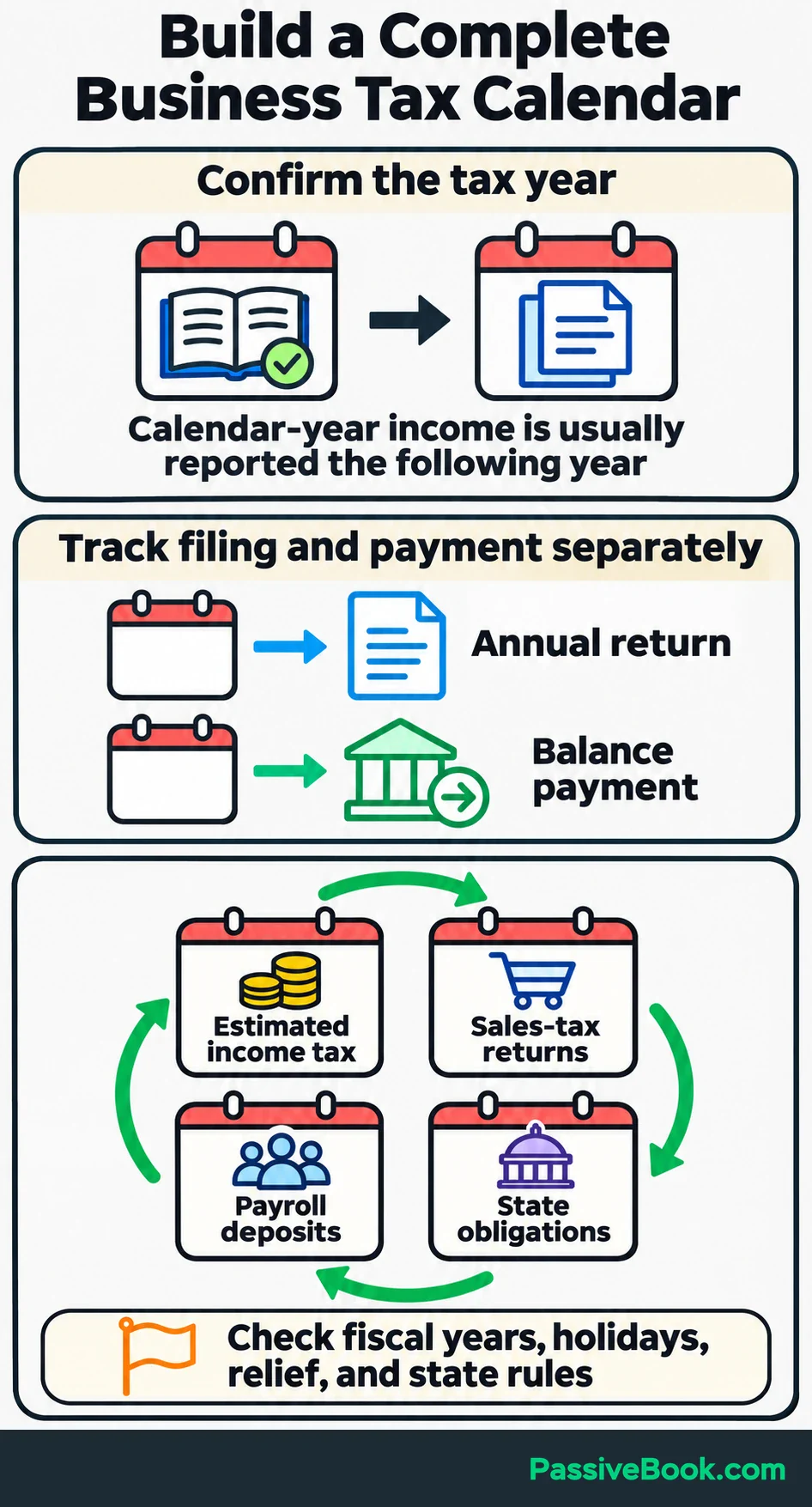
These follow the IRS business-return deadline rules. A business using a fiscal year needs the deadline for its own year-end.
Build a calendar with separate entries for filing and paying. Include estimated income-tax payments, sales-tax returns, payroll deposits, and state obligations. Your annual income-tax deadline does not replace those recurring dates.
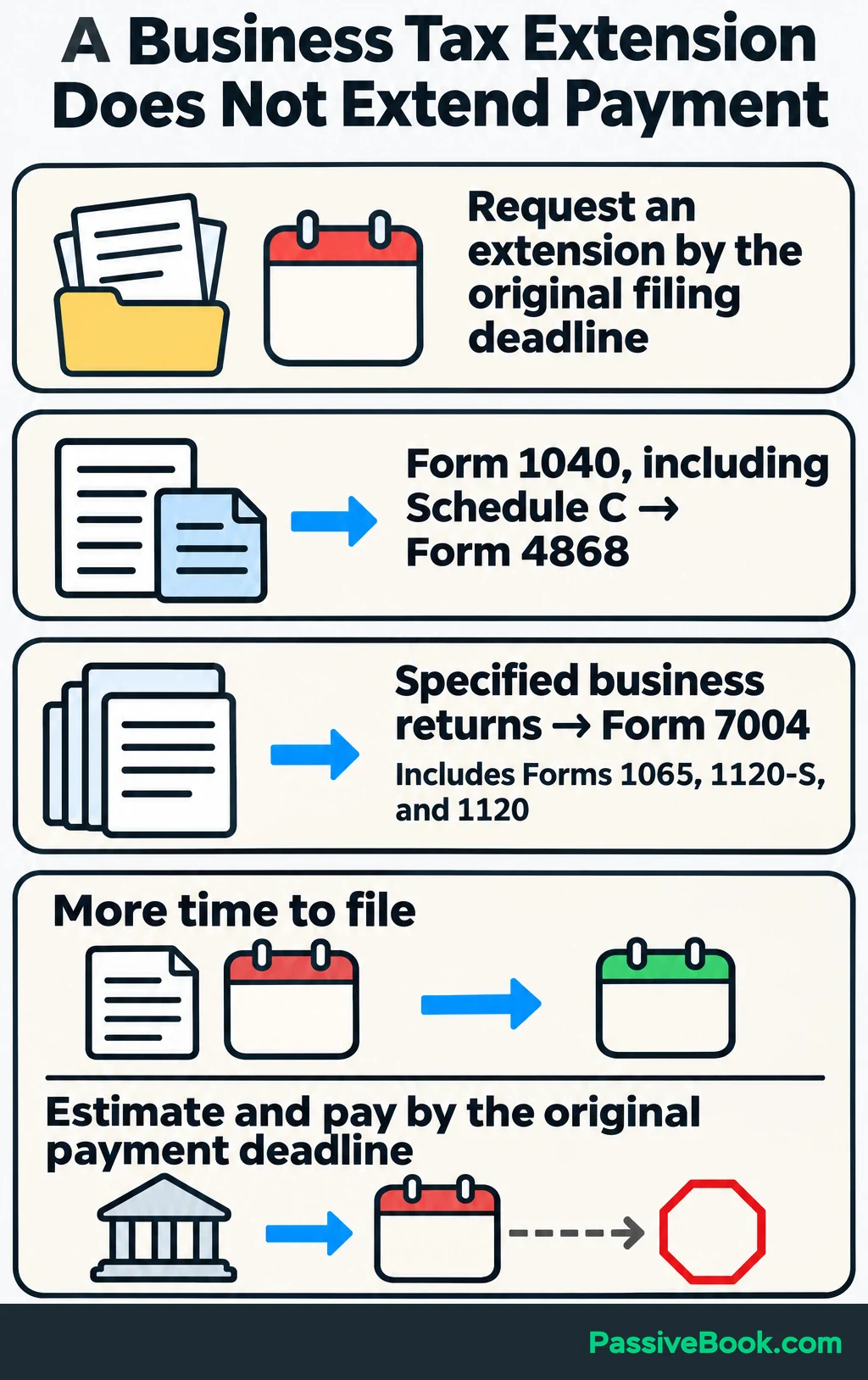
If you need more time, request an extension by the original filing deadline:
- Form 4868 applies to an individual return, including one with Schedule C.
- Form 7004 applies to specified separate business returns, including Forms 1065, 1120-S, and 1120.
An extension gives you more time to file. It does not move the ordinary payment deadline. Estimate the balance and pay by the original due date; the IRS extension guidance explains the available routes.
Check weekend and holiday adjustments, along with any disaster relief covering your location. Confirm state deadlines independently. If a return is already overdue, start resolving it now rather than waiting for another filing season.
3. Choose How to File Online
Compare Software and Professional Preparation
Choose software by the return it supports. A product marketed to “business owners” may prepare Schedule C but not a partnership or corporate return.
Before starting, confirm support for your tax year, federal form, required schedules, and states. Compare the total cost through submission, including state filing and any help you expect to use.
| Filing Route | Suitable Use | What to Check |
|---|---|---|
| FreeTaxUSA | Preparing Form 1040 with Schedule C and Schedule SE | State charges, optional assistance, and support for your full personal return |
| TaxAct business software | Preparing separate Forms 1065, 1120-S, or 1120 through the appropriate product | Correct entity product, state returns, K-1 preparation, and whether owner returns cost extra |
| A tax professional | Resolving complex reporting or having returns prepared for you | Relevant experience and a written list of included returns and services |
For a straightforward sewing-pattern sole proprietorship with reconciled books, I would consider self-filing with software that supports Schedule C. I would compare the full filing cost before buying an expensive package because its name contains “business.”
I would get targeted professional help for an unresolved tax classification, partnership allocations, S corporation shareholder payroll, multistate obligations, or old filing problems.
Ask what the quote includes. Preparing an S corporation’s return does not necessarily include its shareholder’s Form 1040, payroll filings, or state returns.
You can also pay for help with one difficult issue while handling the routine record gathering yourself. That is often a better use of a limited budget than paying someone to sort a year of unnamed receipts.
Use IRS Accounts for Account Management
Prepare and transmit your income-tax return through suitable filing software or an authorized preparer. Creating an IRS account does not file it.
An individual IRS account helps you manage personal tax matters, including Form 1040 balances and payment records.
Business Tax Account access depends on the entity and your role. Opening one is not a prerequisite for filing Schedule C.
4. Gather and Reconcile Your Records
Gather the documents that establish who is filing, what happened during the year, and what has already been paid.
A useful collection includes:
- Taxpayer identification details, prior returns, and accepted tax elections.
- Bookkeeping reports, receipts, and business bank statements.
- Website, marketplace, and payment-processor reports.
- Forms 1099 and other information returns received.
- Estimated-tax payment confirmations.
- Equipment records and existing depreciation schedules.
- Personal tax documents needed for Form 1040, such as wage statements.
Next, reconcile the records. This means explaining how sales, refunds, fees, and other adjustments lead to the money deposited in your bank.
Start with one payout rather than the whole year. Compare its sales, refunds, fees, and other adjustments with the amount that reached your bank.
Free Ecommerce Reconciliation Workbook




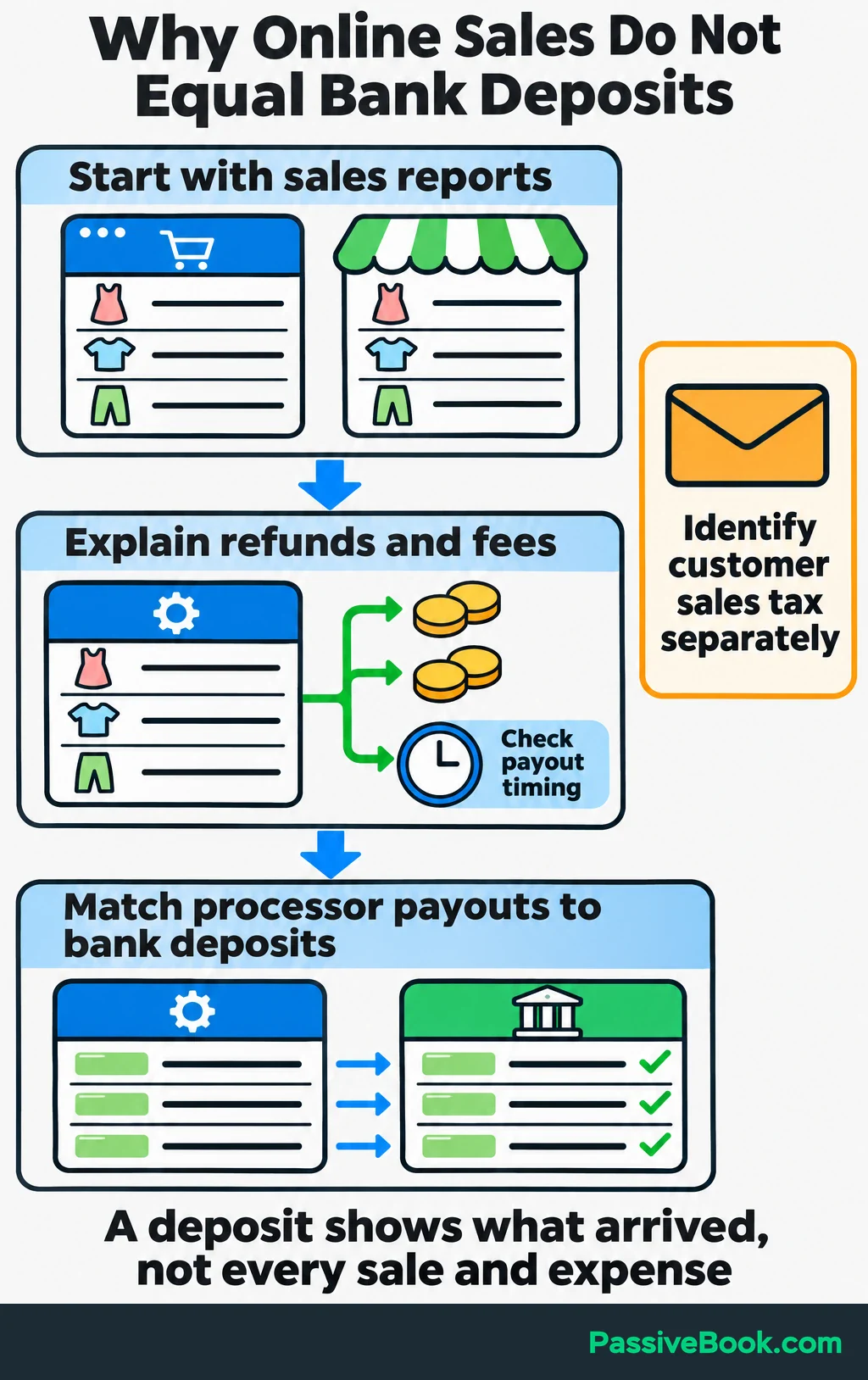
On one digital-product project, I built a monthly sales summary from bank deposits. It looked tidy until I tried to find the processor fees. They had already been taken out of the deposits, so my summary had quietly lost both part of the sales figure and the matching expense.
I went back to the sales reports and worked forward to the payouts. Now I start there. A bank deposit tells me what arrived, but it does not explain everything that happened before it arrived.
Form 1099-K also needs checking. It reports gross payments before adjustments such as fees and refunds. Business income must still be reported when no form arrives. The IRS Form 1099-K guidance explains how to use the form alongside your records.
For the sewing-pattern shop:
- Reconcile website sales against processor activity and payouts.
- Reconcile marketplace sales against marketplace fees, refunds, and payouts.
- Match any Forms 1099-K to those transactions.
- Combine the reconciled business totals, counting each sale once.
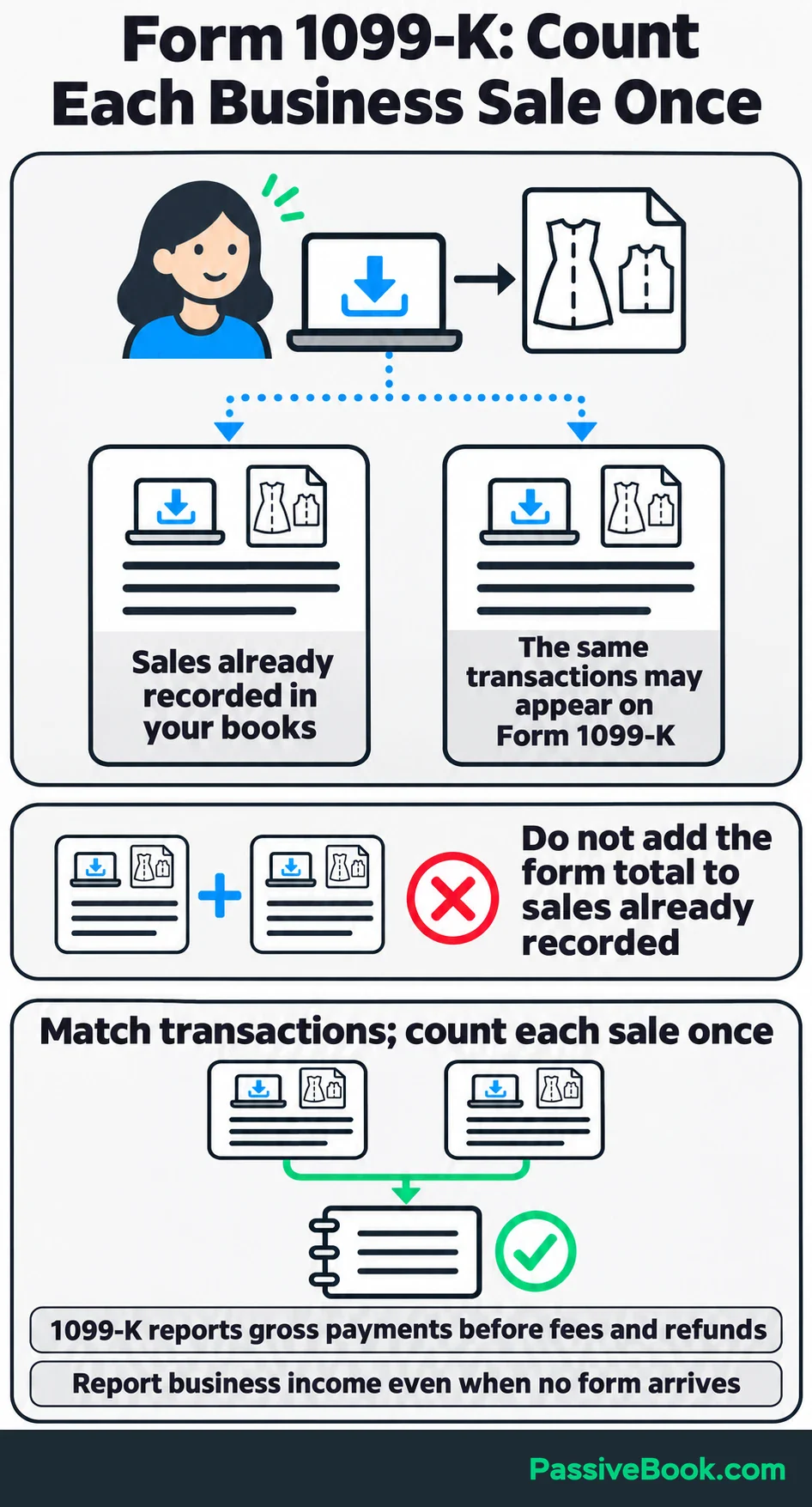
Do not add a 1099-K total on top of sales already recorded in your books. The form may describe the same transactions.
Keep customer sales tax separately identified so you can apply the correct reporting treatment. Also investigate payout timing differences, such as December sales deposited in January, using your accounting method.
If an information return is wrong, request a correction and keep the correspondence. If it remains uncorrected, follow the IRS reporting instructions for that error.
Finally, group expenses by category and record their business purpose. For shared costs, save how you calculated the business portion. Keep equipment purchase dates and inventory records where relevant.
5. Prepare Your Federal Return
Enter Income and Claim Supported Deductions
Select the correct tax year and return type, then check names and identification numbers before entering your reconciled figures.
Review imported transactions. Software can recognize a merchant name and still choose the wrong expense category. Automation makes an error travel faster; it does not make the error deductible.
Common qualifying costs for an online business include:
- Advertising and website hosting.
- Ongoing business software subscriptions.
- Marketplace and payment-processing fees.
- Business supplies.
- Accounting, legal, and other professional services.
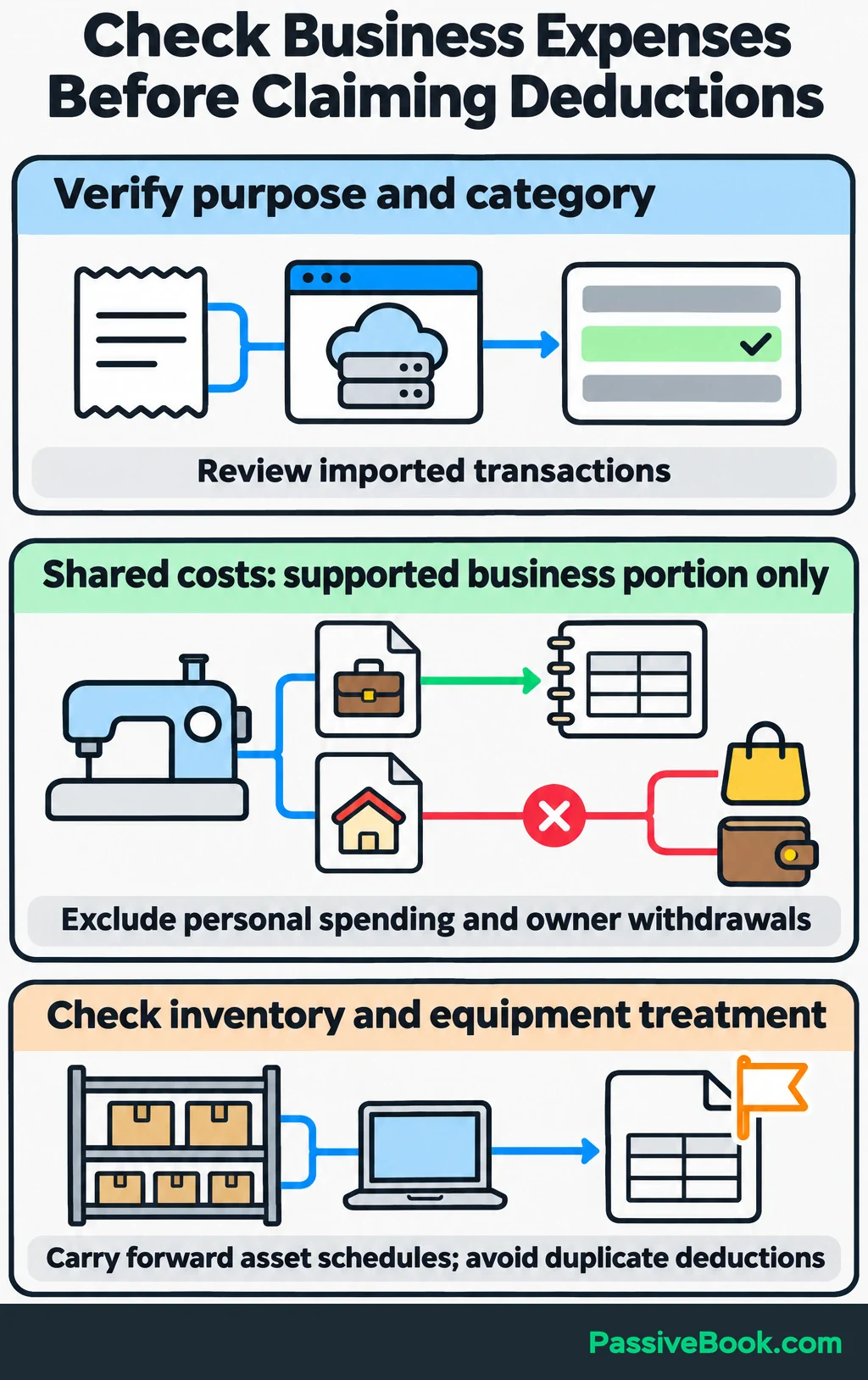
Keep personal spending and owner withdrawals out of business expenses. For shared costs, deduct only the supported business portion.
Merchandise and equipment need their own treatment. Inventory rules may affect when you deduct goods bought for resale. Equipment costs may need to be deducted over several years through depreciation, or qualify for a deduction in the year you start using the equipment for business. Carry forward existing asset schedules so a cost is not deducted twice. The IRS Schedule C instructions explain these expense categories and reporting rules.
For the sewing-pattern shop, hosting and selling fees are straightforward categories to review. A sewing machine used for both product development and personal projects needs a documented business-use allocation and the appropriate equipment treatment.
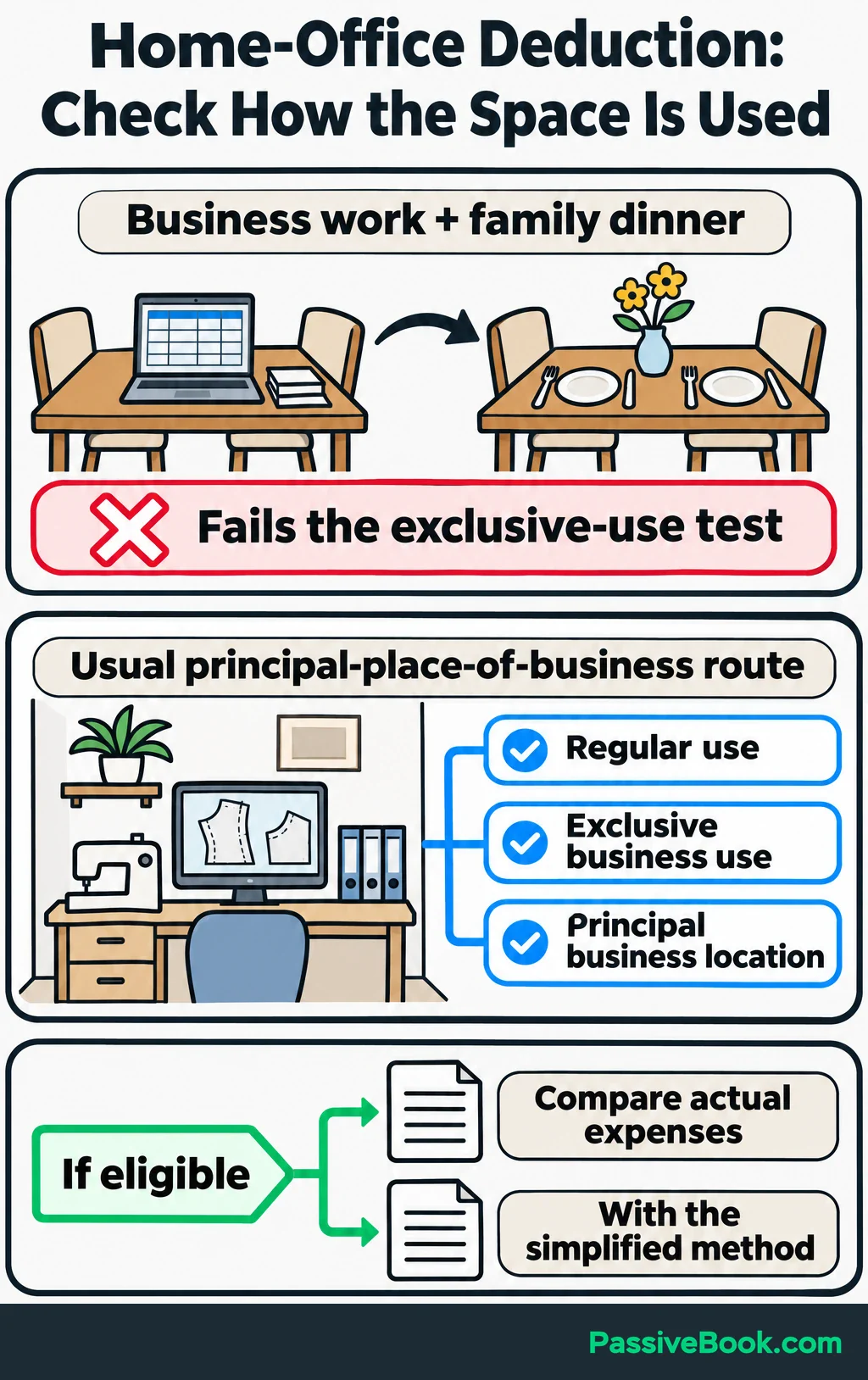
Check home-office eligibility before claiming it. Under the usual principal-place-of-business route, the space must qualify as your principal business location and be used regularly and exclusively for business.
A dining table that also hosts dinner does not meet that exclusive-use test. Eligible filers can compare actual expenses with the simplified method under the IRS business-use-of-home rules.
I would claim supported costs carefully and skip the creative storytelling. Buying something through a business account does not establish its business purpose.
Complete the Business and Owner Reporting
For Schedule C, work from business receipts to profit by accounting for refunds, applicable merchandise costs, and deductible expenses.
Here is the sewing-pattern example. Assume the figures cover one tax year, with no refunds, no inventory costs, and no customer sales tax included. The expenses are documented and deductible that year.
| Item | Illustrative Amount |
|---|---|
| Website sales revenue | $7,500 |
| Marketplace sales revenue | $4,500 |
| Total sales revenue | $12,000 |
| Deductible business expenses | $2,000 |
| Schedule C profit | $10,000 |
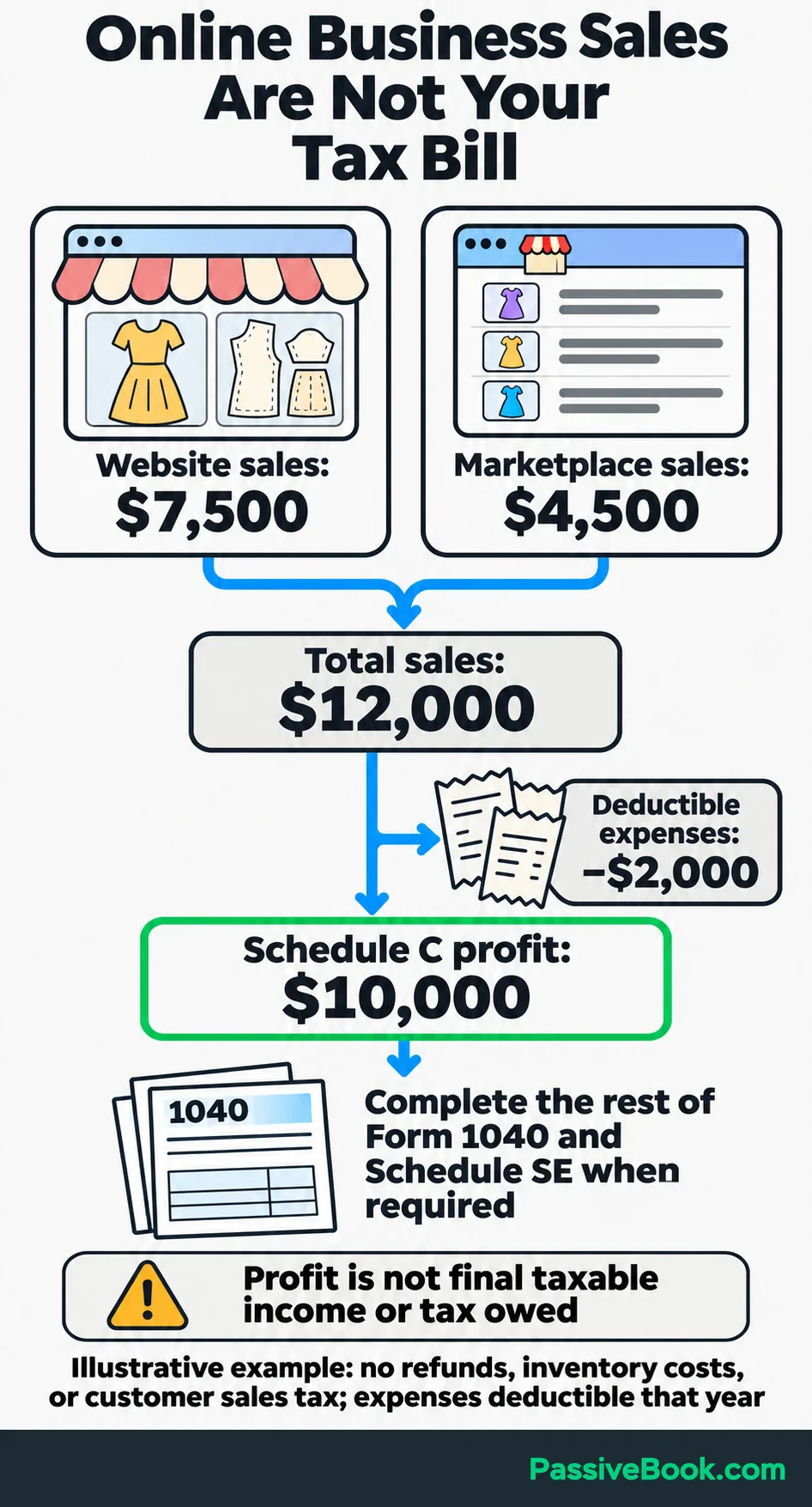
The profit calculation is $12,000 minus $2,000, giving $10,000.
That profit feeds into the rest of Form 1040. Complete Schedule SE when required, then finish the individual return with other income, deductions, credits, withholding, and estimated payments.
The $10,000 is business profit. It is not the final taxable income or the tax bill.
This is why I would not estimate the balance due by applying an income-tax rate to sales. Sales come before expenses, and your complete return determines the final result.
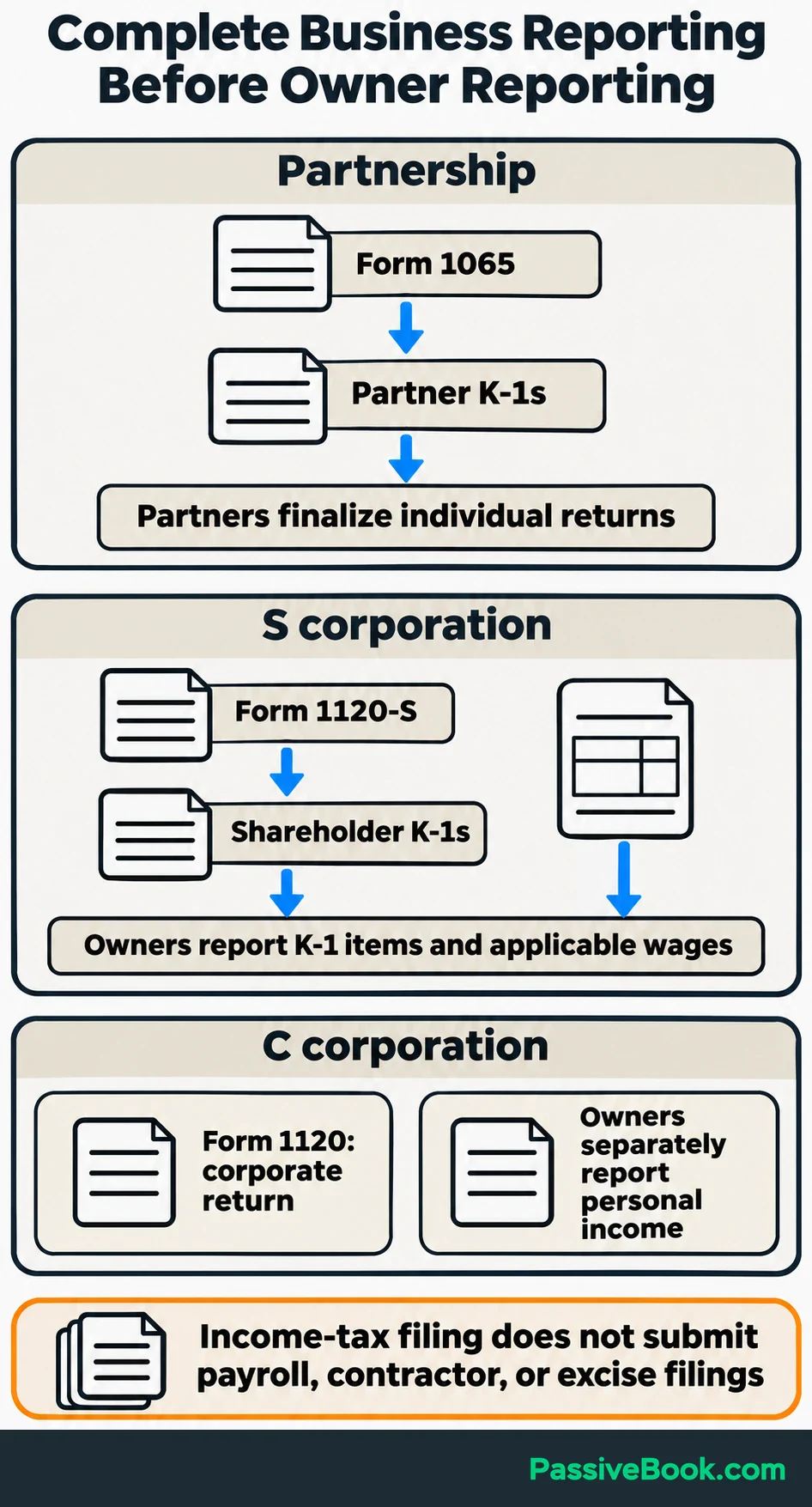
For other classifications, the order changes:
- Partnerships prepare Form 1065 and partner K-1s before partners finalize their individual returns.
- S corporations prepare Form 1120-S and shareholder K-1s. Applicable shareholder wages are reported separately.
- C corporations prepare Form 1120 separately from their owners’ individual returns.
Complete required payroll, contractor-information, and excise filings through services that support those forms. Submitting an income-tax return does not automatically submit them.
6. Complete Required State and Local Filings
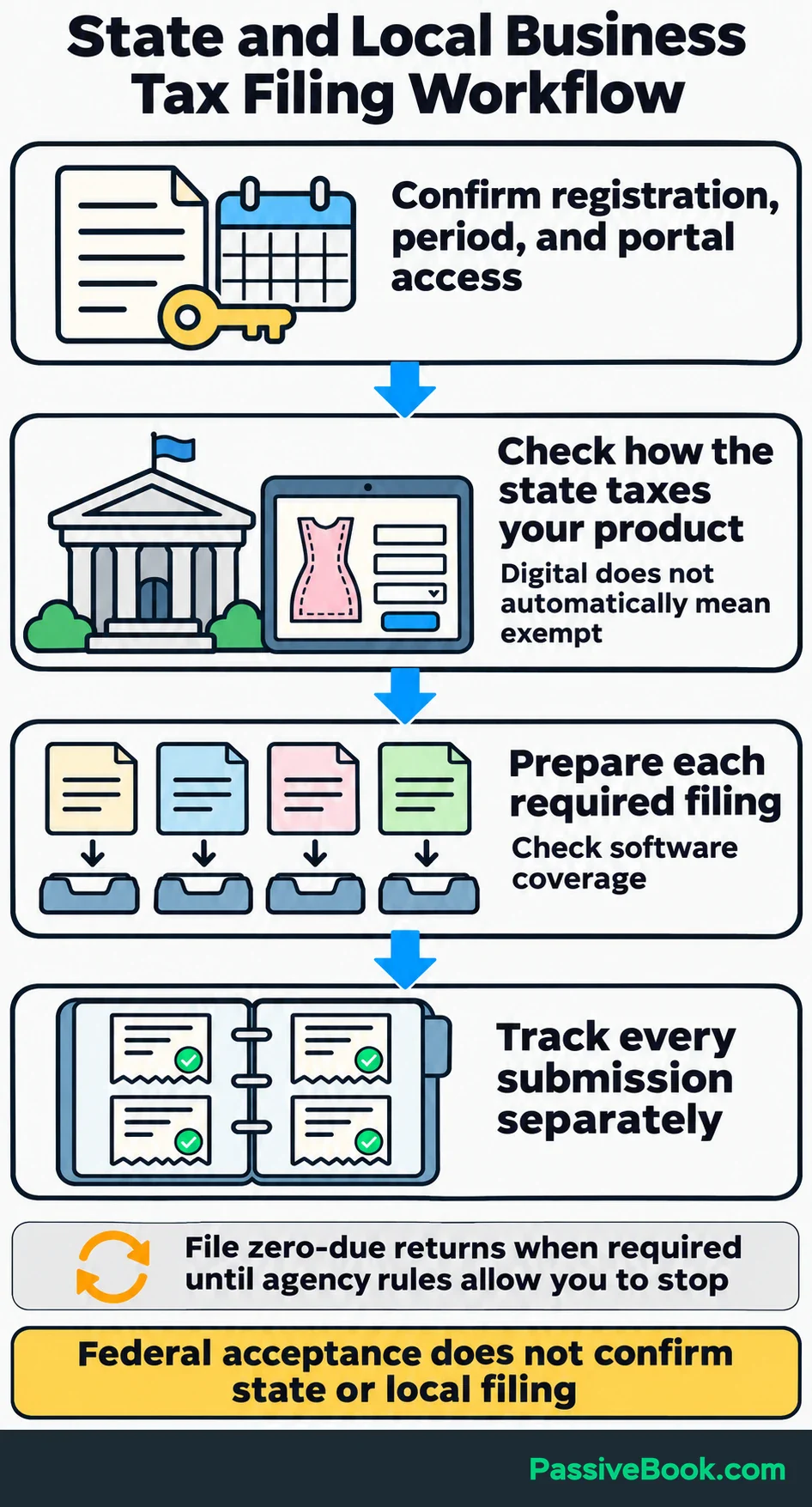
Return to the obligations list you made earlier. For each agency, confirm your registration, reporting period, and access to its filing system.
Do this early if you are a first-time filer. Discovering that you need registration details at the deadline is an avoidable nuisance.
Prepare required income, franchise, or gross-receipts returns through approved software or the agency’s portal. Check which state returns your federal filing package includes.
Sales-tax reporting needs separate attention. Reconcile direct sales, marketplace sales, taxable sales, exemptions, and tax collected by the marketplace.
A marketplace collecting sales tax can still leave you with registration or reporting duties. The Streamlined Sales Tax marketplace guidance links to state requirements and explains why marketplace collection does not settle every obligation.
For the sewing-pattern shop, check the relevant state’s treatment of downloadable patterns first. Then distinguish website sales from marketplace sales.
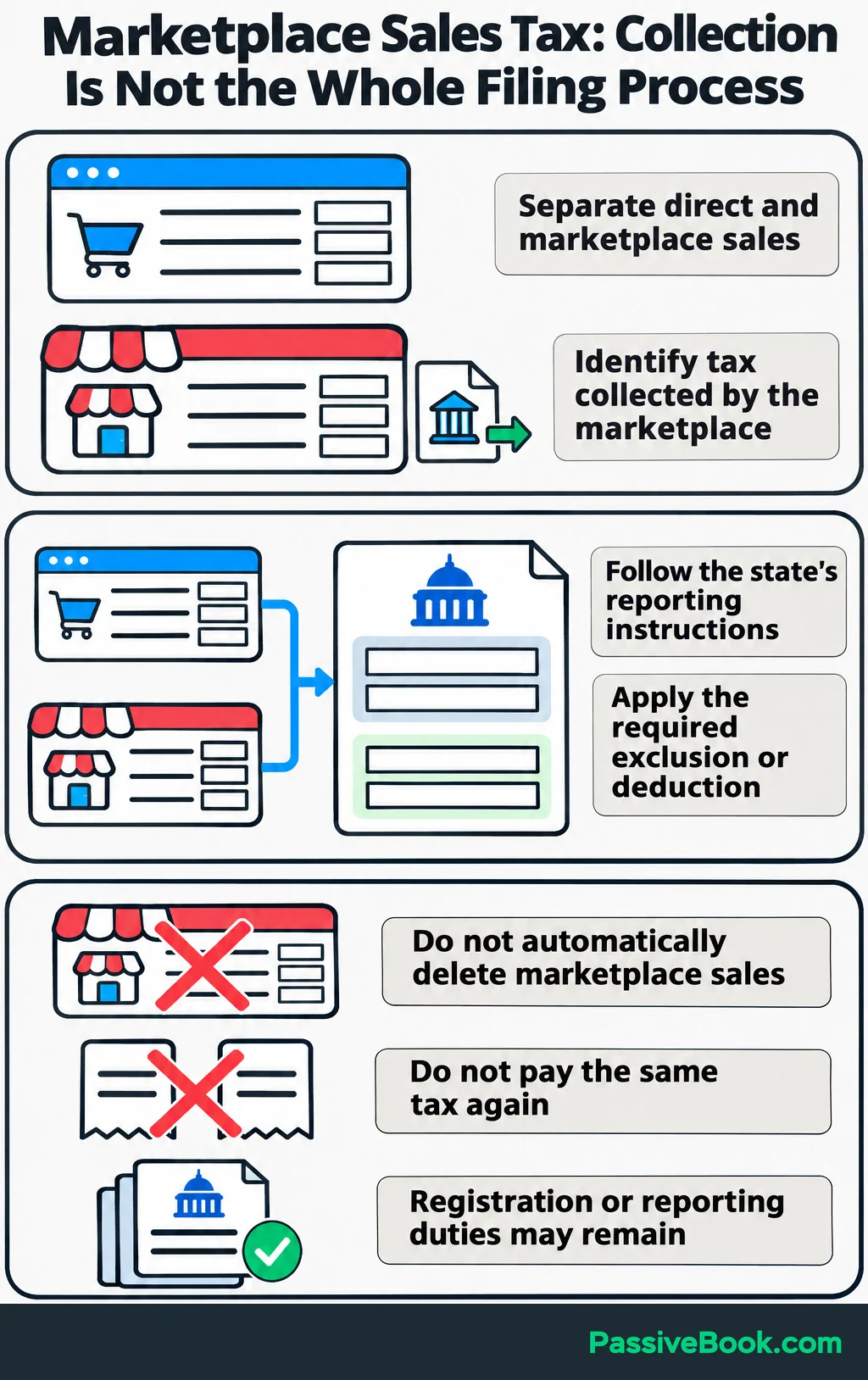
If the marketplace already collected and remitted tax, follow the state’s instructions for reporting those sales and the corresponding exclusion or deduction. Do not automatically delete them or pay the same tax again.
If your registration requires returns for periods with no tax due, keep filing until the agency’s rules allow you to stop or close the account.
Track every required submission separately. Federal acceptance does not confirm that a state income-tax return or local sales-tax return was filed.
7. Review, E-File, and Confirm Acceptance
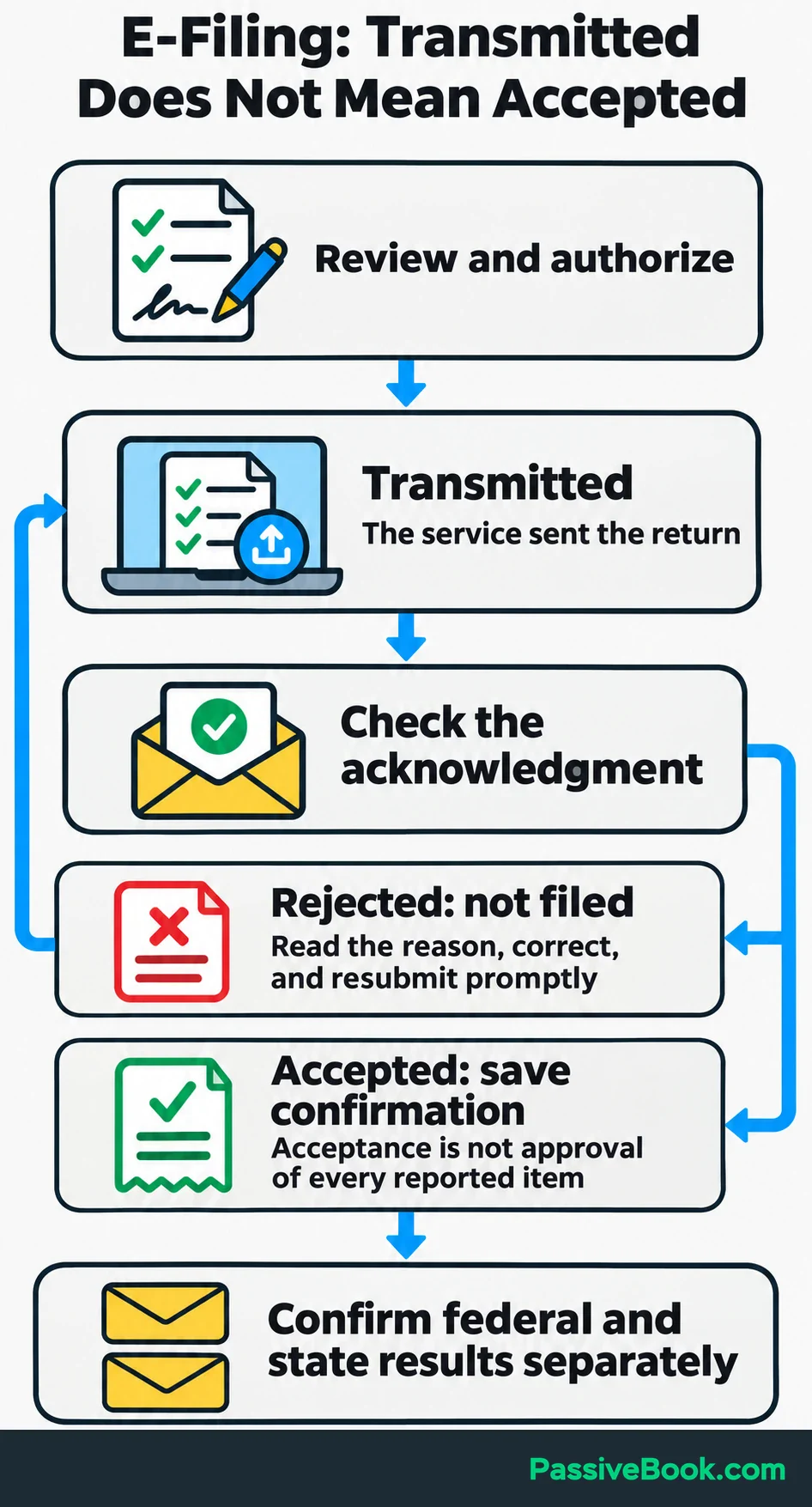
Before signing, open the completed return and compare it with your records. Do not rely only on the software’s final refund or balance screen.
Check:
- The tax year, classification, names, and taxpayer identification numbers.
- Income totals and any overlapping information returns.
- Expense categories, business-use allocations, and asset deductions.
- Withholding and estimated payments already made.
- Required schedules and K-1s.
- Bank details and any scheduled withdrawal.
Resolve software warnings against the records. If you use a preparer, review the finished return before authorizing transmission.
Complete the electronic-signature requirements and submit each return. Then check the acknowledgments for federal and state filings separately.
“Transmitted” means the service sent the return. Look for confirmation that the tax authority accepted it.
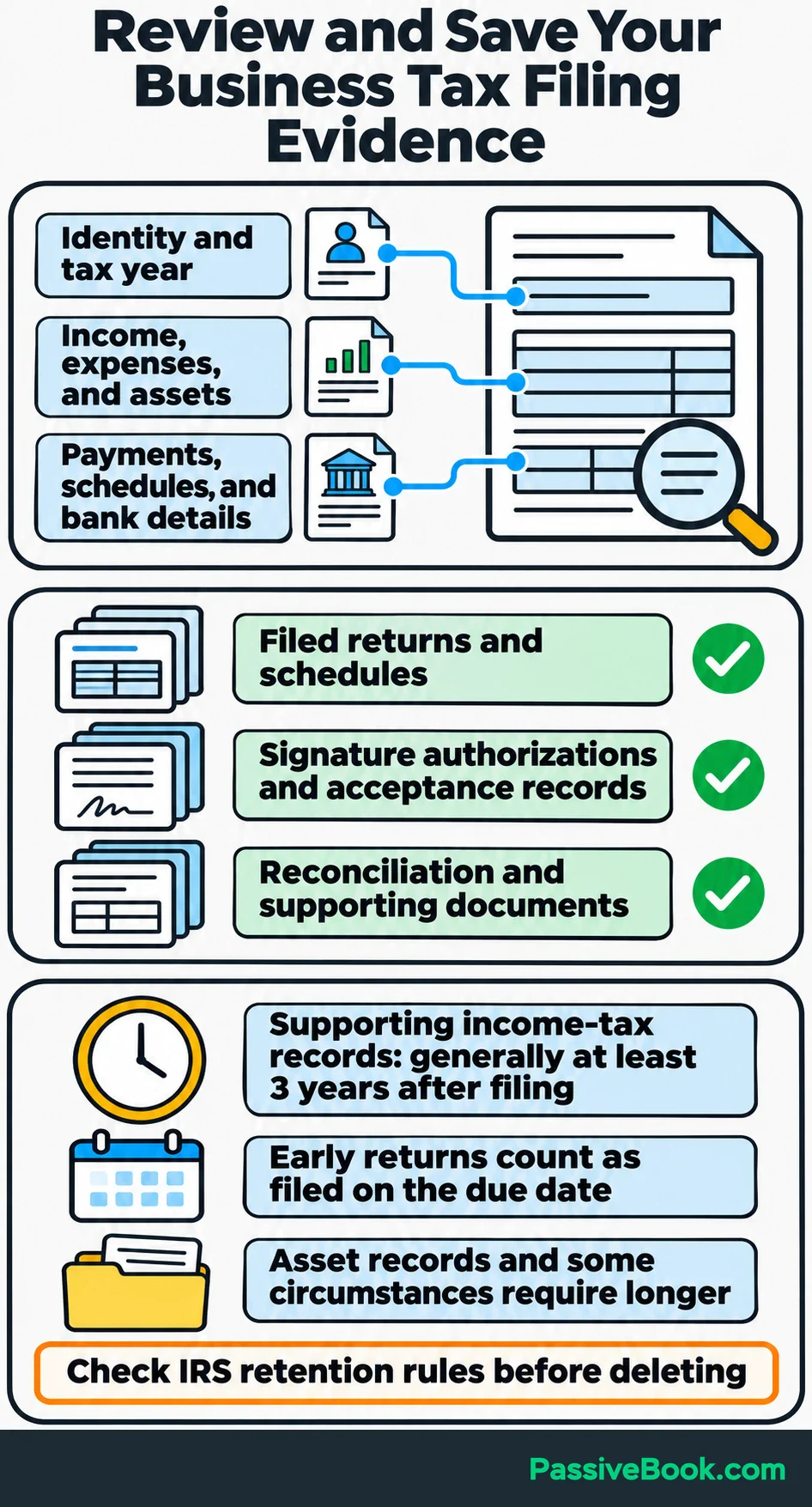
A rejected return has not been filed. Read the rejection reason, correct the problem, and resubmit promptly under the rules for that return and deadline. Acceptance also does not mean every reported item has been approved after examination.
Download the filed returns, schedules, signature authorizations, and acceptance records. Keep them with your reconciliation and supporting documents.
Generally, keep income-tax supporting records for at least three years after filing; an early return counts as filed on its due date. Asset records and certain circumstances require longer. Follow the IRS record-retention rules before deleting anything. I would keep permanent copies of the filed returns themselves.
8. Pay Online and Schedule Estimated Taxes
Pay the Balance to the Correct Tax Authority
Check the balance after withholding, estimated payments, and credits have been applied.
Before making a separate payment, confirm whether your filing service already scheduled a withdrawal. Paying twice creates a new administrative job, which is a poor reward for finishing your taxes.
You can authorize a supported bank withdrawal through filing software or use an official payment service. IRS Direct Pay offers individual and business payment routes from a bank account without a processing charge or sign-in.
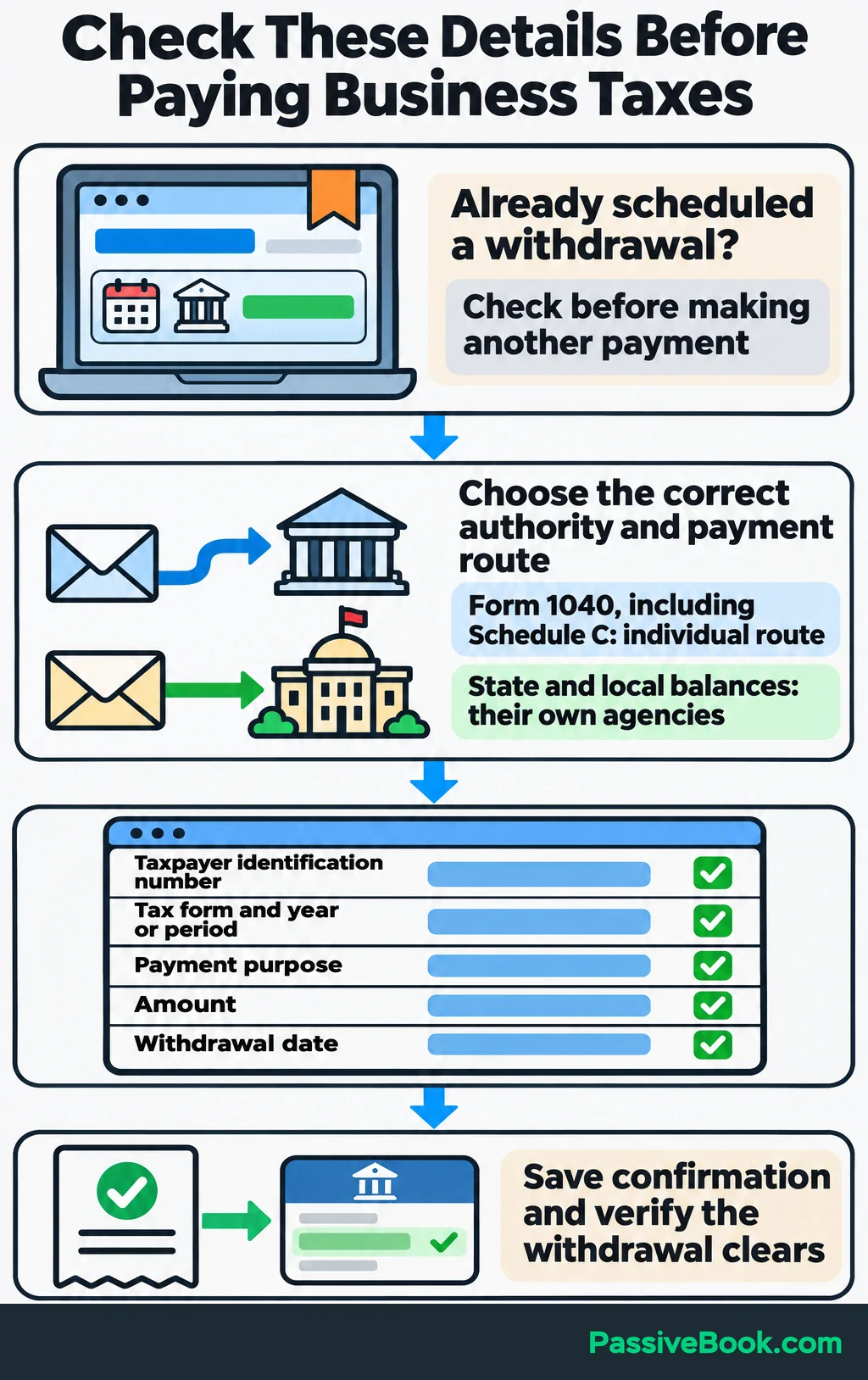
Use a route that supports your form and payment type. For Form 1040 obligations, including tax arising from Schedule C income, use the individual route.
Before confirming, match:
- The taxpayer identification number.
- The tax form and tax year or reporting period.
- The payment purpose, such as a return balance or estimated tax.
- The amount and withdrawal date.
Pay state and local balances to their respective agencies. Save each confirmation, then verify that the withdrawal clears.
If you cannot pay in full, file on time, pay what you can, and request an arrangement. Sole proprietors use the individual payment-plan route. For partnership or corporate tax debts, follow the IRS instructions for contacting the agency to request a business payment plan.
Interest and applicable penalties can continue on unpaid balances, so review the IRS payment-plan options rather than assuming an arrangement freezes the debt.
Calculate and Schedule Estimated Payments
Check estimated-tax requirements during the year you earn the income. Waiting for the annual filing deadline can leave earlier payments overdue.
Individuals generally need estimated payments when they expect to owe at least $1,000 after withholding and refundable credits, and those amounts will not meet the required payment level. Corporations generally use a $500 expected-tax threshold.
The IRS estimated-tax guidance explains these requirements. It also notes that late or insufficient installments can cause a penalty even when the annual return shows a refund.
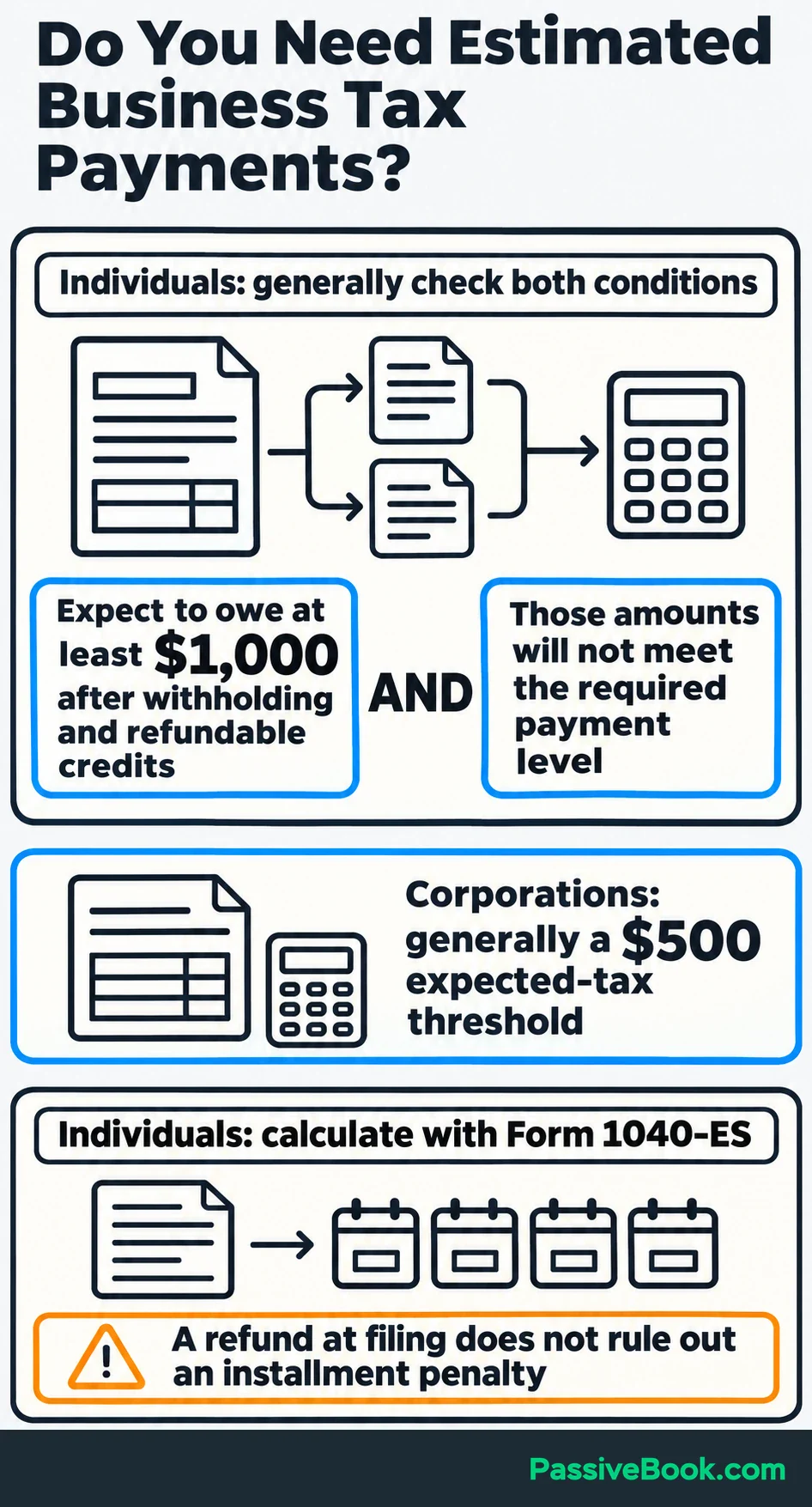
For an individual return, use Form 1040-ES to calculate installments. Include expected business profit, self-employment tax, household income, deductions, credits, and withholding.
Use its required-payment worksheet to calculate the installments needed to avoid an underpayment penalty. You may still owe a balance when you file. Saving a percentage of sales may help you build a reserve, but it does not establish how much tax is due.
The ordinary calendar-year individual installment dates for 2026 are:
| Installment | Payment Deadline |
|---|---|
| First | April 15, 2026 |
| Second | June 15, 2026 |
| Third | September 15, 2026 |
| Fourth | January 15, 2027 |
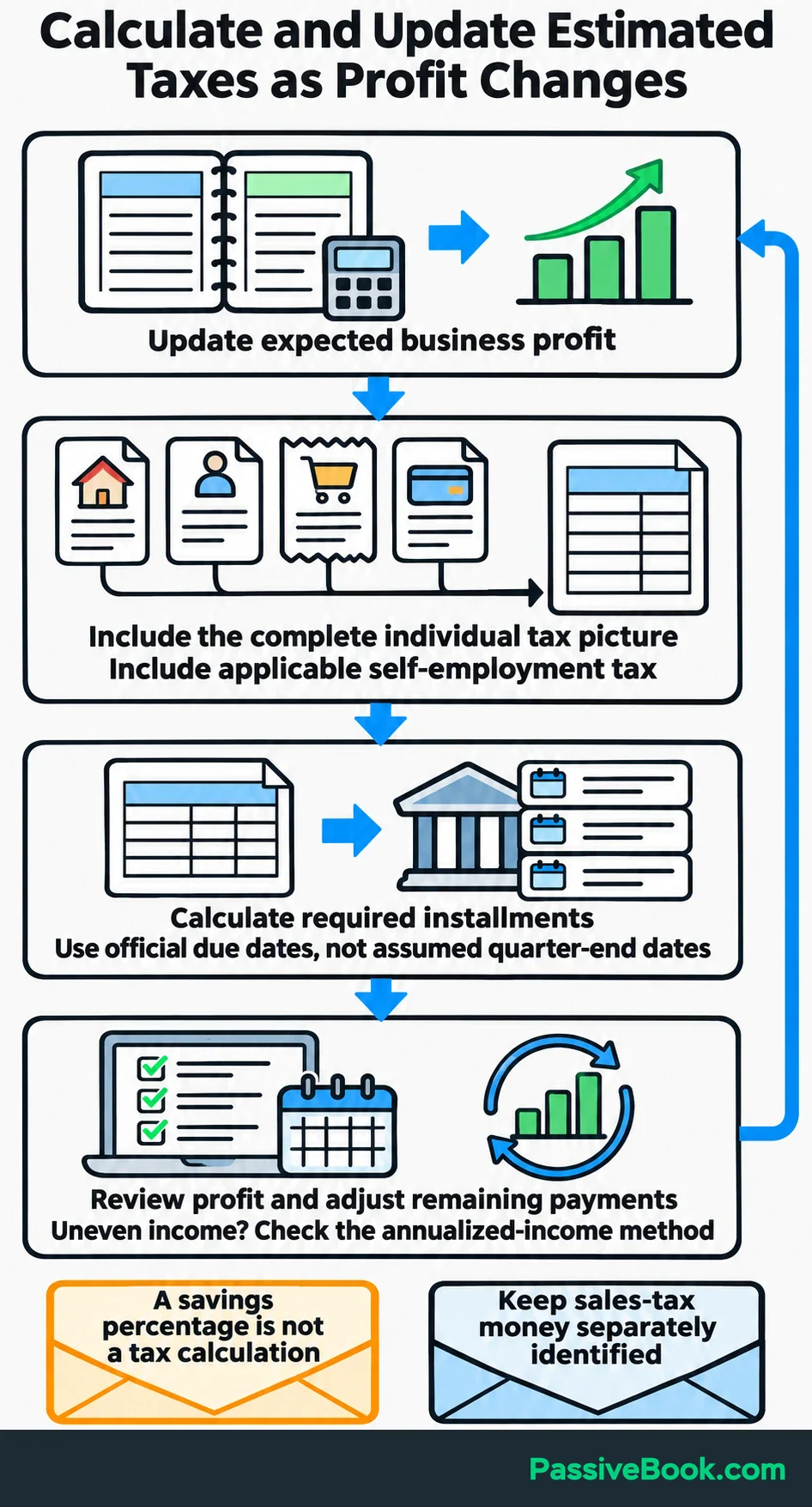
These cover 2026 income before the annual return is due. The 2026 Form 1040-ES instructions contain the worksheet, dates, and rules for changing income.
For the sewing-pattern shop, update the estimate as actual profit changes. A strong sales period may require a larger reserve, while higher costs may reduce expected profit.
If income arrives unevenly, check the annualized-income method rather than assuming equal installments fit. If you also receive wages, additional paycheck withholding may help cover the business-related tax.
I would set a recurring bookkeeping review and use the updated figures to adjust the reserve and remaining payments. Keep sales-tax money separately identified too. It has its own obligations and should not quietly become next month’s spending money.
What Next?
Find your last filed return and write down your federal tax classification, required returns, and next filing and payment deadlines. That gives you a concrete starting point before you choose software.
Use the social buttons to share this filing process and make the path from sales records to confirmed tax payments easier to follow.
Which part of your tax process still feels unclear: identifying returns, reconciling income, or planning payments? Tell me in the comments, and bring any other questions too.
Share this post with your friends & followers:

