I created my first online business plan on a Sunday afternoon in 2014, full of optimism and wildly inaccurate revenue projections. Six months later, my actual business looked nothing like that plan. My target audience was different, my revenue streams had shifted, and I was bleeding money on marketing channels that didn’t work. That disconnect between plan and reality taught me something valuable: a business plan isn’t a static document you write once and file away. It’s a living tool that needs regular updates to reflect what you’re learning in the market.
If you’re running a new business or small online business and haven’t looked at your business plan in months, you’re not alone. Most solopreneurs get so caught up in daily operations that strategic planning falls off the radar. But here’s the reality: the business environment changes fast, especially online. What worked last year might not work today, and your plan needs to evolve with your actual experience.
The landscape changed significantly in 2026 and into 2026. AI writing tools, automated analytics, and no-code platforms shifted what’s possible with limited time and budget. If your business plan was written before these tools existed, you’re missing opportunities that didn’t exist when you started. Regular reviews ensure you’re leveraging capabilities that can 10x your productivity.
- •What Updating Your Online Business Plan Actually Involves
- •Why Regular Reviews Matter for Solopreneurs
- •When to Review Your Online Business Plan
- Critical Metrics to Track During Reviews
- •Revisiting Your Target Audience
- •Competitive Landscape Assessment
- Streamlined Review Process for Time-strapped Solopreneurs
- •Step-by-step: Making Changes to Your Business Plan Document
- •Goal Setting After Your Review
- Tools for Efficient Business Plan Updates
- •Deciding If It's Time to Pivot
- •Frequently Asked Questions
- •What Next?
What Updating Your Online Business Plan Actually Involves
Here’s what surprised me most about business planning: many solopreneurs confuse reviewing and updating your business plan. They’re related but different activities.
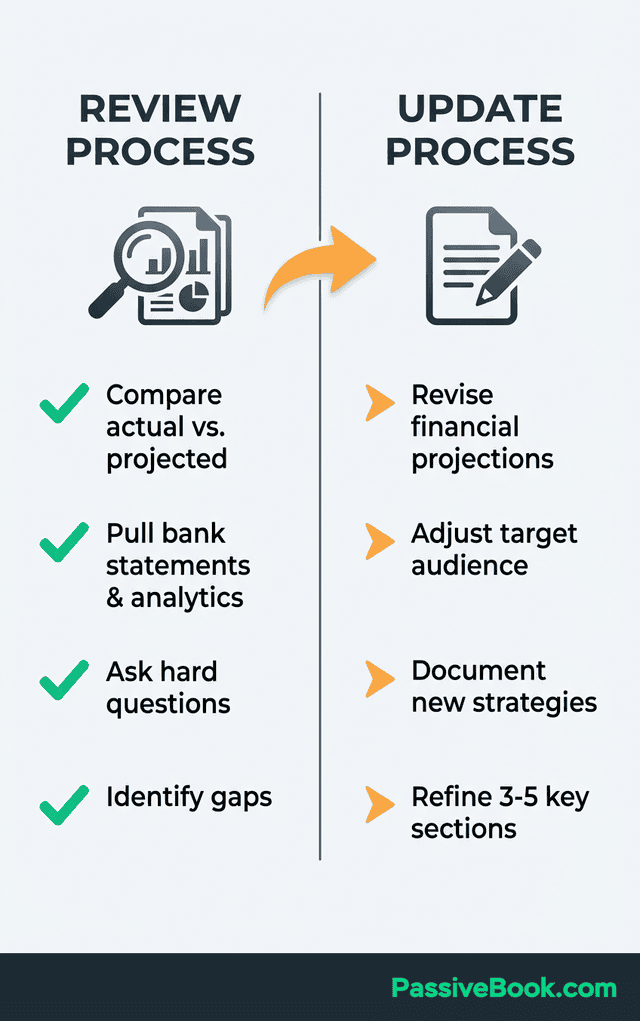
A business plan review means comparing your actual performance against your original goals and assumptions. You’re pulling up your bank statements, checking your analytics, and asking hard questions about what happened versus what you predicted. This review process reveals where your assumptions were accurate and where reality diverged from your projections.
Updating is what comes after the review. You’re making edits to your written business plan document.
That means revising financial projections based on real data, adjusting your target audience descriptions to match your real buyers, and documenting new strategies based on what you learned.
Here’s what might surprise you: updating doesn’t mean starting from scratch. Research shows that over 20% of small businesses fail within their first year, often because they don’t adapt their plans to reality. The solution isn’t writing a completely new business plan every quarter. It’s strategic refinement of what’s working and fixing what’s broken.
Most solopreneurs update three to five key sections of their plan per quarter rather than rewriting everything. You focus your edits where reality diverged most from your projections. If your customer acquisition costs came in triple what you expected, that section needs attention. If your target audience shifted from small business owners to corporate employees, update that description. Leave the sections that are still accurate alone.
The goal is to keep your plan aligned with reality without turning updates into a time-consuming project that pulls you away from work that makes money.
I used to think I needed to rewrite my entire plan every quarter. After wasting three weekends on that approach, I figured out the surgical update method: fix only what’s broken, leave the rest alone.
Why Regular Reviews Matter for Solopreneurs
Regular business plan reviews improve decision-making and resource allocation for growing ventures. That’s not just theory. The practical benefit shows up in your bank account.
Quarterly reviews help solopreneurs catch cash flow problems before they become crises. When you spot a downward revenue trend in month one, you have time to adjust. When you ignore your numbers for six months, you wake up to an emergency. Business coach Anna B. Yang uses 90-day check-ins to review financial goals, lifestyle goals, and feelings about her business. This ensures her solo venture stays aligned with both income and personal well-being priorities.
Keep your timeline expectations realistic during reviews. Most solopreneurs need 3-6 months to reach their first dollar of revenue when starting fresh. If you’re reviewing a business that’s past launch, compare your progress against this baseline to gauge whether you’re on track or need adjustments.
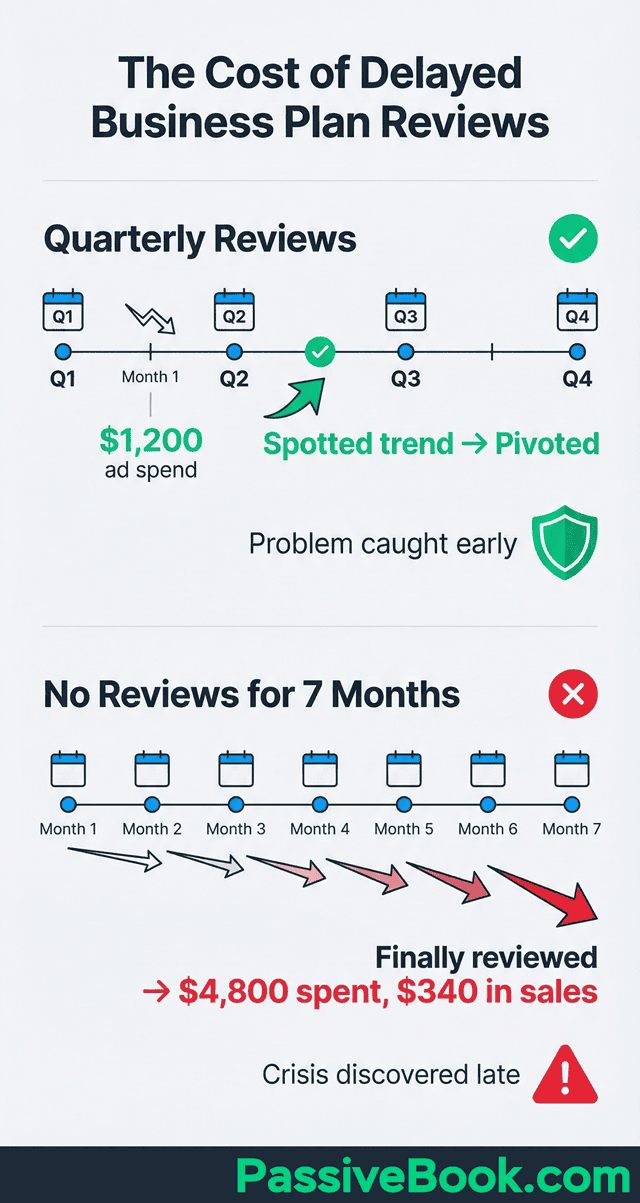
I learned this lesson the expensive way in my third year of business. I was so focused on creating content that I didn’t review my results for seven months.
When I finally sat down with my spreadsheet, I discovered I’d spent $4,800 on Facebook ads that generated exactly $340 in sales.
If I’d reviewed quarterly, I would have caught that problem after spending $1,200 and pivoted to a better channel. That delayed review cost me over $3,600 in wasted ad spend.
The online business landscape has shifted dramatically in recent years. In 2024 and 2026, AI tools and automation platforms changed what’s possible for bootstrapped solopreneurs. Regular reviews ensure you’re leveraging new capabilities that didn’t exist when you wrote your original plan. AI content generation, automated email sequences, and smart analytics can now handle tasks that used to consume hours of your time. But you won’t incorporate these tools unless you’re regularly asking what could work better.
Reviews also help you distinguish between building sustainable income versus chasing vanity metrics. A growing Instagram following feels good, but if it’s not converting to sales, your time investment isn’t justified. Updated plans provide clarity on whether your side hustle deserves full-time commitment or needs a different approach.
When to Review Your Online Business Plan
Timing your reviews strategically makes the difference between staying aligned and drifting off course.
Quarterly reviews keep solopreneurs aligned with fast-moving online markets. Three months gives you enough data to spot real trends without waiting so long that problems compound. Solopreneur business coach Anna B. Yang credits her quarterly 90-day goal check-ins with keeping her solo business aligned. She sets new launch goals and investment priorities each quarter based on the previous quarter’s results.
Annual deep reviews are essential for evaluating long-term direction and major strategy shifts. Once a year, step back and ask the bigger questions. Is this business model still serving your life goals? Are you building toward something sustainable or just grinding through another year? Annual reviews examine whether your entire business model needs rethinking, not just tactical adjustments.
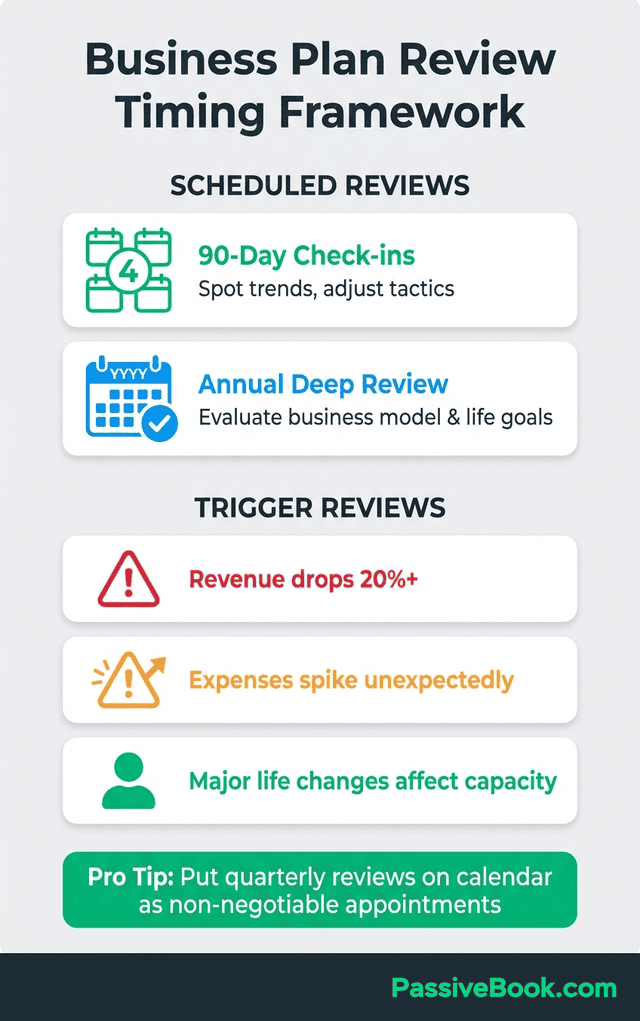
Some situations demand an immediate review regardless of your schedule. If your revenue drops 20% or more compared to the previous period, don’t wait for your quarterly check-in. Pull your numbers and figure out what changed. The same applies when expenses spike unexpectedly. A sudden increase in platform fees, tool costs, or advertising expenses needs investigation right away.
Major life changes also trigger review needs. If you have a baby, take on a new day job, or experience a health issue, your available time changes. Your business plan needs to reflect your actual capacity, not your capacity from six months ago.
The key is establishing a rhythm. Put quarterly reviews on your calendar as non-negotiable appointments with yourself. Then stay alert for the trigger events that demand an off-cycle review.
Critical Metrics to Track During Reviews
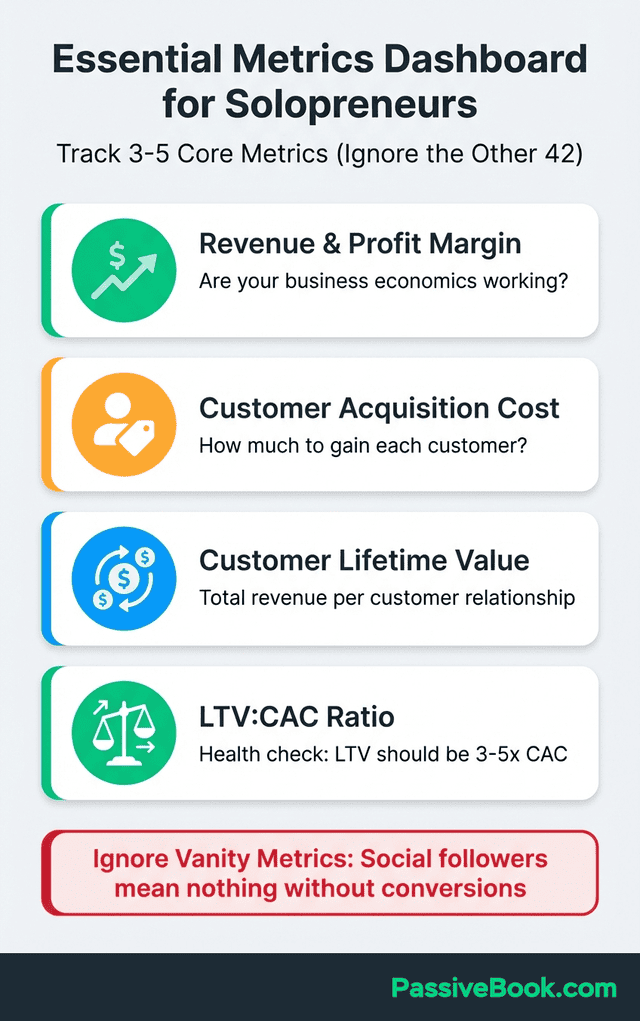
Your analytics dashboard shows 47 different metrics. You need to ignore 42 of them.
Most solopreneurs should track three to five core metrics that directly connect to their income goals. More than that and you’re drowning in data instead of making decisions. The specific metrics depend on your business model, but certain fundamentals apply across the board.
Every online business owner needs to track five essential metrics: customer acquisition cost (CAC), conversion rate, monthly recurring revenue (MRR) growth, customer lifetime value (LTV), and time to first sale.
These actual results tell you if your business economics work. You can have growing revenue with terrible margins and still go broke. You can have great margins but if customer acquisition costs more than customer lifetime value, you’re building a losing business model.
Beyond these core five, the metrics that matter vary by business type. Course creators should add email list growth rate and course completion rate to their tracking. That completion rate matters because low completion predicts poor word-of-mouth and weak testimonials. Ecommerce solopreneurs add average order value and repeat customer percentage. Content creators monitor ad revenue, affiliate commissions, and audience engagement rate.
Ignore vanity metrics like social followers unless they convert to revenue. I once spent four months growing my Twitter following from 800 to 3,200 people.
It felt like progress. Then I tracked clicks from Twitter to my products. The number was depressingly small, under 50 clicks per month.
Those hours would have generated far more income if I’d focused on email list building instead.
When you review metrics, compare performance against your projections, not against aspirational goals. Your original plan predicted $2,000 monthly revenue by month six. You hit $1,400. That’s the gap you need to understand and address.
Revenue and Profit Margins
Revenue tells you how much money comes in. Profit margin tells you how much you keep.
Ecommerce solopreneurs achieve 20-40% margins while digital product creators reach higher. The difference comes down to costs. Physical products have manufacturing, shipping, and inventory costs. Digital products have minimal marginal costs after creation. That’s why digital product profit margins often exceed 50% due to low overhead costs.
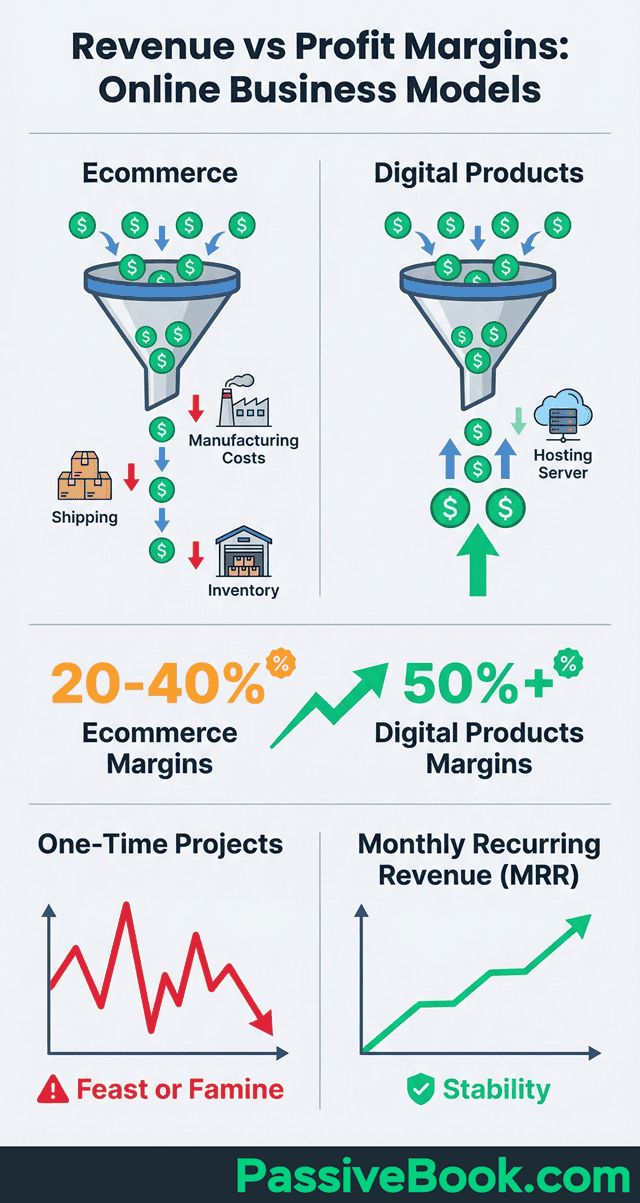
Track your monthly recurring revenue separately from one-time project income. Recurring revenue provides stability and predictability. One-time projects create feast-or-famine cash flow that makes planning difficult. If you’re building a sustainable business, you want recurring revenue growing as a percentage of total income over time. Compare your margins against industry benchmarks for your business model. If you’re running a print-on-demand shop with 15% margins while competitors achieve 25-30%, something in your pricing or cost structure needs adjustment.
The real insight comes from tracking margin trends over time. Are your margins improving as you optimize operations, or are they shrinking as competition intensifies and advertising costs rise? That trend tells you whether your business model is getting stronger or weaker.
Customer Acquisition Cost
Customer acquisition cost (CAC) reveals how much you spend to gain each new customer. Calculate it by dividing total marketing spend by the number of new customers acquired in that period.
Average CAC varies widely by industry, ranging from $7 to over $200 per customer. The range depends on product price, competition, and sales complexity. A $27 ebook has to acquire customers cheaply. A $2,000 online course can justify higher acquisition costs.
Rising costs signal you need to review your marketing channels or adjust your pricing strategy. If your CAC was $40 six months ago and it’s now $75, something changed.
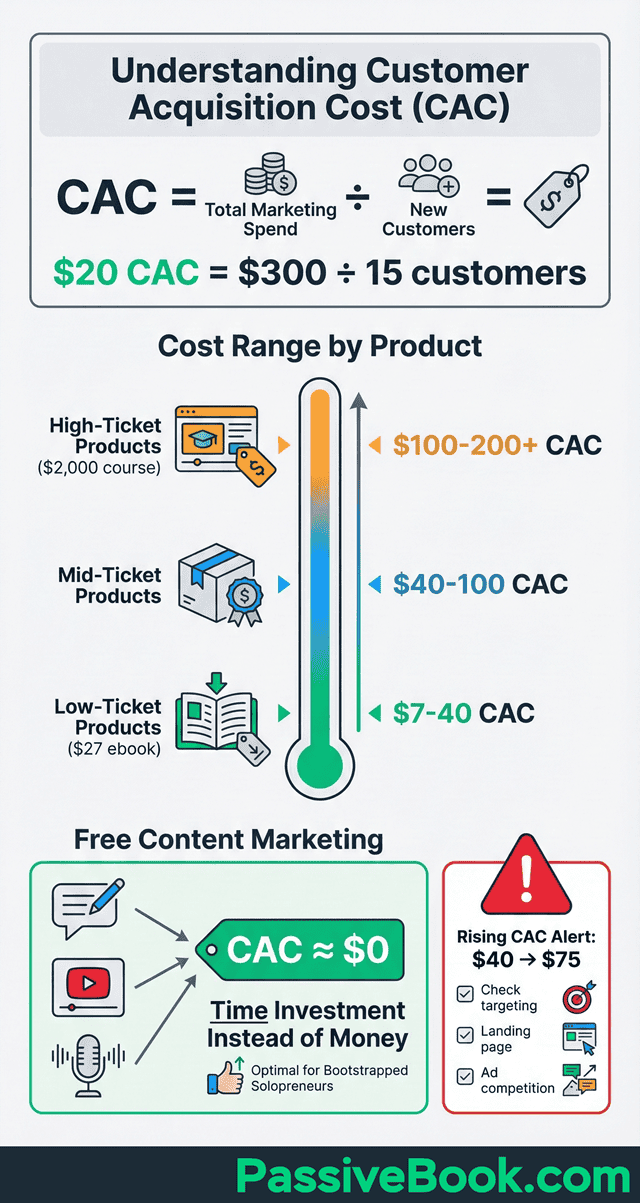
Maybe your ad platform got more competitive. Maybe your targeting got less precise. Maybe your landing page conversion rate dropped. You need to diagnose and fix the problem before it kills your profitability.
Many solopreneurs discover that free content marketing beats paid ads for their audience. When you build an audience through valuable blog posts, YouTube videos, or podcast episodes, your CAC approaches zero. You’re investing time instead of money, but for bootstrapped solopreneurs with more time than capital, that’s usually the right trade-off.
Customer Lifetime Value
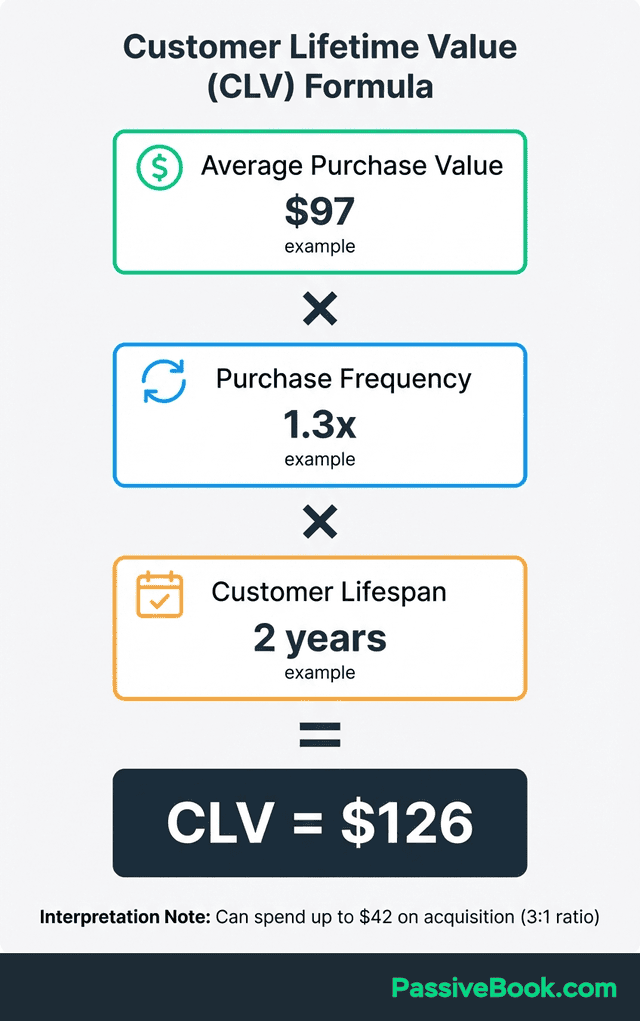
Customer lifetime value (LTV) tells you the total revenue you’ll generate from a customer over your entire relationship. Calculate it by multiplying average purchase value by purchase frequency and relationship lifespan.
Low lifetime value means you’re either pricing too low or your retention strategy is failing. If customers buy once and never return, you have a retention problem. If they return but spend small amounts, you have a pricing or product depth problem.
Ecommerce solopreneurs need to know if customers buy once or return repeatedly. A one-time buyer with a $45 purchase has an LTV of $45. A repeat customer who buys four times per year for three years at $45 per order has an LTV of $540. Those are fundamentally different businesses requiring different strategies.
Subscription models typically generate higher lifetime value than one-time purchases. A membership site charging $29 per month keeps generating revenue for as long as the member stays subscribed. The average member who stays for 18 months generates $522 in lifetime value. That predictability makes subscription businesses valuable.
The LTV to CAC ratio matters more than either metric alone. If your LTV is $300 and your CAC is $280, you’re barely profitable. If your LTV is $300 and your CAC is $60, you have a healthy business with room for growth.
Financial Projections Accuracy
Your original business plan included financial projections. Now you have actual results. The comparison reveals how well you understood your market and your own capabilities.
Most entrepreneurs overestimate initial revenues significantly when creating first business plans. If you projected $5,000 monthly revenue by month six and you’re at $1,800, you’re in good company. The question is whether you understand why the gap exists.
Compare expenses to projected costs line by line quarterly. You underestimated some categories and overestimated others.
Tool subscriptions cost more than expected as you discover you need additional platforms. Advertising costs fluctuate based on competition and seasonality. Understanding these variances helps you project more accurately going forward.
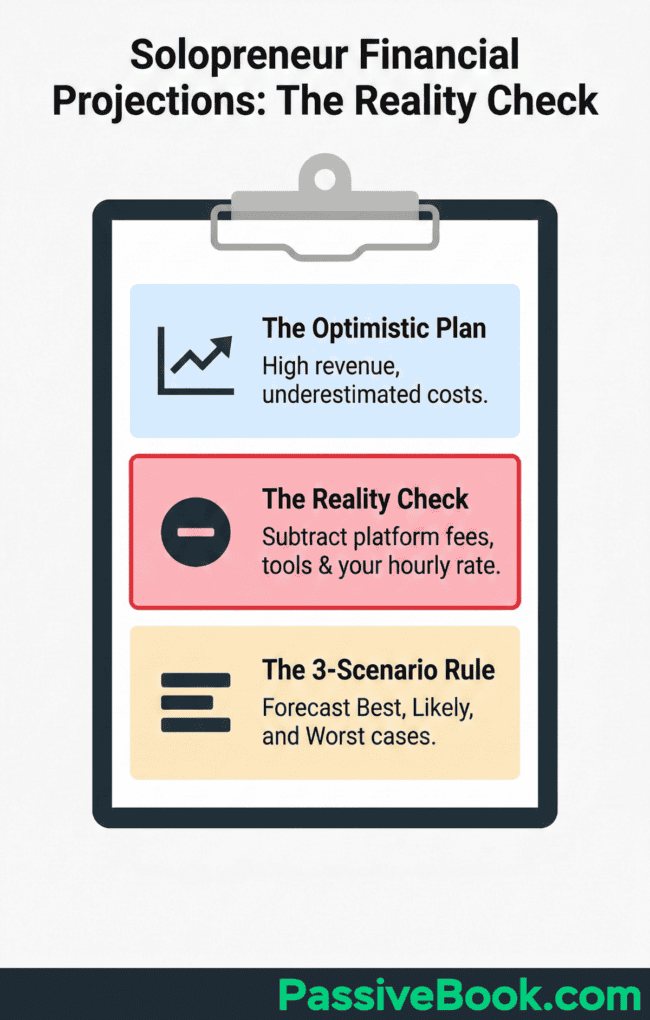
Update your cash flow forecasts based on real payment timelines, not optimistic assumptions. If you projected customers would pay within 15 days but they take 45 days, your cash flow forecast was wrong. That matters because cash flow gaps kill businesses even when they’re profitable on paper.
Factor in platform fees, tools, and your personal time investment at realistic hourly rates. Many solopreneurs forget to account for Shopify fees, payment processing fees, email platform costs, and design tools. They also undervalue their own time. If you’re working 15 hours per week on a business generating $2,000 monthly profit, that’s around $31 per hour. Is that acceptable for your situation? The answer depends on your goals and alternatives.
Revisiting Your Target Audience
Here’s what surprised me most about target audiences: the people buying from you are rarely who you planned to serve. Your customers differ from your original plan assumptions. You thought you were serving small business owners, but freelancers are buying. You expected busy parents, but you’re attracting college students instead.
This disconnect happens because early business plans rely on assumptions rather than data. This often happens when you enter a new market without enough customer research upfront. Your original target was small business owners, but freelancers are buying. The plan expected busy parents, but college students showed up instead.
Early assumptions relied on educated guesses about who needed your solution. Sales data, customer emails, and support conversations now reveal who values your offer.
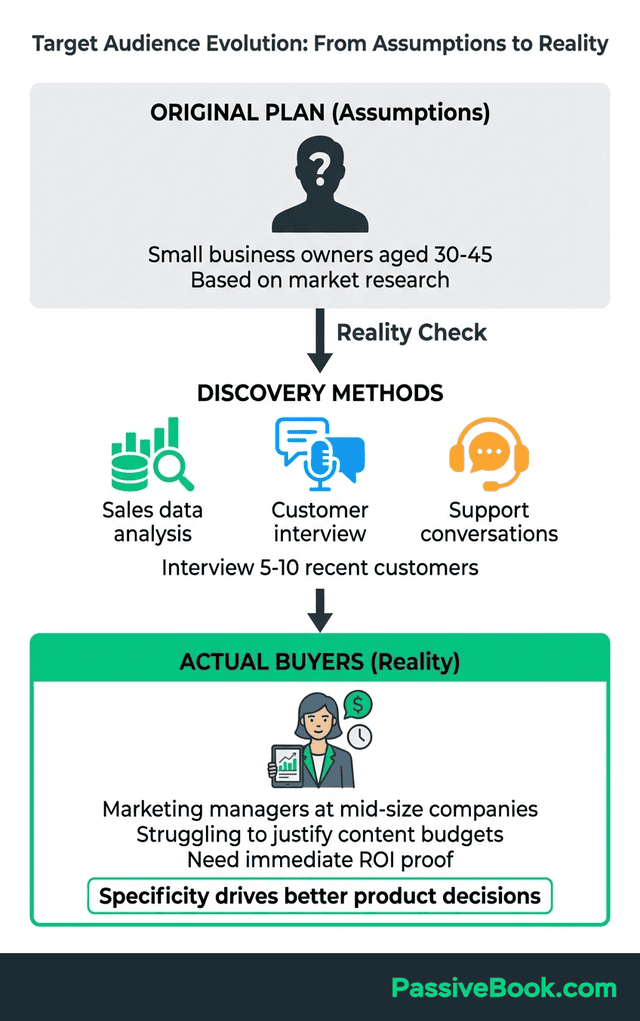
Interview five to ten recent customers to validate if you’re solving their real problem. Ask what they were struggling with before they found you. Ask what alternatives they considered. Ask what outcome they wanted. These conversations reveal patterns that your analytics miss.
Many solopreneurs discover through customer conversations that their buyers have different pain points than expected. You might have built a productivity course thinking people wanted to get more done, when they bought because they wanted to reduce overwhelm. That distinction matters for your marketing message and product roadmap.
Document these discovered needs in your updated business plan’s customer section. This guides future product decisions and keeps your messaging aligned with real customer motivations. When you understand what your customers care about, you stop wasting time on features and content that miss the mark.
The target audience section of your business plan should include details from these conversations. Instead of “busy professionals aged 30-45,” write about the products services they need and their pain points: “marketing managers at mid-size companies struggling to justify content budgets to executives who want immediate ROI.” That specificity makes all your other decisions clearer.
Competitive Landscape Assessment
After clarifying who your real customers are versus who you originally planned to serve, competitive analysis reveals how to position your offers differently from the alternatives your customers are considering.
Start by listing direct and substitute competitors offering similar solutions in your niche. Direct competitors sell the same type of product or service to the same audience. If you teach email marketing to coaches, other courses teaching email marketing to coaches are direct competitors. Substitute competitors solve the same problem differently. A done-for-you email service competes with your course because both solve the “I need better email marketing” problem.
Analyze competitor websites and marketing strategies to identify gaps. Look at their pricing, messaging, audience focus, and content approach. What are they emphasizing? What are they ignoring? Those gaps represent opportunity.
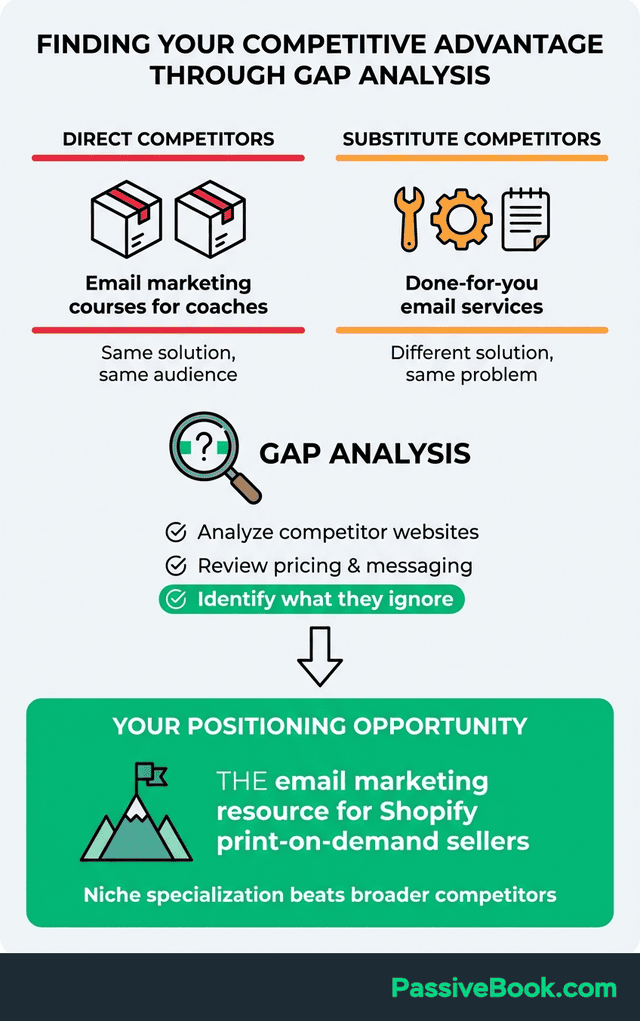
I learned this when I stopped competing with 50,000-subscriber YouTube channels and focused on becoming the best resource for Shopify print-on-demand sellers specifically.
Niche specialization beats broader competitors in overlooked segments of the current market. A general productivity app struggles to compete with Notion or Asana. A productivity system for real estate agents has a clear positioning advantage for that audience. The specialization makes your marketing more effective and your product more relevant.
Successful solopreneurs win by serving neglected micro-niches within broader markets. You can’t out-compete Shopify in general ecommerce tools, but you might build a thriving business with a Shopify app that solves a problem for jewelry stores or print-on-demand sellers.
When you update your business plan, document how your positioning has evolved relative to competitors. If you started as a general freelancing course but discovered your best customers are designers, update your competitive analysis to focus on design alternatives. This keeps your strategy aligned with where you compete.
Streamlined Review Process for Time-strapped Solopreneurs
Now that you know what to review, here’s how to do it without losing a week of income-generating work. This planning process doesn’t require complex frameworks or consultant fees. Every tool recommended here is free. You don’t need paid software to do this right.
One-page business plans help entrepreneurs stay focused on essential elements. Complex planning frameworks drain time without adding proportional value for most solopreneurs.
Schedule 90-minute review sessions rather than full-day planning marathons. Block the time on your calendar like any important client meeting.
Ninety minutes gives you enough focus time to dig into real issues without losing a full day of work that makes money.
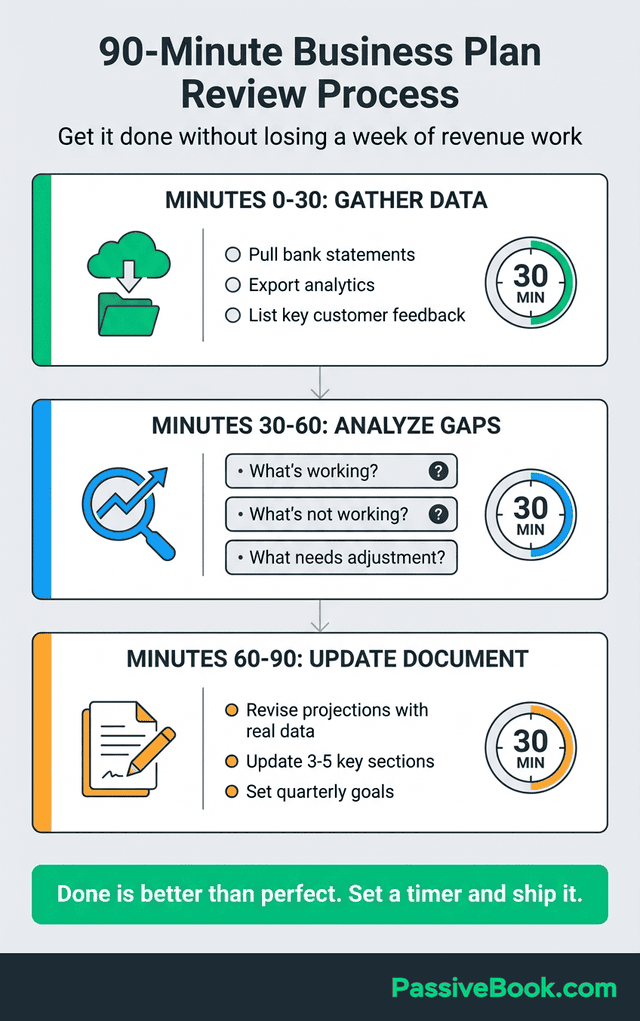
Structure your review around three questions: what’s working, what’s not, what needs adjustment. What’s working gets documented and potentially expanded. What’s not working gets analyzed to understand why. What needs adjustment gets action items with deadlines.
You don’t need to stop all revenue activities while refining your strategy. Continue serving customers, creating content, and fulfilling orders while you work through your review in the background over several weeks. The review informs your daily decisions without replacing them.
Lean Canvas provides a simple visual framework for business model planning. It fits on one page and covers the essential elements: problem, solution, unique value, customer segments, channels, revenue streams, cost structure, and key metrics. You can review and update a Lean Canvas in a single focused session.
Traditional business plans make more sense when seeking bank loans or investor funding. Banks want detailed financial projections, market analysis, and management team bios. Investors want growth projections and exit strategies. If you’re not raising outside capital, this complexity adds work without adding value.
Start with Lean Canvas and expand to a full plan only when raising capital. As a bootstrapped solopreneur, your one-page plan covers everything you’ll need to make good decisions. You can always create a more detailed document later if your funding situation changes.
Common Review Mistakes to Avoid
Don’t pivot your entire strategy based on one slow month. Sales fluctuate for seasonal reasons, platform algorithm changes, and random variation. Look for consistent three-month trends before making major changes. Reacting to every dip creates chaos instead of progress.
Change one major thing at a time so you can measure what moves the needle in your next quarterly review. If you simultaneously change your pricing, target audience, and marketing channel, you won’t know which change drove the results. Sequential testing reveals causation instead of correlation.
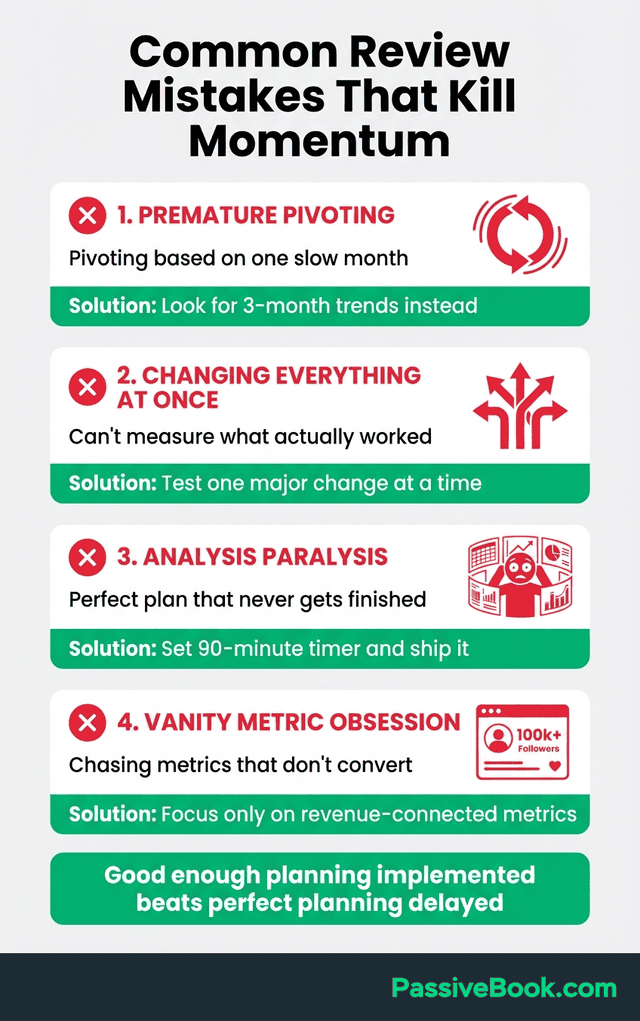
Perfectionism kills momentum for solopreneurs. Set a 90-minute timer for your review session. An updated plan you finish beats a perfect plan that languishes for weeks while you try to get every detail right. Good enough planning implemented beats perfect planning delayed.
Step-by-step: Making Changes to Your Business Plan Document
Start with your one-page Lean Canvas or executive summary. Update your value proposition based on what you learned about customers versus who you originally planned to serve. If your original value prop said “helping busy professionals save time” but you discovered customers care about “reducing decision fatigue,” that refined language belongs in your updated plan.
Revise your financial projections and executive summary section by replacing original estimates with actual results from the past quarter. Then adjust future quarterly projections based on real performance trends rather than aspirational goals. If you projected 20% monthly growth but you’re consistently hitting 8% growth, update future projections to reflect that realistic pace.
Your projections should show best case, likely case, and worst case scenarios. Best case assumes continued growth at your current rate. Likely case assumes some slowdown or plateaus. Worst case accounts for market changes or increased competition. This range helps you plan for different possible futures.
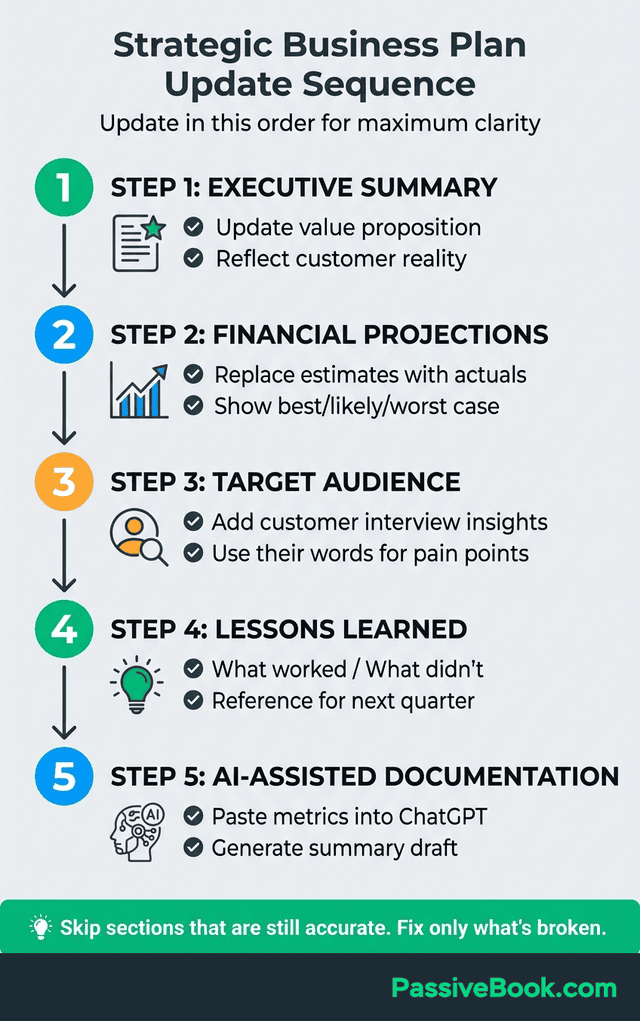
Update your target audience description section with details from customer interviews, sales conversations, and engagement data. Include the pain points customers mentioned in their own words. Write down the objections they raised before buying and how you addressed them. This detail makes your future marketing more effective.
Add a brief “Lessons Learned” section documenting what worked and what didn’t this quarter. This becomes your reference point for next quarter’s review and prevents repeating mistakes. When you’re tempted to try Facebook ads again in six months, your lessons learned section reminds you they didn’t work the first time and why.
If you’re using AI tools like ChatGPT, you can streamline the documentation process. Copy your key metrics and insights into a prompt like this: “I’m updating my business plan for my online course business. Here are my key metrics and findings from this quarter: [paste your data]. Help me write a concise summary paragraph that highlights the most important changes and trends.” The AI output gives you a solid starting point that you can refine based on your judgment.
Goal Setting After Your Review
Use the SMART framework (Specific, Measurable, Achievable, Relevant, Time-bound) with exact deadlines. Vague goals like “grow my business” don’t drive action. Goals like “increase monthly revenue from $2,800 to $3,500 by March 31” give you a clear target to work toward.
Break annual revenue targets into monthly milestones based on your actual capacity and the resources you’ll need to hit them. If you’re juggling a day job and can commit 12 hours per week to your business, don’t set goals that require 40 hours per week. Your goals need to fit your real constraints or you’ll consistently fall short and get discouraged.
Content creator and business coach Anna B. Yang uses quarterly goal-setting after her reviews. She includes one new launch goal and one investment goal per 90-day period. This keeps her focus narrow enough to achieve results while juggling her solo business.
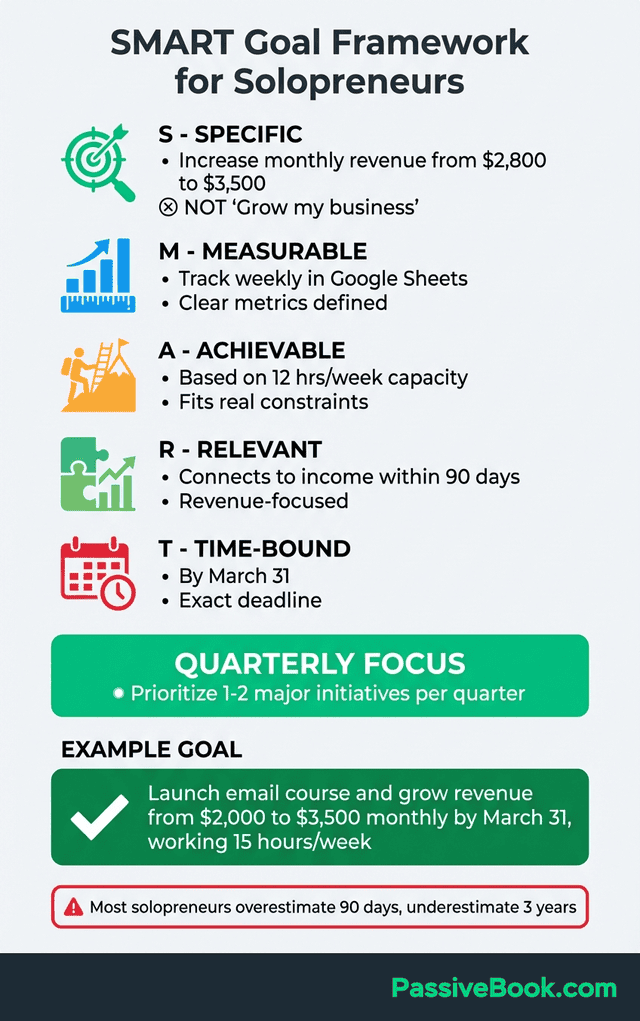
Prioritize one to two major initiatives per quarter instead of overwhelming yourself with a long list. Most solopreneurs overestimate what they can accomplish in 90 days while underestimating what they can build over three years. Focus beats scattered effort.
Each goal should connect directly to income generation within 90 days. Long-term brand building matters, but when you’re bootstrapping, you need regular cash flow. If a goal doesn’t plausibly lead to revenue this quarter, question whether it deserves your limited time right now.
When setting your goals, ask ChatGPT to stress-test them: “I have 15 hours per week and I’m currently making $2,000 monthly from my blog. I want to launch an email course and grow revenue to $4,000 monthly this quarter. Is this realistic and what should I prioritize?” The AI can help you spot unrealistic expectations before you commit to them.
Tools for Efficient Business Plan Updates
Prioritize 100% free tools first. Solopreneurs don’t need paid subscriptions to update plans effectively when you’re bootstrapping your online business. Many premium tools provide marginal improvements over free alternatives that don’t justify the monthly cost.
The right tools depend on your business model. For video content creators, pair free YouTube Analytics with Google Sheets for custom tracking. For ecommerce, use Shopify‘s built-in analytics if you’re on that platform, or Woocommerce reports if you’re using WordPress. For course creators, use the platform analytics included in Teachable or Thinkific base plans.
Free AI tools like ChatGPT assist with business planning and data analysis tasks. You can paste your raw metrics into ChatGPT and ask it to identify trends, calculate percentages, or highlight anomalies. This saves time on manual analysis so you focus on decision-making instead of calculation.
To leverage AI for your review process, try this workflow: First, export your key metrics from your analytics platforms into a simple text format. Second, create a prompt: “Analyze these business metrics from my last quarter. Identify the top 3 trends I should pay attention to and suggest one action for each trend: [paste your data].” Third, review the AI’s analysis and add your own context about what you know from customer conversations and market changes.
Free Metrics Tracking Options
Google Sheets remains the most flexible option for custom solopreneur tracking needs. You can create exactly the dashboard you want without paying for features you don’t need. Templates exist for most common tracking scenarios, from basic revenue tracking to complex customer cohort analysis.
Your dashboard should display key metrics on a single screen without scrolling. If you need to scroll through multiple tabs to see your core numbers, you’ve overcomplicated it. The goal is to open one page and immediately see if you’re on track or falling behind.
Google Analytics offers free comprehensive tracking for web traffic and conversions. The free version handles everything most solopreneurs need: page views, traffic sources, conversion funnels, and goal completions. You don’t need Google Analytics 360 unless you’re processing millions of monthly sessions.
Set up weekly automated reports so you review numbers consistently. Most platforms let you schedule automated emails with key metrics. These regular reports prevent the “I haven’t checked my numbers in two months” problem that leads to drift.
Free dashboard templates help solopreneurs visualize metrics in one centralized view. Rather than building from scratch, adapt an existing template to your needs. This saves hours of setup time and ensures you’re tracking metrics that matter based on best practices.
Deciding If It’s Time to Pivot
Should you push through or change direction? The numbers tell you which. Sometimes the numbers tell you to change direction.
Track consistent income trends over several months before making major transitions. One or two bad months don’t indicate a failed business model. Six months of flat or declining revenue despite your best efforts suggests a real problem. Look for patterns, not isolated data points.
Test your pivot by adding new products or content formats before abandoning your current revenue stream. If you’re considering shifting from blogging to YouTube, create five videos and see if they gain traction before you stop writing entirely. Validate your pivot hypothesis with a small experiment that doesn’t require burning your bridges.
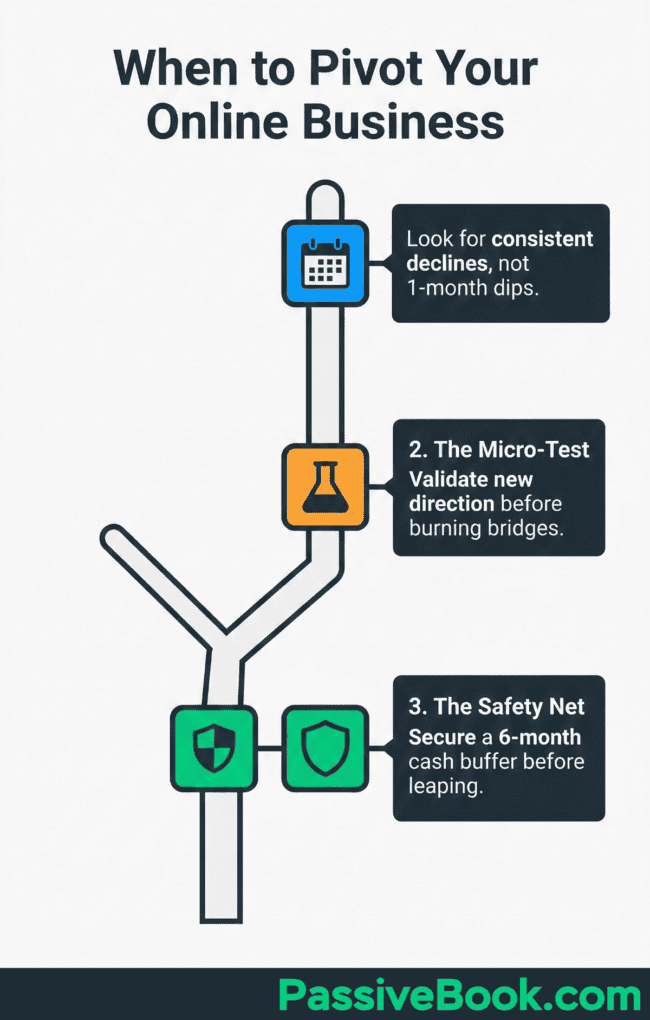
Maintain a six-month emergency fund before leaving a steady paycheck for full-time solopreneurship. The business might be profitable, but if one slow quarter would put you in financial crisis, you’re not ready for the transition yet. Security gives you space to make good decisions instead of desperate ones.
Ensure no single client represents more than 25% of your income before transitioning to full-time self-employment. Concentration risk kills businesses. If you lose that one big client, you don’t want to lose your ability to pay rent simultaneously.
Diversification protects you from sudden income shocks.
The decision to pivot combines quantitative and qualitative factors. The numbers might show declining revenue, but how do you feel about the work? Some businesses are worth persisting through challenges because they align with your skills and interests. Others feel like pushing a boulder uphill and maybe that resistance is telling you something.
Frequently Asked Questions
How Often Should a Business Plan Be Reviewed and Updated?
Quarterly reviews work best for solopreneurs actively growing online businesses. Three months provides enough data to identify real trends without waiting so long that small problems become major crises. Your first-time review may need an extra hour to establish baseline metrics and create your tracking system.Annual deep reviews become necessary for evaluating strategy and major pivots. Once yearly, examine whether your entire business model still serves your life goals. This annual review asks bigger questions than quarterly tactical reviews.
How Do I Update a Business Plan?
Start by reviewing financial performance against your original projections. Pull your revenue, expenses, and key metrics from the past quarter. Update the sections showing the largest variance between your plan and reality first.Use a one-page template like Lean Canvas to keep the process focused on essentials. You don’t need a 40-page document. Update your value proposition, target customer description, revenue model, and key metrics. That covers what matters for most solopreneurs.
How to Review a Business Plan?
Compare current metrics against original assumptions in three areas. First, revenue: are you hitting 70% or more of projections, or significantly over or under? Second, costs: which expenses were underestimated, such as tools, advertising, or time investment? Third, audience: who is buying versus who you originally planned to serve?Identify which assumptions were accurate and which need adjustment. Focus on the two to three biggest gaps between your plan and reality, not every small variance. Document lessons learned and incorporate them into your updated strategy going forward.Schedule 90 minutes for your first quarterly review. Spend 30 minutes pulling numbers from your bank account and analytics tools. Spend 30 minutes analyzing gaps between projections and reality. Spend the final 30 minutes updating your plan document with revised projections and lessons learned.
What Are the 5 P’s of a Business Plan?
While traditional business planning frameworks exist, solopreneurs benefit more from focusing on metrics that matter to their situation. The u00225 P’su0022 and similar frameworks come from corporate planning contexts that don’t translate well to bootstrapped online businesses.Prioritize tracking revenue, profit margins, customer acquisition costs, customer retention, and time investment. These five metrics tell you if your business economics work and whether you’re building something sustainable. Adapt planning frameworks to your business model rather than following rigid templates designed for different contexts.
What Next?
You now have a practical framework for reviewing and updating your online business plan without losing weeks to planning paralysis. The difference between a static plan gathering dust and a living document guiding real decisions comes down to building a review rhythm that fits your actual schedule.
Building a business while juggling other commitments isn’t easy. Some quarters will go better than planned, others will fall short, and that’s normal. The solopreneurs who succeed aren’t the ones with perfect plans. They’re the ones who consistently learn from reality and adjust accordingly.
I’d love to hear about your experience with business planning. Have you updated your plan recently? What surprised you most when you compared your original projections to results? Use the share buttons below to pass this guide along to another solopreneur who might find it helpful, and drop your biggest planning insight in the comments. Your experience might be exactly what someone else needs to hear right now.
Share this post with your friends & followers: