I spent my first two years online selling “productivity tips for busy professionals.” Generic, forgettable, and nearly impossible to monetize.
The moment I shifted to “AI-powered content systems for time-strapped solopreneurs,” everything changed. My client inquiries increased significantly, and I finally attracted people who valued specificity over bargain pricing.
If you’re struggling to stand out in a crowded market, the problem isn’t your skills or your offering. It’s that you haven’t clearly articulated your unique value proposition.
This guide shows you exactly how to identify what makes you different, communicate it effectively, and use it to attract your ideal customer without competing on price.

- •What Is a Unique Value Proposition?
- Why Most Solopreneurs Struggle With Differentiation
- How to Uncover Your Strengths Without Overthinking
- Understanding Your Customer's Problems That Matter
- Finding Your Competitive Edge in a Saturated Market
- Crafting Your UVP: The Simple Formula That Works
- Real-World Examples: Solopreneurs Who Got It Right
- •How AI Is Changing UVP Development in [year]
- •Common UVP Mistakes That Kill Conversions
- •Communicating Your UVP Across All Touchpoints
- •Frequently Asked Questions
- •What Next?
What Is a Unique Value Proposition?
Your unique value proposition is a clear statement explaining why customers choose you over every alternative available. It focuses on specific outcomes customers achieve, not generic features or capabilities.
Your unique value proposition answers one question: “Why should I buy from you instead of anyone else?” A strong value proposition cuts through noise immediately.
Slack promises “where work happens,” focusing on productivity outcomes rather than listing chat features. I used to describe my business as “helping people create content.” Slack doesn’t say “we help you send messages.” They say “where work happens.” See the difference?
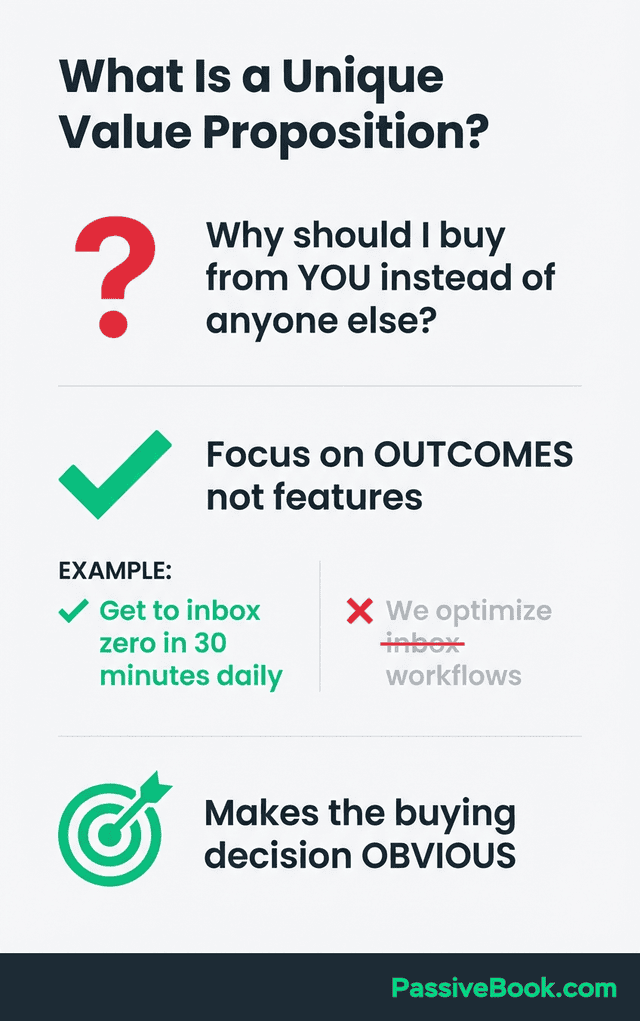
What a UVP is NOT: taglines, mission statements, or lists of product features. Those elements have their place, but they don’t communicate the transformation you deliver.
Your value proposition statement must make the buying decision obvious by highlighting unique benefits tied directly to customer needs. Tools like the value proposition canvas help visualize how your offering connects to customer needs, though most solopreneurs can start with the simpler framework I’ll show you later.
Why Most Solopreneurs Struggle With Differentiation
Around 20% of businesses fail in their first year, due to unclear positioning. When potential customers can’t quickly understand your specific value, they move on to competitors who communicate more clearly.
The core issue is confusion between describing what you do versus the transformation you deliver. Saying “I’m a freelance writer” tells prospects nothing about the pain points you solve or the ideal customer you serve.
This vagueness forces you into price-based competition. I did this for two years. Every networking event: “I help businesses with marketing.” Translation: I had no idea who I actually served.
How Unclear Positioning Hurts Your Revenue and Growth
Vague messaging attracts bargain hunters, not clients who pay premium rates. When prospects can’t distinguish you from alternatives, price becomes the only differentiator.
Tiago Forte repositioned from “productivity expert” to “Building a Second Brain” methodology creator. This shift transformed him from solopreneur to multi-million dollar education business with clear, defensible positioning.
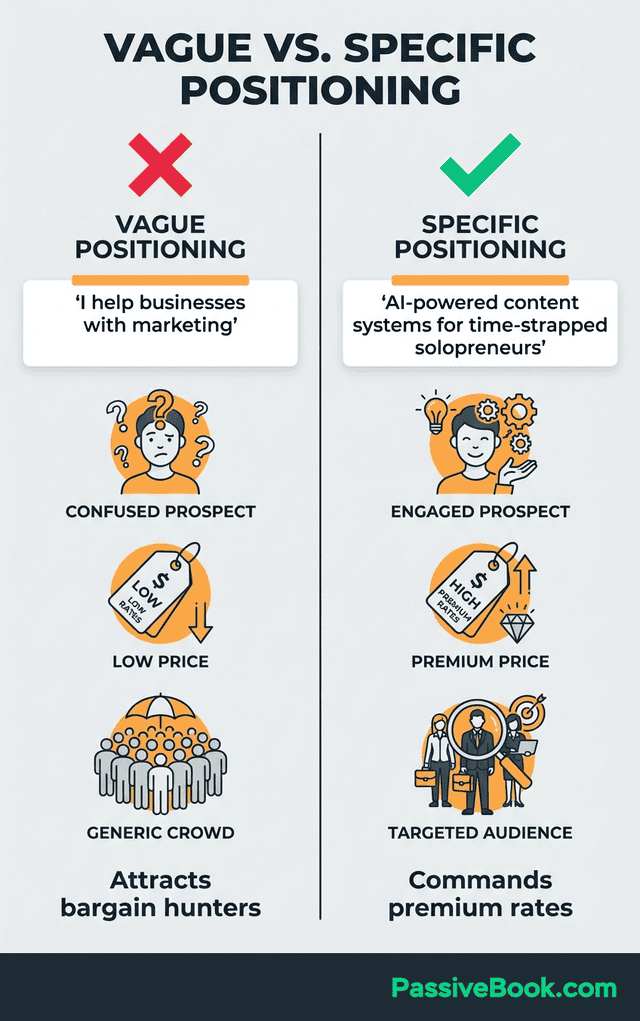
The specificity made his offering memorable and command premium pricing. Lower conversion rates are the inevitable result of unclear value propositions.
Prospects landing on your site spend three seconds deciding if you’re relevant. Generic messaging fails this test every time, while specific positioning immediately signals whether you’re the right fit.
Fear of Niching Down (and Why It’s Costing You)
Broad positioning like “I help everyone” repels customers seeking specialists. People pay premium rates for experts who understand their specific challenges, not generalists who claim to do everything.
Nicolas Cole niched from “freelance writer” to “ghostwriter for thought leaders and executives.” This repositioning allowed him to command premium ghostwriting rates 10-20x typical freelance pricing.
The specificity didn’t limit his market. It expanded his revenue.
Specific positioning makes you memorable. Generic messaging gets instantly forgotten. When someone asks “Do you know a good writer?” your network can’t remember the generalist. But “Do you know someone who ghostwrites for executives?” immediately triggers recall of the specialist.
How to Uncover Your Strengths Without Overthinking
I wasted months on this mistake: your unique strengths aren’t what you think they are. I spent all that time believing my strength was “technical SEO knowledge,” but my clients kept thanking me for something else entirely.
They thanked me for making complex strategies feel simple to implement. Once I shifted my positioning to focus on that simplification skill, my client inquiries doubled.
Justin Welsh identified his strength by analyzing which LinkedIn posts drove client inquiries. His corporate sales transition stories resonated most.
This led him to reposition from “sales consultant” to “solopreneur mentor for corporate executives.” This clarity helped him build a multi-million dollar one-person business.
The fastest path to clarity is asking past clients what they valued most about working with you. Their answers reveal your actual differentiators, not the ones you assume.
Look for patterns in their feedback. The words they repeat are your positioning gold.
Identify skills where you deliver results faster than peers. Speed matters because it signals natural aptitude. If you can accomplish in two hours what takes others eight, that efficiency becomes part of your unique value proposition.
The 15-Minute Skills Audit
List five projects where clients thanked you or asked for more. Don’t overthink this. Just write down the first five that come to mind. The goal is speed, not perfection.
Identify the common thread across those projects. Was it your speed, clarity, creativity, or specific expertise? One pattern will emerge more strongly than others. That pattern is your core strength.
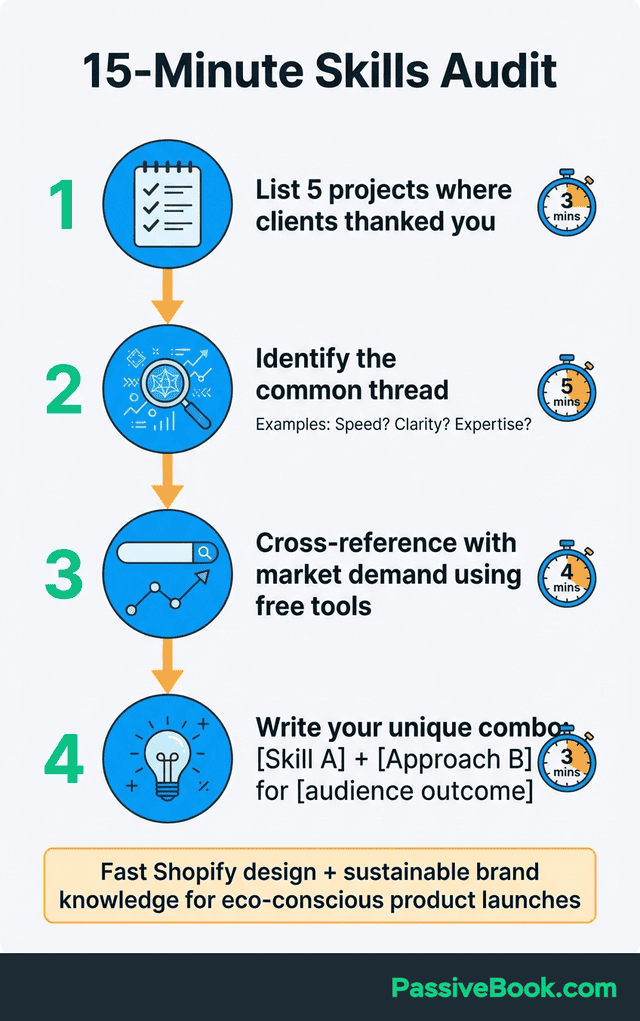
Cross-reference with market demand using free keyword tools. Your strength only becomes valuable when people actively search for solutions in that area. Tools like Ubersuggest show monthly search volumes for related terms.
Write your unique skill combination using this formula: “[Core Skill A] + [Background/Approach B] for [specific audience outcome].” For example: “Fast Shopify design + sustainable brand knowledge for eco-conscious product launches.” This combination creates differentiation that a single skill cannot.
What If You Don’t Feel “Special Enough”?
The biggest block to identifying your UVP isn’t lack of skills. It’s imposter syndrome. You assume your strengths are obvious or ordinary because they come easily to you.
They’re not ordinary to the people who struggle with them. What feels simple to you is someone else’s nightmare task.
I spent a year dismissing my ability to “simplify complex strategies” because it felt basic. My clients paid premium rates specifically for that skill. Your normal is someone else’s superpower.
List what clients thank you for, not what impresses you.
Understanding Your Customer’s Problems That Matter
Effective customer research goes beyond surface complaints. Surface complaints don’t reveal much. You need to discover what actually keeps them awake at 2 AM.
Most solopreneurs ask “What do you need?” when they should ask “What’s preventing you from succeeding right now?”
Ali Abdaal studied YouTube comments on productivity videos and discovered viewers struggled with advice that didn’t account for medical student schedules. This insight led him to niche his content around productivity for medical students.
He eventually built a 2.8 million subscriber channel. He focused on problems customers actively pay to solve right now, not theoretical future concerns.
Side note: Don’t get distracted by arguments in video comments. Set a timer if you do this.
Your ideal customer isn’t everyone who might buy. It’s the person whose buying decision centers on the exact transformation you deliver best.
The gap between what people say they want and what they’ll actually pay for is massive. Customer research reveals this gap when you dig deeper than initial responses. Ask follow-up questions until you reach the emotional driver behind the surface problem.
Where to Find Unfiltered Customer Insights for Free
Reddit communities and niche Facebook groups reveal raw customer frustrations that never make it to formal surveys. People vent honestly in these spaces, giving you direct access to their pain points without sugar-coating.
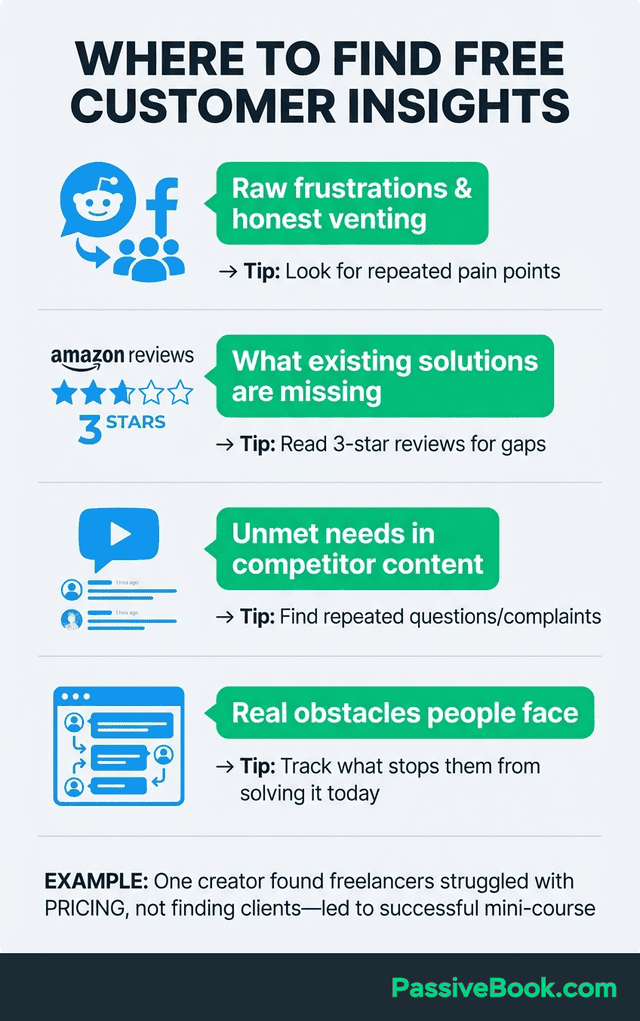
Amazon book reviews in your niche show what solutions customers seek. Read three-star reviews especially. They reveal what existing solutions are missing. These gaps represent positioning opportunities for your unique value proposition.
YouTube comments on competitor videos highlight gaps and unmet needs. Look for repeated complaints or questions the video didn’t address.
A course creator discovered through Reddit r/Freelancers that new freelancers struggled with pricing conversations, not finding clients. This led to a successful “Pricing Confidence” mini-course that addressed the real obstacle.
The Questions Most Solopreneurs Forget to Ask
“What would make this completely unnecessary for you?” reveals desired outcomes better than asking what features they want. This question forces prospects to articulate their end goal, not their assumed solution.
“What’s stopping you from solving this today?” uncovers real obstacles. The barrier isn’t money or time. It’s confidence, knowledge, or a previous bad experience.
Understanding the true blocker allows you to position your offering as the solution to that specific barrier.
“How do you currently handle this?” shows current alternatives and workarounds. Every prospect has some method of dealing with their problem, even if inadequate.
Your value proposition must demonstrate why your approach is superior to their current workaround, not just superior to doing nothing.
Finding Your Competitive Edge in a Saturated Market
Pull up your top 5 competitors’ websites right now. Read their homepages. Notice how similar they sound? That’s your opportunity.
Justin Welsh studied LinkedIn thought leaders and noticed none specifically addressed corporate employees wanting to transition to solopreneurship. He positioned in this gap, combining corporate sales expertise with solopreneur tactics.
According to his public reporting, he grew to multi-million dollar annual revenue. The market wasn’t empty. It was underserved in a specific way.
Study competitor messaging to identify underserved customer segments or overlooked problems. Your competitive edge lies in serving someone everyone else ignores, not in inventing something new.
Position around WHO you serve, not just what you sell. A unique selling proposition emerges from specificity.
While competitors target “small business owners,” you might target specific target customers like “service-based solopreneurs launching their first digital product.” The narrower focus actually expands your appeal within that specific segment.
Free Competitor Research Tools for Budget-Conscious Solos
Ubersuggest offers free keyword research and competitor domain analysis. You can see which keywords competitors rank for and identify gaps in their content strategy. The free tier provides enough data for positioning decisions.
Google Alerts monitors competitor mentions and industry trends automatically. Set up alerts for competitor brand names and key industry terms.
You’ll receive daily or weekly emails showing where they’re mentioned, revealing their marketing strategy and partnership opportunities.
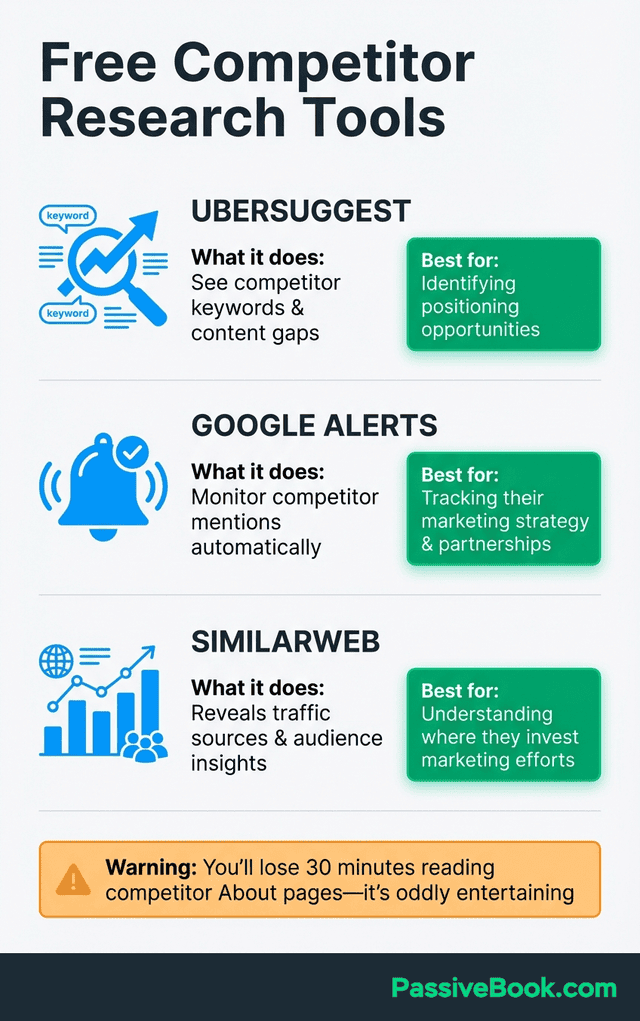
SimilarWeb reveals competitor traffic sources and audience insights. The free version shows top traffic channels and engagement metrics, helping you understand where competitors invest their marketing efforts and where gaps exist.
Fair warning: You’ll lose 30 minutes reading competitor About pages. It’s oddly entertaining watching everyone claim to be “industry leaders.”
The Gap Analysis Framework
List your top five competitors and their primary value propositions. Visit their websites and write down exactly how they describe what they do. Most will sound similar. That similarity is your opportunity.
Identify customer complaints about competitors from reviews and forums. Search “[competitor name] review” and “[competitor name] Reddit” to find honest feedback. Common complaints reveal positioning gaps you can fill.
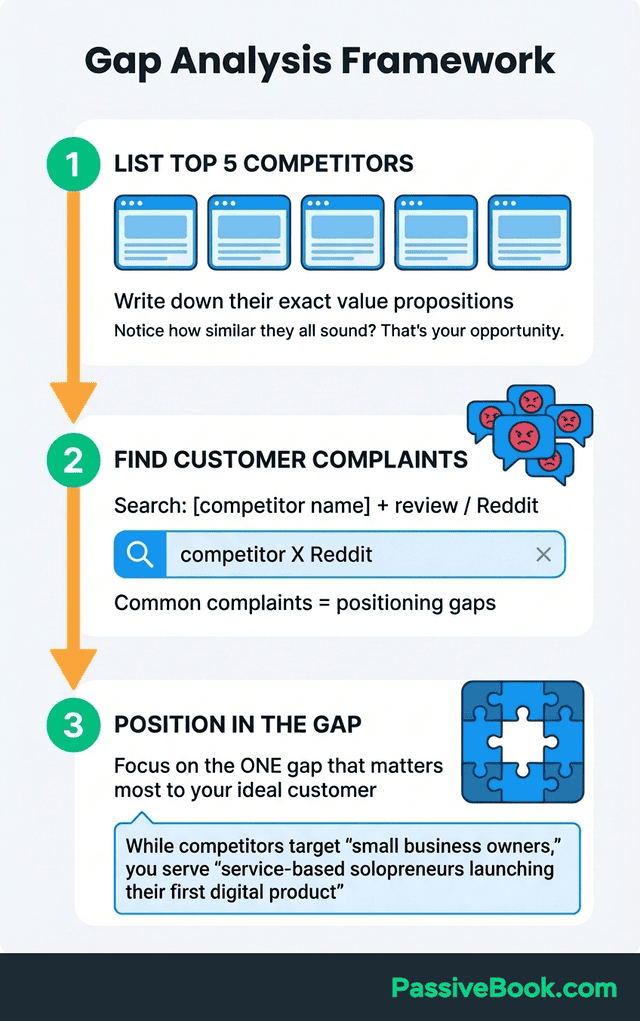
Position your offering to fill the most significant gap. Don’t try to address every weakness. Focus on the one gap that matters most to your ideal customer.
Your effective value proposition should make it obvious why someone frustrated with competitors should choose you instead.
Crafting Your UVP: The Simple Formula That Works
This template works whether you’re positioning a product service or digital offering: “For [specific audience] who [struggle with X], I provide [solution] through [unique approach].” This structure forces you to define every critical element of your positioning in one sentence.
I tested 47 variations of my UVP before finding one that worked. You don’t need to test 47, but you definitely need to test more than one.
Dog Ross Pet Painting used this formula to create “For pet owners who want unique, art-style portraits, I provide custom paintings through Bob Ross-inspired pet portraiture.” This positioning grew into a successful print-on-demand business because it clearly communicated who, what, and how in memorable terms.
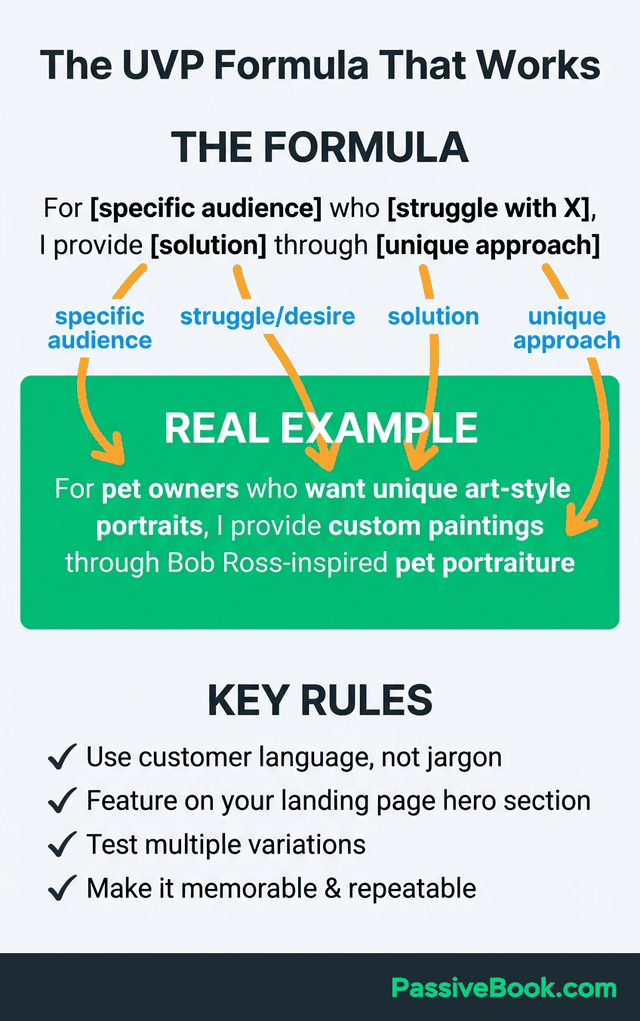
Use customer language, not industry jargon or technical terms. If your target customers say “I’m drowning in emails,” don’t say “I optimize inbox workflows.” Say “I help you get to inbox zero in 30 minutes daily.”
The value proposition canvas emphasizes matching your language to how customers actually describe their problems.
Your landing page should feature this value proposition statement in the hero section, above the fold. Visitors decide within three seconds whether to stay or leave. Your UVP is the primary tool for passing that test.
Testing and Refining Your UVP Over Time
Solopreneurs test UVP variations by creating simple one-page sites with Carrd and running small Facebook or Instagram ad tests. You can measure which messaging drives the highest conversion with as little as $50 to $100 in ad spend.
This practical approach works for budget-conscious solopreneurs.
Share your draft value proposition with 10 to 20 ideal customers and ask if they understand the value immediately. Don’t explain it. Just show them the statement and watch their reaction. Confusion means you need to simplify.
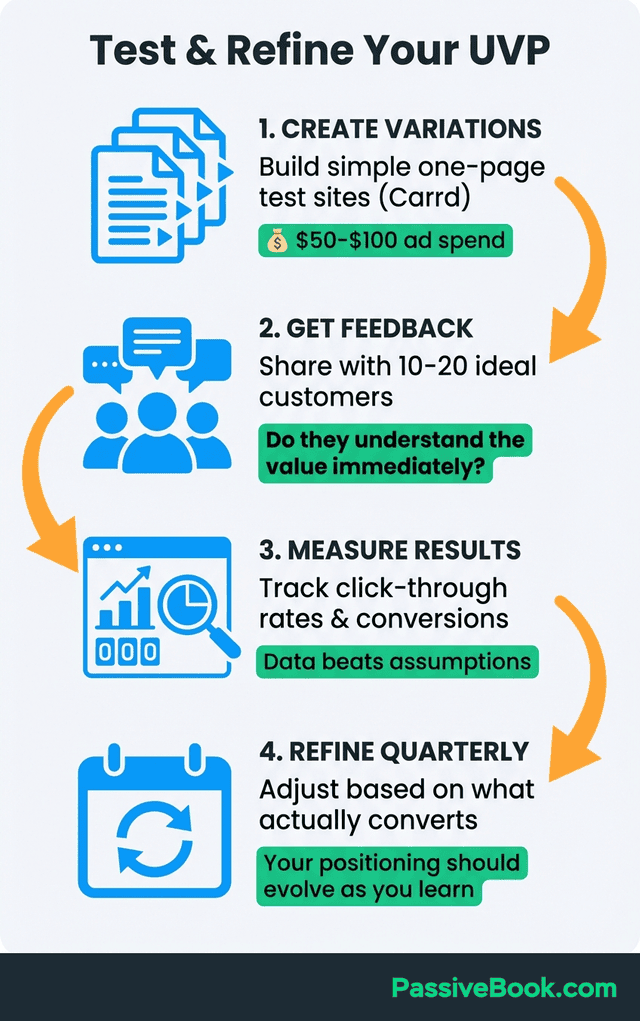
Review your UVP quarterly as you collect customer feedback and results. Your positioning should evolve as you learn what resonates. What works in month one might need adjustment by month six based on which customer segments respond best.
Refine based on which messaging drives highest conversion rates and engagement on social media. Track click-through rates on different headline variations. The data tells you what’s working better than your assumptions ever will.
Real-World Examples: Solopreneurs Who Got It Right
Strong value propositions address specific target customer pain points in under 10 words. Notice how successful solopreneurs focus on transformation, not features. Their messaging immediately signals who they serve and what outcome to expect.
The best examples demonstrate how positioning around a specific problem or audience creates clarity that generic messaging cannot achieve. Strong case studies prove your UVP delivers results. These prove that niching down expands revenue opportunities rather than limiting them.
Content Creators and Course Builders
Ali Abdaal’s journey shows how medical doctor credibility enhanced productivity content differentiation. His background as a doctor gave weight to his productivity advice that generic productivity creators couldn’t match.
The combination of medical training and productivity expertise created a unique value proposition.
Pat Flynn’s transparency strategy built authority through monthly income reports and honest affiliate marketing. While others hid their numbers, Pat’s openness about what worked and what didn’t created trust. His value proposition centered on “learn from my actual experiments,” not theory.
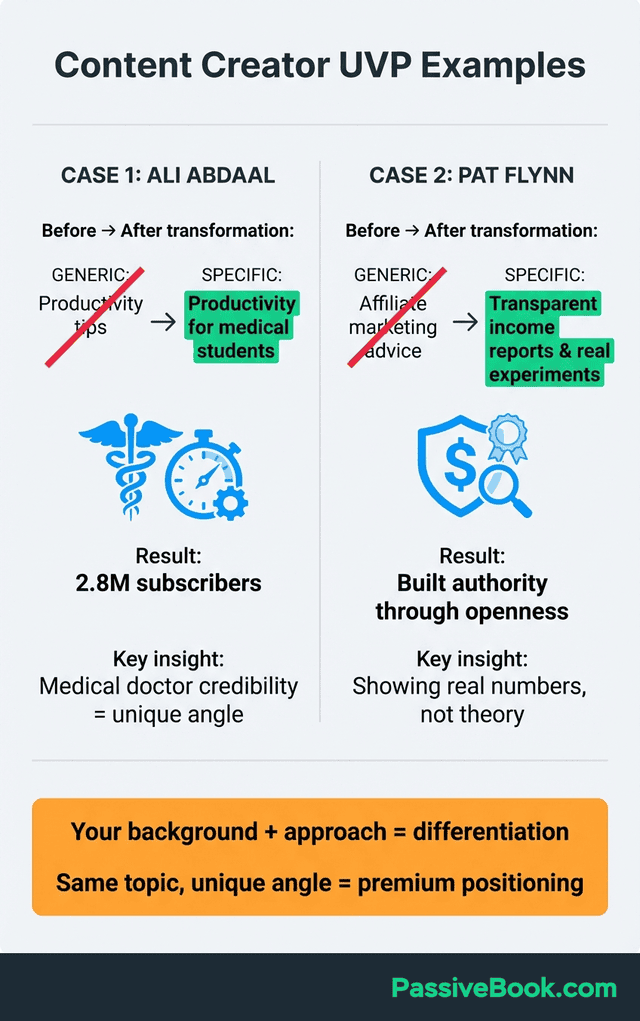
Both creators demonstrate that your unique approach matters as much as your topic. Productivity content exists everywhere, but productivity advice from a doctor or transparent income reports from someone showing real numbers create differentiation.
Both succeeded by making their background part of their positioning, not separate from it.
Service-Based Solopreneurs
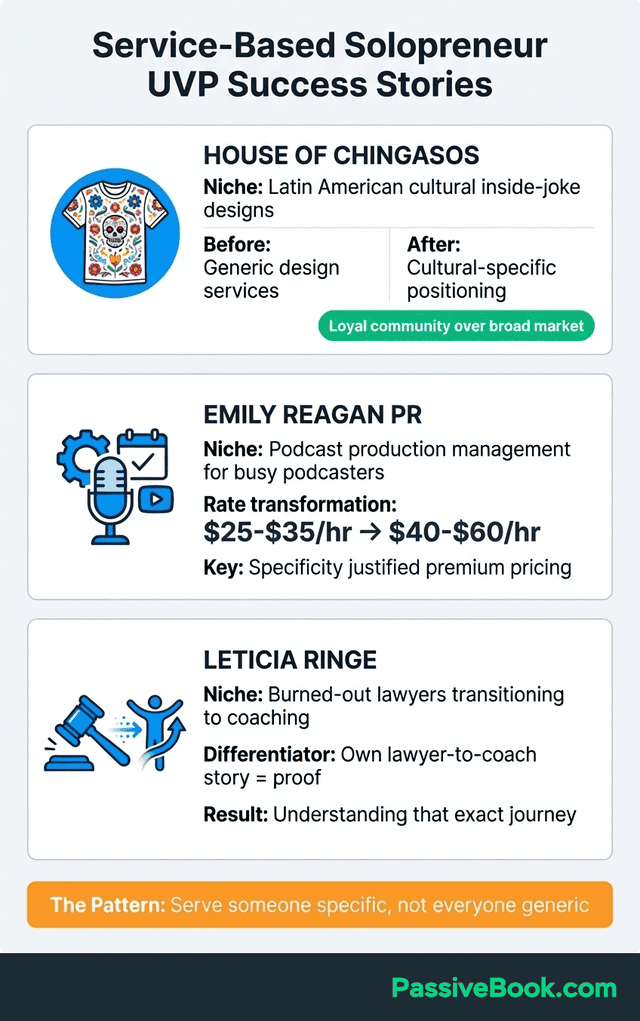
House Of Chingasos targets the Latin American cultural niche with specific inside-joke designs. This positioning creates a loyal community versus generic design services. Cultural positioning proves you don’t need to serve everyone to build a profitable business.
Emily Reagan PR niched into podcast production management for busy podcasters, growing from general VA work at $25-$35/hour to specialized podcast operations at $40-$60/hour. The specificity justified premium pricing. Leticia Ringe positioned specifically for burned-out lawyers transitioning to coaching, leveraging her own lawyer-to-coach transition story as proof of understanding that exact journey.
E-Commerce and Product Creators
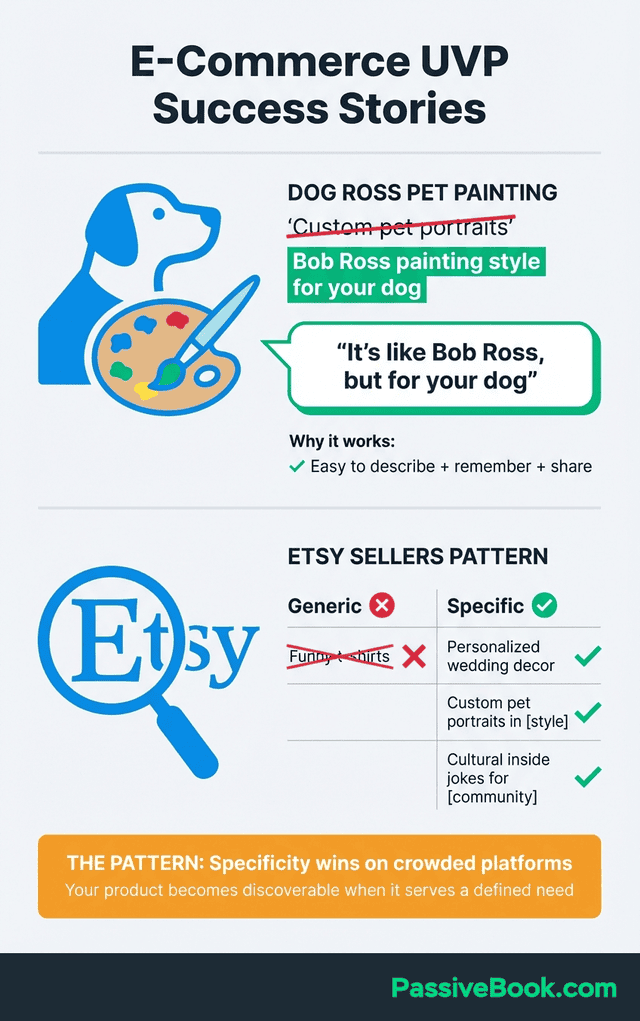
Dog Ross Pet Painting offers custom pet portraits in Bob Ross painting style. The combination of pet portraits and a specific art aesthetic creates memorable positioning.
Customers can describe it to friends easily: “It’s like Bob Ross, but for your dog.”
House Of Chingasos demonstrates how cultural specificity beats generic catalogs. Instead of “funny t-shirts,” they offer “inside jokes for the Latin American community.” Here’s a great example of positioning around identity rather than product category.
Successful Etsy sellers focus on hyper-specific niches like custom pet portraits or personalized wedding decor. The pattern is clear: specificity wins on platforms crowded with generic offerings.
The pattern? Specificity wins on crowded platforms.
Your product service becomes discoverable when it serves a defined need.
How AI Is Changing UVP Development in 2026
AI tools are empowering solopreneurs to validate positioning faster than traditional methods. What used to require expensive focus groups or months of trial and error now takes hours with the right prompts.
Tools like ChatGPT generate multiple UVP variations for testing purposes. You can prompt it with “Generate 10 value proposition variations for [your offering] targeting [your audience]” and receive diverse options to test.
This speeds up the brainstorming phase dramatically.
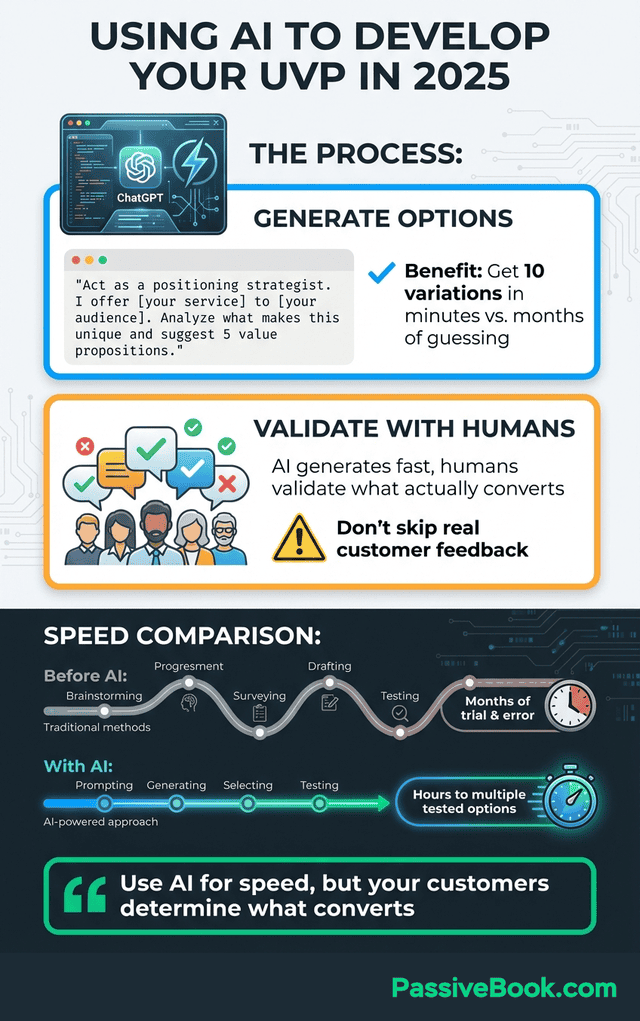
To effectively use AI for your marketing campaigns, try this prompt: “Act as a positioning strategist. I offer [your service] to [your audience]. Analyze what makes this unique and suggest 5 value propositions that emphasize different angles.”
The variety helps you see positioning options you might miss alone.
Human judgment remains critical for validating which AI suggestions resonate with real customers. AI generates options quickly, but only you and your customers can determine which messaging converts.
Use AI for speed, but validate with real human feedback before committing to a positioning strategy.
Common UVP Mistakes That Kill Conversions
I see this everywhere: “We provide the best quality service.” So does everyone else. Generic claims like “best quality” or “great service” fail to differentiate you from alternatives.
Instead, use specific outcomes like “reduce email response time by 40%.” Measurable results communicate value that vague quality claims cannot.
Overpromising unrealistic outcomes damages credibility faster than it attracts customers. Promise one achievable result you deliver, like “convert blog posts into 3 LinkedIn posts in 15 minutes.”
Potential customers trust specific, modest promises over grandiose claims.
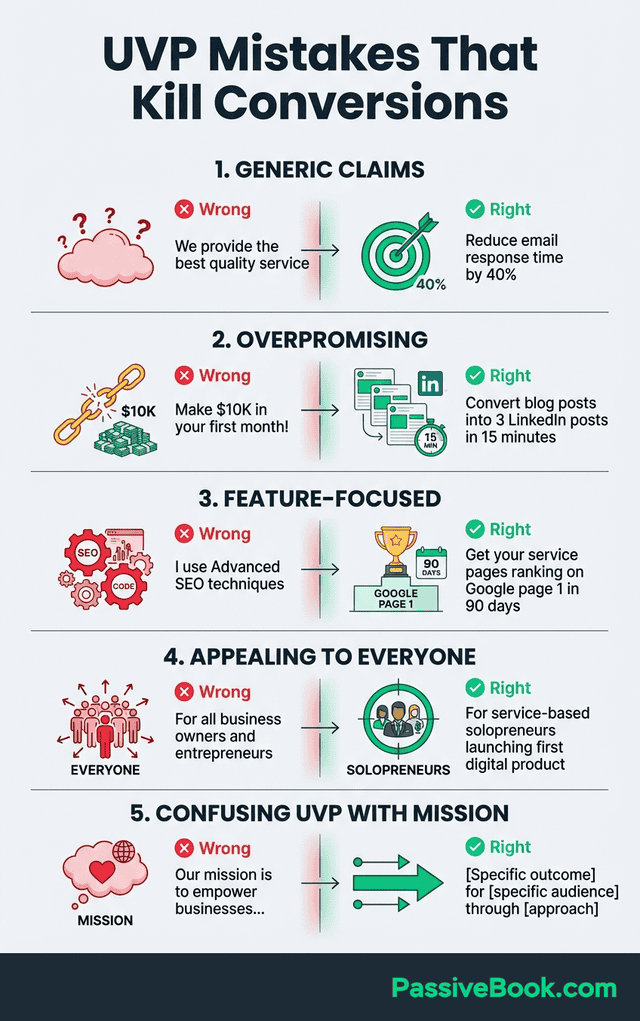
Feature-focused messaging instead of benefit-driven outcomes is the most common error. Replace “I use Advanced SEO techniques” with “Get your service pages ranking on Google page 1 within 90 days.” The second version communicates the actual transformation target customers care about.
Trying to appeal to multiple audiences creates confused messaging. Optimize for your primary 80% audience, then create separate landing pages for secondary segments. Your main value proposition should speak clearly to one group, not vaguely to everyone.
Many solopreneurs confuse their UVP with a mission statement. Your mission describes your purpose. Your value proposition describes customer outcomes.
Similarly, don’t mistake your marketing campaigns for your positioning. Campaigns communicate your UVP, but they aren’t the UVP itself.
Communicating Your UVP Across All Touchpoints
Justin Welsh demonstrates consistent UVP across LinkedIn headline, Twitter bio, website hero, and email signature. All emphasize “solopreneur systems for corporate escapees,” creating instant recognition.
This consistency contributed to his multi-million dollar annual revenue by making his positioning impossible to forget.
Lead with an outcome-focused headline in your website hero section and bio. Don’t bury your value proposition in paragraph three.
The first thing visitors see should communicate exactly who you serve and what transformation you deliver.
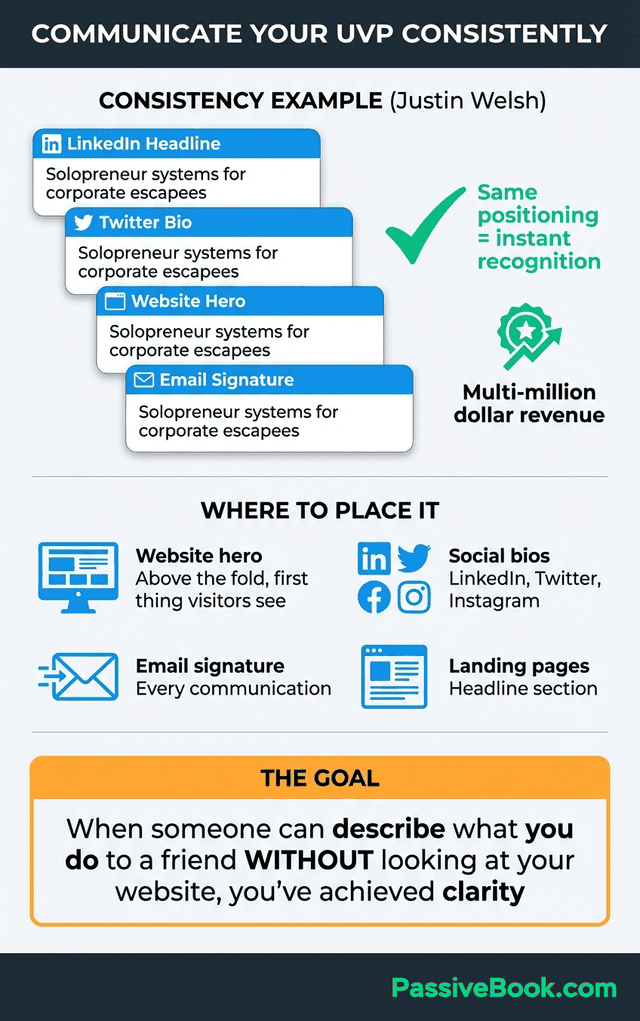
Use consistent language across platforms so prospects recognize your positioning instantly. If your website says “email automation for coaches” but your social media says “marketing systems for consultants,” you create confusion.
Pick your core value proposition and repeat it everywhere, adjusting only minor details for platform constraints.
Your target audience’s recognition of your positioning is the goal. When someone can describe what you do to a friend without looking at your website, you’ve achieved true clarity. Repetition across touchpoints builds this recognition.
Frequently Asked Questions
How Long Should My Unique Value Proposition Be?
One clear sentence or 10 to 15 words maximum for your primary headline. This forces you to distill your positioning to its essence.Expand with 2 to 3 supporting benefit bullets in subheadings if needed, but the core value proposition must be immediately scannable.
Can I Have Different Value Propositions for Different Products?
Yes, but ensure each stems from your core positioning and strengths. Different offers can emphasize different benefits for specific audience segments.For example, if you’re a productivity coach, one product service might focus on u0022morning routines for parentsu0022 while another targets u0022focus systems for ADHD entrepreneurs.u0022 Both are rooted in your productivity expertise.
What If My Competitors Have Similar Value Propositions?
Differentiate through specific audience targeting, unique approach, or personality. Combination of factors creates uniqueness even in similar markets.Two coaches might both help u0022burned-out professionals,u0022 but one focuses on corporate escapees while the other targets healthcare workers. The audience specificity creates distinction.Your marketing campaigns can also differentiate through channel choice and messaging style. Even similar UVPs can feel distinct through execution.
How Do I Know If My UVP Is Working Effectively?
Track conversion rates on landing pages and inquiry forms. Listen for prospects repeating your positioning back to you in discovery calls.Monitor if you attract ideal clients versus tire-kickers. The right UVP repels wrong-fit prospects while attracting perfect matches.
What Is the Value Proposition of an Online Business?
A value proposition for an online business is a statement communicating specific value customers receive from your digital product service. It emphasizes convenience, accessibility, and digital-specific benefits relevant to your niche, like u002224/7 access to templatesu0022 or u0022learn at your own pace without travel.u0022
Should My UVP Mention Specific Features?
Your UVP should focus on outcomes, not features. Whether you offer a product service or digital course, lead with transformation.Features belong in your detailed description, not your positioning statement. Think of your UVP as the u0022whyu0022 and features as the u0022how.u0022
What Next?
The framework is clear. The hard part? Actually doing the honest self-assessment to uncover what makes you different. Most solopreneurs skip this work and wonder why their marketing falls flat.
If this guide helped clarify your positioning, share it using the buttons below. Other time-strapped solopreneurs in your network are probably struggling with the same invisible-in-the-market feeling you had before reading this. Sharing saves them months of confusion.
Ready to implement? Start with the 15-minute skills audit from earlier. Block time on your calendar today, not next week, and complete it. Clarity comes from doing, not planning to do.
Need help refining your positioning once you’ve identified your strengths? Check out related guides on our site about crafting landing pages that convert, where you’ll learn to communicate your UVP in the first three seconds.
Share this post with your friends & followers: