I wasted six months chasing every opportunity that came my way. A podcast interview request, a YouTube collaboration, a course partnership. I said yes to everything. My evenings disappeared into projects that felt productive but led nowhere. The turning point came when I finally wrote down what I was actually trying to build. That document became my filter for every decision since.
You don’t need a corporate-style strategic plan to run a side hustle. But without a clear mission and vision, you’ll spend your limited time reacting to opportunities instead of building something meaningful. Let me show you how to create these in under an hour, using language that helps you make decisions.

- •What are Mission and Vision Statements
- Why Time-constrained Solopreneurs Actually Need These
- •Mission Statements as Internal Tools, Not Marketing Copy
- •Common Mission Statement Mistakes That Create Paralysis
- How to Write Your Mission in 20 Minutes or Less
- •How to Craft Your Vision Without Corporate Jargon
- •Review Your Mission During Weekly Planning Sessions
- •Match Your Mission to the Right Platform
- •Update Your Mission When Business Constraints Change
- •Frequently Asked Questions
- •What Next?
What are Mission and Vision Statements
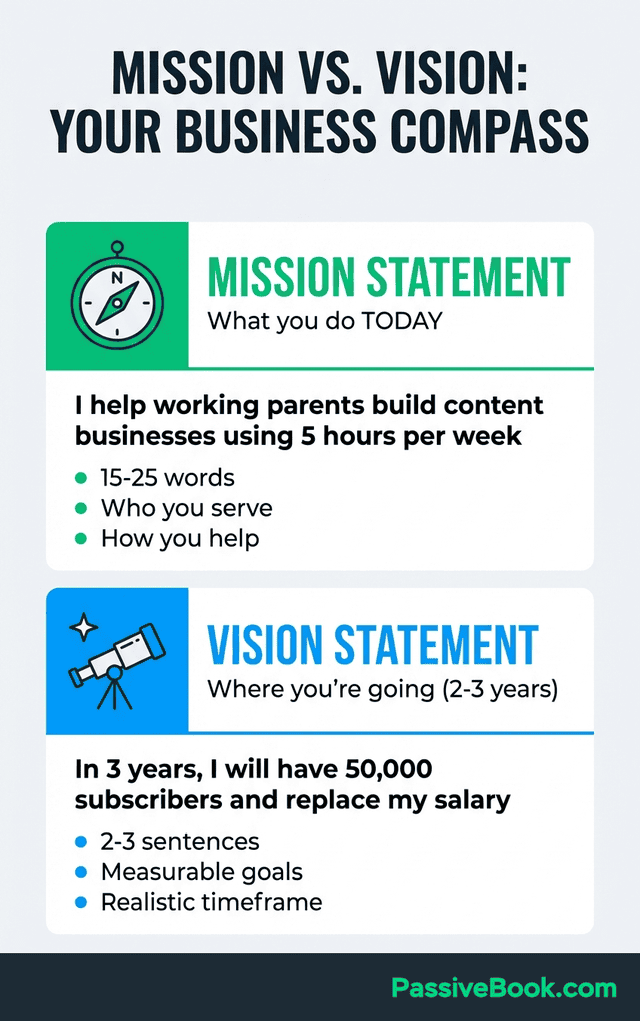
A mission statement defines what your business does today and whom you serve. Think of it as your day to day operating guide, answering the question: “What am I working on tonight?”
Your vision describes where you want your business in the long term – typically two to three years for solopreneurs testing early traction. It’s your target destination. Pat Flynn’s Smart Passive Income mission demonstrates this clarity: “help entrepreneurs achieve personal fulfillment and financial independence through ethical passive income strategies.” You understand who he serves and how he helps them.
Your mission and vision flow from your core values – the non-negotiable principles guiding your business decisions. For solopreneurs, these might include work-life balance, ethical monetization, or creative freedom. Identifying 3-5 core values before writing your mission helps ensure your statement reflects what matters to you, not what sounds impressive.
Patagonia’s vision cuts even deeper: “We’re in business to save our home planet.” Founder Yvon Chouinard created a clear direction that scaled with the business. Your vision won’t match their scope, but it needs the same clarity.
Keep your mission statement between 15 and 25 words maximum. It should be short enough to recall during quick decisions. Can you start a podcast? Does this client fit? Your mission statement should answer in seconds.
Vision statements can extend to two or three sentences to describe your destination clearly. You need slightly more room to paint the picture of where you’re headed.
Here’s the brevity test: If you can’t recite your mission from memory after reading it twice, it’s too long. Complexity kills utility for time-constrained solopreneurs.
Both statements work as filters for choosing between YouTube, courses, or e-commerce opportunities. When someone offers you a collaboration that doesn’t fit your stated mission, you have an objective reason to decline.
Why Time-constrained Solopreneurs Actually Need These
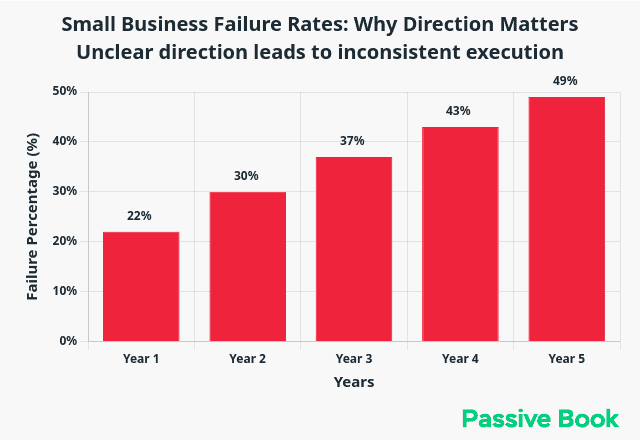
About 20 to 24 percent of small businesses fail within their first year, according to Bureau of Labor Statistics data. Nearly half fail within five years. The pattern is consistent: unclear direction leads to inconsistent execution.
Your vision prevents pivoting too frequently between platforms during early validation phases. You need enough time to test an approach before jumping to the next shiny opportunity.
When Clear Direction Prevents Months of Wasted Effort
Business leaders spend significant time making decisions, but McKinsey research suggests much of that time is unproductive. For solopreneurs working evenings, this means weeks of lost hours every year.
A clear mission helps you reject client work that drains time without advancing your core goals. That $200-per-hour ghostwriting gig sounds appealing until you realize it’s building someone else’s business, not yours.
I learned this after accepting three months of freelance work that paid well but left me with zero progress on my own platform. My mission now filters these opportunities before I waste time considering them.
When to Develop Vs. Skip the Planning Phase
Your first 90 days should prioritize customer validation over perfecting statements. Action beats planning when you’re testing ideas.
Dropshipping and print-on-demand sellers succeed by testing products quickly. They launch, gather data on which economic opportunity converts best, and adjust. Your mission emerges from paying customers, not brainstorming sessions alone.
Start with a rough mission statement, then refine it after your first 10 to 20 customer interactions. Real feedback shapes better direction than hypothetical planning.
My friend’s first business was a Pinterest VA service. She spent three weeks crafting the perfect mission statement before she had a single client. Then her first five clients all asked for Instagram help instead. Her carefully crafted mission became irrelevant in 48 hours. She should have written “I help small businesses with social media” and refined it after learning what they needed.
Mission Statements as Internal Tools, Not Marketing Copy
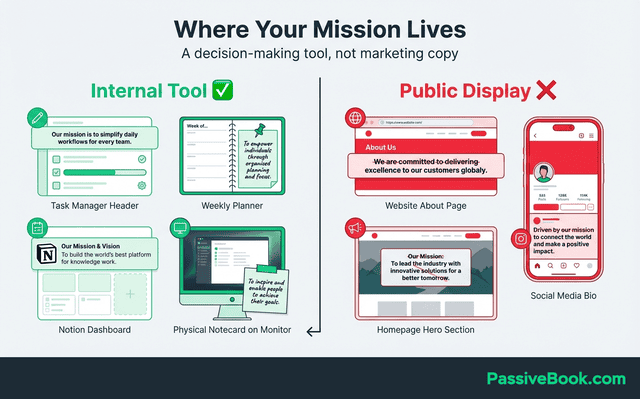
That filtering power works best when your mission stays private. Harvard Business Review research shows mission statements work best as internal guides rather than public displays. The most effective solopreneurs use mission statements for personal decision-making during weekly reviews.
Your customers care about the results you deliver, not your internal compass. They want to know if you can solve their problem, not read your philosophical foundation.
Mission clarity drives value through consistent business choices, not website displays. Think of it as your private decision-making framework. Your mission clarifies your business’s reason for existence when you’re tempted to pivot every time a new platform trends.
Store it in your planning tool where you see it during work sessions, not on your about page. Most successful solopreneurs I know keep their mission statement in the header of their task manager or weekly review document. It’s a tool for them, not a marketing message for visitors.
Common Mission Statement Mistakes That Create Paralysis
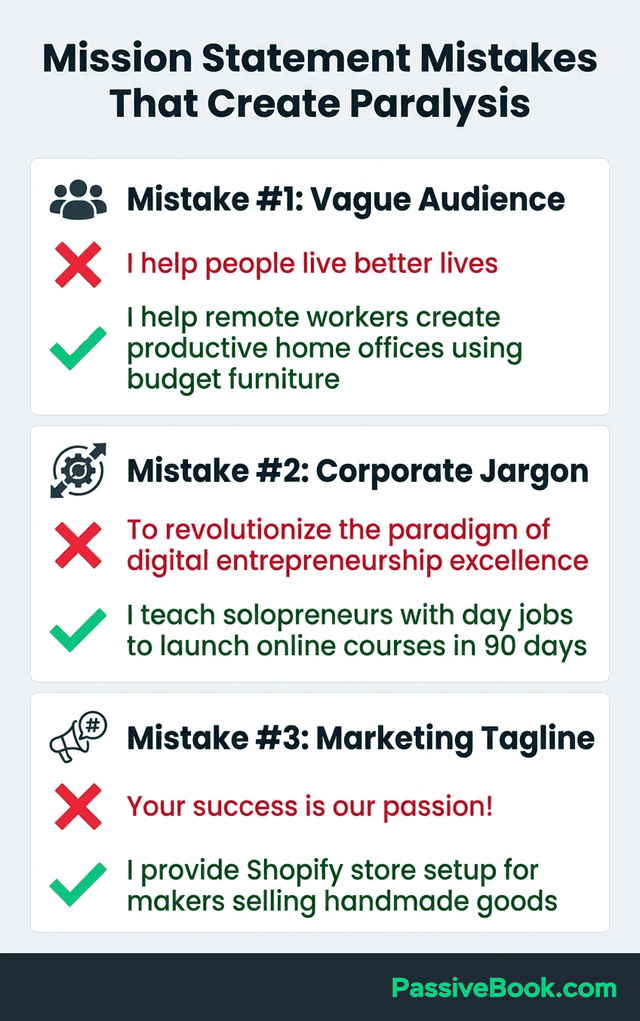
The biggest mistake is writing vague statements without specific audience or problem identification. Compare these two approaches:
❌ Vague: “I help people live better lives.”
✅ Specific: “I help remote workers create productive home offices using budget furniture.”
The first statement doesn’t help you decide anything. Should you create a meditation course or a desk setup guide? You can’t tell.
The second statement clarifies your focus.
Another trap is creating impressive-sounding missions that don’t guide weekly decisions. I’ve seen dozens of these:
❌ Corporate jargon: “To revolutionize the paradigm of digital entrepreneurship excellence.”
✅ Actionable: “I teach solopreneurs with day jobs to launch online courses in 90 days.” This tells you your customer (solopreneurs with constraints), your deliverable (course launch), and your timeline (90 days). No ambiguity about whether you should accept a request to consult on enterprise training programs.
The jargon version sounds professional but tells you nothing about who you serve or how you help them.
Marketing taglines like “Your success is our passion!” sound nice on a homepage but won’t help you decide whether to accept a consulting project. Compare that to an internal mission like “I provide Shopify store setup for makers selling handmade goods,” which gives you clear criteria: Are they a maker? Are they selling handmade goods? Do they need Shopify setup?
Here’s my favorite test for mission statement quality: the elevator pitch test. Explain your business to someone unfamiliar in 15 seconds.
Success means they can identify who you serve and what problem you solve.
Failure means they ask “So what do you do?”
If you fail, refine your mission statement until you pass. I failed this test four times before I got my mission clear enough that my neighbor could explain my business back to me.
How to Write Your Mission in 20 Minutes or Less
All you need are three questions and a timer.
Set a 20-minute timer. This mission statement takes less time than most people spend scrolling social media during lunch. Answer three questions. Combine the answers into one sentence. That’s your mission statement framework.
Avoid corporate jargon that doesn’t energize you during evening work sessions. If reading your mission statement feels like reading a quarterly earnings report, you’ve failed. It should make you want to open your laptop.
The Three-question Framework for Solopreneurs
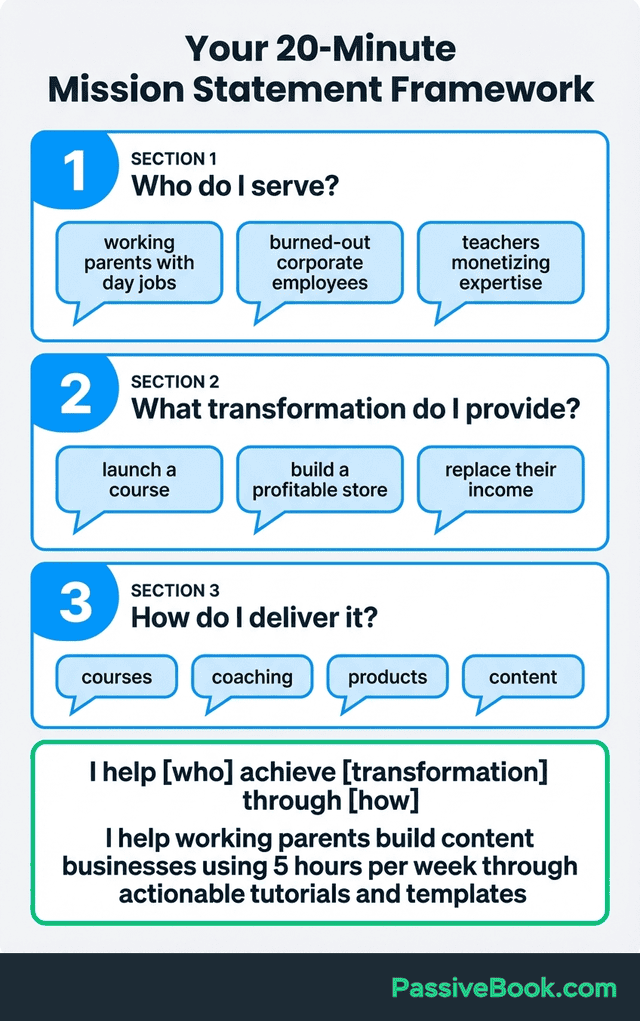
Start by answering these three questions. Get narrow. “Everyone” is not an audience.
Question 1: Who do I serve?
Not “everyone” or “people interested in success.” Try “working parents with day jobs” or “burned-out corporate employees planning their exit” or “teachers looking to monetize their expertise.”
Question 2: What transformation do I provide?
Describe the outcome, not vague “helping.” What changes for them? They launch a course, build a profitable store, create a content system, replace their income.
Question 3: How do I deliver it?
Through courses, coaching, products, content, services. Be clear about your method.
The Small Business Administration recommends this approach to craft focused missions answering who, what, and how. I’ve used it across three business pivots, and it works every time.
Combine your answers: “I help [who you serve] achieve [transformation you provide] through [how you deliver it].”
Example: “I help working parents build content businesses using five hours per week through actionable tutorials and templates.”
Testing Your Mission Against Real Opportunities
Your mission statement only works if it helps you make real decisions. Apply it to your current choice: “Should I start a podcast or YouTube channel?”
If your mission doesn’t help you choose within 60 seconds, refine it until it does. Your mission statement is a decision-making tool, not a philosophical exercise.
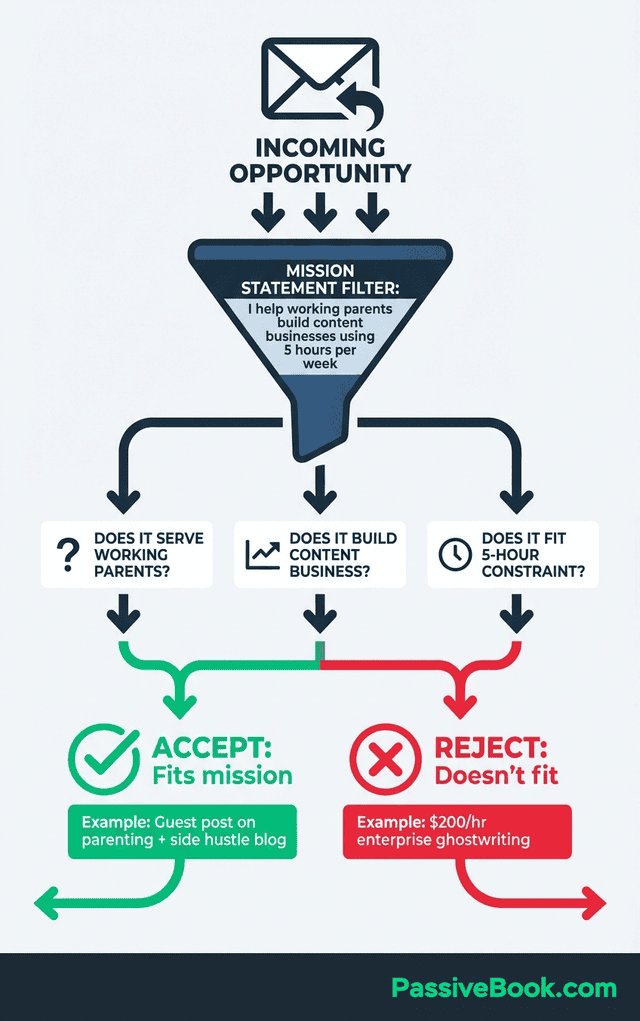
Here’s an example. Your mission states: “I help working parents create content businesses using five hours per week.”
An enterprise Software as a Service (SaaS) company offers you ghostwriting work at $200 per hour. Should you take it?
Filter result: Reject.
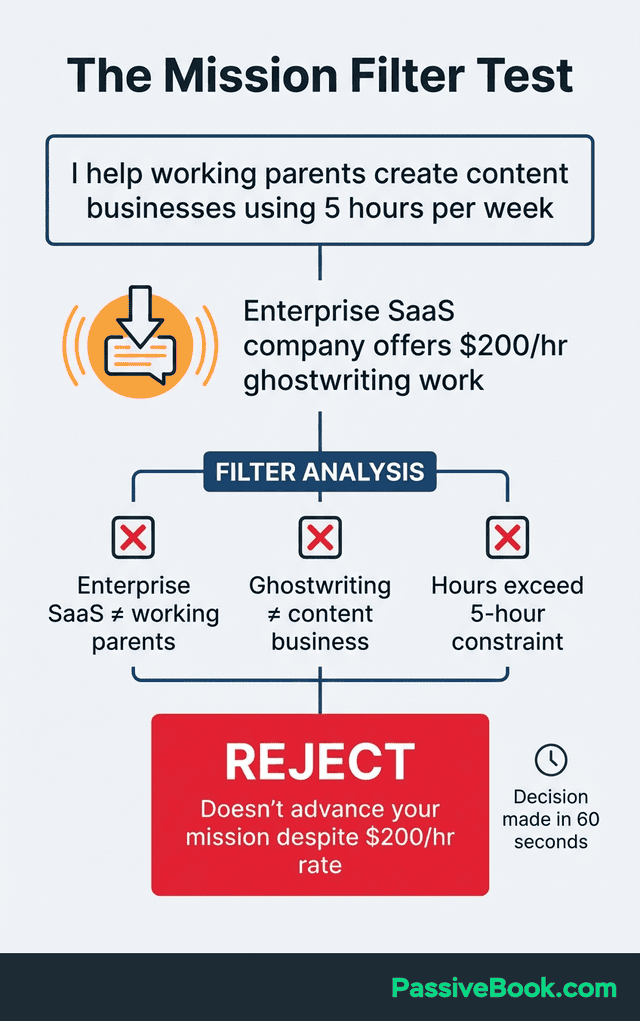
Why? Enterprise SaaS isn’t working parents. Ghostwriting doesn’t build your content business. The hours will exceed your five-hour constraint, taking time from your mission.
Reject opportunities that don’t pass your filter, regardless of potential revenue. I’ve turned down $10,000 projects that didn’t fit my mission vision statement. Each rejection freed time that built my business.
How to Craft Your Vision Without Corporate Jargon
Your mission filters today’s opportunities. Your vision targets where those decisions lead. Fill in this prompt: “In two to three years, I will…”
Successful content creators focus on audience size and income goals, not sweeping declarations. Your vision statement needs measurable markers you can track.
Use language that motivates you during evening work sessions after your day job. If it doesn’t excite you at 9 PM when you’re tired, it won’t pull you through difficult months.
Focus on realistic goals that fit your limited time availability, not decade-long projections. Three years is enough time to build meaningful traction while keeping your vision actionable.
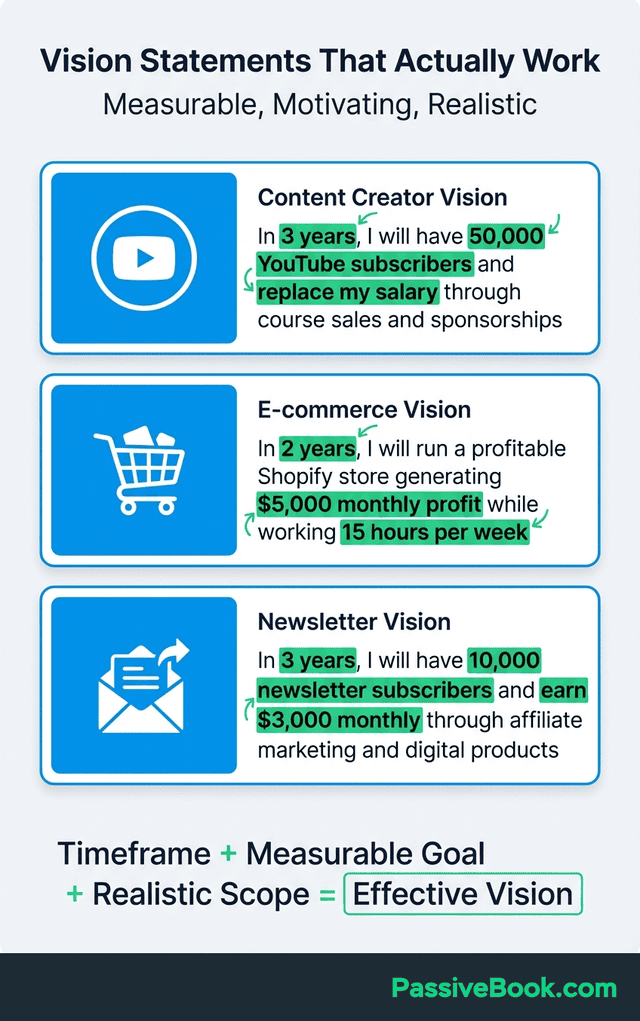
Here are vision statement examples that work:
“In three years, I will have 50,000 YouTube subscribers and replace my salary through course sales and sponsorships.”
“In two years, I will run a profitable Shopify store generating $5,000 monthly profit while working 15 hours per week.”
“In three years, I will have 10,000 newsletter subscribers and earn $3,000 monthly through affiliate marketing and digital products.”
Notice the pattern: timeframe, measurable audience or revenue, and realistic scope for a solopreneur. These vision statements guide platform choice, content strategy, and daily priorities.
Your vision should answer: What does success look like when I’m ready to quit my day job or scale significantly?
Review Your Mission During Weekly Planning Sessions
Store your mission in your daily planning tool where you see it during work sessions. I keep mine in the header of my Notion workspace to stay focused when new opportunities create distraction.
In Notion, I use a linked database that shows my mission at the top of my dashboard, weekly planner, and project tracker. Other solopreneurs use Google Docs with browser pinning, Trello card descriptions, or even a physical notecard taped to their monitor. The tool matters less than seeing it before every work session.
Review your mission before saying yes to opportunities. Someone asks you to guest post on their blog? Compare the request against your stated audience, transformation, and method. Does it serve working parents? Does it advance content business skills? Does it fit your five-hour constraint?
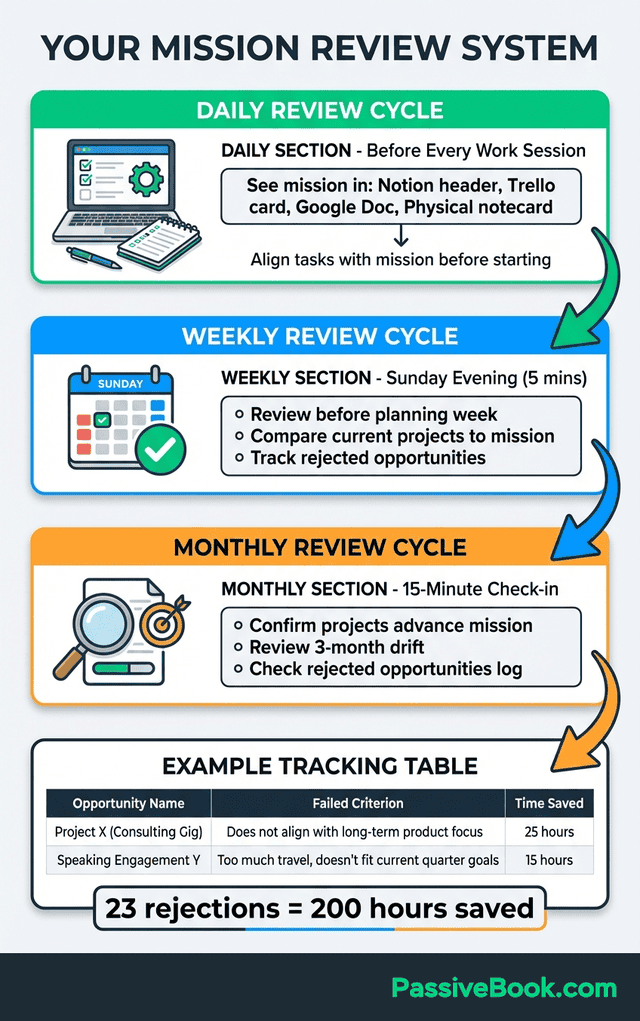
Time management experts recommend weekly mission reviews taking five minutes to prevent months of drift. I schedule mine every Sunday evening before planning my week.
Schedule a 15-minute monthly check-in as well. Confirm your current projects advance your mission or provide necessary validation-phase income.
If you’re three months into a project that doesn’t fit either category, you’ve drifted.
I also track rejected opportunities in an Notion database with three fields: opportunity name, reason rejected (which mission criterion it failed), and estimated time saved. This reinforces how my mission protects my limited hours. Last year’s 23 rejections saved me approximately 200 hours of work that wouldn’t have advanced my business.
Match Your Mission to the Right Platform
Those monthly reviews also prevent platform drift. Your mission statement guides your platform choice, not the other way around. If your mission focuses on visual demonstration, YouTube makes more sense than blogging.
Teaching complex systems favors written guides on WordPress with screenshots. Readers can follow at their own pace, reference steps, and bookmark sections. Video forces linear consumption.
Product reviews fit affiliate content on blogs or newsletters. You need space for comparison tables, detailed pros and cons, and linked resources.
A YouTube review works, but written reviews convert better for purchase intent searches.
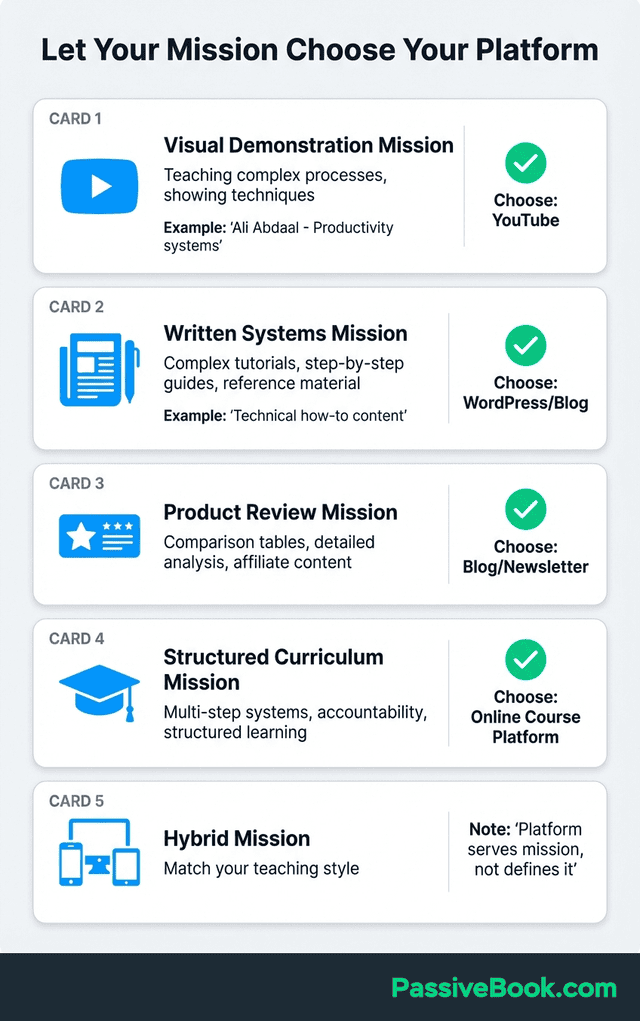
If your mission involves showing processes, YouTube provides the best format. Someone learning to edit videos needs to see the clicks and movements. Text instructions become confusing quickly.
Text-based tutorials on blogs serve audiences who prefer written instructions. Some people learn better by reading and referencing written content while working.
Online course platforms work when your transformation requires a structured curriculum. If your mission involves teaching a multi-step system with accountability, courses beat free content.
Ali Abdaal chose YouTube for productivity content because his medical background suited a visual teaching format showing techniques. His mission focused on demonstrating productivity systems, not explaining abstract concepts.
Match your preferred teaching style to your mission. If you prefer writing and your transformation doesn’t require video demonstration, build on WordPress or a newsletter platform. If you think in visuals and your audience needs to see processes, YouTube serves your mission better.
The platform should serve your mission and vision statements, not define them.
Update Your Mission When Business Constraints Change
Review your mission annually to ensure alignment with your current constraints and goals. Life changes, and your business should adapt.
Update your mission when pivoting business models. Moving from YouTube creator to course seller requires a mission adjustment. Your audience might stay the same, but your transformation and delivery method change.
Entrepreneur research shows successful pivots require mission alignment before major changes gain traction. You can’t effectively execute a new strategy while clinging to an outdated mission.
Major life changes affecting your available time require mission adjustment as well. Having a child, changing jobs, or caring for aging parents all impact your capacity.
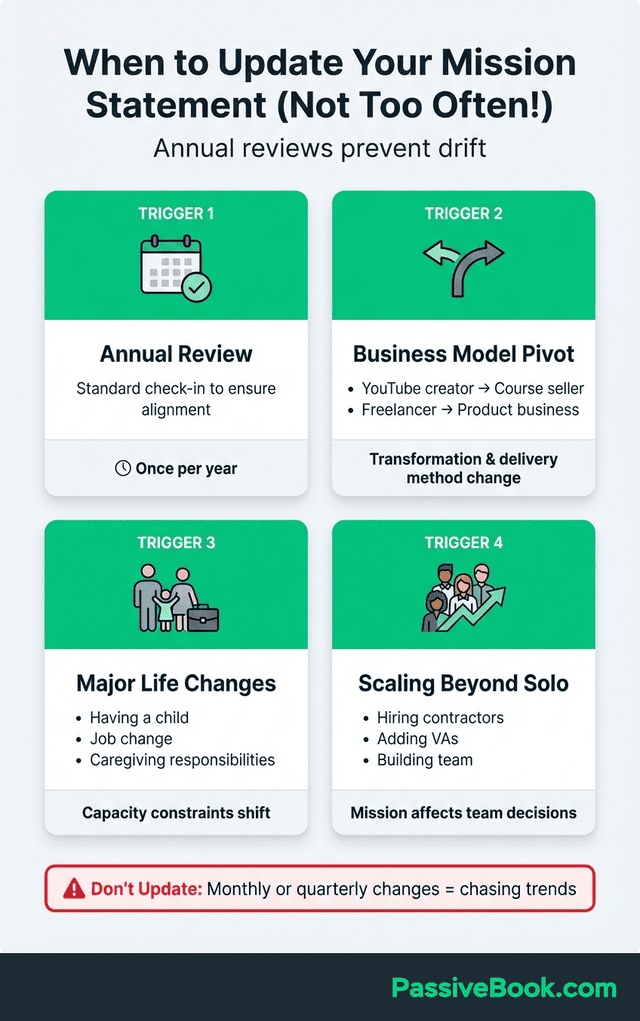
Your mission should reflect your actual constraints, not wishful thinking. Even as a solopreneur, your mission affects decisions about contractors, virtual assistants, or future team members if you scale beyond solo operations.
I’ve updated my mission three times in ten years. Version one focused on freelance writing clients. Version two shifted to course creation when I realized I was trading hours for dollars with no leverage.
Version three (current) centers on AI-automated content distribution after spending 18 months manually posting to six platforms. Each update came after months of friction between what my mission said and what I wanted to build.
Don’t update your mission too frequently. Annual reviews prevent drift while allowing necessary flexibility. Monthly or quarterly updates suggest you’re chasing trends instead of building a sustainable business.
Frequently Asked Questions
What Is an Example of a Business Mission and Vision?
Mission example: u0022I help working parents build content businesses using five hours per week.u0022 It specifies the audience, transformation, and constraint clearly. Vision example: u0022In three years, replace my salary through online courses.u0022 Both use clear language instead of corporate phrases. The mission guides daily decisions while the vision provides a destination.
What Should a Solopreneur Mission Statement Include?
Your mission statement needs a target audience more specific than u0022everyone.u0022 Use descriptions like u0022working parents with day jobsu0022 or u0022burned-out teachers seeking career changes.u0022 Include the clear transformation or outcome you provide, such as u0022build content businesses using five hours per week.u0022 State your delivery method: content, products, courses, or services. Optionally add your unique approach or constraint like u0022budget-consciousu0022 or u0022time-efficientu0022 that differentiates you. Mission statement frameworks vary across business theory, so prioritize clarity over following rigid formulas.
How Long Should My Mission Statement Be?
Keep it between 15 and 25 words maximum. If you can’t recite it from memory after reading it twice, it’s too long. My current mission is 18 words, and I’ve rejected opportunities mid-conversation because I could quickly recall whether they fit. Length matters because your mission only works if you use it during decisions.
Do I Need Both a Mission and Vision Statement?
Yes, but not right away. Start with your mission statement first – it guides today’s decisions about what content to create or which opportunities to accept. Add your vision statement once you have 10-20 customers and understand where your business could realistically go. Trying to craft a vision before validation leads to fantasy planning instead of goal-setting.
Can My Mission Statement Change as My Business Grows?
It should change, but not frequently. Review your mission annually and update it when you pivot business models, your available time changes significantly, or your target audience shifts. I’ve updated mine three times in ten years. Monthly changes suggest you’re chasing trends instead of building a sustainable business.
What Next?
You now have a framework to write your mission and vision in under an hour. These aren’t corporate exercises for solopreneurs with limited time. They’re filters that protect your most valuable resource: your evening and weekend hours.
I know this might feel like one more thing on your list when you just want to start building. That’s why you need it. Without clear direction, you’ll spend months building someone else’s dream or chasing opportunities that look good but lead nowhere.
If you found this guide helpful, share it using the buttons below. Another time-constrained solopreneur might need this framework to avoid the months of wasted effort I experienced. Drop a comment with your mission statement once you’ve written it. I read every comment and often provide feedback. What’s the biggest challenge you face in defining your business direction?
Share this post with your friends & followers: