I built my first online business while working a corporate job. Mornings were spreadsheets and meetings. Nights were content creation and customer emails. The biggest mistake I made in year one was copying a 30-page marketing plan template I found online. It sat untouched in a Google Doc while I scrambled to figure out what to post on Tuesday.
That plan failed because it wasn’t built for someone with 10 hours a week. You don’t need a document that impresses investors. You need a simple roadmap that tells you exactly what to do next Saturday morning when you have two free hours before the kids wake up.

- •What a Marketing Plan Is (and Isn't)
- •Why Most Marketing Plans Fail for Solopreneurs
- •Define Who You're Actually Talking to
- •Clarify Your Unique Value Proposition
- •Set Smart Goals That Match Your Time Constraints
- Choose 1-2 Marketing Channels (not Ten)
- •Build Your Marketing Budget Without Overwhelm
- •Free and Low-cost Tools to Get Started
- •How AI Changes the Game for Time-strapped Solopreneurs
- •Create Your One-page Marketing Plan
- •Track What Matters, Test, and Optimize
- •Frequently Asked Questions
- •What Next?
What a Marketing Plan Is (and Isn’t)
A marketing plan is a simple document that defines your target customer and exactly how you’ll reach them. It answers three critical questions: who you’re selling to, where they spend their time, and how you’ll get their attention.
It’s not a 50-page business plan filled with market analysis and competitive matrices. Think of it as a one-page roadmap for the next 90 days. You should be able to print it on a single sheet of paper and tape it to your wall.
The data backs up this simplified approach. 60-90% of business strategies fail before implementation even begins. The problem isn’t strategy quality. Over-complicated plans never get executed by time-strapped founders.
Your marketing plan should answer three questions in plain language.
- Who is your ideal customer?
- Where do they spend time researching solutions?
- How will you reach them with your message?
Why Most Marketing Plans Fail for Solopreneurs
I spent three months building a content calendar across six platforms. I had color-coded spreadsheets mapping Instagram posts to blog articles to YouTube videos. It looked professional. It felt strategic. I abandoned it in week two because I couldn’t keep up.
The failure wasn’t laziness. Static annual plans become outdated fast in today’s marketing landscape. Instagram tactics that worked in January get buried by algorithm changes in March. Lead generation tactics that dominated Q1 stop working when competitors copy them in Q2.
Over-complication causes decision paralysis for time-strapped founders. When your plan lists 15 weekly action items, you spend Saturday morning deciding what to tackle instead of marketing. Analysis replaces action.
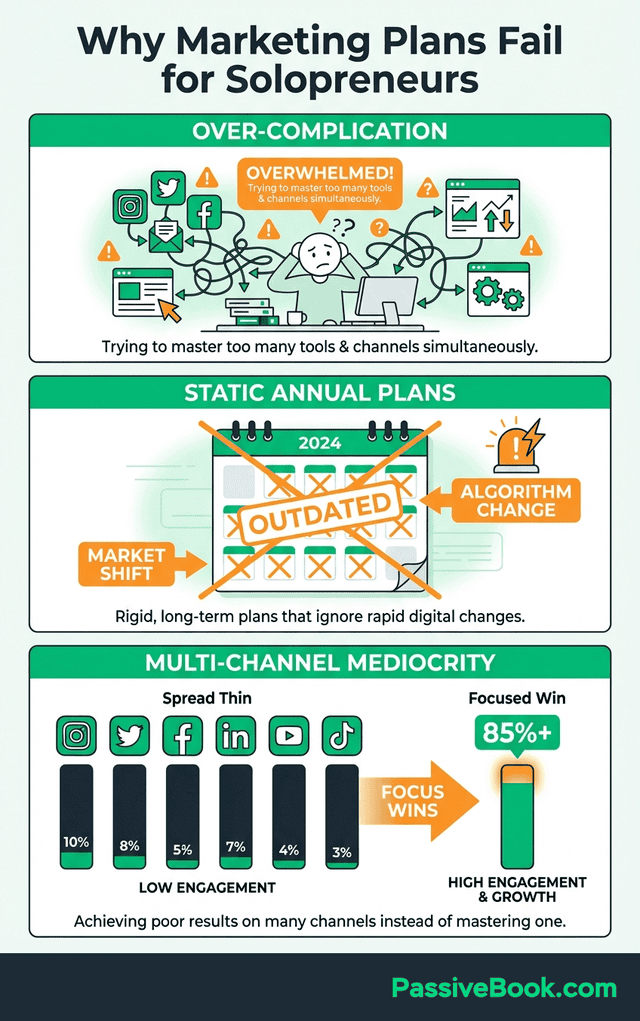
The Simply Business 2026 Solopreneur Report found that financial stress comes from unfocused marketing spread across too many channels. Solopreneurs try to be everywhere, master nothing, and burn through resources without traction.
The counterintuitive solution is extreme focus. Nick Huber built a $150M real estate business focusing exclusively on Twitter. He ignored Instagram, LinkedIn, Facebook, and TikTok. That singular channel mastery beats multi-platform mediocrity every single time for founders with limited bandwidth.
Define Who You’re Actually Talking to
Solopreneur Justin Welsh built a $5M+ one-person business using what he calls the “Rule of One.” Single customer type. Single platform. Single offer. This extreme clarity eliminates the confusion that kills most solopreneur marketing efforts.
Your first step is documenting one specific person. Not a demographic segment. Not a buyer persona with five variations. One actual human. Write down their goals, their fears about your product category, and where they research solutions online.
This focused approach differs from traditional market research that creates multiple buyer personas. While enterprise companies need complex segmentation, solopreneurs benefit from singular focus. You’re not ignoring market research – you’re conducting it with extreme precision on one high-value customer profile in your target market.
I learned this the hard way. Interview 3-5 existing customers to validate assumptions about their pain points. Ask what problem they were solving when they found you. Ask what almost stopped them from buying. Ask where else they looked before choosing you. Their answers will surprise you.
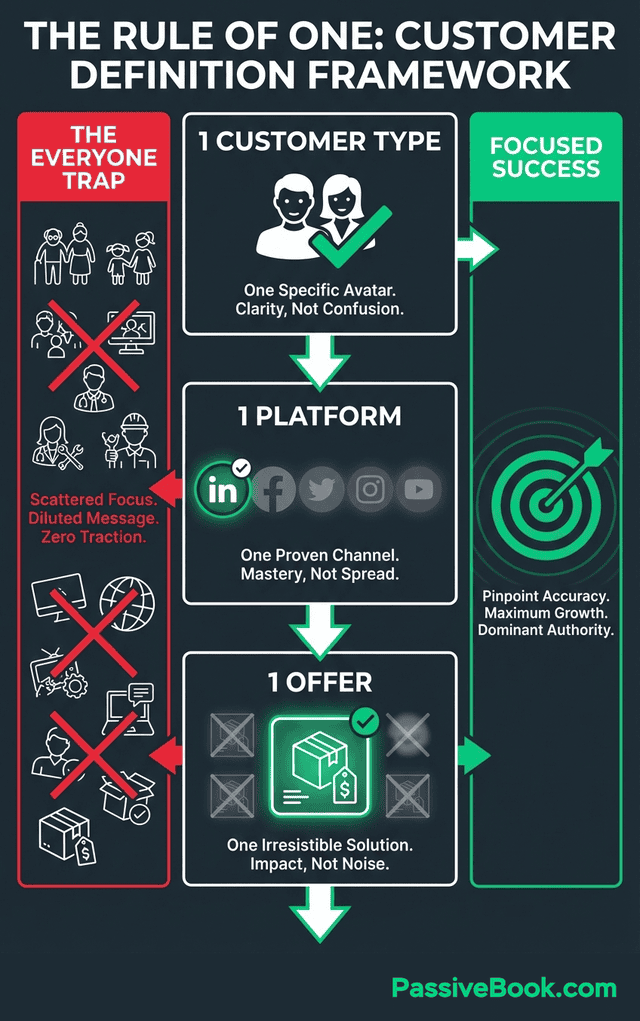
Here’s what kills most marketing: the “everyone” trap destroys marketing effectiveness. When you speak to everyone, your message is generic and forgettable. A narrower focus creates stronger, more compelling marketing messages that make your ideal customer feel like you’re reading their mind.
Validate your customer definition by showing it to someone unfamiliar with your business. If they can’t tell you where that person hangs out online and what keeps them awake at night, your definition is too broad. Keep narrowing.
Clarify Your Unique Value Proposition
Your Unique Value Proposition (UVP) is a one-sentence explanation of what makes your offer different from competitors’ offerings. It must address a specific problem and explain why customers should choose you over the alternatives they’re already considering.
TypingMind by Tony Dinh demonstrates this perfectly. His UVP reads: “Use ChatGPT with your own API key, better UI, no limits.” He bootstrapped this tool to over $500K by making the differentiation immediately obvious. Better interface. No usage limits. You control the API costs.
Before finalizing your UVP, conduct a simple SWOT analysis. List your Strengths (what you do exceptionally well), Weaknesses (constraints or gaps), Opportunities (underserved market needs), and Threats (competitor advantages). This competitive analysis doesn’t require expensive tools. Spend 30 minutes reviewing 3-5 competitor websites and note what they emphasize versus what your target customer actually needs. The gap between opportunities and threats is your differentiation zone.
Most solopreneurs bury their differentiation in paragraph three of their About page. Your UVP should be the first thing visitors see. Make the value clear before they scroll or click.
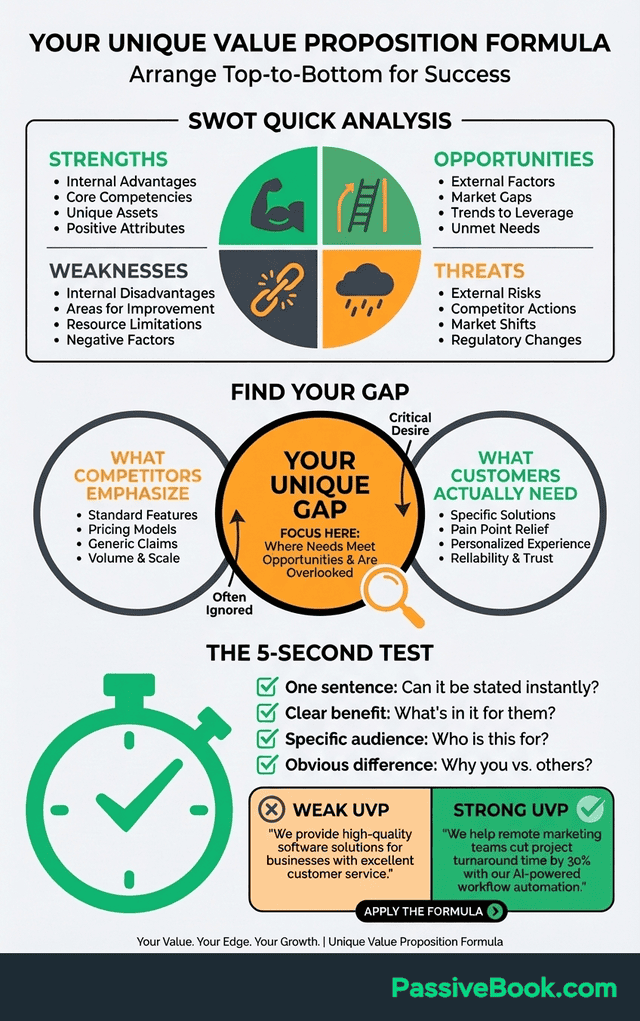
Test your UVP by asking: would a customer understand this in five seconds? Show it to someone unfamiliar with your business. If they have to ask clarifying questions, your value proposition isn’t clear enough yet. Simplify until the benefit becomes instantly obvious.
The strongest UVPs combine what you do with why it matters to your specific target customer. “Email marketing software” is a category description. “Email marketing that doesn’t require a designer” speaks to a solopreneur’s constraint. The second version immediately resonates with the right person.
Set Smart Goals That Match Your Time Constraints
Focus on 1-3 revenue-based goals maximum. More goals create the illusion of productivity while diluting your actual effort. Choose metrics that directly connect to money: subscribers gained, sales made, leads generated.
Make each goal specific, measurable, attainable, relevant, and time-bound. This SMART (Specific, Measurable, Attainable, Relevant, Time-bound) goals framework transforms wishes into measurable goals with clear key performance indicators. Define exactly what success looks like numerically, so you know whether you’re winning or guessing.
A Zerobounce profile of 10 solo entrepreneurs making money with email showed one creator grew from 0 to 2,700 subscribers in 12 months. That’s 225 subscribers monthly. Specific numbers make progress visible.
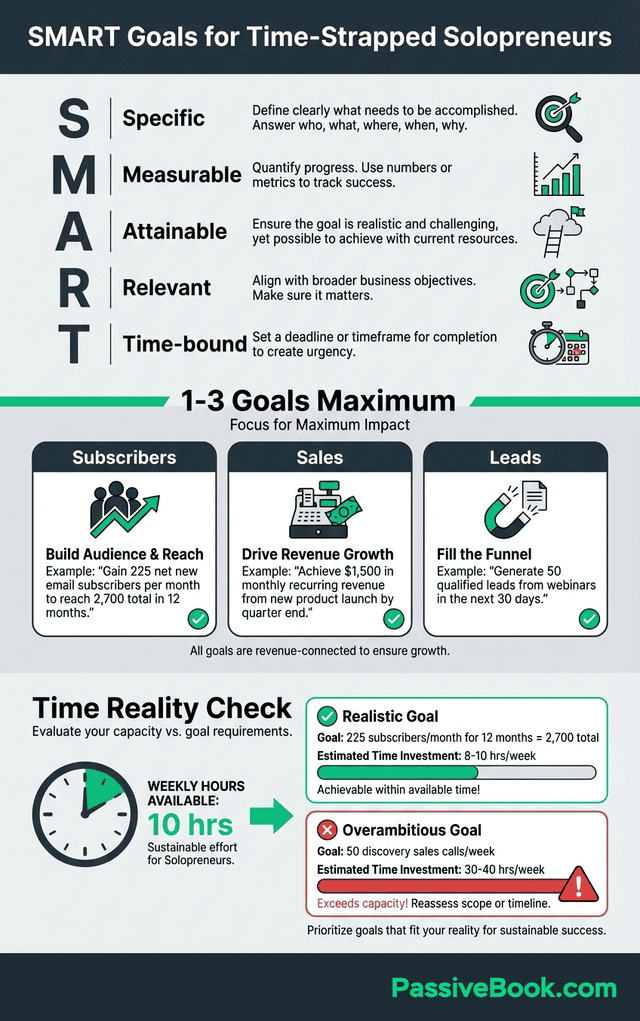
Your goals must respect your time constraints. If you have 10 hours per week, a goal requiring 20 hours of execution will fail. Build your targets around what’s actually possible with your available bandwidth, not what sounds impressive.
Revenue-based goals keep you focused on business growth rather than vanity metrics. Ten thousand Instagram followers who never buy means zero dollars. Five hundred email subscribers who convert at 5% means real revenue you can reinvest or pay yourself.
Choose 1-2 Marketing Channels (not Ten)
Tony Dinh grew from $0 to $45K per month in 2 years focusing exclusively on Twitter. He documented his journey publicly, built an audience, and converted followers into customers. One platform. Complete mastery.
Master one channel before adding a second to avoid spreading time too thin. The math is simple. Ten hours across five platforms means two hours per platform. Ten hours on one platform means depth, consistency, and actual results.
Start where your ideal customer already spends time researching solutions. If they’re searching Google for answers, prioritize search engine optimization and content marketing. If they’re scrolling Twitter for founder stories, build there. Don’t pick platforms because they’re trendy.
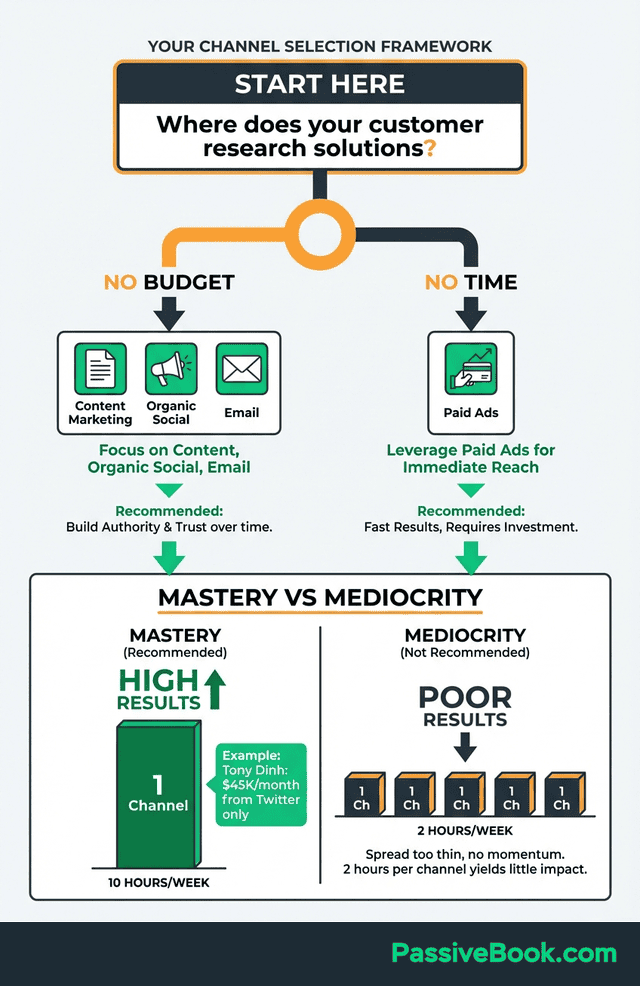
The time-versus-money trade-off determines priority. No budget means content-heavy channels like organic social, blogging, or email. No time means paid channels like Google Ads or Facebook Ads where money buys visibility.
Once you’ve validated one channel and understand what works, you can consider adding a second. But only if you can maintain quality on the first while scaling the second. Multi-channel mediocrity beats single-channel excellence exactly zero times.
Email Marketing for Sustainable Growth
Email marketing generates an average ROI of $36-42 for every $1 spent with 27.6% conversion growth in 2024. This return on investment crushes most other marketing channels available to solopreneurs with limited budgets.
You’re building an owned asset immune to algorithm changes and platform policy shifts. Instagram can tank your reach overnight. Twitter can change verification rules. Your email list belongs to you. No platform controls access to your audience.
ConvertKit offers a free plan for up to 10,000 subscribers with landing pages included. You can start collecting emails today without spending a dollar. The platform grows with you as your list expands and your needs increase.
Email subscribers have higher purchase intent than social media followers. Someone who gives you their email address wants to hear from you. Someone who follows you on Instagram might forget you exist by tomorrow’s scroll session.
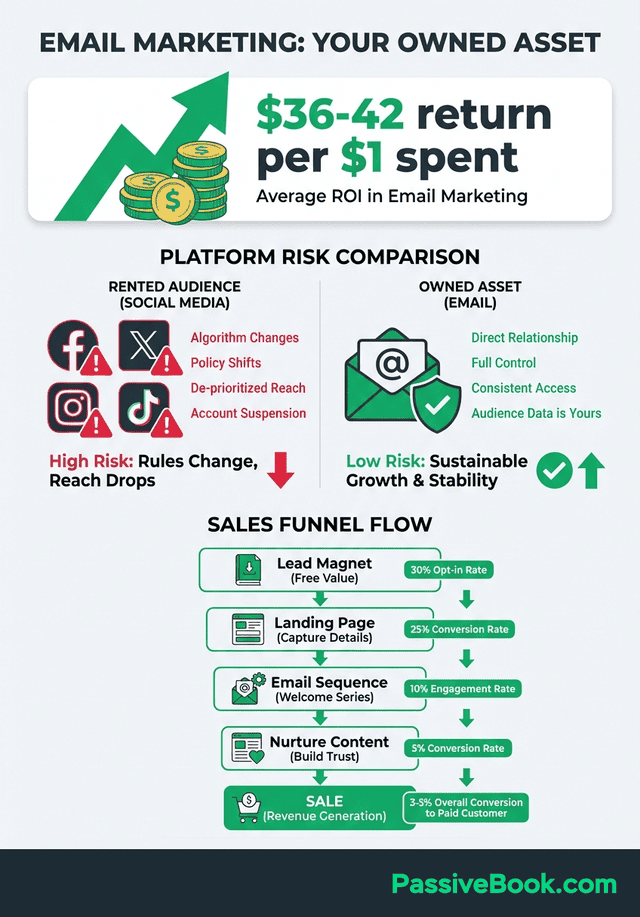
Your email marketing serves as the primary sales funnel for lead generation. Create dedicated landing pages for each lead magnet that focus solely on conversion. Remove navigation menus and competing links. One page, one offer, one clear action. Tools like Convertkit include landing page builders, eliminating the need for separate software.
Start with a simple lead magnet addressing your target audience’s immediate problem. A checklist. A template. A mini-course. Exchange value for email addresses, then nurture those subscribers with consistent, helpful content that builds trust before you ever pitch a product.
Content Marketing and SEO
The Hustle newsletter reached millions of subscribers using a consistent daily content strategy. They published every single morning. No exceptions. That reliability built trust and turned casual readers into devoted fans who opened every email.
Content marketing with search engine optimization creates long-term organic traffic without ongoing per-click advertising costs. This builds brand awareness sustainably as your content ranks for dozens of related queries. Paid ads stop working when budget runs out. Organic traffic compounds month over month.
This channel requires patience. Meaningful results typically take 3-6 months as search engines index your content and your domain authority builds. But the traffic compounds over time sustainably, unlike paid channels where you must continuously spend to maintain visibility.
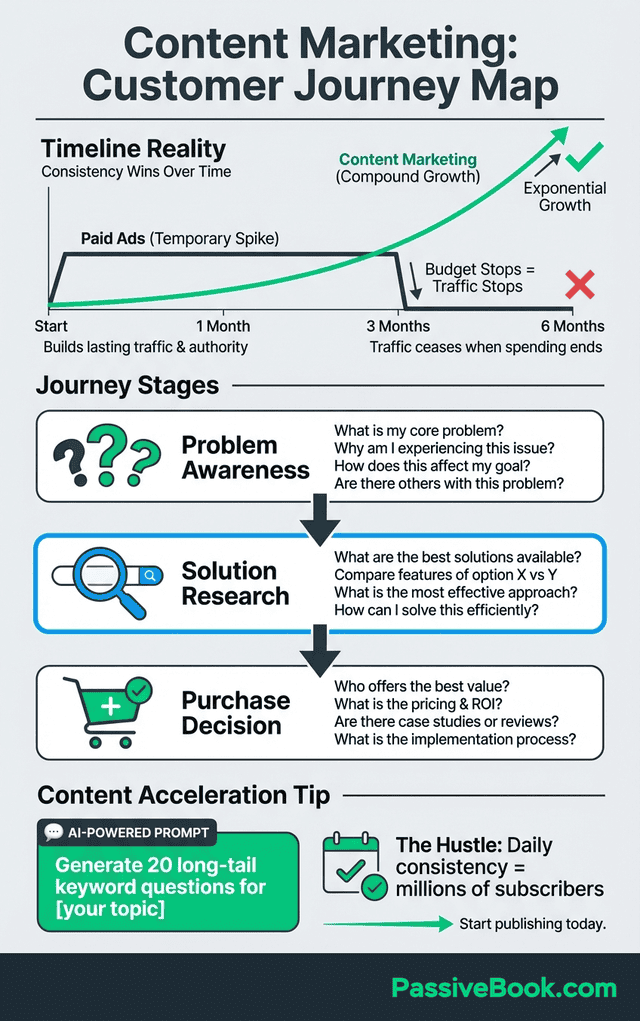
Start by mapping your customer journey from problem awareness to purchase decision. Identify 10-20 specific questions they ask at each stage. Document case studies of successful customer outcomes. Then write step by step answers to those questions optimized for search intent. Use Google’s “People Also Ask” section or tools like AnswerThePublic to find real questions.
To accelerate content creation, ask ChatGPT: “Generate 20 long-tail keyword questions that someone researching [your topic] would search for on Google.” Review the list, validate search volume using free tools like Google Keyword Planner, and build your content calendar around high-potential queries.
Organic Social Media (The Reality Check)
Social media organic reach averages 5.2% of followers. Post to 1,000 followers, and only 52 people see it. This dramatic decline makes organic-only social strategies increasingly difficult for businesses trying to grow without paid amplification.
Meta’s algorithm changes dramatically reduced business page reach for unpaid posts throughout 2024. The platforms prioritize personal connections over business content. Your carefully crafted post gets buried beneath your follower’s cousin’s vacation photos.
The strategic approach uses organic social for discovery, then immediately drives engaged followers to your owned email list. Social media becomes your funnel top, not your final destination. You’re fishing in a rented pond and need to get your catch into your own lake.
Nick Huber built 365,000+ Twitter following that sourced real estate deals by treating Twitter as his funnel top. He shared valuable content, built authority, and converted engaged followers into business relationships. The platform was his discovery engine, not his customer database.
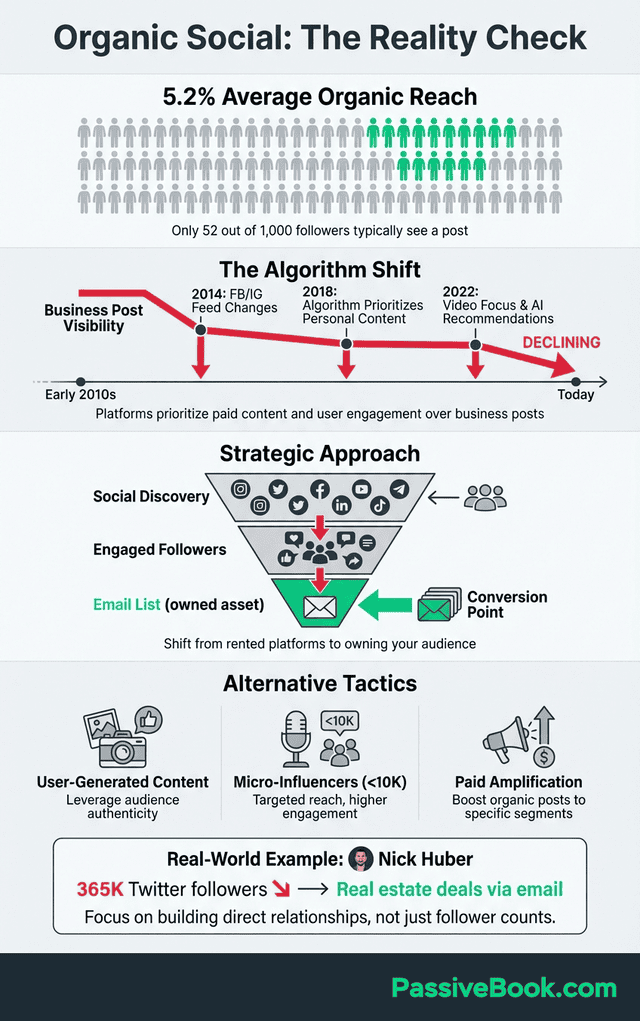
Don’t ignore social media. But don’t delude yourself about organic reach either. Build on social platforms, monetize through owned channels like email. Every piece of social content should include a clear path to join your email list where you control the communication. Consider user generated content from customers and micro-influencer partnerships with accounts under 10K followers. These tactics cost less than ads while providing social proof that organic posts lack.
Build Your Marketing Budget Without Overwhelm
If you’re pre-revenue or very early stage, time replaces money. Content marketing, organic social, and email require sweat equity instead of advertising spend. One hour creating valuable content costs zero dollars but generates compounding returns over months.
If you’re pre-revenue, start with time-based budgeting. Calculate the dollar value of your available hours. If you earn $50/hour at your day job and have 10 hours weekly, that’s $500 worth of time you’re investing. This reframes “free” marketing as costing real opportunity cost and helps you decide when paying for tools makes sense.
Track your actual customer acquisition cost ruthlessly. Spent $500 on Facebook ads that generated 10 customers? That’s $50 per customer. If your average order value is $40, you’re losing money on every sale. Math doesn’t lie about marketing effectiveness.
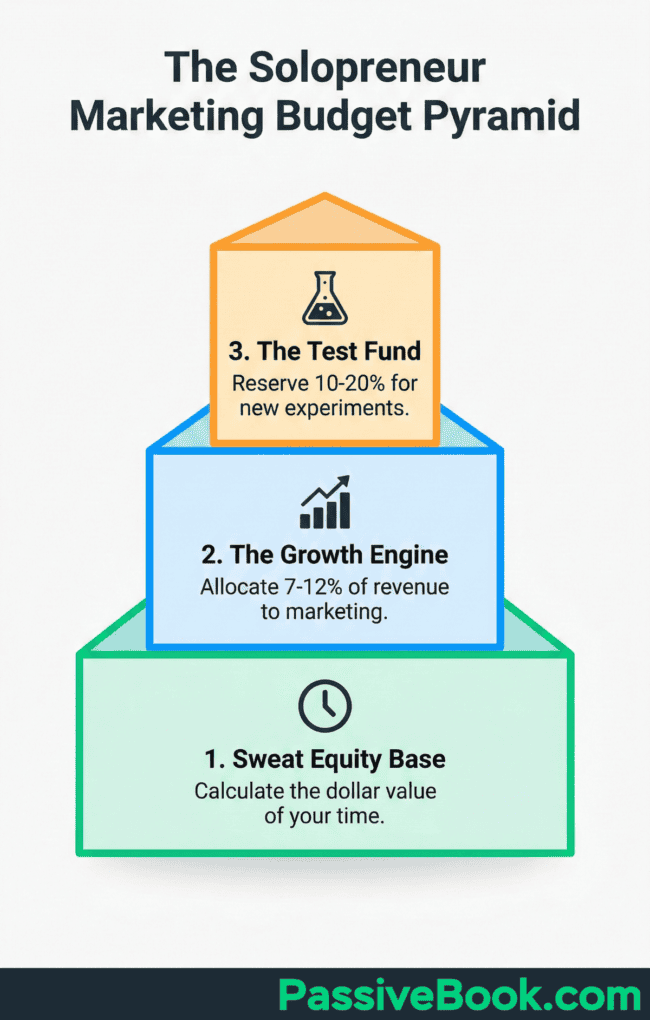
Small businesses typically allocate 7-12% of revenue to marketing depending on growth stage. New businesses need higher percentages for awareness building. Established brands can spend less because they already have recognition and customer loyalty.
Start with your SMART goals and calculate budget needs backward. Need 500 email subscribers at $2 per subscriber? That’s $1,000. Want 50 sales at $20 customer acquisition cost? That’s $1,000. Revenue targets determine spending requirements through clear budget allocation.
Reserve 10-20% of your total marketing budget for testing new creative, platforms, and messaging quarterly. This testing allocation prevents stagnation while limiting risk. You’re not betting the entire budget on unproven experiments, but you’re not ignoring innovation either.
Free and Low-cost Tools to Get Started
Canva Free provides graphic design templates for social posts and marketing materials without requiring design skills. Drag-and-drop interface, thousands of templates, and ability to maintain brand consistency across all visual content.
Google Analytics 4 tracks website traffic and conversion behavior at no cost. See which marketing channels drive visitors, which pages convert best, and where potential customers drop off in your sales funnel. Essential customer data for optimization decisions.
Later schedules social media posts across multiple platforms with a free plan. Write your content in batches during one focused session, then schedule it to publish throughout the week. This batching saves hours compared to posting manually every day.
For project management of your marketing tasks, Trello‘s free plan organizes your 90-day action calendar visually. Most marketing platforms include robust help centers with tutorials, eliminating the need for expensive courses while learning the tools.
These tools eliminate the excuse that marketing requires expensive software subscriptions. A solopreneur can execute professional marketing campaigns using entirely free tools until revenue justifies paid upgrades with advanced features.
The key is starting with free versions and upgrading only when you hit their limits. Paying for features you don’t use yet wastes money that could fund advertising or content creation that actually drives growth.
How AI Changes the Game for Time-strapped Solopreneurs
61% of small businesses use AI to save time on repetitive content tasks. These aren’t Fortune 500 companies with dedicated tech teams. These are solopreneurs automating the grunt work that used to consume their weekends.
51% of marketers use AI tools to optimize content from email to SEO rather than writing everything from scratch. The tools handle first drafts, generate variations for testing, and suggest improvements that would require hours of manual editing.
I personally cut my content creation time from 6 hours to 2.5 hours weekly using AI for first drafts. Instead of staring at a blank screen for 30 minutes brainstorming blog topics, I now ask ChatGPT: “Generate 15 blog post ideas for solopreneurs struggling with marketing budget constraints. Focus on actionable tactics requiring under 5 hours per week.” The tool delivers options in seconds that I can validate and refine.
ChatGPT handles content ideation, email drafts, and social post creation in minutes instead of hours. Feed it your target audience description and ask for social media captions, email subject lines, or blog outlines. Review and edit the output to match your voice.
AI writes blog outlines and generates multiple content variations for A/B testing. AI creates video content from text, turning your blog posts into short-form videos without recording equipment or editing skills.
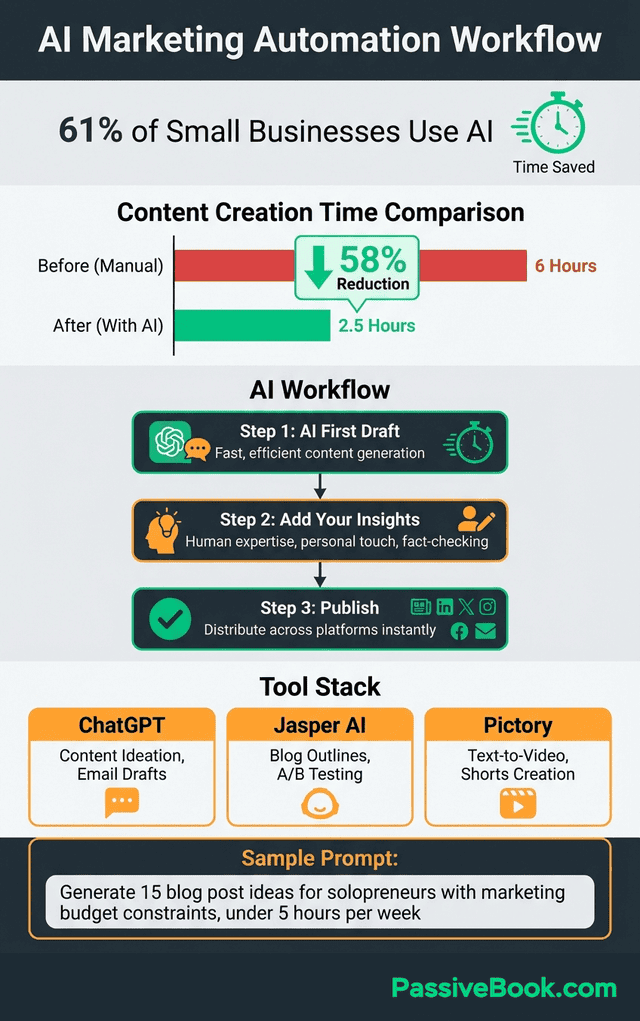
The workflow that works is using AI for speed, then adding your specific insights and personality before publishing. Let the tools handle structure and first drafts. You handle the unique perspective that makes content worth reading.
Create Your One-page Marketing Plan
Document your target customer in 2-3 sentences describing their specific situation, goals, and fears. Write it like you’re describing one real person, not a demographic segment. This clarity drives every other marketing decision you make.
List your 3 key messages that address your customer’s most pressing concerns. These become the themes you return to repeatedly across all content. Repetition creates familiarity. Familiarity builds trust. Trust generates sales.
Identify your primary marketing channel and the specific action you want people to take there. If it’s email, the action is “join my list.” If it’s Twitter, the action is “follow and engage.” One channel. One clear call to action.
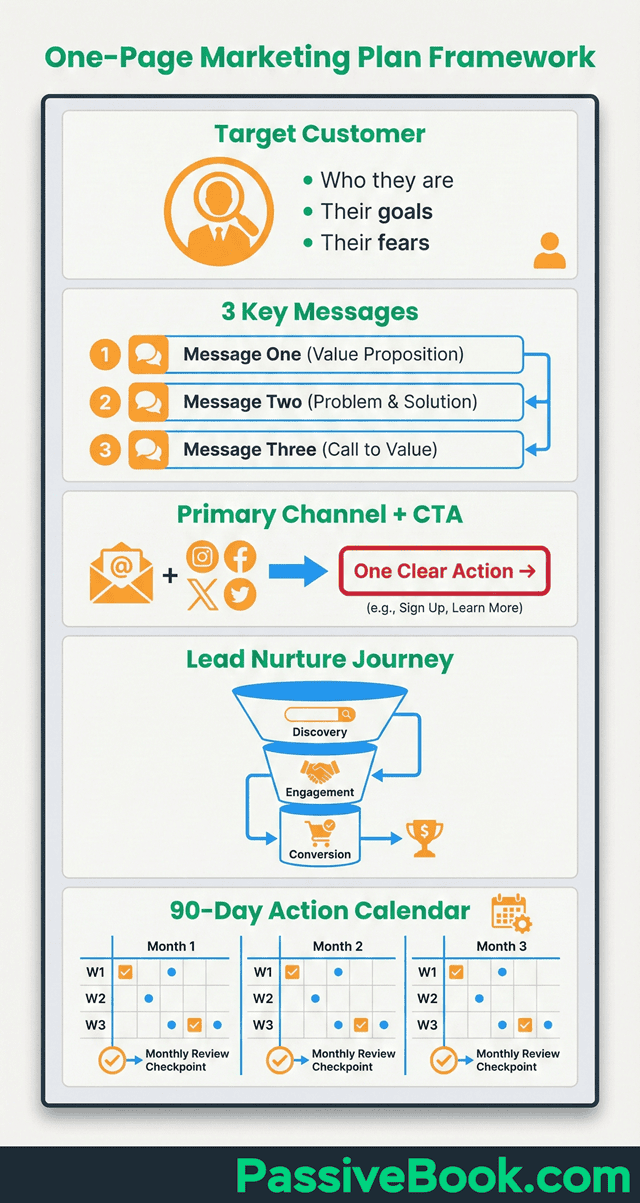
Define your lead nurture method for moving prospects from discovery to purchase. Email sequence? Content series? Direct outreach? Map the journey from first contact to paying customer in 3-5 steps maximum.
Include a 90-day action calendar with specific weekly tasks and monthly review dates. Week 1: Set up landing page. Week 2: Write first 5 emails. Week 3: Create lead magnet. Review and adjust quarterly versus rigid annual planning that becomes outdated before you execute it.
Your one-page plan documents your core marketing strategies without overwhelming detail. List 3-5 specific marketing tactics you’ll execute this quarter under each channel. For example, if email is your channel, tactics might include: weekly newsletter, welcome sequence, product launch campaign. This clarity transforms vague marketing campaigns into executable weekly tasks.
This entire plan should fit on one page that you can reference daily. Complexity kills execution for time-strapped solopreneurs. Simplicity creates momentum and consistent progress toward your revenue goals.
Track What Matters, Test, and Optimize
Focus exclusively on conversion rate, customer acquisition cost (CAC), and customer lifetime value (LTV). These three metrics tell you if your marketing actually generates profit or just burns money. Everything else is noise that distracts from business growth.
Calculate your marketing ROI religiously. Return on investment tells you which channels deserve more budget and which need cutting. Use this formula: (Revenue from campaign – Campaign cost) ÷ Campaign cost × 100. A data driven approach to this calculation prevents emotional attachment to underperforming tactics that feel good but don’t generate profit.
Monitor email open rates against industry benchmarks for your sector. Track click-through rates to see which messages drive action. Measure revenue per channel to identify your highest-performing traffic sources.
Don’t obsess only over new customer acquisition while ignoring customer retention. Repeat customers cost 5-7x less to convert than new ones. Focus on customer experience improvements and simple loyalty programs like exclusive discounts for returning buyers. Retaining customers drives sustainable growth more efficiently than constantly chasing new ones.
Successful newsletter operators track subscriber growth and revenue per subscriber rather than follower counts. Ten thousand Twitter followers who never buy contributes nothing to paying your bills. One thousand email subscribers who each spend $50 annually contributes $50,000.
Newsletter growth case studies show that tracking engagement by source identifies most effective acquisition channels. You discover that guest posts drive subscribers who convert at 8% while Facebook ads drive subscribers who convert at 2%. That data redirects budget from ineffective channels to winners.
Test one variable at a time to isolate what actually drives results. Change subject lines this week. Test posting times next week. Try new content topics the following week. Testing multiple variables simultaneously creates confusion about which change caused improvement.
Run 90-day test periods before cutting underperforming channels or tactics. Some marketing strategies need time to compound before showing results. Content marketing takes months to gain traction. Cutting it after 30 days wastes the investment just before it would start paying off.
Frequently Asked Questions
How Do I Create an Online Marketing Plan?
Start by defining your target audience in specific detail and choosing one primary channel where they already spend time. Document your unique value proposition, set 1-3 measurable goals for the next 90 days, and create a simple action calendar. Your complete plan should fit on one page you can reference weekly to stay focused on revenue-generating activities.
What Is the 3-3-3 Rule in Marketing?
The 3-3-3 rule suggests posting 3 times per day across 3 different platforms for 3 months to build audience. This approach works for full-time content creators but overwhelms time-strapped solopreneurs with limited hours. Focus on mastering one platform with consistent quality over spreading yourself thin across multiple channels with mediocre content.
What Is the 7 Times 7 Rule in Marketing?
The 7 times 7 rule states that prospects need to see your message 7 times across 7 different touchpoints before making a purchase decision. This emphasizes the importance of multi-channel presence and consistent repetition. For solopreneurs, achieve this through email sequences, retargeting ads, and content that prospects encounter multiple times throughout their research journey.
What Are the 5 C’s of Marketing Strategy?
The 5 C’s are Company, Customers, Competitors, Collaborators, and Climate. Analyze your own strengths, deeply understand customer needs, research competitor positioning, identify partnership opportunities, and monitor market trends. This framework helps solopreneurs assess their market position and identify gaps where their unique value proposition can stand out effectively.
How Much Time Does Marketing Take Weekly?
Effective marketing for solopreneurs requires 5-10 hours weekly minimum when using AI tools and batching content creation. Manual approaches without automation demand 15-20 hours for comparable results. Time investment decreases as you build systems, create templates, and repurpose existing content across channels rather than starting from scratch every week.
What Next?
You now have the framework for creating a marketing plan that respects your time constraints and budget limitations. This isn’t theory from a marketing agency pitching expensive services. This is the simplified approach that actually works when you’re building a business in stolen hours between your day job and family commitments.
Marketing can feel overwhelming when you’re comparing yourself to brands with dedicated teams and six-figure budgets. You’re not competing with them. You’re building something sustainable that serves your goals, whether that’s replacing your income or creating meaningful side revenue. Simple beats complex when execution matters more than perfection.
If you found this guide valuable, hit the share buttons below this article. Share it with another solopreneur who’s drowning in conflicting marketing advice and needs a clear path forward. Your recommendation helps them discover the resource they’re desperately searching for.
Drop a comment below answering this question: What’s the single biggest marketing challenge you’re facing right now in your online business? I read every comment and your answer helps me create content that addresses the real problems solopreneurs actually struggle with daily.
Share this post with your friends & followers: