I spent three months building an online course nobody wanted. I researched competitor pricing, designed professional slides, and recorded 40 videos. When I finally launched, seven people bought it. The problem wasn’t the quality – I never confirmed anyone actually wanted to solve that specific problem before I invested hundreds of hours.
Market research sounds expensive and corporate, but it doesn’t have to be. This guide shows you how to validate your online business idea in one focused week using free tools and a few hours of work. You’ll learn the exact questions to answer, where to find real customer conversations, and when to stop researching and start building.

- •What Is Market Research for Solopreneurs?
- •Why Market Research Matters When You're Building Alone
- The Three Questions That Replace Traditional Research
- 3 Free Research Tools Every Solopreneur Needs
- •How AI Tools Changed Market Research in Recent Years
- •Your Research Success Scorecard
- Quick Validation Methods by Business Type
- •Your 5-hour Weekly Research Framework
- •When to Stop Researching and Start Building
- •Frequently Asked Questions
- •What Next?
What Is Market Research for Solopreneurs?
Market research for solopreneurs means confirming paying customers exist before you invest 100+ hours building your product or service.
It’s about understanding the exact language your customers use so you can write copy that converts without expensive tools or guesswork.
Twenty percent of small businesses fail within their first year according to Bureau of Labor Statistics data. Many of these failures happen because founders build something nobody wants to buy.
Traditional market research methods require focus groups, academic surveys, and months of analysis – luxuries solopreneurs don’t have.
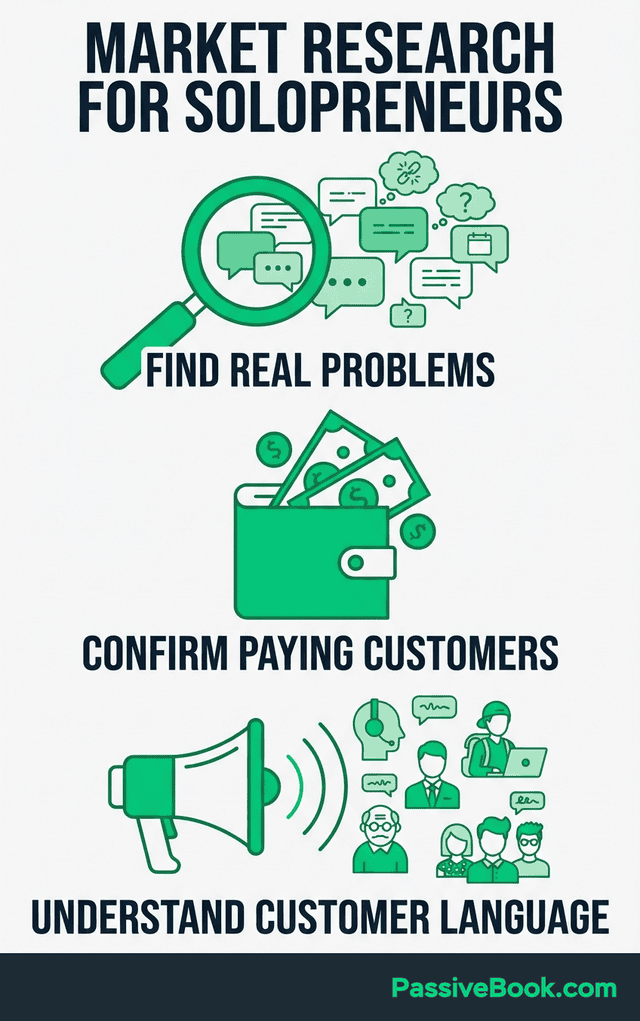
For time-starved small business owners, research means finding existing conversations where people complain about actual problems and budget money to fix them. It means discovering where your target market already gathers online. Understanding your target market’s behavior patterns matters more than demographic data.
This approach takes hours, not months, and costs nothing beyond your time. You don’t need to pay $20,000 for consultant reports, run formal focus groups, or spend six months collecting data before you take action. Small business owners need speed and clarity, not perfection.
Why Market Research Matters When You’re Building Alone
Half of small businesses survive to their fifth year according to Bureau of Labor Statistics data, with lack of market need being a primary failure factor.
When you’re building alone, every hour matters. You can’t afford to waste months on a business idea nobody wants.
I learned this the hard way with my first dropshipping store. I picked products I thought were clever without checking if anyone actually searched for them. After three months of tweaking product pages and running ads, I had spent $400 and made exactly zero sales. The demand simply wasn’t there. Research from multiple failed ventures shows me that validating demand first would have saved me months of wasted effort.
You’ll price correctly when you see what people already pay for similar solutions.
It reveals where your potential customers gather online so you can reach them without expensive advertising. Most importantly, it identifies the real pain points people complain about daily and have budget allocated to fix.
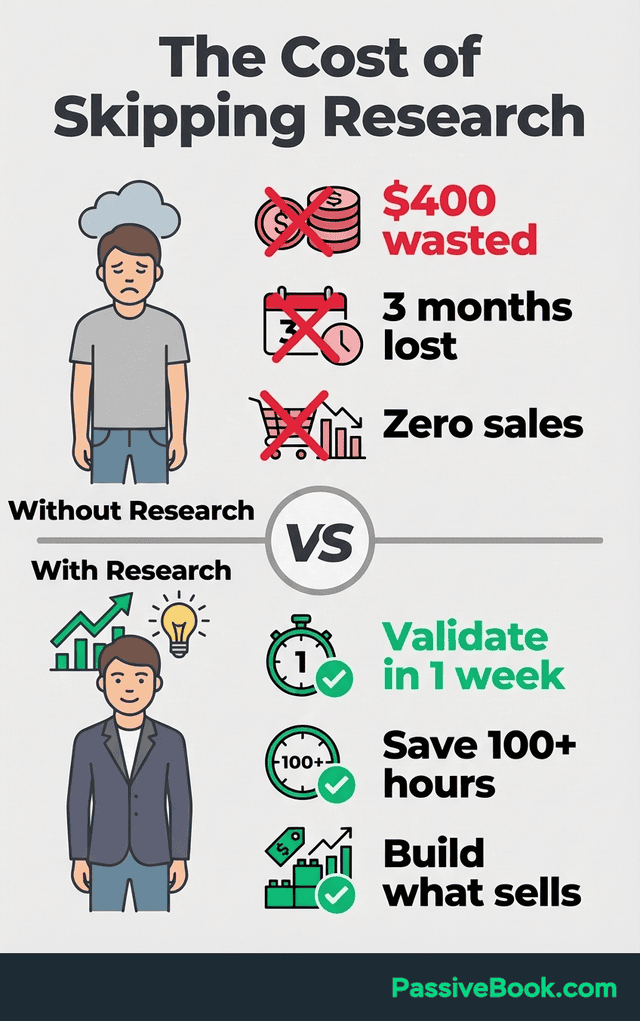
The traditional approach requires $20,000+ budgets that solopreneurs building their first online business simply don’t have.
Those expensive methods made sense for corporations launching nationwide products, but they create impossible barriers for someone testing an online course idea with 10 hours per week. Focus groups and professional research firms charge $5,000-15,000 for insights you can extract from Reddit threads for free.
Skipping research creates predictable traps. Asking friends “Would you pay for this?” generates polite yeses that don’t translate to real purchases. Analysis paralysis from overthinking prevents action – one week of focused research beats months of endless data collection. Surveying interest doesn’t equal validation because one paying customer proves more than 100 “yes” survey responses from people who risk nothing.
Your scarcest resource is time, not money. Research protects that resource by preventing you from building something the market doesn’t want.
The Three Questions That Replace Traditional Research
Answer these three questions in one focused week instead of spending months on traditional analysis. Each question validates a different failure risk before you make any major time investment. Speed matters more than perfection when testing early-stage business ideas.
Behavior reveals truth that surveys hide. You’re researching your target market’s actual spending patterns, not their stated intentions. People lie in surveys but their wallets tell the truth. You’re looking for evidence of real money changing hands, not promises about future purchases.
Question 1: Are People Already Paying to Solve This Problem?
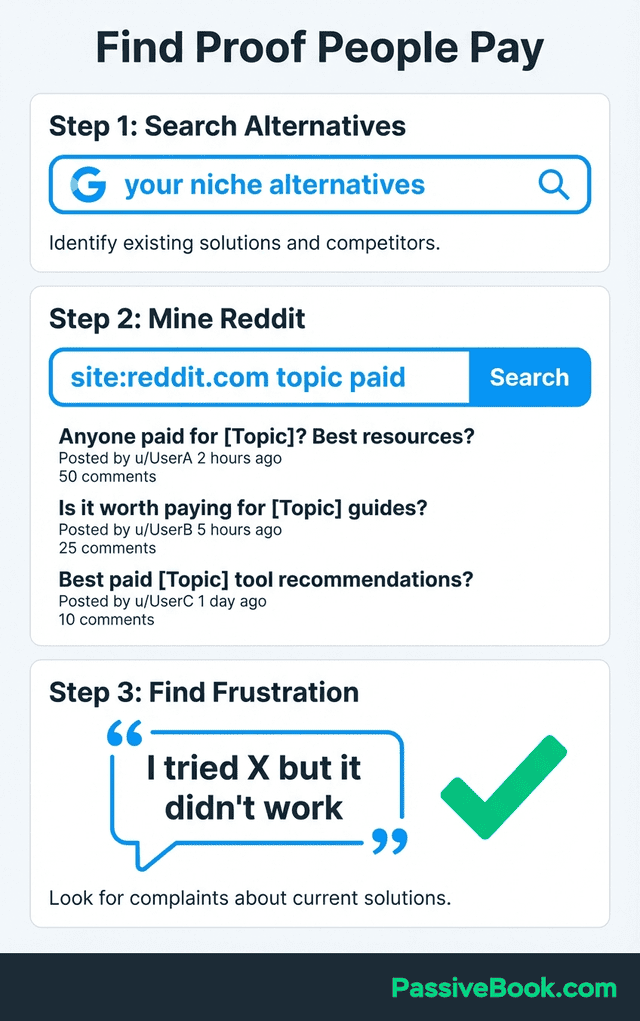
Search “[your niche] alternatives” to find existing paid competitor reviews. This simple competitive analysis takes 20 minutes and reveals if real money changes hands in your niche. Real problems make people try multiple failed solutions and actively budget fixes. If nobody sells anything remotely similar, you probably don’t have a viable market.
Look for workarounds people purchased, not just free advice they consume.
Someone watching YouTube tutorials for free doesn’t validate demand. Someone who bought three different courses trying to solve the same problem absolutely does.
Use Reddit’s search operators to find posts mentioning paid solutions and product recommendations.
Type “site:Reddit.com [your topic] paid” or “site:Reddit.com [your topic] bought” to surface real purchase discussions. When multiple people mention paying for solutions, even imperfect ones, you’ve found evidence of market demand.
The key signal is frustration with existing options. When people say “I tried X but it didn’t work” or “Y is too expensive,” they’re showing you where opportunity exists.
Question 2: Can You Find Your Audience in Under 10 Minutes?
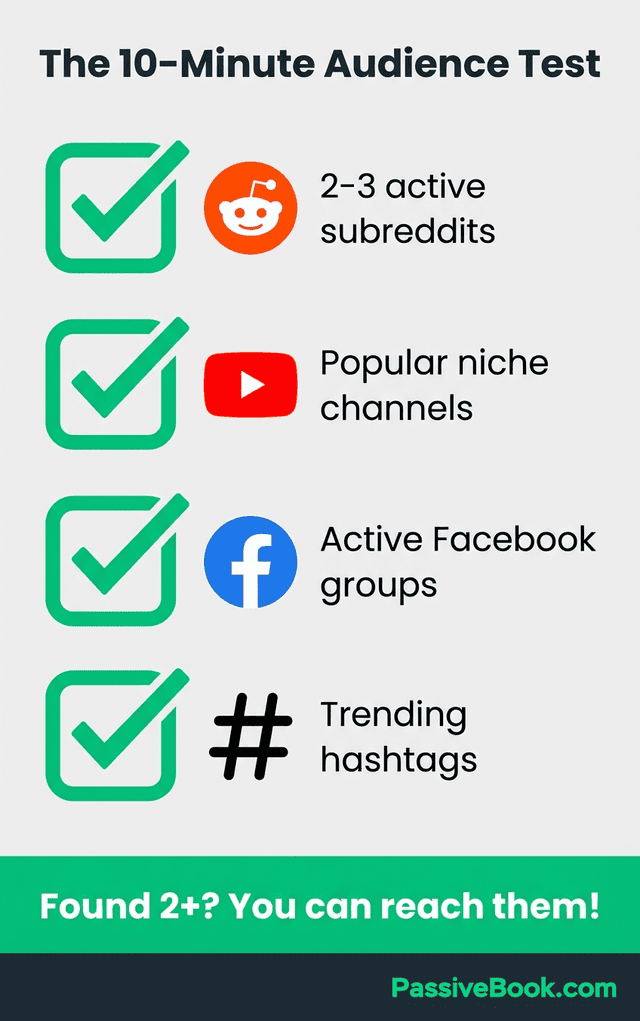
Identify specific subreddits, YouTube channels, podcasts, and hashtags your target market uses daily.
If you can’t locate them quickly, reaching customers will cost more than your limited budget allows. This question prevents the common mistake of building for an audience that doesn’t congregate anywhere online.
Check where competitors advertise using the Facebook Ad Library for free.
Search for any business in your niche to see their active ads, which platforms they target, and what messaging they use. This reveals where they’re finding success reaching similar customers.
Use the search “[your topic] Reddit” to find active communities discussing your niche. If multiple subreddits exist with thousands of members posting daily, you’ve found your audience. If you only find one tiny subreddit with three posts from two years ago, that’s a red flag about market size.
Look for at least two or three places where your target audience already gathers. One community might be a fluke. Multiple active communities signal a real market you can tap into.
Question 3: Can You Get Commitments Before You Build?
Offer discounted early-bird pricing to gauge genuine purchase intent versus survey interest. Five paying customers validates demand better than 100 survey “yes” responses from people who risk nothing. Pre-selling validates demand effectively by testing if people will pay before you build anything.
Create a simple landing page explaining your planned product or service and the problem it solves.
Offer a 40-50% discount to the first 10 buyers who commit now. If nobody takes the offer, you’ve learned the market isn’t willing to pay without investing months building the full product.
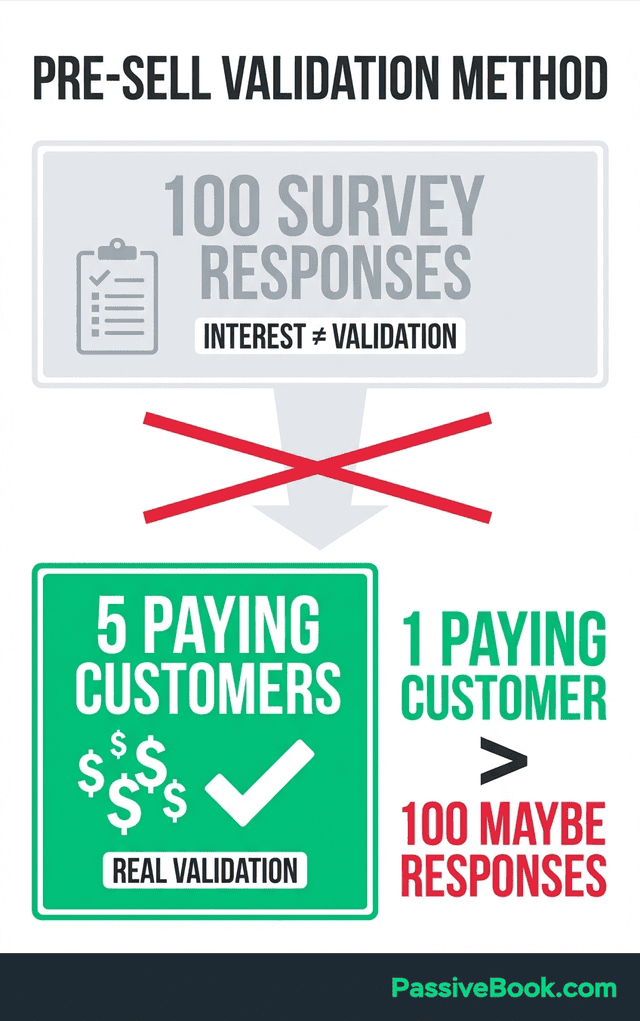
Alternative signals include waitlist signups with deposits, pre-orders for physical products, or sponsorship interest for content. Real commitment requires friction. People must give you something valuable like money or a credit card to demonstrate real intent. Email addresses alone don’t prove demand.
If you struggle to get even five commitments after reaching out to relevant communities, that’s crucial feedback.
Either your positioning is wrong or the demand doesn’t exist at your price point. Both insights save you from wasting months building the wrong thing.
3 Free Research Tools Every Solopreneur Needs
Combine three free tools for validation without expensive subscriptions or enterprise software.
Focus on behavior patterns rather than vanity metrics like social media likes or follower counts. Time investment beats money investment when bootstrapping your first online business. Skip expensive industry reports and consultant fees.
Search data reveals problems people actively seek solutions for, not problems they claim matter. Community discussions expose the exact language your target audience uses. Together, they give you everything needed to validate demand.
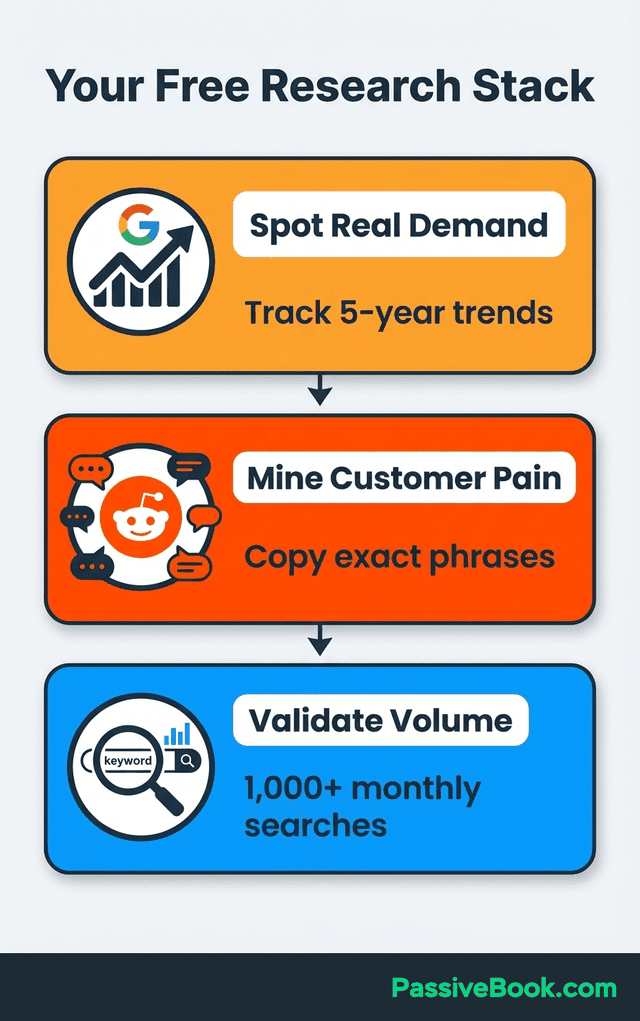
Google Trends: Spotting Real Demand
Google Trends reveals industry trends showing whether your topic has sustainable long-term demand or temporary hype that will disappear. Compare related search terms to identify rising versus declining interest over time. A topic trending upward over five years signals opportunity. A sharp spike followed by decline warns you away.
Filter by region and timeframe to match your target market’s location and planning horizon. If you’re targeting US customers, don’t make decisions based on global data that might reflect different markets. Set your timeframe to “Past 5 years” for strategic perspective. I ignored this once and built a course for a US audience based on global data dominated by Indian searches. The search intent was completely different. Don’t make my mistake.
Look for consistent interest rather than temporary spikes that disappear quickly.
A trending news story creates short-term search volume that collapses after the news cycle ends. Sustained interest month after month indicates real problems people continuously try to solve.
Compare your main idea against three related alternatives. If “online course creation” shows steady growth while “membership sites” declines, that comparison informs your business model choice. Market trends like these help you pick the rising opportunity instead of the fading one.
Reddit: Mining Unfiltered Customer Pain Points
Search “[your topic] problems” and sort by Most Comments to find active discussions where people vent real frustrations. Identify recurring complaints mentioned across multiple threads with high engagement. When the same problem appears in five different discussions, you’ve found something worth solving.
Copy exact phrases people use for headlines, bullets, and marketing copy. These authentic words convert better than anything you’d invent because they match how your target audience actually thinks and speaks. Someone saying “I waste three hours every week doing X manually” gives you perfect copy: “Stop wasting three hours per week on X.”
Fair warning: you’ll lose 30 minutes falling down Reddit rabbit holes. I’ve started researching coffee maker problems and ended up reading conspiracy theories about espresso machine manufacturers. Set a timer.
The Reddit search syntax guide helps you find actual pain points and product discussions efficiently. Advanced operators let you search within subreddits, filter by date, or exclude certain terms to refine results quickly. Pay attention to threads where people ask for tool recommendations. When someone posts “What’s the best way to…” and receives 50 comments suggesting different paid solutions, you’re seeing proof that people in this niche purchase products. That behavior validates market demand better than any survey.
You can speed up this process by copying 10-15 high-quality Reddit threads into ChatGPT with this prompt: “Analyze these customer discussions and identify the top 5 recurring pain points mentioned. For each pain point, give me the exact phrases customers use and estimate how frequently it appears.” This compresses hours of manual reading into a 10-minute synthesis.
Google Keyword Planner: Validating Search Volume
Google Ads provides free access to Keyword Planner; no ad spend required to access the data. Search volumes confirm if enough potential customers want your solution monthly to sustain a solopreneur business. Competition levels reveal whether markets are oversaturated or opportunity-rich.
Create a Google Ads account and navigate to Tools > Keyword Planner > Discover New Keywords. Enter your core business idea and 3-4 related phrases. The tool returns monthly search volume ranges and competition indicators for each term.
Look for 1,000+ monthly searches as a signal of sufficient demand for solopreneur businesses. These search volumes help you estimate market size without expensive reports. A keyword with 10,000 monthly searches reaching 3% of searchers means 300 potential monthly customers – enough to sustain a solopreneur business. Lower volumes might work for high-ticket products, but most solopreneurs need volume to generate enough transactions. Check related keywords too – sometimes a slight variation gets 10x more searches than your original phrase.
Don’t obsess over exact numbers. The difference between 1,200 and 1,800 monthly searches doesn’t matter. You’re looking for signals of magnitude – hundreds vs. thousands vs. tens of thousands.
Competition marked as “Low” or “Medium” suggests opportunity. “High” competition means established players dominate the space, making customer acquisition expensive. For solopreneurs with limited budgets, medium competition often provides the best balance of demand and achievable market entry.
Compare search volumes across your top three business ideas. Data showing one idea gets 10,000 monthly searches while another gets 200 makes your decision obvious. Let market research resources like this steer you toward bigger opportunities.
How AI Tools Changed Market Research in Recent Years
ChatGPT analyzes competitor strategies and market positioning in minutes versus days of manual research. AI market research tools accelerate data synthesis, helping solopreneurs analyze customer feedback and identify patterns faster than traditional manual methods.
Paste customer conversations from Reddit, Amazon reviews, or support tickets directly into an AI tool to identify recurring pain points across hundreds of comments. Use this prompt: “Extract the top 10 customer pain points from these conversations, rank them by frequency, and give me the exact phrases customers used.” This transforms overwhelming data into actionable insights.
Turn raw research into detailed customer personas in minutes instead of hours of spreadsheet organizing. After collecting your Reddit threads and review data, ask: “Based on these customer conversations, create 3 detailed customer personas including their goals, frustrations, budget constraints, and where they spend time online.” The AI synthesizes patterns you’d miss manually.
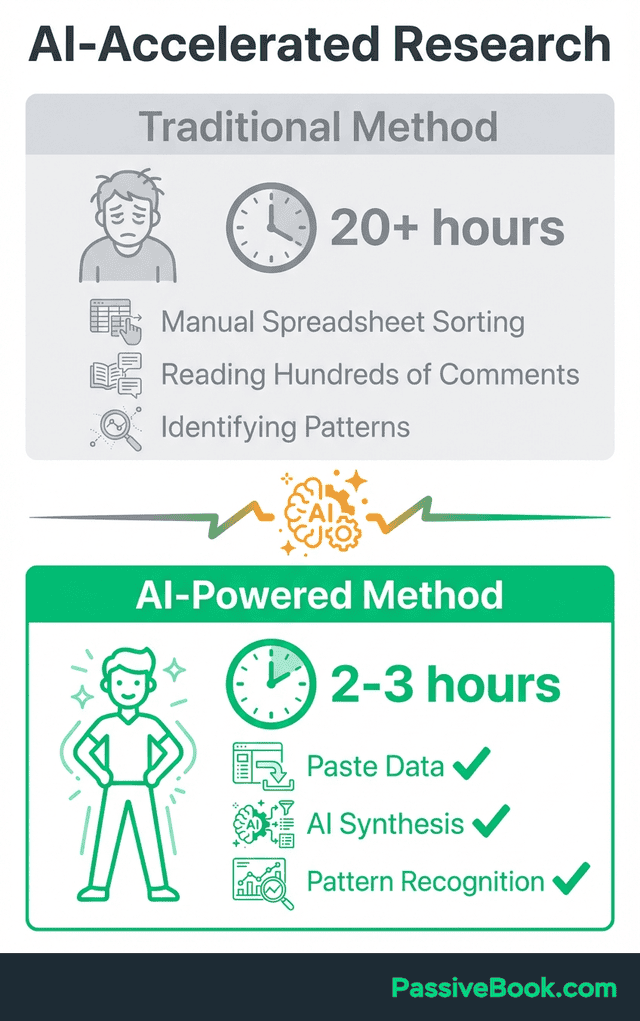
AI compresses what took 20+ hours of manual analysis into 2-3 focused research sessions.
You still need to collect the raw data from real customer conversations, but the synthesis and pattern recognition happens exponentially faster. This speed matters when you only have 5-10 hours per week for your entire business.
Use AI for synthesis and pattern recognition, not as replacement for primary research. The tool identifies trends from existing data but can’t replace talking to real customers. You still need to find where your target market gathers and what real people say about their problems.
For competitive analysis, try this workflow: Find 3-5 competitor websites and paste their About pages, service descriptions, and pricing into ChatGPT. Prompt: “Analyze these competitors and identify: 1) Their unique positioning, 2) Gaps in their offerings, 3) Common price points, 4) Language patterns they use.” This gives you market positioning insights without expensive tools.
Your Research Success Scorecard
Use these benchmarks to measure if your research validates demand:
Search Volume Test: Google Keyword Planner shows 1,000+ monthly searches for your core topic. Lower volumes work for high-ticket offers ($500+), but most solopreneur businesses need volume.
Community Presence Test: You find at least 2 active online communities with 5,000+ members discussing your topic. Posts from the last week should have 20+ comments showing engagement.
Commitment Test: After presenting your idea to 50-100 relevant people, at least 5 commit with money or deposits. If you can’t get 5 commitments from 100 qualified prospects, either your positioning is wrong or the market doesn’t exist.
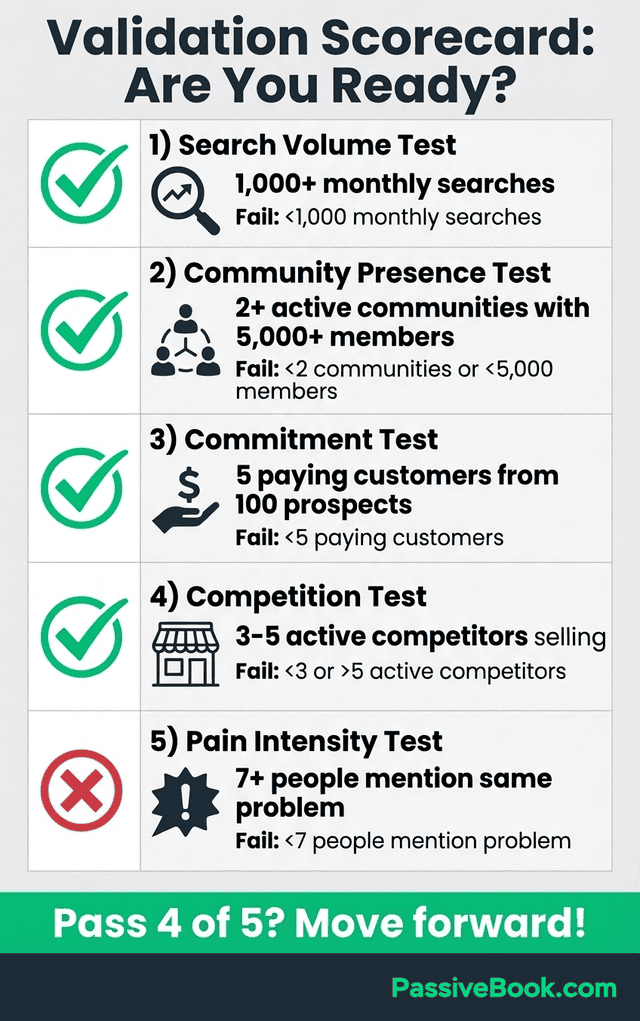
Competition Test: You identify 3-5 competitors actively selling similar solutions. This proves people pay to solve the problem. Zero competitors usually means zero market, not opportunity.
Pain Intensity Test: Customer conversations reveal recurring frustrations mentioned by 7+ people. They describe current workarounds costing time or money. Mild annoyances don’t drive purchases.
Hit 4 of these 5 benchmarks? Move forward. Hit fewer than 3? Pivot or refine your positioning.
Quick Validation Methods by Business Type
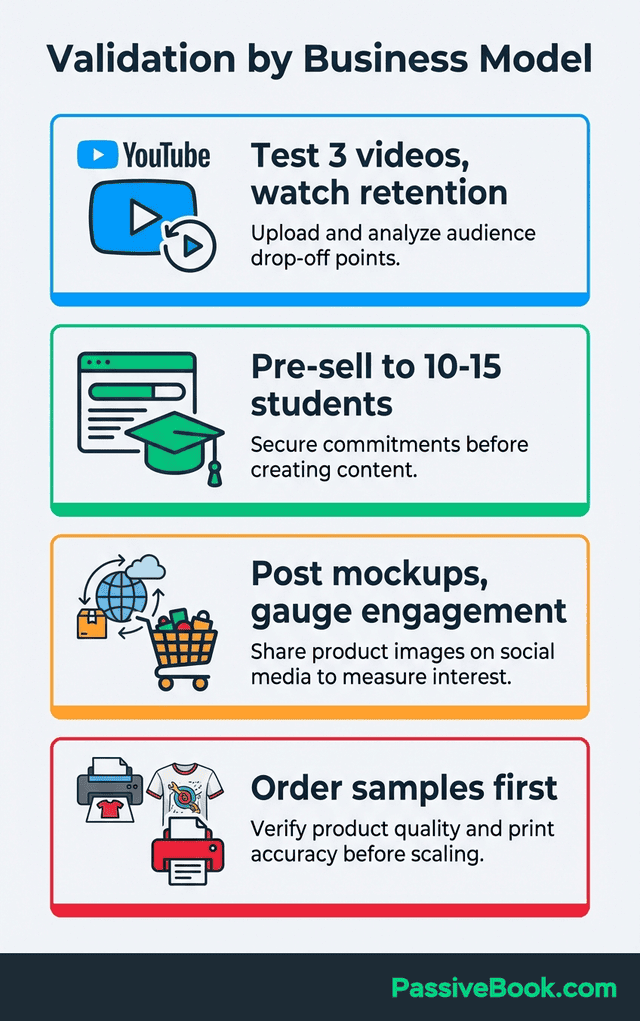
Tailor your validation approach to your business model for faster decisions. Each method requires 5-10 hours maximum to execute and get clear yes or no signals about demand. Stop after getting those signals instead of collecting endless data that creates analysis paralysis.
Different online business models need different proof points. A YouTube channel needs video engagement data while an online course needs pre-sale commitments. Matching your validation method to your business type speeds up the process dramatically.
Youtube Channels: Testing With 3 Videos
Create three videos on different subtopics within your niche to test interest before committing to a full content calendar. YouTube retention rates average 40-50% in the first 30 seconds according to Hootsuite data; strong content maintains 60% or higher retention. If you exceed industry averages early, it signals strong niche fit.
Pick three different angles within your broader topic. If your niche is “budget meal prep,” test one video on “5-ingredient recipes,” another on “meal prep for weight loss,” and a third on “30-minute Sunday prep.” Different subtopics attract different audience segments.
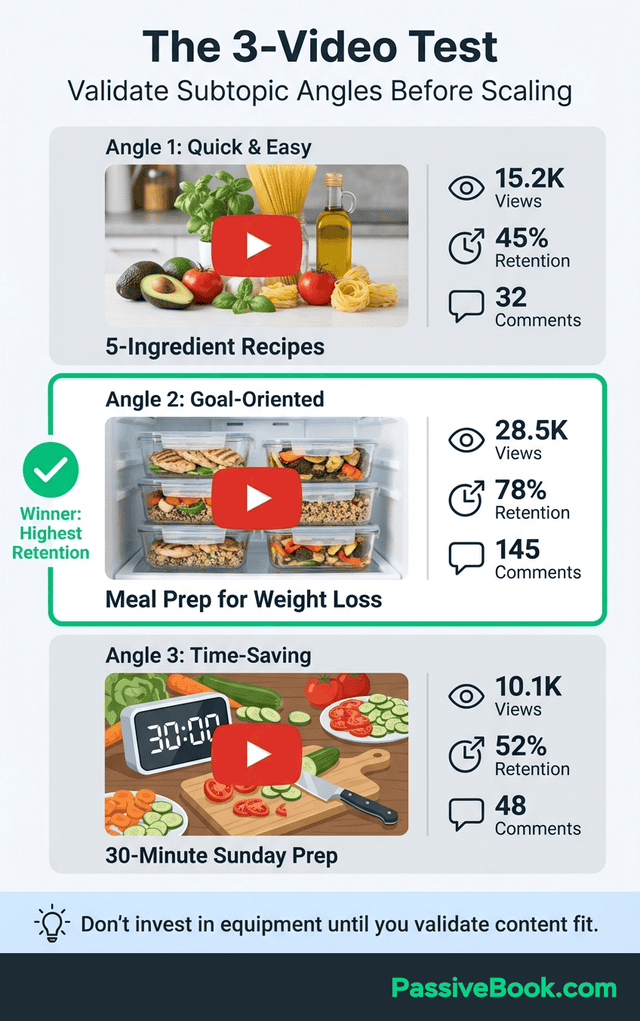
Analyze which video gets the highest retention and most comments within the first week. Comments reveal content gaps competitors miss that you can fill. When viewers ask specific questions, those questions become your next video topics.
Don’t invest in expensive equipment or editing software until you validate that people watch your content. Record on your phone, edit with free tools, and focus entirely on delivering value. Production quality matters far less than topic selection at this stage.
Online Courses: The Pre-sell Method
Pitch your course with a detailed outline before creating any content modules. Offer early-bird pricing at 40-50% discount for immediate commitments only. Test course demand through pre-launch waitlists offering early access to gauge real interest before building anything.
Write a compelling landing page that explains the transformation your course delivers and the problems it solves. Break down the curriculum into 6-8 clear modules so people understand exactly what they’re buying. Add your bio to establish credibility.
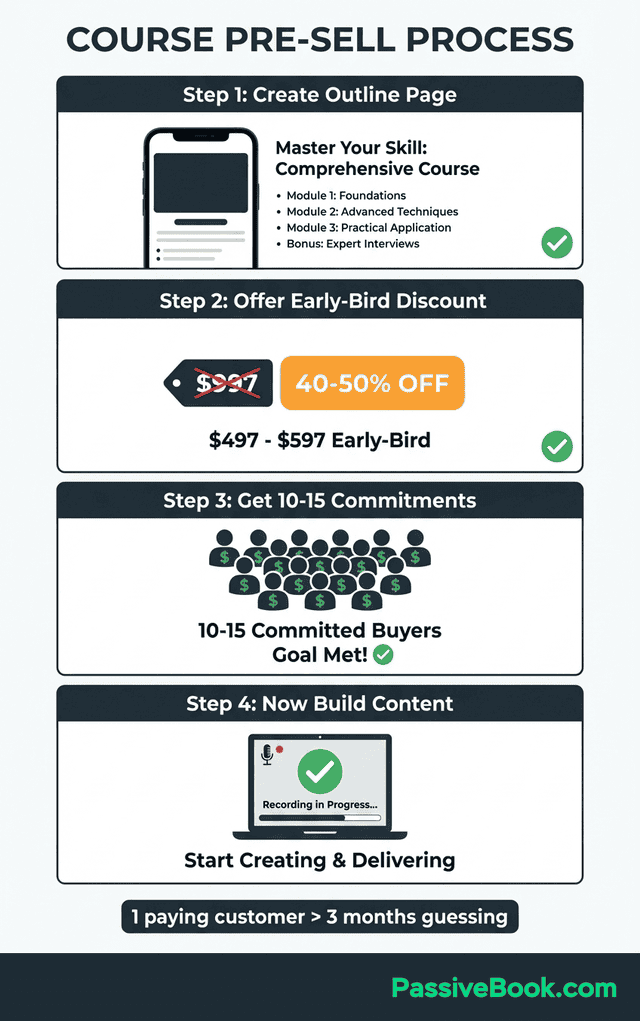
Aim for at least 10-15 pre-sale commitments to validate demand. At a $150 course with 40% discount, that’s $90 per student and $900-1,350 in validated revenue before you record a single lesson. Pre-selling eliminates startup costs by funding course creation with customer deposits. You’re not investing your own money until customers prove they’ll pay. This proves people will pay and funds your course creation.
If you struggle to get even 10 commitments after promoting in relevant communities, you have three options. Lower your price to test if it’s a pricing issue. Revise your positioning to address different pain points. Or accept that demand doesn’t exist and pivot to a different course idea.
The beauty of pre-selling is speed. You can validate or invalidate a course idea in one week instead of spending three months creating content nobody wants. One paying customer proves more than theoretical market research ever could.
Dropshipping and Print-on-demand: Product Research
Validate print-on-demand (POD) products through social media posts testing design engagement before inventory investment. Focus on niches with strong demand but manageable competition levels using the free tools covered earlier. Post designs on Instagram or Pinterest to gauge organic engagement before placing any orders.
Create 5-10 product mockups using free design tools and post them to relevant Facebook groups or subreddit communities. Ask “Which design would you wear?” or “What do you think of these?” Comments and shares signal interest. Orders or “Where can I buy this?” messages signal real demand.
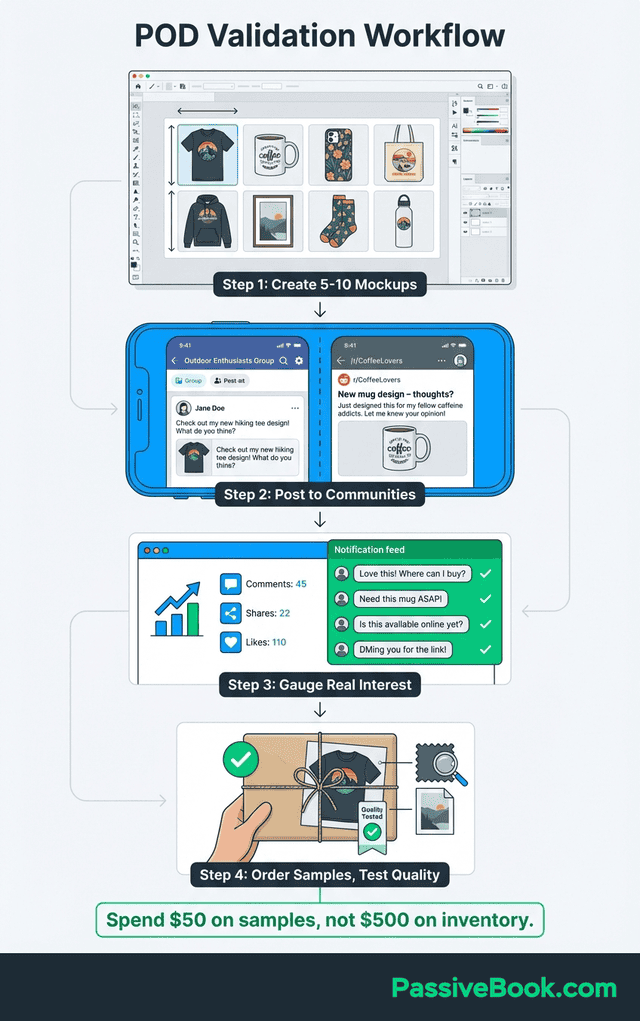
Order samples to validate quality before large-scale launch, preventing costly errors. Print-on-demand services typically charge $15-25 per sample. Spending $50 to test three products beats investing hundreds in inventory nobody wants. Check fabric quality, print clarity, and sizing accuracy.
Use Google Trends to confirm your product niche shows stable or growing interest. Combine that with Google Keyword Planner data showing 5,000+ monthly searches for products in your niche. Layer in Reddit discussions where people ask for product recommendations to complete your validation.
The critical mistake is assuming a product will sell because you like it. Validation requires external signals from strangers willing to open their wallets. Test in communities where you aren’t known to get honest feedback.
Your 5-hour Weekly Research Framework
This framework condenses market research into a repeatable weekly process anyone can execute alongside a full-time job. Set a strict one-week deadline for your initial research sprint to prevent overthinking and analysis paralysis. Track what you learn in a simple document, not complex spreadsheets that slow you down. Research works regardless of your business location or time zone.
The framework frontloads tool-based research in the first two hours, then dedicates the remaining three hours to qualitative research where you extract customer language and identify patterns. This sequence works because quantitative data narrows your focus before you dive into conversations.
Hour 1-2: Run keywords through free tools and analyze search volume trends. Open Google Keyword Planner and enter your core business idea plus 10 related phrases. Export the results. Switch to Google Trends and compare your top three keyword variations over a five-year timeframe. Screenshot the trend graphs.
Spend the second hour organizing this data. Which keywords show the strongest sustained interest? Which have adequate search volume above 1,000 monthly searches? Write down your top five validated keyword opportunities.
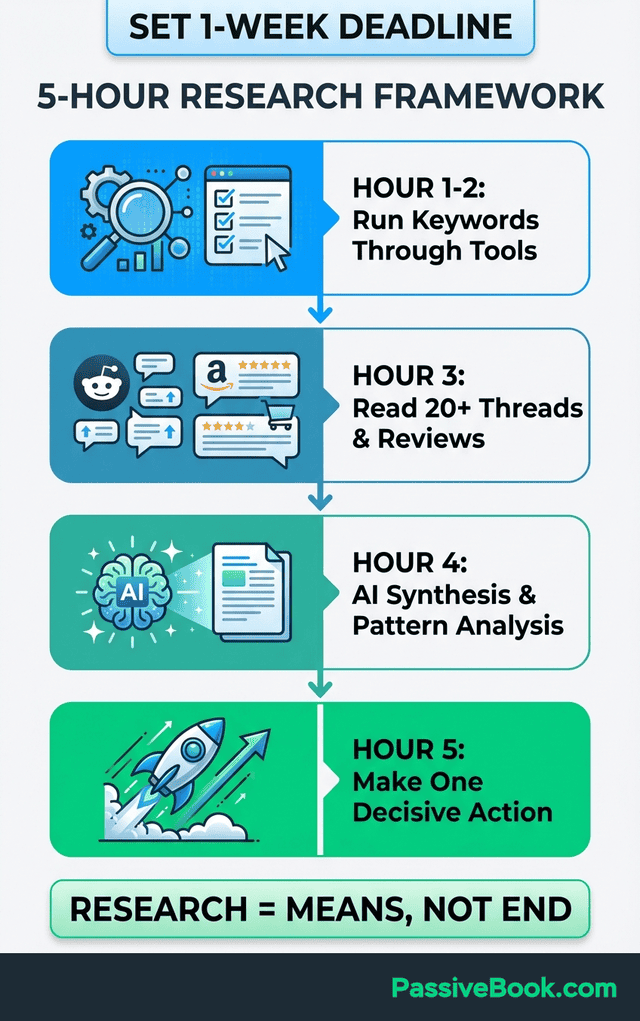
Hour 3-4: Read 20+ Reddit threads and Amazon reviews for customer language. Search Reddit for “[your topic] problems” and “[your topic] alternatives.” Open the top 10 threads with the most comments. As you read, copy exact phrases people use to describe their frustrations into your tracking document.
If you’re researching a product-based business, find the top three competing products on Amazon and read their critical reviews. People who bought something and complained reveal exactly where existing solutions fail. Those gaps are your opportunities.
For your fourth hour, paste all the customer conversations you collected into ChatGPT with this prompt: “Analyze these discussions and identify the 5 most frequently mentioned pain points. For each pain point, provide the exact phrases customers use and estimate how many people mentioned it.” Let AI compress your analysis.
Hour 5: Analyze findings and make one decisive action toward validation. Review your compiled research. Do you have 1,000+ monthly searches? Did you find active communities discussing your niche? Did customer conversations reveal clear, recurring pain points?
Make one decisive move based on what you learned. If signals are positive, create your pre-sell landing page or record your first test video. If signals are negative, pivot to a different business idea from your list. The goal is progress, not perfection.
When to Stop Researching and Start Building
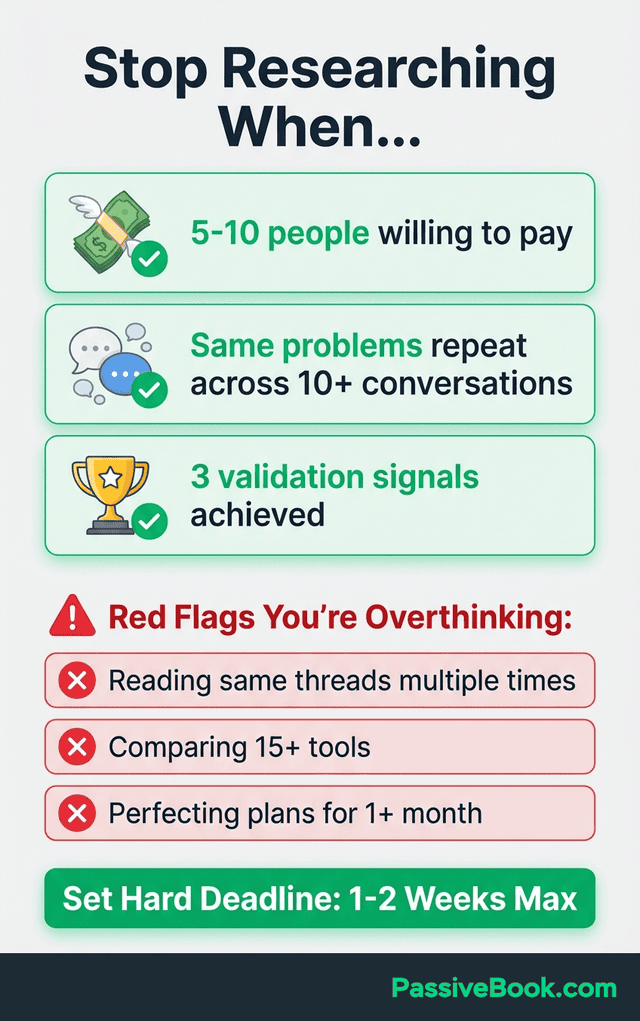
Move forward when you find 5-10 people willing to pay before launch. One paid customer validates more than ten people saying “interesting idea” without putting money down. Success means achieving 3 validation signals: first, 1,000+ monthly searches in Google Keyword Planner; second, active discussions in at least 2 online communities; and third, 5+ people willing to pre-pay or commit before launch.
Stop when you hear the same problems and objections repeatedly in conversations with potential customers. After your tenth conversation, if everyone mentions the same three frustrations, you’ve identified the core pain points. Additional research adds diminishing returns at that point.
Fear of making wrong decisions causes paralysis more than lack of data. You’ll never have perfect information. The market validates or invalidates your idea faster and more accurately than any amount of additional research. If you already have 10+ people asking when they can buy, validate through pre-sale instead of collecting more data.
Early validation requires watching behavior, not collecting opinions. Watch what people do with their money, not what they say they might do someday. Five paying pre-sale customers beat 500 survey respondents who expressed interest.
Set a hard deadline. One week for initial research. Two weeks maximum if you’re testing across multiple business models. After that, you’re stalling. Build a minimum version, put it in front of real customers, and let the market tell you if you’re right.
Common signs you’re overthinking: reading the same Reddit threads multiple times, comparing 15 keyword tools when three give you the answer, or spending a month perfecting your business plan before talking to a single potential customer. Research is a means to an end, not the end itself.
Frequently Asked Questions
How Many Potential Customers Should I Talk to Before Launching?
Talk to 10-15 people minimum to identify consistent patterns in pain points they experience. Five detailed conversations reveal more than 100 quick survey responses because depth matters more than breadth in early validation. Stop when problems and objections start repeating across multiple conversations – that repetition signals you’ve found the core issues.Focus your conversations on people who already tried to solve the problem, not general audiences. Someone who bought three competing products and still feels frustrated is your ideal research participant. Ask what they’ve tried, why it failed, and what they’d pay for a better solution.
What If I Can’t Find Any Competitors in My Niche?
No competitors usually means no market, not an untapped opportunity waiting for you to discover. If nobody sells anything similar, it’s typically because people don’t pay to solve that problem. Look for adjacent solutions people currently use as imperfect workarounds – those reveal the real market boundaries.Test demand with free content before building a full paid product or service. Create three YouTube videos, write five blog posts, or post in relevant communities about your topic. If you can’t generate any engagement with free content, paid products will struggle even more. Market demand shows up in attention first, purchases second.
What Next?
You now have a complete framework for validating your online business idea in one focused week using free tools and a few hours of work. The three validation questions, the tool stack, and the 5-hour weekly framework give you everything needed to confirm demand exists before you invest months building. These data-driven decisions help you grow your business sustainably without expensive consultants or formal training.
Market research sounds intimidating because traditional advice assumes corporate budgets and full-time teams. But solopreneurs don’t need that complexity. You need speed, clarity, and confidence that real customers will pay for what you’re building. This simplified approach delivers exactly that.
If this guide helped you avoid wasting months on the wrong idea, share it with another solopreneur using the buttons below. Someone in your network might be about to make the same mistake I did – building for six months before validating demand.
Drop a comment below: What business idea are you researching right now, and which validation method will you test first? I read every comment and often share additional resources based on what people are working on.
Share this post with your friends & followers: