I wasted two months creating a 40-page business plan for my first side hustle. It had projected financials for five years, competitive analysis charts, and a mission statement nobody would ever read. The business never launched because I got stuck in planning mode instead of testing if anyone wanted what I was building.
Then I discovered Lean Canvas. I mapped my next idea in 20 minutes on a single page, talked to 10 potential customers, and launched a minimum viable product within two weeks. That scrappy approach generated my first $500 in revenue and taught me more than two months of theoretical planning.

- •What You'll Accomplish in the Next 90 Minutes
- •What Is Lean Canvas for Online Business?
- •Why Lean Canvas Fits Time-starved Solopreneurs
- Understanding Your Customer and Offer (blocks 1-4)
- Your Business Model Blocks (blocks 5-9)
- •Your 20-Minute Canvas Creation Protocol
- •Validating Your Canvas Through Customer Conversations
- •Common Lean Canvas Mistakes That Waste Time
- •When Your Canvas Signals a Pivot or Exit Decision
- •Your Lean Canvas Quick Start Checklist
- •Frequently Asked Questions
- •What Next?
What You’ll Accomplish in the Next 90 Minutes
This guide breaks down into three focused sprints you can complete between meetings or during your lunch breaks:
Sprint 1 (30 minutes): Map Your First Canvas
- Fill out blocks 1-4 based on your current understanding
- No research required yet – just capture your assumptions
- You’ll revise everything after customer conversations
- Locate 3 online communities where your target customers gather
- Identify 10 active members posting about related problems
- Draft your 3 validation questions
- Fill out blocks 5-9 with realistic constraints
- Set your first 30-day validation metric
- Schedule your first 3 customer conversations
What Is Lean Canvas for Online Business?
Lean Canvas is a one-page business planning tool created by Ash Maurya and available at Leanstack. It breaks down complex business models into nine testable building blocks that fit on a single page. Each block represents a core assumption about your business that you can validate or disprove through real-world testing.
The Lean Canvas template has become the standard for lean startup practitioners who use lean methodologies to test business ideas rapidly. This framework adapts the Business Model Canvas specifically for startups and side hustles, replacing operational details with startup-specific risks around problem-solution fit.
Instead of detailed forecasting, it focuses on identifying your riskiest assumptions first. Dropbox famously used this approach by creating a simple demo video to validate demand for file storage before writing a single line of production code. The video went viral and proved people wanted the product, saving months of premature development.
Lean Canvas isn’t a traditional business plan. You won’t find five-year projections or detailed operational procedures.
The tool is designed for rapid iteration, letting you update your assumptions after each customer conversation or product test, making it perfect for time-starved solopreneurs testing ideas without quitting their day jobs.
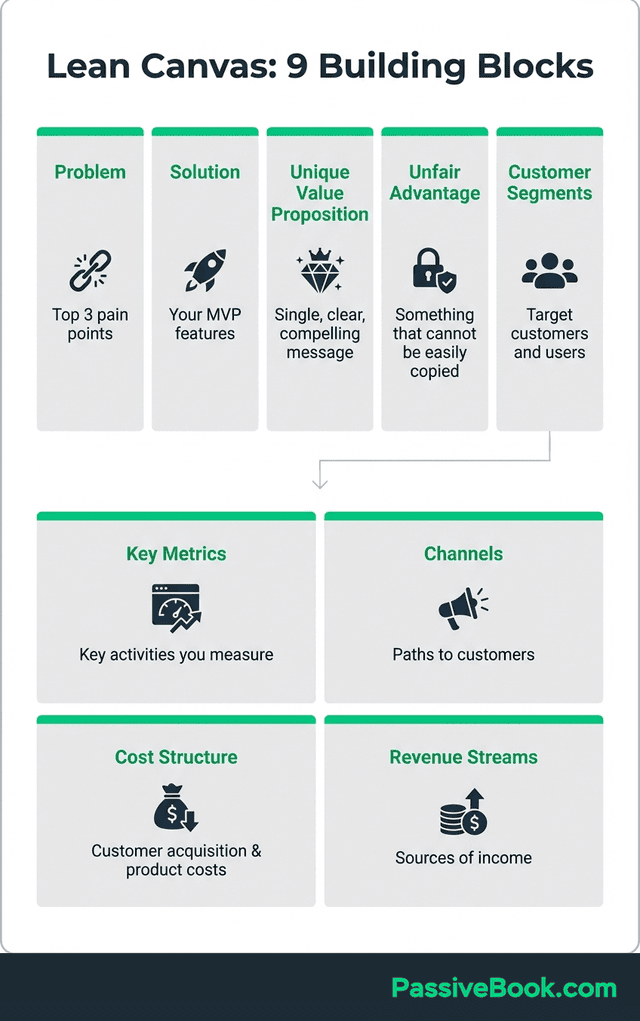
The nine blocks cover everything from customer problems to revenue streams, but the real power lies in the framework’s flexibility. You can sketch your first version on sticky notes during lunch break, then refine it as you learn what resonates with your target customers. Many founders use sticky notes on a physical board for their first iteration, moving blocks around as they refine their thinking. Digital canvas templates offer the same flexibility with easier sharing. Both approaches follow the same lean business principle: rapid iteration beats perfect planning.
Why Lean Canvas Fits Time-starved Solopreneurs
CB Insights research shows that lack of market need causes 35% of startup failures. The majority of failed businesses spent months building solutions nobody wanted.
Traditional business plans amplify this risk because they take weeks to complete, then become outdated the moment you talk to your first real customer.
Lean Canvas solves the planning paralysis problem. You can complete your first version in a single 20-minute session, then revise it after gathering customer feedback.
The framework assumes every block contains unproven assumptions that need testing, not certainties that require detailed documentation.
This speed advantage matters for solopreneurs juggling day jobs. You can map your business idea during lunch break, test it with real people over the weekend, and pivot before investing serious money or time.
Ali Abdaal demonstrated this approach by starting his YouTube channel using just an iPhone while working full-time as a doctor. He validated audience interest through simple videos before scaling his content operation into a multi-million dollar business.
While these examples show large-scale success, the same Lean Canvas approach works for validating a $500/month side hustle. The framework scales to your goals.
The lean startup methodology embedded in the canvas reduces financial risk. Instead of guessing what customers want, you systematically test each assumption with minimal investment. A failed hypothesis costs you a few hours of work, not months of development time or thousands in startup capital.
Understanding Your Customer and Offer (blocks 1-4)
The four blocks on the left side of your canvas will prevent the most expensive mistake in business: building something nobody wants. Get these right before worrying about revenue models or marketing channels.
Problem: Your Customer’s Top 3 Pain Points
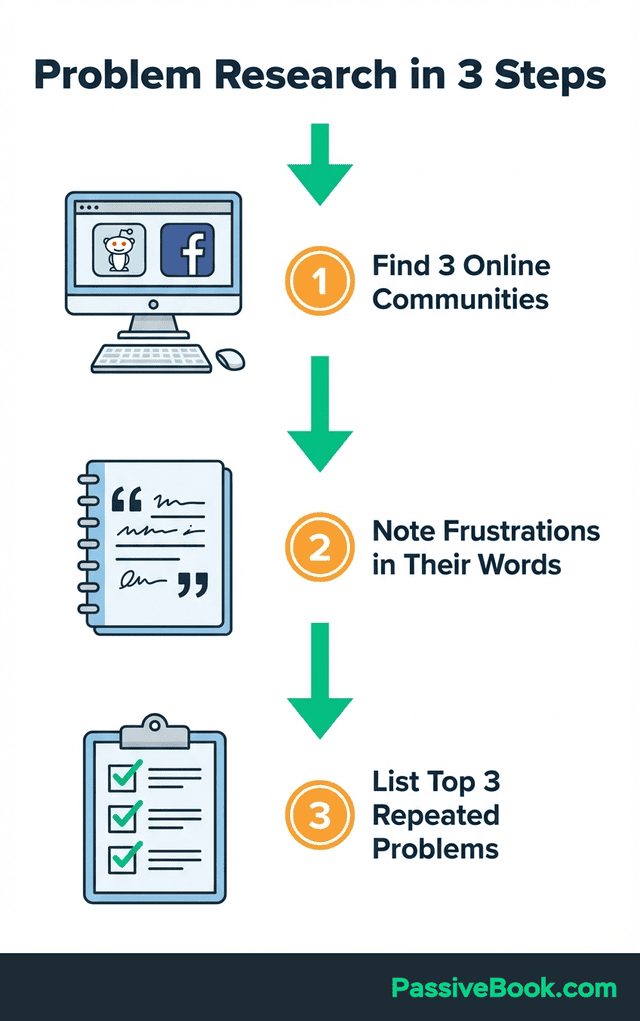
Start by listing the specific problems your target customers mention repeatedly in their own words. Don’t invent problems you think they should have.
Spend time in Reddit threads, Facebook groups, or YouTube comments where your potential customers gather and note the frustrations they express naturally.
Effective problem statements are concrete and observable. Instead of “people struggle with productivity,” write “freelancers miss client deadlines because they can’t track time across multiple projects.” The specificity helps you later validate whether your solution addresses the pain point.
Include existing alternatives your customers currently use to solve these problems. This might be manual workarounds, competitor products, or simply living with the problem.
Understanding what they’re doing now reveals the switching costs you’ll need to overcome and helps you position your unique value proposition.
I spend about five hours in this research phase for each new project idea. It feels slow when you’re excited to build, but I’ve learned this upfront investment is non-negotiable. The one time I skipped it – convinced I understood my audience because I was part of it – I built a product that addressed my personal pain points but not the broader market’s priorities. Zero sales in 60 days taught me that lesson expensively.
Five hours of problem research saves months of building features nobody needs.
Customer Segments: Who Will Pay You
Define your narrow early adopter profile before worrying about mainstream markets. Your first 10 to 50 customers should be people who feel the problem so acutely they’re willing to try an imperfect solution.
These early adopters forgive rough edges and provide the feedback that shapes your product service into something scalable. His approach demonstrates how early adopters within a specific customer segment become the foundation for product development.
Justin Welsh built a business generating over $5 million annually by targeting a hyper-specific segment: mid-career LinkedIn professionals who wanted to escape corporate jobs. He didn’t try to serve “all entrepreneurs” or “anyone interested in business.”
This narrow focus let him create content and products that resonated deeply with one customer segment, making his marketing far more effective than generic advice ever could.
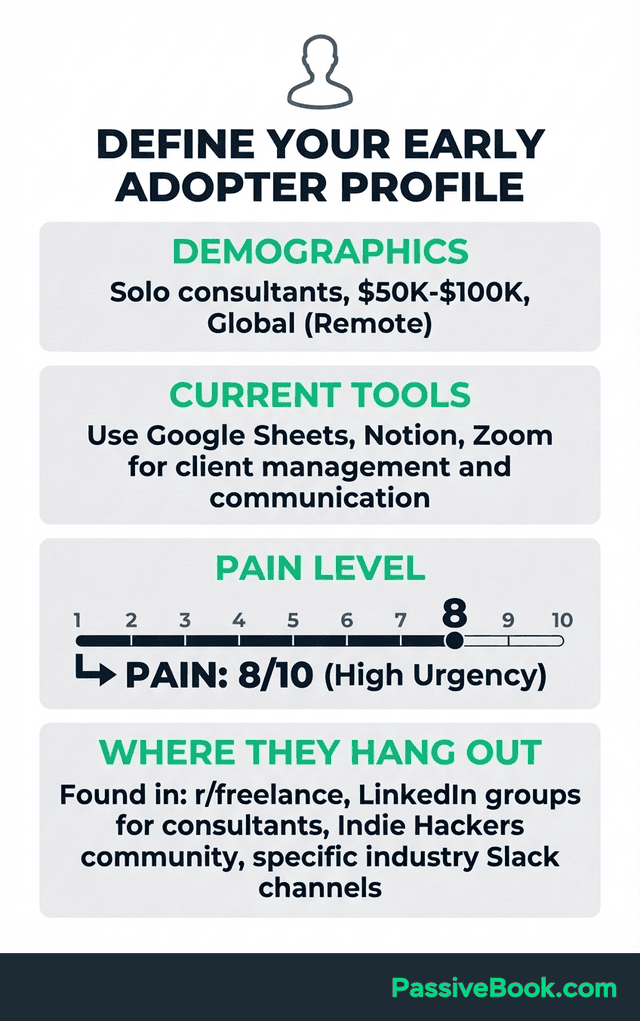
Focus on accessible groups within niche online communities or platforms you already use. If you’re a graphic designer, your early adopters might be solopreneurs in design-focused Facebook groups. If you’re building a course on email marketing, look for beginner marketers asking questions in specific subreddits.
Geographic proximity matters less than psychological proximity – the shared mindset that makes your message resonate immediately.
Early adopter identification often requires going beyond demographics into psychographics. I look for people who are already trying to solve the problem through manual workarounds or duct-taped solutions. These folks demonstrate high motivation and low satisfaction with existing options – the perfect combination for product validation.
One framework I use: search your niche community for posts where people describe current solutions and end with “but…” That “but” signals a gap your product could fill. Example: “I use Trello for project management but I can’t track billable hours without switching to a spreadsheet.” That sentence tells you exactly what your early adopter needs and what they’re currently cobbling together.
Avoid the temptation to define multiple customer segments in your first canvas. Pick one, validate your assumptions with real conversations, and achieve product-market fit before expanding. Trying to serve everyone dilutes your message and makes it impossible to know which feedback to prioritize.
Unique Value Proposition: Your One-sentence Promise
Your unique value proposition should be a single clear statement explaining why target customers choose you over free alternatives or existing solutions. It must communicate both a functional benefit and an emotional outcome in roughly 10 words. This constraint forces clarity and prevents the vague promises that plague most startup messaging.
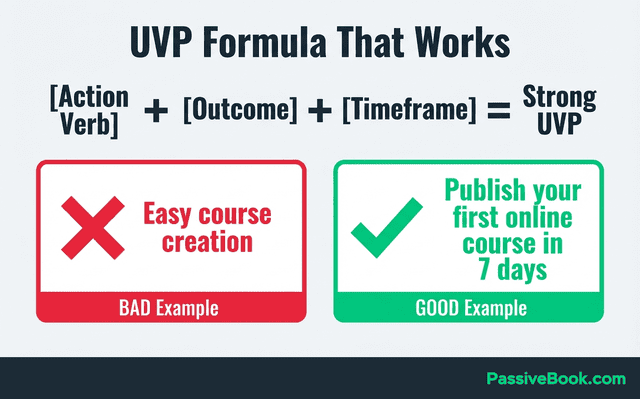
“Publish your first online course in 7 days” beats “easy course creation” because it specifies the outcome and timeline. “Turn client calls into published blog posts automatically” beats “AI content tools” because it names the transformation. The functional benefit is the mechanism, the emotional outcome is what customers gain.
Test your unique value proposition by showing it to five potential customers without additional context. If they can’t immediately explain what you do and why it matters, the statement needs revision. A strong unique value proposition makes people say “I need that” before you’ve explained features or pricing.
Most solopreneurs struggle here because they try to communicate everything their product service does. Resist that urge. Pick the single most compelling benefit for your early adopters and build your messaging around that one transformation. You can expand messaging later once you’ve proven the core value.
Solution: Your Minimum Viable Product Approach
Describe the simplest minimum viable product (MVP) version of your product service that solves Problem number one for early adopters only. This isn’t your full vision – it’s the stripped-down prototype you can build or launch in days, not months. The minimum viable product should feel uncomfortably basic, which means you’re probably scoping it correctly.
Ali Abdaal started his productivity YouTube channel using an iPhone and free editing tools, publishing videos from his bedroom between hospital shifts. He didn’t wait for professional equipment or a studio. That scrappy approach let him test whether his teaching style resonated with viewers, and his channel now generates millions in annual revenue through courses and sponsorships.
I follow the same approach with my educational content. My first blog posts were written in Google Docs and formatted directly in WordPress with zero design customization. The early versions looked amateurish, but they let me test whether my teaching style resonated before investing in custom themes or design work. That scrappy start led to the digital product business I run today.
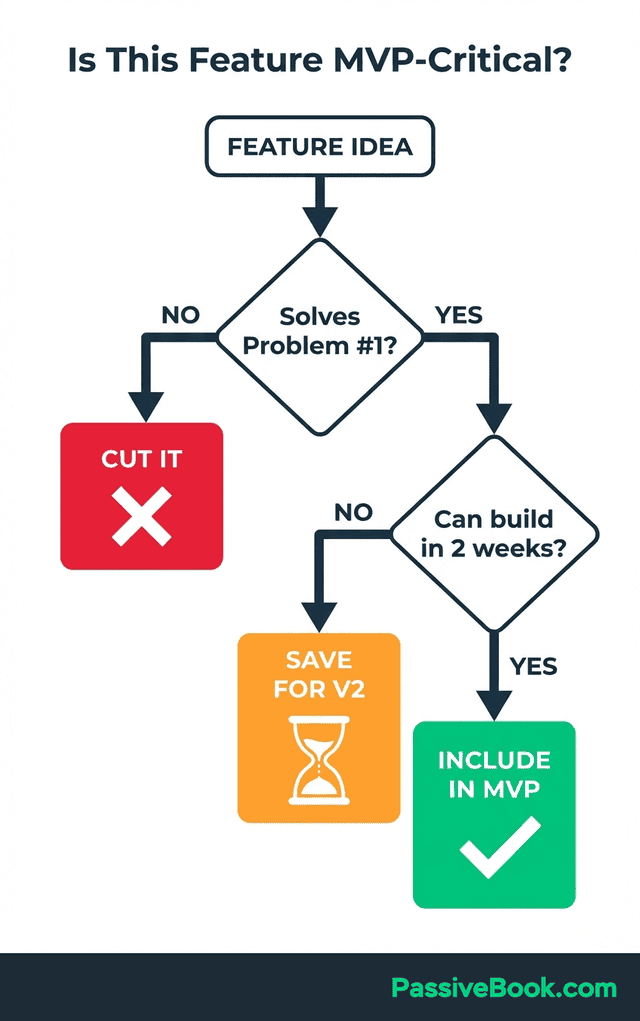
Your solution block should list the core features required to test your riskiest assumption. If you’re building an online course, your minimum viable product might be three pre-recorded videos and a PDF workbook, not a full learning platform with quizzes and certifications. If you’re starting a newsletter, it might be five issues sent manually through Convertkit‘s free tier before investing in automation.
The goal is learning, not perfection. You want to put something real in front of customers quickly so their feedback can guide your product development. Every feature you add before launch is another assumption you’re hoping proves correct, and hope is an expensive business strategy.
Your Business Model Blocks (blocks 5-9)
Now you know what you’re building and who it’s for. These five blocks answer the practical questions: How will people find you? What will they pay? What will it cost you?
Channels: Free and Low-cost Customer Acquisition
Focus on one or two platforms where your early adopters already spend daily time. Trying to establish presence across every social network guarantees mediocre results everywhere instead of meaningful traction somewhere. Pick channels based on where your customer segment hangs out, not where you personally enjoy spending time.
Popular solopreneur channels include TikTok for visual demonstrations, Instagram Reels for bite-sized educational content, YouTube Shorts for evergreen tutorials, and specific Facebook groups where niche communities already gather.
Each platform favors different content styles, so match your channel selection to your natural communication strengths.
I’ve made the multi-platform mistake three times across different businesses. Each time I convinced myself “this time will be different” and each time I ended up with mediocre presence everywhere and strong presence nowhere.
Free organic reach still works in 2026, but it requires consistency over three to six months before gaining momentum. Your publishing cadence depends on platform and content type:
- TikTok/Instagram Reels: 4-7 posts weekly (algorithm favors frequency)
- YouTube Shorts: 3-5 posts weekly (less frequency pressure than TikTok)
- Blog posts: 1-2 in-depth articles weekly (quality over quantity)
- Newsletter: 1-2 editions weekly (consistency matters more than frequency)
Test channel effectiveness by tracking a single metric: conversations started with potential customers. Vanity metrics like follower counts matter less than whether your content attracts people who match your customer segment profile and want to discuss their problems with you.
Revenue Streams: Simple Monetization Models
Common revenue streams for online businesses include digital products, affiliate commissions, course fees, or subscription memberships. Your first canvas should list only one or two streams to avoid complexity during validation. You can always add monetization methods after proving your primary model works.
Price testing for digital products targeting solopreneurs typically starts between $7 and $47. Lower prices reduce purchase friction but require higher volume. Higher prices attract more committed customers but need stronger perceived value.
Creator jhaminakshi earned $7,000 in her first 30 days on Gumroad with an AI templates pack priced at $19, demonstrating that mid-range pricing works when solving pain points.
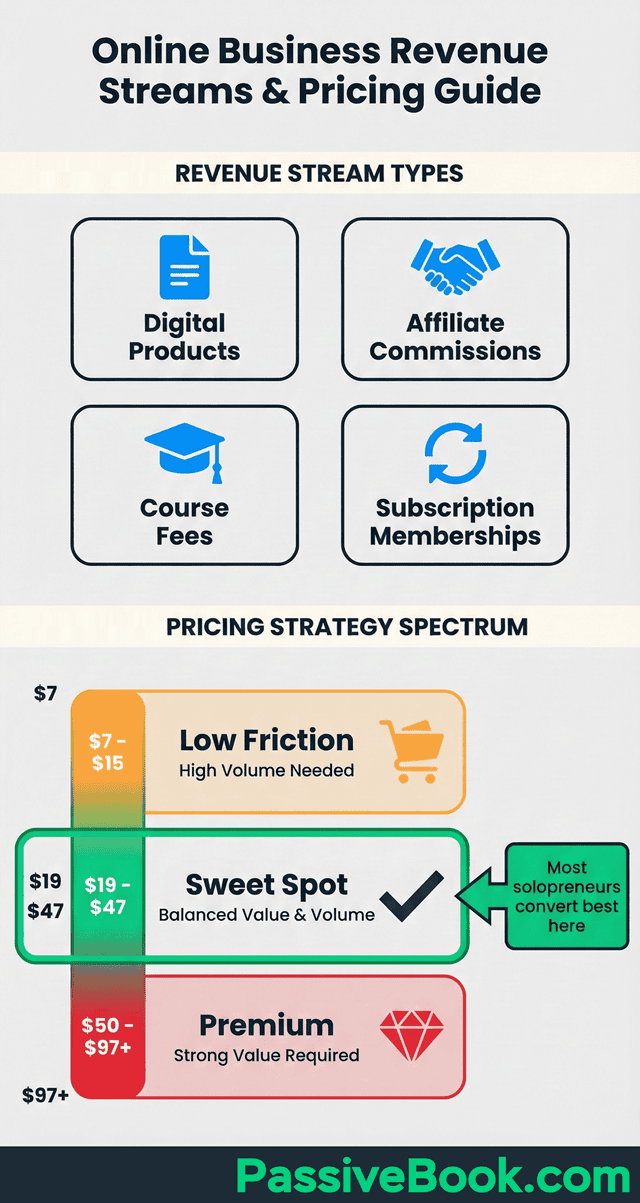
My own digital products typically start in the $27-$47 range because my audience consists of solopreneurs bootstrapping their businesses. I tested a $97 course once and saw conversion rates drop by 60% compared to my usual $37 products. The market told me clearly that my customer segment has a psychological pricing ceiling around $50 for digital products, which now shapes all my revenue planning.
Your revenue model should align with how your customer segment prefers to buy. Information products suit one-time purchasers. Subscription models work when customers need ongoing access to updated content or tools.
Affiliate commissions make sense if you’re recommending products you genuinely use and your audience trusts your recommendations.
Avoid complicated tiered pricing structures in your first canvas. Pick one price point, test it with 20 customers, then adjust based on purchasing behavior you observe.
Cost Structure: Keeping Startup Investment Under $500
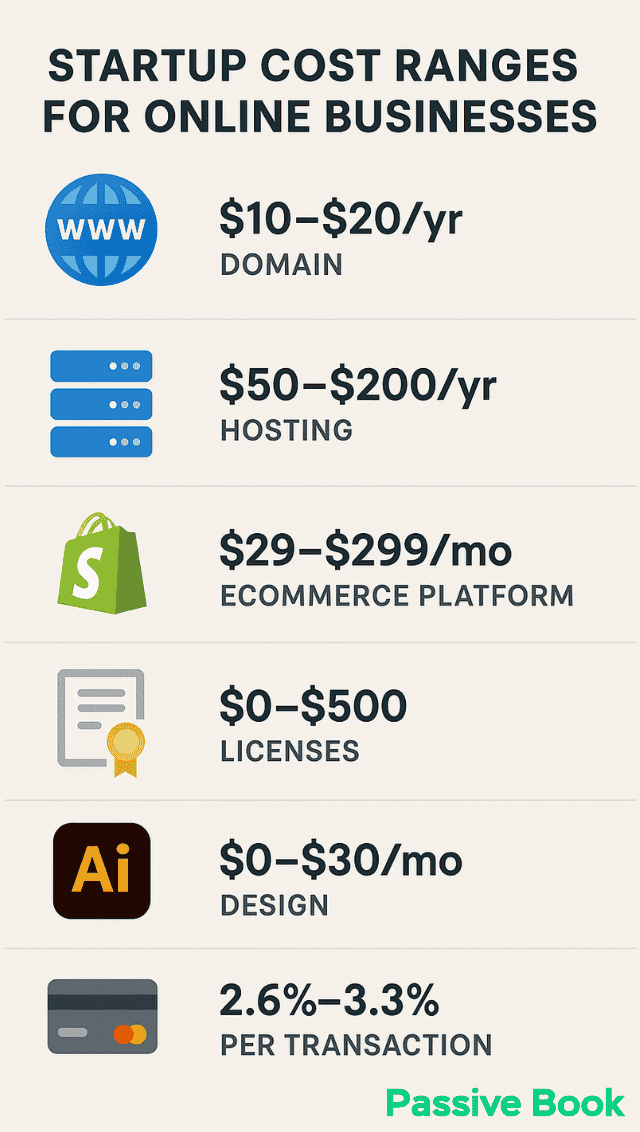
List all recurring costs required to test your business model over the first 90 days. This includes domain registration, email marketing tools, design software subscriptions, and platform fees. Be ruthlessly honest about what you need versus nice-to-have tools you can add after generating revenue.
A realistic example for content creators: domain registration costs around $10 to $20 annually, Canva Pro runs approximately $13 monthly, and ConvertKit offers a free tier supporting up to 1,000 subscribers with unlimited emails.
This totals under $100 for your first three months before you need any paid email plan.
I cringe when I see new creators buying $297 “essential” tool suites before making their first dollar. That money becomes psychological pressure to stick with a flawed idea just to justify the sunk cost.
Many solopreneurs overspend on premium tools before validating their business model. You don’t need expensive software subscriptions until you’re generating revenue. Start with free tiers and manual processes, then upgrade tools only when they become genuine bottlenecks to growth.
Track your cost structure against your first revenue milestone. If you spend $300 to make your first $100, that’s valuable learning. If you spend $300 before talking to a single customer, that’s premature optimization disguised as preparation.
Key Metrics: Your One Essential Number
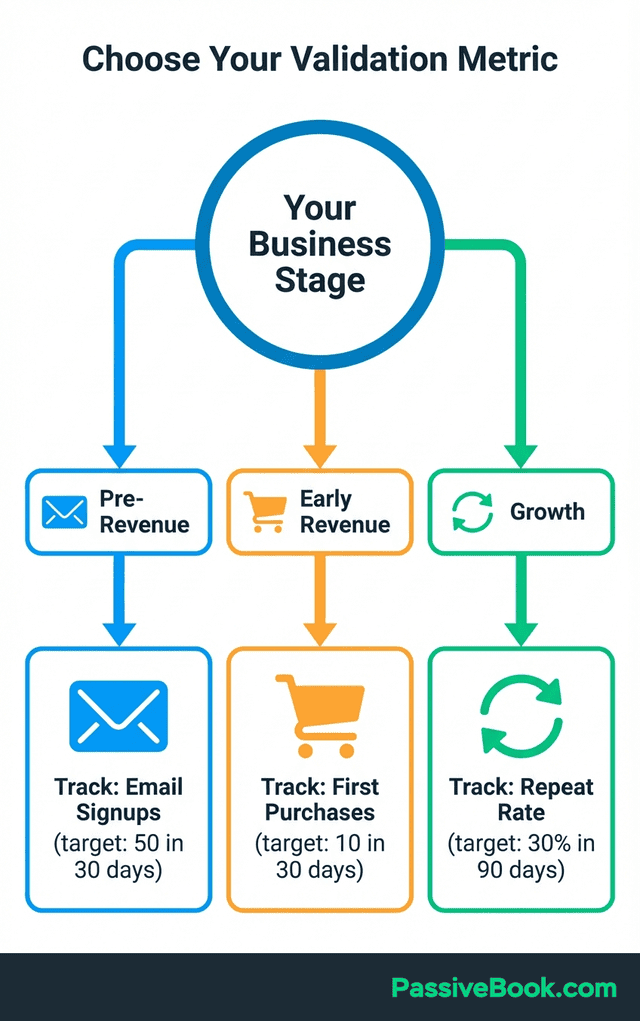
Choose a single metric that proves customers want your solution. For pre-revenue businesses, this might be email signups, for early revenue it’s first purchases or repeat purchase rate. The key metric should directly indicate whether you’re solving a problem people care about enough to take action.
Setting a target creates accountability and clear validation thresholds. An example target might be 50 email subscribers within 30 days, which signals genuine interest from your target customers.
If you hit 10 subscribers after aggressive outreach, that’s weak validation suggesting you need to refine your unique value proposition or customer segment targeting.
I write my key metric target on a sticky note and put it on my monitor. When I’m tempted to add features or optimize things that don’t move that number, the physical reminder keeps me focused on what matters for validation.
Avoid tracking multiple metrics simultaneously during early validation. Revenue, signups, engagement, and social followers all matter eventually, but focusing on everything means you’re optimizing nothing. Pick the one number that best indicates product-market fit for your business model, then obsess over moving it.
Your key metrics will evolve as your business matures. Early stage focuses on interest signals. Growth stage tracks customer acquisition costs and lifetime value. The canvas should always reflect your current priority, not a comprehensive dashboard of everything you could measure.
Unfair Advantage: What You Have That Competitors Can’t Copy
Your unfair advantage must be something defensible that competitors can’t easily replicate. This might include a personal audience you’ve built over years, specialized expertise from your career, or unique network access within your customer segment. “Hard work” or “passion” doesn’t qualify – any competitor can work hard.
Many first-time founders leave this block blank initially, and that’s acceptable. Focus your energy on the other eight blocks first. Execute consistently in a narrow niche, and your accumulated expertise and customer relationships will eventually become the advantage competitors struggle to replicate.
Your 20-Minute Canvas Creation Protocol
Set a timer and work fast. Your goal is capturing assumptions, not perfection.
Minutes 1-5: Problem Block
- Write 3 problems you believe your customers face
- Use language like “can’t track time across projects” not “time management struggles”
- Don’t research yet – list your current hypotheses
- Describe one narrow early adopter profile
- Include current income, tools they use, where they hang out online
- Example: “Solo consultants earning $50K-$100K who use Google Sheets for project tracking”
- Combine your Problem #1 + Customer Segment into one sentence
- Formula: [Action verb] + [outcome] + [timeframe]
- Test: Can a stranger understand what you do in 5 seconds?
- List only the features needed to solve Problem #1
- What can you build/launch in 2 weeks?
- If your list has more than 3 items, you’re overbuilding
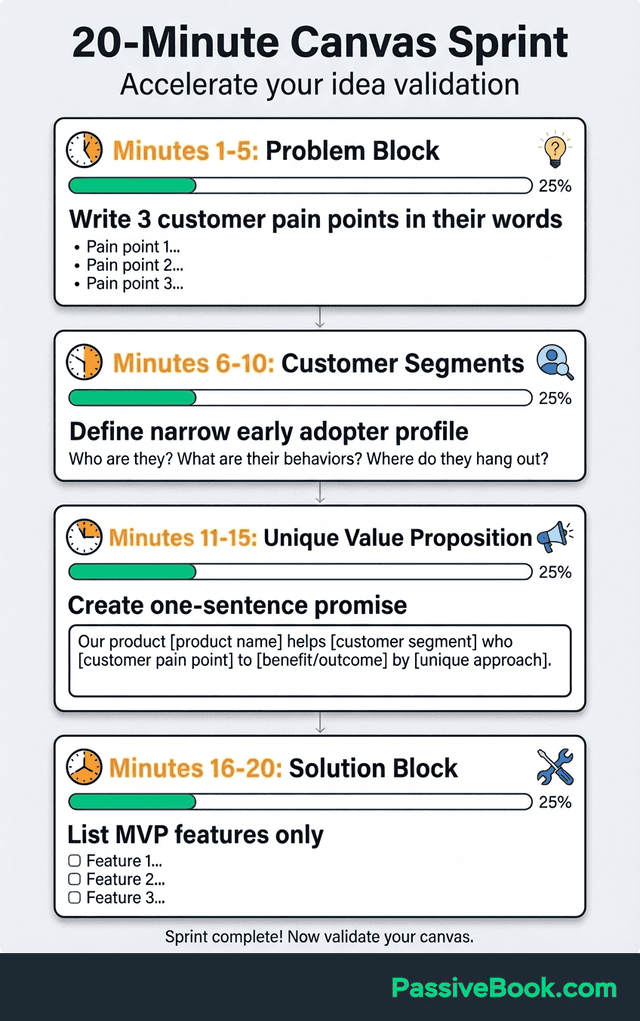
Complete the blocks in this order: Problem, Customer Segments, Unique Value Proposition, then Solution. This sequence forces you to understand customer pain points before designing solutions, preventing the common mistake of building features nobody needs. Each block should inform the next, creating a logical narrative from customer need to your proposed answer.
Start with the Problem block by writing down the top three pain points you believe your customer segments experience. Be detailed rather than generic. “Freelancers miss client deadlines because they can’t track billable hours across multiple projects” is testable, while “people struggle with time management” is too vague to validate or solve effectively.
Move to Customer Segments and describe your early adopters in concrete terms. Instead of “small business owners,” write “solo consultants earning $50,000 to $100,000 annually who currently use spreadsheets to track projects.” The detail helps you find these people for validation conversations and ensures your solution addresses their constraints.
Your Unique Value Proposition should emerge naturally from combining your Problem and Customer Segments insights. If freelancers miss deadlines due to poor time tracking and your early adopters currently use clunky spreadsheets, your value proposition might be “Track billable hours across all projects in under 2 minutes daily.” Test this statement with five potential customers before moving forward.
The Solution block comes last in this initial sequence because you need to resist the urge to design features before understanding the problem deeply. Describe only the core functionality required to solve Problem number one for your defined early adopters. Everything else is a distraction at this stage.
Fill out the remaining blocks – Channels, Revenue Streams, Cost Structure, Key Metrics, Unfair Advantage – after you’ve validated your problem-solution fit through customer conversations. These business model details matter, but they’re premature if you haven’t confirmed anyone wants what you’re building.
Validating Your Canvas Through Customer Conversations
Find your first 10 potential customers in niche communities where your target customers already gather. Relevant subreddits, Facebook groups, and LinkedIn communities provide direct access to people experiencing the problems you want to solve. Look for active threads where members ask questions or express frustrations related to your Problem block.
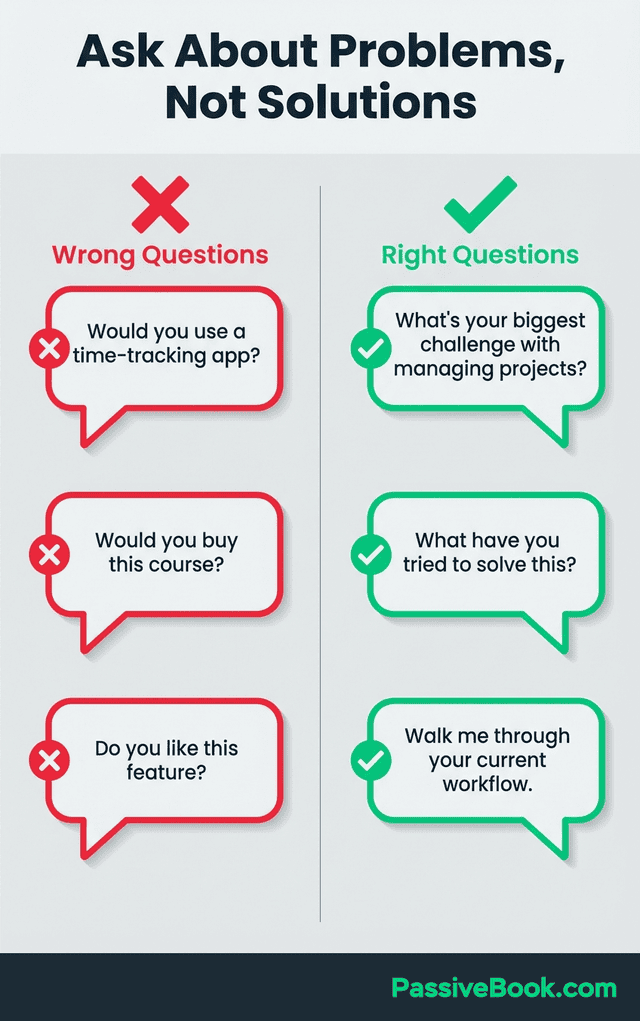
Ask about their problems, not your solution. The question “What’s your biggest challenge with managing client projects?” generates useful insights. The question “Would you use a time-tracking app?” generates polite hypothetical answers that rarely predict purchasing behavior.
People struggle to imagine using products that don’t exist yet, but they’re experts at describing their current frustrations.
When I validated my AI automation course idea, I asked “What’s your biggest frustration with using AI tools in your workflow?” instead of “Would you buy a course about AI automation?” The first question got me 15 minutes of detailed pain points about prompt engineering and tool integration. The second question got me “yeah, maybe” responses that meant nothing for validation.
Update your Problem and Customer Segments blocks after each conversation reveals patterns you hadn’t anticipated. If seven out of your first 10 conversations mention a pain point you hadn’t listed, that’s a strong signal to revise your canvas.
If only two people resonate with your stated problem, you’re likely targeting the wrong customer segment or solving a problem that isn’t urgent enough to pay for.
In my experience, if fewer than 7 of your first 10 potential customers acknowledge the problem exists and affects them regularly, you need to rethink your core assumptions. I use this 70% threshold as my personal validation benchmark. This doesn’t mean abandoning your idea entirely, but it does mean your current Problem or Customer Segments blocks are misaligned with reality. Revise and test again before building anything.
Document these conversations in a simple spreadsheet tracking each person’s role, their stated problems, current solutions they use, and whether they’d be interested in trying a minimum viable product. This validation log becomes the evidence that your Lean Canvas reflects real market needs rather than hopeful assumptions.
Common Lean Canvas Mistakes That Waste Time
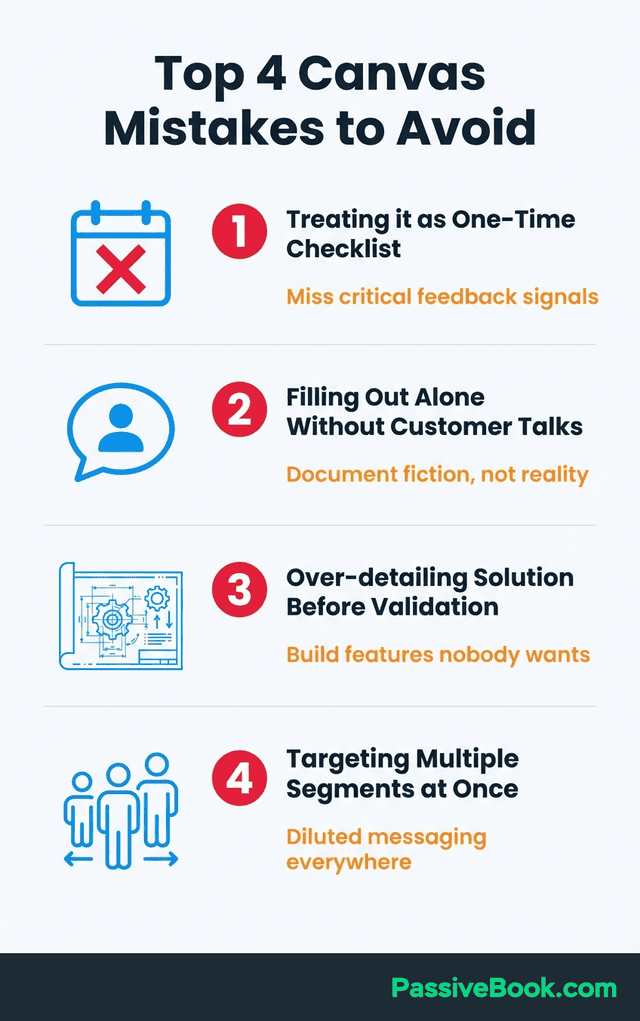
Treating the canvas as a one-time checklist represents the most expensive mistake solopreneurs make. The framework is a living document designed for continuous revision as you learn from customers. Founders who fill it out once, then execute for months without updates, miss the entire point of the lean startup methodology. Your canvas should evolve weekly during the first 90 days as you test assumptions and gather feedback.
Filling the entire canvas alone without talking to a single potential customer first guarantees you’re documenting assumptions, not insights. The temptation to complete all nine blocks in isolation feels productive, but you’re just creating detailed fiction about how you think customers behave. Every block except possibly Unfair Advantage should be informed by customer conversations, not armchair theorizing.
I made this exact mistake with an AI writing tools comparison site. I spent three weeks building a comparison matrix with 47 data points before talking to a single person. When I finally showed it to potential users, they told me they only cared about 5 features – pricing, output quality, ease of use, integration options, and customer support. I’d wasted 60% of my development time on features nobody would reference in their buying decision.
My beautifully detailed canvas addressed the wrong problem entirely. I pivoted the entire concept after those 10 conversations, which would have been wasted development time if I’d started building immediately.
Describing your solution in excessive detail before validating the problem exists wastes time on features nobody asked for. New founders often jump straight to the Solution block and map out elaborate feature sets, user interfaces, and technical architectures. This premature product development feels like progress but delays the crucial validation work that determines whether anyone wants your product service at all.
The canvas is designed to be rough and incomplete initially. Embrace that discomfort. Your first version should take 20 minutes and contain more questions than answers. The clarity comes from systematic testing, not prolonged internal brainstorming sessions where you convince yourself your assumptions are facts.
When Your Canvas Signals a Pivot or Exit Decision
Revise your canvas immediately after your first 10 customer conversations reveal misaligned problem assumptions. If the problems you listed aren’t resonating, or if customers describe entirely different pain points, that’s your signal to pivot the Problem block.
Harvard Business Review research shows that startups willing to pivot based on customer feedback have higher success rates compared to those rigidly committed to original assumptions.
Update your canvas monthly during the first 90 days as channel effectiveness becomes clear through results. If you’re publishing content consistently on Instagram but seeing no engagement from your target customers, that’s data suggesting you need to test different channels rather than doubling down on an ineffective platform. Your Channel block should reflect where customers discover you, not where you wish they would.
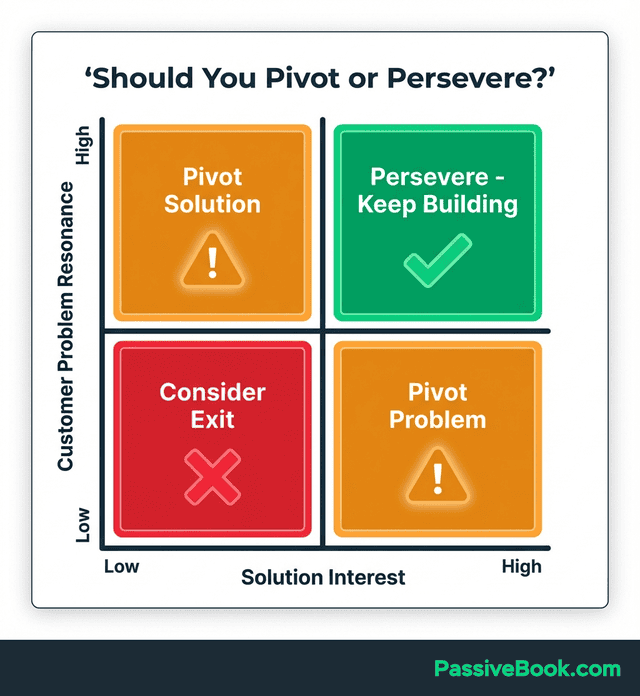
Revenue model pivots happen when your initial pricing or monetization approach doesn’t match customer willingness to pay. If you’re offering a $47 course but conversations reveal your early adopters can only budget $20, that’s a clear signal to revise your Revenue Streams block and potentially your Cost Structure to support lower pricing.
The canvas becomes an exit signal when repeated revisions across multiple blocks fail to generate validation from customer conversations. If you’ve tested three different customer segments, revised your problem statements twice, and still can’t find 10 people who acknowledge the pain point matters to them, you’re likely pursuing an idea without genuine market need. That’s valuable information that saves you from investing months building something nobody wants.
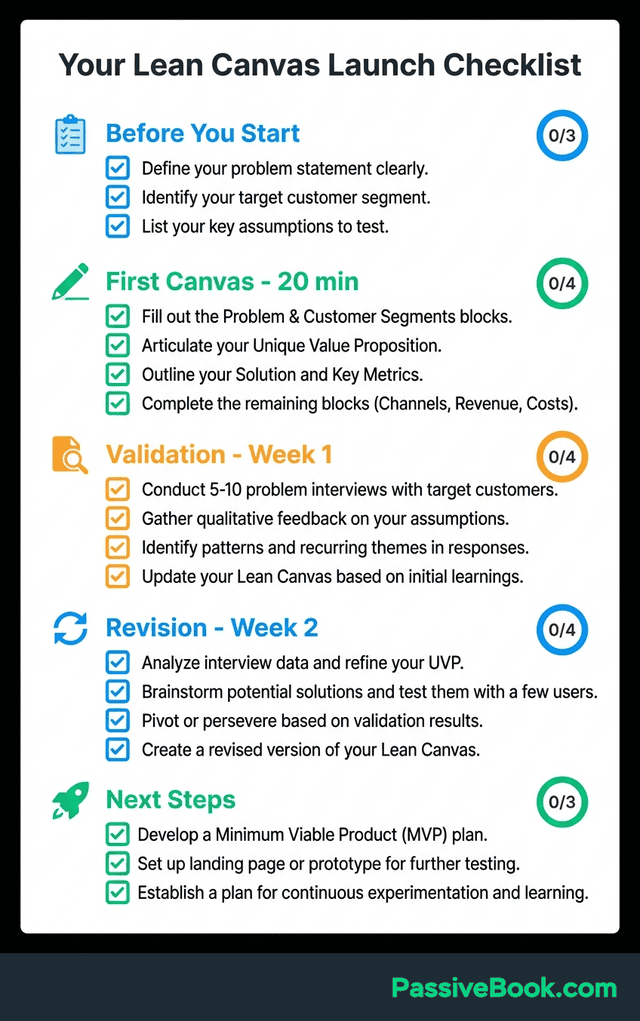
Your Lean Canvas Quick Start Checklist
Frequently Asked Questions
Do I Need a Lean Canvas If I’m Just Testing an Idea?
Yes, Lean Canvas is designed for pre-launch idea validation and testing. The framework helps you identify your riskiest assumptions before investing time or money into building. Complete an initial version based on your current understanding, then systematically test each block through customer conversations and small experiments.Update the canvas as you gather real customer feedback from minimum viable product tests. The revision process is the core value, not the initial document. Many founders discover their original assumptions were wrong within the first 10 customer conversations, saving them from building solutions nobody wants.
How Is Lean Canvas Different From Business Model Canvas?
While both frameworks map out your business model, the Business Model Canvas includes key partners, key activities, key resources, and customer relationships blocks. Lean Canvas replaces these with startup-specific elements like Problem, Solution, Key Metrics, and Unfair Advantage. The lean startup methodology embedded in Lean Canvas makes it better suited for pre-revenue validation. (All rights reserved to respective framework creators.)Use Lean Canvas when testing a new idea before launch, working with limited budget, or needing to pivot quickly based on customer feedback. Use Business Model Canvas when you’re optimizing an established business with multiple stakeholders requiring detailed operational planning. Solopreneurs in validation phase almost always benefit more from Lean Canvas simplicity.
Should I Create Separate Canvases for Different Customer Segments?
Yes, create one canvas per distinct customer segment you plan to serve. Different segments often have different problems, prefer different channels, and require different revenue models. Trying to serve multiple segments with a single canvas forces you to make compromises that weaken your value proposition for everyone.Start with a single segment until you achieve product-market fit before expanding. Many solopreneurs make the mistake of targeting multiple customer segments simultaneously, which dilutes their marketing message and makes it impossible to prioritize conflicting feedback. Dominate one narrow segment first, then clone your canvas and adapt it for additional segments once you’ve proven your business model works.
What Next?
You’ve learned how Lean Canvas transforms overwhelming business planning into a focused 20-minute exercise that helps you build something people want. The framework isn’t about creating perfect documentation – it’s about systematically testing your assumptions before they cost you months of wasted effort.
I still use this approach for every new project idea, even after a decade of building online businesses. The canvas keeps me honest about whether I’m solving real problems or just falling in love with my own cleverness. That discipline has saved me from pursuing countless ideas that looked brilliant on paper but had no genuine market demand.
If you found this guide valuable, hit those share buttons below and spread the word to other solopreneurs who are stuck in planning paralysis. Leave a comment sharing your biggest fear about starting your online business. What’s the one thing holding you back from filling out your first Lean Canvas today?
Share this post with your friends & followers: