I spent my first six months as a side-hustling entrepreneur drowning in a sea of half-finished projects. I’d jump from course creation to blogging to dropshipping, always busy but never making progress. The turning point came when I built my first actual action plan – a simple one-page document that forced me to choose one business model and map out 90 days of focused work. That single shift took me from chronic overwhelm to my first $1,200 revenue quarter.
Whether you’re trying to start a business from scratch or scale an existing side hustle, the planning framework is identical. If you’re juggling a day job while trying to launch an online business, you don’t need another motivational pep talk or a 50-page business plan. You need a tactical roadmap that tells you exactly what to do this week with the limited hours you have. That’s what this guide delivers.

- •What an Action Plan Is for Online Business
- •Why Focused Execution Matters for Solopreneurs
- •Setting Smart Goals That Fit Limited Hours
- •Breaking Goals Into Weekly Tasks
- •Prioritizing With the Eisenhower Matrix
- •Master Time Blocking to Maximize Productivity
- Free Tools to Organize Your Action Plan
- Why Most Action Plans Fail
- How to Build Your First Action Plan in 90 Minutes
- •Real Action Plan Example: 90-Day Content Business Launch
- •How AI Tools Can Accelerate Your Action Planning
- •Tracking Progress Without Burning Out
- •When to Adjust Your Plan
- •Frequently Asked Questions
- •What Next?
What an Action Plan Is for Online Business
An action plan is a structured document that lists specific steps and deadlines to achieve your business goals. Think of it as the tactical execution layer that sits below your big-picture vision.
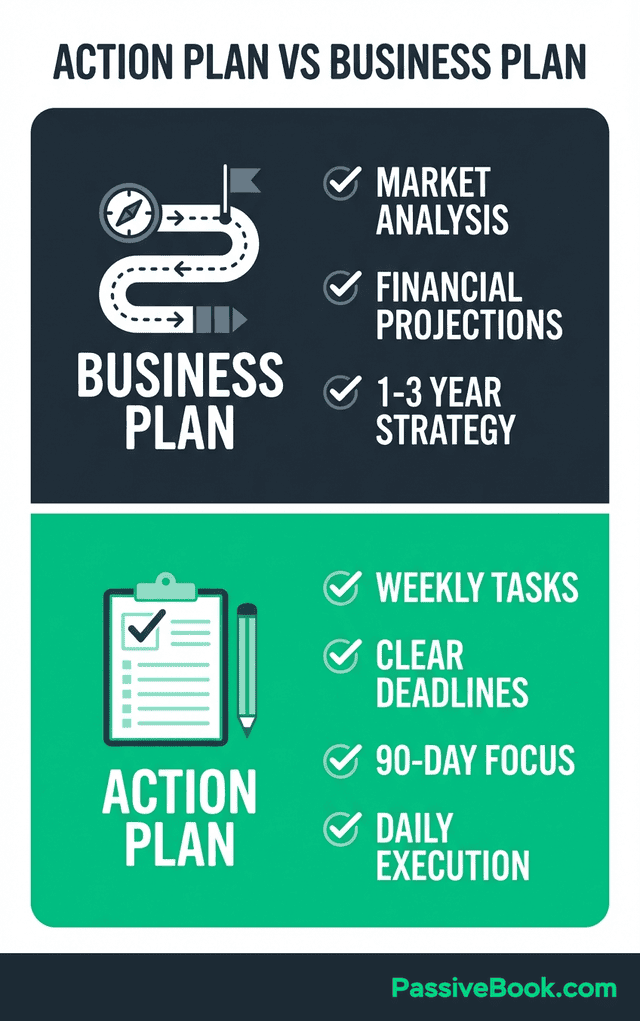
Unlike strategic plans and traditional business plans that focus on market analysis and financial projections, an action plan outlines specific tasks and breaks your goals into daily and weekly action items. A proper action plan assigns responsibilities, sets clear deadlines, and tracks progress on specific deliverables.
This isn’t a wishlist of things you’d like to accomplish someday. It’s a concrete roadmap that answers three questions every morning: What am I working on today? Why does this task matter? When must it be finished?
For solopreneurs trying to start a business around a full-time job, this distinction matters. You can’t afford to waste your precious 8-10 weekly hours on vague activities like “work on website” or “research marketing strategies.” Every task needs a clear outcome you can check off.
Why Focused Execution Matters for Solopreneurs
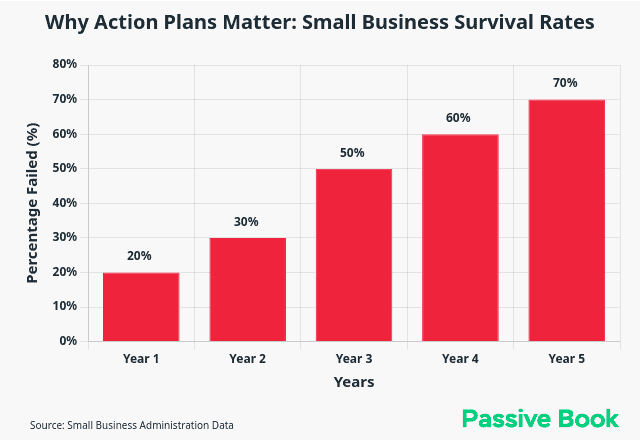
About 20% of small businesses fail within the first year (2024 data), primarily due to lack of market need and poor planning. For solopreneurs trying to build something meaningful in their spare hours, the failure rate climbs even higher.
Action plans prevent the overwhelm that kills side businesses. When you’re managing multiple responsibilities simultaneously – day job, family, business – your brain craves structure.
Without a clear plan, you’ll default to whatever feels urgent rather than what drives revenue.
When working in isolation, solopreneurs need external accountability systems. Full-time entrepreneurs have co-founders, investors, or team members expecting progress updates. An action plan becomes your external accountability system, forcing you to confront whether you’re shipping or just staying busy.
Action plans help you prioritize revenue-generating activities over busy work. It’s easy to spend three hours perfecting your logo when you should be reaching out to potential customers. A good action plan keeps you focused on the 20% of tasks that produce 80% of results.
Setting Smart Goals That Fit Limited Hours
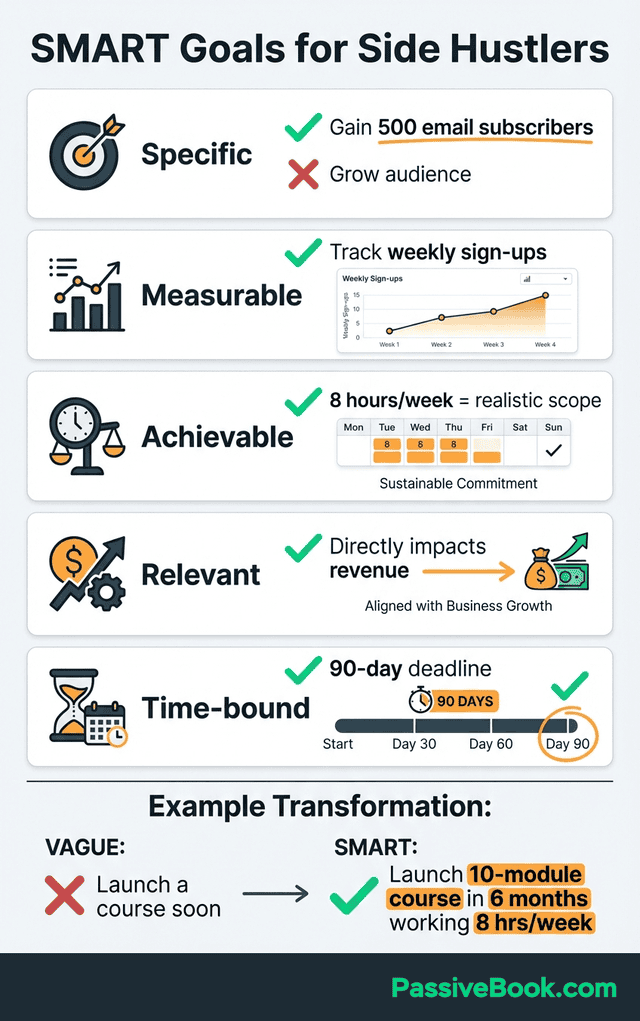
The SMART framework ensures goals are Specific, Measurable, Achievable, Relevant, and Time-bound for effective business planning. This isn’t just corporate jargon. It’s the difference between “grow my audience” and “gain 500 email subscribers in 90 days.”
The second smart goal tells you exactly what success looks like and lets you track weekly progress. You know when to celebrate or pivot. Vague goals create vague action plans.
For solopreneurs with constrained schedules, the “Achievable” component requires brutal honesty. Before finalizing any goal, perform a time audit. If your goal requires 15 hours of work weekly but you only have 8 hours available, you have two choices: extend your timeline or reduce your scope.
Most side-hustlers skip this step and wonder why they’re constantly behind. I still overestimate my available time every few months, usually around holidays when I convince myself I’ll work while visiting family. Never happens.
A smart goal acknowledges your real constraints. “Launch a 10-module online course in 6 months working 8 hours weekly” beats “launch a course soon” every time.
You need to transform your project goals into actionable steps. The specificity forces you to estimate time and prevents scope creep, turning strategic planning into daily execution.
Breaking Goals Into Weekly Tasks
Once you have a 90-day goal, divide it into 12 weekly action items. This isn’t arbitrary. Research from the University of Maryland’s Smith School found that breaking large goals into bite-sized chunks significantly boosts commitment and performance.
Each weekly task should have a single clear outcome you can check off. Not “work on email marketing” but “write 3 welcome sequence emails and schedule them in Convertkit.”
The specificity forces you to estimate time and prevents scope creep.
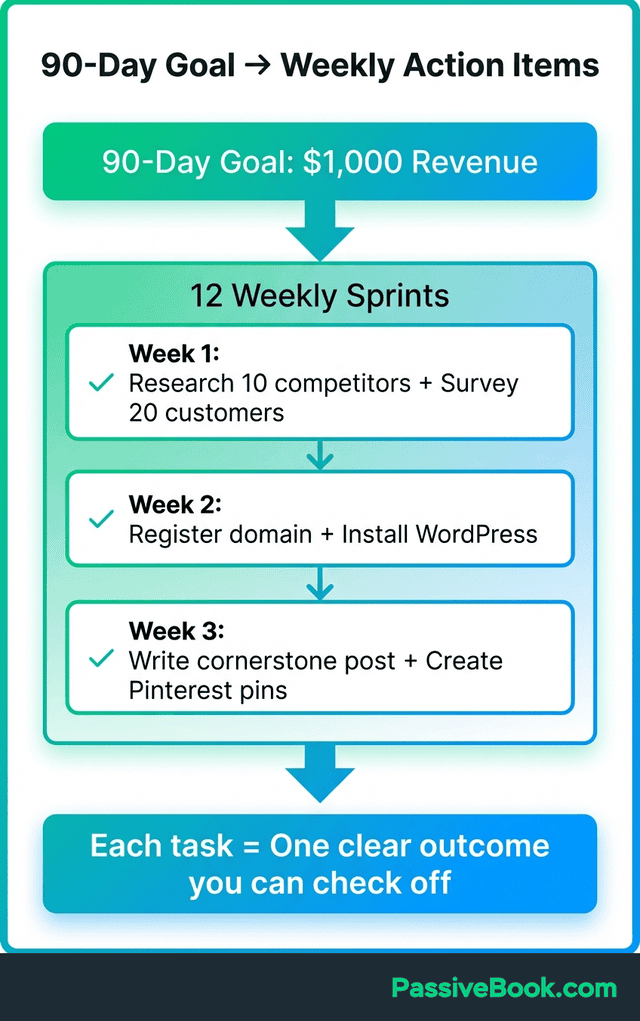
Weekly sprints match the reality of working around an existing job. You can protect 8-12 hours across a week much easier than you can block off an entire Saturday. Life happens. Kids get sick. Work deadlines hit. Weekly tasks give you flexibility to shift hours while maintaining forward momentum.
You wouldn’t skip a client call on a whim. Apply the same discipline to your business tasks by treating these weekly action items like unmissable work meetings.
Prioritizing With the Eisenhower Matrix
The Eisenhower Matrix organizes tasks by urgency and importance into four quadrants: do, schedule, delegate, and eliminate. For solopreneurs, this framework prevents the “urgency trap” where you confuse busy with productive.
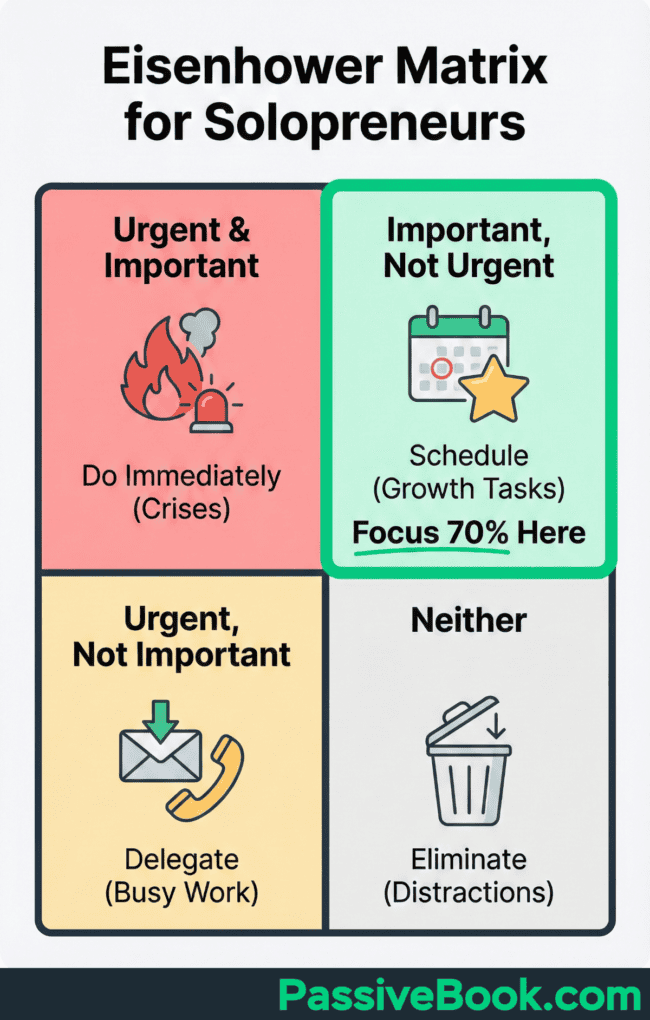
Quadrant 1 (urgent and important) includes true emergencies like website crashes or customer complaints. Handle these immediately.
Quadrant 2 (important but not urgent) is where solopreneurs should spend 70% of their time. This includes content creation, audience building, product development, and strategic planning. These activities don’t scream for attention, but they’re what builds your business.
Quadrant 3 (urgent but not important) is the trap. Responding to every social media notification, attending networking events that don’t fit your niche, or redesigning your website for the third time, or posting on every social media platform instead of focusing on one. These feel productive but don’t advance your goals.
Quadrant 4 (neither urgent nor important) should be eliminated ruthlessly. Stop researching productivity systems when you should be executing. Stop watching motivational videos when you could be creating content.
Every Sunday, categorize your upcoming week’s tasks using this matrix. If most of your time goes to Quadrants 3 and 4, your action plan needs a rewrite.
As you grow your business and eventually add team members or contractors, delegate Quadrant 3 tasks first.
Master Time Blocking to Maximize Productivity
Time blocking dedicates specific calendar slots to individual tasks, reducing context switching and increasing focus. This technique transforms your action plan from a wish list into a calendar commitment.
Schedule your creative work during peak energy hours. If you’re sharpest in the morning, block 6-8 AM for content creation before your day job starts.
Save administrative tasks like responding to emails or updating spreadsheets for low-energy periods.
Common patterns for full-time employees look like this: Tuesday and Thursday evenings from 7-9 PM for content creation, Saturday mornings from 8 AM-12 PM for product work, and Sunday evenings from 6-8 PM for admin and planning.
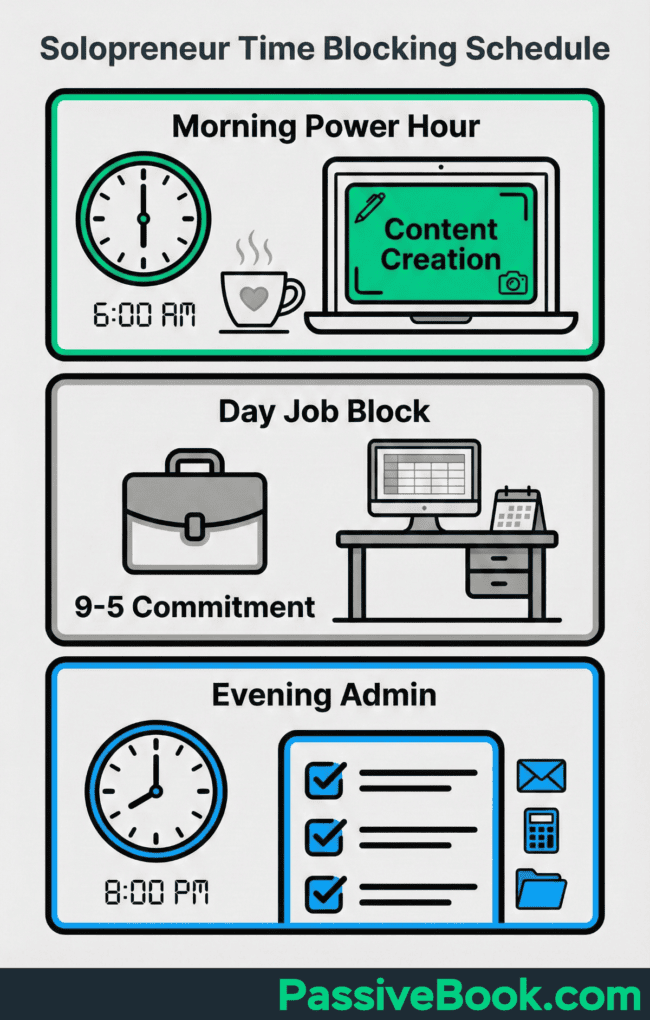
Adjust based on your personal energy cycles and family commitments.
Protect your scheduled blocks like unmissable work meetings. Add them to your calendar. Silence notifications. Communicate boundaries to family members.
When someone asks if you’re free Tuesday night, the answer is no – you’re working on your business.
I used to treat my side business hours as flexible and wonder why I never made progress. I now dump my constraints into ChatGPT – ’10 hours weekly, 6-8 AM weekdays, content business’ – and ask it to build a schedule prioritizing creation over admin busywork. Takes 30 seconds instead of the hour I used to spend second-guessing myself.
Sometimes the AI suggests ridiculous things like ‘deep work sessions’ at 10 PM when I’m barely conscious. Adjust the output for your actual human limitations.
Free Tools to Organize Your Action Plan
You don’t need expensive project management software or paid action plan templates to build an effective plan. Several free tools handle everything a solopreneur needs.
Trello offers visual Kanban boards perfect for organizing tasks and tracking project progress. Many platforms include free action plan templates and business plan templates you can customize. Create columns for “To Do,” “In Progress,” and “Done,” then move cards as you complete tasks. The visual progress feels motivating when you’re working in isolation.
Notion provides an all-in-one workspace combining notes, databases, wikis, and project management features. Build a dashboard that houses your action plan, tracks revenue, and stores content ideas in one place. The free version includes unlimited pages and blocks.
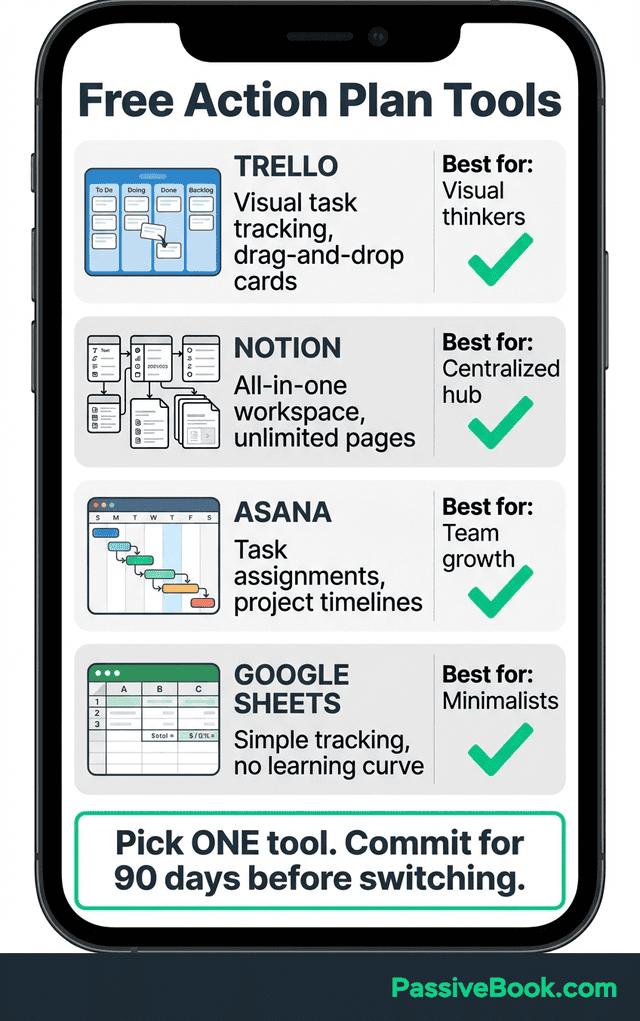
Asana’s free tier supports up to 15 team members with task assignments and timelines – useful when you eventually hire a VA or contractor. Even as a solo operator, you can create different projects for content, products, and marketing, then view everything in a unified timeline.
Simple spreadsheet action plan templates work brilliantly for early-stage planning. Create columns for task name, deadline, status, and time estimate. No learning curve. No feature overwhelm. Just clear tracking of what needs doing.
Pick one tool and commit for 90 days before switching. Tool-hopping wastes more time than using an imperfect system consistently.
Where to Find Free Business Resources and Templates
Most platforms include help centers with free action plan templates and business resources. Notion‘s template gallery offers dozens of customizable project plan templates. Trello‘s Inspiration gallery shows real action plan examples from solopreneurs. Save these to your bookmarks – they’re faster than building from scratch.
Why Most Action Plans Fail
I’ve failed at this more than I’ve succeeded.
Financial stress from inconsistent income is the top reason solopreneurs consider quitting. The income inconsistency stems from flawed action plans, not lack of effort.
Most solopreneurs try doing too much without focusing on high-impact activities. They build action plans with 15 different initiatives when they have 8 hours weekly. The math doesn’t work.
You make minimal progress on everything instead of finishing anything.
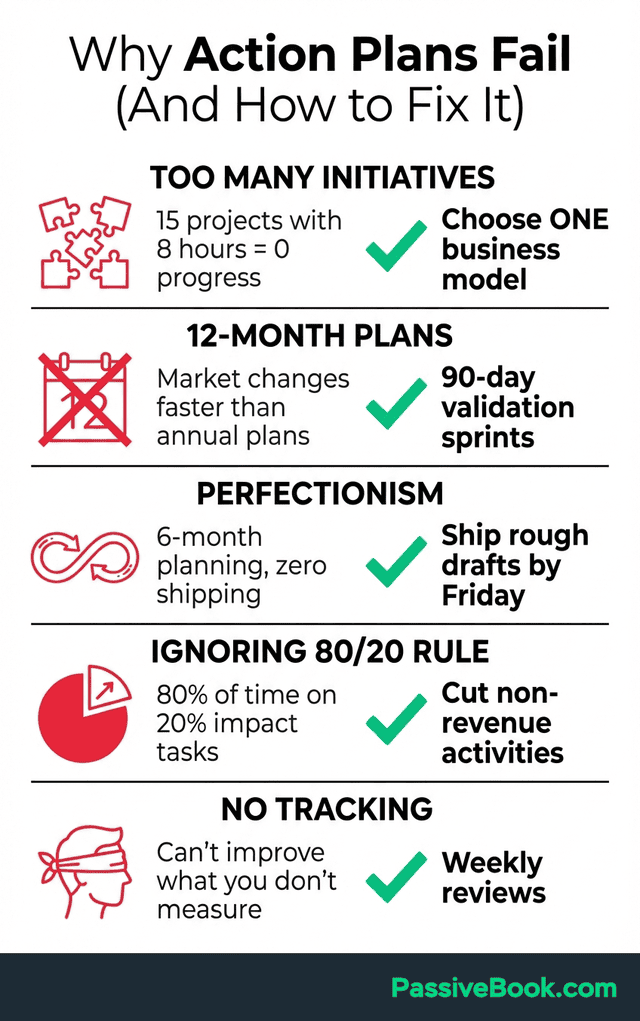
Twelve-month plans become obsolete when market feedback contradicts your assumptions. I spent three months building a course on productivity systems, only to discover my audience wanted content monetization strategies. My detailed annual plan was useless.
Launch minimum viable offerings within 30 days for real validation. Your action plan should get you to market fast, then iterate based on customer behavior.
Perfectionism and Over-planning
Perfectionism leads to procrastination by creating unrealistic standards that delay action indefinitely. I’ve seen six-month planning marathons that ship nothing.
Your first action plan should fit on one page. Mine was a Google Doc with 12 bullet points, one per week. It wasn’t pretty, but it got me moving.
Published rough drafts beat perfect drafts gathering dust. Build “ship by Friday” into your weekly action items, even if the work isn’t polished.
Ignoring the 80/20 Rule
The Pareto Principle shows that 80% of outcomes come from 20% of efforts across business contexts. Identify the handful of tasks producing most revenue or audience growth.
In my content business, writing one cornerstone blog post per week drives more traffic than posting daily on three social media platforms. It took a month of tracking to see this.
Regularly audit where your time goes and cut non-essential activities. If a task doesn’t contribute to revenue, audience growth, or product development, it probably belongs in the “eliminate” category.
How to Build Your First Action Plan in 90 Minutes
Build your action plan now. Not after more research. Set a 90-minute timer and work through these four steps.
Choose One Business Model
Picking one focused business model prevents dilution of effort and enables faster market validation. This requires saying no to shiny opportunities – the hardest part.
Content creators must choose YouTube, podcasting, or blogging as their primary platform. Not all three. Pick the format that matches your strengths and available time. Video requires more production time than writing. Audio requires consistent speaking skills.
If you choose blogging, commit to one social media platform for distribution – Pinterest for visual niches, LinkedIn for B2B, or X for tech audiences.
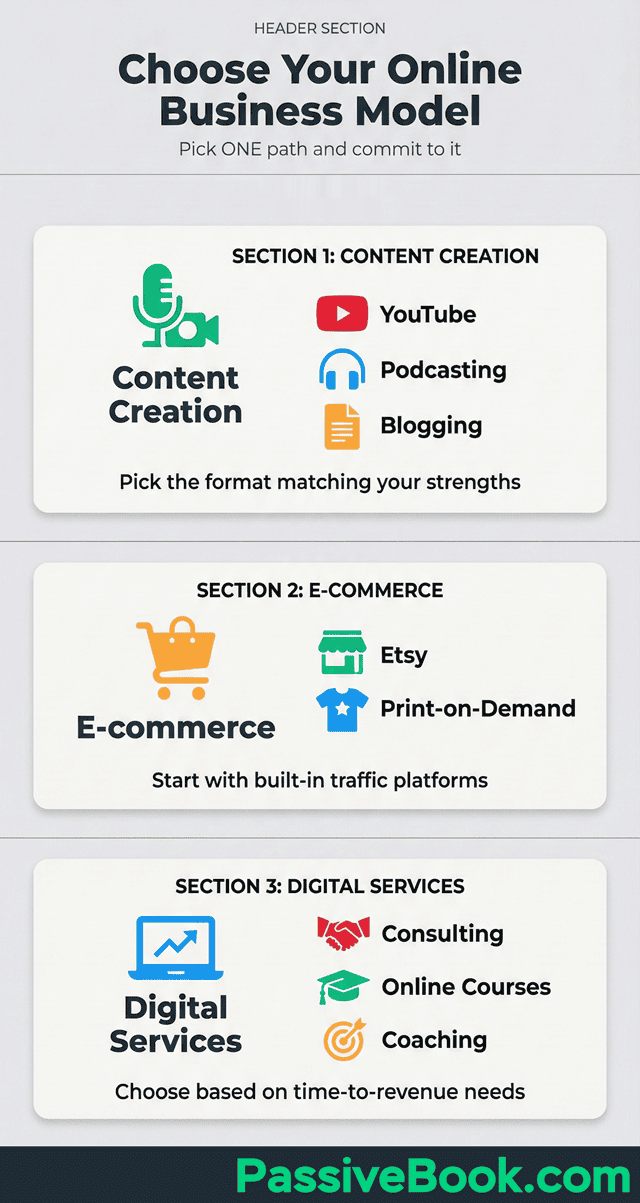
E-commerce entrepreneurs should start with Etsy or print-on-demand before building a standalone Shopify store.
These platforms handle payment processing and provide built-in traffic, letting you focus on product selection and customer service.
Digital service providers need to pick one offering: freelance consulting, online courses, or coaching. Each requires different marketing approaches and time commitments. Consulting can generate revenue fastest but trades time for money. Courses take longer to build but scale better.
Write your chosen model at the top of your action plan document. Every task you add must serve this model. If it doesn’t, cut it.
Define Your 90-day Revenue Goal
First revenue milestones should be realistic, such as $1,000-$5,000 for validation versus six-figure targets. First-quarter goals for new solopreneurs range from $1,000-$5,000 total revenue.
Only a small percentage of solopreneurs generate over $1 million annually, making six-figure first-year goals unrealistic for most beginners.
Start with validation, not revolution.
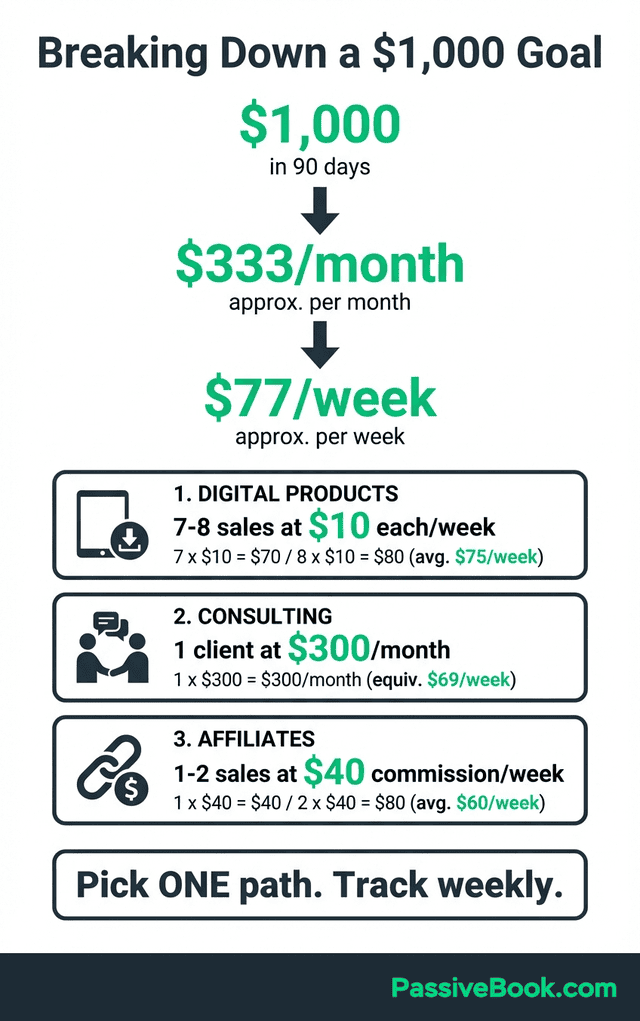
A $1,000 goal breaks down to roughly $77 per week. That could be selling 7-8 digital products at $10 each weekly, landing one consulting client at $300 monthly, or closing 1-2 affiliate sales at $40 commission each per week. The specificity helps you reverse-engineer the activities needed.
Write your 90-day revenue goal in dollar terms. Then calculate the weekly number needed. This becomes your north star metric for evaluating which tasks matter.
List Your Core Tasks
Successful solopreneurs limit focus to 3-5 core revenue-driving activities maximum each week. More than that and you’re spreading yourself too thin.
For content creators, these core tasks are content production, platform growth tactics, and audience engagement. Content production means writing blog posts, recording videos, or publishing podcast episodes. Platform growth includes SEO optimization, Pinterest strategy, or YouTube thumbnails. Audience engagement covers email newsletter management and community interaction.
For e-commerce businesses, focus on product sourcing, listing optimization, and customer service. Product sourcing involves finding suppliers or creating designs. Listing optimization means writing compelling product descriptions and testing pricing. Customer service includes responding to inquiries and handling returns.
For course creators, the three pillars are curriculum development, marketing activities, and student support. Build your course content first, then promote through content marketing or partnerships, and finally engage with students to gather testimonials.
Assign time estimates to each task based on your available weekly hours. If you have 10 hours weekly, you might allocate 5 hours to content production, 3 hours to growth tactics, and 2 hours to engagement.
Schedule Around Your Day Job
Building a business while employed full-time requires strategic time allocation and consistent scheduling discipline. Look at your calendar honestly and identify available blocks.
Allocate specific calendar blocks for each core task. Monday and Wednesday mornings from 6-7 AM become content creation time. Saturday afternoons from 2-5 PM are for product work or course development. Sunday evenings from 7-8 PM handle admin tasks like invoice tracking and weekly reviews.
Build Buffer time for unexpected delays or learning curves. If you think a task takes 2 hours, schedule 2.5 hours. New solopreneurs consistently underestimate how long activities take, especially technical setup or content editing.
Protect these scheduled blocks from non-essential commitments. Your business hours are as important as your day job meetings. When friends suggest dinner during your Tuesday content block, propose an alternative time instead of sacrificing your progress.
Paste your weekly schedule into ChatGPT and ask: “Review this 10-hour weekly schedule for a content business. Are my time allocations realistic? What adjustments would you recommend?” The AI can spot imbalances like spending 7 hours on content creation but only 1 hour on promotion.
See how one solopreneur protects business time around a demanding job:
Your Action Plan Template (Copy This)
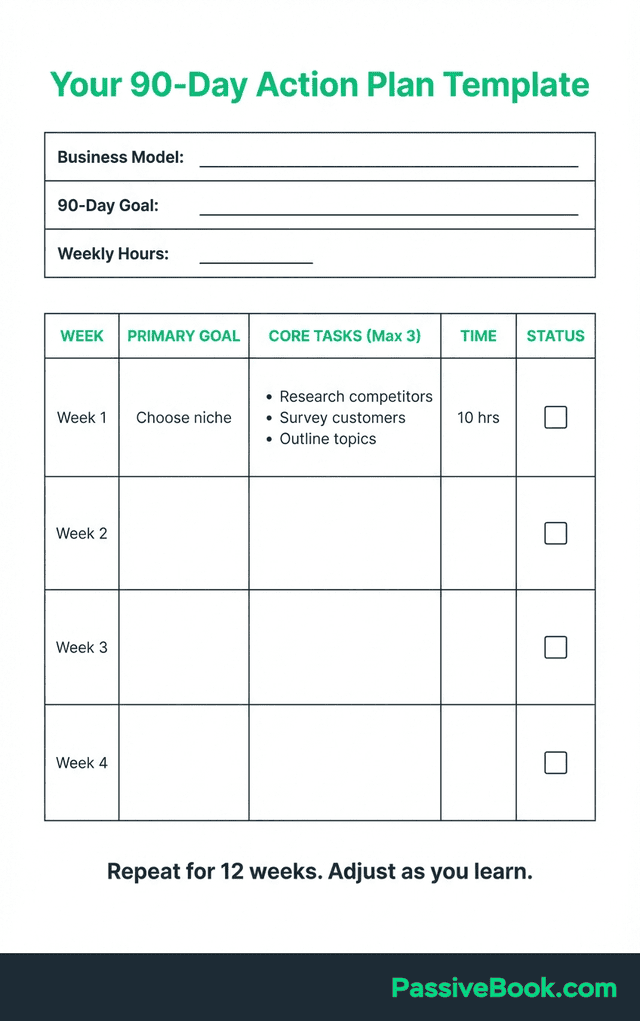
Here’s a simple template you can copy and customize for your business. Fill in your specific goals and tasks:
| Week | Primary Goal | Core Tasks (Max 3) | Time Allocated | Status |
|---|---|---|---|---|
| 1 | Choose niche & validate demand | 1. Research 10 competitors 2. Survey 20 target customers 3. Outline first 5 content topics | 10 hours | Not Started |
| 2 | Set up business foundation | 1. Register domain & hosting 2. Install WordPress/[Shopify](https://passivebook.com/go/shopify/) 3. Create social media profiles | 10 hours | Not Started |
| 3 | Create first content piece | 1. Write cornerstone blog post 2. Design Pinterest pins 3. Set up email capture | 10 hours | Not Started |
| 4 | Launch & promote | 1. Publish content 2. Share on chosen platform 3. Track first analytics | 10 hours | Not Started |
Continue this pattern through Week 12, adjusting based on your business model and available hours.
Real Action Plan Example: 90-Day Content Business Launch
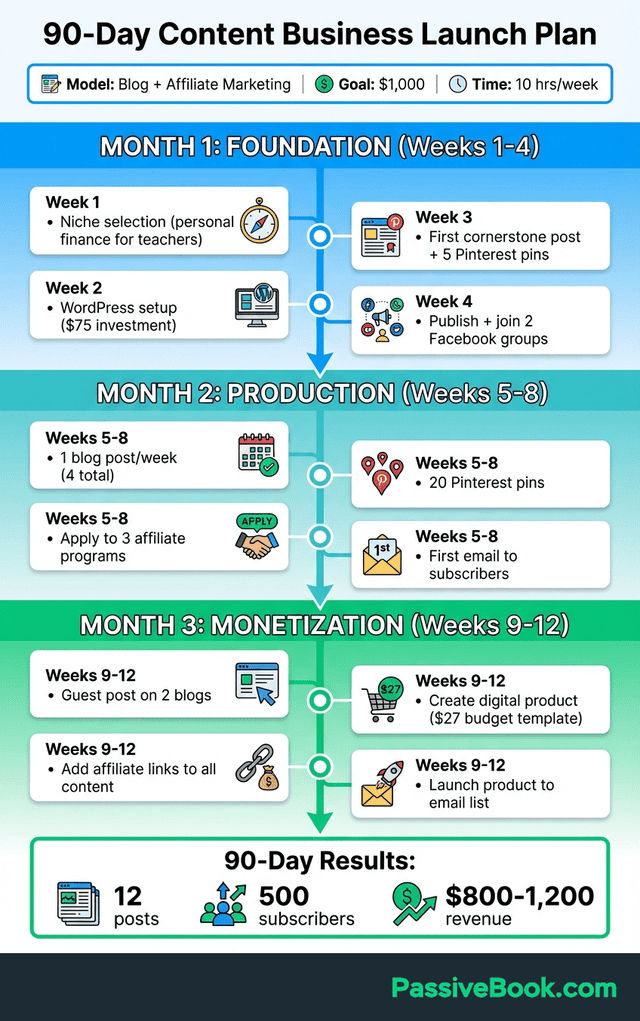
Here’s what a complete 90-day action plan looks like for someone starting a content business with 10 hours weekly:
Business Model: Blog monetized through affiliate marketing and digital products
90-Day Revenue Goal: $1,000 (approximately 10-12 affiliate sales at $80-100 commission each)
Weekly Time Available: 10 hours (weekday mornings 6-8 AM, Saturday 2-5 PM)
Month 1: Foundation (Weeks 1-4)
- Week 1: Niche selection (personal finance for teachers) + competitor research + keyword analysis
- Week 2: WordPress setup ($15 domain + $60 hosting) + essential plugins + basic design
- Week 3: Write first cornerstone post (2,500 words) + create 5 Pinterest pins + set up Convertkit free account
- Week 4: Publish post + create 3 follow-up articles + join 2 teacher Facebook groups for promotion
- Week 5-8: Publish 1 blog post weekly (4 total), design 20 Pinterest pins, apply for 3 affiliate programs, send first email to subscribers
- Week 9-10: Guest post on 2 established blogs, create first digital product (budget template), add affiliate links to all content
- Week 11-12: Launch product at $27, promote to email list, optimize top-performing content for conversions
This plan is honest about what’s achievable in limited hours. Notice how it focuses on one platform (blog + Pinterest) rather than spreading across YouTube, Instagram, TikTok, and Twitter.
How AI Tools Can Accelerate Your Action Planning
AI tools help solopreneurs automate repetitive tasks and scale operations without hiring staff. For action planning specifically, AI excels at generating task breakdowns, optimizing schedules, and identifying gaps.
Use ChatGPT to generate initial task lists by prompting: “I’m starting a content business with YouTube as my primary platform, working 10 hours weekly. What are the 3-5 highest-impact tasks I should focus on in my first 90 days to reach 1,000 subscribers?” This usually provides a solid starting framework you can customize.
For more advanced planning, try this prompt: “I need to launch a mini-course in 6 weeks working 12 hours weekly. Break this into weekly milestones with specific deliverables and time estimates for each task.” The AI creates a realistic project plan timeline you can drop directly into Trello or Notion.
Free automation tools like Make.com (formerly Integromat) or IFTTT handle basic workflows without paid plans. Connect your task manager to a Google Sheet for automatic logging, or trigger social media posts when you publish new content. Start with 1-2 simple automations before building complex workflows.
Notion AI can auto-generate weekly review templates and summarize your task completion patterns over time. After a month of tracking, ask it: “Analyze my task completion rate and identify which time blocks are most productive.” This reveals whether you’re more effective in morning or evening sessions.
This walkthrough demonstrates ChatGPT prompts for action planning:
Tracking Progress Without Burning Out
Weekly reviews identify wasted time from distractions and optimize future schedules. Dedicate 30 minutes every Sunday evening to review your completed tasks from the past week.
Compare completed tasks against planned tasks. If you planned 8 tasks but only finished 5, don’t just feel guilty. Analyze why. Were your time estimates too optimistic? Did unexpected day job responsibilities eat into your side business hours? Did you spend time on unplanned activities?
This data improves future action plans. After three weeks of tracking, patterns emerge. You might discover that you always skip tasks scheduled for Friday evenings because you’re mentally exhausted from your day job. Solution: move Friday tasks to Saturday morning when your energy is higher.
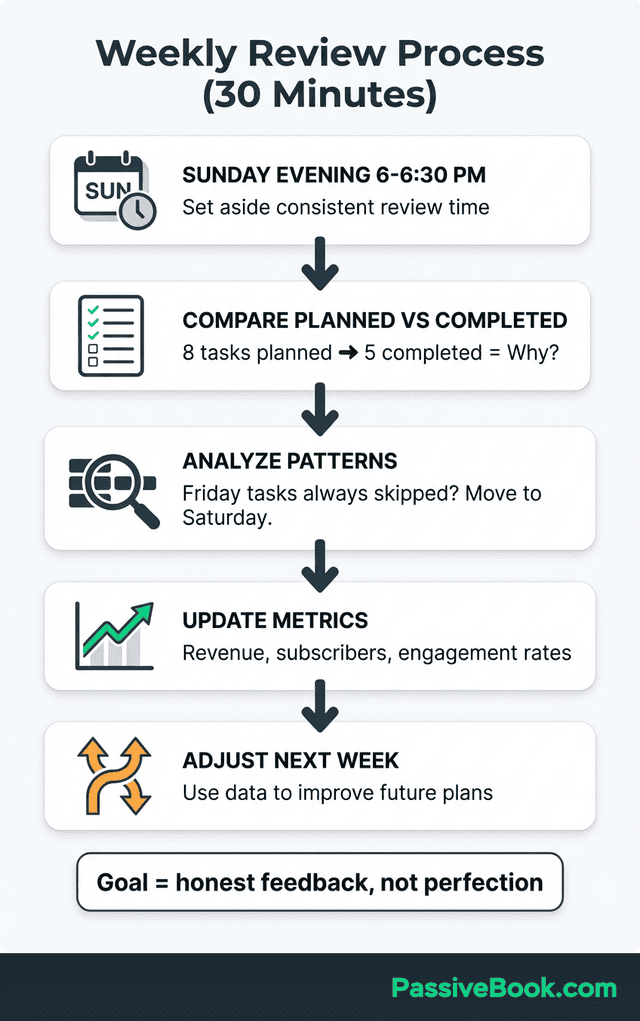
Monthly revenue tracking shows whether your business model validates or requires a pivot. Create a simple spreadsheet with columns for date, revenue source, amount, and notes. If you’re three months in without any revenue, your action plan needs serious revision – probably a different business model or target audience.
Track metrics that matter for your specific model. Content creators should monitor email subscriber growth and engagement rates. E-commerce businesses need conversion rates and average order value. Course creators track enrollment numbers and completion rates.
The goal isn’t perfection. It’s honest feedback. Some weeks you’ll crush your tasks. Other weeks life happens. The tracking data shows whether you’re trending toward your 90-day goal or need to adjust.
When to Adjust Your Plan
Pivot when customer feedback shows product-market fit issues or declining engagement metrics. Not every dip requires a complete overhaul, but consistent negative trends demand attention.
Adjust your action plan when key metrics decline for 2 consecutive months. If you’re running a content business and posting three times weekly but engagement drops 50% over 8 weeks, test a format change before abandoning the platform entirely. Maybe your audience prefers video to written content, or shorter posts to long-form articles.
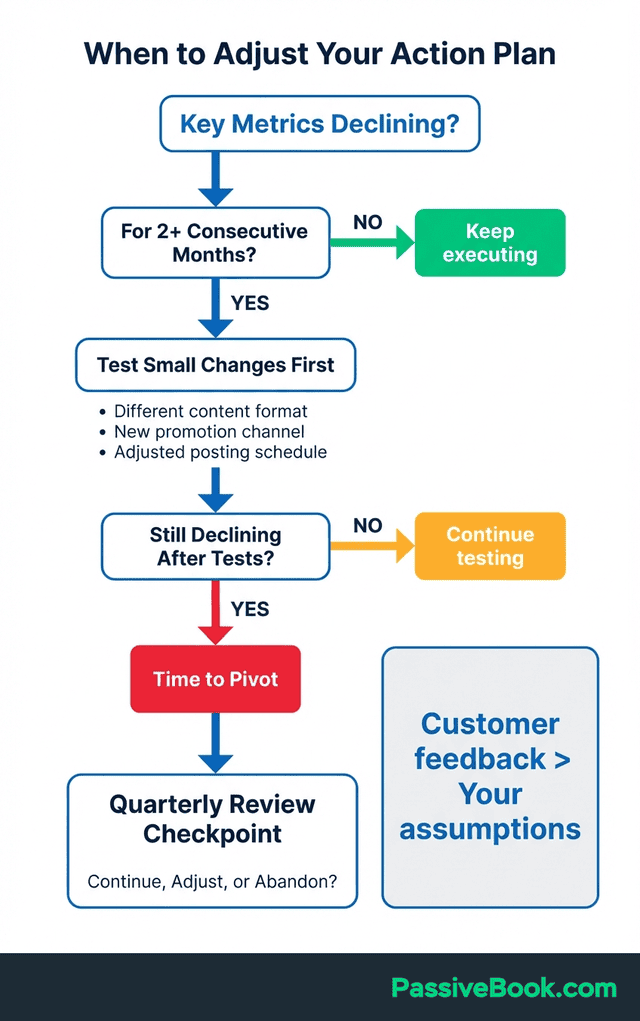
Test small changes before overhauling your entire approach. Don’t jump from blogging to podcasting because one article flopped. Try different topics, formats, or promotion strategies first. Pivoting should be a last resort after methodical testing.
Market feedback trumps your assumptions. If customers keep asking for a feature you didn’t plan to build, adjust your roadmap. If your audience ignores your premium products but loves your free resources, consider affiliate marketing or ad revenue instead.
Set quarterly review points where you evaluate whether to continue, adjust, or abandon your current direction. These aren’t daily decisions. Give your action plan enough time to produce meaningful data before making major changes.
Frequently Asked Questions
How Detailed Should My First Action Plan Be?
Your first action plan should fit on a single page with 12-15 bullet points maximum. Each bullet represents one week’s primary objective, stated clearly enough that you know exactly what done looks like. Avoid the trap of creating a 20-page planning document that takes longer to maintain than to execute.
What If I Can Only Work on My Business 5 Hours Per Week?
Five hours weekly is enough if you focus ruthlessly on one business model and one growth channel. Allocate 3 hours to your core revenue activity like content creation or product development, 1.5 hours to promotion or customer acquisition, and 30 minutes to admin and tracking. You’ll progress slower than someone working 15 hours weekly, so extend your 90-day goals to 6 months.
How Often Should I Review My Action Plan?
Review your action plan weekly for 30 minutes to track task completion and adjust the upcoming week’s priorities. Conduct a deeper monthly review to analyze metrics, identify patterns in your productivity, and course-correct if you’re falling behind your 90-day goal. Avoid daily reviews – they create planning paralysis instead of execution momentum.
What’s the Difference Between a Business Plan and Action Plan?
A business plan outlines your overall strategy, target market, competitive analysis, and financial projections for 1-3 years ahead. An action plan breaks your next 90 days into specific weekly tasks with clear deadlines and owners. Think of the business plan as your roadmap and the action plan as your turn-by-turn GPS directions for the immediate journey ahead.
Do I Need a Strategic Plan Before Creating an Action Plan?
No. Strategic planning is valuable for established businesses, but new solopreneurs should start with a 90-day action plan focused on validation. Build your strategic plan after you prove your business model generates revenue. Action plans keep you moving while strategic plans help you scale what’s already working.
What Next?
You now have everything you need to build an action plan that fits your actual life – not some idealized version where you have unlimited time and energy. The framework works whether you have 5 hours or 15 hours weekly, as long as you commit to protecting those hours like sacred work meetings.
Building a business around a day job is hard. Some weeks you’ll nail every task on your list. Other weeks you’ll miss everything because life happened. That’s normal. The action plan isn’t about perfection – it’s about making consistent progress toward a specific 90-day goal, then adjusting based on what you learn.
Before you close this tab, do two things. First, open a blank document and write your 90-day revenue goal – just one sentence with a dollar amount and date. That’s your starting point. Second, leave a comment with your goal and your #1 obstacle to achieving it. I read every comment and often spot solutions you’re too close to see.
Share this post with your friends & followers: