You can spend every spare evening building an online business and still reach launch day without knowing whether anyone wants the offer. The website looks finished, but the question that matters is still unanswered: will people pay?
When time and money are tight, that uncertainty gets expensive. Another subscription or weekend of work needs a better reason than “this might help.” To decide what deserves that commitment, this guide follows a small digital-product launch from checking demand and costs to finding buyers and making delivery repeatable. It also shows what changes for services, physical products, and content businesses.
1. Find a Customer Problem Worth Solving
Start with a situation you understand and people you can reach. A useful skill helps, but access to potential customers matters too. You need somewhere to ask questions and eventually show your offer.
Look for a problem people already try to solve. Ask about recent behavior:
- “When did this last happen?”
- “How did you handle it?”
- “What have you tried or paid for?”
- “What still made the task difficult?”
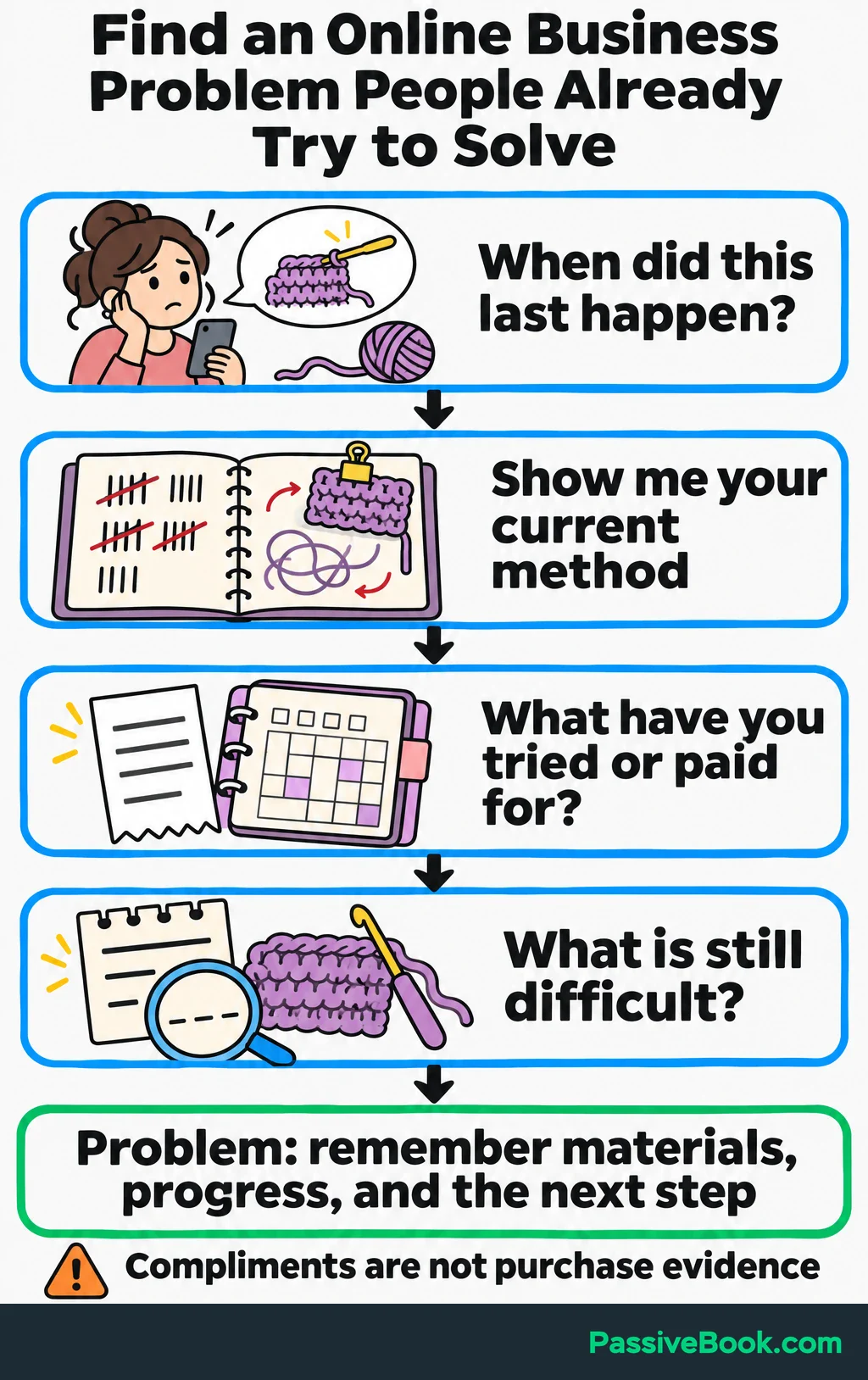
I would skip “Would you buy this?” at this stage. People can sincerely like an idea without ever needing to purchase it.
For the running example, imagine selling downloadable crochet-project planners to people juggling several unfinished projects. The product, prices, costs, and sales figures throughout this guide are illustrative.
Before designing pages, investigate how people remember yarn details, completed rows, and where to restart. Ask them to show you their current method. A notebook full of crossed-out notes tells you more than a general complaint about being disorganized.
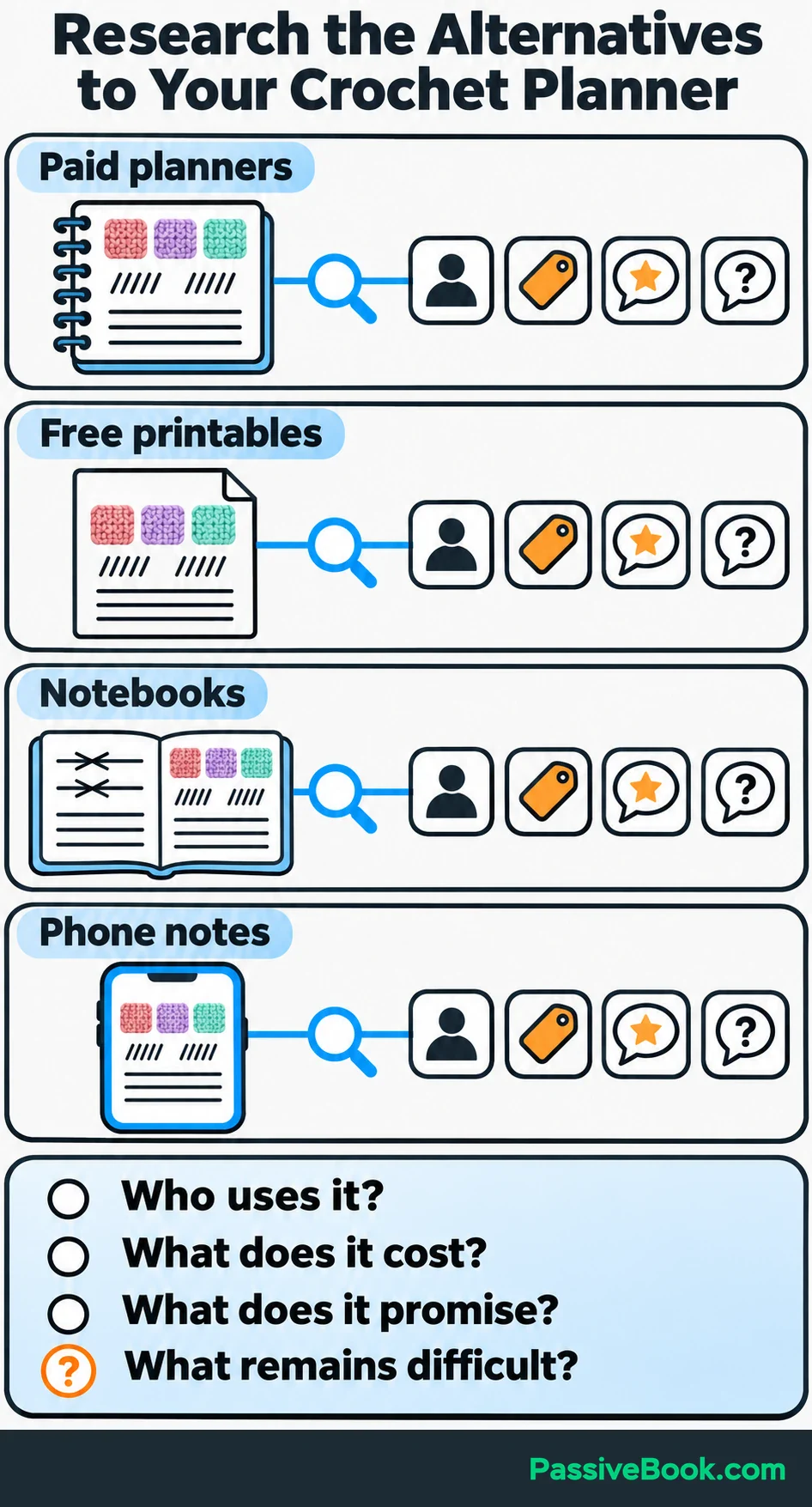
Then compare paid planners with free printables, notebooks, and phone notes. Record who each option serves, what it costs, what it promises, and what users still find difficult. The U.S. Small Business Administration’s market research guidance offers a useful framework for checking demand, alternatives, and pricing.
Finish with a plain problem statement grounded in what you heard:
People switching between crochet projects need a simple way to remember their materials, progress, and next step.
That gives you something specific to test. “People love crochet” does not.
2. Choose a Business Model You Can Operate
Write down your available hours, spending limit, useful skills, and access to buyers before choosing a model. Include the work after the sale. A business that needs daily shipping may clash with a job that keeps you away from home.
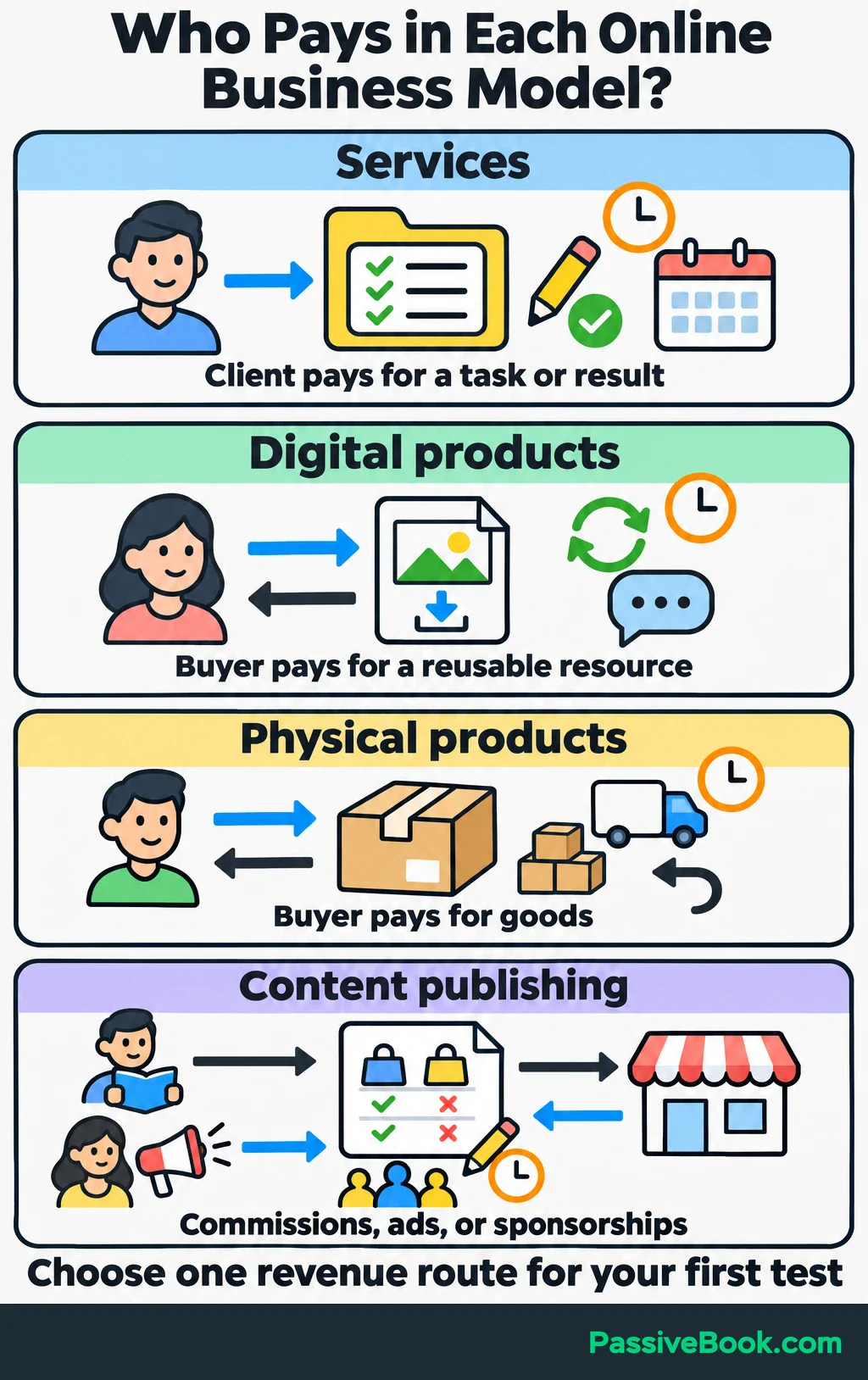
Use this comparison to choose a first test:
| Model | Who Pays and Why | Startup Cost Drivers | Recurring Workload | Smallest Useful Demand Test |
|---|---|---|---|---|
| Services | A client pays for a defined task or result | Tools, insurance where needed, and time spent finding clients | Delivery, revisions, scheduling, and support | Sell one tightly scoped paid project |
| Digital products | A buyer pays for a reusable resource or access | Creation, design, selling tools, and payment fees | Promotion, updates, delivery checks, and support | Sell a small product that solves one problem |
| Physical products | A buyer pays for goods | Samples, sourcing, inventory, packaging, shipping, and returns | Fulfillment, quality checks, stock management, and support | Sell a limited batch before ordering substantial stock |
| Content publishing | Merchants pay affiliate commissions on qualifying purchases through your recommendation links; advertisers or sponsors pay to reach readers | Research, publishing tools, and distribution | Creating and updating content, attracting readers, and managing revenue sources | Publish a buying guide and track affiliate commissions, or sell one sponsor placement |
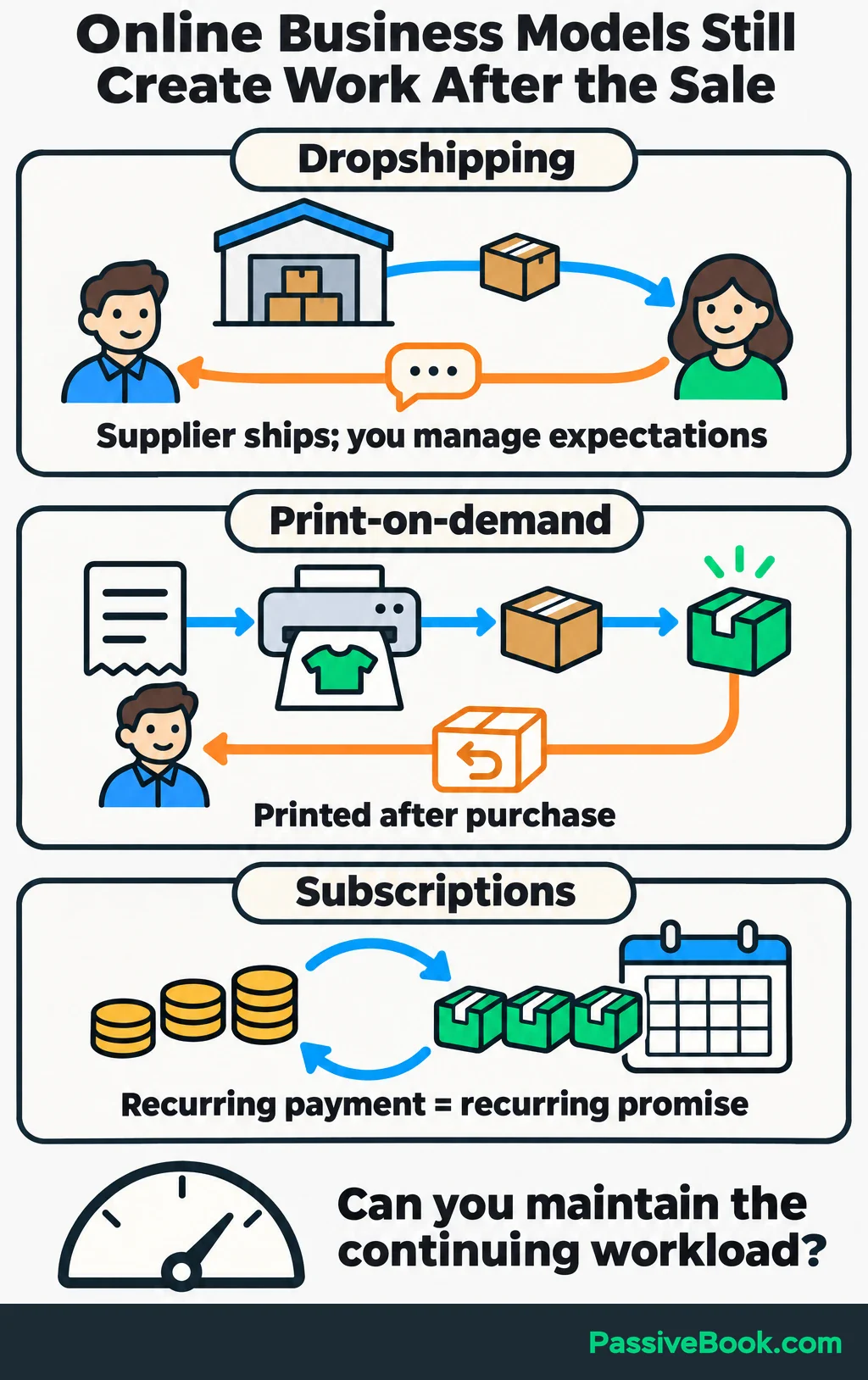
With dropshipping, a supplier ships products directly to your buyers. With print-on-demand, a supplier prints items such as T-shirts after an order arrives. Both can reduce the stock you hold, but you still handle customer expectations and the costs of supplier mistakes and returns.
Subscriptions add a continuing promise. Before choosing one, decide what customers will keep paying for and what work that creates each month. I abandoned a membership site because producing constant premium content became unsustainable alongside my corporate job.
For the crochet example, I would test a digital product because the proposed solution is a reusable organizational resource.
You can combine models later. A blog might attract buyers for your downloads and earn affiliate commissions, but choose one primary revenue route for the first test. Otherwise, you can end up building three businesses before proving one.
Define the Offer You Will Test
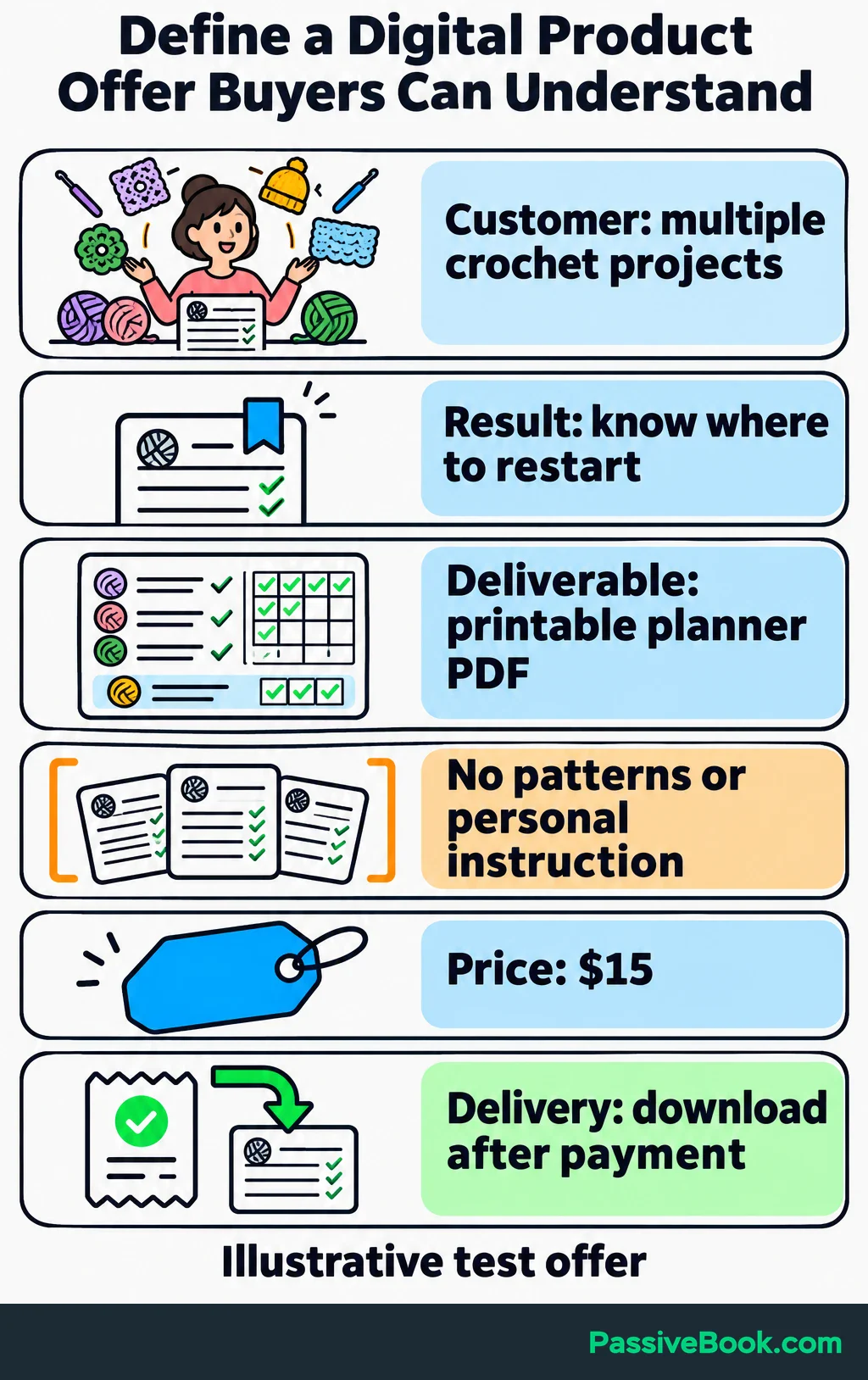
An offer needs a clear customer, useful result, deliverable, scope, price, and delivery method.
For the planner, the test offer could be:
A $15 printable PDF for people managing several crochet projects, with yarn records, progress logs, restart notes, and a completed example. Buyers receive a download after payment. It does not include crochet patterns or personal instruction.
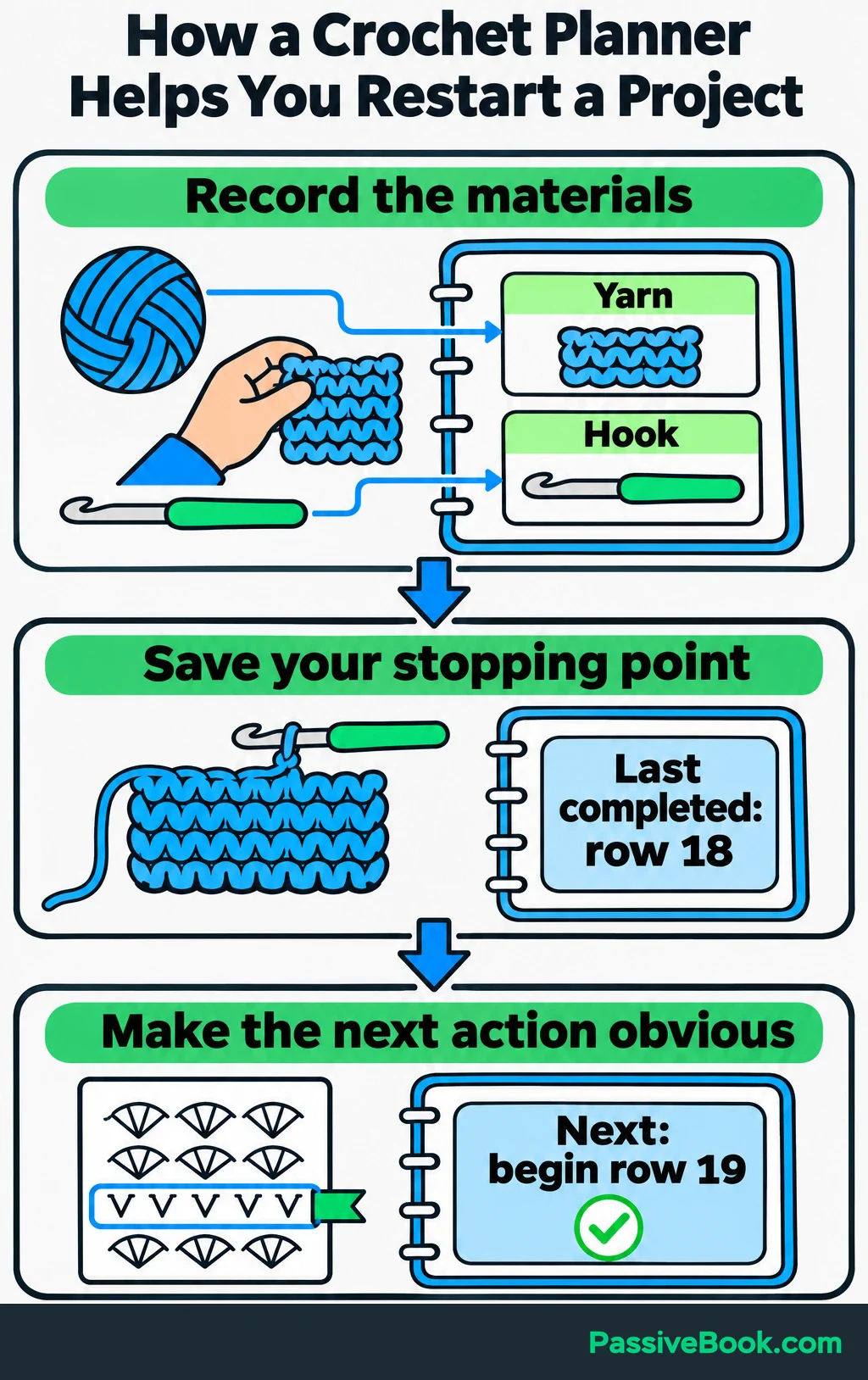
Show how the product helps through a sample. A restart note might read:
Last completed: row 18. Next: begin row 19 using the marked pattern section. Hook and yarn details are recorded above.
That makes the intended use visible. Adding thirty decorative pages would make the file bigger, but would it make restarting easier?
The next step is to make your own offer just as concrete. The AI Copywriting Studio below turns your rough notes into an offer draft and messages you can use to put it in front of relevant buyers.

Free AI Copywriting Studio




For a service, define the result and boundaries just as clearly. For a content business, name the audience problem and revenue source you will test. “Publish articles” is an activity; “help readers compare relevant tools and earn commissions from qualifying purchases” describes a business model.
3. Calculate Your Startup Budget
Separate Essential Costs From Purchases That Can Wait
Budget for your first test.
Separate expenses into three groups:
- Setup costs: Spending needed to begin, such as required registration, samples, or initial product preparation.
- Recurring costs: Bills that continue while you operate, such as hosting, software, or insurance.
- Costs per sale: Expenses triggered by an order, such as payment fees, materials, shipping, or partner commissions.
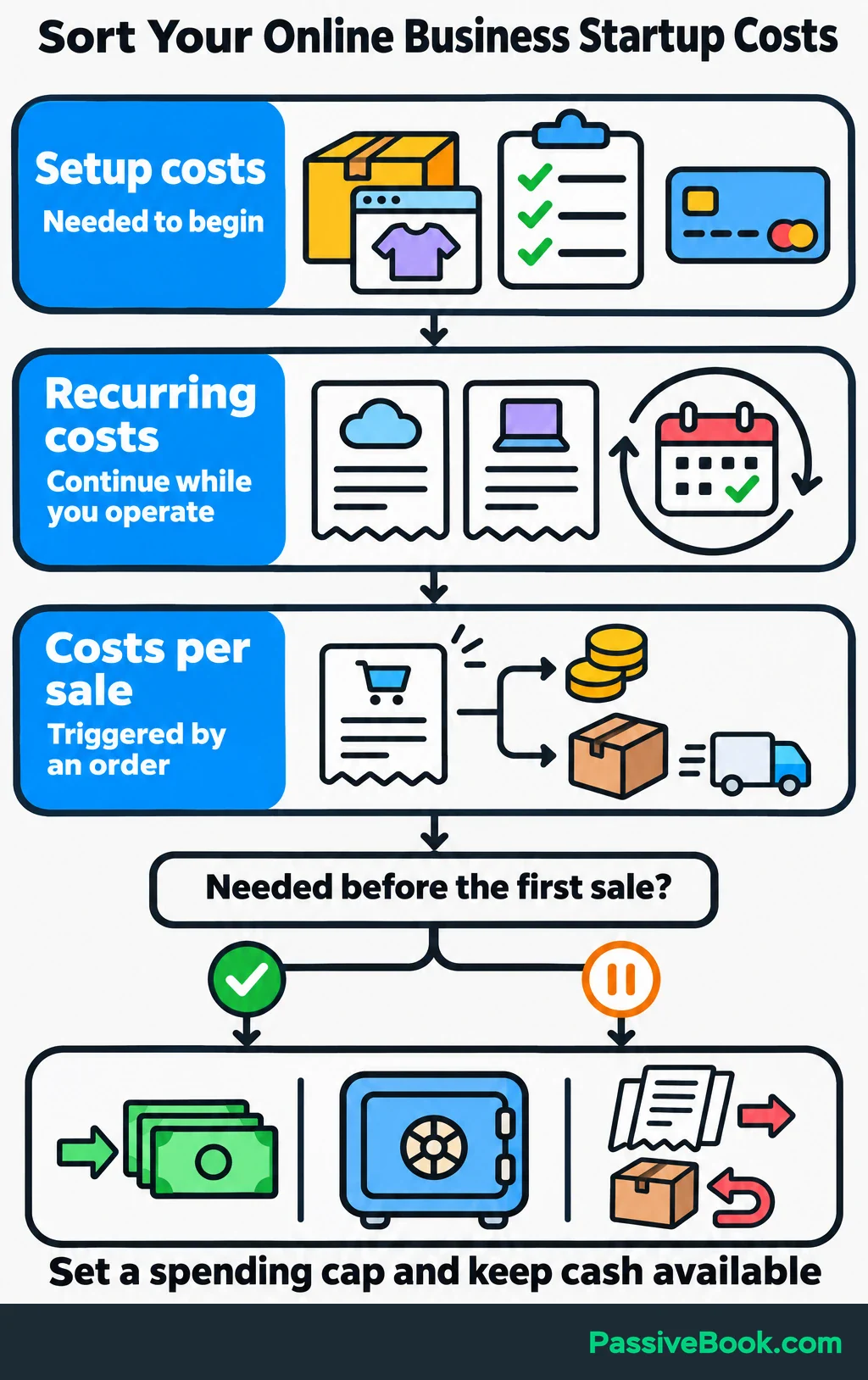
List each expense, its current price, payment date, and renewal cost. Mark what you need before the first sale.
Include applicable taxes, professional help, refunds, and returns. An expense does not disappear because it makes the spreadsheet less cheerful.
Set a spending cap and review date before buying anything. Keep cash available for bills and refunds during payout delays; Stripe’s payout guidance explains when funds reach your bank.
Check What Each Sale Contributes
First, work out how much one sale leaves after the costs caused by that sale. This is its contribution toward setup costs, ongoing bills, and eventually your pay.
For the illustrative planner:
| Item | Amount |
|---|---|
| Selling price | $15 |
| Variable costs per order | $2 |
| Contribution per order | $13 |
| Setup spending to recover | $60 |
| First-month fixed expenses | $20 |
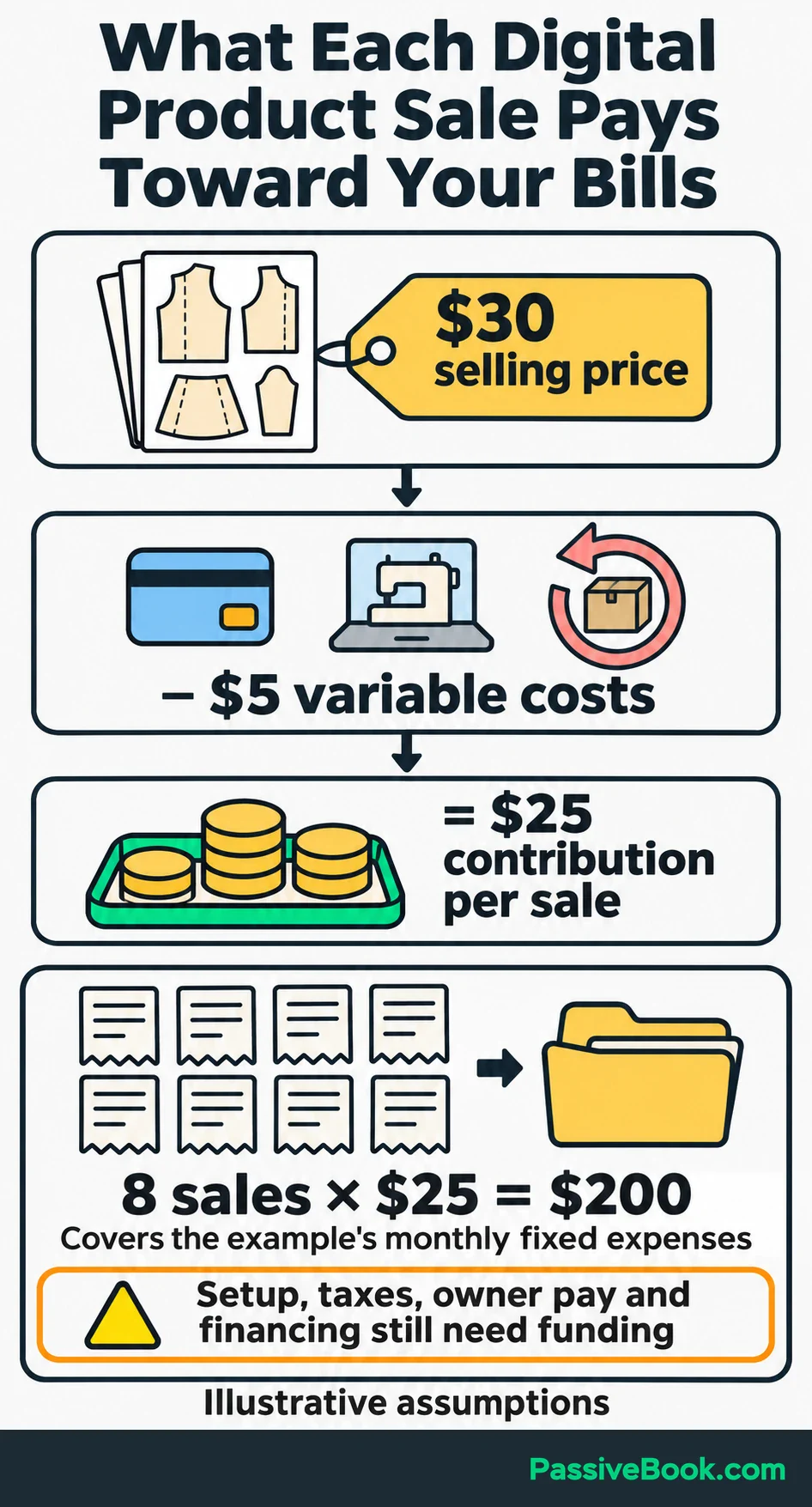
To recover the setup spending and first month’s fixed expenses, you need to cover $80. Divide that by the $13 contribution and round up:
$80 ÷ $13 = 6.15 → 7 sales
This applies the SBA’s break-even formula to a target that also includes recovering setup spending.
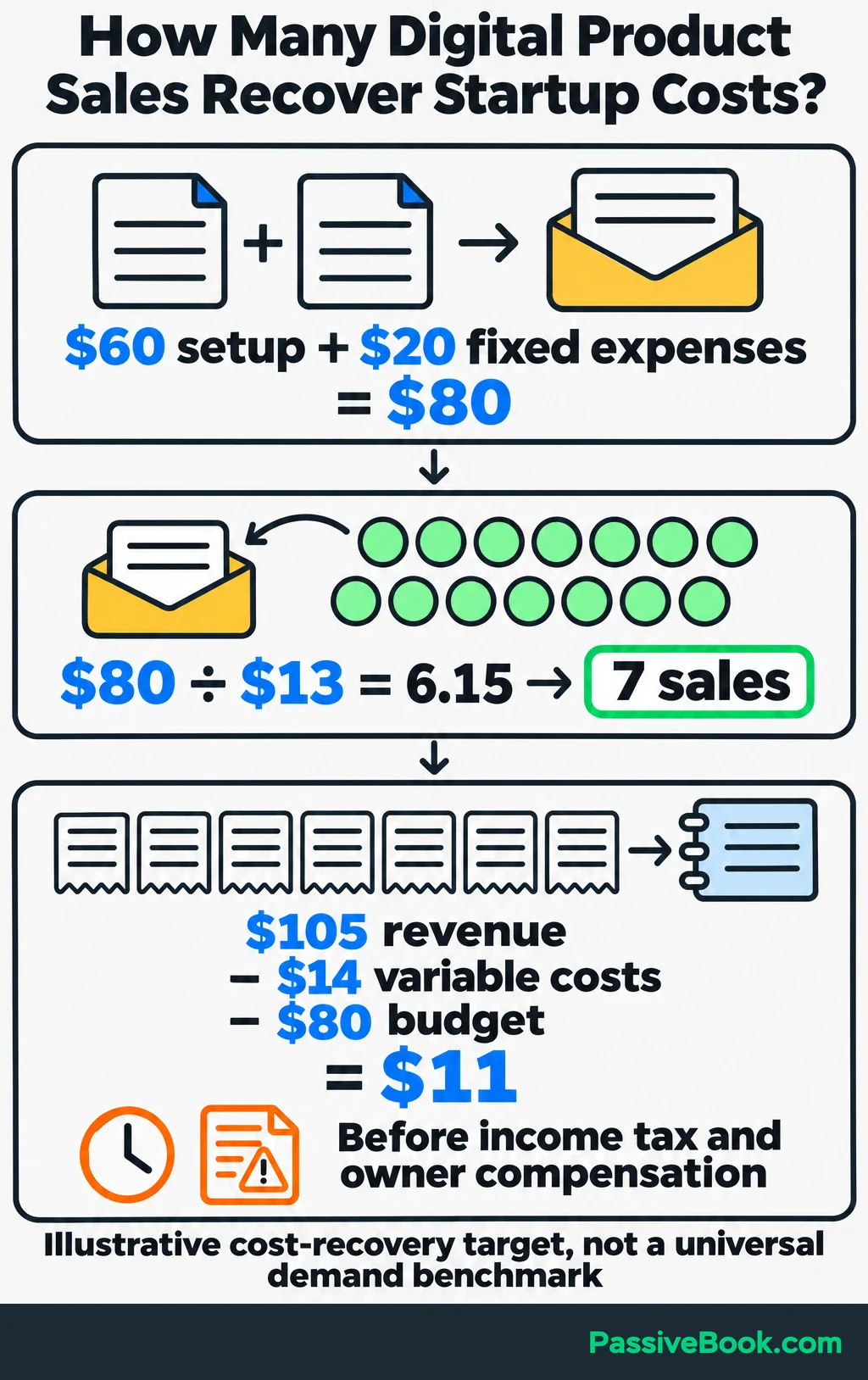
Seven sales produce $105 in revenue. Subtract $14 in variable costs and the $80 budget, and $11 remains before income tax and owner compensation. The $2 is an assumption for this example, not a quoted platform fee.
Count your creation, promotion, delivery, and support hours. Add what you want to earn for those hours to the cost target and calculate again. If the required sales exceed what you can attract or fulfill, change the price, costs, scope, or model before expanding. If each sale contributes zero or less, selling more will not solve the problem.
Your sales target needs to fit your available hours as well as your budget. Use the Business Cash Planner below to compare both before committing more money.

Free Business Cash Planner
4. Validate Demand With a Small Paid Test
Put the Offer in Front of Relevant Buyers
Before accepting payment, check the registration, licensing, tax, and liability requirements that apply where you operate and sell. For U.S. businesses, the SBA’s launch checklist is a starting point. Elsewhere, use the relevant local authorities.
Then create the smallest version you can sell and fulfill properly.
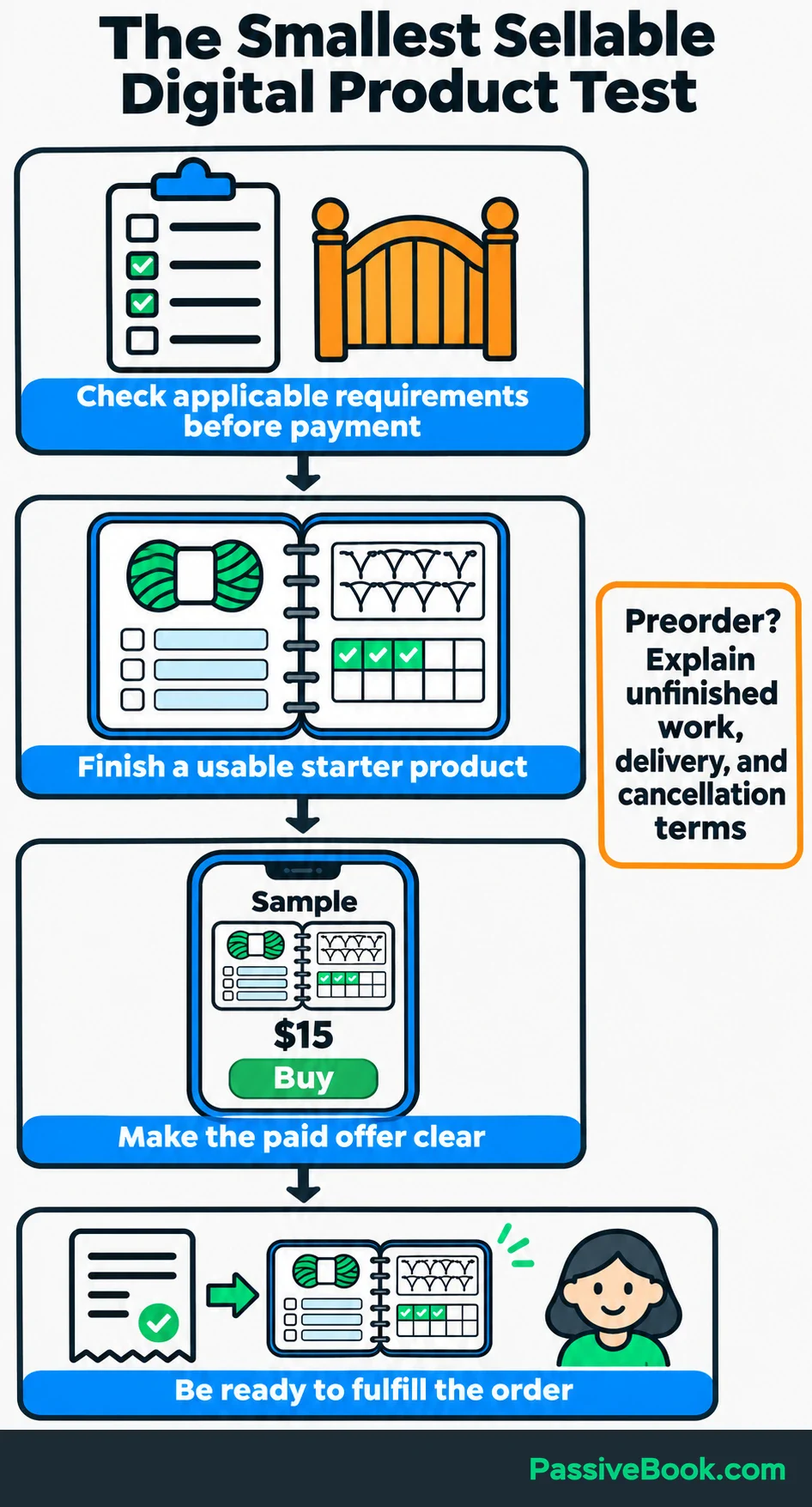
For the planner, that means a usable starter download, sample pages, a clear price, and a purchase link. I would finish that small product before taking orders. If you use a preorder instead, explain what already exists, what remains unfinished, the delivery commitment, and the cancellation or refund terms.
Choose a purchase target, review date, spending cap, and time limit. Tie them to a decision.
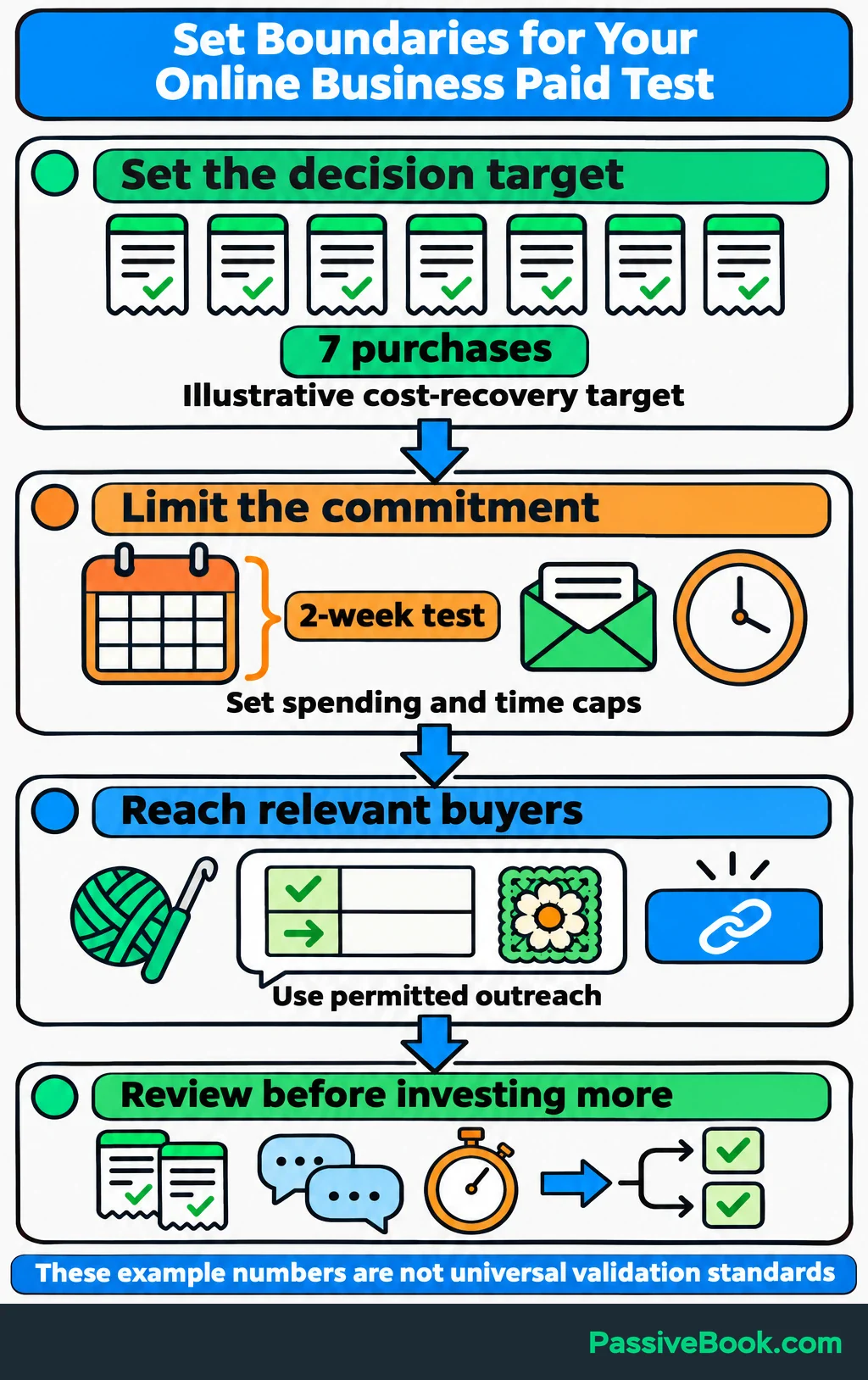
For example, you might test for two weeks and look for seven purchases before funding a larger version. That target comes from the illustrative cost calculation. It is not a universal standard for proving demand.
Reach people who experience the problem through relevant contacts, permitted community posts, or focused outreach. Demonstrate how the planner records the last completed row and next step, then make the paid offer visible.
A content business needs a test appropriate to its revenue source. Publish something useful that answers a buying question and track resulting affiliate commissions. If sponsorship is the model, test a defined placement with a relevant advertiser.
Decide Whether to Continue, Revise, or Stop
Record suitable prospects reached, purchases, objections, refunds, customer feedback, and hours spent. Keep compliments and email signups separate from purchases.
I committed approximately $1,200 to my online jewellery store without doing market research. I accumulated unsold inventory and lost most of the investment. That experience is why I want evidence of demand before making the next expensive commitment.
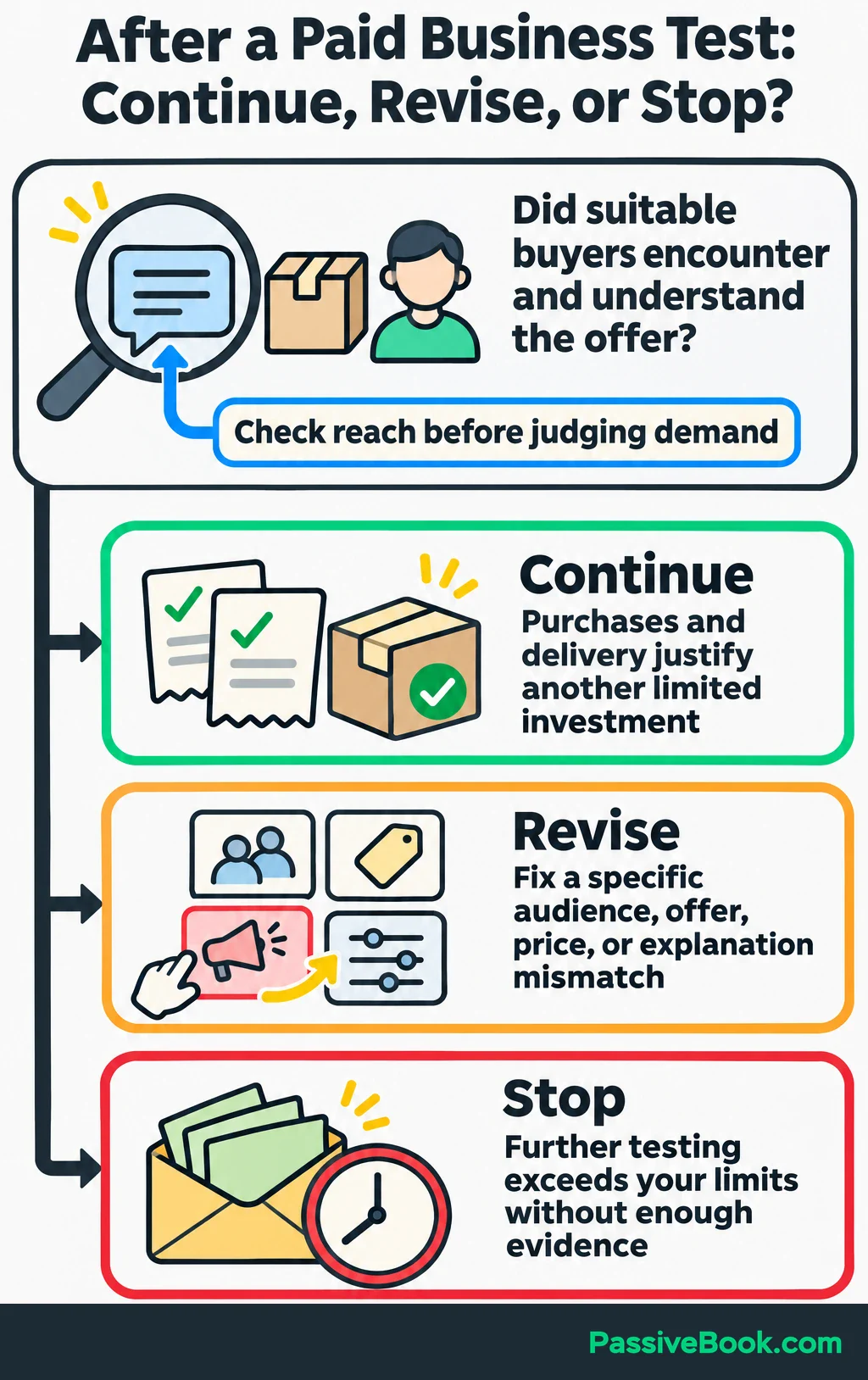
Use the test to choose among three actions:
- Continue: Purchases and successful delivery justify another limited investment.
- Revise: A specific mismatch appears in the audience, offer, price, or explanation.
- Stop: Further testing would exceed your spending or time limit without enough reason to continue.
Before blaming the product for weak sales, check whether suitable buyers actually encountered and understood the offer. An unanswered outreach message does not tell you much about willingness to pay.
A small paid test supports the next decision. Dependable income requires repeated sales, manageable costs, and reliable delivery over time.
5. Prepare the Offer for Reliable Delivery
Turn customer feedback into a delivery checklist before adding more products.
For the planner, check that buyers can:
- Open the file on the devices you say it supports.
- Print it at the stated paper size.
- Read and write in the spaces provided.
- Understand how to use it from the instructions and completed example.
- Find help if the download fails.
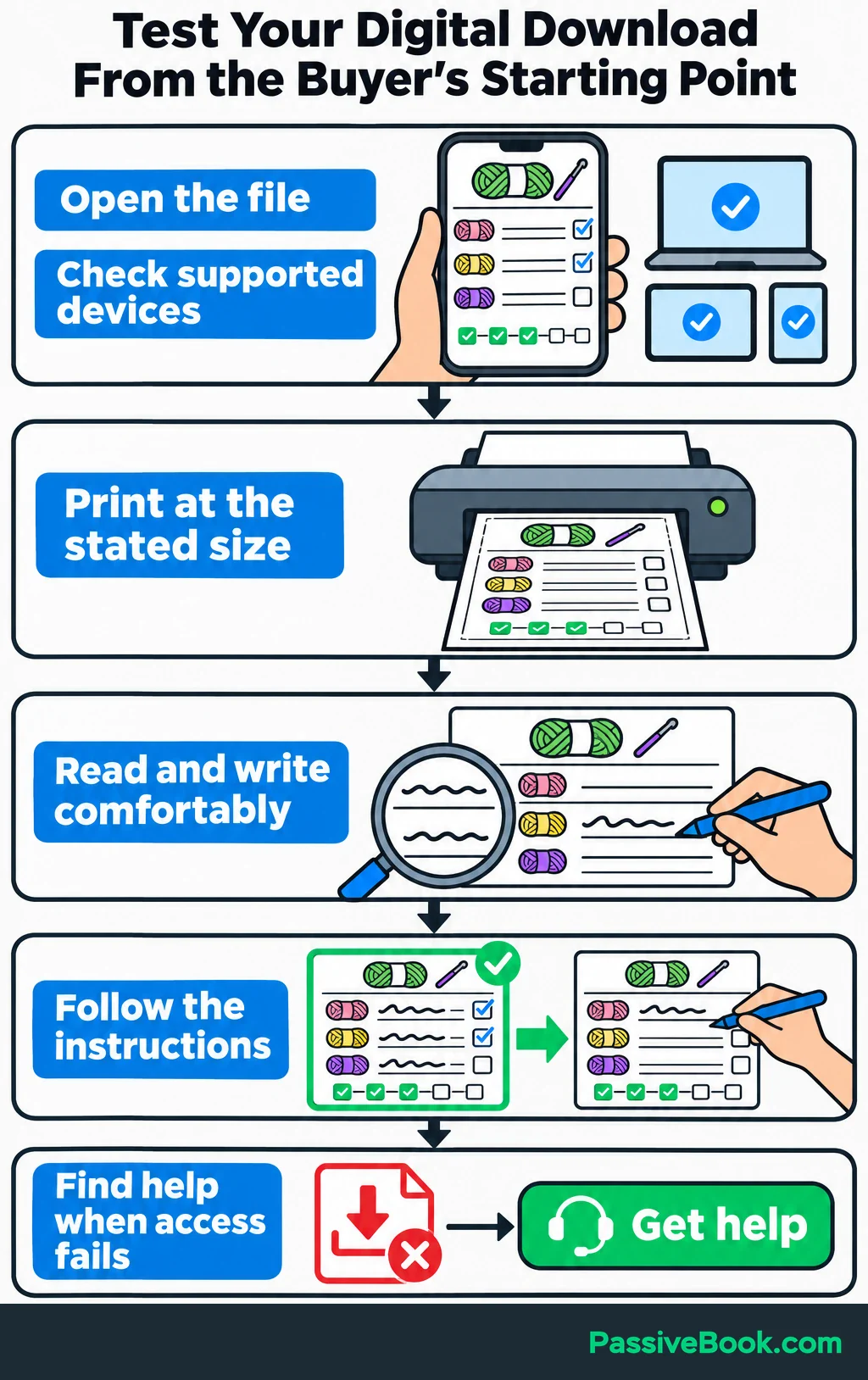
Try using the product from the buyer’s starting point. A blank page may look obvious to its creator because its creator already knows what belongs there.
For services, write down required customer inputs, milestones, revision limits, and what falls outside the price. For physical products, inspect samples and confirm packaging, shipping, returns, and replenishment costs.
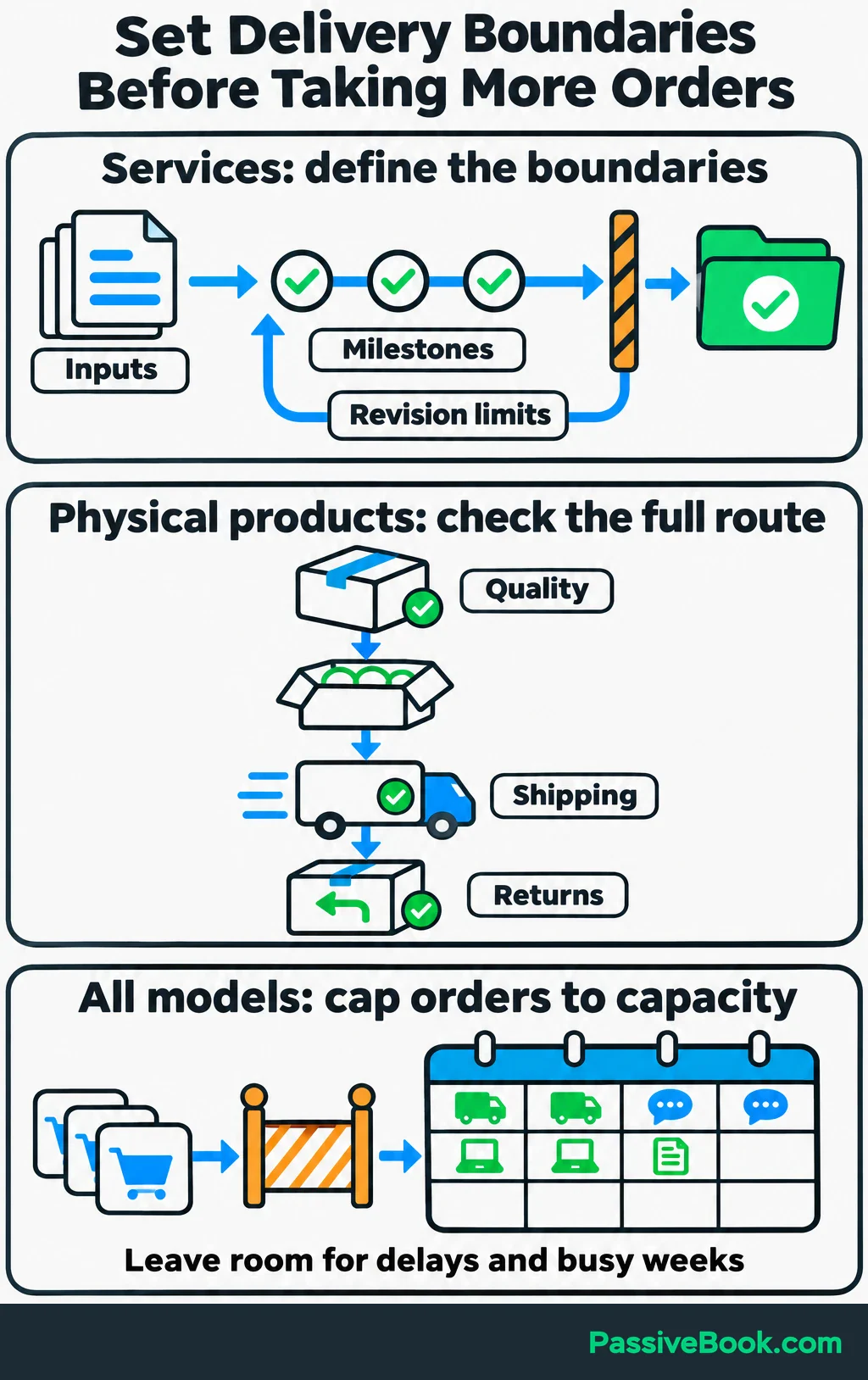
Set order or booking limits from actual capacity, including support and administration. Leave room for a late supplier or an ordinary busy week.
Delivery promises also carry obligations. For merchandise covered by the U.S. FTC merchandise-order rule, sellers who cannot ship within the promised time must obtain the buyer’s consent to a delay or refund the unshipped order.
Explain what customers receive, when they receive it, and how they get help. Make those answers easy to find before purchase.
6. Build a Simple Place to Buy
Keep your validation page if it still works. A full website becomes useful when you need better presentation, more control, or additional ways for buyers to find you.
For a first digital download, I would consider Gumroad, which provides a hosted storefront for digital products. If you already run a WordPress site and want to manage sales there, WooCommerce is another option. It adds store functions to WordPress, but you also take responsibility for site maintenance.
Before choosing a provider, verify seller-country eligibility, supported payments, total fees, payout arrangements, and delivery features. Choose based on the work and costs you will actually carry.
Pick a clear business name and check relevant business-name and trademark conflicts. Check domain availability if you need a website, but keep the visual branding simple.
Your sales page should answer:
- Who is this for, and what problem does it help solve?
- What exactly does the buyer receive?
- What does a sample look like?
- What does it cost, and how does delivery work?
- Where can the buyer get help?
For the planner, show a completed progress log beside a blank page. That explains the download better than a stack of attractive mockups alone.
Add the seller information, privacy notices, and transaction policies required for your market. For EU consumer sales, immediate access to a digital download does not automatically remove the buyer’s right to cancel without giving a reason. Before access starts, get the buyer’s express agreement to immediate access and acknowledgement that starting the download ends that right. Record both in the order confirmation, as explained in the EU’s distance-selling guidance.
Test the whole journey on mobile and desktop: purchase, confirmation, delivery, support, and refund. Simulate a failed delivery and check how you would recover it.
Start keeping sales and expense records with the first transaction.
7. Launch Through One Focused Acquisition Channel
Choose a Route to Buyers
Use your customer research to choose where to promote. Look for places people already search, shop, or ask for help.
I would choose one route you can maintain within your available hours:
- Targeted outreach when you can identify suitable buyers directly.
- A marketplace when people already shop there for your kind of product.
- Useful search content when buyers research questions you can answer.
- Relevant partnerships when another business already serves the audience.
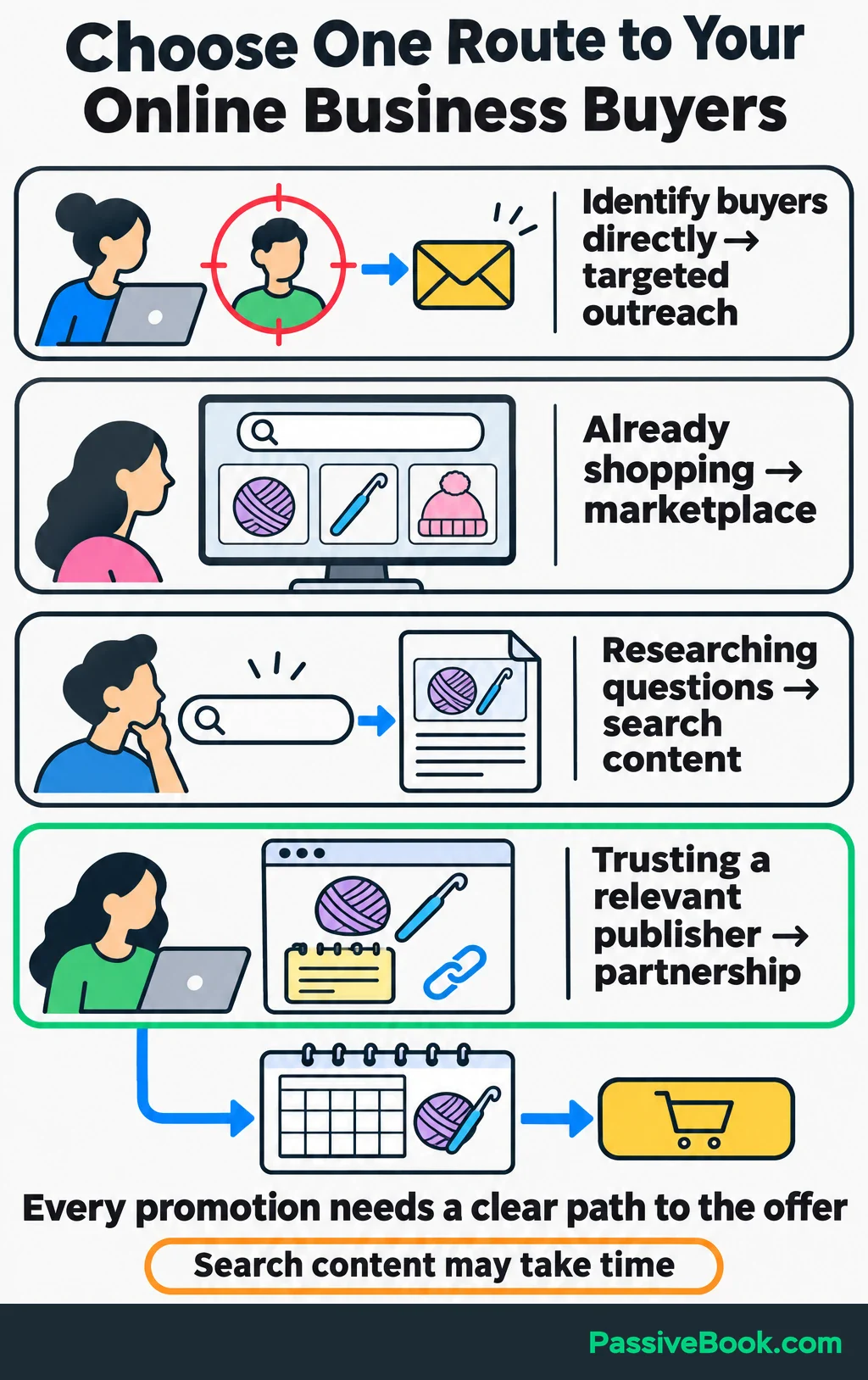
For the planner, I would start with a relevant crochet newsletter. Offer its publisher a useful demonstration of recording a project before putting it away, with a link to the sample and paid download. Agree on any placement cost or commission before counting it as an affordable channel.
Search content can support the business over time, but I would pair it with access to buyers you can reach now. Google says some search changes can take several months to show effects in its SEO Starter Guide.
Give each promotion a clear path to the offer. A popular post with no relevant next action can keep you busy without testing the business.
Invite Your First Customers
Contact interested validation participants through the method they agreed to. Explain what is available, whom it helps, and how delivery works.
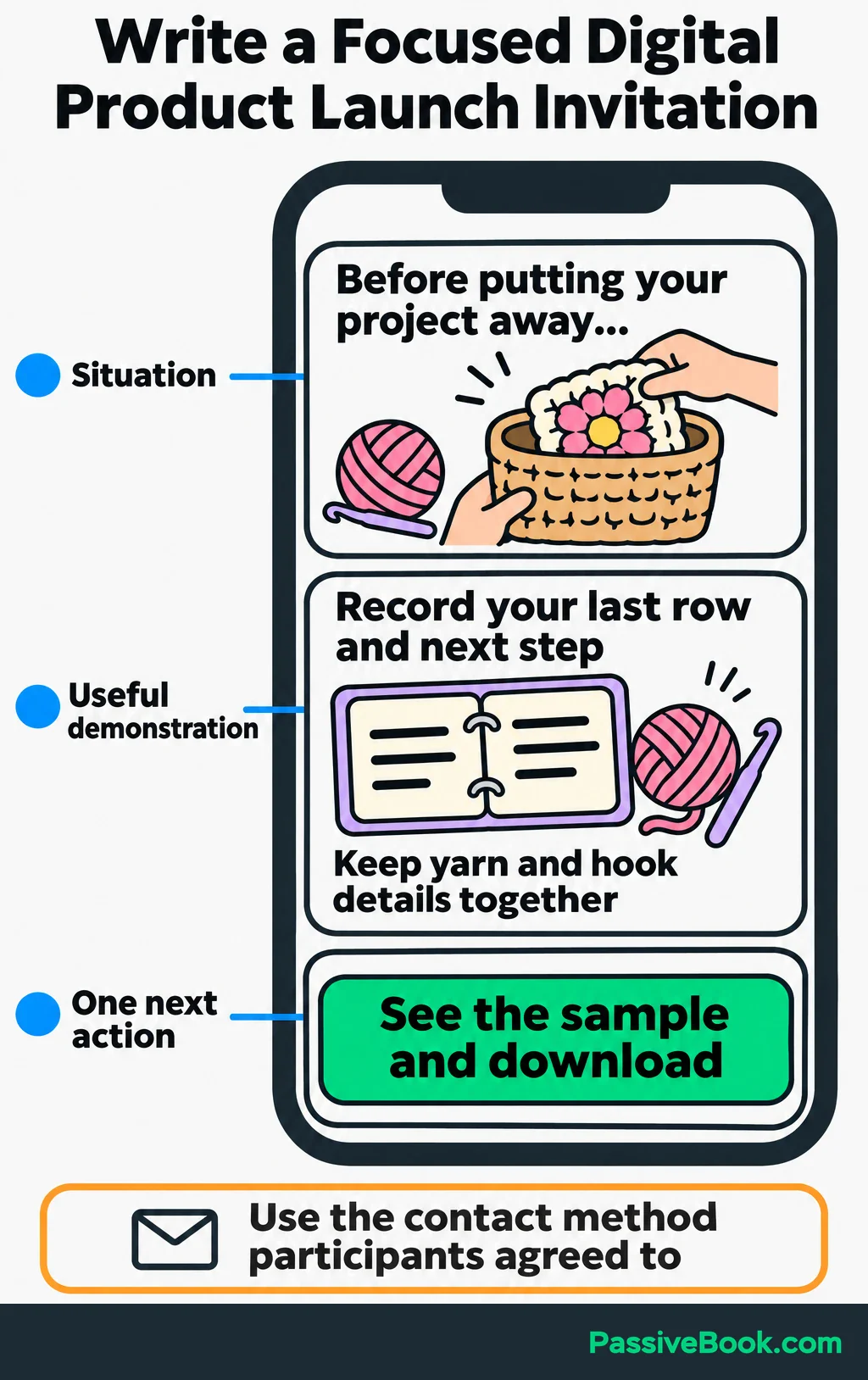
Keep each message focused on one next action. A compact demonstration could say:
Before putting your project away, record the last completed row and your next step. The planner keeps that note beside your yarn and hook details. See the sample and download here.
Offer voluntary email signup for visitors who want more help before buying. Follow up with a demonstration, answers to recurring concerns, and a purchase link.
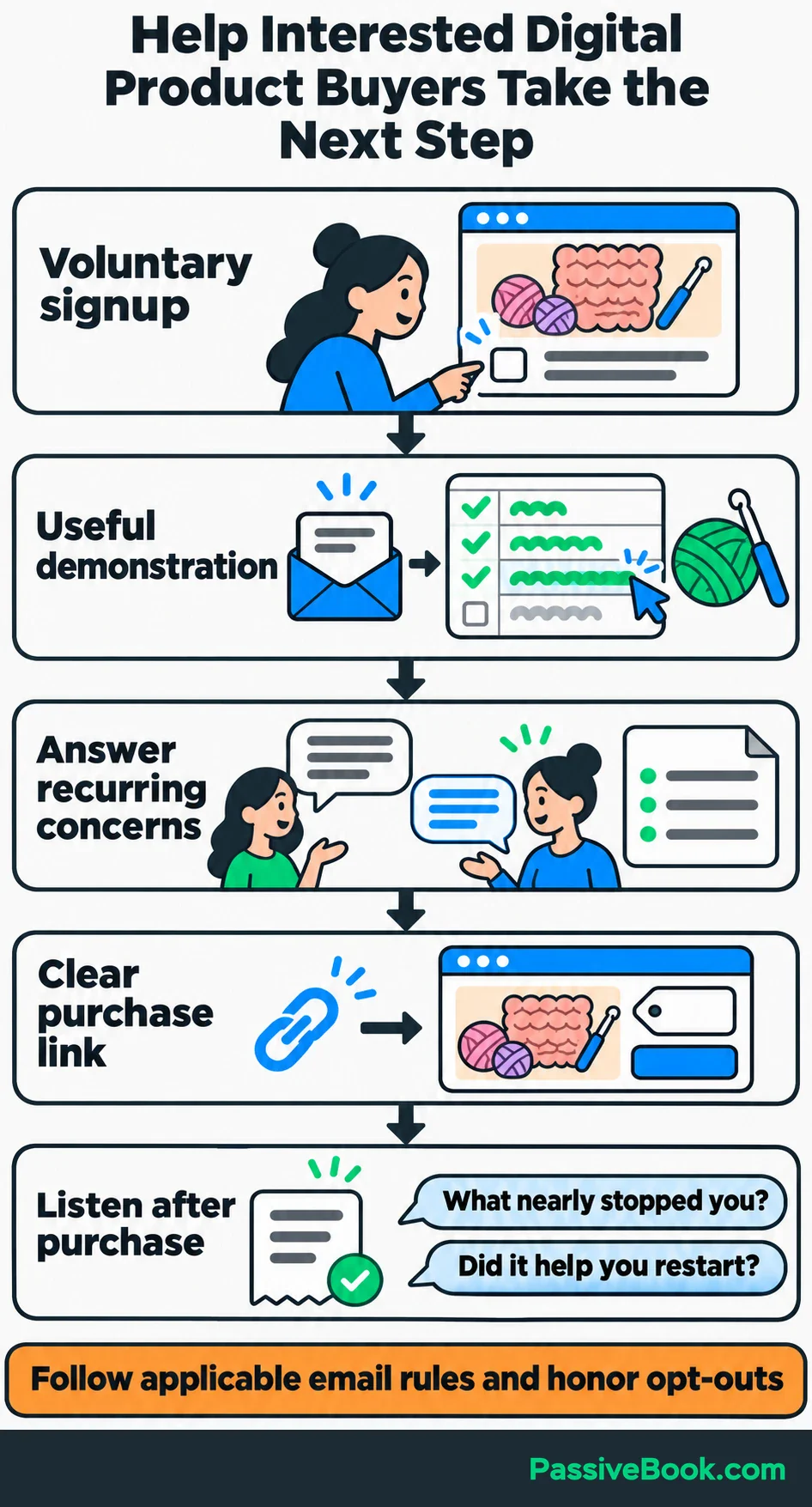
Follow the email and consent rules that apply to your recipients. U.S. commercial-email requirements include accurate sender details and subject lines, advertising identification, a valid postal address, and compliant opt-outs. The FTC’s CAN-SPAM guide explains those requirements.
During launch, watch orders, delivery failures, and support messages closely. Ask buyers what nearly stopped the purchase and whether the product helped them resume a project. Those answers give you more useful work than refreshing a follower count.
8. Use Results to Choose the Next Improvement
Keep a simple weekly scorecard. Record the period, acquisition source, offer visits or sales conversations, purchases, refunds, revenue after refunds, expenses, owner hours, and recurring customer problems.
For website purchase conversion, count offer-page visits that led to a purchase during that visit. Divide by all offer-page visits in the same period, and count each purchasing visit once even if it contains multiple orders.
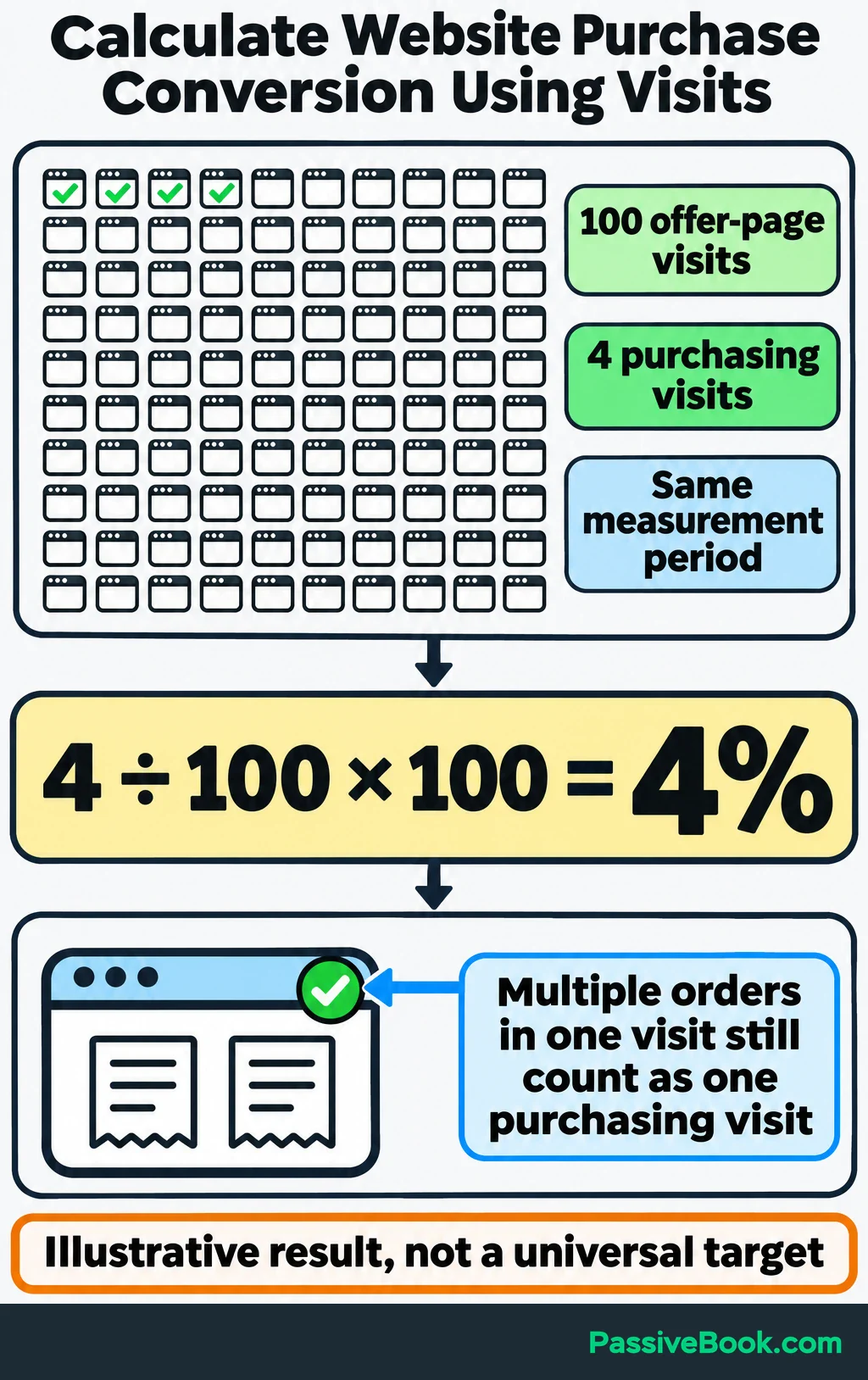
For example, four purchasing visits out of 100 offer visits gives a 4% purchase conversion rate. That describes this illustrative group; it is not a target every business should meet. For services, track sales conversations that become paying clients separately.
Use the results to locate the problem:
| What You Observe | What to Check Next |
|---|---|
| Few suitable people reach the offer | Check where your intended buyers look for help and whether your promotion appeared there. |
| People visit but rarely buy | Ask interested visitors what stopped them buying. Check whether the sample explains the offer, make the price clear, and test checkout. |
| Buyers request refunds or struggle to use the product | Try the product using only the buyer’s instructions, and compare complaints with what the sales page promises. |
| Sales increase but little money remains | Subtract fees, fulfillment costs, and refunds from revenue. Compare what remains with the hours spent delivering and supporting orders. |
| Orders exceed available time | Time delivery and support tasks. Reduce scope or cap orders while you identify work you can automate. |
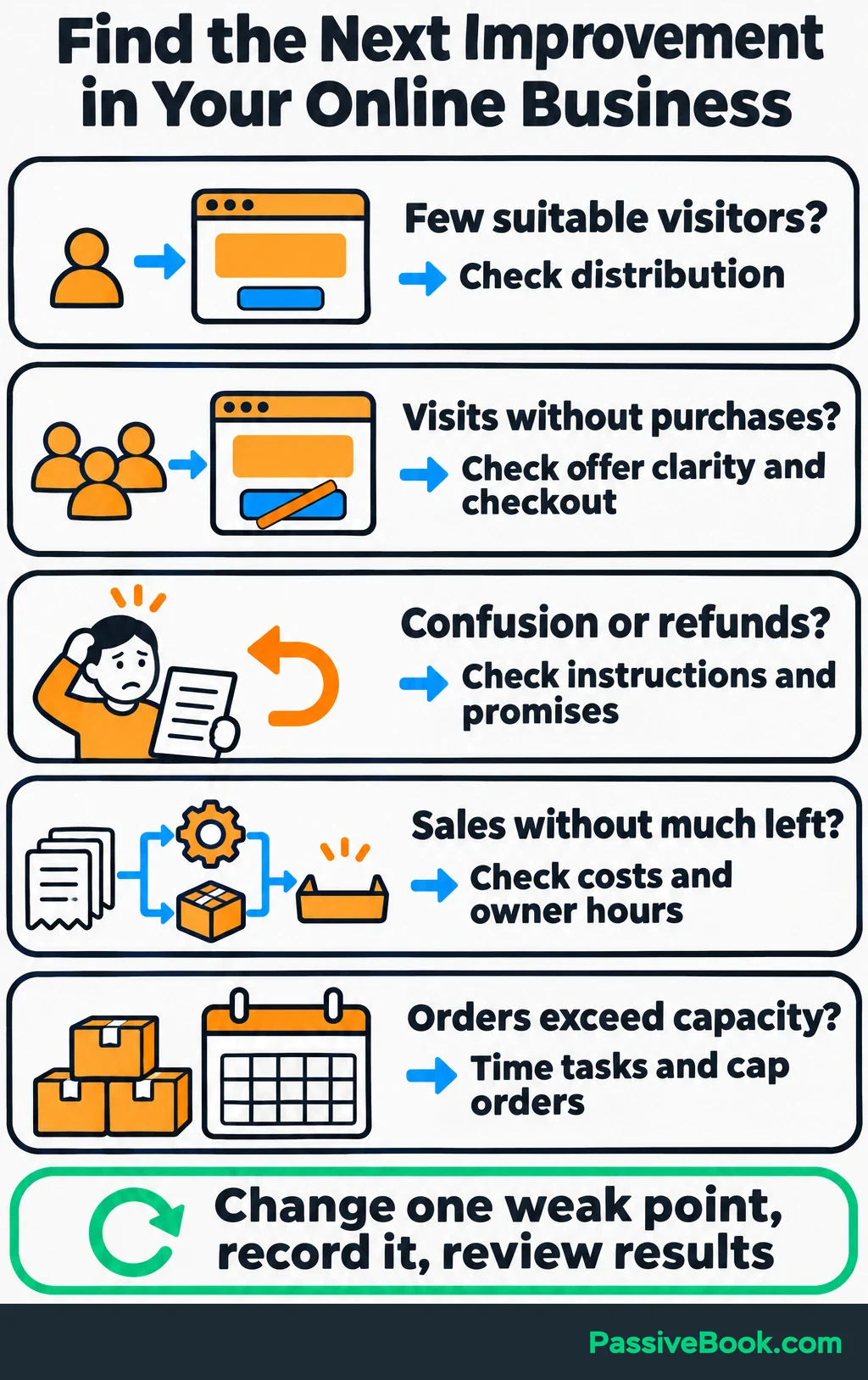
For the planner, repeated printing questions suggest an instruction problem. If buyers use it happily but few suitable people see it, investigate distribution before redesigning the product.
Review profit separately from revenue, and available cash separately from both. Money waiting for payout cannot pay a bill due now, and a healthy sales total can conceal expensive delivery work.
I would change the weakest part of the process, record what changed, and review the result before increasing spending or adding channels.
9. Make the Working Process Repeatable
Once the process works, write short checklists for promotion, order handling, delivery, support, recordkeeping, and review.
Document what actually happens. “Handle customer support” is too vague. “Check failed downloads, confirm payment, resend access, and record the cause” gives you a task you can repeat.
Automate stable work with four things defined:
- Trigger: The event that starts the task.
- Expected result: What should happen afterward.
- Failure alert: How you learn something went wrong.
- Recovery action: What you do to complete or reverse it safely.
For the planner, confirmed payment should trigger file delivery. A failed delivery should create an alert, and your recovery checklist should explain how to resend access without creating another charge.
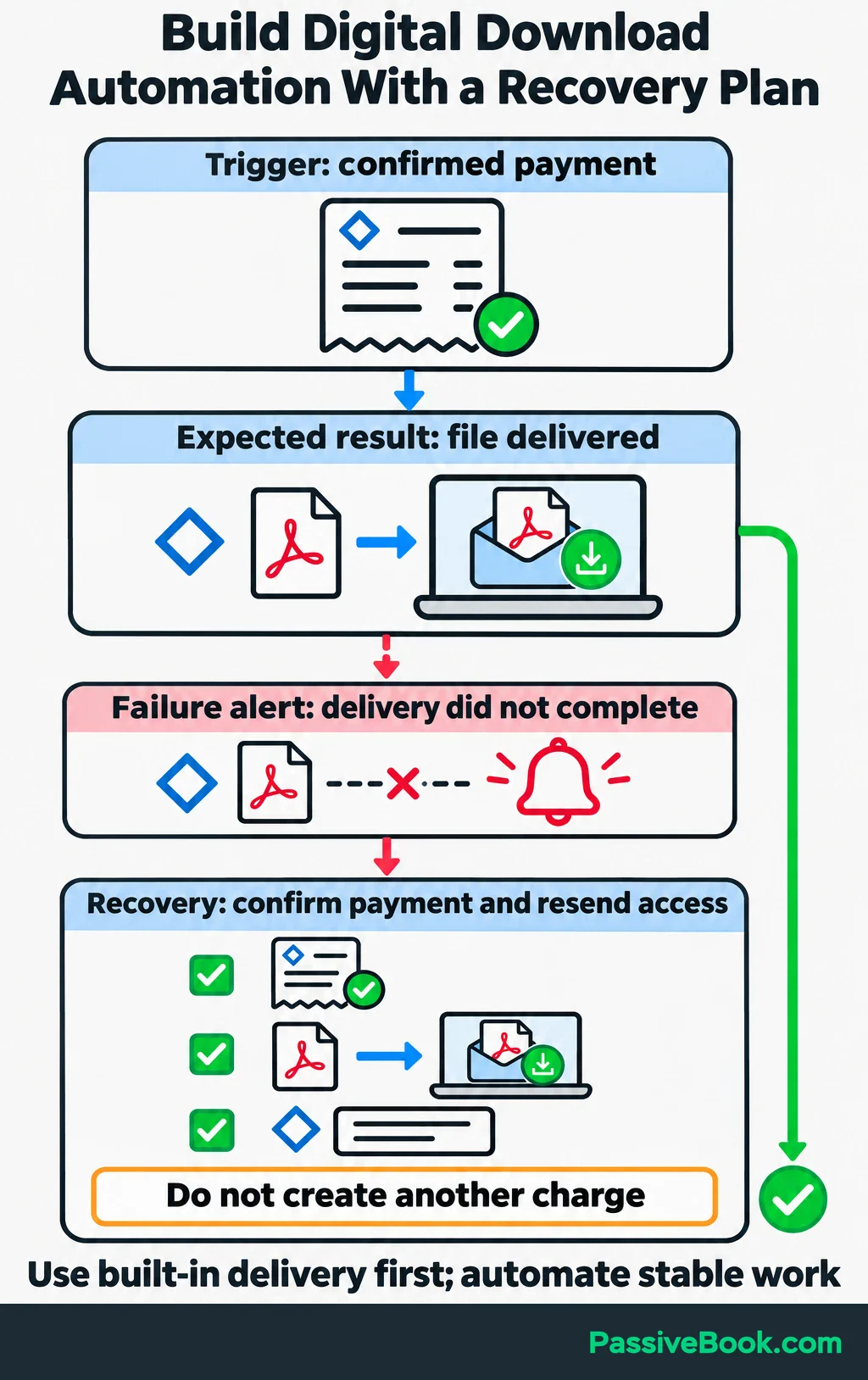
Use the selling platform’s built-in delivery first. Add a tool such as Make, which connects apps through visual workflows, when you have a clear gap to fill. I use n8n for more involved connections, but I would not make a beginner maintain extra infrastructure just to deliver one PDF.
AI can draft routine replies, group customer feedback, or summarize a report. Review its work before it changes customer communications or business decisions.
My custom AI content pipeline reduced article production from days to hours. That result applies to content production. Sales, delivery, support, and financial review still need their own working processes.
Reserve recurring time for those responsibilities. If you have five hours a week, put selling, support, maintenance, and review into those five hours before promising another product.
Reinvest in the constraint you can see. Improve instructions when support is heavy. Strengthen distribution when delivery works. Add capacity when profitable orders exceed what you can handle. Repeated sales and an acceptable return give you a reason to expand.
What Next?
Write down one customer problem and arrange a conversation with someone who recently faced it. Ask how they handled it and what they tried before opening another design tool.
Use the social buttons to share this guide when you want to compare launch plans or put a small paid test into motion.
Which part of your idea needs evidence before you would spend more time or money on it? Tell me in the comments, and bring any other questions about your launch.
Share this post with your friends & followers:

