The seller says the website needs two hours a week. The listing shows a profit, and the price seems within reach. What you still cannot see is how much of that profit depends on work, accounts, or relationships that leave with the seller.
Buying gives you customers and operating records to assess, but it also gives you problems to inherit. A low asking price can hide an expensive handover.
This guide shows how to judge those earnings, set a supported price, and arrange a transfer that leaves you able to run what you bought.
Choose a Business You Can Operate
Before browsing listings, write down your limits: available hours, useful skills, tasks you can afford to outsource, and problems you can handle during a working day.
Include emergency coverage. A business that takes five quiet hours a week may still need someone available when checkout breaks.
Start by comparing the work behind each model.
| Model | Recurring Responsibilities | Specialist Skills | Operating Costs |
|---|---|---|---|
| Content and digital products | Update articles and products, maintain links, answer questions, and fix delivery failures | Writing, SEO, product knowledge, and website maintenance | Hosting, software, editors, product testing, and support |
| Ecommerce | Manage stock, suppliers, fulfillment, returns, and customer service | Purchasing, merchandising, and supply planning | Inventory, shipping, storage, payment fees, and support |
| Software and apps | Fix bugs, maintain integrations, support users, and keep systems available | Development, security, and infrastructure management | Hosting, developers, software services, and support |
| Services | Deliver client work, manage deadlines, retain customers, and supervise contractors | The service itself, quality control, and client management | Staff or contractors, delivery tools, and sales costs |
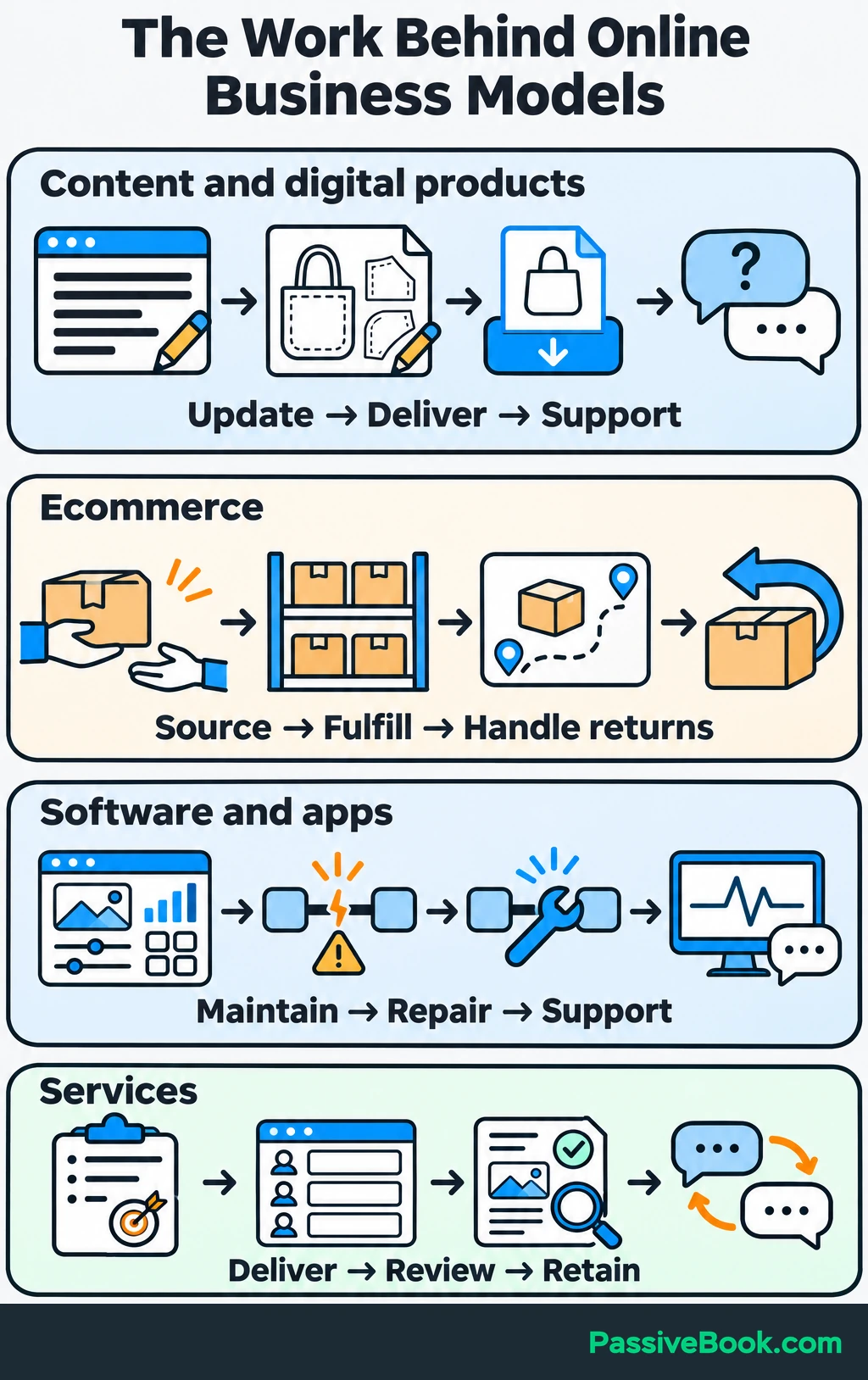
I abandoned a membership site after spending six months building it alongside corporate work. Finishing one batch of content only exposed the next batch I owed. The recurring work was the problem, so that is what I would inspect first in an acquisition.
For a first purchase alongside a job, I would favor a model you already understand. A content or digital-product business may suit you if you can maintain its products and arrange support. I would skip software that needs a developer you cannot afford or supervise.
Throughout this guide, consider a hypothetical beginner-sewing website that earns affiliate commissions and sells downloadable tote-bag patterns. Its figures, cost allowances, and valuation multiple are illustrations.
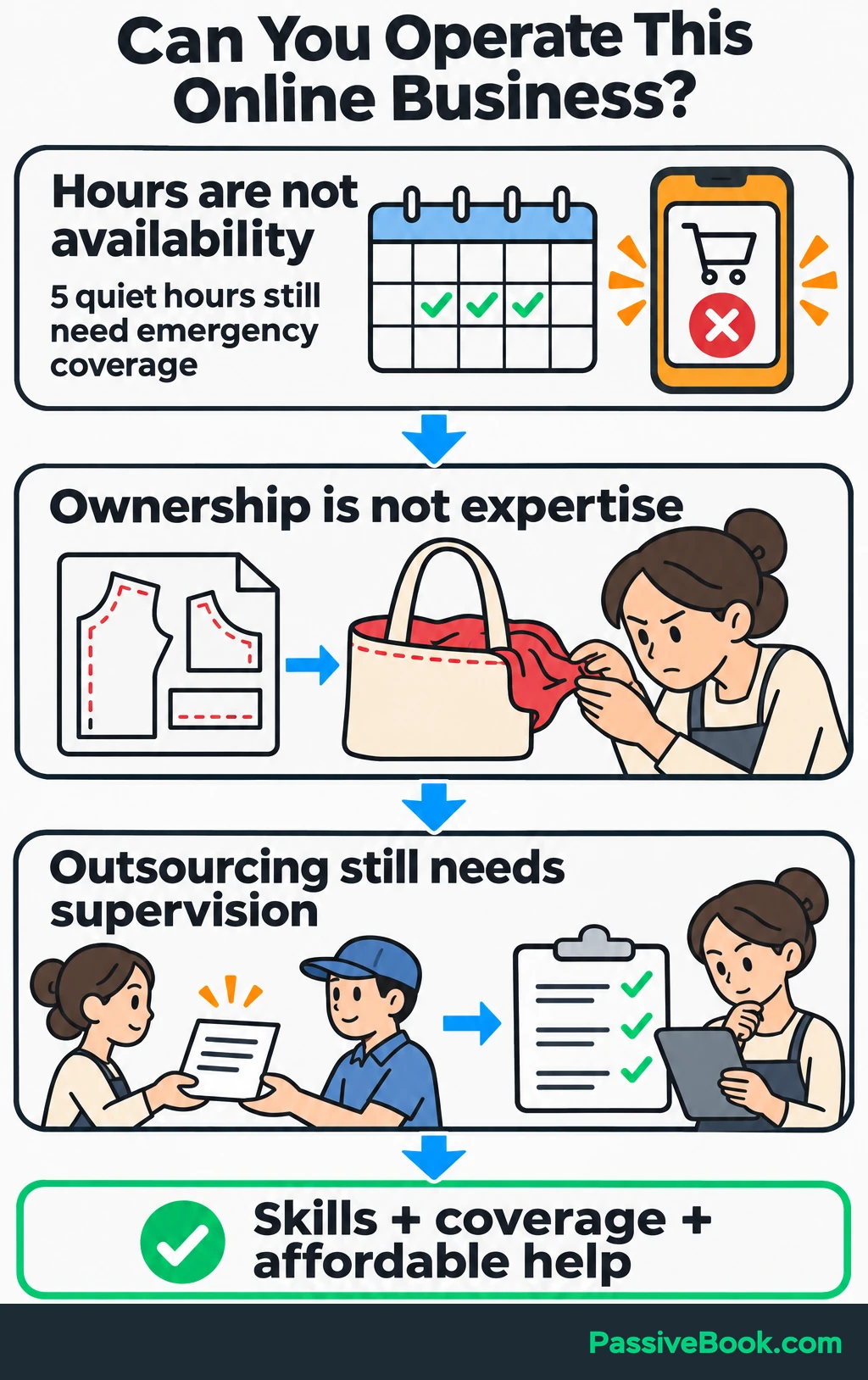
Before buying it, you need to know who updates tutorials, checks affiliate links, tests patterns, and answers sewing questions. Owning the files does not give you the skill to explain why a bag’s lining will not fit.
Also separate an operating business from a project. A domain, attractive template, and unfinished product may have usable assets, but projected sales are not existing earnings. Compare the cost of finishing that project with building your own.
Acquisition makes sense when the verified assets, customers, and operating system justify both the price and the inherited work.
Set Your Total Acquisition Budget
Your purchase ceiling is what remains after paying for the transaction, preparing the business for your ownership, and keeping enough cash to operate it.
Get estimates for:
- Professional Reviews: Accounting checks, legal review, and any technical inspection.
- Transaction Charges: Marketplace access, escrow (a service that holds payment during the transfer), payment charges, and financing fees.
- Immediate Work: Migration, urgent repairs, security fixes, and replacement licenses.
- Transition Expenses: Training, overlapping subscriptions, and temporary contractor help.
- Inventory: Stock priced separately from the business.
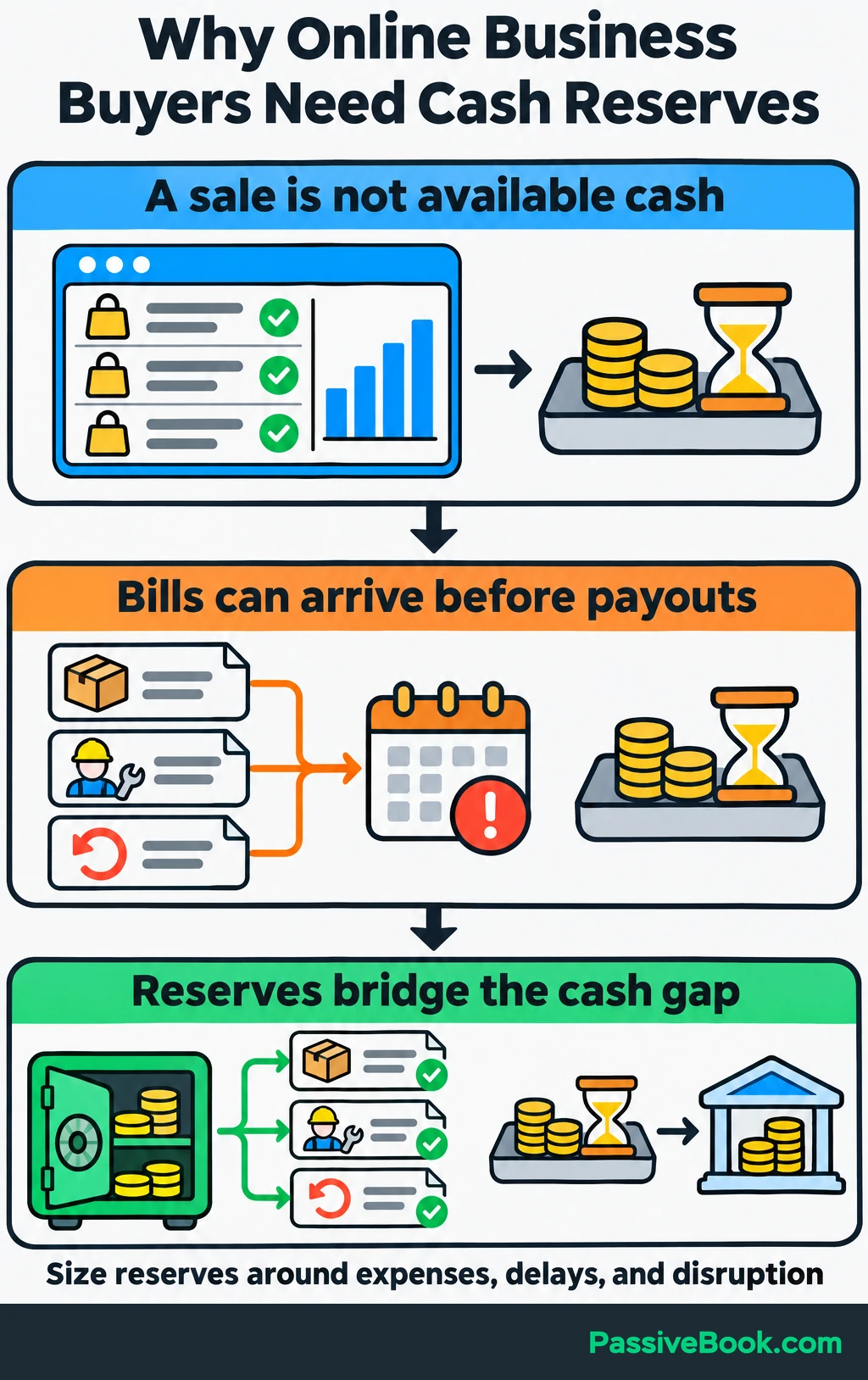
- Operating Reserves: Cash for expenses, payout delays, refunds, replenishment, and revenue disruption.
Record who pays each charge. “Closing costs” is too vague to budget against.
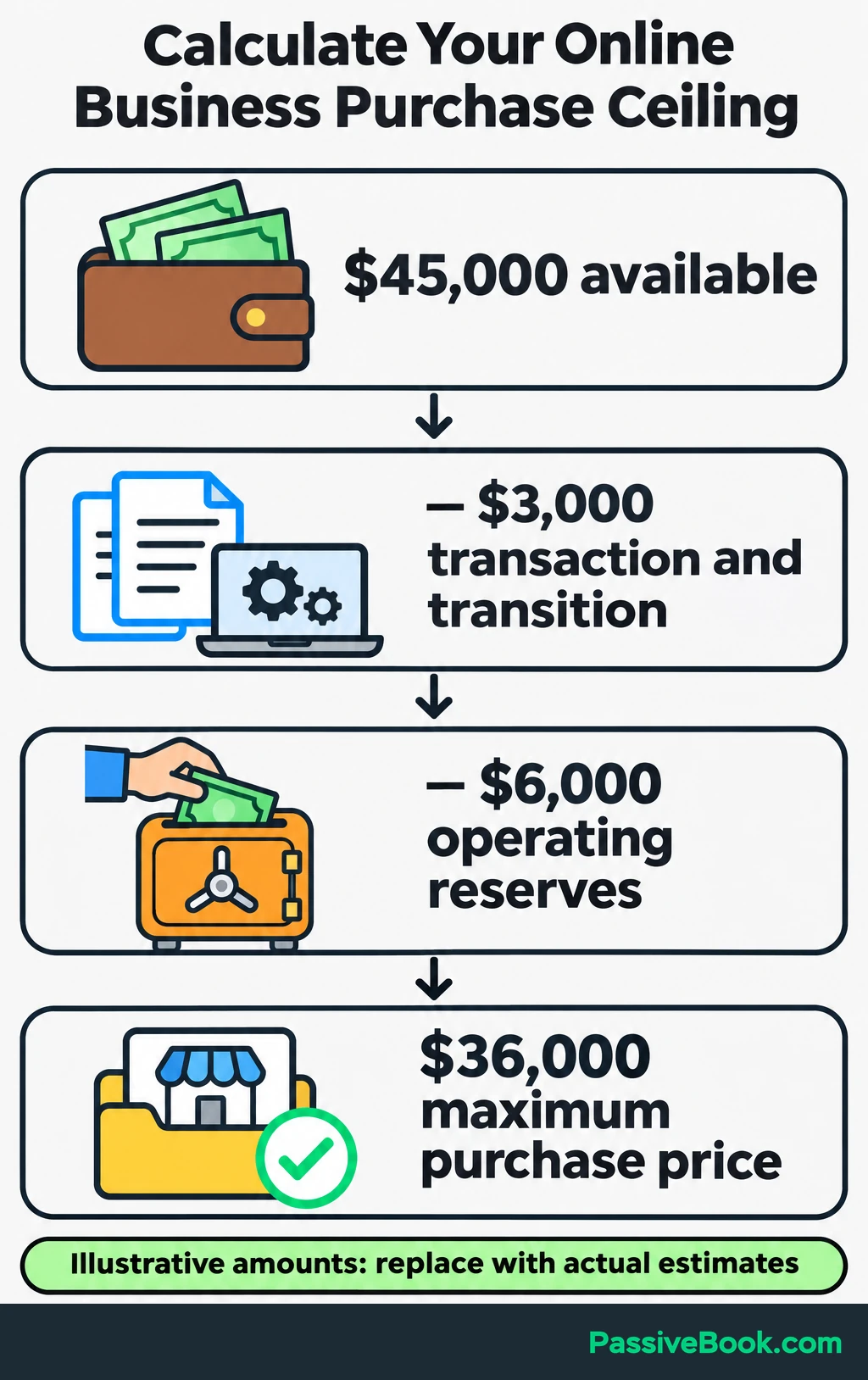
For an all-cash purchase, subtract the money you must keep outside the purchase price:
| Budget Item | Illustrative Amount |
|---|---|
| Total acquisition funds available | $45,000 |
| Transaction and transition allowance | −$3,000 |
| Operating reserves | −$6,000 |
| Maximum purchase price | $36,000 |
Those allowances need replacing with actual estimates. If legal review or migration costs more, the purchase ceiling falls.
Size reserves around the business’s cash needs. Check when sales become available cash, which bills come due first, and what happens if revenue falls during the handover. Keep personal emergency savings separate.
The same calculation applies to budgets of $1,000, $5,000, or $10,000. Deduct expenses and reserves before searching. Then inspect what the remaining amount buys: documented customers and earnings, usable assets, or substantial unfinished work.
Funding also changes affordability:
- Cash: No acquisition loan payments, but more of your money becomes tied up in the purchase.
- Borrowing: Preserves some upfront cash but adds interest, scheduled repayments, and potentially personal guarantees.
- Seller Financing: Lets you defer part of the price, but creates a repayment obligation with its own terms and possible security requirements.
Confirm lender eligibility before treating a loan as available money. Then calculate what remains after replacement labor, essential reinvestment, principal-and-interest payments, and applicable taxes.
I would make that calculation using current operations. Growth you hope to create should not be required to make the first repayment.
Find Online Businesses Worth Investigating
Search with your operating limits and purchase ceiling already written down. Otherwise, every promising listing becomes a reason to change your budget.
Compare Marketplaces, Brokers, and Direct Outreach
Choose a source based on the businesses it carries, the evidence available, and the help included. Ask any intermediary whom they represent and who pays them.
| Source | Relevant Inventory | Access Requirements | Screening | Transaction Support | Buyer Costs |
|---|---|---|---|---|---|
| Flippa | Websites, ecommerce, software, and other digital assets | Free buyer access with optional paid features; private information may require approval | Connected platform records or manual review, depending on the verification badge | Space to negotiate, contract builders, and payment options | Optional subscription, payment or escrow charges, and chosen review services |
| Empire Flippers | Online businesses across several models | Register and meet requirements to unlock listing details | Listing review; the linked overview does not specify which records are checked | Purchase guidance and asset migration | Not specified in the linked overview; request buyer-paid charges and exclusions |
| Acquire.com | Software businesses and other startups | Public details are free; founder contact and private details require a paid plan, with access limits based on startup revenue | Paid access lets you request private records; those records still need checking | Tools to draft offer terms and guidance on escrow; confirm migration support | Paid buyer access plus applicable closing and professional costs |
| Specialist broker | Businesses within the broker’s model, size, or sector focus | Usually registration, confidentiality terms, and buyer qualification | No broker specified here; request the records checked and findings | Confirm who handles negotiation, documents, and asset transfer | Obtain the fee agreement and identify who pays |
| Direct outreach | Owners whose businesses fit your criteria | Contact the owner and agree access to records | Arrange your own verification | Organize advisors, contracts, and closing yourself | Your search, review, legal, and closing expenses |
I would start with public listings to learn what records sellers provide and how businesses are described. Use a specialist broker or direct outreach when the available inventory does not fit.
These routes can work together. None removes the need to verify the business.
Build an Evidence-based Shortlist
Use a spreadsheet with one row per candidate. Record asking price, business age, earnings definition and period, revenue sources, traffic sources, owner workload, included assets, and unanswered questions.
Then ask the seller:
- Why are you selling, and why now?
- What changed in revenue, costs, or workload recently?
- Which tasks do you personally perform?
- What would stop working if you left tomorrow?
- Which accounts, contracts, or relationships need approval to continue?
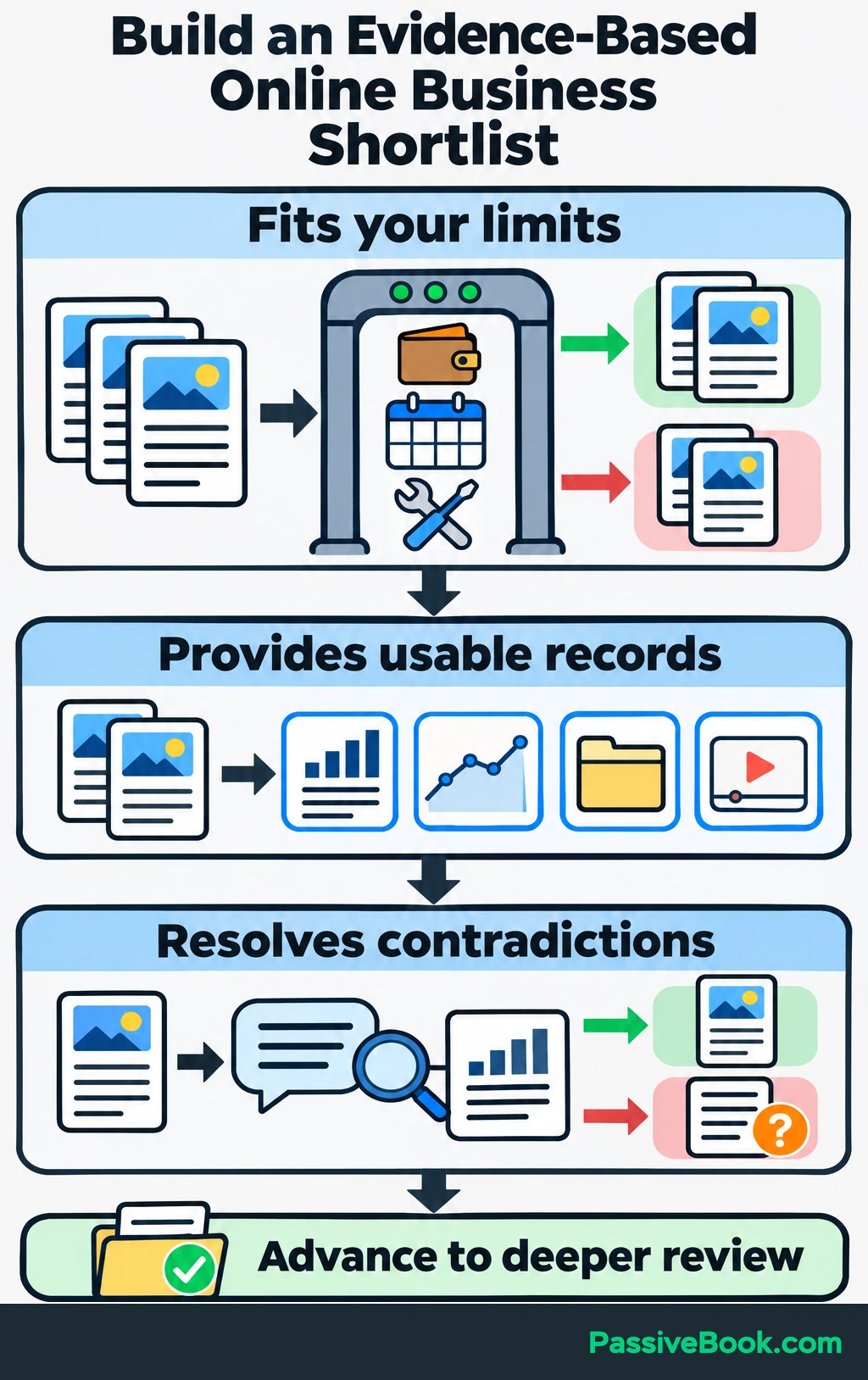
Request records that support the seller’s answers.
Start with monthly financial summaries, traffic history, an asset list, and an operating walkthrough. Agree confidentiality terms before receiving sensitive records.
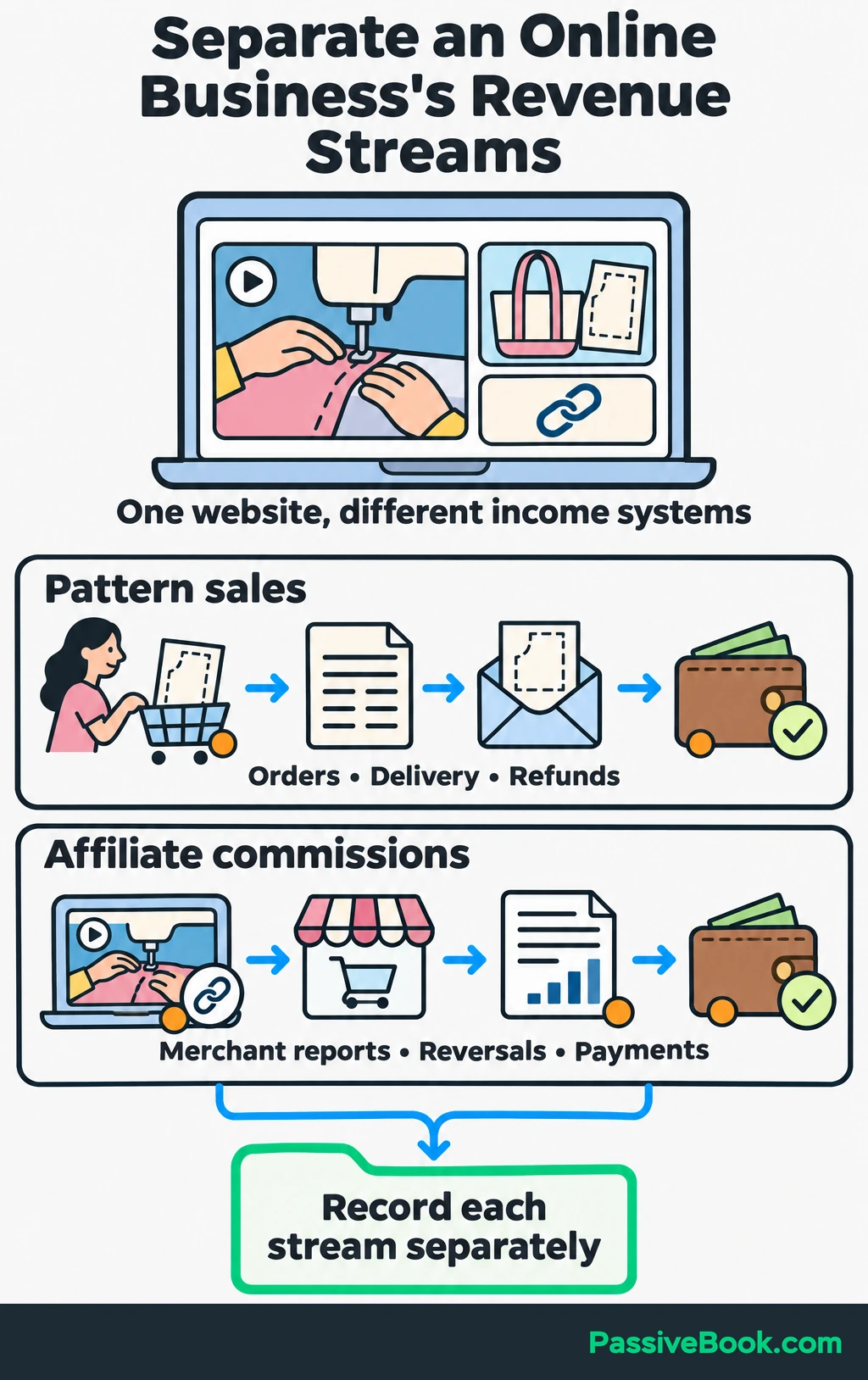
For the sewing website, “digital-product income” is not enough detail. You need to separate pattern sales from affiliate commissions because they have different costs, payout schedules, and transfer requirements.
Advance listings that fit your limits and whose sellers provide usable records. Resolve obvious contradictions before paying for deeper reviews.
You do not need a polished due-diligence vocabulary to start the conversation. The acquisition correspondence tool turns the listing into a seller email with specific requests, rather than a vague request for more information.

Free AI Acquisition Correspondence Writer




Estimate a Price the Earnings Can Support
A price becomes useful when you can explain the earnings behind it and what those earnings leave for you.
Understand the Earnings Figure
Revenue is sales before expenses. Accounting profit subtracts recorded expenses. Neither automatically tells you what you can take home after buying the business.
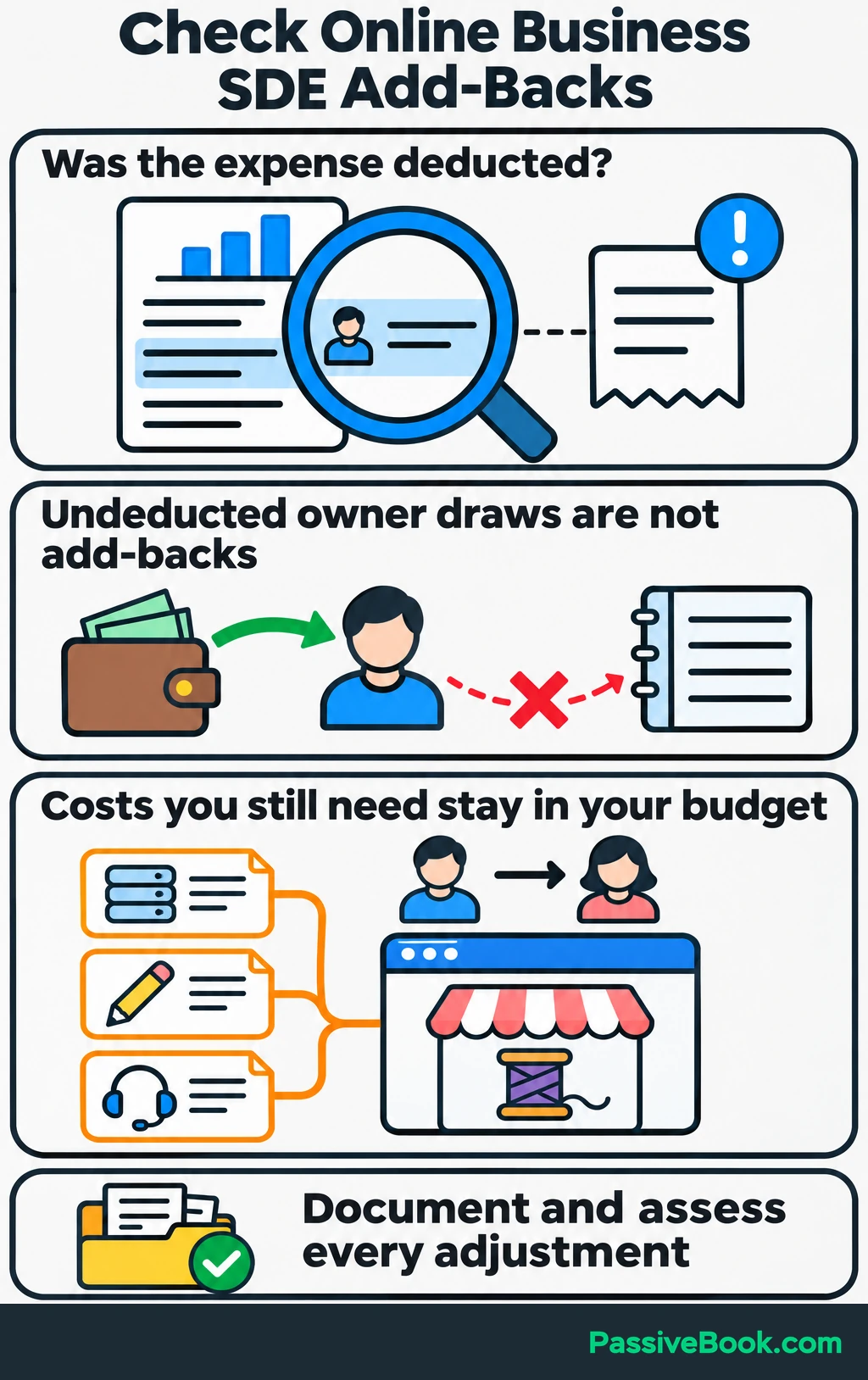
Small-business listings may use seller’s discretionary earnings, or SDE. This starts with profit before tax and adds back documented expenses such as one working owner’s deducted pay, interest, qualifying personal or one-time expenses, and noncash charges. Those noncash charges include depreciation and amortization, which spread asset costs over time. Owner draws or distributions that were never deducted cannot be added back. BizBuySell explains the calculation and adjustments.
Check every proposed adjustment. If you will keep paying for hosting, editing, or support, that expense stays in your operating budget. A seller calling something “optional” does not make it disappear.
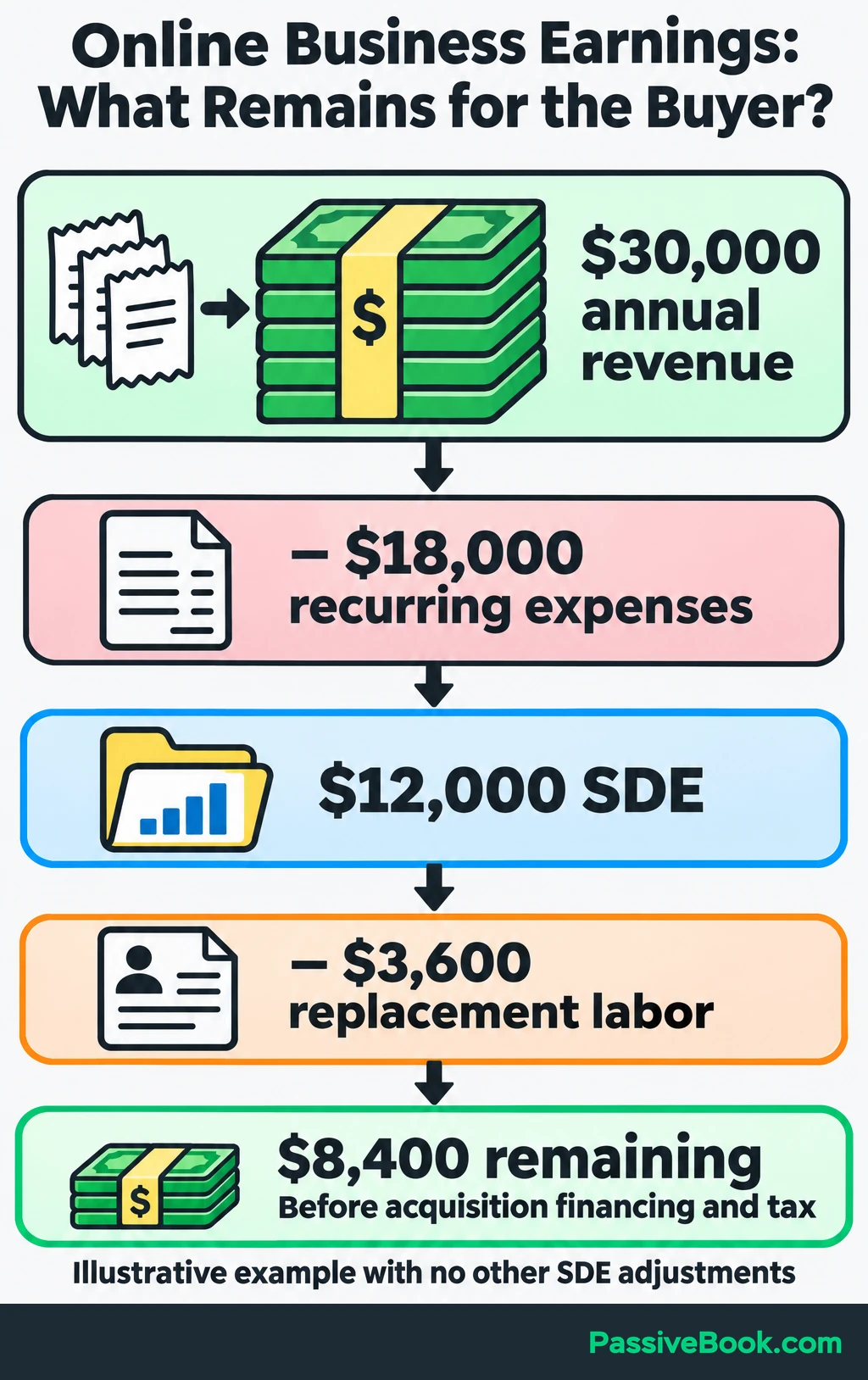
For the sewing website, assume there are no deducted owner wages, financing charges, noncash charges, or other adjustments. First subtract recurring expenses from annual revenue, then deduct the additional labor you would need.
| Annual Earnings Calculation | Illustrative Amount |
|---|---|
| Revenue | $30,000 |
| Recurring operating expenses | −$18,000 |
| SDE under these assumptions | $12,000 |
| Additional cost to replace the seller’s work | −$3,600 |
| Remaining before acquisition financing and tax | $8,400 |
The $12,000 helps you compare listings using the same earnings measure. The $8,400 helps you judge affordability under your ownership.
If you do that work yourself, you may avoid the cash expense, but you still need to check whether the hours fit your week.
Compare Multiples on a Consistent Basis
An earnings multiple tells you how many times the stated earnings are included in the purchase price. Divide the price by earnings for the specified period.
For the sewing website:
$36,000 asking price ÷ $12,000 annual SDE = 3× annual SDE.
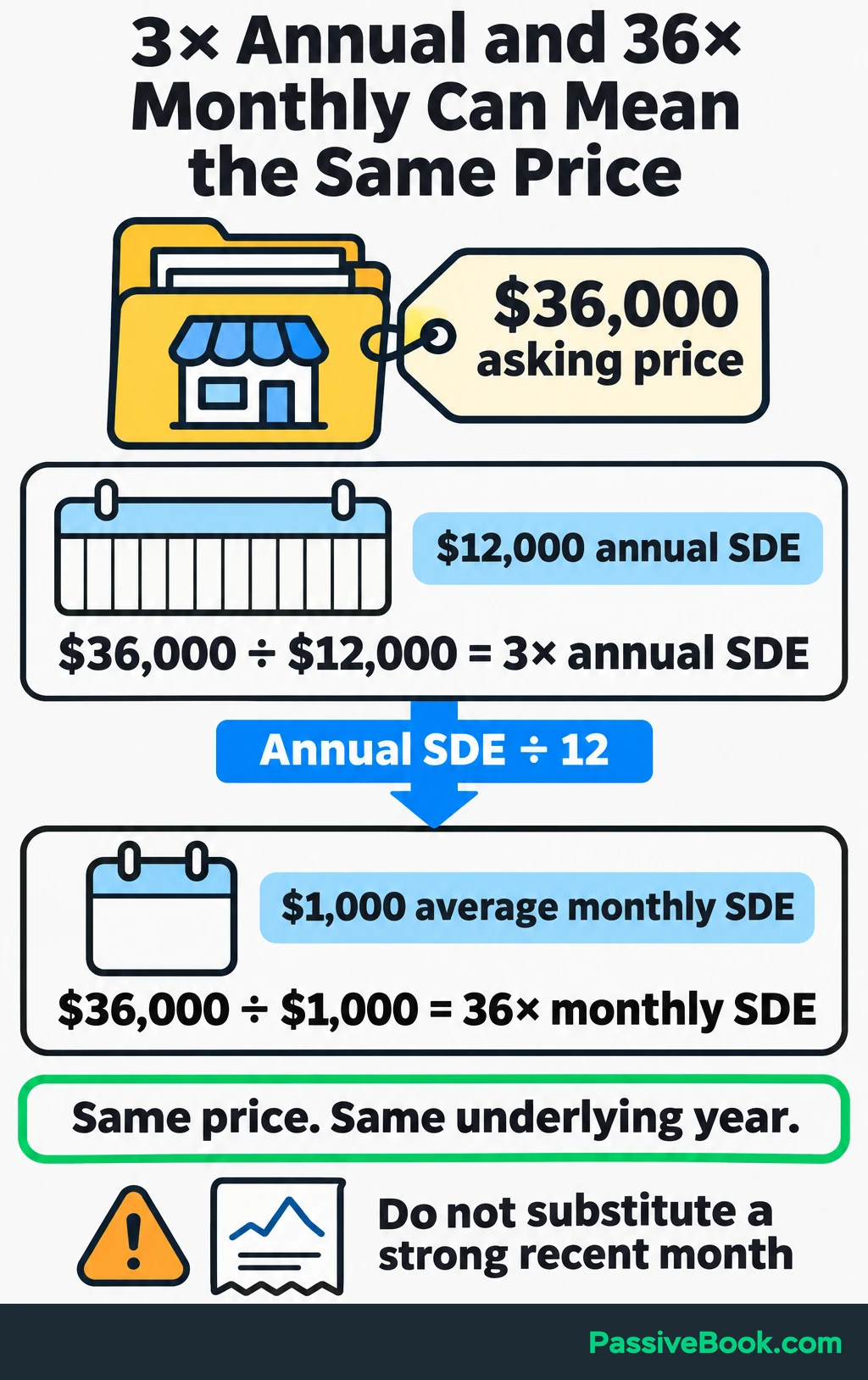
A monthly multiple uses a different time unit. Here, annual SDE of $12,000 means average monthly SDE of $1,000, so the same price equals 36× average monthly SDE.
That conversion works because both figures use the same underlying year. Comparing a recent strong month with someone else’s full-year average would distort the result.
To judge the multiple, seek documented completed sales of similar businesses. Compare model, earnings scale, trend, workload, and dependence on particular customers or platforms. Asking prices show seller expectations; they do not establish what buyers paid.
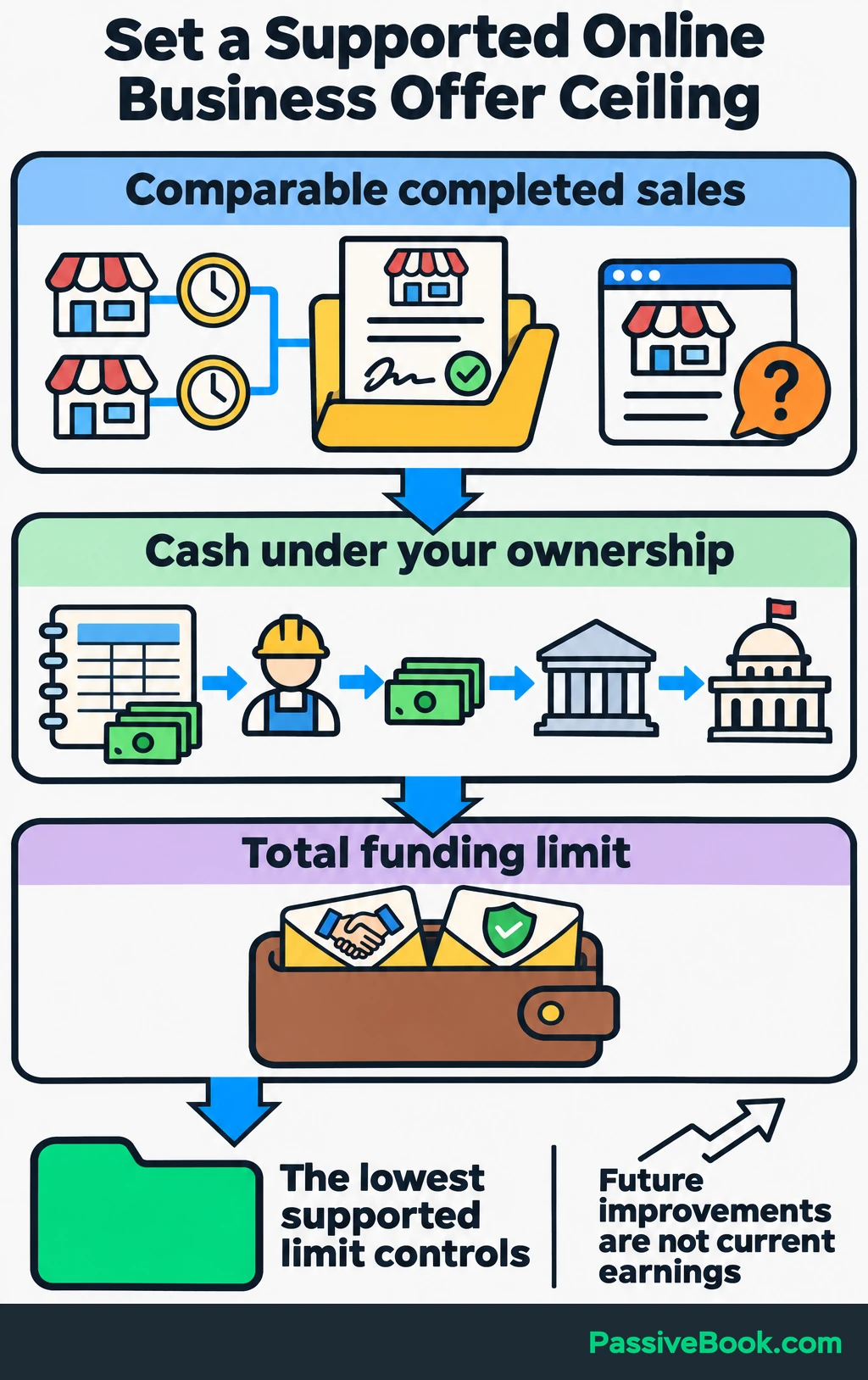
If you cannot obtain credible completed-sale comparisons, acknowledge that gap. I would keep my offer conservative rather than substitute a marketplace valuation badge for evidence.
Set a provisional ceiling using comparable sales, the cash left under your ownership, and your total funding limit. The lowest limit controls the offer.
A multiple does not tell you what will remain after your own costs and repayments. Use the Business Acquisition Calculator to test the asking price against your available cash and income needs.

Free Business Acquisition Calculator
An idea for doubling pattern sales belongs in your improvement plan. It does not belong in the earnings you pay the seller for today.
Make a Conditional Offer
Specify what you propose to buy before discussing the final price.
An asset purchase identifies the assets and obligations being acquired. Buying company ownership leaves the business inside its existing legal entity, including its liabilities. Have a lawyer who handles business purchases assess the risks under your proposed structure and local law. DLA Piper explains the distinction between asset and share acquisitions.
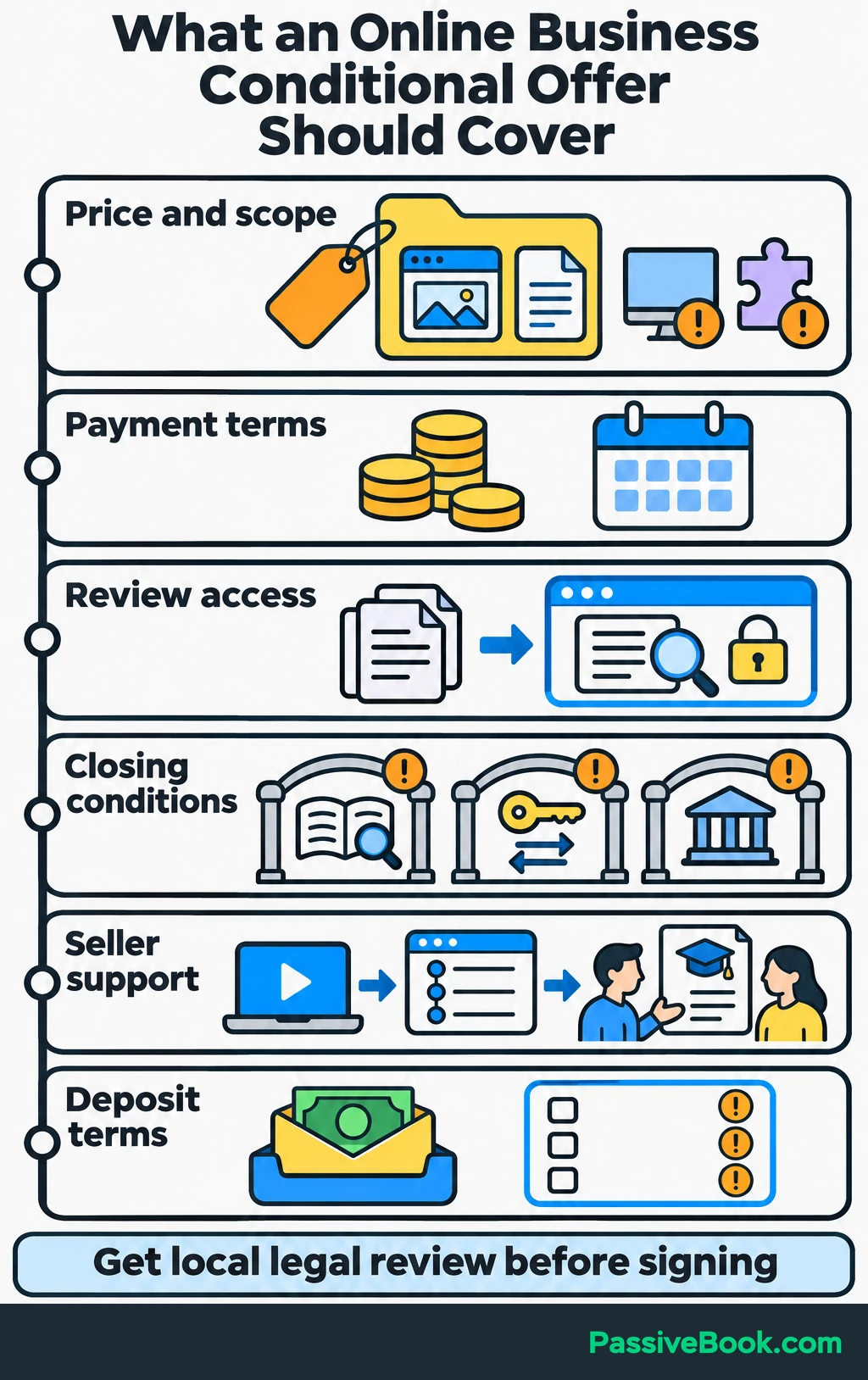
Use a letter of intent to record the proposed deal terms before drafting the final purchase agreement. Include:
- Price and Scope: The proposed amount, included assets, and excluded items.
- Payment Terms: Cash at closing, deferred payments, and any performance-based amounts.
- Review Access: Records required, access arrangements, and the review deadline.
- Closing Conditions: Satisfactory financial, legal, and operational checks, essential transfer approvals, and required financing.
- Seller Support: Training, introductions, availability, and completion requirements.
- Deposit Terms: Who holds it, its purpose, and the circumstances in which it is refundable.
Negotiate support alongside price. A cheaper business with no usable handover can cost more to operate.
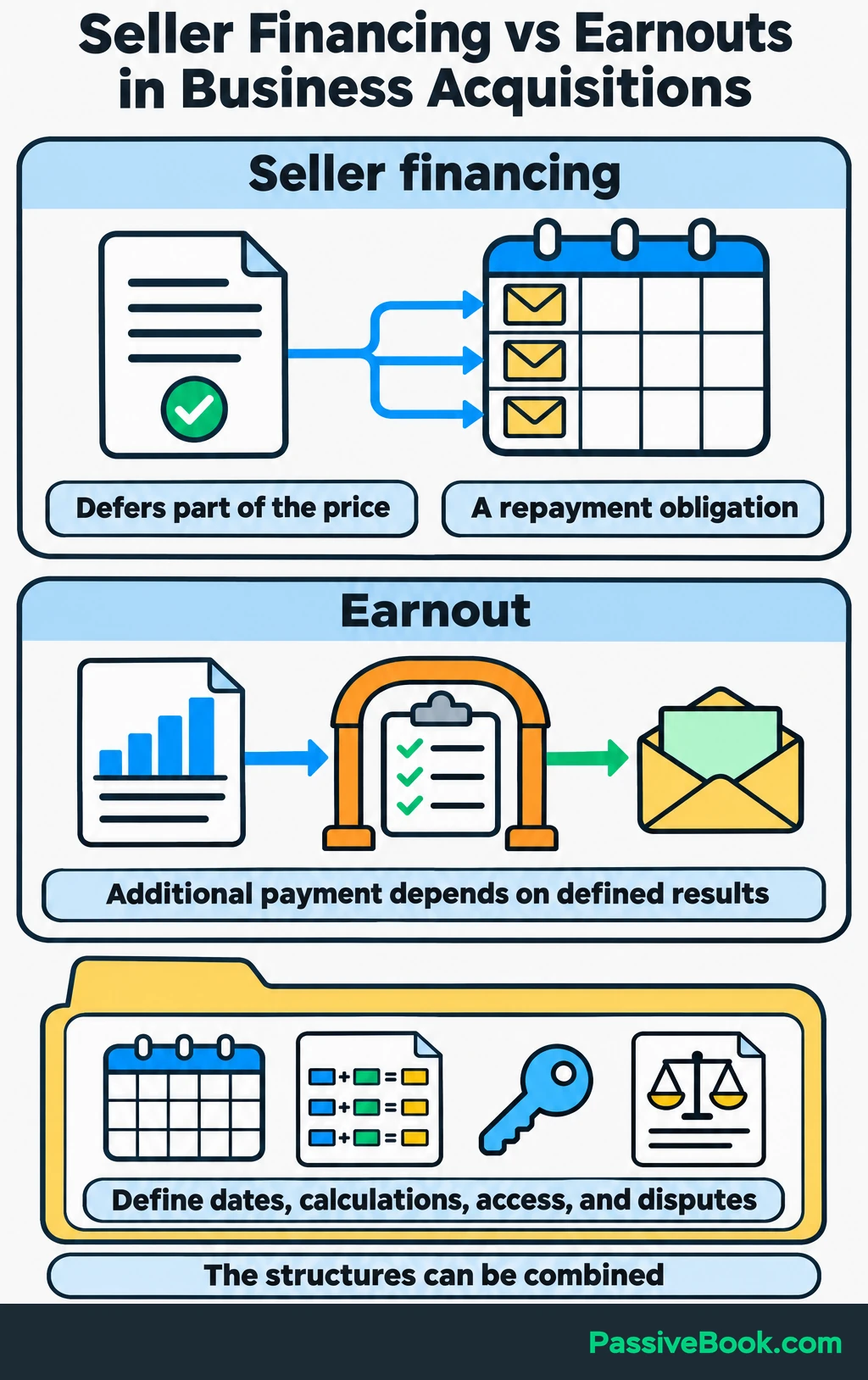
Seller financing and an earnout serve different purposes. Seller financing defers payment through a repayment obligation. An earnout makes additional payment depend on defined results. They can be combined, but neither should have vague calculations.
For deferred amounts, define payment dates, interest where applicable, performance measures, reporting access, and dispute procedures.
Have a local lawyer review the letter before signing. Baker McKenzie’s U.S. guidance on preliminary documents notes that confidentiality terms can bind you and warns that careless drafting can create unintended commitments.
Verify the Business Before Committing to the Purchase
Due diligence tests the claims supporting your offer. Agree the required records, access, and deadlines while you still have the contractual ability to withdraw or renegotiate.
Organize the review around four questions: Are the earnings real? Is demand holding up? Can you operate the business? Can you legally receive what makes it work?
Reconcile Earnings to Original Records
Request monthly profit-and-loss statements, transaction exports, processor settlements, relevant bank records, expense invoices, and available filed tax returns covering the valuation period.
Trace sales through refunds, chargebacks, fees, payout timing, and bank deposits. A difference may have a valid explanation, but it needs an explanation supported by records.
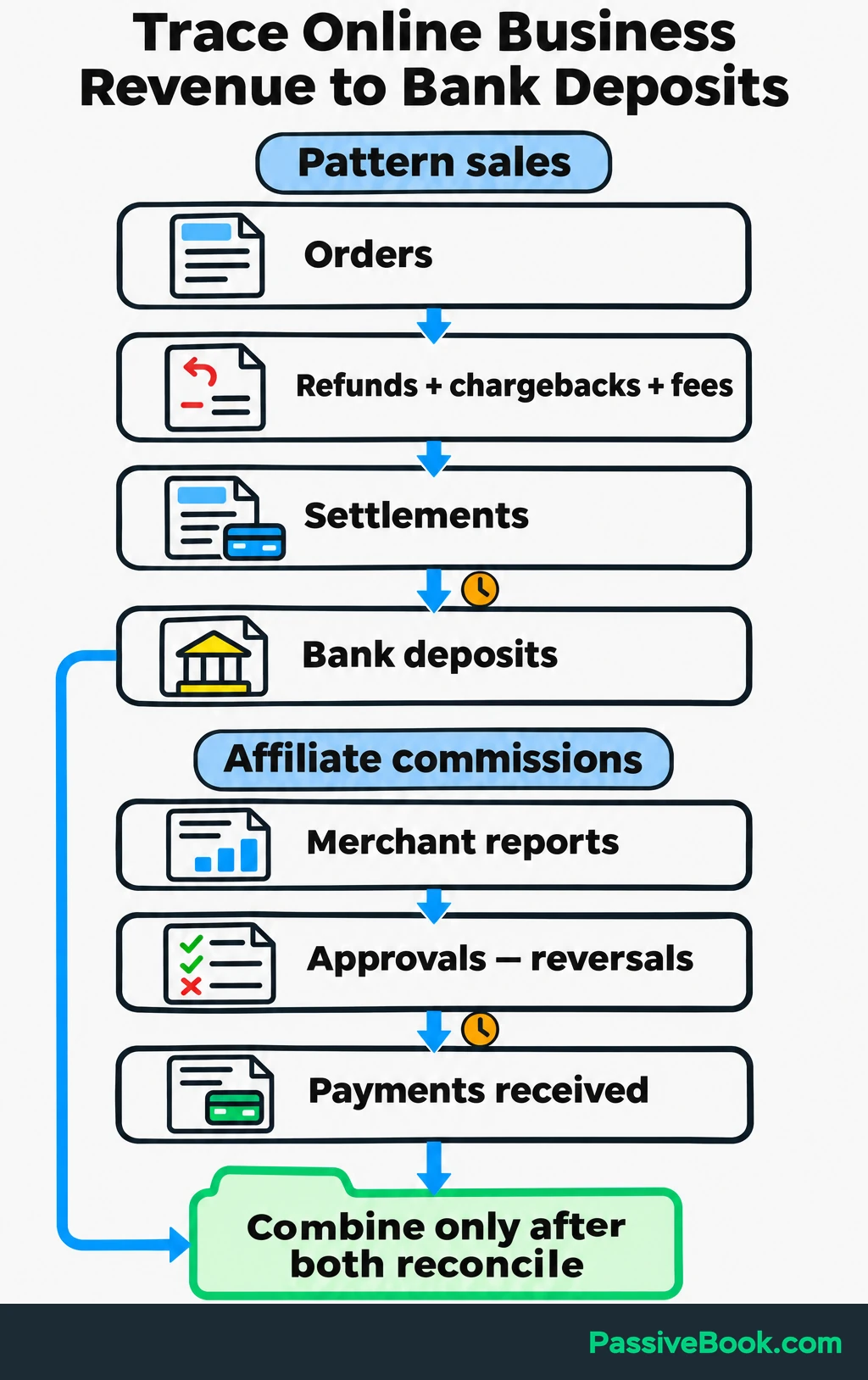
For the sewing website, reconcile the two income streams separately:
- Pattern Sales: Match orders to refunds, processing fees, settlements, and deposits.
- Affiliate Commissions: Match merchant reports to approved commissions, reversals, and payments received.
Only combine them after both make sense.
Check hosting, software, contractors, advertising, support, and maintenance expenses. If the seller runs several websites, establish which shared costs this business needs after separation.
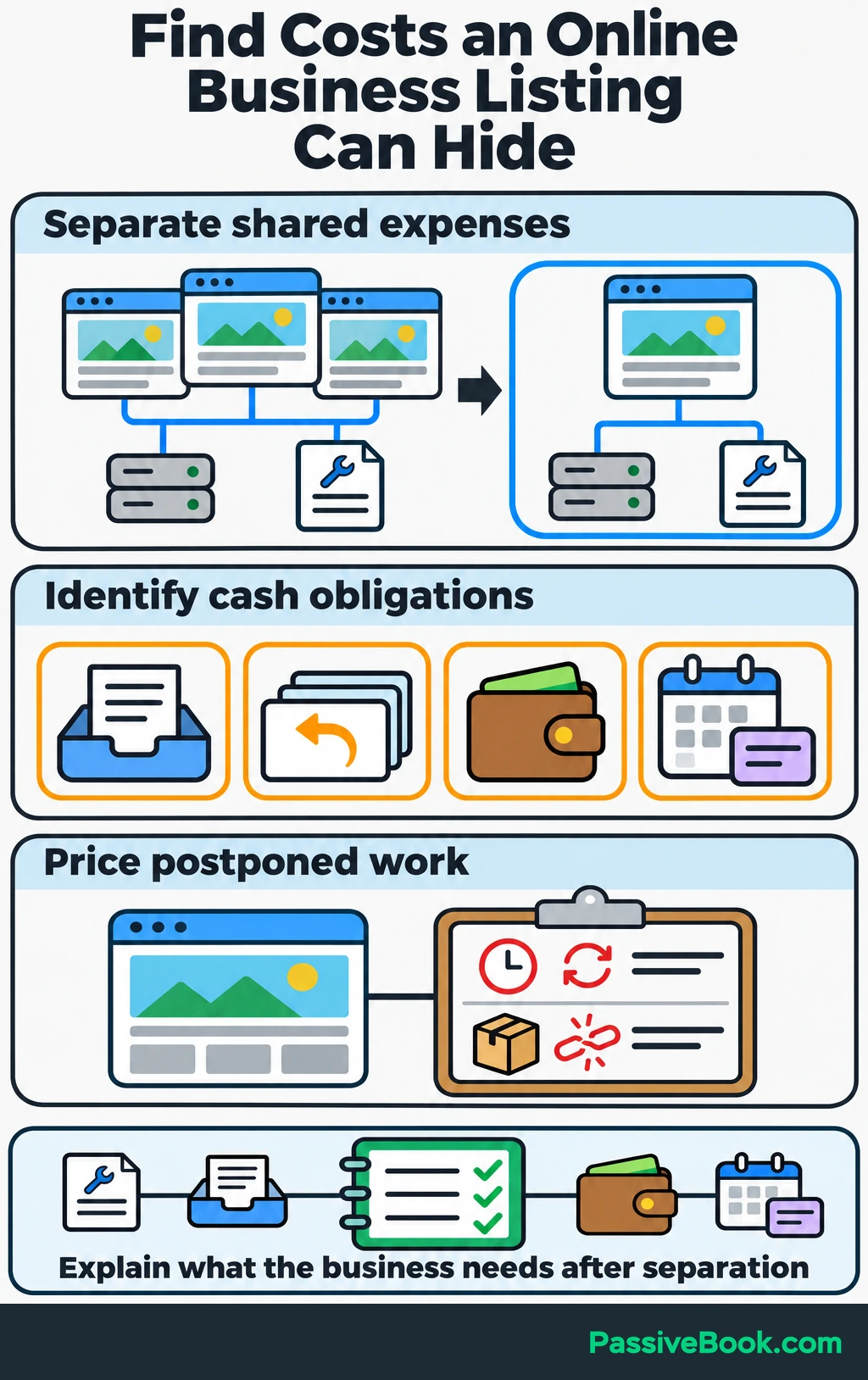
Review at least one full seasonal cycle where records permit, and inspect earlier periods when needed to explain changes. Compare equivalent months before treating a holiday peak as normal income. A short history gives you less evidence to price.
Also look for cash obligations that are easy to miss: unpaid invoices, outstanding refunds, customer credits, prepaid subscriptions, and maintenance the seller postponed.
Use original exports and appropriate read-only access alongside documents. Bring in an independent accountant when the reconciliation or earnings adjustments exceed your expertise.
Check Traffic and Customer Demand
Inspect the site’s own analytics and search records alongside sales. Look at channels, landing pages, visitor locations, conversions, and the actions that generate money.
A growing visitor count is not enough. Find out whether those visitors buy, subscribe, or click revenue-producing links.
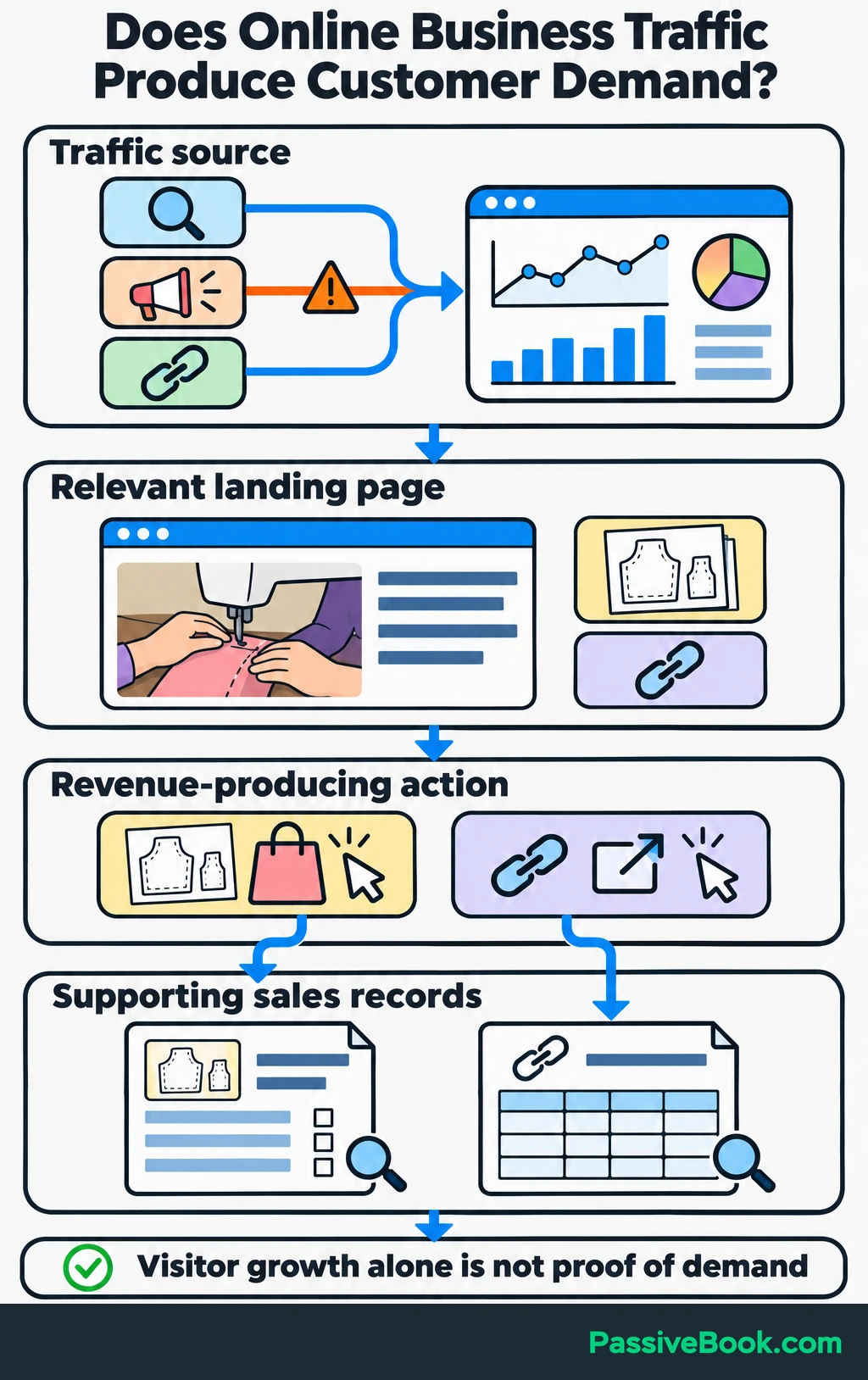
For the sewing website, identify tutorials that lead to pattern purchases and affiliate clicks. Then check whether order and commission records support the claimed results.
Investigate unexplained spikes, steady declines, purchased traffic, and dependence on a few pages or referral sources. Ask what changed and look for supporting records.
In Google Search Console, Google’s tool for monitoring search performance, check the Manual actions report for penalties applied by Google reviewers. Request records of earlier search problems and fixes. Google says manual actions can lower rankings or remove affected pages from search results. A clear report does not explain away a traffic decline, so still inspect the trend.
Adjust the customer checks to the model. Examine refunds and repeat orders for ecommerce, retention and cancellations for subscriptions, and client concentration and renewals for services.
The aim is to understand what keeps demand coming back after the seller leaves.
Test Workload and Critical Dependencies
Watch the seller perform routine work and resolve a representative problem. Compare the claimed hours with support queues, task records, contractor duties, and maintenance logs.
For the sewing website, test a pattern purchase and download, inspect affiliate-link maintenance, and walk through a backup and a customer-support request.
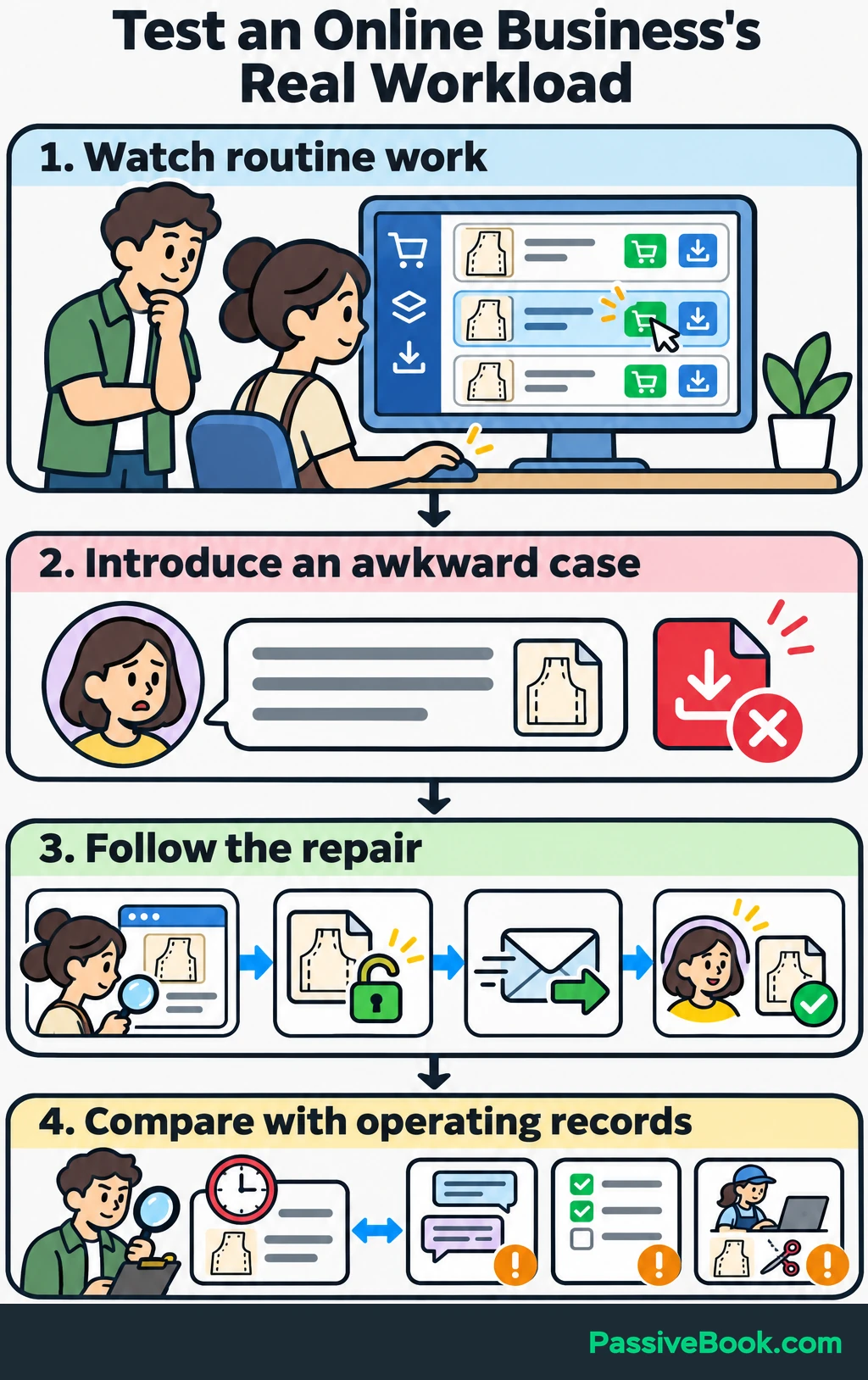
I would ask to see an awkward case too. Resending a missing file or correcting a checkout failure reveals more about the operating process than a tour of the homepage.
List each major dependency and record:
- Earnings Exposed: Which revenue would be affected if it failed.
- Replacement Options: A realistic alternative supplier, worker, merchant, or platform.
- Recovery Time: How long switching or repairing would take.
- Cash Needed: The expense and lost-income allowance during that period.
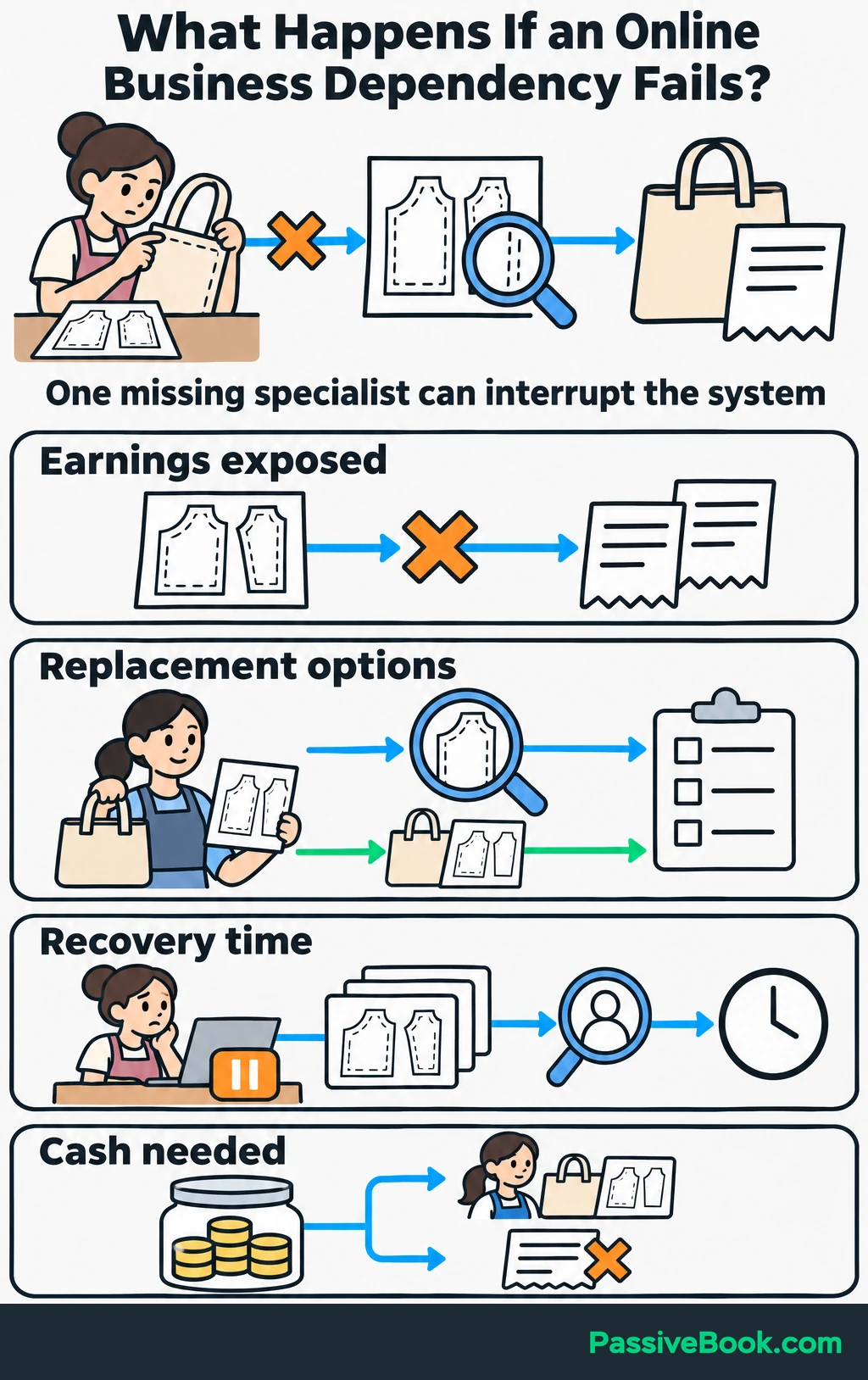
Confirm whether important contractors and partners will continue on acceptable terms.
For the sewing site, a contractor who tests patterns may be more important than the publishing tool. Replacing a tool is manageable. Replacing expertise you cannot assess is harder.
Confirm Ownership and Transferability
Build an asset register covering domains, website files, databases, content, product files, source code, brand assets, analytics, email systems, and essential contracts.
For each item, record ownership evidence, the transfer method, required approval, and an acceptance test.
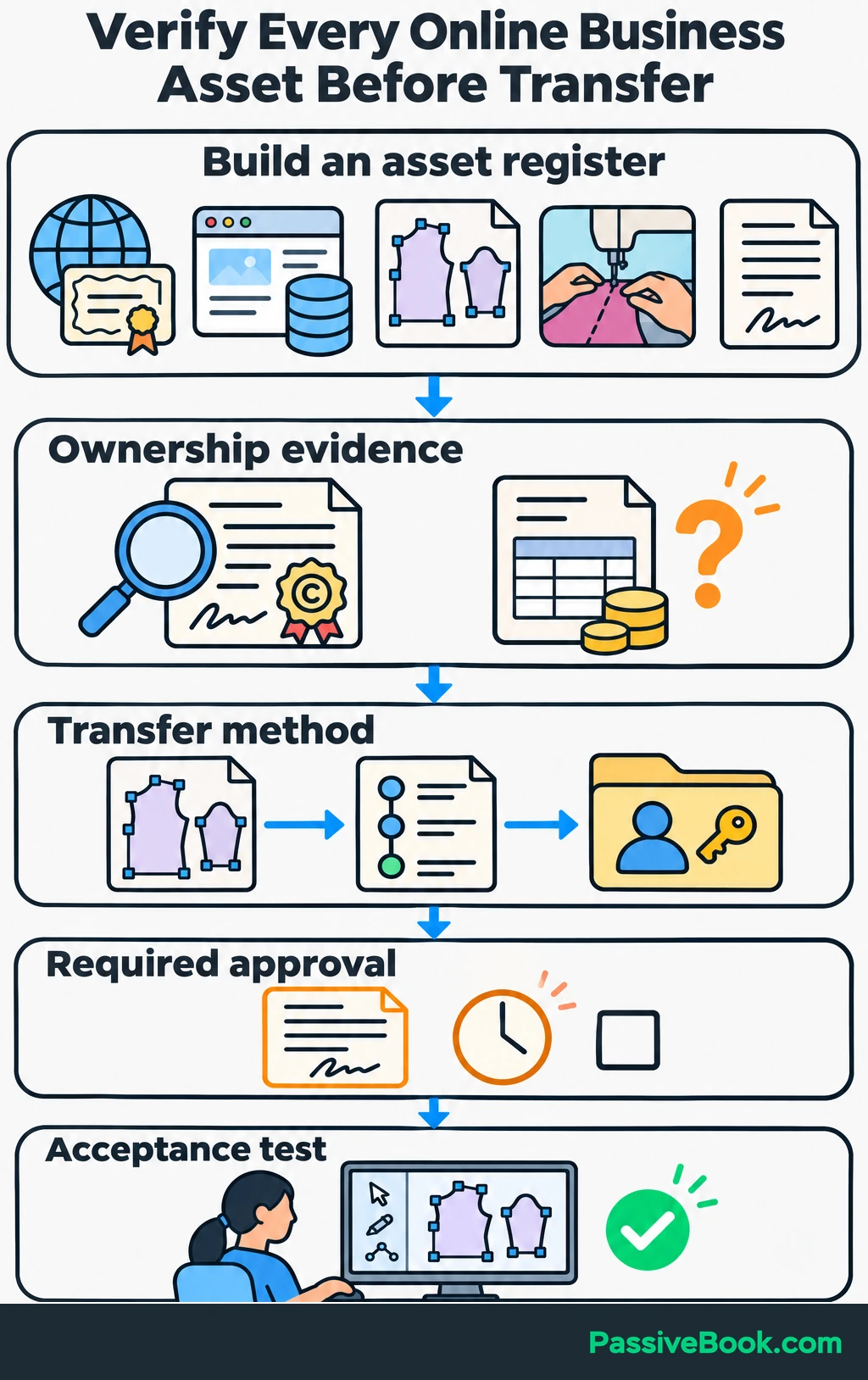
Check commissioned work and licenses carefully. An invoice shows payment, but you also need written agreements showing that the seller owns the work or holds a license you can take over. Venable’s ownership guidance flags missing ownership assignments and calls for reviewing rights the seller has already granted to others.
For the sewing website, include the patterns, instructional photographs, editable source files, and any contractor agreements.
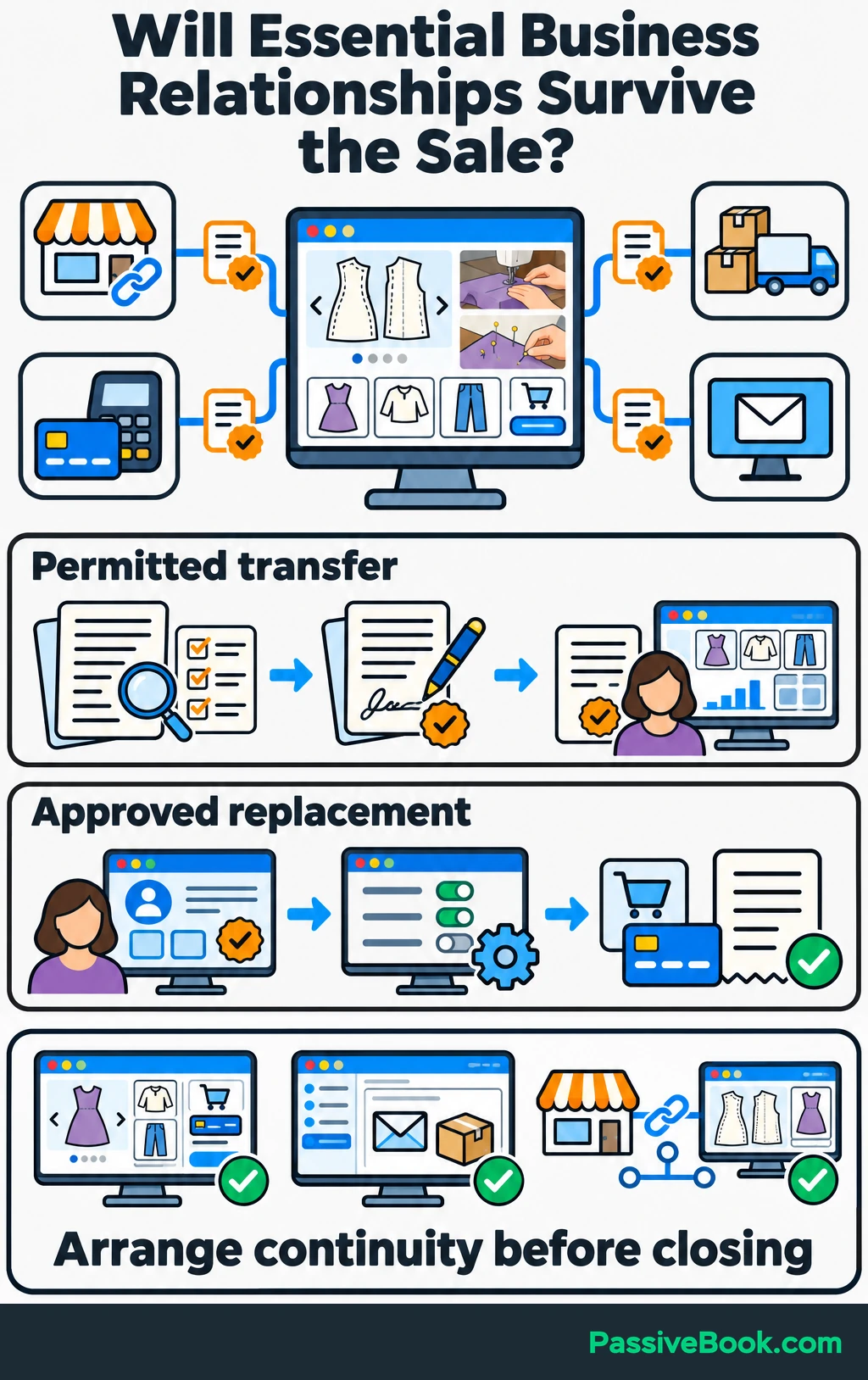
Then confirm how essential commercial relationships will continue. Affiliate programs, payment providers, suppliers, and platforms may require approval or replacement accounts. Arrange what you need before closing.
If inventory is involved, verify quantities, ownership, and purchase costs including shipping and import charges. Identify stock that is outdated or unlikely to sell. State whether it is included in the price.
Have your lawyer check debts and other liabilities, claims against the assets, disputes, and approvals needed to transfer contracts. Include customer-data transfer requirements in that review. If UK data-protection law (UK GDPR) applies, check whether customer data will pass to a new or additional data controller—the organization that decides how it is used. For those transfers, the ICO’s acquisition guidance calls for a lawful basis, documented sharing, and consideration of when and how to notify customers.
Decide Whether to Proceed, Renegotiate, or Walk Away
Maintain an issues list with the evidence, financial impact, proposed remedy, responsible person, and resolution deadline. Replace your provisional assumptions with verified findings.
Then test a less comfortable version of the business.
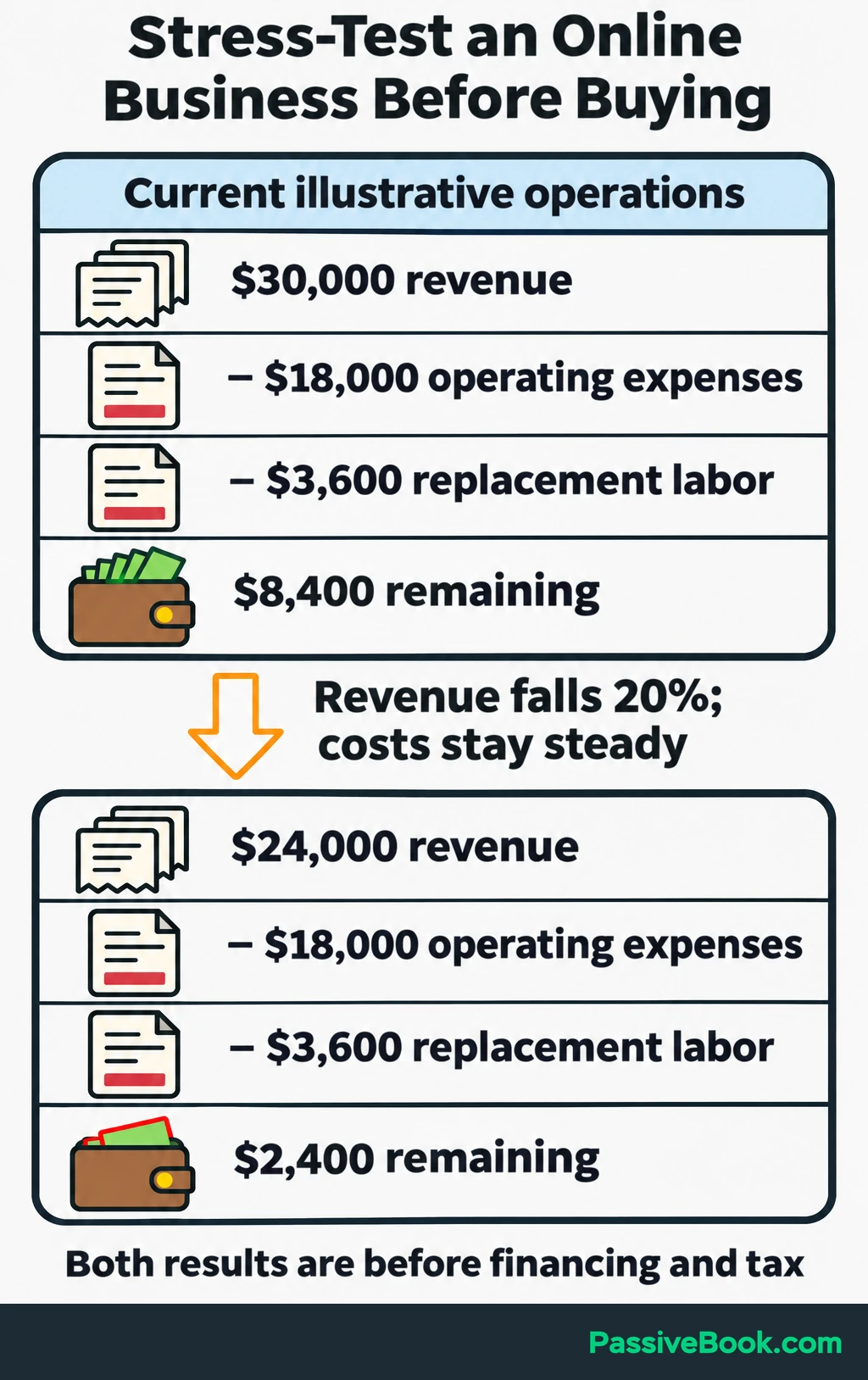
For the sewing website, reduce annual revenue by 20% while holding operating expenses and replacement labor steady. This shows how much remains if sales fall but costs do not adjust quickly.
| Annual Calculation | Current Example | With 20% Lower Revenue |
|---|---|---|
| Revenue | $30,000 | $24,000 |
| Operating expenses | −$18,000 | −$18,000 |
| Replacement labor | −$3,600 | −$3,600 |
| Remaining before financing and tax | $8,400 | $2,400 |
A moderate revenue decline leaves much less room for repayments, repairs, or owner income. Run other tests where relevant, such as higher contractor costs or the loss of a major customer.
Check that the revised price, transaction expenses, repairs, and reserves still fit your funding limit.
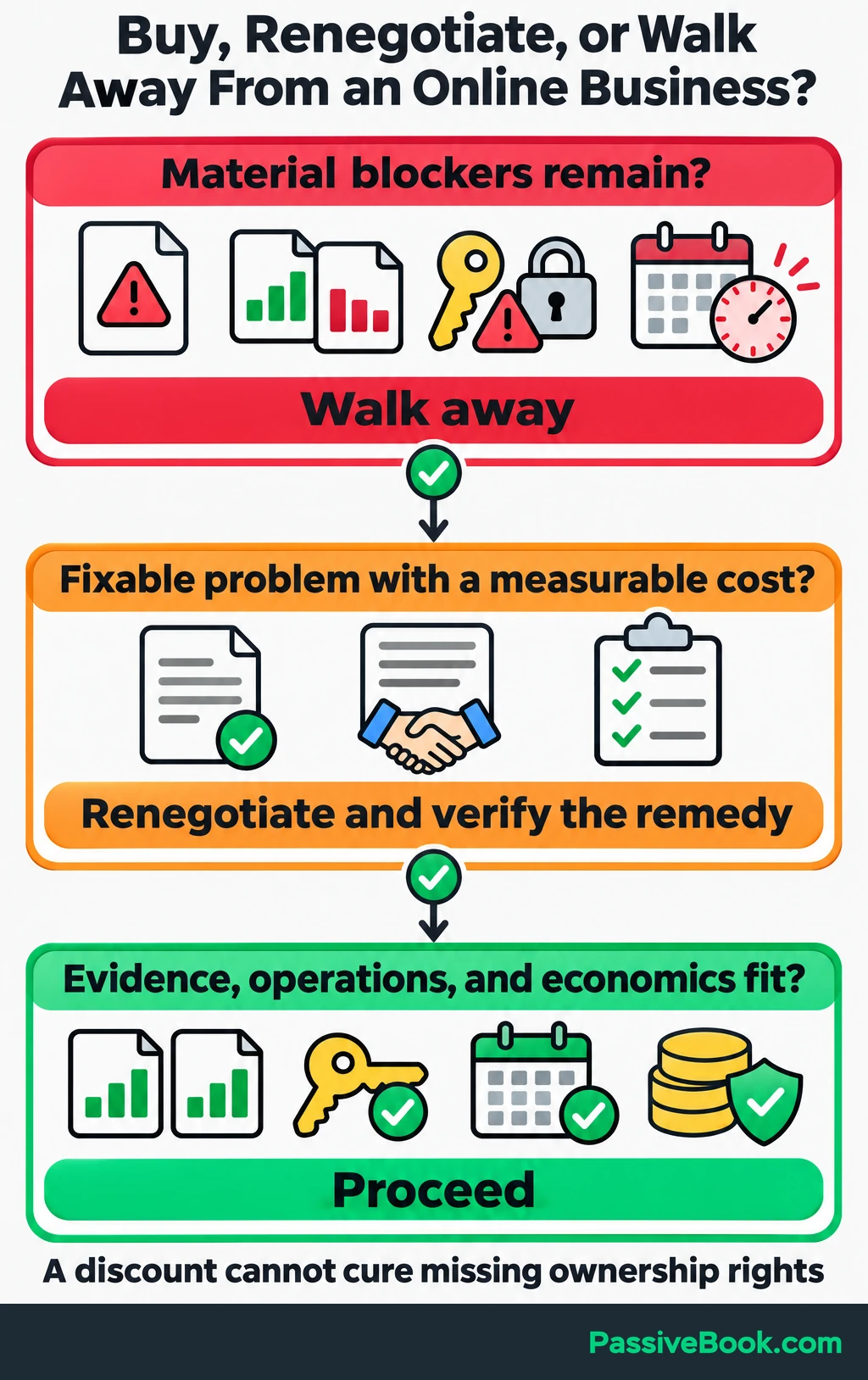
Use the findings to choose:
- Proceed: The evidence supports the earnings, essential transfers are achievable, and the workload and economics fit.
- Renegotiate: A fixable problem has a measurable cost that price, support, or payment terms can address.
- Walk Away: Records are fabricated, material discrepancies remain unresolved, essential transfers are blocked, or the business fails your limits.
A discount cannot cure missing ownership rights. Resolve those before closing.
I would also walk away from a deal that only works if every planned improvement succeeds. That leaves you paying upfront for work and risk you still have to take on.
Close Through a Documented Transfer
Turn the agreed deal into a list of responsibilities, deadlines, and tests. Everyone involved should know what must happen before money is released.
Finalize the Agreement and Seller Support
Have acquisition counsel review the purchase agreement, final asset schedule, assumed and excluded obligations, seller representations, remedies, required consents, and closing conditions.
Agree how to allocate unsettled revenue, refunds, inventory, prepaid customer purchases, and expenses spanning the closing date. Ask an accountant to assess the transaction’s tax treatment.
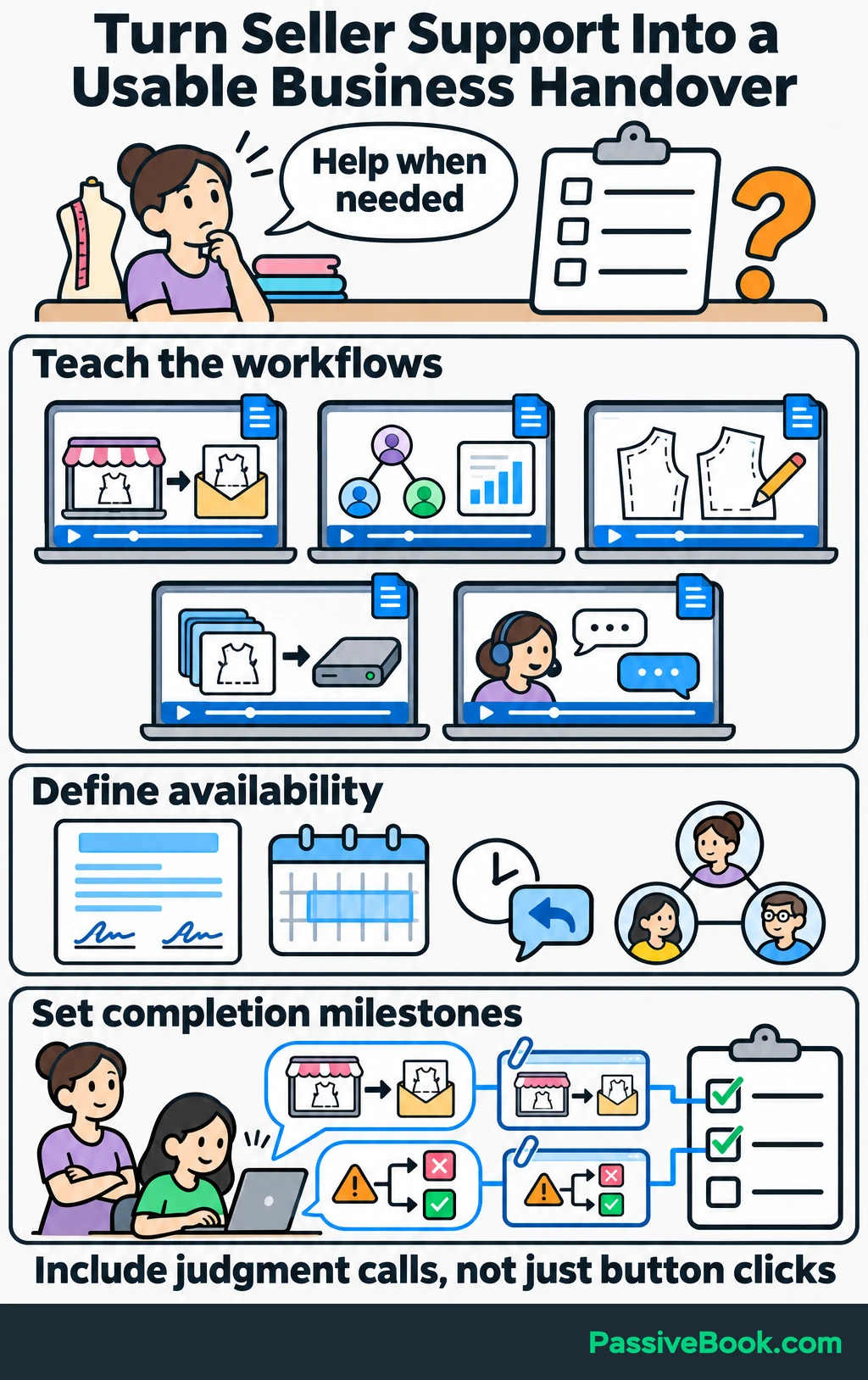
Make seller support specific. Define the workflows to teach, recordings to provide, introductions to make, support duration, response expectations, and completion milestones.
“Help when needed” is a pleasant phrase with no useful deadline.
For the sewing website, request recordings of product delivery, affiliate reporting, pattern updates, backups, and customer support. Include the problems that require judgment, not just the buttons to click.
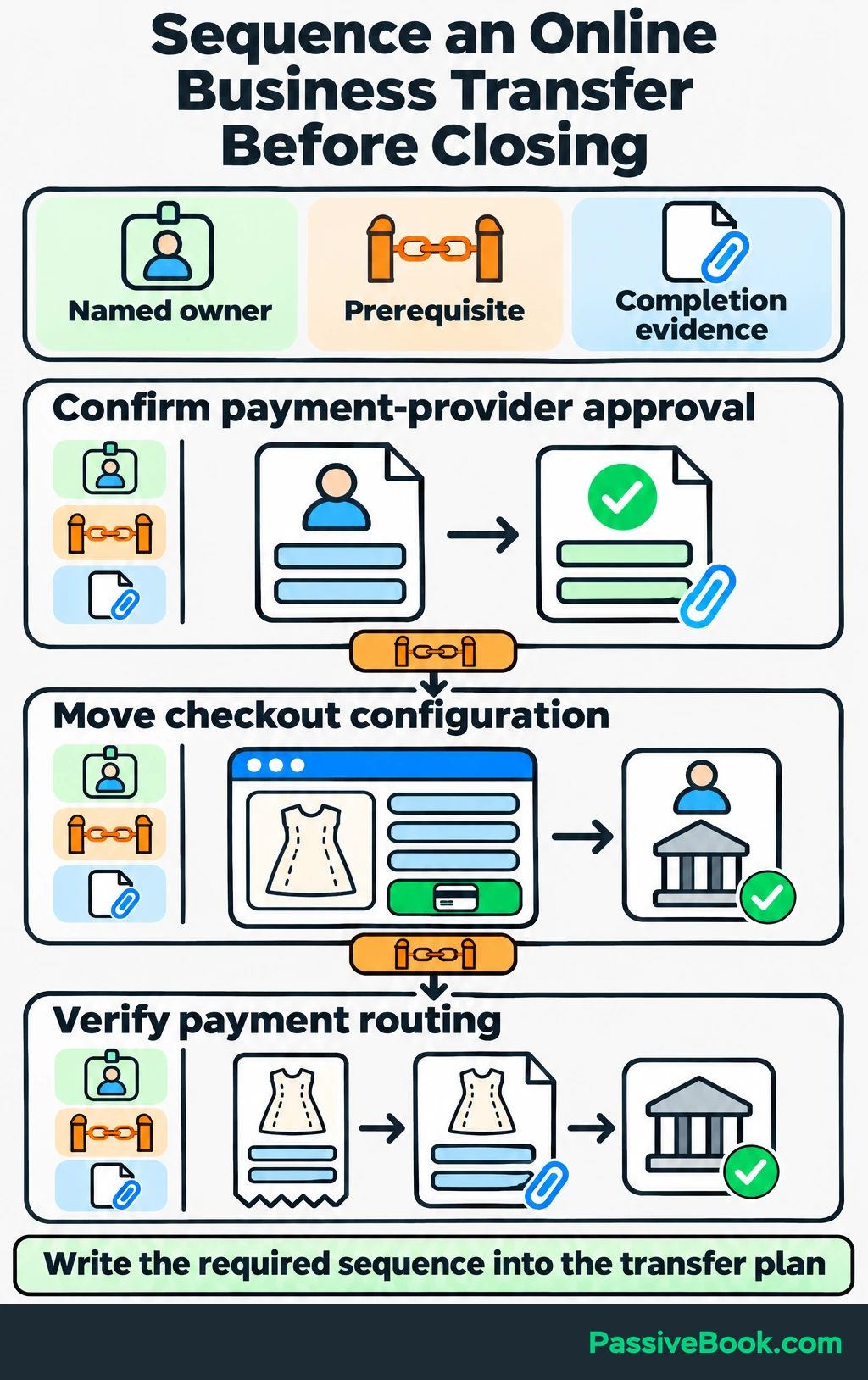
Assign each funding and transfer task to a named person. For each task, record what must happen first and how you will confirm it is complete. If payment-provider approval must happen before checkout can move, put that sequence in writing.
Coordinate Escrow, Transfer, and Inspection
Use an established escrow or closing provider that supports the assets and jurisdictions involved. Independently verify payment instructions through a trusted channel before sending funds.
Escrow holds payment while agreed transfer conditions are completed. It does not establish whether the business was worth buying.
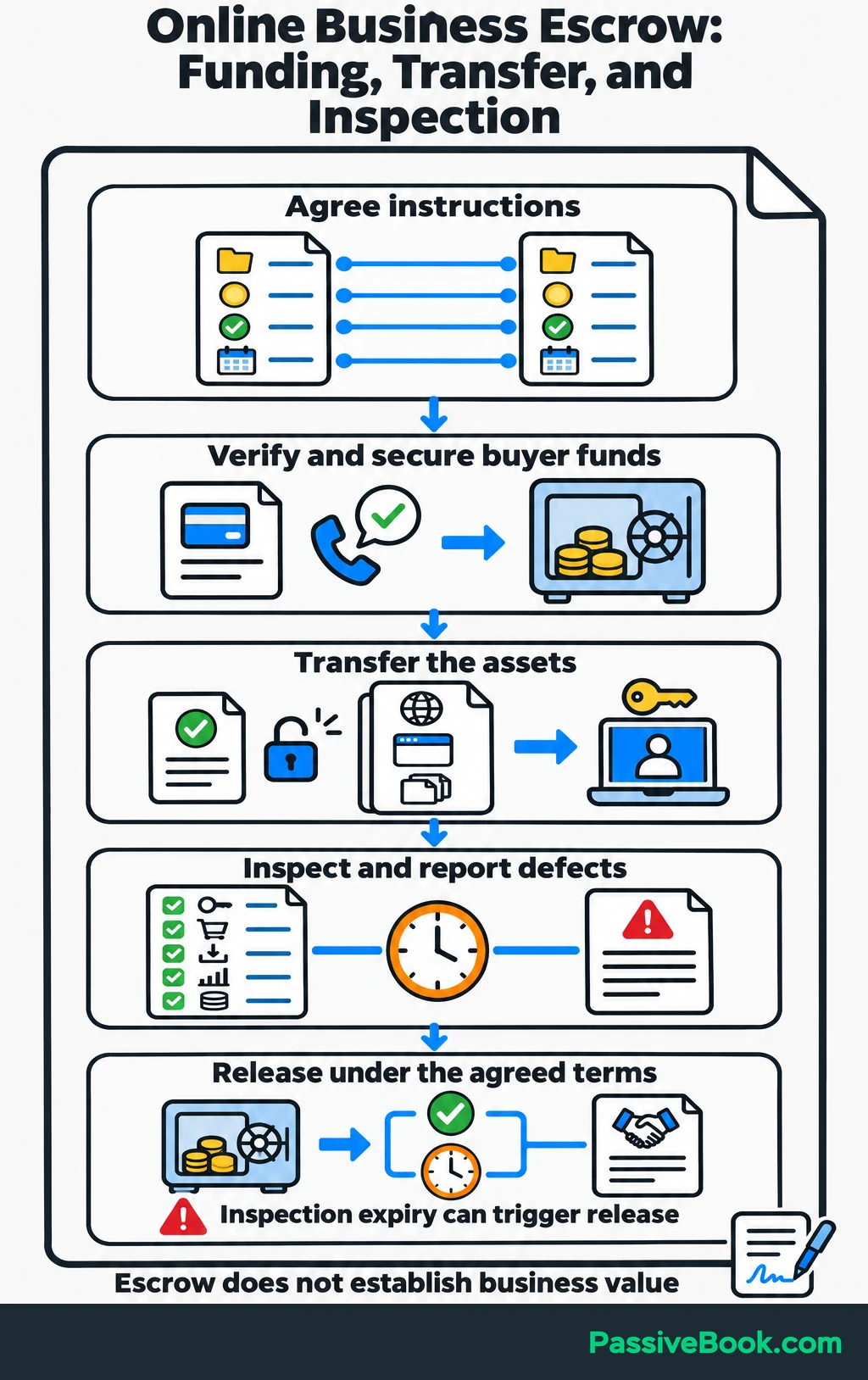
Align the escrow instructions with the purchase agreement: included assets, fees, funding confirmation, transfer evidence, inspection start, acceptance tests, and dispute procedures.
Follow the agreed sequence. Escrow.com’s website-transfer process, for example, instructs the seller to transfer after the buyer’s payment has been verified and secured. Its process describes the funding and transfer steps.
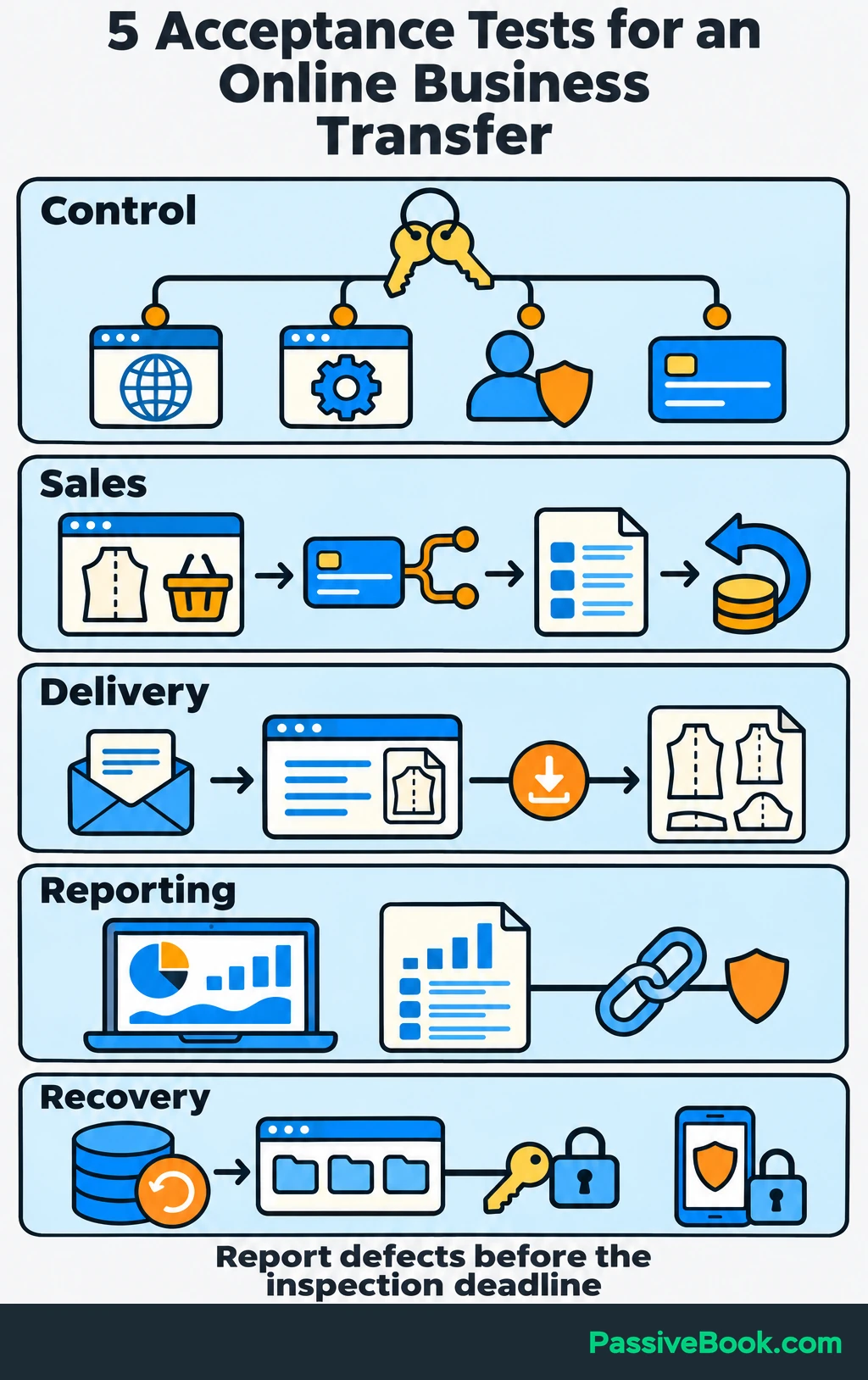
Back up the business before migration. During inspection, test:
- Control: Domain ownership, website administration, recovery details, and billing.
- Sales: Checkout, correct payment routing, order records, and refunds.
- Delivery: Pattern downloads and customer emails.
- Reporting: Analytics access, sales reports, and approved affiliate tracking.
- Recovery: Backups, restore procedures, credentials, and multifactor authentication.
Monitor inspection deadlines and report defects through the required process. Escrow.com states that funds can be released after acceptance or expiration of the inspection period, so silence can have a financial consequence. Its inspection terms explain the deadline.
Establish buyer-controlled credentials and recovery methods, then remove seller access according to the agreed support arrangements.
Take Over Operations Before Making Major Changes
Keep the website available, orders fulfilled, customers supported, and renewals paid. Fix urgent security and payment failures immediately.
Everything else can wait until you understand what you bought.
Run critical workflows yourself while seller support is still available. Record missing instructions and the exceptions that the original walkthrough skipped.
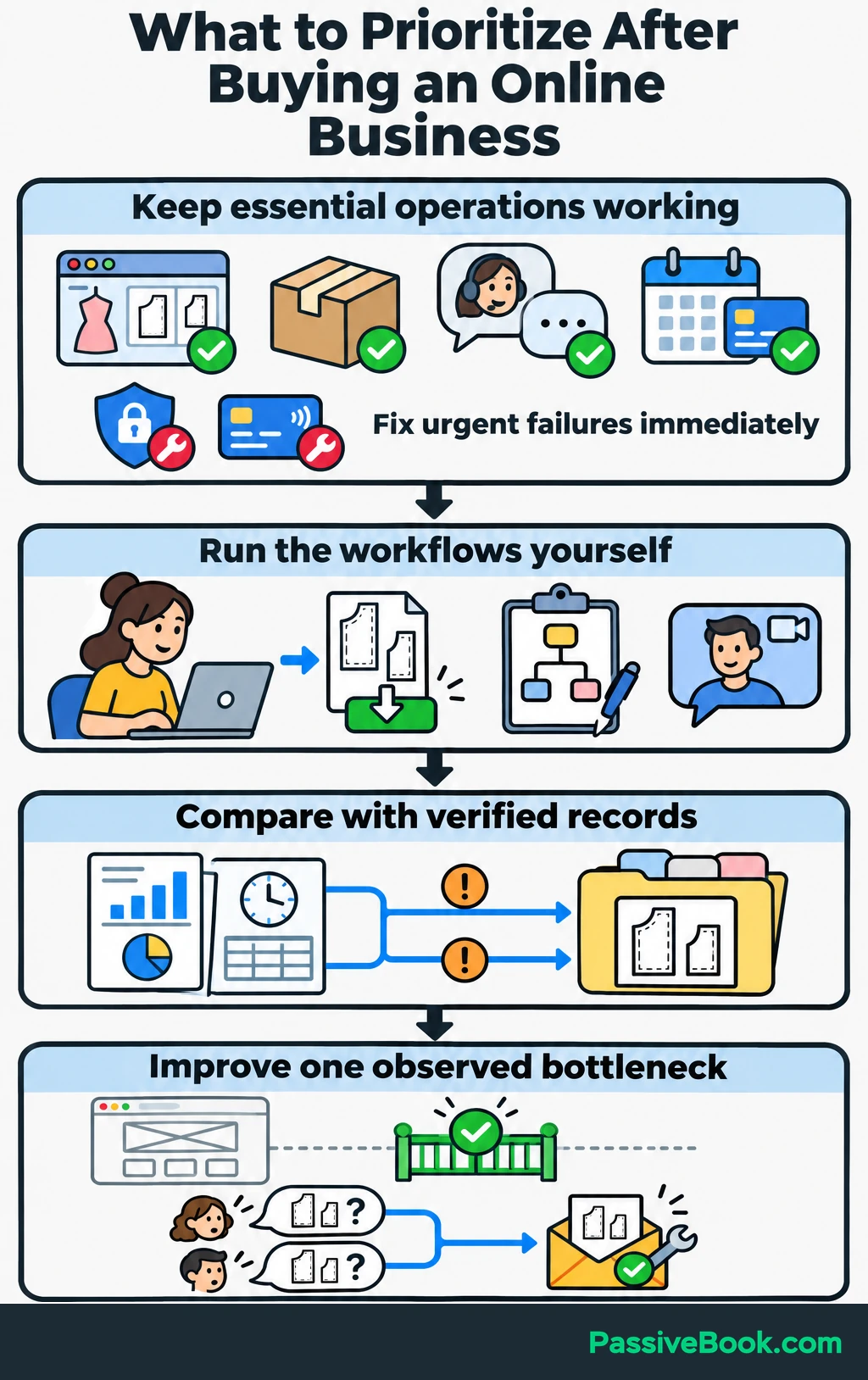
Compare revenue, expenses, traffic, refunds, support demand, and owner hours with the records verified before closing. Investigate gaps before they become your new normal.
For the sewing website, confirm pattern delivery and affiliate tracking before changing the design or publishing system. A fresh homepage is poor compensation for broken downloads.
I have made the same mistake at a smaller scale with digital products: improving the sales page while leaving a confusing delivery instruction untouched. Answering the same question again made the priority obvious. Fix the recurring customer problem first.
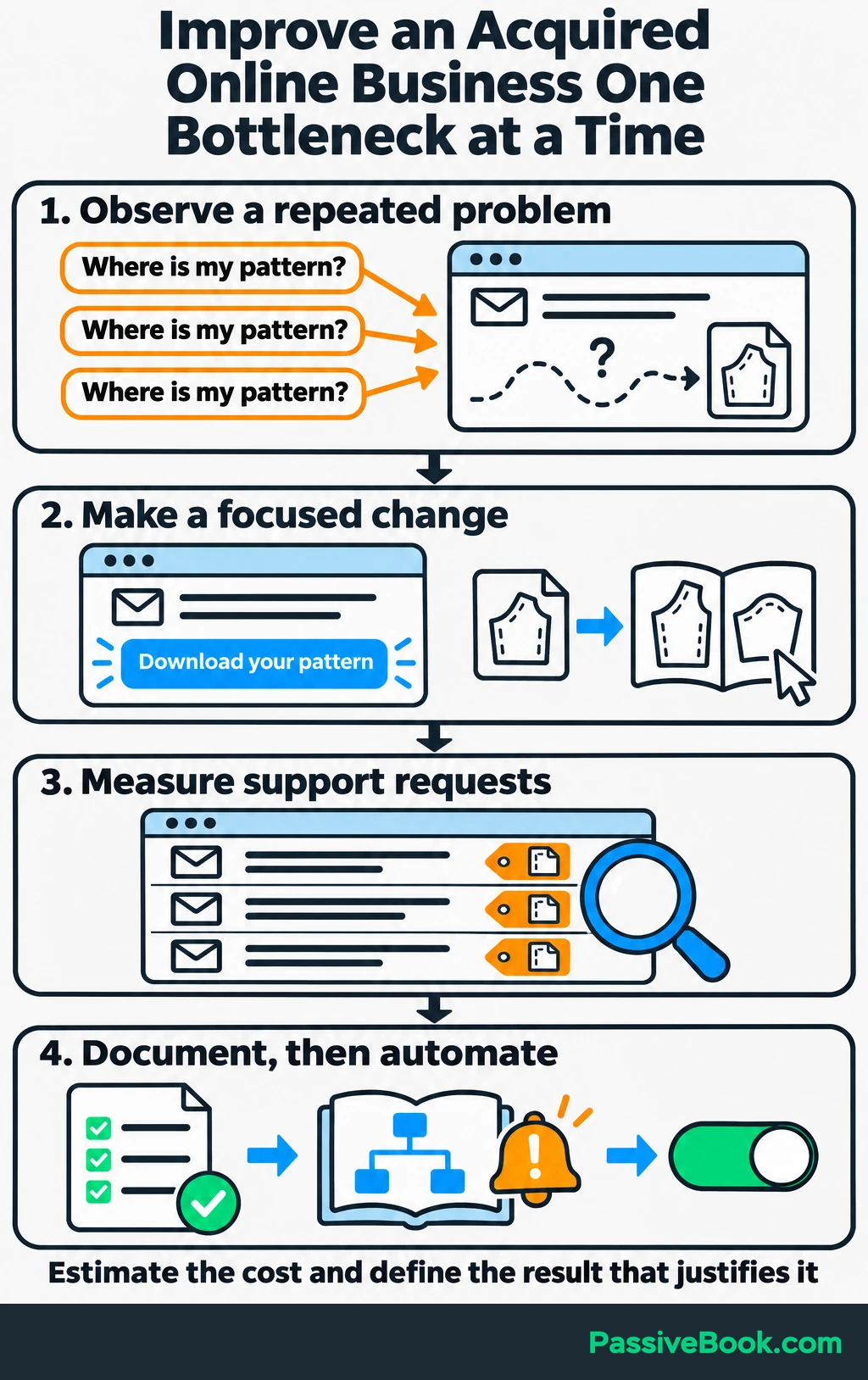
Once operations are stable, choose one observed bottleneck. Estimate the cost of fixing it and decide what result would justify the work.
If customers keep asking where to find their patterns, improve the delivery message and measure support requests. If a tutorial attracts readers but few purchases, inspect the offer and buying path before publishing more articles.
Automate a process after you understand it. A recorded workflow, clear exception rules, and working alerts are more useful than an impressive automation nobody knows how to repair.
Keep the verified records, valuation, signed agreements, asset register, transfer tests, and operating instructions together in an acquisition file. That file becomes your reference when memory and seller availability fade.
What Next?
Write a one-page buying brief with your purchase ceiling, available weekly hours, preferred model, and reasons you would reject a listing. Use it to assess three businesses before contacting a seller.
If this guide helps you spot the work and costs behind an asking price, use the social buttons to share that buying process.
Which part of an acquisition would you find hardest to verify: earnings, workload, or ownership? Leave your answer in the comments, and bring any other questions too.
Share this post with your friends & followers:

