You can spend months publishing useful articles and still have no clear answer to a simple question: what would a reader pay for after reading them?
Publishing more adds work, but it doesn’t answer that question. Ads, affiliate links, services, and products bring different costs and demands on your time, so choosing among them can feel like another project. This guide compares six ways to earn and follows a watercolor blog from useful articles to paid offers, with a worked income example to help you judge what’s worth testing.
Find a Reader Problem Worth Paying to Solve
Start with what readers need to buy, decide, or accomplish. Then choose a way to earn from helping them.
If your blog already gets visitors, review the search queries bringing people to relevant articles. Look through comments, emails, and inquiries for questions your free content leaves unanswered.
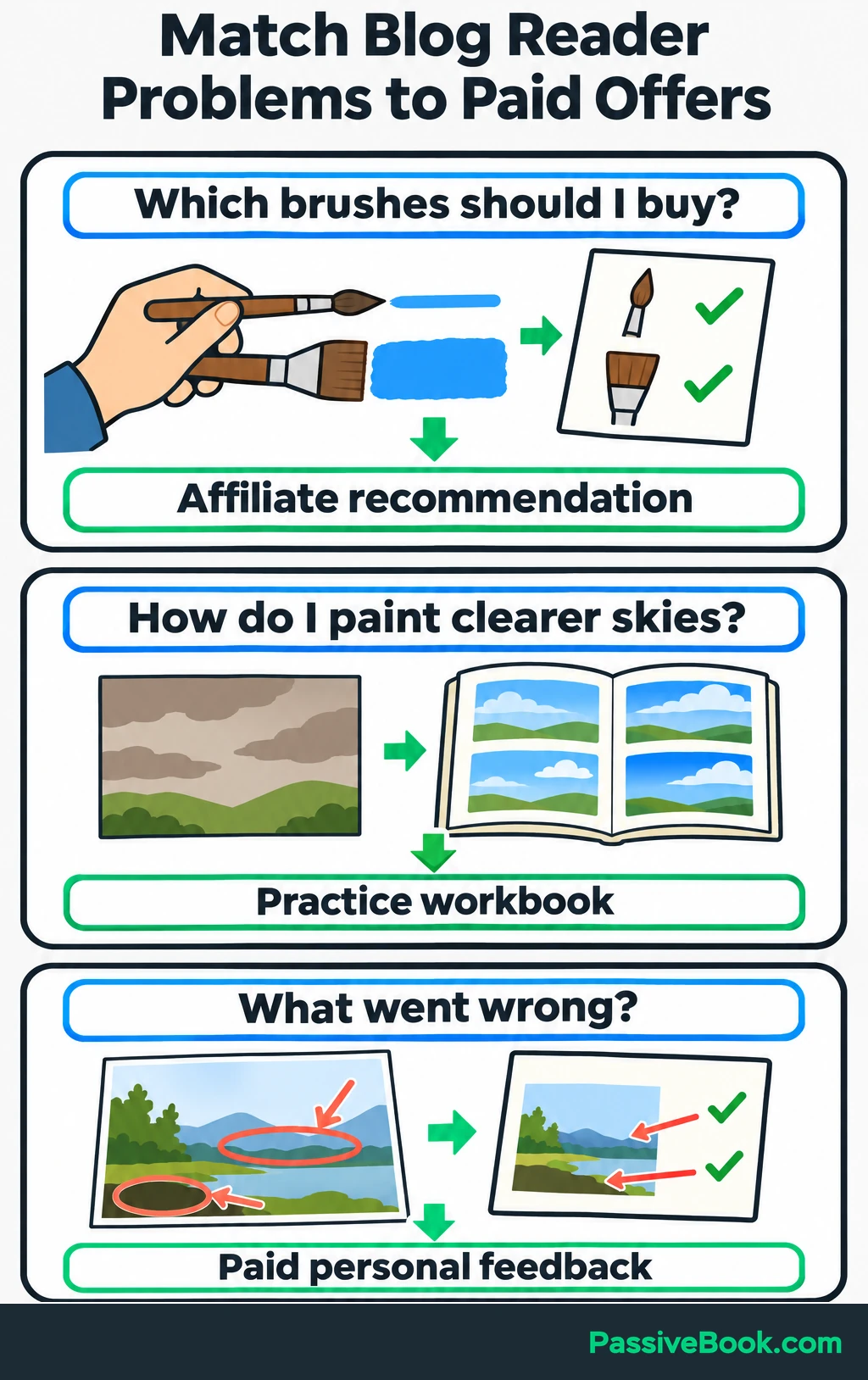
For a new blog, choose one focused problem and publish a useful article about it. You don’t need a hundred posts before you can test an offer.
Imagine your blog teaches beginners to paint watercolor landscapes. You could help readers choose brushes, practice painting skies, or get feedback on a finished painting. This business and the figures used below are hypothetical.
Those needs point toward different offers:
- A reader choosing their first brushes needs buying advice.
- A reader struggling with muddy skies may need guided exercises.
- A reader who cannot see what went wrong may need personal feedback.
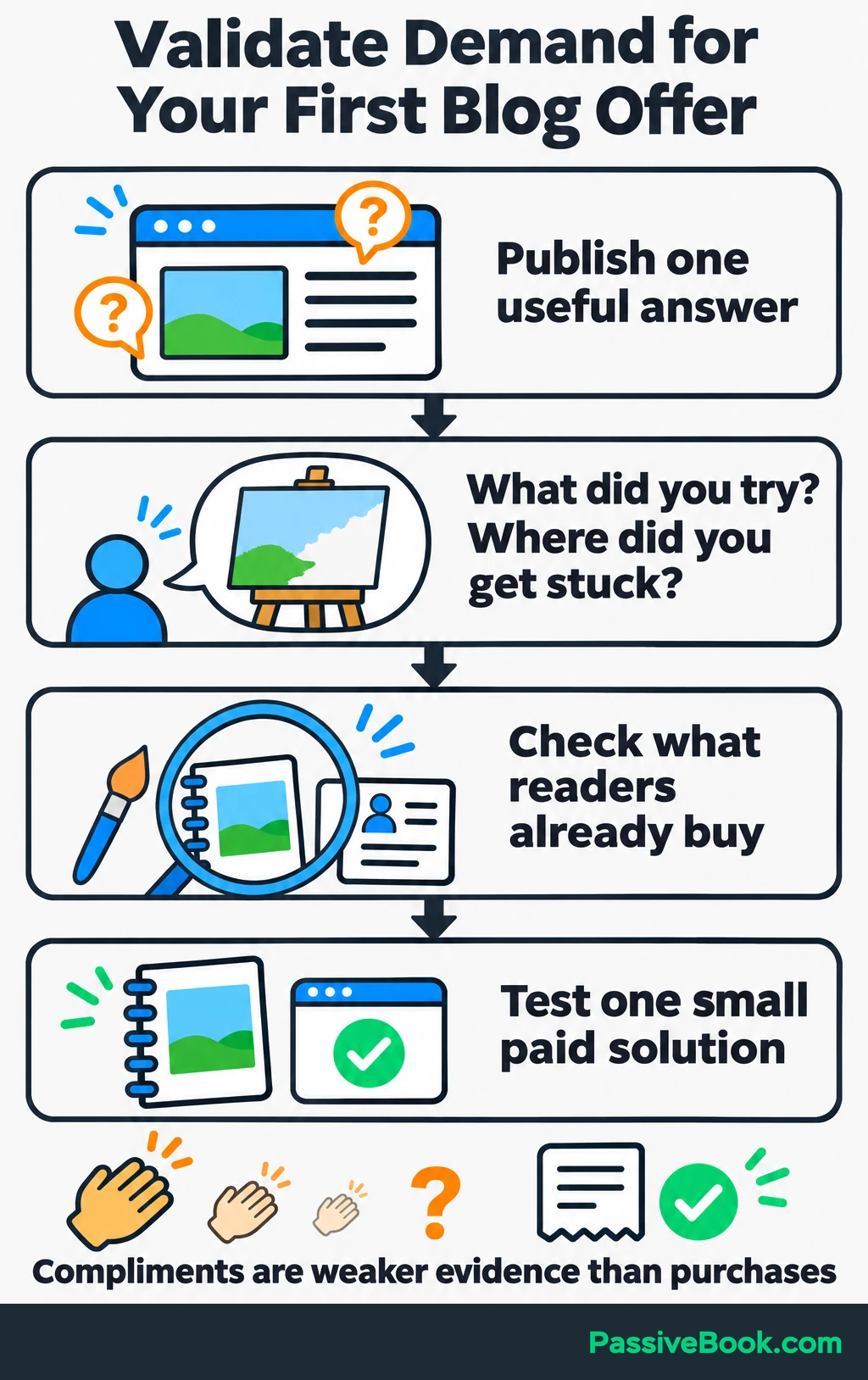
Check what people already buy to solve the problem, but also ask about their most recent attempt: “What did you try, and where did you get stuck?” That gives you more to work with than “Would you buy my course?”
I would test one relevant affiliate recommendation, a small finished product, or a paid service before building a large catalog. A first purchase gives you a reason to investigate further. Compliments alone don’t pay the hosting bill.
Start With One Monetization Method
Choose your first method around reader intent, your expertise, and the hours you can reliably give it. Traffic matters, but so do delivery costs and your control over the offer.
| Method | Who Pays | What Generates Revenue | Starting Requirements | Ongoing Work | Main Trade-Off |
|---|---|---|---|---|---|
| Affiliate marketing | A merchant or affiliate program | A qualifying purchase or action through your link | Relevant content and program approval | Update recommendations and check links | You don’t control commissions or checkout |
| Digital products | Your reader | A workbook, template, ebook, or course sale | A useful product, sales page, checkout, and delivery | Support, corrections, and updates | You build before knowing how much will sell |
| Services | Your client | A completed paid engagement | Expertise, clear scope, and a booking process | Deliver each job and manage communication | Your available hours limit sales |
| Display advertising | Advertisers through an ad provider | Advertising activity on your pages | Eligible content, traffic, and provider approval | Monitor placements and site usability | Revenue depends heavily on traffic and ad rates |
| Sponsored content | A brand | An agreed article, placement, or campaign | A relevant audience and work samples | Pitching, production, approvals, and reporting | Brand demands can compete with editorial judgment |
| Memberships and paid subscriptions | Your members | Recurring subscription payments | A continuing need and a sustainable delivery plan | Provide value, support members, and handle cancellations | Recurring revenue comes with recurring obligations |
I would start with services when readers need personal help, affiliates when they need purchasing advice, and products when the same solution can help many people.
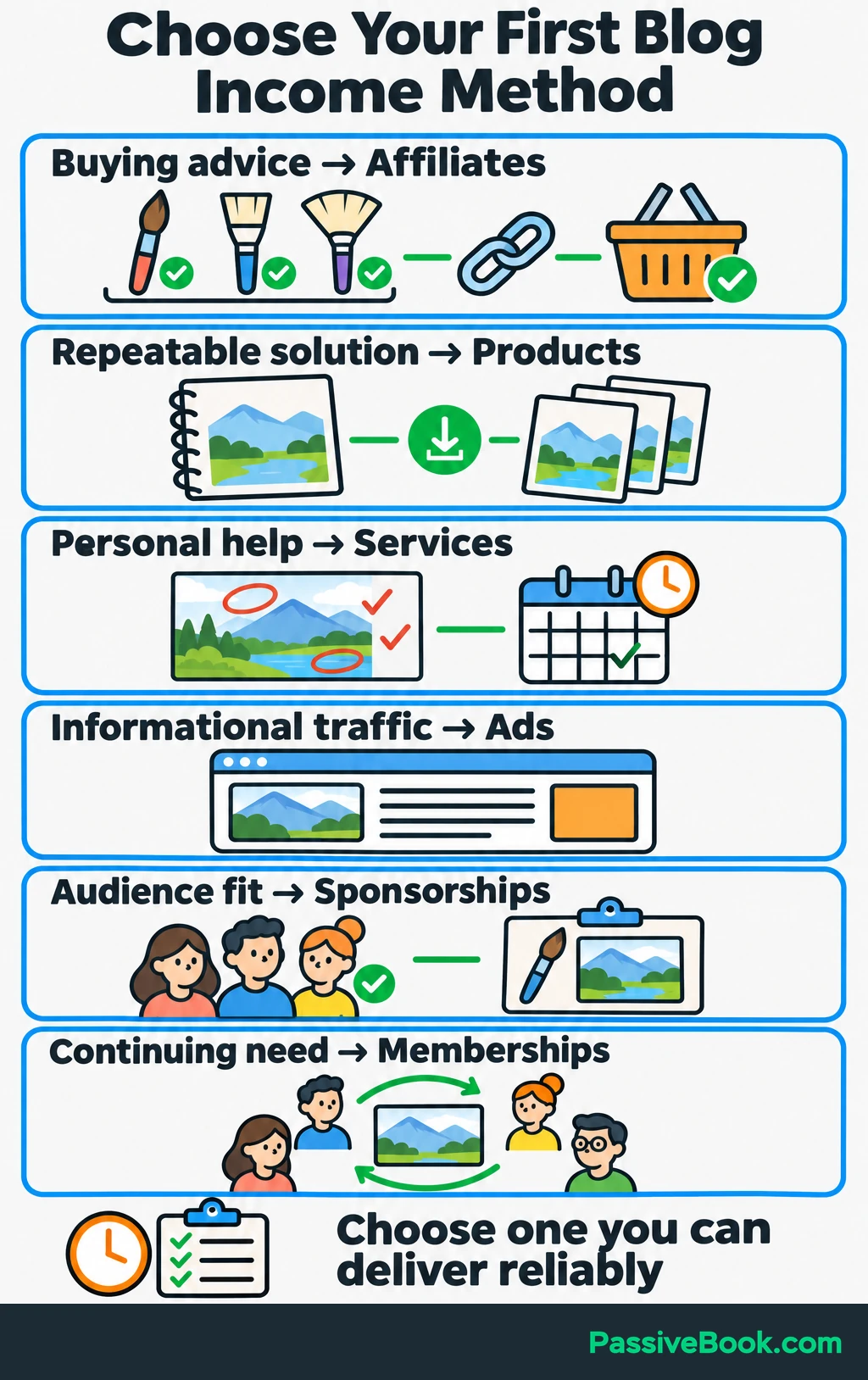
Ads suit informational traffic that doesn’t naturally lead to a purchase. Sponsorships need a demonstrably relevant audience. Memberships need a reason for people to keep paying.
Before building anything, check that your blogging platform permits the method and supports the links, forms, or checkout you need. Keep your existing tools until a specific limitation gives you a reason to change.
Affiliate Marketing
Affiliate marketing pays you when a reader completes a qualifying purchase or action through your tracked link.
Choose products that help readers do what your article teaches. A brush-selection guide could recommend a few suitable brushes and explain which work for broad washes, fine details, or a tight budget. Twenty unexplained shopping links give readers more decisions, not better advice.
My first three months of affiliate marketing brought in roughly $23 while I chased poorly matched products. After switching to honest reviews of tools I actually used, I reached approximately $340 a month consistently. Those were my results, not an earnings forecast, but they explain why I put product fit before commission size.
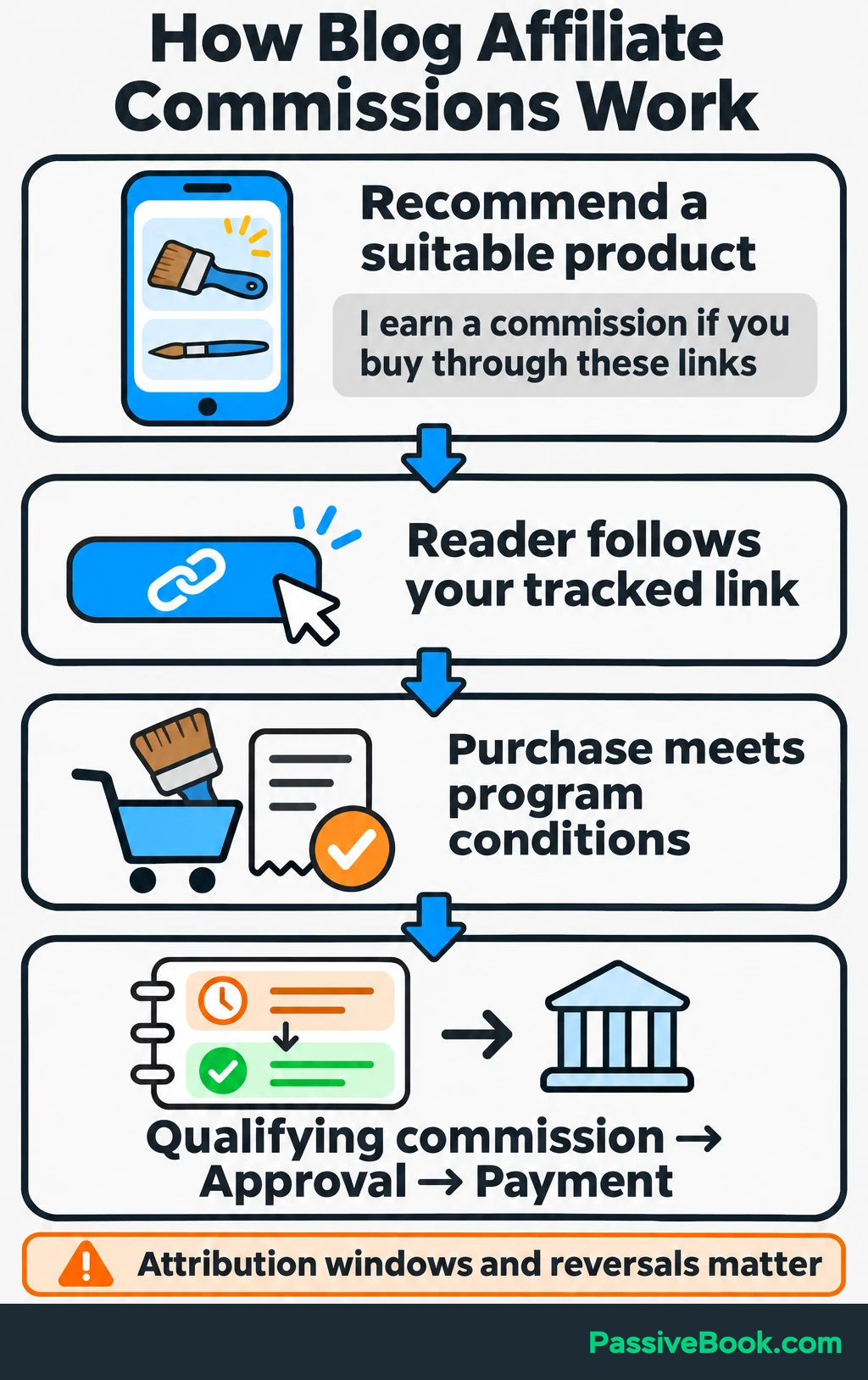
Before committing substantial content to a program, check:
- Whether your site and promotion channels qualify.
- How commissions are calculated.
- How long purchases can be attributed to your referral.
- What causes commissions to be reversed.
- When and how you get paid.
Apply when you can meet those conditions. For example, Amazon’s US program reviews applications after at least three qualifying sales within the first 180 days, and personal orders don’t count. Amazon Associates application requirements
Where US FTC rules apply, explain the commission relationship clearly near the recommendation. “I earn a commission if you buy through these links” tells readers what happens; “affiliate link” alone may not. FTC affiliate-disclosure guidance
Also mark affiliate links with rel="sponsored" in the link settings or HTML. This tells Google about the paid relationship. Google accepts nofollow too, but prefers sponsored for paid links. Google’s paid-link guidance
Digital Products
A digital product packages a useful solution that you can sell repeatedly. Choose the smallest format that completes the task.
For the watercolor blog, I would test a landscape practice workbook before making a video course. It could include sky exercises, reference images you have rights to use, and examples showing how to correct common mistakes.
Show prospective buyers sample pages and ask what they still need to complete the exercise. Then finish a small version and offer it for sale.
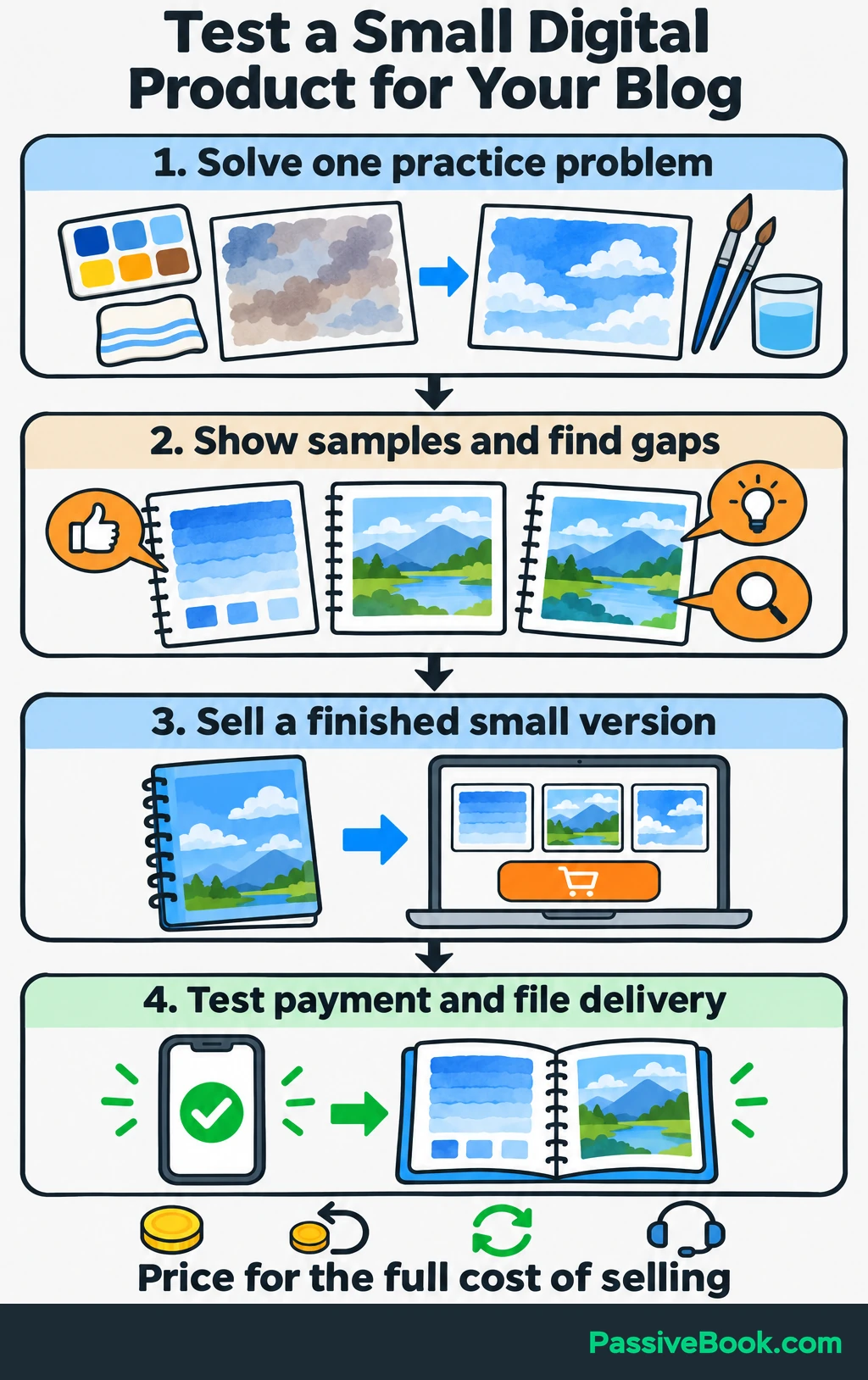
I once rushed a course without validating demand. It attracted few sales and a bad review, and I took it down. That experience is why I would rather test a finished workbook than spend months polishing a course nobody has asked for.
Your sales page should explain:
- What the buyer will be able to practice or complete.
- What files or lessons they receive.
- What experience and supplies they need.
- The price, support, and refund terms.
For a first download, I would choose Gumroad for a hosted checkout. If you already sell through WooCommerce on WordPress, use that setup rather than adding another storefront.
Connect payment to file delivery and test the purchase on a phone. Include payment fees, platform fees, refunds, updates, and support when deciding whether the price leaves enough profit.
Services
Services let you charge for applying your expertise to a reader’s specific problem.
Make the offer narrow enough that both sides know what completion looks like. For example, you could provide written feedback on one watercolor landscape and a short practice plan.
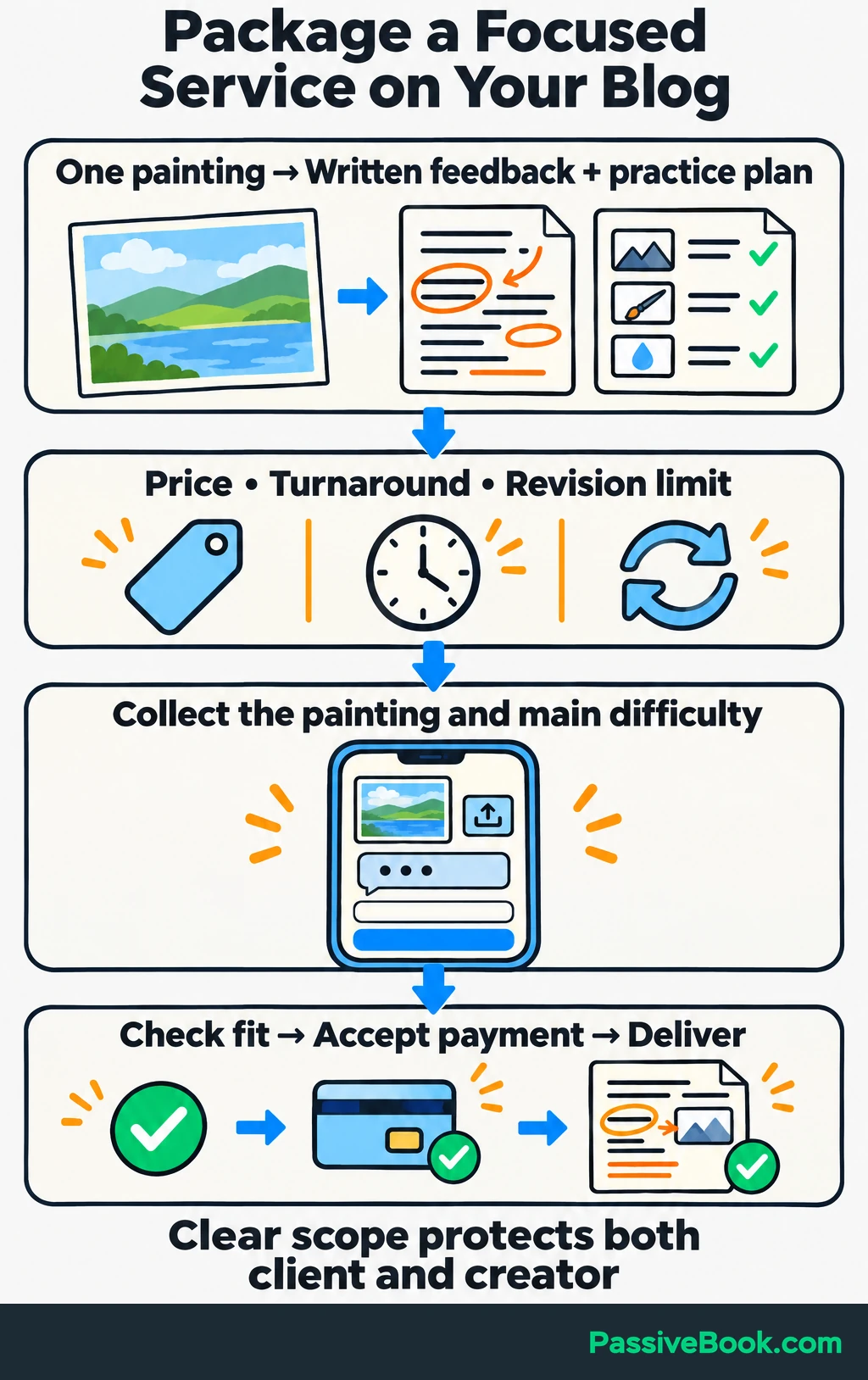
Define the deliverable, price, turnaround, revision limit, and booking process. Show relevant work samples, and link the service from articles about problems it solves.
Set up intake, payment, and delivery before accepting bookings. Ask for the painting and the reader’s main difficulty through an intake form so you can check that the request fits your scope.
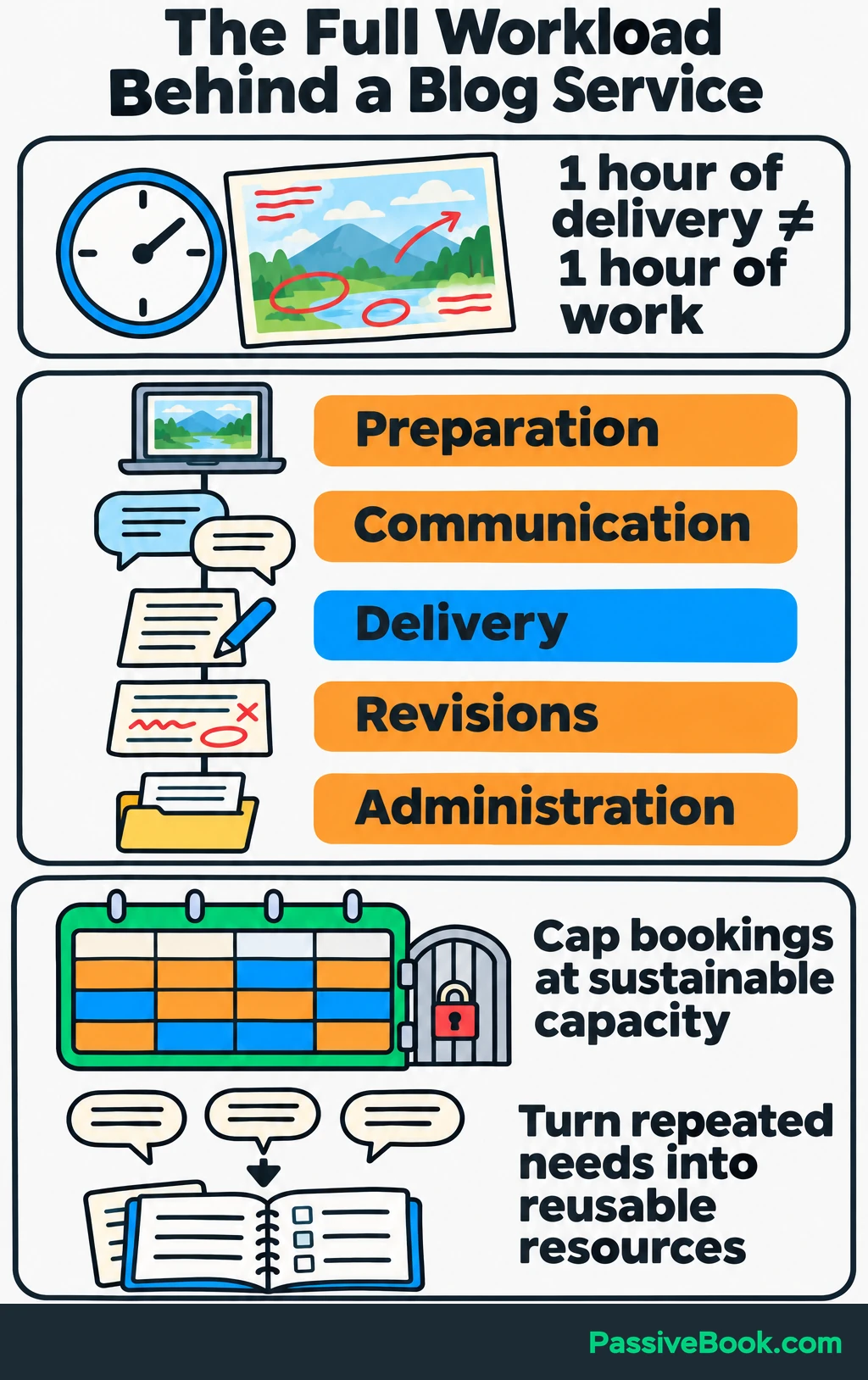
Count all the time involved: preparation, communication, delivery, revisions, and administration. A job that takes an hour to deliver may consume considerably more than an hour of your week.
I would use services to learn what people need and earn from skills you already have. But cap bookings at a level you can sustain. Repeated questions may later become workbook exercises or another product, so every sale doesn’t require another appointment.
Display Advertising
Display ads earn money from advertising activity alongside your content. They can suit useful informational articles even when readers aren’t shopping.
Compare providers by eligibility, publisher earnings, contract length, payment timing, and control over placements.
AdSense’s published eligibility guidance sets no numeric traffic minimum. It calls for original, policy-compliant content, access to the site’s HTML, and an adult account holder. Meeting those conditions doesn’t guarantee approval. AdSense eligibility requirements
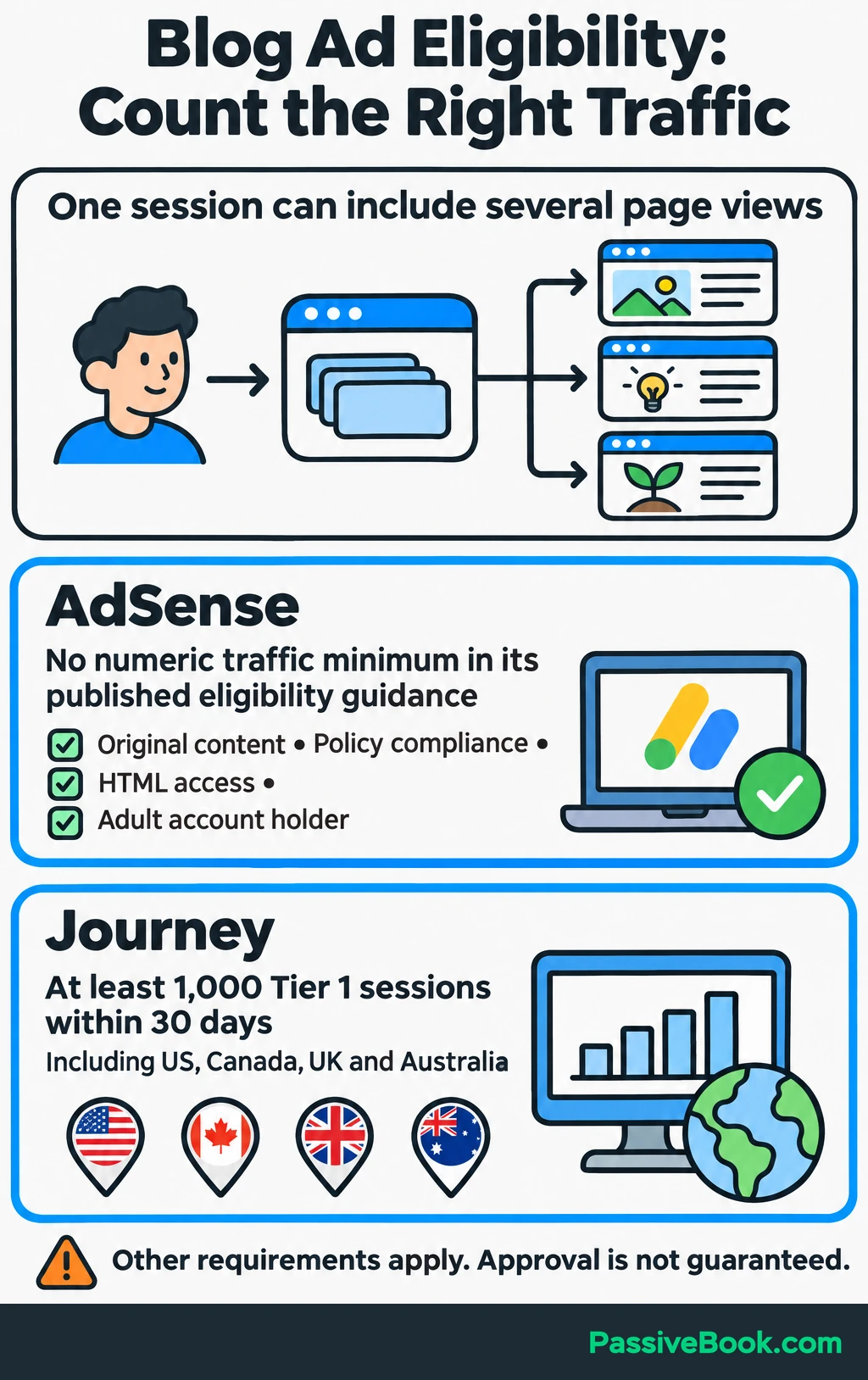
Journey requires at least 1,000 sessions from Tier 1 countries, including the US, Canada, UK, and Australia, within a 30-day period, alongside content and traffic-quality requirements. A session is a visit that may include several page views, so don’t compare that threshold with your page-view total. Journey application requirements
I wouldn’t make ads the first priority for a small watercolor blog with a promising workbook. I would first test whether readers buy the workbook, then evaluate ads on suitable informational pages.
After approval, inspect placements on mobile and desktop. Compare added ad revenue with product purchases, inquiries, and how easily readers can follow the lesson.
Sponsored Content
With sponsored content, a brand pays for an agreed article, placement, or campaign. An art-supply company might sponsor a watercolor-sky tutorial.
Prepare a short document for prospective sponsors—a media kit—with reader interests, audience locations, traffic to relevant articles, and examples of your work. Use figures you can support. A focused audience is a clearer pitch than a vague promise of “exposure.”
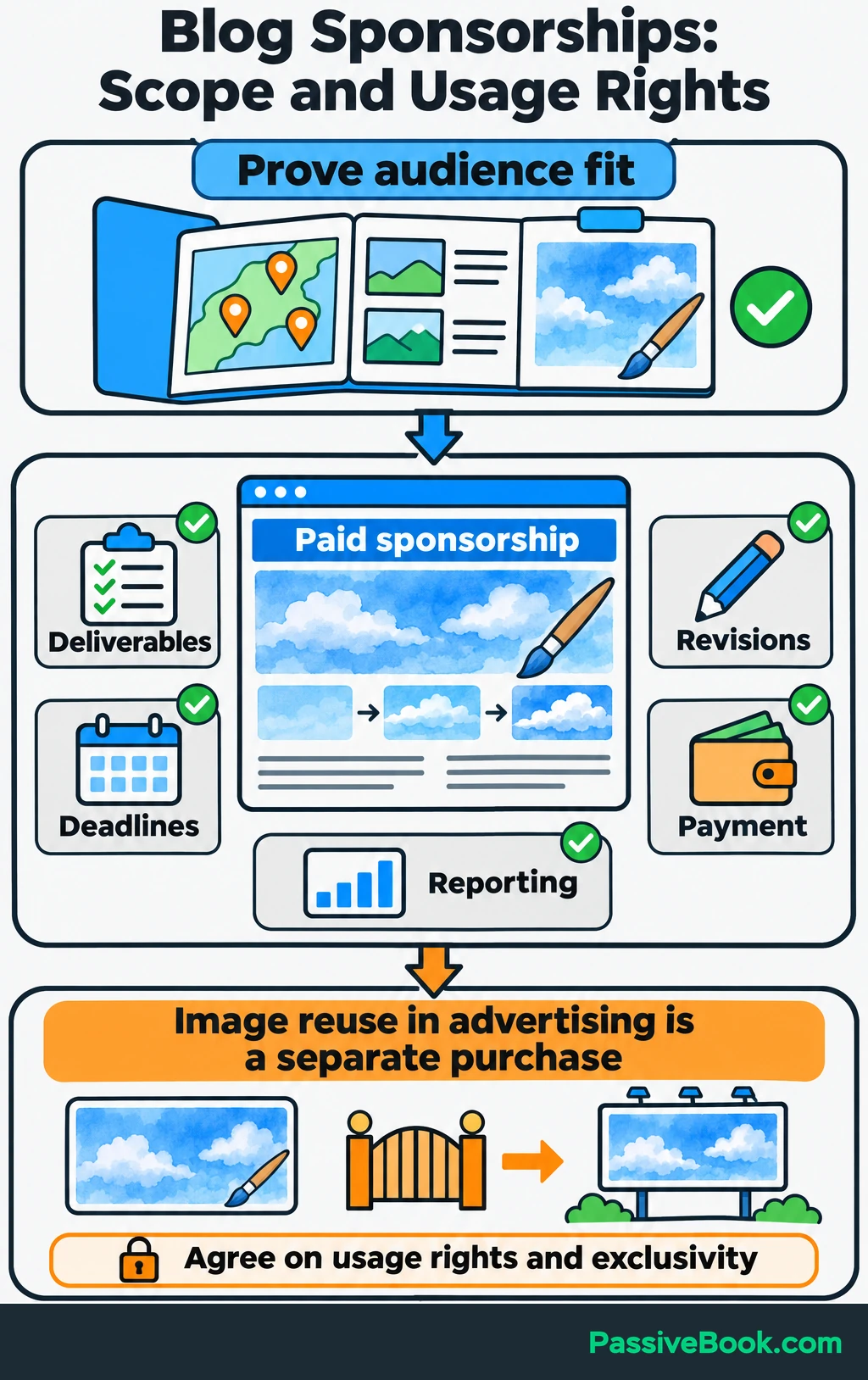
Pitch a specific idea that helps those readers, then agree on:
- Deliverables and publication timing.
- Revision limits and approval deadlines.
- Payment timing.
- Whether the brand can reuse your work.
- Any exclusivity period.
- What results you will report.
Price the production work and distribution, and charge separately for additional usage rights. A sponsored article and permission to reuse its images in advertising are different purchases.
Make the paid relationship clear and apply the disclosure and paid-link rules covered above. Keep your opinions honest.
Memberships and Paid Subscriptions
A membership charges recurring fees for continuing value. That might mean monthly painting critiques, group troubleshooting, or a paid newsletter.
The question I would ask first is: what keeps being useful after the first month?
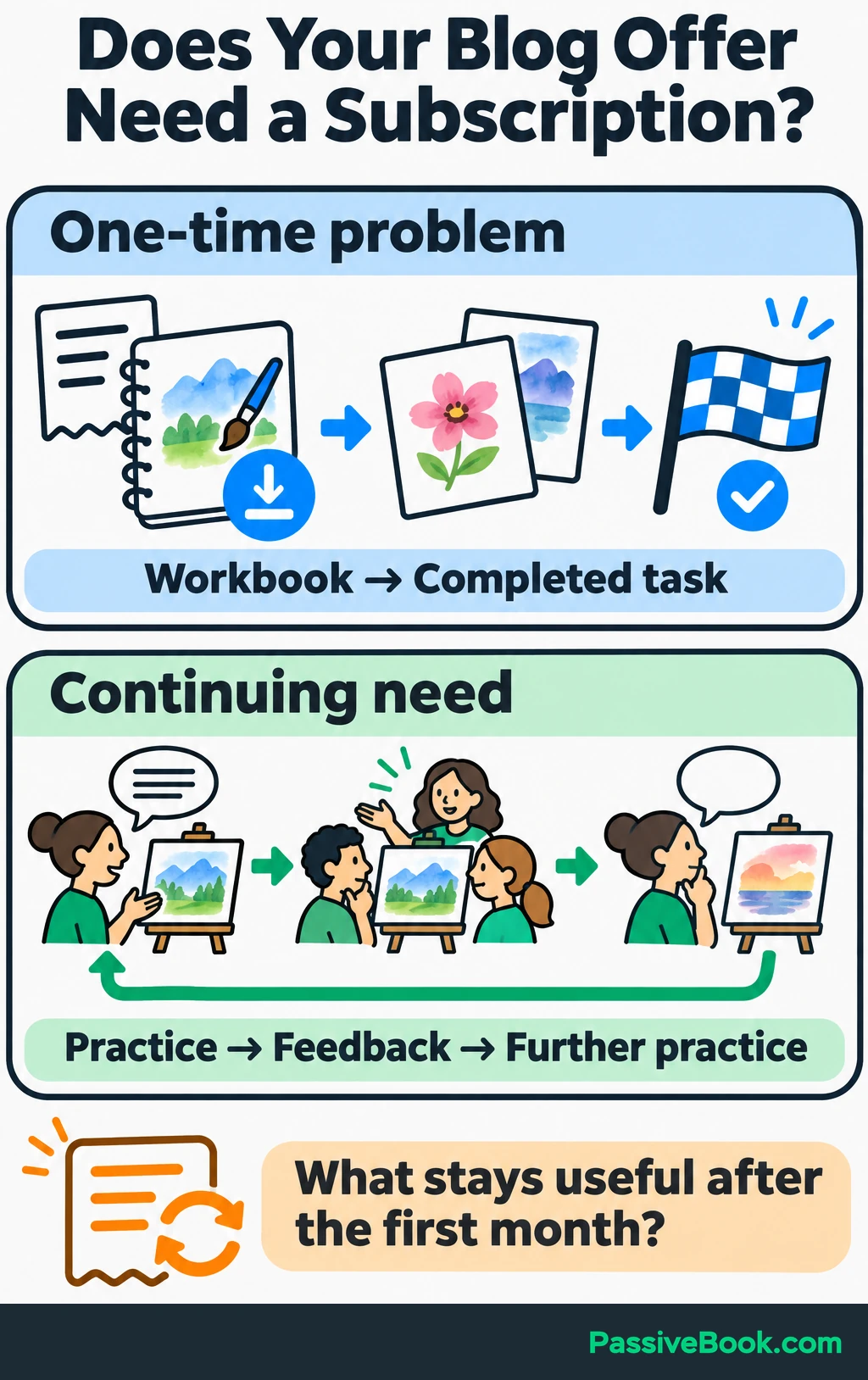
An ongoing need for feedback may support a subscription. A workbook that solves a one-time problem usually doesn’t need a monthly bill attached.
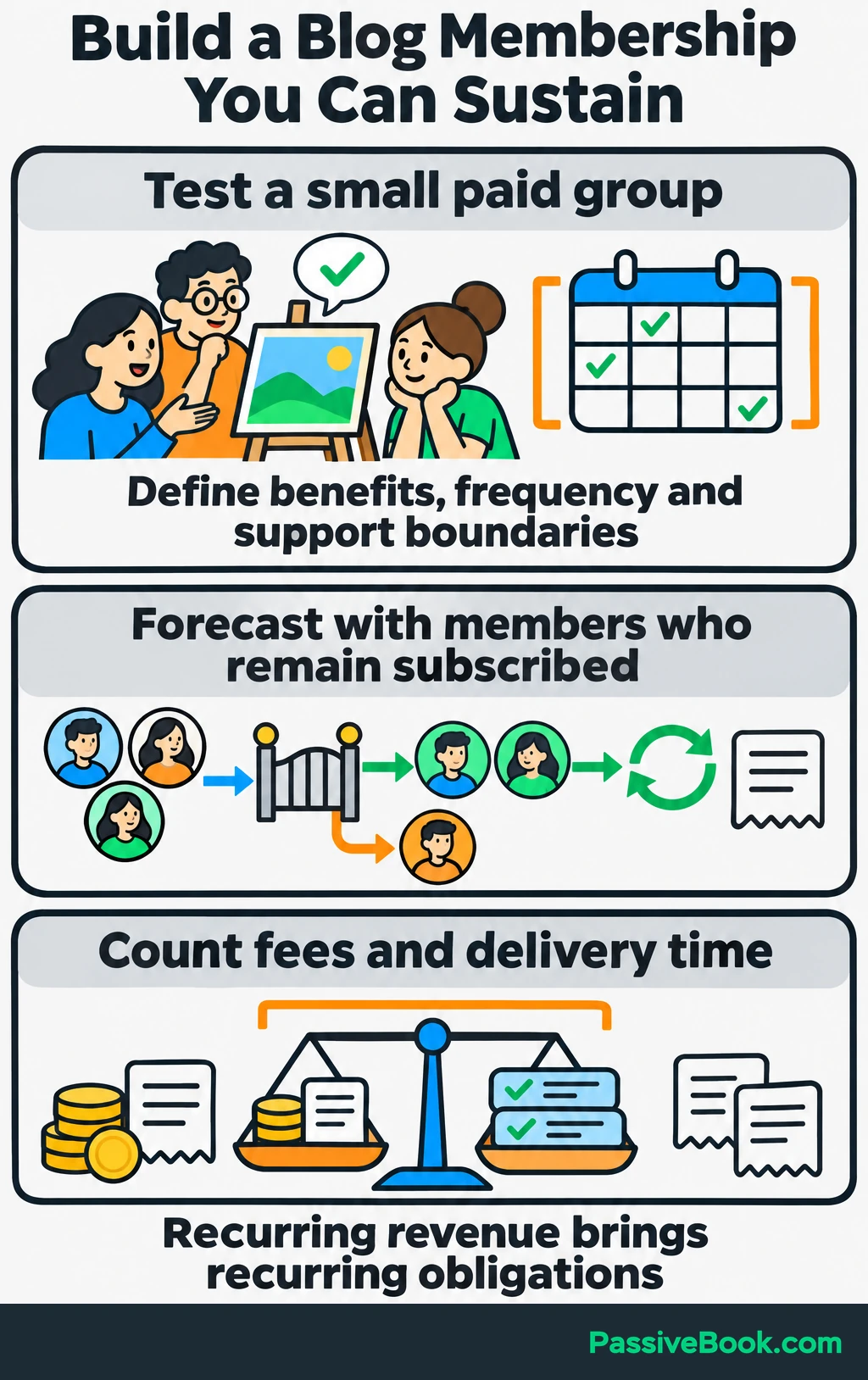
Before accepting payments, define what members receive, how often you deliver it, your support boundaries, and how cancellation works. Test a small paid group and count both fees and delivery time.
I abandoned a membership project after six months of building because continual premium-content production was unsustainable alongside corporate work. That experience makes me cautious about offers that need fresh lessons every week.
Estimate future revenue using members who remain subscribed, and allow for cancellations. Recurring billing won’t make an exhausting delivery schedule sustainable.
How Much Can You Earn From a Blog?
There is no fixed payment for 1,000 blog views. Your earnings depend on what those visitors do and what you receive for that action.
Start with what generates payment: product sales, qualifying affiliate purchases, completed bookings, or ad-supported page views.
Page RPM means estimated ad revenue per thousand page views. If a provider reports session RPM instead, use sessions in the calculation. Google’s page RPM definition
| Method | What to Count |
|---|---|
| Digital products | Count purchases generated by your sales-page visits, then multiply by price. |
| Affiliate marketing | Count qualifying purchases attributed to your link clicks within the program’s referral window, then multiply by the average commission per purchase. |
| Services | Count completed paid bookings, then multiply by price. Limit bookings to what you can deliver. |
| Display advertising | Count page views, divide by 1,000, then multiply by page RPM. |
At an assumed $10 page RPM, 1,000 page views would produce $10 in advertising revenue. That says nothing about what those readers might spend on products or services.
For a product example, count visits to the workbook’s sales page during one month and the purchases generated by those visits. These are sales-page visits, not total blog page views.
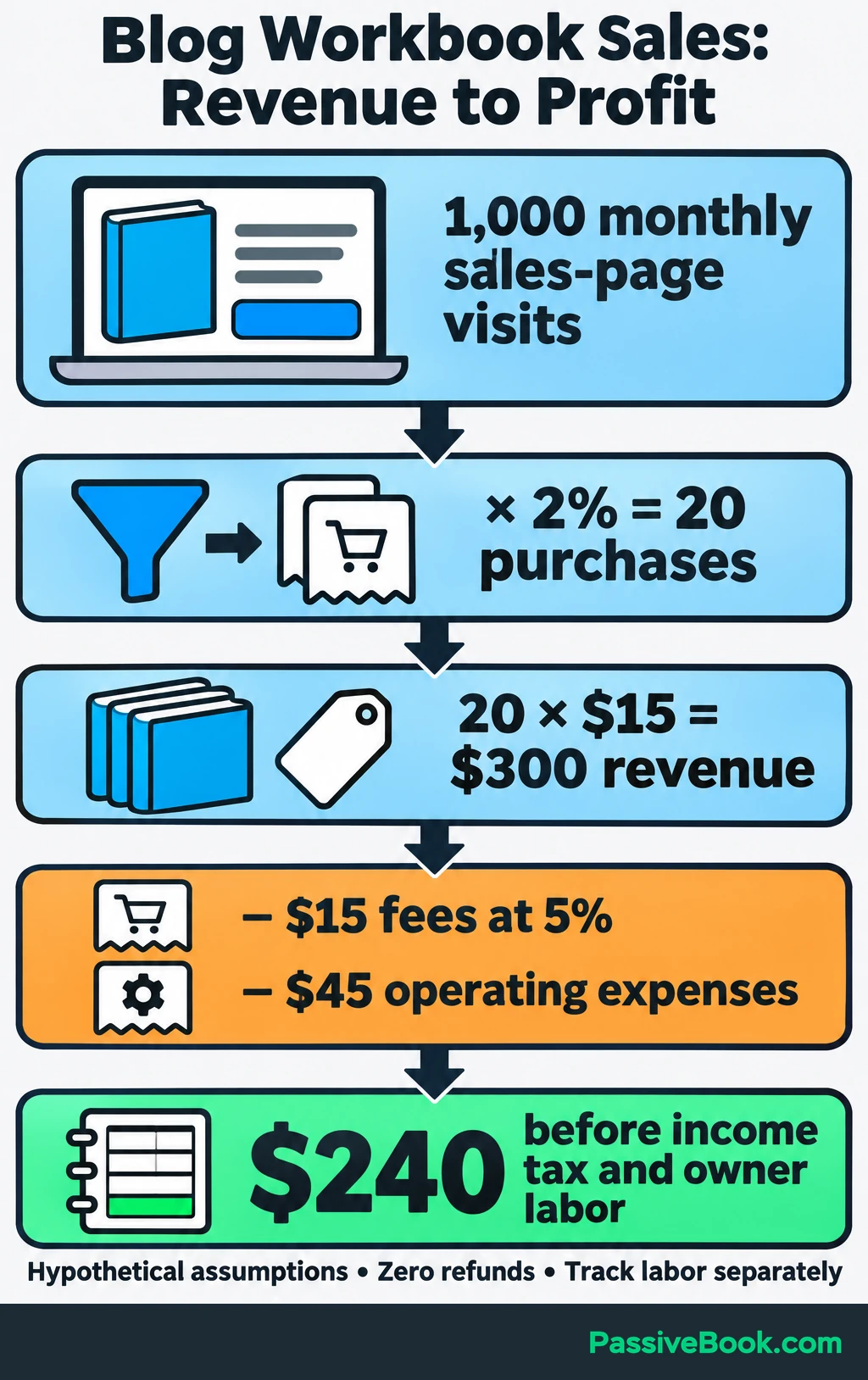
Assume 1,000 monthly sales-page visits, a 2% purchase rate, and a $15 workbook. First, estimate how many visits produce purchases:
1,000 × 2% = 20 purchases
Then multiply those purchases by the workbook price:
20 × $15 = $300 revenue
Now assume zero refunds, payment and platform fees totaling 5% of sales, and $45 in monthly operating expenses.
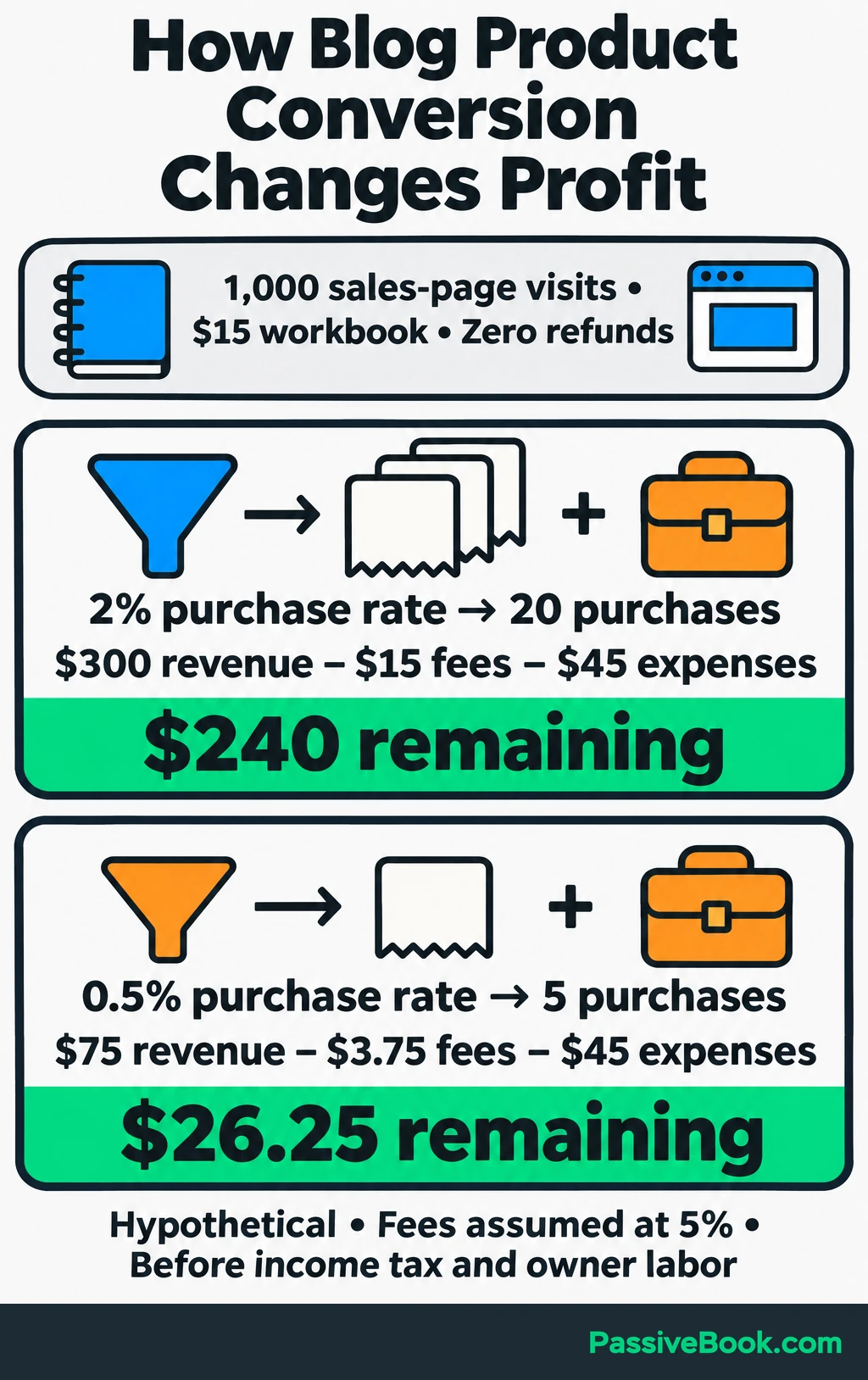
$300 − $15 in fees − $45 in expenses = $240
That leaves $240 before income tax and payment for your labor. Record working hours separately.
Check a weaker-sales case before taking on recurring expenses:
| Monthly Result | At a 2% Purchase Rate | At a 0.5% Purchase Rate |
|---|---|---|
| Purchases from 1,000 sales-page visits | 20 | 5 |
| Revenue at $15 per workbook | $300 | $75 |
| Fees at an assumed 5% | $15 | $3.75 |
| Operating expenses | $45 | $45 |
| Profit before income tax and owner labor | $240 | $26.25 |
These are planning assumptions, not typical earnings. Replace them with your actual costs and results as sales arrive. Until then, I would avoid expenses that only make sense in the stronger case.
Revenue alone won’t tell you whether an offer fits your week. Use the calculator to work backward from your income goal and check the price, sales volume, and hours it would require.
Free Pricing Profit Calculator




Give Each Post a Clear Path to Purchase
An article needs a next step that follows from the question it answers. That step may lead straight to payment, or it may help the reader decide.
Match the Next Step to the Reader’s Question
Choose one primary action for each relevant article: follow a recommendation, view a product, request a service, or subscribe for related help.
Answer the question first, then introduce the offer where it becomes useful. In a tutorial about painting skies, show workbook sample pages beside the exercise they extend.
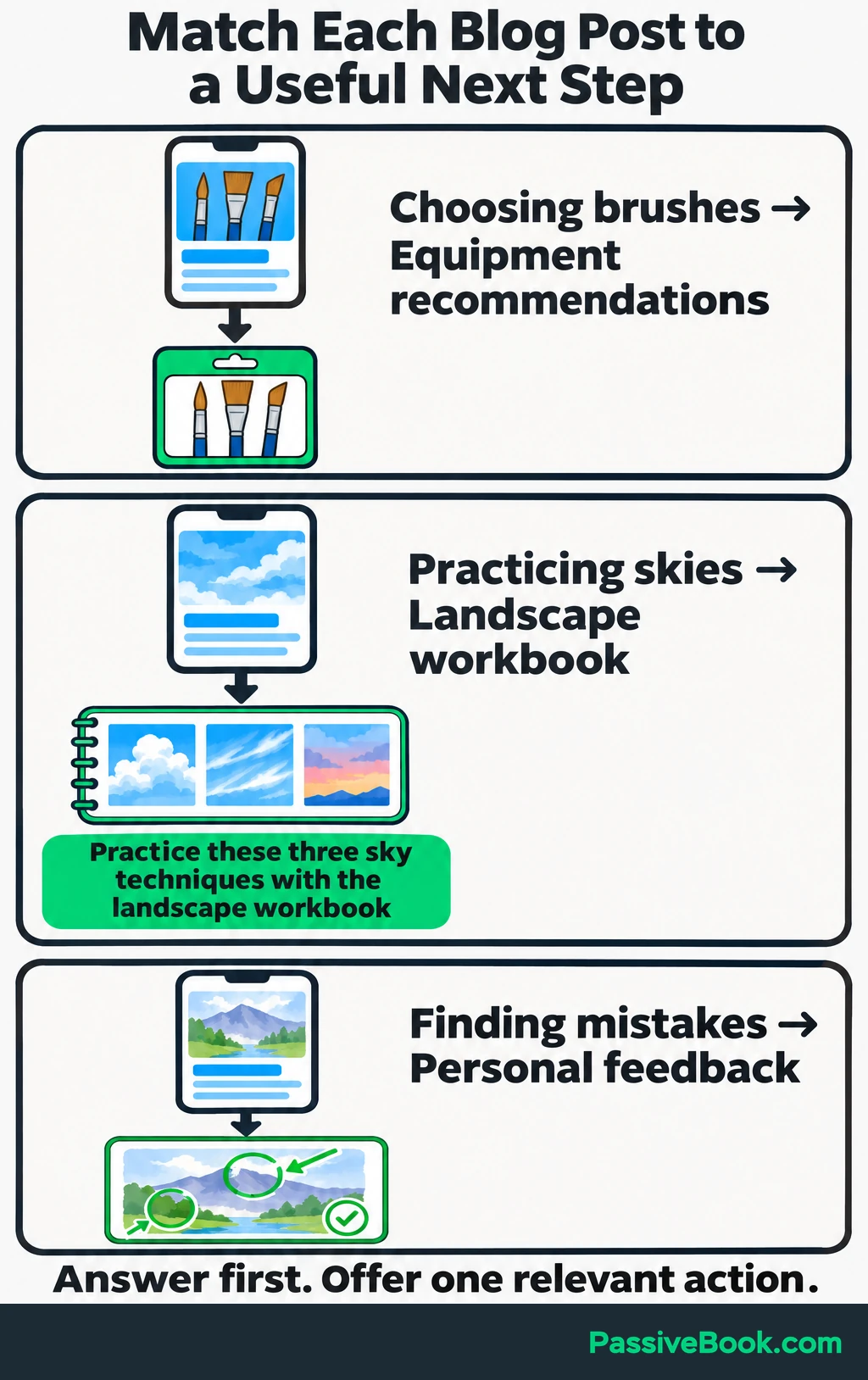
Use an invitation that names the next task:
Practice these three sky techniques with the landscape workbook.
Link directly to the page explaining and selling it. “Click here” makes readers do unnecessary detective work.
If you know what you can offer but haven’t written the invitation or sales page, this AI Skill can draft both from your details. That gives you a connected starting point instead of two blank pages.

Free AI Copywriting Studio
A brush-selection guide can lead directly to equipment recommendations. A troubleshooting article may lead to personal feedback. You don’t need to send every reader through the same sequence.
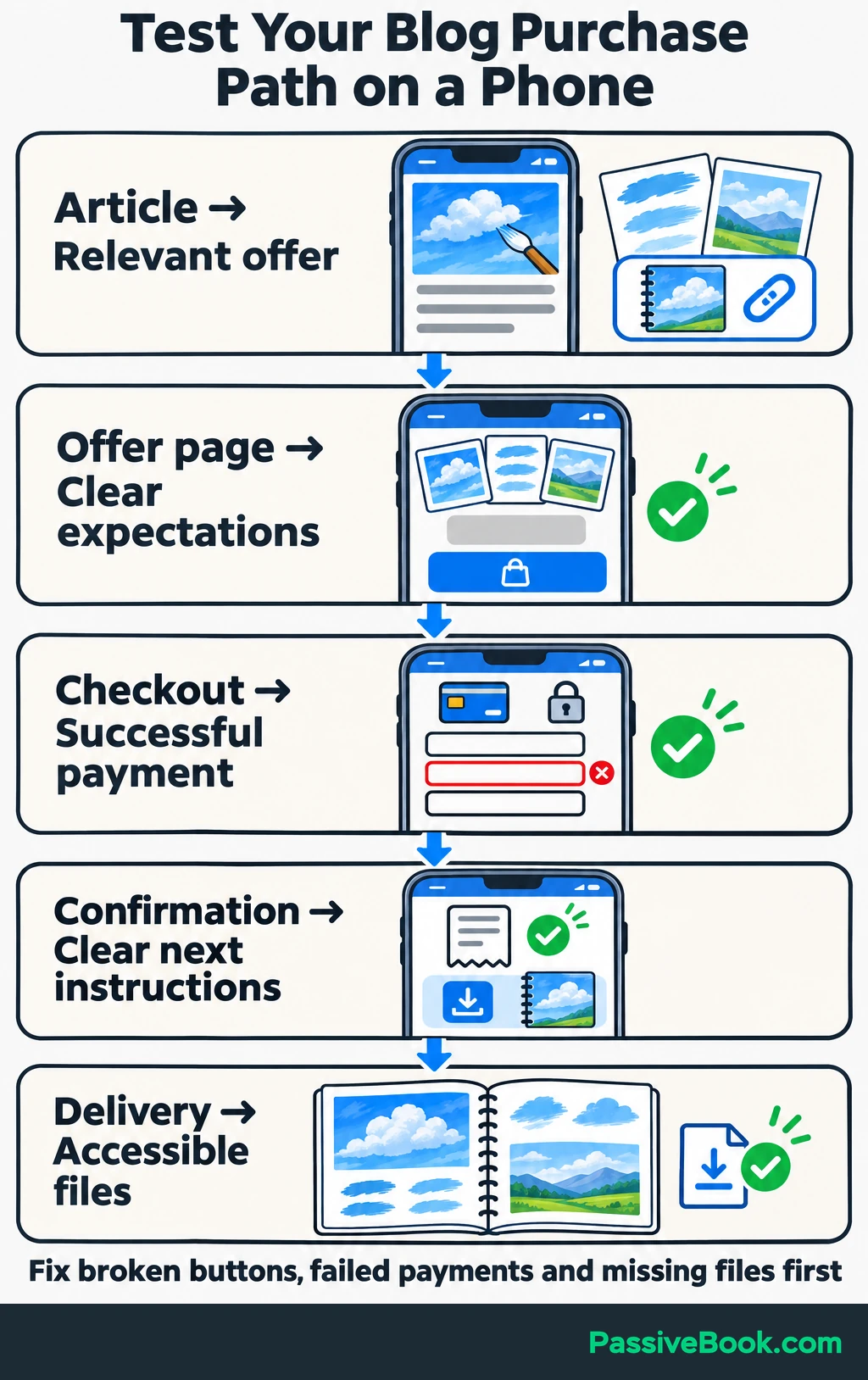
Test the entire path as a visitor: article, offer page, checkout or inquiry, confirmation, and delivery. Check it on a phone too. Fix failed transactions and missing files before spending another afternoon attracting visitors.
Follow up by Email When Readers Need More Time
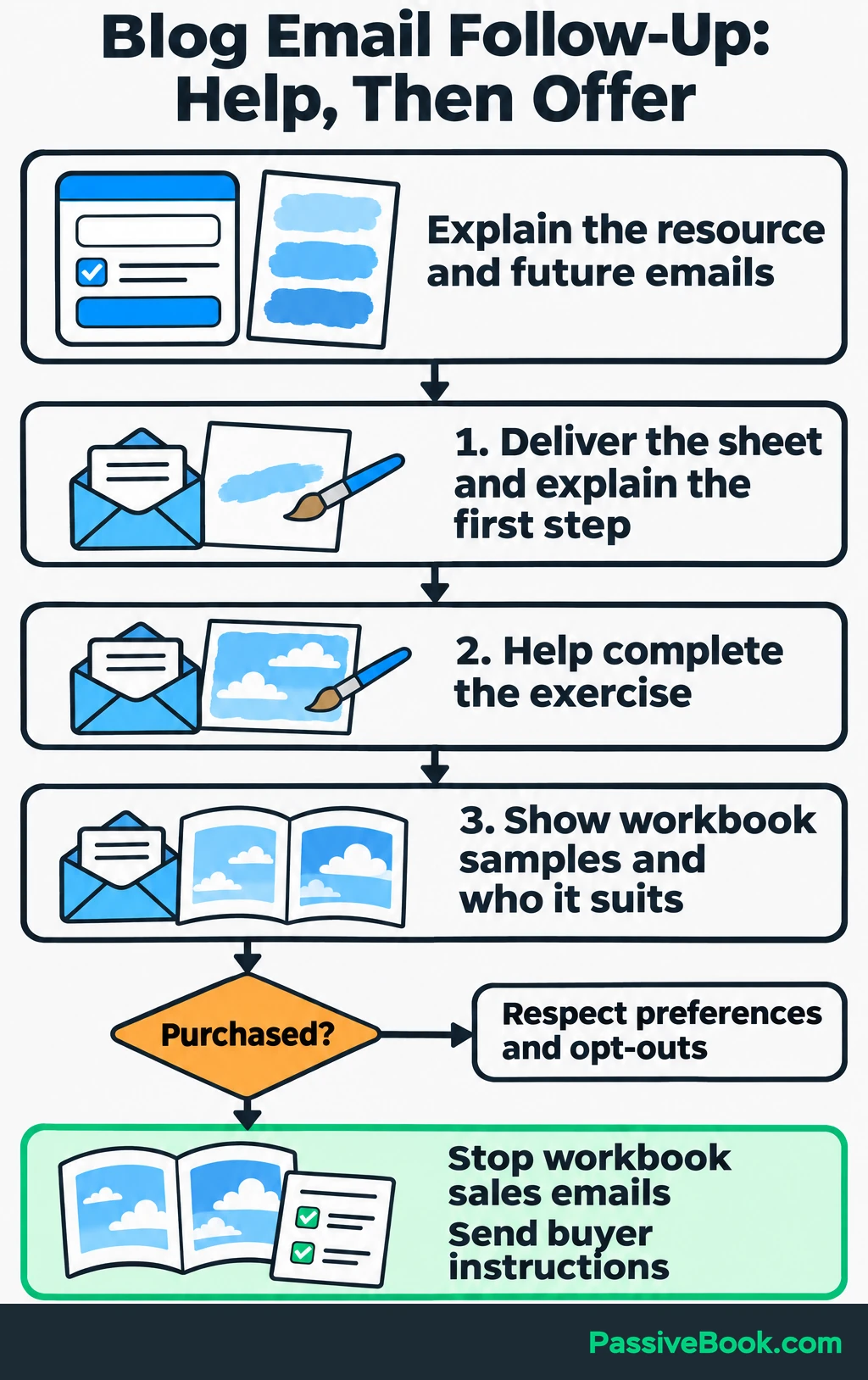
Some readers want help but aren’t ready to buy. Offer a resource that lets them make progress, and explain what further emails they will receive.
For the watercolor blog, that could be a sky-practice sheet followed by a short sequence:
- Deliver the sheet and explain how to start.
- Help the reader complete the exercise and address a common difficulty.
- Show the workbook’s sample pages and explain who it suits.
Once someone buys, remove them from that workbook’s sales sequence and send the instructions they need to use it.
A free newsletter supports other revenue streams. A paid newsletter is itself the product, so it needs continuing value worth paying for.
For a simple hosted email setup, I would choose Kit. On WordPress, I would consider FluentCRM if you’re comfortable managing the site and a separate email-delivery service. Choose one setup that handles the sequence you need.
Use permission-based signups and follow the email rules that apply to your business and recipients. For US commercial email, core requirements include accurate sender details and subject lines, clear identification as advertising, a valid postal address, and an easy opt-out. Opt-out requests must be honored within 10 business days. FTC commercial-email requirements
Attract Readers Who Need Your Offer
Once the purchase path works, publish around questions people ask before choosing or using the offer.
For the watercolor workbook, useful topics could include smooth sky washes, choosing paper for practice, and simple landscape composition. Each article should help with its own question and connect to the workbook only when relevant.
Improve existing articles that already attract interested readers before expanding into unrelated topics. A clearer explanation or better sample may be a more useful investment than another general post.
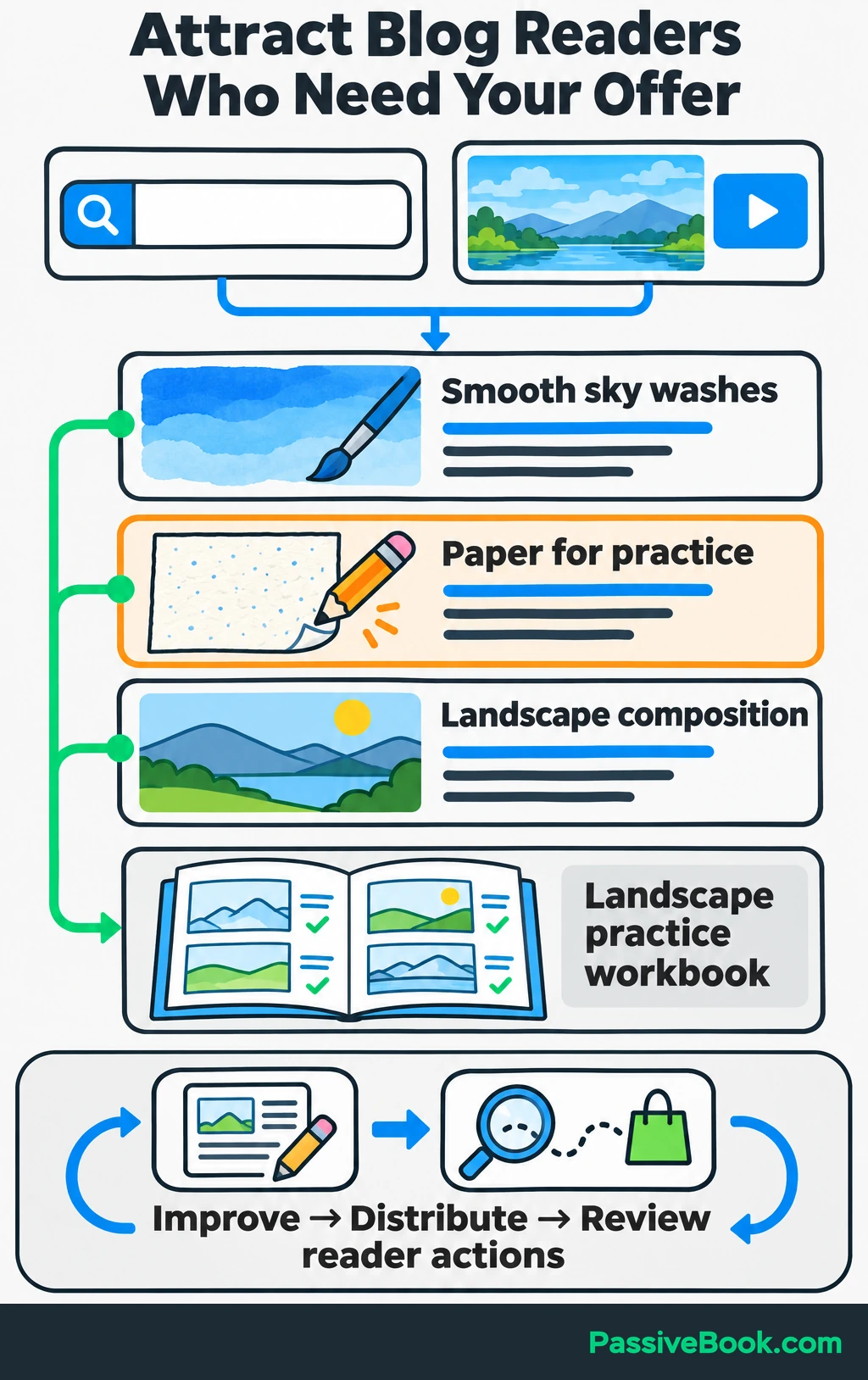
Choose a discovery channel you can maintain. I would use search-focused articles for specific questions and test visual painting tutorials on Pinterest.
At Passive Book, I publish detailed articles around questions people search for, and Pinterest sends readers to the site. That gives me a reason to test Pinterest for visual subjects, but the test still needs to produce useful website visits and purchases.
With limited hours, keep a manageable routine: improve one relevant article, distribute it through your chosen channel, and review what readers do next.
Track Profit and Fix the Weakest Step
Keep a simple scorecard with one row per article or offer and traffic source for each reporting period.
Record relevant visits, offer clicks or inquiries, completed purchases, approved revenue, expenses, profit before tax, and working hours. Keep pending affiliate commissions separate from approved earnings.
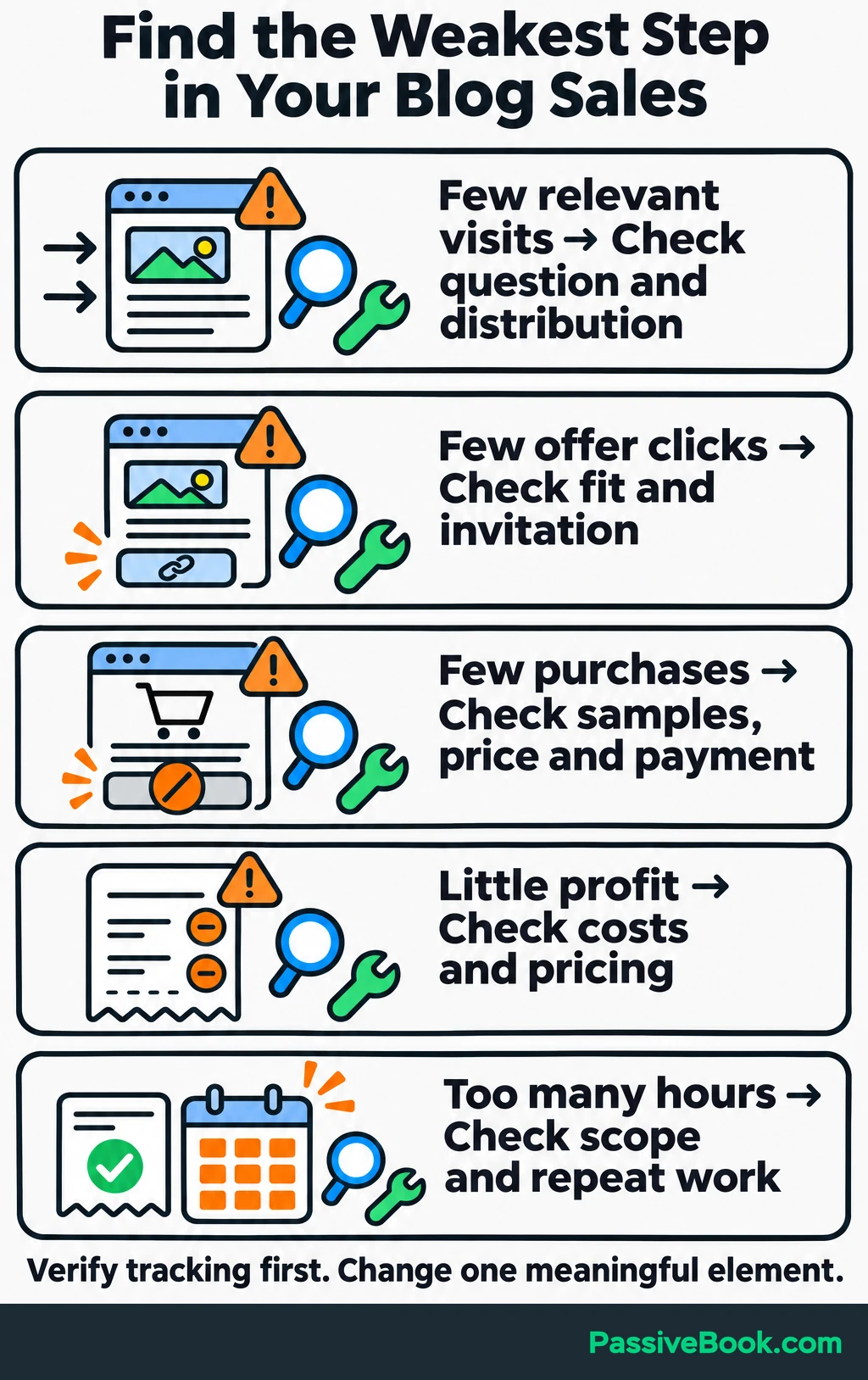
Also distinguish revenue earned from cash received. A commission due later cannot cover a bill due now.
Then match your next change to the problem:
| What You Observe | What to Check First |
|---|---|
| Few relevant visits | Whether the article answers a specific question and reaches people with that need |
| Visits but few offer clicks | Whether the offer fits the question and the invitation explains its value |
| Offer clicks but few purchases | Sales-page clarity, sample quality, price, checkout, and payment failures |
| Sales but little profit | Fees, refunds, support time, delivery costs, and pricing |
| Profit but too many working hours | Scope, repeated support questions, and tasks you can automate |
Verify the tracking and purchase path before interpreting zero sales. A broken button can look surprisingly like a demand problem.
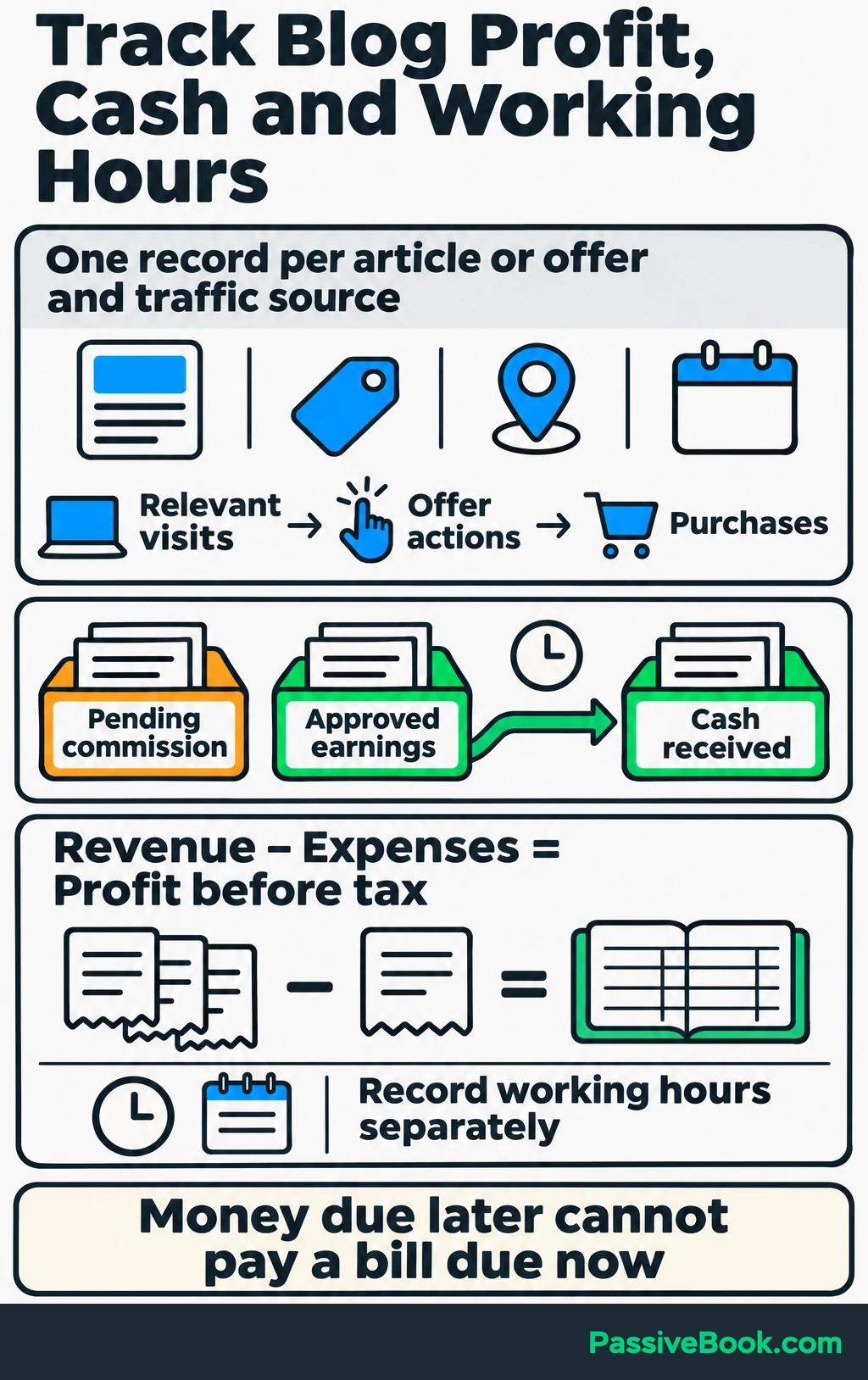
Use consistent reporting periods and change one meaningful element at a time. For a small blog, I would review the numbers weekly but let useful evidence accumulate before making a major decision.
When purchases are scarce, ask readers what stopped them. Combine those answers with the numbers. One sale or one silent week is too little evidence for a sweeping conclusion.
Your scorecard should help you choose where the next hour goes. Prioritize articles and offers producing profitable actions instead of treating publishing volume as the main measure of progress.
Grow From What Already Sells
Improve the offer that readers already buy. Use customer questions to clarify instructions, add useful examples, and fix gaps in the sales page.
For the watercolor blog, repeated questions about paper could improve the workbook and suggest a related buying guide. That creates a reason to add equipment recommendations without starting a separate business.
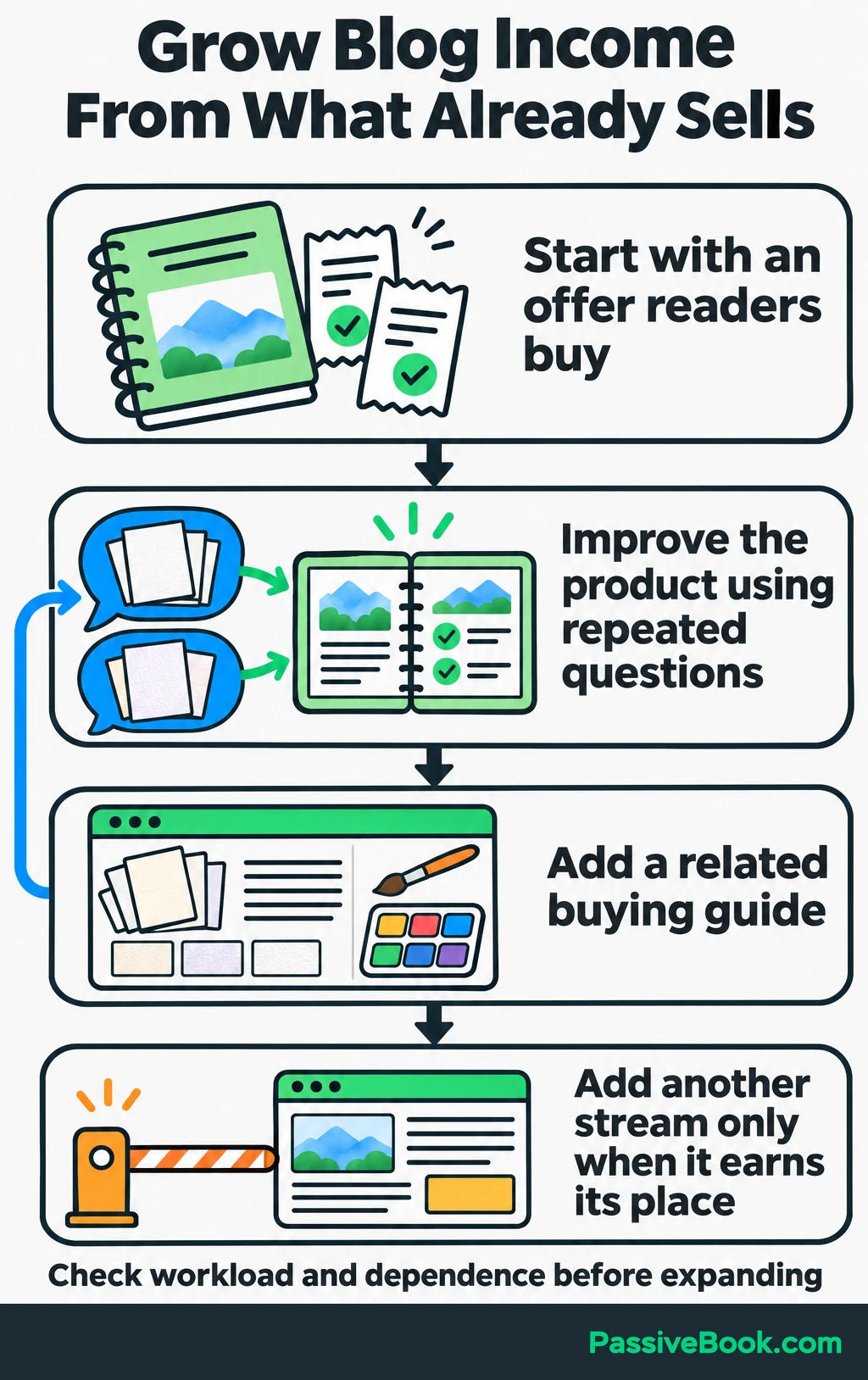
Add a complementary revenue stream when you can support it. The workbook could sit alongside relevant affiliate recommendations, followed by ads on suitable informational pages. Each addition should earn its place.
Automate repeatable tasks once they work reliably:
- Deliver files after confirmed payment.
- Send welcome and buyer emails.
- Schedule useful promotion.
- Gather routine reports.
- Alert you to failed payments or delivery problems.
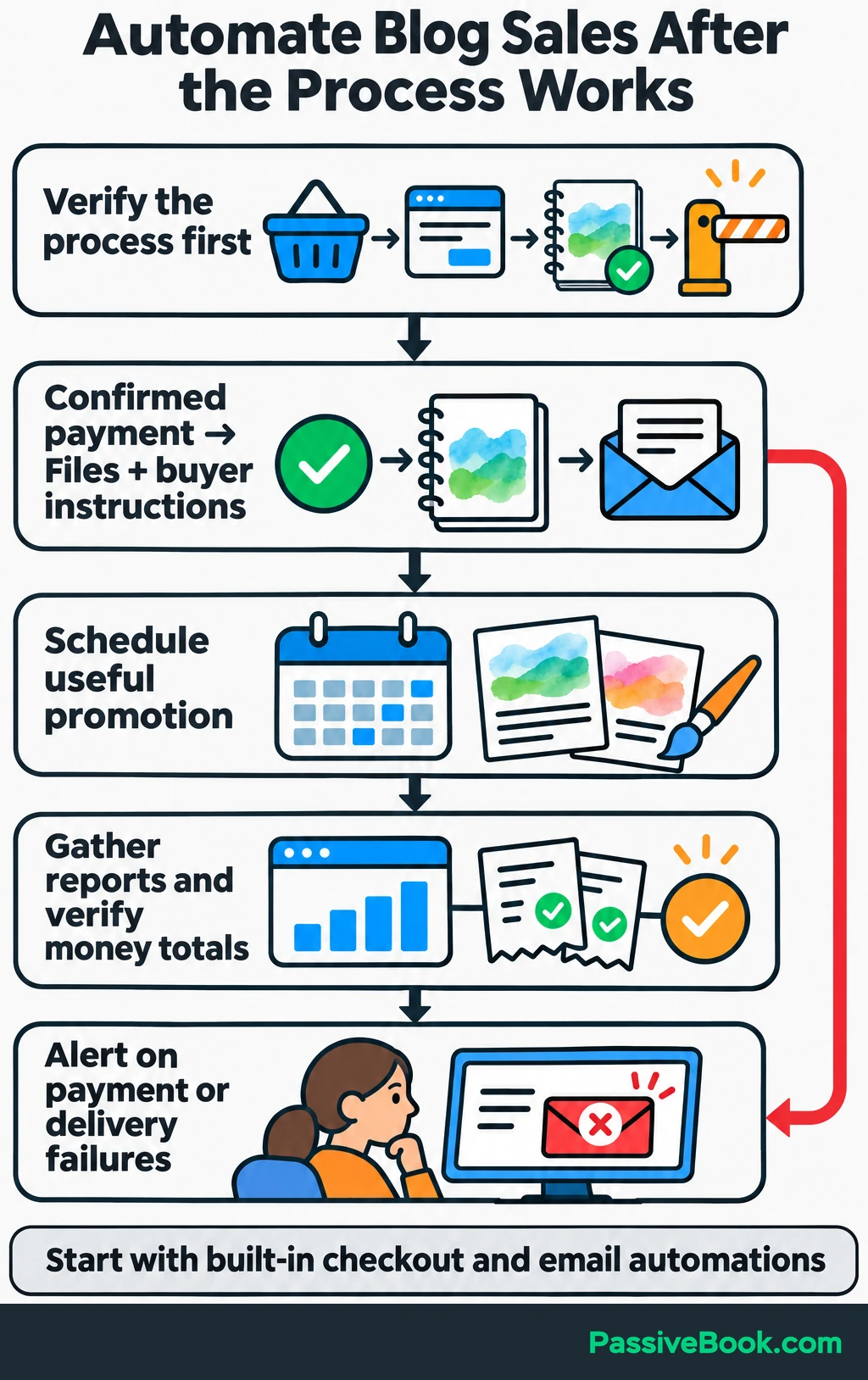
I would use the built-in checkout and email automations before adding a separate workflow tool. AI can help group recurring questions or draft report notes, but check money totals against transaction records.
Watch for dependence on one merchant, offer, or traffic source. Choose an addition that reduces a specific weakness without creating a workload you cannot maintain.
Set milestones around a functioning offer, completed sales, repeat purchases where relevant, and sustained profit. Increase spending or reduce other work when the business has demonstrated it can support that decision.
What Next?
Choose one article and write down the paid next step that would help its reader. Add the recommendation or offer, then test the path through payment and delivery.
If this guide helped you choose where to focus, use the social buttons to share a practical starting point for earning from useful content.
Which reader problem could you solve with your first paid offer? Leave your answer in the comments, and bring any other questions about monetizing your blog too.
Share this post with your friends & followers:

