Your AI assistant writes a clear answer about your product, but the answer includes a promise you never made. Now you’re checking every sentence against your own documents.
One unsupported promise can leave a customer expecting something you don’t offer. But reviewing every answer by hand makes it harder to save time with AI.
That trade-off makes retrieval-augmented generation worth understanding. This guide explains how it connects document search with AI writing, what can still go wrong, and when a simpler approach is enough.
What Is Retrieval-augmented Generation?
Retrieval-augmented generation, or RAG, finds relevant information from a source collection and supplies it to a large language model, or LLM, to help it answer. Retrieval finds the reference material, and generation turns that material into a response. IBM Research explains this combination of retrieval and generation.
An LLM generates language using patterns learned during training and the context supplied for its current response. Context is the information available to it for that answer, including your question, instructions and reference text.
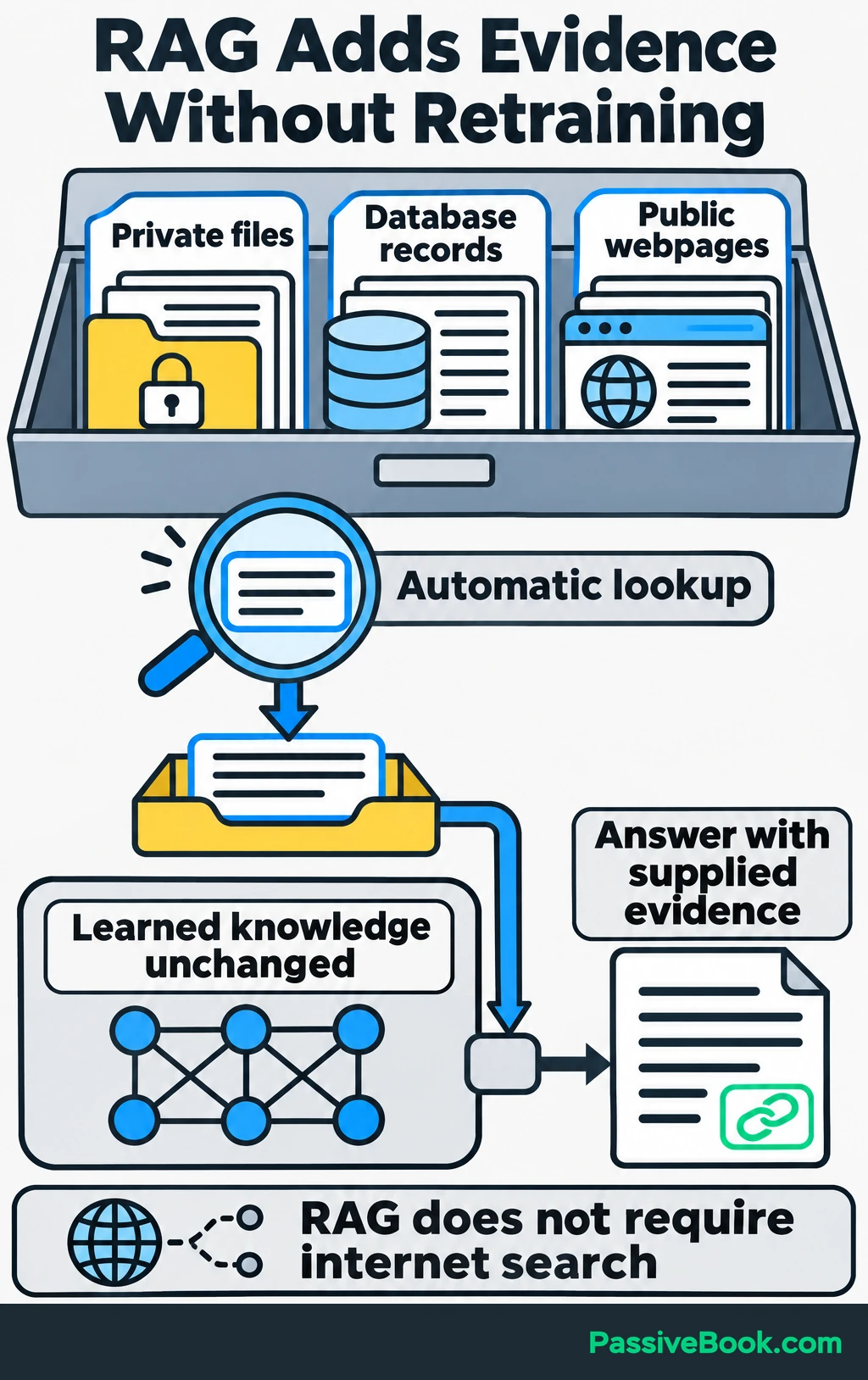
RAG adds an automatic lookup step. It doesn’t require retraining the model whenever you add a document.
The sources are often called “external,” but that means outside the model’s learned knowledge. They could be your private files, database records or public webpages. RAG doesn’t necessarily search the internet.
Imagine you sell a beginner watercolor course. Your enrollment guide, lessons and support FAQ could supply the reference material for a customer assistant. We’ll follow this course business throughout, using a policy that gives buyers lesson access for 12 months after purchase.
How Does RAG Work?
Separate the preparation work from what happens when someone asks a question:
- Source preparation: Make approved material searchable and keep it updated.
- Retrieval: Find passages that help answer the question.
- Augmentation: Add those passages to the model’s input.
- Generation: Ask the model to answer using that information.
“Augment” simply means adding something. Here, you’re adding relevant evidence to the question.
Prepare a Searchable Knowledge Base
A knowledge base is the collection your system can consult. An index organizes that information so the system can search it efficiently.
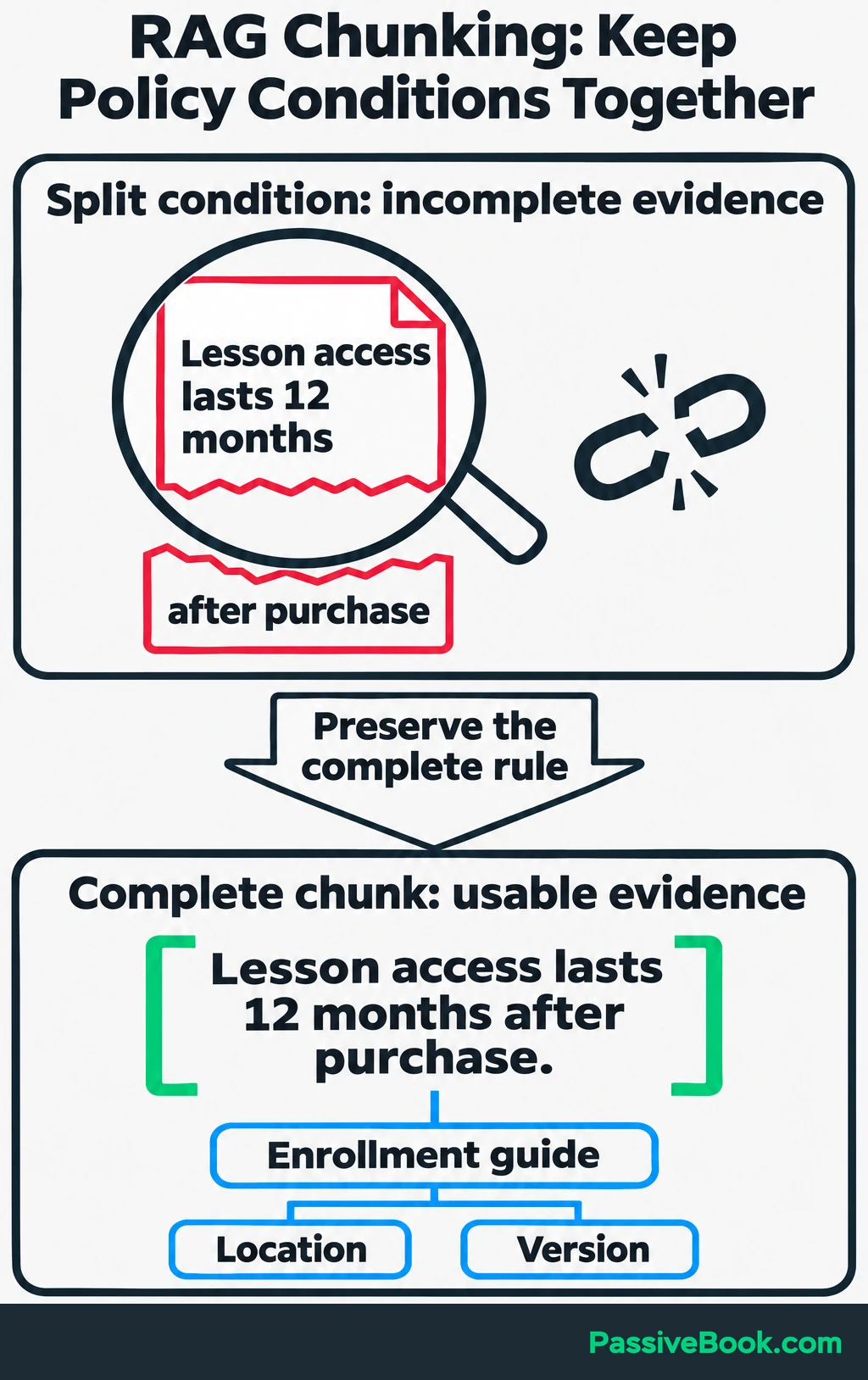
Start with sources you trust. Extract readable text from documents, and split longer material into useful passages called chunks. A chunk might contain one FAQ answer or a lesson section.
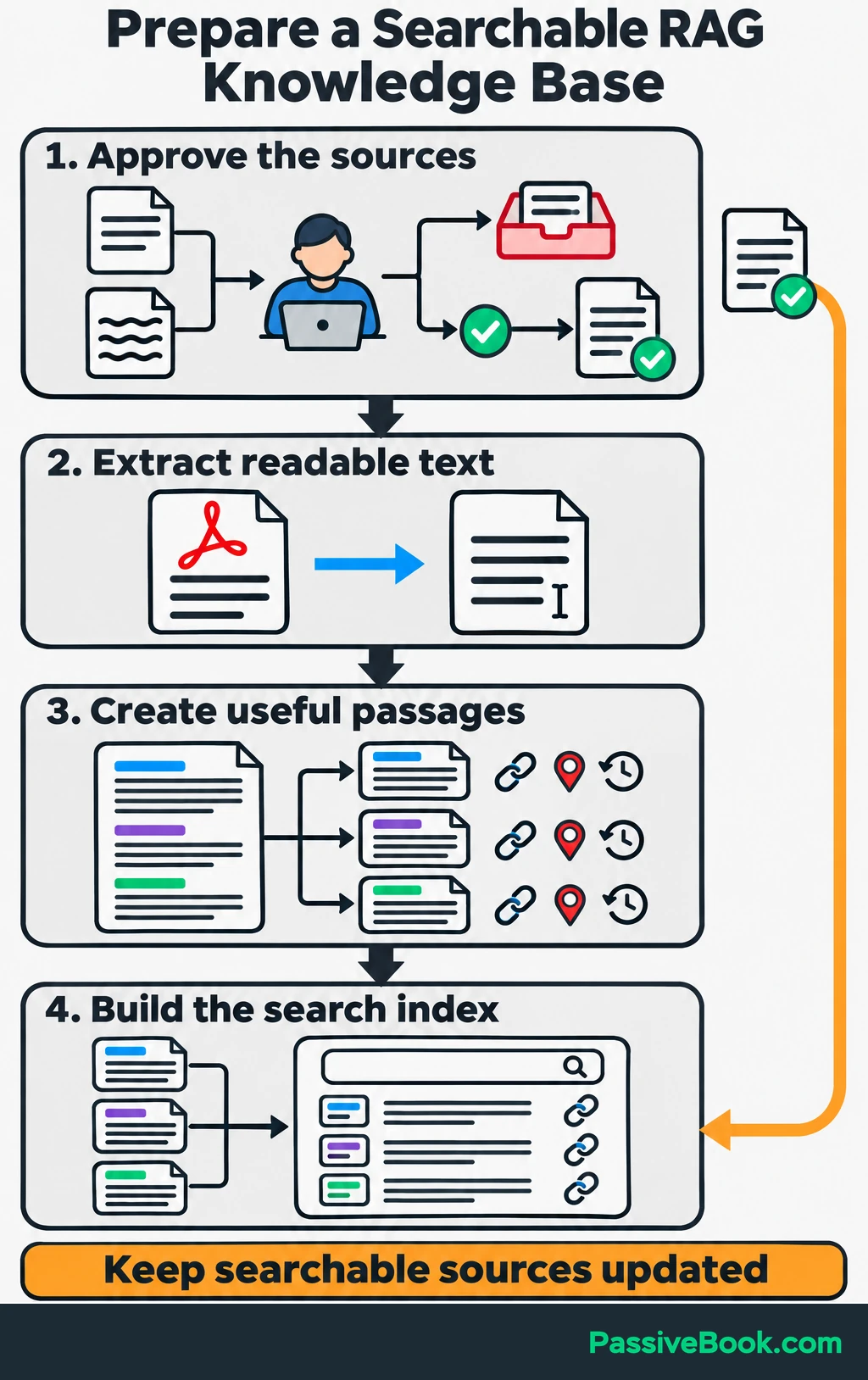
Keep the conditions with the rule they explain. If “access lasts 12 months” and “after purchase” end up in separate chunks, the system might retrieve the duration without its starting point. Headings also help preserve context, which is why Microsoft’s chunking guidance recommends keeping meaningful content together.
For the watercolor course, keep enrollment policies separate from painting lessons. Each passage should retain its source title, location and version so you can find the original later.
I once found an old product note beside a revised sales page while preparing reference material for a writing workflow. Both sounded authoritative because I had written both. I had to decide which one described the current offer before using either as a reference.
That’s the first useful job here: resolve your documents’ disagreements before asking AI to resolve them for customers.
Retrieve Material Relevant to the Question
When a question arrives, the system searches for useful evidence. It can use several methods:
- Keyword search: Matches words and phrases. This helps with exact product names or policy terms.
- Vector search: Uses lists of numbers called embeddings to represent content and find passages with similar meaning.
- Hybrid search: Combines keyword and vector search.
In a typical vector workflow, the same embedding model represents both your stored passages and the incoming question. Search compares those representations and returns the matching passages’ text for the language model to read. Microsoft describes how these search approaches work.
That distinction matters: the generator reads the retrieved text. Embeddings help find it.
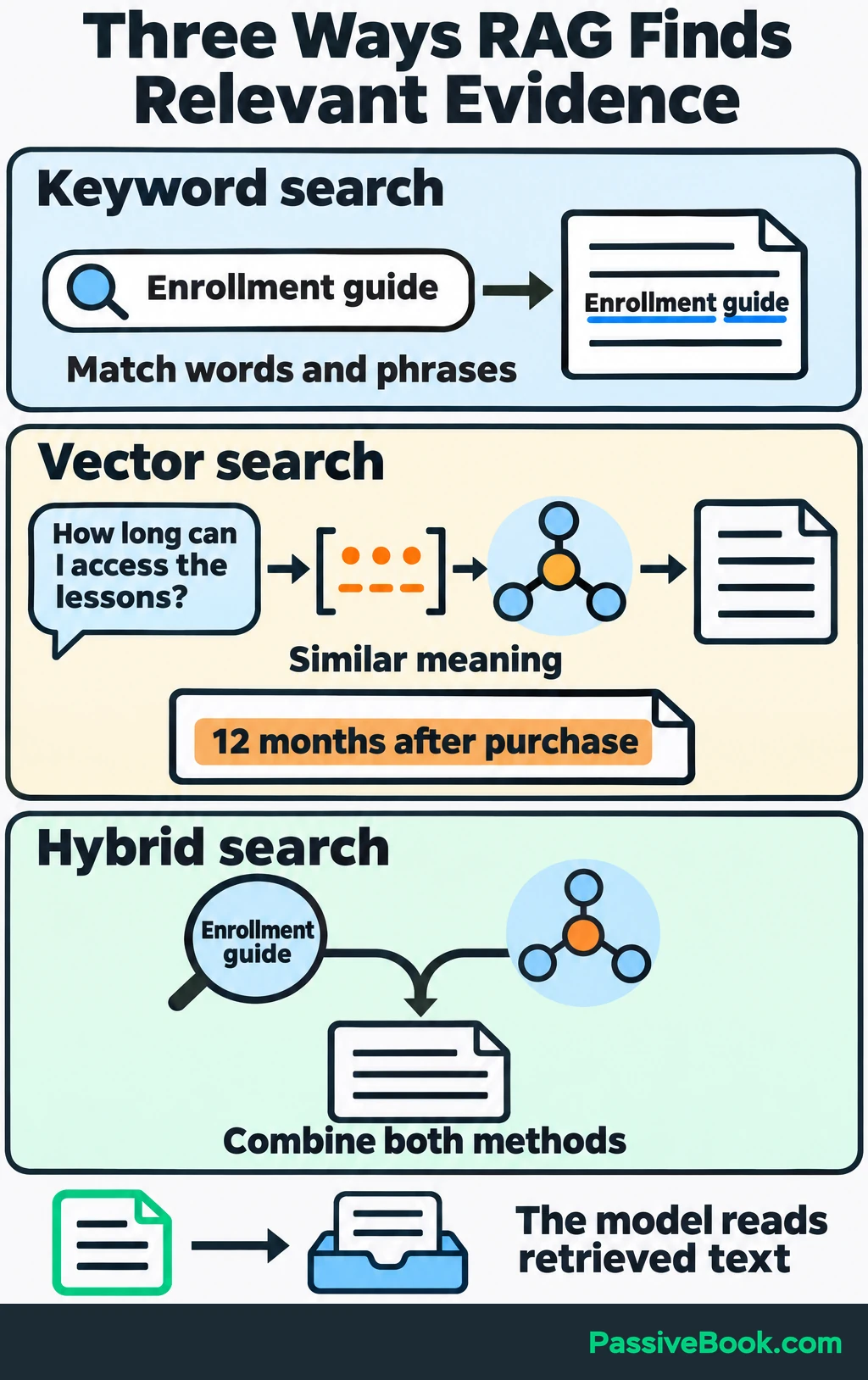
For example, “How long can I access the lessons?” should retrieve the watercolor course’s enrollment policy. A passage about mixing paint might mention “lessons,” but it won’t answer the question.
RAG can also use keyword retrieval without embeddings or a separate vector database. I would choose the search method by testing the questions people actually ask, rather than buying infrastructure because its name sounds advanced.
Only retrieve material the requester is allowed to see. Also treat retrieved documents as reference material, not as instructions that can override the assistant’s rules.
Supply the Context and Generate an Answer
The application combines the question, retrieved passages, source references and instructions for answering. Those instructions should explain what to do when evidence is missing or conflicting.
For our course example, the relevant parts could look like this:
Instruction: Answer from the supplied policy and identify the source. If it doesn’t answer the question, say so.
Reference: Enrollment guide — Lesson access lasts 12 months after purchase.
Question: How long can I access the lessons?
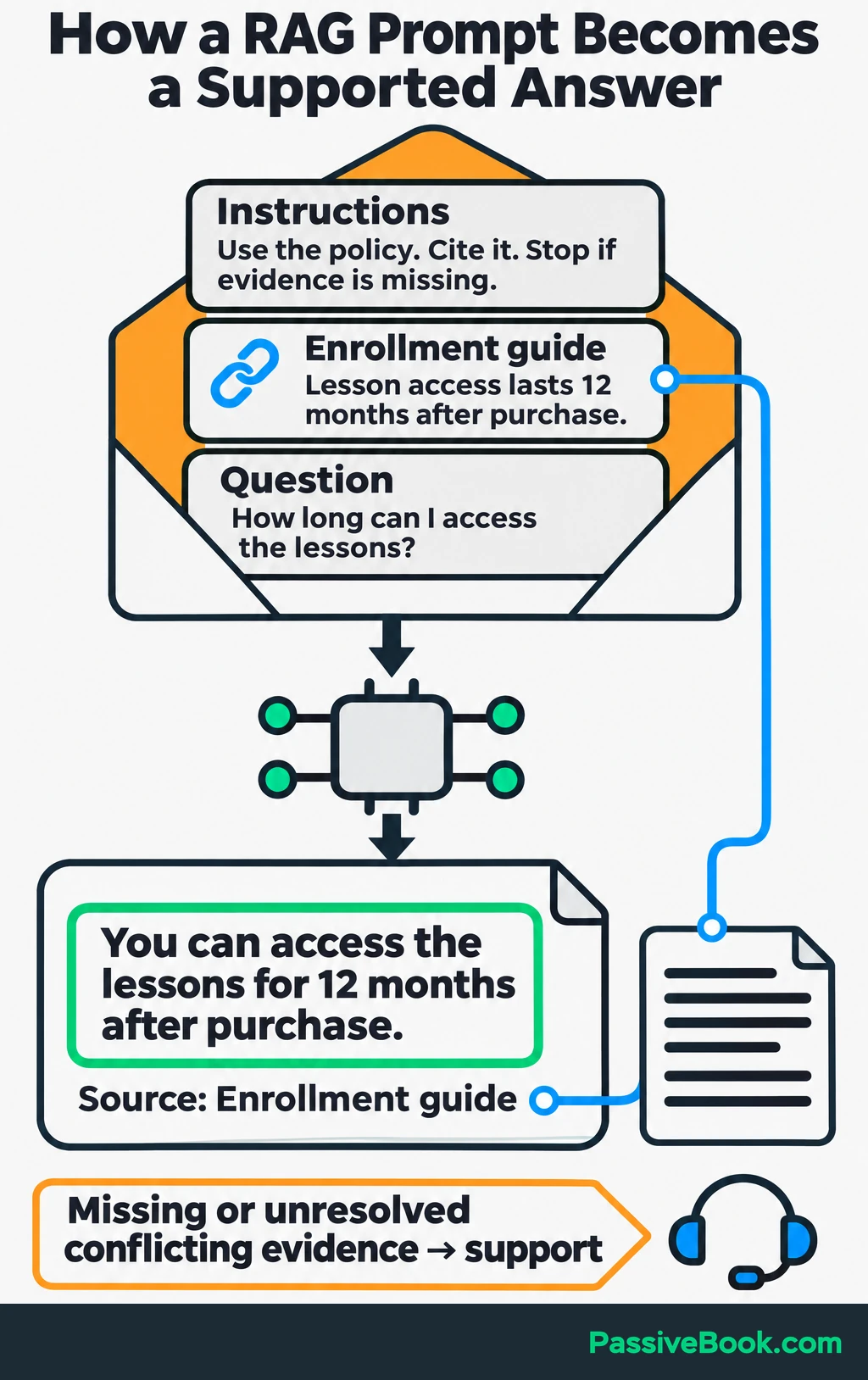
A supported response would be:
You can access the lessons for 12 months after purchase. Source: Enrollment guide.
The application should keep the source reference connected to the original passage so the reader can inspect it.
If two policies conflict and the system cannot establish which applies, it should direct the question to support. Asking the model to pick whichever policy sounds friendlier is an expensive way to invent a new offer.
What Can RAG Improve?
RAG is useful when an answer depends on information the model may not have, or when you need to inspect where an answer came from.
- Relevance: It can supply your business’s actual rules, product details and lesson explanations.
- Freshness: You can update the source collection without retraining the base model. The revised information becomes available once the retrieval system can access it.
- Traceability: Source references can connect an answer to passages you can check.
For the watercolor course, that could mean drafting customer replies from enrollment policies, answering lesson questions from course material, or preparing content from approved notes.
The same mechanism serves each task: find the relevant material and give it to the model before it writes.
I would start with internal drafts that I review. That gives me a chance to see which questions the collection handles well before putting its answers directly in front of customers.
Does RAG Prevent Hallucinations?
No. Hallucinations are plausible answers that are unsupported or wrong, and RAG doesn’t eliminate them.
Errors can happen in two different places:
- Retrieval failure: The system finds an obsolete course policy or misses the relevant passage.
- Generation failure: It retrieves “12 months after purchase” but answers “lifetime access.”
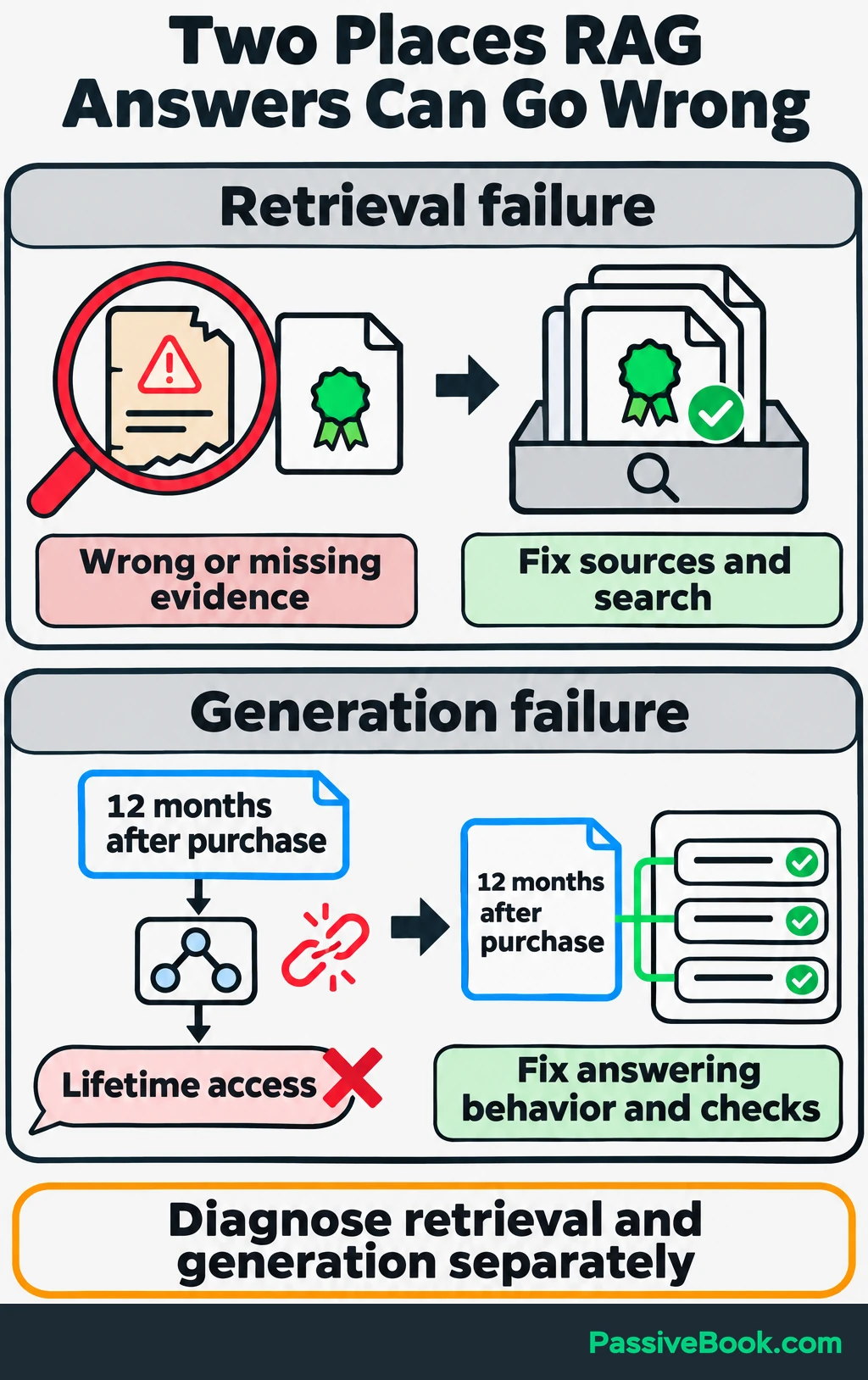
Those failures need different fixes. A clearer writing instruction won’t repair a search that keeps returning the wrong policy.
You also need to distinguish groundedness from correctness. Groundedness means the answer agrees with its supplied material. Correctness means the answer is accurate. An answer can faithfully repeat an inaccurate document. Microsoft treats these as separate evaluation questions.
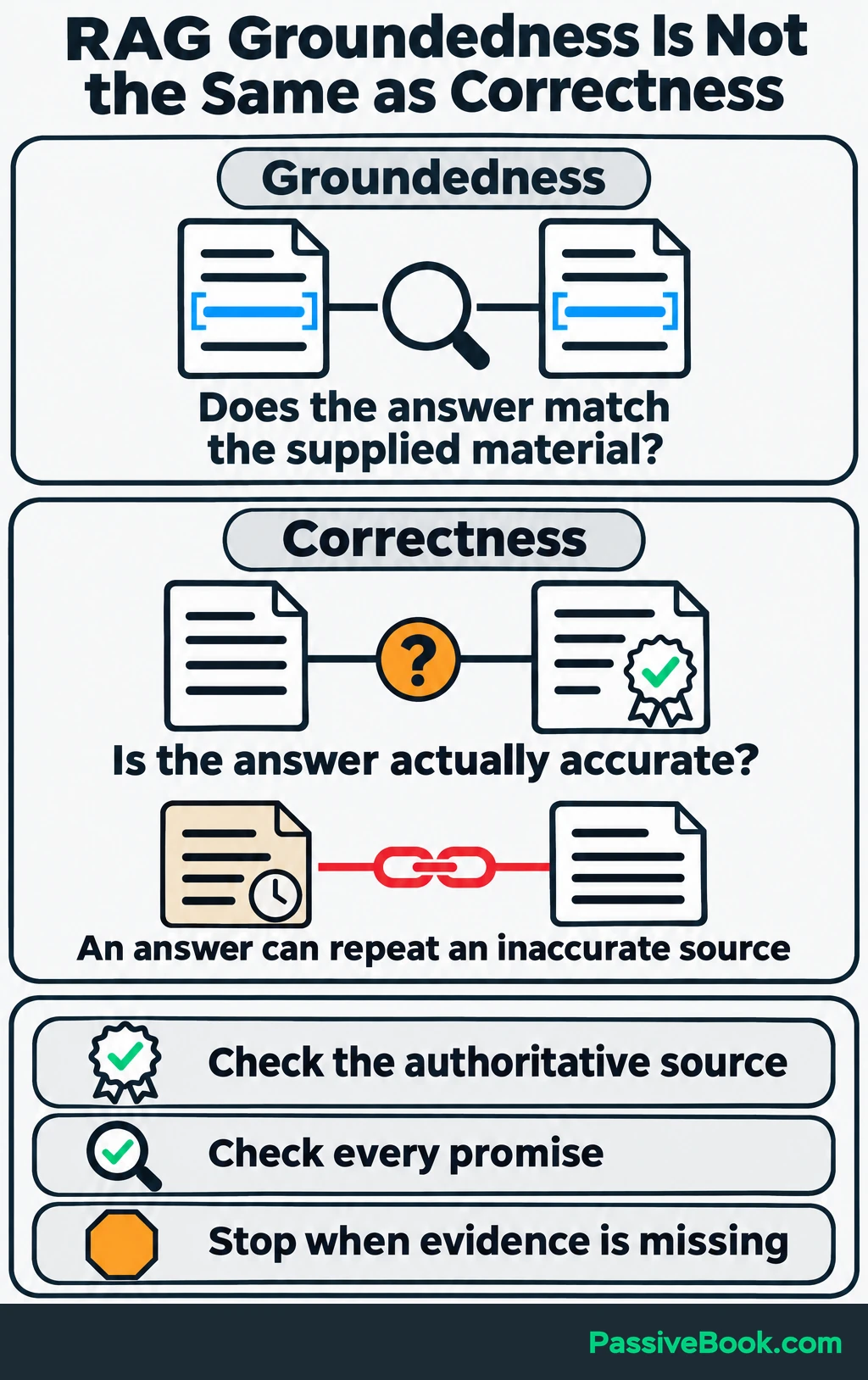
Check both the evidence and the response:
- Source check: Is this the authoritative policy for this question?
- Answer check: Does the passage support every promise in the reply?
- Missing-information check: Does the assistant stop when the documents don’t answer?
Suppose someone asks whether the watercolor course includes individual feedback on their paintings. If the documents say nothing about feedback, the assistant should say it cannot confirm that and direct them to support.
A citation alone doesn’t settle the issue. Open the cited passage and check whether it supports the claim attached to it.
What Does It Take to Use RAG?
You need maintained sources, a retrieval method, a language model and a workflow that connects them.
Managed systems can handle tasks such as splitting documents and creating embeddings. A custom application gives you more control, but you take on more integration and maintenance.
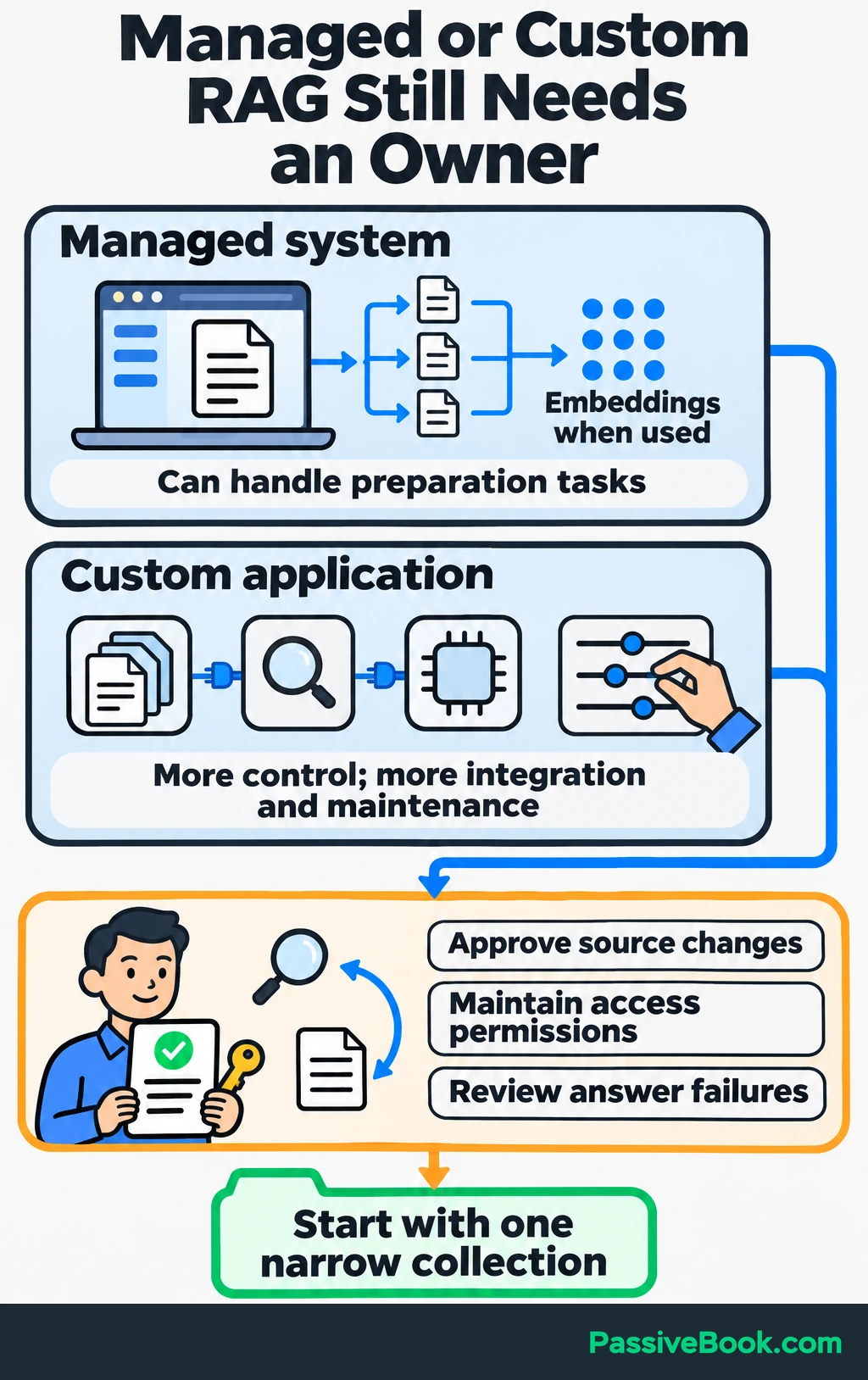
You don’t need to begin by training a model. You do need to understand which documents should supply answers and who will maintain them.
Budget for:
- Preparation: Extracting text, processing documents and creating embeddings when used.
- Retrieval: Storing searchable material and running searches.
- Generation: Sending instructions, questions and retrieved text to the model.
- Maintenance: Updating sources, managing permissions and reviewing failures.
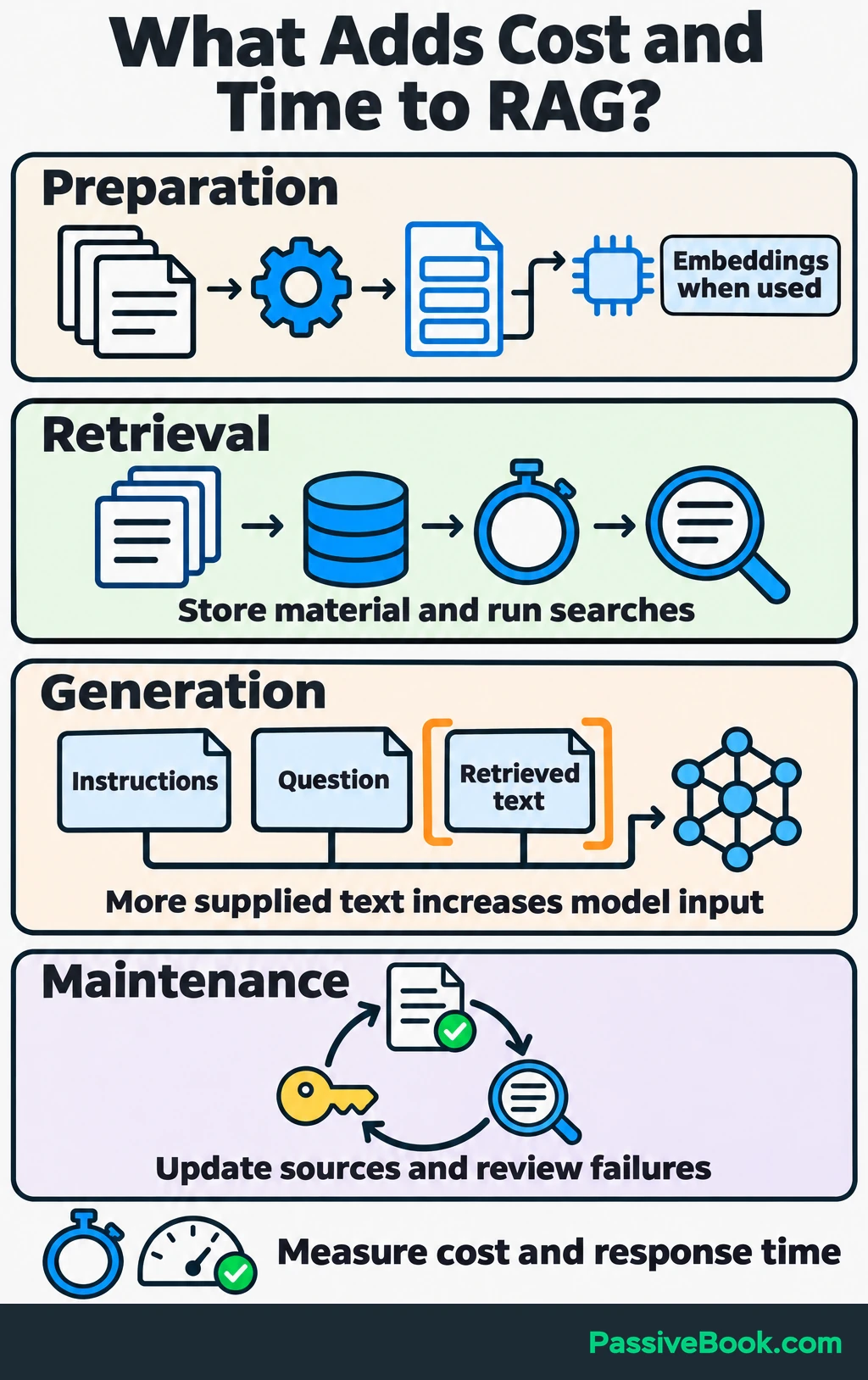
Retrieval adds work compared with a model-only request, and the extra passages increase the model’s input. Both can affect cost and response time. Microsoft outlines these RAG cost and latency drivers.
I would begin with one narrow collection, such as the course’s enrollment and support documents. Adding the entire business archive makes it harder to see why an answer went wrong.
Assign someone to approve policy changes and make sure they reach the searchable collection. In a one-person business, that someone is you. Automation still needs an owner.
When Should You Use RAG Instead of Direct Prompting or Fine-tuning?
Choose according to the problem you need to solve.
Supplying knowledge and changing model behavior are different jobs. RAG selects reference material, while fine-tuning trains the model further on examples to change its learned settings, called parameters. The two approaches can also work together. AWS compares RAG and fine-tuning, including their combined use.
| Approach | What Changes | Suitable Need | Ongoing Work |
|---|---|---|---|
| Direct prompting | You supply instructions and reference text in the request. | An occasional customer reply that needs one short enrollment policy. | Keep the prompt and supplied policy accurate. |
| RAG | A retrieval process selects reference material for each request. | Repeated questions across a growing collection of policies, lessons and FAQs. | Maintain sources, search quality, permissions and answer checks. |
| Fine-tuning | Further training changes model parameters using examples. | A persistent task, style or formatting need that better prompts haven’t resolved. | Maintain representative training examples and test model changes. |
For an occasional question about course access, I would paste the relevant policy into the request and ask for a reply. That is direct prompting, and it may be enough.
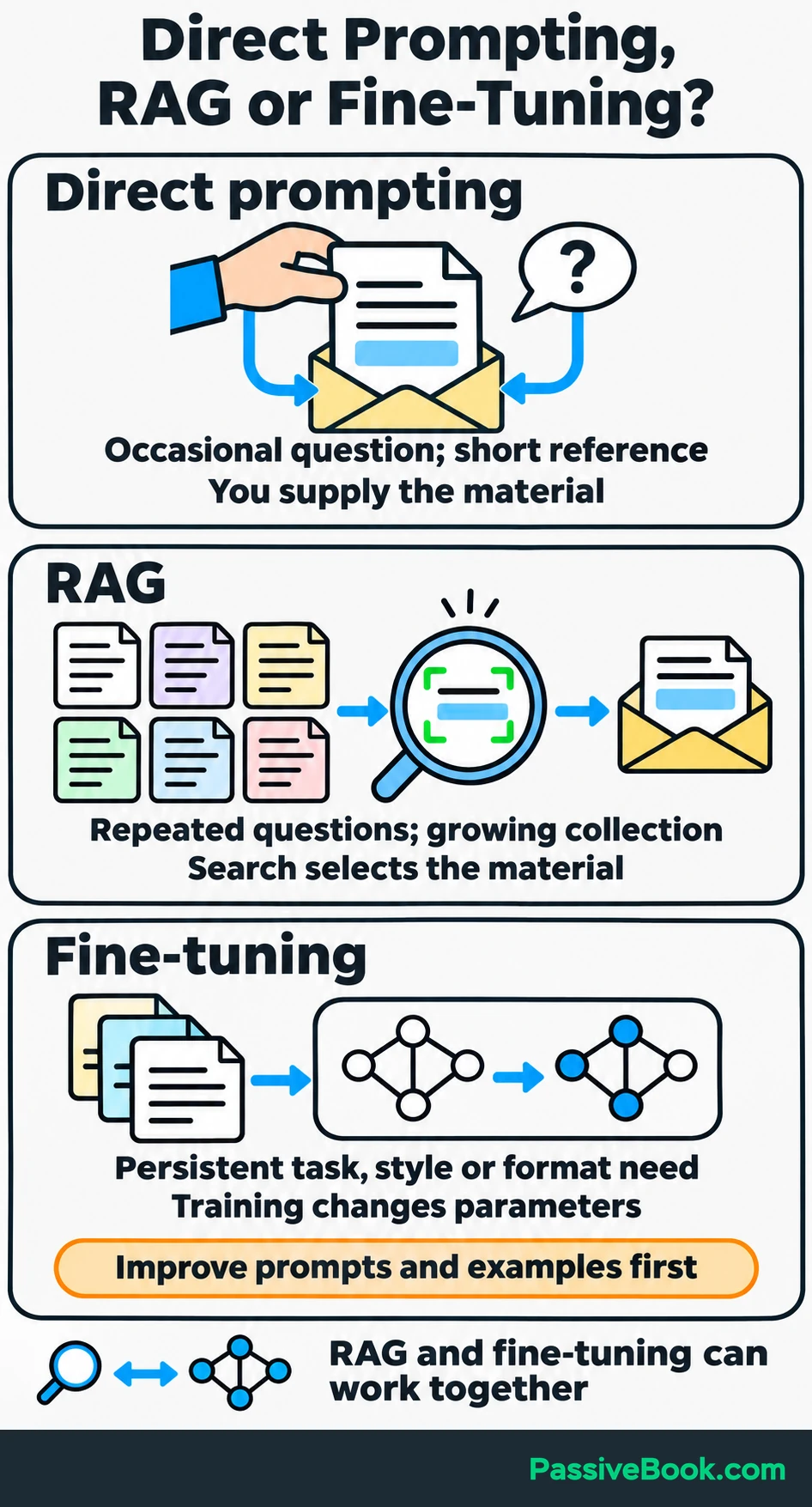
If customers ask repeated questions across a growing lesson library, manually finding the right passages becomes a recurring job. That creates a stronger case for RAG.
A larger context window—the amount of material a model can handle in one request—may let you supply more documents directly. RAG’s advantage is that it selects material automatically for each question.
I wouldn’t fine-tune a model just to teach it a policy that might change. I would consider fine-tuning for a repeated behavior problem after improving the instructions and examples. Prompting still matters inside either approach.
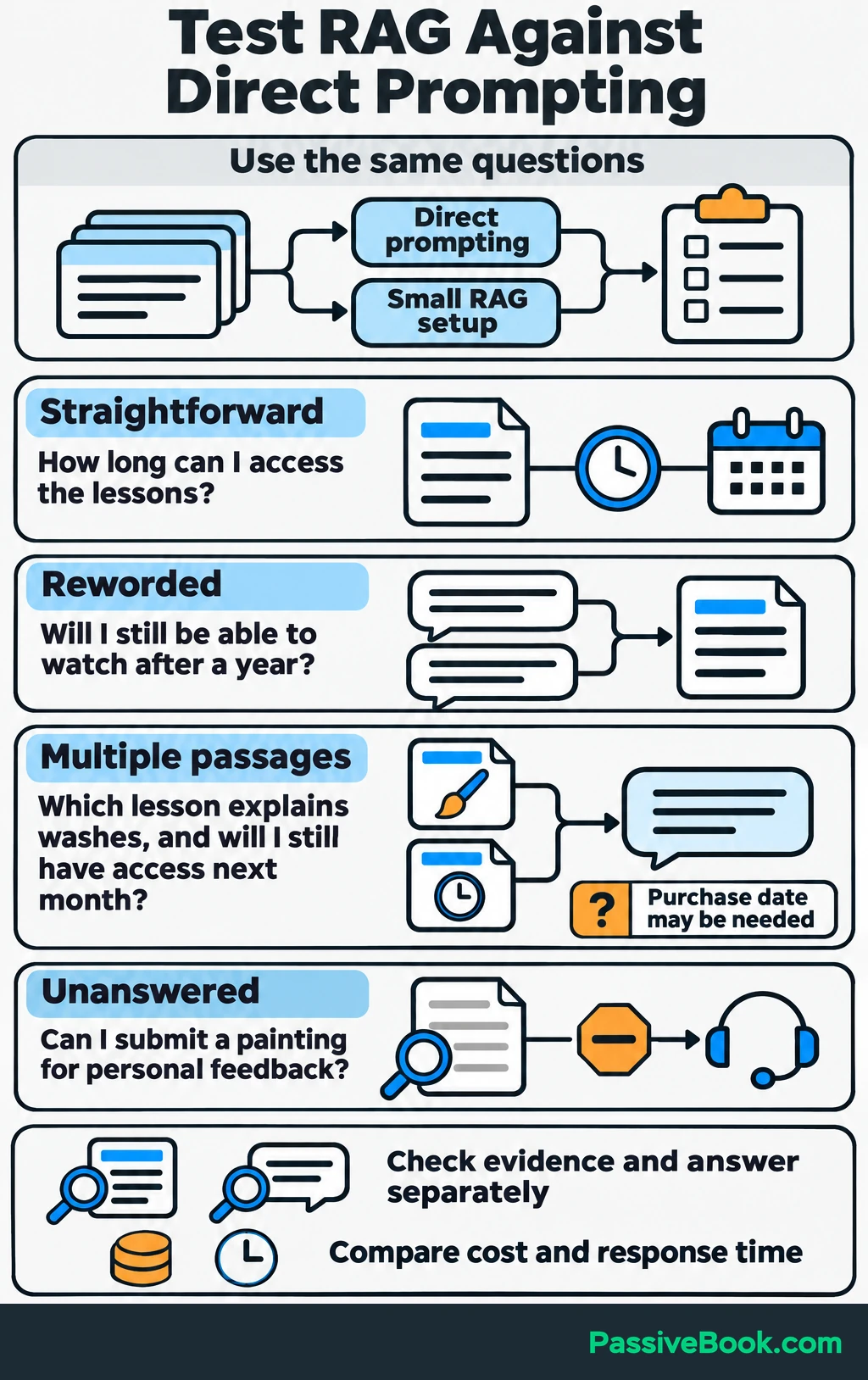
Before committing, compare direct prompting with a small retrieval setup on the same questions:
- Straightforward: “How long can I access the lessons?”
- Reworded: “Will I still be able to watch after a year?”
- Multiple passages: “Which lesson explains washes, and will I still have access next month?”
- Unanswered: “Can I submit a painting for personal feedback?”
For the access question involving next month, the assistant may need the buyer’s purchase date as well as the policy. It should ask for missing information rather than guess.
Inspect the retrieved evidence separately from the final answer. Then check whether the reply is supported, complete and clear about anything it cannot answer. This follows Microsoft’s distinction between evaluating retrieval and evaluating the response.
Compare response time and cost too. Choose RAG when finding the right sources automatically improves the workflow enough to justify maintaining it.
What Next?
Pick one recurring question and gather the documents needed to answer it. Try supplying those references directly to your AI tool, then check every claim in the response against them. That gives you a useful baseline before adding retrieval.
For that first test, start with the policy-based customer reply workflow. Supply your approved policy, run the drafting and review prompts, then check the result against the original document.
Free AI Business Workflow Library




Use the social buttons to share this guide when an AI discussion gets stuck at “just retrain it.” Finding the right evidence deserves a place in that conversation.
Which recurring question would you trust an assistant to answer only after it checked your sources? Share it in the comments, along with any other questions about RAG.
Share this post with your friends & followers:

