A model can write a convincing demo reply and still struggle when a customer sends a screenshot, asks a vague question, or needs an answer buried in your documents. The trouble starts when that demo becomes an automation.
Then you pay for retries, correct confident mistakes, or discover that your chosen model needs hardware you never budgeted for.
Mistral gives you several ways to build that system, from hosted APIs to models you can run locally. This guide connects those choices to actual business work, so you can choose what to test before committing your time and money.
What Are Mistral AI Models?
Mistral AI develops models for broad tasks such as answering questions, interpreting images, writing, and coding. It also develops specialists for jobs such as extracting document text, transcribing recordings, and finding relevant information.
Some models are available through hosted APIs, which let your application send requests to a model running on a provider’s servers. Others also have downloadable weights—the files containing what the model learned during training—so you can run them on your own infrastructure.
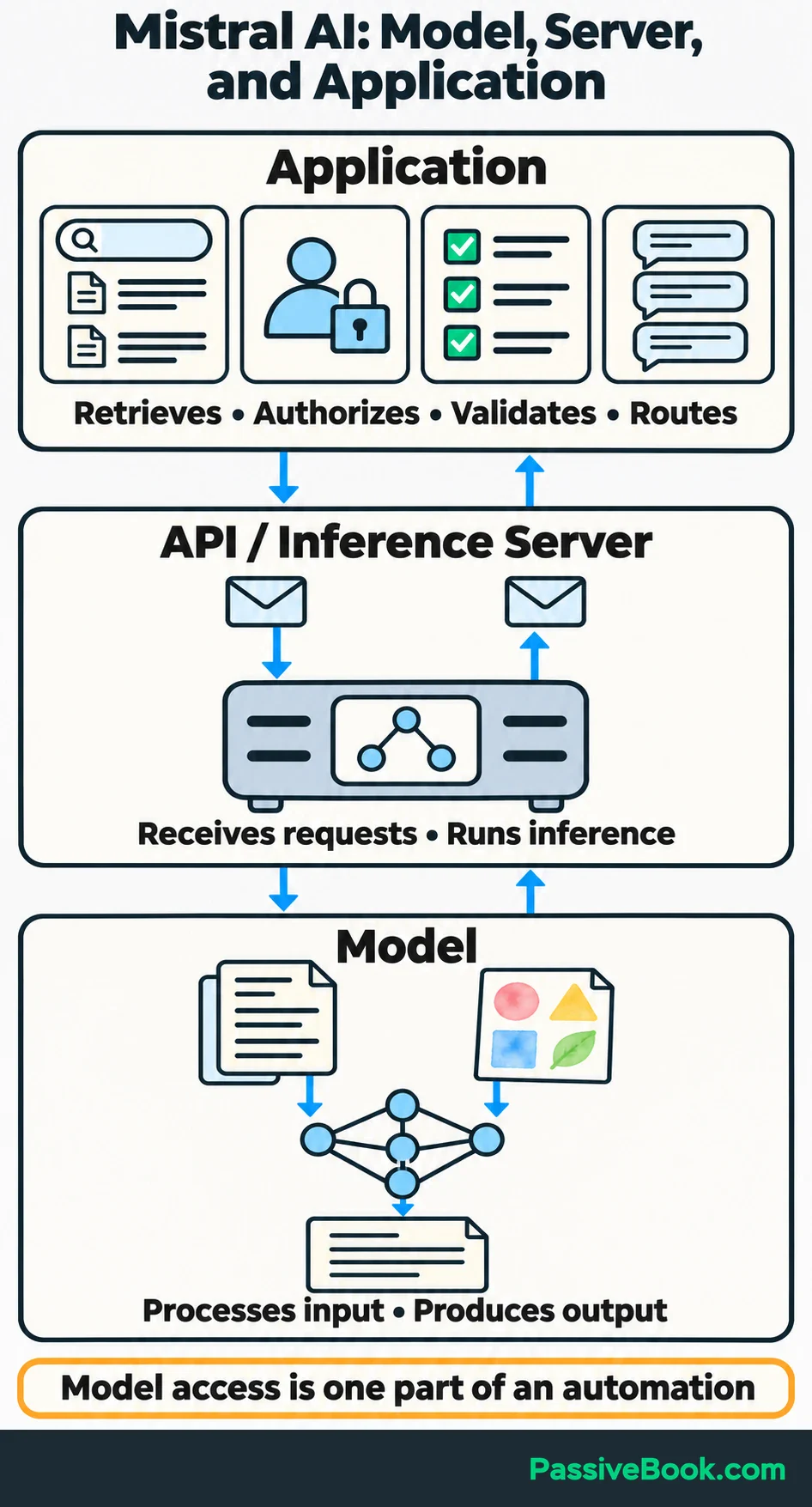
Keep three parts of the system separate:
- Model: Processes the information and produces an output.
- API or Inference Server: The API receives requests from your application; the inference server runs the model to answer them.
- Application: Finds documents, checks customer access, validates answers, and decides what happens next.
Buying access to a capable model gives you one part of an automation. You still need the application around it.
Also, Mistral’s platform includes third-party models. Appearing in its official model catalog does not mean Mistral developed a model or that its weights are available to download.
My starting shortlist would be Small 4 for everyday automation, Large 4 for difficult requests, and Ministral 3 when local hardware shapes the decision. Add specialists when the workflow needs them.
To make those choices concrete, imagine you sell a beginner watercolor course. You want an assistant to answer learner questions using lesson notes, worksheet screenshots, and recorded lessons. This business and the requests below are illustrative.
Which Model Specifications Matter?
A model’s name tells you less than its specifications, but you only need a few specifications to build a useful shortlist.
- Input and Output Types: Check what the model accepts and what it produces separately. A model that understands images may produce only text. That does not give it image generation or audio support. Confirm language support, structured responses (fields in a fixed format), and tool calling (requests for your application to take an action).
- Context Window: This is the amount of information a model can work with in one request, measured in tokens. Tokens are pieces of text or other encoded content. The window includes input and generated output, so instructions, conversation history, retrieved passages, tool results, and the answer all need room. A separate output limit may also apply. Mistral’s context guidance confirms that input and output both count.
- Parameters: These are the learned values stored in the model. A dense model uses its main network for each token. A mixture-of-experts model selects parts of a larger network. Its active parameter count helps describe the work done per token, but you still need to accommodate the stored weights.
- License: Downloadable weights let you run the model yourself. The license determines what you may do with it and which obligations apply.
- Response Time and Capacity: Measure how long the answer takes to start, how long it takes to finish, and what happens when several requests arrive together. A quick opening sentence means little if the complete answer arrives too late.
- Lifecycle Status: Check whether the hosted model is experimental, in preview, generally available, deprecated, or retired. These stages affect how you plan production use and future changes.
For the watercolor assistant, I would retrieve the few passages that address the learner’s question. I would not send the entire course library with every request.
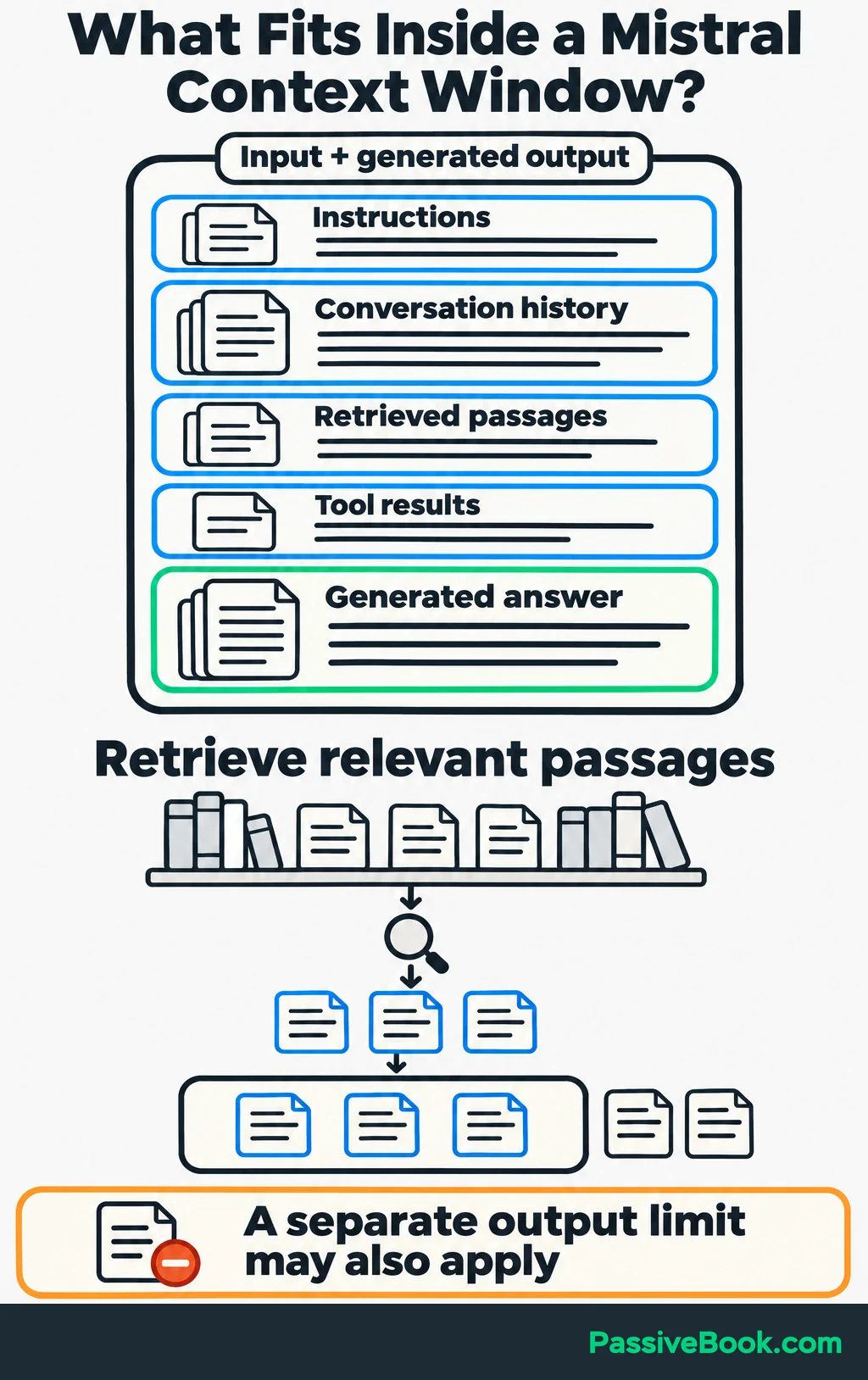
That process is often called retrieval-augmented generation, or RAG. In plain words, your application finds relevant material and gives it to the model before asking for an answer.
A large context window gives you more room. I would still test whether the model uses the supplied details correctly, especially when lessons describe different stages of the same process.
General-purpose Mistral Models Compared
These models are candidates for the same broad job: understanding a request and producing a useful answer. The specialists in the next section can prepare information for them.
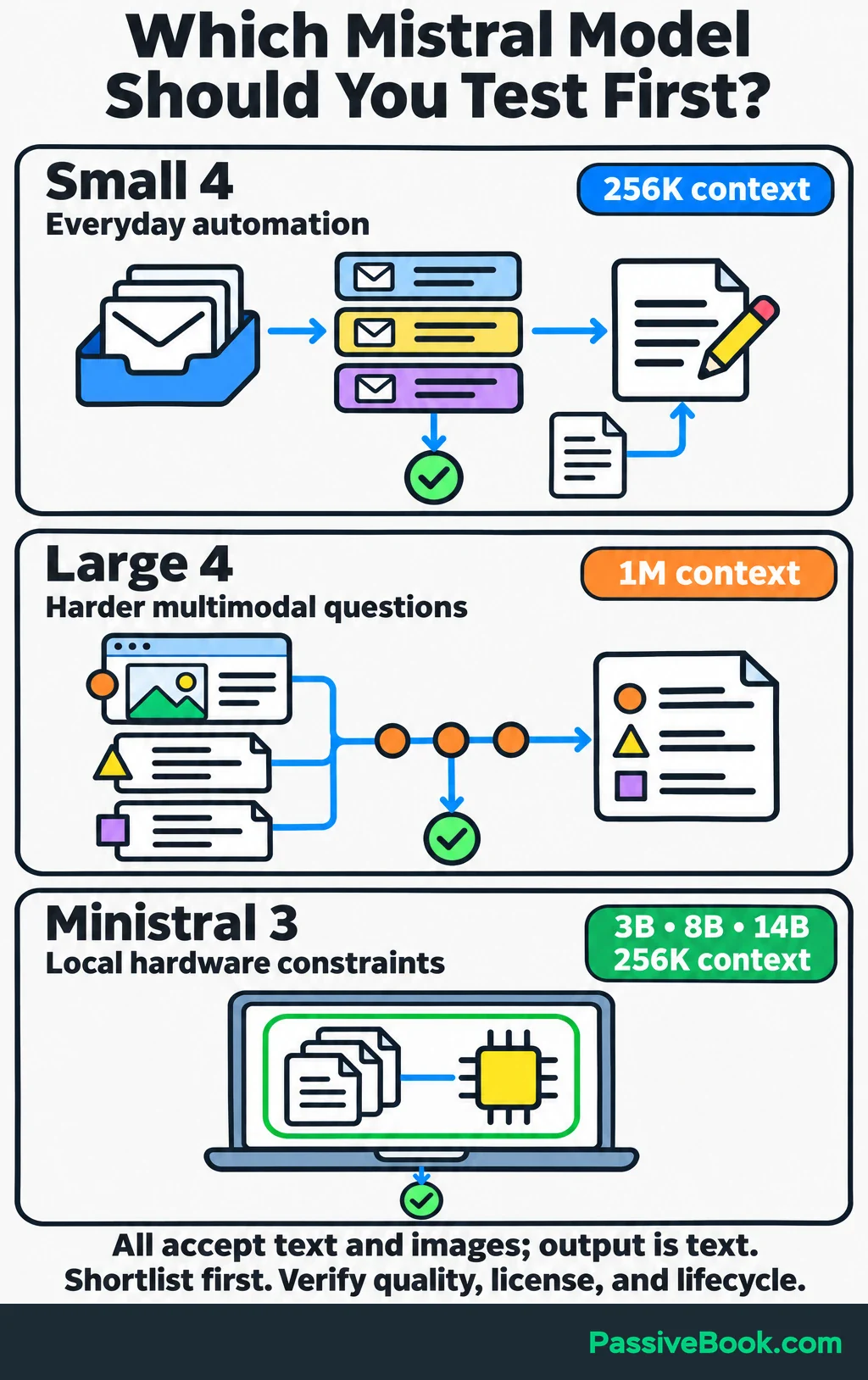
In the table, K means thousand tokens and M means million tokens. B in a model name means billion parameters. General Availability is Mistral’s stable production stage.
| Exact Model/Version | Suitable Tasks | Input → Output | Context Window | Hosted Access | Downloadable Weights | Weight License | API Lifecycle Status |
|---|---|---|---|---|---|---|---|
| Mistral Small 4 v26.03 | Summaries, classification, extraction, document-based answers | Text and images → text | 256K | Direct API | Yes | Apache 2.0 | General Availability |
| Mistral Large 4 v26.10 | Difficult reasoning, complex images, questions spanning several documents | Text and images → text | 1M | Direct API | Yes | Mistral Ecosystem Open-Weight License | Public Preview |
| Ministral 3 3B v25.12 | Local assistants under tighter hardware constraints | Text and images → text | 256K | Direct API | Yes | Apache 2.0 | General Availability |
| Ministral 3 8B v25.12 | Local work where you can allocate more memory | Text and images → text | 256K | Direct API | Yes | Apache 2.0 | General Availability |
| Ministral 3 14B v25.12 | Local work where testing justifies the larger model | Text and images → text | 256K | Direct API | Yes | Apache 2.0 | General Availability |
The task recommendations are starting points for evaluation. They do not establish that one model will meet your quality or response-time target.
Mistral Small 4 for Everyday Automation
I would start here for a hosted support assistant.
Small 4 combines instruction following, reasoning, and coding. That makes it a sensible candidate for summarizing messages, assigning categories, extracting fields, and drafting answers from supplied documents.
For the course business, begin with two tasks: answer straightforward lesson questions and route account problems to the right queue. Those give you useful work to test without building a sprawling agent first.
The name needs a warning beside it, though. Small 4 has 119 billion total parameters and 6.5 billion active parameters. The official model card describes that architecture and its text-and-image input.
“Small” is a family name. It is not a promise that the model fits comfortably on your laptop.
Mistral Large 4 for Demanding Multimodal Work
Test Large 4 when the smaller candidate fails on questions that require several pieces of evidence.
For example, a learner might upload a worksheet screenshot that says “keep the paper damp” and point to another lesson that says “wait until dry.” The assistant needs to establish whether those instructions describe different stages before explaining them.
Large 4 offers a million-token context window and configurable reasoning effort, so you can test different settings for harder requests.
Keep its Public Preview status in the decision. Under Mistral’s lifecycle policy, preview models can receive silent updates. Recording a version identifier therefore does not guarantee unchanged hosted behavior.
I would use it only when its measured benefit justifies both the additional cost and the need to monitor that changing service.
Ministral 3 for Local and Edge Workloads
Ministral 3 gives you three model sizes to compare: 3B, 8B, and 14B.
If local processing is required, I would test the smallest version that fits the task, then move up when the results justify it. Measure memory use and complete response time on the intended machine alongside answer quality.
For an assistant, select an instruction-tuned checkpoint—a specific saved release of the model’s weights. A base checkpoint is a foundation for further work, while an instruction-tuned version is prepared to respond to requests.
In the course example, the application could search downloaded lesson notes and draft answers without sending those notes to a hosted answering model. Whether that feels practical depends on the actual device, model file, and workload.
Where Older Model Names Fit
Older tutorials introduce names that still appear in repositories and model downloads:
- Mistral 7B and Mixtral: Earlier language-model families.
- Pixtral: A name associated with vision models.
- Magistral: A reasoning-model family.
- Devstral: A software-engineering model family.
Treat an old tutorial’s model identifier as something to check before copying it into a new application.
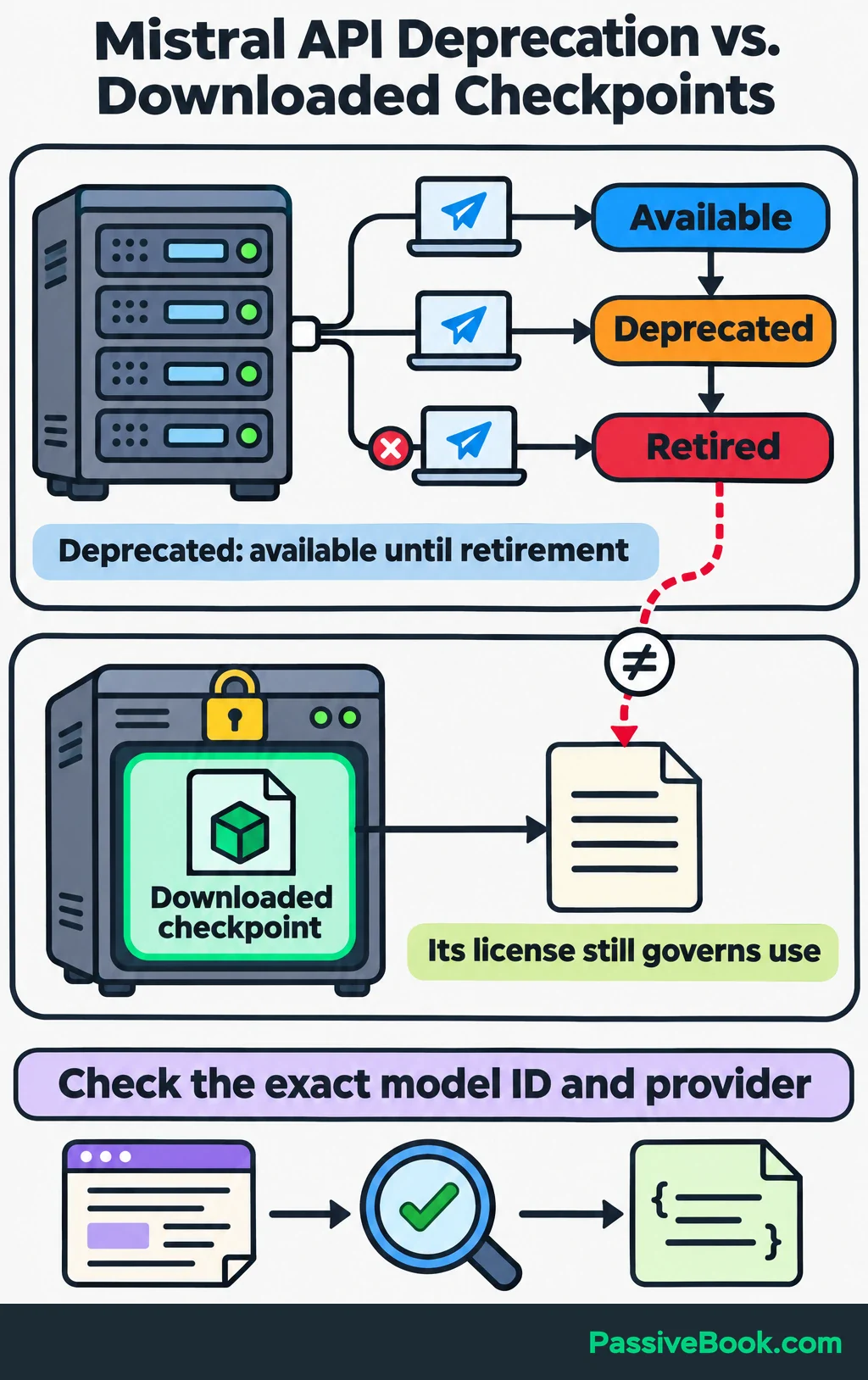
For example, the API cards for Large 3 and Medium 3.5 mark them deprecated and direct new integrations to Large 4.
Deprecation means the API model remains available until retirement. It does not revoke a downloaded checkpoint’s license or tell you whether another provider still serves it.
Specialist Mistral Models and Their Uses
A general-purpose model does not have to perform every step of your system.
You can extract worksheet text once, transcribe recorded lessons once, and search that prepared material whenever a learner asks a question. The answering model then receives the relevant passages.
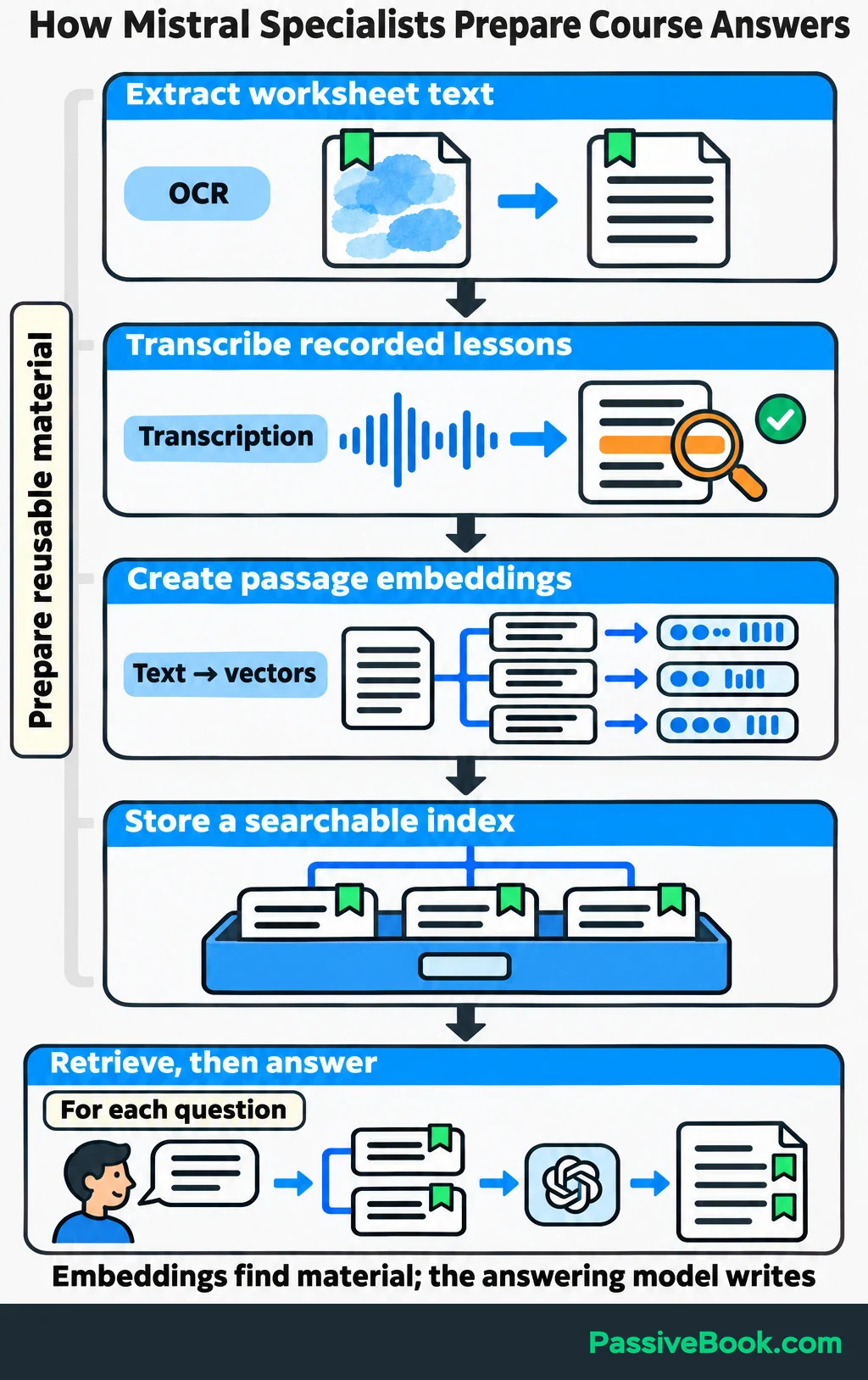
The official catalog groups these specialists by their jobs. Their outputs differ, so compare them within the job you need.
OCR means optical character recognition: extracting text from page images. Embeddings are numerical representations, also called vectors, that help a search system find related material. They help locate an answer; they do not write it.
| Job | Model/Version | Input | Output | Access Form |
|---|---|---|---|---|
| Code completion | Codestral v25.08 | Code, including surrounding code | Generated or completed code | Hosted API |
| Document extraction | OCR 4.1 | Documents and page images | Extracted text and document structure | Hosted API |
| Text retrieval | Mistral Embed v23.12 | Text passages | Numerical vectors for similarity search | Hosted API |
| Code retrieval | Codestral Embed v25.05 | Code passages | Numerical vectors for code search | Hosted API |
| Recorded-speech transcription | Voxtral Mini Transcribe 3 v3.0 | Audio recordings | Transcript text | Hosted API; Public Preview |
| Audio understanding | Voxtral Small v25.07 | Audio and text instructions | Text responses | Hosted API and Apache 2.0 weights |
| Speech generation | Voxtral TTS 3 v3.0 | Text | Generated speech | Hosted API; Public Preview |
| Numerical forecasting | Timestral 1.0 209M | Time-series data | Forecasts | Downloadable weights |
For the watercolor assistant, I would prepare the material in this order:
- Extract text from scanned worksheets, keeping each passage connected to its worksheet and lesson.
- Transcribe recorded lessons and check important course terms.
- Split the text into useful passages and create embeddings.
- Store those passages and their lesson references in a searchable index.
- Retrieve relevant passages when a question arrives, then ask a general-purpose model to answer.
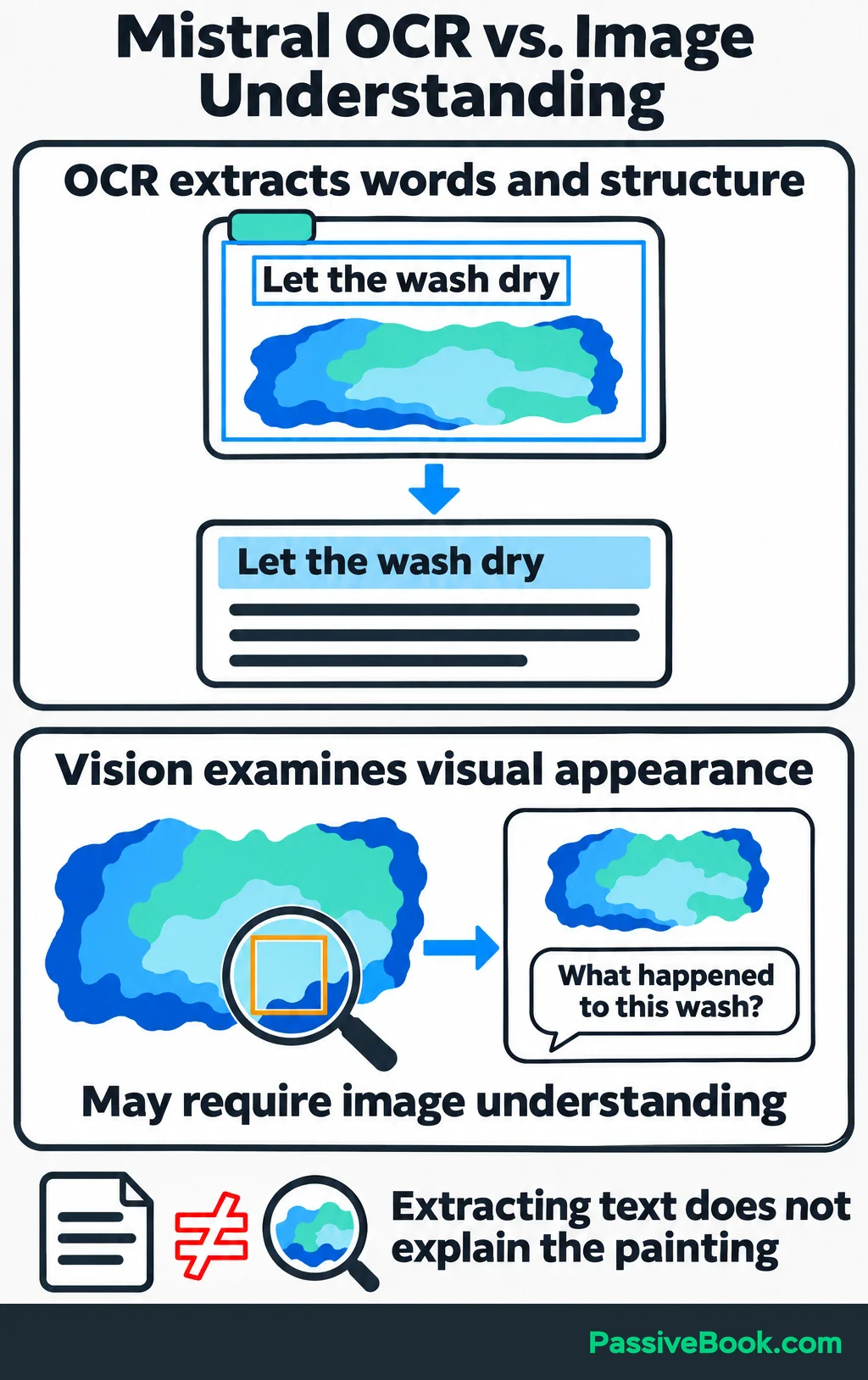
OCR serves a different purpose again. It can extract the words and layout from a worksheet, but a learner asking about the appearance of a painted wash may still require image understanding.
Codestral is useful when building the course storefront. Its completion features can fill a gap in a function, while your development tools run tests and manage repository changes. It does not take over those responsibilities merely because it generates code.
I would skip speech generation unless learners need spoken answers. Likewise, live captions need a realtime transcription model rather than an ordinary recording-transcription workflow. Moderation models can screen content, and Timestral can support a separate forecasting task, but neither replaces the answering model.
Where Can You Deploy Mistral Models?
Hosted access and downloadable weights can coexist for the same model. You are choosing who operates it and where the information travels.
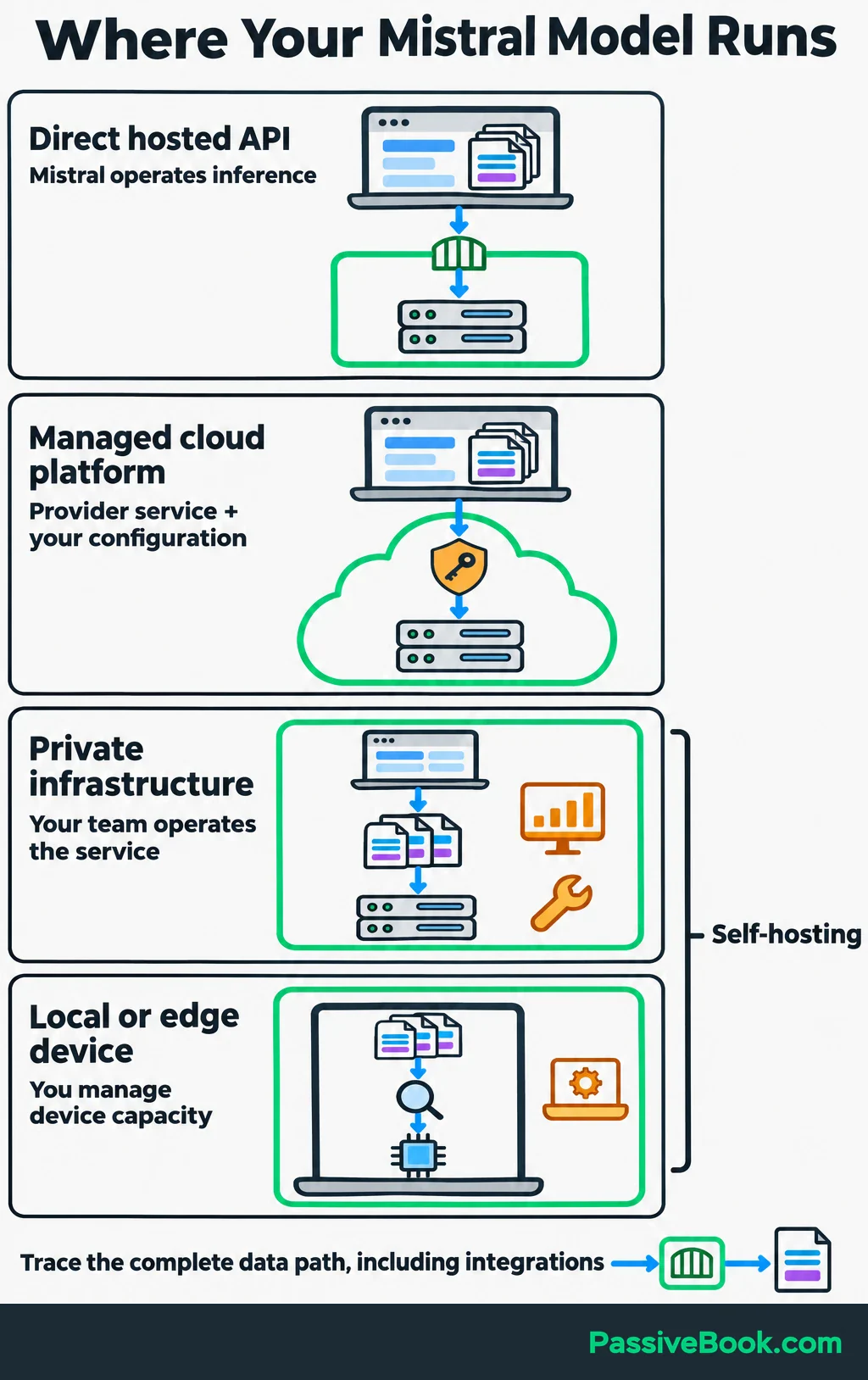
Local and edge deployment are forms of self-hosting. They place the model on a personal computer or a device close to the data rather than on a central server.
| Deployment Route | Infrastructure Responsibility | Data Path | Scaling Responsibility | Billing Basis | Suitable Constraints |
|---|---|---|---|---|---|
| Direct hosted API | Mistral operates inference | Selected content goes to Mistral’s endpoint | Mistral manages capacity; you handle limits and traffic | Model and service usage | Fast evaluation and limited operations time |
| Managed cloud platform | Cloud provider operates inference | Requests follow the provider’s endpoint and processing terms | Provider capacity plus your configuration | Provider-specific charges | Existing cloud identity, procurement, or regional requirements |
| Private infrastructure | Your team operates the service | Requests reach your controlled servers; integrations may add other destinations | Your team | Hardware or rental, energy, and operating time | Infrastructure control and sustained workloads |
| Local or edge device | You manage each device | Can stay on the device when the whole workflow is local | Device capacity and your distribution process | Device purchase and operation | Offline work or processing near the data |
Hosted APIs
For an initial evaluation, I would usually choose the direct API. It lets you test the business task before taking on model-serving work.
Create credentials, select an available model identifier, and send requests from a backend service. Keep the API key on that backend.
An existing cloud platform may be more practical when your application already depends on its access controls and purchasing arrangements. Check the exact model version, endpoint, region, and terms separately. A family name on two platforms does not establish identical availability or behavior.
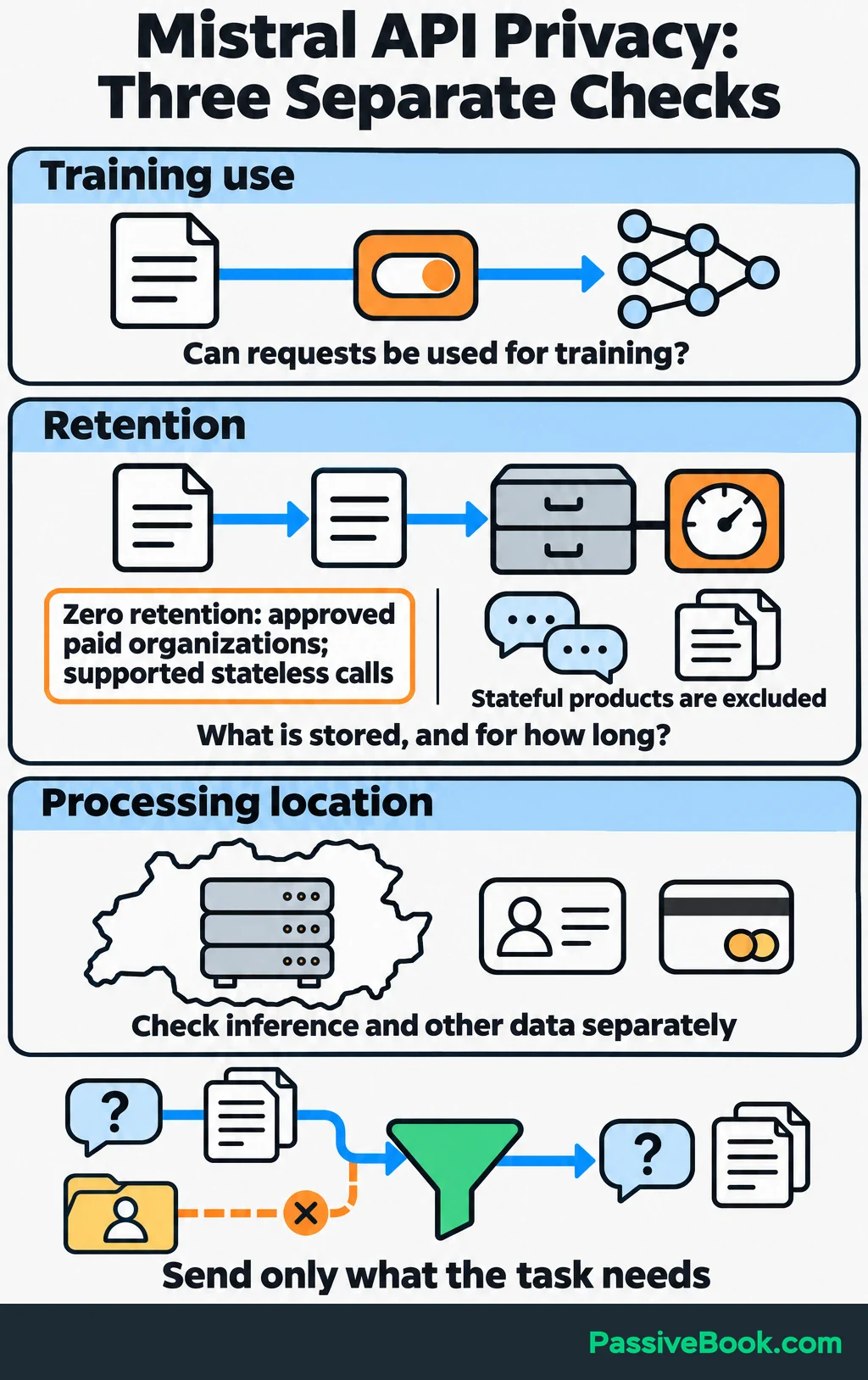
Before sending learner information, separate three decisions: whether data can be used for training, how long it is retained, and where it is processed.
Training opt-out and retention are different controls. On paid plans, approved organizations can use Mistral’s zero-data-retention access for supported stateless API calls, which do not need to save inputs or outputs after returning a response. This setting excludes stateful products such as Agents, Conversations, and Files, which store information to function.
If processing location matters, check regional inference support for the complete workflow. Selecting a regional inference endpoint does not make all account, billing, or operational metadata regional.
For course support, I would send the question and relevant lesson passages. There is no reason to attach a learner’s full customer record to a painting question.
Self-hosting on Private Infrastructure
Start with the exact checkpoint and a compatible serving runtime—the software that loads the model and handles requests. Then choose the numerical precision before estimating hardware.
Memory has several demands:
- Stored Weights: The model files loaded for inference.
- Runtime Overhead: Memory needed by the serving software and its operations.
- Context Cache: Memory used while processing prompts and generating responses.
- Concurrent Requests: Additional capacity for people using the service together.
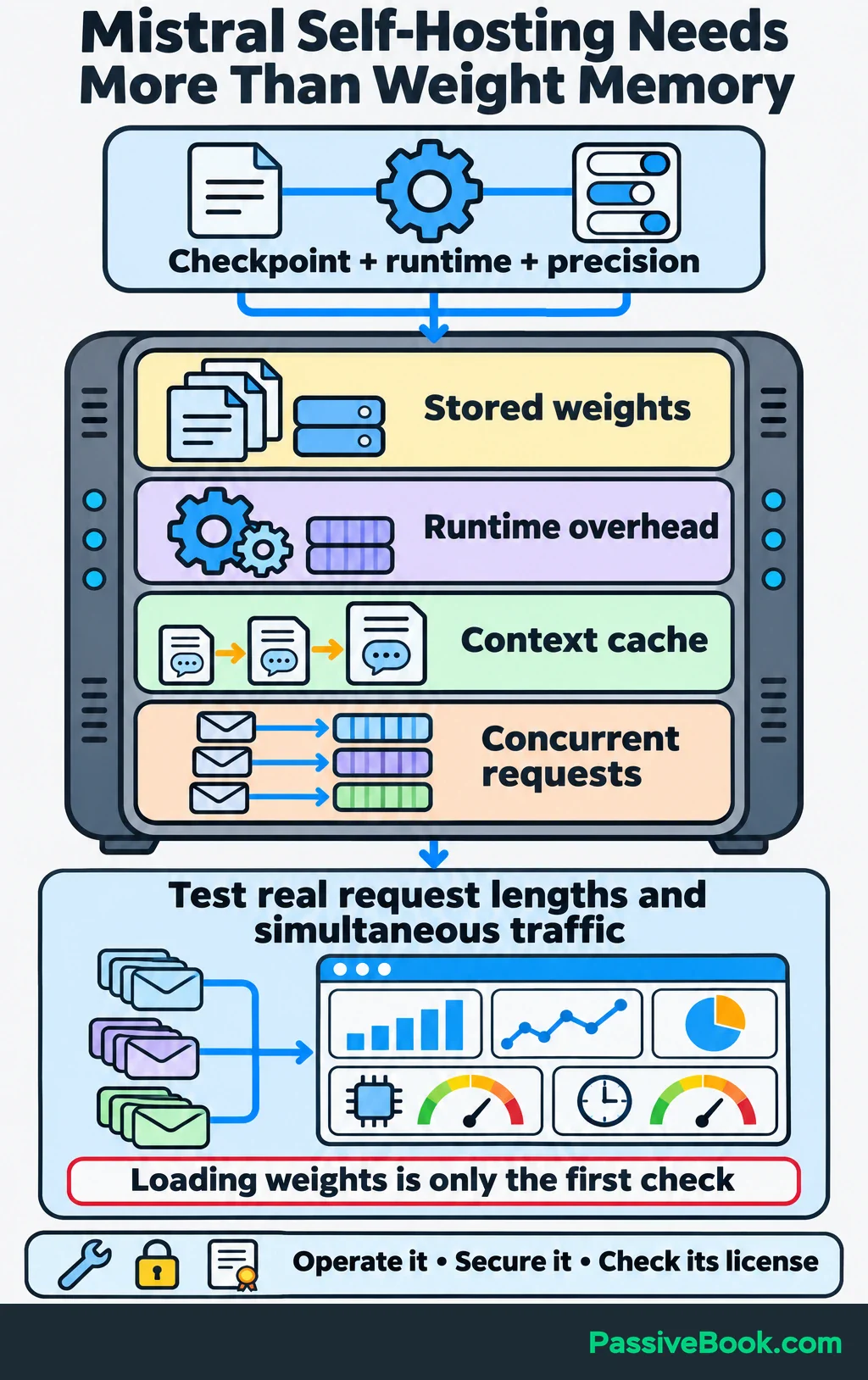
Test your intended request lengths and simultaneous traffic before buying hardware. Loading the weights is only the first check.
You also inherit updates, access controls, monitoring, backups, and recovery. I would choose self-hosting when its control or measured economics justify that work.
Licensing can change the decision. Small 4 and Ministral 3 use Apache 2.0. Large 4’s license contains a separate commercial-license requirement for qualifying model-as-a-service businesses, with exclusions for capabilities embedded within specific product features and exemptions for internal use. Check how your intended service fits those terms before building around the checkpoint.
Local and Edge Deployment
Local deployment is worth testing when offline access or local processing is part of the requirement.
Quantization stores weights at lower numerical precision, which can reduce their storage and memory needs. Evaluate the exact quantized file because its quality, supported inputs, and runtime support matter.
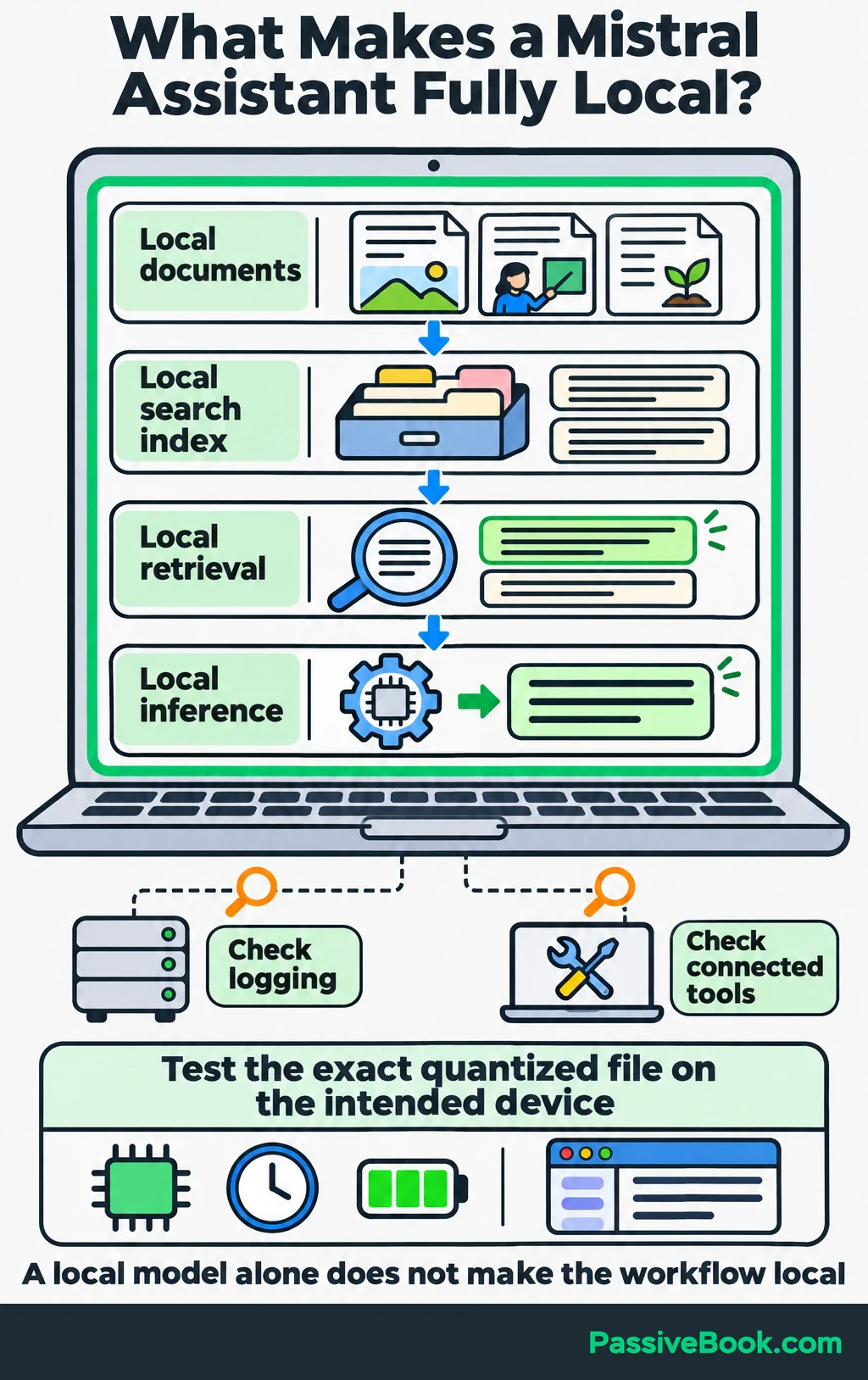
Mistral provides an official Ministral 3 14B GGUF checkpoint. GGUF is a model-file format used by local serving tools.
On the intended device, check memory pressure, full response time, power use, and behavior during other work. A machine that barely runs one prompt may be unpleasant to use all afternoon.
For an offline course assistant, keep the documents, search index, retrieval process, and inference local. Trace connected tools and logging too, because a local model alone does not establish that the whole system stays on the device.
How Much Does a Mistral Workflow Cost?
Start with the model charges, then add the rest of the workflow.
For text generation, count all billed input and output tokens across the calls needed to complete the task. Retrieved passages, conversation history, tool descriptions, extra tool turns, and retries can all contribute.
When rates are quoted per million tokens:
Generation cost =
(input tokens × input rate + output tokens × output rate)
÷ 1,000,000
These standard direct-API USD rates provide a comparison. Check Mistral’s pricing page for current rates and other billing options.
| Model | Input per Million Tokens | Output per Million Tokens |
|---|---|---|
| Small 4 | $0.15 | $0.60 |
| Large 4 | $0.70 | $2.10 |
| Ministral 3B | $0.10 | $0.10 |
| Ministral 8B | $0.15 | $0.15 |
| Ministral 14B | $0.20 | $0.20 |
| Codestral | $0.30 | $0.90 |
Suppose the course assistant handles 10,000 requests. Each uses one uncached call containing 2,000 input tokens and 500 billed output tokens.
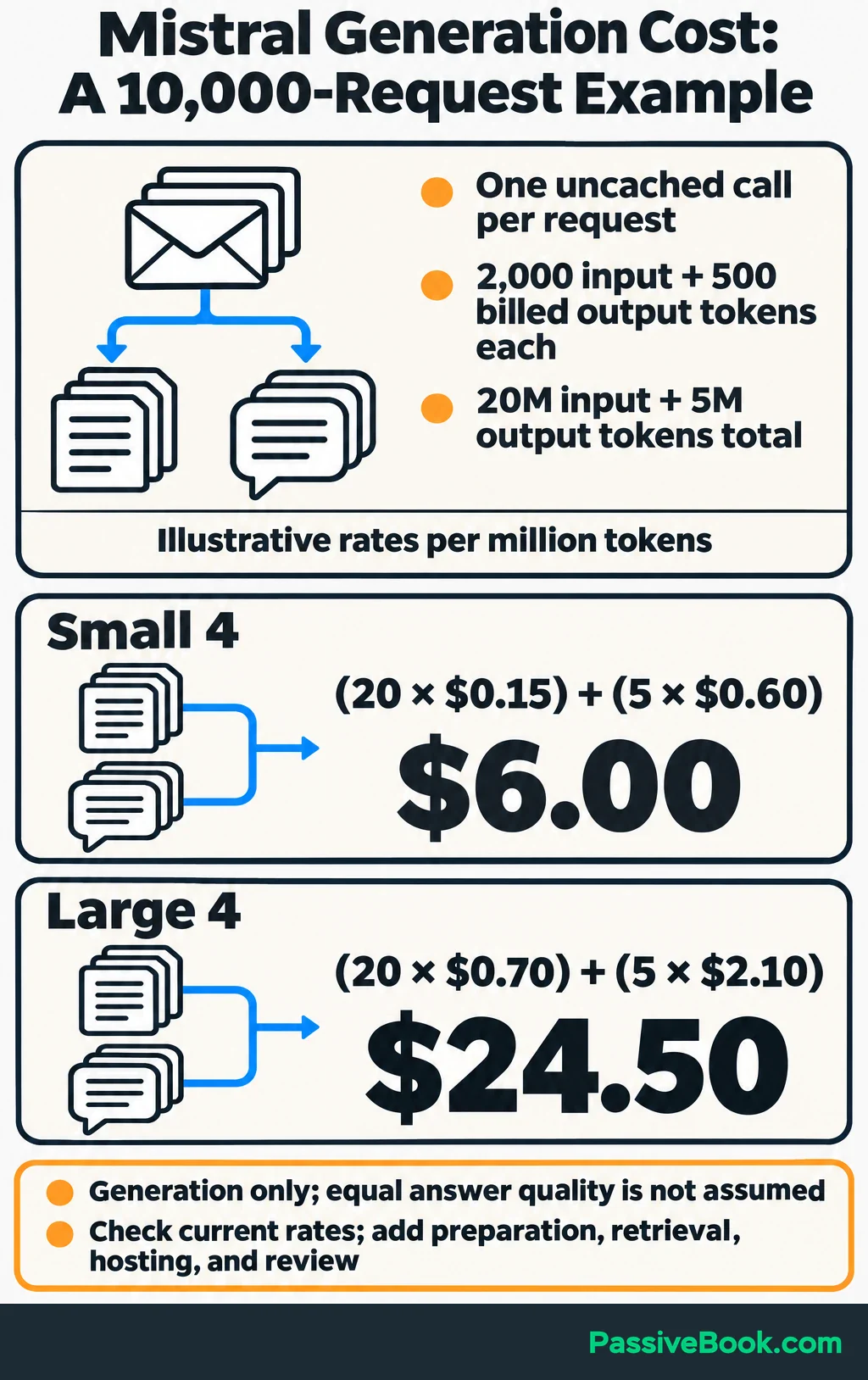
That produces 20 million input tokens and 5 million output tokens:
| Candidate | Illustrative Generation Charge |
|---|---|
| Small 4 | (20 × $0.15) + (5 × $0.60) = $6.00 |
| Large 4 | (20 × $0.70) + (5 × $2.10) = $24.50 |
The output allowance includes any billed reasoning tokens. These figures exclude retrieval, document preparation, hosting, correction, and human review, and they do not establish equal answer quality.
Specialists also use different billing units. OCR is billed by pages, transcription by audio minutes, and speech generation by characters. Keep those units separate when estimating the full service.
Self-hosting has another cost pattern: hardware or rental, idle capacity, energy, and operating time. Downloading weights does not remove those expenses.
The number I would use for the final decision is total spending per accepted completed task. Count all spending for that workflow during the test or billing period, including failed attempts, corrections, and human review. Divide by the number of tasks completed to your required standard during that same period.
A cheaper request can become an expensive answer if you keep rewriting it.
How Do You Choose a Suitable Mistral Model?
Define What an Acceptable Result Looks Like
Write the requirements before choosing candidates. Otherwise, it is easy to keep changing the test until your preferred model wins.
Specify the task, input and output types, languages, data restrictions, response-time target, expected traffic, and deployment constraints.
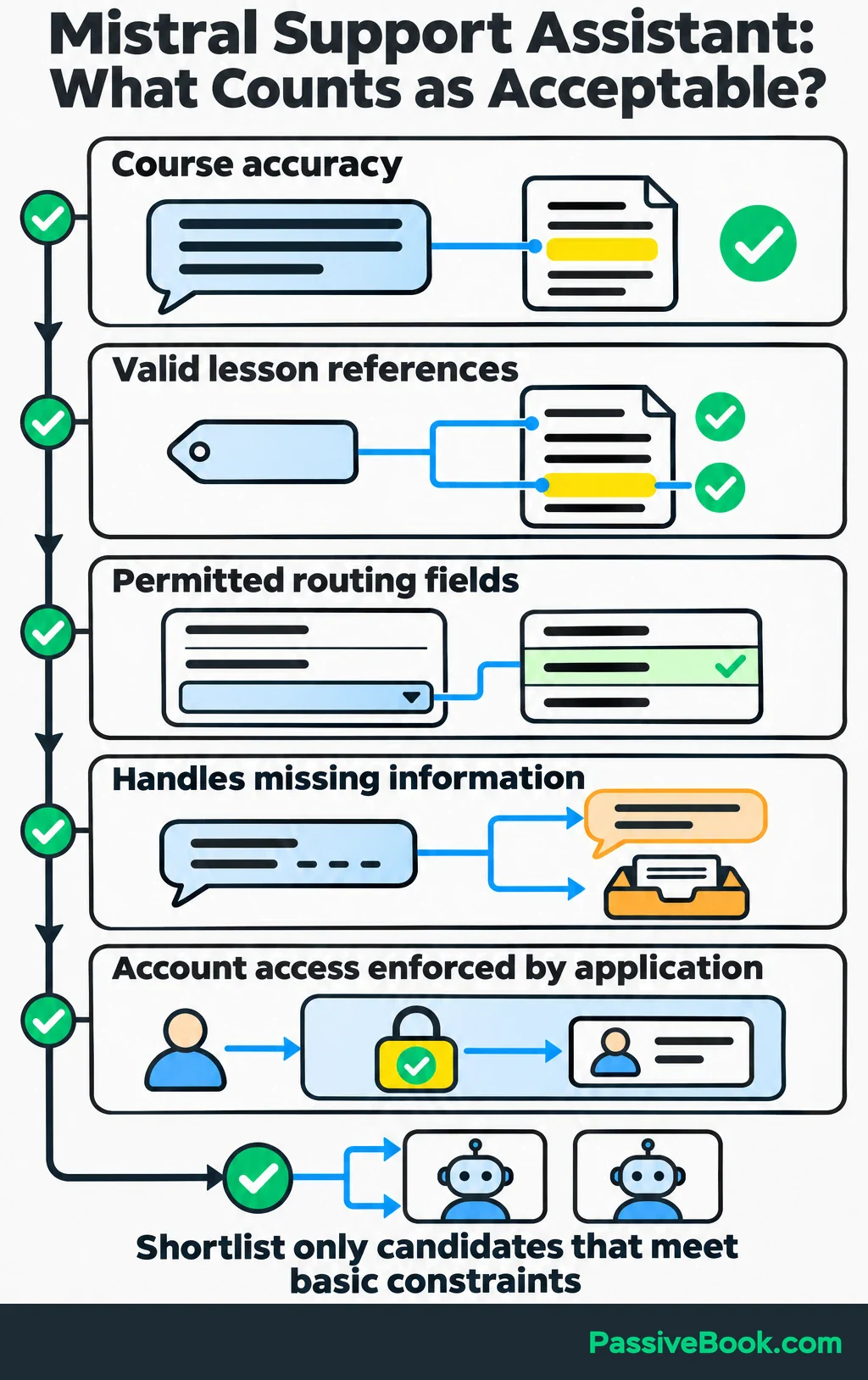
For the watercolor assistant, I would require:
- Course Accuracy: Answers agree with the supplied material.
- Lesson References: Every cited lesson exists and supports the answer.
- Routing Fields: Categories and escalation fields use permitted values.
- Missing Information: The assistant asks for clarification or escalates when the material cannot answer.
- Account Boundaries: The application permits learners to access only their own account information.
Then shortlist two or three candidates that meet the basic constraints.
Compare Small 4 with Large 4 when the main question is whether harder reasoning earns its cost. Compare Ministral sizes when local deployment is required. There is little value in testing a hosted-only workflow against an offline requirement.
Compare Candidates on Representative Work
Use the same questions, supplied passages, and scoring rules for each candidate. Begin with a small test set you can inspect carefully, then expand it with failures and new requests.
Include ordinary questions and awkward ones:
| Test Request | What an Acceptable Response Must Do |
|---|---|
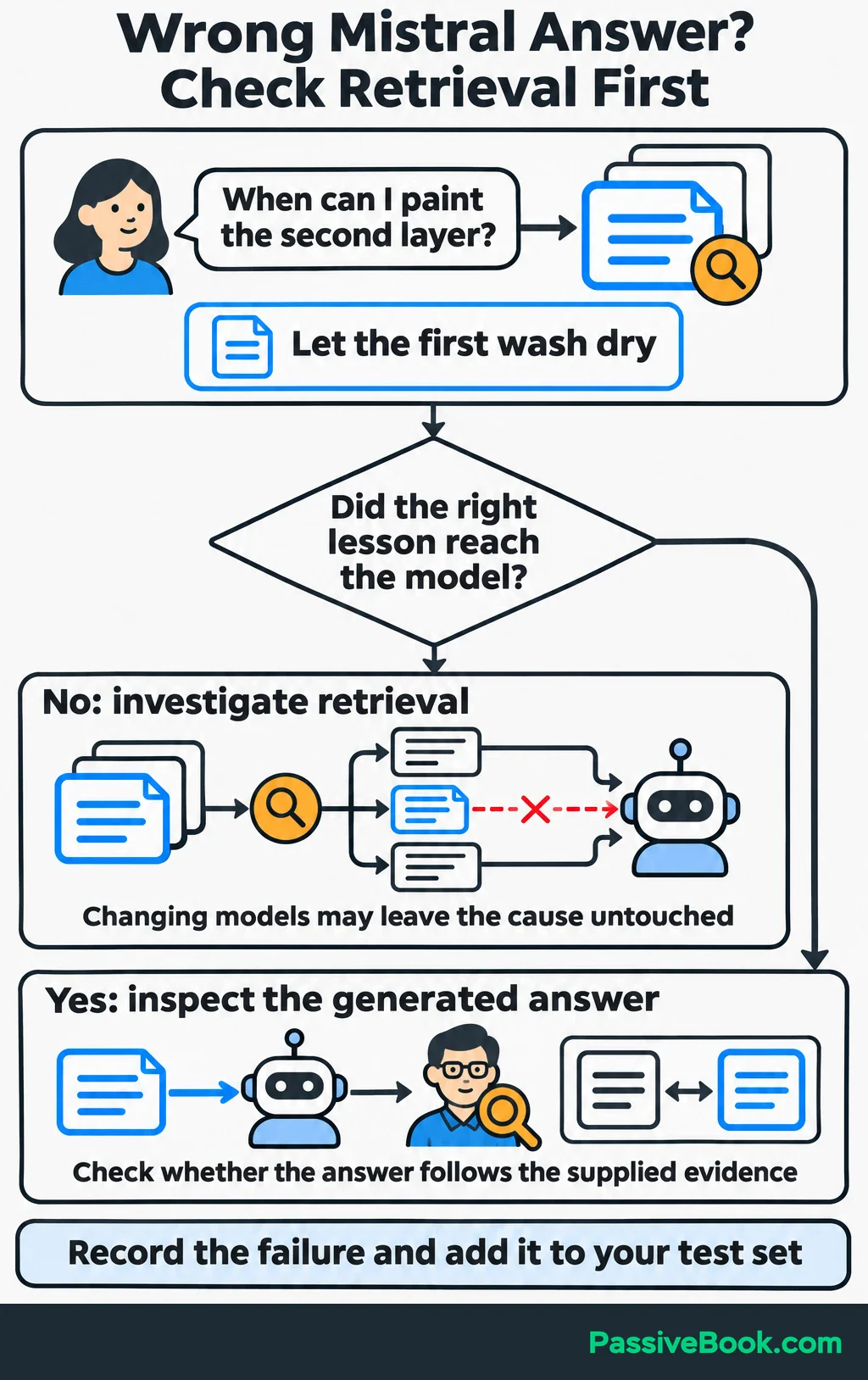
| “When can I paint the second layer?” | Use the relevant lesson and give a supported answer |
| “This screenshot says damp, but another lesson says dry. Which applies?” | Identify the stages involved or ask for missing context |
| “Why did this happen?” with no image or description | Ask a useful clarification question |
| “Can you critique this technique that the course never covers?” | Acknowledge the gap and route for help |
| “I paid, but the lesson is locked.” | Route to account support without inventing payment information |
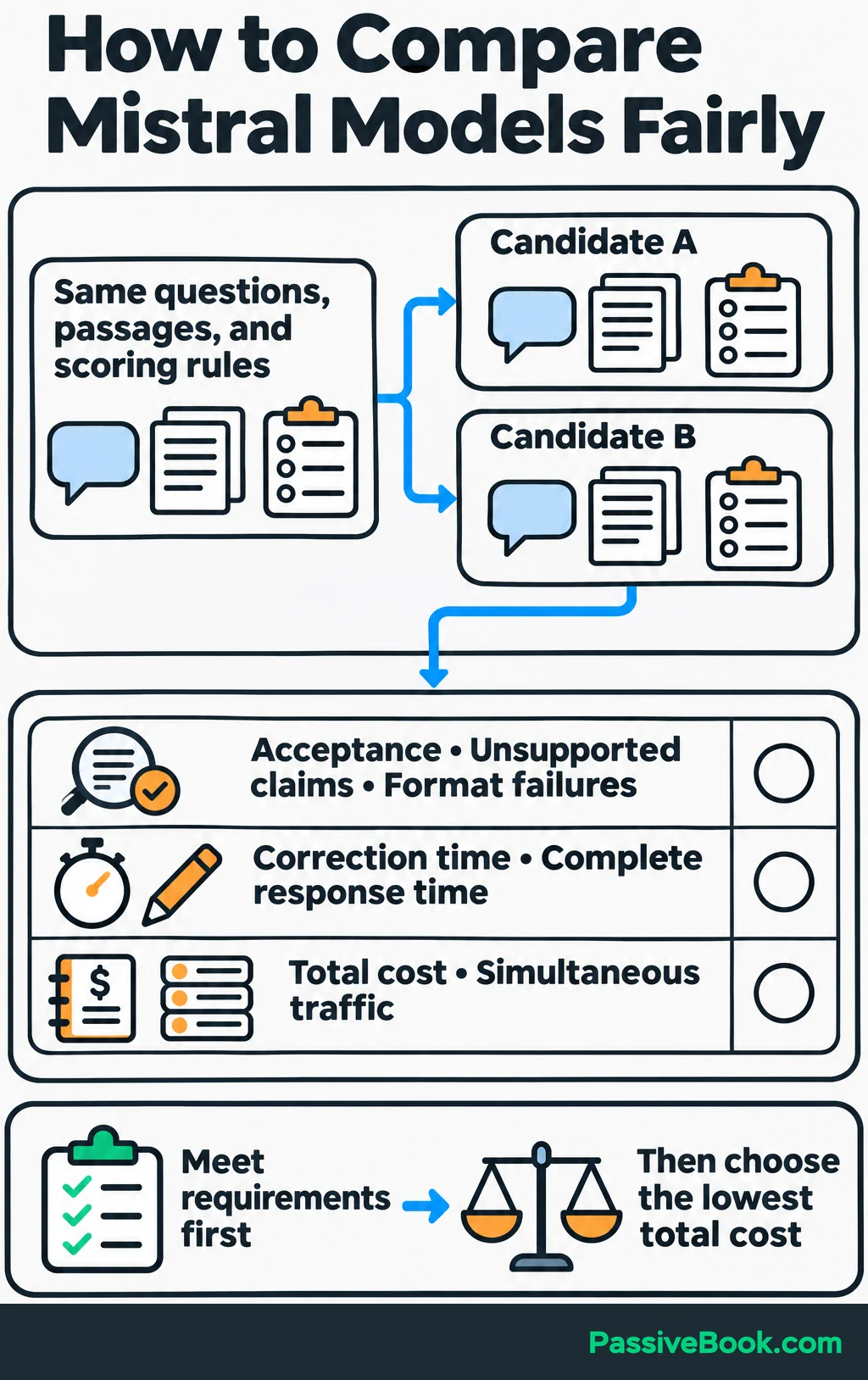
Record acceptance, unsupported statements, format failures, correction time, complete response time, and total cost. Test expected simultaneous traffic as well as individual requests.
Published benchmarks help identify candidates, but they use particular tasks and conditions. Your application earns its choice by passing your test.
The watercolor questions show the pattern, but your workflow needs its own test cases. This AI Skill drafts the requests and passing criteria so you can compare candidates on the same material.

Free AI Evaluation Studio




I would choose the lowest-total-cost candidate that meets the requirements. If Large 4 saves enough correction work on difficult questions, its higher generation charge may be worthwhile. If it produces longer versions of equally acceptable answers, I would keep the cheaper option.
Also inspect retrieval failures. When the right lesson never reaches the answering model, changing models may leave the real problem untouched.
Connect the Selected Model to the Workflow
Build one complete path before adding more jobs:
Learner question
→ retrieve lesson passages
→ generate structured response
→ validate
→ create draft reply or escalation
Give the model clear task instructions, the relevant material, permitted output fields, and an output cap through a backend call.
Here is a compact illustrative test.
The learner asks:
“Can I add the second layer while the first wash still feels cool?”
The retrieved course passage says:
Lesson 2: “Let the first wash dry before painting the next layer. If it still feels cool, wait.”
An acceptable structured response could be:
{
  "category": "lesson_question",
  "answer": "Wait before adding the second layer. Lesson 2 says to let the first wash dry and to wait if it still feels cool.",
  "lesson_references": ["lesson_02"],
  "needs_human": false
}
Your application should check the structure, confirm that lesson_02 was supplied, and verify that the answer follows the passage. A valid lesson identifier alone does not prove a correct answer.
I learned the value of clear handoffs while building my Python content pipeline. Generated drafts could arrive successfully and still leave me sorting where they belonged and whether they were ready for review. Adding a destination and review status made the next step easier to automate. I would apply that same discipline here: every answer needs a clear destination and a clear review decision.
An automation tool such as n8n can connect intake, retrieval, model calls, and the review queue. Start with that single path and add branches only when a real requirement appears.
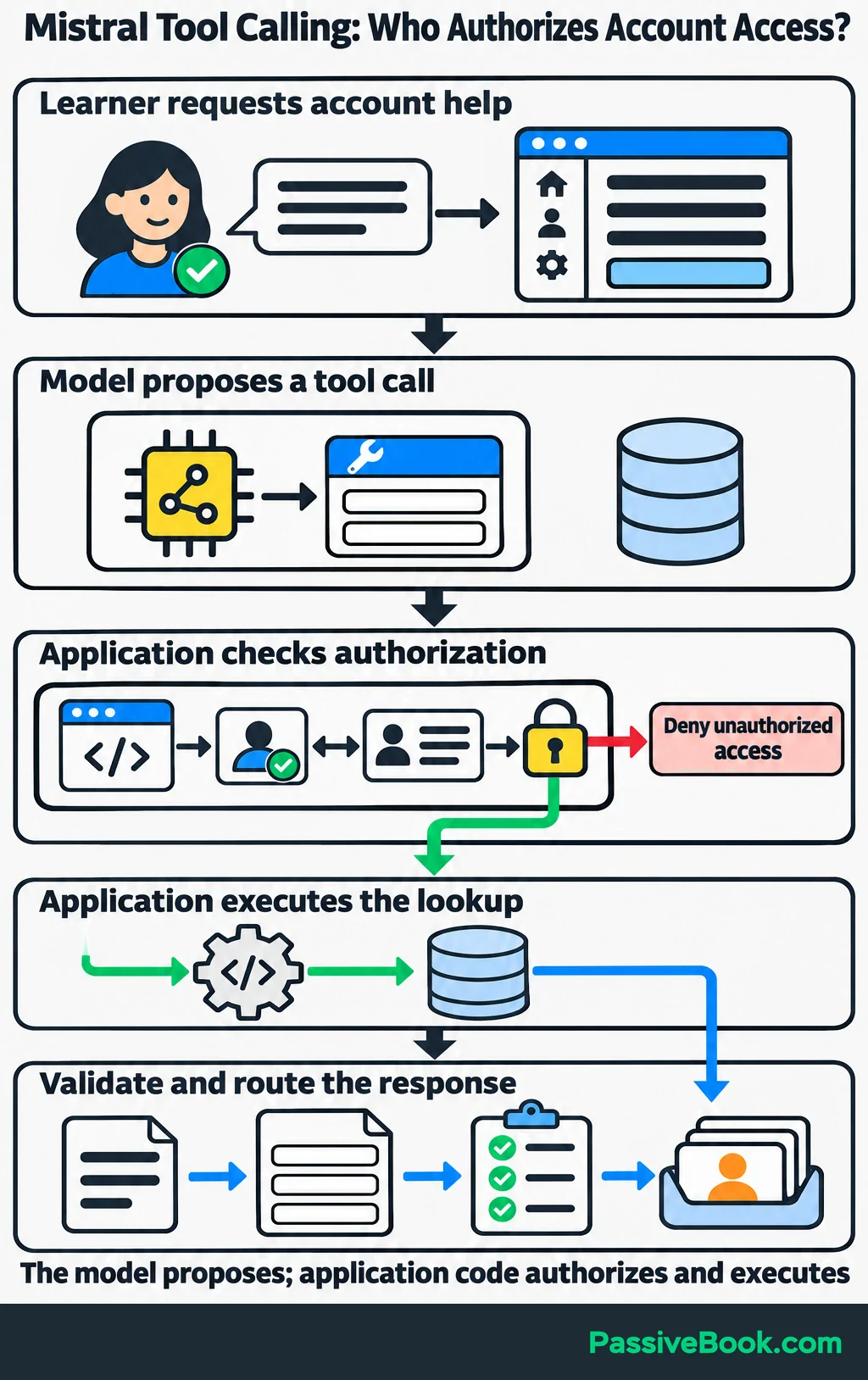
For account lookups, give the model a narrow permitted function. The model proposes the call and arguments; application code checks authorization and executes it, then returns the result. That follows Mistral’s function-calling process. Let the application establish which account belongs to the learner.
Begin with reviewed drafts. Expand automatic delivery only for request types that meet your acceptance standard, and retain an escalation route.
Before increasing traffic, add:
- Failure Handling: Timeouts, bounded retries, and a fallback queue when the service fails.
- Usage Records: Model identifier, settings, token use, response time, and review outcome, with appropriate handling of personal data.
- Capacity Checks: Request limits and token limits for the chosen account and endpoint.
- Repeat Evaluation: Rerun the test set when the model, prompt, retrieval process, or provider changes.
Keep your lesson material and evaluation set outside provider-specific features where practical. That gives you something concrete to reuse when you need to change models.
What Next?
Collect ten real requests from a workflow you want to automate and write down what would make each answer acceptable. Use those requests to compare two suitable candidates before building the full system.
Use the social buttons to share this guide when model names are getting in the way of a practical automation decision.
Which constraint will shape your choice most: answer quality, total cost, privacy, or local hardware? Share your reasoning in the comments, and bring any other questions there too.
Share this post with your friends & followers:

