An AI tool writes a polished customer reply in seconds. But how did it choose those words, and can you trust the instructions it gives your customer?
That gap matters when you’re deciding what to automate. A reply can sound helpful while sending someone to a download page that doesn’t exist. Now the task you hoped to remove has created another support email.
You don’t need a machine-learning degree to judge that reply. Following one customer question through a language model will show you where its answer comes from, what can go wrong, and where your checks belong.
How Do Large Language Models Work?
A large language model, or LLM, learns patterns during training and uses the information available to it to predict the next token. A token is a small unit of text. Repeating that prediction process builds a response.
Here’s the path:
Prompt → tokens → numerical representations → contextual processing → next-token prediction → repetition → response
Underneath this process is a neural network: layers of numerical operations with adjustable values called parameters. Training changes those values. A parameter isn’t a fact stored in a numbered drawer; many parameters work together to shape a prediction.
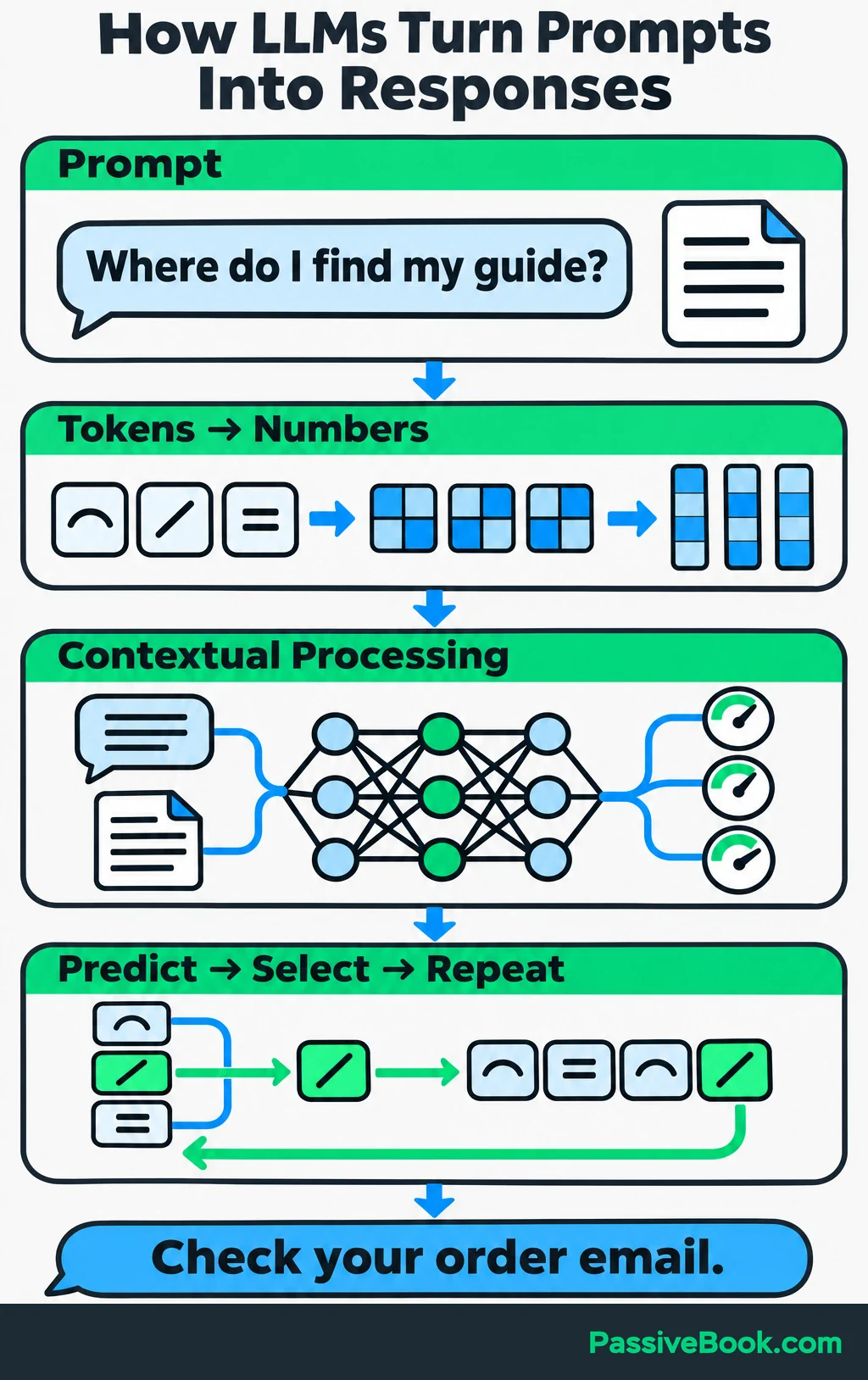
“Large” refers to the model’s scale, including its many learned parameters. This guide follows the Transformer models that generate text from preceding text. This way of generating a sequence is called autoregressive generation.
A few related terms help put LLMs in place:
| Term | What It Means |
|---|---|
| AI | The broad field of building systems that perform tasks associated with intelligence. |
| Machine learning | Methods that learn patterns from data instead of relying only on hand-written rules. |
| Deep learning | Machine learning that uses neural networks with many layers. |
| Generative AI | AI that produces content, such as text, images, or audio. |
| Generative LLM | A language model that produces text, including code. |
ChatGPT is an application you interact with, while language models power its responses. The application adds the chat interface and can connect models to tools such as search. You can use it by writing ordinary instructions without coding.
Throughout this guide, imagine you sell a downloadable beginner watercolor guide. We’ll follow one question: “Where do I find my guide?”
How Are Large Language Models Trained?
Training builds the model’s general abilities before you ask it that customer question. It has two broad jobs: learning patterns and shaping how the model responds to requests.
Pretraining Learns Patterns From Text
Pretraining uses large collections of text, sometimes including code. The exact mixture depends on the model.
For next-token training, the text itself supplies the exercise. The model receives preceding text and predicts what comes next, and the training process compares its prediction with the token that actually follows.
This is self-supervised learning: people don’t have to label every prediction because the training material provides the target.
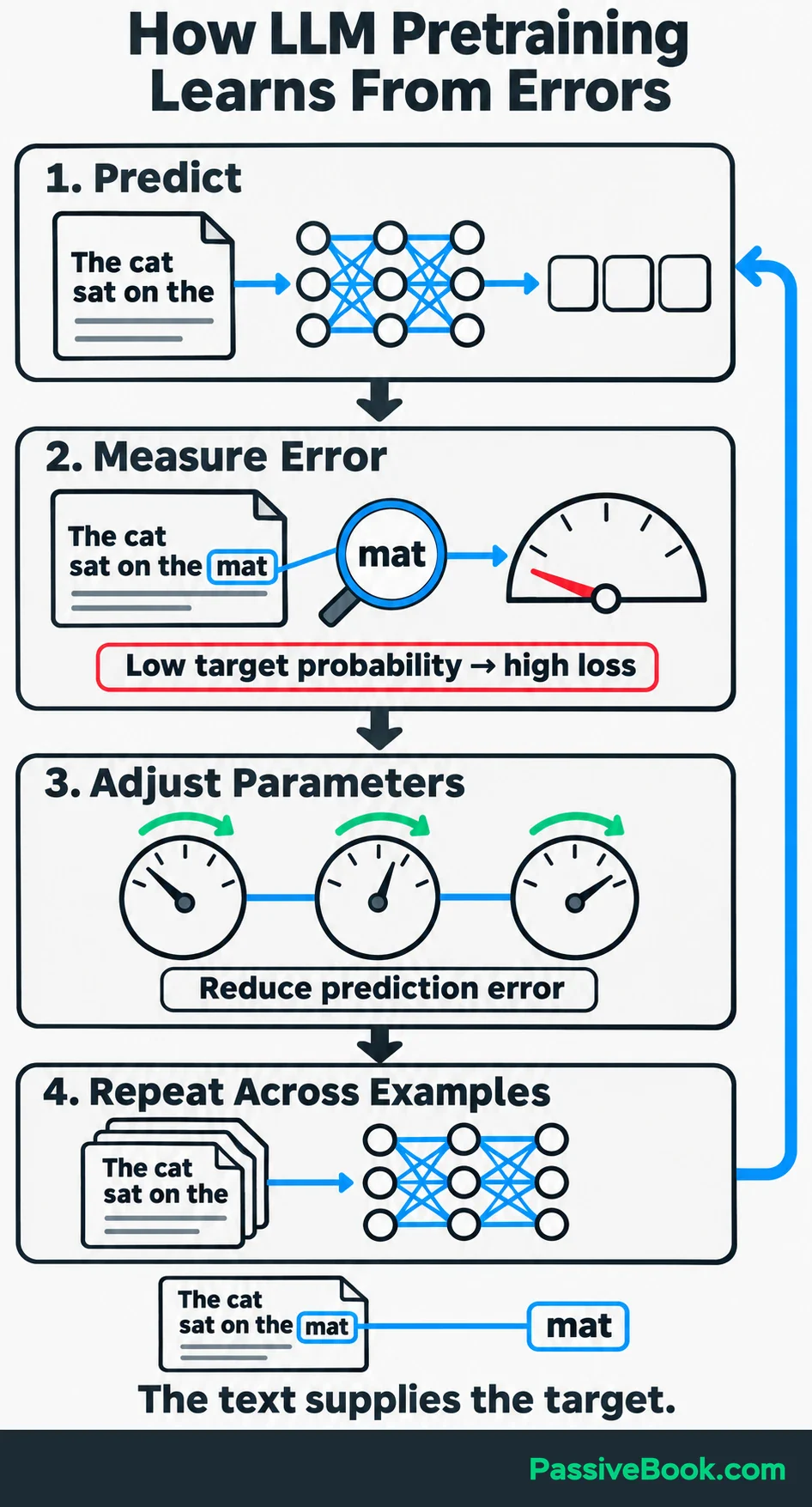
The learning loop works like this:
- The model predicts the next token.
- A loss function calculates an error score. If the model assigned a low probability to the actual next token, the error is high.
- The training system adjusts parameters to reduce that error.
- The process repeats across many examples.
Across these examples, the model learns patterns involving grammar, facts, writing styles, and relationships between ideas. Those patterns help it respond to inputs it hasn’t seen before and create new combinations of text.
Some training material can also be memorized. But you shouldn’t treat the model as a complete archive that can reliably retrieve every document it encountered.
For your watercolor shop, pretraining may give the model useful patterns for answering questions about digital downloads. It doesn’t establish your delivery policy.
Post-training Shapes Useful Responses
Continuing a piece of text and following a customer-service instruction are different jobs.
Supervised instruction tuning gives a pretrained model further examples of requests and desirable responses. These examples help shape behavior such as answering a question directly or following a requested format.
Preference-based training adds another signal: which responses are judged better. One approach is reinforcement learning from human feedback, or RLHF. The InstructGPT research used demonstrations of desired responses, followed by training informed by rankings of model outputs.
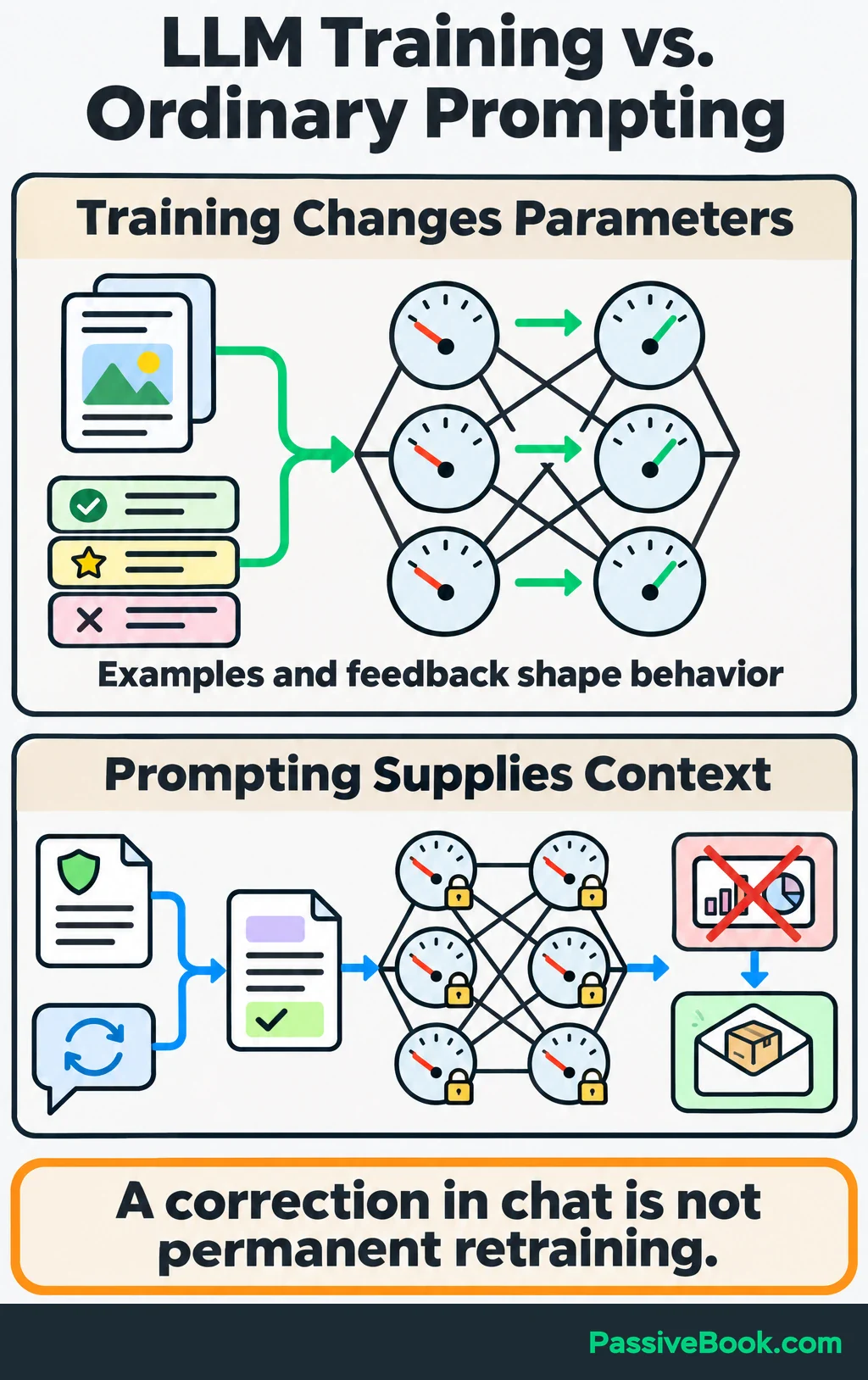
Methods vary between models. Preference training can encourage helpful behavior, but it doesn’t guarantee that an answer is true.
There’s also a practical distinction between training and prompting. Training changes parameters; an ordinary prompt guides the existing model without changing them.
If you correct a reply, the model can use that correction while it remains in the conversation’s context. That doesn’t mean you have permanently retrained it.
For a simple delivery-policy question, I would supply the policy in the prompt before considering any custom training. It’s a smaller job, and the information you need is already available.
How Does a Prompt Become a Response?
A prompt contains the instructions and input supplied to the model. Running an already-trained model is called inference.
Let’s follow what happens when you ask it to draft the watercolor shop’s reply.
Tokenization Turns Text Into Numerical Representations
The model needs numbers it can process, so the text first passes through a tokenizer.
A tokenizer divides text into units that may represent whole words, word fragments, punctuation, or other characters. Each token has a numerical ID. A word can span several tokens, so token counts and word counts aren’t interchangeable.
An embedding layer then maps those IDs to vectors: lists of numbers used in the model’s calculations. Information about position helps the model account for the order of the tokens.

Conceptually, the conversion is:
Text → token IDs → numerical vectors
Your input includes both the source information and the customer’s question:
Policy: The watercolor guide is a PDF download. The download link appears in your order email.
Customer: Where do I find my guide?
Both pieces become tokenized input. The model can now process the question alongside the policy instead of relying only on general patterns about online shops.
The Context Window Limits the Available Information
Context is the information available for the current response. The context window limits how many tokens the model can consider at once.
Instructions, included conversation history, supplied documents, and generated text occupy that space.
Keep these two sources of information separate:
- Learned parameters: Patterns developed during training, such as how questions and answers are usually written.
- Current context: Information supplied for this response, such as your watercolor guide’s delivery policy.
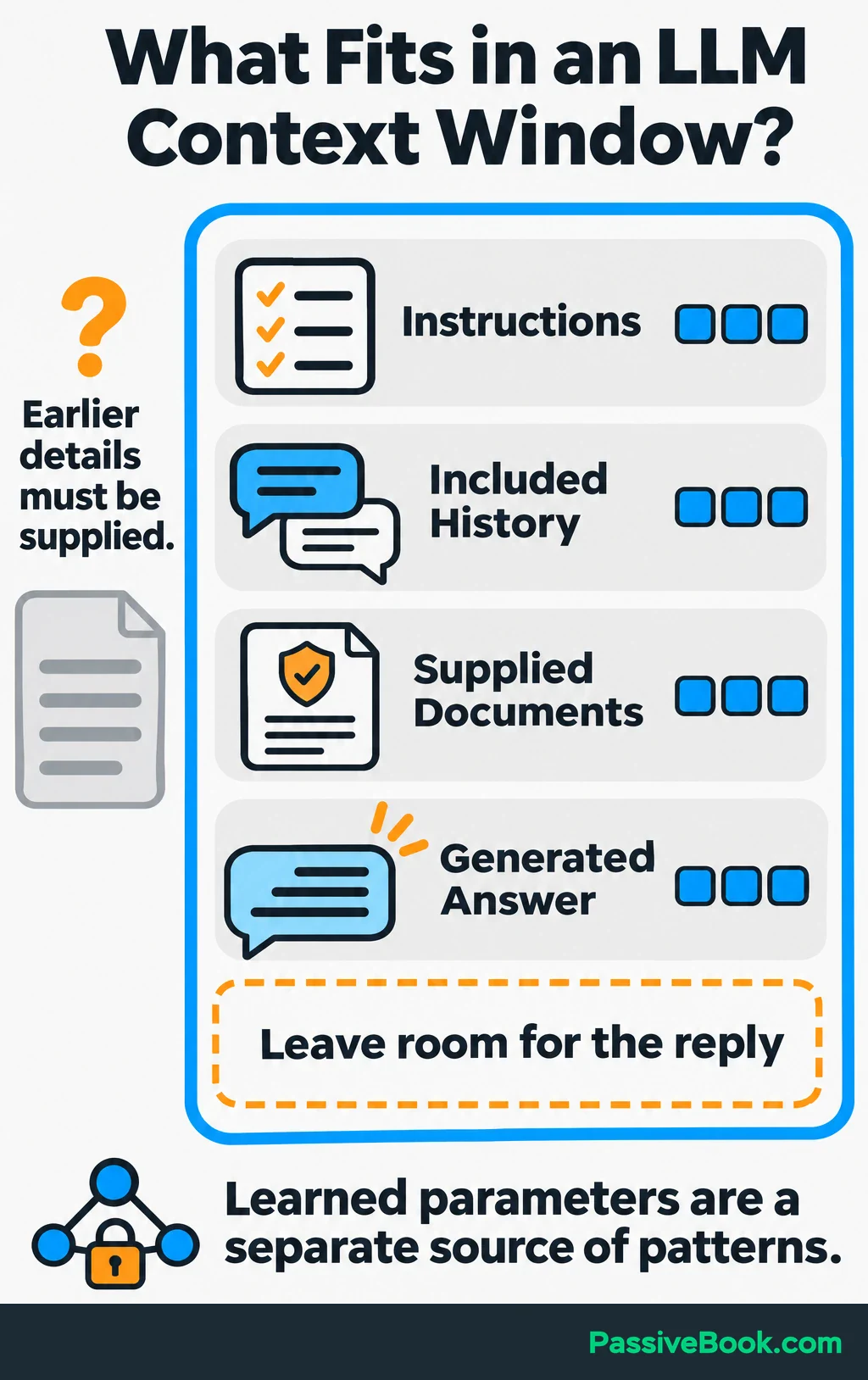
General training doesn’t give the model access to your private order records. If the customer asks whether their payment succeeded, the policy above cannot answer that question.
Conversation continuity also depends on what the application supplies in later requests. That may include previous messages, a summary, or stored information. Keep essential rules available and leave space for the answer rather than assuming every earlier detail will always carry forward.
For larger collections of business documents, a system can retrieve relevant material before asking the model to respond. This is called retrieval-augmented generation, or RAG.
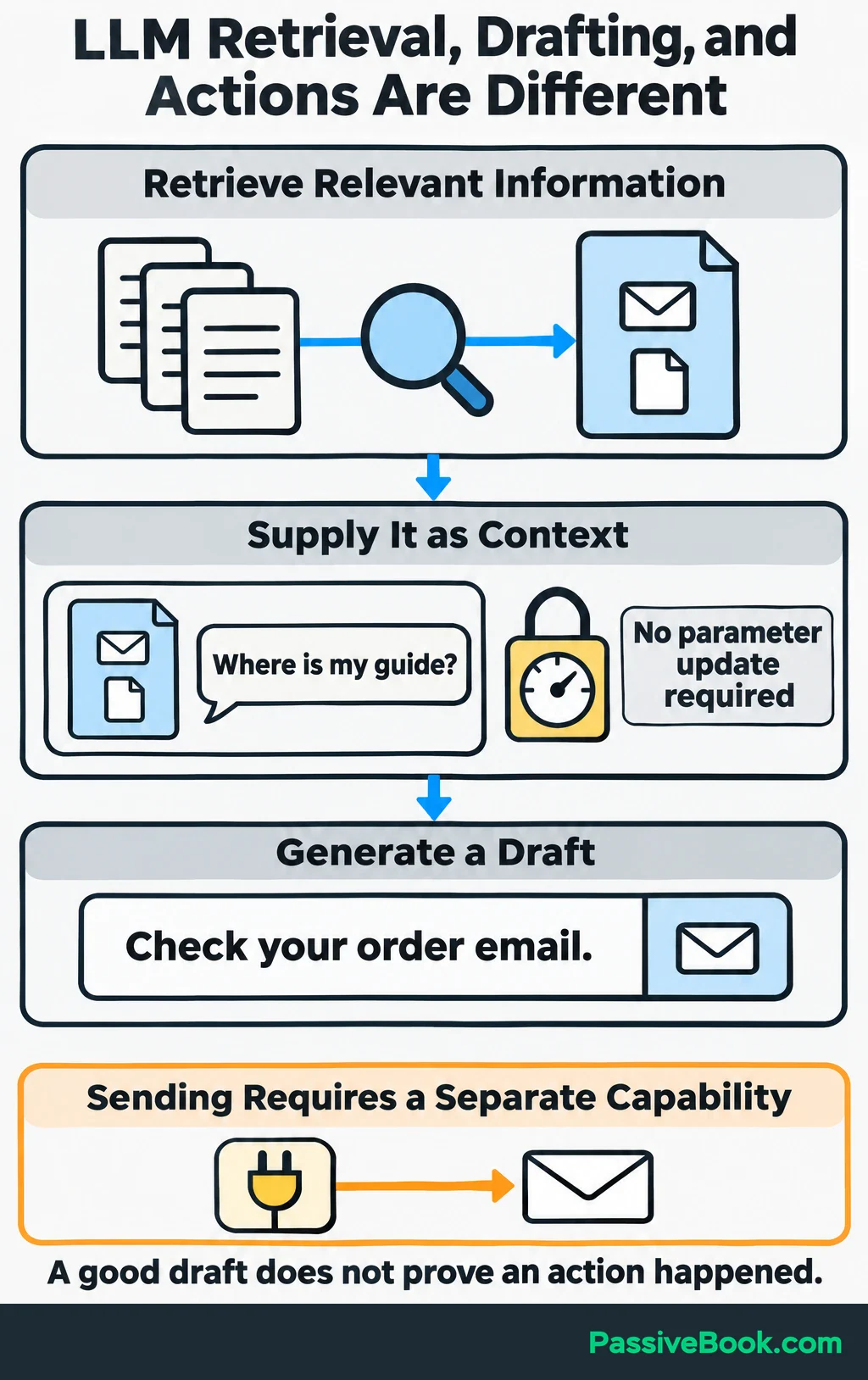
In your shop, it could find the delivery policy and supply that passage with the customer’s question. RAG combines model knowledge with retrieved information; supplying a document this way doesn’t require changing the model’s parameters.
Tools add separate capabilities. Search retrieves information, a calculator computes results, and an email integration can send a message. Writing a reply alone doesn’t send it or change an order.
That distinction matters when choosing automation software. A good draft and a completed business action are separate things to check.
Transformer Layers Connect the Context
A Transformer is a neural-network design that processes token representations through repeated layers.
One key mechanism is self-attention. For each token, it calculates how strongly to draw on information from the available tokens.
In the autoregressive model described here, each token can draw on itself and earlier tokens. A rule called causal masking blocks access to later tokens. The original Transformer paper describes this mechanism, along with embeddings, position information, and the other layer components.
For the shop’s question, the supplied policy gives the model information that can connect “my guide” with the watercolor PDF and its order email.
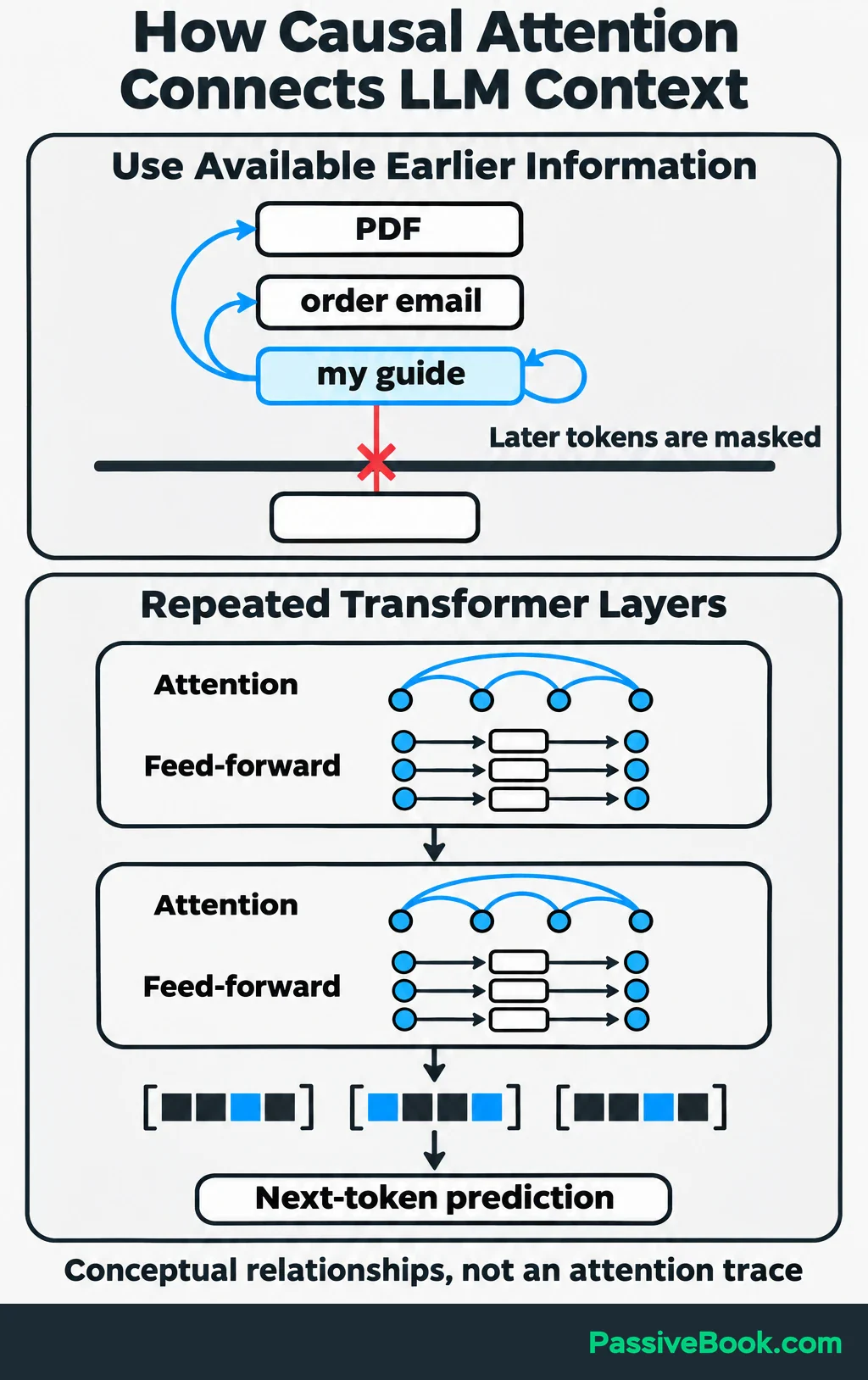
That illustrates a useful relationship in the input. It doesn’t show the actual attention calculations of a particular model.
Attention is also a numerical mechanism, not human concentration. There isn’t a tiny support agent inside the computer deciding to read the policy more carefully.
Feed-forward layers perform further transformations on each position’s representation using learned parameters. Repeating these operations across layers builds representations that reflect the surrounding context.
Those representations are then used to predict what comes next.
Next-token Prediction Builds the Response
The model produces scores for possible next tokens, and those scores are converted into probabilities.
A decoding method selects a token. It might choose the highest-probability option or sample from the possibilities, allowing some variation.
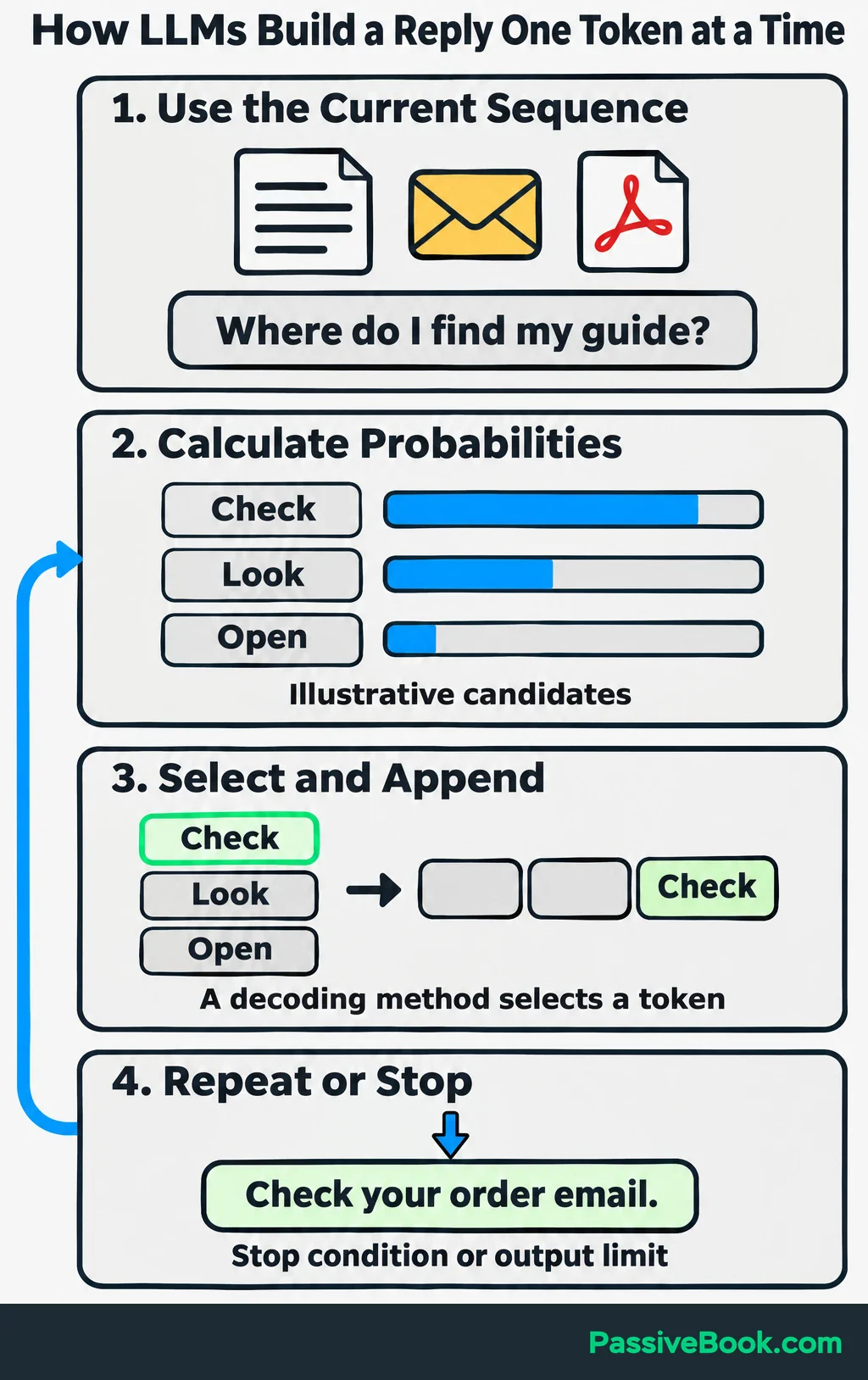
The selected token joins the sequence, and the model predicts the next one using the available input and what it has generated so far. This repeats until it reaches a stopping condition or an output limit. The generated token IDs are decoded into readable text.
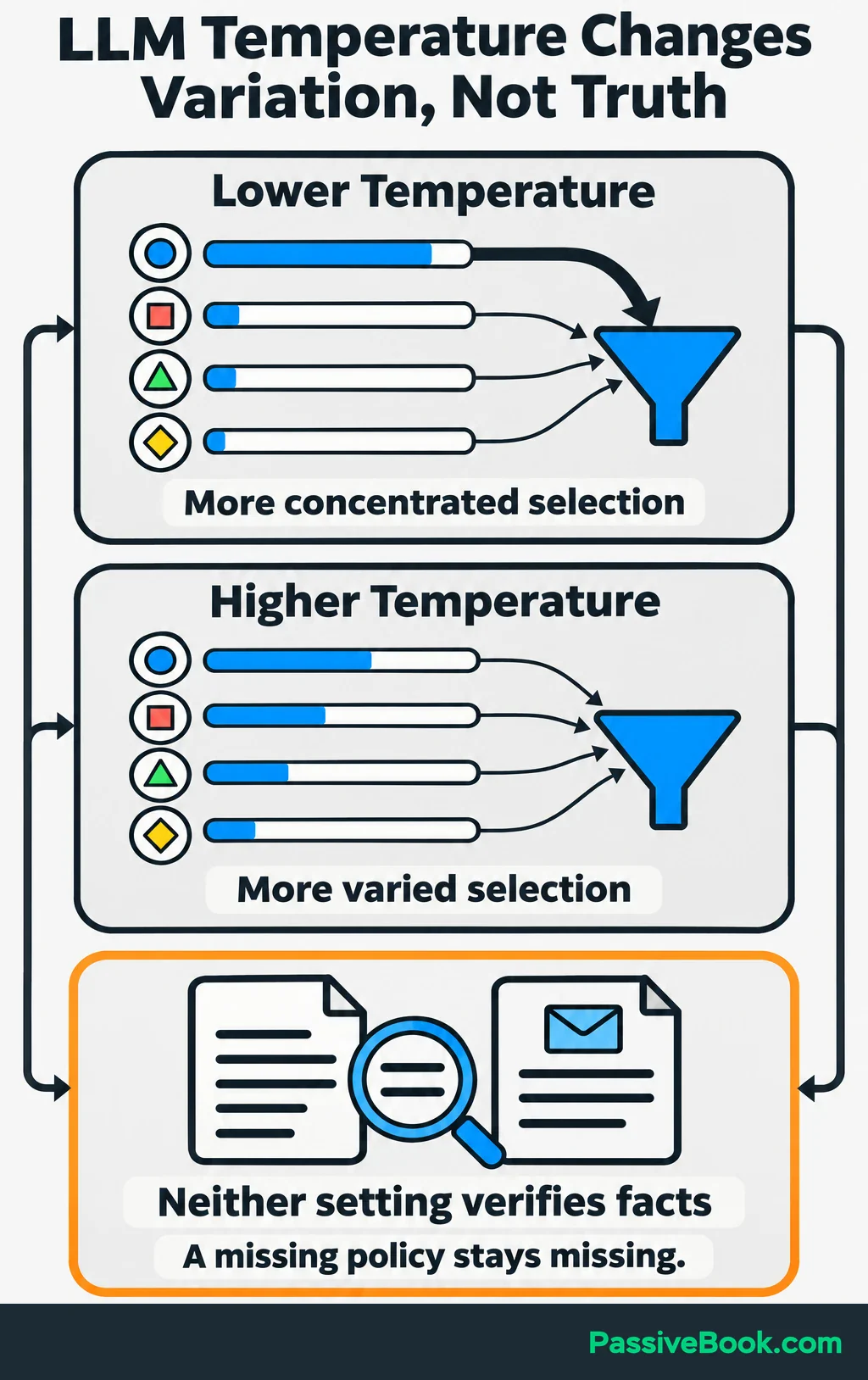
One sampling control you may encounter is temperature. Lower values concentrate selection toward more likely tokens, while higher values allow more variation. Hugging Face’s generation reference documents this control.
Temperature doesn’t check facts. Turning it down won’t turn a missing delivery policy into a known one.
An illustrative completed reply is:
Check your order email for the link to download your watercolor guide as a PDF.
That sentence develops through successive token selections. Each selection uses the preceding sequence, including the supplied policy and the reply generated so far.
The useful result is a sentence that correctly applies your policy. Its fluent wording is only part of the job.
Why Can a Fluent Answer Still Be Wrong?
A model can produce false or unsupported content that sounds completely reasonable. These errors are commonly called hallucinations.
NIST describes this failure as confabulation: generated content can be confidently presented even when it is false or contradicts the input. Predicting plausible text doesn’t automatically verify each statement against an authoritative source.
Consider this reply to the same customer question:
Log into your account dashboard to download the guide.
It sounds like normal customer support. But the supplied policy says the link appears in the order email, and it says nothing about an account dashboard.
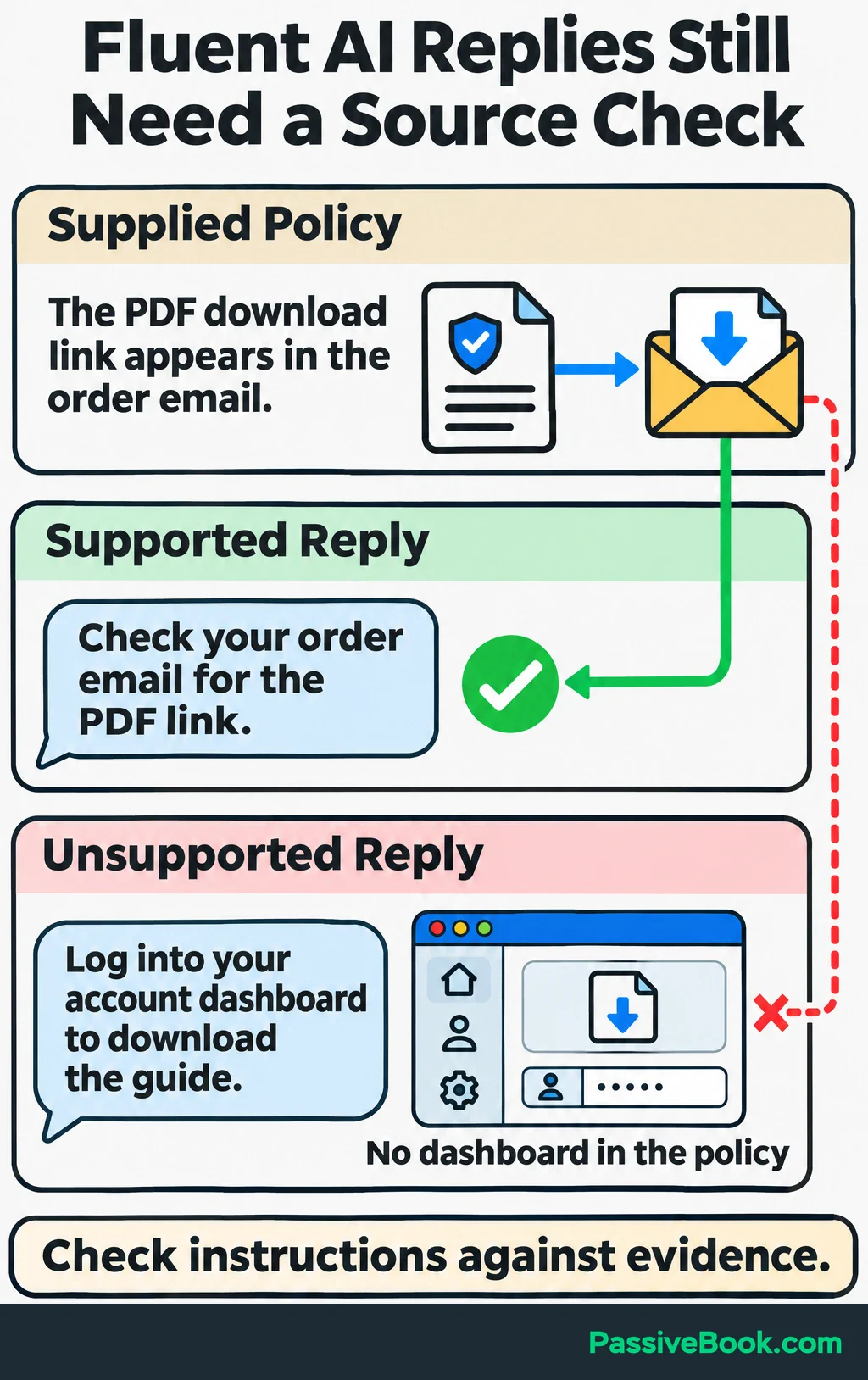
The extra instruction is unsupported. Your customer could waste time looking for an account you never asked them to create.
Errors can also come from the information supplied to the model. An outdated policy can lead to an outdated reply, and training data or source material can contain mistakes and biased assumptions.
I judge this kind of output against the source, not against how professional it sounds. For the shop, the question is concrete: does the reply direct the customer to the order email without adding a delivery method?
Humanlike wording doesn’t establish humanlike understanding. Models can interpret context and perform useful language tasks, but you still need evidence that they applied the right information.
How Can You Use an LLM More Effectively?
Start with a task whose result you can inspect. Drafting a reply from a short policy is a better first test than allowing a system to handle every support request.
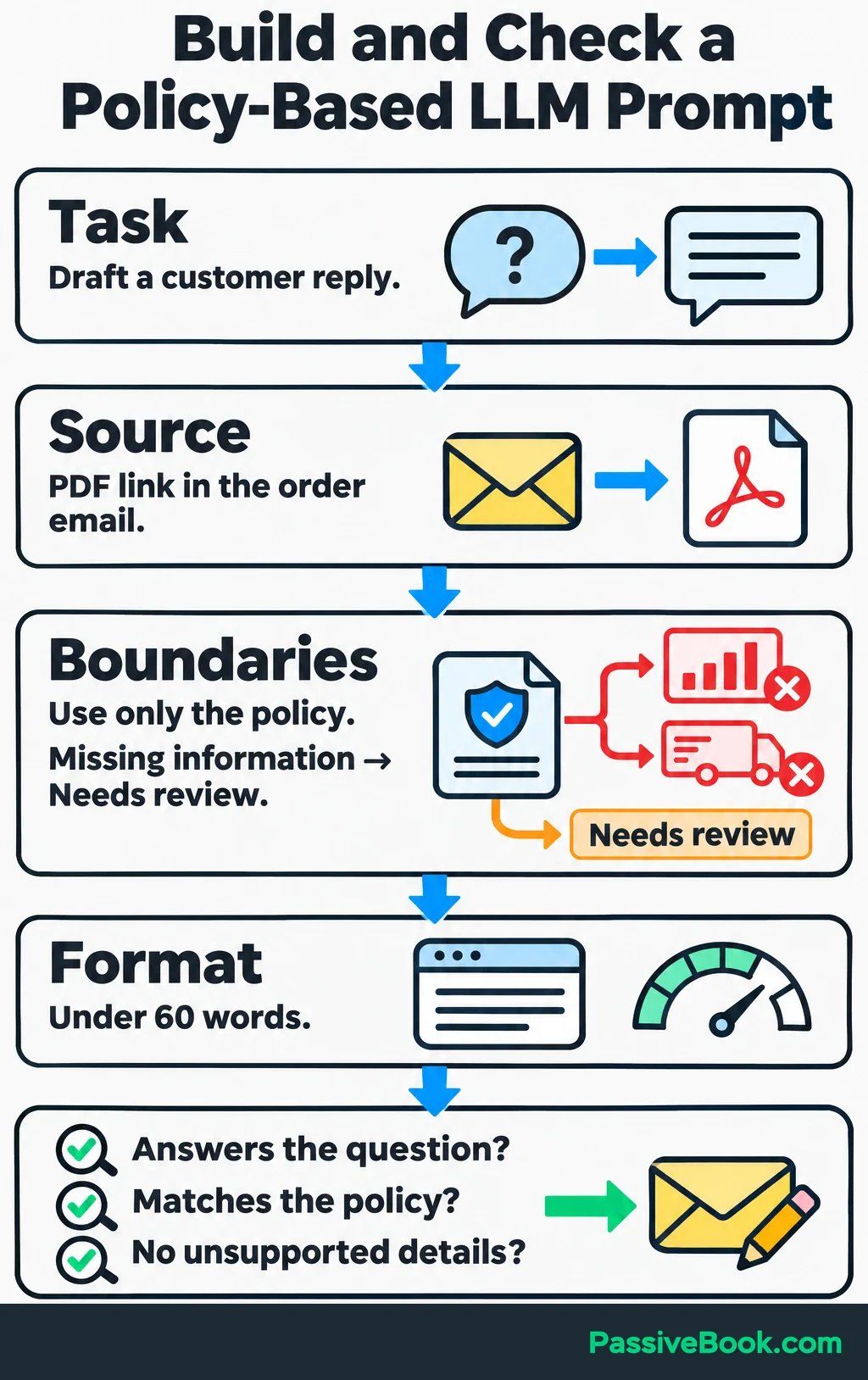
Give the model four things:
- Task: The specific result you want.
- Source: The information it should use.
- Boundaries: What it must avoid and when it should flag a gap.
- Format: The length or structure you need.
For the watercolor shop, that becomes:
Draft a customer reply under 60 words using only the policy below. Do not add download methods, delivery promises, or account instructions. If the policy does not answer the question, write “Needs review” and briefly state what information is missing.
Policy: The watercolor guide is a PDF download. The download link appears in the order email.
Customer: Where do I find my guide?
You can use that structure across chat tools. I use Claude for long-form writing and ChatGPT for quick general tasks, but I would test this workflow in one tool you already have before buying another subscription.
Before using the draft, check three things:
- Does it answer the customer’s actual question?
- Does every instruction agree with the policy?
- Has it added a promise or detail that the source doesn’t support?
If the customer instead asks, “Can you resend the link to a different email address?”, the supplied policy doesn’t settle that request. Route it for review. A prompt can tell the model how to handle missing information, but you still need to check whether it follows that rule.
You don’t have to write those drafting and review instructions from scratch. Start with a ready-made workflow in the AI assistant you already use.
Free AI Business Workflow Library




I learned to pay attention to this gap while building my custom AI content pipeline. Early drafts could look finished because the sentences flowed, but comparing them with the brief still exposed missed instructions. That made the review step part of the workflow instead of an optional tidy-up.
Protect the input as well as checking the output. Remove customer details the task doesn’t need, and check the service’s data-use, retention, and access terms before submitting confidential material. NIST’s privacy discussion explains why sensitive information requires care.
For the example question, the model needs the policy and the question. It doesn’t need the customer’s billing address.
Finally, count review and correction time when deciding whether to automate. Compare the whole process with doing the task manually. If a draft takes more effort to repair than to write, change the task or the prompt before adding another tool.
I would keep customer replies as drafts while testing, then consider automatic sending only for narrow cases that consistently pass review. Automation repeats the workflow you give it, including the parts you haven’t checked.
What Next?
Take one short policy from your business and ask an LLM to draft an answer to a common question using only that text. Compare every instruction in the reply with the source.
Use the social buttons to share this guide when a discussion about AI needs a clearer way to judge its answers.
Which task would you trust an LLM to draft but still want to approve yourself? Leave your answer, along with any other questions, in the comments.
Share this post with your friends & followers:

