I wasted six months creating an online course nobody wanted. I had convinced myself the idea was brilliant because a few friends said “cool concept.”
Zero market research. Zero customer conversations. Just me, my laptop, and misplaced confidence.
The wake-up call came when I launched to crickets. That failure taught me that validation isn’t optional. It’s the difference between building something people pay for versus something that sounds good in your head.
This guide walks you through seven low-cost methods to validate your niche before you waste a single evening building. Five methods are completely free. The other two cost under fifty dollars total.

- •What Niche Validation Actually Means
- •Why Solopreneurs Skip Validation
- •How to Use These 7 Validation Methods
- •1. Mine Reddit and Online Communities for Repeated Pain Points
- •2. Run a $0 Landing Page Experiment in 48 Hours
- •3. Conduct 10 Customer Interviews During Your Lunch Breaks
- •4. Test Search Demand With Free Keyword Research Tools
- •5. Pre-sell Your Offer Before Building Anything
- •6. Launch a 7-Day Content Sprint to Measure Engagement
- •7. Track Competitors to Prove People Already Pay
- •How to Know If You've Found Real Demand
- •Red Flags Your Niche Won't Work and When to Pivot
- •What to Do After Validation
- •Frequently Asked Questions
- •What Next?
What Niche Validation Actually Means
When you validate your niche, you’re testing whether real people will pay to solve a specific problem before you build anything. It’s not about proving your idea is clever or that people find it interesting. It’s about confirming strangers will open their wallets.
Most solopreneurs confuse interest with intent. Someone saying “that’s a great idea” at a coffee shop doesn’t validate anything. What validates is when they ask “how much does this cost?” without prompting.
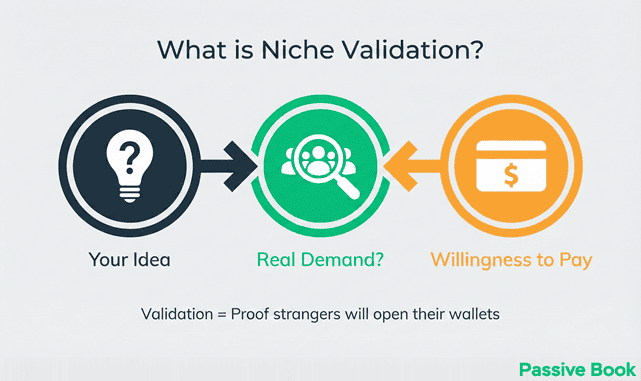
I learned this the hard way when friends told me my course was “interesting” but nobody’s credit card came out.
The stakes are high. Research shows that 20% of small businesses fail in their first year. They built solutions for problems that didn’t hurt enough or markets that didn’t exist.
True validation answers three questions. Does the problem exist? Do people currently pay to solve it? Will they pay you to solve it? Everything else is just noise.
Why Solopreneurs Skip Validation
I skipped validating my niche because I was excited. The dopamine hit from building something new felt more rewarding than the boring work of asking questions and analyzing data.
That’s the trap most solopreneurs fall into.
The vast majority stay stuck because excitement overrides research discipline. They fall in love with their solution before confirming anyone has the problem.
Corporate professionals transitioning to solopreneurship face a specific pitfall. Launching services nobody asked for is their top failure mode. They bring corporate thinking to small business and build for imagined customers instead of real ones.
Social media creates another validation illusion. Research confirms that Facebook likes are not correlated with business engagement. Data analysis of thousands of Facebook business pages found zero correlation between like counts and customer engagement or sales.
A post getting 200 likes means nothing. What matters are comments asking about pricing or expressing frustration with current solutions, not “that’s cool” responses.
The pattern repeats across industries and business models. Solopreneurs skip validation, build for months, launch to silence, then wonder what went wrong. The answer is always the same. They never confirmed real demand.
How to Use These 7 Validation Methods
Running all seven methods to validate your niche is overkill. You’re already time-starved, juggling your day job and trying to build something on the side.
Trust me, I’ve tried doing everything at once, and it’s a recipe for burnout, not validation. The goal is confidence, not perfect data.
Start with Methods 1 and 4. Reddit community mining and keyword research. These require 2-4 hours total and zero budget. They tell you if demand exists and whether people are searching for solutions.
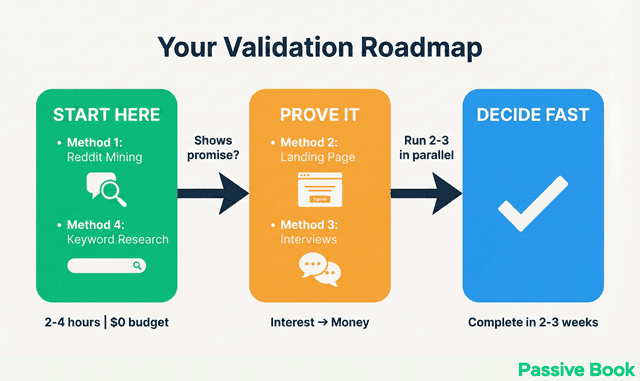
If those two show promise, move to Methods 2 and 3. A landing page experiment and customer interviews prove willingness to pay. This is the critical validation gate. People expressing interest versus people committing money.
Run 2-3 methods in parallel to complete validation in 2-3 weeks, not sequentially over months. Your constraint is time, so compress the timeline. Test fast, decide faster.
Let’s start with the fastest free method.
1. Mine Reddit and Online Communities for Repeated Pain Points
Reddit is a goldmine when you need to validate a niche because people complain freely about their problems. They don’t sugarcoat frustrations or pretend solutions work when they don’t. It’s raw market research you can access in your lunch break.
Chris Bressler used this exact strategy. He posted his Excel formula generator idea on Reddit‘s r/Excel and received 10,000+ upvotes. That overwhelming response validated massive demand.
Within three months of launch, he reached $4,200 in monthly recurring revenue (MRR) and surpassed $30,000 in total sales. That overwhelming validation response turned a Reddit post into a sustainable SaaS business.
Look for complaints mentioned 15+ times across different threads and users. One person complaining is an outlier. Fifteen people describing the same frustration is a pattern worth solving. Focus on recurring pain points about existing solutions, not theoretical problems.
Pay attention to questions with 100+ upvotes. High upvote counts signal problems worth solving with paid solutions. These aren’t casual curiosities. They’re pain points that resonate across the community.
Search your target subreddit for keywords like “frustrated,” “waste of money,” “doesn’t work,” and “alternative to.” These phrases reveal dissatisfaction with current options. That dissatisfaction is your opportunity.
2. Run a $0 Landing Page Experiment in 48 Hours
The fastest way to test if people will take action on your idea? A simple landing page.
A landing page helps you validate your niche idea and test whether people will convert from visitors to interested prospects. It’s not about building a perfect website. It’s about creating a simple page that describes your solution and captures emails from interested people.
One entrepreneur validated their startup idea with just a landing page and signup form. They got 100+ signups in 72 hours, which proved the concept before building anything. Those signups became their first customers.
Use free tools to build this fast. Mailchimp’s free landing page builder includes built-in email capture. WordPress.com offers free landing page templates.
I’ve built validation landing pages in under an hour while my coffee got cold. Both options require zero coding skills and zero budget.
Your landing page needs three elements. A headline stating the problem you solve, two paragraphs explaining how you solve it, and an email signup form. That’s it. Don’t overcomplicate with fancy design or lengthy copy.
Drive traffic through targeted communities where your audience hangs out. Post in relevant subreddits, Facebook groups, or LinkedIn. Frame it as seeking feedback, not selling. Most communities allow this if you’re genuine.
Industry data shows that conversion rates of 2-5% are healthy benchmarks for landing pages. If you’re seeing 10%+ conversions from cold traffic, that signals strong demand. Anything under 1% means your message isn’t resonating or the problem isn’t urgent enough.
Track your conversion rate daily. If 100 people visit and 3 sign up, that’s 3%. If 100 visit and 15 sign up, you’ve found something real. The numbers don’t lie about whether your niche has genuine interest.
3. Conduct 10 Customer Interviews During Your Lunch Breaks
Customer interviews help you validate your niche in ways surveys can’t. People say one thing on anonymous forms and something completely different in conversation. A 15-minute call uncovers the real frustrations, the workarounds they’ve tried, and how much the problem costs them.
Want proof this works? Justin Jackson built Convertkit by conducting phone and Skype interviews asking two questions: “What’s your biggest struggle?” and “What have you tried?”
The patterns that emerged from those conversations shaped his entire product direction. Convertkit now generates over $29 million in annual recurring revenue.
Schedule 15-minute calls with potential customers. Reach out through LinkedIn, Twitter, or niche communities. Be direct: “I’m researching X problem and would love 15 minutes to hear about your experience.” Most people say yes if you respect their time.
Five people describing the same frustration validates better than 500 survey responses. You’re looking for pattern recognition. When person three uses almost identical words as person one, you’ve found something real.
Ask open-ended questions and shut up. “Tell me about the last time you dealt with X” works better than “Do you find X frustrating?” Let them talk. The best insights come when you’re listening, not pitching.
Listen for specific dollar amounts. When someone says “I’m currently paying $200 monthly for Y and it doesn’t even do Z,” that’s gold. They’ve revealed their budget, their pain point, and their willingness to switch.
4. Test Search Demand With Free Keyword Research Tools
If nobody’s searching for your solution, you’ll spend all your time educating the market instead of selling. Trust me, I’ve pushed that boulder. That’s uphill battle for solopreneurs with limited time.
Successful niche bloggers understand how to validate their niche before writing a single post. They use Ahrefs and keyword research tools to check monthly volume and competition before committing to content strategy. This validates demand before they create anything.
Look for 1,000-10,000 monthly searches for solopreneur niches. Tight niches with engaged audiences convert better than broad topics. A keyword with 5,000 searches and low competition beats 50,000 searches with saturated competition.
Use free tools to gather this data. Ubersuggest offers limited free searches daily. WordStream provides search volume estimates. Google Keyword Planner is free if you have a Google Ads account, even without running ads.
Check search trends over the past 12 months. Consistent or growing interest signals a sustainable niche. Declining search volume warns you to reconsider. You want to ride a wave, not fight against a current.
5. Pre-sell Your Offer Before Building Anything
Pre-selling is the ultimate way to validate your niche because it requires zero excuses. Someone either gives you money or they don’t. Everything else is just friendly encouragement that pays zero bills.
Nathan Barry used this strategy to launch Convertkit. He pre-sold the product to customers before building the full platform. Customer feedback and pre-sale commitments validated real problems, not imagined ones.
That early revenue funded development and proved market fit. Convertkit now serves over 35,000 creators.
Aim for at least $1,000 in pre-sales. That’s roughly 10-20 customers at fifty to one hundred dollar price points. This threshold proves strangers will pay, not just friends doing you a favor. Friends buy to support you. Strangers buy to solve their problem.
Create a simple offer document explaining what you’ll deliver and when. Be honest about timeline and features. Offer a discount for early buyers who take the risk with you. Deliver value even if the final product isn’t perfect.
Real payment commitments validate more than 1,000 “interested” email subscribers. Email lists are filled with tire-kickers. Pre-sale buyers are qualified leads who already trust you enough to pay. That’s the validation that matters.
Use payment tools like PayPal, Stripe, or Gumroad to collect money. Make the transaction real. Collecting emails with “I’ll pay when you launch” doesn’t count. Cash collected today validates. Promises to pay later don’t.
Pre-selling works best for services, software, and physical products. If you’re validating content like YouTube or podcasting, use Methods 1, 4, and 6 instead. Pre-selling a YouTube channel makes no sense, but measuring engagement on a 7-day content sprint does.
6. Launch a 7-Day Content Sprint to Measure Engagement
Want to know which topics resonate before committing to a full product build? Run a content sprint.
A content sprint helps you validate your niche by revealing which topics drive engagement before you commit to a full content strategy or product build. You’re testing messaging, angles, and whether your audience cares about what you want to sell them.
Jadah Sellner discovered which topics resonated by running a 7-Day Challenge model to boost lead generation. Daily content showed which topics resonated most with her audience. That data validated her niche focus before she built full products.
Post one focused piece daily on LinkedIn, YouTube, or your target platform. Each piece should address one specific pain point or solution related to your niche. Keep it short and valuable.
You’re testing, not perfecting. I’ve fallen into the perfection trap too many times, and it’s the enemy of validation.
Track engagement metrics that signal buying intent. Comments asking “how do I do this?” or “where can I learn more?” matter more than likes. Save counts on Instagram or bookmarks on Twitter show people plan to reference your content later.
Content triggering “how do I do this?” questions signals strong product-market fit. Those questions reveal pain points people want solved right now. They’re not casually browsing. They’re actively searching for solutions.
Compare engagement across all seven posts. The topics that generate the most questions and shares point to your strongest validation angle. Double down on those themes when building your offer.
7. Track Competitors to Prove People Already Pay
Competitor research is a validation shortcut. If others are successfully selling to your target market, you’ve confirmed people already pay for solutions. Your job becomes differentiation, not market education.
Research shows that 72% of successful niche businesses perform quarterly competitor research. Analyzing competitors validates that customers are paying for solutions in your space. This removes the biggest risk. Will anyone buy?
Identify 5-7 existing products or services successfully serving your target niche with consistent revenue. Look for active social media, regular content updates, or customer testimonials dated within the past six months.
When I first researched competitors, I made the rookie mistake of assuming dead websites meant opportunity. They usually just mean nobody cares. These signals confirm ongoing business operations.
No competition usually signals no market, not untapped opportunity. The “blue ocean” myth convinces solopreneurs they’ve found a secret goldmine. More often, the absence of competitors means the market doesn’t exist or can’t sustain a business.
Analyze competitor pricing to understand willingness to pay. If five competitors charge $50-100 monthly and have active customer bases, that’s your validated price range. Don’t try to undercut drastically. Match the market or differentiate on features.
Study their customer complaints through reviews, social media comments, and support forums. Where they fail becomes your differentiation opportunity. Look for three patterns: features customers request repeatedly, complaints about pricing or complexity, and problems marked “planned” but never shipped.
You’re not copying. You’re improving on validated demand with better execution.
How to Know If You’ve Found Real Demand
Signals that you’ve successfully validated your niche are easy to misread. Excitement feels like validation. Compliments feel like validation. But neither pays your bills or builds a sustainable business.
Real demand shows up in unprompted questions. When customers ask “when can I buy this?” without you pitching, that’s genuine demand. Unprompted enthusiasm about their current problems signals real validation, not polite interest.
Your landing page converting at 3%+ from cold traffic is another strong signal. These aren’t warm leads from your personal network. They’re strangers who found you, understood your offer, and took action. That conversion rate proves messaging resonance.
Listen for prospects sharing specific dollar amounts they currently pay. “I’m spending $300 monthly on X and it barely works” tells you three things: budget exists, pain is real, and switching motivation is high.
The pattern of frustration matters most. Ten conversations revealing the same core problem validates better than 100 survey responses saying “sounds interesting.” Pattern recognition across independent sources confirms you’ve found something real.
Track these signals in a simple spreadsheet. Date, source, exact quote, and signal type. When you hit 15-20 strong validation signals across multiple methods, you’ve done enough research. Time to build.
Red Flags Your Niche Won’t Work and When to Pivot
Some niches are doomed from the start. Recognizing fatal flaws early saves months of wasted effort. The hardest part is admitting your idea won’t work and moving on.
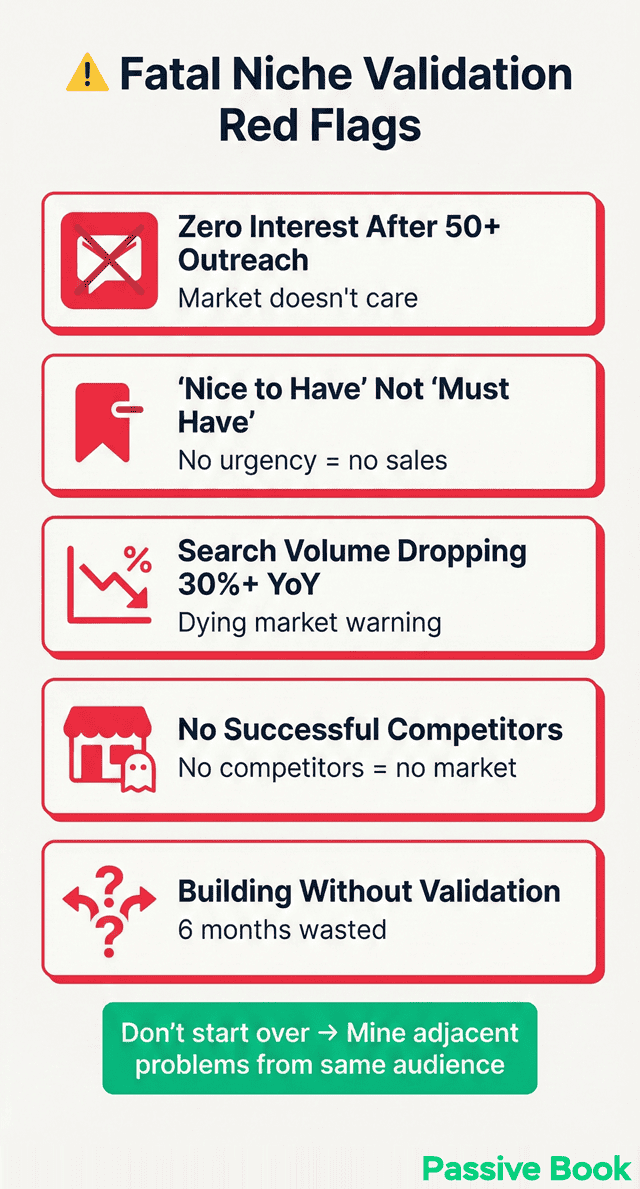
Jumping straight to building without validating your niche is a recipe for failure. Solopreneurs who skip validation discover unsellable solutions after months of wasted development. They’ve built what nobody asked for.
Zero interest after 50+ targeted outreach attempts is a clear red flag. If you’ve reached out to 50 qualified prospects and none respond with enthusiasm, the problem isn’t your messaging. The market doesn’t care about your solution.
Consistent “nice to have” feedback rather than “must have” signals weak demand. Nice-to-have products compete with endless alternatives. Must-have products create urgency and clear buying intent. You need the latter.
Watch for declining search interest. Keyword search volume dropping 30%+ year-over-year warns of a dying market. Jumping into a shrinking niche means fighting for scraps in a declining pie.
The inability to find 3-5 businesses successfully monetizing similar solutions is the biggest red flag. No competitors means no proven market. You’re gambling that you’ll be the first to crack a problem nobody else could solve or monetize.
When you spot these red flags, don’t start from scratch. Go back to Method 1, Reddit mining, and look for adjacent problems mentioned by the same audience. The pivot is usually closer than you think. I found my second business idea by analyzing complaints in the comments of my failed course launch post.
What to Do After Validation
Successfully validating your niche isn’t permission to build everything at once. I know this feeling. You’ve got proof people want your solution, and now you want to build every feature you imagined. Resist that urge.
Start narrow, serve deeply, expand later. Most solopreneurs fail by doing the opposite. Launching broad and shallow products that please nobody.
Start with your narrowest viable audience and offer solving one problem. Wait until 50-100 people express buying intent through pre-sales, waitlist signups, or direct inquiries. That threshold confirms you’re not building for a handful of friends.
Build the minimum version that delivers value. Your first offer doesn’t need ten features or perfect design. It needs to solve the validated problem better than current alternatives. Ship fast, collect feedback, iterate based on real usage.
Plan expansion only after achieving profitability in your initial niche. Profitability proves you can acquire customers for less than they pay you. Without that proof, expanding just multiplies your problems across more audiences.
Set a clear timeline for your first version. Give yourself 4-8 weeks to launch something sellable. Longer timelines invite feature creep and perfectionism. Both kill momentum and delay revenue.
Frequently Asked Questions
How Many Signals Do I Need to Validate My Niche Before Launching?
I recommend waiting for 15-20 strong signals across at least two different validation methods. One method might produce false positives. For example, Reddit upvotes plus landing page conversions plus customer interviews creates triangulated proof. Wait for pattern recognition before building.
What If My Validation Results Are Mixed – Some Positive, Some Negative?
Mixed results mean unclear positioning, not invalid niche. Revisit who you’re targeting and what specific problem you solve. The negative signals come from wrong-fit audiences while positive signals cluster around your true target customer.
How Long Should It Take to Validate a Niche Before Committing?
I’ve found that 2-3 weeks of focused validation is the sweet spot. Longer timelines invite analysis paralysis and delay revenue. Run methods in parallel to compress time. Launch your landing page while conducting interviews and analyzing keyword data simultaneously.
What’s the Difference Between Validating Demand Vs. Validating Willingness to Pay?
Demand validation confirms people have a problem and want solutions. Willingness to pay confirms they’ll spend money on your specific solution. The first tells you a market exists, the second tells you if you can capture it profitably.
What Next?
Start with Methods 1 and 4 this week. You now have seven methods to validate your niche without wasting months or thousands of dollars.
The difference between successful solopreneurs and those who quit is simple. Successful ones validate before building.
I know validation feels boring compared to the excitement of building. But that course failure taught me that excitement doesn’t pay bills. Validation does. Two hours of research beats two months of building the wrong thing.
Share this article using the buttons below if you found it valuable. Other solopreneurs in your network are making the same validation mistakes you almost made. Help them avoid the painful lessons we’ve discussed.
What validation method are you starting with first, and what’s holding you back from beginning today? Share your answer in the comments below.
Share this post with your friends & followers: