I spent my first year as a solopreneur making the same mistake most beginners make. I thought casting a wider net meant catching more customers. My pitch was “I help online entrepreneurs grow their business.” Sounds good, right? Wrong. Nobody knew what I actually did or who I was for. My content was all over the place, and my income reflected it – I was making maybe $200 a month after six months of work.
The turning point came when I narrowed to one buyer, one problem, one outcome. Within three months, my email list grew faster and my conversions improved. This article will show you how to size your niche correctly so you don’t waste months like I did.

- •What Is Niche Breadth?
- •Why Niche Selection Matters in [year]
- •Signs of a Too-Broad Niche
- •Signs of a Too-Narrow Niche
- •Quick Test to Evaluate Your Niche Scope
- •Income Potential Based on Niche Size
- Adjusting The Scope of Your Niche
- •Choosing the Right Platforms for Your Niche in [year]
- •Common Pitfalls Leading to Niche Selection Failures
- •Validate Your Niche in 7 Days
- •FAQ
- •What Next?
What Is Niche Breadth?
Niche breadth refers to how specific you are about your buyer, their problem, and the outcome you deliver. Think of it as a spectrum. On one end, you have “I help everyone with everything.” On the other, “I help left-handed accountants in Denver optimize their coffee breaks.”
The practical rule that works in 2025 is simple: one buyer, one urgent problem, one outcome.
Google’s Search guidance rewards distinct expertise, not generalist advice. AI-shaped search surfaces creators who demonstrate deep knowledge in a specific area.
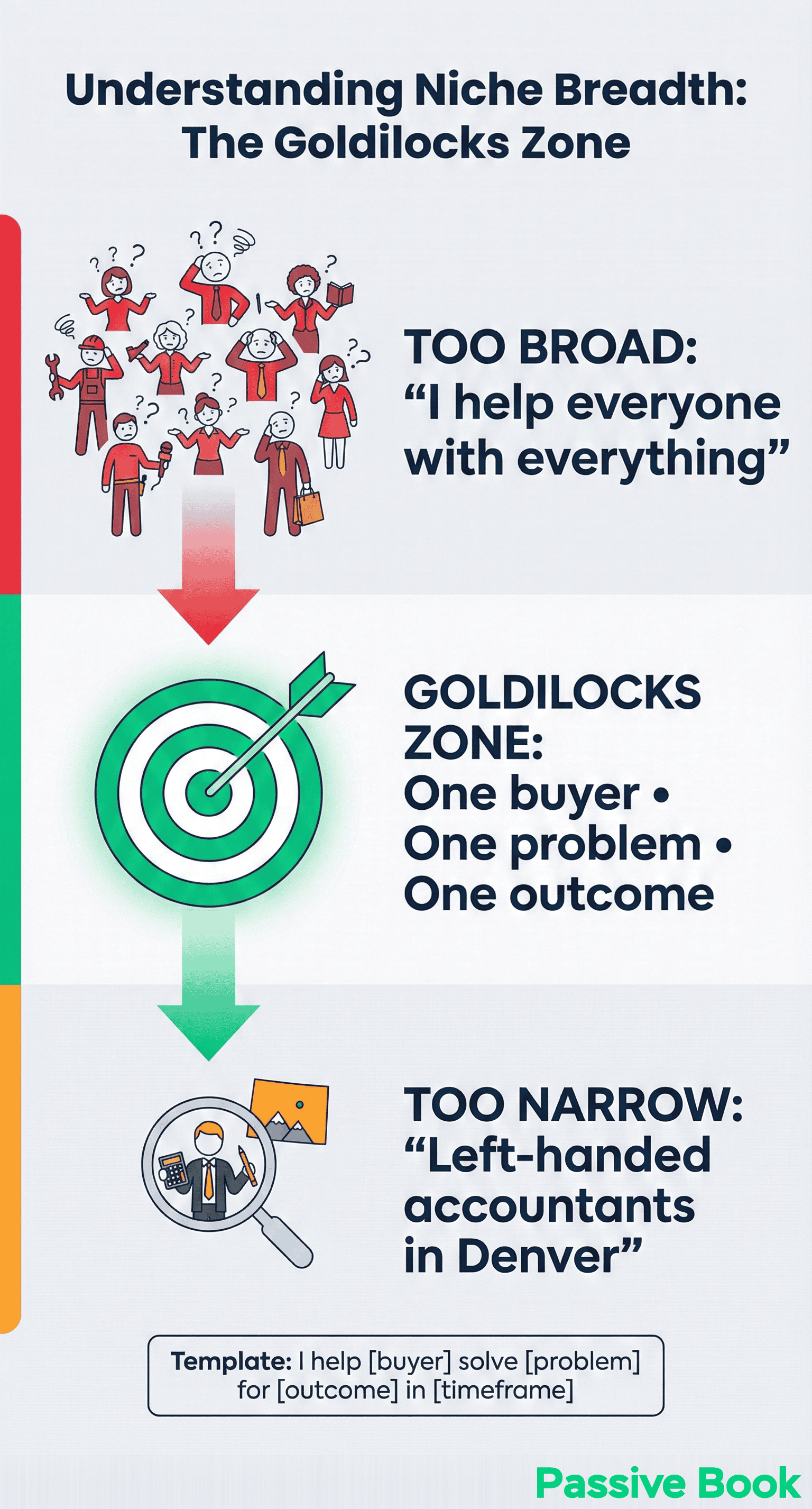
Proper niche breadth looks like this: “Freelance brand designers wanting LinkedIn inbound in 90 days.” Notice the specificity. You know exactly who this person serves, what problem they solve, and what result they promise.
Use this template to define your own scope: I help [buyer] solve [problem] for [outcome] in [timeframe]. If you need multiple sentences to explain what you do, your niche is too broad.
Why Niche Selection Matters in 2025
AI-shaped search changed how people discover expertise online. Google’s recent guidance confirms that distinct, demonstrable expertise outranks generic advice. The algorithm looks for depth, not breadth.
Most business gurus tell you to “find your passion” or “follow your bliss.” That’s garbage advice for bootstrappers. You need to follow the money first, passion second. I learned this the expensive way.
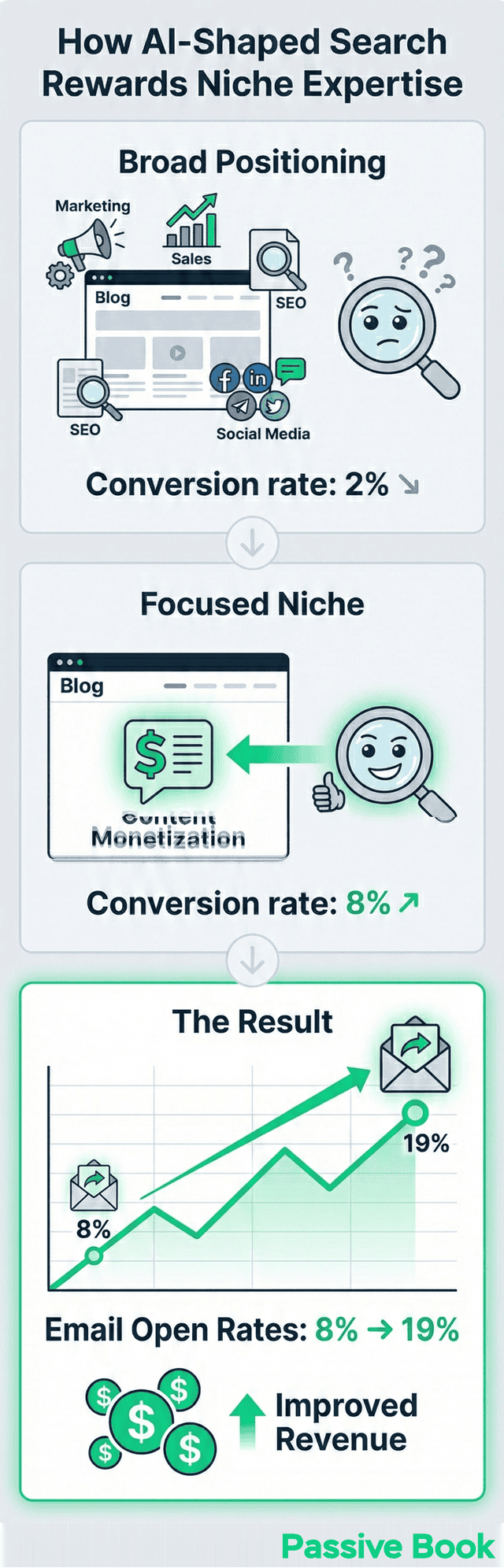
When I finally narrowed from “business growth” to “content monetization for solopreneurs,” my email open rates jumped from 8% to 19% in two months. That specificity made my content easier to find, easier to understand, and easier to buy. Broad positioning might feel safer, but it’s the riskiest move a bootstrapped solopreneur can make.
Signs of a Too-Broad Niche
Your pitch says “everyone” or “anyone,” and you watch people’s eyes glaze over when you explain what you do. If listeners can’t immediately picture who you serve, that’s your first red flag. Confusion doesn’t convert.
Watch your content calendar. If you’re writing about email marketing Monday, Instagram Wednesday, and SEO Friday, you’ve got a problem. Each piece might be decent, but together they don’t build toward one cohesive outcome for one specific person.
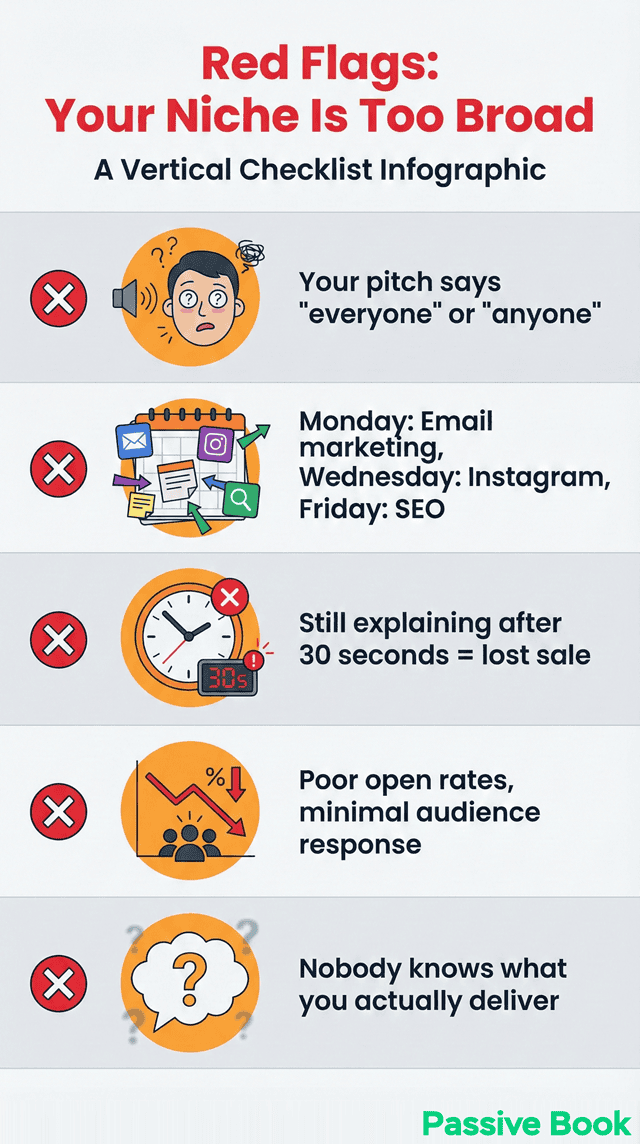
I made this exact mistake in my first year. My blog covered freelancing, affiliate marketing, course creation, and dropshipping. My open rates were terrible because nobody knew what value I actually delivered.
When I narrowed to content monetization for solopreneurs, my engagement doubled within two months.
If you’re still explaining what you do after 30 seconds, you’ve already lost the sale. People won’t work hard to understand you – they’ll just move on. Pick one buyer and one problem. Commit for six months, then evaluate.
Signs of a Too-Narrow Niche
Demand signals are scarce. You check keyword tools and see fewer than 10 monthly searches. Reddit threads on your topic have three comments. Facebook groups dedicated to your niche have 47 members who haven’t posted in six months. These are not viable markets for a bootstrapped solopreneur.
Another warning sign is you can’t list 50 content ideas without repeating yourself. If you’re struggling to find 30 distinct topics, your niche can’t sustain a content business. You’ll burn out or bore your audience within months.
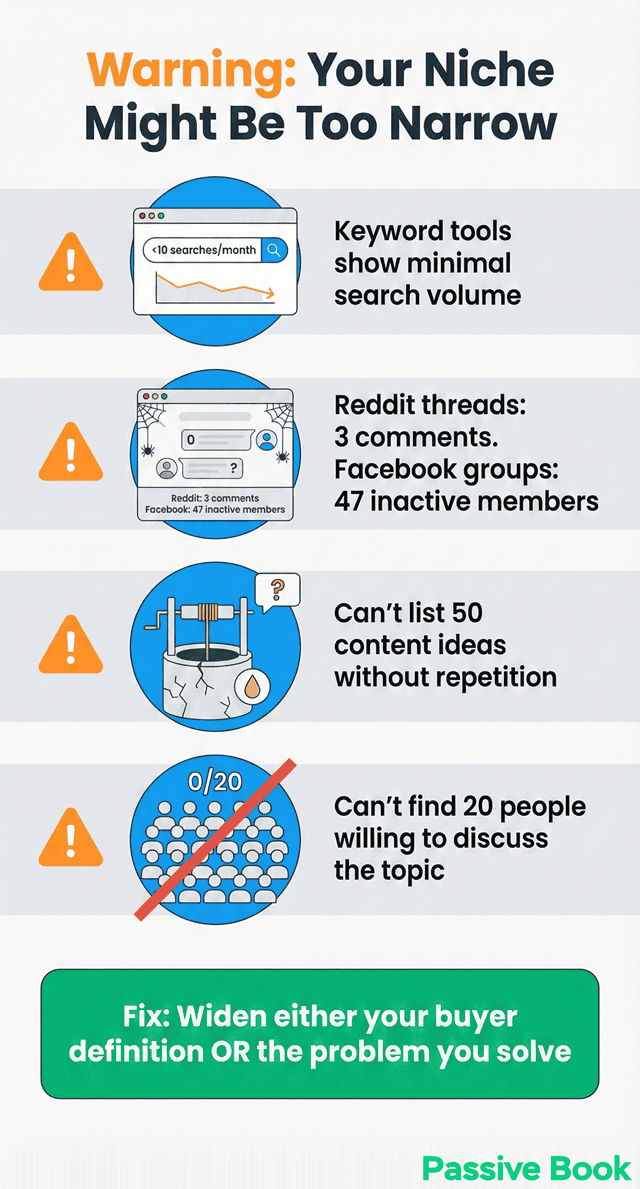
Nathan Barry’s approach offers a better path: validate before you build. He presold his book to an email list before writing a single chapter. That validation proved demand existed. If you can’t find 20 people willing to discuss your topic, much less pay for a solution, you’re too narrow.
Slightly widen either your buyer definition or the problem you solve. Instead of “kettlebell wrist mobility for busy moms,” try “15-minute strength workouts for busy moms.” Test the wider scope quickly with a landing page and five direct messages to prospects.
Quick Test to Evaluate Your Niche Scope
Define your Ideal Customer Profile (ICP) in one sentence. If you need to use “and” or “or” to describe multiple buyer types or outcomes, you’re too broad. The sentence should answer: who they are, what problem keeps them up at night, and what outcome they desperately want.
Next, list 50 content titles you could create for this ICP. Don’t write the content, just the headlines. If you stall before hitting 30, your niche is too narrow. If you reach 50 and could keep going for another 50, you’re in the sweet spot.
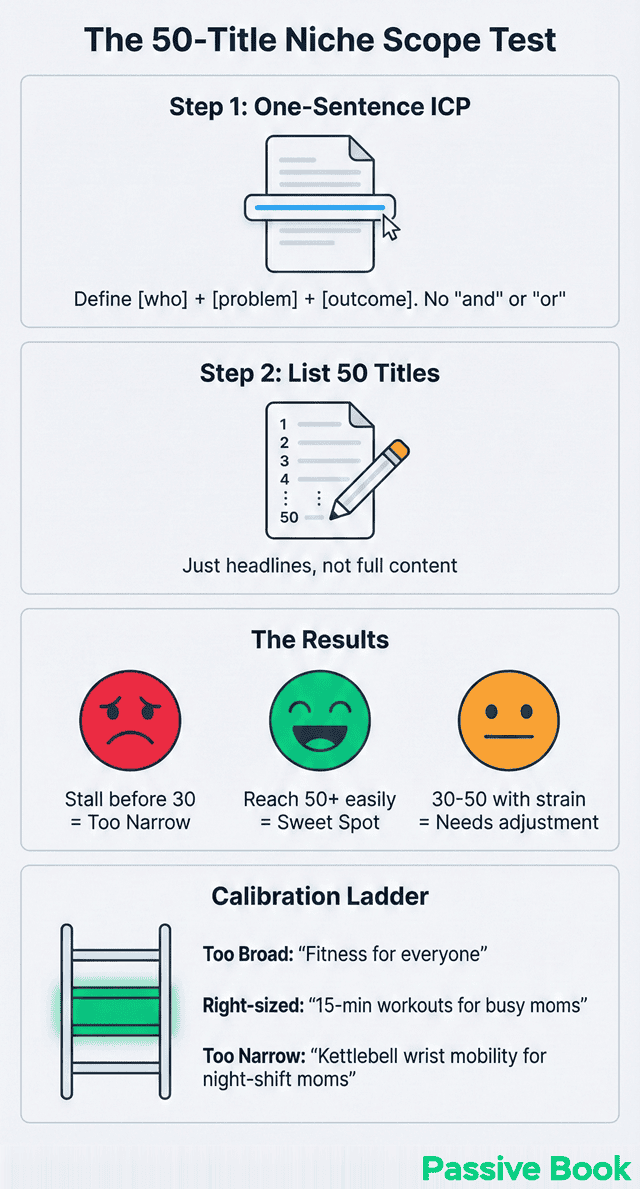
This ladder will help you calibrate. Too broad: “Fitness for everyone.” Right-sized: “15-minute workouts for busy moms.” Too narrow: “Kettlebell wrist mobility exercises for busy moms who work night shifts.”
Notice how the middle option balances specificity with addressable market size.
Beardbrand’s story demonstrates this principle. They started with beard grooming products, validated demand, then expanded to men’s lifestyle content. They didn’t launch with “men’s everything.” They proved one specific category first, then grew from that foundation.
Run this test right now. Open a document and start listing titles. Your ability to generate ideas without repetition or strain is the clearest signal of proper niche breadth.
Income Potential Based on Niche Size
Start by reverse-engineering your income goal. Let’s say you want $2,000 per month. You can reach that by selling 40 units at $50 each, or 10 units at $200 each. Your niche breadth determines which path is realistic.
Broader niches typically suit low-ticket, high-volume offers. If you’re teaching “productivity for remote workers,” you can reach thousands of potential buyers with a $50 course. Narrower niches work better for higher-ticket outcomes. “LinkedIn ghostwriting services for SaaS founders” supports a $200+ monthly retainer because the outcome is specific and valuable.
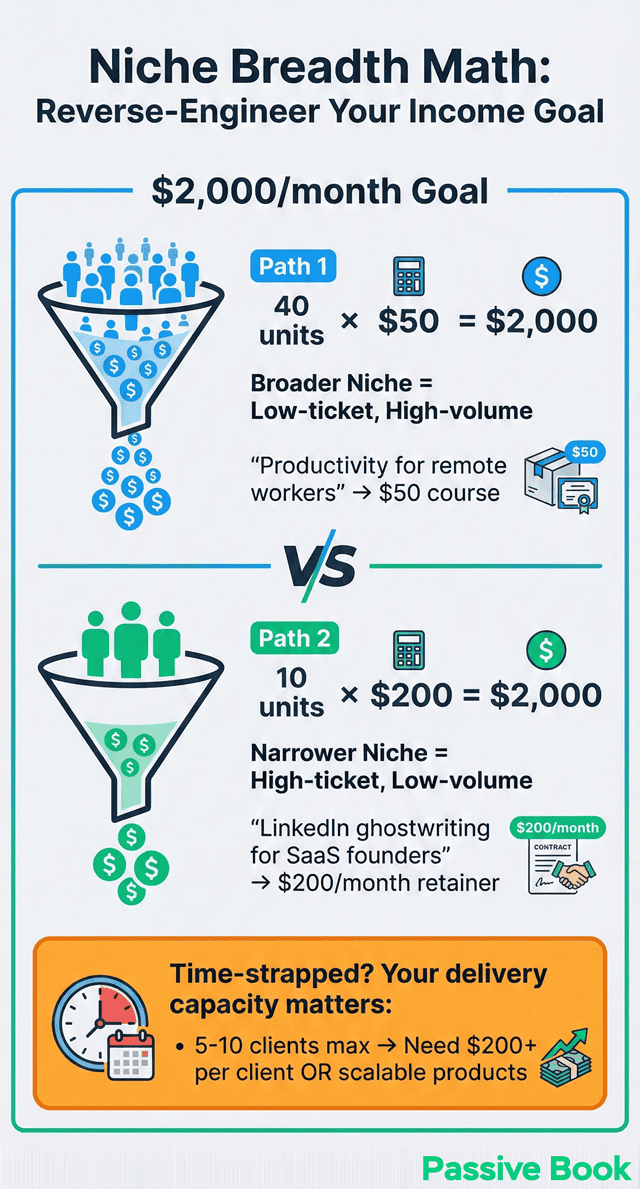
When you’re working around a day job, your delivery capacity matters. I could only handle 5-10 clients max while employed full-time, which meant I needed either $200+ per client or a scalable product.
That math forced me toward digital products.
Set risk guardrails before you commit. Cap your time investment at 10 hours per week for the first three months. Aim for at least a 2% opt-in rate on your landing page. Target a minimum of two sales by week four. If you hit these marks, your niche breadth is viable.
The math should clarify your scope decision. Too broad makes high-ticket sales harder because you lack authority. Too narrow means you’ll struggle to find enough buyers for low-ticket volume.
Adjusting The Scope of Your Niche
Narrow Your Niche Without Losing Market Size
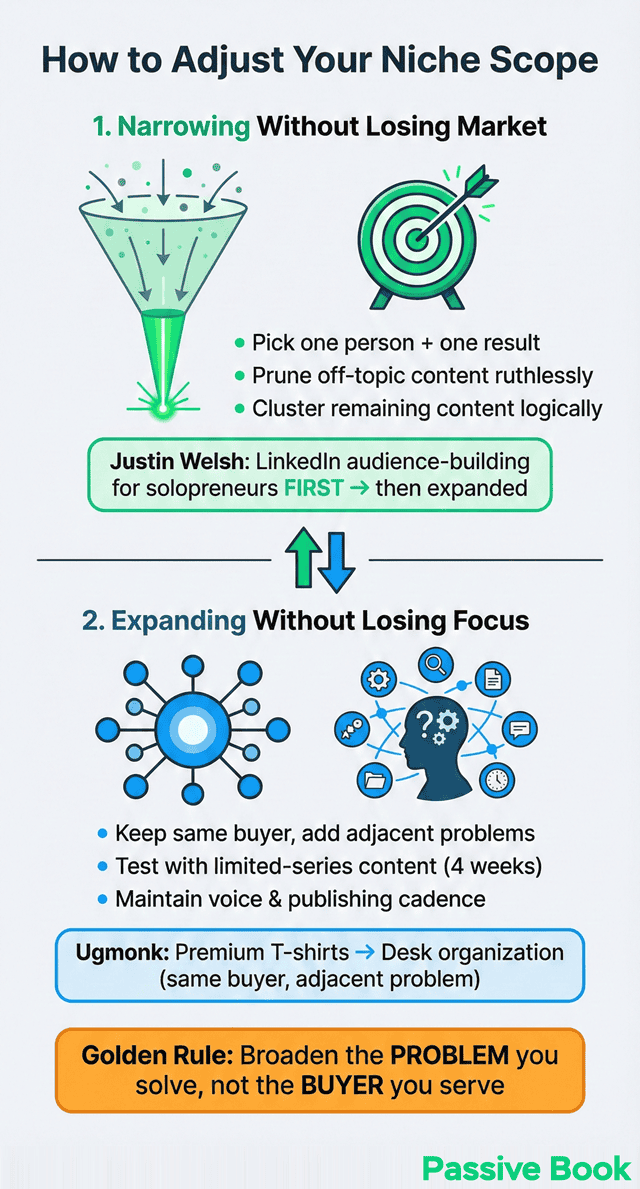
Pick one person and one result. That’s your starting point. The method you use to deliver that outcome is what differentiates you later. Don’t narrow by methodology, narrow by buyer and result.
Prune off-topic content ruthlessly. If a piece doesn’t directly support your one buyer’s transformation, delete it or archive it. Cluster your remaining content so every article links to others in a logical progression toward your core outcome.
Justin Welsh’s evolution shows how to narrow without strangling growth. He focused exclusively on LinkedIn audience-building for solopreneurs first. Only after establishing authority in that specific area did he expand to products, newsletters, and other distribution channels.
His initial narrowness created the credibility to expand.
Total Addressable Market (TAM) concerns are overblown for solopreneurs. You don’t need a million potential customers. You need 100 to 500 people willing to pay you. That’s a sustainable solo business.
Expand Your Niche Without Losing Focus
Keep serving the same buyer, but add adjacent problems you can solve for them. Your audience stays consistent, your expertise deepens, and your revenue potential expands without confusing your positioning.
Use limited-series content experiments to test new topics. Launch a four-week series on an adjacent problem, measure engagement, then decide whether to continue. Maintain your voice and publishing cadence so your core audience doesn’t feel abandoned.
Ugmonk’s expansion illustrates strategic broadening. The brand started with premium T-shirts, then moved into desk organization tools. Same buyer (design-conscious professionals), adjacent problem (workspace aesthetics).
They validated the Gather desk system through Kickstarter before scaling production.
Broaden the problem you solve, not the buyer you serve. Trying to serve multiple buyer types simultaneously destroys focus and trust. Solving multiple problems for one buyer builds a comprehensive, valuable brand.
Choosing the Right Platforms for Your Niche in 2025
Pick one hero platform plus email, then commit for six months. Spreading yourself across multiple platforms as a time-strapped solopreneur guarantees mediocre results everywhere. Focus produces compound growth.
Pew Research data from 2025 shows YouTube remains the most widely used platform among U.S. adults. Instagram reaches about 50% of Americans, with the highest usage among people under 30. Your platform choice should match where your specific buyer already spends time.
When I was building my business around my corporate job, I had maybe 90 minutes per day. I couldn’t be on three platforms. I focused on my blog and email exclusively for the first eight months. That constraint forced better content quality.
Professional service providers often find LinkedIn most effective. Justin Welsh built his initial audience there before expanding to YouTube and other channels. He didn’t try to be everywhere at once. He owned one platform first, then leveraged that authority to succeed on others.
Time-box your efforts: hero platform plus email list. Track three metrics only: content views, direct replies or comments, and email list growth. If these numbers improve month over month, your niche breadth is working. If they stagnate, your scope needs adjustment.
Common Pitfalls Leading to Niche Selection Failures
Chasing viral breadth dilutes trust. Your audience doesn’t know what you stand for, so they don’t remember you when they need help. Conversion rates stay low because you haven’t built credibility in any single area.
Over-niching starves demand. You can’t find enough buyers to sustain even a modest income goal. Content ideas dry up. You start second-guessing everything, which leads to paralysis and eventual abandonment.
Here’s what nobody tells you: most niche advice comes from people who already have audiences. Easy to preach “go narrow” when you’ve got 50K followers. When you’re starting at zero, the fear is real. But the math doesn’t lie – broad positioning kills conversion every single time.
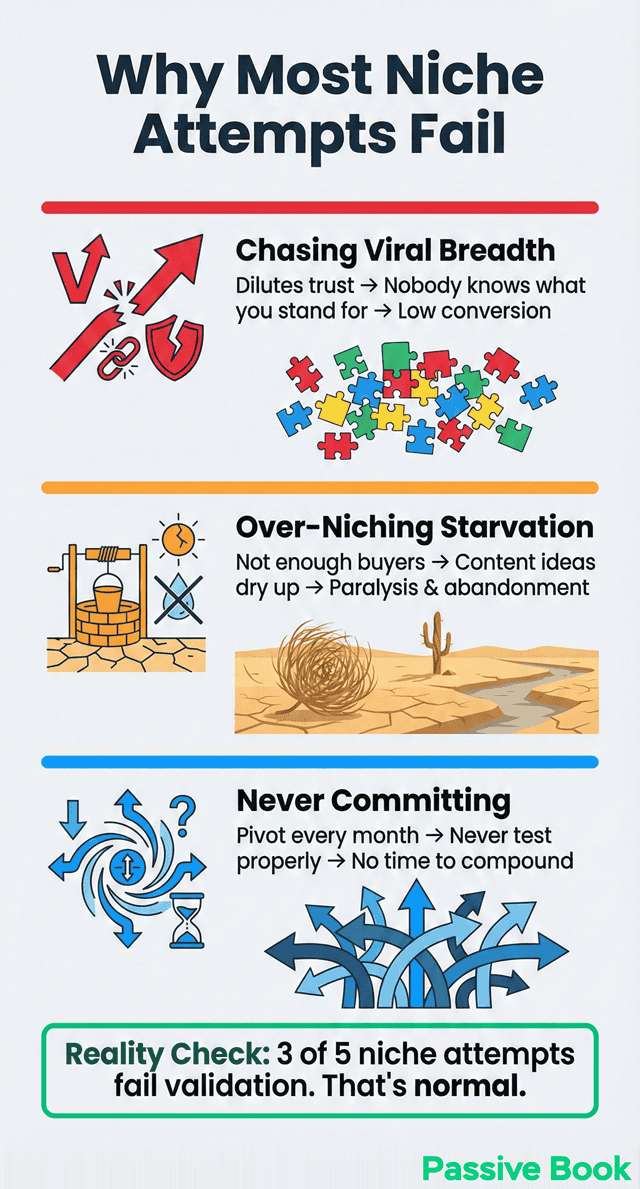
I’ve tried both extremes. Three of my first five niche attempts failed validation. One was too broad (business growth tips), two were too narrow (productivity apps specifically for freelance copywriters in B2B SaaS). The failures taught me more than the successes.
Most solopreneurs quit not because they chose the wrong niche, but because they never committed to testing it properly. They chase shiny objects, pivot every month, and never give any positioning enough time to compound.
The 7-day sprint below forces you to gather real signals from real people, not just research and overthink.
Validate Your Niche in 7 Days
Days 1 to 2: Publish a Minimum Viable Product (MVP) offer. Use Carrd for a one-page landing site or WordPress if you prefer more control. Add an email capture form via ConvertKit or Google Forms. Set up a simple payment link through Stripe.
Your MVP should describe the problem, your solution, and the outcome. Ask visitors to reply with their biggest objection or question. These responses reveal whether your niche positioning resonates or confuses people.
Days 1-2 might be your entire weekend. Days 3-5 might be 30 minutes before work each day. That’s fine. The sprint works with whatever time you have – I did my first validation sprint across two weekends while working 50-hour weeks at my day job.
Days 3 to 5: Run a poll in a relevant community or on your hero platform. Ask a specific question about the problem you solve. Direct message five prospects who match your buyer profile. Share your MVP and ask if it addresses their need. Presell one paid slot at a discount to validate real demand.
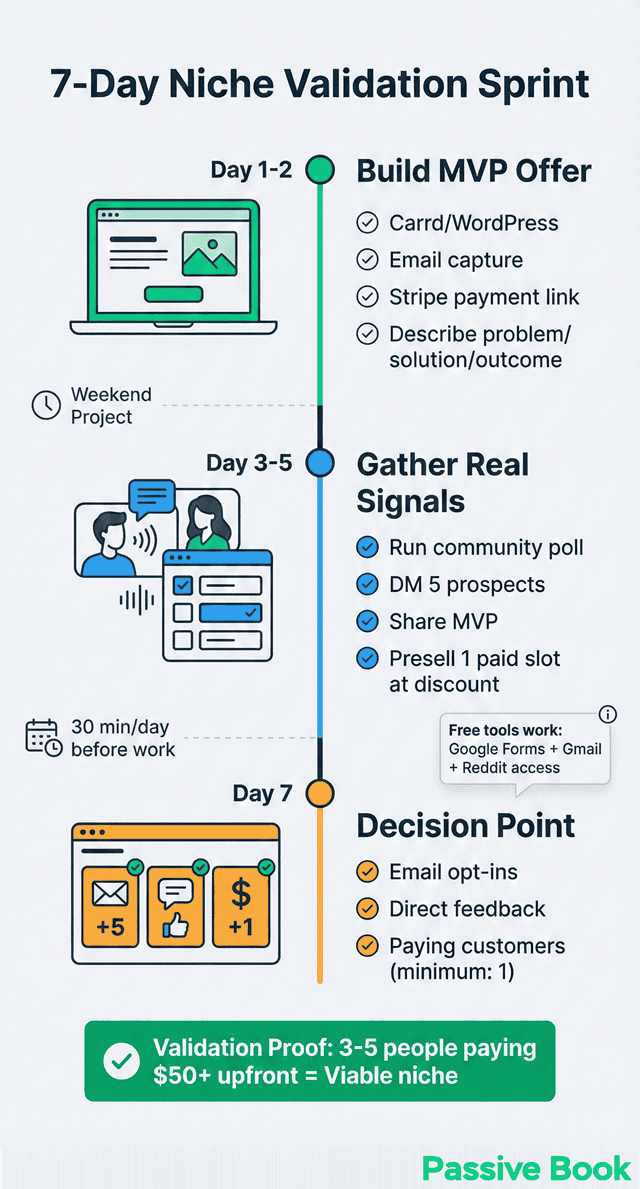
Nathan Barry’s approach proves this works – he validated demand before building. You don’t need $12K in presales. Even 3-5 people willing to pay $50 upfront proves your niche can work. I validated my content monetization niche with 4 presales at $79 each, earning $316 before creating the full course.
If $20/month for Convertkit is too much right now, use Google Forms and a Gmail account. I validated my first niche with zero tools beyond free Reddit access.
By day 7, you’ll have concrete data: email opt-ins, direct feedback, and ideally at least one paying customer. That’s enough to decide whether to commit or adjust your scope.
FAQ
How Can I Figure Out What My Niche Is?
Define who you serve, what problem they face, and what outcome they want. Validate it with a 7-day presell sprint using a simple landing page and direct outreach. Nathan Barry presold his book before writing it, proving demand existed. If people will pay you before you build, your niche is viable.
What Next?
You now have a framework to evaluate whether your niche is too broad, too narrow, or just right. The diagnostic tests, income math, and 7-day validation sprint give you concrete tools to make a confident decision instead of guessing.
Niche selection feels overwhelming because most advice is theoretical. This process forces you to gather real signals from real prospects. That data removes the paralysis.
Three of my first five niche attempts failed validation. That’s normal. The 7-day sprint’s value isn’t guaranteeing success – it’s failing fast so you don’t waste months.
Share this article using the buttons below if it helped clarify your thinking. I’d love to hear about your 7-day sprint results in the comments. What signals convinced you to commit or adjust your niche scope?
Share this post with your friends & followers: