Six months into my first content business, I’d published 72 pieces of content, spent $800 on tools, and built exactly zero excitement for my own work. I was consistent, improving, and completely miserable. The worst part? I had no idea if I should push through or cut my losses.
If you’re reading this, you’re probably in a similar spot. You’ve invested time and maybe money into building something, but the results aren’t matching the effort. The question isn’t whether pivoting is “giving up.” The real question is whether you’re solving the right problem for the right people in a way that actually energizes you.

What a Niche Pivot Actually Means
A niche pivot isn’t about abandoning everything you’ve built. It’s a strategic shift in your target audience or content focus based on what the market is actually telling you. Think of it as course correction, not starting over.
The difference between a smart pivot and shiny object syndrome comes down to one thing: are you responding to real market signals or just chasing what looks easier?
When Ali Abdaal started his YouTube channel in 2017 focused on medical school exam prep, he noticed his productivity videos performed better. He followed that data instead of rigidly sticking to his original plan. He didn’t wake up one day and randomly decide to pivot. He followed the data his audience gave him.
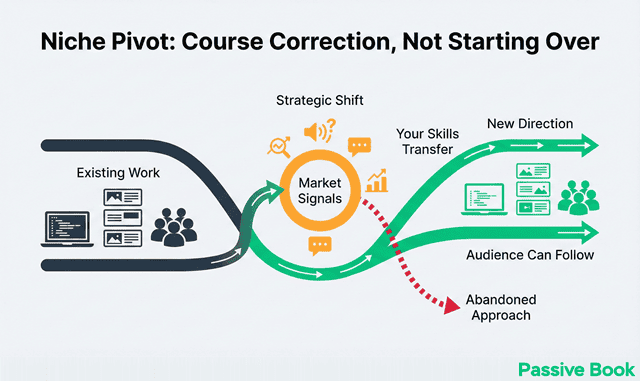
Real pivots come from validated learning. You’ve tested your initial idea long enough to gather meaningful feedback. You’ve seen which content resonates and which falls flat. You know what your audience asks for versus what you’re delivering. That’s signal. Jumping to a new niche because you saw someone else succeed in it last month? That’s noise.
Your existing work isn’t wasted when you pivot strategically. The content creation skills transfer. Your understanding of platform algorithms carries over. Even your audience might follow you if the pivot makes sense. The key is making a decision based on evidence, not emotion.
When Pivoting Your Niche Makes Sense
Not every challenge means you should pivot. Sometimes you just need better execution. But certain patterns signal a fundamental mismatch between you, your niche, and your market. Recognizing these patterns early saves months of frustration.
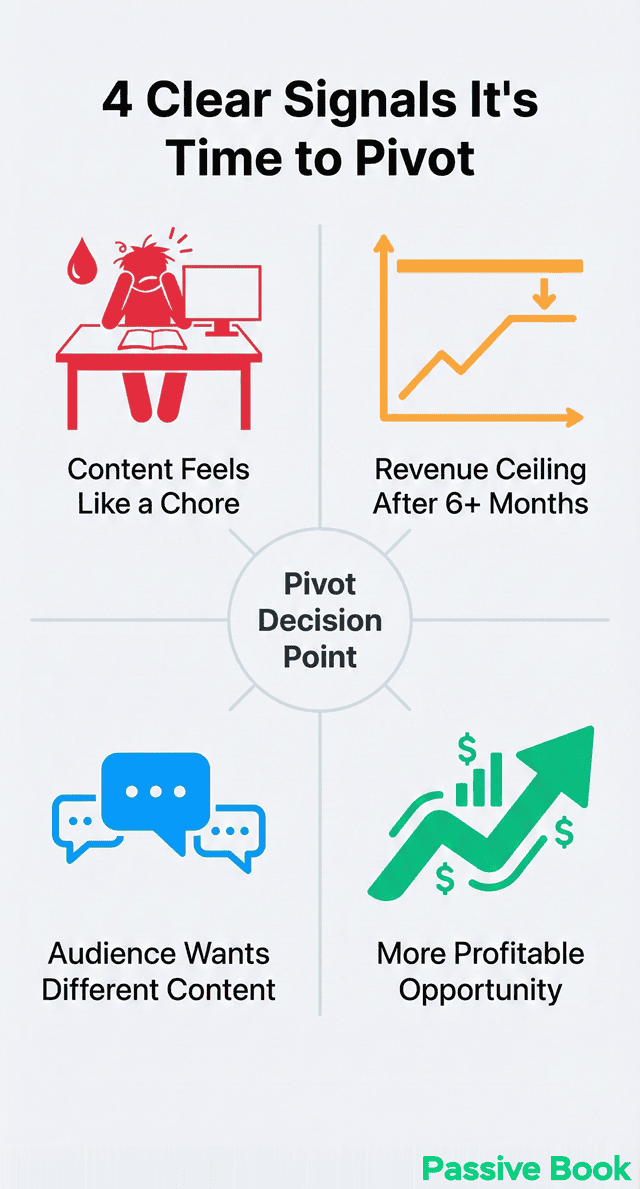
Your Content Feels Like a Chore Despite Consistency
I spent four months creating content about a topic I thought I should care about. Every writing session felt like pulling teeth. I was consistent, hitting my schedule, improving my craft. But something was fundamentally wrong.
Creating content should energize you, not drain you. When you’re in the right niche, those limited hours feel like the best part of your day. When you’re in the wrong one, you’re white-knuckling through every session.
Research shows that 42% of business owners experience monthly burnout, and it stems from poor niche fit rather than workload.
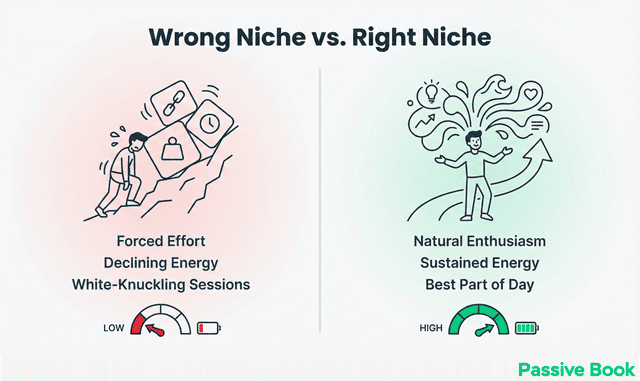
In my experience, audiences can tell when you’re forcing it. I’ve seen this in my own analytics – my most authentic posts always outperformed polished-but-distant content. Authenticity isn’t just a buzzword. It shows up in your tone, your examples, your willingness to go deep on topics.
The tricky part is distinguishing between temporary fatigue and fundamental misalignment. Ask yourself: am I tired because I’m overworked, or because I genuinely don’t care about this topic anymore?
If technical milestones like better editing or writing quality don’t reignite your enthusiasm, you’re in the wrong niche.
You’ve Hit a Revenue Ceiling After 6+ Months
Revenue is the market’s clearest signal. If you’ve been consistent for six months and you’re still earning under $1,000 monthly, something isn’t working. Either your niche lacks monetization opportunities, or your audience doesn’t have purchasing power.
The statistics are sobering. 78% of solopreneur businesses make less than $50,000 annually.
But within that reality, some niches produce better results than others. A finance creator with 5,000 engaged subscribers might earn more than a gaming creator with 50,000 because of sponsor rates and product fit.
Look at your monetization attempts honestly. Are brands ignoring your sponsorship pitches? Are your affiliate links getting clicks but no conversions? Do you have an audience but no clear path to revenue?
These aren’t execution problems. They’re market signals that your niche might not support your income goals.
High follower counts mean nothing without revenue. I’ve seen creators with impressive audience sizes struggle to make $500 monthly because their audience demographic doesn’t match their monetization model. If you’ve built an audience of broke college students but need to sell a $500 course, you have a niche problem.
Your Audience Wants Different Content
Sometimes your audience tells you exactly what they want, and it’s not what you’re creating. Pay attention to comment patterns. What questions keep coming up? What topics generate the most discussion?
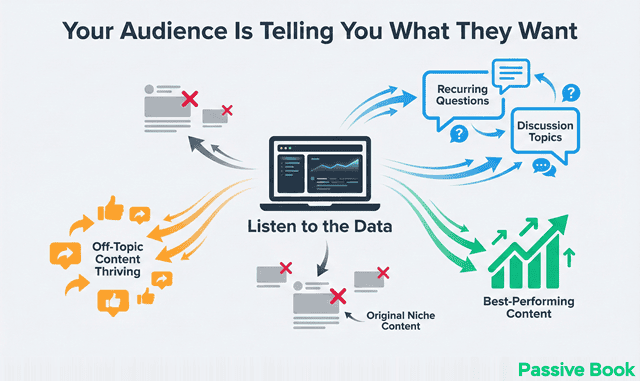
Your analytics provide another layer of truth. When your best-performing content consistently falls outside your stated niche, your audience is voting with their attention.
A productivity creator might find their “morning routine” video outperforms everything else, signaling interest in lifestyle content.
The painful version of this signal is when new content underperforms despite better production quality. You’ve improved as a creator, but engagement rates are declining. Your posting schedule is consistent, yet reach is shrinking. This usually means your existing audience came for something you’re no longer delivering.
Don’t ignore these signals because they don’t match your original plan. Your audience is giving you free market research. The question is whether you’re willing to listen.
You’ve Found a More Profitable Opportunity
Sometimes pivoting isn’t about escaping what’s wrong. It’s about moving toward what’s better. You might discover an adjacent niche that fits your skills and offers better monetization.
Your day job provides hidden advantages. An accountant creating general small business content might realize financial education for a specific audience offers better sponsor rates and faster authority building. The pivot isn’t random. It leverages existing expertise in a more profitable direction.
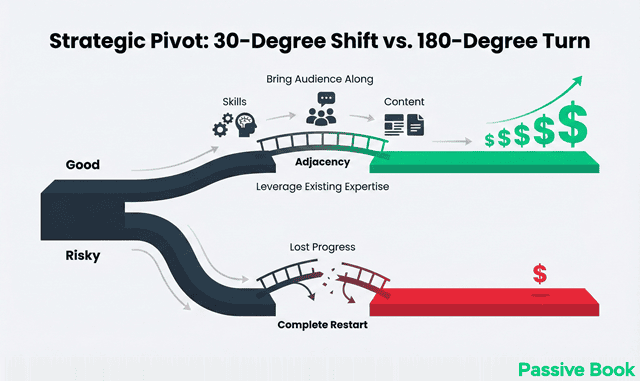
Pat Flynn started with architecture exam prep after he was laid off. Once that succeeded, he pivoted to teaching others how to build online businesses. His second niche leveraged the skills he’d learned in his first success. That’s a strategic pivot, not starting from scratch.
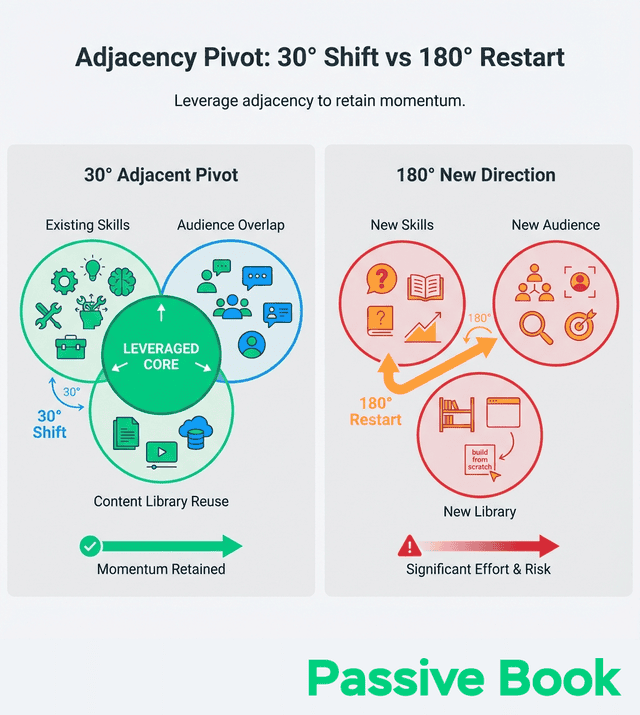
The key is adjacency. A complete 180-degree turn means starting over. But a 30-degree shift lets you bring your existing audience along. Your content library might still be relevant. Your brand positioning carries over. You’re building on a foundation, not abandoning it.
How Long to Test Your Current Niche Before Pivoting
Timing matters. Pivot too early and you never give your initial idea a fair shot. Wait too long and you waste months on something that won’t work. The balance point is difficult but critical.
Research suggests 90-day validation periods for testing niche ideas before making major changes. Three months of consistent effort gives you enough data to make an informed decision. You’ve created enough content to identify patterns. You’ve seen what works and what doesn’t.
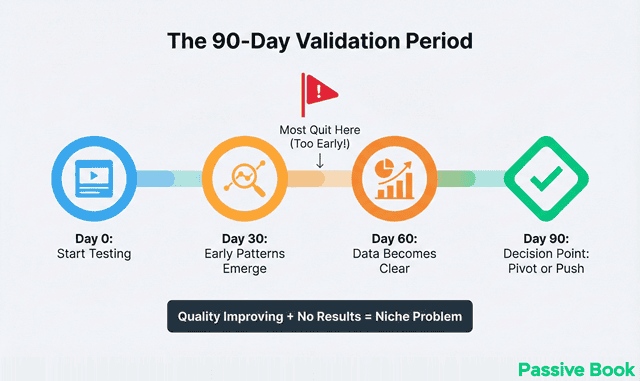
In my observation across online communities, many solopreneurs quit around month four or five, right when traction begins. That’s the cruel irony of building online. The difference between failure and success isn’t the niche itself but sticking around long enough to find what works within that niche.
Distinguish poor execution from fundamentally wrong choices through data. If your content quality is improving but results aren’t, that’s a niche problem. If your content is inconsistent or low-quality, fix execution first. Don’t use pivoting as an excuse to avoid doing the hard work of improving.
Compare new content performance to itself, not to legacy metrics. If you’re testing a new direction within your existing channel, your new video about topic B will naturally underperform your established videos about topic A. Give it time to find its audience before deciding it failed.
Choosing Your New Niche Direction
Picking your next niche isn’t about following trends or copying successful creators. It’s about finding the intersection of what you know, what you’ve experienced, and what the market actually wants. Most solopreneurs get this backwards and wonder why their pivot fails too.
The Three Ps Framework for Solopreneurs
Past Profession, Past Pain, and Passion give you three different angles for building authority and creating sustainable content over years, not months.
Past Profession means leveraging expertise from your day job or previous career. An accountant pivoting to financial education for freelancers or small business owners already has credibility and deep knowledge. They don’t need to fake expertise or spend years learning the basics. They’re teaching what they already know.
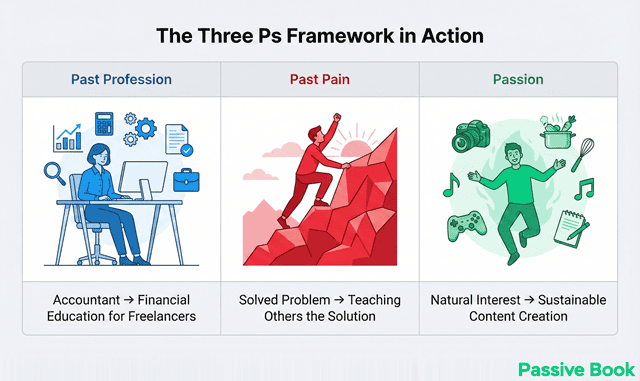
Past Pain focuses on problems you’ve personally solved. The founders of Morning Brew created the newsletter they wished existed during college: business news without the boring format.
They weren’t business journalists. They were their own target audience. That authenticity resonated.
Passion is the hobby or interest that naturally consumes your free time. Gaming, fitness, cooking, travel. The best way to sustain content creation for years is to choose something you’d engage with anyway. You’re not forcing yourself to care. You already do.
Daniel Vassallo walked away from a $500K job at Amazon to build a portfolio of small bets as a solopreneur. His niche became teaching others how to escape corporate life and build indie projects. He combined his profession with his pain point into a profitable niche. That’s the framework in action.
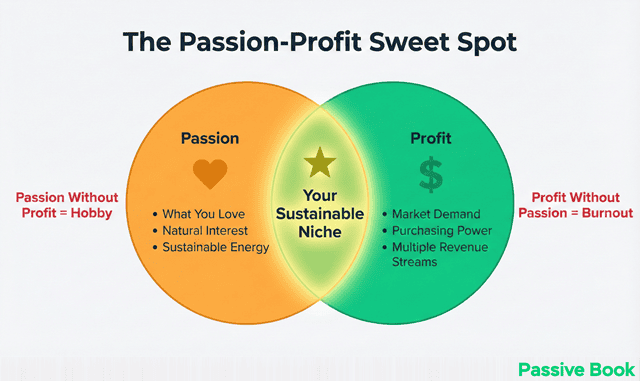
The mistake most people make is choosing a niche based purely on profit potential without considering their natural advantages. You’ll lose to creators who genuinely care about the topic and have real expertise. Find where your Three Ps overlap with market demand.
Validating Market Demand Before You Commit
Passion without profit is a hobby. Profit without passion is a grind you’ll quit. Before you commit to a pivot, you need evidence that people will actually pay attention to your new direction. Validation comes before creation.
Start by interviewing 5-10 potential customers in your target niche. These don’t need to be formal calls. Join communities where your target audience hangs out. Ask what problems they’re trying to solve. Find out what content they’re currently consuming and what gaps exist.
Keyword research tools show you whether active search demand exists for your topics. You’re not looking for the highest volume keywords. You’re looking for consistent, sustained interest that indicates a real audience seeking solutions. Tools like Ahrefs or even Google’s free autocomplete can reveal this.
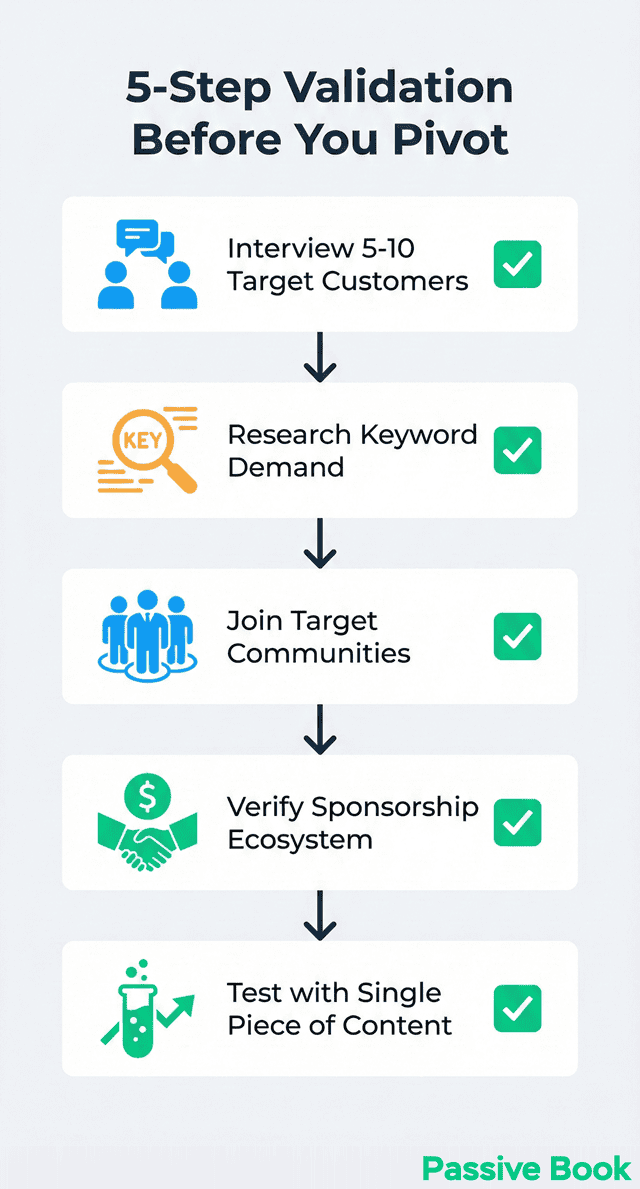
Here’s what validation looked like when I considered pivoting to productivity for remote workers. I searched “remote work productivity tips” and found 2,400 monthly searches with manageable competition. Then I joined three remote work Slack communities and asked what their biggest productivity challenge was. Four out of five mentioned time-blocking failures. That confirmed both demand and a specific pain point I could address.
Research whether brands actively sponsor content in your potential niche at your scale. Small business content attracts SaaS tools and productivity apps as sponsors. Gaming content attracts peripherals and energy drink brands. Some niches have thriving sponsorship ecosystems. Others don’t. Know which you’re entering.
Test your idea with a single video or article before going all-in. Gauge initial audience response and engagement rates. If your test content generates more interest than your current niche content, you’ve found something worth exploring. If it falls flat, you’ve saved yourself months of wasted effort.
Finding the Overlap Between Passion and Profit
The sweet spot for solopreneurs is a niche where mid-tier creators consistently earn $500-$2,000 per brand deal. You’re not looking for the absolute highest-paying niches like enterprise software or finance.
Those require credentials you might not have. You want steady, accessible monetization.
Target demographics with purchasing power that matches your monetization model. If you plan to sell courses, you need an audience willing and able to invest in education. If you’re focused on ad revenue, you need topics that attract advertisers with healthy budgets.
Narrow your focus to specific pain points rather than broad categories. “Marketing for small business” is generic and saturated. “Facebook ads for self-published authors” is specific enough to dominate. The tighter your niche, the easier it is to become the go-to resource.
Verify multiple monetization paths exist before committing. The best niches support ads, affiliate partnerships, digital products, and sponsorships. If your only path to revenue is one income stream, you’re vulnerable. Diversification isn’t just smart investing. It’s smart niche selection.
Gradual Pivot Vs Clean Break: Which Strategy Fits You
Once you’ve decided to pivot, you face a tactical choice: do you gradually transition your existing platform or start fresh with a new channel? There’s no single best way to execute a pivot – the approach depends on your niche overlap and audience loyalty. Both strategies work, but they require different execution.
The Bridge Content Method for Related Niches
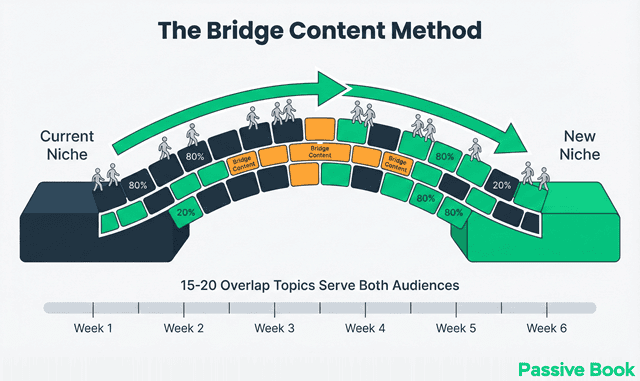
If your new niche shares overlap with your current one, bridge content lets you transition without shocking your audience. The method is simple: create 15-20 content ideas that naturally connect your current focus with your new direction. These pieces serve both audiences.
Graham Stephan spent 80% of his time on YouTube while still working in real estate before his full pivot. He didn’t quit real estate and announce a new channel. He gradually shifted his content mix. Real estate investment led to personal finance, which led to wealth building for his generation.
I tried the opposite once – announced a hard pivot with zero preparation. My engagement dropped 40% in two weeks because nobody knew what my channel was about anymore. Don’t be like 2019 me.
Start with one overlap piece monthly while maintaining your core content. Test audience reaction without committing fully. If engagement holds or improves, increase frequency gradually over 4-6 weeks. You’re training the algorithm and your audience simultaneously that your content scope is expanding.
A fitness creator introducing “morning routines for energy” can naturally expand into broader lifestyle content. A productivity YouTuber covering “tools for creators” can slide into creator economy topics. The key is making each step feel like a natural evolution, not a random jump.
Track your analytics closely during this phase. If bridge content underperforms significantly, your audiences might not overlap as much as you thought. If it outperforms your core content, you’ve validated the pivot and can accelerate the transition.
When to Launch a Separate Channel or Site
Drastically unrelated topics justify a fresh start. If you’ve built an audience around parenting content and want to pivot to day trading, those audiences don’t overlap. Trying to transition your existing platform will confuse everyone and tank your performance.
A separate platform protects any passive income from your current niche. If your existing content still generates ad revenue or affiliate sales, keep that revenue stream alive while you test your new direction. Think of it as maintaining your safety net.
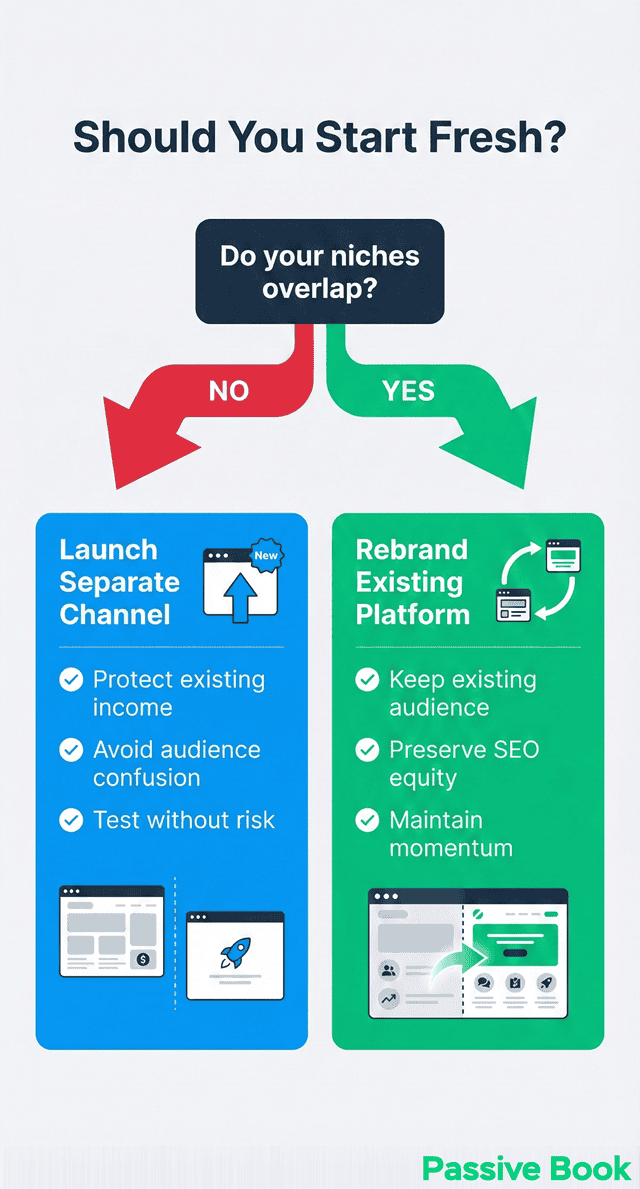
Setting up a new site means handling the basics again – domain registration, hosting setup, and mandatory pages like your privacy policy and about page – but modern website builders make this a 2-hour task, not a 2-day project. That $300 you spent on your old domain, hosting, and tools? Not wasted if the tools work across niches and you can transfer learnings.
The downside is real: managing multiple platforms doubles your workload. You’re already time-strapped with a day job. Adding a second channel means splitting your limited hours between maintaining the old and building the new. Be honest about whether you can handle that before committing.
Rebranding your existing platform makes sense when your new direction serves a similar audience with natural overlap. Productivity content pivoting to entrepreneurship keeps most of the same viewers. Tech reviews expanding into general creator tools serves the same demographic. You’re broadening, not replacing.
Executing Your Pivot Without Losing Momentum
The execution phase is where most pivots fail. You’ve made the strategic decision, but translating that into daily content creation across your blog, email list, and social media channels while maintaining your existing audience requires a careful plan. Move too fast and you lose people. Move too slow and you lose months to indecision.
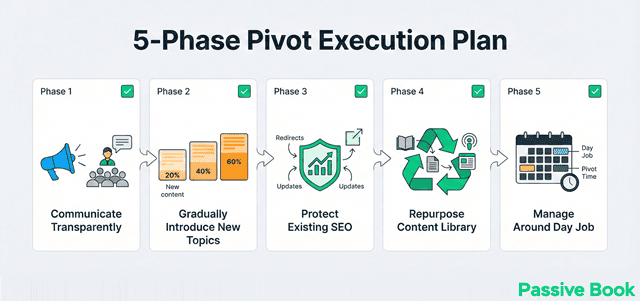
Communicate Transparently With Your Audience
When I decided to expand beyond my initial niche, I spent weeks agonizing over how to announce it. Should I make a big deal about it? Should I just quietly shift? I landed somewhere in the middle, and the response taught me transparency wins.
Vanessa Lau openly discussed her YouTube pivot from social media marketing tips to broader lifestyle content. She didn’t apologize or over-explain. She simply shared that her interests had evolved and her content would reflect that growth. Her audience appreciated the honesty.
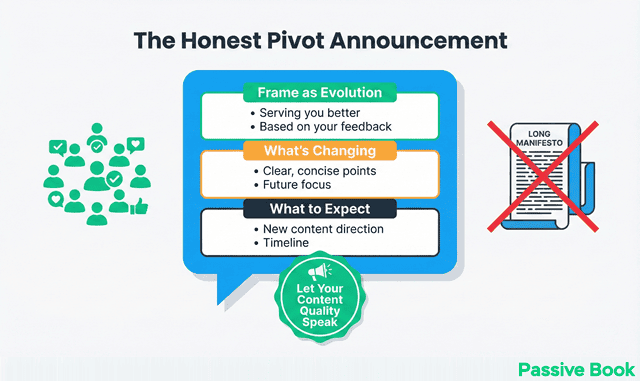
Frame your pivot as evolution serving your audience better, not abandonment of your community. Explain what’s changing and what subscribers can expect going forward. If your niche shift addresses feedback they’ve given you, point that out. They’ll feel heard.
Don’t write a 2,000-word manifesto about your journey. One clear piece of content explaining the change is enough. Whether you announce via email, a blog post, or a social media update, keep it concise and forward-focused. Then let your content quality speak louder than your explanations. Your audience will judge the pivot by whether your new content delivers value, not by how well you justified the decision.
Gradually Introduce New Topics
Seed new topics within your existing content before making a full shift. A coding channel might start including sections on freelancing. A recipe blog might add posts about meal planning systems. These test the waters without requiring a complete overhaul.
Increase the proportion of new content slowly over 4-6 weeks. Start with 20% new direction content, then 40%, then 60%. This gradual shift prevents algorithm shock on platforms like YouTube where sudden topic changes can crater your distribution. Social media platforms like YouTube, Instagram, and TikTok reward consistency in topic focus, even during transitions.
Monitor engagement metrics closely to adjust your transition speed. If your new content matches or exceeds your old content performance, you can accelerate. If there’s significant drop-off, slow down or refine your approach. The data tells you whether you’re bringing your audience along or leaving them behind.
Test different angles within your new niche before committing to a specific content calendar. Your first attempt at positioning might not be the best one. Treat your first 10-15 pieces of new content as experiments that help you find the strongest angle within your new direction.
Protecting Your Existing SEO During the Transition
Search Engine Optimization (SEO) equity you’ve built over months doesn’t have to disappear when you pivot. Strategic content management preserves your rankings while you shift focus. The key is making deliberate choices about what to keep, update, or redirect.
Start by identifying your top 10-15 traffic-driving posts using Google Search Console. Look at the past 90 days of data to see which pages bring consistent visitors. For each piece, ask: does this content align with my new niche direction, even loosely?
Content that fits your new focus just needs updated introductions and conclusions. A post about “productivity tools for busy professionals” easily pivots to “productivity tools for solopreneurs” with minimal changes. Update the headline, adjust your examples, and add a paragraph connecting to your new angle. Google sees this as freshening existing content, not creating something new.
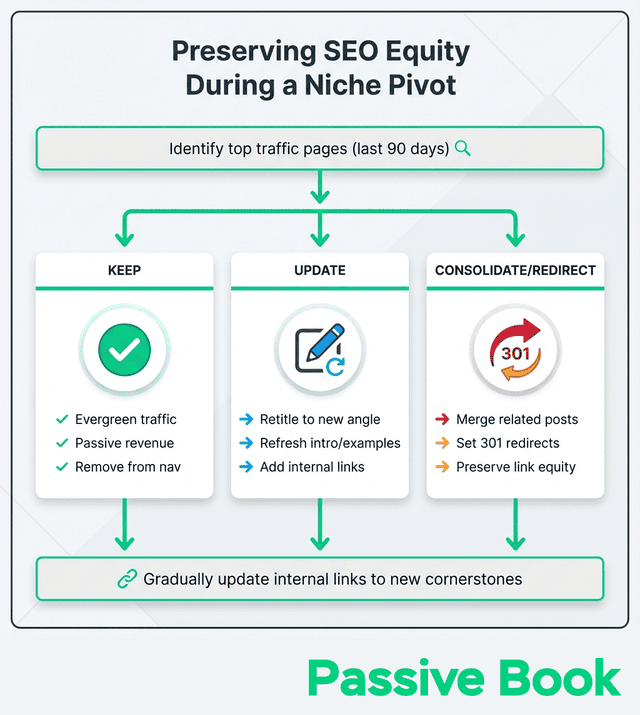
For posts that are adjacent but not perfect fits, consolidation works better than deletion. When I pivoted, I had three separate articles about morning routines, time-blocking, and focus techniques. I consolidated them into one comprehensive “productivity systems for entrepreneurs” guide and set up 301 redirects from the old URLs. This preserved the combined SEO authority instead of abandoning it.
Some content should stay untouched if it still generates traffic or affiliate income, even if it’s off-topic now. A ranking post earning $50 monthly stays published. Just remove it from your main navigation and new internal linking structure so new visitors encounter your current focus first.
Update your internal links gradually as you publish new content. Each new post should link to your new cornerstone content, not your old pieces. Over 8-12 weeks, this naturally shifts your site’s topical authority in Google’s eyes without triggering ranking drops from sudden changes.
Repurposing Your Existing Content Library
Your existing content library isn’t dead weight during a pivot. With strategic adaptation, you can extract value from work you’ve already done instead of starting from zero. The decision framework is simple: keep, update, or archive.

Keep content that serves both your old and new audience. Evergreen topics with natural overlap require no changes. A post about “email marketing basics” works whether you’re targeting bloggers or course creators. Leave it published and active.
Update content where the core idea fits but examples need refreshing. A YouTube video about “staying consistent as a content creator” originally featured blogging examples. Record a 2-minute intro addressing your pivot, explain that principles apply to any creator, and add timestamps in the description directing viewers to updated resources. You’ve repurposed a video with 10,000 views instead of letting it languish.
Archive content that conflicts with your new direction. If you pivoted from parenting advice to day trading, your “toddler sleep training” posts serve no one in your new audience. Make them private or unlist them. They’re not deleted – you can revive them later if needed – but they’re not confusing new visitors.
I’ve successfully repurposed podcast episodes by pulling audio quotes and turning them into social media content for my new niche. A 45-minute interview about freelancing became 8 Instagram graphics about client management. Same insights, different packaging, new audience.
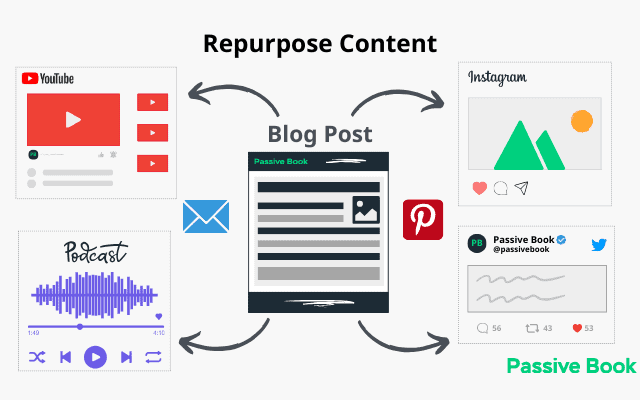
The goal isn’t to salvage everything. It’s to extract maximum value from your strongest existing pieces while cleanly separating yourself from content that no longer serves your direction.
Managing Pivot Logistics Around Your Day Job
Here’s the reality nobody talks about: executing a niche pivot while working full-time means something has to give. You can’t double your content output when you’re already maxed out at 8-10 hours per week. The solution is strategic reduction, not heroic effort.
During your transition’s first month, reduce your content frequency by 20-30% to make space for new direction testing. If you normally publish 3 posts per week, drop to 2. If you release 2 YouTube videos weekly, make it 1 long-form and 1 short-form test in your new niche. This feels scary, but maintaining quality in a new direction beats burning out trying to maintain old volume.
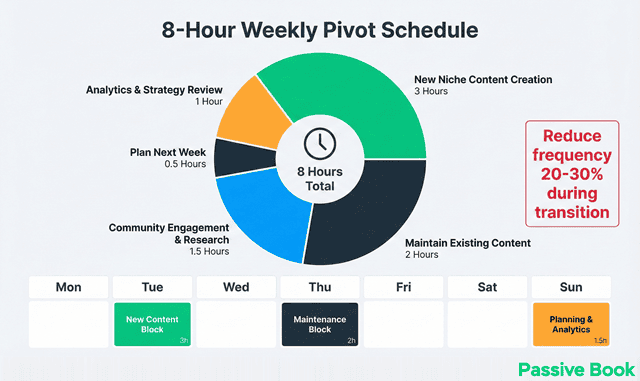
Time-block your limited hours with brutal specificity. Here’s a sustainable 8-hour weekly breakdown during pivot months: 3 hours creating new niche content, 2 hours maintaining existing content at reduced frequency, 1.5 hours engaging with your new target community (commenting, networking, market research), 1 hour reviewing analytics and adjusting strategy, and 30 minutes planning next week.
Batch your content creation by topic focus, not by task. Dedicate Tuesday evening entirely to your new niche content – research, creation, and scheduling happen in one 3-hour block. Thursday evening is your old niche maintenance block. Switching contexts between old and new topics multiple times per week fragments your focus and wastes mental energy.
Accept that your income might dip during months 2-3 of your transition. If you’re earning $500 monthly from your current niche through ads or affiliate sales, plan for that to drop to $300-350 while new niche revenue builds. This is normal. Most solopreneurs see revenue recover to previous levels by month 4-5 if the pivot is working, then exceed it by month 6-8.
The constraint of limited time actually protects you from over-committing to a bad pivot. If you had 40 hours per week, you might push a failing direction for months. With 8 hours, the data comes faster and forces quicker decisions.
Archive or Prune Content That Attracts Wrong Audience
Strategic content pruning removes underperforming pages that dilute your site authority and relevance. This isn’t about hiding your past. It’s about preventing your old content from confusing your new audience and the algorithm.
Private or unlist videos that are incompatible with your new niche direction. A creator pivoting from gaming to business content might unlist old gameplay videos. They’re not deleted. They’re just not the first impression new subscribers get when visiting your channel.
This prevents algorithm confusion when you’re testing new content on your existing subscriber base. Platforms use your historical content to understand what to recommend. If 90% of your videos are about topic A and you want to pivot to topic B, the algorithm will keep pushing you to topic A audiences.
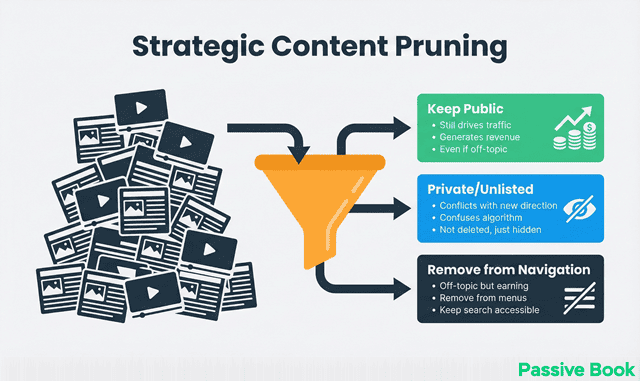
Keep evergreen pieces that still drive traffic or generate passive revenue. A blog post ranking on page one of Google and earning affiliate income stays published even if it’s off-topic. A YouTube video with consistent views remains public. You’re pruning strategically, not burning everything down.
Update your privacy policy if you’re collecting different types of user data or working with new affiliate partners in your new niche. If you’re adding email sequences for course promotion when you previously just ran display ads, your data practices changed and your policy should reflect that.
What to Expect During Your Transition
Setting realistic expectations is the difference between pushing through a difficult transition and panicking when normal challenges appear. Pivoting isn’t smooth. Understanding what’s normal helps you stay committed when things get temporarily worse before they get better.
Expect to lose 10-30% of your subscribers in the first 30-90 days after your pivot announcement. Some people followed you specifically for your old content. When that changes, they leave. This is healthy attrition, not failure. You’re filtering for an audience that fits your new direction.
Though I’ll admit, watching that subscriber count drop still stings even when you know it’s supposed to happen.
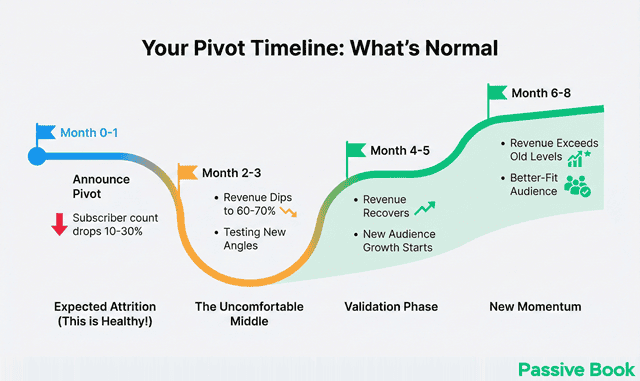
New growth in a better-fit niche outweighs initial losses within 3-6 months. The subscribers you lose weren’t your target audience anymore. The new subscribers you gain are more engaged because they’re there for exactly what you’re creating now. Better engagement matters more than raw numbers.
Focus on attracting the right audience rather than desperately retaining everyone. Trying to serve two completely different audiences simultaneously means satisfying neither. Let go of the guilt about people who unsubscribe. They’re making space for people who actually want what you’re creating now.
Document your learnings from each attempt to make subsequent pivots more strategic. What worked? What flopped? Which content ideas connected and which fell flat? This documentation becomes your personal playbook. Most solopreneurs pivot at least once before finding their sustainable niche.
Skills and audience insights transfer between niche experiments. You’re getting better at content creation, understanding algorithms, and reading audience feedback. None of that is wasted. Every iteration makes you more effective at building an online business, regardless of the specific niche.
The broader statistics provide context: most solopreneurs earn under $100K annually. Multiple pivots are completely normal on the path to success. The Levels.fyi founder tested multiple ideas before finding product-market fit as an indie hacker. Your first niche choice won’t be your last.
Using AI Tools to Speed Up Niche Research
Time is your most limited resource as a solopreneur. AI tools won’t make your pivot decisions for you, but they solve specific research bottlenecks. The best way to leverage AI is knowing which tools solve which problems and using them strategically rather than hoping they’ll do the thinking for you.
ChatGPT excels at generating keyword suggestions and analyzing competitor content at scale. Feed it your potential niche and ask for 50 long-tail keyword variations. Have it analyze top-performing content in your space and identify patterns. It’s like having a research assistant who never gets tired.
Perplexity AI provides niche research with built-in source citations for validation. Unlike ChatGPT, which can confidently state incorrect information, Perplexity links to actual sources. When researching whether a niche has monetization opportunities, you want verifiable data, not hallucinated statistics.
AI workflow tools can automate competitor tracking and trend identification. Set up alerts for specific keywords in your potential niche. Track what content types are gaining traction. Monitor which topics are getting more competitive versus which gaps still exist. This gives you market intelligence without spending hours manually researching.
Use AI to test 5-10 content angles before committing to a full pivot strategy. Generate outlines for potential videos or articles. See which topics you feel excited to create versus which ones feel like a chore. AI can’t tell you what you’re passionate about, but it can help you quickly prototype ideas to test your own reaction.
I’ve asked ChatGPT to tell me which niche to choose. It gave me a confident answer based on market data. I ignored it and chose what excited me instead. Sometimes the spreadsheet answer and the gut answer diverge, and you have to pick one. Use AI for research and validation, but make the final decision based on your honest self-assessment.
What Next?
You’ve reached the end of this guide with the framework for making your pivot decision and executing it strategically. The reality is that most solopreneurs pivot at least once before finding their sustainable niche. That’s not failure. That’s the process of building something that works for you and your market.
Pivoting feels scary because you’re letting go of what’s comfortable, even if it wasn’t working. But staying in the wrong niche because you’ve already invested time is the sunk cost fallacy in action. Six months from now, you’ll either be further down the wrong path or six months into building something better.
If this guide helped clarify your thinking, share it with another solopreneur who’s stuck in the same decision. Use the social media buttons below to pass it along. Someone in your network is probably wrestling with this exact question right now.
Drop a comment below with where you are in your journey. Are you considering a pivot? Already mid-transition? What’s the biggest obstacle holding you back? Your experience might be exactly what someone else needs to hear.
Share this post with your friends & followers: