I spent my first year as a night entrepreneur chasing every shiny online business model I could find. Dropshipping one month, affiliate blogging the next, then course creation. The result? Zero traction and a growing sense that I was spinning my wheels.
You’re likely in the same spot I was – scrolling through success stories, wondering which business model to choose, paralyzed by the fear of picking wrong. Here’s what most niche guides won’t tell you: you can validate whether a niche will pay you in seven days for under $20. This guide shows you the exact formula I use. You need a defined audience, a painful problem, and a promised outcome. You’ll have a tested niche by next Sunday.

What Is a Niche?
A niche isn’t a broad category like “fitness” or “marketing.” It’s a specific formula. You need a defined audience, a painful problem, and a clear promised outcome. Your niche exists at the intersection of who you serve, what keeps them up at night, and the transformation you deliver.
Consider the SQL for journalists workshop niche. It’s not “teaching SQL” or “helping journalists.” It’s teaching SQL to journalists who need to analyze datasets for investigative stories. The audience is narrow, the problem is concrete, and the outcome is testable.
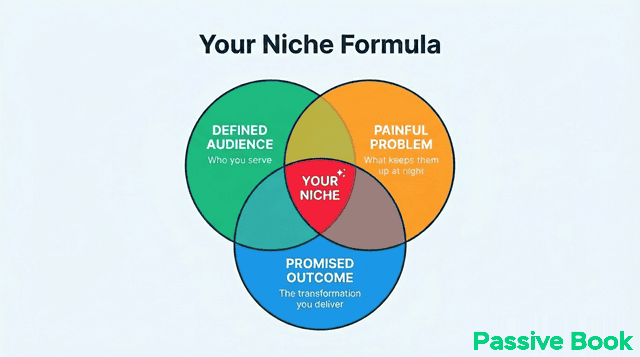
This precision matters because it makes your promise falsifiable. You can’t fake whether a journalist learned to query a database. You can fake whether someone “improved their mindset.” The tighter your niche, the faster you learn what works.
Most solopreneurs fail here because they confuse a niche with a topic. “I’ll blog about productivity” isn’t a niche. “I’ll teach remote parents how to reclaim 90 minutes of deep work before their kids wake up” is a niche market you can actually test.
Niches typically fall into four categories:
- Problem-based niches solve a specific pain.
- Audience-based niches serve a defined group.
- Outcome-based niches promise a measurable result.
- Method-based niches teach a unique process.
Most beginners roll their eyes at this level of specificity. I did too. Then I watched generic ‘how to be productive’ content get 30 views while ‘SQL for journalists’ workshops sold out.
Why It Matters
Tiny niches reduce competition and compress your learning cycles. When you serve everyone, you compete with funded companies and established players. When you serve SQL-curious journalists, you compete with maybe three other offerings.
The SQL for Journalists workshop demonstrates this tier-two strategy. It doesn’t chase “learn SQL” search volume. It owns the newsroom outcome niche where generic SQL courses fail. Journalists don’t want to learn database theory. They want to pull public records for a deadline story.
Time-poor solopreneurs benefit because this approach skips mass-virality goals. Your constraint isn’t reach. It’s important to understand that you don’t need massive audiences to make money. One hundred paying customers at $29 per month generates $2,900 in monthly revenue. That’s $34,800 annually from a tiny audience.
Skip the temptation to “keep your options open.” Broad positioning forces you to create generic content that converts poorly. Specific positioning lets you speak directly to one person’s exact struggle, which attracts more of the right people.
How to Choose a Niche: 4-Step Process
This is the test I wish I’d run in year one instead of building entire product suites nobody wanted. This four-step process delivers one tested niche and clear validation signals. You’re not launching a business. You’re validating whether a specific audience will pay for a specific outcome.
Buffer validated their SaaS idea by tracking pricing page clicks before building the product. You’ll use the same logic. Measure buyer intent before investing weeks in product creation.
The outcome is clarity. By the end of step four, you’ll know if your chosen niche generated any paid interest or if you need to iterate. Most solopreneurs waste months building products nobody wants. This process compresses that failure cycle into focused action.
Step 1: Map Your Skills to Paid Outcomes
Budget 60-90 minutes for this phase. List every skill you’ve acquired in the last five years. Include work skills, hobbies, certifications, and side projects. Your goal is to map these skills to painful, paid outcomes that buyers actually value.
A skill alone isn’t a niche. “I know Photoshop” isn’t valuable. “I create classroom visual schedules for special education teachers” is valuable because it solves a painful, time-consuming problem for a specific audience.
Write down three skill-to-outcome combinations. Example: “I’m a former teacher who can create behavior tracking templates for elementary special ed classrooms.” The more specific the outcome, the easier your validation will be.
Step 2: Score Your Best Ideas
Now that you have three skill-to-outcome combinations, score each one across four dimensions. Use a simple 1-to-5 scale for each dimension. The niche with the highest total score is your top candidate for validation.
Skill Leverage: How much of your existing knowledge applies? If you’re a teacher creating classroom resources, you’re using existing skills (score: 5). If you’re a teacher trying to build a SaaS product, your skill leverage is lower because you’ll need to learn coding or hire developers (score: 2).
Pain Intensity: How desperately does your audience need a solution? Special education behavior tracking templates solve a painful, daily problem (score: 5). Generic productivity planners solve a vague wish (score: 2). Higher pain means faster validation.
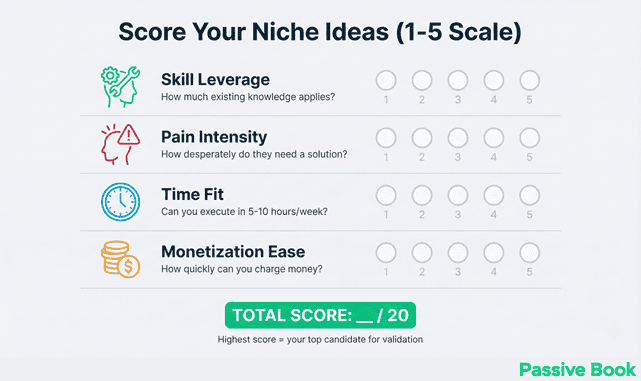
Time Fit: Can you execute this niche with five to ten hours per week? A print-on-demand store fits (score: 5). A high-touch coaching business with ten calls per week doesn’t (score: 2). Be honest about your constraints.
Monetization Ease: How quickly can you charge money? Digital products and templates monetize immediately (score: 5). Content businesses that rely on ad revenue take months to generate income (score: 2). Prioritize models where you can collect payment within your first week.
Add up your scores for each niche idea. The highest total (out of 20 possible points) is your starting point. If two ideas score similarly, pick the one with the highest Pain Intensity score—desperate buyers validate faster.
This 9-minute video walks through scoring your top three niche ideas:
Step 3: Research Audience Demand and Competition
Take your top-scoring niche idea and research it. Your research has two goals. Confirm the audience exists and check if AI Overviews dominate the search results.
Sample ten search results for each niche idea. Log how many results show AI Overviews and whether any small sites get cited. Free tools like Google Trends and Reddit search work for this research. You don’t need paid SEO platforms. Seer Interactive’s AIO impact data shows that experience-driven content still earns citations even when AIOs appear.
This video shows how to research niche communities on Reddit:
Follow Google’s AI search guidance and prioritize niches where forums, subreddits, or niche communities dominate. These spaces signal active buyers discussing real problems. If your niche has a Reddit with 5,000 members asking daily questions, that’s a stronger signal than search volume.
When evaluating your potential niche, look for communities actively discussing the products services they wish existed. Check AI citations monthly using tools like DataSlayer’s tracking approach. Your content strategy should focus on earning citations, not just ranking, because citations drive credibility even when clicks decline.
Step 4: Validate with Real Money (The $20 Test)
Use no-code payment tools to test buyer intent before building anything. Stripe Payment Links, Lemon Squeezy, and Buttondown let you create checkout pages in minutes without a website.
Your goal is two preorders or three discovery calls within 72 hours. This validates that real people with real pain will pay you. If nobody bites, you’ve learned something critical without wasting weeks.
Nathan Barry’s presale approach demonstrates the model. He presold a course before creating any lessons and generated significant revenue from early buyers. You’re not chasing that number. You’re chasing the validation signal that someone will pay.
No-code checkout links are the fastest path to test whether your chosen niche can generate revenue. You don’t need a website, a landing page builder, or a complex funnel. You need one offer and a way to collect payment.
Stripe Payment Links let you create a checkout page with a URL you can share anywhere. Stripe charges 2.9% plus $0.30 per transaction. On a $20 presale, you pay $0.88 in fees. Lemon Squeezy is slightly higher but handles all tax compliance for you. Buttondown works for newsletter pre-launches where you sell early access.
Create a simple one-page pitch describing the problem, your solution, and the outcome. Set a price at $20 (low enough to reduce hesitation, high enough to signal commitment). Send the link directly to ten people who fit your target audience via email or DM.
Success is two or more paid preorders within 72 hours. If you get zero, iterate your pitch or test a different niche. If you get one, that’s a maybe – try reaching ten more people. If you get two or more, you’ve validated enough to build further.
Compute Tiny TAM
Define what “enough” looks like for your first year. Most solopreneurs overestimate the audience size they need. One hundred buyers paying $29 per month generates $2,900 in monthly revenue. That’s $34,800 annually from a tiny audience.
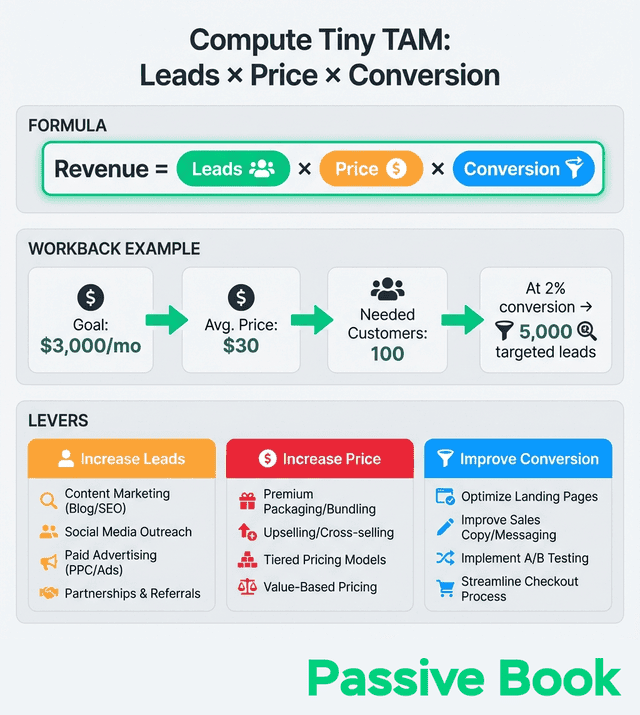
Build a simple model. Leads multiplied by price multiplied by conversion rate. If you attract 200 email subscribers, price your offer at $49, and convert at 2%, you’ll generate $196 in revenue. That’s not impressive, which is why you need either more leads, a higher price, or better conversion.
Add a tiered pricing structure to increase revenue per customer. A $19 basic tier captures budget-conscious buyers. A $79-99 premium tier with bonuses captures 10 to 20% of your audience and dramatically increases average order value.
Calculate your target TAM by working backward from your revenue goal. If you want $3,000 per month and your average customer pays $30, you need 100 active customers. If your conversion rate is 2%, you need 5,000 targeted leads. Those numbers determine your content and outreach strategy.
Hard Truths & Traps
Niche hopping resets your momentum to zero. Every time you switch, you abandon audience trust, content assets, and learning. Commit to one niche for 90 days minimum before evaluating whether to pivot.
I wasted my first year jumping between dropshipping, affiliate blogging, and course creation. Each pivot meant rebuilding everything.
The breakthrough came when I committed to one niche long enough to understand what actually worked. Avoid validation theater. Surveys and polls measure interest, not intent. Buffer’s fake-door test tracked pricing page clicks because clicks signal stronger intent than survey responses. Your validation needs to involve friction – asking for an email address, a small payment, or a calendar booking.
Most failures happen because solopreneurs optimize for vanity metrics instead of revenue metrics. Followers, likes, and page views feel good but don’t pay bills. Track the one metric that connects directly to money – sales, paid subscriptions, or booked calls.
Expect slow starts. Your first 90 days will produce modest results because you’re building audience trust from zero. A realistic goal for month one is five engaged subscribers or two sales, not 1,000 followers. Compounding happens later, not immediately.
Pick Success Metrics
Choose one metric you’ll track weekly – paid members, first ten checkouts, or recurring revenue. Tracking everything dilutes focus. Tracking one thing clarifies whether your niche is working.
Use click-through rate and click-to-open rate for email validation. HubSpot’s benchmark data shows average email CTR hovers around 2%. [Growth-onomics’ 2025 analysis](https://growth-onomics.com/email-marketing-benchmarks-2025-open-rates-ctrs/) confirms this benchmark. Opens are unreliable due to Mail Privacy Protection, which prefetches content and triggers false opens.
Revenue connection matters most. Email capture rate only works if those emails convert to buyers. Traffic only works if it generates leads. Followers only work if they become potential customers who pay you.
Set a 90-day baseline. If you’re testing a newsletter niche, your metric might be “30 subscribers with a 3% CTR.” If you’re testing a micro-product, it’s “10 checkouts at $29.” The number matters less than having a clear target.
Model-to-metric Mapping
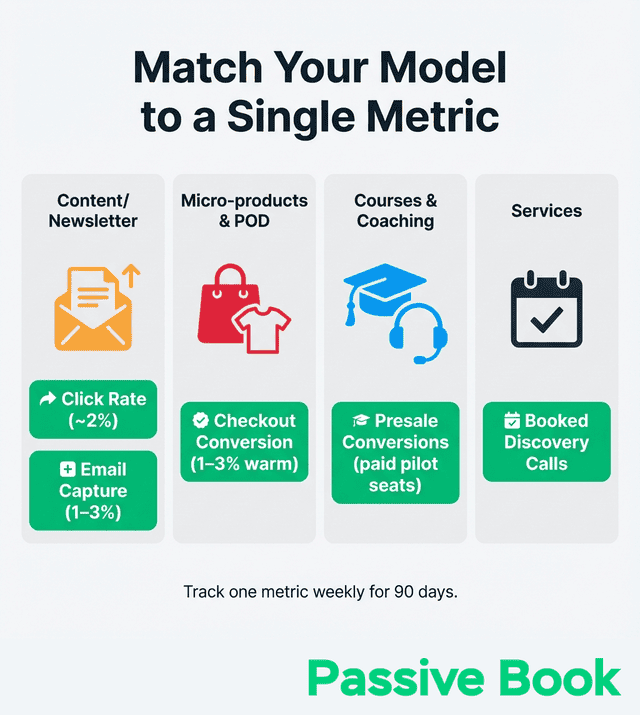
Content creators and newsletter operators should track click rate around 2% and email capture between 1 and 3%. These benchmarks come from HubSpot’s research and reflect realistic performance for solopreneurs without paid traffic budgets.
Micro-product sellers and print-on-demand operators need checkout conversion rates between 1 and 3% from warm traffic. Warm traffic means someone who clicked your email, watched your video, or engaged with your social post. Cold traffic converts lower, often below 0.5%.
Course creators and coaches should focus on presale conversion. Your goal is two or more paid pilot seats before building the full curriculum. Nathan Barry’s approach validates this model. He presold three pricing tiers and converted 276 buyers in the first 24 hours by validating demand before creation.
Match your business model to your available time. If you have only five hours per week, avoid high-touch models. A print-on-demand store using free Printful integration or a newsletter monetized through Gumroad affiliate links fits better. Fulfillment is automated and costs under $30 per month.
Frequently Asked Questions
What Are the 4 Types of Niche?
Problem-based, audience-based, outcome-based, and method-based. Problem-based niches solve a specific pain point. Audience-based niches serve a defined group. Outcome-based niches promise a measurable result. Method-based niches teach a unique process. Your potential niche should fall clearly into at least one category. The 7-day plan in this guide helps you test all four angles. Most successful niches combine at least two of these elements.
What Are the Big 3 Niches?
Health, wealth, and relationships are massive but impossible for solopreneurs to compete in broadly. The historically largest niches are health, wealth, and relationships because they address fundamental human needs. Your opportunity is finding ultra-specific sub-niches within them. Instead of ‘health,’ try ‘meal prep for night-shift nurses.’ Instead of ‘wealth,’ try ‘retirement planning for freelance designers.’ Instead of ‘relationships,’ try ‘conflict resolution for remote teams.’
What Next?
You now have a definition of what a niche actually is, a plan to find and test yours that cuts through guesswork. The formula is clear. Audience plus painful problem plus promised outcome equals a testable niche you can validate this week.
Finding your niche feels overwhelming because most advice skips the hard part – actually testing whether anyone will pay. The frameworks in this guide compress months of trial and error into a single focused week. Your job is to pick one idea and commit to the 90-day sprint.
Share this article using the buttons below if it helped clarify your next step. Leave a comment with your biggest niche selection challenge. What’s the one thing holding you back from testing your first idea this week?
Share this post with your friends & followers: